Archive for the ‘Uncategorized’ Category

MATH LESSON AT TIRE CREEK

April 6, 2026

My arms were aching, and it wasn’t even 11 am. We had hiked in a mile and a quarter to the second bridge site at Cloverpatch, shedding a few of the group to help Brian log out a 21 inch log that barely missed our first bridge. He planned to cut out several other annoyance logs on the three quarter mile trail between the first bridge site and the second. 

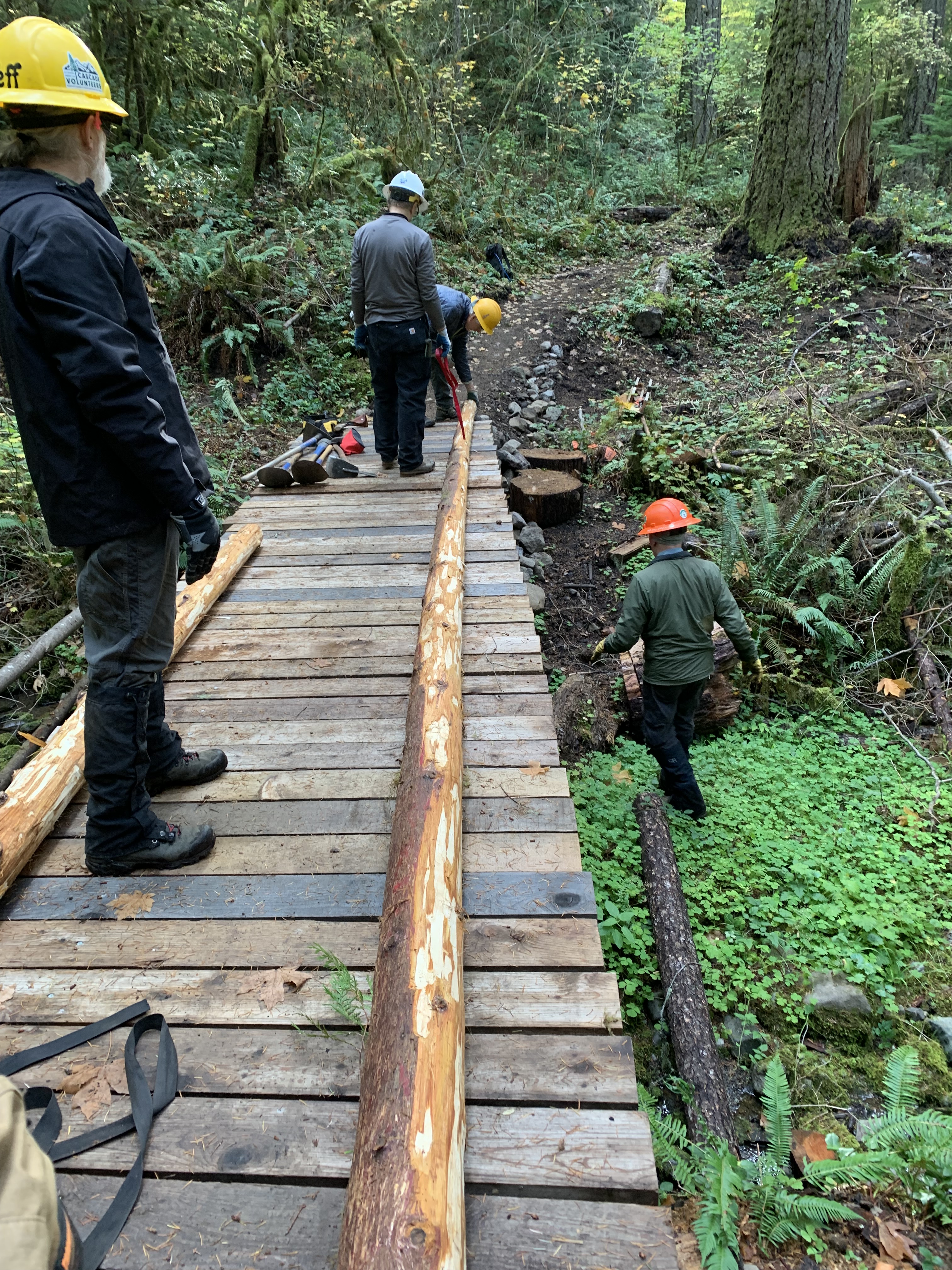
The rest of us planned to finish the second bridge by widening the eastern ramp and more importantly, fetching 50 feet of downed Western Red cedar from across Tire Creek, another third of a mile. Sig had cut three logs, they were mostly debarked, and they would become the base rails, the final step in bridge completion.

I lifted the end of a 25 foot log, 5-6.5 inches in diameter, a bit less at one end, as cedar tapers. This was heavy, and we needed to first get it across the creek, then move it uphill on a narrow trail and then more than a quarter mile back to the second bridge.

Jeff and I picked up the shortest log, 9 feet, put it on our shoulders and hiked back to the first bridge. My acromion, part of the scapula that is the point of the shoulder, protested, but 9 log feet had been transferred.

Eighteen per cent.

Getting the larger logs across the creek was an effort, with many ways to fall and fail.  When we had six people, we used straps and brute force, and with multiple stops, got the log across the creek and part way up the hill on the other side. I was asked to video, which was great, because I then didn’t have to help for thirty feet. I should have videoed the whole process.

I had been computing in my head 6 inches in diameter, 3 inches radius, quarter foot, area 1/16 square foot, times pi, or about 0.2 sq ft. multiply by 25 feet to get about 5 cubic feet of wood.  Now, Western Red cedar weighs 28 pounds per cubic foot dry, but this wood was cut 9 days ago and is green. How much?  Well, figure maybe 50% more, although one can find even higher numbers.  So the weight is probably 40-45 pounds per cubic foot, and we were carrying somewhere around 200 pounds. Two hundred solid, long, not bendable, heavy pounds. While we had six of us, at least two or more of us at any given time were not doing as much when the trail turned or there was an unfortunate rock or tree in our way. Six of us somehow got the log back over to the destination bridge with multiple stops. I felt sorry for Doug, who had the heavy end.

The third log remained. When I went back over, I noted one end was too narrow for what we needed.  Someone said we needed only 14 feet? That didn’t seem right, so I checked if we still needed 50 feet total. Yes.

OK. Jeff and I hauled 9 feet, and all of us hauled another 25. That’s 34. We need 16 feet to finish. There was a pause, then agreement. Think twice, measure twice, speaking of which, we had 25 feet of tape measure that wouldn’t roll back up. That’s a 300 inch metal mess spread across the trail.

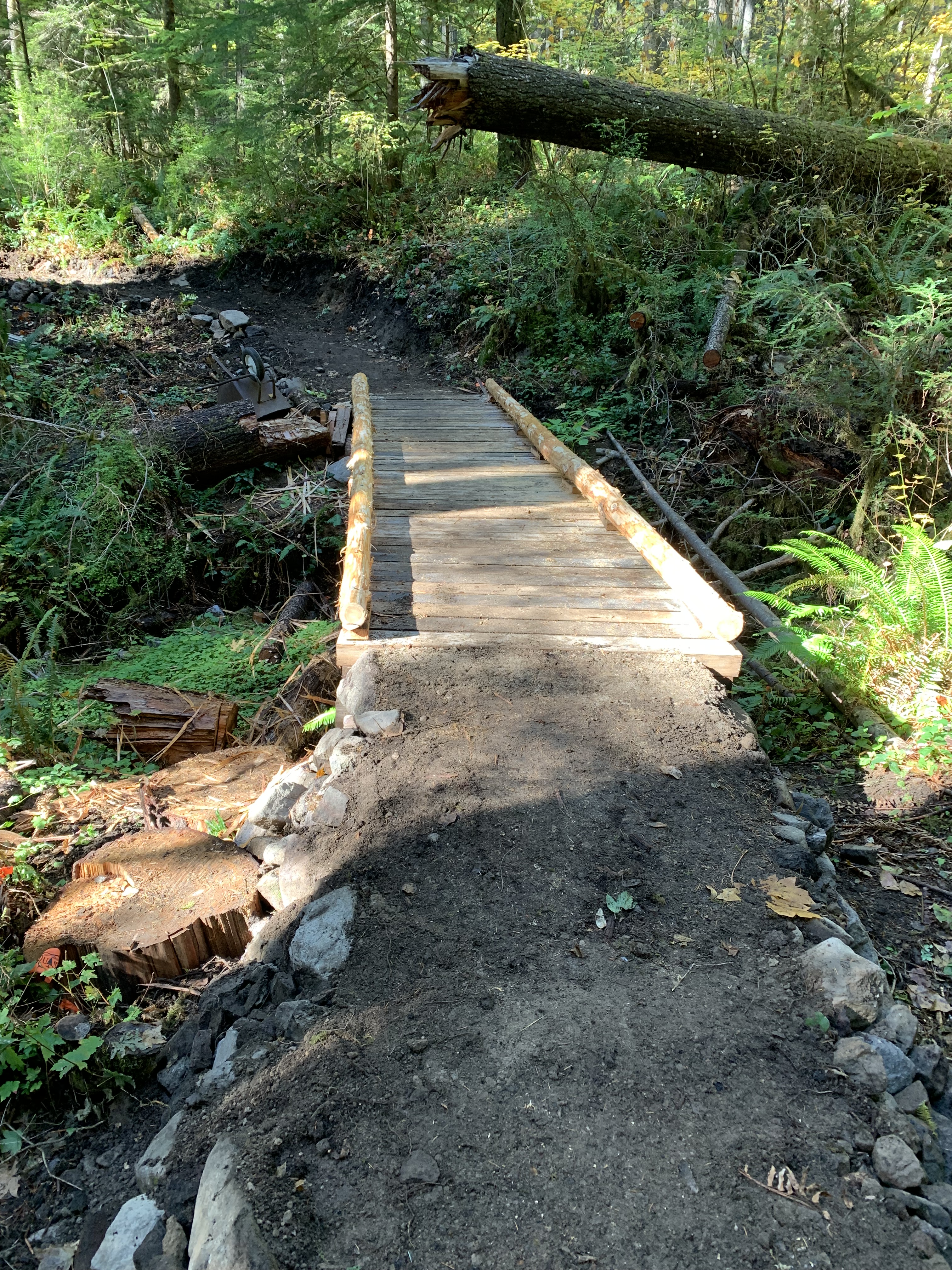
We cut the log on the narrow end to 16 feet; the same six of us hauled it over, far easier with a third less weight. We placed it on the bridge, let Chris finish debarking; Sig and Steve would put it into place with spacers and lag bolts, we widened the on ramp, and the second bridge was finished! 

Two more to go. See you on the trail.

Oh, forgot to mention. On the way home, we got stopped for a train, then 5 minutes after moving again got stopped because of a police action in Westfir. We turned around and came home via the North Shore Road.

by Mike Smith

Willamette NF 2024
TEACHING, GENDER, GENDER ROLES ON THE TRAIL

April 3, 2026

I should have looked at the Oakridge forecast rather than Eugene’s, I thought, as rain spotted the windshield and I discovered I needed a better rain top than the one I had, in order to stay warm and dry. Four of us in the vehicle were part of a 6 person crew to log out Pioneer Gulch trail, steep, gaining 1100 feet in just over a mile, which Camilla and I had scouted a week prior. We had a brief window this day to get in there to cut out trail blocking logs before a major snow storm arrived that evening. 

After we got the gear sorted out at the trailhead, I went with Brian and Jean as one crew. Brian and I are both B-certified crosscut sawyers, but he is more experienced. Jean was going for her B cert next month. I wasn’t worried. She’s competent and will get it. Hiking in to the first log, two-tenths of a mile, I was concerned how I would hike with the rest of the crew. I am slower after my radiation treatments and didn’t want to hold anybody up. While I couldn’t stay with Jean or Brian, whom I knew I couldn’t, I did maintain some distance from Hal. I needed to know I could do that, even having hiked significantly the prior two days. I hadn’t been sure my hiking speed is adequate despite no testosterone; I won’t hold people up. If I can’t hike with the rest of the crew without significant delays, I will stop going out.

At the first log, Jean did the explaining, Brian critiqued her, and while I was odd person out, I did have a function being at the other end of the saw, until my arms got tired. When Brian offered help. I took it. I didn’t used to, but my endurance is less than it once was.

Note: I could have done more, but I had no reason to do so. It goes against the competitive, macho, man culture.

I found myself in a conundrum. On the one hand, I was glad seeing Jean’s getting instruction before her certification day. On the other hand, I never had such instruction in the 3 years before I obtained my certification to the A and then B level, other than the day long course before certification at the A level. None. I learned by being told I was “pulling” the saw, often without saying left, right, up, or down, and never by being told what I should be doing so I would not get this criticism. When Jean joined the crew, she immediately was taken under the wing of one of the experienced sawyers. When I joined, there was no such offer. When two young women worked with the crew on Hand Lake Trail a few years back, a couple of crew members were eager to help them. I watched an unusual scene: someone being taught how to saw. I never had that experience. 

It wasn’t that I never had good feedback: on my 47th outing with the Crew (now over 400), an experienced crosscut sawyer was on the other side of the log in the Waldo Lake Wilderness. We were underbucking, cutting from below, and the sawyer said I was one of three people with whom he would be willing to underbuck. Three people. He had decades of experience. Later, he asked me to evaluate a log, which is where I learned the important “when you make the first cut, see if you can envision what is going to happen to where you make the second cut.” I didn’t evaluate a log again by myself for at least 2 years after and never received that sort of compliment again.

I was surprised by my sudden vocalization of both disappointment and anger in the lack of teaching me how to use a saw. My words were heard by the others, with some surprise by me that I felt that way. After that; I remained quiet. For me, it was a major loss of potential that I never became and never will become the sawyer I hoped to be. I was the wrong gender. Knowledge should not be segregated by sex. Some men aren’t familiar with tools or saws; many women are. 

We need to teach those who need knowledge regardless of gender. When I joined the crew, nobody took me under his wing; I had no mentor, wasn’t invited to become even A certified until after three summers of log outs, and even then in my class was a person who had never touched a crosscut saw before; both of us got the same certification. It seems to me that men are assumed to know about tools, machines, and power equipment. This is wrong. On the other hand, I have seen four women in my crew immediately helped with their saw skills when they were on the crew, even though some had more experience with equipment and machinery than I had. This is sexism. Ideally, we ought to pair each new person with a mentor. Practically, we need a way to teach sawing to new crew members equally to allow them to function. It is not being done, and it should be.

Many feel teaching is not difficult. Many would be wrong. Being experienced in the field does not necessarily make one a good teacher. Good teachers make a field come alive, make their students want to be like them, and are a joy to listen to. They are uncommon. I’m a natural teacher.  A while back, when a young woman at the drug store couldn’t make change properly, I patiently explained the transaction to her two different ways. I did not berate her. She felt badly enough and apologized for her lack of math. I quietly told her not to worry about it. If she’s good, she will worry about it, and she will get better, but at least it was between me and her. Nobody else.

I am disappointed when a system appears discriminatory against men who don’t fit into the right mold. I don’t discriminate against those who can’t read a map, have poor trail memory, or can’t find their way to a trailhead. I assume everybody can do it, and if they can’t, I help them.

On the way back out, I carried a saw when the strap suddenly came apart where the hook held the saw. That happens. I stepped off the trail to fix it. Two others came by me. The first asked if he could carry the saw. I said I was OK. The second said the saw was a little strange to carry, and if I would take the pry bar, he would take the saw. I agreed.

In summary, I took relief during sawing; I gave up carrying a saw in exchange for an easier pry bar. I did something few guys I see do out in the woods, I asked for relief, and I accepted someone’s helping me by changing what I carried.

There may not be competition on the trail, but it feels like one. Men should keep going and not ask for help. Women should be helped. One man older than I wouldn’t give up a brusher he was carrying out of the woods. I was crew leader and asked if he wanted help. He refused. This sort of behavior should stop. It is symptomatic of why so many men function poorly in society today: deal with adversity quietly, don’t seek medical help, with consequences, must be a “man,” don’t let down one’s guard with weaknesses, hide emotions. And in the woods, be in charge, be in control, don’t be the first person to say “Enough!” On a job, you are the one who has to do it, don’t take help, show how good you are every chance you get. Life is a competition that one has to either win or at least not lose.

I decided to leave that game some time ago. I am a lot happier, and I think I will be a lot healthier, too. Whether I can change others remains to be seen, but I am going to try; too much is riding to stay silent on this matter.

Hal and Peggy working a log on the Pioneer Gulch Trail, March 2026

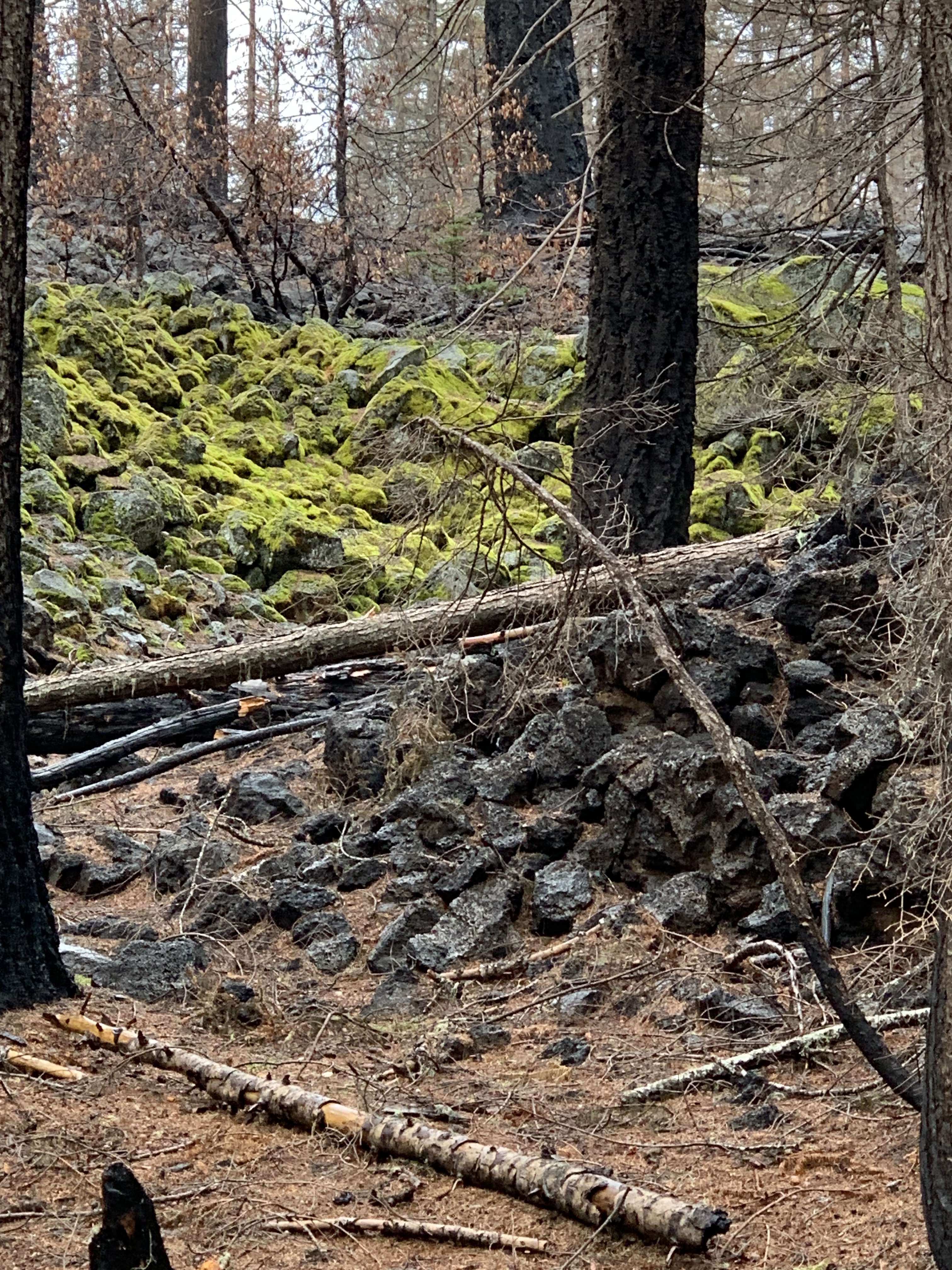
Some green in the black zone, Pioneer Gulch Trail

LIFE IS DIFFERENT WHEN YOU ARE IN CHARGE

February 22, 2026

Two weeks after my last radiation treatment, it was my second day working with the Crew, and I was doing tread work at Clark Camp at Fall Creek. At about ten, I had to stop temporarily to go down the hill to relay a message another had asked me to take to the Crew boss, who had just driven up. The boss looked at the message, then at me, and said, “I’m going out of town in three weeks. Can you cover the crew for 2 weeks? You know the trails that need to be worked.” Indeed, I did.

I hadn’t led a crew in months; I had just finished 45 photon radiation treatments of my prostate, and relugolix had removed all my testosterone. I was breathing harder than I liked going uphill, none of me was 100%, and yet the boss wanted me to lead two crews. I was thrilled and while nervous, I wanted to do it.

The first lead I had was Winberry divide trail, a three part path where the upper two parts needed a logout and the lower one needed two brushing crews. I had 10 crew members, one more than I had scheduled, but the last added was new, young, and from what I had seen, looked promising. Not only would I take him, I put him with the saw crews, because I saw his potential.

We did a good job; there were a few more logs than expected, which pleased the saw guys, the power brushing wasn’t too bad, either, except someone forgot to move a brusher’s pack forward with the rest of his gear, delaying that person’s lunch. But we got it straightened out, all of us finishing at the same time, even including the late lunch. Our group, nearest the vehicles, hiked out, while the saw groups, further up the trail, each trailhead reachable by dirt road, drove their vehicles back down to leave. I doubt anybody else noted how well the day worked out, but I sure did, because of planning, luck, and a little of both. I had the right people in the right place for the right amount of time.

The second trail required two separate days. The first day needed at least one brushing crew, although two would have been nice. I went up with Caroline, a first timer to the crew, showed her the shortcut by a trailer, avoiding the two dogs that lived there, leading to the high point of the South Willamette trail, (SWT), where I fired up the brusher and started cutting for 15 minutes before handing the machine over to her. She did great. I made one slight adjustment to how low she needed to cut, and 5 minutes later, told her she was cutting perfectly. The two of us got the job done quickly, and it was fun, too. 

Two days later, we needed to brush the mile and a half section of the SWT west of where we had been. Previously, I hiked up to the west end to cache a brusher, so on the day we worked, I could hike up more quickly without carrying it and therefore begin sooner. 

The trail also needed logging out, so work day, I sent the saw crew off to the Eula Ridge trailhead at the far eastern end to do their work, adding the same person I added at Winberry. There was a vehicle change to accommodate him, but the sawyer leader did me a favor and took him. When the new person becomes a good sawyer, I hope he remembers how he got some of his experience.

Our brushing group had 7, two pairs, each with a brusher, who would start at the east end, and I took the additional person, Camilla, with me at the west end. Camilla was new, had never used a brusher before, so I gave her a chance to work it, to learn how to start it herself, and she did fine. The two groups met about 0.6 mile from the east end. We did far more with one brusher, finishing much earlier than I expected.

As leader, I noticed who should work with whom, when to add another, and taking extra care with new people, so they felt like they were always within their comfort zone. It worked well. I watch the work being done, asking for changes when I think they are needed, but always at some point making sure if the work is good I tell the person that, for we all need good feedback if deserved, and it almost always is. I seldom had such feedback. Sometimes, I need to let go and let people do things with neither my advice nor help. There is a first time for everybody. Let them have it. Recently, I learned that reading someone’s body language and speaking with a soft voice gave them clear permission not to do some task that they thought they “should.”

The following day, I went south to the Umpqua National Forest, three men, two women. I wasn’t the leader or the sawyer, but wished I made some changes anyway. We took one chain saw instead of both. Chain saws can get stuck in a log. It is better to have an extra than it is to hike back for one, which I have now done twice in the Umpqua. Later, when we went to remove some nearby sills, large logs, I didn’t bring my pack. I knew better. Always take your pack. I needed my first aid kit; saws can slip, people can fall. I didn’t take a Pulaski, which would have worked well on the semi-rotten logs, making them smaller and easier to dispose of. 

Had I been in charge, I would have also thanked this third guy who came, for he carried saws, helped moving logs, and had a spare hardhat in his vehicle for the sawyer. Thanks would have mattered a lot to him.

“WOULD YOU BE HAPPIER IF…”

February 12, 2026


I hit the throttle and the brusher motor died.

Again.

I had cached the brusher four days earlier, but it hadn’t rained, nobody had touched it, and it had started fine. I just couldn’t get it to run. I started it again, hit the throttle again, and it died again. Jeff and Camilla, the latter first timer coming out with the crew, looked at me. If I couldn’t get the brusher going, we were going to have an incomplete, ruined day, Four others using two brushers were coming our way, and we needed to do at least a third of the trail. The others could not complete the whole trail.

A half hour earlier, when I addressed the other 6 in the brushing crew at Crale Creek Rd., I was ready for this day. It was my eighth time on the South Willamette trail (SWT) this year. Two days earlier, I had brushed 0.7 miles of it with Caroline, another new person, competent with a brusher, willing to take a shortcut to the trail, even going by an illegally parked trailer with a couple of dogs. We got the trail brushed, and we had fun doing it.

Today I had sent two teams of two west from where we were standing. I took Jeff and Camilla and drove back to Hardesty trailhead to our west, hiked up 0.6 miles to the western terminus of the SWT, where four days earlier I had briefly brushed about 75 yards before caching the brusher. We were 1.5 miles from the other four and would work towards each other, assuming I could get the brusher going. 

I opened the fuel tank, which I had filled before I left. The fuel looked a little brownish. Maybe there had been water contamination. I took a chance and dumped the fuel. I refilled the brusher and pulled the starter cord. The motor started. I hit the throttle.

Success. We were in business, I was off and moving, taking long swings back and forth as I moved down the trail. About 15 minutes later, I motioned for Camilla, who had never brushed before, to come up and take over. She put on the vest which would attach herself to the brusher, and pulled the starter cord. Nothing happened. I had her put her foot on the brusher and then pull, but nothing happened. I pulled the cord and it started right up.

“Oh,” she said, “I need to pull straight up and a little further.” She did, and the brusher started. Camilla was the third woman I have taught how to start a brusher. Caroline was the second, and Jean, at the far end of the trail, was the first. Each of them loved being able to do it, and I thoroughly enjoyed watching them do it.

In this way, with Jeff’s solid help, we moved steadily east fast enough that a few times, I actually sat down on the side of the trail to rest. Once, I told Camilla not to swing the brusher too far off the trail, but now she was perfect, and I made sure I told her that, too. I yelled “YO!” at her, and when she turned around, snapped her picture. People like to know they are doing things right and like to be photographed. I had given her instructions that to stop any time she thought she had had enough. 

I took the last long pull before lunch and where I ran out of gas, we had lunch. We could hear the other two brushers now, but we were at least half way, and our share was only a third. We were flying.

After lunch, Camilla stood up,”Do you want to take another turn brushing?” I asked. For some reason, 12 feet away, she didn’t look eager. Maybe it was a second sense, but I cultivate my second sense. Camilla thought about it and said, “I could do that.” The rest of the conversation comes from her letter to me.

“That was an honest answer. 

 “How I remember your next (perceptive) question was something along the lines of, ‘Would you be happier if you DIDN’T brush more right now!?’ and the answer, if I paid attention to my dear body, was that my forearms and hands would be happier to be doing something else. 

“I did appreciate your reframe of the question, because I would have tried and done some more, but, at least for me, it was a big win to honor the messages from my body rather than to try to prove anything to you and Jeff. 

“I have been working over the last few years to retrain that familiar pattern of self-abandonment or self-betrayal in order to get someone else’s approval. And it was a step forward for me to pause in that moment and not say an instant, “Yes!” and when you asked the second question, it gave me permission and encouragement to really examine what was most true for me in that moment, even if part of me REALLY wanted to pull my weight and do as much as you were doing.

“Your example of the story you tell below and your explicit statements about the value of resting when we need it and about pacing ourselves were super helpful, Mike. You made me feel welcome to be there with whatever I was able to bring. Hopefully I’ll get stronger, and there won’t be as much recovery necessary, but today would have been a memorable day for other, more painful, reasons if I didn’t have that support. Instead, it’s a day to celebrate a small victory in self-care!  Thank you for your part in this progress.

“Gratefully, 

“Camilla””  

With 3 people and a brusher, we completed nearly two-thirds of the trail ourselves. I told Carol that we would be silent about our contribution and be glad the others did what they did, hoping they had a good time out there. That seemed to be the case.

I don’t know why I said the words I said, but I have been talking and writing for weeks now about how we trail crew leaders needed to respect the need for breaks, for rest, and we needed to couch questions about work in a way that did not show a bias towards more work is better and less is bad.

We three did a great job brushing, but the real triumph of the day was Carol’s words, and the person who was blown away by it all was me.

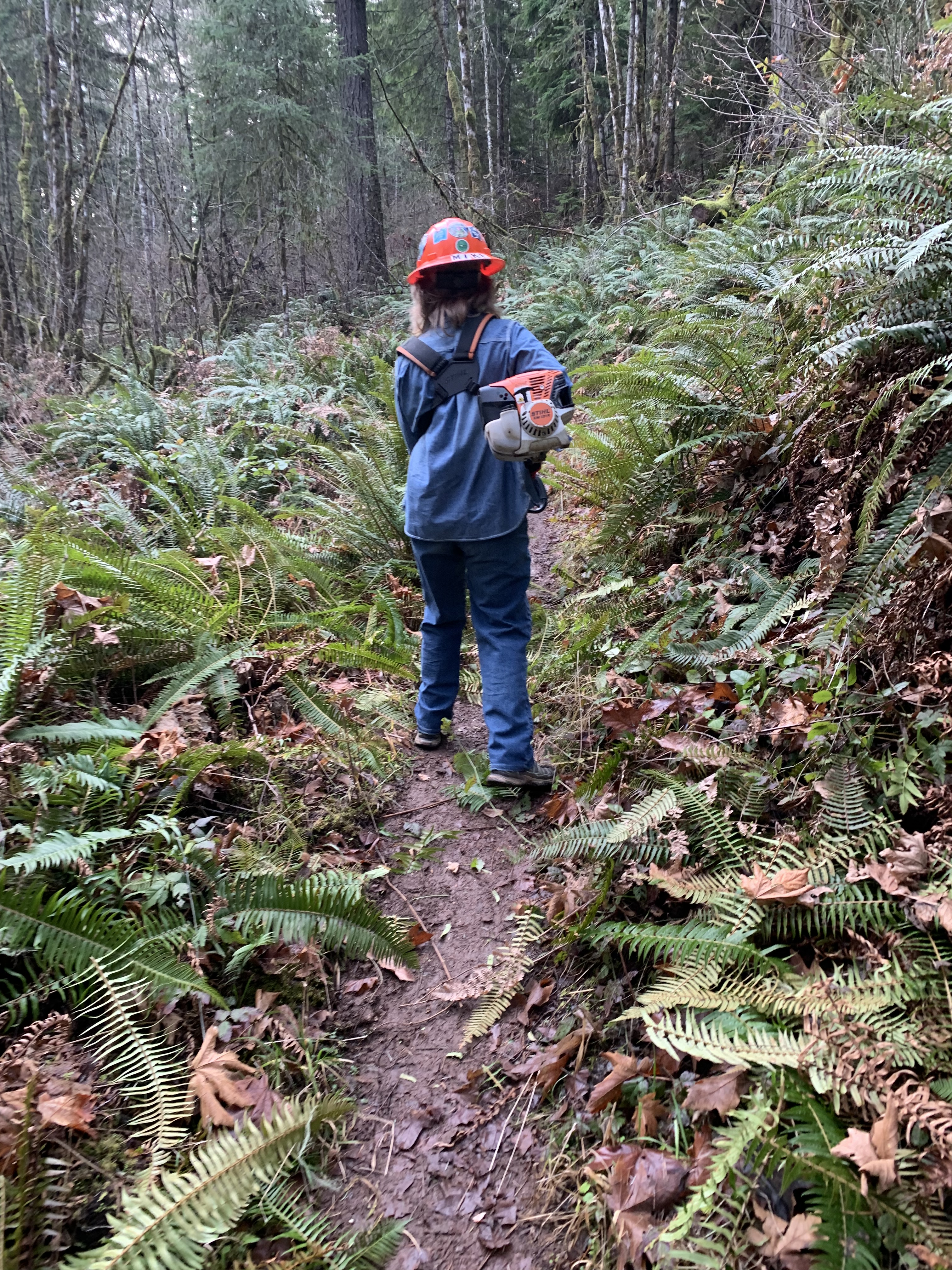
Carol brushing her way through a sword fern patch. She borrowed a hard hat from me.

MADE MY DAY

February 11, 2026

First day back to trail work after a 3 month hiatus due to 45 radiation treatments to my pelvis, and I’m grubbing trail in a spot where I dug almost exactly 6 years ago, just before the pandemic. Much of what I did back then, including carrying planks for a puncheon, or type of bridge, would be repeated on my second and third days out here as well.

We’re working at Fall Creek, where most of my work there in the past was required after a fire or later destroyed by a fire. ”Most” is actually an understatement. It would be all.

During this day, which I survived just fine, and the next, where I did more trail digging to make it free of organic material on top, I thought of the other tasks I did out here. I am not the best in any of them, but with the exception of power brushing, or weed whacking, I’m perhaps no better than average. I’m terrible with tools, horrible with hammers, can’t deal with chisels, ignorant about impact drivers, dumb with drills, sloppy with saws, and rough with a Reinhart. I do the best I can, which is showing up now nearly four hundred times to do the work. Last year, I was second in the crew in hours worked, and I had only nine months’ data before I had to leave for radiation. I have been first or second for five years, not remembering which, and not really caring, except I want to at least emphasize that I show up, and success is purportedly 90% showing up.

But something happened on the second day, a really difficult day for me, as two of us did the unglamorous work of digging out seven hundred feet of trail. Somebody had to do it, and we volunteered. In a crew, we support each other. The first 300 feet were worse as the plant life did not yield to our tools easily.

Later that morning, I saw the crew boss return to his truck, and from my vantage point of digging, having recently been given some information from one of the other sub-crews working nearby, I hiked down the hill we were on to his truck and relayed the message. He got it, paused, and then looked at me.

“I’m going to be away for two weeks at the end of the month. Can you take the crews for those two days? You have scouted the trails that need to be worked on.” Indeed, I had.

Wow, the foggy day suddenly became brighter. As already mentioned, I didn’t feel too competent doing a given task out on the trail. But when it comes to actually organizing a crew, making sure information gets online properly, knowing and getting all the equipment I need, ensuring everyone and the tools get there, function properly, and back safely, I am the go-to person for the crew boss. I have led the crew 33 times. I can’t do the job the boss can, but I am not a stranger to responsibility and organizing, know the strengths of crew members, where they should be working, and how to get the job done. The crew may not consider me the full deal, but they all know that I can handle the job, was asked to do so, and everything will be fine.

I had to deal with cancer, and while I am not the same as I once was, I can still work and still lead. I may not be good with individual tasks, but leading a crew is not a task. It is responsibility, serious work, an honor, absolutely necessary to do the job. I can do that competently. Knowing that day the boss still trusts me to run the crew in his absence made my day, and I have not had many days like this one in a long time. 

GENERATIONAL DIFFERENCE

January 29, 2026

As soon as I heard the chain saw fire up, I swore softly. I had a choice of hardhats to bring this day and I brought the one without ear muffs, because the chain saw cutting I thought we would be doing would be on the bridge further down the trail and not here, where I was working on building steps to replace the ones burned by the Bedrock fire two years ago.

The Crew was again at Fall Creek, repairing bridges, steps, and trail burned by fire. A few years ago, I was at the far east end of road 18, maybe 10 miles from here, helping to clear 30-50 inch diameter logs that were felled because of another fire and landed on the trail. I spent 19 days working Fall Creek that year. The Bedrock fire started four days after I left the 19th time, negating all the work I did all those days. I’ve been at Fall Creek for years trying to build trails around or through mudslides. It’s a never ending task that will continue far beyond my lifetime.

I covered my ears and put my fingers over my hearing aids, but nothing seemed to change. Fortunately, the cutting was brief, and I was able to get back to my work.

That night, if I hadn’t misplaced my phone in the house, I never would have learned a few fundamental facts about my hearing aids and why putting my fingers in my ears didn’t work.

But I did—I misplace my phone often—and called it several times, because I had the sound turned down on it and couldn’t hear. I have hearing aids, but that doesn’t mean I can hear normally with them. When I found the phone, I accidentally held the landline phone up over my right ear and noted that it sounded different, duller, than it did in my left ear. That was with the hearing aids in. When I took them out, the difference remained. This was strange.

So, the first thing I did was to be a good boy and change the filters on the hearing aids, because that is what I was told to do by my audiologist. There was a sign over her desk in the office that said, “Did you change the filter?”

I next made an appointment to be seen and explained my problem. I told the audiologist was that I had changed the filter. The first thing the audiologist did was to clean the hearing aids and reprogram the firmware. She said that the vents were not completely open and had needed some cleaning.  She asked me if I had noted any hearing loss. I couldn’t be certain, but things had seemed a little duller. I wasn’t hearing a cat lap food as loudly, and I seemed to be asking people what they had said a little more. She looked in both ears and they were fine. No wax issues.

When the hearing aids seemed OK, and she was convinced I hadn’t had a stroke, because there had been nothing sudden occurring in my story. I mentioned that I had been out with the trail crew and closer to loud noises when we were cutting planks for steps on a nature trail at Fall Creek, but I was still probably 15-25 yards away. She seemed puzzled. She thought it might have to do with the vents, but it didn’t explain the dial tone issue. She said that we didn’t have a good test to try.

I noted the landline phone behind her. I’m not really sure she ever used it. I picked up the receiver, heard the dial tone, and put the receiver by each ear in turn. There was still a difference.

“But look where you are holding the phone!” She said..

“Well, yes,” I replied, a bit surprised,” I’ve been holding a phone that way for more than 70 years. I remember when one picked up a phone, a female voice said, ‘Number please!’”

“But the phone is not in the right place!” Now it was my turn to be confused. 

“Where should I hold it?”

“Behind the ear. That’s where the speaker is.”  Oh yes, I remembered something like that when she told me when talking on my phone to hold it behind my ear, not in the auricle. But I still do that until I remember to move the phone further back.

I then tested both ears with the dial tone, held her way. I heard the same with both.

“What did you do when you heard the saw?” 

“Covered my ears.” I showed her..”Stuck my fingers in them.”

“OH, now I understand. When you stick your fingers in your ears, you are actually increasing the sound by pushing the dome further into your ear. Did it help?”

I thought again of the spot on Fall Creek: “Well, now that you mention it, no.”

“The dome only transmits the sound. What makes it louder is in the part behind the ear. By the same token, holding a receiver to your ear will not make a difference, and you will have the same deficits hearing as you have without hearing aids.”

She said she would call in a week and see how I was doing. I could get another hearing test if I wanted, but she wanted to be sure I did want one.

I fed the cat when I got home and could hear the lapping clearly. I hear purring again, too. Both are nice.

STARTER CORD

December 24, 2024

It’s just an old plywood boat

With a ’75 Johnson

With electric choke

— Alan Jackson (singer-songwriter, from his song “Drive”)

I heard the sound of a starter cord’s being pulled but nothing started. 

I was leading a work party to the E2C Trail (Eugene to the Pacific Crest) from the North Shore Road by Lookout Point Reservoir up to Winberry Divide. I was familiar with the trail, 3 years ago having worked it and two days prior hiking it to be familiar with the upcoming job: clear encroaching brush and establish and clear water drainages. It rained two days earlier, and parts of the trail then looked like a Willamette tributary.

The crew split into dealing with one or the other tasks. I was one with the power brusher, which I like. I’m all thumbs with tools, but helping a person use a brusher was the first time I taught anything to another crew member. It’s rewarding to show a person how to use their own body to pull a starter cord hard enough to start the motor.

Well, sometimes.

I went over to the recalcitrant brusher, moved the fuel knob from choke to high, and pulled a couple of times. From the vibration, I knew it started, because with Kleenex in my ears plus the ear muffs on my hardhat, I couldn’t hear a thing. The brusher was back in business. I didn’t do anything special; maybe I got lucky, for the second time that day. Made me feel good. The brushers were listening to my whispers. While working, I wear a vest fastening me to the shaft. I move the rotating blade back and forth across the trail, couple feet on either side. Everybody with whom I’ve brushed thinks we clear about twice as much distance as we actually do.

I was a generation before Alan Jackson, when the motor on my plywood boat was not 75 hp but a 5 hp green Johnson SeaHorse, 2 cycle, no electric choke but a silver dial on the left side on the top. I had no idea it was a choke and in 1954 in Ontario too young to understand anyway. I turned the brass four cross screw left side and would hear fuel flow. I next opened the silver gas vent cap on top, hearing the hiss of escaping vapor. I then pushed the clutch out, which looked like a silver ear and put the shaft in neutral, moved the throttle to the stop, half way to the right, pumped the silver disk three or four times, and pulled the starter cord on the upper right part of the motor’s front, rewarded by smoke and the sound of the Johnson. Reverse was rotating the motor. Put me by that motor right now, fueled, and I could start it blindfolded and immediately recognize sounds I haven’t heard in seventy years. I share Jackson’s feelings he had driving his boat, “a piece of my childhood will never be forgotten.”

So perhaps it isn’t surprising I like brushing. The orange Stihl is a 4-cycle motor using a 2-stroke 50:1 fuel mix, 24.1 cc /35 mm bore, 25 mm stroke, and yes, it is loud and pollutes, but it allows us to clear brush from long sections of non-wilderness trail. On the lower part of Olallie Mountain, in the Three Sisters Wilderness, there is a long stretch of thimbleberry. In 2018, Brad and I spent a few hours brushing it by hand, a big chore. Sig spent a day on it a year ago. On Lowder Mountain, three of us spent a morning hand clearing only a third of the brush in the lower reach. I hiked Cummins Creek Wilderness trail once with waist high brush that completely soaked my pants, prompting a non-intended change to rain gear. Thick brush is a safety hazard; coming down Horsepasture Mountain last summer, there were 2-3 foot drop-offs on the trail we couldn’t see because the brush was so thick. Trails will disappear without brushing. 

We cleared a mile that day and established nearly ninety separate drainage spots on the trail. We’re half done.

SHORTCUT

August 23, 2024

I wasn’t lost, but I wasn’t on a trail, either. Downed trees surrounded me, holes nearby to step in, branches to trip over, and at least 100 yards to go in the Forest Primeval to get to a real trail. I was bushwhacking, and there were a few bushes, too.

My goal was to find an alternative way to reach the north end of the Hand Lake Trail in the Mount Washington Wilderness without having to hike in 2.3 miles from Robinson Lake Trailhead. I am part of the volunteer Scorpions Trail Crew, and we work on trails clearing fallen trees blocking passage, or logging out, brushing the trail free of encroaching brush, removing root wads on the trail, and building an occasional bridge for a hiking or mountain biking trail. We work year round. In the wilderness, where a few logs back, give or take, I had just crossed into, no power equipment is allowed, so we saw by hand. I’m a retired neurologist, and I never dreamed I would be occasionally leading a trail crew. Today, I was alone.

The 2.3 mile distance was something I and the Crew didn’t want to lug our packs, tools, and selves, because we didn’t need to work on that part of Deer Butte Trail, my current destination. We needed a shorter way to reach the junction of Deer Butte and Hand Lake Trails.

Once we reached Hand Lake Trail, we would begin work on its nearly four miles. The trail climbs through forest then enters a large area of the Scott Mountain fire footprint, where each year falling trees add to our workload and give us job security. I scouted the whole trail last year and found close to 100 logs.  This year, I scouted the north half and saw the same logs plus new ones. The trail was a mess and in need of significant work.

I had driven in from Route 126 five miles on unpaved FS 2657, FS 840, to the last, FS 841. I parked the car at the beginning of 841 among several clumps of yellow Tansy Ragworts, taking care that nothing flammable was under the car. The Ore Fire was burning about 25 miles from me.  

FS 841 climbs 420 feet in 0.8 miles, but it was impassable because of two small trees down over it; a little further were two 20 inch logs, the first covering half the road, the second completely across at windshield height.  Along the road were leaners that needed to be cut out, and many branches were also in the way. When I started doing trail work, I tried to be careful of removing branches. Now, it is just “they’ve got to go,” and I cut. I will, however, leave beautiful wildflowers, like Mariposa Lilies, alone and try to let them go to seed. I was going to deal with all the logs and boughs as I went along, but it became clear that if I were to find a shortcut, I needed to stop clearing and start the bushwhack, the priority.

I bushwhacked straight towards the trail, forgetting that the shortest route may be the most difficult. I should have looked at the contour lines more carefully. I began to mark the trail before realizing that marking would encourage people to go the way I was going, and that was a mistake. Once I finally reached Deer Butte trail, I hiked a half mile to the junction, looking for places where I could begin the trail back to 841. After looking at the GPS, I got the idea of taking a route along a contour at about a 45 degree angle from the trail to the road. This way, it would be close to flat, for any climb or descent would be taking me off the contour.  I marked my way with ribbon on trees, being careful to be sure one could see from one ribbon to the next. 

Once I reached the road, I was almost done. I had to go back the original way to remove all the markers I put up and no longer wanted.  If we cleared the road, we could drive to the end and in the course of a day, hike about three miles fewer. That is an extra two hours of logging out time. I couldn’t clear the road today, but I’d get a small crew up here.

For now, I needed to return to the car and try not to run over any Tansy Ragworts on my way out.  Next time up, they should have gone to seed.

FIREFLIES

May 7, 2023

“We don’t claim to be sane,” said Spur as he and Silvermoon left the Hogback Ridge Shelter at 9 p.m., heading north on the Appalachian Trail towards Erwin, Tennessee.  They arrived at the 3-sided wooden shelter as I finished my dinner.  For the last hundred miles, we had leapfrogged each other. They were about to jump ahead.

A month earlier the pair, whom I had learned were from Atlanta, decided to thru-hike the entire trail.  Spur, his trail name coming from his spur-of-the-moment thru-hike decision, ran a business.  Silvermoon was a florist.  I was “Voyageur.”  I never learned their real names.

Shelters occurred every 8-15 miles along the Trail.  While comfortably sleeping a dozen, an adage was “there’s always room for one more,” especially in a driving rain.  Unfortunately, most shelters harbored large populations of well-fed, pack-smart mice that ran over sleeping hikers.  I usually pitched my tent nearby. There was usually a logbook left by a hiker containing instructions to mail it, postage guaranteed, when the book was full.  Reading the past months of entries was a pleasant way to spend an evening and to learn about diversity of hiker goals, opinions, adventures, and equipment. In addition, because of travel in both directions, one heard about upcoming terrain and obtained reviews of the nearest town, emphasizing food, cost, and lodging, in that order.

That evening, I was in the middle of a 300-mile section hike from the Smokies to southwest Virginia.  The previous year, I had hiked from northern Georgia to the Smokies.  I was in better shape this time and had exactly what I needed, nothing more. “Ten (miles) Before Ten (a.m.)” was my motto, and twenty plus mile days were normal. The pack felt part of me.

I had stuck my head outside the tent to see how well their headlamps worked.  Seemed interesting. While the two were hiking under a waxing gibbous Moon, it was often cloudy in the Appalachians, so bright moons usually weren’t helpful. Probably more relevant, however, was that the AT was a green tunnel. I arrived on the Trail from Arizona with a full body tan.  After hiking in just shorts for two weeks, my tan disappeared.

Hogback was in dense, hardwood forest, dark even by AT standards.  Still, the idea of a night hike was intriguing. I missed out on a real treat.  I should have gone with them, even after 21 miles that day and even without a headlamp.

Three days later, I caught up with the two at a restaurant in Erwin.  They were staying at Johnny’s Hostel near where the Trail emerged from the mountains by the Nolichucky River. Everybody on the AT in Tennessee knew about Erwin and Johnny’s.  Hikers were good listeners in restaurants, since they were eating and not talking. I was no exception. Sitting down at a table across from Silvermoon, I rapidly spooned a quart of chocolate ice cream into my fat-starved frame, seldom looking up. It was really good.  

Silvermoon was still excited about their night hike. “After we left you,” she said, looking at my rapidly diminishing pile of ice cream with some envy, “we descended into Low Gap and climbed in pitch darkness up to Big Bald.”  The AT in the South has numerous descents into gaps and climbs to balds, grassy mountaintops. 

“Once we were on Big Bald, it was just us and fireflies everywhere, with lots of stars and a bright Moon.  We didn’t need our headlamps, so we turned them off.  It was even better then.” I actually stopped eating, visualizing the scene, having been there hours after they were.

“The miles just slipped by, with little flashes of light everywhere we looked. We finally slept up there in the open, with twinkling lights above, below, and around us.  It was magical.” Silvermoon smiled, then delivered the coup de grace: “And so much nicer than that dark hole where you were.”

See you on the trail. Watch for fireflies.

from the Obsidian Journal May 2023 at obsidians.org

MOMENT OF TRUTH

October 15, 2022

Nearly every time I had participated in a wilderness logout, where we clear downed trees from trails, at least once somebody had corrected something in my saw technique. Initially, I expected this, although I have written here before about “pulling,” which for a full year by me was interpreted as pulling to one side or the other; pulling down as a flaw never occurred to me. Nobody told me about it; I happened to figure it out on a large log where the two of us couldn’t see each other and the only way any pulling could be determined without sight was my pulling down on the saw. To me, that was a revelation, one I could easily and did fix.

I never had a mentor, unlike some members of the crew, someone who could have taught me, and I never had specific teaching on a given log, except one afternoon on my 47th trip out with the crew, three years ago, when I worked with one sawyer who let me decide how to cut out the log. One time. Now, when young women joined the crew for a day, suddenly there was a lot more teaching! I did, as I have throughout most of my education, taught myself.

I really shouldn’t have been bothered by the corrections, except I seldom heard anybody else get corrected, and I had seen plenty of pulling to one side, strokes too fast or too short, or other issues. All of us make occasional errors on the saw, and to me, fair or unfair, it seemed like mine were pointed out, rather than let go, if they were one and done. I seldom corrected others, mostly because I still felt myself new at the business, and besides, most of the corrections or instruction I had given to newer people appeared to me to be ignored. 

The feeling never went away, and I began to dwell on it more than I should have. Still, after more than 80 days doing logouts, I could think of only 2 where nobody commented, and if after nearly 5 years of doing this I still was getting such comments, well, I’m old, perhaps too old for this.

With these thoughts in my head, the Crew went out to log out Rebel Rock trail, a steep monster that climbs 3200 feet in 6 miles (1 km in 10 km), easily over 1000 feet (300 m) in the first mile and a quarter (2 km), one of the steepest trails I have encountered. I had been more forgetful than I usually am, leaving my radio and axe at home, although those weren’t major problems. In any case, instead of that 7 pounds, I had a Pulaski and a saw in addition to my pack. Part of our group split off at the first log maybe a half mile in; two of us kept on going uphill—plodding would be a better verb for me—to the next downed log a half mile further. Nobody caught up to us when we finished, and we continued uphill to the next few logs where eventually others started to filter in. They looked like they were plodding, too.

We cut this one out by first having two of us climb up hill about 30 feet and cutting there. After the end bind, or the weight of the log, was removed, the second cut was made just to the left of the blackened trunk. The fire was 5 years ago.

I worked Rebel Rock 5 years ago as my first outing with the Crew. We climbed 2700 feet that day, and it was more work than most of my Club hikes, and I was carrying tools and working as well. 

Sure enough, on the third log, my partner on the saw told me to give him more saw, which meant let him be able to pull back more. My record was now 83 for 85 in having corrections on logouts. Oh well.

By the time we had lunch in a dry stream bed near where several big logs were not only across the trail, but below a small slide where a large rock looked like it might let go any second, I was tired. Afterwards, we worked out a way to go under the logs, not daring to try to remove them with fear of the rock, and the group split so that half stayed working on the nearby tread, and the other half, including me, kept climbing and logging out. I was moderately concerned about my water supply because I had only a liter and a half on an October day that was more like mid-August. I was closely watching my consumption.

Where we chose to keep the trail under the log. Notice the rock in the upper left corner.

One with me was recently B-certified on the saw, which was appropriate, but we had similar experience, and he always seemed to make a point to find something I was doing wrong. We had reached the last log we would do before turning around and hiking an hour’s back downhill to the vehicles. It was a 14 inch one across the trail with side bind, the log’s bulging out where the tree had fallen and become entrapped between a couple of others well downhill from the trail.  With side bind, if one cuts on the convexity, the log will explode outward. I mean explode. I have seen it. There was a YouTube Video of that on Instagram where a guy did it with a chain saw. He got thrown back several feet, lucky he wasn’t hurt or worse. My partner started on the below trail part in the danger zone. I was off trail as well, ready to saw, but he couldn’t seem to get comfortable. I suggested we change positions, because I could see I could sit on the trail and saw safely away from the bind. He was taller and could stand where I had been.

As we started sawing, he was still trying to get comfortable, and I saw him pull the saw strongly to his left. No question at all. He then did it again. I stayed silent as I usually did. We worked a little longer, the kerf or cut spot on the log started to open up at the top and towards me, consistent with the bind, and a short while later, he said I was pulling about an inch to my right.

Moment of truth. What do I do?

I quietly said, “You’ve been pulling a few times on your left.” Just the truth, not trying to be critical.

“Thank you for telling me.”

We cut the log out, the rest of the time my vision’s being laser-focused on the saw, which was in a straight line between the two of us. One more cut needed to be made over the trail, before we could close everything up. Once I saw everything had been cleared, I left the site.

It was a long way to the vehicles. I fell crossing a root wad hole, on cruise control forgetting that the soil was slick, fell and landed on my back, breaking the saw blade sheath and giving myself a hematoma on my forearm. I found a couple of small streams on the way down and cleaned my arm.  I would finish the last of my water about a quarter mile from the cars and once again would have three new bruises on my arms, which would go with the other ten in various stages of healing.

Next time Rebel gets logged out, people are going to have to hike uphill for 2.5 miles to begin. That is what I did 5 years ago. It won’t be easy, maybe or maybe not I will be up for it, but in any case, I will be polite and honest with my partner on the saw. I think I needed to correct others more often. My partner needed to hear it, and I needed to say it.