Archive for the ‘Uncategorized’ Category

THEY WAY WE WERE

September 4, 2016

“You will wear this monitor for 30 days, and if you feel anything strange, push this button.”

Thirty days? I thought. After my first episode of palpitations, a 48 hour Holter had been non-diagnostic. A second episode a few months later lasted long enough to obtain an EKG during it and show I was in atrial fibrillation.  A mid-level provider reassured me this was not serious.  As a neurologist, however, I knew full well (and I knew it before the mid-level was born) that atrial fibrillation is a strong risk factor for stroke.  It wasn’t his heart; it was mine. I didn’t see the cardiologist that day, but I did get an appointment for a week later, with one who had seen me before.  I’m an established patient—a week is a bit long to wait but acceptable.

My first appointment had been well after my first episode.  A then-66 year-old with palpitations ought to be seen quickly, I thought, but It took two weeks to get a Holter monitor and another month to be seen, in part because the referral got lost, and I had to call to find out what was going on.  I do wonder what happens to the elderly who aren’t physicians and might not be thinking clearly.  Would they ever call?  Would anybody notice there was no appointment? We don’t discuss bad system problems when we discuss health care reform.  We assume access and dealing with cost is the problem; quality is supposedly a given.

It isn’t.

After my diagnosis was confirmed, the cardiologist told me all the probabilities, gave me a medication if I needed it, and said he didn’t need to see me for a year.  OK, I had better than 95% chance (but not better than 97% chance) of doing well.

Twenty days later, I had another episode after a hike, and while I was fine while walking, I was light-headed in the car, so somebody drove me home.  I wrote the cardiologist, because we now have e-mail communication.  I was called two days later, not from him but from the appointment scheduler, telling me to come in for a monitor. That sounded odd, because I knew what I had.  Shortly after, I was discussing a month-long monitor, which had never been mentioned at either of my first two appointments.  Worse, it was the wrong kind of monitor for my condition, and that bothered me.  The tech was savvy enough to say I could decline the monitor, and she was right.  Patients can refuse tests.  I could not understand that if my appointment were a year away, why did I suddenly need another test?

The problem was that the cardiologist neither called me nor spoke to me.  It appears today that doctors are so busy that patient inquiries are handled by middlemen and middlewomen.  That’s a recipe for miscommunication.  I think, but don’t know for sure, the cardiologist received a message that I was desperate to know what was going on, which I wasn’t.  I was just informing him.

My wife gets after me every time I complain that “medicine isn’t the way it was when I practiced it.”  Well, it isn’t.  I spent an hour or two a day in practice on the telephone with patients, and these calls were never billed.  They were part of giving care. The patients didn’t want to talk to a nurse; they wanted to talk to me. They called about test results, and if I had my staff tell them their test was normal, they still wanted to speak to me.  I answered every call the day it was received.  I didn’t blow them off.

This is lost, now.  Thirty weeks later, I had my fourth episode, followed by my fifth 4 weeks later, both after hikes, both spontaneously converting in 2-3 hours.  I e-mailed the cardiologist asking whether I should take the pill or just ride the episode out.  I said the problem wasn’t urgent, but the longer the e-mail sits (3 business days is the reply time they say, but it has now been 9), the more likely it is to be forgotten.  Why can’t somebody pick up a phone and call me?  Or, since we have technology, answer a simple e-mail?  We’re talking 30 seconds.

My wife has the same issue.  She needed a GI evaluation, and the referral wasn’t successfully  transmitted across a street.  It was finally hand carried, which I would have done the first time. I used to walk 150 yards to an imaging center to look at my patients’ head scans with a radiologist.  It took fewer than 10 minutes, during which I got a great reading, the radiologist loved having clinical information, and I could tell the patient what was occurring, not having them go home to wait 1-2 weeks (or longer) for a report.  This is what medicine should be doing. Today, I could pull the scan up in the office and view it myself.  I probably could talk to the radiologist at the same time.

My wife had a later reason to call GI and was told she couldn’t see the doctor for five months. She’s an established patient, and five months is unacceptable. She got to talk to a PA who had a 2 month appointment wait.  I can’t count how many “Headache, emergency, see today” patients I had to work in to my daily schedule, and they were nearly all tension headaches. Same day service by a specialist.  Even a walk-in one day who was a Canadian winter visitor. I discounted the charge on the Canadian, because the problem was simple.  Who does that?

My wife got three pages of information what to try.  This involved the PA’s talking to the physician and deciding what she had on the basis of second hand communication.  Doctor Radio on Sirius XM has better.  I am convinced that a good GI physician could deal with her problem in 10-15 minutes.  Talking to a physician appears to be closely regulated. If this improves medical care and flow of patients, fine.  I’d like to see the data, however.

Fortunately, we still know a physician in Tucson, where my wife frequently goes, who does answer calls.  Semi-retired, he is as wise as they come.  He’s the kind of doctor I wish I could have been.  He’s old style when it comes to seeing people but adept at using technology, so that I could have pictures of my colonic polyps that he removed. When I needed to see him for something else, he sat down in the office and gave me the sense he was there as long as I wanted. He’s great.

If we’re too busy to do it right, then we are too busy.  I was too busy, and my only solution was to leave.  I think medicine lost something, although some might disagree.  Technology is essential in medicine, but the human voice, the human touch, the human approach is also essential.  I can’t put a price tag on it.

Robots are great in the OR.  I hope they never end up in the office.

BE PREPARED–TOTALLY–FOR THE 2017 SOLAR ECLIPSE

August 29, 2016

(Opinion piece, Eugene Register-Guard, 28 August 2016).

In less than a year, a long awaited total solar eclipse, perhaps the most beautiful sight in nature, will make landfall in Oregon, crossing 14 states in all before leaving in South Carolina. While the entire country will see some portion of the Sun covered by the Moon, the path of totality, where the Sun is completely covered, will be only 60-70 miles wide. Here in Oregon, totality will last from a few seconds at the edge of the path to 2 minutes, 9 seconds on the centerline at the Idaho border. The path is shown below.

Oregon is one of the best places climatologically to see this eclipse.   Many will come here from all over the world, an economic boon to the state and an excellent educational opportunity.  Watching day turn rapidly into twilight, seeing the black disk of the Moon block the Sun, allowing us to view the Sun’s thin corona, bright stars and planets visible, will be unforgettable.

Sadly, many will view the eclipse on television or not at all, afraid of non-existent “damaging rays” that occur during totality.  Ironically, no eye protection is necessary to view a totally eclipsed Sun.  Others will worry that the eclipse will cause natural disasters, wars, miscarriages, and a host of other myths, rather than just being a rare, beautiful natural occurrence.

The rules are simple: be on the totality path at the right time, and if the Sun is not obscured by clouds, you will see a beautiful spectacle for perhaps 2 minutes.  The most important rule is that any time part of the Sun is visible, you must use adequate eye protection: mylar eclipse glasses, #14 welding filters, commercial solar filters for optics, or indirect projection, NOT X-Ray or other film, sunglasses or staring at the Sun. Eclipse glasses are cheap and easily available. In Eugene, the eclipse is 99.3% total; the whole event must be viewed with eye protection. The southern limit of totality is a line from Waldport to Sisters. Viewers in Sweet Home and Finley WR will see a total eclipse; Monroe and Marcola will not.

I hope many who have never seen totality will see this eclipse and be as thrilled as I have been the sixteen times I have stood under the Moon’s shadow.

I have concerns about how we will handle perhaps half a million or more visitors to Oregon’s eclipse path. The last total eclipse here was February 26, 1979; far more people are interested in viewing one today, especially in summer.  Traveling to this eclipse at the last minute will be difficult.  Eclipses don’t wait and don’t care about the carrying capacity of roads.  Eastern Oregon, a prime eclipse viewing site, has limited road access, hotel rooms and campgrounds.

Once on the eclipse track, across the state, it is likely many will be more focused on finding a place to set up to view the eclipse than traffic, other drivers, or private property.  I-5 crosses the track for nearly 70 miles.  There will be the usual heavy commercial traffic, some who aren’t aware an eclipse is occurring may be startled by sudden darkness at about 10:20, some who will look while driving, others who slow down or pull off the road, get out, and look.  This is a bad combination.

Eclipses are weather dependent.  If there is smoke, common this time of year, or if a weather system makes parts of the eclipse track foggy or cloudy, many viewers will be moving at the last minute.  Count on it.  I have moved my site during five eclipses.  People pay a lot of money for eclipse tours and expect to be successful; cloudiness may cause craziness.  Paying attention to weather forecasts will be important.

Oregon is literally totally first in 2017.  The eclipse is coming and we can’t change, move, or control it.  Let’s see this wonderful event, but let’s also plan for the days and minutes prior to the eclipse.  We must protect not only our eyes from harm, our minds from those who claim an eclipse is something scary or frightening, which it isn’t, but ourselves from accidents and ill-fortune in a very infrastructure-stressed Oregon on a most special day: August 21, 2017.

Michael S. Smith, retired neurologist, member of the Eugene Astronomical Society, has seen 16 total eclipses from the ground, sea and air on or over all continents and both poles. 

[Web pages:  http://eclipse.gsfc.nasa.gov/SEsearch/SEsearchmap.php?Ecl=20170821

http://www.greatamericaneclipse.com/eclipse-2017/

http://www.oregonlive.com/travel/index.ssf/2016/08/7_things_you_need_to_know_abou.html


I’LL LISTEN, BUT I’M NOT HAVING A DISCUSSION ABOUT RACE ON FACEBOOK

August 24, 2016

A recent Pew survey concluded that whites were much less likely to post and see comments about race on Facebook than blacks.  The implication was that I, white, am doing something wrong and am likely racist, no matter what I think.  There was a reference to an article about 5 take-aways on race; whites and blacks have differences in percentages, my responses agreed with the majority of blacks, going strongly against my skin color when it the question had to do with fairness in the workplace and skin color.  But I’m retired and not in the workplace much these days.

I’m one of those elderly white men that gets ads on FB for Republican candidates, because I’m white, male, well-off and old.  I’m supposed to vote Republican and support Trump. Well, I am far to the left of Mr. Obama and Mrs. Clinton.  They aren’t even close to being liberal.  You want a liberal’s viewpoint, talk to me.  I am liberal even in Eugene, which is quite a statement.  I blasted the ad I got for the Republican candidate for Congress here, telling FB I never wanted to see that again. I didn’t.

But no, I am not going to have a conversation on race.  Not at all, and not only because such a concept bombed at Starbucks a while back.

I am not on FB to discuss race, and most of the time I don’t discuss politics, either. I sometimes lose my cool when one who believes manmade climate change does not exist starts posting, but I have four rules I follow before getting involved: no personal attacks, statistics with a confidence interval, p-value, and margin of error, verifiable local, national and global predictions (I won’t see a cooler than normal year for the rest of my life.  That’s verifiable), and consequences should one be wrong.  I have never had anybody get past the first, so I don’t argue. I’ve don’t discuss overpopulation. Nothing has changed.  Instead, I post pictures of places I’ve been, because I can control what and where I go, and I’ve been fortunate enough to have seen many beautiful places.

Specifically, I’d rather discuss things with people whom I can see and hear, because tone of voice and body language are important cues, and they usually aren’t present on social media.  I don’t like having someone a third my age using my first name without my permission.  First name basis has the sense of equality, and I am not equal to them in age, experience or education.  I don’t care if the young are on a first name basis with everybody.  I’m not. I wouldn’t have dreamed of calling the elders in my world by their first names. Age doesn’t per force make me wiser, but I have used my years to learn a great deal about the world.  I’ve published in 9 different fields, I have traveled all over the world, and I have a doctorate in medicine and a Master’s in statistics.

No, I don’t know what it is like being black, pregnant, a woman, have cancer or be a refugee. I do know what it is like to be seriously injured and to have lone atrial fibrillation, which is a stroke time bomb.  I respect the views of those who have experienced things I have not.  But I become annoyed when people who haven’t lived my life act as if they know how I should feel.  I’ve been around the Sun nearly 70 times; I don’t want a twenty something trying to tell me what I should think.  Hint: use “might,” not “should.”  It’s softer.

I don’t know the amount of emotion that written words contain, but if the grammar and spelling are bad, it not only bothers me; it colors my opinion of the point the individual is trying to make.  If one can’t be bothered with where to put an apostrophe, if one makes spelling errors, including my first name, it tells me there is a certain sloppiness in communicating that may spill over into their arguments.  People judge me by how I look. I do the same, and I judge people’s arguments by their language, spelling, and grammar.

Still, I am far more likely than most to change my mind in the face of compelling evidence.  I listen, I learn, and I change.  I will not, however, have a conversation with one who isn’t likely to listen, learn or change, no matter what I say.

Over time, I have argued less on social media.  I try to think very carefully before writing inflammatory statements, often deleting them. I’m not likely to change someone’s thoughts with my words.  I was a firebrand a decade ago; I am almost apolitical this election cycle.  I’m sure not about to get involved in race.  Heck, I have enough trouble meeting and talking to white people.

I try not to take the wrong turn at Jerk Junction. I try to do unto others.  I try to seek first to understand, but then I want to be understood, not blown off.  In short, I’m not the enemy.  Really.  But I don’t wish to have a discussion about race and how I don’t get it in social media.  I’ll read what I think I should, I’ll process it slowly, as I always do, and I will hopefully change what I think I should.  I may comment, but there’s a good chance I’ll delete it.

That’s good advice, really.  Get it off your chest, but then delete it and move on away from Jerk Junction to Suck it Up Road.  That’s my advice for people of all colors.

GO FUND AMERICA

August 10, 2016

On a long drive back from Nevada, I listened to the radio and heard about a function being given in a small town to support a young man who had been severely injured.  The money was going to pay for his medical expenses.  Two nights later, I saw on the news another function to raise money for an injured man who was in a wheelchair, who looked to me, a former neurologist, quadriplegic.

I’ve seen thousands of jars of coins in my lifetime to support children with leukemia, young boys vegetative after football injuries, or a young girl in a hospital after a retaining wall fell on her at a national park.  Quads?  Yes, them, too.  Awful.  Terrible. Unfair.  Devastating.

These functions, these jars, these attempts are futile.  Yes, futile. The amount of money they collect is minuscule compared to even one day in a hospital, let alone the fees charged by a surgeon, anesthesiologist, and the consultants that are part of everyday medical care. Go Fund Me will, for a 5% fee, allow crowd sourcing to help families of victims get money.  Even right wing sheriffs in Arizona used it, despite their past opposition to the Affordable Care Act, about as ironic as it comes.  We don’t have Go Fund Me pages for the millions of people who need medical care and can’t get it.  They can’t get it because we don’t have a national system of medical care that covers catastrophic as well as basic care.  We’re better than we used to be, despite 60-odd attempts to repeal the Affordable Care Act, but we have a long way to go.

Go Fund Me works for those who have connections with others who have money.  For those with identical medical issues without such connections, and that would be far more people, there is no recourse.  That is why we need a system that covers catastrophic and basic care, so everybody has a fair chance to get necessary treatment.  Ideal and equal?  Nope.  But it would be more fair and help many more people.

Another irony is that small town America votes Republican.  The Congressman representing this town voted against taxes, he voted against the Affordable Care Act, the passage of which may have given him his seat.  Despite the fact that the ACA has insured millions of Americans and has been a success, both in decreasing bankruptcies and improving the percentage of people who consider themselves healthy, that insurance isn’t enough.  And while the ACA is starting to cost more money, that is not bad, because it means people are finally getting care for things they once let slide, like diabetes, hypertension, Pap smears, skin checks, colonoscopies.

A national health plan covering catastrophic and basic medical care would raise taxes, but it would end the practice of saddling ordinary people with hundreds of thousands of dollars of debt they can’t possibly repay.  It would help hospitals and doctors, too, both groups delivering free care.  I did as a practitioner, and the hospital for which I was medical director did, too.  The problem with Go Fund Me is that some get help and some don’t, the help not proportionate to the medical need.  Pass out leaflets instead of jars, leaflets supporting the Democratic candidate who will work to bring health care reform to the entire nation, and we would see an end of the bankruptcies occurring because of catastrophic medical expenses. Medicare’s overhead is less than Go Fund Me.  While taxes would rise, medical costs paid out in personal budgets would fall.  I can’t put a price tag on the lack of worry whether a medical condition would have to be lived with, because the cost to get care was prohibitive.

Yes, it is you in rural America who ought to start supporting Democrats who vote for things you need.  The Democrats are not coming to take your guns, your liberty, and your land.  The first two have never happened, and as for “your land,” we the American people own it, you and us, and that includes a guy like me. who enters it, doesn’t trash it, shoot up road signs, foul the water, run an ATV across fragile parts, cut down trees, and despoil what should not be despoiled.  The American people own the Owyhee, we all own the Grand Canyon, the national forests, the parks and lands held in trust for us which we must hold in trust for those whose lives are yet to begin.

We cannot realistically help everybody deal with medical bills by crowd source fund raising.  You want to help?  Then vote in legislators who will give us national health insurance so that basic and needed care will be paid for by the people of this land, because each of us is one bacterium, one virus, one plugged vessel, one leaking vessel, one drunk driver away from medical bills that may lead to bankruptcy.  I am frankly less at risk than most, because I have Medicare and can afford my supplementals.  I have social security, which I don’t need and I am near the end of my life, older than 90% of the rest of you.

I am willing to vote and have voted against my economic self-interest to pay for what is needed nationally.  What I don’t understand is why so many in rural America support those who have more than 60 times voted to repeal the ACA, and if given a chance will take away Medicare and other safety nets.

Everybody deserves a chance to have freedom from fear–fear of choosing between medical care and food, fear of bankruptcy, fear of wondering what delaying care for oneself or one’s child might mean. There are many things to be afraid of in this world, but this fear we can and should address.

We’ll be a better nation and people for doing so.

KATMAI

July 28, 2016

Last year, we spent a day in Kotzebue and several days in Anchorage and the Kenai, visiting Lake Clark NP and taking one flight seeing tour. We liked Kotzebue and wished we had stayed longer.  We were less enthralled with Anchorage and wished we had stayed less.  Part of the problem was that we did not realize how crowded south Alaska is in summer.  We saw two rivers packed with fishermen side by side.  I guess people love doing that, but I don’t.

We went to the Kenai because we had heard so much about Homer.  People loved it.  We thought it pretty but not special. The spit was fine if one likes a sea of humanity, and many do.  We don’t. We went over to Lake Clark to see bears, but unfortunately for our poor guide, we saw one brown bear and a black bear with two cubs.  That happens.  I view wildlife sightings as a gift, not as a right.  I wasn’t surprised by the bear paucity with the number of powerboats on the lake, especially at one end of the lake, where bears had been previously sighted.

IMG_5919.JPG

Black Bear and cub at Lake Clark, NP.  This was the only time I saw both a black and a brown bear the same day.

This year, we changed our visit, spending most of the trip in Kotzebue and the final full day in Anchorage.  Kotzebue is a native village north of the Arctic Circle, accessible twice daily by plane.  There is one hotel there and two rustic B and Bs.  The food isn’t great, and there are a lot of junked cars in yards, because there is no place to dispose of them, and ATVs are more useful than a car there.  But we liked Kotz.


We took three flights, one to see the caribou migration in the Brooks Range from the air, one to see Kobuk Valley National Park, and a third to see Serpentine Hot Springs, all special places in the public lands system. The number of people we encountered in the last two?  Zero.

IMG_7307.JPG

Caribou migration from the air.

IMG_7358.JPG

Kobuk Valley NP

IMG_7405.JPG

Tor (granite) at Serpentine Hot Springs

We then returned to Anchorage and flew to Katmai for the bear viewing, hoping my wife could see what I saw in 2013.  Then, I saw 18 bears, two sets of 3 cubs and 7 boars at one time feeding at Brooks Falls.  There was a slight wait to get to the Falls platform, but it was minor, and I had three separate hour visits, because an hour is all that is allowed at once.  Since then, I have often said, “I’d go back to Katmai in a heartbeat.” (Not, “You should see Katmai.” I seldom use “should,” because it sounds like I am imposing my values on others.)

We flew down and went to the orientation, better than I had remembered.  The rangers have a good video and one mentioned she told someone to leave the Falls platform, because he had a Diet Coke with him.  The rangers are serious about no food being allowed.  If food is not regulated, too many will try to throw bread or candy, because they believe feeing animals is cute.  It is not.  It is a death sentence.  Here, I will use a stronger word than “should.”  One MUST NEVER feed animals in the wild.

The only thing I didn’t like about the orientation was when she said, “Yesterday, there was a 3 hour waiting period for the Falls platform.”  I was stunned. At Katmai, the Falls platform, where the boars congregate, catching and eating salmon that are trying to make their way upstream, is the best viewing spot.  People give their names to a ranger who controls access, one is allowed an hour there, then must leave and get in line again to return, although last year a group of Germans apparently refused. I know all Europeans aren’t like that, but they must abide by our rules, just like I try to be polite and abide by European rules when I am abroad—including the expectation I will be pushed, shoved, subjected to a lot of second hand smoke, deal with rowdy football fans, and have some pretend they don’t understand my German or French.  We are all different.

While waiting, the “riffles,” the lower platform, 100 yards downstream, is accessible.  There may or may not be bears there.

We walked the mile plus distance to the check-in, not being told the waiting time, although it would be easy to do.  The ranger can count the number on each page who are waiting ahead, and divide by 40. That’s the waiting time in hours.  The ranger made it clear she didn’t like being asked.  We wondered why the ranger didn’t give people the page number and have a small board with the current page (which had a total of 20-25 parties containing) being served.  It would have allowed some flexibility. Not knowing makes it difficult to decide if one wants to take a chance to use the pit toilet, a 30 minute round trip.  Since I knew my page number, I asked for only that, so as not to annoy her.  We had time to go back down the trail—during which we and maybe five others saw a large boar go by right under the raised boardwalk— to the pit toilets and return.

IMG_7512.JPG

We got lucky.  He passed 10 feet under us.

Many waiting were bored, standing, although there were 3 cubs asleep below the raised area, and occasionally the sow had them go to the river.  A ranger told me that the sow had helped him deal with a lot of grumpy people, suggesting that the bear viewing was not optimal this year, often because there were so many salmon they were feeding in early morning and resting the rest of the day.  I wondered if that and the extensive waits were causing problems.

After 2 hours, we had an hour on the Falls platform, which has an upper and lower part, good for 30, but 40 were crammed in, most of whom were on the lower part, not moving, including a French couple in the corner with a tripod, which takes up an extensive amount of space.  I guide at Rowe Sanctuary during the Crane migration. We don’t allow photographers to do that. There were two bears, and watching the salmon attempt to jump the falls was more interesting.

IMG_7546.JPG

I estimated about 5% of the jumps were successful.


IMG_7504.JPG

IMG_7505.JPG

Sow with 3 spring cubs.

Viewing the bears at Brooks Falls in Katmai has to change.  We need to sharply curtail the number of daily visitors.  It’s better for the viewing experience and for the bears, and the latter matter more.  It is expensive to get there, crowded, the waits are long, unpredictable, leaving one to stand around, for possible sub-optimal bear viewing.  For the time, effort and money, it isn’t worth it.  There are custom trips that can be taken, but they book rapidly and are more expensive.

In the meantime, I’ll do my Alaska visiting further north. I’ll go to Kotzebue, perhaps.  Or not.  I haven’t decided.  The Sheenjek River drainage in the Arctic Refuge beckons.  Serpentine Hot Springs would be nice for 2 days, and I’d love to try to catch the caribou migration from the ground.  I’m not saying that you should see it.  Indeed, the good places I want to go, I want as few people as possible to be there.

Selfish?  Yep.  But look at the bright side.  I won’t be clogging up Brooks Falls.


THE POSTS I DELETED THIS WEEK

July 19, 2016

When we were staying up in Kotzebue, the Internet was slow, so I did a lot of reading, especially the day it was rainy and windy.  I like those days.  After years in the desert, I equal “beautiful sunny days” with drought. I read “Wheelmen,” how Lance Armstrong was able to cheat in the Tour de France and hoodwink millions, including me. I also helped students on algebra.com, a math help site.  I find it relaxing; the students are mostly grateful.

When we got to Anchorage, with faster Internet, I posted some of pictures from my America the Beautiful Series on Facebook—the Western Caribou Herd migration seen from the air, Kobuk Vally NP, Serpentine Hot Springs, red raspberries picked from a vacant lot next to the hotel, and pictures of the brown bears salmon fishing at Katmai.  I commented on several posts…and quickly deleted my comments.

IMG_7313.JPG

Western Caribou Migration north of the Arctic Circle. This line went on for 7-8 miles.

IMG_7360.JPG

Kabuki Valley NP, Alaska.  This is reachable only by plane or boat.

IMG_7405.JPG

Serpentine Hot Springs, Bering Land Bridge Preserve, Seward Peninsula, Alaska

I don’t often give advice to people, because few either want or follow it.  You will seldom hear me use  “should,” like “You should do xxxx,” because I think it arrogant and presupposes my values should be somebody else’s.  I am not advising anybody to do what I did here, only stating that I have found deleting a comment on Facebook—before or shortly after posting— is a good way not to have to eat my words later or get into an argument with somebody I don’t know….or do know.

The first comment I deleted was on a post that said “Take this test to see if you are racist.”  I think we are all racist.  Humans evolved that way.  We are tribal. Listen to the Kingston Trio’s Merry Minuet sometime, and you will understand that racism is not new.  I don’t have conversations about race, and I try not to treat people differently based upon race, dress or sexual orientation.  If they are trying to convert me to something, I’m generally not interested, although in the face of compelling evidence I may change my mind.  I might be more willing to listen if they gave me the same courtesy to offer my opinions.  They won’t, for they alone know the Truth.  I can’t remember what I deleted, but it was along the lines that given my 17 years of expected longevity I wasn’t going to change much, so please don’t tell me how racist I am. Delete.

The second came from a relative who posted  that the Earth was going to be destroyed at midday tomorrow, a time that has come and gone.  It was on some “truth” site, and if I were going to comment on every bit of bad science that found its way to Facebook, I wouldn’t have time to tell some kid how to solve a mixture problem or complete the square of a quadratic equation.  I started….then I just went to a new page.  FB is nice enough to give me a “Do you really want to leave this page?” to which I reply quietly “You betcha, delete that mother that I wrote.”  Problem solved.  No trolls to come after me, nobody to say I used the wrong word, and nobody telling me I was going to hell (I did but they kicked me out for bootlegging ice water becomes too trite after a while).

I have a few rules I use on FB.  I don’t de-friend people, only stop seeing their posts.  It’s easier that way, because they don’t know that I am not following them but I show up on their friend list.

I don’t share things that people ask me to share.  That’s their banner to carry, not mine.  I don’t read things for the most part that people tell me I must read. The “watch how xxx just slammed xxx in Congress” in general is not much of a slam; indeed, there are very few perfect squelches.  I can think of exactly four times where I have said exactly the right words at the right time, and it was devastatingly powerful.  Most “classic putdowns” are not worth reading.

Some have political or religious beliefs I don’t share.  It’s easier to delete all posts coming from Right Wing News or Oliver North.  It helps my heart stay out of dysrhythmias if I don’t read stuff I want to challenge and squash.  Few will read my post, and I will only annoy someone.

The third one I deleted was easy.  It was about how much money was being spent to build a replica of Noah’s Ark in Kentucky to spread the gospel that humans walked with dinosaurs (appalling in 2016 that some believe that.)  I commented the ark could be used for low-income housing, especially since the toilet and septic system were likely good, given all the bs.  It felt good for a few seconds.  Then I deleted it.  I had other more constructive things to do, like help kids with their math homework.  Interesting sidelight: I tend to answer questions where kids beg for aid, like “I am totally lost,” or “Please, I haven’t a clue how to do this,” and I can, easily and clearly.  That is doing the Lord’s work, although I don’t follow the Lord’s posts, because…well, I don’t.  I just try to be a decent guy.

The last post was how the Western world was at WAR (capitalized) with radical Islam, and that we didn’t have Facebook memes and blabs when we dealt with Natsis (Nazis—her spelling and grammar leave a lot to be desired, but I’d never dream of telling her that) weren’t going to be the solution. She’s right on one count—changing one’s profile, calling ourselves French…or Turkish…or whatever—doesn’t change anything.  I’m pessimistic. History is on my side. And I wish in the meantime we would stop using the word “solidarity,” for it lasts as long as it takes for the next tragedy to strike.

I posted that before we go to war, I’d like to know the endpoint when we will stop warring.  We didn’t have one for Afghanistan, and we may be there forever.  We screwed up. I had hoped after Vietnam in 1975 we had learned our lesson, but we didn’t.  I continued: if we go to war, I want a War Tax (50% marginal rates) and a draft of men and women.  Next war, everybody serves, and we pay as we go. That sort of personal and financial commitment gets people thinking whether it is worthwhile. I said in 2003 we would create a lot of terrorists by invading Iraq, so I am not surprised by what I am seeing now.

Why did I delete this post?  I like the person.  Her son will be draft age in 6 years. He’s going to fight the next war, not me.  She is going to worry, and she will learn in spades what going to fight the bad guys means.  She won’t remember my words.  She will likely blame My Side for it.

After I left Alaska, posts deleted, I have found myself spending less time on Facebook.  It’s too damned depressing.  And there is far too much life to be lived, far too much good to do, like math homework.  Or math help in person.  Or reading a book.  Or hiking.  Or showing a kid the night sky.  Or an adult for that matter.  Or seeing places in the world while I still am able to.

Don’t bother sharing. It’s just my way of living. Your results may vary.

SAME BEAUTY, DIFFERENT BEHOLDER

July 12, 2016

As the Cessna 206 flew northward over the western Brooks Range, dark clouds ahead, I was thinking that we weren’t going to see the caribou migration from the air.  We might have to soon turn around, but at least we had already seen spectacular scenery that few are fortunate enough to view.

We had flown to Kotzebue, Alaska, for the express purpose of seeing the caribou migration from the air.  The Western Arctic Herd fluctuates in size, now about 275,000.  I have seen pictures of the herd bunched together from the air; I have heard stories of having the caribou go through one’s campsite.  The chances of being in the right place on the ground, however, are small.  The animals may come early, late, or take a different migratory route.

Jared, our pilot, had told us a year ago on a prior visit that it might be possible to see the migration from the air, suggesting we come about the second week in July.  We decided to spend six days in Kotzebue.  If weather were an issue, or Jared busy, which all pilots are in summer, we would have flexibility.  We arrived on the evening of the sixth and walked one block from the airport to their office.  Jared had just finished a trip and told us the caribou had migrated 2 weeks earlier this year.  Much of the herd was far to the northeast, he said, but a significant number were still due north of us in one of the valleys.  He thought we might be able to fly out the next afternoon, proposing a triangular leg that would put us near the first group and then move westward to see the others.

The next day Jared was still busy at 3, and my wife and I were beginning to think we’d wouldn’t go until the following day.  Maybe. I have dealt with Alaskan bush pilots for a decade, and things are predictably unpredictable.  One needs to expect anything, be ready immediately, and ascribe any untoward event as “It’s Alaska.”  We took a short walk down the beach, waiting. At 4:30, we were asked if we were ready; at 5, we were in the air heading north. We were going to try to find the tail end of the migration.

We overflew the valley where the caribou had been the day before, now empty, except for a stunning rainbow, which suggested we might have some sunshine in between showers.  I wasn’t expecting much, my long standing philosophy being that seeing wildlife is a gift and not an expectation.  We turned east, passing by mountains of the western Brooks Range. I think we saw six rainbows.

IMG_7302.JPG

Rainbow over the Brooks Range

IMG_7300.JPG

Not uncommon view in the Brooks

IMG_7334.JPG

Canyons of the Noatak River.

Suddenly, Jared said, “There are 10.”  I didn’t see anything.  “There are a few more. Wow, they sure have put on their hiking boots.”  My wife then saw them.  I hadn’t configured my eyes yet for what I should be seeing from the air.  I’ve seen thousands of caribou, but mostly from the ground.  I looked and looked.

Then I saw them, a couple of small dots, moving.  Then I saw several brown lines on the tundra, animal trails, with a line of brown moving on them. Caribou.


IMG_7313.JPG

There are about 400 caribou in this picture.  The dark lines are animal tracks.

The valley narrowed into a canyon, and the river, its banks, and the narrow sides of the canyon appeared alive.  It was.  The ground itself was moving, lines and lines of caribou moving east.  We weren’t standing still watching them move.  We were traveling 80 knots, 1.5 miles a minute, and for at least five minutes we saw lines of caribou.

Everywhere.

Jared banked at a fork in the canyon, and we turned back to a valley where a hill marked the entrance.  Flying much lower now, we could see the hill covered with caribou, a sea of brown, some lying on the ground in the 24 hour a day sunlight.  It was stunning.  I like to take pictures, but from a moving plane through a window, I looked, videoing while looking more carefully with my eyes.  If the pictures came out, fine.  If they didn’t, well…it’s Alaska, and the scene was now embedded in my brain.

All too soon, we banked away from the caribou, leaving them to their migration, heading south.  Nearby, the prior night, Jared had dropped off a guide with 3 Australian clients, telling them to camp by a small, shallow river and hike over to a nearby hill and wait for the caribou.  “I hope I was right,” he said.

We approached the camp and overflew it, then banking and landing on a gravel bar near the group.  The guide, a young woman, appeared with the three others in tow, young men.  She was ecstatic, slapping hands with Jared, saying they had spent much of the night, sun up of course, watching the migration from a quarter mile.  The clients seemed more muted. Wow, I thought.  What an experience, hours of caribou viewing from the ground.

IMG_7317.JPG

Ground view about 10 miles from Caribou viewing.


We took off and flew back to Kotzebue, thrilled that on our first full day we saw what we came—and hoped— to see.  No, we didn’t see 200,000 caribou in a valley milling around.  I’ve seen those pictures, and they are amazing.  We saw instead something more subtle, nothing I expected to see, but to me every bit as memorable.  We saw miles and miles of caribou on the move, covering the hills, the streams, moving through a valley and a canyon.  One doesn’t see that when they are bunched up.  We saw a migration.  Would I like to see it from the ground?  Yeah, I would. But I saw something special.

The next day, we happened to run into one of the Australians in the hotel, not surprising, since there is only one major one in Kotzebue.  He said nothing about the caribou, not one word, but spoke about the Wildebeest migration in Tanzania, telling us at least 3 times that we really ought to see it. I’m 3 1/2 times his age, but I get excited about nature like a kid.  At 19, he saw something rare and beautiful, but as Steve Prefontaine said, “sacrificed the gift.”  His father paid for his trips; the flight alone (not including guides, food, or the trip from Australia) were $6600.

We subsequently took two more flights with Jared, one to Kobuk Valley National Park, where we were dropped off while he flew elsewhere to shuttle a group from one area to another.  We had free “ground time,” because he had to be out there anyway, and spent three hours hiking in perhaps the most remote park in the country, quiet, beautiful and alone.  Two days later, we flew down to the Seward Peninsula to see Serpentine Hot Springs, part of Bering Land Bridge National Preserve. Jared, very familiar with the area, had never been in the water. Come to think of it, he had never seen such good weather there, either. While we were hiking, looking at the many tors, granite that appeared as the ground above it eroded, he soaked.

IMG_7370.JPG

Bush growing on sand dune in drainage where there were a remarkable number of wildflowers and a 15 year-old spruce tree.

IMG_3850.jpg

Western edge of Great Kobuk Sand Dunes

IMG_3837.JPG

The wind causes changes in the sand, changes in the clouds.

IMG_3836.jpg

Crop circle effect of wind’s blowing grass. Foot tip for perspective.

IMG_7396.JPG

Changes in the color and texture of sand occur just like in snow.


We came to see the caribou migration, seeing it in a way I had not expected.  Additionally, I got to see Kobuk Valley a second time, with adequate time to explore.  And I flew down to Serpentine Hot Springs, a place I hoped some day I might see but figured I never would.

I won’t ever see the Wildebeest migration, although I’m certain it’s remarkable, as are both North American migrations, caribou and crane.  Some of the best experiences come not from managing a trip to Tanzania or Alaska, but from managing one’s expectations.


AGATE: THE CASE FOR A SINGLE PAYER SYSTEM

July 7, 2016

Years ago, in the doctor’s lounge, one of my colleagues said, “I admit it.  I make money off CT scan referrals to the center where I invested.  I’m greedy.”

While honest, he was not fulfilling a fiduciary duty, a legal obligation to act solely in another party’s interests. Parties owing this duty are called fiduciaries.  That meant when I practiced, I had to act in my patient’s best interests.  I could not order a test to make money unless the patient needed the test. For example: I might see a patient with classic carpal tunnel syndrome, 5 minute history and exam. Confirmation, if surgery were a consideration, was a nerve conduction velocity, testing to see if the velocity of conduction were decreased through the carpal tunnel of the wrist. I billed either for a simple new patient visit, $95 then, or 2 nerve conduction (NCV) studies, one in each arm, to confirm, $86.  I could have billed for both and charged $181, but it was a 5 minute evaluation, and a 5 minute NCV, and that seemed excessive.

I knew some who charged an extensive new patient visit ($165), two NCVs plus sensory conduction (the other way) on both arms with electromyography (EMG) both arms, to see if the muscle were damaged (almost never, these days) done by the tech, while they were seeing another patient, nearly $800.  Physician time: 10 minutes.  We were paid by amount billed.  My wife ran a CT scanner back then, but I did not send patients to her.  Her readings of scans were better than other radiologists, but there was an appearance of a conflict of interest had I sent a patient to her.  Many colleagues did not have such worries.  They invested in CT scanners then sent patients to them, a nationwide practice so bad that the Stark laws, named for the California congressman who introduced them in the late 80s, were passed, limiting referrals by doctors to places in which they had invested.

The Oregon Health Plan is Oregon’s Medicaid plan, Medicaid being a joint federal and state program that helps with medical costs for some with limited income and resources.  In 1996, because insurers wouldn’t cover Medicaid services in Eugene, physicians created an IPA, not the beer one, an individual practice association.  Each physician ponied up $6000 for a set number of shares; many were not happy about doing it.

For-profit Agate Healthcare bought out the IPA, claiming in 2001 they had covered 30,000 Medicaid patients and had stayed within budget. For-profits do not have a fiduciary responsibility to their patients but rather to their stockholders.  Stated another way, costs to cover medical care from beneficiaries are called “Medical Losses,” the amount paid divided by the amount received called the Medical Loss Ratio, a term I dislike, because it has the sense that delivering medical care is bad.  Doctors with shares got dividend checks every year and they could buy and sell shares.  This is OK.  It’s capitalism, and for risking $6000, doctors got some reward.

Agate later contracted with Trillium Healthcare to manage the Plan, and now with 94,000 patients Trillium has rapidly increased their revenues from a quarter to a half billion in the past two years.  Over time, stock options, something most of us don’t have, exercise, or even understand, allowed executives to obtain more shares.

Successful companies are often bought by a larger one.  Centene, based in Missouri, with $16.1 billion in revenue and $261 million in net income, bought Agate. Yet in 2015, 13,000 Lane County patients still did not have a doctor.  Big problem.  Eventually, they did, but that’s not “high-quality care” that payers, hospitals, and doctors are often trotting out.  There was concern that Agate kept some of the Medicaid money to make them look like a cash cow, a company with a lot of cash on hand.

When the buyout occurred, Agate had marketed themselves well, their share price increasing 600% overnight.  My bank pays me 0.15% annually.  When Agate was bought for $109 million, the proceeds went to the shareholders, not for medical care for homeless or paying medical debts people had in Lane County, but rather to rich, connected locals, all white and mostly men.

The CEO got $5.7 million, the CFO $4.2 million, and the entire 13 member board of directors received $34.2 million.  Another 77 doctors got a total of $41 million; 128 shareholders got $34 million. For a $6000 investment, continuously compounded, the last received a 19% return over 20 years.  The whistleblower, an investor, felt he came by his half million “somewhat honestly,” whereas the board, he said, “well, that’s an awful lot of money.”  Yeah.  It is.  But “somewhat”?  The letters to the editor blasted the whole lot of them, not that much will change.

From medical loss ratios to “managing ED use and bed days,” for profits have dictated care.  We doctors put ourselves here by fee for service and cranking up the service. For profits manage the number of bed days by discharging patients early and denying some care, but in all fairness, I saw many patients who stayed in the hospital with either no visits on the chart during a long weekend, or a bunch of “doing well”  with no documentation why they needed continued hospitalization. This isn’t and wasn’t optimal utilization of hospitals. As for denying care, in my day, carotid surgery for asymptomatic narrowing was not indicated, heavily abused, with high complication percentages. I had the data.

There is too much money flying around in medicine, but fiduciary responsibility to patients must not be lost. Fiduciary responsibility to patients often requires one to leave money on the table, rather than taking all the groceries that were supposed to feed everybody.  Like not charging $800 for carpal tunnel workups.  Or doing unnecessary surgery.

How did the Agate issue become public?  The board president, a physician, put out talking points to defend its sale.  Who got how much was kept secret; the company hired lawyers to keep the sale results private.  The media sued, and all was to be contested in court, because Agate shareholder felt it was private information whereas the media felt the money came from public funds, which indeed it was.

The newspaper knew that prior to the sale of the company, many on the inside bought shares from others who didn’t know what was happening.  This is dishonest, but it is the way people work. The paper finally received 218 pages from a disgruntled member whose own share was about a half million (the somewhat honestly guy).  He was disgruntled because share owners were asked to fund the legal costs for a minuscule amount, enough to irk him to go public. When you stand to get $5.2 million, a little thing like asking others to pay legal costs tends to annoy people.  It’s remarkable how the whole secret house of cards came tumbling down over a buck a share issue.

We need a single payer system.  This sort of stuff is what Bernie Sanders railed about all spring.

We need to tax capital gains progressively, so that when somebody makes an investment that grows 6 fold overnight, they will pay a much higher rate.  I like 80%, but 70% would be acceptable.

Finally, I noted that every doctor named but one was a surgeon.  That one got individually blasted in a letter to the editor.  Seemed that he disappeared when a woman’s father was in his final hours. She never forgave him. Would you?

Fiduciary responsibility would have dictated different behavior there, too.

WHY I LEAD HIKES

July 5, 2016

After I joined the Obsidians, an outdoor club in Eugene with 500 members, I thought it might be interesting to eventually lead a hike or two.  One of the women in the club, a dynamo now 75, has led perhaps 500, and strongly encouraged me to lead.  I told her I couldn’t lead anything that I hadn’t hiked myself, so I spent my first summer in Oregon soloing many trails in the Willamette and Siuslaw National Forests.

In August, two months after I joined, I led my first hike on the Obsidian Limited Use Trail, requiring a permit, for no more than 30 are allowed in any given day, post the hike online, meet everybody at a given time and place, assign cars and drivers to get to the trailhead, then hike.  Somehow, everything worked out fine.  The first reason I lead hikes is that the club needs hike leaders.

During the next two years and the 51 hikes I led, some were easy, like in-town ones that required little driving and were on a trail or path that was familiar to everybody.  Most, however, were out of town.  I had hikes where people were spread out on 2 miles of trail, others where some people were fast and had eaten lunch before the stragglers got to the turn around point.  I had hikers who wanted to video the whole trail, some who wanted to photograph, others who used the hike as training, slowing down the group, and one, who was late to the meeting point, joining us at the trailhead and didn’t say one word to me the whole hike.  I treated falls, heat exhaustion, and often hiked a mile extra each hike.

We leaders are volunteers, but to hear some talk, one might think that only certain people lead.  I got behind two discussing various merits of leaders on an in-town Thanksgiving Day walk.  Why, I thought, don’t they lead, if they don’t like a leader’s style?  That is what I did.  So the second reason why I lead hikes is because I like having control.

Leading, however, is work.  It’s easier to show up at a hike and just do it, without having to organize it, write a description of what is expected, field phone calls from members or non-members who often would have such questions answered if they logged on to the site and read the description, ensure that the people going can do the hike and have adequate equipment, worry about drivers, know where everybody is, make sure the hike moves along, take care of any problems, and get everybody back to the trailhead safely.

I want those on my hikes to know what to expect. We leave promptly, I give the approximate speed on the trail, regrouping points, the lunch stop, and when we can expect to get back home.  If you want to hang loose and walk around in the woods, I’m not your hike leader.  If you want to see some good backcountry where not many people go, cover some ground, and get home at a specific quoted time, I am.

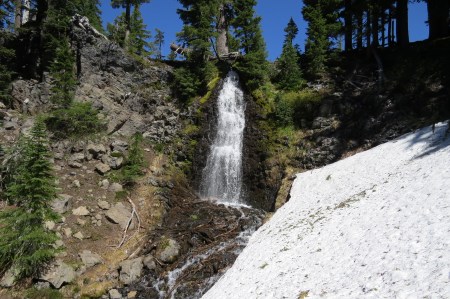
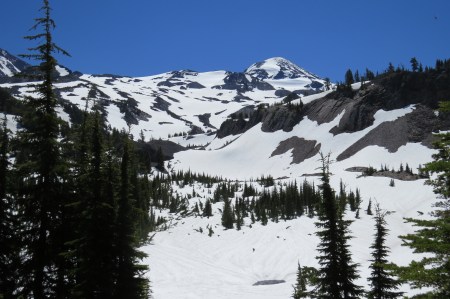
I put Obsidian Loop on the schedule for 1 July this year, figuring the hot June would take care of the snow.  The Forest Service told me the snow level was at 5200 feet.  I had done a hike in early June to 5600 feet, encountering only one small patch of snow.  I suspected there might not be much snow left, but to be sure, I scouted the hike 5 days prior.  Scouting is a full days’ work.  I’m doing the whole hike, including the drive. I had to buy a permit, then a few days later drove to the trailhead, the last 20 miles on a winding, curving, narrow road.  Finally, I hiked the loop, 12 miles—solo.  There was a lot of snow, although not as much as two years before.  I got off trail several times and navigated by GPS.  It was a difficult day. The Obsidian Trail is beautiful, but it takes a lot out of people— some is on volcanic rock, a lot of snow was present in this instance, there were six stream crossings, some of which were deep. Still, I was glad I did it, because I knew exactly what we could and could not do. I returned home fine, but I put on the trip description that we might be doing an out and back to Obsidian Falls, and to be prepared for snow. Two people cancelled.  One other, who had been on the waiting list, joined, and I was glad to see him, for I knew he was a good hiker.

IMG_1045.JPG

This is the Obsidian Trail after a snowy winter, 3 July 2014.  No trail visible, and one either knows the route or uses GPS.

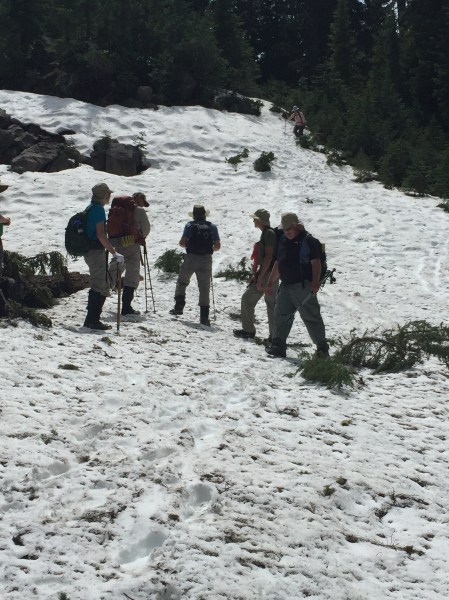
Friday, eleven of us met, driving up in three cars.  We always carpool.  I had a good group, and we got an earlier start on the trail than I had hoped.  We stop at trail junctions, and as leader, I usually am not in front but somewhere in the middle, trying to have a sense where the front and back are, who is fast, who isn’t, and anything else I observe.  When we reached the first regrouping point, I discovered that one of our hikers had continued on, which was clearly not something we do. I hoped he would go directly up the proper trail to the Falls, because there were side trails that could be taken.

IMG_7274.JPG

Obsidian Falls from above.  The passage here was the area I was most concerned about, for it was on a 45 degree snow field where sliding was dangerous.  

From here on, I led from the front, because I knew the trail and wanted to keep the group together.  When we reached the Falls, I saw the missing person and went down to talk to him.  I first quietly asked him how he was, and when he told me he was fine, told him firmly that we waited at trail junctions.  He hadn’t heard me say that, but I had, and others on the hike could verify that, and in any case it’s a Club rule.  I had been worried about his well-being and a bit angry, but I kept my anger in check and he apologized.

IMG_3789.jpg

100 meters off trail, we came down this area, some choosing to glissade.

After lunch, I thought with less snow, we could complete the loop, and we did, slowly coming back down off trail through snow, my navigating by GPS and memory I had of the trail, which I knew ran near a creek.  More than once, I was concerned about not knowing exactly where I was, despite having been in the area five days earlier, but yet I knew we were going the right direction.  The map on the GPS was off by 400 meters.  Eventually, we finished the loop and hiked almost 4 miles to the cars.  For the second time in 5 days, I had to drive back down the winding road, tired, back to town.

People loved the hike.  One called it his favorite, another said he wanted to do anything I led, and a third said “That is what I call a hike.”  That’s a good day.  They aren’t all that way.  Why do I lead hikes? My third reason: Had I not decided to do this hike, no Obsidian–indeed, no person–would have seen the vast stretches of snow in the Three Sisters Wilderness that we saw on 1 July 2016.  Nobody would have glissaded, nobody would have seen a lake emerge from its winter ice, nobody would have seen the Winter Wren calling, and nobody would have known what they had missed.

IMG_3750.jpg

Lake emerging from ice at 6800′ elevation.

IMG_3788.jpg

Nobody saw this area that day but us.  Middle Sister in the right center.

IMG_3794.jpg

Winter Wren.  Interestingly, five days earlier there was one on this root ball, so a nest is probably nearby.

TEMAGAMI

June 21, 2016

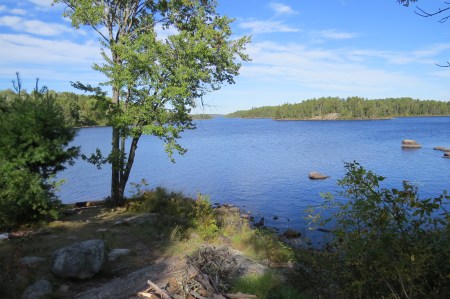
Fifty-two years ago this August.  On the sixth, to be exact.  Ten days of my life, beginning by being trucked up past Lake Nipissing, further north than I had ever been at the time, to a wild place called Temagami.

I had long forgotten about Temagami, and I would not have remembered it had it not been for Camp Pathfinder’s 100th anniversary and reunion I attended in 2013. I wanted to see the place where I learned canoe tripping, which I’ve continued the past 50 years.  I was glad to go to the reunion; while I don’t plan to return, I made the trip once, and that was a gift to myself.  I got a chance to canoe again in Algonquin Park, which I did not expect to do at all, and I discovered at 64 I could still carry a 90 pound canoe on my shoulders for a mile, without stopping.

And survive.  The guy with me was ten years younger, a big advantage.  He took the stern, and I was happy in the bow.  The first carry was a lift-over, and the second one was his. Right away, we had a problem.  We were not about to carry the entire weight on our neck.  We were used to lashing paddles to the bow seat and carrying thwart, and putting the weight on our shoulders.  Neither of us had lashed since then, but it wasn’t like it was rocket science.  We alternated portages and had a great day trip.  I needed to wash the muck off, so I had to swim again in Source Lake.  I couldn’t believe how cold the water was, although only I had changed.

It was a lot easier when I was 18.  Algonquin was a lot wilder back then, too.  When I drove into the Park, I stopped at the Canoe Lake store to use a pay phone and could barely orient myself.  There was a huge restaurant on the second floor, and the launch point, which used to be a sand beach, was paved over.  We kids used to shoulder our packs without help when we landed at the Canoe Lake store, because we were young, full of testosterone and wanted to show off.

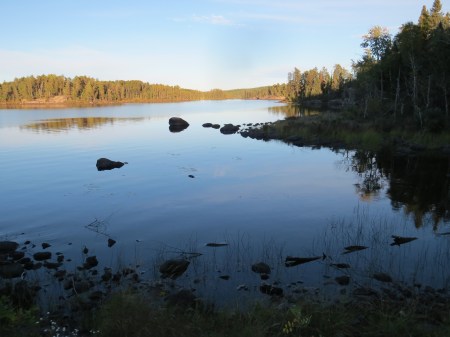
Pathfinder has listed online all the trips ever taken from 1959 to the present, and my name is on twenty-five of them during the 1960s.  As I looked through the ones in 1964, one called “Temagami” popped up.  Wow, Temagami.  When certain names of wild country appear, my brain goes somewhere Up North, where the lakes have no cabins, the horizons are tree-lined, the shores rocky, the rivers free flowing, and one hears campfires crackling, the banging of pots, the chopping of wood, the rain on the tent at night, and the haunting call of the loon.

Temagami.

Temagami was one of the wildest places I would ever canoe until I ran the Nahanni River in the Northwest Territories in 1985. The Nahanni, Yukon, and the Brooks Range in Alaska are more remote, but Temagami was remote enough.  It hadn’t been done by the camp before, so we campers were honored to be chosen; the head man was the director of tripping.  We were going for 10 days, north, a wonderful word, north of Lake Nipissing to the 45th parallel, which for me was like being in the Arctic.  We knew the lakes were big, the portages long and not well maintained, and the campsites few.  What we didn’t know was it would rain every day,  and back then, neither rain gear nor canvas tents was very good.

As I started writing, a few memories returned.  I don’t know how many are true, half a century plus two years later, but I’m assuming the best.  Lake Temagami, our jumping off point, was the first “big lake” I had ever paddled.  Kneeling in the bow, for Pathfinder campers never sat, was the only time my knees ever hurt from the force of the waves.  I came right down on the ribs and planking, stroking into a strong headwind.  We had to pull into shore to dump water out of the canoe, for the waves often came right over the gunwales of our Old Town, loaded with 3 people 3 packs, with little freeboard.  I was about to write that it was the only time that happened, but over the years, I’ve had to go to shore several times to dump water out of the canoe to keep packs drier.

I don’t remember many campsites, only that they were primitive. Back then my boots were wet the whole time, and most of my clothes were, too.  That was before rain suits. To this day, wet boots and wet feet don’t bother me.  I actually feel less at home in the woods with dry feet.  I remember one site where we were camped by a roaring falls. It rained the whole night. I woke with a puddle of water under the foot of my sleeping bag, tried to remove as much as I could, figuring the bag would be soaked the next morning.

When I awoke, the spot was dry.  Go figure.  Maybe I had been dreaming.

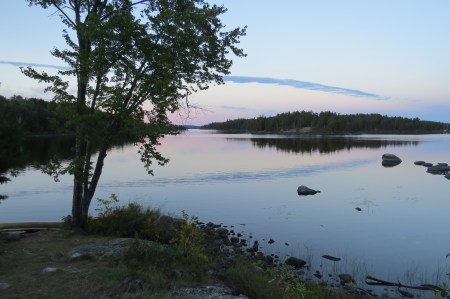
Makobe Lake was the furthest north we went, and I can still remember the black spruces dotting the shores and the horizon.  I thought I was so far north then.  Now, I live at that latitude.  On the penultimate day, the Sun, the glorious Sun, broke through the clouds, a raven called, we answered in kind, and all was right with the world.  I don’t know if that was on Larn or Ostergut, but that’s what the lakes were called back then. Never forgot them.

I never saw and never will see Temagami again. For some things in life it’s actually better not to go back.  I did look online, and the portage known as Fat Man’s Misery, which I am very proud to have done, even if only with a pack, now has many more trees.  I prefer my imperfect memory of wondering how our staff got canoes down that carry.

The following year, I would transition from a superb bow man to a third man, lowest of the staff on a trip, paddling in the stern.  It would be three years before I would be in charge, wearing the red bandanna. My last summer, my last trip, as a camper, wasn’t in Algonquin.  It was to wild Temagami further north, where the haunting whistle of CN trains carried us back at the end of our trip..

Today, Pathfinder sends month-long trips to Hudson’s Bay.  They’ve even done the Bloodvein River, which makes me a little jealous.  But not much.  I’m thrilled that young guys and gals are out in that country.  I hope there will always be wild country for them—and folks like me— to test themselves in.  It might still be Temagami, Quetico, Ile à la Crosse, Aichilik, Kobuk:  any name that evoke black spruce, muskeg, the Canadian Shield, rivers running wild and free, and a land like no other.