Archive for the ‘Uncategorized’ Category

TEASING

April 1, 2016

One Saturday night early in my internship, I was called to the cardiology floor to evaluate a patient with a fast pulse.  I walked into the room, today still able to remember what room and which bed he was in.  The man’s heart rate was about 150, and while he was tolerating it, he needed to have something done.  I hooked up an EKG, both confirming the rapid pulse rate and the diagnosis, atrial flutter, with 2:1 block, so the atrial rate was 300 contractions a minute and half of them were getting through to the ventricles.  Back then, before the anti-arrhythmic drugs we have today, massaging the carotid artery was one way to stimulate vagal tone and slow the heart rate.  Thinking I could see the EKG well, I started massaging the patient’s right carotid artery.

I can still see the patient as he had a seizure about twenty seconds later.  I took my finger off the carotid and he quickly woke up.  I looked more closely at what I thought I had been watching.  The vagal tone I stimulated was so strong that I blocked all atrial conduction, no longer 2:1 but rather 300:0, so that not one beat passed through the atrioventricular node to the ventricle.  I had put him into cardiac arrest.  Great job, Doc.  No pumping, no blood.  No blood, no brain function.  When the brain suddenly gets no blood, one of two things may happen: coma, which is the most common, or a sudden burst of electrical activity, a seizure. I once seized when I fainted.  A lot of “near death” experiences may be due to excessive brain stimulation due to severe hypoxia.

The attending showed up an hour later, looked at the patient, then the EKG, and finally me.  He held up the EKG, looked down his glasses, and quietly said, in a British accent,  “Are you the author of this?”  I was embarrassed beyond belief.  The patient was moved to ICU and fortunately made an uneventful recovery.

My misadventure with a patient’s neck was the butt of many jokes for the rest of my internship. For days afterward, every one of my fellow interns, when they saw me, would rub the side of their neck. Even today, I would be willing to bet money if one of the interns I knew saw me, the first thing he would do is put his hand on the right side of his neck and act like he was rubbing it.  He did that every time he saw me for the rest of the year.

The first few times it was tolerable.  Then, it became annoying and finally hurtful.  I admit it.  I screwed up.  Do I have to be reminded of it every time you see me?  What do you want?  Should I admit to being the worst doctor in existence?  Would that help?  Should I quit? Would that help?  Why are you doing this to me?  Have you never made a mistake?

Later, in practice, I saw a psych patient whom I was convinced didn’t have anything neurological going on.  A nurse disagreed, and she was proven right; the CT scan I ordered showed a large, benign brain tumor, which had caused the person’s problems.  I might add while this is always a consideration, I only saw twice a benign tumor causing psychosis in all the years I practiced.  Oh, I diagnosed the other tumor.  For years afterward, the nurse reminded me of my mistake.  Stuff like that hurts.  It starts to eat away at a person.  OK, I missed a tumor.  I am a bad person, a bad diagnostician, a bad doctor, and on and on up the ladder of inference.  Do you continue to  have to remind me?  Does anybody remind me, I wondered back then, about the diagnoses I did make correctly, the patients I did help, the times I was right and others were wrong?  What about the case of Wilson’s Disease that I diagnosed on the first visit in the office?

Teasing is toxic.  Maybe in small doses, it is fine, but only in small doses.  Let the individual poke fun at himself or herself.  And perhaps that is why I behaved the way I did last February 2, when the hike leader gave me a stuffed toy of a groundhog and told me quietly to start hiking before everybody else and put the groundhog on the trail somewhere where it could be seen.  About fifteen minutes up the trail, I stopped and placed the groundhog on the edge in the sun, because frankly I wanted six more weeks of winter.  I like rain; I haven’t seen enough of it in decades.

I waited, and when the first group of hikers arrived, one looked at the groundhog and pulled out his camera.  He was dead serious.  “Wow, a groundhog is up here!”

I thought he was kidding.  He had to be.  But the furry thing did look kind of real.  I quietly walked over and put my hand down on the stuffed animal.

“Oh my God,” the hiker said. “I fell for that.  I can’t believe it!!”  I didn’t say anything.

And I haven’t since.  The individual has mentioned the groundhog event to several people, but I have stayed quiet.  Sure, I could have teased him about it, but a long time ago, I learned what I should have known all along:  a good deal of teasing is toxic.  It hurts, and it isn’t appreciated, no matter what people say.  “Can’t you take a little teasing?” I heard as a kid.  I should have replied, “Can’t you take a little poison?”

GREAT EXPECTATIONS

March 23, 2016

It all started with a packaging error on some soy burgers I bought.  At home, I discovered a slit in the bottom of two that I didn’t see when I bought them.  Who knows how long the contents had been exposed to air?  How often do you check the packaging when you buy something?  For me, not often enough.

I returned to the store and told the manager, who was shocked.  I said I was going to look at the other packages they had to see if they, too, were defective.  When I checked the box that had the identical soy, sure enough, the two remaining packages in it had rips.  I took them back to the manager’s counter.

I had to wait, however, as I watched a woman with bleached blonde hair, maybe mid 40s, and a young man, who might well have been her son, discuss lottery tickets.

“We can’t afford too many,” she said.  “We need $20 for xxxx.”  I couldn’t hear what “xxxx” was.

I was stunned, as I watched them purchase six lottery tickets, some sort of scratch type, for $60, which the woman counted out using twenties, fives and ones.  It might have been a Raffle. You can’t win if you don’t play, right?  That was the catch phrase in Arizona.  You can’t lose if you don’t play would have been more accurate, and I can prove it.

Let us look at the expected value, which anybody playing the lottery should understand.  We ought to teach this in schools. If the expected value of something done is positive, over the long run it will be successful; if negative, over the long run, it will not be.

Here’s an example.  At a roulette table, you plunk down $1 on a roll of two dice.  If they come up double 3s, you get a 30-fold return—$30.  Well, it isn’t 30 fold, because you paid $1 to begin with.  It is 29-fold.  Don’t laugh, casinos get rich on these “minor points.”  You have a 1 in 36 probability that the dice will both be 3: 1 in 6 for each, and we multiply the probabilities when one doesn’t affect the other, a term called  independence. The probability of winning $30 is (1/36), and the probability of losing $1 is (35/36).  If you multiply these and then add, you get +$(30/36)-$(35/36)=$(-5/36).  That fraction comes out to about MINUS 14 cents per dollar bet.  Are there winners?  Yes.  The consistent winner is the casino.  Not only is it consistent, they can predict very accurately how much they will make, because in the long run (not a player’s time horizon), the casino will make 14 cents on each dollar wagered for that bet.

What I saw for a $10 Raffle ticket:

1 in 250 chance of winning $100

1 in 25,000 chance of winning $20,000

1 in 250,000 chance of winning $1,000,000

The exact calculations are more complicated, but the simple way works just fine.

You spend $10, and you have a 1/250 chance to win $100, an expected value of $100/250 or $0.40, 40 cents.  You also have a 1/25,000 probability of winning $20,000, and that is $0.80, so the expected return of both is $1.20. Add to that the 1 in 250,000 chance of winning $1 million, $1,000,000/250,000=$4.  The total expected return on $10 spent is $5.20, give or take.  That’s the plus.  The minus is $10(249/250)=$9.96.  The expected value is $5.20-$9.96=  MINUS $4.76.  The pair spent $60. If we looked at a lot of people buying, all of them, they would on average lose about $28.50.  One of those $20s that one comes in to the store with, and nearly a ten spot as well, won’t be seen again.  Do that weekly for a year, one will lose nearly $1500 on average.

The lottery is very coy about posting long lists of numbers that won $100.  Sounds like a great deal, except that first, they really won $90, because they paid $10 for the ticket.  Secondly, the list of those who lost is about 120 times longer.  We don’t see that one.

Here in Oregon, 93% of the money spent on the lottery goes to payouts.  Sounds good, except that the big payouts go to very few people.  BUT A LOT OF PEOPLE WIN A LITTLE, LIKE $100, AND THAT’S A HUGE PROBLEM.  This is called variable ratio reinforcement.  Winning occasionally keeps one playing.  Never winning at all causes one to quit sooner.

There is a very strong correlation between low income and high use of the lottery. Why do people play?  Answer: they see this as the only way out of poverty.  The probability is exceedingly high, however, that they will only go deeper into poverty. The lottery is a regressive tax levied on those who can least afford it.  The lottery steals from those who don’t understand math, probability, or how our brain can lie to us.  When the money goes to education, a noble cause, it is being paid for by those who have the least money: the very poor spend 9% of their income on the lottery.  If one makes $13,000 a year, that is nearly $1100 they spend on the lottery.  If one has difficulty making ends meet, this is going to push them over the edge—with high probability—and I can define that probability exactly.

I never forgot what my statistics advisor said about expected values:  “If it is positive, I will beg, borrow, steal every dollar I have to play.”

It becomes absolutely certain at some point that somebody will win Powerball.  We can predict that as well.  If there is a Powerball with a probability of winning equal to 1 in 110 million (roughly equivalent to your guessing correctly a minute I choose between the signing of the Declaration of Independence in 1776 and now), and 330 million play the Powerball, the expected value of winners is 3.  Three people are expected to win; the probability of exactly 3 is about 22%; the probability that between 1 and 5 will win is nearly 7 in 8, and the probability nobody will win is about 5%, quite small.  In other words, one can make remarkably accurate probabilistic statements what is going to happen.  Did you guess my minute? (It was 3:32-3:33 a.m. 15 August 1846).

I’m lucky; I live comfortably.  Still, I bend down to pick up a dime or a penny if I see one.  If PetsMart gives me a $3 coupon for doing a survey, I will do it.  If REI gives me a dividend, and I am planning to buy something, I will buy it with the dividend and furthermore try to get it when the item is on sale.  I use coupons when I shop, I comparison shop, I don’t drive 30 miles for cheaper gas, because it’s more expensive to do so, I pay my credit cards off every month, I try not to get a tax refund, because it means I loaned the government money, and I DON’T PLAY THE LOTTERY.

But occasionally, I do silly things with money.  The store agreed that the ripped packages I returned, and the two others in that I found that were also ripped, needed to be removed.  I found two good packages, but they were not on sale, so I actually had to pay to replace them.  I paid $4.40 for doing the store and any customer who bought those a favor.  Small price for what I learned about the lottery.

The expected value for doing a good deed was negative.  In the long run…

THE ASTROPHYSICS GUY

March 13, 2016

It’s easy to get disoriented finding one’s way around the night sky from the Southern Hemisphere.  I’ve been south of the equator 11 times, each time having to relearn the southern night sky.  From our ship in the Java Sea, 4 degrees south of the Equator, almost all the northern hemisphere constellations were visible, but they appeared upside down, although my Down Under friends would disagree.

My wife and I had done a lot of laps walking around the deck during this cruise, never using the elevators.  We were piling up steps, number of feet climbed, in a losing effort to burn off the calories it was so easy to consume on board.  At least we eschewed alcohol, saving both money and calories.

On one evening walk on the third deck, we stopped to look at some of the stars, despite the bright lights aft.  My wife spotted Orion, high overhead, and from there I was able to work my way around familiar stars in both the northern and southern celestial hemispheres.  From the Equator, theoretically the entire sky is visible, although near the horizon faint stars disappear, because we look through many thicknesses of the Earth’s atmosphere to the horizon.  Go outside on a dark night sometime and notice how much brighter a star appears overhead compared to when it was on the horizon.

We did see a bright star to the south, but I couldn’t identify it, needing a darker sky.  The next night, we went looking for a better spot.  The first place we tried was the bow, but some ship workers told us that was off limits.  We weren’t convinced, however, because we had been there in daylight without problems, so we waited until they were gone and snuck back, but found the area dark and full of obstructions.  Chastened, we beat it back to safety and planned another assault to view the dark sky.  My wife suggested seven decks higher, where we finally found an open deck with a small platform that allowed us a view over a plexiglass rail.  The sky was beautiful, the ambient light minimal but enough to keep us from tripping over a bollard or a deck chair.

Now I could see some neat stuff.  Leaving Orion behind, I pointed out the False Cross and then the true Southern Cross, low in the east.  I was speaking softly, when a man approached, asking if he could join us.  We helped him up, since the platform held four or five.  He was either an astrophysicist from Vancouver or was interested in astrophysics, I wasn’t really sure, but he definitely wanted to learn the night sky.

Now I was in my element.  Night sky, interested person, chance to teach, to talk about what the stuff meant, along with what I didn’t know, which is a lot.

I started with Orion:  On the Equator, Orion is a bit hard on the neck, but wow, even the sword was bright, and the Milky Way’s running through Orion and Monoceros was fabulous, although I omitted mentioning the name of the latter.  Keep things simple.  I took us around the stars of the Winter/Summer Hexagon/Heptagon, depending whether one counts Castor and Pollux as one or two.  Following Orion’s belt to the south, I began with Sirius, brightest star in the night sky and closest night star visible to the unaided eye; then Rigel; Aldebaran; and Procyon; P for the next star, Pollux; then Castor; C for the next star, Capella; then back to Sirius.  Red Betelgeuse was in the middle and at the opposite end of Orion from Rigel.  The astrophysics guy was able to appreciate the colors of Betelgeuse, orange Aldebaran and slightly orange Pollux.  He was having fun, I was having a blast. My wife found the Pleiades, one of her favorites, and she was contributing, too.  This was great.  I mentioned the Hyades Cluster around Aldebaran, about a third the distance of the Pleiades.

From Sirius, we looked down to Canopus, the second brightest star, just visible from southern Arizona in the winter, but really bright here on the Equator.  The astrophysics guy loved it.  He had once been to a star party in Nevada’s Great Basin National Park, and was starting to remember a few things. I then took him further south in the sky, to alpha-Centauri and the Southern Cross.  This was new to him, and he was thrilled, saying he wished his wife were up with us.

By now, I was fully dark adapted, and I remembered in March, the Magellanic Clouds are visible, and pointed them out a little south of where we had been looking.  This was amazing, reminding me of the writer Peter Leschak’s words:  “You don’t see this stuff every day.  But you do see it every night, under a clear, dark sky.”  Or something like that.

Not detecting boredom, and not being told by my wife I had said enough, I kept going. I pointed out the three stars of Orion’s belt, Alnitak, Alnilam, and Mintaka, from left to right in the northern hemisphere, and I was totally confused what to call them overhead, laughing.  OK, Mintaka was about overhead, lying on the celestial equator, the projection of our equator on the night sky.  Orion is great.  Want to learn the night sky?  Find Orion, and you can learn to name about 18 stars in a hurry:  Betelgeuse and Bellatrix are at the top, in the Northern Hemisphere, Saiph and Rigel on the bottom.  But top and bottom are different on the equator—different degrees of neck straining.  Betelgeuse is definitely red and the belt goes directly overhead.  At least where we were.  Your results may vary.

So, seven stars in Orion; near Sirius was Murzim to the west; near Procyon, Gomeisa shone to the left or west; near Castor and Pollux was Alhena near Betelgeuse.  I think that’s 16.  Canopus and Alpha-Centauri make 18.  The astrophysicist mentioned that everything we were looking at was part of the Milky Way.  He was doing great.  I pointed to the region where the open star clusters M41,near Sirius, M35 near Alhena were.  We were rolling now.  I talked about the “kids,” three dim stars near Capella, one of which fades in an eclipse every 27 years, although I was damned if I could remember which Greek letter it was (it’s epsilon). The last eclipse was 2010.  I doubt I will see it eclipsed again, but I’ve seen two, and they were fascinating.  I mentioned I was formerly a variable star observer, measuring the light of pulsating intrinsic variables and eclipsing binaries.  Astronomy is such a huge field.

The astrophysicist mentioned that Andromeda was the furthest we could see with the unaided eye and continued that Hubble was one who realized that Andromeda might be beyond our galaxy.  Great.  He was teaching.  That got me talking about the Cepheid variables, whose brightness is a function of their cycle, something that allowed us to determine Andromeda’s distance.  Thank you, Henrietta Leavitt, one of the forgotten—not by me—women of astronomy, who discovered that.*  The astrophysics guy said he was going to try to bring his wife top side.

At that point, my wife was going to try to bring me back to Earth, or at least the lowest deck, where our room was.  Fair enough.

I’ll remember a lot from the cruise, but that night with the astrophysics guy was better than a lot of tours we took.

I bet he’d say the same thing.

*Henrietta Leavitt (1868-1921) proposed the periodicity-luminosity ratio for Cepheid variables in the Magellanic Clouds, discovering that the brighter ones had a longer periodicity.  Assuming correctly that they were all similar distances from the Earth, it was then possible to determine the distances of remote objects.  Hubble used it to determine the distance Andromeda Galaxy was far further from the Earth than we could have imagined, that the universe was expanding,  huge leaps in astronomical knowledge.

SHADOW: THE 2016 ECLIPSE IN INDONESIA

March 13, 2016


My wife and I are dedicated eclipse chasers.  Yes, we are crazy folks (we prefer the adjective “interesting”) who go to the ends of the Earth and take a chance on the weather in order to see the Moon completely cover the Sun, one of my top four sights in nature.  By the ends of the Earth, I mean both poles, Pitcairn Island, all 7 continents, Siberia in March, and five times in Africa.

I have been fortunate enough to have been in many beautiful wilderness areas, and the other top three were a face-to-face encounter with a wolf on Isle Royale, nobody within ten trail miles of me; the annual migration of the Sandhill Cranes; and the closeness I’ve been to grizzlies in Alaska.

IMG_3539.JPG

Bears at Brooks Falls, Katmai

On our last chase, hoping to see my sixteenth total eclipse, we flew to Singapore, boarded the MS Volendam and sailed across the equator (my finally earning at long last “shellback” status) to Indonesia, first south, later east and finally northbound for the eclipse 8 days later.

I wasn’t particularly eager to take the trip. Long flights are difficult, I don’t sleep well, and I’m not a great people person, so cruises and Asia aren’t places I like to be.  Still, I will do what it takes to see an eclipse.  We took a tour in Jakarta, so I trod on the soil of my fiftieth country.  I’ve seen a lot of the Third World, only a few times actually immersing myself in it helping people, time measured in days, not months or years, and it is difficult to see how most of the people in the world live.

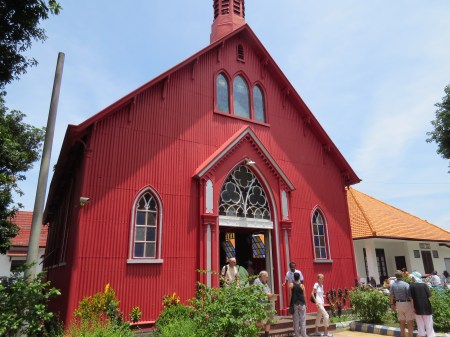
We often find special moments in unexpected places.  On Jakarta’s tour, I saw the usual monuments and museums that I guess I should see, although frankly I am not a monument or a museum person.  Maybe I should be, but I don’t judge harshly those who don’t share my love for the wilderness.  In Probblingo, we went into town for the sole reason to find a mall to buy a couple of cotton Indonesian shirts like the ones we had seen in Jakarta.  We found the mall, got the shirts, explored the place, and enjoyed ourselves.  The tour was on our own, lasted two hours, and we have fond memories of the place.

IMG_6222.JPG


National Monument in Jakarta


IMG_6263.JPG

Red Church in Probblingo

Several days later, heading north towards the eclipse track, we stopped in Makassar, a city on the southwest corner of the island of Sulawesi, across the strait from Borneo.  This was a place I never expected to see, a comment I make on every eclipse trip.  We saw Fort Rotterdam, avoided getting run over in traffic, and later returned aboard the ship, a little nervous about next day’s eclipse.

IMG_6278.JPG

Fort Rotterdam in Makassar

Eclipse chasing requires one to be at exactly the right place at the exactly right time, have decent skies, clear where the Sun happens to be.  This is a tall order in the tropics, especially during rainy season.  Sometimes, we have had to explain to a tour guide that “exact time” means to the second, not whenever one happens to arrive.  Exact time for eclipses does not mean mañana.  There is no mañana.  It is be there or miss it.  You can’t see it “some other time.”

With that attitude, I can perhaps be forgiven for not being overly polite to those who dawdle going to the eclipse path, thinking that my visiting one more museum or monument is important.  No, seeing the eclipse will make my trip.  If that means I miss a monument, an elephant ride, a temple, or a church, so be it.  My priority is seeing the eclipse.  I’ve heard stories of ships being 2 hours late to the eclipse track, of vehicles breaking down.

Fortunately, we had a good captain, who along with his bridge crew understood our needs.  He steamed a little further west in the Makassar Strait than originally planned, because cloudiness was less there.  It’s not only a matter of rain that may affect eclipses, but those puffy, pretty cumulus clouds become eclipse killers on eclipse day, and we needed to dodge them.

A good eclipse is directly proportional to the amount of sunscreen one uses.

My wife and I were up at 5 to get a place on the 9th deck on the starboard side at 5:10, where twenty people had already arrived.  Stars were visible, Jupiter dotting in and out of view between clouds to the west.  Well, I thought, there is hope, but I couldn’t yet see the sky well.  We didn’t have much equipment, but we still brought up two chairs from the deck below.  The Sun rose just after 6, and the clouds were not great, not bad.  We knew the Sun would be higher during eclipse, and we waited. Others arrived, bringing more deck chairs from below.

IMG_6314.JPG

People on deck before totality

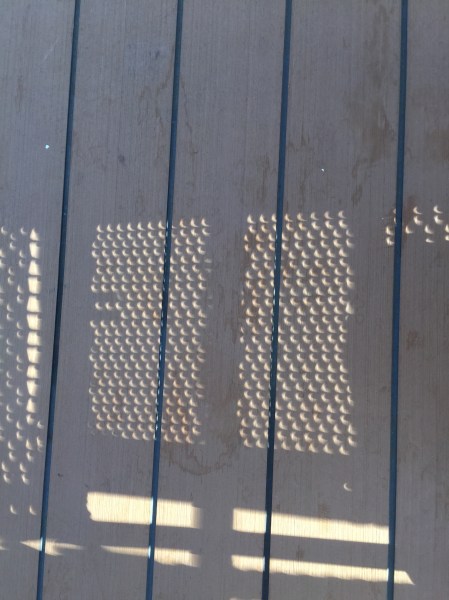
At first contact, where the Moon takes a small bite out of the Sun, it was partly cloudy.  Eclipses last about two and a half hours, totality in the middle, a little less than 3 minutes for this eclipse, 7 minutes and 32 seconds maximum possible.  After first contact, the Sun often disappeared behind a cloud for a few minutes, which is no problem, unless those minutes are during totality.  As the eclipse progressed, weather prospects improved.  The clouds became fewer and thinner.  The Sun’s projection through the weave of our deck chairs showed a multitude of crescents on the deck below, scores of pinhole cameras.  This is one of our favorite times during every eclipse.

IMG_2880.jpg

Crescents made by eclipsed Sun’s shining through tiny holes in a deck chair

As the crescent shrank to nearly nothing, I looked behind me to the west.  I was first to call out the arrival of the Moon’s shadow, a huge, dark mass, approaching at 30 miles a minute, the Moon’s orbital speed.  I turned around in time to see the Diamond Ring, the last bit of sunlight, and then beautiful totality, lasting 2 minutes and 45 seconds, over the calm Makassar Strait.  After the second Diamond Ring, the end of totality, I quickly looked down and east, calling out the rapidly disappearing Moon’s shadow, leaving us at a half mile a second.  For some time now, I have regularly watched the disappearance of the Moon’s shadow.  It’s visible for about 5, maybe 10 seconds.  I don’t know anybody who has ever mentioned it in eclipse talks.

IMG_2881.jpg

Totality

IMG_6320.JPG

Maybe they never looked.  After all, when totality is over, most people leave to celebrate, unfortunately in our instance leaving their chairs on the deck, instead of putting them back where they got them.  That’s kind of rude, even on a cruise ship.

Then a man about my age nudged me.  “Thank you,” he said, with his wife’s standing by him, “for pointing out the shadow’s disappearance.  I saw it, and I had never seen that before.  It was really interesting.”  His wife nodded.

IMG_2887.jpg

Moon’s shadow’s disappearing.  It is subtle, but the darkness on the horizon is the shadow

All total solar eclipses are special.  Sometimes, what I remember best is not the black disk in the sky covering the Sun, but something else, quite unexpected, like a disappearing shadow.  The man’s comments made my day.  I taught him something, and he was glad.

Later, my wife and I picked up about four dozen chairs left behind and helped the crew return them.  Yes, the crew is there to serve the passengers, but put the chairs back.

It appeases the eclipse gods.

EERO, EPOR AND THE 577R ALLELE

March 2, 2016

It did me good to read that Finnish skier Eero Mäntyranta’s success in winning seven Olympic medals in cross country skiing was likely due to a genetic mutation that increased his oxygen carrying capacity 25-50%.  He wasn’t the only Finn who was this fortunate.  I wondered at the time why Americans never were on the podium in those events.

It also did me good when I read in Outside about a man who could hold his breath six minutes—yes, six minutes— and used that skill to dive to tag threatened hammerhead sharks.  A comment was even made by Laird Hamilton that this man was unique.

Hamilton, one of the great big wave surfers, is unique, too.

It did me good to read that virtually every Track and Field star has the 577R allele in some form, enabling them to do things that the rest of us can’t.  It isn’t a matter of training harder, as some have told us, or “mental toughness”; nope, it’s genetics.  Now, that doesn’t mean one can’t train and improve.  There was evidence that Lance Armstrong improved his muscle performance 8 per cent through training.  Unfortunately for the sport, he improved it another smidgin by taking drugs, although he was far from alone.  All Tour de France riders are genetically exceptional, and at the top of the top, a fraction of a per cent advantage matters.  Some argue that genetic mutations don’t make for a level playing field. Well, we aren’t all created equal.

For years, reading about all these guys and gals who could do everything from surf to big wall climbing made me feel inadequate, despite my wondering that these skills were genetic.  Now it’s clear.  You either are born that way or you aren’t.  Nurture is essential, mind you, but nature creates a few special people every generation.  I am not one of them and never will be.  On the other case, I’ve never taken performance-enhancing drugs.  I was drug-free.  Maybe there is a genetic mutation for that, too.  Or maybe good nurturing teaches one not to cheat.

For most of my life, I tried to play sports well.  I am competitive.  But I have a modest ceiling.  My medal in 1966 for the third place 400 yard freestyle relay at the Delaware state swimming championships was my being a moderate size fish in a puddle, since Delaware, besides being the first state, is the second smallest.  I played baseball but never thought to try out for the team.  Basketball? I played third string in the city league, although one fabulous day I hit 20 free throws in a row at a schoolyard.

In cycling I was in the top 14% of the El Tour de Tucson 109 mile finishers.  That meant I placed about #736.  I trained long hours and had done all the right things; my result wasn’t bad, but hardly noteworthy.  In only one sport—skiing—was I good, and that was because I started young, took lessons, and had a lot of days on snow.  I was an excellent technical skier, but I couldn’t race well.  As a kid, I dreamt of being a pro baseball player; I never once dreamed of being a top skier. I was neither.

I feel better knowing that when I watch a track meet, or a good basketball game, I am watching people with chromosomal genetic code that I and nearly all others do not have.  More importantly, I understand the pain of those who train and train and train, but they didn’t have the right 577R allele to be part of the U.S. Olympic Team.

I feel better knowing that I was right when I argued with my cycling friends that it was genetics that made top riders.  All the training I did made me better and faster, but I reached a low asymptote.  I do believe I have a slight genetic advantage for endurance. I did a 200 mile bike ride once in just over 12 hours. In the 2002 Cochise County Classic, I was part of a small group that had our own support, and from mile 100 to mile 160, the end, I was pulling at the front two-thirds of the time, stamping out a solid pace, seven riders in my slip stream,  as we finished in about 8 hours, averaging 20 mph.

I was sixth out of 20 finishers.  Not even podium.

I was right when I argued that if I could be a top cyclist by training, anybody could multiply three digit numbers in their head, the way I do, simply by training.  That stopped most arguments, because people knew then that my skills were genetic.  Sure, I practiced math a lot, but I had this stuff in my genetic code from day 1, just like Yo-Yo Ma and cello;  Laird Hamilton in big wave surfing, Chris Froome in cycling, or Stephan Curry in basketball.

We should celebrate these people, and we do, paying them good money and cheering for the the ones we like to succeed.  No doubt they eat right, they train right, they do everything they can to reach their potential.  Some do it better than others, and they are household names.

I no longer feel inadequate when I read about these people who grace the articles in Outside, Sports Illustrated or Golf Digest.  I am reading about genetics, what how random mutations can positively affect performance, and—I think—to a lesser extent what training does.  Training is what we can control, and allows us to do reasonably well, be it learning a language or hiking up a mountain.  None of us will be noteworthy except maybe in our small group.  Nope, it is the mutations who make the stars, the names we know.  They work hard, to be sure, to separate themselves from other stars, but they are in a league of their own.

Now all we need is a mutation that leads to idea generation that would fix the rest of the human race, so we wouldn’t trash the planet and drive ourselves to the brink of extinction, which we will.

Maybe it’s time for better nurture.

MY ANNUAL BILL TO BE AN AMERICAN

February 18, 2016

After the New Hampshire primary, a friend commented that she didn’t want her taxes to go to send other people’s children to college, a comment on Sen. Bernie Sanders’ plan for free college education.

I was surprised and a little disappointed to hear that.  Through grants, to name one example, government is involved in education.  My taxes go to many places that are irrelevant to me.  I have no children,  I don’t eat meat, and I’m not a woman.  Should I have the right not to be taxed for public education, grazing fees on my land, and Planned Parenthood?  Of course not.  Is my friend going to vote for the other side, who will defund  Planned Parenthood and require that all rape-caused pregnancy be carried to term?   I was against the Iraq War long before it started, but my taxes went for that debacle.  I will never drive on roads in Texas again, so why should my taxes go for that?

While we are at it, we could get rid of the phrase “hard earned dollars.”  Sometimes they are, sometimes not.  In any case, the phrase is worn out.

There are things that the federal government must do, because we as people living in towns, cities and states simply cannot do them ourselves with our own resources.  We can’t clean up after a devastating natural disaster without federal help.  Yet, more than 30 Senators voted against Hurricane Sandy aid, even though many were from states that FEMA has been to many times after devastating storms.  We can’t defend ourselves against major foreign powers, and we can’t pay for medical care for the elderly or infirm.  We can’t build a national system of roads, and we can’t have a national weather service, the NIH or the CDC without the federal government.  These and so many other programs are essential to our well-being.  Live in the South?  Maybe you are glad the National Hurricane Center exists.  Government shouldn’t do everything, but there are things government can do.  And should.

People ought to save for retirement.  I did.  Sure, there are many who buy toys or travel everywhere without putting anything away and then find themselves old with no money.  I am not sure what is going to happen to them, except they will have less—but not zero—money.  We ought to make it easier to save, and we have to an extent with IRAs.  We need to do more, however, because if a senior is destitute, somebody somehow has to care for them, unless we are a different country from the one I thought we were. I had good fortune and a good job.  In the 45 years of being between 20 and 65, had I developed a significant medical problem, and I hadn’t had insurance, I would have become bankrupt.  Many have.  It doesn’t matter whether or not a person was saving money or whether the problem was their fault.  They need a safety net.  We can argue about the size of the safety net or whether people like me should receive it, just because we reached a certain age.  That is fair.  But the fact our taxes go to pay for something somebody else gets doesn’t a priori make it wrong.  That’s what elections are about.  My taxes are payment for my annual bill of being an American, and frankly, it is a great bargain.

People ought to have a healthy lifestyle, too.  Why should I pay for smokers who develop emphysema or lung cancer?  Or those who eat the wrong diet and suffer the consequences?  Or motorcyclists who have accidents and weren’t wearing helmets?  The list is endless.  I could add to it the question “Why should I pay for future cases of Chronic Traumatic Encephalopathy caused by football, soccer, or hockey?”  Nobody forced those people to play the game.  Many made a lot of money.  Why, I could ask, don’t they fund themselves?

What we have accomplished with our collective will and our federal government is so pervasive in our lives we don’t recognize it but take it for granted.  It isn’t; it may be removed at any time.  When FEMA was decimated under Bush, we saw what happened to New Orleans.  Bush’s response to Katrina did as much to bring down his presidency as Iraq.  Had Social Security been privatized, the recession would have bankrupted millions of people who get by on something they were never intended to get by on.  I shudder to think what will happen if Medicare is taken away.  It can be.  All it needs is a president, a Congress, and a Supreme Court willing to do it, and if one thinks that is impossible, one is unaware of reality.  I am already preparing for 2017 and 2018, when the other side is in power and the safety nets are removed.  I am counting on voters finally waking up and showing up to vote in November 2018 to take back Congress and stop the madness.  Being American voters, I may be hoping for too much.

Every time we drive on a federal highway/Interstate, we are seeing what our taxes went for.  Every time we go into a national forest or a national park, we see it. The food labels for nutrition that are so helpful are a federal law.  We ought to have point-of-origin food labels and label GMOs. The medications we take are safer, due to the FDA.  If one flies, there is the FAA, NTSB, and the TSA.  Indeed, we now have the TSA, because prior to 2001, the airlines were responsible for security, and we saw what happened.  Pilots are trained to certain standards.  Flight attendants are, too, and everything that they say was legislated.

Regulations exist to ensure there is a certain baseline of information that is given to the public.  Regulations in food safety exist because without them, we have no guarantee that each food service facility will do the right thing.  Regulations exist, because every year we see what happens without proper regulation.

Here’s my plan for who pays for college:  I would bring back the Civilian Conservation Corps and the GI Bill, make young people serve their country and then give them the education they want.  College for young people is a better investment than the Iraq War was. My downpayment for being an American was serving my country.  The annual payment is called taxes.  I get a say in what happens.  That’s my social contract.

Let’s bring it back.  It will help bring us together.


THE HALLWAY

February 9, 2016

A good friend of mine is trying to decide a career path, and having grown up in a very different culture, has choices and restrictions very different from what mine were.  Nevertheless, without asking in advance, admittedly a bit rude, I offered some thoughts, my own story, hoping perhaps it might help.

I wasn’t happy in medicine.  Neurology would have been a great specialty for me fifty years prior—even 20 years—before imaging tests allowed most physicians to diagnose many conditions that hitherto had been the province of neurologists.  I was left with the complaints of headache, spine pain, limb pain, and dizziness, 45% of my new patients (I counted), where imaging tests were normal and my training to deal with these conditions practically non-existent.

Night call was dreadful.  I didn’t sleep well, even on quiet nights.  I hated weekends, especially when my partners decided (with my dissent being the only one) one person be on call the entire weekend.  I was the only one in my group who took off the following Monday afternoon, not the whole day, because it took me all morning to get everything cleaned up from the weekend. I was on call 582 nights during my time with the group, and I then wondered what was the toll was on me from lack of sleep—how many errors I made, how many times I was unnecessarily nasty, cruel, or mean.

I knew I had to do something different, so I decided to take a 6 month leave of absence, 6 months of retirement at age 43 to work as a volunteer for the Superior National Forest, being a wilderness ranger in the Boundary Waters Canoe Area Wilderness,** a million acres of lakes, rivers, and forest—no roads, no cabins, no powerboats.

That time was perhaps the most content I ever have been in my life.  I was in the woods 100 days that summer.  I learned the Boundary Waters like my neighborhood, traveling hundreds of miles through 300 different lakes.  I was strong and soloed 15 times, single carrying (canoe and pack) a mile without stopping.  I traveled 6 days solo without seeing another person.  Didn’t mind that, either.

But winter comes to the North Country and I had to return to my practice, never having had the epiphany one night by a campfire, when I would suddenly realize what I was going to do with my life.  That is what I thought would happen.  It didn’t.  Back in practice, I was calmer but I still was dissatisfied with my life.  Then, quite by chance, the medical director of the hospital resigned for another position out of state and I decided to apply for the job. I wasn’t sure how it was going to work, only that it was more to my liking than what I was doing.

I liked the job, learning a great deal about medical management.  I never would have dreamt during my training I would become an administrator.  Nor would I have predicted that hearing Brent James from Intermountain speak on medical quality would be life altering, and that I would not only take his 4 month long course in Salt Lake City, but I would ultimately leave medicine in all forms to pursue a Master’s in Statistics.  No, I never foresaw this.

Nor would I have guessed how I would have failed at being a medical statistician.  I had closed a door, one that paid well and gave me power and influence, but it locked behind me.  I couldn’t go back.  Instead of a bright world in front of me, it was as if I were in a hallway, with a lot of doors, all of them closed.  Only one was unlocked, and I entered a room, the door’s not locking behind me.

This imaginary room was like a classroom, as if I were back in school, doing two things I liked and was good at—teaching and math—and another that I liked but wasn’t good at—writing.  Somehow, I cobbled together a new life of writing about patient safety and medical errors for magazines, became a columnist for the medical society and Physician Executive magazine, and continued writing a weekly astronomy column for the newspaper as well.

Quite by chance, which became three words that would define my life, while looking through a drawer one day, I found “The List,” things I wanted to do in my life, ignored for two decades.  I started to dream, then I started to act.  I began in 2004 with seeing the Sandhill Crane migration, and then began the following year to see the national parks, beginning late 2005 with Guadalupe Mountains and Carlsbad Caverns.  It was as if I had opened an imaginary door and gone literally and figuratively outdoors, without the door’s locking behind me.  I had written down “See Alaska’s Arrigetch Peaks,” and I did in 2007.  That led to five more Alaska backpack trips to the Brooks Range.  I had learned that writing a column was like my life—I didn’t force things to happen, I recognized opportunities and tried to act upon them appropriately.

In 2010, cold weather in Nebraska and a delay in the arrival of the cranes led to my returning in late March, which was life changing, for instead of being at Rowe Sanctuary before the public arrived, I became a guide to the viewing blinds, going again this April for my seventh consecutive year. That July, I planned to see the total eclipse in Patagonia, but the flight-seeing plane we had booked to fly over the almost certain cloudy country was cancelled, meaning our chances of clear skies in the austral winter were about 5 per cent. I nearly missed making the plane to Buenos Aires, which I wouldn’t have minded missing, but found myself 2 days later in Patagonia under thick clouds the day prior to the eclipse.  Yet the next day, in a clear sky, I and a large tour of mostly Germans saw the most striking of the 15 total solar eclipses I have been fortunate enough to see.  The friendliness of the Germans I met led me to try to learn their language.  I won’t ever finish the job, although I watch far more German than American shows on TV.  There was no way I could have foreseen either of those two events that year.  Quite by chance.

When we moved to Oregon, I knew that I would do something and was perhaps wise enough to know that I would do things that I could not possibly foresee, and other things would not work out as planned.  Leading hikes, tutoring math at the community college, and running planetarium shows could not have been predicted by me, but I do them.  Two weeks ago, I went snowshoeing for the first time in my life. (Salt Creek Falls, Oregon; February, 2016).

What I told my friend was not to force any decision about school.  Think about what you like, I wrote, and keep your eyes and ears open for opportunities.  Take some risks.  You might end up in a brand new world, or you might end up in a hallway with a lot of closed doors.  Try them all.  I bet at least one will be unlocked.

Quite by chance.

At right, trip leader to Black Crater, Oregon, 2015.

**”The examiner re-examines” and “Burnout or rejuvenation?” were my words, except for the title, that Steve Nash, former Executive Director of the Pima County Medical Society and now of the Tucson Medical Osteopathic Foundation.  I deeply appreciate his taking my words and adding his style to the medical society publication Sombrero.


CRESCENT MOUNTAIN

February 7, 2016

“We can’t go any further!!” one of the hikers in the lead group yelled to me, the leader, as I approached.  “There is too much snow.”

We were about 4 miles and 1800 feet up Crescent Mountain from the trailhead on a day that was alternating between rain and snow flurries.  My thirteenth time leading hikes for the Obsidians, and I had everything I could handle.

I hadn’t planned ever to lead hikes.  Indeed, I had heard of the Obsidians, a hiking club, only by chance, when on a visit to Eugene before we moved, the person showing us around mentioned the Obsidian Lodge, as we drove by a large building set in the woods in the South Hills.  After we moved, six weeks later I suddenly remembered the club, looked it up, wrote them about perhaps my joining, hoping, “we would be a good fit for each other.”

We were.  One has to do three hikes to become a member, and on my first, up Rooster Rock in the Menagerie Wilderness, I found I wasn’t left behind.  Indeed, on the steep upper part, climbing 750 feet in a half mile, there were two of us in front, and I kept up a conversation with the other ahead of me.  I belonged in this country.  (Picture of Obsidian Hiking Group, Rooster Rock, 2014).

The leader on that hike, a dynamo, 73, kept telling me I should lead hikes.  I told her I couldn’t lead a hike without having done it first, so I spent much of the summer of 2014 doing hikes in the Cascades or on the Oregon Coast by myself.  I started with Eagle’s Rest, a 2000 foot climb, then did Hardesty, a 3500 foot climb over 4.5 miles.  I found a way to do Hardesty without backtracking, and did that 14.5 miler, with 5000 feet of climbing, twice.  I hiked Obsidian Loop, one of the classic Cascade hikes, on July 4, six feet of snow or more on the ground.  I later combined the loop with Opie Dilldock for a 19 miler.  I did Maxwell Butte, Iron Mountain, Castle Rock, and on a cold October day near season’s end, Browder Ridge, solo.  (Collier Cone, Opie Dilldock 19 miler, August 2014).

I started leading hikes in August, two months after I became a member.  I led Obsidian Loop twice, once in November, four days before the road closed for the winter.  That was a great hike, in fog and rain, not the usual way people see that country, which is usually in summer.

The non-winter of 2015 meant that hikes we normally did in June or July were able to be done in April.  Indeed, I led lower elevation Rooster Rock in mid-February, with trees in bloom.  Crescent Mountain was in April.  I had done it the prior June 29.

There had been some rain, but 12 of us showed up, the typical number that carpool, and we arrived at the trailhead high in the Cascades about 10.  The woods are dense here with Douglas Firs and sword ferns.  Early season hikes had a problem which I had not anticipated: several blowdowns, fallen trees, were blocking the trail.  While it didn’t snow much, there was rain and a lot of wind.  Saturated soils often cause trees to fall.

We started the hike by descending to Maude Creek, where we regrouped.  There had already  been three major blowdowns, and I led, finding the best way around them.  We regrouped at the creek, and I counted people, always counting, as I had on canoe trips nearly a half century earlier, when my campers went swimming.  I had to reach 12.  It wasn’t like there were other trails here, although that does occur on other hikes.  People can get hurt or have a medical emergency, and our median age on the hike was well over 60.

After the creek, I let people go at their own pace, staying in the middle of the group as we steadily climbed.  As we broke out into the first small meadow, there were several firs that had fallen together and required a few minutes to navigate through.  It was a mess.  (Upper Meadows of Crescent Mountain, looking at Browder Ridge to the south.)

This area was about the half way point of the climb, and I waited for everybody I could see, even backtracking to make sure whoever were 11 and 12 were OK.  They were, and I moved back through the group to the higher meadows, too soon for the wildflowers we had seen last June.  At the upper end of the meadow section, I heard the shout about the snow.  I looked and saw the six of my group clustered where the trail disappeared into the woods.  I knew the trail went up from there, and I found it easily, despite the snow.

Everybody followed, catching up when I looked for a way around a blowdown in the woods.  The snow was a lot deeper but still passable.  Nobody complained, and we climbed the last few hundred vertical feet to the summit.  This was the lunch spot , but I then went back down the trail, to find the last five. (View from summit of Crescent Mountain).

Three were about a quarter mile back, just past the blowdown, and they were doing fine.  The other two were another quarter mile back, and I wondered if I should turn them around.  I hated to do it, and we were fine on time, not as fast as I had wanted, but not in trouble either.  I can sense well time on the trail and thought if we didn’t stay too long on top, we would be down at a reasonable hour to get back to town.  (View towards Mt. Jefferson, hidden in the clouds).

The last two arrived at the summit and thankfully quickly ate their lunch.  A few who were cold asked if they could slowly start down.  I told them to go.  The view was beautiful in fog, with the trees below covered in recently fallen snow.  I pointed out Crescent Lake to the north, unfrozen, and Browder Ridge, below to the south.  We wouldn’t be seeing The Sisters, Mt. Washington, Three-fingered Jack, or Mt. Jefferson today.  I quickly ate, took a few pictures and was left with one other person.  She was having a little trouble with her gloves and told me to go, but I stayed and got her settled.  Gloves are important and if the hands are cold, other things might happen, like falling.  Once she was taken care of and started down, the count being correct, I left.  The hike down was uneventful.  The group walked about 11 miles; I might have done 13.

It was just a hike, nothing special, not a race, not a major climb, just a Sunday outing.  It was the day that truly I became a trip leader, realizing that it was far more than posting the hike online and showing up.  Leading is counting people, watching the clock, watching the sky, watching how people hike, looking at their body language, their expression, their gear, listening to their breathing.

The Obsidians give patches for those who do 100,200,300, and 500 hikes.  They also give them for leading 25,50,75,and 100 hikes.  I’ve now taken more 120 hikes and led 34.  I led Crescent again later, in a cold autumn rain.  At the meadow, the cold wind’s howling and the 45 degree temperatures led me to call off trying to summit in fog.  We turned around and got back down wet, but warm.  (Upper Meadows in fog.  It was windy and intermittently snowing).

Knowing when to quit is perhaps the most important part of leading.

(Black Crater summit, August 2015)


THE DIFFERENCE BETWEEN FAIR AND FAIRLY

January 24, 2016

I travel all the time but have not paid the $100 for the TSA pre-check. However, I get selected for this line in LGA more often than not. I think that they (Delta) know the frequency that I travel and do not consider me a risk. I will tell you that it ticks off the people on my team that have paid for the service.

This was a recent Facebook post from one who was randomly chosen to use the TSA pre-check line. TSA does this to encourage more to be pre-screened.  It cost me $84 to get mine, and I had to drive to Roseburg to be fingerprinted, but the few times I fly,  I don’t wait in line.  I am at an age when convenience is worth a lot, even if I can’t attach a dollar value to it.

“It ticks off the people on my team that have paid for the service.”  In other words, somebody got something for nothing, They had to pay for it, IT IS NOT FAIR, IT IS WRONG, AND IT MUST BE CHANGED.

Fairness is an American obsession.  Many want to end Food Stamps, now SNAP, Supplemental Nutrition Assistance Program, because a few have abused it to buy things they shouldn’t have. Food Stamps is one of the least abused, most useful of all federal programs.  Still, any unfairness bothers people.  In Kentucky, able-bodied adults between 18 and 50 with no dependents must work, volunteer, or take classes for 20 hours a week for SNAP.  Heaven forbid somebody get something for nothing.  Many can’t find jobs, and I know first hand the difficulty to find volunteer opportunities. If we want “must work programs” let’s have mandatory national service for the young and able-bodied on welfare with an organized list of thousands of jobs, thousands of supervisors, so that we can fix infrastructure and support the three gifts America gave the world: liberty (military service), the national parks (build trails, fix the backlog of jobs), and public education (help in the schools).  Then let’s pay them by giving them a reasonable stipend followed by four years of education in a field of their choice after completion of their duty.  Such work gives people dignity, and I can’t attach a dollar value to dignity, either.

Because somebody cheats on welfare, many want to disband it. One should pull himself up by his own bootstraps, by golly.  This is difficult if one doesn’t have shoes, let alone boots. If we tried to enhance family planning, rather than trying to destroy it, we would have fewer children, less poverty, and require fewer jobs.  Freeloaders are employers who come to a city lured by tax breaks, not single women with children on welfare.  Every corporation that skirts IRS laws is a freeloader.

In college, I discovered for the first time in my life that hard work didn’t bring success and good grades.  It wasn’t fair, but life isn’t. When asked whether it was fair to call Reservists up for duty in Vietnam, JFK replied, “There is always inequity in life. Some men are killed in a war and some men are wounded, and some men never leave the country, and some men are stationed in the Antarctic and some are stationed in San Francisco. It’s very hard in military or in personal life to assure complete equality. Life is unfair.”

Want to know something that wasn’t fair?  Read Paul Kalanithi’s “My Last Day as a Surgeon” or “How long do I have left?”  He was, the past tense a sad way to refer to a remarkable human being, a neurosurgical resident, diagnosed during his training as having Stage IV non-small cell lung cancer.  He died two years later at 37.  As a resident, he was a skilled communicator and physician.  He learned in his last two years of life to enjoy the simple things as realizing his reassurance of a patient mattered.  He was a physician-scientist who could have been a writer, too.  It wasn’t fair that he died so young.  He quoted his chances of getting his disease: 0.00012%

As a physician, a lot of my stress was seeing people who had medical problems that weren’t fair.  I saw the 55 year-old at 2 a.m. with a sudden onset of a Grade V (the worst) subarachnoid hemorrhage, who was going to die. Not fair.  I saw a colleague develop a glioblastoma multiforme, which killed him at age 52. Not fair.  Or the 41 year-old man who in the ED at midnight, with a big stroke, whose wife said, “He’s going to die,” and I remained silent, because I knew she was right.  Not fair.  The 25 year-old woman devastated by MS.  Not fair.  The 28 year-old who broke his tibia, who coded one night at 3 a.m.  He didn’t make it.  I can still see the ugly, huge pulmonary embolus at his autopsy.  A gifted classmate, hiking by a Colorado river, falling, hitting his head and drowning.  He was 27.  Not fair. Notice that four of these were sudden.

This is life, or maybe death.  Bad things happen.  Some we can prevent, and some we haven’t a clue how to prevent.  I try to think that I must make each day count in some way, because we don’t have forever, and time is passing.  Atrial fibrillation was my game changer.  My probability of having a stroke has significantly increased.  Not fair that I inherited some bad genes, but biology doesn’t really care how I feel.  It just is. I’m moving on. The clock is really ticking now.

One question we must address as a society is how much unfairness is…for lack of a better word…fair.  The other is how to treat people fairly.

The tax code is unfair and could be changed.  It is not a malignancy.  I don’t think it is either fair or appropriate to pay women less who do the same work as men.  I don’t think it is fair for a child to die of a preventable disease because the parents didn’t believe in vaccination. I don’t think it is fair that people should go bankrupt because they had a medical condition that nobody could have foreseen.

We aren’t born equal, we don’t have equal opportunities and life will never be fair.  We can, however, treat people fairly who end up on the wrong side of the luck scale.  Any of us could be one of them.

Any time.

DOWNRIGHT AMERICAN

January 12, 2016

I got an email from Senator Jeff Merkley’s office saying there would be a town hall meeting with the senator Saturday afternoon up in Coburg.  All the places where Merkley holds such meetings are small towns.  Lane County is big, Eugene the County Seat, but Mr. Merkley, from a small town in southern Oregon, held his Lane County meeting in Coburg.  Good for him.

I arrived at the IOOF Hall to find it full.  I could have probably wrangled a seat because I’m graying, but seats are for old people, if you get my point.  I stood in the back.  I had never been to one of these town halls and had no idea what was going to happen.  I was amazed that I didn’t get patted down.  Five years and a day prior, my Congresswoman was holding a town hall when she got shot in the head from 3 feet away.  She amazingly survived.  Six others did not, including a county attorney, 63, a “9/11” girl, 9 years old, and women in their late 70s who were in the wrong place at the wrong time.  Nothing changed, and we can’t even put fingerprint codes on firearms, which would keep children from firing them.  America the armed; America the afraid, America the land that used to innovate, America where a billionaire boor stands a damn good chance of becoming president.

When I signed in, I was asked if I wanted to ask the Senator a question. I chose not to, but had I, I would have been given a ticket with a number on it, and as numbers were announced, if my number were called, I would have held up my hand, given a microphone, and then talk one-to-one with a US Senator.  That’s pretty cool.  I’ve seen a few important people in my life, but it’s been a long time since I saw a significant public figure.

Merkley gave the first question to a little girl, who asked him something about charter schools.  I didn’t hear the question, which was just as well, because I think we ought to support public education and limit the numbers of people who are homeschooling and using for profit schools that aren’t doing anything better.  I was the son of a public school superintendent who could have put me in a private school named after one of the duPont’s.  A lot of superintendents did that for their children, but Dad enrolled me in one of the public high schools. Had to do with integrity and belief in the system he ran.

I survived—and thrived—in a public school, where I learned about diversity, dated a Jewish girl, and had my first girlfriend the daughter of a single mother.  I never felt special; I worked hard.  The private schools probably had better curricula, but I there were plenty of damn smart students in my school.  We were integrated; back when people thought one black student was integration, a third of our student body was black.  If we set public education up to fail, it will, and America will fail, too.  Our choice.

Anyway, back to Merkley.  He was asked two questions about the LNG pipeline that might go to Coos Bay.  This is a bad idea: a Canadian company wants to build it and use eminent domain, which they can’t do.  The young people, one of whom walked the pipeline’s proposed path, weren’t articulate, but their fervor spoke volumes—clear cuts, carbon footprint, and putting a terminal in a major earthquake zone.

A teacher, retired Air Force, had ideas for gun control in schools and wanted more than a form letter back from the Senator. That one went to a staffer on the spot.  The teacher, like everybody else in the room, was polite. One guy was upset about the Malheur insurgents, saying that it was continuing because it was a bunch of white guys with guns.  If those were black guys with guns or Muslims with guns, he said, I think the response would have been a little different.  Merkley listened and said he was getting updates.  Lot of Oregonians are upset about outside agitators coming in with their camo and their big assault weapons.  I think that’s terrorism and treason, but I stayed quiet.   You got a problem with how federal land is run, you use lawful means.  Merkley added that the ranchers were in jail because of a mandatory sentencing law, and that if one breaks a chair in his office that could lead to a 5 year jail term.  He didn’t think that right.  Maybe he can change it.  It might stop future problems.  Mandatory sentencing for drug problems has helped make incarceration a major US industry.

Somebody with chronic Lyme disease had a question, and the lady in front of me was having trouble with getting Social Security and paying for her expensive insulin.  She gave such a scathing diatribe about the pharmaceutical industry that Mr. Merkley said he couldn’t improve upon it.

Town halls aren’t for discussions of foreign policy.  They are discussions of local and state-wide issues that affect everyday people.  Senators need to hear this, and Merkley was listening.   There isn’t a lot he can do as a member of a minority party.  He has some ideas, but working across the aisle isn’t easy to do these days.  When one side refuses to negotiate, says your arguments are all wrong, and they are right, it’s difficult to govern.

I missed a chance to ask something near and dear to me, but that can wait for maybe Mr. Merkley’s 280th town meeting next year.  Yes, the Senator goes around, along with the senior senator, Ron Wyden, to every county every year.  Next year, I am going to ask Mr. Merkley about mandatory national service.  I may get a couple of boos, but maybe not.  I think every young person should serve America in some non-sectarian way for at least a year and maybe two.  It would do them good.  They might get to see other parts of the country and understand why Mississippi, Carolina, Vermont, Michigan, or Nebraska folks think differently from us up here.

We need infrastructure rebuilt, we need help in the schools, nursing homes, highways, animal shelters, the Parks, which have a several billion dollar maintenance list that isn’t being funded.  We give the young people room and board, a decent stipend, and have them do something as part of service to America.  When their term is up, they may have a job waiting for them, or they may to go back to school, which will be paid for by taxpayers.  There would be a lot less student debt and a lot more people in college who should be and not in college who shouldn’t be. Being told one has to show up at a certain time or place builds character.  I don’t have the idea totally right, but it’s valid and needed.

At a town hall, I would have to say those 9 sentences about as fast as Ralphie  told his parents and Santa that he wanted an Official Red Ryder Carbine-Action Two-Hundred-Shot Range Model Air Rifle.  The Senator is busy.

But wow, to stand up at a town meeting and ask a senator what you think the country ought to do.  Why, that’s downright American.