Archive for the ‘Uncategorized’ Category

A TENNER AND A RED CUP

November 10, 2015

After finishing graduate school, I returned home to become a medical statistician.  At 51, I knew people in the community, I was a statistician, I knew medicine, medical administration, was trained in quality improvement, and a decent writer.  I had it all.

Except for the course on marketing.  I bombed, completely failed, one of the biggest failures of my life. I was bitter for at least 5 years, maybe longer, until time and dealing with the deaths of my parents both shoved me into another direction.  I often blamed my failure on the fact that I had pissed off the medical community.  War on Mike, I could have called it, sort of like the War on Christmas.

Except for a few vocal detractors, perhaps four, the medical community could have cared less about me.  They were too busy getting on with the stresses of their own practices, families, and other matters, not trying to think how they could screw me over.

Sometimes, I wonder if I will ever become an adult.

After being executor of my father’s estate, I moved on. I’ve been fortunate.  Nah, I won’t be famous, but I am content in my own skin.  I have discovered that there are some good things about growing old and there are things that just plain suck.  In short, I am alive, and a lot better off than most.

That brings me to Starbucks, which has a plain red cup for Christmas, and now accused by many so-called Christians as “hating Jesus,” being anti-Christian, and has Donald Trump calling for a national boycott.  I think the country has more important matters to address then the color, which I like, on a Starbucks cup.  To those who now hate Starbucks, I say, “get a life.”  Re-read the second, third, and fourth paragraphs above, especially the fourth.

My solar eclipse video in 2010 got 1000 views, yet the Starbucks customer who said that the company hated Jesus has a video with over three million views.  Sort of says something about Americans.  You know what?  I’d rather be a quiet guy who taught people about solar eclipses, volunteered teaching math, taught English online to people in 90 countries, donated to animal welfare in two countries and four cities, and on my own dime led hikes in the Cascades than a guy who had three million people listen to his stupid rant.  For the record, I decided not to add to his count.  If he looks at my video, I’ll look at his.

The holidays are a time I now look forward to.  Formerly, when in practice, they were a time I dreaded:  most of my partners took time off, patients who went to the hospital usually had a horrible reason, services at the hospital were often slow, because people were “away for the holidays,” and I usually came down sick with something.  Additionally, I had to do Christmas shopping, because my late mother made a big deal about Christmas. Oh yes, night call was really depressing when somebody with a Grade V subarachnoid hemorrhage or irreversible anoxic encephalopathy had to have the plug pulled on Christmas Eve.  I disliked the season.

These days, my wife and I go to the mall on at least one December Monday (more if we can) and watch people in line with their pet animals wait to get a picture with Santa.  What a hoot.  A woman last year had a Siamese cat perched on her shoulder for at least 45 minutes while she stood in line.  She had another half hour to go.The best we could do with any of our cats is about 4.5 seconds with the silver one, and maybe 4.5 milliseconds with the semi-feral 5 year-old.  I’m not exaggerating.

Yes, that is a Siamese on her shoulder. Valley River Mall, 2014

Yes, that is a Siamese on her shoulder. Valley River Mall, 2014

Christmas Eve Day, we go shopping for things we want, have lunch somewhere, and return home early.  After dinner, we walk the neighborhood looking at lights, then turn on the 24 hours of “A Christmas Story,” which we love.  Hell, two of our cats are named Red Ryder and Black Bart.  We use quotations from that movie often:  “The line ends here.  It begins back there.”  “Soooooaaap poisoning.”  Christmas Day is vegetarian; we do just fine with fake turkey and all the trimmings.  I put on some Christmas music, pick up the tree that the cats have knocked over and enjoy the day.

Who is declaring war on Christmas?  Well, the nightly progress reports about how well merchants are doing this year compared to last is a little counter to the message Jesus preached, if I understand the Bible.  I don’t think Jesus would like our constant war since 2003 and our troops overseas since 1945.  I think Jesus might have preached something about gun violence, but I’m not religious, so I may be wrong.

It is a goddam red coffee cup for Chrissakes!  It’s not Satan jumping over the counter.  Get over it!  Bring in your own decorative cup or mug and save the planet.  Starbucks lost $3.2 million last April when their computers crashed, so they gave customers free coffee.  It was April, not December, but isn’t there something  about keeping Christmas in your heart the whole year?  Saturday,  Safeway had $1, $5, and $10 coupons to donate food to the needy. On impulse, I threw in a five spot.  My heavens, the clerk started ringing the bell as if I were a breast cancer survivor in October at Starbucks in the MSP airport.  Yes.  That Starbucks.  Where the manager comes out and hugs a survivor.  I don’t cry easily, but that sort of stuff brings tears to my eyes.  Yes, that Starbucks.  The one that wants to increase hiring of veterans to 10,000 and provide free tuition to get a bachelor’s degree at Arizona State University.  And a red coffee cup is all the talk is about, rather than helping veterans to attend college?  I’m a veteran, and helping vets trumps any complaint about coffee cups, which I happen to like.

Anyway, the cashier asked if I wanted my name on the coupon.  Embarrassed, I declined.  She thanked me three times.  It was just $5.  But no, that’s not the point.  I was making this cashier and some unknown recipient happy.  That’s what Christmas is about, not politicizing the event to make it sound like we are trying to defeat the 70% of Americans who call themselves Christians.  Can’t we just have Christmas, Chanukah, Kwanzaa, and any other holiday this melting pot of people celebrate, without claiming there is some sort of war?  Can’t we do good things for others? Are these people Dementors or Ebenezers?

The very next day, I went right into Starbucks that’s part of Target, although I personally prefer Dutch Brothers, and by God, I got me one o’them red cups for my decaf.  Yeah, I have to drink decaf. It’s better for my heart, especially when I am dealing with damned idiots who think we’re having a War on Christmas. It’s repetition, and repetition doesn’t make it right.  It’s wrong, and I am by nature argumentative against wrongs.

Take it from me, you poor Christians who feel persecuted.  I thought the medical community was persecuting me, and I just didn’t do a good job marketing myself.  It took me a while, but I got over it.  Start marketing yourself.  Begin with following Jesus’s teachings.  Ya know?  Love, caring for the poor, he who is without sin….

Be big boys and girls.  This War on Christmas is bogus.  Get over it, you hear?  Go to Safeway, stick a tenner coupon in with your groceries, which I will do the next time I’m in, and you will be doing the Lord’s work.   The next time I might even put five of them in.  It will make the clerk’s day.  Then, this non-believer, who likes pagan holidays like Christmas, will say to her:  “Merry Christmas.”

And walk out of the store with a big smile on his face.  Won that war.

DEAD END

November 8, 2015

When I moved to Oregon, I volunteered for organizations I didn’t even know existed, and I didn’t volunteer, but thought I would, for others. Such is life, and I predicted this experience before the move. When I learned there was a state-wide reporting system for medical errors, I wrote them, eventually being invited to their offices to meet with the staff. I was optimistic.

But not surprisingly, nothing came of it. I knew that when I walked out the door after that meeting. I read body language well. I saw the expression, “I’m really busy and need to get back to work rather than talk to this guy.” What I brought, they didn’t need, and that is OK, just unfortunate for me. I later wrote an opinion piece about the need for pharmacies in the state to do more analysis of the errors they made, so that we could improve state-wide systems. Seven hundred pharmacies in the state generated only 20 reports last year. That’s disappointing, but again not surprising, either. Nothing came of my article, but I didn’t expect anything. I’ve gone down a lot of dead-end roads. I turn around and try others. Occasionally, I find a path that leads to interesting places. I don’t find one often, but if I don’t try, I won’t find it at all.

After a few problems obtaining my medication, which I recently wrote about, I sent a letter about my experiences to the head of the Patient Safety Commission. I didn’t know what would happen, but again, if I didn’t write, nothing would happen. I received a reply, saying my letter was forwarded to the staff as a reason why the Commission exists. I found that Interesting. A few days later, a staff member wrote me saying she knew a man who taught pharmacy students, and he might be interested in talking to me. This road was going a little further than I thought. After exchanging a few emails, the pharmacist called me and we spoke about medical errors, pharmaceuticals, and other issues.

It wasn’t a fit, and before I heard the words, I knew this wasn’t going to work out. I can read body language over the phone well, too. He wanted somebody “downstream,” a patient who could come to his class and explain how a medication error affected them. That’s asking for a lot, and I think is unrealistic. I sure couldn’t provide it. I saw the Dead End sign, but we had an interesting talk. I think his class would benefit from one who had seen a lot of errors in other fields, studied them, and could advise his students about system design and learning from errors. Somebody like me.

For a couple of hours after the call, I had the usual down in the dumps feeling, which happens when I encounter a dead end sign. Maybe something will happen. He might talk to other people who are interested in what I have to say. But I strongly doubt it. It almost never happens. Networking to me has led only to my giving free advice, almost never receiving anything in return. Still, I keep trying, although I am running out of time.

I might have told the students about the error in a Bend hospital, where a lady after recent brain surgery came to the hospital and had fosphenytoin, an anti-convulsant, ordered. For some reason, she was given an IV bag containing rocuronium, a paralytic, but labelled as fosphenytoin. She might have survived had there not been a Code Red, for fire, and was left unattended for 20 minutes. She died a few days later from anoxic encephalopathy. It’s like a plane that has a landing gear problem that consumes the pilot’s attention so much that the plane runs out of fuel and crashes. That happened in Portland in 1978, killing 10. It spawned CRM, Crew Resource Management, which essentially considers everybody in the cockpit an equal resource in an emergency. The concept worked a decade later on a United jet and to perfection in 2010 when a Qantas A-380’s port engine exploded and the plane had to be nursed back to Singapore. The video is worth seeing, as an example of how teamwork in the cockpit saved the plane and all aboard. The investigation is worth reading, as well, as to how a seemingly minor quality assurance problem at Rolls-Royce had catastrophic results. Oh, it wasn’t a miracle that everybody survived. A miracle would be not to have had a problem ever occur with anything we make. Everybody survived because of redundancies built into the aircraft and skill of the crew. Medicine needs that kind of dedication to safety, where pharmacists are important resources who can find errors in drug choice, dosage, or interactions.

Instead, I read online that there now needs to be a safety zone where those mixing drugs will not be interrupted. I’ve been harping on that for 15 years. Sterile cockpit means that nobody talks about anything but the aircraft when the altitude is below 10,000 feet. In 2013, exactly four cases of incorrect medication being given were reported state-wide. Whatever the number, we aren’t learning from them. I later read that up to 440,000 deaths in the US occur from medical errors annually, and I don’t believe that number, either, because if we can’t even track something simple like the wrong medication’s being given, we can’t possibly know the number of medical errors. I offered a solution a decade ago, one that uses random sampling of hospitals, but I hit a Dead End sign.

I could have spoken to the students about our needing to count the number of prescriptions filled improperly, the number of prescribing errors made, and the number investigated, not to shame anybody, but to understand how many errors and what kinds of errors are made, so we could refine systems and know whether or not we had refined them successfully.

I think with examples compared to aviation, which I find compelling, we could start educating students the need to have a safe, effective, voluntary way to report safety issues. Maybe that generation would stand on my shoulders and see further than I.

No, I have spoken out on the topic enough, maybe too much. I’m out of date, but there are things still happening that shouldn’t be. A patient was recently awarded over $12 million from being given the wrong dosage of Amiodarone during a procedure. He is now brain-damaged for life. This was a preventable error. For him, normal life hit Dead End.

That’s far worse than the Dead Ends I’ve had.

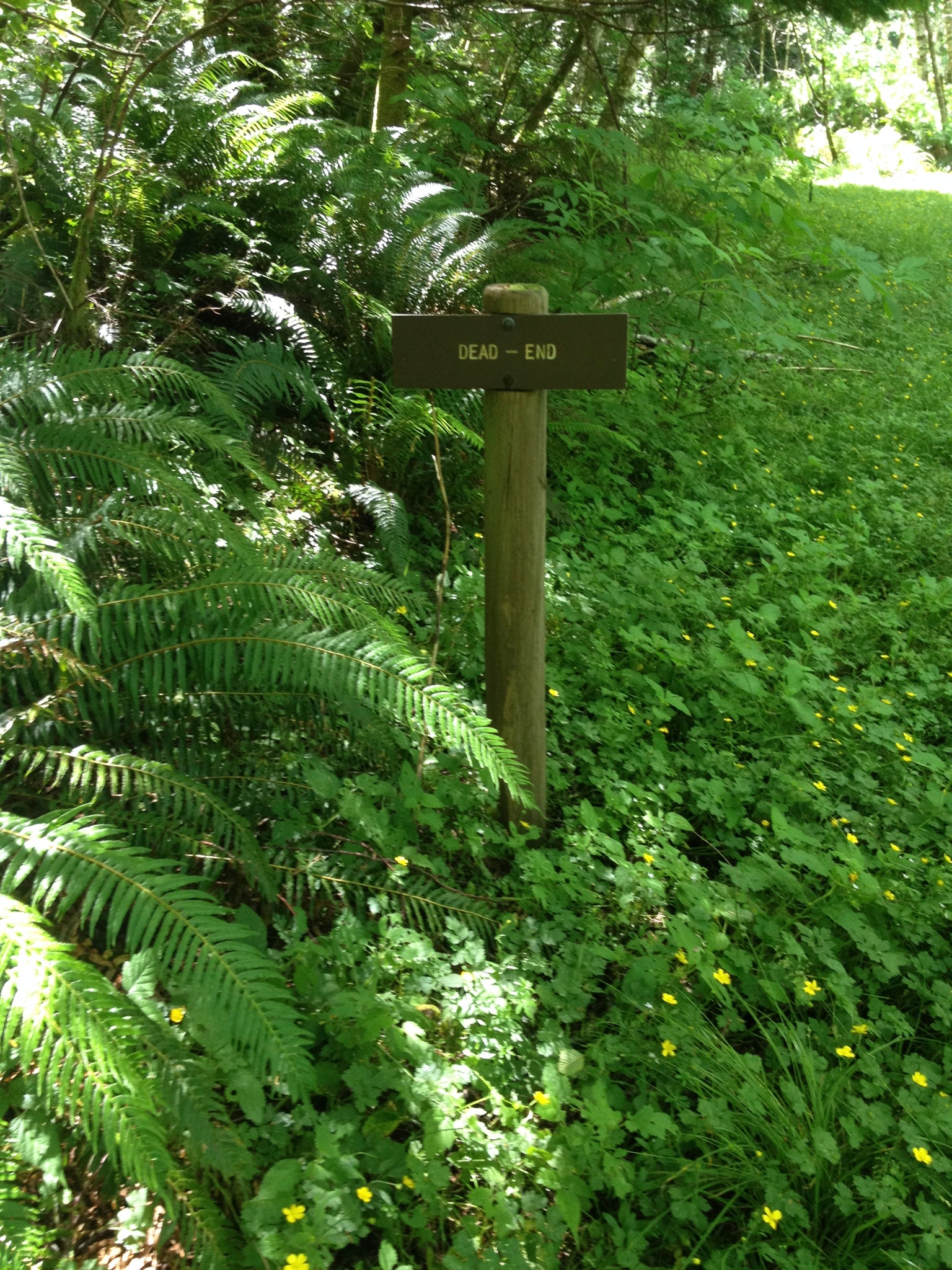
Cummins Creek Trail, Oregon Coast

Cummins Creek Trail, Oregon Coast, 2014

THE DEMENTORS IN OUR SYSTEMS

October 24, 2015

I don’t speak out much any more about quality of care in medicine, mostly because I am out of date.  But I am not out of data.

Last July, I had a sudden dysrhythmia.  I was minding my own business one evening, checking  a sunflower, when I stood up and started noticing my pulse pounding irregularly.  I had no pain, and at first I thought it was a bunch of PVCs, premature contractions, although they were a little different.  I was alone, didn’t want the animals to be uncared for if I were admitted, so I did the next best thing.  I went to bed.  I awoke at 1 am and felt fine.

I saw my PCP the next morning, who had had a cancellation, and my EKG looked fine.  She recommended a Holter Monitor, so I wore one for 48 hours, during which time I hiked and had no symptoms.  The monitor showed a few supraventricular rapid beats, nothing solid, but not normal, either, so I was told I would need to see a cardiologist, and a referral sent.

Ten days later, I had no appointment. On my own, I stopped all caffeine and chocolate, and the few funny sensations I had had vanished.  Unfortunately, so did my referral.  An email to the office went unanswered for a week, until my PCP replied, asking me what the cardiologist said.  Well, I wrote, maybe he or she had said something, but not to me, since I had no appointment.  She apologized and within a few days I had an appointment 5 weeks later, nearly 8 weeks after my event.

I saw patients as emergencies the same day who had a 10 year history of the same headache with several normal CT scans. I have a dysrhythmia as a 66 year-old and it takes 8 weeks to see a cardiologist?  It’s a different world today.

**********************************

Later, my wife needed a GI evaluation.  A referral was faxed to the specialist’s office, and we were to get called back.  The office of the referring physician was about 150 meters away, as the crow flies, from the office of the new physician.  Two weeks later, we had heard nothing.  My wife called, and nobody knew where the referral was.  This sounds familiar.

My wife and I are not mildly or moderately demented, we are educated, knowledgable about medicine, and can afford our care.  What happens if one is demented, uneducated, or unclear about the medical system?  Most people are unclear.  I certainly am, and I practiced medicine.  Perhaps these people think (1) nothing needs to be done, (2) the physician wants money up front and they hadn’t paid in advance, (3) somebody had changed their mind, or (4) they might not have assumed anything, just forgotten about the referral, since they didn’t have it on our mind and didn’t follow up.

Sort of like what happened to those who sent the referral.

A phone call was answered pleasantly, and my wife was told the referral would be faxed over to the other physician’s office that day, there would be “three business days” to set up a future appointment, and then she could have the procedure.  With all due respect to electricity, I can walk a referral over almost as fast and with complete certainty deliver it to the right person.  With all due respect to the fact my style of practice isn’t done today, “business days” is redundant.  Every day was a “business day” for me.  I told my wife that we were going to go to the physician’s office that day.  It was a 15 minute drive, and there is something about a face-to-face interaction that gets things done quickly.  It’s far more difficult to ignore a person, unlike a call, e-mail, SMS, or some other electronic medium of communication.

We bypassed everything possible and had the appointment 46 hours later, one business day, to those who count such things.

The same week, I discovered my monthly medications had no refills.  I sent an email through the online patient portal and waited a week to hear.  Nothing.  I called the pharmacy, and they had received nothing but would call the physician’s office.  I waited another week, now two weeks late in getting my medications, and called the pharmacy to see if my prescriptions were ready.  I heard a “prescription” (indefinite article, singular) was ready, and when I stopped by, indeed, one was.  The second one?  Nowhere to be found.  The pharmacy tech was pleasant enough, however, saying she would call it again to the doctor’s office. Before she called, I asked to see the dose, having changed it several months earlier. It was the original amount.

Fortunately, I had plenty of the medication at home, since the pharmacy had not changed the dose, despite my having asked them to do so.  Two days later, I got a call from the pharmacy, telling me that they had been unable to reach the physician’s office.  So much for pharmacies’ calling physicians successfully.  I called and talked to an answering machine.  I would have walked over, but I figured I had a week to burn.  I still haven’t received the drug.

None of these three issues was serious.  Sadly, none of them is rare, either.  These sorts of things on a daily basis are Dementors, for they suck the happiness out of people.  Time spent fixing these problems is time that can’t be spent doing something more important, like promptly scheduling a patient, rather than have them wait on hold, which we all do.

There needs to be a better way to track referrals.  I can log on to Amazon, UPS, or USPS and immediately know the status of a package that I ordered thousands of miles away, yet I can’t find out in my own small city whether my referral has been seen by the specialist or where my medications are.  What happens if somebody is elderly, infirm, doesn’t hear or see well, and needs specialty care?  We are up in arms about the Affordable Care Act, yet virtually everybody is silent about the many broken systems in medicine that affect everybody in the country who seeks care, which is about all of us.  Am I just incredibly unlucky?  I doubt it.

As for pharmacy issues, I find it ironic I am having the same problem that my op-ed in the local paper addressed: pharmacies must start using the state error reporting system.  Oregon is the only state that includes pharmacies, but the 721 last year reported exactly 20 errors.  I alone have had three, and there are nearly four million people in the state.  I don’t think I am incredibly unlucky. What happened after my op-ed?  Choices: (1) few read it, (2) pharmacies jumped on board and are reporting like mad, or (3) nobody really cares, because we have high quality care.  A=1; B=2,C=3, D=1,3.  You choose.

Every broken system has countable and uncountable costs.  The countable ones are hours spent doing things twice, looking for something, fixing what is wrong, and spending time apologizing.  The uncountable ones are Dementors: annoyance, unhappiness, feeling of powerlessness, the wondering why, after so many years of stating what we need to do in medicine, why it still hasn’t been done.

THE SEASONS OF OUR LIVES

October 21, 2015

The 2015 Canoe Trip has been like the last twenty or so.  We fly to Minnesota, drive 4 hours north to Ely, get the gear we rented, drive to the entry point, our jumping off point, and the next morning, regardless of the weather, enter the wilderness, for entry permits are day and place sensitive.

We are both old now, although we do note with some pleasure a few more folks like us on the water than in years past.  I think it’s because the gear is better, lighter, and more convenient than it once was, and a lot of our generation grew up in the outdoors.  I don’t do the long travel trips that I once lived to do.  Instead, we go in a dozen miles, find a site we like, usually one we have stayed at before, pitch the tent, and settle in.

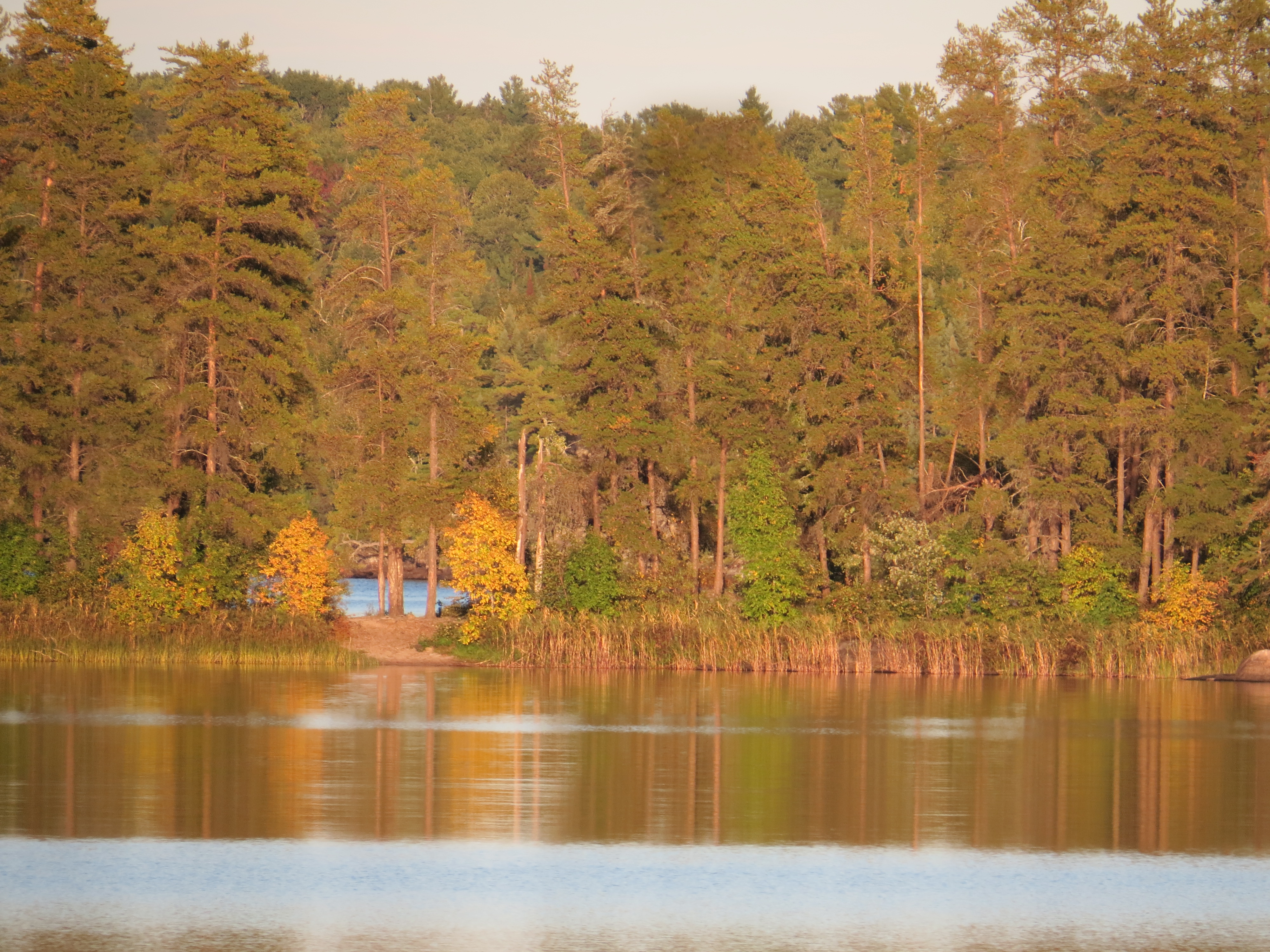
Fall Lake from the Fall-Newton portage, BWCA, 2015

Fall Lake from the Fall-Newton portage, BWCA, 2015

I like base camping.  It’s nice to pitch the tent and not have to take it down the next day to do another dozen miles.  Yeah, we could do it, but we’d pay for it a lot more.  The site we have is really nice.  It’s not one people go to by choice, I suspect, because there are only two tent sites, neither of which is great.  The one we use has me slide slowly towards my feet during the night.  I can live with that.

Down a bay is an isthmus site where I stayed in 2013.  It’s pretty, being ten yards from water to water at its narrowest spot.  There are a lot of tent pads, a decent kitchen area, and great sunsets.  I liked it and thought in 2014, when my wife was again well, we’d stay there.  She had seen the site once before with me when we were exploring and in 2014 we fully expected to stay there.

The isthmus campsite from our site on the point.  They get the sunset, we get the "Ross Light," a special light at sunset, coined by the great wilderness author Sig Olson.

The isthmus campsite from our site on the point. They get the sunset, we get the “Ross Light,” a special light at sunset, coined by the great wilderness author Sig Olson.

However, the site was taken. Bummer.  We paddled back out the bay, deciding to look at a site on the point.  It rises up some ledge rock from the lake, only 20-30 feet, but elevation matters in the Canoe Country.  We immediately noted the view down the lake a couple of miles to Canada and back to the isthmus site where we had just been.  Yeah, it’s work bringing the packs up, but we only have to do it once.  We get here in 4 1/2 hours and we often just sit for hours, watching the water and an occasional traveler.

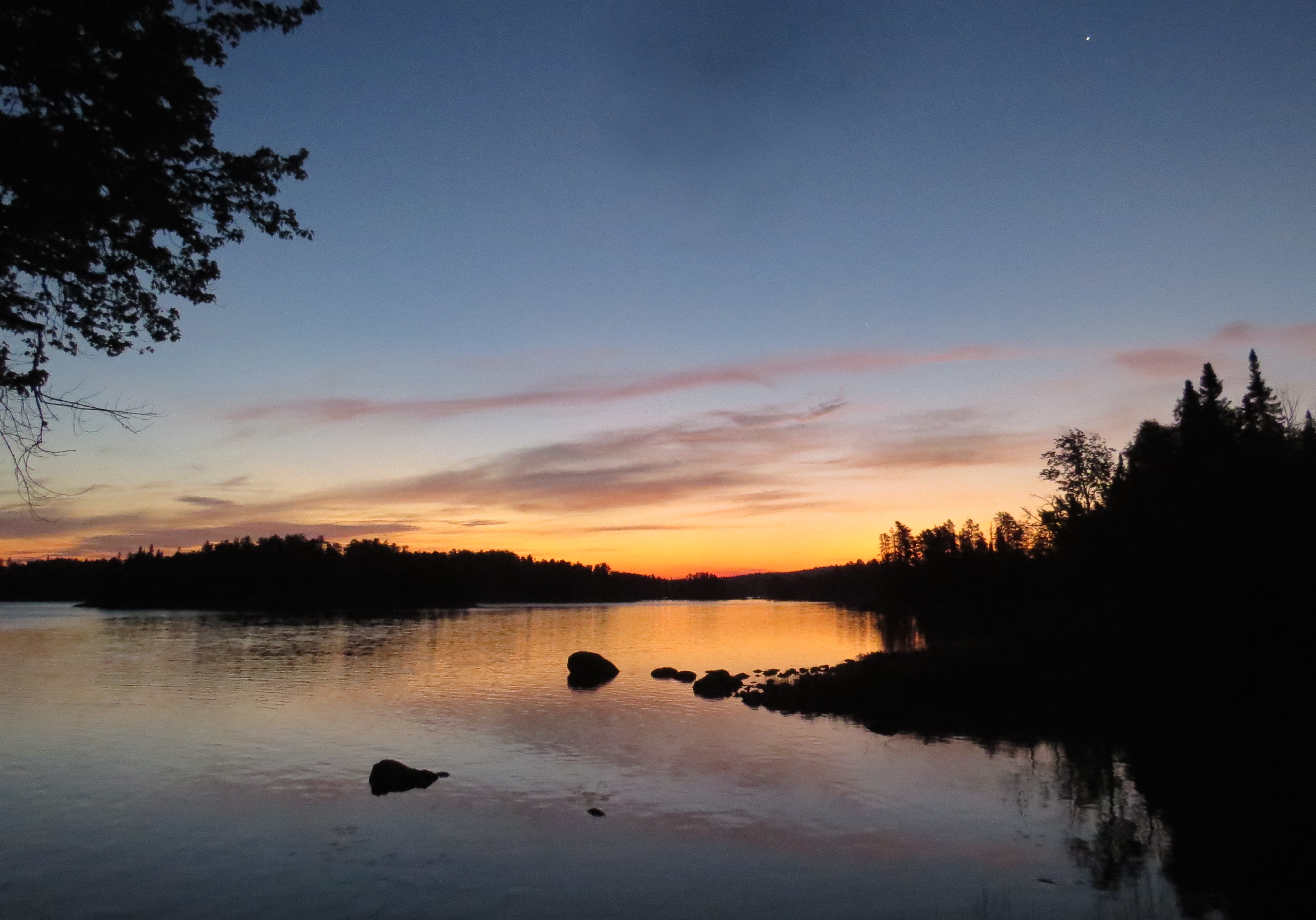
Evening view down the lake

Evening view down the lake

We have learned that by sitting still, we see a lot more.  This is basic to observing nature, but in the past, I’ve been in a hurry to see what’s out there, not as conducive to seeing wildlife.  Last year, we were treated to a nightly show of beavers swimming into the small swampy inlet next to us.  This year, we had no beavers, although the beaver house was still nearby.

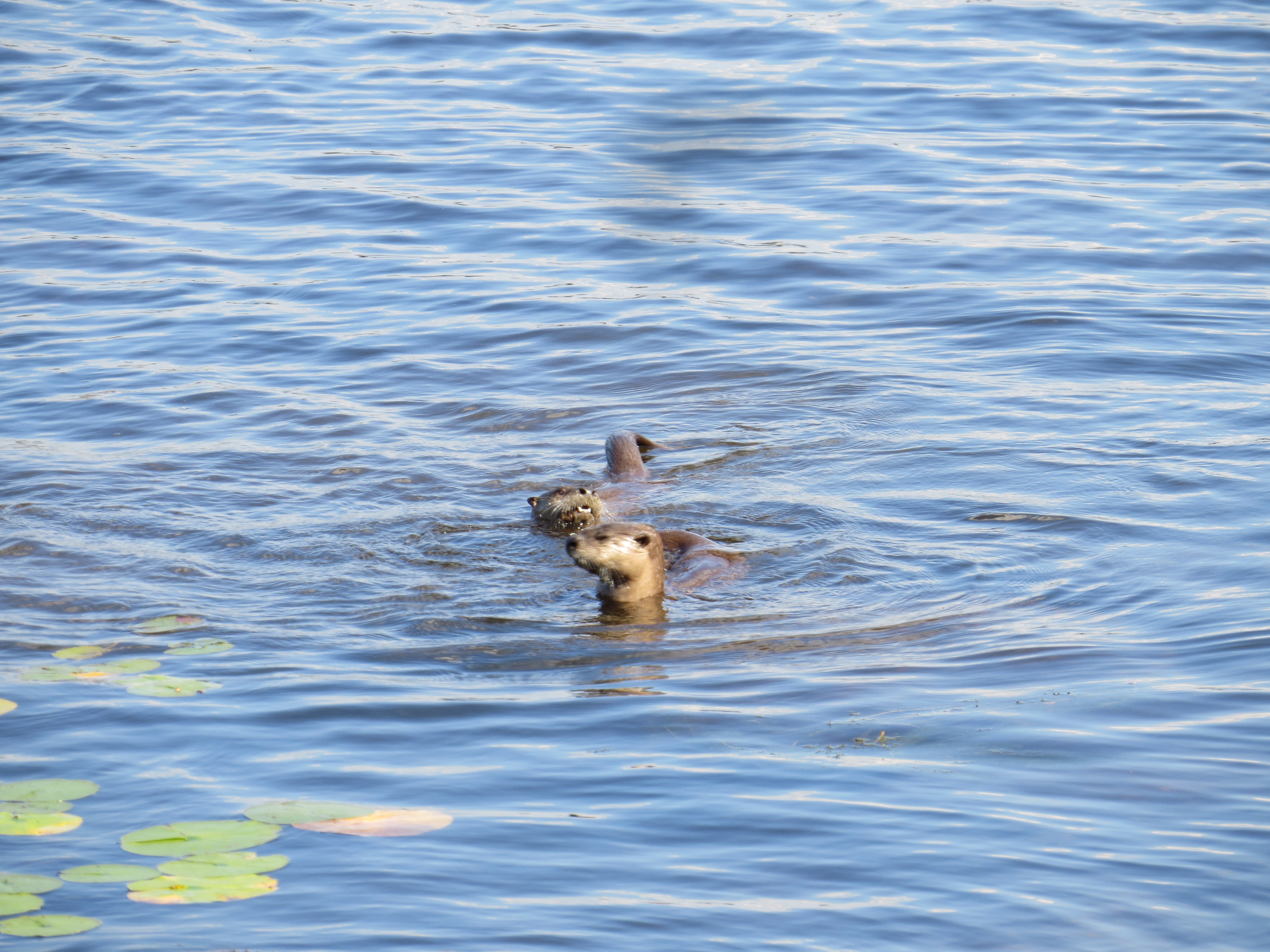
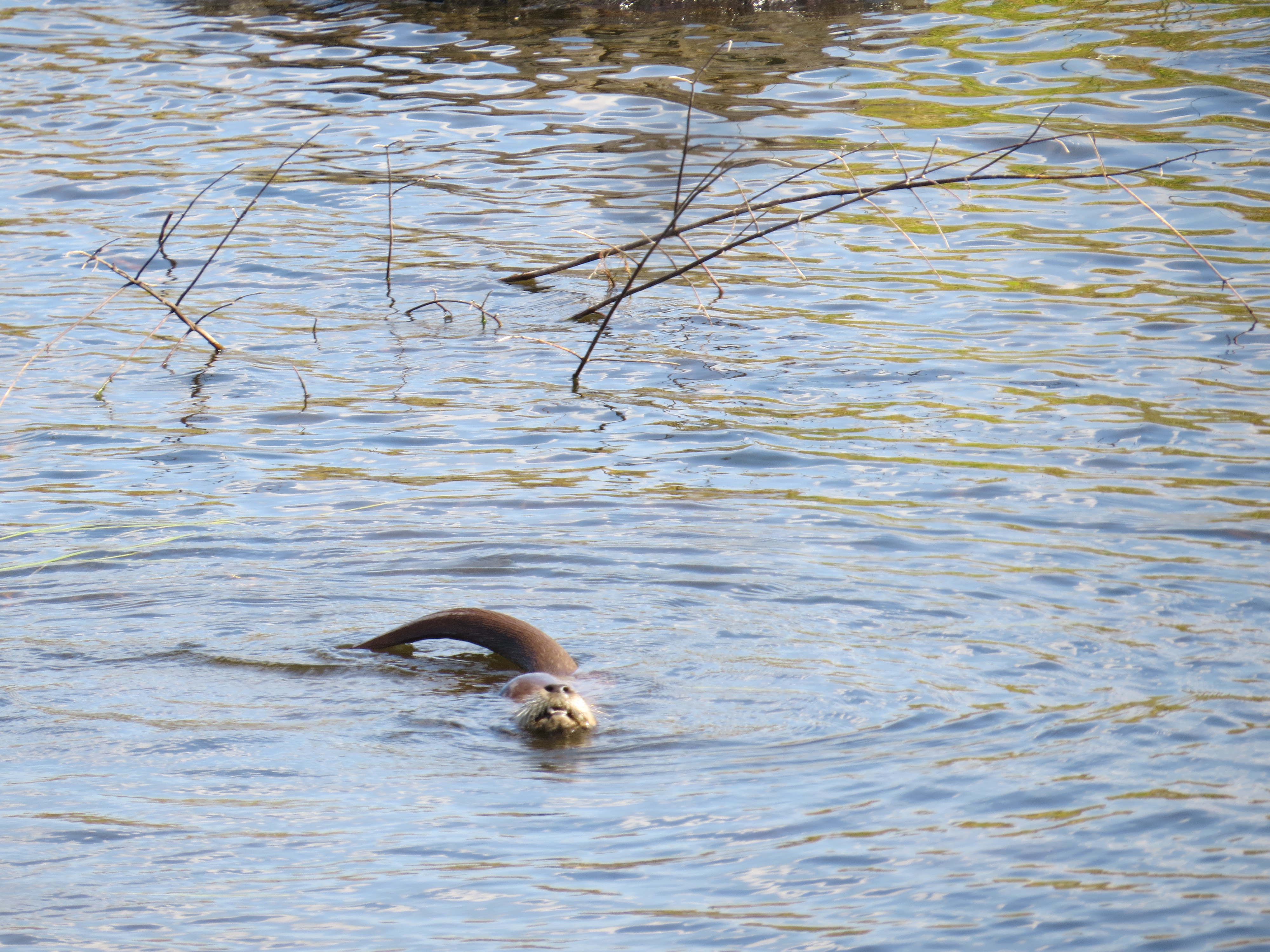
No matter, the weather was rainy for three straight days, so we got out for some short paddles and spent a lot of time in the tent, sleeping.  We sleep a lot out there.  The autumn colors were better last year; this year they are just beginning, although they were going to peak the week after we left. We get what we get.  The last full day out, we awoke to mist everywhere, threatening rain, figuring we’d take another day trip with the canoe.  The weather cleared, but then the wind came up, strong enough that we decided just to sit in camp the last day, reading, writing, looking down the long channel, or over to the isthmus.  We had a long paddle out the next day and wanted to save our arms.  At least that was our excuse.  Neither of us was looking at anything, just the trees that had changed color, the sky, the shadows, and the.….otters that suddenly appeared right off shore, three of them.  The day before, we watched one play with a stick on a rock face, before he ran down into the water.  We had missed the beaver show, but the otters played right below us, diving, allowing us to see them underwater, come up by a rock, by each other, and then disappear again.

IMG_6094 IMG_6097

Otter, Basswood Lake, BWCA, September 2015

Otter, Basswood Lake, BWCA, September 2015

By remaining silent, we saw a hermit thrush walk through camp, a Hairy Woodpecker and a Three-toed Woodpecker work on a dead birch tree near us.  Sometimes you see this stuff when you are traveling fast; the chances are greater you will if you sit still. I have long had the philosophy that wildlife viewings are a gift.  I never expect any, so if I see something, I feel blessed and grateful.  The otter viewing was the best I’ve seen, and I’ve seen a lot of otters.

We talked about what we would do when either of us or both of us can no longer do the work to get up here, or if the benefits don’t outweigh the effort, which can be considerable.  We can see those years in the future now.  It could be next year.  For my wife, 2013 was such a year.  On the other hand, we are able to do the work, and we hope maybe we’ve got a few more years out at this site until we need to move to a place that closer in, but still keeps us in the wilderness we’ve grown to love.  Eventually, we may have to stay in a cabin and canoe from there, not in the wilderness, but close to it.  That is how we hope our lives may play out.

There are many who say that age is just a number, but they are young and not wise in the ways of probability and genetics.  Things happen as we age.  The work necessary to get into this country requires strong enough arms to paddle long distances, often against headwinds, legs and body to carry packs and a canoe, decent balance to walk in camp, and ability to take care of oneself in the outdoors.  I’m relying heavily on experience these days.  On the trip in, the canoe went up on my head automatically, without my even thinking of it.   I can still move a canoe in any way I want it to go, I can read the sky and try to travel smart.  There are no guarantees, however.  I want to come out here as long and as I safely can.

I spend only a few nights every year up here.  They have now added up to more than three hundred in the border lakes country.  The special places I’ve seen are where I go in my mind when things are bad, life is difficult, and I need to mentally separate from the present.  Like the otter, I appear there, spend some time, then go, glad for what I experienced.

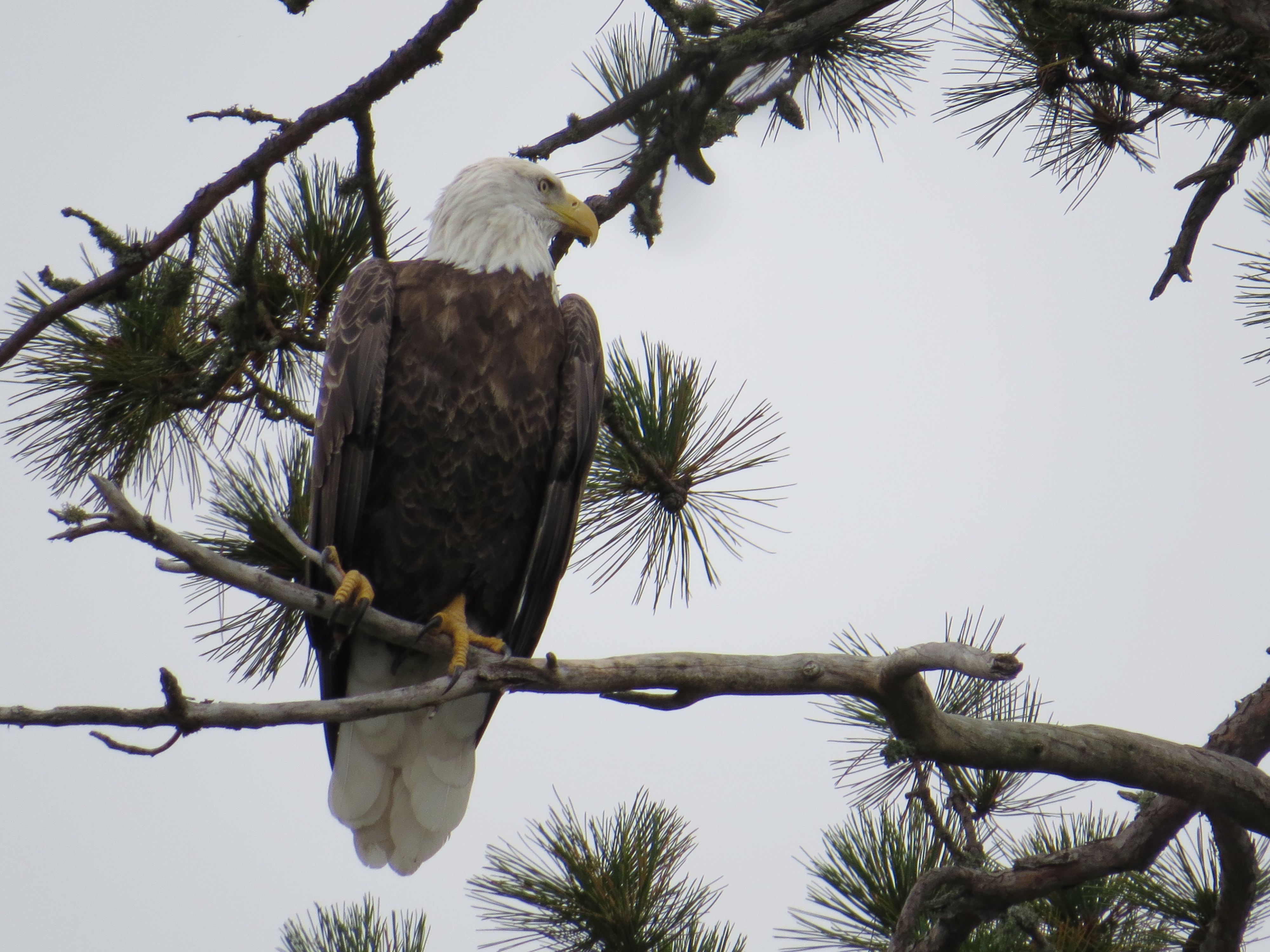
Eagle near the Canadian Border, BWCA

Eagle near the Canadian Border, BWCA

TWO MOOSE ON ISLE ROYALE

October 12, 2015

In Isle Royale National Park’s Visitor Center, on the largest island in Lake Superior, there are many moose skulls on the wall.  Such is not surprising; since 1997 a few hundred moose and a few dozen wolves have been completely isolated from the mainland.  It is one of the longest, most intensively studied predator-prey relationships in existence, but the wolves are dying off, a tragedy and a controversy as to whether new ones should be introduced, a raging controversy, both sides passionate about what to do.

Ironically, how we usually handle this and other hot button issues is summarized right on that wall.

Two skulls are very close together.  Indeed, it takes a little while to see that there are two, for there are so many antlers around them.  Then, it becomes strikingly clear what happened.  Two moose, probably in rut, fought over a female.  Their antlers locked, and they were unable to disengage.  Their destiny was not to win or lose.  No, their destiny was death together, fighting futilely to exhaustion and starvation, easy prey for wolves.

We might learn from that, if we weren’t so busy locking our own horns to realize we and those with whom we argue may both lose, prey for our common enemies.  Red-Blue, Conservative-Liberal, Pro Gun-Anti Gun, Republican-Democrat, one side-other side.  Take your pick, apparently, because there no longer seems to be much common ground, except there is, if we start looking.  If we choose to keep fighting, the wolves of the world will pick us off, because we will be too busy playing the futile game of trying to convince people who won’t be convinced, rather than finding a new solution, missing opportunity after opportunity.

That is why when Facebook put an ad on my site saying “Stand with Hillary and take on the NRA,” I didn’t add my name.  I will admit I have no love for the organization and am against their current agenda (which wasn’t always the way it is today).  But I know that without the NRA’s help, yes help, we aren’t going to solve the issue of mass shootings.

I’m going to assume that no decent American wants to hear about another mass killing.  It doesn’t matter whether the individual is an Oath Keeper or one who wants firearms banned.  No reasonable person wants the shootings to continue.  Simple solutions proffered by both sides won’t work, but we are a technologically developed country with many who are experts about firearms, their manufacture, use, safety and locking mechanisms, as well as tracking them. We have experts in firearm safety, human behavior, system and study design.  We need all of them.

It is not likely that we will be soon be able to determine which mentally ill person is a likely mass shooter. Maybe with better mental health care we would slightly alleviate the problem, but  many of those who harbor violent urges don’t seek help.  They don’t see a problem.  Additionally, we aren’t likely to pay for the cost of mental health care, even if we returned to institutionalization of the 1950s, which was a dictatorship over people.  Without doubt, it would solve a lot of problems: homelessness, some shootings, extra police work, and many emergency department visits, but at the cost of liberty to many.

Cars are dangerous, too.  Thrice as many die in the US every year from automobiles than from murders due to guns.  Notice my use of numbers.  These are facts.  If we allow research into gun violence to again be done, the way it once was, we would operate from facts, less from emotions and inaccurate numbers.

Guns are the major cause of suicide, and twice as many die from suicide by gun than murder.  Only the most callous would say that those who want to kill themselves should do so and be done with it.  These callous people are online, and we need the help of ISP and other computer experts to deal with the harmful byproduct of anonymity on the Internet. No reasonable gun advocate or anti-gun advocate wants to see firearms used to commit suicide.

We once had poorly engineered automobiles.  Indeed, Ralph Nader became famous with “Unsafe at any Speed.”  Improved engineering, better materials, seat belts, air bags, ABS, and side protection have cut the number of motor vehicle deaths 40%, despite a significant increase in the population (the number per 100,000 has fallen 60%).  We haven’t eliminated the problem.  One may wear a seat belt and die in a MVA, but the probability is less.  We don’t know who the 20,000 survivors are because of safer automobiles, but if we had 52,000 deaths a year, we would do something about licensing people, drunk driving, safer roads, and better auto engineering.  Oh, we did have that many deaths, and we did act.

So, this is where the firearm experts are needed.  Here is where the NRA is needed.  Here is where every responsible gun owner is needed.  We need ways to prevent people misusing firearms.  Yes, it is impossible to do it perfectly, but yes also, we can find a way to improve our current situation.  If we had 5,000 gun deaths from murders a year, it would still be too many, but it would be better than what we have now.  If we had 5,000 suicides a year from guns, it would still be too tragic, but it would be so much better.  If 30, rather than 60 children died from accidental GSWs, it would still be too many, but 30 fewer devastated families.

I’m weary of arguing.  It is not the time to “Take on the NRA.” Like the man with the wind and the Sun, if I blow harder, he will only pull his coat tighter.  No, it is time for the NRA and its membership to be invited to the table, to offer engineering and other solutions that have a chance of being tried and tested.  Who should own what?  How is ammunition regulated?  What should be written down, and what not?  How do we do background checks and maintain privacy?  What are ways to deal with this problem that we can a priori postulate what we think will happen and then count to see if it did happen?  Wouldn’t that be an improvement over what we aren’t doing today?

I want the mental health community to be at the same table to offer suggestions.  I want researchers to design studies showing how we might determine if a possible improvement works.  I want security experts and IT at the table, too.

Legislation may have to come from a Republican Congress.  Only a Republican in 1972 could go to China, and I think only a Republican Congress can write such legislation.  They need help from the Democrats, but at the same table, with the goal to decrease gun violence in this country and at the same time not limit responsible firearm ownership.  It is a tall order, given the money involved in making firearms and the emotions when somebody is gunned down.  However, given where we are today, we can’t do much worse.

Like the moose, we can lock antlers and hope to win, bloodied but victorious.  Or, we may end up together on the ground, helpless against our enemies.  We can use what’s in our skulls to solve the problem, with leadership and risk taking.  It’s our choice.

The two moose were programmed to fight.  They didn’t know one of the consequences.  What’s our excuse?

LEAVE NO TRACE JOURNEY

October 2, 2015

Leave No Trace (LNT) has been a part of backwoods, wilderness, outdoor travel for a few decades now, but until the first half of the 20th century, wilderness was the enemy, the “out there” that needed to be subdued by cutting trees, draining wetlands, building roads to lakes, later flying into them, making the outdoors accessible and safe for people.

About a century ago, outdoorsmen like Aldo Leopold, Wallace Stegner, Bob Marshall, and Sig Olson, among many others, challenged the notion of subduing wild lands, stating the opposite, that we need wilderness.  As a species, we are not far removed from wilderness, they wrote, and periodically need to get away to the “back of beyond,” far from steel, asphalt, cars and towns, where a person could be alone, on his or her own, and by being such, might reclaim some of the sanity, some of the humanness that had been lost.

In the early 1950s, I spent summers at a cabin by Ontario’s Crow Lake, a beautiful place with few people and motors.  We didn’t worry about trash.  We burned what we could and daily took the cans out to the center of the lake and sank them.  Everybody did it, but everybody back then was a small number.

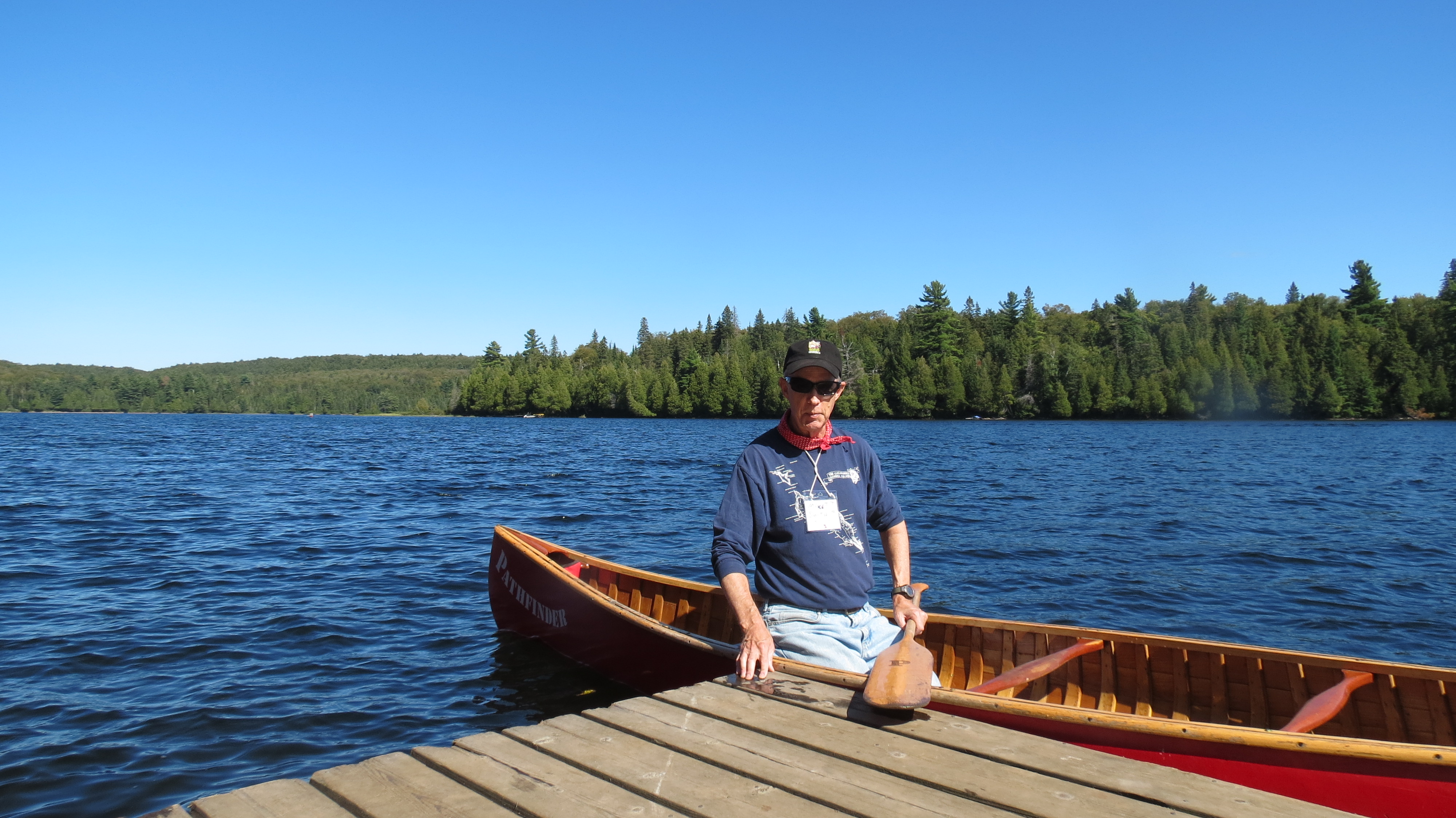
A decade later, as a camper and then member of the Camp Pathfinder canoe tripping staff, we traveled in wood and canvas canoes, with keels.  Pathfinder today, 102 years after its founding, still uses red Old Towns. Our heavy canvas tents leaked if one touched the inside of them when they were wet.  The mosquito netting had holes, and every night, campers were told to ‘hold their breath” as bug repellent was sprayed into the tent.  I have no idea what I inhaled.

Author at Camp Pathfinder 100th year reunion, 2013, back in a red canoe for the first time in 47 years.

Author at Camp Pathfinder 100th year reunion, 2013, back in a red canoe for the first time in 47 years.

Day trip to Little Island Lake, Pathfinder reunion.  I camped on this very site fifty years prior.

Day trip to Little Island Lake, Pathfinder reunion. I camped on this very site fifty years prior.

We cut down small trees, usually balsam firs, to use their trunks as tent stringers, to which we tied the front and the back of the tent.  We used the boughs as mattresses.  Our food was cooked over an open fire, requiring large amounts of wood, for there were no camp stoves.  An axe was a necessity; every campsite had a can pit, a considerable amount of rusted junk, which attracted bears.  We made our own fire pits and camped wherever we wished.  Meal time, we soaped the pots and pans to make removing the blackness easier, later cleaning our dishes in the lake, leaving many visible food particles.  We used sand to scrub, moss to remove grease, thinking ourselves woodsmen of the first order.  Maybe we should have known better, but nobody I knew did. Sunscreen was unknown and we had no water filters.  Small wonder we often became ill.

Having learned to camp this way, the idea of complete LNT has been slow for me to adopt and for many others my age, some of whom haven’t adopted it at all.  I began using camp stoves about 25 years ago, never did cut green trees for firewood, or strip birch bark from a live tree.  That part was easy.  I’m still able to camp where water is drinkable, but even in the Boundary Waters, I’ve become ill on two occasions.  I take water from the middle of the lake and usually boil it now.  I use a small saw to get wood, although I do have issues with the suggestion that wood be gathered more than 150 feet from the shoreline of a lake.  Better wood, not degraded, is present along the shore, and walking deep in the woods risks injury, getting lost and hurting plants.

I hadn’t made the final step until recently.  I stopped burning trash. In Alaska, people still do on trips, but it is illegal in Minnesota to do so, and burning plastics releases toxic gases.  Many food containers used have aluminum foil present, the bane of litter in the woods.  Contrary to many beliefs, aluminum foil does not melt, but it does fragment, so even burning the pouch and carefully collecting aluminum left some behind.  All trash was packed out, including dental floss, and when I brush my teeth, I spit into the fire pit, not spray it on leaves, many of which on campsites are white from others’ doing this.  Cleaning pots means getting the soap off, but away from the lake, scrubbing with scouring pads and not rinsing them in the lake.  It seems so tempting just to do it in the lake.  A little soap won’t hurt.  But yes, it will.

In 1992, when I volunteered for the Forest Service in the Boundary Waters (BW), I saw first hand how LNT was being implemented. The BW has designated campsites, where one must stay.  This concentrates the impact to a few places, rather than many.

We need to regulate, because people don’t self-regulate well enough:

  • We must enter on a specific date and place.  The length of time one may stay and exit may not be regulated.  We want to disperse people throughout the wilderness, not overwhelm designated campsites.
  • Campsites all have a fire grate, the only place a fire is allowed.  The fire must be out, dead out, tested by using one’s hands in the ashes, when one leaves the campsite, be it for good or for a day trip.  I’ve seen experienced people leave burning fires when they day tripped.
  • It is illegal to cut, deface a tree or pick flowers.  The days of tent stringers are long gone; new tents are easier to pitch and leakproof.  Despite Thermarests, people still cut pine boughs, but it is rare.  Still, many trees are defaced by having nails driven into them to hang packs off the ground or for clotheslines, neither of which is necessary.
  • Only 9 people and 4 watercraft may be at the same place at the same time.  This removes crowds.  On busy portages, crowding may be a problem, but with 250,000 visitors annually to the border lakes, rules are needed.
  • No cans or bottles are allowed in the BW except for medications, fuel, and toilet articles, one of the first rules and one of the best. Can pits are long gone.
  • The latrine at each campsite concentrates human waste in one area. Nothing should be thrown into it, although I’ve seen fish, books, clothing, fuel bottles, and liquor.  Latrines may last a few years before being re-dug.  I have dug sixteen in the rocky soil, a difficult, nasty job, especially removing the old one and covering the prior area.  The Appalachian Trail Conservancy must come to grips with human waste with hikers passing through, because many don’t bother to bury their waste,  More and more LNT is requiring packing out human waste  We did it on Grand Canyon raft trips 35 years ago. If I live long enough and remain healthy, I see a day when will routinely I pack out my waste.

I have found these changes to be difficult to adopt, but with time, they become easier.  The idea is to leave a site better than it was when one arrives.  For the current generation, this should all be easy.  For my generation, it has required a lot of changes. It isn’t 1950 any more, we aren’t making new wilderness, and many would like to destroy the little we have.

We need wilderness for our sanity.  Some of us have long known it.  Others have yet to learn.

View from campsite in Boundary Waters, 2015.

View from campsite in Boundary Waters, 2015.

DESIGN FLAW

September 21, 2015

I reached across the canoe to the opposite gunwale, ready to hoist, flip it upside down and put it on my head.  Suddenly, I felt a sharp, quick, not-real-painful-but-you-know-it’s-going-to-bleed-like-stink sensation, as my finger encountered a razor sharp aluminum strip.  With a big OW, I managed to get the canoe up and started walking from Meadows Lake to Agnes, a 160 rod, (1/2 mile) portage on rocky trail, annoyed at the pain, the blood, and wondering what happened.  I forgot at least two other times later, had several fingers bandaged at the end of the trip, when I told the outfitter that the strip was a design error and needed to be fixed.  These things happen; if nobody speaks up, they continue to happen, and others get hurt.

Volkswagen, in Wolfsburg, Germany, north of the Deutsche Bahn tracks, got in serious trouble on my side of the Atlantic. It began when their cars’ emissions were a lot worse than the lab tests showed.  A small clean air group here, led by an individual, ironically named John German, asked to have tests done in the US, where we have the world’s strictest emission standards.  A car was driven from San Diego to Seattle, and the emissions were 30-40 times higher than the standards set by the Clean Air Act.  German, who believed that diesel was a clean fuel, was stunned. VW put a software patch on the cars, and they passed our emission tests, but open road tests still showed discrepancies. Only then, did VW admit they designed the software patch to turn on emission controls during testing but turn them off afterwards.  How can somebody work for a company when they know they are deliberately falsifying emissions data?  Money.  VW only polluted air.  GM killed people.

For that same week, GM got hit with big fines— only fines, no jail time—for a faulty ignition switch which shut off the engine and critical systems, like air bags, killing 124 and injuring nearly 1000 others.  One death was not counted by GM, because the airbag in the back seat worked, although the young woman still died as a result of the crash caused by the faulty switch. A root cause analysis leads straight back to the ignition switch, which was known in 2002 not to produce enough torque. GM had held meetings about this problem since 2005, and the investigation has continued since then, hindered by GM’s hiding key papers, making it difficult to find out which accidents were due to cars’ having a faulty switch.  Yes, hiding papers.  For that, 15 people lost their jobs (not lives) and 5 others were disciplined.  At the Senate hearing, the CEO, who had worked at GM for 33 years, claimed not to know anything about a defective switch.  As my late father would have said, “She was either stupid or lying.”  GM knew they had a faulty device, and they took the chance that a recall of the cars would be more expensive than having to pay lawsuits, $575 million now in a contingency fund, run by Kenneth Feinberg (the man who doled out 9/11 compensation), fix twenty-nine million recalled cars, and pay a $900 million fine.

By the way, had it not been for a Georgia plaintiff attorney, we might never have known about this problem.  Not only do we appear to have a Congressional culture against regulation, we need better regulators in those instances where there is supposed to be regulation.

Congress makes laws, like the Clean Air Act, back in the days when Congress did the people’s business, and Republican presidents signed environmental laws. Congress has failed since 2003 to compensate illnesses among the 70,000 who cleaned up the wreckage at the Twin Towers.  We know the air they breathed was toxic (1000 tons of asbestos, 200,000 pounds of jet fuel, mercury from computers to name three), yet the people involved were told the air was safe.  We don’t know how many of the 874 who have died did so from the cleanup; many others have chronic illnesses. My God, is the country so desperate for money that we can’t cover medical costs for these people?  Why, because somebody might cheat? These people cleaned up hallowed ground. We call poor people who get something for nothing cheaters (the few that cheat on Food Stamps, half that of Medicare); we call businesses that get something for nothing “blue chip.”

Systems are complex and imperfect.  Sometimes, products don’t work the way they are designed to, like metal strips on a canoe, and need to be fixed.  Product recalls are annoying when one sits in an auto showroom waiting for a vehicle to be fixed.  But when the product is known to be defective, put on the market anyway, and a financial choice is made as to whether this should be recalled or deal with the consequences, I become irate.  I’m uncertain what the cost of a life is, although Mr. Feinberg might know.

That brings me sadly back to Congress.  The same people who swear on their Saint Ayn Rand don’t get it.  I’ve read her books, which presuppose a perfect world, where businessmen don’t cheat, do insider training, accept the wrong ignition switch, deliberately program software to do the wrong thing, or have poorly designed gas tanks.  These “self made” people didn’t make it just because they worked hard; no, they made it because of genetics and an infrastructure and educational system paid for by others, connections, and sometimes dumb luck.  The notion that hard work succeeds, and failure is just the absence of hard work, is wrong.  Go to the Olympic Trials sometime, and look at the athletes that didn’t quite make the Team.  They worked just as hard, maybe harder, were very skilled, but not third best, only fourth.

What is this hard work?  Some is truly genius and a lifelong devotion.  No question.  Some were deliberately creating financial instruments people didn’t understand, like CDOs with NINJA mortgages (No Income No Job Applicant), and market them as AAA securities.  This isn’t capitalism.  It’s cheating.  Ayn Rand knew a lot about cheating, too, although few publicize her biography.

We have certain realities in this country: any of us is a virus, an aneurysm, a mutation, a blood clot, a head-on away from a disaster that isn’t our fault.  Does America have compassion or is it survival of the fittest?.

As I write this, I am going into the wilderness, created by law in 1964 to protect land and allow man to visit it but not live there.  This country was almost dammed 80 years ago and had aircraft flyovers restricted 65 years ago to preserve solitude. Now, the current risk is sulfide mining, one of the most polluting industries there is.  Yes, we need to mine, but there are places where mining is too risky to consider, bad consequences irreparable. The EPA was only the proximate cause of the pollution in the San Juan River, and hydroplaning and crashing was the proximate cause of the women’s deaths.  The bankrupt company that abandoned the mine without cleaning it up was the root cause, without which nothing would have happened, just as the faulty ignition switch stage was the root cause for the women’s deaths.

“I HAD THE BEST OF IT”

September 15, 2015

We woke at 1 a.m., perhaps because it was so quiet on Horse Lake in the Boundary Waters Canoe Area (BWCA).  When we unzipped the tent and crawled outside on the dewy grass, we saw Orion’s stunning reflection on the water.  I looked overhead, the only time in my life seeing all 7 of the Pleiades visible to the unaided eye.  Oh my, there was absolutely no sound.  Wilderness, dark skies, and quiet:  My outdoor triad.  We had the best of it.

Yeah, we had the best of it one night on the North Tonto Platform down in the Grand Canyon, west of Clear Creek, where we had left the prior afternoon, so we could get part way back to Phantom Ranch rather than doing the whole hike the following day.  We dry camped, maybe where nobody had camped before.  We saw dark skies and heard nothing, not even the Colorado.  We whispered.  The Canyon is noisier today, and I don’t know whether that experience is possible, along with our hearing the echo of a raven’s wings off the Redwall, in a deep southern curve called The Abyss, back in ’86, unforgettable.

We had the best of it just last year in the BWCA, awakening to the sound of wolves not far from our campsite.  We got up, went out and saw an aurora, not just that night but the next, too.  Beavers felled trees in a swamp nearby, not knowing or caring about us as they swam by with leafy branches in their mouths.  A moose walked through the swamp, an hour after the thought had occurred to me the only thing we had missed was a moose.

Beaver swimming back to lodge, BWCA, 2014. Basswood Lake

Beaver swimming back to lodge, BWCA, 2014. Basswood Lake

Moose in swamp, Basswood Lake, 2014.

Moose in swamp, Basswood Lake, 2014.

Oh, the best of it could have been a number of places, one of which was from a small site on Lake Insula, where we saw the Harvest Moon’s rising over the trees at the far east end, trees now burned, but some day, not in my lifetime, will grow back.  We had the best of Insula.  I spent 40 nights there.  Camped twice for 5 nights each on one site and didn’t see a soul. That’s wilderness.  We had sunny days; we had sleet and snow.  We knew the whole lake.

Lake Insula sunset, 2009.

Lake Insula sunset, 2009.

Author standing on

Author standing on “The Rock,” Lake Insula, 2005

Author in tent, 2007, Lake Insula trip where we evaluated all 47 campsites. Snow and cold weather made the job interesting.

Author in tent, 2007, Lake Insula trip where we evaluated all 47 campsites. Snow and cold weather made the job interesting.

We had the best of it the day we hiked the upper Aichilik in Alaska, under heavy packs, where lunch was a sit down affair with Caribou walking right by us, and afternoon was walking below Dall Sheep, who weren’t the least bothered by us.  Doesn’t get much better.

Dall Sheep, upper Aichilik River drainage.

Dall Sheep, upper Aichilik River drainage.

Caribou, upper Aichilik River, Alaska ANWR, 2009. No telephoto.

Caribou, upper Aichilik River, Alaska ANWR, 2009. No telephoto.

We had the best of it in the Gunflint when we finished the 15th portage of the day, and I took the canoe off my head, tired but knowing we had finished the Frost River.  What a great decision to camp early the day before and start the river in the morning.  Saw a moose, too. That day some people asked what lake they were on and the weather forecast.  I told them Cherokee Lake and that it would rain the next day.  Mind you, I hadn’t heard a weather forecast in a week.  New south winds up north, however, mean rain.  Poured the next day, planned day of rest.  Great trip.

I had the best of Crooked Lake the day I soloed in from Mudro Lake.  I had an otter surface next to the canoe and hiss at me, as the south wind pushed me north. I crossed a rough stretch, later watching the Sun set, knowing my tired arms could take me the last mile of 20 to a campsite on the border.  I was awakened the next morning by wolves.  I got up, but it was too dark to see them.  I did see clouds moving up through Orion’s belt.  South wind. I broke camp and launched, and it poured all the way to Fourtown Lake. Didn’t see anybody the whole trip.

It’d be 14 more years before I actually saw a wolf— on Isle Royale— 10 trail miles from the nearest person. Told that to a friend, and he wrote back, “God Damn!  That’s what it’s all about.”  Never heard him swear before or since.  But he nailed it.  So did I.  He has had the best of it, too, in a different style.

Or ’92 in Canada’s Quetico, on Kawnipi Lake, alone, a quiet late spring night, after a hard push through snow and wind up Agnes.  The work involved in canoe travel matters as much as the destination.  Kawnipi is special, difficult to reach, and I went there six times, the last time solo, at 56. Wow, am I blessed.  I go to Kawnipi in my mind sometimes.  I had the best of it.

Last time on Kawnipi, May 2005. Or do I try one more time?

Last time on Kawnipi, May 2005. Or do I try one more time?

I had the best of Alice Lake, mid-October 23 years ago, 6 days without seeing anybody, alone in perhaps 200 square miles, with a morning blizzard and a headwind.  Crazy?  No, it was one of the most memorable days I’ve canoed, and I’ve been lucky to have camped five hundred nights Up North.  Last night out, I fell asleep to rain and then heard it stop, knowing I would wake up to a white landscape.

I’ve been alone at the top of Texas, on Guadalupe Peak, calm, despite gale predictions, looking down on the salt flats and watching the low sun cast the shadow of the mountain miles to the east.  I made it down that evening just as it got dark. Great hike.

Guadalupe Peak, Texas, summit, December 2005.

Guadalupe Peak, Texas, summit, December 2005.

Same in Wind Cave National Park, in South Dakota, on a hike out somewhere where you could see forever except for a few copses of trees, and an elk herd galloped right in front of me, a drop your jaw and stare moment.

Wind Cave, NP, South Dakota, 2007.

Wind Cave, NP, South Dakota, 2007.

I had the best of it on a cold February evening in the viewing blind at Rowe Sanctuary, alone, when a flock of ten thousand Sandhill Cranes displaced a large flock of Snow Geese.  There were birds coming right at me, birds everywhere.  On my video I say, “I have never seen anything like this in my whole life.”

Rowe Sanctuary, Nebraska, Crane Migration, 2012. These are not uncommon sights.

Rowe Sanctuary, Nebraska, Crane Migration, 2012. These are not uncommon sights.

It could have been the best along the Lady Evelyn River in Temagami, up in Canada, fifty-one years ago, when we camped by a long set of rapids on one of the most difficult canoe trips I ever did.  It was marvelous country to see, in my sixteenth year.

Or splashing down the Tim River, pack on my back and canoe on my head, because one of the campers was unable to carry the pack, and as head man, I had to do it.  I still remember on the Bulletin Board at Camp Pathfinder, where they listed trips, the words, “Mike Smith in charge.”  I was eighteen.

Oh, the best close to home might have been back in ’89, hiking up to 9000 feet in rain/snow mix, camping on Baldy Saddle in the Santa Ritas.  Snowed that night, but I was warm, listening to snow gradually accumulate and slide down the tent.

We had the best of the grasslands of Sonoita, before it got crowded, when we slept out under the stars, watched the Milky Way rise, and shortly thereafter the waning gibbous Moon.  A decade ago, I hiked up the Santa Catalinas from my then house, walking three miles to the trailhead and climbing 4000 feet, so I could fulfill a dream I had to spend one night—just one—sleeping up there.  Nearly a million people were below me, but I didn’t hear a sound.  I had the best of the Catalinas that night.

A letter in High Country News prompted these musings.  A prior issue was devoted to the overcrowding, cycling in the wilderness, and the loss of wild country, through privatization and destruction.  The writer, 63, if I remember correctly, wrote simply:  “I had the best of it.”  He did.  And so have I.

It’s still possible to have the best of it, but far more difficult because of more people, less wild country, many years behind me and few ahead.

My hearing is fading, my strength less, but I still hear the call of wild country.  I’ll answer as long as I can.

Young Moose, Isle Royale, May 2006. Too close.

Young Moose, Isle Royale, May 2006. Too close.

The Big Lake, Superior, from Isle Royale. May 2006: 9 Moose, 1 wolf, 1 fox.

The Big Lake, Superior, from Isle Royale. May 2006: 9 Moose, 1 wolf, 1 fox.

NEEDLESS, PREVENTABLE DEATHS

September 3, 2015

“I don’t think it’s about more gun control.  I grew up in the South with guns everywhere and we never shot anyone.  This (shooting) is about people who aren’t taught the value of life.” (Samuel L. Jackson).

I’m not Mr. Jackson, a famous actor.  I’m Mike Smith, a nobody, but I have training in analysis of data Mr. Jackson doesn’t have.  Words like his get read by millions.  My words will be read by a couple of dozen.  Maybe.  But mine are worth more.  Here’s why: Mr. Jackson talks of a time that never existed.  I know, because I am 16 days older than he (fact 1), and we grew up when 7 people per 100,000 died from firearms (fact 2).  Back then, the population was 150 million, not well over 300 million today (fact 3), so there were fewer than half the deaths.  We didn’t have 24 hour a day rehashing of many deaths due to firearms, either.  There were no social media to post information, making it sound some days like we are in a free fire zone.  Teaching “the value of life” is a platitude.  It sounds good; it doesn’t give details exactly what is supposed to happen. Lot of good churchgoing young boys raped girls and did bad things where I grew up, Mr. Jackson. Let’s leave anecdotes and go to a few more facts.  I like facts.

Deaths from firearms per 100,000 peaked in the 1970s and 1980s (fact 4), and have declined significantly since 1993 to a number not much different from the 1950s (fact 5).  Back in the 1950s, there were 3 TV channels.  The news was on at 6 and 10; there was no other TV news.  There was no Internet; we heard about major events on the radio, TV, or newspaper.  Gun violence, incest, priest pedophilia, unwanted pregnancies were hushed up, lynchings were common, people died at more than twice the rate they do now in motor vehicle accidents, children died from acute lymphoblastic leukemia, rather than being cured, poliomyelitis and other infectious diseases were a scourge.

To the anti-gun crowd, gun violence deaths are not increasing per 100,000 people.  Fact.

To the pro-gun crowd, gun violence is a problem.  Fact.

It is a major public health issue, and it was politicized enough to hold up the Surgeon General’s nomination, because he agreed.  When I looked up information about gun deaths, I saw one link that said that “knifes” (sic) cause more deaths than rifles.  Note the misspelling of the first word and the use of the second, rifles.   Yes, for a few years knives killed a few more than rifles.  However, handguns cause 20 times more deaths than both knives and rifles combined. (Fact 6).  Handguns have a bad connotation, which is why we have the National Rifle Association, not the National Handgun Association.

Comment on knives:  Against a knife attack, I have a decent chance to escape without death and maybe without injury.  Knife attackers have to TOUCH their victim, significant.  With firearms, one may inflict death from hundreds of yards, never touching the individual. One might be talked out of using a knife, whereas with a handgun, it is a quick twitch and cessation of existence for the other person.

Shootings with assault weapons get the public’s attention.  Less attention was given that in the last two days, three people in Eugene died from handguns, two murders, one suicide, associated with a murder.  You won’t read about this in upstate New York, but the people are just as dead.  The murder-suicide was over a woman, who at least wasn’t killed herself, although three women die daily due to violence from men they know.

Background checks aren’t perfect.  So?  Neither are seat belts.  That doesn’t mean we don’t wear them.  They improve the probability that if we are in an accident, we will survive.  One less gun where it doesn’t belong and saves one life would seem to me to be worth it.  We need liability insurance to drive a car.  We ought to have it when we own a gun.

Fact 5 is that the death rate from firearms has fallen compared to two decades ago.  Indeed, crime has fallen in every major category (there are 9), not just per 100,000, but ABSOLUTE numbers, in the last two decades.  (fact 7) Here is the link: http://www.disastercenter.com/crime/uscrime.htm In other words, we are safer.  That doesn’t mean people aren’t dying or being robbed; they are.  We need to do better.  But, we are safer than we have been in our history. Yet people still buy guns, believing in a myth that we aren’t safe.

Suicides, however, are a major problem.  Sixty per cent of firearm deaths in the US are suicides, the highest percentage ever (Fact 8).  Why can’t we do research into this issue to try to prevent nearly 20,000 of them annually?  http://www.hsph.harvard.edu/news/magazine/guns-and-suicide/   Depression is treatable.  We can’t cure everybody, but that doesn’t mean we shouldn’t try.  Keeping guns out of the hands of those prone to depression is difficult, but rather than use it as an excuse that “they aren’t murders,” we ought to try to address the problem of controlling guns in the hands of seriously depressed people.  Easy? No, but let’s stop saying “fix mental health” and actually deal with it as a country.

A friend commented 390 children drown each year, and the 60 to 100 children who die accidentally shot by another child is a smaller number.  Actually, the number is at least 1100, (fact 9) and the fatality rate in hospitals has fallen from 0.5 per 100,000 to 0.3, a statistically significant drop. (fact 10). It’s easy to look at a link that says something you want to hear, but it is a lot more work to delve into the link to see what it says.  More than a thousand children under 14 die each year in automobile accidents. Should we therefore ignore drownings? Why do we tolerate this carnage?  Drownings are completely preventable and safety mechanisms must be enhanced, not “Be careful”.  TV ads help, but we need a system that makes it impossible for a young child to drown.  Why are guns available for children to accidentally shoot their parents?   One death a year is too many.  We require special car seats for infants and toddlers, and they decreased deaths by 71% and 54% respectively.  Perfect? No, but the 8-14 age group death number fell 50% in the last decade.   What about firearm deaths? Between 2006-2012 the number fell 20%.  Why not 50%….or 100%? Children’s curiosity about guns outweighs their parents telling them “don’t touch them.”   Yeah, it was a convenience sample, but it’s worth reading. http://www.ncbi.nlm.nih.gov/pubmed/11389238

To those who misuse statistics to prove everything they can to that gun violence isn’t bad, I say loudly, ANY unnecessary death is a loss to society.  Suicides are a special case of gun violence.  Can’t both sides agree that maybe this is one area we look at controlling access to firearms? Depressed people with firearms present at home are at high risk for death.  Difficult to control guns here?  Yes.  I thought America was good at dealing with difficult problems.  It used to be.  Want a dollar cost?  For children alone it is $8.4 billion in medical costs from firearms.  I am ignoring the “loss of enjoyment of life” and lost wages, which would increase that number 13-fold, I am told, but I can’t put a dollar cost on it.

Enough is enough.  Children shouldn’t drown, they shouldn’t die in MVAs, they shouldn’t die from leukemia, they shouldn’t die from child abuse, and they and depressed people shouldn’t die from guns.  We have made great progress in all of those areas but only modest progress on guns.  I don’t accept that. Mr. Obama has not taken one gun from one law abiding citizen.  Murder rates are down; let’s keep working to understand why and make them fall further.

To paraphrase Jimmy Carter, I’d like the last child to die from gun violence before I die.

IN THE SHADOW OF AUTZEN

September 2, 2015

I left The Science Factory the other day, a local children’s museum, where 2 days a week in summer I volunteer, giving two shows at the planetarium.  There isn’t much I have to do: start the projector, play two shows for a total of 10-30 people, and shut down the projector.  One show is about summer stars and constellations, the other changes every week.  This week, it was “Two small pieces of glass,” about the first telescope.

As I walked home, I realized that The Science Factory is almost literally in the shadow of Autzen Stadium, where the University of Oregon (UO) plays football.  The Science Factory does some neat things for children.  It has a large indoor playroom, where kids can make things, play with light, optics, a mini-recycler, learn about gravity, optical illusions, ham radio and orbits.  There are summer camps for young and teens, learning about technology and outdoor nature activities, too. It costs $4 to get in, a little more for a planetarium show, a little less if one is a member.  I’ve shown people sunspots outside, plan to build an analemmatic sundial, where one stands on the date and the shadow reads the time.  I like to think I help free up the planetarium director to do other business.  A few months ago, I spoke to 30 about the upcoming 2017 total solar eclipse visible in Oregon.  The staff is small, but many community volunteers help, all of whom believe that introducing children to science is a good idea.  It helps their brains.

Contrast that to introducing children to football, which may in extremely rare instances lead to a lucrative career, and most definitely harms their brains.  It harms them enough that the game, in my opinion as a neurologist, must change. “Stingers” are a nice way to minimize what I think are significant nerve trauma and concussion is the first step on the pathway to dementia.  ACL injuries are a way to say a knee is buggered up, when one is not even 21.

Oregon’s head football coach makes $3.5 million; ten assistant coaches make between $250,000 and $400,000.  They also have 4 graduate assistant coaches, two interns, and “Football Supoort (sic) Staff; Academic Coordinator for Football.”  I thought it ironic that the academic coordinator had a spelling error on the Web page.

I compared those numbers to UO senior administrators: the President makes $440,000, slightly more than a top assistant football coach.  There are 10 other senior staff, although one is Director of, you guessed it, Intercollegiate Athletics. In other words, if we pay what the market commands, since “the market” defines pay in this country, the head football coach is worth eight times that of the President.  Given the recent turnover in the latter, perhaps that is not wrong.

That’s what the market commands.  To paraphrase Dickens’ Mr. Bumble: “If the market supposes that, then the market is an ass.”

For a pittance of the salary for one of the assistant coaches, The Science Factory could obtain a really high quality projector for the planetarium, enlarge its space, and have a top notch technology center, something that might change a lot of young people’s lives.  Some might track near-Earth asteroids or help deal with space junk, increase our albedo or reflectivity to decrease warming, or understand our place in the universe better.  Oh, but high quality facilities don’t lead to children’s becoming better scientists.  Right.  So why do we have high quality facilities for athletics?

Back to football, tickets start at $44 for the cupcake games, triple that for the important ones.  Every game is a major event, and living close to the stadium, my Internet slows on game days.  On game days in Eugene and Corvallis, one needs a super reason to use I-5 in northern Oregon.

Football matters.  Walk into Track Town Pizza, there are pictures of Pre and other track stars from past Pre-Classics; over the Coors beer sign, a clock counts down down from season’s end to opening day kickoff.  Really.  Last countdown clock I saw was for 20 January 2009. I have read dozens of obituaries how somebody was “a big Duck fan.”  I cheer for the home team, and I enjoy sports a great deal, but I’ve written my obituary, and it doesn’t mention what teams I rooted for.

Football matters in America. While only a game, so is roulette, and big money, which is toxic, is involved in both. If one disagrees, I offer big money politics here and abroad as an example. The concept of student-athletes is reasonable in many sports but not college football.  The players should be compensated for what they are do, especially given the damage they incur upon their bodies.  It’s time to end the charade that they are students, at least the majority of them. I consider the staff salaries outrageous, literally on the backs, knees, and brains of 20 year-olds. But the market commands it.

I understand that “glory sports” subsidize athletics, but all very high income earners need a tax, at least 80% on salary over $2 million and 40% over a million.  A coach making $3 million now would be reduced to a paltry $1.8 million under my program. The extra money can go to interest-free loans to students.  That would be adding value to society. I mean value.  Like Steve Jobs or Bill Gates value.  Or FEMA, the Red Cross, National Weather Service, Public Health Service, NIH, CDC, FAA, NTSB. National Interagency Fire Center, FAA, you catch my drift.  Well, sports actually do provide value. They are a great escape from reality. I’d rather watch a dull baseball game on TV than turn on the news and hear about what humanity has done lately to the world or each other.  Sad it should cost so much.

How much? The University had a 7 cases of meningococcal meningitis, a significant cluster, and in the four months after they began vaccination, fewer than half the students were vaccinated.  I pointed out in a letter published in the paper that the school paid $27 million for a consulting group and branding, to bring a center of excellence, yet couldn’t develop a simple vaccination protocol that would have ensured all students at risk quickly got their first of three shots.  That would have been excellence. And branding.

The Science Factory has one big advantage being in the shadow of Autzen.  It has room for tailgaters on its property, and the organization gets a significant portion of their income from it.  The money won’t buy a new planetarium projector, but trickle down economics never really worked either.  Wish Mythbusters had attacked that trickle down economics along with “voter fraud.”

I’ll donate time and money to The Science Factory.  Both are well used, better than those donors, $900,000 of their donations was to buy out the last president’s contract; he had a major campus rape scandal on his watch.

Overshadowed by being national runner up in football.