Archive for the ‘Uncategorized’ Category

LIVING IN THE PUBLIC EYE

July 4, 2015

When I graduated from high school, 49 years ago, I got compliments from people whom I respected a great deal, my parents, and my homeroom teacher when I was a junior.  The latter wrote in my yearbook, “having grown up in the public eye, I know how difficult it can be.  You have emerged as your own person. I’m proud of you.”  My father was superintendent of public schools, sending me to one of the high schools in his district, for going to a private school, while perhaps offering a better education, would have been hypocrisy.  It didn’t hurt that his son was valedictorian.  He told me that my not getting into trouble made his job immensely easier.

Too many live in the public eye and refuse to deal with the big downside of such: everything you do is scrutinized.  I wasted three minutes of my life listening to “The Sarah Palin Channel,” as she opined about the California drought.  She advised them to build more dams, but in fairness, she did offer a water source, the ocean.  “There’s all that water around ya’.”  I don’t like “ya” in this context.  I know it sounds folksy, and she appeals to many, especially men, but she is now in her 50s and long since should have left the airwaves.

Let’s discuss desalinization.  It works.  I drank ocean water that went through the boilers on my ship, that took salt water, heated it to steam, and then let the steam power the ship.  Some of that steam was allowed to condense, and that was our drinking water and cleaning water, but not our toilet water. Desalinization requires converting water to steam, an energy-intensive process, because one needs to make steam and let the fresh water condense out.  I’m surprised Ms. Palin, important and tellin’ the truth, didn’t discuss the number of calories it takes to turn water into steam.  Heating water from freezing to boiling is not difficult.  It takes 100 calories/gram.  From boiling to steam is called vaporization, and it requires 540 calories/gm, nearly five and a half times the heat needed to get to boiling.  That, incidentally, is why sweat cools us, because body heat is used to convert water to water vapor, cooling us.  Evaporation cools, condensation warms. That is why when there is dew, the temperature stops falling, because condensation releases heat, limiting radiational cooling. In the sky, when clouds form, heat is given off, and if the atmosphere is unstable, the water tends to rise into cooler air, condensing and releasing more heat.  This is why we get convective thunderstorms.

Ms. Palin didn’t like the idea that the government should tell people what to do, although she would have had no problem as vice president telling people what to do.  I heard that in the first week of October 2008, when she debated then Senator Joe Biden, who schooled her in exactly what power the Vice President had.  Why, she said, government would dictate how long showers might last.  She didn’t mention that most of the water use in California is for growing heavy water consumers, like almonds, pistachios, alfalfa for cattle feed, and pasture.  Nor did she discuss the 250 different water companies and patchwork regulations, which is what happens when there isn’t a strong state government.  Nor did she discuss that voluntary measures had failed to help California save water.  Or the “blob” in the Gulf of Alaska, that may be changing climate on the West Coast.

She didn’t mention that many municipalities do not meter water, using far more than such desert cities as Phoenix, Tucson, and Santa Fé.   Government is bad, she said, taking her own advice and resigning governorship of Alaska after thirty-one months in office.  She has two children with out-of-wedlock pregnancies, which normally I could care less about, but had this been from a Democrat, people would have been screaming moral decay.  Even Mike Huckabee gave her daughter a pass on her out-of-wedlock baby, the couple later never marrying.  Lot of adults have out-of-wedlock pregnancies, but to tout abstinence only as the form of birth control we should use as a nation, as Ms. Palin once did, might first have begun in her home.

The problem with being in the public eye is that one has to behave to a different standard than the rest of us.  I knew that, and I am a nobody. I also don’t get into fights at parties where my children (not that I have any) rip off their shirt, flip people off, throw punches, while I yell at (other) jerks, “Do you know who I am?” That’s a shame, because another guy at the party yelled, “This isn’t some reality TV hillbilly show.”  Damn, I would have loved to have said that. I wouldn’t have been the first, however, as her family was referred to during 2008 as “Wasilla Hillbillies.” Ms. Palin denied having been at the party, but there were eyewitnesses.  She could have apologized for her behavior and that of her family, and slunk away quietly.

Palin didn’t read books, couldn’t name one major Supreme Court case (other than Roe vs. Wade), apparently forgetting Brown vs. Board of Education, along with Marbury vs. Madison or even Dred Scott.  She drew targets on the pictures of Democrats whom she wanted removed from office.  When Gabby Giffords, one of those targeted, was shot 4 miles from where I lived, the comment came back to haunt Ms. Palin, who replied that she didn’t mean gun.  I believed her.  “It wasn’t in good taste, and I apologize,” would have shown class.

Too many don’t like smart men and women; they don’t trust them.  They figure that if somebody is smart, they probably can’t ride a horse, camp outdoors, in a tent, or read the weather, things that real men and women can do.  Well, Ms. Palin, I can ride, camp, and read the weather, the latter two really, really well.  I also understand heat of vaporization and fusion.  I thought school was a good place, and I learned a lot.  What I learned much later was that people want an attractive somebody who will tell them what they want to hear.

Sarah Palin is one of those people. Most assuredly, I am not. I tell people what I think is right.  Then I prove it or open myself up to compelling evidence that will change my mind.  Ms. Palin would do well to follow my example. I’m not as pretty or as young, but I’m a lot wiser and more open to change.

I’ve hiked places in her state she can’t even pronounce.

Far more importantly, for the few times in my life I was in the public eye, I didn’t become a jerk.  And I was a teenager at the time, not a former governor and nearly Vice President.

TO ERR IS HUMAN; TO LEARN FROM THEM ESSENTIAL

June 29, 2015

In the movie “It’s a Wonderful Life,” George Bailey saved pharmacist Gower from mixing poison into a prescription.  Gower’s son had recently died from influenza, and Gower was thinking of his son, not the prescription.  Here’s the root cause analysis.  Why was poison there?  Because it always had been.  Why had it always had been?  The movie doesn’t tell us.  Why didn’t Gower notice it was poison?  Because he was still grieving his son’s death.  Why was he working?  Because he had to.  He had no choice.  Why had he no choice?  Because you worked or starved back then.  Why?  Because we had no safety nets.  Why not?  Because it had always been that way. Why?  I don’t know.  End of analysis.

Did Gower want to err?  Of course not. But he almost did.  Poison has always been present in pharmacies.  It’s called the wrong drug, the wrong dosage, or an unexpected interaction. None of us is immune from making errors.  “Be more careful” isn’t the solution.  We need systems robust enough to make errors impossible, for people may be preoccupied, sleep-deprived, hurried, interrupted, multi-tasking, under pressure to produce may all combine to produce errors. None of us is immune.  “Be more careful” isn’t the solution.

Compare how improvement doesn’t and does occur, respectively.   I once got a letter from the quality committee castigating me, because a nurse asked me, a consultant, if she could have an order to get a blood gas analysis.  I gave the order, the blood gas was mildly abnormal, and I neither got a call nor followed up on the result, which was wrong.  I felt worthless, a bad doctor.  Good doctors are perfect, and I wasn’t perfect.  Nobody asked why these results didn’t go to the attending physician, or weren’t even called to me.  Indeed, the idea of quality in medicine was to assign responsibility and blame.  It was my job to follow up on this blood gas, and I failed.  Don’t do it again.  You are reported.  What did I do after that?  I never ordered another blood gas as a consultant again.  Was that optimal care? Nope.  But I wasn’t going to be nailed again for not doing what the attending should have.

Here’s an example of how root cause analysis helps.  The columns on the Lincoln Memorial were eroding from power washings, and this was becoming a concern.  Rather than just replacing the marble, very expensive, somebody actually talked to the people doing the work, an amazing idea, since while management traditionally makes decisions, the people on the ground really know what is happening.  Asking why learned of frequent power washings, which came from bird poop.  Why?  Birds came to eat insects.  Why?  Because insects were attracted by floodlights.  Solution?  Shine the lights, not for two hours after sunset, but only for 30 minutes, which didn’t attract insects.

Oregon is the only state where pharmacies are included in the confidential error reporting system.  I was disappointed to learn how few errors are reported here with a full “root cause” analysis. The first pharmaceutical report was in 2012, a few years after the program began.  Of 200 total reports, only 28 were last year among 721 pharmacies state-wide.  I’m a retired physician, I take medications, and I have considerable knowledge of medical errors, having been on both sides of the error divide.  I regret my errors, but what has additionally bothered me was that I could neither unburden myself of my guilt nor could I allow anybody to learn from them.  Silence does not improve systems; it allows the same error to recur.

Thinking on one hand I might have something to offer, despite my age, I contacted the Commission, whose staff were most kind to meet with me.  I wasn’t seeking employment, hoping only that my passion for improving medical quality and safety might allow me to contribute.  I am willing to help in any possible way at any interested pharmacy or health care facility in the state.  Reiterate. No charge, free.  Every person in my small family has suffered from medical errors.  This isn’t surprising.  Nor would I be surprised if every pharmacist who reads this knows that he or she has made errors or had close calls.  And didn’t report them. Shame, fear of reprisal, no time, no harm no foul. Which one?

I was wrong about numbers of reports.  I expected that was crucial.  It is not.  Pennsylvania has a quarter million reports annually, but “fall” without knowing why doesn’t help, not even if you knew the numbers state-wide.  How do I know?  I asked that question.  A few thoroughly investigated reports, learning why something happened until the question can no longer be answered is effective.  The Commission has people who can and want to help with this. I could, too. However, the culture of medicine and management must also change, away from punishment, excuses, fear, shame, ridicule, silence and hiding, to one of openness, learning, sharing information and power, the goal being to improve systems to cause less harm.  I am pleased that the Commission has done so much.  I am disappointed that 14 years after I proposed a similar program, how far we still have to go.

Were each pharmacy to perform one thorough analysis on a mistake every other year, this volume would have vast potential to improve systems that currently hurt patients and shame those who make errors.  The information could be shared state-wide.  Far from desiring to punish well-intentioned, hard-working people, I want them and others to learn from errors or near misses.  We make mistakes.  The days of hiding them must end.  Top management must vigorously support reporting by encouraging front line people to talk candidly to the Commission about what happened, with absolutely no fear of reprisal.  That’s a tall order.  I do not want to hear about percentages of successes, because counts of serious mistakes must be driven to zero.  In 2001, 99.999996% of all domestic flights were safe, and I doubt anybody believes that was a good percentage.  One mistake that is investigated is not going to cause long waits in Eugene, Portland or Bend.  Mistakes are made.  That is a fact.  We need to understand thoroughly why they occur and how to prevent them.  “Double check” and “education” don’t cut it.  We don’t tell people to put their foot on the brake when they back the car.  Cars are designed so that people can’t shift into reverse before their foot is on the brake.  Repeating “we believe in safety” does not establish validity.  “You mean you once didn’t?” I want to reply.

For reporting the error, George Bailey was initially slapped on his bad ear by pharmacist Gower, who later embraced George, when he realized the scope of his error.  It’s time to end both the slapping and the fear of it.

For reporting an error, George Bailey was initially slapped on his bad ear by pharmacist Gower, who later embraced George, when he discovered the error.  It’s time to end both the slapping and the fear of it.

INATTENTIONAL BLINDNESS

June 26, 2015

I was relaxed and would soon arrive at the meeting point for our weekly Wednesday hike up Spencer Butte in Eugene, 6 miles, 1000 feet vertical.  It’s a good weekly workout, and I like the other hikers.  I came to a 4-way stop, looked left then right, focusing on the car to my right.  I let him turn; he was there first, and he was to my right.  I started to go, but for some reason, looked left.

I had NOT seen the bicycle just to my left.  I hit the brakes and stopped immediately, quickly enough that I didn’t get a dirty look, but still shaken.  Where did SHE come from? It was possible when I looked the first time, the cyclist wasn’t visible, but I doubt it.  I think I looked for a car, not a bike, didn’t see a car, so I then looked right. There’s a term for that, and it’s called inattentional blindness*.  We see what we expect to see.  If you are watching a video of a basketball game, asked to count the number of times people in white shirts pass a basketball, you might not notice the person in a gorilla suit that comes out, thumps her chest, and walks away.  Half the people viewing the video didn’t. Yes, really:

We operate on faulty assumptions, too.  Last year, I was driving east, when a cyclist on a cross street to my left made a right turn, heading west.  I didn’t give it another thought.  Slowing to make a right hand turn in heavy traffic, I eased over, fortunately not quickly, as I suddenly had this “where the hell did he come from?” moment.  The cyclist had made a U-turn behind me and came up faster than I was driving.  I almost hit him, and it would have been my fault.  On the other hand, had the cyclist, who gave me a very dirty look, realized how I interpreted his move, he might not be so quick to do that again.  Or he might, since he wasn’t wearing a helmet, and that to me is a strong sign of ignorance.  Helmets save lives, and they are a “go to the mat” issue for me, one upon which I will not compromise.

I bring this up because of a TED video about Dr. Brian Goldman’s experience with medical errors.  His video is nearly five years old, a decade after I proposed a system for dealing with doctor imperfections and system design failures, wanting what Dr. Goldman wanted—ability of doctors to come clean.  I approached it from the standpoint of reporting anonymously, he from the standpoint of allowing doctors to stop hiding what shouldn’t be hidden and admit what is normal:  people aren’t perfect.  Both of us agree that better system design is the answer, so that when errors are made—for they will be—there are backups in place to make it impossible or at least highly unlikely that the errors will propagate or concatenate into worsening problems.  Dr. Goldman is a young man, compared to me, so he doesn’t know that three decades ago, I knew that sleep deprivation, hurry, and interruptions were rampant in medicine and were wrong.  I was told by my colleagues to put up:  good doctors didn’t make mistakes.

Yes they did, but back then I believed the contrapositive—if you made a mistake you weren’t a good doctor.  Being sued for missing an acoustic neuroma was the first step that ultimately would lead to my leaving medicine.

I’ve mostly gotten beyond the bitterness of the lawsuit, but my wife tells me I take insults personally too long.  She’s right.  I do, although the lawsuit was personal.  It took me years to realize my not being a successful consultant in medical statistics was not entirely my fault.  Or that my medical safety reporting system, introduced 14 years ago, had no chance of passing in the state in which I was living. Dr. Goldman is personable, has a radio show, and is a somebody.  I was an average doc who hadn’t the personality, the drive or ability to convince people something is a good idea. I swore I’d never deal with medical quality again.

Moving to Oregon changed that.  Or maybe I grew up a little.

Oregon has a patient safety commission here that deals with doing root cause analyses on voluntarily reported errors.  I did a little reading, emailed them with my experience, and was invited to talk to them up in Portland.  It helps, if one is a volunteer.  Yes, you may get what you pay for, but you may get wisdom for free.  Or not.  It was interesting to talk about things I haven’t talked about in a long time.  I’m a bit rusty about how medicine is practiced today.  In some ways, there has been great progress.  In the matter of errors and patient safety, I haven’t missed a lot in the past decade since I left.  The head of the commission and I were both a little discouraged.  I had expected more progress, frankly.

I doubt I will do much for them, because I can’t make doctors and nurses report errors and investigate them.  Everybody is busy.  Too busy.  Too busy doing things to get by, too busy to fix systems that rob their lives of time to do other things.  I could tell the woman was in a hurry, although she was polite.  I recognize all the signs.  I kept a cautious eye on the clock.  Time is important.  Most people are important.  I’m not.

Twenty years ago, I made a list of things to do “if there is only a little time left.”  That’s the bad cancer diagnosis list of things to do, like take my wife to Hawaii or England, as promised.  There are also things to do while I can still do them, like one more time in the Refuge.  That’s ANWR.  That’s the “you aren’t going to be healthy forever,” list.  There are also things to do because I like them.  That’s the, “you are alive, and you have an opportunity. Do them” list.

If my  latest ventures don’t work, well, I can keep providing answers on algebra.com.  Look me up, under “Boreal”.  I’ve taught English, reading, and math.   I know English well, I taught myself to read when I was 2.  Math is just natural.  And fun.

*For inattentional blindness, the observer must (1) fail to notice a visual object or event, (2) the object or event must be fully visible, (3) observers must be able to readily identify the object if they are consciously perceiving it, and (4) the event must be unexpected and the failure to see the object or event must be due to the engagement of attention on other aspects of the visual scene and not due to aspects the visual stimulus itself. Individuals who experience inattentional blindness are usually unaware of this effect, which can play a subsequent role in behavior.

JUST A NOBODY

June 18, 2015

JUST A NOBODY

A recent article in an environmental magazine discussed a trip by a small group to the Aichilik River in the Arctic National Wildlife Refuge (ANWR).  The group included the executive director of the organization, a multimedia artist, one looking to tie racial justice to environmental movements, a photographer, an author, and their guide.  These were important people, head of a national organization, published authors, international exhibitors, go getters.

And they didn’t belong in ANWR.

The first inkling was laughable.  The musician saw caribou and walked towards them holding out his hands in a gesture of peace.  This is Alaska, not a petting zoo.  It quickly became worse.  Shortly after they had set up camp on the Aichilik River, where I backpacked in 2009, a bear came downstream on the other side of the river, then crossed to their side.  The photographer and a club director then went towards the bear, soon retreating, running, hollering, and using their bear spray in such a way that it formed a mist.  The bear came close, later lay down and rolled before departing.   I quote:

“Fortunately—especially considering that …executive director….was part of the trip, dispatching a beautiful grizzly was not necessary.  The bear turned and fled as suddenly as it had approached…”

Sow with one cub crossing a side stream on the Noatak. River.

Cubs crossing a side stream on the Noatak River.

moving away

moving away

I was appalled.  “especially”?  “dispatching”?  The verb is “to kill.”  A bear that was minding his own business until two humans appear, a species he may never had encountered before (that happens in northern Alaska) scream, run, and spray something that he can smell but isn’t bothered by?  Twenty feet from camp?  Why weren’t you backing up quietly long before the bear came?  Why did you approach a bear?  Why would you run, potentially provoking a chase?  And why would you use bear spray nowhere near a bear?

More practically, why would you publish what you did? I would have been embarrassed as hell.

I’ve had a sow, two cubs, and a 2 year-old grizzly suddenly appear out of brush and walk through our camp.  We were obviously alert but hardly shouting, spraying everywhere, and causing a ruckus.  We stayed quiet and still.  I’m a nobody photographer, but I got nice pictures, and I certainly didn’t approach the bear.  Later, on the same trip, a bear came down the shore of a lake towards our camp.  When he got within 100 yards, the guide stood up, said, “Hey Yogi.  Out.”  The bear turned and ran off.  They run about a mile when this happens.

I’m a nobody.  I’m neither an executive director of a club, nor a famous musician, nor a famous author, nor an organizer.  I’m just a guy who has been in ANWR twice, knows the Aichilik basin, been in the Brooks Range four other times, and encountered 17 bears. Lot of people have done a lot more than I.  A lot. True, a couple were killed by a bear 10 years ago on the Hulahula River in the Refuge, the first fatal attack there.  They had done all the right things, but the vast majority, and I am not exaggerating when I say vast majority, of bear encounters end with the bear’s running away, no spray needed.

As for caribou, if one sits down on the ground and stays quiet, and they will walk close by.  The animals don’t see humans as a threat when humans are quiet and low.  Stand up with hands outstretched, and caribou quietly but determinedly move away.  I was new in Alaska once, and I tried to approach one.  It left.  I didn’t state my mistake until now, because as I said, I’m a nobody.  I expected better from world class important people, who write articles for environmental magazines which are well read by millions.  I expected them not to approach a bear for a “perfect picture,” certainly not to shoot bear spray into the air, which does no good at all, and absolutely not run, which will have the bear potentially chase.

Caribou with no telephoto.  I was sitting quietly on the ground.

Caribou with no telephoto. I was sitting quietly on the ground.  Upper Aichlik River, 2009.

Just curious.

Just curious.

The part about “dispatching,” or killing the bear, was most appalling.  Nowhere did the author discuss Alaskan hunting regulations, which require the head and hide of the bear be brought out, which is a huge deterrent to shooting bears.   Had this environmental leadership group been involved in killing a grizzly, I, a life member, would no longer be a member.  My wife, another life member, had a better thought for a letter to the editor:  “You were a disgrace to the organization and should quit.”

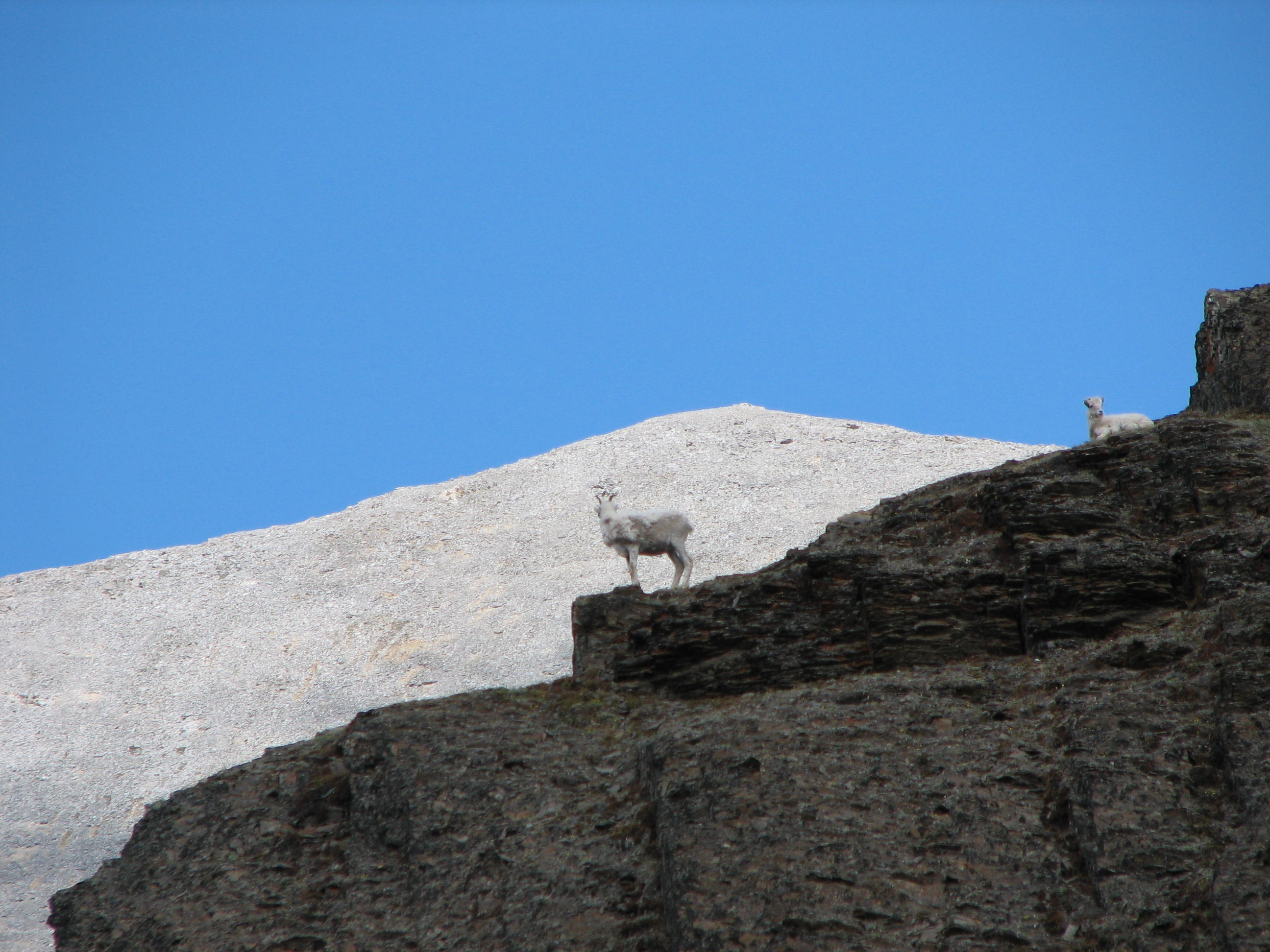
Fortunately, at least for the wildlife, it appeared that the group didn’t float the upper reaches of the Aichilik, which may well have been too low.  It was there where I saw Dall Sheep, 10 meters above me and used my camera to view them, not try to approach them “in peace.”

Dall Sheep, upper Aichilik River, 2009.

Dall Sheep, upper Aichilik River, 2009.

IMG_1279 IMG_1281

IMG_1286

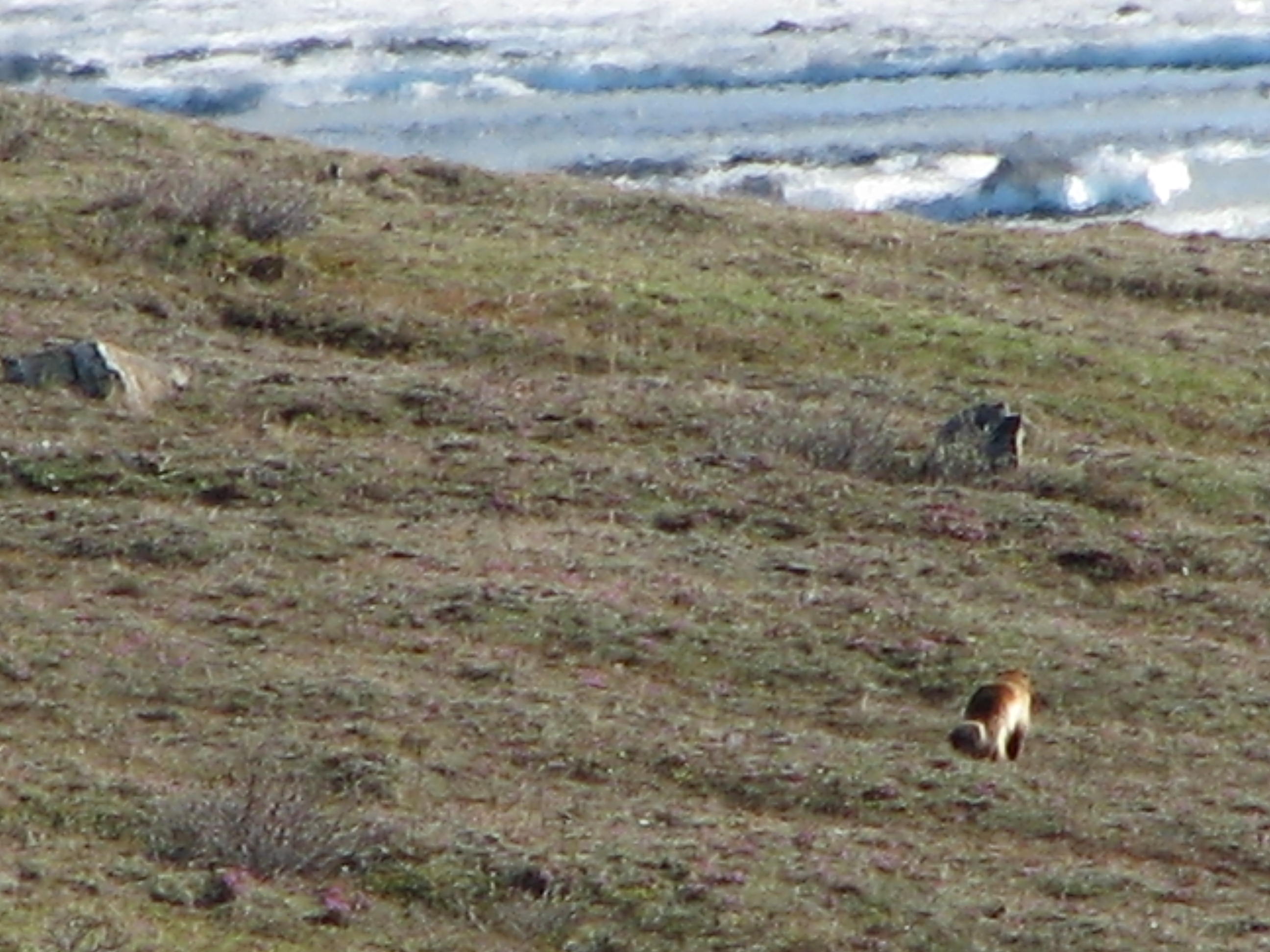
I’ve had a wolverine on the Aichilik run right by my tent.

Wolverine, running away, lower Aichilik River, 2009.

Wolverine, running away, lower Aichilik River, 2009.

I’ve seen the Sun well above the horizon at 2 a.m., and I’ve walked the banks in a pouring rain.  In short, it is part of Alaska, and one accepts the land as “It’s Alaska,” not trying to mold the country into what suits you, but to deal with Alaska on its terms, what comes your way—hunger, thirst, bugs, no bugs, heat, cold, dry riverbeds, floods, wildlife, no wildlife.

I’ve seen solo hikers in Alaska.  This isn’t smart.  Some have had trouble—a sprained ankle is life threatening— and set off emergency locator beacons to get hauled out.  A German did that once up near Summit Lake, not because he was hurt, but he got into more difficulty than he realized.  ELBs are non-specific.  He needed a satellite phone. Frankly, that area is fairly easy hiking for Alaska.  Walking in the stream is fast, walking far from a stream avoids tussocks.  You learn that when you’ve been up there a while.  Alaska hiking is not Europe. He was flown out, no easy feat, costing American taxpayers $15,000.  Our wilderness is for real here.  I could hike the Aichilik alone if I wished.  But I would never do it.  There are far too many risks.

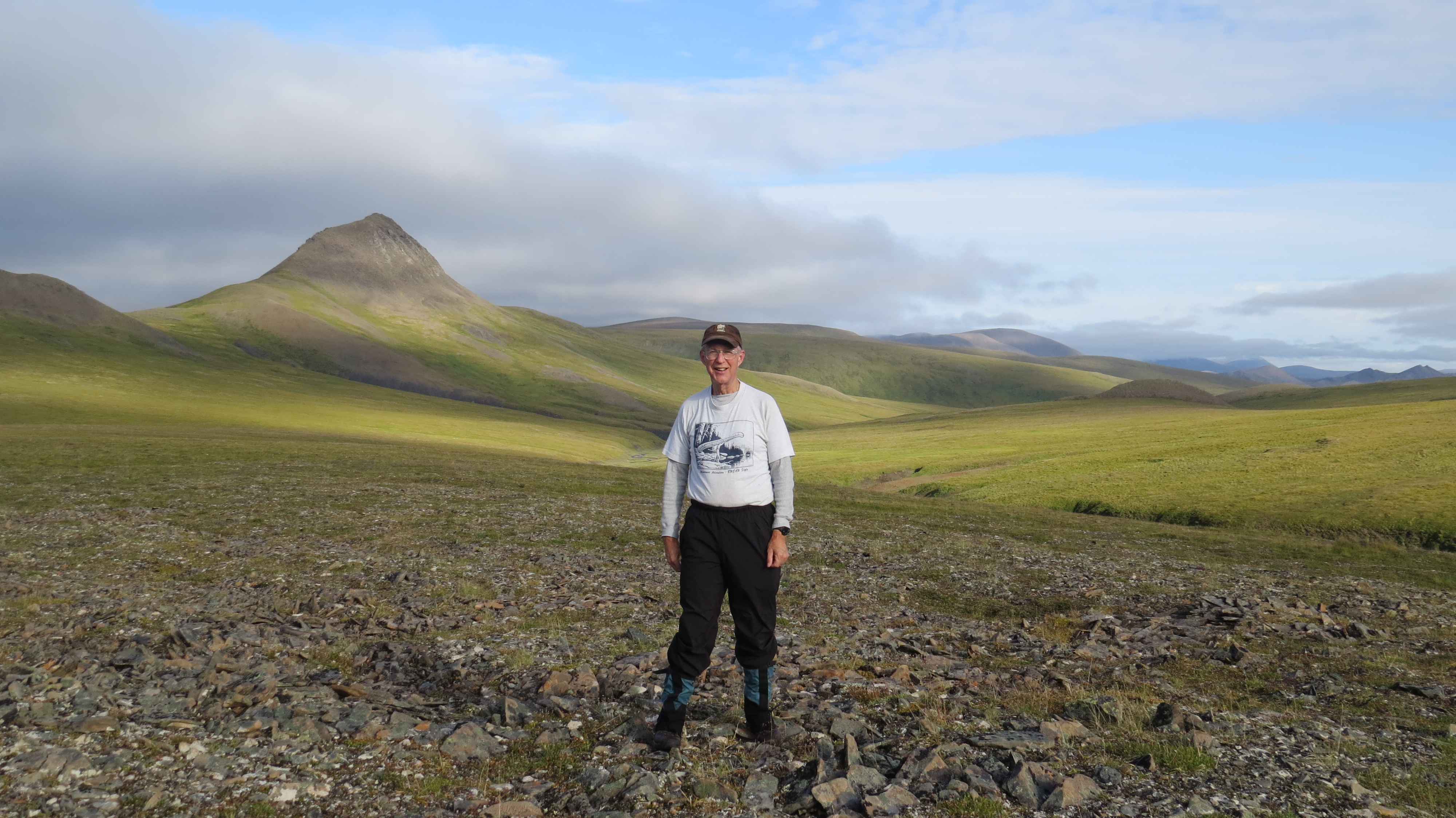
I’m an experienced Alaska hiker, which is to say I am several levels below guides.  I know enough to take weeks getting into shape before I go, have good gear, which isn’t new, but which I can trust, know my limits, and take only what I know I will need.  I’ve gone with one other, I’ve gone with six others.  I’ve hiked in every condition imaginable except freezing rain, and that was close.  I’ve seen wonderful sights up there, from Kotzebue to the Canadian border.  I trust the bush pilots and the guides.  I’m a nobody, a guy from the “lower” who loves the country, respects it and knows his limits.  I’ll never have my experiences published in an environmental journal, but do note the picture at the top of the page you are reading.

I took that in 2010, on the Noatak, from my tent.  She had two cubs, too.  I played by her rules, stayed silent, and she could have cared less about me.

Just like Alaska.

  I WASN’T THAT IMPORTANT, OR WAS I?

June 14, 2015

A few years back, we drove over to LA for the wedding of my youngest niece.  The other two had had their weddings on the East Coast, but we aren’t close to our families, and we didn’t go.  LA was a day’s drive away, and we thought we ought to make at least one of the weddings and see the family.  We both felt it was a duty, so we did it.  Family visits, of course, have a down side, but that’s families, and that’s duty.  You pick your friends, not your family.

On the plus side, I could get to see Channel Islands National Park, which was on my “See all the National Parks” list.  We drove over on a Thursday, mistakenly believing that staying up in Ventura would make the travel easier.  It didn’t.  We entered freeways where speed went from 75 to zero in a half mile.

We had a great visit on Santa Cruz Island the next day.

On Santa Cruz Island. Hard to believe 10 million people are right across the water.

On Santa Cruz Island. Hard to believe 10 million people are right across the water.

IMG_3667

On a big plus side were some whales.

Anacapa Is. from Santa Cruz.

Anacapa Is. from Santa Cruz.

We thought we could easily make the rehearsal dinner that Friday night, but well, the boat bringing us back from Channel Islands was a little late, so we got to the hotel a little late, and check in was a disaster.  The first room had luggage present which wasn’t ours, and when we went back to the reception desk, a good walk in its own right, they looked at us with disbelief.  We did get a second room, except the room card didn’t work.  Back we went.  Bottom line was that we could get into the third room with about as many swipes of the card. We took it.  The hotel was deemed 10 stars; I wondered aloud whether “10” was binary notation.

Somewhere along the line, my observant wife noted both the clock and a Trader Joe’s next door, announcing to me that we weren’t going to the rehearsal dinner.  I had a brief moment of “we can’t do that,” followed by visions of driving in LA on a Friday night, which in my 45 years of driving in several countries, was in the top three for difficulty (Toronto and Cádiz, Spain are the other two). After the “we can’t do that,” came “wow, we could just relax and start the visit early tomorrow morning,” which is exactly what we did.

Saturday morning, we went to the bride’s house, offering our services for whatever she needed.  We weren’t part of the wedding party, but we had a car, which is a total necessity in LA.  My niece desperately needed a few things at a pharmacy and a store, and we got them with no problem.  She was grateful.  I thought that nice, given that what we got was easy to do.  For us, it was.  We then took my sister-in-law (SIL) out for coffee.  That got her out of the house, for which both she and my niece were appreciative, albeit for very different reasons.  We went to a coffee shop for about an hour and a half, and for the then 42 years I had known her, we had the best conversation I can ever remember.  I think the fact I was fairly relaxed, aside from being in LA, and my SIL really stressed had a lot to do with how well things went.

We went to the wedding early.  I hadn’t been looking forward to meeting my SIL’s estranged husband.  I didn’t like him on several levels, not the least was how he had treated her.  He had crossed Jerk Junction so many times that it no longer had a “Stop and Think” sign.  A short time after we arrived, a few older men showed up, and my wife and I went down to meet them.  Sometime after I shook hands with all, my wife commented, “That was xxxx, you know.”

I didn’t.  I don’t have prosopagnosia, or the inability to recognize faces, but I am not exactly good at placing faces on people, especially those whom I have not seen for 16 years.  I hadn’t a clue that I had just shaken hands with the estranged husband, which meant that I treated him like a stranger, which in many ways he was, politely, without giving away my dislike.  Wow, I couldn’t have scripted that better if I had tried.

The wedding went well, and at the dinner, I volunteered to sit between the parents of the bride, her near-ex’s voice booming out loud and clear, as he was the Master of Ceremonies.  It wasn’t a big deal, after all, sitting between the two of them.  I had to deal once with his trying to bring up Navy days, for we both served in very different ways, but I had no desire to talk either to him or about my time in the service 35 years earlier. I ignored him.  I made sure I turned towards my SIL, listening carefully to her and my wife, talking when I could, and somehow getting food into my mouth without looking at my plate, in order to avoid any further interaction with her then-husband.  When husband got up to make a toast, I shoveled food into my mouth.  The rest of the time, I kept the two of them away from each other, possibly avoiding a scene. When things were winding down, we left, got back to the hotel, and were on the road early the next morning, eastbound to the Colorado River and Arizona, LA in our rear view mirror.  Mac Davis in reverse, for those who go back to 1980 in their music.

We weren’t at all important in the wedding party.  Yet, I have fond memories of what I did that day.  We were the two most relaxed people present.  We had time to run errands, we had time to separate mother from niece, woman from husband, and we made good use of the time.  We did it quietly with no fanfare, no raising of voice, nothing at all.  We were there.

Maybe I was important.  For years, I gave my SIL and our nieces gifts during the holiday season.  The biggest gift I ever gave them, however, was that day in Los Angeles.  Maybe they remember it, maybe they don’t.   No matter.  I do.  Like most gifts, the giver gets a lot back in return.

My SIL still sends me e-mails.  I cringe when they come.  Family.

WHAT WAR? UPON WHOM?

June 11, 2015

A few years ago, many right-wing talk show hosts complained vehemently about a “War on Christmas.”  A few places, trying not to offend anybody, had required “Happy Holidays”.  Others tried to cater to Chanukah and Kwanzaa, as well as Christmas.  Back in the good ‘ole days, when we had Christmas, by golly, men worked, women stayed home, with 2.3 children, all the dirty dark secrets of everybody, including pedophile priests, remained hidden, and we had a Christian nation.  Back then, smoking and being drunk were cool, blacks were not called that, interracial marriage was a sin (but not interracial sex, as Strom Thurmond did), and gays were thought to be pedophiles.  The good old days weren’t so good.

If there is any war on Christmas, it is the daily financial report in December how sales, and by extension, our economy, are doing. I didn’t think Christmas was about shopping, but I’m not a Christian, so I may have missed something. Being brought up Unitarian, where in my world people were Catholic, Protestant, or Jewish, Christmas was an important holiday, even for kids, for while it meant presents, it also meant caring for those less well off and peace on Earth.  Unitarians believed we had a social duty to our fellow men during our only existence.

In June, I don’t want to write about a war on Christmas.  I am more concerned about those who say there is a war against Christianity, Christians are being persecuted, fascism is afoot, and this is the first step of Nazi-ism, which is a horribly inappropriate word to use.  I’ve seen Mauthausen, where people jumped—or were pushed (they had only those choices)— to their deaths (“Parachuters without parachutes”) with guards laughing. I’ve seen Stolperstein, the brass plaques on cobblestones, commemorating those who once lived at that place, deported and later murdered. Such comparisons by right-wing Christians are not only wrong, they demean those who died, including 1500 who deliberately chose death by crossing an electrified fence to escape rather than to remain imprisoned.

I’m not against Christianity, only against those who want to live in the 5th…or 19th century.  We are today a more diverse, overpopulated world, the last due in great part to religion’s requiring women to bear as many children as possible.

In addition to Christianity, we have Islam, Judaism, Hinduism, Buddhism, Wiccans, and the most hated group of all, the one group that won’t ever win the presidency in America:  atheists.  The world is not only more religiously diverse, there are those who have a variant of human sexuality, wanting same sex partners.  These people desire to marry, for without marriage, they have no civil rights should one of them become ill.  They do not sully marriage, but they have become hated by so-called Christians, who are supposed to be tolerant of others. It is so bad that some states are outlawing “conversion therapy.”

I have a deeply spiritual side that questions the reason for my existence, the nature of the universe, whether there is a Creator, and is intensely curious about the world.  I believe in the right of people to worship the way they choose, to marry whomever they choose, to live their life the way they choose, so long as it does not infringe upon my right to do the same.  I was against the Iraq war, which Christians started.  Many Americans placed yellow ribbons, with the shape of a cross, on their vehicles, making the war appear like a crusade, the word used by the prior president, later apologizing for a bad choice of words, but not for his bad choice of war.  Instead of “blessed are the peace-makers, for they will be called the Children of God” (Matthew 5:9), we had “shock and awe” (Rumsfeld; March:2003).

Too many of these so-called Christians hate blacks, vilify a half-black president, hate Mexicans and Central Americans who come here for a better life.  I don’t blame those who come here for a better life.  I sadly take the realistic approach that America can no longer save the world, either militarily or humanely.  There are things we can and should do, but policing the world and taking in every refugee is a non-starter.  How we go about changing that and remain true to our ideals is a difficult endeavor.  Banning birth control, which the religious right wants, calling women “a different cut of meat,” disallowing abortions when a raped woman becomes pregnant, which even Iran allows, saying a woman’s body can reject a rape-caused pregnancy, shows a profound war on women.  Want fewer refugees, fewer wars? Start with world-wide birth control, equal rights for women, and in two generations, we’d see a difference.

I reject that notion of a war on Christians.  I am against hate, anti-science hypocrites who use things science provides, megachurches, and Republican support, when it comes as a message of hate, intolerance of others, an armed society, make as much money as possible, destroy the environment, and not regulate anything.  They want their prayers in the public domain; politicians must be believers, preferably white, and non-believers are going to hell.  Regarding the latter, Christians, Muslims, and Mormons have all told me I was going to hell.  They all claim to be right, so either 5 billion people are wrong, or the few who think the way I do are right.  If I voluntarily help a students with math problems, teach adults and children how to read, teach English to people in 90 countries without pay, log on to an algebra site and help people with questions, organize and lead hikes, donate to humane societies, volunteer in several environmental organizations, is that not doing good?  One Muslim woman told me I was going to hell, even though she liked me.  She has since said I was the nicest person she has ever known, and her homeland is 99 per cent Muslim. What kind of disconnect is this?  If religion says that people who do good go to hell, then I want no part of it.

How can these Christians not believe in climate change, what we have done to the environment and to humanity?  Not one of the Presidential candidates on the other side admits that the climate has changed.  “God said, ‘Let the earth bring forth living creatures of every kind: cattle and creeping things and wild animals of the earth of every kind.’ ”  Where did it say, “thou shalt increase the extinction rate of species one thousand fold”?  Where did it say, “And thou shall rain fire and horror down upon a country that did not attack you, but whom you convinced your people it did”?  Where does it say, “Exponentiate” instead of “multiply,” and why has nobody to my knowledge other than me said, “Be fruitful, but you may multiply by one half or by one”?

War on Christianity?  No. But I am speaking out against those who profess to be Christians but whose behavior is completely counter to the teachings of Christ.  I’m not fighting Jimmy Carter.

I am, however, resisting those who say “God, Guns, and Guts made us great,” for they are cowards at heart, bully others with their weapons, and make a mockery of their God to whom they think they alone have a direct line of communication.

PUSH BUTTON EDUCATION

June 2, 2015

“You guys have all given me different answers, and I don’t know what to do.”

The math tutoring room at the local community college has two parts, one for advanced math—trigonometry, pre-cal, and calculus; the other is for basic math, from carrying and borrowing up to college algebra.  I work in the latter, but as somebody with a Master’s in statistics, I am often the “go to” person for statistics questions.  The fact I have seldom used statistics in the last decade has made me rusty, but the material comes back, so long as one learns it well the first time.

When the individual came to me stating the conflicting opinions she had received, I should have either turned her down or told her she was going to have to decide up front whom to believe.  If I were not that individual, she should leave, and not waste her time.  The issue itself was a 1-sample proportion test, one of the M &M problems, where a certain proportion of different colors are put into the bag, people count out the number of each type to see if the proportion corresponds with the claimed proportion, within a reasonable margin of error.

The student had used the instructions given to her what to input into the calculator and found a probability that made no sense to me.  I looked at the question and came up with the correct probability.  The example she copied looked at the probability’s being greater than a specific number; the problem she asked me looked at the probability’s being less than a specific number.  She didn’t understand that the example given to input and the problem were asking opposite things.

I tried every way I could think to explain the issue to her.  I have become more adept at calculators, finding them fast and helpful.  This woman, as are so many students today, was faster with the calculator than I.  Her problem, however, was something that it took me some time to figure out.  I had drawn a diagram of the probability curve, the Bell-shaped normal or Gaussian distribution, and she had looked confused.  That led me to finally ask a simple question:

“Have you ever computed these probabilities using a normal probability table?”

“No.”

I now understood her problem.  She was being asked to input data and push a lot of buttons.  Unfortunately, she had no idea what was being done to the data and why.  A lot of statistics is finding the difference between the sample and a postulated or known mean/average, then dividing by the standard error, a measure of variability.  The concept of variability is critical to understanding not only statistics, but everything statistics is used for, be it political campaigns or climate science.  Natural processes, like heart rate, body weight, stock market prices, or temperature, are not the same when measured over a period of time.  They fluctuate, and statistics helps us understand the fluctuation.

Dividing the mean by the standard error normalizes the data, allowing it to be compared to one standard, this instance to a table to find a probability.  By doing many problems where I had drawn a bell-shaped curve and looked at probabilities, I understood the concept well enough to teach it to undergraduates in Las Cruces for two years and in Tucson for another four.

This woman was from another generation of students, however, and in the decade where I have not been heavily involved with statistics, drawing a picture of how the data were distributed and having a sense of what the data were trying to say has atrophied, at least where I am tutoring.  The argument I was having with the student had a lot to do with the arguments I needed on the calculator;  she did not understand them, only that she was obtaining different answers.  Put simply, she did not have the background to be using a calculator.  I could say that about many students.  When I taught for a private for profit college, when a student saw a probability “6 E-4,” they wrote “6” as a probability, both impossible and showing no sense of what E-4 means, which is a power of 10 to a minus number:  6 E-4 =0.0006.  I don’t expect the average person to know that; I do expect somebody taking statistics and using a calculator to understand it.

That is only my opinion, from one who learned the material from first principles and is still slow to pick up a calculator, because I am often more comfortable performing my own calculations.  It remains to be seen whether we will continue to teach by calculator or teach by understanding the material, using the calculator as a tool to speed up the process.  I fear that in our rush to educate people, we are giving them instructions as to what buttons to push in a lot of subjects, without any idea of what is going on inside a calculator or more importantly, inside the system we are analyzing.

This is not idle philosophical musing.  When I taught, more than half the class did not understand what “the rate of increase in health care costs is declining” meant.  To them, the statement meant that the costs were decreasing, rather than the number was still increasing, but less rapidly than it was before.  This term is commonly used. The concept of statistical error to many people means that statistics is wrong, so it doesn’t matter.  Statistics is unable to tell us the exact results in a population, because from a poll, we do not know what the exact result is for the people in whom we are interested.  Where we differ from other fields is that we quantify the error in terms of confidence and probability, and we know the difference between the two terms.  We reject the concept that “anything can happen,” because we define a priori what “can happen” means.

We need to learn what calculators can do; equally importantly, what they cannot do.  Data that are not collected randomly have limitations what we can say about them.  Calculators do not have the ability to discern that. Calculators answer only what we ask them; they neither ask questions, nor do they tell us what we might want to know.

Calculators and computers are wonderful tools to get information that one needs, but education, critical thinking, and understanding remain timeless.

CAUTION: BEFORE GOING TO WAR, READ INSTRUCTIONS CAREFULLY

May 28, 2015

Early March 2003:  I remember speaking to my father about how many people alive that day would not be in the coming year, due to the impending invasion of Iraq.  I was against the war, because I believed Saddam Hussein had nothing to do with 9/11, there was no convincing evidence of weapons of mass destruction, starting wars was a lot easier than ending them, we would create terrorists by being there, and we would have an influx of refugees.

2015: my father is no longer alive, I still am, and every one of my concerns was correct.  Several thousand Americans and perhaps more than a million Iraqis died; the consensus recently was that the war was a mistake.  Really? Those who made the mistake are alive and rich; incredibly, some of them are still being considered for high level governmental jobs:  Mssrs. “the war will pay for itself” Wolfowitz and Bolton, the latter one of the nastiest men on earth.

With that background, I read American Sniper, by Chris Kyle.  I had some misgivings about whether I really should or wanted to read the book, but did so.  Not surprisingly, there were  things I didn’t like.  He and I were from two different worlds, generations and belief systems.  But we were both Americans, and we both served.  There were areas where I found myself nodding assent.  Mr. Kyle was a warrior, not a writer.  I am a writer, not a warrior. He was a warrior like Patton, for he loved being at war.  He loved it more than family, he and his wife both admitted it.  He had a chance to quit the military but stayed.

What Mr. Kyle wrote should be discussed every time we go to war.  He de-humanized the enemy, referring them as savages.  This is not wrong; it is how people bring themselves to kill other people.  We used “gook” in Vietnam.  He referred to killing simply as “got him.”  He was a superb warrior and sniper who lived for action, had incredible luck, much of which he made, whereas literally millions of others did not have the luck or live.

While Mr. Kyle said he had only one brief “flashback,” he was changed by the war.  I don’t know how he couldn’t have been. Diving for cover when a car backfires is not normal.  I don’t know how any individual can live through war and remain normal.  He and his fellow warriors fought in bars over minor issues and got drunk often.  It doesn’t make them bad; they were young men at war.  Being at war makes such behavior more likely in young men.

We glorify warriors; mankind always has.  When we need them, we want good ones, and Mr. Kyle was the best of the best.  He was humble in his story, lavished praise upon others, and had many narrow escapes.  One man next to him was shot in the eye and was permanently blind.  He lived, but not long.  Another died in Mr. Kyle’s arms. Every person “down” ended up either in a body bag or in the hospital.  This was an ugly war in an ugly place fought by an ugly enemy.  The smells of Iraq cannot be described.  I have smelled similar places.  The smell of blood, the sight of bad trauma I know, although not like what occurred in Iraq.  Mr. Kyle survived an IED and just missed another one; several hundred Americans did not; thousands survived mutilated and beyond repair.  Many are homeless today. Having video games extolling fighting and killing disturbs me deeply.  War is horrific.

Mr. Kyle was a patriot.  Sadly, he fought in a war started by old men who had never been warriors and who had no business starting this one.  He spoke out strongly against politicians giving rules of engagement, lawyers wanting to know if a “kill” should have been done.  Mr. Kyle wrote that once the military is in place, it should be allowed to do its job.  He was dead right.  That is why going to war must be carefully thought out, for the military’s doing what it should do is ugly, often based on misleading intelligence, and many will die unnecessarily. That is war.

The run-up to the Iraq war was a lot of flag-waving and jingoism.  It was “Mission Accomplished,” when 3 years later, the country was nearly a failed state and in 2015 may become one.  The war was illegal and marketed to the American public. The strategy was flawed by men who chained warriors like Mr. Kyle, so he could not be as effective as he could have been.  It made contractors like Blackwater rich for shoddy work, frank murder and showed an uncaring nation in our handling of Abu Ghraib, Guantanamo, Walter Reed, and care for veterans.

I laud the late Mr. Kyle for including comments by his wife, her experiences.  She built her own walls against pain, walls against a person whom she loved.  She did not enjoy war action, for she was raising children and wondering if she would be visited by two men, informing her that her husband was dead, which happened to thousands of others.  As bad as death is, having a husband come home who is blind, had his legs blown off, or his brain damaged in a way that can never be made whole again may be worse.  It is an ongoing hell, and those who go to war leave behind those who worry and deal with “boring,” tedious, necessary day-to-day life.  Warriors fight and have glory, thinking they are immortal, until something happens that ends it all….forever.  Their spouses must bring up children who don’t know a parent.  Some are widowed mothers at 19. That tragedy visited Tucson after Fallujah.

Mr. Kyle’s death at 38 was at the hands of someone he was trying to help, who turned on him at a range, shooting him six times, so sad and ironic.  Mr. Kyle no longer feels, but his wife does and has her own hell to go through, alone.

I’ve served in the military, but I’ve never been a warrior.  Nor have I been or ever will be a hero.  I’ve fired a rifle exactly ten times, 40 years ago.  I never have touched another firearm.  Not once. I don’t shoot bullets.  I write words, try to help people understand the world we live in, and give of myself to causes I believe in.  I won’t be famous, and when I die, few will grieve.  I have lived as an imperfect human being, done some good, seen more of the world than many, been blessed with skills others have not, and tried to speak out against injustice, evil, and wrongdoing.

Had we stayed out of Iraq, the late Chief Kyle would likely be alive today, as would perhaps a million others.  In 2003, few knew Mr. Kyle.  In 2015, most of the country knows of him.  I salute both his memory and his wife, for what she had to do.  I cry out against the injustice, the lies, the waste, my being labelled a traitor, and all the other things the Iraq war did to individuals and to us collectively.  It was wrong, and in 2003, I was in the 16% who said it was wrong.  I wasn’t prophetic.  I’ve read much about war, from the Romans, The Rise and Fall of the Third Reich, and every word Samuel Eliot Morison published.  I walked on Corregidor; I’ve seen Pearl Harbor, the Memorial Cemetery in Manila, gone ashore on Okinawa and Inchon, seen rusted hulks on Eniwetok.

In 1970, we seniors at Dartmouth were asked to answer a question:  “Is there a war that you would want to fight in?” I never forgot the words one of my classmates wrote, back when we were involved in another wrong conflict.

“I can’t imagine there ever being a war I would want to fight in.  I can imagine one I ought to fight in.”

“IT DON’T COME EASY”  

May 24, 2015

Quite by accident, which is how my life usually occurs these days, while tutoring at the community college, I went to an algebra site to check something.  I don’t remember what it was, but when I tutor, I frequently encounter problems I remember but don’t recall exactly how to solve. I understand ellipses and hyperbolas, but I forget how to find the foci or the latus rectum.  I have to look it up.

While on the site, I discovered the solutions were posted by volunteers, so when I had a quiet stretch, I gave myself a user name and logged in, solving a few problems that afternoon.  I found it relaxing, which I am sure would surprise many for whom math is an odious chore.  What I have learned, besides hyperbolas and ellipses, was more than math itself.  Those who do not like math might read on, for you will be surprised.  Those who do like math will likely shake their heads in agreement.

The first lesson comes early in Ringo’s and George’s lyrics:  “You’ve got to pay your dues, if you want to sing the blues.” MATH TAKES PRACTICE, just like the piano.  I practiced the piano an hour a day and took lessons for three years.  I got better.  Oh, I never got past a couple of recitals, where a dozen of us played solo to our parents and a few others.  Wow, I was nervous.  But I did fine.  I played “By the Sea,” which I had memorized.  I played it well and everybody clapped.  I never thought I had musical talent, and to be sure, I don’t have much.  But I could play the piano; I could read music and even change it into different keys.

I think latent math talent exists, too, but one has to follow the guidelines, of which practice is the most important.  Practice allows one to solve problems, but it has a bigger advantage.  When one needs such math in the future, while it may have been forgotten, it returns quickly.  I never forgot the slope of a line.  I did forget the point slope formula and quickly relearned it.  I forgot how to integrate by parts, but I re-learned it enough to astound a few people in graduate school, 30 years later, when I blurted out the integral of log x one autumn afternoon in Las Cruces.

Sit with me as I tackle online a routine problem.  Routine problems are ones I can do without pencil or paper.  People submit them to get help.  Watch my thinking, but more importantly, WATCH HOW I MAKE MISTAKES.

Joel and Nicole each together have 350 coins.  When Joel gives away half of his and Nicole a third of hers, they now have the same number of coins.  How many did they start with?

I love mixture problems; I’ve never had to review them.  It’s sort of like a guitarist who learned “Don’t Think Twice” in the 60s, never played it since, and tries to play it at a gathering.  He may not tune the instrument quite right, and he gets a few chords wrong, but he plays the song, and it is appreciated.  Math is intertwined with music; an eighth note is held twice as long as a sixteenth.

I let Joel’s coins = x  and Nicole’s = y.  I could let Nicole’s equal 350-x, a trick I use, if I choose to use only one variable.  Musicians have tricks when they play, too.  They put a song in D major, rather than in D.  They invent stuff.  I have in math, too. Back to Joel and Nicole.

x + y =350.  That is a fact.  Translate: Joel and Nicole together have 350 coins.

Joel gives away half his coins.  He has half left, (1/2)x.  I put parentheses around the numbers, because 1/2x is not the same.  Hey, you play in E minor on a piano, you may touch the D major key, same one, but it doesn’t sound the same.  (1/2)x is not the same as 1/2x.  We’re no different in math.

Nicole gives away 1/3 of her coins, so I first write she has (1/3)x.  I am not correct, and when I later check the problem, it isn’t right.  I return to the beginning, BECAUSE SOMETHING ISN’T RIGHT.  I don’t convince myself it is right, I don’t dictate it is right.  It is NOT RIGHT.  I have an open mind and start over, asking WHERE DID I GO WRONG?  A lot of politicians ought to ask themselves this question.  The guitarist knows when it doesn’t sound right, too, asking himself where he went wrong.  I and the guitarist are on the same wavelength.  WE KNOW IT JUST ISN’T RIGHT.  Oh, I discover, Nicole has (2/3)s of her coins left, not (1/3).  What was I thinking?

Can you see that somebody like me, good in math, makes a simple mistake?  If you aren’t good at math, did you ever realize how many mistakes mathematicians make?  We make them all the time!!!

OK, so (1/2)x=(2/3)y .  Now, there are at least three different ways to solve this, but I’m not going to play the song in 3 different keys, just one.  I’m lazy, and I like my math simple.  If I double (1/2)x, I get x.  If I double (2/3)y, I get (4/3)y.

x=(4/3)y,  I like this.  It feels right, just like hitting the proper chord feels right.  You sense it.  We’re brothers here.  The sense is well known in sports, where it is called “the zone”:  Bill Bradley was once interviewed during practice.  He made a 20 foot hook shot while talking:  “You have a sense where you are.”

Now instead of x+y= 350, I have (4/3)y + y=350.  One variable. But y = (3/3)y.  You’d be amazed how often we math guys multiply by 1, which doesn’t change anything.  Not only that, we multiply by really strange “1”.  Here, it is (3/3).  Sometimes, it is (√7 + 2/)(√7 +2).  That is also 1.  Even stranger, we may add 0, because it doesn’t change them.  Crazy.  Until we add 36-36 to an equation that has (x2+12x), allowing us to write (x+6) – 36.  Both of those are equivalent, but we can do things with the second that we can’t with the first.  I now add the y’s: (4/3)y + (3/3)y =(7/3)y, which equals 350.  I flip the fraction over, because (1/2)(2/1)=1 and (7/3)(3/7)=1, and I want 1y or just y on the left.  I must multiply the right by (3/7), too, and without boring anybody, y=150.

I make another mistake, a rookie one.  I usually solve for x, but if Joel had 150 coins, Nicole had 200, and one can’t divide 200 evenly by 3.  I WAS WRONG.  Two minutes later, I realized I had solved for y, and when I went to the top, I had CLEARLY WRITTEN BUT FORGOTTEN that y was Nicole’s.  She had 150; that checked just fine.

This is a simple example to a math guy.  We make many mistakes.  All of us.  We copy the problem wrong, we forget a minus sign, we add wrong.  Yeah, that too.  I’m just a guy who plays with math to relax, hitting a lot of wrong notes along the way.  Like the guitarist, I make good music, but “You Know, it Don’t Come Easy.”

I paid my dues.

ZWEI ALLEIN (TWO ALONE)

May 14, 2015

The man was adamant.  “My wife will not have chemotherapy.  We survived the concentration camps, and we will both go together.”  His wife had cancer metastatic to the brain, and other than radiation, there wasn’t anything else we were going to be able to do except control brain swelling.  I had the sense the man was challenging me, but I wasn’t about to fight them, not a pair of concentration camp survivors fighting their own losing battle.

A few weeks later, I read in the newspaper that there had been a murder-suicide in an elderly couple.  The name was familiar, and I knew exactly what had happened.

I watch German videos online every day.  I no longer spend 3-4 hours daily learning vocabulary, memorizing lists, or studying grammar.  I did that for a few years, but I moved on to other interests, as I knew I would.  I like exploring the world; there is so much to see and do, and I find the time short.

Today, I listened to a video where the ending was not perfect, unfinished.  It was real. It was powerful. The plot was simple enough.  A woman, Henriette, and her sister were walking in a park, when suddenly a robber jumped out, stole the sister’s purse and shot Henriette in the abdomen.  The sister was unhurt and got help, but Henriette died in the hospital during surgery.  There had been 4 murders in the park in the past several months, so this appeared to be another.

Benedikt, her husband, was a bus driver.  The next day, he went to work, confused, and drove the bus past people waiting, through a red light, and was pulled over by the police.  When they learned his wife had died the day before, they told him they would take him home.  Benedikt suddenly left the bus and took a cab, not home, but by places where he had spent time with his wife.  For the next several days, he acted like a grieving man. Flashbacks were shown, one finally showing the Henrietta with him, months earlier, suddenly collapsing from abdominal pain.

It dawned on me that perhaps this shooting was intentional.  Indeed, it soon became obvious.  The woman had visited a gynecologist and had a malignancy, likely ovarian cancer, although it was not stated.  She and Benedikt had discussed her disease, decided against further treatment.  The police in the meantime, had discovered the perpetrator, but the latter stoutly denied anything to do with this murder, even as he laughingly admitted to the others.

At the end, it was obvious that Benedikt had shot his wife, with her prior consent.  His sister-in-law finally discerned the truth and watched helplessly at the end, as Benedikt held a gun to his chin.  He suddenly fired the gun at the sky, at God, he said, and the movie ended. There was no “closure,” a term that needs to be used less, since many seem to believe that candlelight vigils and other memorials will help speed closure.  They don’t.  Closure takes time, and Americans, for whom time is precious, want to speed up something that has its own schedule.

In Oregon and four other states, Benedikt’s wife and the woman with metastatic cancer could use Death with Dignity.  Both women were had a life expectancy fewer than 6 months, mentally competent, and would have qualified for a prescription, if two physicians, one of whom could be the individual’s personal one, agreed that she were terminal. Two requests have to be made 15 days apart.  This is not a “I want it tomorrow” issue.   The prescription is then taken to a specific pharmacy, filled by a specific pharmacist, because some pharmacists refuse to fill it.  Then, at a time of the patient’s choosing, the patient takes the pills, becomes unconscious and die.  No gun, no jail for the spouse.  It is terribly sad, but the individual is in control of the dying process, which was going to occur soon regardless.

Do we think that people don’t know they are dying?  Do we have to let the soon-to-come death come on its terms, rather than on a patient’s terms?  Oh yes, there is palliative care, and while it is good, if I have pancreatic cancer or a glioblastoma I don’t want death on death’s terms.  I don’t want to lose half my weight, become jaundiced, lie in a bed for weeks, slowly dying, even with pain control, seizure control, and being kept clean, all a very tall order, because not all palliative medicine is the same.  There won’t be a sudden miracle, and anybody who practices medicine as I have is far more an expert than those who live in a dream world of fluff and unicorns, where there are happy endings.  No, I wouldn’t want to die.  But I would not take my life, the disease would.  If it is a matter of one day vs. a few weeks, why should I not have control?  Isn’t that a civil right of mine?  What is more private to an individual, more of a right, than their right to exist?

Oh, I know the arguments.  Hospice can do this, except there are hospices that don’t do it, and I don’t want to end up in one of them.  One charged Barbara Mancini for murder when she handed her father morphine that he asked her for.  It wasn’t even clear he wanted to end his life then.  He wanted it for pain and was taken to the hospital against his wishes and given naloxone to reverse the morphine.  He died a few days later, the way he did not want to.  About $100,000 later, jail time, and national press, Ms. Mancini was acquitted, with a 42- page scathing report written by the court against the prosecutor, who may now be in Congress.

I am not on a pedestal shouting this to the world.  Or maybe I am.  In any case, the slippery slope that the Catholic Church and others predicted would happen in Oregon didn’t.  The thousands of people predicted to die every year hasn’t reached one thousand yet, and the law has been on the books for 17 years.  A third of the people who get the drug never use it.

I say all this as a former neurologist who spent 17 years practicing in a Catholic hospital, where I had no trouble pulling tubes and stopping feeding of those on whom I diagnosed irreversible brain injury and the family told me “he never wanted to be like this.” I wasn’t playing God.  The Church and I had no disagreement about discontinuing futile treatment.  Many of my colleagues disagreed with me, and I wasn’t popular, although a dozen referred their families or themselves to me, even if they didn’t refer me patients.  The ICU nurses, who frequently dealt with death, respected me.  That respect mattered.

The probability we will live to 90 in great health and suddenly die is highly unlikely.   I’ve seen and dealt with the reality.  We need to remain compassionate, accessible to families, and allow in all 50 states this final civil right.  It isn’t suicide, and it isn’t forced.  It’s humane, sacred, and its time has come.