Archive for the ‘Uncategorized’ Category

HIDDEN GEM

October 1, 2014

“Damn, the site is taken. I had really looked forward to camping here.”

On a beautiful September morning, my wife and I had paddled and carried 13 miles from Fall Lake into Basswood Lake, in the Boundary Waters Canoe Area Wilderness,

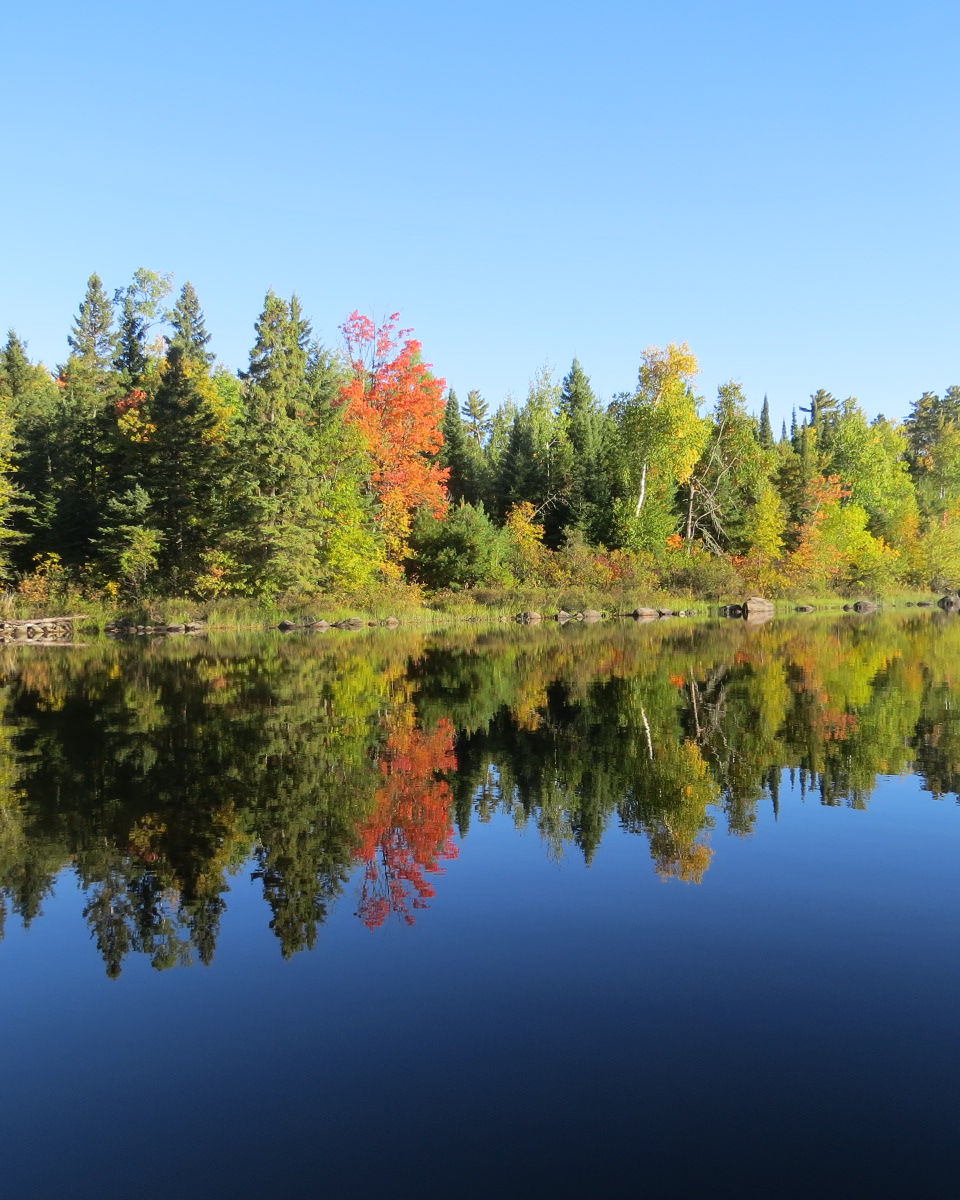
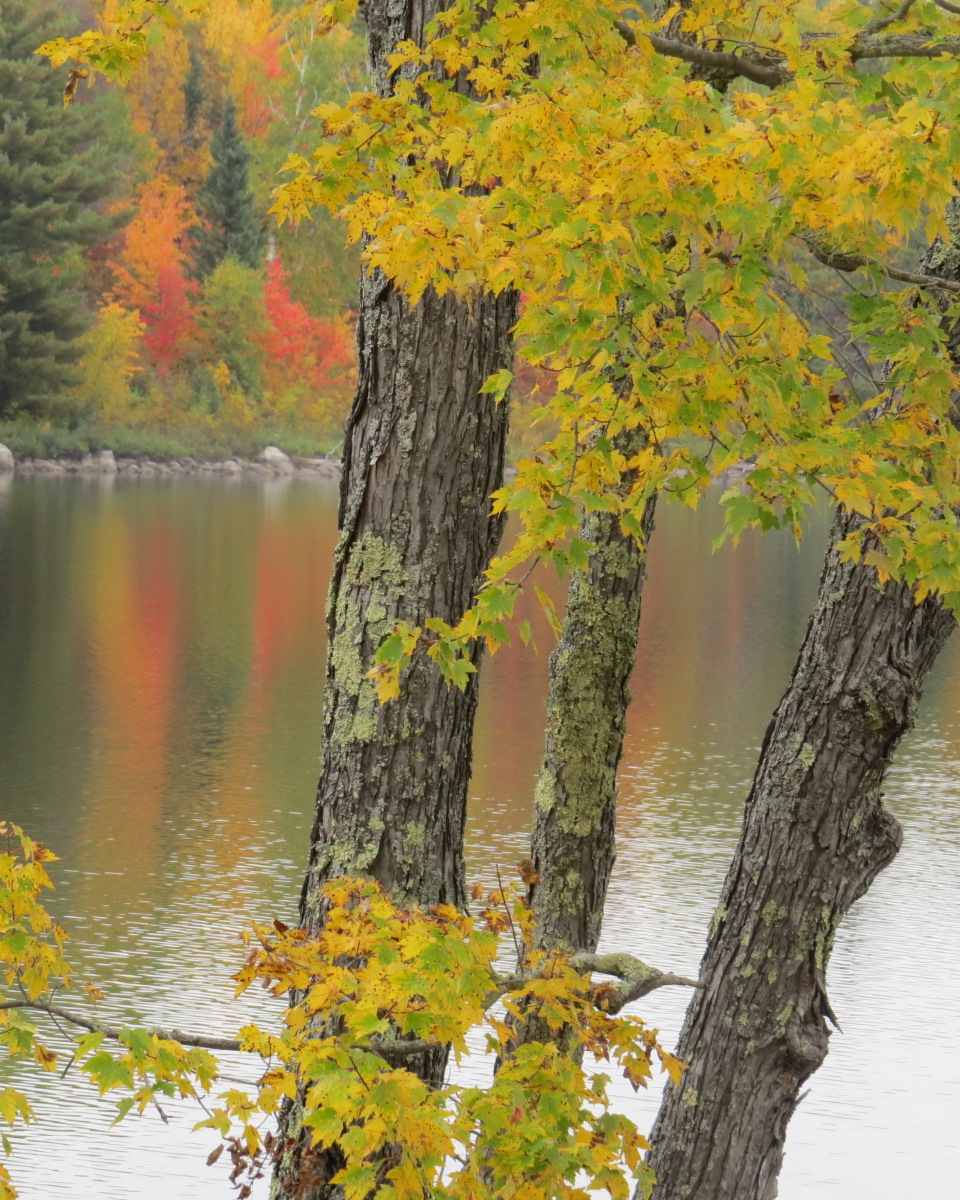
Fall color, calm water of Newton Lake.

Fall color, calm water of Newton Lake.

the fourth wilderness area to be created in the national system.  Fall and Newton Lakes were dead calm, and with only a slight wind present on Pipestone Bay on Basswood Lake, we made good progress, covering the distance in 4 1/2 hours.  As we entered the final bay, we saw through binoculars something that looked like a tent.  Hoping it wasn’t, we came closer, until I saw the clear movement of a tarp.

We had scouted the site two years ago and had thought it a perfect place to camp.  I did in fact camp there four nights last year, when I had to go alone, and it was better than I had thought.  On a ten to twenty yard wide isthmus was everything we needed to explore two big bays of Basswood Lake, which straddles the US-Canada border for 14 miles, 27,000 acres.  It is an International Treasure shared by the two countries.

Basswood Lake campsite author stayed at in 2013.

Basswood Lake campsite author stayed at in 2013.

The Boundary Waters has designated campsites in order to restrict impact to certain areas.  I have been on over 600 sites when I volunteered for the Forest Service from 1992-1999, cleaning them of trash and litter, sawing limbs of dead trees that were either a threat to a tent or blocked access to parts of the site.  I have camped on more than 70 different lakes; on Basswood alone, I have camped on 20 different sites.  I like campsites on a point, with a great view of sunrise and sunset; a good place to land a canoe, a nice kitchen area; sheltered, if possible; and good, flat tent sites.  The campsite we wanted had a view back up the bay.  We had both seen it in 2012 and thought it adequate.  We didn’t realize how lucky we were that the site was occupied.

Sunset from the campsite, looking east.

Sunset from the campsite, looking northeast.

In the next five days, on our secondary site, near a swamp, we would encounter:

  • The aurora borealis, twice, because we had clear views to the north each night.  The first night showed faint lime-green streamers along the horizon.
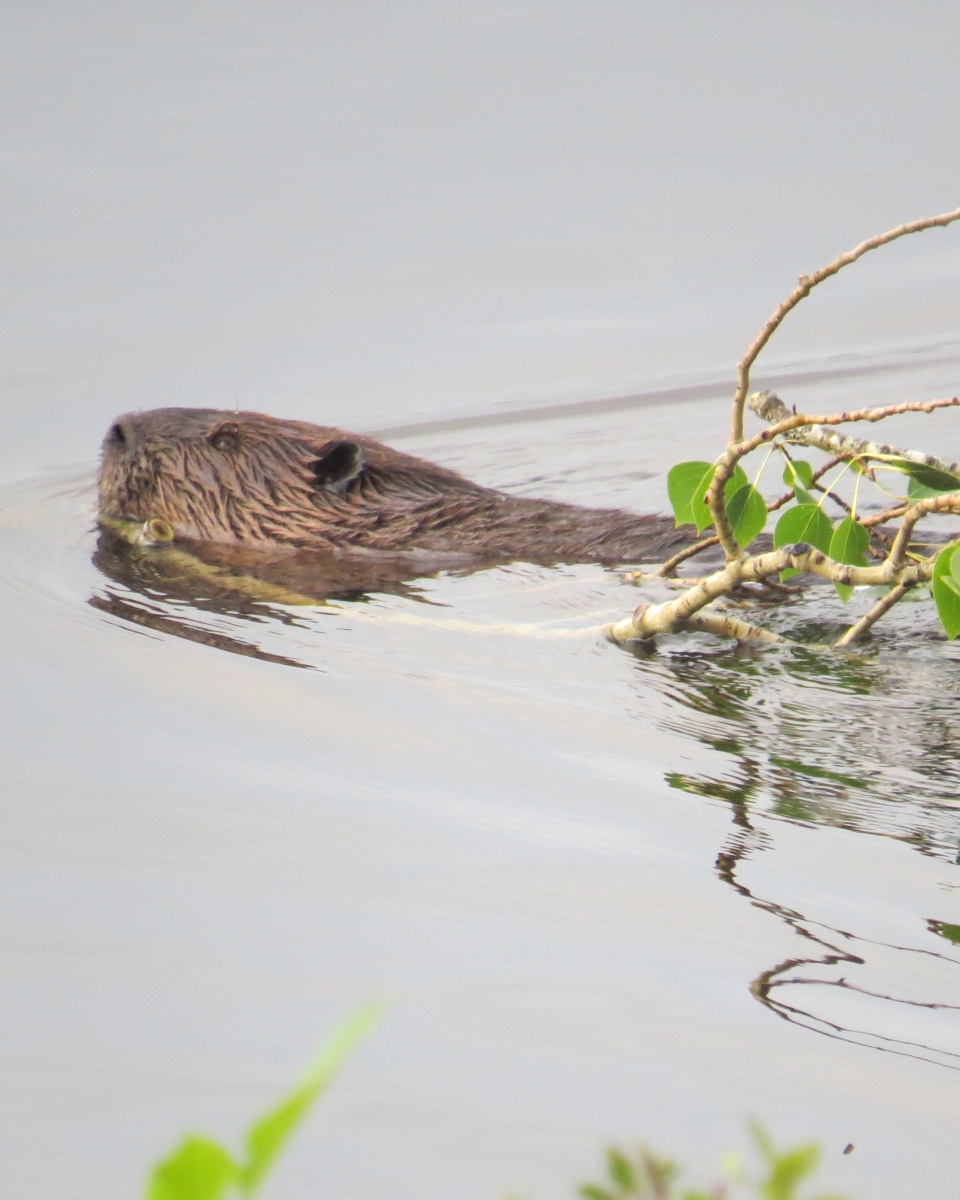
  • A beaver show nightly, when 2 adults and their young swam from their beaver house near the campsite into the nearby swamp.  We saw them chewing trees, bringing logs and brush out, eating them not 50 feet away, then swimming back to their house.
    IMG_4658

    Baby beaver, swimming

    IMG_4654

    One of the best views I’ve had of the beaver’s tail.

    IMG_4583

    Adult beaver, who straddled the branch, and took it back to the beaver house.

  • Once, one of the trees that had been chewed, cracked and fell, in plain view of the campsite.
  • During one night, we heard a pack of wolves howl, a quarter mile away.
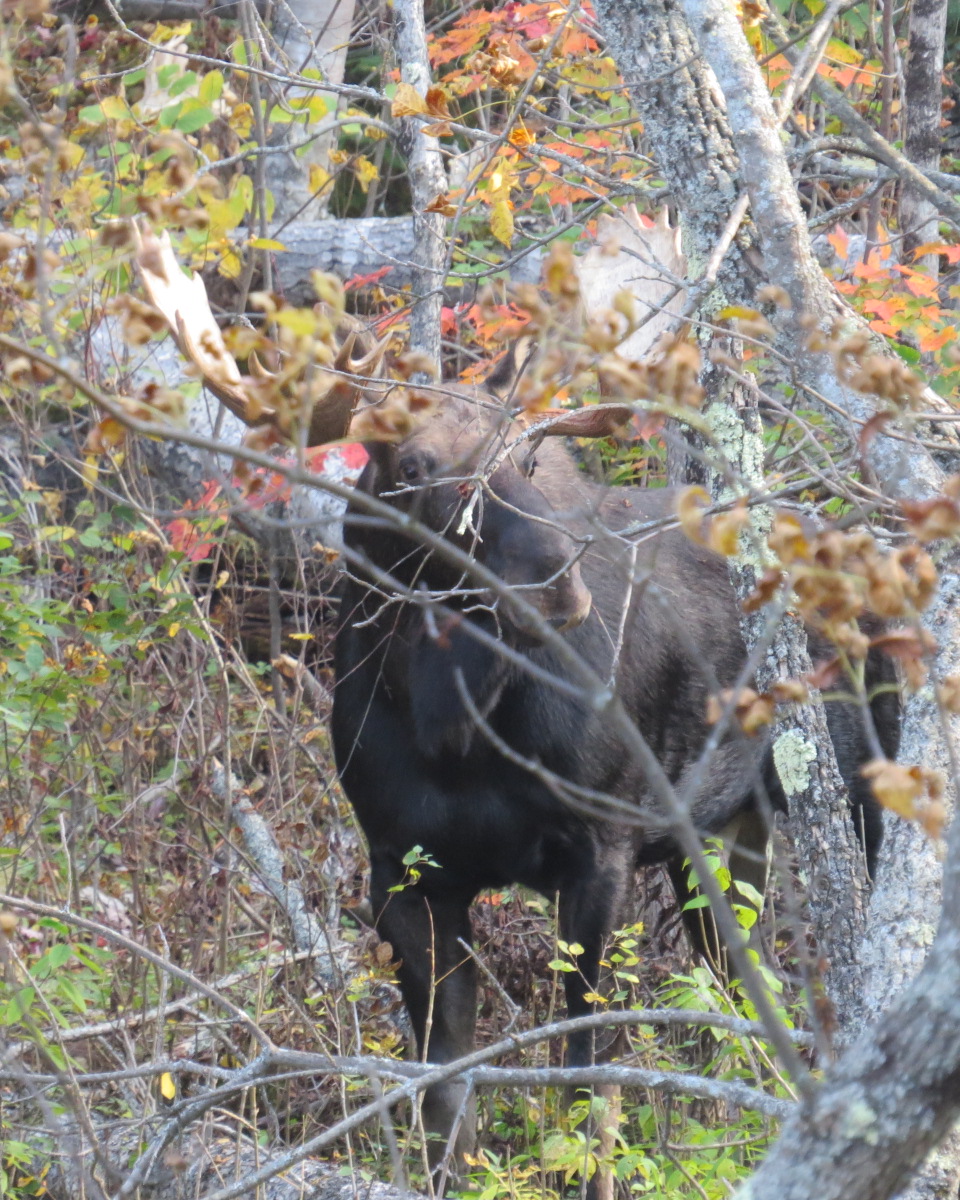
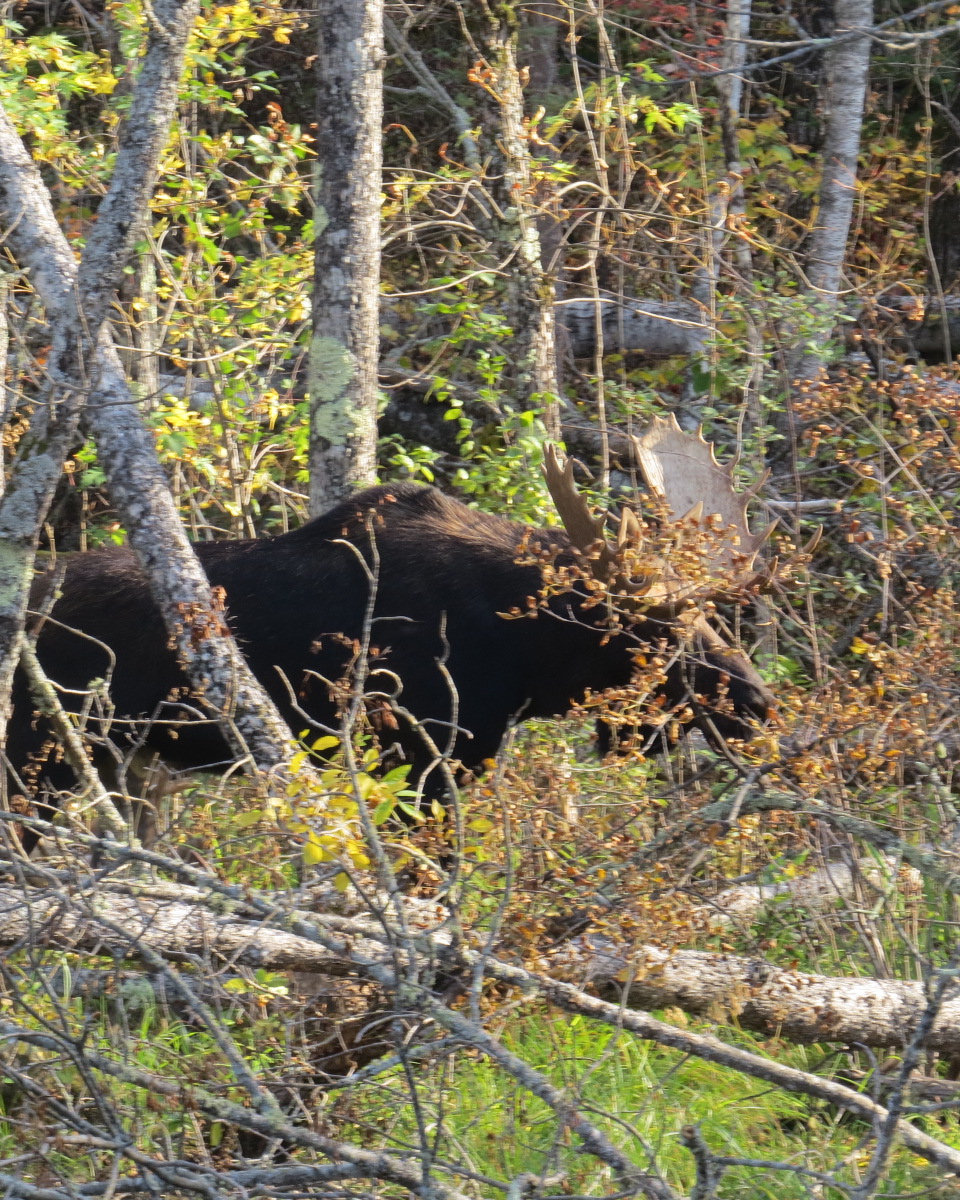
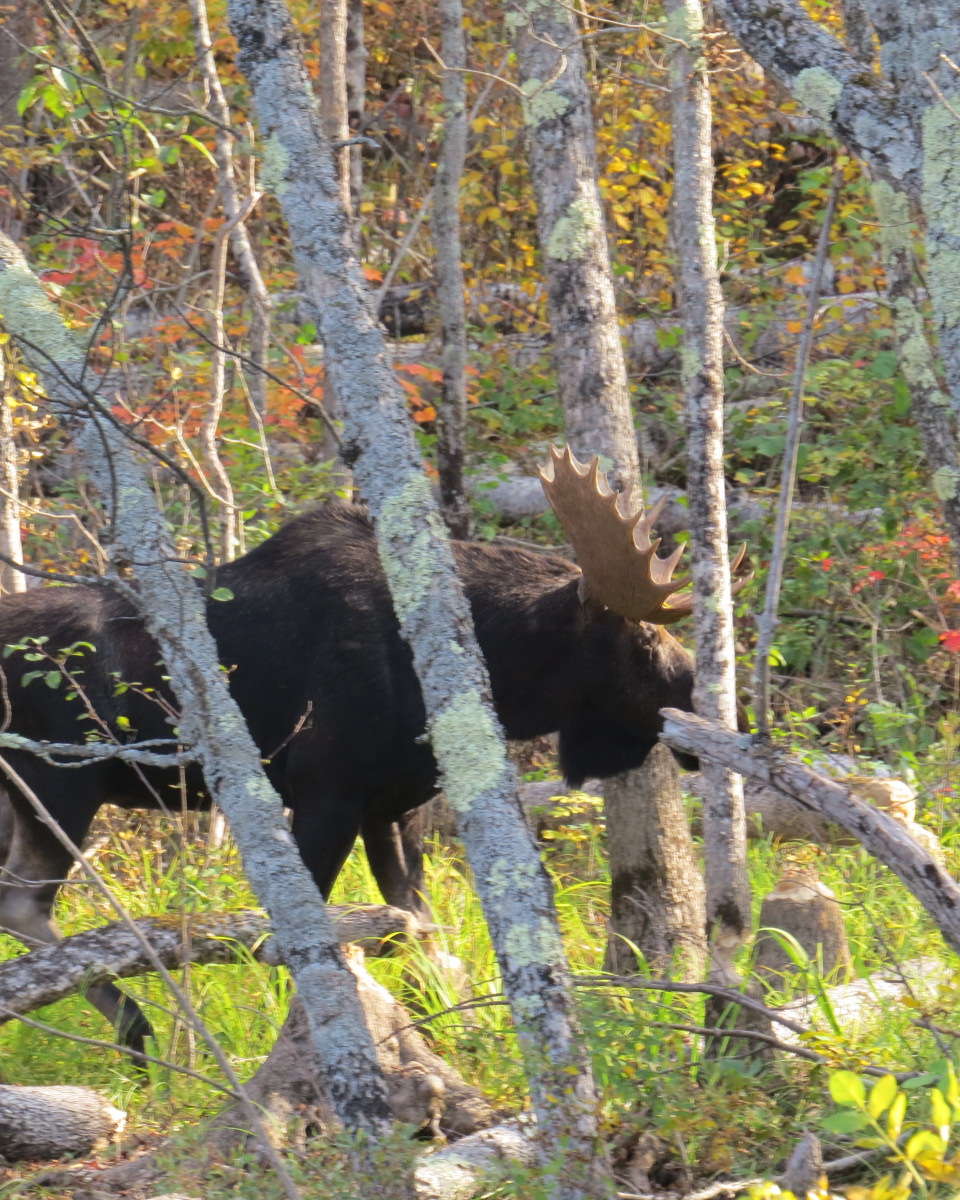
  • A large, bull moose came by the swamp, 50 yards away, walked along it in plain view, then walked through the back part of our campsite, without any evidence he cared we were there.
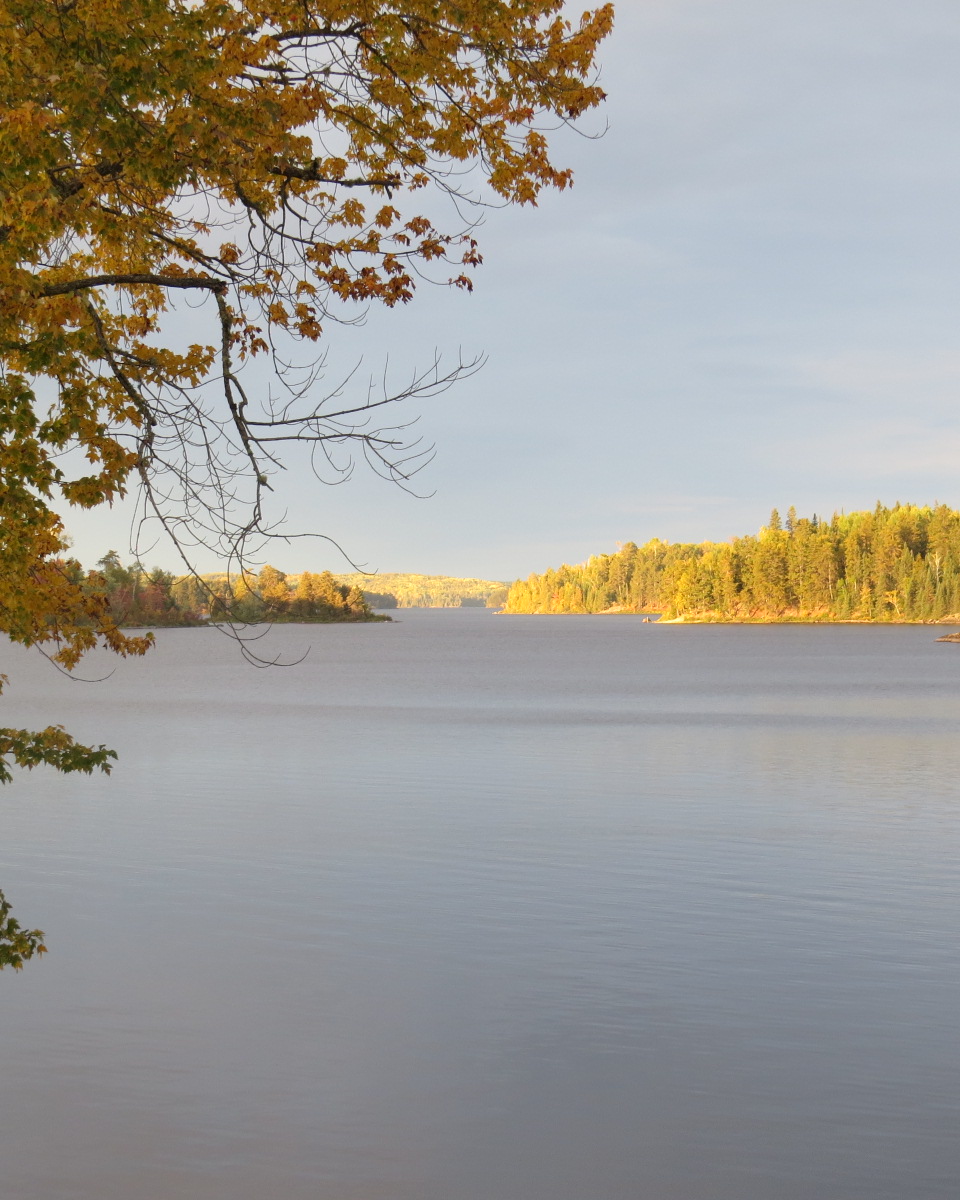
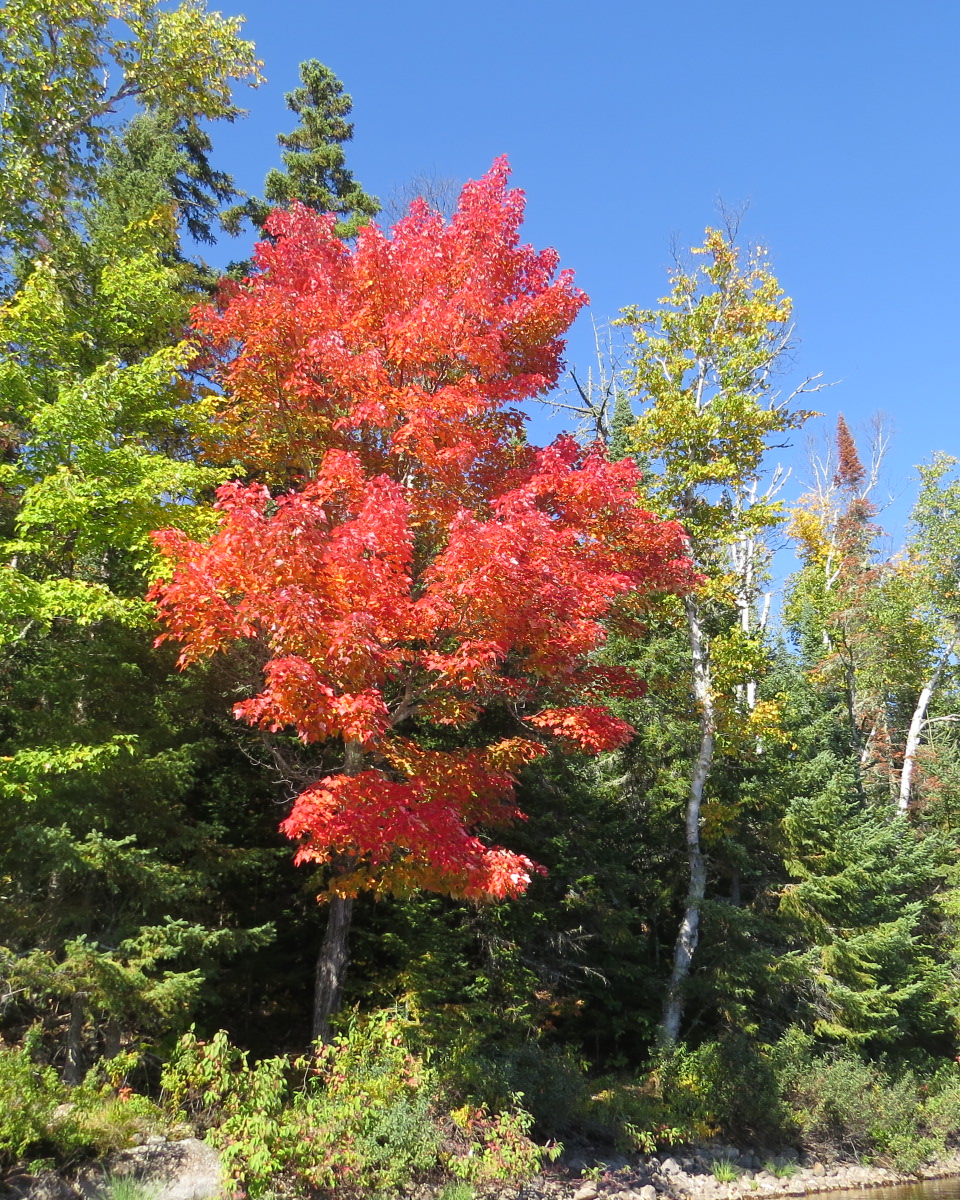
  • There were spectacular views of the autumn colors down the channel of Basswood Lake towards Canada.
  • No more than five parties passed by the site daily.  Sometimes, we saw only one.
  • There were at least two days when nobody was on a campsite north of us all the way to Canada.
IMG_4564

Sunset view down the lake.

IMG_4667

Bull moose arriving and walking through nearby swamp.

IMG_4676 IMG_4677

In short, the site was a hidden gem.  There are sites with better tent sites, good landings, nice kitchen areas, and good views of the sunset.

There are also sites with poorer tent sites, difficult places to land the canoe, exposed kitchen areas, and difficult latrine trails to navigate.

All we did was set up camp, stayed quiet, and looked.  When one base camps, staying every night in the same place, one may travel a little each day to learn about the lake and have time to see what happens in a square mile of wilderness.  I could have mentioned the eagle that flew overhead daily, the frequent visits of ravens, the loon often out front, the grouse nearby, the squirrels that ignored us, because they had never been fed on this site by people.  There was also the gradual falling of leaves from trees that became quite noticeable, and climbing the cliff across the bay rewarded me with a nice view to the south.

Twenty years ago, the idea of base camping didn’t appeal to my desire to cover miles and see new territory.  With age, I have found that slowing down, camping in one spot and making it home for a few days appeals much more.  It is easier, and I see things that I had missed on the 20 mile days.

During this trip, we enjoyed the “outdoor triad” of wilderness, totally dark skies, and complete silence.  Not only did we see the Aurorae, I saw Andromeda Galaxy and the Double Cluster in Perseus clearly, Capella’s and Venus’s reflection in the lake.  Too many do not have the fortune to ever experience one of these 3; to experience all together is beyond measure.  I have awakened in the Boundary Waters and seen Orion’s complete reflection in a calm lake, absolutely soundless, except the ringing in my ears, with knowledge nobody was within miles of me.  These places still exist in America today.  They need to be guarded, not allowed to be used to extract resources in the name of “jobs.”  People who are alive today need these places, either to go to, like me, or to know only that they exist.  Many who come here might return to the “outside world” differently, were they to do what we did.

Is there a guarantee one will find a hidden gem?  Yes.  Being in the wilderness allows one to open his or her eyes and see the gems that are available for one who happens to be in the right place at the right time.  It may be two leaves on the ground (picture), a bee or small gnats feeding on a flowering plant, or an ant carrying a pine needle twice as long as it is.  Will one see specific creatures or sights?  No, there is no guarantee. Yet, I had no thought I would see or hear the things mentioned above, except for the eagle and loon, which are common on all wilderness lakes in the North Country.

The isthmus site is good and a beautiful place.  When we visited it on this trip, however, we saw a jackpine cracked in two, threatening to drop itself and at least one other tree into the kitchen area.  That is a significant risk. The views there are great for sunrise and sunset.  Last year, the sunsets were spectacular.  But there are no views to the north, and there is no swamp nearby. I wouldn’t mind staying there again, for if I did, and were quiet, I would see something special.  I just don’t know what.

But I also know that there is a hidden gem nearby.

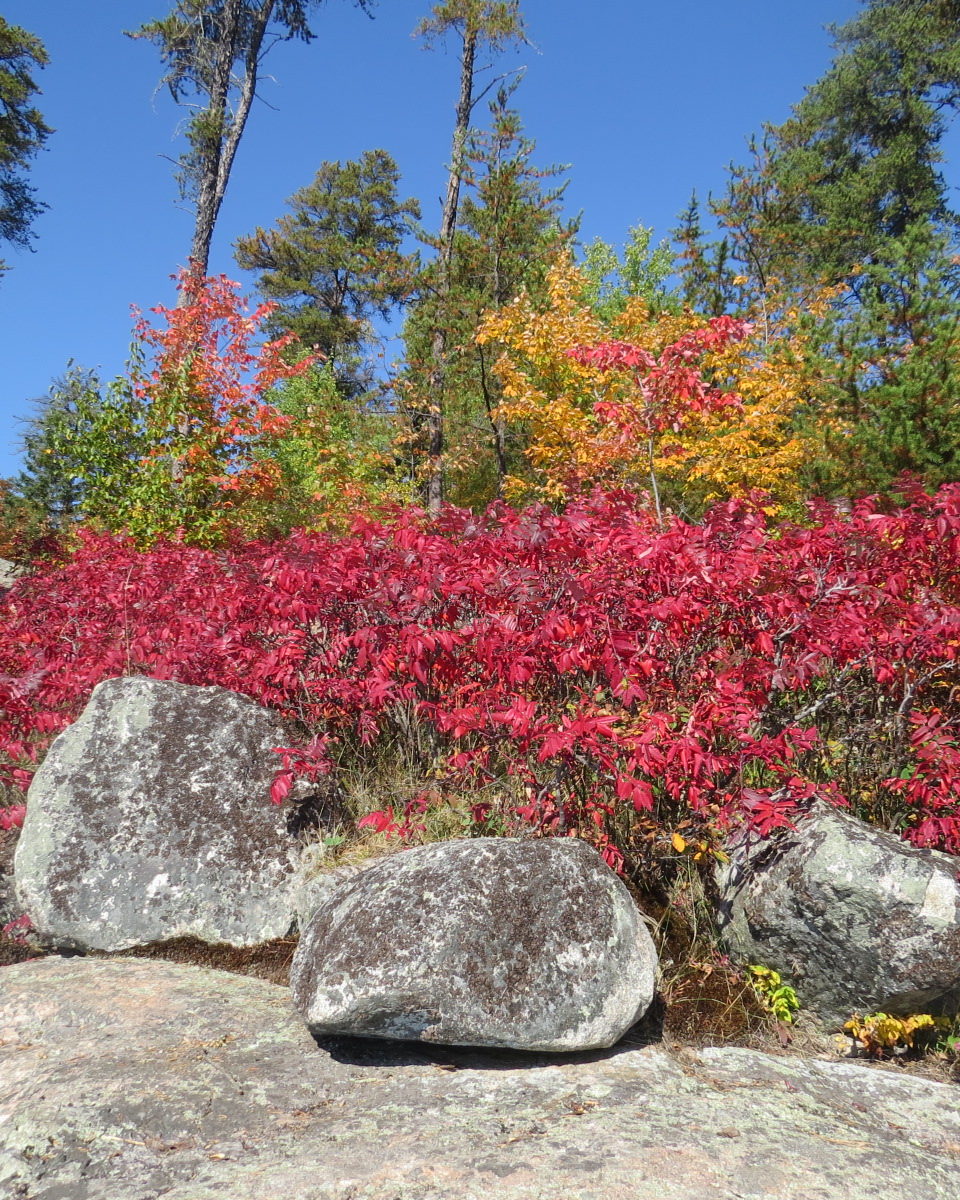
Fall colors

Fall colors

IMG_4606

IMG_4509

Kitchen area above this color on another campsite.

Kitchen area above this color on another campsite.

The plant that I spent time watching a honeybee pollinate and small gnats doing the same.

The plant that I spent time watching a honeybee pollinate and small gnats doing the same.

THE LAST STEP ON THE FINAL PATH

September 5, 2014

I remember one time where I “owned” the ICU at the hospital where I worked.  I was the consultant on eight patients – eight – who were severely, irreversibly brain damaged, or brain dead.  I don’t remember all the diagnoses; there were a couple of aneurysms, an intracerebral hemorrhage, hypoxic encephalopathy, a bad surgical outcome and some devastating strokes.

During my harried week, the staff were superb in using my time efficiently, shepherding me from one family group to another.  It is easy to get jaded when one often sees lethal brain damage, and such patients need to be seen a few times a day.  I tried not to become too cynical, but I don’t know how successful I was.  Taking time to talk to families is necessary, deeply appreciated but stressful, since many grieve using anger.  Nobody who is acutely grieving comprehends much of what a doctor says, so there needed to be constant repetition, and I had to bite my tongue more than once when a nurse said, “The family said you didn’t tell them anything.”  As much as I tried to talk to one designated family member, who would relay the information, that didn’t happen often.

All it took to undo a day’s work was a lung or heart consultant who told the family, “He’s doing well,” when the consultant meant the organ system.  The family didn’t hear that.

It was often the family’s first time dealing with death; it might have been my thousandth time saying, “there is nothing that can be done,” “he will not wake up,” “I am sorry.”  Doctors need to do it and to do it well.  Many do not.  Many made rounds when the family wasn’t there.  Sometimes, the nursing staff had to pressure the attending to contact a neurologist, and they often called me.

Not that it mattered, since I was busier than I wanted to be, but the time spent dealing with families was uncompensated, whereas a carotid endarterctomy, in my hospital a proven worse way of managing carotid disease than leaving it alone (I had the data), was compensated well into four figures.  We pay doctors to do procedures far more than we pay them to listen to a grieving family, say a grasping of a hand is reflex, not voluntary, see the expression of disbelief on their faces, when we give them the bad news, and hear the same stories about “some miracle” that wasn’t.  Small wonder we have expensive medical costs compared to the rest of the world, vegetative patients receiving futile care, because nobody acted when they were irreversibly brain injured and were clinically unstable.  The longer a patient lingers, the more hope a family has.  I was frequently castigated for “taking away hope,” when what I avoided was doing the worst thing of all, “giving false hope.” We pay a lot for the final months of life, but to me that statistic is misleading, because most people don’t know when they are going to die.  We do, however, pay for a lot of unnecessary care.

If we dealt with death well, we would have fewer patients lingering in a way the vast majority would say they never wanted, since the diagnosis of irreversible brain injury may often be made when the patient is clinically unstable, and support discontinued then.

If I returned to medical practice, which I won’t, I would be a far more compassionate physician than I was during the twenty years I did practice.  I thought then I was fairly good.  Now, I am not so sure. I thought I was skilled at allowing patients to die at the right time with more dignity and less stress on the families.  When it came time for my parents to die, I did everything I promised them; neither lived more than eight weeks from the time they started to die.  Ensuring quiet, quick, painless dignified deaths of my parents was the second best thing I’ve ever done in my life.

I wrote about the change in my relationship with my recently widowed father, probably the best article I will ever write.

Having lived through my parents’ deaths, I now look at life differently.  I would be far more compassionate to those who were facing death of a family member.  I would be able to tell families that it is normal to feel guilty when the time comes to stopping life support.  I could tell them how one will miss having that loved one to talk to, all the conversations one would want to have in the coming years, dreaming of the person, a decade later, the way they were in life.  I could tell families how the relationship between children and the surviving parent would change.  I would be good and far more effective.

As I enter a new phase in my life, I am considering once again dealing with death, not as a physician, who cares for a patient, but as a volunteer helping people to navigate the complexity of care and options when they have illnesses that are not going to be cured, problems that are not going away, time that may no longer be present, helping them find their own path, perhaps their last steps on that path.

In doing so, I will help myself.

BE AFRAID; BE VERY AFRAID

August 26, 2014

“Tanks at the Ukrainian Border.  World War III?” was posted, and I just shook my head.  Today, it was “Hamas style tunnels going under the Mexican-US border.”  There is so much fear out there, I wonder why only 7% of Americans have served in the military.  It sounds like we all ought to be conscripted, for terrorists appear to be everywhere.

We have become a nation of fear, afraid of the boogeyman, who will bring nuclear weapons across the southern border, infect the country with Ebola, blow up our nuclear plants, abduct thousands of children a year, drive millions of Americans out of work, raise a black flag over the White House, take over our land, allow Russia to run unchecked, ISIS to control the whole Middle East, Iran to have nuclear weapons, which they will use on Israel, and Texas targeted by North Korea (which it actually was, although the missile blew up shortly after launch and didn’t have the range).  Every time Mr. Obama speaks, people buy guns to add to the 310 million in the country, yet if any gun has been taken away illegally by the Feds, I have yet to see credible evidence.  How many guns do we need in this country?  A half billion?  A billion?  Ten billion?  A trillion?  Is there a top number?

The President has created fewer national monuments than his predecessors, yet the Organ Mountain Monument was a “federal land grab.”  I AM the federal government.  ALL OF US are.  I LIKED the monument.  I DON’T LIKE people’s grazing cattle on federal land for free, then calling for people to fighting against “them.”  I AM THEM.  I don’t eat meat, and I pay land use fees.

Make no doubt: inciting fear wins elections.  George W. Bush won in 2004 by campaigning on fear, when most Americans still believed 9/11 was caused by Saddam Hussein. Perhaps most of Americans still do believe it.  Iraq kept Bush in power, until the war became costly, “dead enders” were very much alive, and more Americans came home permanently maimed or in body bags.  Congress changed; the response to Hurricane Katrina, which was scary, was a contributing cause.  Who but the federal government would have rebuilt New Orleans, or Joplin?  We saw what happened without a decent FEMA in 2005 and with a decent FEMA in 2012.

I have fears, but nothing on the above list.  Almost anything is possible, but I can think of a many things that would easily wreak havoc in this country that nobody has mentioned; I won’t mention them here, except for rolling back safety nets.  Get rid of Medicare, Social Security, food and water inspections, and we will be the newest member of the Third World.  I find that scary.  We know enough about Ebola and other infectious diseases that we bring our living soldiers in the infection war home alive to be treated.  I can understand one’s wanting to have the body of a loved one returned home; to decry bringing a living infected body home for treatment is a contradiction.  The probability of a child’s dying from a motor vehicle accident is over 10 times that of their being abducted by a stranger, yet I see no ads for strong enforcement of child safety restraints in cars.  Scary news sells.  In 1979, during the Iran crisis, the media showed screaming protesters outside the embassy.  A block away, all was quiet.  

Muslims in America are not about to take over the country, except maybe in mathematics, where Dr. Mirzakhani, a 37 year-old Iranian citizen, full professor at Stanford (at 31), won the prestigious Fields Medal in mathematics.  Our high schools are full of students who can’t do basic division, don’t know their multiplication tables or how to write an English sentence, let alone cursively,  have no idea where Canada is, let alone Iran.  I fear ignorance.  We don’t teach critical thinking, so people are easily swayed by rumors deliberately fomented by good-looking people, nice sounding “news” outlets.  Ten children families scare me. We are straining our resources and our space.  I hear no, and I mean no, comments about that.

Russia will do what it wishes, and there is not much we can do about it.  The world has changed; American troops are not the answer to problems that can be created by a few thousand people using complex armaments supplied them by developed nations (like us).  As I write this, I am flying in an aircraft over a foreign country, but I’m not worried about being blown out of the sky.  The very notion of war continues to change. 

ISIS is controlling land, but radical Islam, Christianity, and Judaism, scare me more, especially Christianity’s influence here.  If people want to pray, fine. It is scary—and insulting— when a Congressman sends a Bible, a book with hundreds of contradictions and false interpretations, to other Congressmen. The constant use of “God” and “prayer” in speeches scares me, rather than offering ideas open to modification.  God sells here; ideas that take time to articulate are ignored. “Just give me the bottom line” is one of the scariest phrases I hear.  Major problems, like immigration, public education and the national debt, can’t be summarized in 30 seconds.

I do not know whether Iran will develop nuclear weapons.  Pakistan has them, and yes, that is scary.  So is the environmental catastrophe about to engulf China, in the name of our “requiring” a completely unsustainable 10% annual growth.  That statement is on a par with “the stock market always goes up,” based on 60 years of data. What scares me is that we in the US will do nothing about climate change, despite 650,000 years of data, until nature gives us—and forgive the term:  a “come to Jesus” moment.  

I am not scared of illegal immigration.  I am scared of drug runners, who will bypass any fence we can build, but I worry less about being shot by them than being in the wrong place at the wrong time in my city.  I am more scared that we are trying to take in much of the world.  I am not scared that Spanish will become a second language; I am more scared that Americans are not working to become fluent in another language—any language.  I am not worried that the dollar will no longer be the reserve currency in the world, but German’s becoming the lingua franca in central Europe ought to give us pause, along with the oft-cloudy nation’s out-producing us in solar power.  The world likes a lot about America, when they stop laughing at us long enough to look.

It’s time to cool it on “disaster is right around the corner,” or “We’re Number One.”  We aren’t.  If one believes all is Obama’s fault, then run for office.  If the opponents win, I give them 90 days to fix everything, since they believe the world is simple. More helpful would be quietly working to improve justice in the world, addressing population control, and dealing with climate change.  There are a few others I would throw in, but the current attention span is limited until the next tweet or upcoming disaster posted on Facebook.  Messenger is probably beeping right now, so I  better go.

24 x 7

June 21, 2014

Recently, I read a post about how the children of the ‘70s survived, despite all the problems they encountered: recalled toys, like lawn darts; not wearing seat belts; no helmets; and leaving kids unattended. Lawn darts caused a few injuries and one death; 12 high school and college students die annually from football, but a lot more play football than threw lawn darts.  It might not have been unreasonable to ban them.  Given football’s propensity to cause brain damage, I think the game must change, a tall order in this country.

We don’t need helicopter parents, not letting their children discover the world for themselves.  Kids need to experiment.  But some experiments we know aren’t a good idea, and we don’t want kids repeating them.  Diving into unknown water is one of those.  Not wearing a seatbelt is another.  I remember when cars didn’t have seat belts; people who first encountered seat belts in cars thought they were weird, like we were going to go flying.  On holiday weekends, we saw in the paper numbers of dead (hundreds) from motor vehicle accidents.  Since 1960, the absolute death rate has fallen, despite a near doubling of population.  The actual death rate per 100,000 is half of what it once was.  Seat belts are the major reason.

Helmets save lives, too.  Recently in my city, an 18 year-old girl hit her head after falling off a skateboard.  She got back on, a little while later was short of breath, collapsed and died.  This was almost certainly due to an epidural hematoma, with the classic lucid interval, and could have been prevented by a helmet.  Anecdote?  Sure.  But data support helmet safety.

Second hand smoke may not have caused cancer yet in the generation born in the ‘70s, but they are still young.  Wait until they become 50 or 60, and some who never smoked die from lung cancer.

The issue is not that you got away with it, and therefore it was safe.  That is Challenger-type of thinking. Challenger was unsafe to fly at the ground temperature it was at.  We had plenty of evidence to suggest that, but no catastrophe had occurred, so launch was allowed.  The issue is probability.  The probability I will die in a motor vehicle accident is very low.  But I can make it lower by wearing a seat belt, which then makes the airbag useful.  The probability I will get cancer from second hand smoke is low, but I can make it less by not being around it.   Smokers can live long lives and non-smokers can die young, but the probability is against such an occurrence.

I continued to write that in my youth, we had 3 TV channels, not hundreds.  We did not have Nancy Grace, Fox News, or Keith Olbermann.  Last year, after the Asiana crash at San Francisco, we had extensive coverage, where experts were continuously asked to offer opinions about something about which they had limited facts.  “Dead air” is an ironic killer in 24 x 7 news, and it has to be filled, but if the filler is conjecture, and if it is repeated often enough, the conjecture becomes treated as fact.  Politicians have known that for decades.

If child abduction and murder by strangers were 26 times higher than it is now, we would have a national campaign to protect children.  Come to think of it, we do.  And it works.  The problem is that a child is 26 times more likely to die in an auto crash and 20 times more likely to die at the hands of a family member than a stranger.  But 24 x 7 coverage of an Amber Alert overplays the idea that children are always in imminent danger, when they aren’t.

The idea that we are just seconds away from death at any moment, “It could happen tomorrow” on The Weather Channel, the idea that but for a super hero or a first responder, our lives could be snuffed out in a second, is wrong.  We need counts of deaths, we need proof of dangers, if we can determine such, and they must be peer-reviewed.  Mike to The Weather Channel:  the most dangerous weather system on Earth is a stalled high pressure system.  Heat-related fatalities comprise a plurality of weather related deaths in the US, drought is the cause of more than half of all worldwide weather-related deaths.  Showing storm chasers near electrical storms does not help teach people that lightning annually kills more people here than hurricanes, even with Katrina’s toll factored in.

Such 24 x 7 coverage often pits two “experts” against each other in the name of equal time, whether or not the science is equal.  Climate change is an example. Or, it asks multiple experts to speculate, when speculation may be outright wrong, either because the facts aren’t clear or the reasoning isn’t.  In a country with over 300 million people, there are daily tragedies.  Indeed, each of us in our own lives has tragedy strike numerous times. On an average day, most of us have things happen that we don’t like.  It is probability, and low probability outcomes with large numbers of events lead to a significant expected value of these uncommon outcomes.

There is significant news every day.  It would be nice if it were reported and then left alone until further information becomes available.  Breaking news is not helpful if it glues people to the TV screen, with experts trying to comment upon things they can’t effectively comment upon.  It is akin to diagnosing a patient based upon what they write in a letter or say over the phone.  A good doctor will use extreme caution here.  A good journalist should, too.


HOOFING IT THROUGH THE DENVER AIRPORT

March 27, 2014

I was really pissed when I opened my e-mail in Portland, a month ago, as my wife and I were getting ready to fly back to Tucson, after a trip to Eugene. “Your flight to Kearney has been cancelled.” The online travel agency didn’t offer a suggestion, only a telephone number to call. This was not what I needed to hear in the morning. The good news was that I could get to Kearney that same day from Denver, in order to volunteer to help out with the Sandhill Crane migration at Rowe Sanctuary. The bad news was that I would land at about 4:45 p.m., 20 miles from Rowe, with the evening tours beginning at 6.

My stay this year was already shorter, because we were in the middle of a move, and I was lucky I could even go. But, I was about to lose an evening in the viewing blinds, which is my selfish reason to go. I guide people to the viewing blinds at Rowe Sanctuary, because the cranes may only be seen close up if people are hidden. Nebraska is the only state where they are not hunted. If I am not a guide, I will “tag along,” to be in the blind, if a space at a window opens up. One always does. I admit it, I am selfish. But I clean toilets, do odd jobs, make morning coffee, act as a roving naturalist, and sleep on the floor in the gift shop. In past years, I taught a beginning course on Cranes for interested tourists. I have taken people out to the photography blinds and brought them back, cleaning up the “chamber pots” they use during their all night stay along the river. That may sound gross, but I enjoy driving out and back, and almost everybody who goes there loves it. I’m not religious, but when I hear somebody say, “I feel closest to God when I am by the river with fifty thousand cranes,” I understand the spirituality. Yeah, I wanted to get to Rowe early in the day, and it wasn’t going to happen.

I found the flight had been cancelled, but I went on line two days before I left, discovering it hadn’t been cancelled, so I tried to get on it. No such luck. I would be leaving in the afternoon, getting there in early evening. The day I left, I arrived in Denver, at 1030, knowing the Kearney flight departed from a different concourse at 1035. But, as I walked from the far end of B concourse, I glanced at the first monitor, looking for the Kearney flight. “Whadda know,” I said to myself, glancing at the yellow “delayed” on the screen, “let’s give this a try.” I didn’t really think I had a prayer of making the plane, but I doubled my pace, weaving through the crowds like an expert slalom skier. “It never hurts to try,” is one of my mottos; another is “All they can do is say no.”

I was seriously hoofing it, so much so that I got on the moving walkway, in order to add another mph to my speed. When a walkway wasn’t working, I took it, because nobody else was on it, and I had a long empty straightaway. I caught the airport train perfectly, got to the A concourse, and blasted up the stairs so fast that the guy in front of me doing two at a time was in my way. I blew by him, not even running, and turned on the gas at the A concourse. I went downstairs to where the small plane check in counter was, asking if the plane were still there. It was, planned departure at 1100.

It was 1055.

I had gone from the plane, through 2 long concourses, a connection, a train ride, and some stairs in 25 minutes. This is hoofing. I jog-walked the last 300 yards to the gate, asking, a bit breathless when I got there if I could get on, assured I could. I then asked if I had time to go to the restroom, although that was really pushing my luck, but again, all they could do was say no. I had enough time to make the calls I needed to arrange a pick up in Kearney and send an SMS to my wife.

This isn’t the first time I’ve done this. I had an 8 a.m. flight to Dallas one time, and as I started walking to the gate, I noted a monitor that said the 8 a.m. flight was delayed. I saw there was a 7 a.m. flight not cancelled, and it was 6:45. I literally walked to that gate, getting on board the 7 a.m. flight, with more time for my connection in Dallas, which was tight to begin with. Lucky? Yes. Very. But I made my luck, too. I thought fast, looked at options, and asked unabashedly.

Much success in life is luck: a photographer who has a person bankroll a book he writes, becoming famous as a result. An amateur astronomer who happens to discover a comet, because he happens to be looking in the sky for one, was out on the right day, in the right weather, and looked in the right place. Some have become famous as a result of their luck. But they made their luck, too. They didn’t bemoan their failures or their work. They put themselves in the situation where the probability numerator might increase with the denominator. When both increase the same, the overall probability increases. It is a mathematical fact.

I could have just as easily sat in the airport and waited the 4 hours for my flight. Instead, I looked at the monitor, knowing these small planes are often delayed because of weather or not having enough pilots or flight attendants. I had nothing to lose by looking, except the few calories by hoofing. I made my luck. Life doesn’t often work out the way we want, but sometimes there are opportunities that arise, taylor made for those who aren’t quite ready to call it quits and are willing to go for the long shot. To most people, getting on that earlier flight wouldn’t have made a bit of difference. To me, it did.

Later, I learned the flight I would have taken was delayed 4 hours.


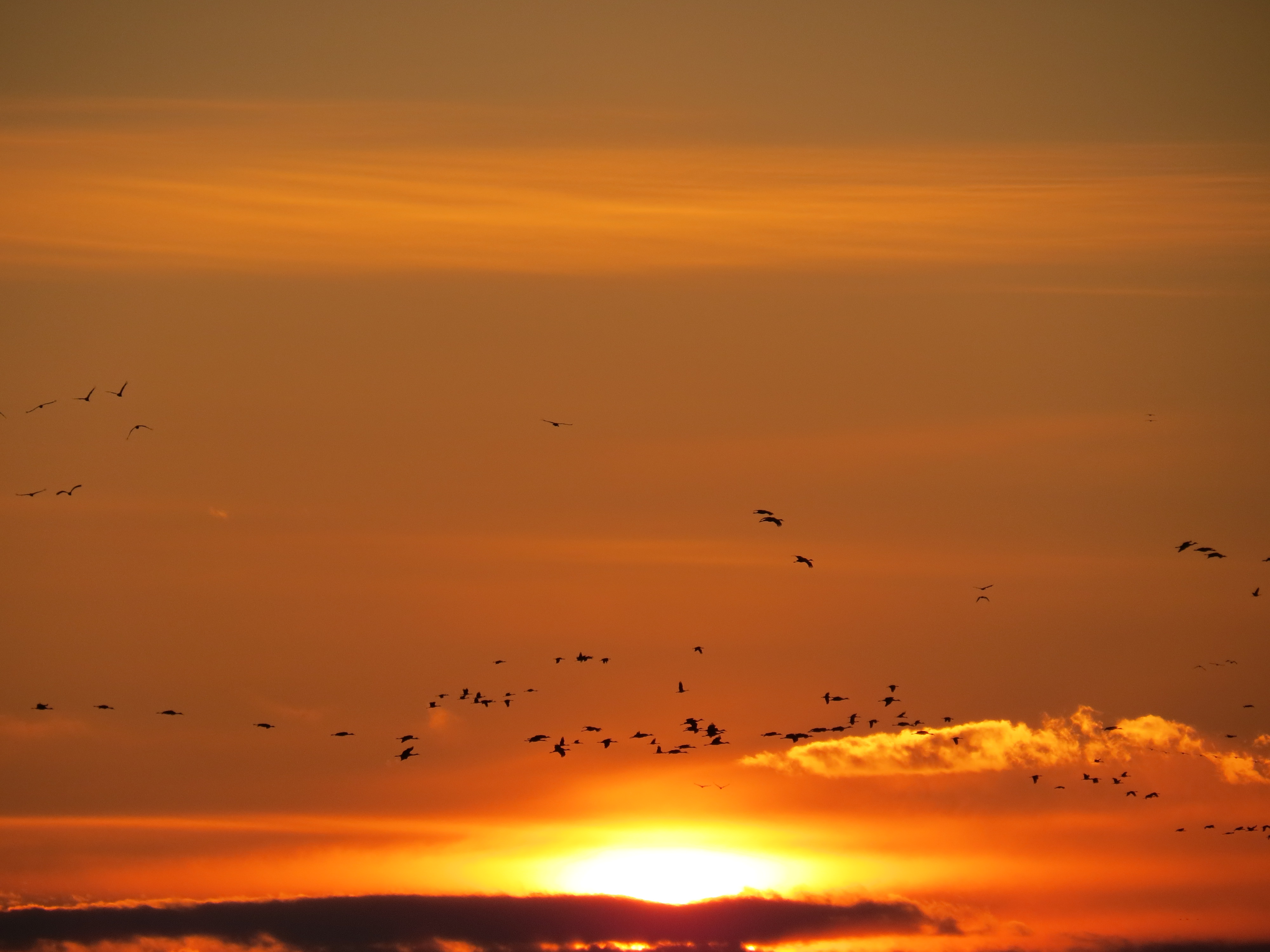
Cranes over the setting sun.

Cranes over the setting sun.


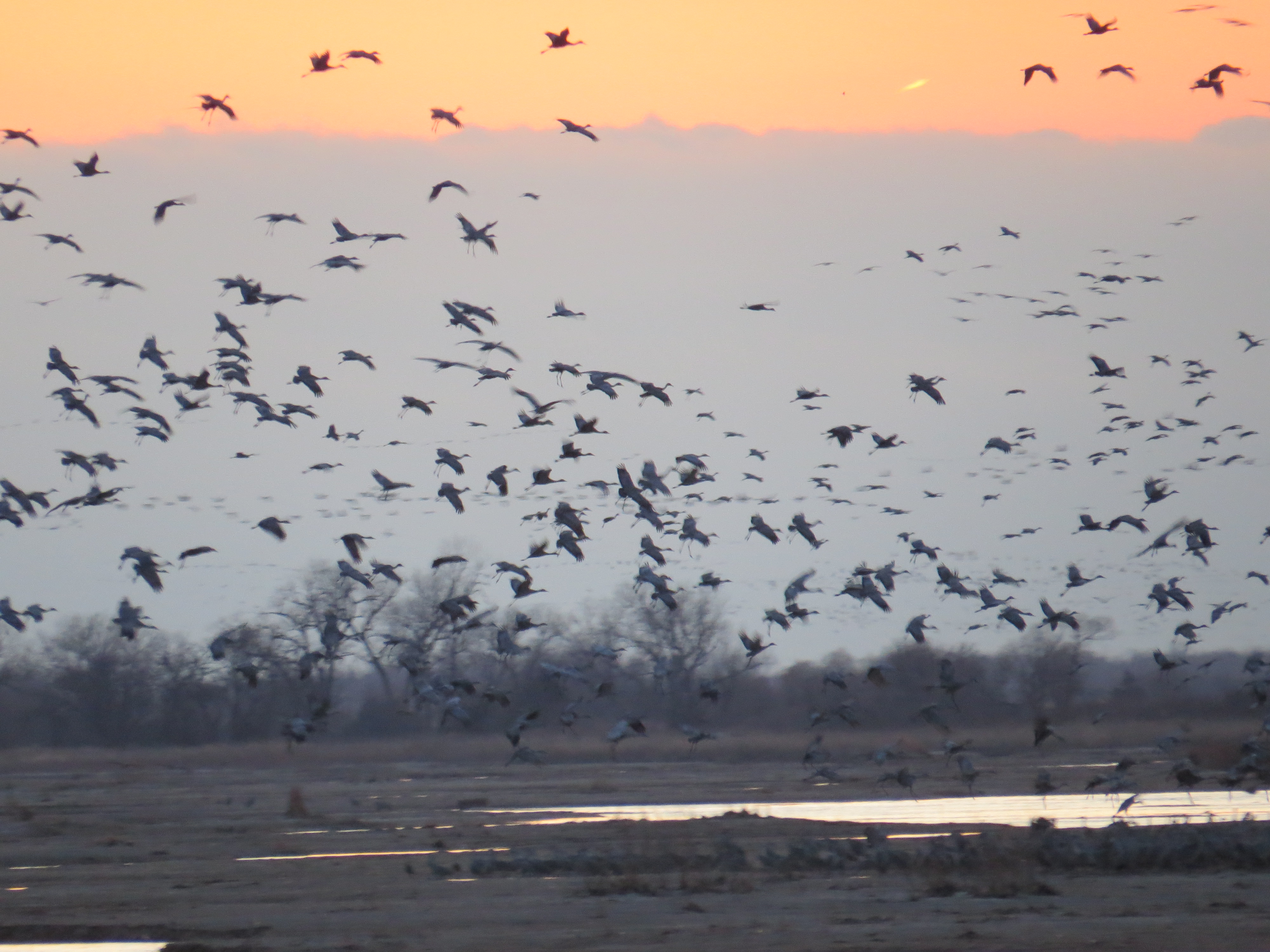
Evening cranes

Evening cranes

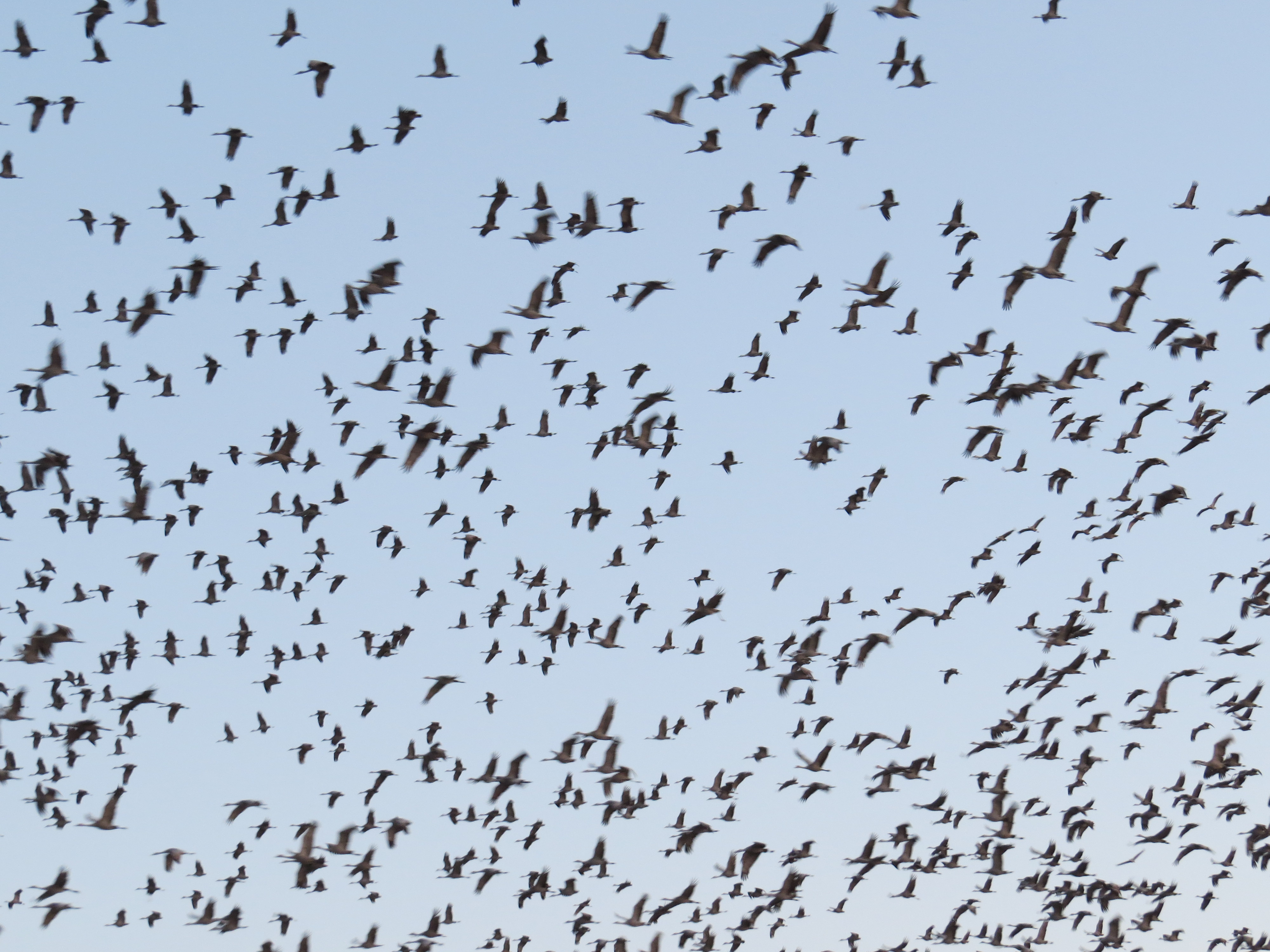
Morning crane "blowoff" from the Platte River.

Morning crane “blowoff” from the Platte River.

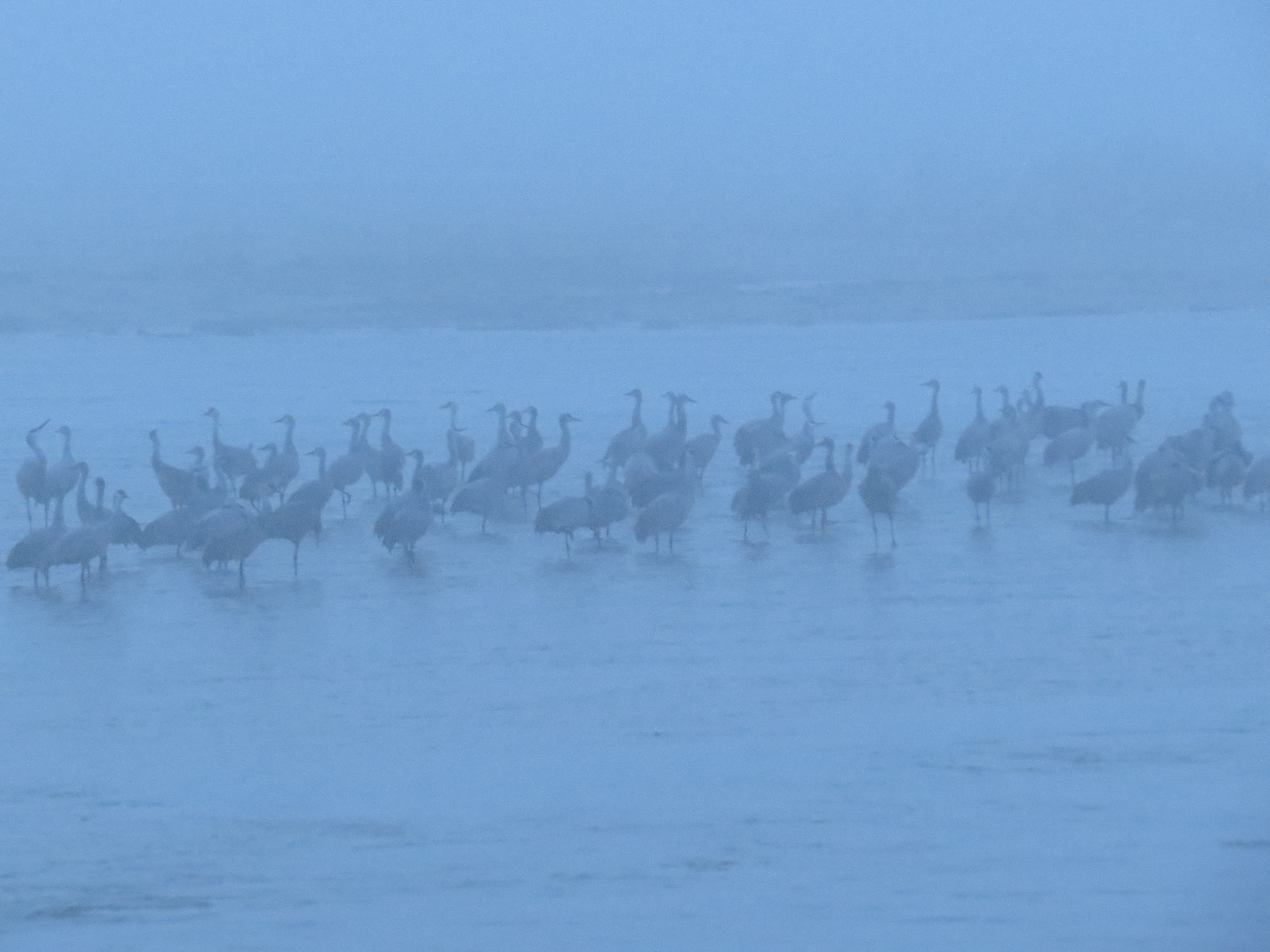
Fog cranes.

Fog cranes.

THE RAINBOW BRIDGE

February 14, 2014

It was the eighth time I have done this, bringing a cat in a cage to the vet’s office, knowing that the cage would be empty on the return trip.

Harry had been with us for more than 12 years, ever since he was spotted around our house, looking eerily like another stray we had adopted a year earlier.  Unlike the other, however, Harry was aloof, not letting us near him.  I knew he was a male; I saw him mark the territory one night.

He was right about marking it, more right than either he or I expected.

We left food out, and it disappeared.  But he never came near us.  He wanted nothing to do with humans.

I was in the office, with my wife, both of us with red faces and barely trying to stop sobbing.  Lisa, the vet tech, knew us, and we sat down, as a woman paid her bill.

We put a trap out and kept it open, gradually starting moving food closer and closer to the trap.  Harry, who of course, wasn’t yet named, ate the food but avoided the trap. Finally, after 2 months, we put the food in the trap but left it open.  Harry could come and go into the trap, and he did.  Finally, we set the trap; my wife slept inside, on the other side of the door, a classic “bait and switch” maneuver.

BAM, CRASH; 1 a.m. the trap, plus one very upset large black cat, was on the ground.  My wife picked up the spitting and growling “prize,” putting it in the trunk of the car.

A little boy came up to the cage, and said, “Is that a kitty?”  Fortunately his mother said, “Honey, it is not a good idea to be around other animals here.  They aren’t feeling well.”  I silently thanked her.  

Harry was hauled to the vet, who gave him ketamine through the bars of the trap, since there was no other way to anesthetize him.  Jupiter would completely orbit the Sun before Harry would receive it again.  After neutering, I brought him home, putting him in the back room, where he tried to jump out a closed window, hitting glass.  We figured we wouldn’t keep him, but we waited to see what happened.

We were then taken in a room and sat down.  I had to tilt the cage to get Harry out, because he was at the far end of it.  

In three days, I had Harry purring.  In a week, he was out in the house.  At night, he was  kept in the room, door open, a gate with polyethylene bars blocking exit–we thought.  One night, he appeared in the hallway outside the room, as if the bars didn’t exist.  Two of bars apparently were loose, like station 9 3/4, where he could go right through a door, like Harry Potter, whom J.K. Rowling had recently introduced to the world.  All our cats–we’ve had 18–named themselves.  He would be Harry P., then just Harry.  He remained aloof and his coat was coarse, but  never again was he interested in the outdoors.

I lifted Harry into my arms, stroking his thin frame, every bone easily palpable, his coat so thin that skin was showing.  He buried his head in my elbow.

We had three black strays and wondered if they were related.  Jack arrived on a hot summer day in 1991, appearing on the front porch with one eye swollen and blind.  Nine years later, B.C., (Black Cat) appeared and accepted house life as well.  We didn’t think Jack would survive.  He lived 15 years.  We hoped B.C. would live 15 years; in 2006, he suddenly dropped dead in the hallway one night.

As we signed the permission slip, we asked about the sedative, which we hadn’t used before.  “We have started doing that, lately. Renal failure veins are often small to get into.” Sedation sounded fine, as I continued to stroke Harry, now calmer.

Over time, Harry became fat, 24 pounds, losing weight after one of his buddies died, when less food was available.  His coat became more silky, he stopped biting us, still remaining a little aloof.

“I’ll inject the sedative.”  Harry moved a little, but he quickly settled down.

As time passed, Harry became more sociable, but last year, we noted that he was thinner, 5 1/2 pounds lost in a year.  We thought it was age, but the vet found an abscessed tooth, needing difficult surgery. How that must have hurt, but cats hide pain. We learned then his creatinine was 7, a sign of serious renal failure.

Harry was fully relaxed in my arms now.  What a good boy you have been, Harry P.  Thank you for gracing our lives.

For nine months, we gave Harry fluids under the skin twice a day, with a phosphate binder injected into his mouth.  My wife did most of the work; I figured out how to get the binder into a syringe.  We didn’t think Harry would survive a week, but he made it through summer.  He became more sociable,too; indeed, he was a different cat, losing weight, but nicer.

“I think we’re ready now,” said the vet.  “He’s almost asleep.”  Thank you, Harry, for everything you gave us.  I’m so sorry I wasn’t nicer when you didn’t eat, because I didn’t know how to handle grief.  Boys are taught not to cry, when they should, but they have to direct their emotion elsewhere, and I directed mine towards anger.  I’m learning, Harry.  Thank you for teaching me. 

The vet put a rubber band around the right front leg, cutting a little of the beautiful black hair Harry had over the now visible vein. 

How many times we thought Harry wouldn’t survive a week, when the next day he ate a can of food!  He started chasing one of the other cats, which we loved to see.  His weight, however, relentlessly fell, below 12 pounds, then 11, then to 10.  It took 5 or 6 different cans of food some days for him to eat anything.  It was more difficult.

“I think we are ready.”  The lavender solution was pretty.  I couldn’t look at Harry’s eyes. I have seen life leave eyes before.  It’s incredibly sad, but it taught me compassion. 

Finally, nine months after Harry’s illness, one morning he ate nothing and went away.  My wife appeared, and I said, quietly, “Today or tomorrow.”  She hugged me, both of us in tears, and said, “Today.”  We had trouble finding him.  We blocked hiding places, but he still found a good one.  When cats start to hide, they are saying they are looking for a place to die.  We listened.

As the solution went into Harry’s vein, I felt no movement.  He had been relaxed for several minutes before the solution was injected.  It was over.  In tears, I picked him up, put him on the blanket, curling him up the way he always had slept.  I kissed him, thanked him again, saying, “I will see you at the Rainbow Bridge.

Image

Harry with his buddy, Ace.

Image

He liked Gryffindor, too. This has been on my Phone for years.

WILDLAND FIRE IS INHERENTLY DANGEROUS; NO MORE PURPLE RIBBONS

July 6, 2013

Ten Standard Fire Orders 

  1. Fight fire aggressively, but provide for safety first.
  2. Initiate all actions based on current and expected fire behavior.
  3. Recognize current weather conditions and obtain forecasts.
  4. Ensure instructions are given and understood.
  5. Obtain current information on fire status.
  6. Remain in communication with crew members, your supervisor, and adjoining forces.
  7. Determine safety zones and escape routes.
  8. Establish lookouts in potentially hazardous situations.
  9. Retain control at all times.
  10. Stay alert, keep calm, think clearly, act decisively. 

Eighteen watch-out situations 

  1. Fire not scouted and sized up.
  2. In country not seen in daylight.
  3. Safety zones and escape routes not identified.
  4. Unfamiliar with weather and local factors influencing fire behavior.
  5. Uninformed on strategy, tactics, and hazards.
  6. Instructions and assignments not clear.
  7. No communications link with crewmembers/supervisors.
  8. Constructing line without safe anchor point.
  9. Building fireline downhill with fire below.
  10. Attempting frontal assault on fire.
  11. Unburned fuel between you and the fire.
  12. Cannot see main fire, not in contact with anyone who can.
  13. On a hillside where rolling material can ignite fuel below.
  14. Weather is getting hotter and drier.
  15. Wind increases or is changing direction.
  16. Getting frequent spot fires across the line.
  17. Terrain and fuels make escape to safety zone difficult.
  18. Taking a nap near the fireline.

I’m going to be a Monday morning quarterback, but on the other hand, accidents and their investigation interest me, for we must learn from them. Commercial aviation has done so to a remarkable extent; medicine has not.

1949: Mann Gulch fire.  Thirteen died when the fire blew up due to strong winds.  From the time trouble was recognized until the men were dead was 11 minutes.  Those who died did so running uphill.  They died from asphyxiation or burns.  The fire was not affecting houses or civilian lives.  We had a culture from the 1910 fire, where 87 died, that all fires were to be put out before 10 a.m. the next day.  Ironically, this has created many problems we face today.

1994: South Canyon fire, near Glenwood Springs, Colorado.  In early July, a lightning strike started it.  Because some residents complained about smoke, a decision was made to fight the fire, which was not endangering any structures or lives, and was 5 acres when a decision was made to attack it, despite its being one of the lowest priority fires in Colorado at the time, where there were at least 35 fires burning, and resources were stretched.  When the fire was initially scouted, the difficulty and the risk were noted, and recommendations were made not to fight it in that particular area.  Catastrophes occur when there are major errors, but they also occur when there is a concatenation of smaller errors.  This fire was an example of the latter.  It was attacked because a person complained of the smoke–an inadequate reason.  Had the fire grown, it might well have been clearly inaccessible to attack in the place where the people who attacked it subsequently died.  It might have been fought differently.  I do wonder whether those who complained about the smoke ever wondered whether they were culpable.

Fourteen people died, including most of the Prineville, Oregon hotshot crew, when they descended a hill, in this worrisome area, in thick growth to build fire lines. Several members thought this maneuver was dangerous, because they had unburned fuel, extremely volatile fuel,  between them and a fire they couldn’t see (Watch out #9). Nobody spoke up, except some smokejumpers elsewhere on the fire, who did not think what they were asked to do was a good idea.  Eight of the ten major rules for fire fighters, 12 of 18 Watch Out guidelines were eventually compromised or violated.

A dry cold front came through that afternoon, predicted, but the information wasn’t relayed to the firefighters.  At 1520 hours, concerns were raised, and some left the area.  At 1600 hours, all left, but sawyers were still carrying their saws, and many were walking.  Twenty minutes later, they were dead, shelters not deployed.  Not only can fire move faster than we can run (this one moved 14 mph), superheated gases and radiant heat can kill people at a great distance, and winds can knock them over.  On Mann Gulch, winds lifted a survivor up and down three times.  The idea that fire suddenly erupts and people die with no warning is not true.  Fire does suddenly erupt, but usually there are hints.  There were such hints at South Canyon.  There were draws, and there was wind, an ideal situation for fire spread, and one that had been previously noted.  Many firefighters didn’t appreciate the severity of the situation until it was too late, for the safety zones were too far away and uphill.

The recommendations after South Canyon were hoped to make fire fighting safer.  They didn’t.

Thirty Mile Fire, Washington State, 2001.  Four fire fighters died after deploying their shelters in a rock field when a small fire earlier in the day suddenly exploded, overwhelming the crew. The problem was many small errors–virtually no sleep the night before (impairs judgment equivalent to being legally drunk), going suddenly to a fire that they hadn’t planned on, faulty equipment, slow start, and pulling in the lookout.  At the lunch spot, not a safety zone, two spot fires were noted up a dead end road (which had not been previously appreciated when the group arrived at the fire), and tankers were sent to the spots.  At this point, the hauntingly sad video given by survivors stops, and the listener is told to put himself in the position of the fireboss, rather than knowing what happened later.  The fireboss sent more help to the spot fires, had no lookout to look at what the main fire was doing, and ultimately, the whole group was cut off from escaping from the lunch site the other way.  Instead, they went up the dead end road (which also had civilians present) to what appeared to be a safe area, with a stream to the east, a rock slide with no growth (but fuel between the rocks), and the road.

Thirty minutes before the fire overwhelmed the crew, many were taking pictures of themselves, not looking for safe spots or beginning shelter deployment, not knowing this would be the last picture of them alive.

Shelter deployment means that people were in an area they should not have been in.  They were too far from the safety zone.  That happens.  Shelters are a last ditch effort to save oneself.  Had everybody deployed on the road, they would have all survived.  But some deployed on the rocks.  They died of asphyxiation.  Many at the time were not adequately trained to deal with shelters, which one must be able to get in either standing or lying.  Several wore fusees and backpacks into the shelter; fusees burn at 375 degrees and can ignite if in contact with the shelter itself.  Some lost gloves, which were in retrospect available and nearby, and others left backpacks too close to the shelter, where they burned, adding fire near the shelter.  I don’t know what I would do if I were in that situation.  I haven’t been trained; all of these people were.  Many deploying shelters do so when there is a great deal of wind from the fire, sometimes ripping the shelter from a person’s hand. When I saw this haunting video, I said to myself, “When the tanker on the downwind spot fire radioed that they needed additional help, that is when I would have pulled out.  Everything is going wrong on this day, and we need to regroup.”

We get back to the basic part of fire fighting.  It is dangerous, and everybody who fights fire knows that.  My experience is nearly nil, only having driven a water tanker on a controlled burn in 1995.  The culture had been not to question orders, and there is a degree of pride in being able to handle adversity.  Nobody likes to lose a fire, nobody wants to say that they couldn’t attack it.  Nobody wants to see houses destroyed.

What I don’t remember about 1994, although I could be wrong, was that we didn’t refer to the fallen firefighters as heroes.  They were professionals, and they were sadly victims. The fire should have been allowed to burn, nobody should have been deployed in any area that was unsafe, regardless of the risk to property and especially not because somebody complained about the smoke.  And that brings me to 19 years later, a lot closer to home.

2013:  Arizona.  Nineteen firefighters die fighting the Yarnell Hill fire.  We don’t know many details yet.  A lookout was posted, and he radioed that the winds had shifted and he was leaving.  We’ve heard he did all the right things, but I know nothing yet of whether his messages were received, or what else was said or not said.  Shelters were deployed, unlike Storm King, so there was more time for the firefighters to realize they were in trouble.  There wasn’t much time, but the early reports saying “nothing could have been done, the fire was on them in seconds” may not be accurate.  I don’t yet know.  More than one report is comparing the Yarnell Hill fire with the South Canyon fire.  Both were initially small, both were in difficult terrain with extreme drought, and both were handled by hotshots.  Both had a major, predictable wind event, both had unburned fuel between the firefighters and the main fire, and both led to disasters.

I suspect by the end of August, most of the investigation will be completed.  Lack of a meteorologist will be one issue, I suspect, or at least under appreciation of what the winds would be.  Working in dense fuels with fire nearby, not seen, will likely be another.  An adequate escape route will be another.  Beyond that, I would not speculate further except to unequivocally state, this was NOT an Act of God.  That statement to me is a copout, an excuse for not trying to understand circumstances that people should understand, and a way to sweep the matter under a rug.  Unfortunately, the mistakes made will be publicized, likely inflaming many communities as much as the fire did.  But mistakes were made.  Thunderstorm downdrafts, erratic winds, Venturi effects, plentiful dry fuel, and a burning fire are all understandable.  Whether we can predict what they will do is another matter, and evidence is beginning to mount that our modeling of fire behavior is inadequate due to increased size of fires because of suppression, climate change allowing bark beetles to survive winters, and more houses in the wildland-urban interface.  Ability to recognize danger and to speak up is part of firefighter training.  If we cannot adequately predict the worst case scenario, and plan for it, then we have no business sending people into harm’s way, except to save lives, not property.  Worst case scenario planning is why firefighters are required to have safety zones and exits to them, both hopefully plural.

Just as Challenger repeated 17 years later with Columbia, almost to the day, with many of the same cultural problems still persisting in NASA, so did South Canyon repeat 19 years later with Yarnell Hill, almost to the day.  I suspect, like NASA, there are still cultural problems in the firefighting community.  Hopefully, the investigation will uncover these issues, and the wildland firefighting community will address exactly how we will approach fires, what we will do, and what simply will not be tolerated.  Whether one wishes to call the men heroes dying doing what they loved is a matter of choice.  I call the men tragic victims who died, not one of whom expected to that day in Yavapai County.  I don’t call dying doing what I loved great.  If I love doing something, dying is not the outcome I want. But that is a my opinion.  We didn’t learn from Mann Gulch in 1949; 45 and 52  years later we had South Canyon and 30 Mile fires respectively.  We didn’t learn enough from them, and 12 years after 30 Mile we had Yarnell Hill.

To the Watch Out situations, I would add:

19. Size of fire does not matter.  Small fires can kill you.

20. Always be aware that you may have only 10 minutes to live, should things turn sour. Act accordingly.

My prediction:  another catastrophe will recur.  My hope:  It won’t.

YOU ARE ON YOUR OWN…THIS IS THE NEW AMERICA

September 3, 2011

While waiting in a physician’s office, I heard a conversation between an elderly man and the receptionist about what Medicare covered.  It was obvious the man had difficulty understanding, and from his demeanor, I suspect he had difficulty understanding day-to-day matters, too.  The prevalence of dementia doubles every five years over 65.  An 85 year-old has an even money chance of dementia.  No, 90 is not the new 50; don’t plan on it.

That sad fact was emphasized by my later hearing a story from an acquaintance who helps an elderly woman with shopping.  She called the woman asking what she wanted.

“I won’t have money for food this week.  They are going to take away my Social Security.”

Of course, this has not yet happened, although many bullies, loud and unwilling to negotiate, want to kill the program.  Imagine being 85, a widow (a plurality of 85 year-olds are widowed women), no longer think clearly, have a failing body, and start hearing about Social Security being taken away.

We must couple spending for Irene’s damage with cuts–incredibly, both NOAA and the National Hurricane Center are on the chopping block.  I find that incredibly stupid and shortsighted.  Maybe we end Social Security and Medicare, too.  Suppose, given 32 C temperatures in the Gulf of Mexico, since the oceans are getting warmer, that a Cat 4 Hurricane enters, headed  northwesterly.  We can take Mr. Perry’s approach with Hurricane Rita in 2005, and pray that it stops and turns around, OR, we can be sensible and have scientific forecasts, which while imperfect, will save thousands of lives.  I am assuming, since Mr. Perry once considered secession, that he will not take federal money for the $30 billion that it would cost to rebuild Houston. Texans can pass the hat. We certainly won’t cut socialized defense or $2 trillion for wars that we could not afford and lied our way into.  No worries, however.  The climate is fine, since Congress passed a resolution saying there was no manmade problem. Maybe Congress will forbid hurricanes, too.  In the new America I see, you take care of yourself.  If you don’t have money, you don’t get medical care.  Vaccines are bad, public education is bad, and the private sector does everything right, from half finished jobs in Iraq that have wasted more than $60 billion to having the airlines regulate security through 10 September 2001, that indirectly cost more than a trillion in the past decade.  How many times do I have to say self-regulation does not work before I am believed?

My screening colonoscopy cost me $4000.  I have insurance.  Those over 50 without insurance will roll the dice.  When the current President finally put the money spent on the wars in the budget, I could hear the howling in Washington from Campbell and Skyline.  Mr. Bush did it, and not I did not hear one person outside my house who complained.

Many people barely make it.  In the new America, they will go bankrupt, medical costs the single biggest cause.  I wonder how much colon surgery for advanced cancer costs.  Oh well, that won’t be my problem, so why should I care?

But I do care.  Liberals care about those who aren’t as fortunate as they.  The current radicals were remarkably quiet when Mr. Cheney said “deficits don’t matter”  in 2005.   If Mr. Obama said that, he would be impeached.  If he kept emergency authorizations off budget, he would be impeached.  If he asked for a trillion to restore our infrastructure, providing jobs, I would need earplugs.  If he asked to raise the top marginal tax rate back to 39%, where we last ran a surplus (under Mr. Clinton), repealed the Bush tax cuts and put a 0.125% tax on stock transactions ($1.25 for every $1000, raising $600 billion by 2020 just on the NYSE alone), a progressive tax, we might get the deficit under control.  He could also put an 80% marginal tax rate on bonuses given to financiers, who have been shown by excellent research not to add value for what they are paid.

There is waste in medicine, too. But my neurosurgeon saved me from neck surgery, my dermatologist saved my face from disfigurement, my gastroenterologist saved me from colon cancer, and a Durango orthopedist’s quick actions on my right hip allow me to backpack today.  We should do better in medicine, but we add value.  I think the teachers who inspired me deserve better, too, and I fail to understand why if the free market is so good, teachers and others, who add clear value, are consistently undervalued.  Lack of oversight and self-regulation severely damaged the world’s economy.  Those who did it made billions.

The elderly lose their bodies, their minds or both.  The young need care, too. What do we do?  Do we remove their benefits and make them fend for themselves?  Do we decrease the surplus population?  Is this America? Where is the outcry demanding we will NOT allow our poor, elderly, disabled and those who did not get a break in life to live a better life?  This is one of the most religious countries in the world.  Where is organized religion?  Where are the voters to elect people who believe America tries to help those less fortunate?

I hear two sides of a story, as if both sides have equal validity.  They do not.  One side lied on Iraq, climate disruption, and vaccine safety, and dared say end of life discussion was “death panels”.  I will never forgive them that, any more than the physician who argued against evolution by saying “it debased man to the level of the animals,”  which is about as unscientific as it gets.  You are wrong, your data are flawed, you bully, and you pervert science.  Sadly, more believe you than I.

I’ve offered my solutions.  I’m ready for the usual attacks, the flawed reasoning, the rhetorical questions and lack of solid solutions from those in the majority. Maybe I need to live in Canada.  America has lost her way, and those of us who have been saying it for a decade are ignored.