Archive for the ‘Uncategorized’ Category

THE DAY I FINALLY JOINED THE CREW

July 20, 2019

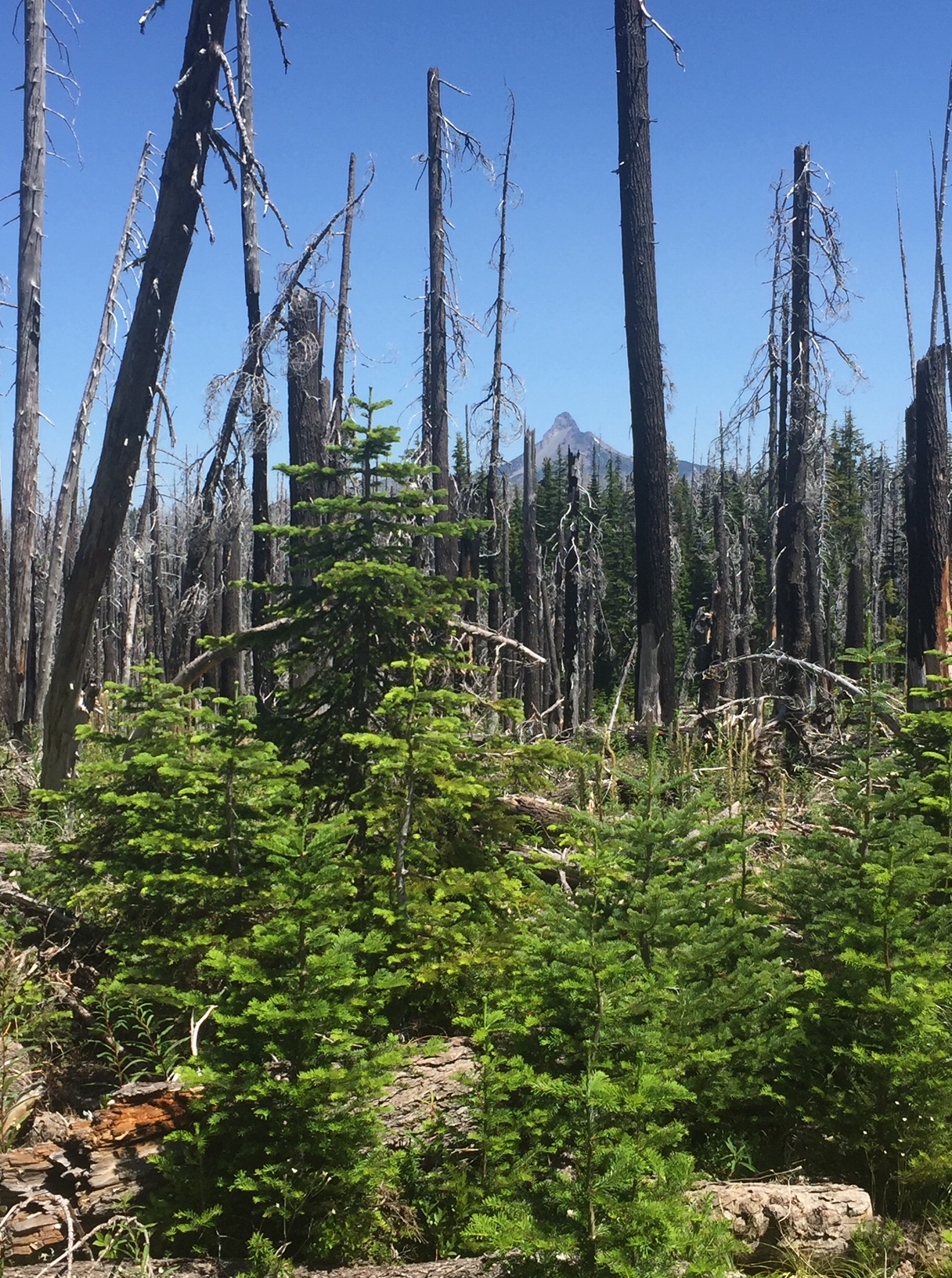
We picked up our saws and started hiking steeply uphill on Waldo Trail west of Waldo Mountain.  I figured we had at least 600 feet of elevation gain ahead, so I looked at my altimeter and estimated a bit more, 200 meters. It’s difficult for me to hike an unknown trail without knowing where I am regarding elevation and distance.  Many would say I am too focused on those things.  True, but I don’t ask how far it is, how much climbing there is, and what time we will get there. I know.

I was with two others, the crew leader with our volunteer trail group, the Scorpions, and a well-known sawyer from a nearby town, who not only uses saws but is the central Oregon expert in sharpening them.  

I hadn’t done trail work in 25 years when I first started doing it in Oregon. The trail work I did in Minnesota was a very different kind where we cleaned campsites, dug latrines. checked peoples permits and instructed them how to canoe safely and care for the wilderness.

I tend to try new fields, learn new vocabulary, new skills, starting at the bottom and working my way up.  I gain competence that suits me, then I move on, not giving up what I have learned but seeking another new adventure.  I have done this with medicine, statistics, astronomy, meteorology, canoe tripping, German, leading hikes, and even writing.  I don’t leave these fields: I tutor statistics, I still observe the sky, the weather, watch German TV, write, lead hikes and canoe trip. I just don’t do as much of them.  My latest interest is trail work.

I had little experience using a 2-man crosscut saw, no experience repairing trails, and constantly needing correction and instruction. Few knew me, and I wasn’t considered much of an asset.  I did a two night trip in the wilderness last summer, helped cut a lot of logs out, hurt my knee, and stayed away from work for about three months. In the winter, a lot of low elevation trail work nearby made it easier for me to go out again for a few hours, and I started doing more.

We had a rough winter, with a lot of trees down on the nearby trails, and I was a swamper, the person who helps the chain saw cutter remove the logs and cleans up the smaller debris.  I didn’t miss a chance to go out, making about two dozen consecutive trips into the woods with the group.  People at least knew me, knew I was out there, but I still wasn’t considered too valuable, at lease in my eyes.  

Two days prior, I had worked in the Diamond Peak Wilderness clearing logs, two of which were north of 25 inches in diameter.  One had serious binding, meaning there was compression of part of the log which made the saw bind or stop cutting.  It took our threesome 3 hours to cut the log out.  We had to keep plastic wedges in the first cut to keep it open and prevent the second cut from binding as well.  I learned a lot from that day, but my arms were dead tired and I was expecting to leave early on the next outing in the Waldo Lake Wilderness.

We started with a 24-inch diameter log that could be pushed downhill, except there was not a lot of room for it on that side.  I made the counterintuitive suggestion that we push it the other way, even slightly uphill a few feet, because we wouldn’t have to push it far to get it off the trail. My way worked well, and the crew leader was pleased.  He hadn’t thought of pushing it the other way.

I worked with the sawyer, also named Mike, on the first 15 incher.  He was experienced, and I expected a lot of criticism. The log was dry, my arms were not as sore as I expected, and I was careful to sight along the saw so that it was straight and not bent.  Bends make it difficult to do a straight cut.  We cut through it smoothly, made a second cut, and pushed the cut log off the trail. No corrections made. The day was going better.

About a half mile up the trail, we had another issue where the log was above the trail and we had top bind, where the top wood was under compression and the lower under tension.  I suggested we cut underneath, since tension leads to a tendency for the cut to open rather than to close.  This would be an “under buck,” and I thought of it because I had encountered this same type of problem two days prior.  We put the saw into position below the log, cut upward, and I just let the saw cut with a trace of upward pressure. It seemed right, and I could hear the saw sing, a sound that meant we were doing it right. We cut through the bottom part of the log, and it dropped, the saw remaining away from the ground, which is important to avoid damage to it.

On the next cut, the sawyer said that despite my being new to this, I was cutting well.

I was stunned,  This was the first compliment I had had ever about my sawing or trail work.  I have been out with the group forty-seven different times, over four hundred volunteer hours, into four wilderness areas, three national forests, and I had never once heard “Good job” applied to me as an individual.

I thanked him, and we moved on and under bucked a second log.  We were making good progress along the trail.  I had stopped counting how many logs I had cut out, but it was a lot.  We were finally descending, after climbing about a thousand feet, far more than the six hundred I expected.  My arms felt good; nothing was difficult.  I was careful how I cut, trying not to force the saw, and I felt confident.

On the next log, when I suggested an under buck, Mike looked up at me and the crew leader, held up a hand with three fingers, and said, “I can think of only three people I will do an under buck with.  You are doing a great job with it.”

Wow, I was not walking on the trail any more.  I was floating.  

Later on, Mike showed me how to get part of a log off the ground using wedges and a small log. On one log, I asked him where he wanted to start, and he said, “You tell me.”  I did, thrilled that my reasoning was good and I had read the log correctly. 

We finished our part of the trail, hooked up with another crew that did a nearby trail, and walked three miles out of the woods to the cars.  Sure, I was tired, I had a long drive ahead home on a lot of dirt roads, and I would be leading a 12 mile hike the next day.  But I’d do fine.  I knew the area. 

I also knew a good teacher, one who could both instruct and positively reinforce a student. Both matter a great deal.  I had long wondered whether I would ever fit in to the trail crew.  This was the day I realized my skills and work mattered.


The two Mikes under bucking a log. Author in orange hard hat. Waldo Lake Wilderness.

Two of the crew taking some pulls at a 26 inch Western hemlock. The wedges in the top of the log are keeping the cut open. Diamond Peak Wilderness.

ANOTHER ECLIPSE, ANOTHER ADVENTURE

July 12, 2019

Ten minutes before totality, and I finally realized that my planned way of viewing the solar eclipse from the air wasn’t going to work. Not at all. I needed to change all my plans, and I didn’t have a lot of time to do it.  I was dead tired from two consecutive nights of overnight flights, as we lifted off from Easter Island to view the solar eclipse at its maximum point of totality, then fly along the path to gain several more minutes of totality than possible on the ground.  This was a crazy trip, and I wondered why I still kept viewing eclipses.  But I have said those words at some point on each of the 27 eclipse trips I have taken.  Eclipse chasers are a crazy lot, going to the ends of the Earth to gain the special currency measured in seconds of totality, seconds under the umbral shadow of the Moon.

I arrived in Santiago, Chile, a day late because of weather and plane issues on the way to Dallas.  When I arrived, the person who was supposed to pick me up wasn’t there, and I paid way too much a cab, which took me to the wrong hotel (PanAmericano does not equal PanAmericana.)  I was joining a group, and I figured I would know somebody—I always do on eclipse trips—but maybe nobody I could visually recognize.

After arriving at the right hotel, I took a long walk in the city, had lunch, then took another long walk.  That helped.  We held a pre-eclipse meeting that afternoon, and nobody recognized me, but I did recognize one Japanese woman from the 2010 eclipse and four others from eclipses 15 and 20 years ago. 

We left the hotel at 10 pm, taking off at 3 am for Easter Island, arriving at 6:30.  At least I slept most of the flight, although I needed more.  I was awakened for breakfast, and I couldn’t decide if that was good or bad.  I did need the sleep, but it was getting difficult to find food, too. I ate, then fell back asleep. It was like being on call in medicine, and I couldn’t figure out how I did that for so many years.

We flew to the eclipse path, circling to let the eclipse come to us.  I had sat quietly away from the others a half hour earlier, meditating, relaxing, and telling myself I was here to see the eclipse any way I could, and I was very fortunate to be here. It helped.  I had difficulty taking pictures of the crescent Sun, because it was high above the horizon and I could barely view it through the window. I wouldn’t be able to get a picture, a video, or even my neck to let me look where I needed to.  Time was passing, totality was coming, and I finally realized I wasn’t going to take any videos, any photos of the shadow, or even use the small binoculars I brought.

Five minutes before totality, I made all the required mental changes. Because we were traveling at a quarter of the Moon’s speed, we would be in contact with the shadow twice as long as on ground—8 1/2 minutes—and for once, I would have as much time as I could want to look at an eclipse, the way I have told hundreds of first timers: “Just look and soak it up. You may never get another chance.”

I lay on my back, sprawled across 23 A, B, and C, used my foam pillow, looked up with my head extended only slightly, and I could see the crescent Sun—and, whoa, Venus too!—calling it out loud.  I take it as a point of pride if I see Venus early.  The Sun was to my left and Venus to the right, but directions made no sense, because I was upside down and below the equator as well.  Maybe everything was right side up. 

Eight minutes passed like eight seconds

The Sun became such a thin crescent that I could no longer see it through a filter.  This is the best way perhaps of looking, no binoculars, and when nothing more was visible through the filter, I removed it and saw the diamond ring, the last bit of sunlight around the now covered Sun, in the dark sky above me. It was fabulous.  The diamond ring slowly faded into totality, and I saw the black disk of the Moon with bright Venus to the right.  We were at 41,000 feet, and this was a really dark eclipse.

I looked for what I thought was 15 seconds, but it was probably two minutes, burning the image of the black disk and Venus into my mind.  Then I reached for the camera, which was right where my hand landed. I used the telephoto to look at the solar disk and the corona in more detail, then put the camera down to look some more.

I got up, as planned, crossed the plane to the starboard side and viewed the shadow stretching to the west before it became light from where the eclipse had ended far west of us.  I got pictures with the plane’s wing present, providing perspective.  I came back to my seat which someone from the press pool had invaded.  He quickly left, and the person in front of me had his reading light go on, which along with flashes from cameras, is a monstrous no-no in eclipses.  He ended up taping it over with a candy bar wrapper, because figuring out how to turn off an aircraft reading light takes a lot longer than taking tape and a wrapper and smashing the two together over the light.

Taped reading light over Row 22

I took a quick look at my watch and then flipped back over on row 23 again, knowing I had two minutes, and knowing I was done with photographs.  I saw the remarkably bright chromosphere and its lavender-orange color that I swear isn’t found anywhere else on Earth, marveled at its extent about a third of the way around the Sun, and realized we were about to see 3rd contact, the second diamond ring.  And there it was, kind of a small bubble, until WOW, the large blob of light that is exposed sunlight, became visible. Three of us commented loudly on the double Diamond Ring.  I looked way too long, 5, 10, maybe 15 seconds after the appearance, not ideal for my eyes, but ideal to remember.  Totality was over, and it was time to return to Easter Island.  

Earlier, one of the flight attendants asked what I did in real life, and I told her in Spanish. She apparently knew one of the journalists, an Argentine, a former neurologist and now a journalist, and introduced us earlier.  After totality, he came by with cameraman in tow, asking to interview me for Argentine television.  

“I am very fortunate,” I began in English, answering a few questions about how I got interested in eclipses.  He asked my why I traveled to see them.  The quick answer is that they are beautiful.  They are—they are one of the top 3 things I’ve seen in nature.  

But there is a second kind of beauty, and that is in the understanding of the resonance of the three lunar cycles: synodic, anomalistic, and draconic, how they come into line every 18 years and 10 or 11 days, 1/3 of the way west around the world.  I had last seen this family of eclipses, Saros 127, north of Lusaka, Zambia, on 21 June 2001.  

I looked at the journalist and said there was a third reason: seeing eclipses ties me to humanity and to those before me going back tens, hundreds, thousands, and yes, tens of thousands of years who have viewed the same stars, the same planets, the same Moon and Sun which occasionally come into conjunction for a spectacular show that can be as frightening as it is beautiful. 

Eclipses can charge a person up to see the next one.  I came down to Chile suspecting that this was my last international eclipse trip.  The trip down certainly didn’t dissuade me from quitting.  But I think my meditation and changing my mental focus were good things.  I looked, not for the perfect picture or video, but at viewing something I’ve seen before in a very different situation and coming away just as awestruck as ever.

787 that flew the eclipse

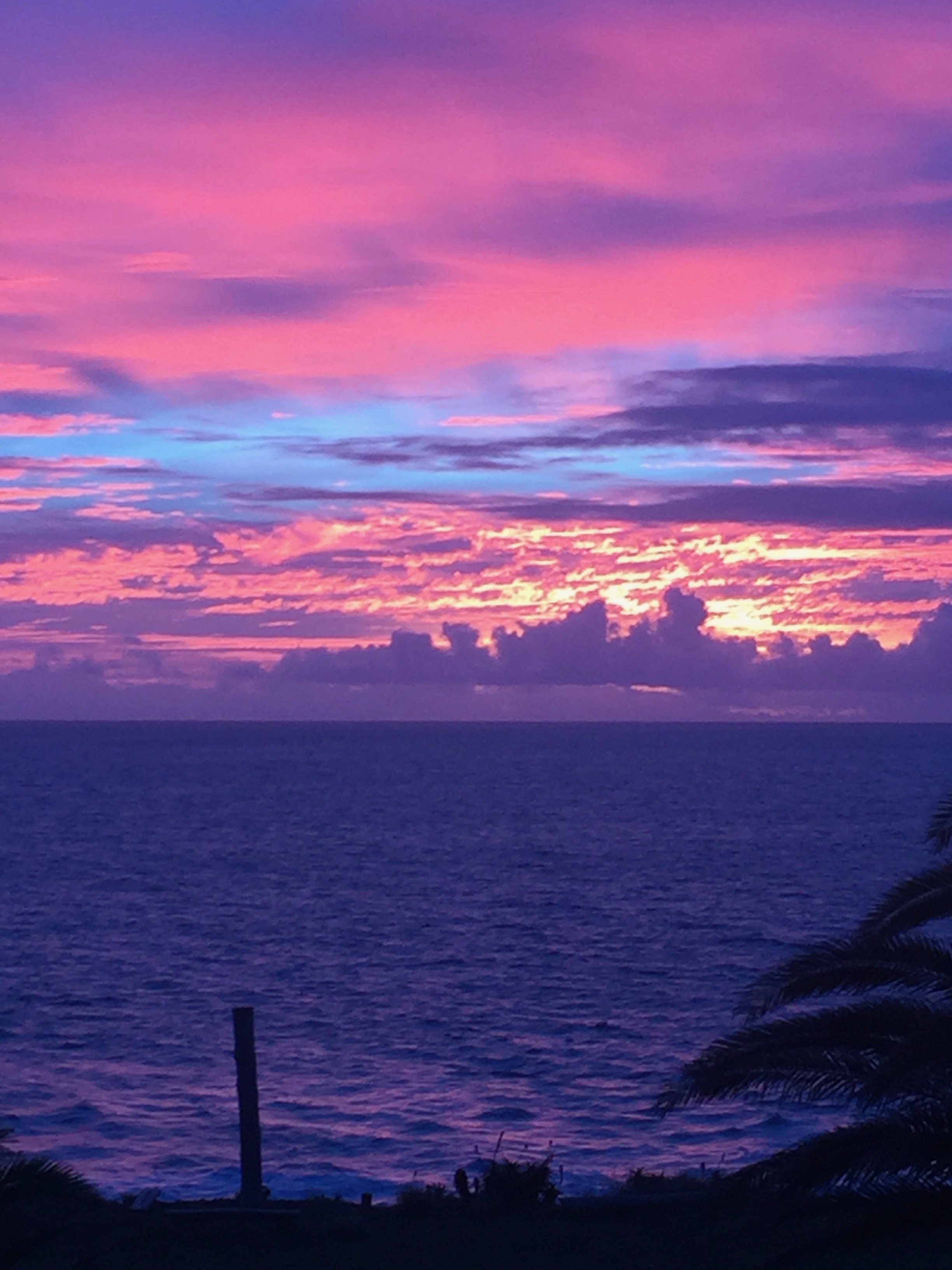
Sunset from Easter Island
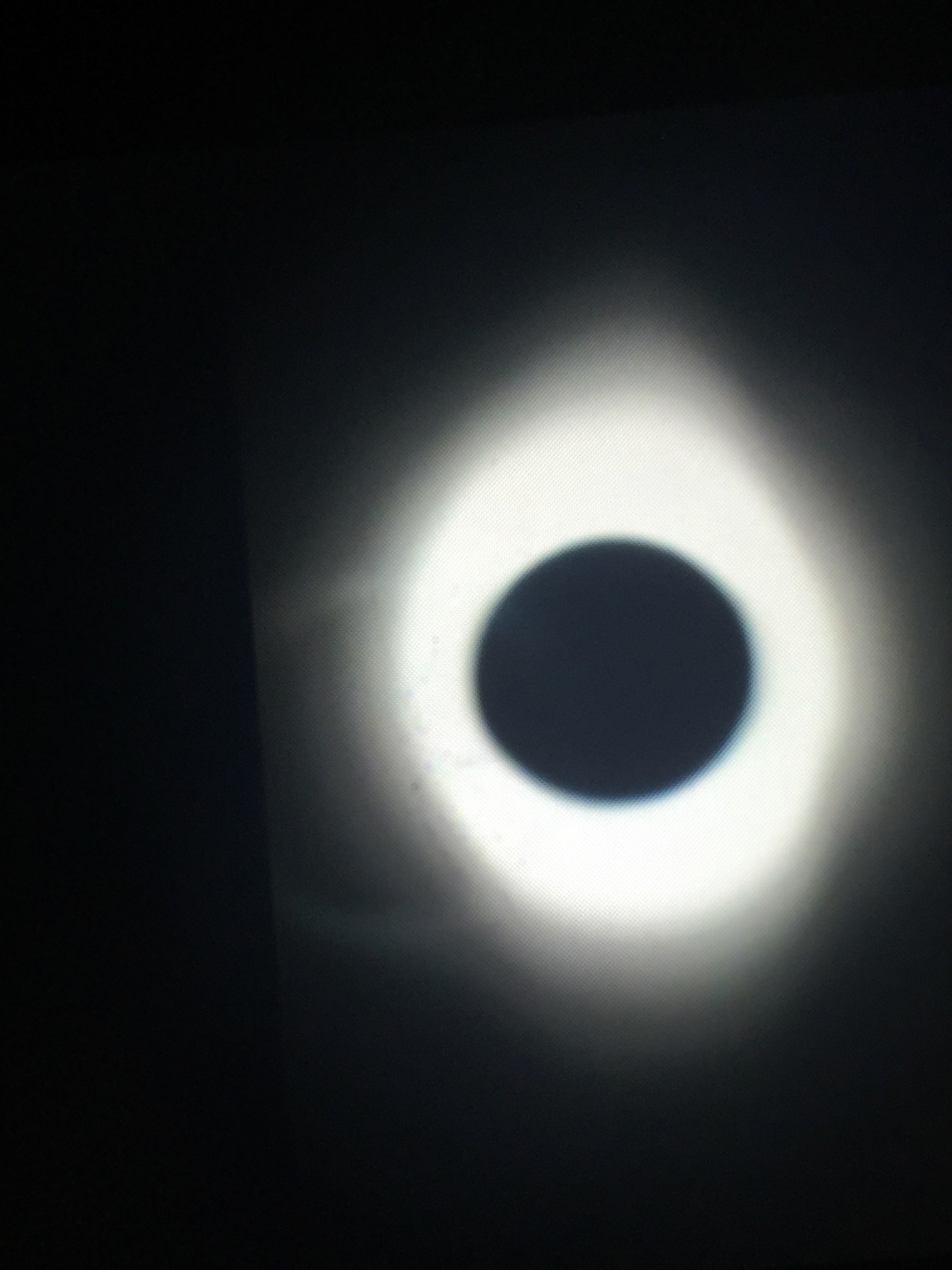
Totality from my back over my head.

WORKING ON A WINTER TRAIL IN SUMMER

June 12, 2019

I wasn’t sure where I was.  I had left the trail, such as it was, fifteen minutes earlier, bushwhacking towards a Forest Service Road about a half mile away.  But I wasn’t making much progress, because the straight line route had large blowdowns, and I had to detour around them.  I thought the trail was to my right somewhere, but I wasn’t even sure of that. 

It was additionally buggy and warm.  I had a GPS, so I knew where I had to go, but even with that, I often found the arrow pointing direction to be pointing perpendicular to where I thought I was going.  The arrow can be very annoying, pointing where I don’t want it to. I have good direction sense on trails, but in the middle of the woods, many ways are possible, and most of them are wrong. My sense of direction was taking me about 45 degrees away from the line I needed to take.

I had gone out to work the Ikenick Sno-Park to put up blue diamonds on the trees for winter travel.  There are many such parks in the mountains, a lot of trails.  I hadn’t planned to adopt Ikenick, but in January, a snowshoe trip there that I was on was stymied by the trail’s suddenly ending with no diamonds to guide us.  We backtracked, and I and one other snowshoed to the other end of the loop and tried that way.  We got to within 100 yards of where we originally were.  Could have fooled me.  There were a lot of brown bushes and white snow.  I didn’t see a blue diamond.  

This image has an empty alt attribute; its file name is img_0157.jpeg
Ikenick in winter, Isaak Nickerson Loop

Anyway, that trip was the second time an Ikenick trail had done that to me, and I swore that if nobody was going to fix the problem, I would.  I wrote the Forest Service, offering my services, the recipient being one with whom I had spent a rainy autumn day fishing tree limbs out of the hot pools at Terwilliger Hot Springs, working on rehabilitating the place after a forest fire had started there last summer.  Today was my day to take hammer, nails, blue diamonds, a hard hat, and a day pack, and I was beginning to think swearing to do this job should have come after a bit more thought.

I bushwhacked through brush, avoided a few holes, didn’t get stuck on a sharp branch, all the while thinking this was not good for being found, should I wrench a knee or keel over, although I wasn’t that far from the road.  It was far enough.  Eventually, I found the road and had to decide whether the trail was to my right or left.  Despite my thinking in the woods it was to my right, I went left, because when we snowshoed the loop, there was a significant distance to the beginning of the other end of the loop.  Sure enough, after a half mile—was I that far from the trail?—there it was.  

Going in the other direction, I got to 400 feet of where I was before, where the trail and diamonds ended, just like last winter.  I went a little further, thick forest on my left and brushy Ceanothus (lilac) plants on my right.  What a mess.  Eventually, I found the other end and then had to figure out the best way to mark a winter trail where a few feet of snow ideally covers the brush.  I worked my way along the wooded boundary, putting diamonds on both sides of those trees where the diamonds would not be hidden by branches or other obstructions.  I noted where I had left the trail to bushwhack, shaking my head at how far off I wandered, and eventually finished marking as much of the trail as I could.

There is one more trail in Ikenick that needs work.  I didn’t have my coffee mug with me that has the simple words, “Not Today,” but I thought about it.  I didn’t have any more diamonds, only a hammer and nails, along with my hard hat and fortunately long pants.  My skin has become a lot more frail with age, and every time I work in the woods, I come home with subcutaneous bruising, or frankly torn skin with blood on my shirt.  I never feel any of this happening, so it is must be adrenaline on the job.  My arm is last month’s diary of various cuts and scrapes caused by working in the woods. Three days earlier, I was helping clear trail in the Umpqua National Forest, rolling large yard-wide diameter logs, that had been cut, off the trail down an embankment.  But what really scraped my skin were the small trees that I was cutting away from the trail.  They are nasty. On the way home, I found new purple blotches.

I have become a wildflower enthusiast, even while working in the woods, noting Oregon anemones with their 5 white petals, the 4-petal bunchberries in bloom, with a plethora of red berries to follow later this summer.  The Ceanothus was fragrant, although I didn’t smell it voluntarily.  Pushing it away, it bathed me in pollen.  Walking back down the road, I saw wild strawberries and blackberry plants blooming, and Thompson’s Mist Maidens, tiny, discrete five petaled white flowers along the tire tracks. It was warm, but the heat of the summer was yet to come. Back at the car, I again noted the western buttercups and the False Solomon’s Seal in bloom here, whereas it has been gone for some time at elevations 2000 feet. 

I was up in this area last week scouting nearby Crescent Mountain for a hike next weekend.  Three weekends in a row I will be up here doing Club work or High Cascade Volunteer Work.  Last month, I was twenty miles further back towards Eugene clearing trails in the Andrews Experimental Forest.  It’s a nice way to spend time, working as a volunteer for a variety of groups.  I am in the woods, and while I don’t enjoy bushwhacking, I am in pleasant spots, seeing the various flora and trying to remember what everything is.

I also again learned how easy it is to get lost in the woods.  I left word with my wife where I would be, so with someone to ping my phone, and knowing within a mile or two where I would be, I could be found, hopefully in time, should anything happen.  I prefer the solitude.  It is quiet, although my hearing aids have allowed me to hear the birds a lot better than I once did.  Ikenick is closed for the summer, ski trails and hiking trails not being the same thing.  I will be back next winter, and I hope put the diamonds higher on the trees should there be enough snow to warrant it. I also hope to be able to walk over the buried Ceanothus bushes. My Forest Service contact tells me that can happen in a good year.

On this hot day, I am looking forward to winter and seeing where the trail really goes.

This image has an empty alt attribute; its file name is img_1782.jpeg
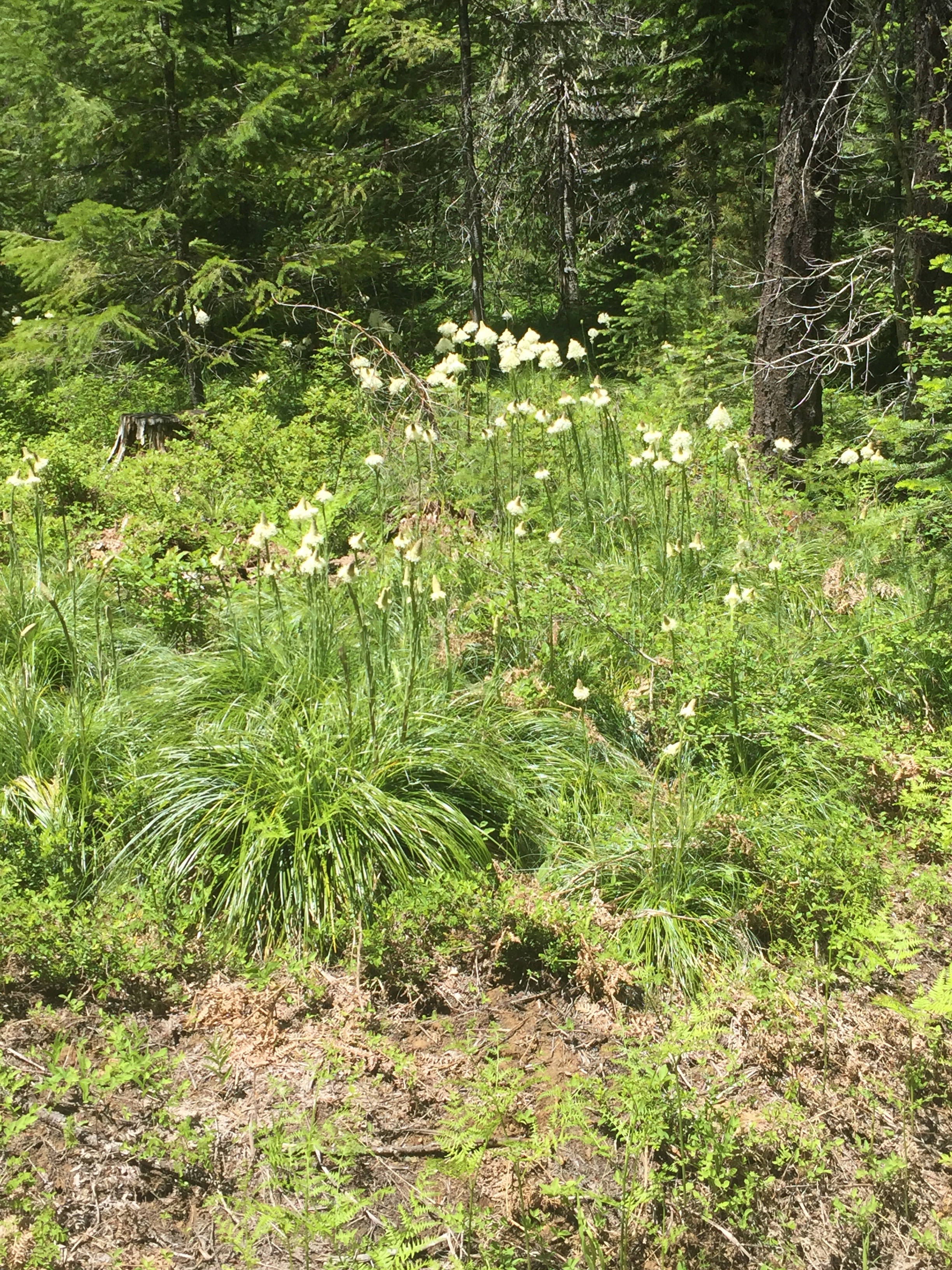
Beargrass

This image has an empty alt attribute; its file name is img_1825.jpeg
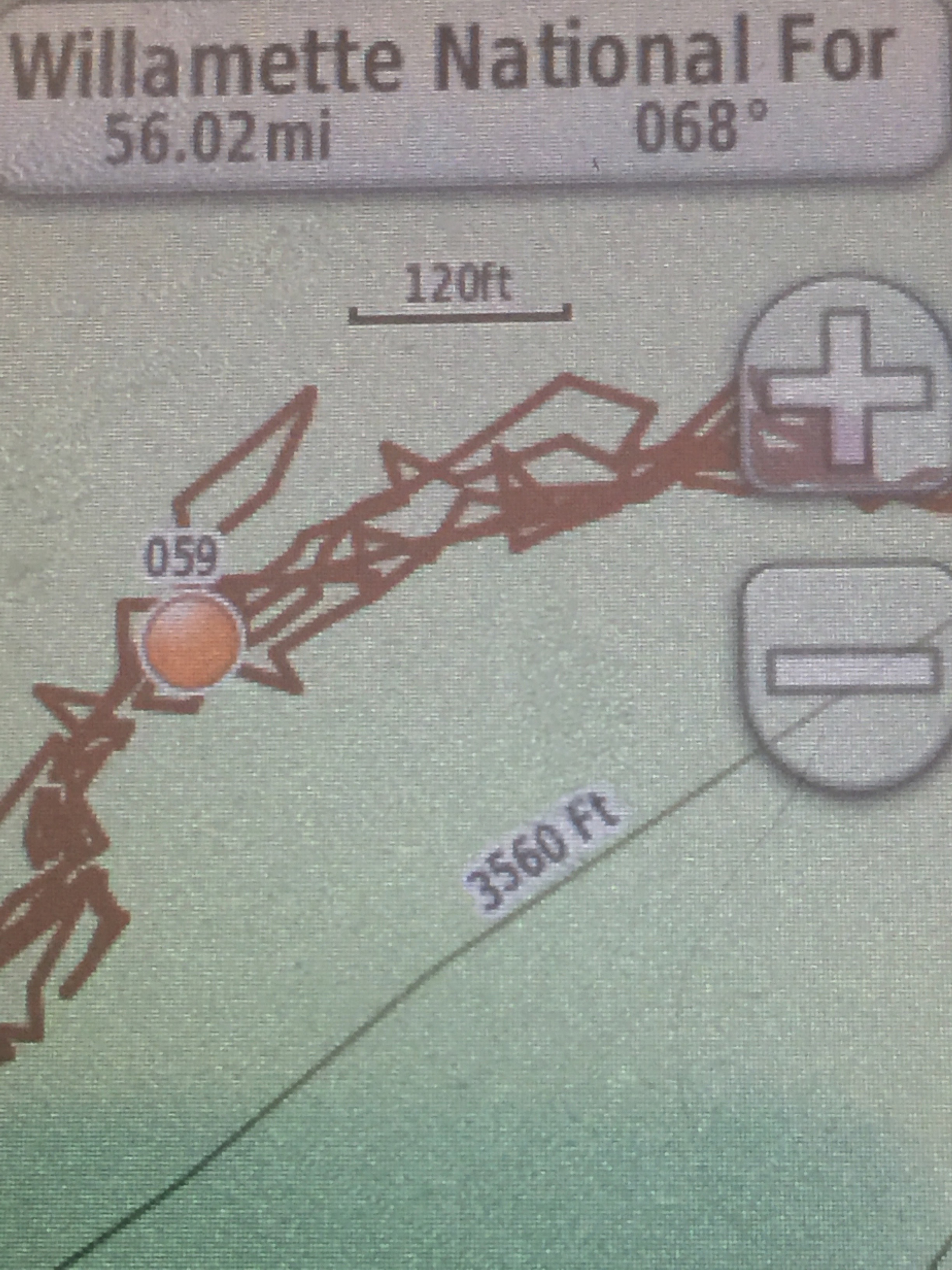
The work involved. “059” was a log where I began my bushwhack. I needed some marker to know where I had been.

This image has an empty alt attribute; its file name is img_1826.jpeg
The red pin is on the bushwhack route. Notice that I wanted to go in a line between “059” and “S TH”.

SECOND SPRING

June 7, 2019

I rediscovered spring the other day.  Autumn is my favorite season, and I remember once seeing an ad for a place promising “Eternal spring,” wondering why on earth anybody would want that.  My experience in 37 years in Arizona was that spring sometimes followed fall, winter a no-show, or winter immediately transitioned into summer, like in 1989, when there was a week of high 90s in March.  I looked at spring as a brief reminder that a very hot summer was coming, with fires, probably not enough rain, and at least 5 nasty months before I could reasonably expect it would be cool again.

Even in Oregon, spring brings spells of hot weather, dryness, heralding a not as hot but far drier summer than Arizona.  Two years ago, we skipped right over spring and went from snow on the ground at 5000 feet to fires in the space of a month.  Last year, the summer dry season started in May and there was no rain for three solid months.  Early April this year was very wet, putting a dent into the several year drought plaguing us.  But the last two weeks of April and the first half of May were hot and dry.  A couple of systems moved in to cool things off, and a surprise low pressure system—surprise, because the models didn’t show anything six days prior—moved south, over water, and gave us a good soaking right before Memorial Day.  Those rains are like gold.  

As the last system started to leave, I was looking at hiking somewhere, which was a problem, because there was still too much snow in the high country to hike in, but not enough to snowshoe on, and the low elevation trails were full of blowdowns. Indeed, I had put in nearly 200 volunteer hours on trail clearing on 24 separate days out.  My trail viewing was on the hike in and close up and personal on my knees for yards at a time, throwing branches off the trail, after digging them out of the mud.  I got better upper body exercise by sawing small branches and trying to push large logs that we had cut off the trail.  

I was going to wait until the following weekend, but on Memorial Day I decided at 11am I was going to try to hike Hardesty Mountain, a 4300’ Cascade peak known for its arduous 3300 foot elevation gain, no views, and why would anybody want to do it.  

I like Hardesty.  Indeed, the reasons people give for not hiking it are the reasons I do. It’s tough, it climbs, and if it is foggy, I won’t have views anywhere I hike.  Doing it gives me a sense of accomplishment.  I have led hikes up there, once an out and back 18 miler up Hardesty across Sawtooth Ridge to Mt. June, and back, a total elevation gain of over a mile.  There is also the triangular loop that goes down from Eula Ridge and back along the not as level as one hopes South Willamette Trail, which I have been heavily involved in clearing this year.  I hoped Hardesty wouldn’t be too bad.  Eula Ridge was out of the question, because of the blowdowns. Doing trail work last week, one of the other guys told me he recently hiked down Eula Ridge and completely lost the trail at the bottom.  I’m not surprised.  He was lucky he got home that night.

Anyway, the day was cloudy with occasional drizzle, as I drove out to the trailhead, arriving at the time I usually finish a hike. It didn’t matter; sunset is late this time of year, and I wasn’t in a hurry.

I passed two women within the first quarter mile, and a half mile later, a runner came the other way downhill.  That boded well, although I knew we had cleared this part of the Hardesty trail just two weeks earlier.  I went through beautiful old growth forest, huge trees with reds and purples of an occasional rhododendron blooming nearby.  There were inside out flowers everywhere, and the false Solomon’s Seals were in full bloom.  Spring was just beginning here.  The last two flowers were going to seed in Eugene.

Inside out flowers. Their unusual geometry makes them ideal for bumblebees. Indeed, on this hike, I did see a bumblebee pollinate one.

I crossed the dirt road about a third the way up and then had a relatively flat stretch where I got wet from both the trail and the drizzle.  It didn’t matter.  I had a rain jacket if I wanted one, and I was well up the mountain.  There were only two down logs, and I kept going.  Past 3000’ elevation, I started seeing Fawn Lilies, which were in bloom about six weeks ago in Eugene.  Here, there were dozens.  I stopped for a drink at the Eula Ridge Trail junction, now only a half mile from the summit.  The last half mile is the last to lose snow in spring, and I was surprised to see it clear this year, with a multicolor pastel of purple Snow Queens and yellow Shelton Violets.  As I got higher, the yellow blooms of Oregon Grapes were evident.  They bloomed and went to seed two months ago in Eugene.  Almost before I knew it, I was on top where the old lookout was.  Now, the forest has grown up around it. Five years ago, when I first hiked up, there were some views of South Sister.  Today, it was too foggy to matter.

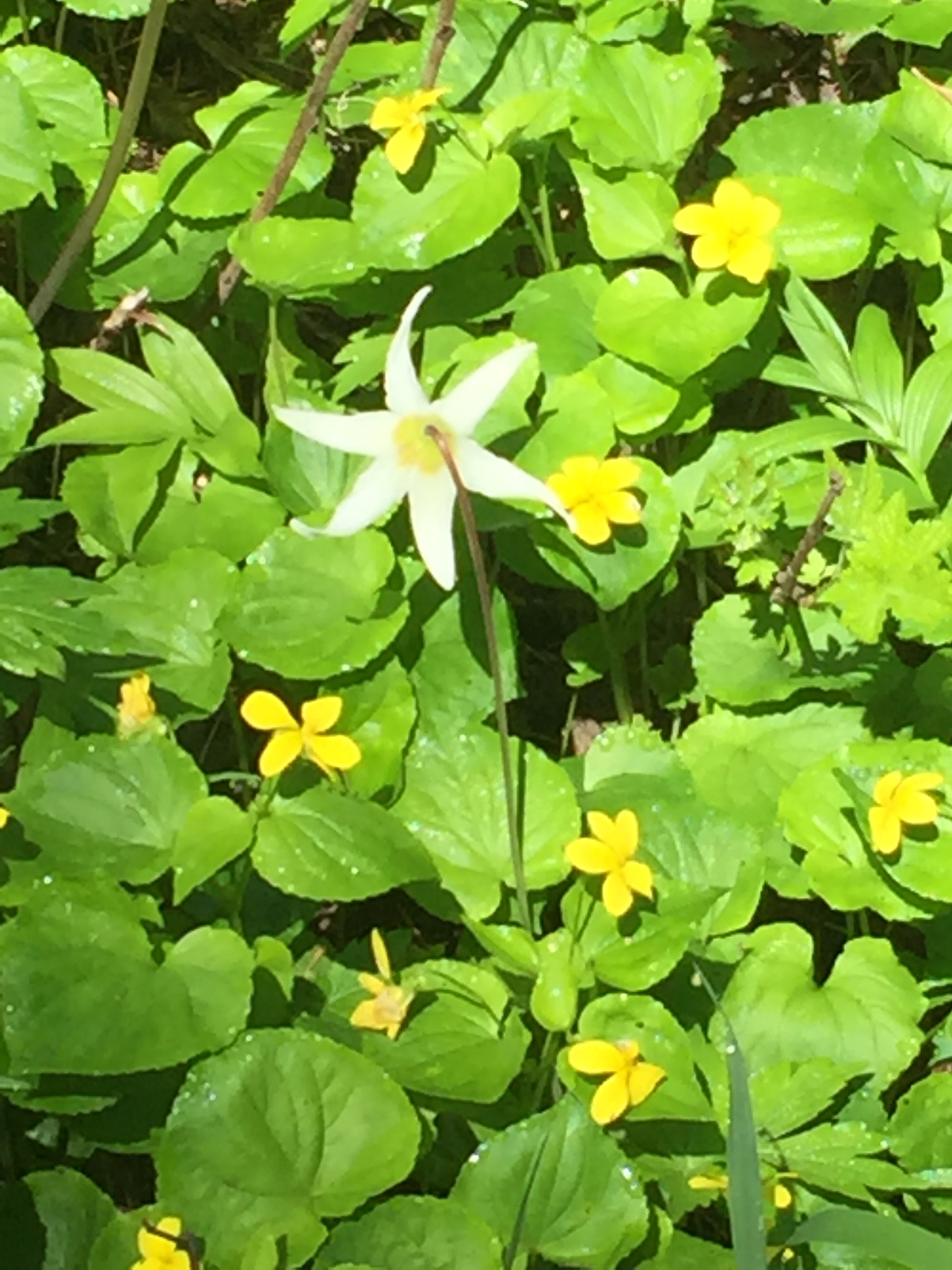
Fawn Lily and Shelton Violets

I came down the trail through a wavy mat on both sides of Oxalis or Wood sorrel.  There were a few Calypso Orchids, as the trail passed through the woods in moderately dense fog.  I had forgotten how lovely a “second” spring was at this elevation.  One had to wait, until the snow was nearly gone, and the first shoots of green were already pushing up.  It was wet without being very muddy, and it would only stay damp a little longer, before the heat of summer would dry everything out for another season.  

Oxalis, trail, and fog

NO, IT CAN’T BE ANYTHING

March 18, 2019

A panda walks into a bar and eats shoots and leaves.  Lynne Truss’ book with that title showed how punctuation matters in a sentence.  In both instances, the panda had a meal.  What isn’t clear is whether the meal was plant based or whether a firearm was involved.

Punctuation matters.  Words do, too. They matter greatly in science, where miscommunications occur with the public with common words.  The word “theory” in general usage means a guess.  In science, a theory is a statement of what one believes based on a compilation of facts. Gravity is a theory.  So is relativity.  So is evolution.  Our understanding may be incomplete, but we are hardly guessing at what is occurring, and a great deal of our daily lives are made easier because of theories. Newtonian mechanics got us to the Moon, but we need Einstein’s relativity to calculate Mercury’s orbit accurately.

Two or more sides to a story don’t mean all sides have equal weight. They do on a die, but not the sum on a pair of dice. The numbers 1-6 come up with equal probability for a die.  There are 11 possibilities with the sum of two dice, but the probabilities are very different for each, from 1/36 for 2 (or 12) to 1/6 for 7.

There is uncertainty in scientific results.  Unfortunately, the lay public views “uncertainty” differently.  In general usage means one isn’t sure and in fact may be guessing.  Malpractice lawyers love to misuse these words, “Were you uncertain?”  If one answers “A little,” then the next comment may be, “So, you really didn’t know what was going on, did you?” putting words in one’s mouth and treating the uncertainty of a diagnosis as a character flaw and a substandard physician.  I’ve been there. When I practiced neurology, I had many instances where I was uncertain of the diagnosis, and frequently the patients, through having been told by someone else or not listening to me, felt that I had no idea what was going on.  Neurology is one of the most difficult specialties in all of medicine, but I was usually considering several diagnoses.  Also, the fact that I could not cure a person with a severe brain injury didn’t mean I was uncertain of what was going on.  

We demand temperature predictions to the nearest degree and rainfall’s beginning to the nearest minute despite inability to correctly predict these regularly.  A temperature range would be a far better forecast.

Uncertainty in science is vastly different from how the public perceives it, and it is one reason many phenomena with a high degree of confidence (another important word) are not believed, because of such uncertainty: “they really don’t know for sure.” The difference is that uncertainty is usually quantified in science.  If we say we are 95% confident of a result, that means if we ran one hundred simulations or saw this particular phenomena one hundred times, 95 of them would contain the value we were measuring.  We wouldn’t know which 95, but it is far from the “anything can happen,” approach, and it doesn’t mean that 5% of the time we don’t have a clue.  Consider “95% certain there is a fracture in your hand,” a probability, which when studied was far less.   It doesn’t mean that there is a 95% probability the interval is right; it either is or it isn’t, and that makes no probabilistic sence.

If one tosses a fair coin four times, one would expect it to come up heads twice.  This is the expected value, 50% probability of heads each time*4=2.  But a priori, we are uncertain. It may come up heads all four times with probability 6.25%, one-half multiplied by itself four times.  Or, it may come up three heads 1/4 of the time, two heads 3/8 of the time, one head 1/4 of the time, and no heads 1/16 of the time.  

If somebody told me I would have to pay them a dollar for every time exactly two heads occurred, because that is the expected value, and I would have to pay them a dollar every time it came up some other number, I would take that bet in a heartbeat.  Am I certain of winning?  No, but the probability—future oriented—of my winning is 62.5%, and that is solid. I am uncertain what will exactly happen, but I am highly certain what the probabilities are and my expected gain. Casinos don’t take money from everybody; they occasionally lose big, but over time, they win, and furthermore, they have a very good idea of the range of their winnings.

With 10 coin tosses, there is a 1.1% probability that there will be 9 or 10 heads.  The expected number, 5, has slightly less than a quarter probability of occurring, no longer 3/8.  Notice that extreme events still occur but with much lower probability with a few more attempts.

Toss a coin 20 times and the likelihood of 90% heads or more is on the order of 1 in 5000, not 4.5%, and the probability of 50%, or 10 heads, is less, about 1 in 6.  The likelihood of exactly half, the expected value, diminishes, but the variability decreases much faster, and more and more of the outcomes cluster closely around 50%, even if they are not 50% exactly.  

It’s like weather and climate.  There are many who say if we can’t predict the weather accurately, how can we possibly predict climate?  It’s because climate is made up of many weather events over a long period of time, where exact averages are not likely to occur very often, but the variability around those averages is much less.  Indeed, extreme values will be far less likely unless the system itself changes.  The issue for science is to try to predict as accurately as possible, but science recognizes that there is always a certain degree of uncertainty—not that we have no idea what is going on, but exact predictions of many phenomena may be impossible. Instead, there is an interval, the “plus or minus,” stating the range where the true value of the parameter of concern is believed to lie.  We will never know that true, exact value, but we are very confident in its interval.

Uncertainty doesn’t mean “it can be anything.”  No, 100 consecutive heads cannot occur with any sensible probability. Indeed, even 75 or more heads has probability 0.0000002, the likelihood of guessing a second chosen at random in the past two months.  It’s only about a 1 in 6 chance there will be 55 or more heads.  

I have long argued in climate scenarios that those who believe there is no significant global warming occurring must offer a confidence interval of what they think the temperature will be in 10, 50, or 100 years.  The interval would be expected to contain zero, no change.  It is not enough to say the current data are wrong. What is the margin of error?  What is the confidence?  It can’t be 100%, for that would be saying one could look at thousands of variables and know exactly how they would behave.

Uncertainty is reality. We embrace it in science, do not consider it a sign of weakness but a strong statement of “we could be wrong, but this is how wrong we can reasonably expect to be.”  

SUMMER CAMP

March 1, 2019

I walked into the Club’s lodge shortly before the informational meeting about the annual summer camp.  There was a potluck in progress, where at least eighty were eating.  I stayed out in the foyer with a few others.  Summer camps are where the Club goes to some interesting place, camps out, hikes, and provides breakfast, lunch and catered dinners.  With luck, there are showers and pit toilets.  

Damn, there were a lot of people there, and being around crowds isn’t my thing.  I spoke to a few people while waiting, and then as everything was cleared away, I noted that I probably knew a third to half the people there through hiking.  It wasn’t like I was a stranger there.

I went to the meeting, because I wanted to see if going to Glacier National Park for summer camp was something I wanted to do.  It was planned for early September, and I canoe in late September.  I don’t like doing two trips close together. It was a two day drive, the northern Rockies can be cold at night or be on fire.  Lot of the latter these past few years.  About a third of the attendees would be staying in hotels, so actual campers would be fewer, but then again, some people I knew well might not be going to evening meals or events, opting to stay warm, dry or quieter in the hotel.  I don’t know if fewer at the evening session would enhance or detract from the camp experience, and I don’t know how I would feel either way.

The hikes themselves were good, including one that was on the “20 best” of the world.  I am leery about these sorts of recommendations, because those rating these hikes have different values from mine, and the better a hike is rated, the more people decide to take it.  I can think of a lot of great,hikes I’ve taken where there was nobody. Maybe that is why they were so enjoyable.

The camp sounded well thought out and put together.  The organization was excellent.  It usually is.

And I won’t be going.

I’ve been to two summer camps before, one in the Ruby Mountains of Nevada, the other in the North Cascades.  Both had interesting hikes, although when we were there, it was in the 90s at 7000’ in Nevada and hit 100 in the North Cascades.  The West is hot in summer.  In the Northern Cascades, we had smoke after the second day, limiting hiking to only a few places.  It burns a lot in the West in summer, too.  

Of course, the weather might be perfect, with 70s in the day, 50s at night, rain only at night, and not a lot of crowds.  That does happen occasionally.  

I don’t enjoy summer camp all that much.  The first year, I agreed to take a “Leader” job which never should have been offered to a first time attendee.  I ended up working in the kitchen doing dishes both morning and evening, since the evening guy didn’t show up until the second day and left early.  Many attendees leave camp early so they don’t have to help with breaking down the camp, which takes maybe two hours if enough people are there.

As a leader, I was late getting started on hikes, which began right after breakfast, and I was doing dishes.  I missed a lot of information at the first evening campfire, because I was doing dishes.  I arrived at camp late enough that I didn’t have a good place to pitch my tent, and was immediately waylaid by two to see if I could give them a ride home at the end of camp, before I had even figured out where I was going to be sleeping.

There were a lot of inside jokes and some inane skits, and I don’t have a great sense of humor after hiking all day and doing dishes at night.  I also didn’t need the catty remark about how my camp chair was “one to get rid of,” from one who had used and didn’t like it.  There’s no shortage of advice in the Club about gear, diet, medical issues, and a host of other things.  

I went to the North Cascades mostly because (1) I wanted to see them and (2) I wasn’t going to be a “Leader” but just one who had two one hour jobs a week (one of the organizers said it would be one.  I chuckled to myself.)

I led a couple of hikes, and one individual complained for days after how I went to a lake that wasn’t very pretty.  Mind you, these are “Explora Hikes,” meaning the leader has not hiked the area before.  If there is a trail to a lake I haven’t seen, I think it might be worth seeing.  No, we didn’t see much, because brush clogged the shore, but it was only a 15 minute detour out of a 5 hour hike, not worth the half dozen or more times I caught grief about it. I suspect a lot of people heard how I led such a crappy hike.

After the second day, the smoke and hot weather moved in and stayed. I awoke more than once at night wondering how we would get out of our dead end road if a fire started nearby.  There was a fire burning 20 miles north that would eventually consume 100,000 acres. I was happy to leave there days later.

I would see new country at Glacier, only having been there in 1970.  But I can see plenty of new hiking country near home.  I would like to hike the entire Timberline Trail around Mt. Hood or the many hikes near Crater Lake.  I would not be gone as long, and frankly—this is my biggest reason—I don’t want to be away from home all that much.  I like where I am, and I have been fortunate enough to have seen a good deal of the world.  

If I were single and had no animals, that might be different.  But I am not and do, and ties to home are strong.  I will see the eclipse in the South Pacific this year, and I will canoe in the Boundary Waters in late September, which I absolutely want to do, because the country, so familiar and so special, draws me back every year.  That’s enough big trips.

For those who go to Glacier, I hope they have a great trip, the weather cooperates, the hikes go according to plan, the leaders better than I, and they return with wonderful memories of the northern Rockies.  

I’ll have my own memories made my own way.

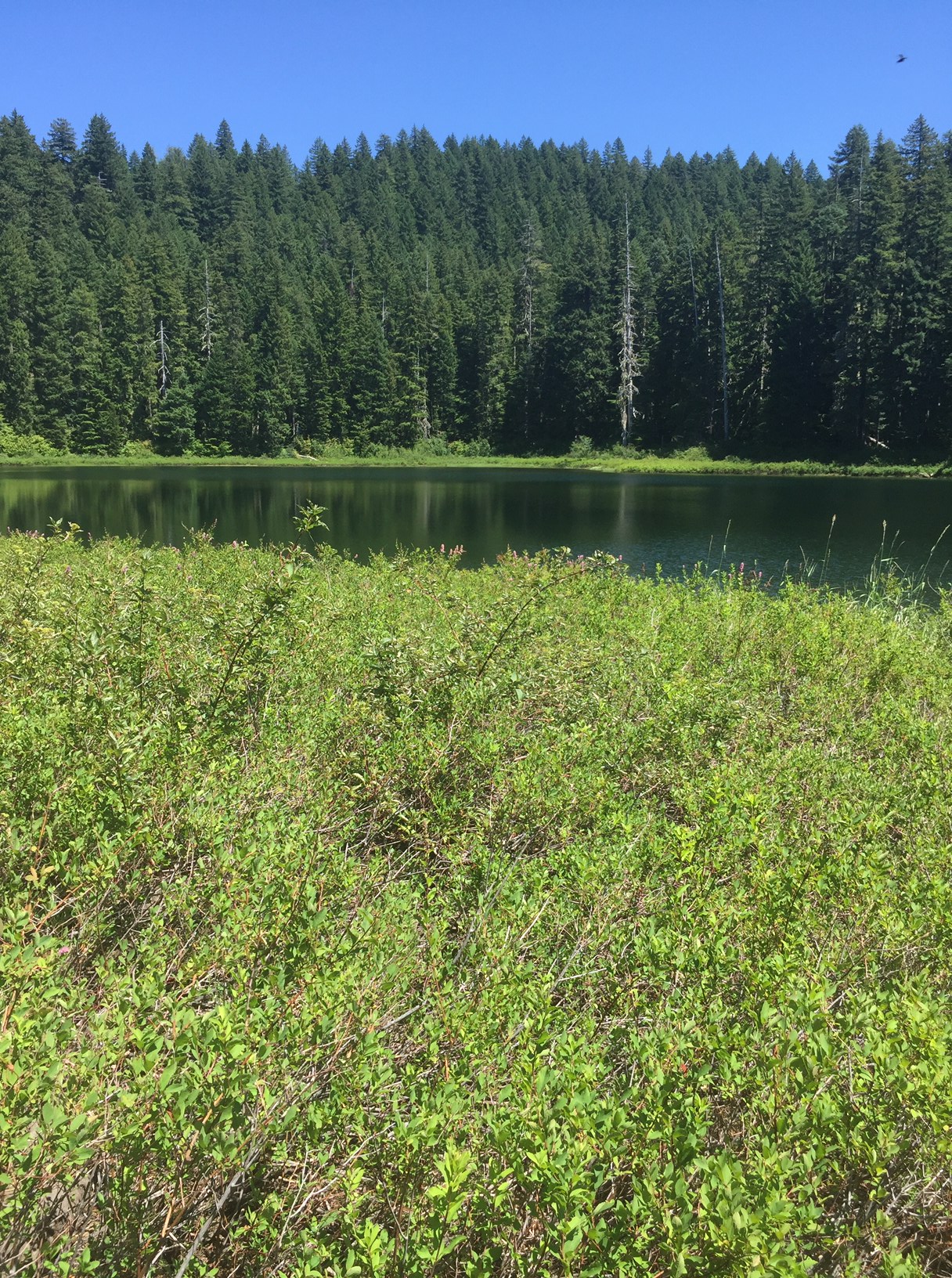
Goat Lake, Ruby Mountains, Nevada, August 2016

Rainy Lake, below the 12 mile Maple Pass Loop, North Cascades, August 2017

NO GOOD DEED GOES UNPUNISHED

January 26, 2019

We didn’t have a long day working at Dorris Ranch, a Springfield park by the bend of the Coast Fork of the Willamette River.  It rained a little, but not much, and we knocked off at about 1:30, after four and a half hours of trail building.

We originally went out to do drainage work on a stream and discovered a trail which was muddy, eroding, and not useful.  Instead of drainage work, we built a new trail, connecting it to two others.  Such work necessitated one’s hacking out some grasses and shrubs, another’s digging down to bare soil to make a path a couple of feet wide, followed by more of us enlarging the path, moving the dirt off the trail, trying to save as many endangered Oregon Grape plants as possible, all the while avoiding poison oak plants standing like sentinels, waiting for the unwary to brush against them and carry the poison off on their skin or clothing.

I was especially attuned to poison oak, for two weeks earlier, I neither saw see the leafless plant at another park where I worked, nor did I wipe myself with isopropyl alcohol at the trailhead to denature the toxic urushiol.  I didn’t smear Tecnu lotion on myself when I got home and missed the last chance I had when I didn’t shower with Dawn dishwashing liquid.  Four days later, I broke out with a rash and was sentenced to two weeks of a itchy rash on my arms, inner thighs, chest and neck.  For this payment, I worked hard as a volunteer. 

I was ready to stop digging when the crew leader suggested we all knock off for the day.  I walked back to the car, trying to wash the mud off my boots on the way.  I found a small stream and stood in it for a while, cleaning the shovel, the hoe, and the McLeod, a large hoe on one side, and a serrated rake on the other, created by a USFS ranger in 1905.  

Back at the car, I knew I had errands to run, and I also needed to go to the toilet.  I looked around, saw a nearby restroom and walked up a short hill to get there.  The door was blocked wide open, floor damp, meaning it had been cleaned, so I unblocked the door, closed it, did my business, telling someone who rattled the door I was in there, washed up and walked out, not thinking to block the door open again because I knew somebody was waiting.  

A young woman wearing a park hat was waiting. She did not look pleased.

“We blocked the door open because the chemicals in there need to dry,” she said.

I thought to myself: “It’s really humid today–like drizzling–nothing is going to dry.” I answered, “I was going to block the door,” not adding, “until I saw that someone was waiting.”

“No you weren’t,” she retorted. “You were walking away.” The woman had gone from retorting to severely reprimanding me, and she was coming very close to outright berating me.

My father always told me not to get into a pissing contest with a skunk.  But I was tired and had just pissed, so I continued, “Excuse me.  I  just spent four and a half hours building trail for you guys and I needed to use the toilet.  Next time, I will use the woods.”  I walked away.  

It’s better not to argue with those who won’t change their minds, be the issue climate, what you think of the president, or whether you committed a sin by using a bathroom that had just been cleaned and then deliberately walked away without re-blocking the door.  It’s easier and saves energy. 

For the record, I clean toilets—men and women restrooms—at Rowe Sanctuary every spring, and if people need to use one and the floor is wet, I tell them that.  I don’t tell them to hold it because the floor has to dry.  I even put up yellow signs on the floor.  They are in two languages.  I don’t reprimand “offenders.”

I don’t know whether the woman thought I was homeless.  I could have looked it with mud on my clothes and my hair not exactly combed.  My hard hat was in the car.  What was I supposed to do?  Wait?  I think so.  She was young, perhaps not realizing that some older men need to use the toilet and can’t wait.  I have been in that latter situation before, although I wasn’t in it today.  

Sadly, I let the incident get to me that afternoon and for the next couple of days.  I was going to write this post saying I might not go back, and if I did, I wouldn’t use the restroom but the nearby woods, and she shouldn’t be poisonous to those who deal with poison oak as a volunteer in her park.  So there.

If I were on social media, where posts are too often made without thinking, unedited, and one has the “satisfaction” of “really nailing” an issue or a person, the ending would have been catchy, but a bit childish, which is a lot of what passes on social media these days, I guess.  I am a year away from Facebook, so I’m out of date.

In any case, I process slowly. What I think a few days after an incident is different from what it is the same day.  Yes, there should have been a sign saying, “Wet Floor,” but peeing in the woods in a city park is a bit much, even for me, unless I’m off my alpha-blocker.

I did go back to work at the park the following week. We finished the trail, hauled rocks using a wheelbarrow, and built a bridge.  Before we went out, I took the park person who was supervising our work aside and dispassionately told him my experience.  I said what was relevant and factual: “I did not see a sign,” does not exclude the fact that there might have been one.  I did not mention that the incident ruined an afternoon. That had nothing to do with the matter.  The supervisor understood that restrooms need to be cleaned, yes, but also that some times people need to use them before everything is perfectly dry.

After all, maybe the woman was having a bad day.  Maybe she had problems at home.  Maybe she was ill.  Maybe she even had a poison oak rash that annoyed her.  Yes, she needed to be thinking that perhaps this person really didn’t want to wet his pants, toilets are made to be used, and I wasn’t making a mess on the floor.  

She may still think I am a jerk, but I don’t have to make threats of what I will and won’t do in the future.  Those threats will hurt me, not the parks, except for maybe a tree’s getting too much nitrogen. I had a valid point, and she felt she had one, too.  Most importantly these days of polarization, I could see her point, even if I didn’t agree with it.  That’s not weakness, despite what many think. 

Maybe the next time, there will be a sign in two languages.  Maybe the sign will say “please leave the door open when you leave.”   Or even, “We aim to please.  You aim too, please.”

McLeod, good for trail work, pulling plants, beveling the sides, moving the dirt.


ALIGNMENT

January 19, 2019

I hadn’t planned to go to the astronomy meeting the other night, but I had missed several of the previous monthly meetings, and tired as I was, for I had been trail building that day, decided I ought to put in an appearance.  It wasn’t like anybody was going to notice my presence, but I would feel better for having gone.

January meetings of the Eugene Astronomical Society (EAS) are devoted to the public, where anybody who received a telescope for Christmas can bring it and club members volunteer to show them how to make it suitable for observing.  Jerry, the secretary, was profiled in the paper a few days earlier about the event, and I hoped to walk in, look around briefly, and then go home.

When I arrived, there were about thirty people, a few talking amongst themselves, the rest clustered around half a dozen telescopes of various sizes.  The first telescope I saw was bright orange, immediately triggering memories and interest from me, not only because of the color, but it was an 8-inch Celestron, the same model as my first big telescope.  

The owner had obtained it from his brother and drove up from Cottage Grove for help.  He was being helped by an old guy—these days, that is someone at least in his mid-70s—who was easy to listen to.  The old guy—John— was helping align the telescope, and while I had once done that with mine and never again changed it, I stayed silent allowing John’s words to fall over me as memories came flooding back.

The night I first observed and somehow found the Ring Nebula in Lyra, M57; the summer night in 1989 I watched the star 28 Sgr pass through Saturn’s rings as the planet’s motion gradually covered it; the two thousand double stars I had “split;” several hundred galaxies identified; several dozen globular clusters seen; a hundred variable stars observed throughout their cycles.  I had carried that telescope to star parties in rural Tucson, to schools nearby, and even had it in the parking lot of a hotel at Palm Desert one night in 1995, so I could show interested people—and there were many that night—Saturn’s rings edge-on. I enjoy showing people the night sky, even being auctioned off once for a night’s observing.

I didn’t say much other than assured the owner that he would see Jupiter’s moons just fine, as well as many of Saturn’s, and it was a good piece of equipment.  John instructed him about eyepieces, with the comment I hadn’t heard before, or if I had, long since forgotten:  “A good eyepiece will make a sh—-y telescope good, and a bad eyepiece will make a good telescope sh—-y.”

My first telescope launched me into a twenty year stretch where I was astronomy columnist for the Arizona Daily STAR, and my 750 columns taught me how to write something interesting weekly for beginners, learning to create columns while doing other things, like walking, aimless thinking, or observing the night sky.  I tried to see the sky through other people’s eyes.  I became a far better observer when I had write what to look for and how to find it.  I learned more astronomy through my columns than anybody else. 

When John showed the owner how to align on Polaris, I suddenly realized I had done this years before and knew what was coming next.  Once the telescope was positioned, it couldn’t be moved to make an exact alignment.  One had to move the whole system, tripod and all.  I had done that automatically every time I observed.

As if he were listening to my thoughts, the owner asked whether it would be possible not to use a compass and just turn the tripod facing north.

“Yes,” I spoke up.  “That’s exactly how I did it.”  John looked at me like I was observing in the 1980s.  Well, I was. “It’s not exact,” I continued, “and you will have to adjust frequently, but I observed that way for years.”  All the stuff I observed I did without using a clock drive, computer, or anything other than star charts.  Many nights, I followed a dozen variable stars without even using charts.  I found the star as naturally as a musician finds the right chord in a song. I was hearing the music of the spheres.  

From observing, I became interested in eclipses and began my long career of twenty-six eclipse trips all over the world to see them.  I saw totality in the middle of the Pacific, from the Great Barrier Reef, over the Arctic and Antarctic, flights that took me over both poles, Patagonia, India, Aruba, the Bolivian Altiplano, Spain, La Paz, North, East, and South Africa, China, and Siberia.  I never thought I would see more than one; I have seen 17.  I never thought I would publish anything in astronomy—thirty-one years ago, I published an article about my experience as an astronomy columnist, and I wrote two “Focal Point” opinion pieces for Sky and Telescope one year. 

While John and the owner were talking, I knelt down by the telescope.  How many times, how many hours, how many places, had I done this?  Without thinking, my left hand went to the declination knob that controlled E-W, and my right to the right ascension knob that controlled N-S.  I was on the ground outside my house in Tucson, where I did most of my observing.  This was “muscle memory,” like playing music I had memorized on a piano, skiing the first mogul field each winter, or arriving at the first portage every summer and swinging a canoe up on my shoulders.  

I was out in the desert at 2 am recording the magnitude of a variable star in Sagittarius for the American Association of Variable Star Observers (AAVSO). The star had recently had an outburst and the observations were needed. One night, near the Desert Museum, I watched the Moon move tangent to a star, seeing starlight blink in and out through the lunar mountains on the edge. That grazing occultation was data for the International Occultation Timing Association (IOTA), to which I once belonged.  I tried to give back to the field when I could. Another summer night, I watched at 4 am as the Moon uncovered four moons and then Jupiter in the pre-dawn sky.  I saw so many meteors out of the corner of my eye when I was observing.  Fortune favors the experienced eye, and I was experienced.  During the Leonid shower of 1999, I saw three hundred meteors in less than an hour, and four times I saw 5 instantaneously. 

John had suggested that the owner see if Jerry, the EAS secretary, had any eyepieces he wasn’t using, for the owner needed a good low power eyepiece.  Jerry came over, admitted he didn’t have any, and took a look at the telescope.  He admired the age and condition, older than my 1983 purchase, for mine gave the focal length in mm and this one in inches.  Jerry identified the outlet type for the drive motor and knew the name of a store who had a cord that could plug into this unusual outlet.  He even knew the voltage.  Jerry knows just about anything, and hearing him talk makes my head shake in wonderment. 

I was so lucky to see so much, the zodiacal light from Sonoita, “false twilight” that occurs well after dark or well before morning, when the dust in the plane of the solar system is illuminated by the Sun below the horizon. I saw rainbows seven minutes after sunset.  In a thirty minute period one night, near a small cloud, I saw cloud-cloud lightning, Jupiter, and a meteor shoot between the two.  Sleeping under the stars in the high grasslands, my wife and I watched the Milky Way rise like a giant cloud–which it is.  We saw Orion reflected in a wilderness lake at 1 am and the aurora shoot across the sky in the canoe country.  An observing session was once interrupted by a rattlesnake, whose buzzing I couldn’t understand until without thinking I jumped back as the reptile slithered past my tripod to the open desert.  

I went to the meeting to make an appearance.  I had no preconceived notion what might happen and was astounded with the experience.  I shouldn’t have been surprised, for astronomy was like this many nights when I took my telescope outside, scanned the night sky with my eyes, and began to observe.

NOT NOW vs. NOT EVER

January 15, 2019

There was a recent article in the New York Times written by a woman to explain why she wasn’t returning an email.  I would have replied to your email after a few hundred more words, I am certain, except that my 11-year-old daughter came in, clutching some pieces of paper… was the style of the article.  She wrote well, and most of the comments were favorable, that these issues with which she was spending time were indeed important.

A few commented that she was fortunate to be able to work at home, have good, healthy children, but that ignoring work-related emails for many is a good way to get fired. I decided to comment, although I am at a disadvantage in that I need more time to process information than most, in order to optimize what I say.  When I used Facebook, most of my comments were “Edited,” meaning I had posted and later changed something.  Many would do well to edit what they write, since first impressions and first words usually are not what most of us truly want to convey.  But if I wait 24 hours, the comments section is closed, and if I want people to read my thoughts I need to write quickly, not after hundreds of others.  I wrote that many of my good faith emails were never replied to even though it took all of 24 seconds to write, “We regret that we have no use for your services.”

My comment got a reply that interruptions slow down a person’s ability to re-focus on what they had been doing for up to a half hour.  I agreed, but added that there is a difference between “Not Now” and “Not Ever.”

That’s really what I wanted to say to the author in the first place.  It’s acceptable not to reply to an email now.  Very few things in life are urgent, and emails can usually wait.  But Not Ever?  You mean to say you are so busy that you can’t find any time in your day or week to reply to a good faith email from someone?

I continued that interruptions in my medical practice, which were seldom truly urgent (life threatening that if I didn’t act someone would significantly deteriorate), did affect my ability to concentrate afterwards on the my care of the patient before being interrupted.  More than once, after two or three interruptions seeing the same patient, I had to explicitly ask my secretary to stop all interruptions so I could get some work done.  I didn’t know back then how badly interruptions interfered with my work, because much research hadn’t been done, except in aviation, where there is the “Sterile Cockpit Rule” below 10,000 feet, where all cockpit conversation relates to only flying the aircraft.  Nevertheless, my colleagues were quick to tell me medicine and flying airplanes were different in regards to errors.  I retorted that they were both quite similar.

[Ten years later, CVR, “Cockpit Voice Recorder,” was a big hit at medical meetings, where two people sat on a stage and read what transpired in an aviation disaster, so perhaps my thoughts earlier were on track.]

I continued, writing that hurry and fatigue were two other reasons I left medicine, both of which again were confirmed by research in part using aviation experience (The Canary Islands disaster in 1977, and the 1999 crash in Little Rock in part respectively.)

I come from a bygone era. When I practiced, we had to return phone calls from patients.  THAT was time consuming.  We had to call, wait for the individual to answer or to be summoned, often repeat ourselves, answer things we had answered in the office, try to explain something to someone without seeing their expression, and not have any sort of written summary of what we said.  I returned calls as soon as I could during the day; many others waited until the evening or didn’t return them at all. I returned my calls if I had a few minutes to do so.  They weren’t interruptions.  Most of us have a lot of time available during the day; back then, we couldn’t use social media as a time dump, but we all have a few minutes here and there that we squander on things that may not be earth shattering.  Want to have time to reply to emails?  Stay away from social media. 

Before there was email, I couldn’t make a phone call between seeing patients, unless I knew it would be very brief.  Today, many questions could be answered in that same time period. I would have loved emails back when I was practicing.  My calls could take several minutes; an email take a matter of seconds.  This is a matter of prioritizing time.  

I used to have a pile of pink slips from calls, answered by an actual human being, that I needed to make, low tech but useful, because human beings could write notes, using a pen, and convey that the patient sounded angry, sad, depressed, busy, strange.  From here, we went to voicemail, which was listened to by a human being, until people used it as a way to avoid work by ignoring them.  That’s going from Not Now to Not Ever.  I consider myself fortunate if my voicemail gets a reply.

From voicemail, we went to email, faster and easier, but I contend that my computer is strange in that it appears to send emails but doesn’t seem to receive them.  Two decades later, I still read complaints that emails are interruptions.  Like most technology, when email is used properly, it is a wonderful tool.  How can it be an interruption unless one lets it be one?  A ringing phone is an annoyance, and those in my generation learned to pick it up, because it was polite and it usually was from someone whom one knew, not Marriott or some other big chain trying to sell me something I didn’t want and my punching 2 to not get any more of these calls made no difference, nor did a national registry of Do Not Call remove these calls.

An email is quiet, unless one chooses to activate the sound letting one know there is an email, which again admittedly used to be important, not someone trying to sell military surplus or Viagra because I was foolish enough to click on a link to read some article seen on the Internet, and didn’t delete the cookie fast enough.  

We have spam filters, and while I’m not in at least the paid work force these days, it seems obvious one can have a work email address for work and a personal one.  Twenty years ago, when I was in graduate school, I had two email addresses, and that was a good screen.

Returning calls, returning emails, communicating with people who ask good faith questions either as friends, clients, or family, is a matter of prioritizing one’s time.  It’s as simple as that.  It’s as complicated as that.  

What is clear is that email, Messenger, Whatsapp, Telegram, and Twitter have not brought us together, but rather pushed us apart, allowing formerly taboo religion and politics into the public sphere, allowing thoughts from those living in caves to see the light of day, and forgetting the best communication is what it always has been, watching body language, listening to tone of voice, repeating back instructions, and seeking first to understand before being understood.

NEW AND OLD MEMORIES

December 18, 2018

I was at the Club’s lodge recently for the annual holiday party, first featuring a 3 mile hike into a nearby large park, followed by lunch, the price being bringing a pair of socks for one of the local charities.

Later, back at the lodge, I spoke to a past president of the Club. He was originally from the UP, the upper peninsula of Michigan, and told me about his canoeing the Apostle Islands of Lake Superior. I’ve never been out there, although I’ve read a lot about the area. I told him about my time on Isle Royale National Park out on the Big Lake in 2006, when I had a wolf in my campsite, and how I always wanted to go back to the park that had the highest percentage of return visitors. Unfortunately, I never have. Still, I have fond memories of for several days one May being one of maybe a dozen people on an island 45 miles long and 9 miles wide.

Isle Royale 2006

“I had some medical issues this past year,” the past president said, “and while I was dealing with them, I realized if I never got a chance to go back out on the trail, I still had many good memories and saw many places.”

I had seen him hiking near the top of Spencer Butte a couple weeks ago on our Wednesday conditioning hike, so he was getting back out. I hope he leads a winter snowshoe this year.

I can relate to his comments. In 2009, I wasn’t sure how I was ever going to be able to travel again to places I wanted to see, but I got better. I remember fondly my three day hikes in Yosemite, while my wife was at a radiology conference nearby, the one and perhaps the only time I will be there. I hiked close to 40 miles in those days, all solo, and was thrilled to be out there in snow, but with nearby wildflowers, alive in the beautiful Yosemite backcountry.

Later that summer, I decided to get another national park under my belt, and I traveled to California’s Mt. Lassen Volcanic National Park, hiking up Brokeoff Mountain, 7.5 miles round trip with 2600 feet of elevation gain. I was thrilled to do it. That was the hike where I encountered an 80 year-old at the summit wearing running shoes, no pack, gave him a soda, which he drank and then threw the can on the ground.

Mt. Lassen from Brokeoff Mt.  2009

I picked it up. There are men who hike in the outdoors, and then there are outdoorsmen who hike. They two don’t always share the same values.

We ended our conversation by discussing the Boundary Waters, where I have taken 69 trips into four districts over nearly 40 years now. Where did the time go?

Newton Lake 2018

Having arrived at three score and ten, I don’t have many hikes or canoe trips left, although in my wildest dreams, I can hope for another decade. One of my patients, on his 80th birthday, hiked up Mt. Wrightston, my favorite hike in Arizona, 4000 feet of elevation gain and about 11 miles round trip. I have climbed Wrightston many times and camped up there twice as well. Another elderly man I knew hiked up Wasson Peak in the Tucson Mountains over a thousand times. For years, I ran up it on my birthday, trying to match my age to the number of minutes it took me to go up 3 miles and 1800 vertical feet. I just missed on my 41st. I made it thereafter.

But there are no guarantees, ever. I go when I can.

While we have struggled with a drought and mountain fires the past year, this autumn, there was enough mountain snow that I checked out the Sno-Tel automatic weather stations up near Willamette Pass. It’s great to be able to access data showing snow depth and snow-water equivalent. After learning there were 9 inches of snow at Salt Creek Falls, the lowest of the stations I was interested in, I thought it might be adequate to snowshoe. The weather forecast showed no precipitation, the roads were open with no chain requirement, and I decided I was going up there, not the following week, not “some time,” not whenever but TOMORROW. A few days of warm rain could melt everything, and a two month thaw, like too many of the past winters, could end all possible trips. The ski area at Willamette Pass was open, taking advantage of low snow conditions to try to eke out a season, after last year’s three day bust.

Each of the past two years, I have taken a chance on the remaining snow and snowshoed in late April and early May. Nobody was on the trails either time, the snow conditions were excellent, and I have pleasant memories of traveling in the quiet Willamette National Forest under my own power.

I expected heavy ski traffic on the road up and had none. I arrived at the Sno-Park, my vehicle the only one there, cold and windy, temperature in the low 20s. I was dressed warmly and carried my snowshoes back up the entry road to the Sno-Park, across Highway 58, to the snow covered road leading up to Fuji Shelter, 3.7 miles further and 1400 feet higher. The snow at the base was deep enough, with one prior set of snowshoe tracks.

I felt like the luckiest guy in the world. I was sheltered from the wind, on the trail, nobody in sight, and no matter what happened tomorrow or many tomorrows, I was going to get a snowshoe in. The road stretched out before me, a snow-covered track ascending through the woods. It felt good having to break trail, but not working excessively hard to do so. I knew the trail but had my GPS running. It remained quiet, the snow’s muffling traffic back on the highway. Eventually, I got far enough away that I heard almost no sound except occasional snow coming off the trees and an occasional crow calling in the distance. The filtered sunlight reflected off the snow like diamonds. It was magical.

I took a break about half way up to get a drink and eat something. My snowshoes felt fine. I had checked them the previous day at home to make sure nothing had deteriorated over the summer. I have had snowshoes where the rubber fell apart, noting it at the beginning of a hike, which is a big problem. I got through that hike, soberly learning a lesson in preventive maintenance.

Finally, I reached the junction of the trail to the shelter and broke fresh snow for about a third of a mile. The shelter was full of wood, had a stove, and its three sided design was open to a splendid view of Diamond Peak right in front of me. I kept my shoes on for lunch, sat down on a log, and spent time looking around the shelter.

When I left to, I first stopped by one of the frozen lakes near the trail. I then retraced my tracks and descended, much faster, occasionally walking in unbroken snow just to do it. I recrossed the highway and went over to see Salt Creek Falls, the second highest in Oregon. Sure, it’s a tourist spot, but it’s really pretty, and besides, I was the only visitor.

I’m not sure when I will get to snowshoe again, but the important matter was I got out and did it.

Snow diamonds

Fuji Shelter

Fuji Shelter

Salt Creek Falls

Diamond Peak