Archive for the ‘Uncategorized’ Category

JOIE DE VIVRE

August 10, 2017

The trail was dusty, the hot sun blazed, the temperature was rapidly rising and our 5 mile trail hike to Louis Lake with 2100’ elevation gain was becoming daunting.  I was the informal leader of the group and thought—correctly, as it turned out—the others would not be feeling well at the trail junction two miles in and 600 feet up.  I was doing fine, for although I do not like hot weather, I have lived in the desert many years, and the temperature was not a problem for me.

It was for the rest of the group, however, and we had a brief, mildly heated discussion whether it was wise to continue a difficult hike on a hot day.  I favored stopping by the creek that we had hiked along, for it was shady and cool there, and I felt the group would not likely to enjoy going to the end of the trail to the lake.  We went on, however, but not before I added a proviso that we would turn around at noon, regardless of where we were.  Definable turn around points are a way to remind people that one has to get home, too.

Often, at the beginning of a hike, my warm up process is slow and I feel like quitting.  Three days earlier, on a hike up Easy Pass, which wasn’t, I reached an open meadow with two thousand vertical feet of climbing ahead of me far to my right.  My spirits sank, but as I moved upward, a nice breeze removed the bugs and cooled me, and an hour later I was on top of one of the nicer places in the North Cascades.

As I ascended the trail, now thankfully in the shade of large Ponderosa pines, my pace fell into my comfortable cruising pattern.  I wasn’t hiking excessively fast, but I was ascending a 10% grade at 3 mph and then some.  I didn’t carry a lot of weight—my day pack had the 10 essentials (map, compass/GPS, sunglasses/sunscreen, extra clothing, headlamp/flashlight, first-aid supplies, fire starter, matches, knife, extra food) and a couple of liters of water—but I didn’t notice the pack, and I barely noticed the climb, over rocks, roots, branches.  It wasn’t effortless, but I had little sense of exertion.  I was one person, climbing upward, at peace with myself and the trail.  I’d wait for the others at the end.  I was comfortably cruising, a feeling I have more as I hike more.  It’s a sense of being one with the trail.

I got to the lake just fine, went back a few minutes later to encourage two others that they were almost there, one of whom told me that the fourth was feeling badly.  I realized I should have taken my pack when I went back, but I expected everybody sooner.  I took off my hat, found a small scrap of paper, and wrote a message asking the last person to stop right where I left my hat in the trail.  I returned to the lake, got my pack, and then started back, finding the individual in good shape and waiting for me.  We all ate lunch in the woods and finished two hours later.

Nearly 20 years prior, on the Appalachian Trail, I had this feeling as well, that my pack—then about 35 pounds—and I were one, inseparable.  I had forgotten that time until I heard a Pacific Crest Trail thru hiker mention it.  The concept isn’t that one is so strong that he or she doesn’t feel the weight, but that one is so accustomed to carrying a pack that he or she doesn’t see the pack as weight.  I was a person with an appendage most would call a backpack, but I’d no sooner walk without it than I would walk without my boots, hat, or left foot.

Five years before that, when I volunteered for the Forest Service in Minnesota, I had to help haul the gear out from the Boundary Waters after a person had abandoned it.  I portaged his heavy food pack over a half mile and returned for the canoe, a heavy Grumman aluminum model.  I had been portaging canoes the whole summer, and I picked this 75 pounder up, put it over my head, and was 100 feet down the trail before I realized I had done all of that without thinking, it was so automatic.

And twenty-five years prior to the BW experience, as a young man a half century removed from now, a canoe guide for Camp Pathfinder, I had to deal with an ill camper on a 6-day trip I was leading.  I had to carry his pack and my canoe, 140 pounds total, down the Tim River, rushing water and slippery rocks part of the equation.  I felt the weight, but I knew I was up to the task.  There never was a question in my mind.

I don’t have many more years of hiking the way I want to, but I have found a joie de vivre, and I enjoy every hike I do with this feeling.  If I am fortunate, as my body ages my brain will develop a new style of hiking, where I may not do as much, but will enjoy it just as much.  My canoe tripping has evolved in that manner, and with good fortune maybe my hiking will, too.

GETTING THE MOST OUT OF THE TOTAL SOLAR ECLIPSE: FIRST TIME VIEWERS

July 28, 2017


EQUIPMENT:

  • Solar filters of some sort, which may include eclipse glasses, a #14 welding filter, mirror covered in paper with a dime-sized hole to reflect sunlight on to the wall.  Please don’t use sunglasses, X-Ray film, black and white film, or smoked glass.  None of it is safe.
  • Sunscreen:  remember, 99% of the event will be spent in sunlight.
  • Binoculars, only to be used during totality, and absolutely MUST not be used for any other part of the eclipse unless they have adequate solar filters. This includes ALL binoculars, even 8 x 20.  Binoculars are more dangerous if one so much as glances at the Sun, for they concentrate sunlight.
  • White sheet to put on the ground to look for shadow bands near totality.  Don’t get too hung up on having one.
  • A colander or something with many small holes.  A hat with a mesh is fine.
  • Thermometer to watch temperature changes is useful.
  • A video camera that about 5 minutes prior to totality you can set pointing to the west, where the shadow will come from, and start it and not worry about until about 3 or 4 minutes after totality.  That way, you can film the darkness without taking precious time away from totality.

CONTACTS

  • First:  Moon just touches Sun and you won’t see any of the Sun eclipsed for a few minutes.
  • Second: beginning of totality
  • Third: end of totality
  • Fourth: Moon just touches Sun and eclipse is over.

Between First and Second Contacts:

  • Watch the Moon slowly cover the Sun.
  • Notice that the temperature starts to fall before you notice any change in light.
  • When the Sun is about half covered, notice the slight “yellowish” cast of the light.  It’s different.
  • After the Sun is more than half covered, use a colander or hat to cast crescents on a surface, as each hole becomes a pinhole camera.  Check to make sure you are positioned where you want to be for totality.
  • IMG_2880.jpg

    Crescents made by the mesh of a deck chair, 9 March 2016 eclipse in Makassar Strait.

  • Periodically look to the western sky, because from there is where the Moon’s shadow is coming.  You are looking for some darkening.  You won’t see anything until a few minutes before totality.
  • Notice Venus to the right or west of the Sun.  It will become very easy to see.
  • Look to see if any animal nocturnal behavior is occurring, such as birds coming to roost or cattle acting like it is evening.

Last 5-10 minutes before totality—things start happening fast:

  • Sun shrinks to a crescent, and the crescent starts breaking apart into fragments to eventually become a single point of light, the Diamond Ring.  This is where you may remove all filters, because the light quickly fades.
  • A minute or two before totality, look at your shadow to see every individual hair.
  • As totality approaches, steal quick looks at the west, as the shadow approaches as a giant black curtain. Watching the shadow is good, but the Diamond Ring is something you want to see for sure.  I can look quickly at both, but I’ve had a lot more practice.  See the Diamond Ring.
  • Don’t forget to look at the ground or a wall for shadow bands.  If you don’t see anything don’t keep trying.  There is too much else to look at.

TOTALITY  (Take the eclipse glasses off, if you didn’t do it at the Diamond Ring)

IMG_2881.jpg

9 March 2016 Total solar eclipse over the Makassar Strait, Indonesia.

  • I begin by staring at the eclipse for 15-20 seconds, to fix it in my mind, for no second spent looking at the eclipse is wasted. I start talking aloud about the corona, how many solar diameters out from the Sun it is and where. I look at how dark it is and comment compared to twilight.  If you do nothing more than look at the eclipsed Sun, you will have done well.
  • What the Moon covers last is the lavender chromosphere, the inner atmosphere of the Sun.  I look for it, because it’s there and the color is beautiful.
  • Look for prominences on the surface of the Sun.  They will be small red dots on the edge of the Sun that get covered by the Moon on one side and exposed more on the other.
  • I do a 360 degree turn looking at the horizon all around me, to see reds everywhere.
  • I look for planets.  Venus has been seen; Mercury will be to the left and below the Sun; Mars on the opposite side. The star Regulus will be to the left of or east of the Sun. I want to see Regulus, but if time is passing quickly. I won’t look for other bright stars other than maybe steal a quick peek at the zenith.
  • I look at the eclipsed Sun and see if the prominences have changed.  The Moon is moving, so there will be a change.

Near the end of totality, get ready for the Diamond Ring.  There will be a slight increase in light and then suddenly there will be brightness, as the Sun is no longer completely covered.  See it, and before you put eclipse glasses on, while others are celebrating the end of the eclipse, watch the Moon’s shadow as a huge black cloud move off to the east.  Virtually nobody discusses this great phenomenon, and there are only about two or three seconds to see it.

IMGA0014.JPG

Libyan eclipse of 29 March 2006, after Third Contact.


Between Third and Fourth Contacts

Look for shadow bands again, notice the crescents on the ground and on you.  Watch everything happen in reverse as the Moon slowly uncovers the Sun.  The lighting changes, the temperature rises, animals revert to normal behavior, and soon it is difficult to know that anything happened.

I consider it honoring the event by staying until Fourth Contact, when the eclipse is over.

IMG_6350.JPG

And for us it is never completely over until we see the Moon as a crescent in the evening sky.  Notice that this is south of the equator and not the view that will be seen the evening of August 22 or more like August 23, since summertime evening crescents are difficult to see until 2 or more days after new.

NATURAL WEB OF LIFE

July 18, 2017

I went to the Oregon Coast recently on a backpacking trip with six other club members.  The coast is pleasant in summer with cool nights and days, an evening campfire welcome, and one sleeps comfortably, without the bugs at the higher elevations, where there might not be any wind and may be a good deal hotter.

The youngest on the trip was 50, the oldest 72.  We share a love of the woods and backpacking, but we had very different personalities.  One disappeared for most of the trip, hiking early and alone.  We saw him the second day out, hiking back from a place where we were going to.  That afternoon he disappeared into the woods reading, and he was gone the next morning when I got up.  I am a morning person, but other than that one individual, the rest were not, so I did some early morning solo walking on the beach, but I stayed in camp when the others were there, and during a lot of the campfire time, listened.

IMG_8741.JPG

My tracks on the beach north of Blacklock Point.

It’s good to listen long and hard to others.  I ought to do more of it.  I forget people’s names, or how to pronounce some of them, so if I listen long enough, I often avoid the embarrassment of asking someone’s name, which I should have learned but didn’t, or how they say it.  If I am especially lucky, I learn how to pronounce some of the natural landmarks from long time residents, so I don’t mangle the pronunciation myself.  While others are talking, I learn about ages, past jobs, families, marriages, divorces, kids, philosophy, and a whole host of things I would never ask, because I generally don’t like to ask people about personal matters.  Listening is great: people like someone with whom they can talk, and I get a lot of free information.  I just have to keep my own mouth shut, and that often isn’t easy.

I also learn how organized people are by how they deal with campfires.  Some like to have every piece of wood in the right place, and are constantly in motion making sure such happens.  Others just let the fire burn where it burns and don’t involve themselves in it at all.  I’m in the middle, tossing an occasional pine cone in, trying to get it to one exact spot.  I need a lot of pine cones.

The woods itself teaches me much every time I go into it.  Too many in the club think all I do is hike as fast as I can without seeing anything.  I don’t try to convince them otherwise; I won’t. I’m too old to make the effort, and I’ve long known that the only person I can likely change is myself, and that hasn’t been easy. Lately, I have been interested in wildflowers, and I get to see some that I can take a picture of and look them up back home.  I watch the Moon in daytime, when it is visible.  I look at its angle with the horizon, the phase, and notice how dim it gets near the horizon, eastern horizon if it is rising before full, western if it is setting after full.

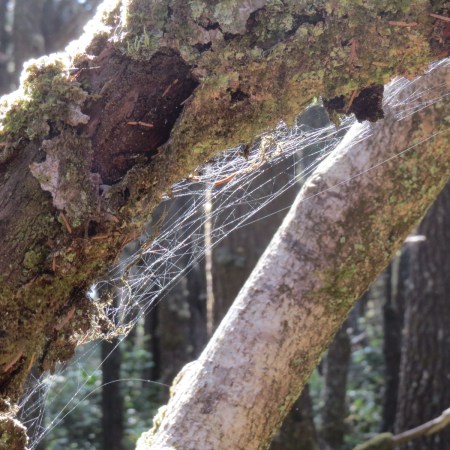
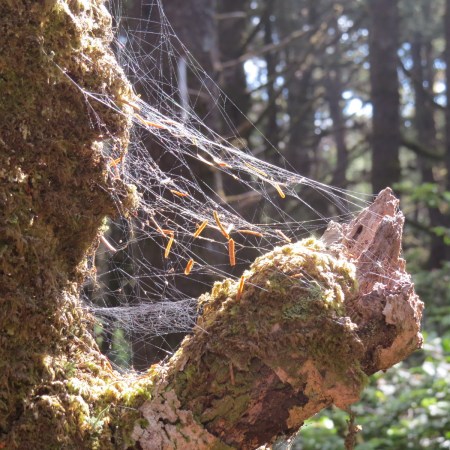
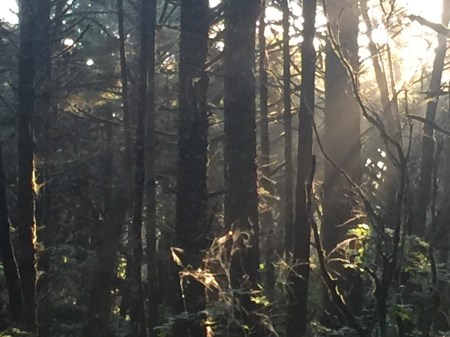
What surprised me the most this particular trip were the spider webs.  Yes, spider webs.  It was quite by accident I even noticed them.  I was making a simple breakfast and happened to look up to the east, where the morning sun sent its beams through a the forest of red pines and Sitka spruce.  That was worthy of a picture, but instead of pulling out the camera, I kept looking. What really struck me were the number of webs, complete ones,  ones with just one strand, a strand 25 feet up in the air, several at near ground level.  I realized how many I destroy when I walk through the woods.  I understand how dangerous these webs are for small flying insects.  Mind you, there have always been spider webs in the woods, and I have long noted the beautiful ones with dew on them, but I never had fully appreciated the sheer number of spiders in the woods.  At 68, that is shameful.  On the other hand, at least it wasn’t when I was 69, 79, or never.  Kind of makes me wonder briefly what else I am missing.  I’m sure someone in the club will tell me.

On the other hand, I bet they don’t know what the phase of the Moon is and why it is angled the way it is to the horizon, either.  Maybe some night I will explain it to them, by a campfire.

IMG_8757.JPG

IMG_8758.JPG

IMG_6920.JPG

IMG_8720.JPG

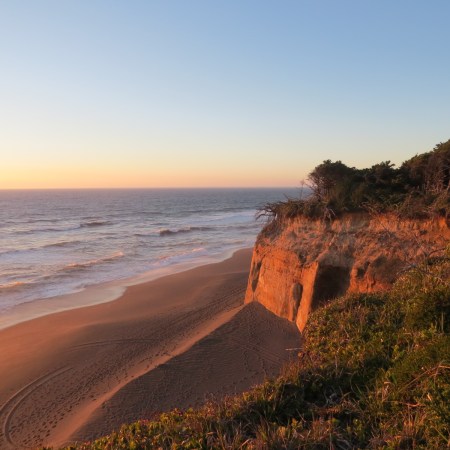
“Ross Light”, the special light, at sunset. It is the name Sig Olson, the great 20th century wilderness writer, gave to that time when photography was the best.

IMG_8777.JPG

Looking south from Blacklock Point, Oregon Coast. At the far right center is the Cape Blanco Lighthouse.

IMG_8766.JPG

Wildflowers, Blacklock Point, Oregon Coast.

TOO MUCH SUN, NOT ENOUGH BRIGHT PEOPLE

July 4, 2017

About a month ago, I felt some scaling on my cheek, saw abnormal skin, and realized it was time to see the dermatologist long before my annual appointment.  Here in Oregon, I get annual appointments; in Arizona, I was seen every six months, which I needed, because I had lived there for decades, the sun angle is higher and there is more sun exposure in general.  Arizona is a hotbed of skin disease.  Worse, I grew up spending a lot of time outdoors, where my parents told me to go outside and play in the sun (along Route 20, I think the pediatrician told them).  Vitamin D was good: we all heard that. I developed many actinic keratoses as a result of all that “good” sun. The four basal cell carcinomas I had were more dangerous, but at least somebody found them in time and cured them with chemotherapy ointment.

Skin cancer is not a big deal if one has periodic checks and gets treated early.  That costs money, requiring insurance and access to dermatologists.  Unfortunately, in the scheme of needed body care, dermatology and dental are not high priorities. If one doesn’t have insurance or access—either one—there is a risk that a melanoma will be missed until it presents with a seizure perhaps, meaning it has metastasized to the brain, or a basal cell cancer presents by eroding deep into skin and bone, treatable only by extensive disfiguring surgery.  The father of a friend of mine died after surgery to try to clear a basal cell cancer that had eroded through his face. My actinic keratosis was treated in twenty seconds of liquid nitrogen therapy.  The blister on my face will be healed in a week.  I won’t discuss dental care other than it is necessary for good health as well as creating a good impression.  Americans are very teeth conscious.

Strep throats are nasty but are easily cured.  Left untreated, because someone cannot afford a doctor’s visit, they will still get better.  Unfortunately, untreated strep throats may have complications as peritonsillar abscess, mastoiditis, retropharyngeal abscess, rheumatic fever with subsequent scarring of the heart valves, and acute glomerulonephritis with kidney failure.  A big reason why I never saw mastoiditis when I practiced medicine was that American children get early treatment for strep.  Take away access to treatment and these diseases will return.  Syphilis has returned to Eugene.  Go to the Third World and you will see people with diseases we Americans never get (polio, tetanus, congenital rubella) and trauma that our “restrictive” safety regulations prevent.  No, we aren’t perfect; every fourth of July, 11 Americans die from mishandled fireworks.  A kid out here blew off his hand last week: “I thought I would have at least two to three seconds.”  He might have had that; people aren’t good judges of time. He now is young with one hand.

We need to ensure people at both ends of the age spectrum have access to affordable, good quality medical care, and then work on those in between.  I had thought we were making progress towards the first until these past few months, when there is now a real possibility we will go backward at least with children on Medicaid.  I would be very naive were I to think Medicare is immune from the chopping block in some form, either.  There are far too many who don’t think they should be taxed to pay for someone else’s medical care, even as these same people are medical care consumers.

I would hope that out of the shooting of Mr. Scalise, there might be an awakening in some circles that each one of us is one bullet away from an unexpected, unforeseen medical catastrophe.  A psychologist I know would have called this being hit with a two by four on the side of the head moment.  I would expand the list from a bullet to one malignant cell, one blood clot, one ruptured vessel in the brainstem, one bacterium, one virus, and one drunk driver.  While some of those have risk factors, virtually none is predictable.  We can screen for cancers, and we can eat right, and that will help, but I, like all doctors and nurses, have seen my share of horror stories: the 29 year-old with aggressive colon cancer, the 24 year-old runner who died after uncomplicated surgery for appendicitis, the 41 year-old man who died from a preventable heart attack, because he couldn’t afford to be screened, a 17 year-old high school student in my class, beautiful, smart, who died after routine thyroid surgery.  Bad stuff can happen to anybody, and not being able to get or to afford care makes a bad situation far worse.

Catastrophes aside, day to day preventive health care gives peace of mind if something isn’t found, and while peace of mind doesn’t have a dollar sign, it has worth: perhaps the pursuit of happiness that is discussed every July fourth.  If something is found early, like a melanoma, an unsuspected heart problem, a small malignancy in the colon, cervix, or prostate, it can be dealt with far more easily, successfully, and yes, cheaply, than waiting until the individual has Stage IV disease and is “found down” or struggles into an emergency department with extensive disease, a bad prognosis, and yes, very expensive, too.

I’m concerned about the 40% of our children covered by Medicaid.  The proportion is not surprisingly higher in the poor, especially in people of color.  A disturbingly large number of children have episodic Medicaid coverage, which is not good for those with chronic diseases, like asthma, who need regular monitoring.  I’m concerned about vaccination status, lead poisoning, and proper nutrition.  If we miss the timeline on these, these children will never catch up and be doomed to a second or lower tier existences.  If we have too many children in this country, which I think we do, then we need more available birth control, not defund Planned Parenthood or take away medical coverage.  What gives?  Let me say it right out:  Paul Ryan is a devout Catholic, and he is going to push the Church’s rules (hopefully not pedophilia, although that is a cheap shot, I admit) down our throats.  Let me keep going.  The Affordable Care Act was signed by a black (half black) president, and that is just too much to tolerate.  In one of my lesser moments in life, my father once accused me of being incredibly irrational.  Yes, I was.  And I learned from it.  (So was my father irrational when it came to the Catastrophic Care Act, which taxed the elderly.)  It’s one thing when I’m irrational.  I hurt the people around me, a very small number.  The Republicans in power are hurting a third of a billion (not counting the rest of the world), because they couldn’t stand a black president and any of his legacy.

What are they thinking?  Do they want more poor people who need more medical care?  Because that is where we are going.  Or do they honestly want to see people die because they aren’t pure in some form?  What is it that they want?  Is it government out of our lives altogether?  Why, when a majority of Americans want Medicare to be left alone, should it be changed?  Why, when a majority of Americans want background checks for firearms, should they not be allowed?  Keeping Medicare is not irrational; wanting background criminal checks before one purchases a weapon is not irrational.

Not making needed preventable and other medical care affordable to every man, woman, and child in this country is irrational.  Not only is it morally right, it will save money in the long run.  Want to save more?  Fund Planned Parenthood and increase family planning.  Wanted children are healthier and will be more productive citizens. It’s necessary, it’s fair.

It’s rational.

EXPLAINING ECLIPSES: MUSIC OF THE SPHERES

June 20, 2017

“Without music, my life would be a lot less enjoyable.  Without science, my life would have ended a long time ago.”   My letter published in Newsweek, many years ago.

It’s a honor to know that I think the same way Neil deGrasse Tyson does about both the night sky and about society’s tacit approval of math illiteracy.

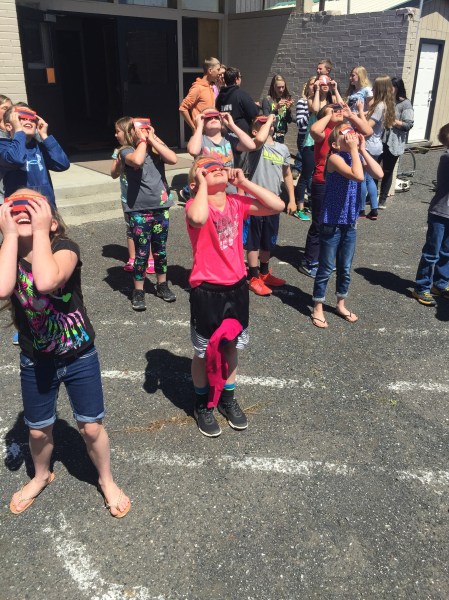
I have spoken to several groups about the upcoming solar eclipse.  Oddly, the largest number to whom I have spoken was not an group of adults but children at “a little school” (the teacher’s comment, not mine) in eastern Oregon.  In an hour, I spoke to all grades, about 100 students, and then in another hour spent time with about fifteen in a class, showing them how to make a solar filter on their own.  The other talks have had fewer than twenty, sometimes under ten.  Last week, I spoke at the LIONS meeting, and despite the microphone’s being near the speaker at one point, making a god-awful noise, one man was asleep right in front of me within 5 minutes after I began.

My solar eclipse talks have been short:  It’s worth seeing totality; protect your eyes and drive safely to and from the event; if you are a first timer, don’t waste precious seconds trying to take a picture.  Then I answer questions, and if the Sun is shining, have people look at it through solar filters.

IMG_6316.jpg

Students at Prairie City school in Oregon view the Sun.  The total eclipse will last 2m6s there.

IMG_6526.jpg

Howard Elementary 5th graders in Eugene.

IMG_6324.jpg

Eastern Oregon, 1 hour after leaving Prairie City. My payment for the talk.

I’ve stayed away from the math explaining why a total solar eclipse occurs.  Much of it isn’t complicated, but people don’t like numbers.  On the 2006 eclipse tour to Libya, there were several eclipse talks, and I asked the editor of one of the astronomy magazines why he didn’t discuss the Saros cycle in detail.  His answer was short, “People don’t like to look at numbers.”

While perhaps readers don’t like to look at numbers, perhaps they might learn something interesting by viewing 6 of them.

223 Synodic periods (common lunar cycle we know)=6585.32 days: The Moon has to be new for a solar eclipse to occur.  That lines up the three bodies in one plane.

239 Anomalistic (from perigee, closest approach, to perigee)=6585.54 days; the Moon must be within a few days of its closest point in order to appear to have the same apparent size (we call it angular size) as the Sun. Too far away, and the Moon will appear smaller, “inside” the Sun, a ring or annular eclipse.

242 Draconic (crossing the plane of the Earth’s orbit)=6585.36 days; the Moon must cross the plane of the Earth’s orbit when new in addition to being the right distance from Earth for a total solar eclipse to occur.  Crossing the plane lines up the three bodies in a plane perpendicular to the synodic.

Divide 6585 days by 365.25 days in a year and one gets 18 years 10.3 days, meaning that eclipses repeat.  The 18 year Saros cycle means that eclipses recur, shifted a third of the way around the world, which is what the decimal 0.3 shows, but the same general path occurs on the Earth.  Ancient people without computers knew this, and they didn’t know the math we know today, an impressive feat.

While these cycles aren’t exact, they are so close that an eclipse “family” will continue for some 70 eclipses, give or take about three.  That makes a family last 1200-1400 years before the small changes in many cycles finally fail to allow an eclipse to occur.  I think the resonance of these cycles might be part of the Musica Universalis, the Music of the Spheres, an idea dating at least to Pythagoreas, yes, that guy, that music was part of the movement of the celestial bodies.  If those three cycles aren’t beautiful, one has amaurosis mathematica, math blindness.

It’s not OK to use “I’m not good at math” to explain away inability to calculate basic things in life.  When I taught statistics to adults, I once made the comment that I didn’t care for a lot of jazz, and the class hammered me.  Wow, one would think I was born with a major defect.  I think the idea of people jamming is neat, playing off each other, finding the right beat, the right chord, the right sense; that is special.  I can’t do that, but I appreciate those who can.  What bothers me about math is that people use “not being good” as proud excuses to explain away issues, rather than concerns that they might be losing money, being conned, or missing out on something special in the world.  Without jazz, my life would be less full; without math, I would not have practiced medicine or even gone to college.

If I could learn to play the piano, and I did learn, I think that it is appropriate to say that others should learn to do basic math and like it. An astronomer the other night at the Club spoke how he taught basic astronomy to students without using math.  Everybody thought that was great, including me, until I thought about it a little.  Why leave out math?  By doing that, one fails to show why math is important.  One fails to listen to the Music of the Spheres.  What’s so wrong about showing the difference between an ellipse and a circle, between a parabola and a hyperbola?  You’ve got a satellite dish, and that is a parabola. These four conics all have a square or a quadratic term present, and quadratics are essential to understand energy of motion, gravity, projectiles, tides, how the solar system works, why we should wear seat belts and not drive too quickly around curves.

Maybe if we understood math a little better, we’d realize the number e, yes, there is a number e, used in a variety of places, including continuously compounding interest.

$1 at 8% for nine years, compounded each year $1(1+.08)^9=$1.99; we make interest on interest.

Compound twice a year, it is (1+(.08/2))^18 or1.04^18= $2.025.

We can compound daily (1+(.04/365))^365*18=$2.0543.

We can continuously compound, infinitely, and 1+(.08/n)^nt=e^(.08t)=e^(0.64)=$2.0544; notice where the 0.08 goes.

This infinitely number of compounding times sadly doesn’t give us infinite riches but approaches a limit given by the number e, the exponential.  Interestingly, it is far easier to calculate continuous compounding than it is daily compounding.

Note the close resonance of the product (multiplication) of the interest rate in per cent times the number of years it takes to double money.  That product is 72. In other words, 8 per cent interest  means that debt, money, population will double in 9 years, 72/8.  At 24% credit card interest, debt doubles in 72/24=3 years.  One student once asked me why we learned the formula for compound interest.  When I explained to him how with punching 5 keys on a calculator, he could find that the tripling time of money at 8% interest was just under 14 years, he was stunned.  Divide 110 by the interest rate.

Yes, beautiful, essential, interesting numbers.  Enjoy the eclipse.  Enjoy the knowledge that three cycles are coming together in August the way they did on 20 July 1963, 54 years and 32 days from when I saw this same eclipse family, canoeing in Canada’s Algonquin Park, where I saw the reflection of the solar crescent in Dickson Lake.

Thrice 18 years 10.3 days.


MURDERS SHOULDN’T COUNT AS DEATHS

June 2, 2017

Jonah Goldberg, conservative columnist, wrote yesterday how government intervention into American medicine would be no panacea.  He cited that while Australia had 3 years’ longevity on average more than Americans, Denmark had only a year and a half.  Then he took issue with the average.  At my age, an extra three years looks good.

Goldberg compared Summit County, CO with Pine Ridge, SD, showing about a 20 year difference in life expectancy, commenting that lifestyles have a lot more to do with the discrepancy than having insurance.  Of course, lifestyles affect longevity.  Native Americans have a high rate of unemployment, diabetes, and alcohol/other drug abuse, but their medical care is not as good as mainstream America.  Yes, they have the Indian Health Service, which I have been a part of, not Mr. Goldberg, and I can attest on reservations the IHS is not staffed nearly as well as it is in, say, Anchorage or Phoenix.  The anecdote fit Mr. Goldberg’s case, however, so it stayed.

He then went on to say a study by a member of the Hoover Institution (on War, Revolution, and Peace, the full name of which he did not mention, and I think is relevant) said while America was ranked 19th of 29 in life expectancy, if we “removed fatal car crashes and murders” we would rank first.

Wow.  If we didn’t count cancer, we’d blow away the field.  This reminded me of a cardiac surgeon I once spoke to, back when my hospital had one of the highest cardiac surgery death rates in the country, ostensibly because we did sicker patients.  Why we operated on them when others didn’t was never explained.  Anyway, one day a surgeon told me most of his fatal outcomes were “non coronary.”  I was speechless, because to me, as a neurologist, the patient had an operation and the patient died.  Period. Very end. Don’t dress up a pig.  Given that the Republican leadership has steadfastly refused to fund studies by the CDC to help us learn from and deal with firearm violence, I hardly think murders should be removed from the count, especially since we rank 99th in the world by rate per million, a third more than Uzbekistan, and four times that of Australia, which did do something about firearms, and eleven times that of Japan.  Imagine, Uzbekistan has a lower murder rate than the US.

Then Mr. Goldberg trod where he had no business treading.  He quoted the Medicaid study in Oregon, where several years ago, extra money allowed more people access to Medicaid via a lottery, which made an ideal study group (comparison of like groups with only presence or absence of insurance as a variable).  Mr. Goldberg stated that with the exception of depression, having health insurance produced no significant improvement in health.  Many of the outcome variables tracked, such as treatment of hypertension, diabetes, PAP smears, colonoscopies, and smoking cessation treatment will require years to determine whether access to affordable medical care will in fact make a difference in longevity.  Mr. Goldberg would do well to show some patience; health care doesn’t file quarterly earnings statements. People who haven’t been able to afford a doctor aren’t going to suddenly feel great when they finally can.  Still, increased health related quality of life and happiness was measurable, and that increased significantly along with a decrease in depression scores.  People sleep better at night when they know they can see a doctor without becoming bankrupt should they fall ill.

Depression is not a minor disease.  A major depressive disorder afflicts up to 25% of all women during their lifetime and 10-15% of men.  I treated thousands of people with depression during my medical career.  The disorder has protean manifestations; it is not a matter of someone’s  being down in the dumps.  Depression is a cause of appetite disorders and subsequent obesity or severe weight loss.  It affects energy level and productivity.  It may present as chronic pain.  Sleep disturbances are present in most depressed people; lack of good sleep is a major health problem today. The immune system is affected. Depression is a major cause of significant memory disorder, often masquerading as dementia; indeed, my father’s depression looked like dementia, and my mother’s dementia presented as depression. Moods are affected, and depression is a significant cause of sexual dysfunction.  These six: S-A-E-Me-Mo-Sex were written on my medical records in the upper right hand corner as soon as I saw a person with many somatic complaints that didn’t fit neatly into a neurological container.  In the ‘80s, I risked patient anger when I diagnosed depression.  People assumed I thought they were crazy, rather than having a chemical disturbance in their brain that was potentially treatable.  Today, we know better, but suicide by firearm is more common than murder by firearm, and depression remains a major cause of the former.

Goldberg concluded by stating that while the Affordable Care Act was correlated with the decline in America’s life expectancy in 2016, he said that some people were helped, quickly adding that there was no evidence that government run medical care did any good.  Mind you, Goldberg wasn’t blaming the ACA, although he didn’t refer to it by that term, which I find annoying.

Mr. Goldberg didn’t mention that the number of bankruptcies fell in half from 1.5 million to under 780,000 from 2010 to 2016, long after the bankruptcy law was tightened.  Some wrote: “bankruptcies disappeared ‘overnight’ with the advent of the ACA.”

I think it is entirely fair to have a reasonable debate on the role of government in medical care.  Let us, however, have a debate based on all the facts, not cherry picked ones. I resent Goldberg’s using his anecdotes then claiming the ACA was anecdotally helpful.  That is galling.  The ACA probably prevented 4 million bankruptcies so far, bringing peace of mind to millions.  Market based care, “choice,” the word used when it doesn’t involve a woman, and lifestyle changes are not the answer.  People need to be able to access basic medical care without financial hardship.  We need to catch illnesses early, and we need to screen for medical conditions, like cancer and yes, depression.

It’s time for the Congressional Budget Office to put a price tag on peace of mind, not declaring bankruptcy, and the long range value of early screening for disease.  Until then, I state that a good night’s sleep without worry about medical care is worth $100/night.  I’m open to negotiation, but it must have a dollar value.  We’re in America.

SOLITARY LATE SEASON SNOWSHOE, WILLAMETTE PASS

May 31, 2017

I had no idea what I was getting into when I drove out of Oakridge, Oregon, headed up to Willamette Pass.  I said I was going to snowshoe solo—the first week of May—and while I knew there was snow in the high country, I didn’t know how much or what condition it was in. There is deep wet snow, deep dry snow, and hard packed snow, each of which makes for a very different snowshoeing experience.  I hadn’t yet discovered the list of Oregon Sno-Tels, which are weather stations spread around the Cascades, so I didn’t know what the depths were at various elevations.

I hadn’t believed in winter in Oregon after my first one, when we were doing hikes in the Cascades in early February, and there was patchy snow only above 6000 feet.  That year it was 80 in the mountains in January, and through October Tucson had had as much precipitation as Eugene.  This winter, however, had been different, with a lot of snow even in Eugene, more in the mountains, and I had snowshoed a dozen times, once even in the Coast Range, where snow is not at all common.

I parked the car off on a side road, walked across Route 58, noting the heavy snow in the ski area and nobody there.  I didn’t see a soul.  Indeed, I could have snowshoed straight up the mountain had I wanted to; it was closed for the season.  Instead, I went into the woods to the Pacific Crest Trail to put on my snowshoes.

Once I was on snowshoes, the trail was fine.  Great, as a matter of fact, with hard packed snow in which I didn’t sink.  The woods were quiet, and it took me just over an hour and a quarter to travel 3 miles to Lower Rosary Lake, where I had been two months earlier.  It was still frozen and snow covered, except for a small area of open water at the outlet.  I went around the lake, crossed a divide into Middle Rosary Lake, went around it, looking up at Tait’s Loop and Pulpit Rock high above me.  I had planned this trip to go by all three Rosary Lakes, climb up to Tait’s Loop and loop back to the trail on which I had entered.  Nearly 10 miles, it was an ambitious endeavor, and I was alone, but alone I could dictate the pace.  About this point I told myself this had the chance to be a very special day.

IMG_6270.JPG

Outlet of Lower Rosary Lake, Pulpit Rock upper right (about 6400′)

I am not leading many hikes any more.  I’ve led more than one hundred; only four active club members have led more, and they’ve been around for decades.  I joined just three years ago. Leading hikes has become more work than I want to do.  I run risks soloing into the backcountry.  In addition to the usual injuries one can get, I can at any time have a bout of paroxysmal atrial fibrillation, which I tolerate reasonably well, even being able to climb while hiking. But I’d much rather not have it. I like the solitude, the ability to go or stop when I want, and go places where I wouldn’t dare lead a group.  I did a 23 mile hiking loop solo last fall through an old burn that had not grown back, and it was an ugly 7 hour chore on a hot day.  I won’t do that one again, but on the other hand, I now know what’s out there, which is why I hike and feel an urgency to see as much as I can, sometimes more than once.  What does that country really look like?

IMG_6274.JPG

Upper Rosary Lake

After Upper Rosary, I didn’t see any blue diamond metal markers that were on the trees I passed.  I looked around, wondering if I would have to turn around, but I kept going a little further and saw one.  Then I saw a several day old ski track coming from uphill.  This was well past the ski area and represented a cross-country skier’s track.  Had I been leading a group, I would have looked for an easier way.  I wasn’t, so I went straight up the track.  Wow.  It was a 30% grade for a few hundred yards, meaning I climbed 300 feet per 1000.  After I caught my breath, I pushed further to the top and then headed towards Pulpit Rock, a large landmark.  I knew the trail went west of the rock, and I was northeast of it, so I stayed at that elevation, figuring I would get back on the trail soon enough, and I did.

IMG_6275.jpg

View from Tait’s Loop: Middle and Lower Rosary Lakes (left); Pulpit Rock (right)

Once on the trail, I found a place where I could sit on a log, eat lunch, and look out at Odell Butte, Maiden Peak, Odell and Crescent Lakes, and the frozen Rosary Lakes.  The place was completely quiet, not sunny with a few breaks in the thick stratus.  I finished lunch, enjoyed my views a little longer, then started snowshoeing again on a trail I had done earlier this year.  That way also led back to the ski area and I could return that way if I got into trouble with my navigation.

I didn’t and found a familiar sign showing me where I needed to go.  Unlike the prior time I had been here, this direction seemed right, and at last I was no longer climbing, my 1300’ vertical effort finished.  The loop then split where I had a choice to go to the ski area or back downhill to where I had come in.  The GPS was tracking fine, I could see how far it was until I rejoined the entry trail, and I checked everything with my map, too.  If in unfamiliar territory, I carry a paper map.  GPS batteries can die, and while I consider myself to have good trail memory, I have easily gotten off trail on a number of occasions.  I was doing well on time,  headed downhill, snow soft but not too much so, and the woods continuing to be absolutely quiet, except for my movement.

Within a half hour, I rejoined the trail where I had come in and then realized that something wasn’t quite right, so I turned around and just saw my faint tracks behind me, heading to my right in the hard packed snow.  From here, it was an easy snowshoe slightly downhill, avoiding dangerous tree wells, where one can fall in and get stuck, and continued back to the trailhead.

IMG_6284.jpg

Tree Well. These can be very dangerous should one fall in head first.

IMG_6285.jpg

Signed Trail: I went out to the right and returned on the left.

This day was as special as I thought it would be; indeed, it was the best snowshoe I have ever done.  I had studied the loop several times, thought I could do, wanted to do it, put the pack on my back and did it: 9.5 miles, about 2 or 3 more than I ever had before, 1300′ of climbing, and explored a loop that not many do on snowshoe.  Nobody else was out there.  I covered distance, elevation, had great views, good snow, and quiet.  I went out that day thinking I might not even be snowshoeing and would drive right back home.  Instead, it was one of the best winter days I’ve had in the woods.

To qualify as a best day in the woods means I had a dream about doing something, did my planning, and made the dream come true.  To do such in my own way I find extremely rewarding.  I will lead a few more hikes this year, but this hike reminded me why I hike solo: the freedom and the quiet appeal to me.

IMG_6286.JPG

Woods at a lower elevation

IMG_6277.JPG

Middle Rosary Lake with Odell Butte in background.

IMG_6279.jpg

It’s a long climb up from the Rosary Lake below, and that is several hundred feet above where I started by Willamette Pass.

UNDERSTANDING THE UNTIED STATES

May 27, 2017

Now, I am beginning to understand, thanks to budget director Mick Mulvaney.  When asked by Sen. Debbie Stabenow of Michigan why money for water protection in the Great Lakes was zeroed out in the budget, he said we had to look at this through the eyes of a taxpayer in Arkansas: “Should I really take some of his tax dollars to do something in Michigan?”

Stabenow commented, “that’s called having a country, with all due respect.”  She went on to say that 20% of the world’s fresh water bordered 8 states. I wonder how many Americans can name all the Great Lakes.  I wonder if Mulvaney could even name the states; he’s from the South.

I would have gone right back at Mulvaney asking why I, here in Oregon, should give a damn about a trailer park in Arkansas that gets leveled by a tornado, something that happens virtually every year.  Or some chicken farmer, when I’m vegetarian.  Why should I care if some cattle rancher’s herd dies in a winter blizzard?  That doesn’t affect me.  Why should I pay to truck sand into some North Carolina beach, so it will get eroded away the next storm?  Or to fight grass fires in Texas, build levees in Louisiana, where the ground is sinking and the Atchafalaya River needs to flow naturally again, which means taking over from the Mississippi.  Why should I care about floods in South Carolina?  That’s Mulvaney’s home.  Let him pay for it.  I’m not going there again.  If there is an EF-5 in Oklahoma, why should I care?  It’s a red state, most of the people there wish somebody like me would drop dead, and they certainly wouldn’t want my money.  Why then?

Because we are the UNITED States, not the UNTIED States.  We fix things in the country that matter.  We help people who need help.  We protect the environment for the next generation, and if I, a guy who neither desired nor wanted nor had children, thinks that helping those who lives have yet to begin is important, why can’t the president’s budget address this fact?

How local to we go, Mr. Mulvaney?  Do we go so local that we only pay for medical bills that affect us?  That our taxes shouldn’t go to medical research because I may see no benefit, to building trauma centers I may never use, to research that tries to cure other childhood cancers, like we cured acute lymphoblastic leukemia (it wasn’t prayer that did that, you know) even though I will never in my life have a child who could have it?  Mr. Mulvaney, it should be noted, failed to pay payroll taxes incurred by a nanny for his triplets from 2000-2004, arguing she was a babysitter.

Why should I pay for somebody who has head trauma and wasn’t wearing a helmet?  Or somebody with a gunshot wound when I think the NRA ought to pay for it? They use firearms, I don’t.

Are we becoming a nation of crowd source funders, passing the digital hat, without a clue what a country is about?  Is this the rugged individualism approach that sounds good when you hear Sheriff Richard Mack, of the Constitutional Sheriffs and Peace Officers Association, the same Mr. Mack who hated Mr. Obama and his ACA?  Sheriff Mack, to remind some and to educate others, had a heart attack and his wife became ill as well.  They went to GoFundMe to try to get their medical bills paid for, since they didn’t have insurance. Crowd sourcing isn’t the answer, because medical bills are far more than most realize, and Sheriff Mack, your bill and many others with similar conditions can’t be anticipated, so that’s why we have a thing called insurance.  Now insurance isn’t all that great when it restricts what you can use it for, so it was changed.  Personally, I would have the government cover all medical care to a certain extent, but I am open to honest, fair debate as to what that extent should be.

For example, I think medical care for heart conditions, cancer, aneurysms, blown out knees, fractured clavicles, broken necks, concussions, childbirth, strep throats, ought to be available so that people—even right wing, red state folks who hate me and everything I stand for—get it when they fall ill, rather than dying and as Charles Dickens would have said, “decreased the surplus population.”  I think a 30 year-old, uninsured, in a coma, should be given medical treatment to try to save his life, not “let him die,” which is what the audience yelled at a Ron Paul rally in 2011. Paul himself said, “let people assume responsibility for themselves.”  Really?  People in a coma can assume responsibility?  Old people can shop for the best value medical care?  Should those who were too stupid not to wear a helmet be left at the side of the road to die?  Granted, I didn’t like coming in at 2 a.m. to care for them, but these people needed medical care, unless or until there was a time when in the my judgment where care would no longer help. I wasn’t, of course, trained as an OBG like Paul, just a neurologist, and I was a few years behind him in medical school, so I didn’t hear the part about having the churches take care of these people.  That’s been tried in this country, and it doesn’t work, although if some of the megachurches put their dollars towards actual hands on care, we could probably make a moderate dent in the scope of the problem.

By the way, Paul’s 2008 campaign manager died at 49 from pneumonia, leaving behind a $400,000 medical bill, because while he could raise money for Paul, he couldn’t afford a few hundred a month for COBRA coverage.  Paul managed to extol the man’s skills and tried to raise money for his medical bills.  Is this the America he envisioned?

Are we united or untied?  Will my America be money for defense, tax cuts for the rich, where the money will not trickle down, but we will continue to hear that it is true? Will my America be where the president’s family uses the office to generate money and virtually nobody will try to stop it?  Where Mr. Putin’s approaches to journalism and money are copied here?  Is it here where we make a budget based on unrealistic growth expectations?  What happens when a Cat 5 hurricane levels Miami, storm surge again wipes out New Orleans, or a cluster of EF-4 tornadoes takes out Birmingham?  Are those people expected to take care of themselves?  What happens if the San Andreas or Cascadia Fault slips, and Los Angeles, San Francisco, Eugene, Salem, Portland or Seattle is leveled?  Or we have an oil spill from a pipeline that a lot of us didn’t want, and the Ogallala Aquifer or Lake Superior are polluted beyond repair?  You’ve heard, I assume, Mr. Mulvaney, of the Enbridge 5 pipeline under the Straits of Mackinac.  What happens if this 65 year-old pipeline, whose supports have failed, leaks? Who fixes Lake Superior?

This is what I finally understand.  I know now where we are going: we are to become a nation of take care of yourself, because nobody else will.  That’s the case in many places in the world today.  I’ve seen those places and those people, in Manila, La Paz, Caracas, Lima, Djakarta, New Delhi, Johannesburg, Cape Town, Lusaka, Nairobi, Cairo, and Tripoli.  Of course, we have them here, too. And we will have a lot more.  You see, the AHCA will remove insurance from 64,000 in Oregon Congressman Greg Walden’s district, and he helped craft the bill.

You know what?  He will be re-elected in 2018.

PREMATURE CHICKEN COUNTING

May 24, 2017

Social and other media have been abuzz the past few weeks about impeachment of the president, a display of both magical thinking and forgetfulness of with whom we are dealing.  In the same vein, the “resistance” is taking credit for things that perhaps are not worth crediting.  In short, while I support all steps that fight the current administration and run down the clock, I want to inject a harsh dose of reality into our lives, too.

I wouldn’t bet against the current president.  He survived insulting of McCain, the Pope and Ted Cruz’s wife, dissing a Gold Star family, giving away Graham’s phone number, and took apart not only the entire Republican field, but the Democrats as well.  He was shrewd enough to bring several of his rivals into his cabinet. He has gotten away with all of it, and other than a few brave judges slowing down some executive orders, is quietly moving to dismantle health care, give a big tax break to the wealthy, remove food stamps, Medicaid, Social Security, and Medicare, and all environmental restrictions.  Maybe this can be stopped, but I am not betting on it right now.

The rules have changed.  While the media is finally stepping forward with investigations into his ties and his campaign’s ties to Russia, already there are those who may find a way to weaken the investigation.  I’ve heard countless times of the dysfunction in the White House and how this can’t continue.  And yet it continues.  He can fire the current special counsel should he choose, like Nixon, more than 40 years ago, and there would be a huge outcry…but nothing to show for it, were I betting.

Despite all the transgressions the current president has made, his approval rating stubbornly remains in the mid to high 30s, back to 40% when we had our $90 million raid on Syria.  Oh, I read that the firing of Comey had a 29% approval rating, but the disapproval rating is today barely over 50%.  The president would get at least 40% of the vote were the election held today, and until or unless I see polling numbers in the 20s, I will not be impressed much has significantly changed.  It doesn’t matter that Mr. Obama ran a scandal-free administration, stymied every step of the way, had unproven conspiracy theories abound, and would have been impeached in a New York minute had he secret conversations with the Russians.  This president has the backing of the Republican Party, who sees more what they can get from him than what is right or wrong in the country. I heard before the election all the Republicans who weren’t going to vote for him. And they all did anyway.  I’m not sure what—if anything—will take this man down.  I suspect if something does, it may be a minor sleeper that takes everybody by surprise.

Currently, I am trying to unsubscribe from the voluminous number of emails I get from so many different groups.  Today was the Democratic Governor’s Association.  I fought the battle 10 years ago, back when Napolitano and Sebelius were still red state governors, until Mr. Obama’s ill-timed use of them in his cabinet.   If the Democrats were too stupid to realize what they needed to do, it isn’t up to me to be their money tree.  I’m retired.  It’s time for somebody else to step forward. I’m tired of losing, of candidates not wanting the national organization to come to their district, because national is out of touch, running candidates with high disapproval ratings who worry more about raising money than going to the heartland in all 50 states and just discussing matters like health care, defense, taxes, and trade.  I’ve had it with voters who demand perfection in race, gender, sexual orientation, medical plans, fighting terrorism, or they will stay home.  These same voters are getting creamed by this administration, and frankly a tax cut would be economically beneficial to me.  If they are too stupid to realize that only the Democrat can beat the president, not a Libertarian or a Green, and that down ballot measures like Congress and School Boards matter, then they deserve what they get.

Resist, yes.  But don’t think for a moment that the resistance killed the AHCA.  It didn’t kill it the first time, the Freedom Caucus did.  And whether the town halls will make a difference at the voting booth, I’m not optimistic right now.  People have short memories.  People are stupid, when they think “Obamacare” was different from the ACA.  I’d predict that if the AHCA became law today, the House wouldn’t change much in 2018. Nobody is protesting the lack of enforcement of the ACA, which is causing more insurers to pull out, the Blues now from the KC area.  Enforcement of the law is a presidential duty.  At least it was for a Democratic president.

Worse, it may be too late.  An estimated 300,000 in Wisconsin alone were disenfranchised because of harsh rules to vote.  It is more difficult to vote now, the districts were gerrymandered, the voting rights act was gutted, and now we are going to have a commission to look into voter fraud, most of the single digit cases of fraud being by Republicans.  In 2020, the census will be politicized, and minorities will be undercounted, underrepresented, and districts drawn by Republicans, because most of the states are run by Republicans now.  The Democrats in power were too busy doing—well, I don’t know what—while the Republicans took 1000 offices nationwide.

It’s not up to me.  If it were, I’d have mandatory national service, military out of South Asia, single payer health care, and a tax plan I’ve discussed here many times.

People would do well to cool it a little bit.  Nobody is going to impeach the president in a Republican run Congress.  Even if that happened, conviction would require two-thirds of the Senate, and other than an occasional feel good bill, there aren’t two thirds the votes for even free enemas in this country.  Maybe the guy will resign.  Or just quit.  Or die or get Alzheimer’s, assuming he doesn’t have that right now.  Then we get Pence, whom I would bet money that very few people in this country realized what those implications might be, because the media was so focused back then on the presidency.  Pence may be investigated too, but to count on that is counting a second generation chicken.

The media is helping uncover a lot of bad stuff now, true.  I’m glad that they are doing their job.  I can be forgiven for not being a fan of theirs when they gave untold amounts of free advertising to this president, who is a candidate still, with packed rallies and a lot of strong support, people who will vote.

I am remaining hopeful that something will end the darkness that has ensnared this country, but I do not underestimate the resiliency of this president, the desire of his party to keep him in office, and the damage he can do.  If one wants to have a feel good moment, that’s fine.  From time to time, we need one.  But it is important to be realistic, look at appropriate sources of news, fact check information, and stay realistic, focused on results, and keep reminding people why elections matter.

THE NINTH LIFE

May 11, 2017

It was ironic that Suzy of all people, the ditz, brought Gryffindor and his two brothers into our lives. It was the one decent thing she did for us.  Out in Benson, where my wife and her horse trainer/best friend once kept their horses, Suzy showed up one day, 14 years ago, with three kittens that she brought from the feed store, thinking they would be a nice addition to the barn, but doing little to care for them.  The kittens, two orange and one black, had their litter, food and water in the same place with a netting to keep them in. My wife was upset at their care.

The morning one of the orange ones got stuck in the netting was the final straw.  “I’m taking those kittens,” she said, taking them first to the vet to be checked and then to our house.  Suzy never noticed. I was out of town at the time and thought we would adopt out the kittens.

I was naive.

When I came home, the kittens were in the back room, playing with each other, and Gryffindor, the first one named, because of Harry Potter’s popularity and the fact that he looked like a little lion, was top guy.  When we served kitten milk, a nice concoction, Gryf would push the black one away, or just put his paw on the black one’s head.  Gryf was a beautiful dark orange with a uniform striped tail and a solid frame.  Needless to say, we kept all three.

Over the years, Gryf didn’t become the top cat but bonded with one of the adults and enjoyed his days in the sun on a bed or on the carpet, catching the last rays of the daylight.  When HC arrived, a silver gray stray tabby, Gryf attacked him from the first moment, and HC ended up with three rooms he could live in, darting from one to the other.  We asked Gryf not to do it, but we got used to the loud spit, a crash, “Gryf get out of there,” stomping our feet, and watching Gryf, tail huge, trot proudly out of the room.

Gryf loved being rubbed on the dining room table, and combing was a treat, although we overdid it one year, leaving him almost bare on his back. The woman who cleaned our house, took care of our cats when we were gone, and was a great friend besides had a special bond with him.  Whenever she got ready to leave, Gryf would jump on the dining room table, meow at her, demanding to be rubbed.

Gryf tolerated the move to Oregon poorly, traveling in a horse trailer with seven other cats and becoming dehydrated on the 60 hour trip.  He arrived at the house with a loud screech that could be heard throughout the neighborhood, and a few days later the smell of acetone on his breath told me we had a problem.  He was in Class 4 renal failure and we had a few minutes to decide whether we should euthanize him.  I looked at the lion face and said that he looked better than his lab numbers and we would try to cure him.  Incredibly, Gryf normalized his kidney function, although he needed chronic potassium supplementation, which he hated, and eventually hypertension treatment.  Taking him to the vet was done with a lot of screeching, and we both hated the trip, but he needed the care.  He got through dental visits and did well for three years. I think Gryf might have treated me differently after this, but of course he was a cat, so I had no idea.

In the spring of his fifteenth year, he decided it was safe, if I were in bed, to come, announcing his presence by a loud meow, demanding to be petted and to lie by me, purring.  The middle of the night visits were a bit hard on my rest, but I rationalized it as his thanking me for what I did three years earlier.

I should have thought maybe he was telling me he was leaving soon.

Gryf weighed 13-14 pounds, slightly more than normal, but far less than the other ones, for whom meal time was most of the time.  He held his weight, and because we were concerned a little about his eating, we stopped his blood pressure medicine and potassium.  He remained stable and ate with gusto, although still a little finicky.

One Friday, a day before my wife flew to Arizona, Gryf was fussy.  I didn’t think much about it, but Saturday, he was definitely off.  He didn’t look comfortable, and when he didn’t have much dinner, I weighed him at 12.8 pounds.  I called my wife, and we thought it was dehydration, so I gave him subcutaneous fluids.  I thought that he would be better Sunday morning, but there was no change.  I decided then to take him to the 24 hour emergency vet service.  Gryf screeched as usual on the drive over.  He was checked in, and I had a list of concerns—dental issue, renal failure, hairball, and at the bottom, “Cancer ???”

The vet came back with the lab, showing his renal function was fine, but his liver tests were elevated.  They wanted to keep him to do an abdominal ultrasound.  I hated to leave Gryf, because he literally quivered with fear when he was at the vet.  But he needed a diagnosis.  Unfortunately, my wife was in Arizona and I was leaving Monday for a two day trip 300 miles away.  The ultrasound was called to us that night as showing a mass in the liver, and he needed a biopsy, which could be done nearby, but we needed an appointment and had to take him ourselves.  I thought I could return by early afternoon Tuesday to take him.  We were hoping for an abscess or easily treatable tumor.

Monday I left, Gryf still at the vet, still scared.  The appointment was scheduled for Tuesday morning; my wife would fly home Monday.  I felt that I had abandoned him.

My wife arrived late Monday, and Tuesday morning I left Baker City for Eugene, 320 miles. When I reached John Day, she had got Gryf, who at last was smelling a familiar scent after 46 hours.  He was taken to the other facility for the biopsy.  Just before I crossed the Cascades, my wife texted that Gryf was about to have the biopsy.

Gryf tolerated the biopsy poorly and was in bad shape.  I made the drive to Springfield in just under 6 hours, arrived at the clinic, went back to a room with my wife and waited.  The biopsy showed a solid mass, not the hoped for abscess.

Gryf had been prodded, shaved, handled by strangers, abandoned, and was scared.   He was taken into a room where he finally smelled something—someone—familiar.  He was placed in his favorite bed and felt a pair of hands, hands that had rubbed him, combed him, fed him, and yes, even put the hated potassium pills down his throat.  What lovely hands. He started to purr.

He didn’t understand the words “5 cm mass in his liver,” “lymphosarcoma,” “everywhere,” “8 weeks at best,” “horrible disease.”  He didn’t understand my words that I wanted him at home one more time, but that would be treating me and not him.  All he knew was those hands were picking him up and placing him on a shirt and lap that smelled oh so familiar and nice.  He heard two people—his people—crying. He felt the stroking on his back he loved so much.

He purred and purred, sticking his head into my armpit where he could hide and I couldn’t see his face.  It was enough that he felt the hands he loved so much, the love from the crying person he loved so much.  He purred, now feeling a finger on his throat.  The person would care for him, love him, take him away from this lonely, painful place.

He felt the strange woman move his leg, but his person hadn’t moved, still stroking him, saying his name, finger on his trachea feeling the vibration.  He heard the crying, but he didn’t understand “propofol”.  It didn’t matter.  The hands kept stroking him.  He was with his person at last.  The person would care for him….

It was important to the person that the last sensation he felt from Gryf was a purr.