Posts Tagged ‘General writing’

THE NINTH LIFE

May 11, 2017

It was ironic that Suzy of all people, the ditz, brought Gryffindor and his two brothers into our lives. It was the one decent thing she did for us.  Out in Benson, where my wife and her horse trainer/best friend once kept their horses, Suzy showed up one day, 14 years ago, with three kittens that she brought from the feed store, thinking they would be a nice addition to the barn, but doing little to care for them.  The kittens, two orange and one black, had their litter, food and water in the same place with a netting to keep them in. My wife was upset at their care.

The morning one of the orange ones got stuck in the netting was the final straw.  “I’m taking those kittens,” she said, taking them first to the vet to be checked and then to our house.  Suzy never noticed. I was out of town at the time and thought we would adopt out the kittens.

I was naive.

When I came home, the kittens were in the back room, playing with each other, and Gryffindor, the first one named, because of Harry Potter’s popularity and the fact that he looked like a little lion, was top guy.  When we served kitten milk, a nice concoction, Gryf would push the black one away, or just put his paw on the black one’s head.  Gryf was a beautiful dark orange with a uniform striped tail and a solid frame.  Needless to say, we kept all three.

Over the years, Gryf didn’t become the top cat but bonded with one of the adults and enjoyed his days in the sun on a bed or on the carpet, catching the last rays of the daylight.  When HC arrived, a silver gray stray tabby, Gryf attacked him from the first moment, and HC ended up with three rooms he could live in, darting from one to the other.  We asked Gryf not to do it, but we got used to the loud spit, a crash, “Gryf get out of there,” stomping our feet, and watching Gryf, tail huge, trot proudly out of the room.

Gryf loved being rubbed on the dining room table, and combing was a treat, although we overdid it one year, leaving him almost bare on his back. The woman who cleaned our house, took care of our cats when we were gone, and was a great friend besides had a special bond with him.  Whenever she got ready to leave, Gryf would jump on the dining room table, meow at her, demanding to be rubbed.

Gryf tolerated the move to Oregon poorly, traveling in a horse trailer with seven other cats and becoming dehydrated on the 60 hour trip.  He arrived at the house with a loud screech that could be heard throughout the neighborhood, and a few days later the smell of acetone on his breath told me we had a problem.  He was in Class 4 renal failure and we had a few minutes to decide whether we should euthanize him.  I looked at the lion face and said that he looked better than his lab numbers and we would try to cure him.  Incredibly, Gryf normalized his kidney function, although he needed chronic potassium supplementation, which he hated, and eventually hypertension treatment.  Taking him to the vet was done with a lot of screeching, and we both hated the trip, but he needed the care.  He got through dental visits and did well for three years. I think Gryf might have treated me differently after this, but of course he was a cat, so I had no idea.

In the spring of his fifteenth year, he decided it was safe, if I were in bed, to come, announcing his presence by a loud meow, demanding to be petted and to lie by me, purring.  The middle of the night visits were a bit hard on my rest, but I rationalized it as his thanking me for what I did three years earlier.

I should have thought maybe he was telling me he was leaving soon.

Gryf weighed 13-14 pounds, slightly more than normal, but far less than the other ones, for whom meal time was most of the time.  He held his weight, and because we were concerned a little about his eating, we stopped his blood pressure medicine and potassium.  He remained stable and ate with gusto, although still a little finicky.

One Friday, a day before my wife flew to Arizona, Gryf was fussy.  I didn’t think much about it, but Saturday, he was definitely off.  He didn’t look comfortable, and when he didn’t have much dinner, I weighed him at 12.8 pounds.  I called my wife, and we thought it was dehydration, so I gave him subcutaneous fluids.  I thought that he would be better Sunday morning, but there was no change.  I decided then to take him to the 24 hour emergency vet service.  Gryf screeched as usual on the drive over.  He was checked in, and I had a list of concerns—dental issue, renal failure, hairball, and at the bottom, “Cancer ???”

The vet came back with the lab, showing his renal function was fine, but his liver tests were elevated.  They wanted to keep him to do an abdominal ultrasound.  I hated to leave Gryf, because he literally quivered with fear when he was at the vet.  But he needed a diagnosis.  Unfortunately, my wife was in Arizona and I was leaving Monday for a two day trip 300 miles away.  The ultrasound was called to us that night as showing a mass in the liver, and he needed a biopsy, which could be done nearby, but we needed an appointment and had to take him ourselves.  I thought I could return by early afternoon Tuesday to take him.  We were hoping for an abscess or easily treatable tumor.

Monday I left, Gryf still at the vet, still scared.  The appointment was scheduled for Tuesday morning; my wife would fly home Monday.  I felt that I had abandoned him.

My wife arrived late Monday, and Tuesday morning I left Baker City for Eugene, 320 miles. When I reached John Day, she had got Gryf, who at last was smelling a familiar scent after 46 hours.  He was taken to the other facility for the biopsy.  Just before I crossed the Cascades, my wife texted that Gryf was about to have the biopsy.

Gryf tolerated the biopsy poorly and was in bad shape.  I made the drive to Springfield in just under 6 hours, arrived at the clinic, went back to a room with my wife and waited.  The biopsy showed a solid mass, not the hoped for abscess.

Gryf had been prodded, shaved, handled by strangers, abandoned, and was scared.   He was taken into a room where he finally smelled something—someone—familiar.  He was placed in his favorite bed and felt a pair of hands, hands that had rubbed him, combed him, fed him, and yes, even put the hated potassium pills down his throat.  What lovely hands. He started to purr.

He didn’t understand the words “5 cm mass in his liver,” “lymphosarcoma,” “everywhere,” “8 weeks at best,” “horrible disease.”  He didn’t understand my words that I wanted him at home one more time, but that would be treating me and not him.  All he knew was those hands were picking him up and placing him on a shirt and lap that smelled oh so familiar and nice.  He heard two people—his people—crying. He felt the stroking on his back he loved so much.

He purred and purred, sticking his head into my armpit where he could hide and I couldn’t see his face.  It was enough that he felt the hands he loved so much, the love from the crying person he loved so much.  He purred, now feeling a finger on his throat.  The person would care for him, love him, take him away from this lonely, painful place.

He felt the strange woman move his leg, but his person hadn’t moved, still stroking him, saying his name, finger on his trachea feeling the vibration.  He heard the crying, but he didn’t understand “propofol”.  It didn’t matter.  The hands kept stroking him.  He was with his person at last.  The person would care for him….

It was important to the person that the last sensation he felt from Gryf was a purr.
ANOTHER LOSS

May 5, 2017

The following three commentators won today:  “I want my money going to fight North Korea, not to pay for somebody else’s knee.”

Joe Walsh’s tweet: “Sorry Jimmy Kimmel: your sad story doesn’t obligate me or anybody else to pay for somebody else’s health care.” Well, Mr. Walsh, I don’t want to pay for yours, either, but I recognize that any of us can be that somebody else, and a malignant cell, blood clot, virus, drunk driver, nut with a gun, bad choice in deciding to fix a roof, can make any of us easily a million dollar consumer of health care.

A hiking friend of mine won, the guy who couldn’t see why his taxes should go to pay for somebody else’s health care.  I liked him a lot until I heard that.  He carries too much weight.  Yes, I may end up using more medical resources than he, but insurance actuaries would rather insure me than him.

America’s greatness in no small part comes from our willingness as a nation to contribute to the collective good.  That means we pay taxes for a lot of things that never benefit us. I learned young that most of the land, parks, and other places in the West were paid for by people in the East who never saw them.  A trillion dollars in 20 years—yes, a trillion, and that would be a one followed by 12 zeros, with a “net” after it—went from my once home New York State to the federal government over the past 20 years.  Most of the red states in the Deep South got a net infusion of money from the government that so many of them despise.  This is either hypocrisy or ignorance.  Knowing the South, and I have walked across Tennessee, yes—walked, I suspect it is both.  The highest percentages of people with pre-existing conditions are in southern red states.  They have high percentages of teen pregnancy and gun violence, too.

I shouldn’t have to pay for the levees in New Orleans, when they are doomed to fail because of ocean rise, subsidence, and the Atchafalaya River. I would not have rebuilt the city after Katrina.  I no longer wish to pay for sand to be trucked in to East Coast beaches, and rebuilding in the same places after another hurricane, ocean rise, storms, bad building, and because nature reshapes beaches.  I am tired of paying for defense that goes on offense and causes worse problems than we started.  I didn’t think the Iraq war was right and my judgment was correct.  And yes, I don’t like paying for health care for people who smoke, use drugs, drink too much, don’t wear helmets when they should, eat too much meat, and are obese.

You know what?  I get a lot back from this country, even though I gave a lot to this country in time and taxes, and until now, I haven’t been keeping score. Now I am.  Conservative commentators who don’t want to pay for people’s health care have no problem driving on roads and crossing bridges in their state that I helped pay for.  Or laud the firing of cruise missiles that I also helped pay for.  Or send their children to good universities that I helped fund.  I have no kids, but I gladly pay to support education, because an educated population is a lot better than an uneducated one, as we have learned in spades these past 18 months.  The Republicans put together a crappy bill, rammed it through the House without hearings or CBO knowledge, not because the country was in dire straits because of health care issues (mostly their fault, since if they had worked to make the ACA better, it would have not been a problem), but because they wanted some legislative victory to go home to.  I hope they enjoy their town halls.

I’d wish the lot of them to be thrown out of office next year, but that won’t happen, because people have short memories, those who don’t get health care will be told it was Obama’s fault, and while the Democrats are great at asking for money, they aren’t so great when it comes to running good campaigns.  When I have given, all I heard was another email:  Give. They mean well, but let’s face it, we have this guy in office for at least four years, and the other night the news media started discussing his “first term,” so it’s likely to be eight.  The Democrats will blow it again in 2020, I’m sure.  True, the president might become incapacitated, but Pence is after him, and he believes that going to church would cure pre-existing conditions.  How he would deal with pregnancy, a pre-existing condition, and abortion, isn’t clear. Paul Ryan is after Pence.  I’m not going to be politically active for another 8 years, not after dealing with Nixon for 6, Reagan for 8 and Bush 43 for another 8.

I’m almost in the David Brooks camp about how the president is really a 3-4 on the worry meter, not the 11 so many of us peg him at.  But Brooks isn’t looking at the big picture: climate change, which neither he nor I will live to see wreak its full havoc, the educational system, and the results of our misadventures in Iraq, Afghanistan, and probably Syria and North Korea before this is all over.  Oh, we are marching, and the Democrats are running better than expected for open Congressional seats, but they are still losing.  The Democrats are really good at losing, and almost getting there isn’t a victory or even a message.  It is another loss.  “Wars aren’t won by evacuations,” as Churchill said after Dunkirk.  Ask the average American high school senior who Churchill was and why Dunkirk mattered, and you’d get a dumb stare.  Half the country can’t find the Ukraine within 1500 miles on a map of the world.  A significant number can’t find north, which these days might be useful in the US.

I am wondering at what point the American public is going to look at how the Republicans rammed through a bill that is going to make health care unaffordable, therefore inaccessible, for millions, clobber hospitals, who have to care for sick people who can’t pay, all in the name of a tax break to the wealthy.  There was no hurry to do this, other than to make the president look good, a president all of their other candidates last year tried to stop.  Now, they are embracing him, which means they own everything that happens to the country.  Everything. The Republicans complain of government overreach, yet they reach right into a woman’s life all the time, telling her what she cannot do.  They say people should be free to choose their doctor and health care, when the average person doesn’t have a clue how their body is put together and doesn’t have the money to pay for just one ED visit. I’m a physician, and when I moved to another city, I had no way to know who was a good doctor. The data are so bad that 19 years after I left practice, I was still given a 5-star rating online.  We’re not talking about Consumer Reports for Toyotas or Leafs, but medical care.  People need care, care that doesn’t bankrupt them.  I could ask that the care be better, but that’s next.

What’s unfortunate is that many of those who voted for this Congress and this president are going to be very hurt by what has happened, and they are not even aware of it.  Nor will most change their vote the next election.  But if 1% of them switched, which is the percentage Nicholas Kristof found, there might be hope.

1% to fight the 1%.

DINOSAUR

April 9, 2017

I started using my first cellphone in 1990, but even as late as 1999, I still used a pager.  When I tried to replace it, I was told nobody used them any more.  I did, and I liked it.  A pager was easy, I knew what number to call, and usually it was something important.  The cell phone finally supplanted my pager, and I no longer know where every pay phone is (or have a pocket full of dimes—er… quarters), not that there are any of them around, but many of my incoming calls are either spam or wrong numbers.  Every technology has untoward, unforeseen side effects.

I have never tweeted.  I do have an account, but I’ve never seen a need to follow somebody on Twitter, since I have my own life to live, not follow somebody else’s.  I haven’t missed much, although I did stun a few people when I admitted I didn’t know anything about the Kardashians. I’d rather know how to backpack, read the sky, start a fire when it’s pouring rain, how to canoe trip, or how to do basic math than worry about somebody famous.  I can’t write well and quickly.  I need time to think; technology does not play to my strengths in this regard, but rather to my weaknesses.

On a recent hike, a few of us saw a flower we couldn’t identify. Somebody asked me if I had an app to identify it. Being a dinosaur, I don’t have such, any more than I have an app to look at the night sky or the types of clouds overhead.  I usually ask someone or look it up when I get home.  Dinosaurs do those sorts of things. I need to get better at flowers; I know my way around the night sky just fine.

Nonetheless, I looked at flower identification apps, found one that seemed useful, bought it, after having to change my password for the app store, because I couldn’t remember it, since I don’t buy apps very often, and took a picture of an Oregon Grape as a test.  I figured the app would match it to a known picture, just like on my computer, where I kept seeing unwanted pictures of people in the background of my photographs whom I couldn’t get rid of until I got lucky with a few buttons (which showed me where the strange face came from–it was a high jumper at the Olympic trials in 2012).  If we can match faces, I reasoned, certainly we can certainly match flowers.

I had to fill in information about the plant, which bothered me, because I thought the flower would be matched with a database. Come on, if American Airlines can send me an ad offering “up to 30% off” sharing miles, two days after I viewed the their offer (20% for under 25,000 miles and nothing off on the fee), we ought be able to match an picture to a plant.  I was informed that I would get an answer within 24 hours from a botanist, to whom I could pay $0.99.   In other words, the identification is not by matching, and I have to pay for it.  Bluntly speaking, another fee, explained as “Many experienced botanists make effort….It is a process requiring their time and knowledge.”

OK, I understand the idea that I’m getting a service that has worth.  I won’t use the app.  I’ll teach myself from now on.  Having answered more than 5300 math problems for free on algebra.com, until now quietly and with no fanfare, I wonder why I am such a chump Dino when I could easily charge a dollar or more for each problem solved, three dollars for showing work, which takes maybe a minute longer, and ask for renumeration for my “efforts” using PayPal. More than one student has wanted me to help them. I won’t charge for two reasons: first, I am a chump. I believe I should to give back to the community by helping people, and second, I quit using PayPal ever since they took a deposit on an outdoor trip I paid, said they could only dole it out $500 a month, so that I had to come up with more money to pay for the trip by check, and meantime I could, if I wished, donate my money held by them to a charity of their choosing.  I don’t know how many of my buttons PayPal pushed with that maneuver, but it was plenty.

I was not the only Dino at Rowe Sanctuary when the new young paid staff had an online sign up sheet for volunteer jobs.  We had signed up online for years, and it worked fine until this year, when they used a free web site and stopped using the jobs Board listing three consecutive days of who was doing what job.  I made the jobs Board back in 2008, and it had been, until this year, a quick and easy way to see what jobs needed done and what one’s responsibilities were on a particular day.  The free web site is slow, because it’s free and oh, we’d also like you to look at the ads.  I don’t like slow loading web sites, because I don’t know if it is the website or the computer has locked up.  Once the site loads, then I have to scroll through every job listed for one day.  It’s slow and inefficient, unless one is young, I guess.  I also didn’t like the volunteer orientation with PowerPoint slides that I can read in 3 seconds then have to listen to somebody else read them over a minute or two.  That drives me crazy.  PowerPoint has been shown to do bad things: Tufte’s article about the Columbia space disaster and the concerns raised by PowerPoint presentations beforehand makes compelling reading.  General McChrystal once said that if he could understand a single PowerPoint slide about Afghanistan (amazing to see), he could win the war. I loved Tufte’s comment: “Why are our presentations operating at 2% of the data richness of routine tables found in the sports section? ” Indeed.  In seconds, I understand the NHL or NBA playoff picture, and I follow them only peripherally.

I’m a Dino, because I recently heard that email is passé.  Well, not to me it isn’t.  I like to read what I have written, make changes so it sounds better, and put in little things like “Dear xxxx,” and “Sincerely yours”.  To me, platforms like Skype, Messenger, and WhatsApp, which I have used a lot, while useful, can be huge time wasters.  Skype is horrible for email.  Get somebody on one of them who is lamming—chatting with somebody else online or in person simultaneously, for example—and if there is a gap in the chat, one doesn’t know whether to stay online wasting time or do something else, like read a paper book, feeling rude to leave.  Dinosaurs have different values.

I realize I am falling further behind the technology curve. I still have a decent idea of what technology is good and not good for.  I no longer need Bartlett’s book of quotations, I can find lyrics to any song I wish and even listen to one, and I can write faster than I could on a typewriter.  Calculators are great for the math I can’t possibly do myself, although I still have ability—no longer taught any more—to determine whether or not an answer makes sense just by looking at it. I’m great at that.

I guess I’ve become the curmudgeon that as a kid I made fun of.  Sorry, gramps, or not.  Maybe like me you had no children.  But you were right.  The world is going to hell.

TOO MUCH BRISTLE

April 3, 2017

After leading one of my typical, long, difficult hikes, 16 miles with over 4400 feet of total elevation gain, one of the participants posted his pictures and said he hoped Advil and 12 hours of sleep would help him recover.  A club member, not on the hike, posted back that there was evidence Advil might interfere with his recovery, giving a blog reference.  This is not new information: non-steroidals, like Advil, have been implicated in slowing of recovery, slight intestinal compromise (coliforms in the blood), and effect upon renal blood flow which might be detrimental if one were dehydrated.  The blog link was posted with a comment that the writer, a physician, was still riding a bike in his eighties, “so he must know what he is talking about.”

I bristle at this sort of stuff, because I’m a doctor with a blog, too, and while I’m not riding a bike in my eighties, I’m doing a lot of hiking in my late 60s, and that makes me an expert in….maybe math or eclipses, but not much else.  Just because somebody is an MD and rides a bike in his 80s doesn’t make him an expert any more than a guy who speaks 5 languages can teach them.  Or a former neurosurgeon can run housing and urban development.  Doctors tend to think they’re experts in non-medical fields, too, so be careful what is taken away from my writing.  Let’s be clear.  I’m still hiking because I inherited good genes, and along the way I’ve tried to take care of myself.  The genes matter a lot.  The right genes make Olympic athletes, Tour de France riders, Track and Field champions in Eugene, and decent hikers.  Yes, we all have potential, which we reach by eating properly and training properly, eschewing bad things.  But make no mistake: all the training in the world isn’t going to make me into an Olympic athlete.  Miss a few key alleles, and you end up eighth in the Olympic trials—national class, but not on the Olympic stage, even if you trained harder than the winner.  I could no more run or perform at their speed with any amount of training than I could play the piano well with any amount of instruction and practice.  I tried the piano for three years.  I played in a couple of recitals.  It was good to be able to read and to play music.  But you never found me in an orchestra.  All men and women are created. Equal they are not.

I bristled again when I later read the link to the doctor’s blog, which detailed how NSAIDs can lessen recovery of muscle and hardening of bone with resistance.  The cohort was 90 post-menopausal women who for nine months were given resistance training three times a week followed by Advil.  To extrapolate this study to a 65 year-old man who took Advil once after a long hike—a very different sort of exercise—one time only, is inappropriate, because frankly the implication that he wasn’t going to have benefited from the hike was wrong. I commented on the study, left the comment up for all of 10 minutes and then deleted it.  I like the person writing and didn’t want to get into a discussion about inappropriate extrapolation.  I try to do all the right things in life in hopes that by improving the probability of a good outcome, I will live healthier and longer.  In fairness to the doctor, he did say more research was needed.  He’s right.

The fact that someone in the club immediately stepped in with advice not surprising, not only here, but in most instances where I have been doing group activities. I tend not to give advice unless asked, and even then I’m wary.  Most people neither want it nor take it, and these days there is too much to argue about.  I’m disappointed that many club members belittle my vegetarian diet (which thankfully no longer makes me bristle too much), when their consumption of meat is clearly harmful to both them and the environment.  I continue to be asked how I could possibly be getting enough protein, which I obviously do, or why I shouldn’t eat apple seeds (I eat the whole apple, with an occasional seed.)  It’s not arsenic, as I was mistakenly told, but cyans, which aren’t an issue unless one eats thousands. I’ve been asked how I manage my electrolytes (I don’t; that’s my kidney’s job, and I would be well advised to let them do it). I’ve been told my walking stick will make my legs weaker (really!), why I should have this or that energy/protein/carbohydrate drink, and how much and when I should drink water. I’ve been told to read such and such or such and such, enough to make me wonder how I could hike a 26.6 mile trail last year, set a pace for my partner, and get in 2 hours faster than everybody else, not counting the hour on the trail we waited, drive home that night and wake up the next morning feeling fine.  Genetics. Training for it.  Moving along steadily.  Not arguing about what I ate, using my mouth to breathe and not gab.

It’s easier to hike alone, and I’d do more of it, but there are some women and others in the club who want to do long, difficult hikes and also feel safe doing it, so I lead a few hikes for them. I feel alive by going out there and covering ground, getting deep in the back country, seeing what is out there, which is a lot, and coming out the same day.  If it is 20 miles, I don’t waste time.  If it is scenery, I go hard to get to the right place then enjoy it.  I’m grateful I can do these hikes; I don’t know how much longer I can.  In the meantime, there’s a lot of wild country to explore, far more interesting than discussing Advil, electrolytes, and diet.

My reply:

What sports medicine really needs is to get clear answers to a lot of questions like this, nutrition, and various trainings-du-jour or d’année. There are far too many conflicting studies (fat good/bad, carbo(hydrates) good/bad), protein good always, which it isn’t, especially in women, regression analyses of dubious value that people treat as gold standards (e.g. max heart rate that became a competition when I was on the bike). We need to get away from the idea that if some super star does something, it must be right. Most of them are genetically gifted. (To those who doubt me, I would reply that anybody can do mental math if they just work at it hard enough). As Joe Average, I do what seems to work for me. I try not to take Advil afterward any more, and I seem to be less sore, but that’s hardly a study. 

TRUE FRIEND

March 30, 2017

I got another one of those “copy and paste, don’t share” posts on Facebook from somebody who was trying to send a message against cancer.  I was told that “the true friends of mine” would be the ones who did that.

Initially, I felt the urge to do something.  After all, who among us turns down a chance to be a true friend?  Then the feeling turned into annoyance, and I started to wonder how well I knew this person, whom I do see every week.  It is emotional blackmail, and I don’t like it.  I practiced medicine for 20 years, was in the medical field for about 35, and diagnosed and treated many people with cancer.  I allowed many to die without prolonging their pain.  I lost a brother to esophageal cancer, and I treated thousands of people who had various neurological conditions affected by cancer.  That was my contribution.  I won’t be copying and pasting to my profile. The best message we could send would be to protest the billion dollar cut to the NIH, the current budget of which is the net worth of each of four Waltons. Stated another way, if each Walton donated his or her entire net worth, they could fund NIH for a year. Mathematically, that is a $1000 a second for a year.  That would do more to further cancer research than pasting a post.

I don’t do certain things on Facebook, such as to share whatever somebody tells me. I’ve shared three things in the eight years I’ve been on it.  I don’t put likes on pages where somebody wants a certain number of likes.  I don’t contribute money to undoubtedly good charities when asked; I have my own list.  I don’t post certain pictures, even ones of nature, for somebody’s collection.  I comment where I should and try not to comment where I shouldn’t.  I delete a lot of my comments.  The most likes I’ve had came from a comment I almost later deleted, because it sounded too hokey, about being a third generation American whose maternal grandfather came over from Ireland. I wrote that I while I was proud of my heritage, I was prouder that I served America as a shipboard naval officer, even though I didn’t do much more than fill a billet on an amphibious cargo ship in the Western Pacific for twenty-three months.  Sure, I did two appendectomies at sea, one by myself, probably reassured some on board, and maybe because of my presence a few slept better at night, but it wasn’t like I was “In Country,” that being Vietnam, which I was 25 miles off the coast of one night, but not in a combat role.  Anyway, that comment got 285 likes and a lot of thanks for my service, which I neither wished nor frankly deserved, since most of us had to serve back when I was in my 20s.

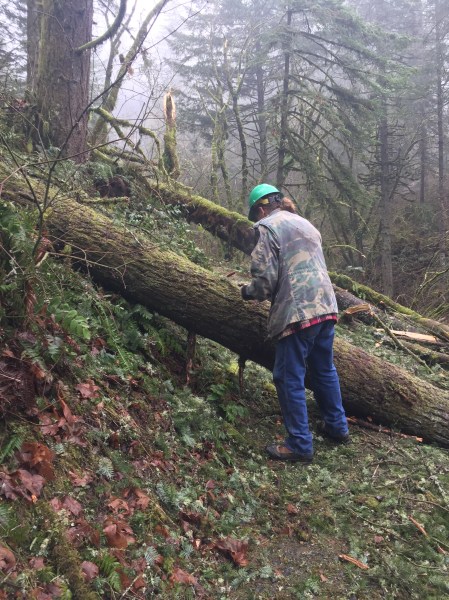
I’m not going to be a “true friend,” because true friends don’t ask others to do something to show their friendship.  Someone I call a good friend was chewed out at the hiking club’s executive meeting for having organized the first trail clearing we did after the ice storm devastated the city and the trails. Several of us showed up, including club board members, and we all worked together, nobody nominally in charge.  We took safety precautions, with hard hats, didn’t do things we weren’t comfortable doing, and cleared a lot of debris.

The head of the trail maintenance committee chewed my friend out at a board meeting, without involving me or two others who “led” trail clearing hikes.  That wasn’t fair.  My friend, one who did every hike he could, stopped hiking so much and started hiking in the closed area, since we had already knew what the trail condition was like.  The closed area was filled with dog walkers and trail runners, and the signs stating closure were poorly visible with no enforcement.  The club wasn’t hiking there, but one snowy morning, my friend called me and asked if I wanted to do a “rogue hike,” as he called it, up the mountain.  I was game, so I went by bus as far as I could, he picked me up, we went to the trailhead and up the mountain.  Frankly, it was the best hike I’ve ever done there, and I’ve done it well north of 100 times.  He later posted that I was a “true friend,” and I had I guess a warm feeling, but  I was more in it for myself.  I haven’t quite felt the same about the club ever since.  We did nothing wrong, and while I will participate in hikes and continue leading, both will be much fewer in number.  That’s too bad. I don’t look at some of my other friends there in quite the same light after this event.

There are people I know never read my posts.  No reason they should.  I’ve been unfriended twice, both from Germans; I prefer to block offending posts or offending people without unfriending them.  Each to his or her own; life is too short to argue about such matters.

I just got back from Nebraska where I had the honor, privilege and pure joy to take several hundred people over the space of eight days out to the viewing blinds where they could see the arrival of the Sandhill cranes at the Platte River at night and their departure in the morning.  I’m selfish there, too.  I go to Rowe Sanctuary because I want to see Sandhill cranes.  I get a big charge out of watching 25,000 birds lift off the river, or land that night.  If that means I have to staff the gift shop, clean toilets, or run the information desk, so be it. I will. I like doing those jobs, too. I like to teach, and I can tell people in all three places, including the toilets, why the cranes are there, where they came from, how long they will stay, and where they are going.

Yesterday on Facebook one of my friends said that after viewing my pictures and videos, his wife said they ought to go to Nebraska next year.  I replied that I don’t use the word “should” in the second person, for I find that too judgmental.  I simply wrote that I found the place unique and magical.  No volunteer at Rowe would dispute those two words.  Not one.  Most would add several other terms, like spectacular, mind-blowing, jaw-dropping, or once in a lifetime.  I hope he and his wife come there next year, but I won’t push it, any more than I am pushing people to see totality in August.

Good friends offer information and suggestions when asked, show up when they are needed.  Otherwise, they offer support rather than advice, don’t keep score or quote a price.

IMG_8447.JPG

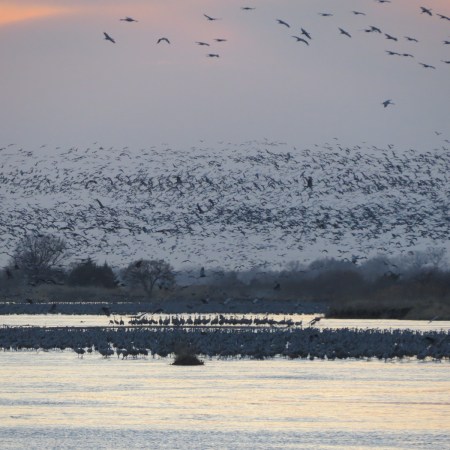
Sunset on the Platte, March 2017.  Sandhill Crane migration.


IMG_5215.jpg

My friend tackling a downed tree after the ice storm.

WHY REPLACE THE PLANETARIUM PROJECTOR?

March 10, 2017

“I have a question for you!”  I looked down at the four-year old girl, accompanied by her mother.  I had just finished an afternoon planetarium show at The Science Factory, a local children’s hands-on museum, and I got down on my knees so our heads were at the same level, and asked what her question was.

“Who named the stars?”

“What a great question!” I answered.  The mother was a little embarrassed, I think, but the little girl demanded an answer.  “Why, they were named by the ancient Arabs, the Persians, and the Greeks,” I said, “who lived in places where it was clear at night and real, real dark, because there was no electricity.  I find some of the names beautiful, like Shaula, Adhara, Albireo, Nunki, and Denebola. What do you think?” She was fascinated but liked Regulus the best. She liked lions.   I think her mother enjoyed the interchange, too. The question made my day.  Maybe I made both of their days, too.

Examples like this are the reason I am writing in support of replacing the planetarium projector, which finally burned out, and I am willing to back up my support as a four figure donor, which information I normally don’t give out, but times are hard.

I’ve used a planetarium show to point out that escaped slaves on the Underground Railroad knew how to find the North Star, whereas very few Americans today can find Polaris.  Knowing how to find north mattered.  Nowadays, a large plurality of Americans would rather study astrology than find north.  I can think of three other ways to find north—without a compass.  Many think Polaris is the brightest nighttime star.  Nope.  It ranks 49th; Sirius is the brightest.  You learn that in the planetarium. I’ve discussed, during and after a show, how one can learn her way around the night sky, treating it like a map of a city, going from the major streets to the minor ones.  It’s easy in the planetarium, when all the major landmarks are on the dome above you, exactly as they appear in the night sky on any date, time or place in the world we choose.

I have volunteered in the planetarium the past two years. The Science Factory needs it as an anchor and Eugene needs it as a tourist attraction.  When I lived in Tucson, Flandrau Planetarium was an excellent astronomy museum, but it was on the University of Arizona campus, where parking was difficult. The Science Factory is easy to find in Eugene, parking is 100 yards from the facility, and a good planetarium is a major attraction, where parents and children together can learn science and the night sky.  The planetarium can inspire questions, teach people how to find the bright stars and planets and learn about the effects of light pollution on our ability to see the night sky.  We could use lectures, I suppose, but the ability to take people on a tour of the night sky in daytime can’t be done anywhere else but in a planetarium.  I’ve had fun turning the calendar forward 10,000 years to see what the sky would look like.  Or change the latitude and longitude and pretend I’m in New Zealand, where back in ’86 I was under some of the darkest skies I ever have seen, on the main road on the west side of South Island by Lake Moeraki.  I wrote two columns about the fabulous Southern sky down there.

I find it ironic that this year, when a long-awaited, exceedingly rare total solar eclipse will race across Oregon, the loss of the current projector makes some on the Board consider closing the planetarium. Boards don’t like to spend money or make tough decisions, I guess.  Boards like things simple, I think. I’m not sure, because other than medical societies, I’ve never been asked to serve on a Board.  I’m not an important person, except when it comes to donating money.  Then I’m courted by many.  But when it comes to ideas, experience, doing something differently, taking some risks, well, we need important people to do that, not some retired science nerd without connections.

Of course we need a planetarium in Eugene, and indeed, the eclipse this August makes it an excellent time to have a fund drive to replace the projector. Normally, I don’t tell people how much I am willing to donate, but since most of the good I’ve done in life appears to have been donations, I figured I would put my money where my mouth is and tell those important people on the Board what I was willing to donate, after I wrote a shorter, more polite, version of the above, so they knew that I had a brain and knew astronomy, planetariums, and the night sky, besides having money to donate.

I continued, writing I found it additionally ironic that literally in the shadow of Autzen Stadium, where no dollar is spared for athletics, we might let The Science Factory—and Eugene–lose an important educational and tourist attraction that will influence people far more and far longer than a football game.  The last coach was fired with about $10 million left on his contract.  The new coach’s strength coordinator, on the second day of the job, put three players in the hospital with rhabdomyolysis, caused by an over strenuous workout likely hurting their renal function permanently, since two of them stayed for nearly a week.  You need to be diuresed when this happens, in order to try to save the kidneys.  For all I know, they might have even had temporary dialysis.  Another assistant coach was paid $61,000 before being fired for driving drunk and hitting another car, two weeks on the job.  The first game isn’t until September.  The last president at the University had a million dollar severance package when he was let go early.  I’m not Mr. Personality, but I have more people skills than this guy had. I’m sure the Duck Athletic Fund Board and the Regents are full of important people, but with all due respect, I think their financial management and judgment could be improved. Who knows, maybe a nobody like me might actually make better decisions.  Mind you, I didn’t say all that in the letter, but I left a lot of lines to read between.

I ended my letter with the answer I gave the girl’s question, rather than putting it in the body.  I wanted them to read wondering who named the stars. Not knowing something is good for people.  It takes them out of their comfort zone, so they have to wonder.  I like having to wonder.  It leads to thinking, asking, or looking it up, all a reminder that none of us is as smart as we think we are.

I later wrote my contact at The Science Factory to count me in as a donor for the planetarium and a volunteer projectionist when she needs me.  But I won’t give one red cent to the Duck Athletic Fund.

Priorities.

GO YOUR OWN WAY

March 2, 2017

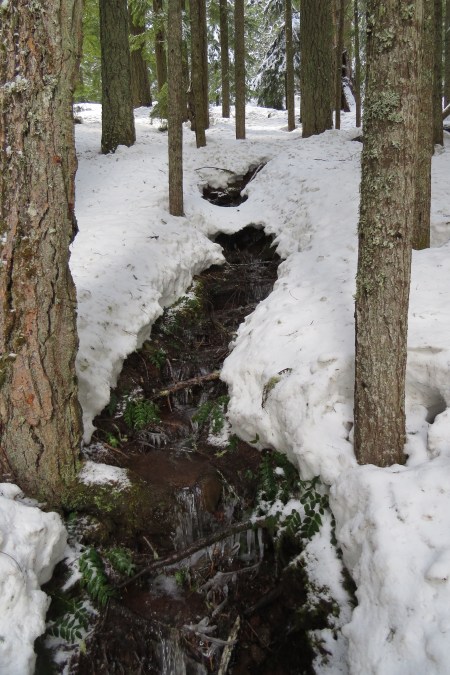
Returning through the woods from the lava fields at Clear Lake, I came upon a lovely seasonal stream that was flowing downhill from a nearby hillside through the thick Douglas fir forest.  I had seen the stream on the way out a few hours earlier and decided I would stop on the way back to look more closely at it.  Had we been doing a loop around the lake, I might have stopped right then, for I’ve decided while hiking that if there is any question I should take a closer look or a photograph, I do it.

The stream had a snow bridge, nice flowing water, and when I looked a little more carefully in front of me, a few icicles as well.  The noise was pleasant, and the knowledge that in a few weeks this place would be dry reminded me how dynamic nature is.

IMG_8229.jpg

Tributary of Clear Lake, Oregon.

I posted those comments, and a good friend wrote that if I traveled more slowly I would see a lot more.  He’s not the first to tell me that, and he won’t be the last. He’s right, in a way. I think many have the sense I go through life in a big hurry and miss seeing things that others see.  Perhaps, it is true.  My father was always in a hurry, and I emulated him.  I have distinct recollections of those times in my life I was hurried to do things that weren’t a rush.  I became a hurried, harried practitioner, and the more I hurried, the less benefit I got from it.  Little I did seemed to me to be soon enough, right enough or timely enough.

What is seeing a lot more?  Why am I out in the woods anyway?  I go my own way, and to me, there is so much to see and so little time to see it.  When I spent the summer of 1992 in the canoe country of Minnesota, I wanted to see every lake I could.  It was impossible, of course, but I got into more than three hundred.  I saw plenty—eagles, otter, beavers, moose, bear—but a big reason that I went was to cover ground or water, lots of it, every day.  It mattered to me.  Why?  It did.  Sure, I could have paddled four miles and found inlets with all sorts of interesting plant and animal life.  Occasionally, I did that, but the long days under pack and paddle was part of fulfilling my need.  I have wonderful memories of the 18 mile day in a cold October rain, where I saw nobody for the fourth consecutive day, a day that took me to Little Saganaga Lake, or the push the following day down to Alice, where I encountered a blizzard, solo, in October.  That trip has stayed in my mind as one of my great ones.  I went six days without seeing another soul.

I did the 26.6 mile McKenzie Trail hike last year, setting a good pace and finishing it in under 9 hours of walking.  The purpose was to hike the whole trail, my kind of hike, and I enjoyed it.  I did the 23 mile Duffy Loop, which carried me through an awful stretch burned over by the B and B fire 13 years earlier, solo.  I won’t go back, but I know what is out there.  There is no blank spot on a map when I look at it.  On the Noatak River, from near the headwaters by Mt. Igepak to Lake Matcharak, I know what that country looks like.  I’ve trod the ground, paddled the water.  I saw a lot of griz, caribou, and even a wolverine.

To me, the hard work, the long distances covered matter.  I have awakened and seen Orion’s reflection on a lake, the sunrise through thick fog, watched a smallmouth jump out of the water with my lure, and watched an osprey dive deep into a lake to come away with a fish.  It all mattered.  Speed on the trail is something I like.  I’m not the fastest, never could be, never would want to be.  I process nature as I go, and I process very slowly.  It is often later when I realize what a special scene I had encountered.  I saw it, and I spent as much time as I wanted to.  Then I moved on.  On the out and back trips, I remember certain areas as special to view, and as I return, the processing primes me for these views.

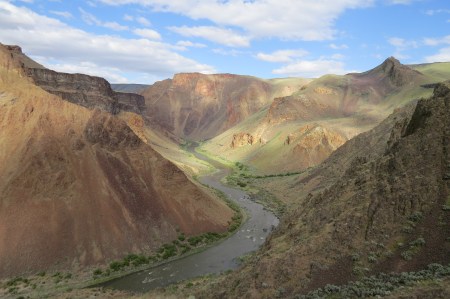
I posted a greatly abbreviated summary of the above, and then realized I needed to continue.  I was on the Owyhee River last year, where distance covered was not under my control, except on day hikes, and one of those I got dropped by a the guide and three other clients.  I realized finally that I couldn’t keep pace, and I didn’t much like the uphill bushwhacking that we did.  I stopped, said no more, and turned towards the river, taking the best pictures I took the whole trip.  Had I kept going uphill, I would have seen more and from higher.  But I went, which is what mattered, and I saw something very nice, by myself.

IMG_7096.JPG

Owyhee River, Oregon

Those who say I miss too much often don’t share the my values.  I don’t tell people what they should or shouldn’t see.  One clear night on the Owyhee, we had an opportunity to see the night sky from one of the darkest places in the contiguous states.  Almost nobody was interested.  I am encountering people who are not interested in seeing the total eclipse this summer, and almost nobody viewed the transit of Mercury that I had in my telescope last May.  These are all interesting, beautiful, and to me special.

IMG_6742.JPG

Transit of Mercury, 9 May 2016; large sunspot in upper center, with Mercury at the 4 o’clock position.

I could go as far as to say that if one is not interested in any of these, one is going through life too fast. But I don’t.  I want others to go through life at their own pace, listening to Nature, listening to the Earth, but listening more to themselves, always learning.

IMG_5809.jpg

Sunrise over Odell Lake, Oregon; 2 March 2017

LIFELONG LEARNERS

February 12, 2017

The man had a lot of miles on him.  Smelling of tobacco and woodsmoke, my age or a little older, I had been helping him understand the rules of exponents.  His partner joined us briefly, and I wondered what both of their goals were.  I should have asked.  Then a young man in his late 20s or early 30s walked in to the lab, and since I was the only tutor in an uncrowded room, asked if I could help him solve a math problem he said his teacher couldn’t.  I had an “Uh Oh,” sort of moment, thinking I would face something awful, but the problem itself was fairly straightforward:

percent of opening= (air mixture-x)/(outside air temperature-x).  Solve for x.

It didn’t seem too difficult, and I solved it.  Then he said, “Oh, I forgot, this is an absolute value problem.”  Oh.  That made it a little more difficult, but I worked it out and came up with two solutions, which absolute value problems have, both of which checked, and looked at the rest of the problem, commenting, “so this might be how a thermostat works, right?”

“Yes,” he replied.  “This is a cooling unit, and this equation solves for how much the damper should be open.”

“Wow,” I said.  “I’ve just learned something.”

“This type of cooling industry has only been around for two years,” the young man said.  I didn’t ask him details, but without too much effort, later I found myself looking at Heat and Mass Exchange (HMX) technologies and found something that looked very much like the equation the student gave me.  Efficiency of cooling systems has increased significantly, to 60%; what I was reading sounded like science fiction.

I’m not surprised.  When I substituted in math in Tucson high schools, I told the students that they would be working at jobs that not only didn’t exist today, they couldn’t even be imagined today.  This student would have a job which didn’t exist when I moved here.

Thomas Friedman writes about these changes in Thank you for Being Late.  Friedman is a successful columnist leagues beyond my limited success, but I can relate to how chance meetings or chance thoughts can help create a column or produce a major change in one’s thinking.  Friedman writes how technology has moved well beyond the ability of society to adapt to it; technology is exponentially increasing, but our ability to adapt is linear with a small positive slope.  This is difficult for many, especially the twenty year-olds who entered the labor force and didn’t realize they would have to be lifelong learners.  The current president was elected in large part from many who think that somehow all we need to do is bring back the high paying jobs that were once available for people with limited education.  At best, those jobs are now modestly paying, higher paying being reserved for those who have learned enough to navigate Friedman’s “Supernova,” a term he likes better than the “Cloud”.

My student was becoming a lifelong learner.  Like the elderly man learning exponents, he is at the community college obtaining math skills that he never learned when he was younger.  The job he has is not likely to be his only one.  The days of being in the same field for 40 years are not gone; Thomas Friedman is still a journalist.  The days of doing the same work for 40 years are mostly over, except in simple work, the kind that is likely to be automated.  Journalists no longer queue up at a telephone to send a story.  It’s streamed.  In energy production, rather than having miners underground, the entire earth over a seam can be sadly removed.  But even coal’s days are numbered, at least as a primary source of energy.  I think most fossil sources of energy days’ are numbered, not because of climate change, but because the technological advances in cleaner energy are so rapid that they are competing favorably, even despite a non-level playing field.  Solar energy efficiency has doubled in the last 30 years to 20-45%;  I remember when it “jumped” to 6%.

The ability to connect and to do things is greater than ever before, but one must have a decent education, meaning STEM subjects and ability to write decently,  communicate, good interpersonal skills, and…., willingness to keep learning throughout one’s lifetime.  Put bluntly: you never finish school.  This isn’t going down well in places that were once manufacturing hotbeds, like Middletown, Ohio, in A Hillbilly’s Elegy.

Not only will people need to become lifelong learners, they must be collaborators, requiring social skills, too. We need well-educated socialized  graduates with proven competency, a tall order.  Here’s my world:  recently, a friend asked me to look at a paper she and three others wrote. She is Colombian, now in school in Germany, has learned 2 languages in the past 5 years, and studies VaR (Value at Risk) near Berlin.  The paper was written in decent English, 5000 words and well referenced.  I had never heard of VaR before, although I should have, for it is a statistical financial measure.

Education is different.  Research has exploded, open source software common, and people all over the world are collaborating.  I have my name on a meteorological paper written about pollution in Tabriz, Iran, because I helped an Iranian learn English.  She’s now living in Spain. A journalist friend of mine in New Delhi has changed jobs twice since I’ve known her, and she works hours that even I in my medical training didn’t work.  I’m not well connected, but through teaching English on various web sites I communicate at least weekly with people on five continents. I’ve communicated in German as well as English, and I’ve been offered teaching English jobs in both China and Brazil.  I bet I could get one in Iran too, if I dared go. A couple snowshoeing with me yesterday teach English in China, because the energy market crashed here.  She’s from New Zealand originally; both know a smattering of Mandarin.

A Kurdish woman I know in Iraq couldn’t find work as an engineer, so she re-invented herself as a travel agent and doing well.  A Syrian asked me to help her sister with her English writing.  How she survived the past six years I have no idea.  The next paper I get from her sister will be an essay about the war.  A friend is German, on her way to Moscow to prepare for the launch of a satellite she helped design to one of the Lagrangian Points (equidistant from the Earth and Sun) to look at X-Ray radiation.  Still another is Russian, learning two languages to be able to become a translator in Europe.  Another emigrated from Iran to Australia, has a permanent stay card in Australia and hopes to become a medical professional.  I helped with some geometry problems a while back.  I get all sorts of perspectives about America, good and bad.

If I were young, I’d be learning at least two other languages, probably German and Russian, and maybe studying abroad.  In this era, having connections world-wide is important and  not too difficult to obtain, given the connectivity today.

Education must be flexible with new courses quickly developed to understand new knowledge.  How we determine competency must also change, a piece of paper less important than proven skills.  Home and online study will be important, but isn’t the answer.  One needs a guide, a mentor, and a teacher all rolled into one.  How America will address education will be painful and very different from not only what it is today, but likely what we can even imagine. We will be required to deal not only with the Supernova-Cloud, collaborate internationally, but simultaneously educate people with limited means, financial and neuronal, so they have some floor under them to keep them grounded, rather than to looking for a wall to hang on, to quote Mr. Friedman.  Stay tuned.

Thank you for coming into the Math Lab, young man.  Had I not met you, I never would have seen so clearly what Mr. Friedman was writing about.  I don’t have the answers for society; I don’t even have them for me, but Mr. Friedman did write that knowing what questions to ask would be essential in the new world, and we statisticians make our living not by having all the answers, but trying to ask the right questions.


TELESCOPES AND MARCHES

January 23, 2017

I was at the Eugene Astronomical Meeting the other night for the annual selling of astronomical stuff people no longer need, a sort of a swap meet-flea market atmosphere.  Several from the community came with telescopes they had received for Christmas and weren’t sure how to use them.

Because nobody had come forth to help one man in a wheelchair, who had a nice Newtonian ‘scope, I did what I could until another man came by giving me a curt “what are you doing, Bud?” before helping.  At my age, which was probably about 10 over his, I don’t like being called Bud.  I was a bit stung and left to wander around.  I don’t like being around a lot of people. Nearby, near the door of the planetarium, which is where we were meeting, I watched as a father, his presumed wife, and a pre-teen boy were getting help with a telescope.  This was clearly a father-son event, as the woman stood away quietly.  They got some help, then the father said he had to leave, because he was getting up at 1 am to work.  He was working two jobs.

Yeah, two jobs.  He’s looked like he was in his early 30s, got a son who is interested in the night sky, and bought a decent first telescope for both of them.  Two jobs. This is tough. Bringing up a kid, also tough, but he’s teaching the boy something about the night sky.  Good father.  Times are bad now, and they are going to be more so.  I have no idea what jobs the man was doing, only that nowadays, there exists the notion that somehow we can bring back the manufacturing era we once had, before just making steel was changed into making certain kinds of steel and other countries starting making their own, too.  We once made all the cars; we passed Japan in 2011 for second place, behind China, and have made as many as we ever have as of 2015.   As for mining, the big coal mining company Peabody went bankrupt last year, and coal, while cheap, is a less efficient-more polluting source of energy than natural gas, and renewables are competitive, especially if we factor in the environmental costs of coal and gas.  There isn’t a long term future in coal mining, only in trying to reclaim lands mined, and that’s a lost cause.

We could of course increase the forestry jobs in Oregon from the current 61,000 if we just cut everything down.  I use “cut down” over harvesting, because that is what we do.  Harvesting sounds a lot nicer, but harvesting corn works for me and harvesting trees doesn’t.  The forests are supposedly producing at a sustainable yield, but it sure bothers me to see the recent clearcut at the top of Cougar Summit on Highway 126 between here and Florence.  It will take decades to regrow. While replanting has to occur so that a tree is a certain height in 6 years, it will be a minimum of 60 and preferably longer years before the trees have begun to mature, in more or less a monoculture, meaning less biodiversity.  I realize we have to have wood, but we could do without a lot less paper, and the scars on the land, the aerial spraying of poison that wafts over people (documented high levels of atrazine in urine), and the loss of biodiversity.  If we had fewer kids, we wouldn’t need the 11-13 jobs paying $36K a year that a million board feet of lumber produces.  Of course, we could cut it all, damn the Murrelets and spotted owls, because we have a political party in power that can, but then after a flurry of jobs, there will be nothing, except complaints about how the Democrats killed the forest jobs.  It’s sort of like the collapse of the fishing industry off the Grand Banks.  The fish were thought to be infinite, but in the space of a few years they were gone.  If your time span of discretion, how long you plan ahead when you are dealing with life issues, is the next day, you cut everything down now.  If your time span of discretion is a decade, uncommon, then you don’t.

——————————————————

The two job guy had been on my mind for a while, when two days later I went to the Women’s March in Eugene, almost as an afterthought.  I don’t like to be around a lot of people, and I wondered whether it would really matter.  The one we had was big for Eugene, the biggest ever here, and we have a history of protests and marches. No, it wasn’t the half million in DC, but 7000 in a small town is impressive.  I was humbled by the diverse people who have always been around, only recently in a reasonable political climate able to exist freely and openly.  This includes women, LGBTQxx (the xx are mine, because I am frankly so far behind the curve in this area that I am probably missing something), and every group that voted for My Side last election.  I came because I thought I should.  I took the bus downtown, where we were stuck crossing the Willamette River in heavy traffic.  Eventually, the bus driver opened the doors for those of us who wanted to join the crowd, and I got off.

IMG_5476.jpg

IMG_5493.jpg

Harry Potter reference; personally, I have spent a lot of time in swamps, canoeing.

I took in everything I could, the energy of a heavily feminine crowd, the signs, the creativity of what they wrote, the anger they had about their treatment, yet anger tempered with a sense of humor, too.  I was in a group of mostly young, smart, articulate people who were damned if they were going to have to put up with what was coming.  As an old white guy, my presence probably helped some people realize not all of us are stodgy Republicans.

What struck me the most occurred later, when I saw an elderly woman, short to begin with, shorter still with the kyphosis of age.  She had to have been in her 80s or 90s.  She wore anti-white supremacy buttons and pushed a wheeled walker—in 43 degree temperature, rain, and significant wind.  She was there because this was a women’s rights march, she for whatever reason was not going to miss it.  I wondered what she did in life, her relationships with men, what she felt.  I was humbled by her presence and equally humbled seconds later by a couple my age standing on a corner, the woman dressed as a suffragette, carrying a sign saying “We Will Not Go back.”  Out in the street a group of women marched by holding a sign honoring women pioneers of all sorts, many of whose names I did not know. The young I knew would show up.  The middle aged ones I expected would.  The presence of the elders moved me deeply, and reminded me that half of humanity has not been allowed to reach its potential.

I needed to be there to support the elders; I needed to be there to be educated, to remember, and in some way to act.  I want to hide.  I must not, for I am in the position where I can help women, those less fortunate, and maybe those working two jobs.

1458.

IMG_5494.jpg

An Elder, marching.

IMG_5499.jpg


IMG_5500.jpg

Bernie’s supporters, se habla español también.

INTO THE LONG, DARK TUNNEL

January 18, 2017

A few years ago, I had dinner with an old friend, who brought his sister, an ED nurse.  In the conversation, she complained bitterly about people who didn’t have money who sought care in the ED.  They were dirty, smelly, unkempt, “frequent fliers” who misused the system.

My wife asked, “Should they just leave and die?”

The nurse replied, “Yes.”

I am not making this up.

I have been quiet regarding the future of the country.  In large part, I was worn out mentally from the sense I had had for months that the outcome would not be good.  I have long learned when people tell me everything is going to be OK, without solid facts to back up their assertions, it may not be.  I had said for a long time that the Democrats had a good chance of losing the election.  I was right.

We are now entering a time of darkness in America. I have been quiet, because I first had to process how this could have happened, then deal with conflicting emotions about what I was going to do or not do as a result.

I will start with the Affordable Care Act.  That is its name. Use it.  Words matter.  It will be repealed, should the Republicans have their way, and in the foreseeable future they will—8 years minimum in the Executive Branch (you don’t think the Democrats can win again in 4 years, do you?), a generation (20 years) or two in the Judicial, and judging by all the Democratic senators up for re-election in 2018, at least 8 years in the Senate, if not permanently—the ACA and other safety nets are on the chopping block.  I’m hoping the American public will eventually see through this unraveling, but I have little confidence in the American public, who could care less about ideas and competence and more about “scandals to go,” and fail to call bullies out on their lies.

The Republicans have had an irrational hatred of the ACA from its inception and now can kill it. If they had a solid plan to replace it (besides prayer, medical savings accounts, GoFundMe and staying healthy), that they were ready to roll out this spring, had the Democrats only been less intransigent, that would be another matter.  But no, the ACA is being repealed without a replacement.  The CBO (Congressional Budget Office) says this would increase deficits $137 billion by 2025 (about $350 billion total in the interval, from looking at their graph) and increase the uninsured 32 million , many of whom being poor rural whites who voted for the president-elect, ironically, because they didn’t seem to understand until now the consequences, because, well, Hillary couldn’t be trusted and what did we have to lose?….)

The incoming president says he will cover everybody with insurance, but Congressional Republicans have no knowledge of his plan.  Repealing something that is working, however imperfectly, without a plan to replace it is a bad idea.  I am reading letters and posts from people who complain that “the rest of us are subsidizing them.”  One who agrees, a good friend, has a pension and is on Medicare.  Those of us who bought his product and live in America pay for his health care, too.  It’s just not as obvious.  It’s like the Interstate Highway or the National Park System.  They are national, and those in the west for the most part enjoy them on the backs of taxpayers in the east, who are remarkably patient with us.  Of course poor people need subsidies to get medical care.  Did you think they suddenly became rich?  In the past, they were excluded by having pre-existing conditions or skipped care altogether, like columnist Nicholas Christoff’s friend, who one day saw blood in his urine, ignored it because of costs, and discovered months later he had Stage IV prostate cancer.  His friend is dead.  Is that what we want in America?  If I am wrong, please tell me, so I will know I no longer belong in this country, for I say it is NOT wrong to try to cover people who have illnesses that the rest of us should be glad we don’t have. The America I served in uniform overseas is about compassion, not a strict fairness/pull yourself up by your bootstraps/I made it by working and so should you/don’t be so damn lazy/it’s my money not yours. Each of us is a microbe, an aneurysm, a bad driver, a malignant cell, or a blood clot away from incurring a massive multimillion dollar hospital bill.  EACH OF US.  Not providing medical care when we could is immoral.  Yes, immoral.  Of course the ACA costs a lot of money.  Twenty million people are accessing medical care who either didn’t access it earlier or weren’t able to pay for it, and it was subsidized by medical personnel like me or hospitals, who couldn’t buy capital equipment or hire more nurses to improve staffing levels.  Some might say that hospitals should do that anyway and pay administrators less.  I agree, but as one who practiced medicine and became a medical administrator, let me assure you that practicing physicians have neither the knowledge, the discipline, nor the time to run a hospital.  Having a system that isn’t paying executives such outrageous sums would be a good start.  But it won’t insure millions of people.

The ACA has become like climate change, a hatred of something that goes beyond facts to an ideology that ignores facts. With climate change, there is a small definable chance the extremely high confidence we have that it is manmade is wrong.  To argue it can’t possibly be occurring means an individual knows all the salient parameters of the Earth and its atmosphere, how they interacted in the past and how they will interact in the future. That is simply not possible.  The ACA is working for many millions of Americans.  It is far from perfect, a fact due to the intransigence of Republicans who never planned to vote for it and who didn’t try to make it better, only tried to kill it, like the stimulus.  All sorts of catastrophes predicted did not come true.  The ACA hasn’t ruined America, but enough loud people have said that long enough that the public believes it without realizing the numbers of uninsured are at their lowest levels in since about mid-1960s,  when we had about 100 million fewer people in this country, medical care was far cheaper, back in the days when you called a doctor’s office for an appointment, the first question asked was about your medical problem, not your insurance.  Don’t remember that?  I sure do.

I remember In 1984, my colleagues and I basically bankrolled the Arizona Health Care Cost Containment System, Arizona’s answer to Medicaid, by not being paid for patients we saw (AHCCCS Non-Certified, which we pronounced Access Non-Cert) because the system didn’t find patients with no insurance until after they came to the ED.  We didn’t like it, but you know what?  We made good money anyway in spite of not being paid for these people. Yeah, I hated being called out at 2 am to see some uninsured drunk guy who wrecked his motorcycle and wasn’t wearing a helmet, because Arizona had repealed that law in 1976.  If the patient were lucky, he might have had enough brain function to cuss me out, threaten to sue me, and not end up in a nursing home vegetative.  It wasn’t fair to me, but life isn’t fair.  I got over it. You don’t let these people die at the side of the road, unlike what folk hero Dr. Ron Paul said, to great applause in 2008 and my friend’s sister said that night at dinner.  We don’t behave that way in my America.

Want to get rid of insurance company markups, high salaries and all sorts of exclusions?  Then expand Medicare, which has such a low overhead and high favorably rating by the elderly that some elderly argued against the ACA by saying, “Keep your government hands off my Medicare,” not even aware the Medicare was government subsidized medical care.  Yes, your taxes would go up, and you would lose money if you were not sick enough in a given year.  In exchange would be peace of mind that a major medical bill wouldn’t bankrupt you.  A physician friend’s husband had a $40,000 ED bill  for a kidney stone. Is it not a good thing to pay for insurance you may not use?  I consider it a good year if my veterinary medical bills are more than my personal ones.  If my house burns down, I have fire insurance. I have peace of mind, a concept apparently not appreciated  by many, because it doesn’t have a dollar sign preceding it.  People with peace of mind about their health tend to be happier. We learned that from the Oregon study where those who received insurance in a lottery didn’t spend time worrying about what would become of them if a child got meningitis, a person passed blood in their urine, they had chest pain, leg swelling, or a breast lump.  I don’t begrudge being taxed to pay for basic health insurance for everybody any more than I don’t begrudge repairing I-35 in Minnesota, for it is part of a national road system, or repairing tornado damage in Alabama. With the latter, however, to be honest, if those people are so anti-government, maybe they should try prayer, passing the hat, or just picking themselves up and doing their own repairs.  I protested paying for a war in Iraq that I felt was unnecessary and illegal, and I resent paying for the 75,000 major hospitalizations annually due to gun violence, when a few decide that we won’t even do background checks.  I resented paying for law enforcement to deal with the occupiers in Malheur, when they broke several laws, bullied people, ruined a small town, and tried to take over lands that belong to me, too.  Life isn’t fair.  Act to change things. I write. That’s my voice.

We have yet to deal with the quality of medical care, which the ACA addressed only slightly.  We haven’t adequately addressed end of life and preventive care, plus a host of other issues that would save money, help people and bring peace of mind simultaneously.  To repeal a major first step, because by God, nobody should get something for nothing in this country, is to condemn many people to bankruptcy, misery, and death.  I thought America was better, but I was conned.  Not by the presidential candidate, but by the gullibility and incredible cowardice of the media and the stupidity of the American public.

It’s time to enter the tunnel.  I will keep my light with me.  I also know which way north is.