Posts Tagged ‘General writing’

MY ANNUAL BILL TO BE AN AMERICAN

February 18, 2016

After the New Hampshire primary, a friend commented that she didn’t want her taxes to go to send other people’s children to college, a comment on Sen. Bernie Sanders’ plan for free college education.

I was surprised and a little disappointed to hear that.  Through grants, to name one example, government is involved in education.  My taxes go to many places that are irrelevant to me.  I have no children,  I don’t eat meat, and I’m not a woman.  Should I have the right not to be taxed for public education, grazing fees on my land, and Planned Parenthood?  Of course not.  Is my friend going to vote for the other side, who will defund  Planned Parenthood and require that all rape-caused pregnancy be carried to term?   I was against the Iraq War long before it started, but my taxes went for that debacle.  I will never drive on roads in Texas again, so why should my taxes go for that?

While we are at it, we could get rid of the phrase “hard earned dollars.”  Sometimes they are, sometimes not.  In any case, the phrase is worn out.

There are things that the federal government must do, because we as people living in towns, cities and states simply cannot do them ourselves with our own resources.  We can’t clean up after a devastating natural disaster without federal help.  Yet, more than 30 Senators voted against Hurricane Sandy aid, even though many were from states that FEMA has been to many times after devastating storms.  We can’t defend ourselves against major foreign powers, and we can’t pay for medical care for the elderly or infirm.  We can’t build a national system of roads, and we can’t have a national weather service, the NIH or the CDC without the federal government.  These and so many other programs are essential to our well-being.  Live in the South?  Maybe you are glad the National Hurricane Center exists.  Government shouldn’t do everything, but there are things government can do.  And should.

People ought to save for retirement.  I did.  Sure, there are many who buy toys or travel everywhere without putting anything away and then find themselves old with no money.  I am not sure what is going to happen to them, except they will have less—but not zero—money.  We ought to make it easier to save, and we have to an extent with IRAs.  We need to do more, however, because if a senior is destitute, somebody somehow has to care for them, unless we are a different country from the one I thought we were. I had good fortune and a good job.  In the 45 years of being between 20 and 65, had I developed a significant medical problem, and I hadn’t had insurance, I would have become bankrupt.  Many have.  It doesn’t matter whether or not a person was saving money or whether the problem was their fault.  They need a safety net.  We can argue about the size of the safety net or whether people like me should receive it, just because we reached a certain age.  That is fair.  But the fact our taxes go to pay for something somebody else gets doesn’t a priori make it wrong.  That’s what elections are about.  My taxes are payment for my annual bill of being an American, and frankly, it is a great bargain.

People ought to have a healthy lifestyle, too.  Why should I pay for smokers who develop emphysema or lung cancer?  Or those who eat the wrong diet and suffer the consequences?  Or motorcyclists who have accidents and weren’t wearing helmets?  The list is endless.  I could add to it the question “Why should I pay for future cases of Chronic Traumatic Encephalopathy caused by football, soccer, or hockey?”  Nobody forced those people to play the game.  Many made a lot of money.  Why, I could ask, don’t they fund themselves?

What we have accomplished with our collective will and our federal government is so pervasive in our lives we don’t recognize it but take it for granted.  It isn’t; it may be removed at any time.  When FEMA was decimated under Bush, we saw what happened to New Orleans.  Bush’s response to Katrina did as much to bring down his presidency as Iraq.  Had Social Security been privatized, the recession would have bankrupted millions of people who get by on something they were never intended to get by on.  I shudder to think what will happen if Medicare is taken away.  It can be.  All it needs is a president, a Congress, and a Supreme Court willing to do it, and if one thinks that is impossible, one is unaware of reality.  I am already preparing for 2017 and 2018, when the other side is in power and the safety nets are removed.  I am counting on voters finally waking up and showing up to vote in November 2018 to take back Congress and stop the madness.  Being American voters, I may be hoping for too much.

Every time we drive on a federal highway/Interstate, we are seeing what our taxes went for.  Every time we go into a national forest or a national park, we see it. The food labels for nutrition that are so helpful are a federal law.  We ought to have point-of-origin food labels and label GMOs. The medications we take are safer, due to the FDA.  If one flies, there is the FAA, NTSB, and the TSA.  Indeed, we now have the TSA, because prior to 2001, the airlines were responsible for security, and we saw what happened.  Pilots are trained to certain standards.  Flight attendants are, too, and everything that they say was legislated.

Regulations exist to ensure there is a certain baseline of information that is given to the public.  Regulations in food safety exist because without them, we have no guarantee that each food service facility will do the right thing.  Regulations exist, because every year we see what happens without proper regulation.

Here’s my plan for who pays for college:  I would bring back the Civilian Conservation Corps and the GI Bill, make young people serve their country and then give them the education they want.  College for young people is a better investment than the Iraq War was. My downpayment for being an American was serving my country.  The annual payment is called taxes.  I get a say in what happens.  That’s my social contract.

Let’s bring it back.  It will help bring us together.


OUTSIDE AGITATORS

January 5, 2016

In my youth, I took part in peace rallies, working for Eugene McCarthy in 1968 as part of the “clean for Gene” group.  I was called an “outside agitator” and worse by those who disagreed with my beliefs.  Indeed, back then, “Law and Order” and “outside agitators” were almost always right wing pronouncements.

The recent takeover of an unoccupied building at Malheur National Wildlife Refuge by armed men, from outside Oregon, protesting the jailing of two ranchers, is at the moment at a divide between a non-issue that went away quietly or a major conflict that will be remembered for decades.  Two things are immediately clear.  These are outside agitators and they broke several laws.

The facts are not yet clear, and I may be in error, unlike my detractors, who know everything with complete certainty.  The spark was the jailing (insufficient time) of a rancher and his son, who about a decade ago set fire to about 150 acres to remove invasive plants so that they could graze their cattle—on federal land—where they held a grazing lease.  Apparently one of the fires was set to cover up deer poaching.  The law requires a minimal sentence, much like drug use.  The lack of all the facts has not stopped people on social media from opining about government takeover of land, need to privatize all land, and let “the people” (at least of their political persuasion, not mine) run things. The ranchers themselves voluntarily reported to jail and did not want publicity, according to their lawyer.  That didn’t stop the mob from singing “Amazing Grace” in front of their house, proving Obama’s famous comment about America’s Red Crescent “Their guns and their religion,” which while a political faux pas, was and is dead right. Nevertheless, the insurgents felt this was unfair and occupied a building on the Refuge. Cliven Bundy’s son (Bundy had a standoff against the Feds 2 years ago about failure to pay $1 million in grazing fees.  For fear of bloodshed, the Feds backed down) said they were prepared to stay there for “years.”  .

I’ve been to nearby Burns, Oregon, and I can’t imagine staying for years in Malheur.  Obviously, somebody is supporting these people, since most of us have to make money to take time off, especially to destroy the federal government.  Maybe the money came from the million Bundy’s dad saved on not paying grazing fees for putting his cattle on my land.  Yes, my land.  And that is what I am concerned about.  We lease federal lands so that ranchers can run cattle on it.  Then if anything happens to the cattle, like predation, they want compensation from we the people.  Twenty-five years ago, in Arizona, one of these ranchers trapped and killed bears that were allegedly killing his cattle on federal land.  My wife and I became vegetarian on the spot.  Still are.

Mind you, the ranchers in the Malpai Borderlands Group work well with The Nature Conservancy, and their joint efforts should serve as a model, not Bundy’s Tea Party-no negotiation group, which doesn’t work, because saying no and not yielding one point doesn’t work in a pluralistic society.

More than half the land in America’s West is federally owned, and since I am part of the government, it is partly my land, too.  There is a lot of resentment of land being “locked up” as wilderness when it can be logged, mined, snowmobiled, hunted, jet skied, regular skied, or otherwise used to make money.  People use public lands—my land as much as theirs—to make money, often off people like me.

The idea that we “lock this land up,” is false, but like so much of what my detractors say, it is a catch phrase, to be repeated often enough so it is treated as fact.  We hold this land in reserve for those whose lives have yet to begin.  We hold it in reserve so we will still have it.  Should we auction it all off to the highest bidder, who knows where it will go?  I do know what happens when nearly all the land is privatized.  It’s called Texas, where 2% of the land is federally owned.

When I saw the Hill Country, I was dismayed at all the fencing.  The restrictions aren’t just a Texan issue, however. Here in Oregon, a rancher sold a huge ranch to a Chicago man, who closed all the trails that were once accessible to the public.  That would be you and me.  Lack of access to places that we used to go to are the first result of privatization of public lands.  Those are the people who are locking land away, not the feds.  Privatize the land, and those with money get it. So, unless one is a millionaire, few will get land, certainly not the guy who can barely pay his mortgage, take care of his kids, pay for his F-350 and the ammo he uses. I wonder why that guy hasn’t yet figured out that the Republican party is using him.

Last century, the Boundary Waters Canoe Area Wilderness came close to being privatized.  It would have allowed resorts, dammed waterfalls, logged everything, and one of the great wildernesses in this country—the most visited today—would have been lost.  If we privatize the Grand Canyon, uranium mining will occur, and people will no longer have the experience of total quiet, miles from the nearest person, in a civilization where such quiet is a rarity.  I’ve experienced these wonders and want others to do so as well.

If we privatize Malheur, that will be the end of a special place for wildlife.  Oh, cattle ranchers—some, anyway—will make more money, although not much, because grazing fees are dirt cheap to begin with.  Tell me, Mr. Bundy, what happens when an ORV or a snowmobile cuts a fence containing somebody’s cattle?  Who is going to adjudicate?  If they think that won’t happen, they are too dumb to own a firearm.  They may feel that progressives like me don’t have a right to visit some of these places.  What about future generations?  Do we get booted out of the country?  Is that what America is about?

Answer:  I think so.  The Far Right has money and buys and cheats its way to power.  We are headed for an oligarchy like Russia, with the same results.

I want Malheur under a total, quiet siege.  Keep the media in Burns.  The less coverage, the less these guys can strut on national news. No power, no water, no food, no utilities, no medical care.  Nothing. If one wishes to give up his weapon and leave, he may do so.  He may be subject to a misdemeanor, but I just want him gone.  Nothing else should be allowed in or out, until everybody leaves.  These guys are terrorists, using terror— numbers and their weapons—to take over federal land and push for overthrow of the government.  That is terrorism, regardless of where they come from Algeria or Austin, Libya or Lubbock, Medina or Missoula, Baghdad or Boise, Yemen or Yreka.

Hopefully, this will not be another Waco, which spawned Oklahoma City, just like the Iraq War ultimately helped spawn ISIS. If people bombed your innocent family, killing all of them, might you consider terrorism as a reasonable response?  The “$1.7 billion” war, “Shock and Awe,” and “Mission Accomplished” have finally came home to roost.

It’s time to stand up to right wing terrorism and keep public land public. The government is not a nebulous entity.  It is we.

Finally, language matters.  This is not a militia.  This is terrorism.

CHRISTIE’S “FEELINGS”

December 8, 2015

Chris Christie was in the news again, stating that the climate has always changed, and he saw no crisis.  He wasn’t quoting any scientists about this, but he had a “feeling” that it wasn’t.  ISIS, on the other hand is a crisis.

What is ironic is that the existence of ISIS has a lot to do with climate change.  Syria is a dry country; from 1900 to 2005, six droughts occurred, and all lasted one season, with about a third of the normal rainfall.  From 2006-2010, four seasons of extensive drought occurred, which was unprecedented, leading to the displacement of 1.5 million people.  If I heard that, I must have forgotten it, but Syria was in the midst of a major upheaval in its economy before the recession which then led to the current situation.  Irrigation had not been completed, and addressing water shortages was poorly done.

The long range water outlook is not good for either Syria or the Middle East.  Had it not been for a change in the climate, that Governor Christie says is “the climate is always changing,” we might not have ISIS to deal with at all. Trust me, the US Defense Department believes in climate change and is actively trying to deal with a new reality when the Arctic is ice-free, and there are wars fought over fresh water.

Mind you, addressing climate change adequately is not going to happen.  That’s clear.  We have many vocal deniers, and I do fault the Associated Press for saying the proper term is “skeptics.”  No, a true skeptic will demand evidence and change his or her mind in the face of convincing evidence.  I will and have changed my mind in the face of convincing evidence.  The climate deniers I have known will not.  Ask for a margin of error or confidence, they will give either no answer or “100% confident,” which is impossible given the complexity of the atmosphere and one’s ability to understand all the factors.  What has been particularly pernicious has been the sowing of enough uncertainty that the average busy American thinks that the issue really isn’t settled and we shouldn’t change our lifestyles at all.  Gas mileage for cars should now average 60 mph, which I get on a 2003 Civic; instead, fuel economy languishes a bit over a third of that.

My computers have run 55.73 quadrillion points (that is 5, with 16 zeros after it) of climate models, as part of climatenetwork.net.  I am running Australia-New Zealand models that showed the Earth every 5 or 15 minutes for a few year period of interest. It’s something I can do right now to help the situation.  From these models, we know that the record October temperatures in Australia were 6 times as likely to have occurred because of global warming.  I know how complex these models are, which require up to 390 hours of computational time for each change a researcher does.  There are hundreds of these, changing variables of interest, in case emissions of CO2 decrease or methane increase, for example.  By doing this, we can make probabilistic statements about climate change vs. natural variability.  We know that up to a quarter of the severity of California’s drought is from climate change, and the least is still about 7%.  Notice the range of estimates, for uncertainty quantification is a big part of science.  Syria’s drought is less uncertain and almost clearly a result from climate change.  One drought on average every 17 years and then four straight years of drought is highly significant, meaning it is not a chance occurrence.  Something caused it with high probability, and we can quantitate that probability.

It is ironic that Hurricane Sandy, which devastated New Jersey, Christie’s home state, is part of  the new normal—storms that look the same as always but are not the same.   One of the things we have learned about global warming is that the ocean’s temperature has increased well below the surface, far further below than we thought.  That limits the atmospheric warming increase, but we have no idea what a deep warming of the ocean portends.  It may have been the reason Hurricane Patricia was so strong, because hurricanes require warm water, and the deeper the warm water goes in the ocean, the more the fuel for the hurricane.  We also don’t know what warmer oceans will do to the atmosphere over them.  The climate deniers don’t think there is a problem.  I think there is a problem; I just don’t know how it will manifest itself.  If I had a child or a grandchild, I would be very worried about their lives in a world whose climate is going to take a direction we have never seen as a species.  Put another way, if one has children and denies what is extremely likely, one is being unfair at best and cruel at worst to their progeny.

What good are models?  Indeed, I had one individual tell me to argue my case without using climate models.  What should I use?  Mr. Christie’s “feelings” that he knows he’s right?  Let’s look at feelings a little more.  Nate Silver runs fivethirtyeight.com, which predicts many events, including the elections.  In 2012, there were people who “had a feeling” how certain states would vote,  whereas Mr. Silver used weighting of polls based on past performance to make probabilistic determinations of how states would vote.  He wouldn’t say that North Carolina would be won by Romney; he said there was an 85% probability that it would be.  It was.  Silver got all the major contested states right; he got all the states right.  It wasn’t a feeling, it was statistics.  The others were dead wrong.  The “political sense” that Pennsylvania would go to Romney was completely erroneous.  Silver not only predicted it, his prediction of the popular vote percentage was almost completely accurate.

With weather models, we have extraordinarily high probabilities of knowing what is going to happen in the next 48-72 hours.  I don’t think we should be timing rainfall’s starting to the nearest minute or should give the probability of rain to the nearest per cent, but the idea of a major storm or heat wave can be seen by looking at the models.  Climate models aren’t perfect, but they are the best knowledge we have, and over decades, they are far more predictive than the weather forecasts.  All of the models are pointing towards a warmer Earth with consequences that are known and others that are not known.

I don’t know what is scarier to me, what will happen to the climate or the fact that the three major branches of government of the most powerful country on Earth will likely be controlled by those who believe that there is no problem at all.  They are wrong, they are foolish, they are arrogant, and they will be the cause of first the downfall of the country and then the species.

I’m sure I’ll be blamed, but I won’t be around to hear it.  The first steps of that have already occurred.

WE THE GOVERNMENT

November 15, 2015

There is a mouse problem at the barn where my wife spends a week or two every month with her horses.  Much as she loves animals, she does not want mice eating the feed, and there are too few cats there for too many mice.

When she went to the local feed store, looking for a certain poison, the clerk told her it was no longer present.  “The government won’t let you have it any more,” the man said,

“We are the government,” my wife replied.

The reason for not selling the poison is that we discovered that mice killed by it became food for raptors, which died after eating the carrion.  We banned DDT in 1972, because it concentrated in the fat of eagles, made their eggshells thinner, breaking before hatching.  After we stopped using DDT, the population recovered.  You didn’t think manufacturers of DDT were going to voluntarily stop selling it, did you?  That’s Ayn Rand’s world, not mine.  We took lead out of paint in 1978 because it is a neurotoxin, especially in children.  We used to have leaded gasoline.  Cars back then ran better with tetraethyl lead, but they run better now with unleaded gas.  California banned lead in gasoline in 1992, the rest of the country in 1996.  The percent of children with high lead levels has decreased from 7.6% to 0.5% since 1997.  That’s not due to the oil or auto industry demanding the removal of lead from gasoline. That is we the government, we the people, telling them to do so, improving public health.

Oh, Robert Kehoe, medical head of the Ethyl Corporation, helped keep lead in gasoline for 40 years.  In 1943, when research showed that children with elevated blood lead levels had behavioral disorders, the powerful corporation threatened to sue and the research stopped.  Kehoe argued lead occurs naturally, the body could deal with it, and thresholds for lead toxicity were far above what body levels were. That sounds a lot like arguments I hear against global warming.  In fact, Kehoe’s upper limits for lead toxicity were 80 micrograms/100ml, when current upper limits survived Reagan’s anti-regulation policy and are 10 micrograms/100ml.   We have smarter kids and maybe less crime, since there is a remarkable correlation between per cent with high lead levels and crime rates.

In 1937, S.E. Massengill Company marketed Elixir Sulfanilamide without alcohol.  Their chemist dissolved the product in diethylene glycol (DEG) (similar to antifreeze) and added raspberry flavoring.  DEG causes kidney failure, but in 1937, few, including the chemist, knew that. One hundred seven died, many of them children, and the outcry caused Congress to pass the Food, Drug, and Cosmetic Act, which required companies to perform animal safety tests on proposed new drugs and submit the data to the FDA before being allowed to market the products.  Massengill said, “We have been supplying a legitimate professional demand and not once could have foreseen the unlooked-for results. I do not feel that there was any responsibility on our part.” The chemist felt differently.  He committed suicide before trial.

A young researcher, Frances Kelsey, was involved in the DEG studies.  Dr. Kelsey later stopped the use of thalidomide in the US, saving untold numbers of American children from being born with phocomelia, or no limbs.  Government meddling again. Just let the pharmaceutical company put whatever they want on the market.  People will make the right choice.  Right, Ayn?

What would happen, pray tell, if we trashed all the “onerous regulations” that we have in place, removing second hand smoke, stop marketing cigarettes to children, mandating child seats, seat belts and air bags, vaccinations, dangerous toys.   Do people really want to do away with government regulation?  Do we want people to die from something preventable?

In 1979, failure of companies to have an adequate amount of chloride in new soy-based infant formulae led to 130 infants developing chloride deficiency.  The new product was faulty, despite company claims. How many have to die, be made ill, miserable, hospitalized at great cost, before we get things right?

In 1989, the number of new foods introduced annually was so large that there was concern people had no way to decide the safety, cost, and nutritional value of what they bought.  One may say, “the market” will decide, but “the market” requires people to decide based upon facts, not ads, and honest numbers, rather than slick commercials.  The change did not come from “voluntary action,” for it never does.  In 1990, after the Nutritional Labeling and Education Act, we started seeing all those numbers on food we buy at the store, and now even at places like Starbucks, where the other day, I had a cup of coffee in one of those red “Satan sippers.”

I wanted something nice with my coffee, but everything that looked good under the glass had 300+ calories, and even if I jogged home, I might burn a third of that.  I ended up buying Vanilla Bean Scones, 300 calories for 3 of them, figuring 100 calories a day extra for 3 days I could handle.  Everything under the glass looked great, for 400-600 calories.

What else did the Nutritional Labeling Act do for me?  Ten years ago, when I suddenly found my profile not to my liking, I stopped peanut butter, which I love, and olive oil, diminishing my intake 600 calories a day.  I read the labels. The change was slow, but over six months, I lost nearly 4 kg or 9 pounds.  On a trip to Oregon, preparing for the move, I ate at a coffee shop every morning, enjoying a Marionberry muffin, which must have been 500 calories extra.  A little of this, a little of that, and the weight came back.

For the past year, nothing changed, despite a lot of hiking and running, remaining 5 pounds heavier than I wanted.  Obviously, I was eating as many calories as I was burning.  That’s thermodynamics.  I then took a hard look at my grocery shopping.  It turned out to be an easy look:  I found two items of note: yogurt I bought was 60 calories more than a comparable amount, which tasted the same.  That isn’t much, but the fancy vegetarian hot dogs I had two days a week were another story.

I was stunned.  Each was 280 calories a pop, 1120 total when I had them for dinner twice a week. By going back to the traditional type, I saved 720 calories alone every week.  Added to the yogurt I was eating, I could eat essentially the same for 1140 fewer calories a week.  Within six weeks, I had lost 1.5 kg, more than 3 pounds.  I couldn’t have done it without the Nutritional Labeling Act.

For every “onerous” regulation, there were a large group of people who once said, “somebody ought to pass a law”.  That’s what politics should be, doing good for people.  I’m not out to trash capitalism, but I’m damned if companies should get away with….murder.  Their fiduciary responsibility is to their stockholders.  We the government have a fiduciary responsibility to we the people, not we the stockholders.

TWO MOOSE ON ISLE ROYALE

October 12, 2015

In Isle Royale National Park’s Visitor Center, on the largest island in Lake Superior, there are many moose skulls on the wall.  Such is not surprising; since 1997 a few hundred moose and a few dozen wolves have been completely isolated from the mainland.  It is one of the longest, most intensively studied predator-prey relationships in existence, but the wolves are dying off, a tragedy and a controversy as to whether new ones should be introduced, a raging controversy, both sides passionate about what to do.

Ironically, how we usually handle this and other hot button issues is summarized right on that wall.

Two skulls are very close together.  Indeed, it takes a little while to see that there are two, for there are so many antlers around them.  Then, it becomes strikingly clear what happened.  Two moose, probably in rut, fought over a female.  Their antlers locked, and they were unable to disengage.  Their destiny was not to win or lose.  No, their destiny was death together, fighting futilely to exhaustion and starvation, easy prey for wolves.

We might learn from that, if we weren’t so busy locking our own horns to realize we and those with whom we argue may both lose, prey for our common enemies.  Red-Blue, Conservative-Liberal, Pro Gun-Anti Gun, Republican-Democrat, one side-other side.  Take your pick, apparently, because there no longer seems to be much common ground, except there is, if we start looking.  If we choose to keep fighting, the wolves of the world will pick us off, because we will be too busy playing the futile game of trying to convince people who won’t be convinced, rather than finding a new solution, missing opportunity after opportunity.

That is why when Facebook put an ad on my site saying “Stand with Hillary and take on the NRA,” I didn’t add my name.  I will admit I have no love for the organization and am against their current agenda (which wasn’t always the way it is today).  But I know that without the NRA’s help, yes help, we aren’t going to solve the issue of mass shootings.

I’m going to assume that no decent American wants to hear about another mass killing.  It doesn’t matter whether the individual is an Oath Keeper or one who wants firearms banned.  No reasonable person wants the shootings to continue.  Simple solutions proffered by both sides won’t work, but we are a technologically developed country with many who are experts about firearms, their manufacture, use, safety and locking mechanisms, as well as tracking them. We have experts in firearm safety, human behavior, system and study design.  We need all of them.

It is not likely that we will be soon be able to determine which mentally ill person is a likely mass shooter. Maybe with better mental health care we would slightly alleviate the problem, but  many of those who harbor violent urges don’t seek help.  They don’t see a problem.  Additionally, we aren’t likely to pay for the cost of mental health care, even if we returned to institutionalization of the 1950s, which was a dictatorship over people.  Without doubt, it would solve a lot of problems: homelessness, some shootings, extra police work, and many emergency department visits, but at the cost of liberty to many.

Cars are dangerous, too.  Thrice as many die in the US every year from automobiles than from murders due to guns.  Notice my use of numbers.  These are facts.  If we allow research into gun violence to again be done, the way it once was, we would operate from facts, less from emotions and inaccurate numbers.

Guns are the major cause of suicide, and twice as many die from suicide by gun than murder.  Only the most callous would say that those who want to kill themselves should do so and be done with it.  These callous people are online, and we need the help of ISP and other computer experts to deal with the harmful byproduct of anonymity on the Internet. No reasonable gun advocate or anti-gun advocate wants to see firearms used to commit suicide.

We once had poorly engineered automobiles.  Indeed, Ralph Nader became famous with “Unsafe at any Speed.”  Improved engineering, better materials, seat belts, air bags, ABS, and side protection have cut the number of motor vehicle deaths 40%, despite a significant increase in the population (the number per 100,000 has fallen 60%).  We haven’t eliminated the problem.  One may wear a seat belt and die in a MVA, but the probability is less.  We don’t know who the 20,000 survivors are because of safer automobiles, but if we had 52,000 deaths a year, we would do something about licensing people, drunk driving, safer roads, and better auto engineering.  Oh, we did have that many deaths, and we did act.

So, this is where the firearm experts are needed.  Here is where the NRA is needed.  Here is where every responsible gun owner is needed.  We need ways to prevent people misusing firearms.  Yes, it is impossible to do it perfectly, but yes also, we can find a way to improve our current situation.  If we had 5,000 gun deaths from murders a year, it would still be too many, but it would be better than what we have now.  If we had 5,000 suicides a year from guns, it would still be too tragic, but it would be so much better.  If 30, rather than 60 children died from accidental GSWs, it would still be too many, but 30 fewer devastated families.

I’m weary of arguing.  It is not the time to “Take on the NRA.” Like the man with the wind and the Sun, if I blow harder, he will only pull his coat tighter.  No, it is time for the NRA and its membership to be invited to the table, to offer engineering and other solutions that have a chance of being tried and tested.  Who should own what?  How is ammunition regulated?  What should be written down, and what not?  How do we do background checks and maintain privacy?  What are ways to deal with this problem that we can a priori postulate what we think will happen and then count to see if it did happen?  Wouldn’t that be an improvement over what we aren’t doing today?

I want the mental health community to be at the same table to offer suggestions.  I want researchers to design studies showing how we might determine if a possible improvement works.  I want security experts and IT at the table, too.

Legislation may have to come from a Republican Congress.  Only a Republican in 1972 could go to China, and I think only a Republican Congress can write such legislation.  They need help from the Democrats, but at the same table, with the goal to decrease gun violence in this country and at the same time not limit responsible firearm ownership.  It is a tall order, given the money involved in making firearms and the emotions when somebody is gunned down.  However, given where we are today, we can’t do much worse.

Like the moose, we can lock antlers and hope to win, bloodied but victorious.  Or, we may end up together on the ground, helpless against our enemies.  We can use what’s in our skulls to solve the problem, with leadership and risk taking.  It’s our choice.

The two moose were programmed to fight.  They didn’t know one of the consequences.  What’s our excuse?

DESIGN FLAW

September 21, 2015

I reached across the canoe to the opposite gunwale, ready to hoist, flip it upside down and put it on my head.  Suddenly, I felt a sharp, quick, not-real-painful-but-you-know-it’s-going-to-bleed-like-stink sensation, as my finger encountered a razor sharp aluminum strip.  With a big OW, I managed to get the canoe up and started walking from Meadows Lake to Agnes, a 160 rod, (1/2 mile) portage on rocky trail, annoyed at the pain, the blood, and wondering what happened.  I forgot at least two other times later, had several fingers bandaged at the end of the trip, when I told the outfitter that the strip was a design error and needed to be fixed.  These things happen; if nobody speaks up, they continue to happen, and others get hurt.

Volkswagen, in Wolfsburg, Germany, north of the Deutsche Bahn tracks, got in serious trouble on my side of the Atlantic. It began when their cars’ emissions were a lot worse than the lab tests showed.  A small clean air group here, led by an individual, ironically named John German, asked to have tests done in the US, where we have the world’s strictest emission standards.  A car was driven from San Diego to Seattle, and the emissions were 30-40 times higher than the standards set by the Clean Air Act.  German, who believed that diesel was a clean fuel, was stunned. VW put a software patch on the cars, and they passed our emission tests, but open road tests still showed discrepancies. Only then, did VW admit they designed the software patch to turn on emission controls during testing but turn them off afterwards.  How can somebody work for a company when they know they are deliberately falsifying emissions data?  Money.  VW only polluted air.  GM killed people.

For that same week, GM got hit with big fines— only fines, no jail time—for a faulty ignition switch which shut off the engine and critical systems, like air bags, killing 124 and injuring nearly 1000 others.  One death was not counted by GM, because the airbag in the back seat worked, although the young woman still died as a result of the crash caused by the faulty switch. A root cause analysis leads straight back to the ignition switch, which was known in 2002 not to produce enough torque. GM had held meetings about this problem since 2005, and the investigation has continued since then, hindered by GM’s hiding key papers, making it difficult to find out which accidents were due to cars’ having a faulty switch.  Yes, hiding papers.  For that, 15 people lost their jobs (not lives) and 5 others were disciplined.  At the Senate hearing, the CEO, who had worked at GM for 33 years, claimed not to know anything about a defective switch.  As my late father would have said, “She was either stupid or lying.”  GM knew they had a faulty device, and they took the chance that a recall of the cars would be more expensive than having to pay lawsuits, $575 million now in a contingency fund, run by Kenneth Feinberg (the man who doled out 9/11 compensation), fix twenty-nine million recalled cars, and pay a $900 million fine.

By the way, had it not been for a Georgia plaintiff attorney, we might never have known about this problem.  Not only do we appear to have a Congressional culture against regulation, we need better regulators in those instances where there is supposed to be regulation.

Congress makes laws, like the Clean Air Act, back in the days when Congress did the people’s business, and Republican presidents signed environmental laws. Congress has failed since 2003 to compensate illnesses among the 70,000 who cleaned up the wreckage at the Twin Towers.  We know the air they breathed was toxic (1000 tons of asbestos, 200,000 pounds of jet fuel, mercury from computers to name three), yet the people involved were told the air was safe.  We don’t know how many of the 874 who have died did so from the cleanup; many others have chronic illnesses. My God, is the country so desperate for money that we can’t cover medical costs for these people?  Why, because somebody might cheat? These people cleaned up hallowed ground. We call poor people who get something for nothing cheaters (the few that cheat on Food Stamps, half that of Medicare); we call businesses that get something for nothing “blue chip.”

Systems are complex and imperfect.  Sometimes, products don’t work the way they are designed to, like metal strips on a canoe, and need to be fixed.  Product recalls are annoying when one sits in an auto showroom waiting for a vehicle to be fixed.  But when the product is known to be defective, put on the market anyway, and a financial choice is made as to whether this should be recalled or deal with the consequences, I become irate.  I’m uncertain what the cost of a life is, although Mr. Feinberg might know.

That brings me sadly back to Congress.  The same people who swear on their Saint Ayn Rand don’t get it.  I’ve read her books, which presuppose a perfect world, where businessmen don’t cheat, do insider training, accept the wrong ignition switch, deliberately program software to do the wrong thing, or have poorly designed gas tanks.  These “self made” people didn’t make it just because they worked hard; no, they made it because of genetics and an infrastructure and educational system paid for by others, connections, and sometimes dumb luck.  The notion that hard work succeeds, and failure is just the absence of hard work, is wrong.  Go to the Olympic Trials sometime, and look at the athletes that didn’t quite make the Team.  They worked just as hard, maybe harder, were very skilled, but not third best, only fourth.

What is this hard work?  Some is truly genius and a lifelong devotion.  No question.  Some were deliberately creating financial instruments people didn’t understand, like CDOs with NINJA mortgages (No Income No Job Applicant), and market them as AAA securities.  This isn’t capitalism.  It’s cheating.  Ayn Rand knew a lot about cheating, too, although few publicize her biography.

We have certain realities in this country: any of us is a virus, an aneurysm, a mutation, a blood clot, a head-on away from a disaster that isn’t our fault.  Does America have compassion or is it survival of the fittest?.

As I write this, I am going into the wilderness, created by law in 1964 to protect land and allow man to visit it but not live there.  This country was almost dammed 80 years ago and had aircraft flyovers restricted 65 years ago to preserve solitude. Now, the current risk is sulfide mining, one of the most polluting industries there is.  Yes, we need to mine, but there are places where mining is too risky to consider, bad consequences irreparable. The EPA was only the proximate cause of the pollution in the San Juan River, and hydroplaning and crashing was the proximate cause of the women’s deaths.  The bankrupt company that abandoned the mine without cleaning it up was the root cause, without which nothing would have happened, just as the faulty ignition switch stage was the root cause for the women’s deaths.

NEEDLESS, PREVENTABLE DEATHS

September 3, 2015

“I don’t think it’s about more gun control.  I grew up in the South with guns everywhere and we never shot anyone.  This (shooting) is about people who aren’t taught the value of life.” (Samuel L. Jackson).

I’m not Mr. Jackson, a famous actor.  I’m Mike Smith, a nobody, but I have training in analysis of data Mr. Jackson doesn’t have.  Words like his get read by millions.  My words will be read by a couple of dozen.  Maybe.  But mine are worth more.  Here’s why: Mr. Jackson talks of a time that never existed.  I know, because I am 16 days older than he (fact 1), and we grew up when 7 people per 100,000 died from firearms (fact 2).  Back then, the population was 150 million, not well over 300 million today (fact 3), so there were fewer than half the deaths.  We didn’t have 24 hour a day rehashing of many deaths due to firearms, either.  There were no social media to post information, making it sound some days like we are in a free fire zone.  Teaching “the value of life” is a platitude.  It sounds good; it doesn’t give details exactly what is supposed to happen. Lot of good churchgoing young boys raped girls and did bad things where I grew up, Mr. Jackson. Let’s leave anecdotes and go to a few more facts.  I like facts.

Deaths from firearms per 100,000 peaked in the 1970s and 1980s (fact 4), and have declined significantly since 1993 to a number not much different from the 1950s (fact 5).  Back in the 1950s, there were 3 TV channels.  The news was on at 6 and 10; there was no other TV news.  There was no Internet; we heard about major events on the radio, TV, or newspaper.  Gun violence, incest, priest pedophilia, unwanted pregnancies were hushed up, lynchings were common, people died at more than twice the rate they do now in motor vehicle accidents, children died from acute lymphoblastic leukemia, rather than being cured, poliomyelitis and other infectious diseases were a scourge.

To the anti-gun crowd, gun violence deaths are not increasing per 100,000 people.  Fact.

To the pro-gun crowd, gun violence is a problem.  Fact.

It is a major public health issue, and it was politicized enough to hold up the Surgeon General’s nomination, because he agreed.  When I looked up information about gun deaths, I saw one link that said that “knifes” (sic) cause more deaths than rifles.  Note the misspelling of the first word and the use of the second, rifles.   Yes, for a few years knives killed a few more than rifles.  However, handguns cause 20 times more deaths than both knives and rifles combined. (Fact 6).  Handguns have a bad connotation, which is why we have the National Rifle Association, not the National Handgun Association.

Comment on knives:  Against a knife attack, I have a decent chance to escape without death and maybe without injury.  Knife attackers have to TOUCH their victim, significant.  With firearms, one may inflict death from hundreds of yards, never touching the individual. One might be talked out of using a knife, whereas with a handgun, it is a quick twitch and cessation of existence for the other person.

Shootings with assault weapons get the public’s attention.  Less attention was given that in the last two days, three people in Eugene died from handguns, two murders, one suicide, associated with a murder.  You won’t read about this in upstate New York, but the people are just as dead.  The murder-suicide was over a woman, who at least wasn’t killed herself, although three women die daily due to violence from men they know.

Background checks aren’t perfect.  So?  Neither are seat belts.  That doesn’t mean we don’t wear them.  They improve the probability that if we are in an accident, we will survive.  One less gun where it doesn’t belong and saves one life would seem to me to be worth it.  We need liability insurance to drive a car.  We ought to have it when we own a gun.

Fact 5 is that the death rate from firearms has fallen compared to two decades ago.  Indeed, crime has fallen in every major category (there are 9), not just per 100,000, but ABSOLUTE numbers, in the last two decades.  (fact 7) Here is the link: http://www.disastercenter.com/crime/uscrime.htm In other words, we are safer.  That doesn’t mean people aren’t dying or being robbed; they are.  We need to do better.  But, we are safer than we have been in our history. Yet people still buy guns, believing in a myth that we aren’t safe.

Suicides, however, are a major problem.  Sixty per cent of firearm deaths in the US are suicides, the highest percentage ever (Fact 8).  Why can’t we do research into this issue to try to prevent nearly 20,000 of them annually?  http://www.hsph.harvard.edu/news/magazine/guns-and-suicide/   Depression is treatable.  We can’t cure everybody, but that doesn’t mean we shouldn’t try.  Keeping guns out of the hands of those prone to depression is difficult, but rather than use it as an excuse that “they aren’t murders,” we ought to try to address the problem of controlling guns in the hands of seriously depressed people.  Easy? No, but let’s stop saying “fix mental health” and actually deal with it as a country.

A friend commented 390 children drown each year, and the 60 to 100 children who die accidentally shot by another child is a smaller number.  Actually, the number is at least 1100, (fact 9) and the fatality rate in hospitals has fallen from 0.5 per 100,000 to 0.3, a statistically significant drop. (fact 10). It’s easy to look at a link that says something you want to hear, but it is a lot more work to delve into the link to see what it says.  More than a thousand children under 14 die each year in automobile accidents. Should we therefore ignore drownings? Why do we tolerate this carnage?  Drownings are completely preventable and safety mechanisms must be enhanced, not “Be careful”.  TV ads help, but we need a system that makes it impossible for a young child to drown.  Why are guns available for children to accidentally shoot their parents?   One death a year is too many.  We require special car seats for infants and toddlers, and they decreased deaths by 71% and 54% respectively.  Perfect? No, but the 8-14 age group death number fell 50% in the last decade.   What about firearm deaths? Between 2006-2012 the number fell 20%.  Why not 50%….or 100%? Children’s curiosity about guns outweighs their parents telling them “don’t touch them.”   Yeah, it was a convenience sample, but it’s worth reading. http://www.ncbi.nlm.nih.gov/pubmed/11389238

To those who misuse statistics to prove everything they can to that gun violence isn’t bad, I say loudly, ANY unnecessary death is a loss to society.  Suicides are a special case of gun violence.  Can’t both sides agree that maybe this is one area we look at controlling access to firearms? Depressed people with firearms present at home are at high risk for death.  Difficult to control guns here?  Yes.  I thought America was good at dealing with difficult problems.  It used to be.  Want a dollar cost?  For children alone it is $8.4 billion in medical costs from firearms.  I am ignoring the “loss of enjoyment of life” and lost wages, which would increase that number 13-fold, I am told, but I can’t put a dollar cost on it.

Enough is enough.  Children shouldn’t drown, they shouldn’t die in MVAs, they shouldn’t die from leukemia, they shouldn’t die from child abuse, and they and depressed people shouldn’t die from guns.  We have made great progress in all of those areas but only modest progress on guns.  I don’t accept that. Mr. Obama has not taken one gun from one law abiding citizen.  Murder rates are down; let’s keep working to understand why and make them fall further.

To paraphrase Jimmy Carter, I’d like the last child to die from gun violence before I die.

IN THE SHADOW OF AUTZEN

September 2, 2015

I left The Science Factory the other day, a local children’s museum, where 2 days a week in summer I volunteer, giving two shows at the planetarium.  There isn’t much I have to do: start the projector, play two shows for a total of 10-30 people, and shut down the projector.  One show is about summer stars and constellations, the other changes every week.  This week, it was “Two small pieces of glass,” about the first telescope.

As I walked home, I realized that The Science Factory is almost literally in the shadow of Autzen Stadium, where the University of Oregon (UO) plays football.  The Science Factory does some neat things for children.  It has a large indoor playroom, where kids can make things, play with light, optics, a mini-recycler, learn about gravity, optical illusions, ham radio and orbits.  There are summer camps for young and teens, learning about technology and outdoor nature activities, too. It costs $4 to get in, a little more for a planetarium show, a little less if one is a member.  I’ve shown people sunspots outside, plan to build an analemmatic sundial, where one stands on the date and the shadow reads the time.  I like to think I help free up the planetarium director to do other business.  A few months ago, I spoke to 30 about the upcoming 2017 total solar eclipse visible in Oregon.  The staff is small, but many community volunteers help, all of whom believe that introducing children to science is a good idea.  It helps their brains.

Contrast that to introducing children to football, which may in extremely rare instances lead to a lucrative career, and most definitely harms their brains.  It harms them enough that the game, in my opinion as a neurologist, must change. “Stingers” are a nice way to minimize what I think are significant nerve trauma and concussion is the first step on the pathway to dementia.  ACL injuries are a way to say a knee is buggered up, when one is not even 21.

Oregon’s head football coach makes $3.5 million; ten assistant coaches make between $250,000 and $400,000.  They also have 4 graduate assistant coaches, two interns, and “Football Supoort (sic) Staff; Academic Coordinator for Football.”  I thought it ironic that the academic coordinator had a spelling error on the Web page.

I compared those numbers to UO senior administrators: the President makes $440,000, slightly more than a top assistant football coach.  There are 10 other senior staff, although one is Director of, you guessed it, Intercollegiate Athletics. In other words, if we pay what the market commands, since “the market” defines pay in this country, the head football coach is worth eight times that of the President.  Given the recent turnover in the latter, perhaps that is not wrong.

That’s what the market commands.  To paraphrase Dickens’ Mr. Bumble: “If the market supposes that, then the market is an ass.”

For a pittance of the salary for one of the assistant coaches, The Science Factory could obtain a really high quality projector for the planetarium, enlarge its space, and have a top notch technology center, something that might change a lot of young people’s lives.  Some might track near-Earth asteroids or help deal with space junk, increase our albedo or reflectivity to decrease warming, or understand our place in the universe better.  Oh, but high quality facilities don’t lead to children’s becoming better scientists.  Right.  So why do we have high quality facilities for athletics?

Back to football, tickets start at $44 for the cupcake games, triple that for the important ones.  Every game is a major event, and living close to the stadium, my Internet slows on game days.  On game days in Eugene and Corvallis, one needs a super reason to use I-5 in northern Oregon.

Football matters.  Walk into Track Town Pizza, there are pictures of Pre and other track stars from past Pre-Classics; over the Coors beer sign, a clock counts down down from season’s end to opening day kickoff.  Really.  Last countdown clock I saw was for 20 January 2009. I have read dozens of obituaries how somebody was “a big Duck fan.”  I cheer for the home team, and I enjoy sports a great deal, but I’ve written my obituary, and it doesn’t mention what teams I rooted for.

Football matters in America. While only a game, so is roulette, and big money, which is toxic, is involved in both. If one disagrees, I offer big money politics here and abroad as an example. The concept of student-athletes is reasonable in many sports but not college football.  The players should be compensated for what they are do, especially given the damage they incur upon their bodies.  It’s time to end the charade that they are students, at least the majority of them. I consider the staff salaries outrageous, literally on the backs, knees, and brains of 20 year-olds. But the market commands it.

I understand that “glory sports” subsidize athletics, but all very high income earners need a tax, at least 80% on salary over $2 million and 40% over a million.  A coach making $3 million now would be reduced to a paltry $1.8 million under my program. The extra money can go to interest-free loans to students.  That would be adding value to society. I mean value.  Like Steve Jobs or Bill Gates value.  Or FEMA, the Red Cross, National Weather Service, Public Health Service, NIH, CDC, FAA, NTSB. National Interagency Fire Center, FAA, you catch my drift.  Well, sports actually do provide value. They are a great escape from reality. I’d rather watch a dull baseball game on TV than turn on the news and hear about what humanity has done lately to the world or each other.  Sad it should cost so much.

How much? The University had a 7 cases of meningococcal meningitis, a significant cluster, and in the four months after they began vaccination, fewer than half the students were vaccinated.  I pointed out in a letter published in the paper that the school paid $27 million for a consulting group and branding, to bring a center of excellence, yet couldn’t develop a simple vaccination protocol that would have ensured all students at risk quickly got their first of three shots.  That would have been excellence. And branding.

The Science Factory has one big advantage being in the shadow of Autzen.  It has room for tailgaters on its property, and the organization gets a significant portion of their income from it.  The money won’t buy a new planetarium projector, but trickle down economics never really worked either.  Wish Mythbusters had attacked that trickle down economics along with “voter fraud.”

I’ll donate time and money to The Science Factory.  Both are well used, better than those donors, $900,000 of their donations was to buy out the last president’s contract; he had a major campus rape scandal on his watch.

Overshadowed by being national runner up in football.

KINSHIP

August 20, 2015

“Mike, could you do me a favor?”

Rosemary, a few years my senior, is a good friend and works with me as a volunteer at Rowe Sanctuary in Nebraska during the Crane migration.  She and her husband are remarkable people, and we see each other for a week or two every spring.

“Sure, what?”

“Could you clean the toilets in the men’s room?  I simply cannot bring myself to do that any longer.”

“Sure.  I’ll do it.”  At Rowe, I do anything I am asked if I am capable of doing it.  I can clean toilets.

Since that day, five years ago, there isn’t any public restroom I have used without scanning the urinals or the toilets for cleanliness.  If I see a man cleaning one, usually a person of color, I feel some kinship.  The man will never know that I’ve done his job.  I don’t like the unnecessary junk thrown into urinals, the misses, the stains on the floor, and the paper that misses the garbage can.  It’s gross, and the job doesn’t pay well.  I did daily cleaning as a volunteer, but morning and night I guided people to see one of the world’s great migrations, and I don’t use “world” lightly,  It’s on Jane Goodall’s top 10 list and my top three.

Cleaning toilets was third in a line of cleaning up poop. I learned it as a fourth year medical student working in the NICU and general pediatrics.  If one examined a newborn, and found the diaper soiled, one changed it and cleaned the baby.  Period.  No exceptions. It’s cruel and unprofessional to knowingly let anybody sit in their own urine or feces.

I cleaned up after adult patients when I examined them, if they had soiled themselves.  It took time, I gagged more than once, but it was relaxing to do something I knew was good.

It’s not always fun being a tour guide, dealing with the public in a visitor’s center.  I don’t walk into one today without knowing exactly what it is like to be behind the desk, to have to clean the place, and answer questions. Perhaps that is why I had I thought my experience interesting, on successive days, with two tour guides in Alaska.

The first tour was to Crescent Lake in Lake Clark National Park.  Our boat guide to see the bears was a man our age, a stone mason for 42 years, with one knee replaced and needing the other done, too.  I wonder why those in Congress who want to raise the age for Social Security can’t understand that that most can’t do difficult manual labor until 70.  I’m not far from 70, and I would have trouble.  Then again, when one is in his 40s, with good health, money and connections, he doesn’t think about the day when his body starts betraying him, as mine has.  I don’t think I must end my hiking and camping, but I’d be foolish to discount the possibility in the near future.  Ted, Rand, Rick, and Donald don’t think in those terms.

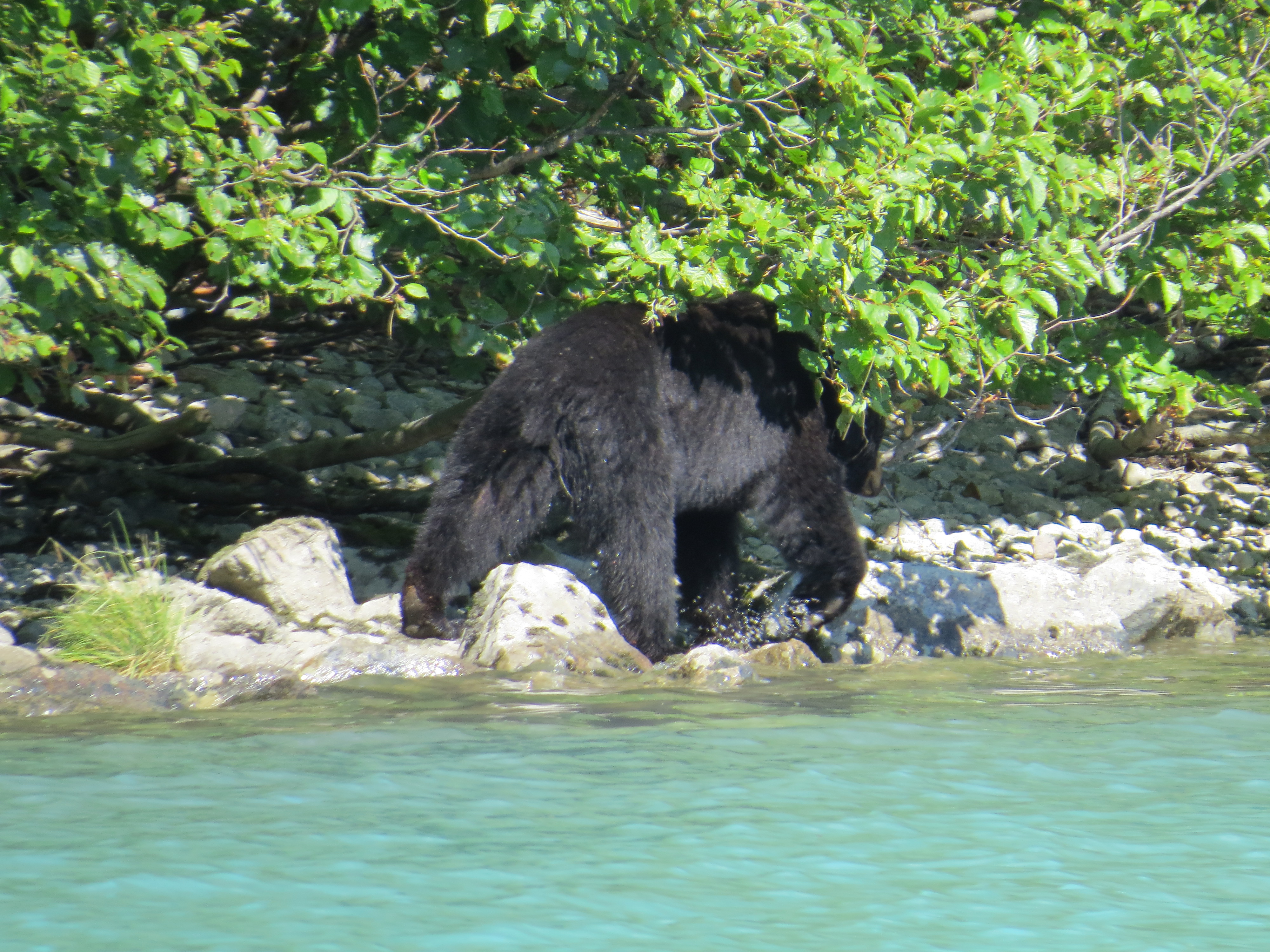
Bear viewing that day was poor.  We went immediately to where there was a single sow, the only brown bear we would see, but saw great bear behavior for an hour.

Brown bear, Lake Clark NP, Alaska

Brown bear, Lake Clark NP, Alaska

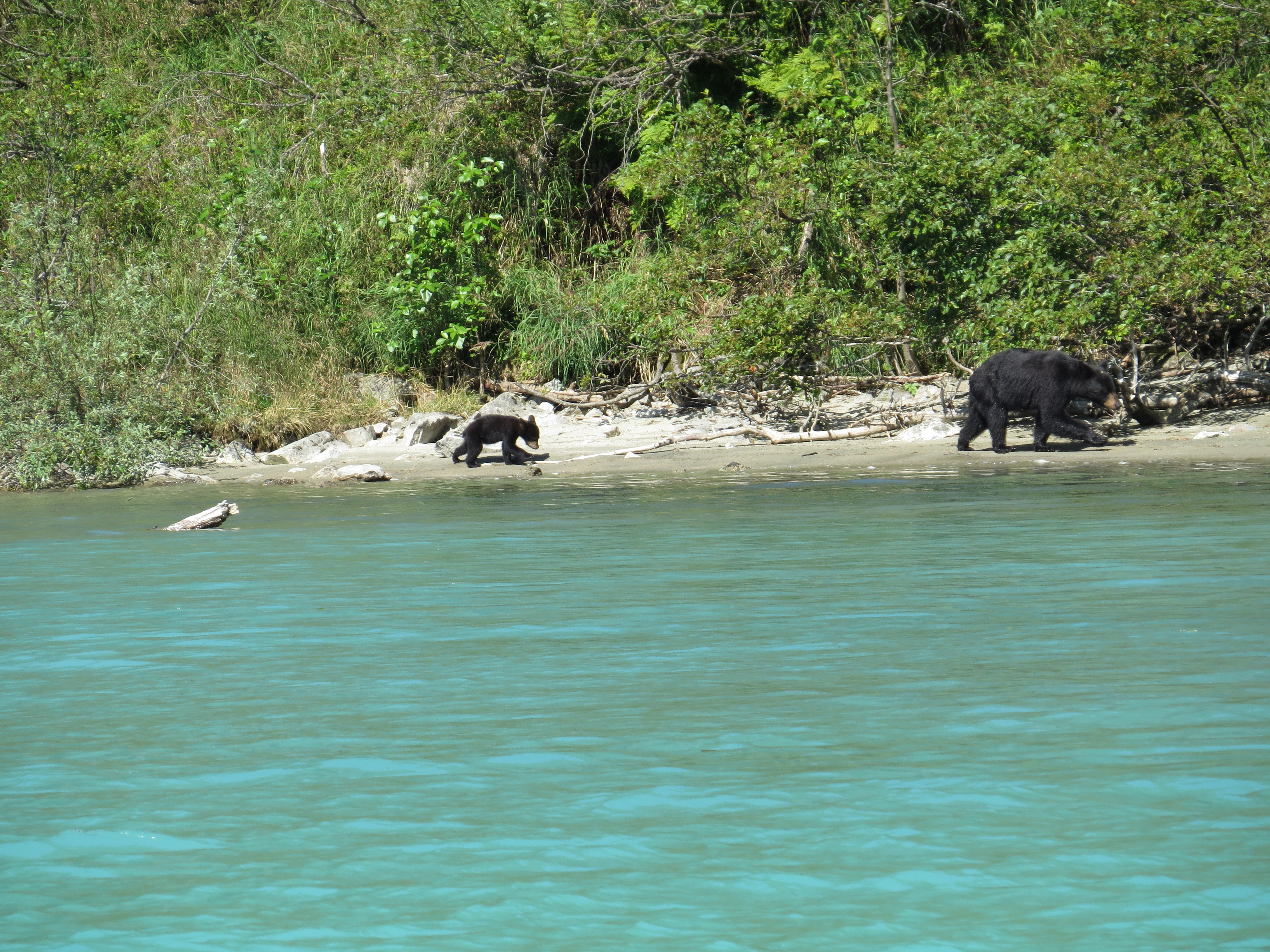
I have seen 18 bears in the Brooks Range, but I saw more behavior from this one in an hour than all of my sightings combined, often from a safe 800 meters, rather than from 50, if that.  I knew the guide was unhappy with the paucity of bears, but the large numbers of fisherman, many with noisy motors, made it impossible.  As a tour guide, I know the pressure guides feel to “deliver,” when nature calls the shots. That afternoon, I spotted a black bear and two cubs from 800 meters, and we had a delightful half hour of viewing when they came closer.  Further away, where the guide hoped to find bears, all we saw was an unseen bear making trees move, the movement gradually uphill.  My wife and I were excited, and I think the guide was glad.

Black bear, Lake Clark, NP, Alaska

Black bear, Lake Clark, NP, Alaska

Sow with one of her two cubs.

Sow with one of her two cubs.

Crescent Lake was beautiful, the mountains clear, the weather perfect.  I still felt sorry for the guide, but this is Alaska, not a zoo, which too many people expect when they go on wildlife viewing tours.  Seeing wildlife is a gift. For the first time, I had seen black and brown bears the same day, interesting bear behavior, and spotted another at great distance.  I helped.

Crescent Lake, Alaska

Crescent Lake, Alaska

The second tour was a flight/see over the Chugach Mountains to Prince William Sound.  The tour was supposed to start at 10; we learned it would be 20 minutes late, because somebody missed the shuttle.  While not in a hurry, it is annoying to make the effort to be on time when others don’t.  The lady who appeared took pictures by the plane, then decided she really needed to use the restroom.  Forty minutes late now, the group still chatting with the pilot, I sat by the plane.  My wife wondered aloud what was going on, adding her husband was a bit grumpier.  The pilot called, “How are you doing?”  I answered, “Waiting.”

The pilot then did something wrong.  He told me in front of everybody that this was fun, his philosophy was to have fun, and if he weren’t having fun, he would quit doing it.  One never, and I mean never, berates a client in front of others.  I have flown in remote parts of Alaska, landing in 15 different lakes or sandbars.  I learned early that nobody who depends upon a plane in Alaska must ever be late.  I should have said that.  His job was to ensure people had a safe tour and hope they had a good time. That’s what I tell clients when I guide.

The pilot was knowledgable, although I could have done without a discussion of his personal life. Later, he played music, neither my kind nor appropriate.  I stayed quiet, not about to get chastised again.  My wife, however, did have a discussion with him about turning off the music.  Note to music lovers: if others complain, don’t ask “you don’t like it?”  They don’t.  That’s what headphones are for.

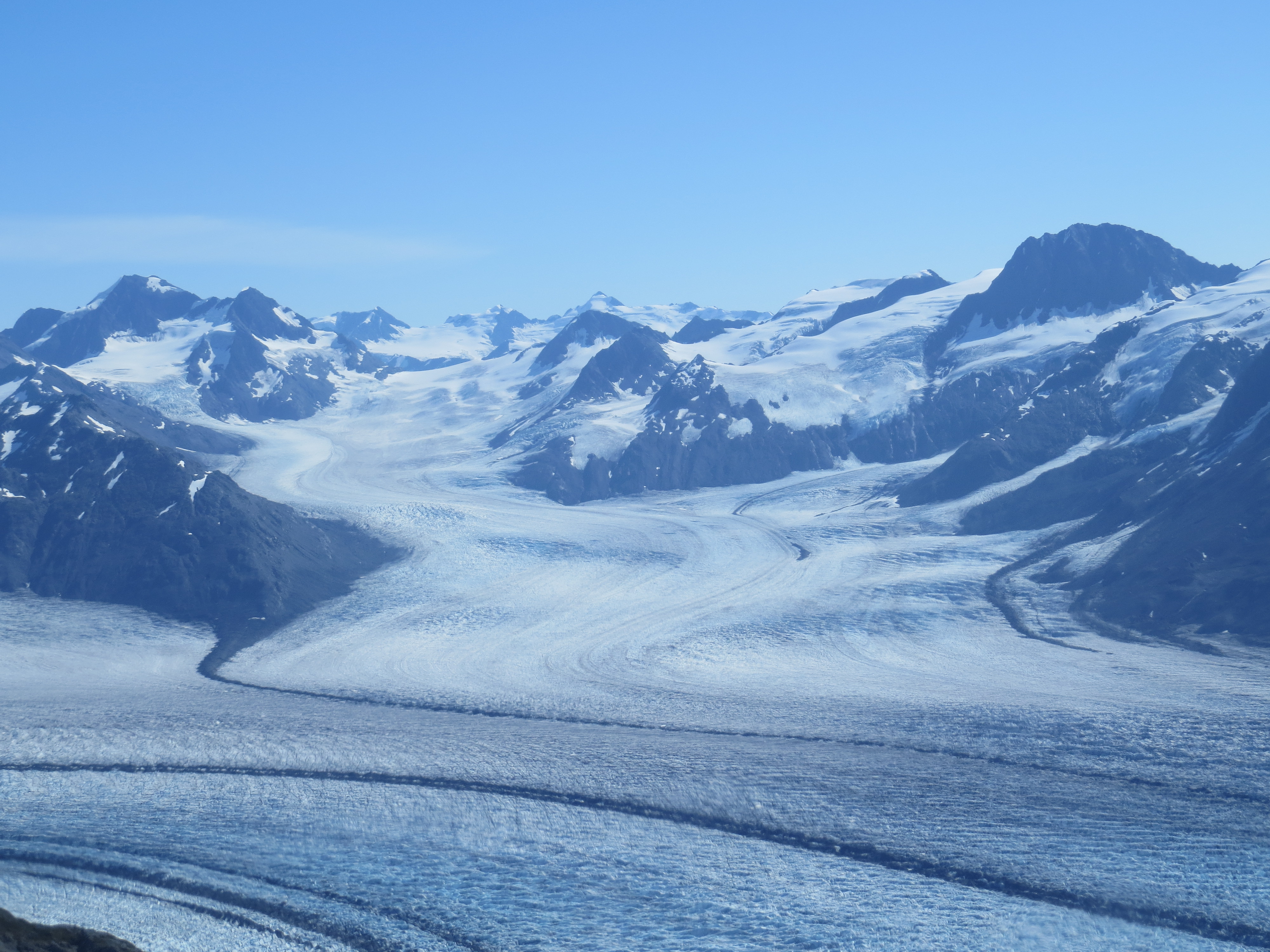
Glaciers in the Chugach.

Glaciers in the Chugach.

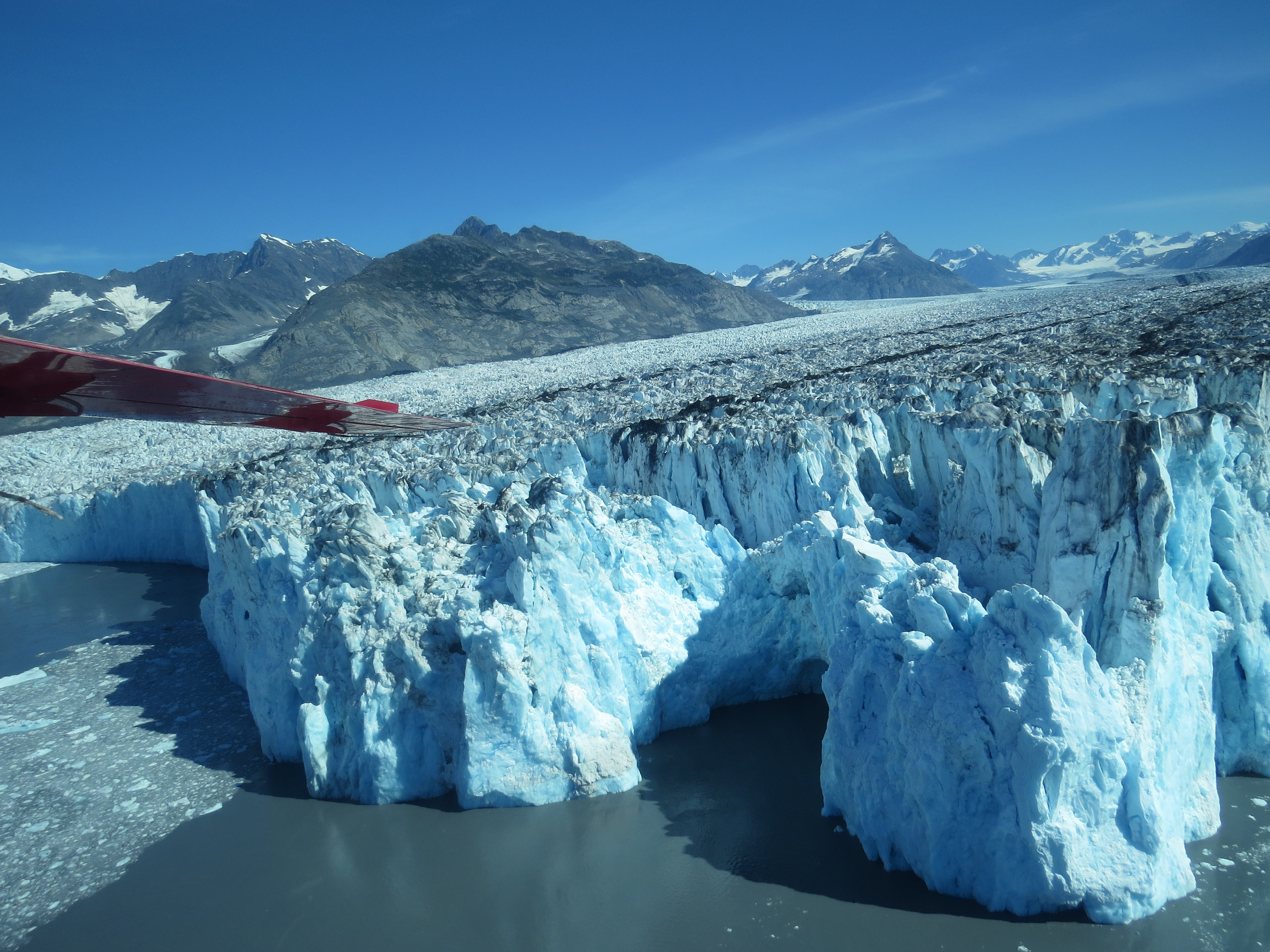
Nose of glacier.

Nose of glacier.

At a stop on a lake to briefly deplane, the pilot neither said how long we would stay nor counted heads over and over, as I would have.  This was bear country, and few tourists knew not to wander far.  Indeed, wildlife was hardly mentioned until near the tour’s end, although I did see fifteen mountain goats.

Pattern on glacier from the air.

Pattern on glacier from the air.

I learned about Alaska’s glaciers. But the other things I learned were a far more important.  They will make me both a better tour guide and a better person, even if I don’t have 25,000 flight hours, haven’t flown for Exxon or rich folks, and have a different take on what is fun.  I’ve missed a lot, but I’ve been around.

I tipped both guides well, including the pilot.  Once a year, somebody tries to tip me at Rowe.  I tell them to please put it in the container in the visitor’s center.

With luck, I’ll see it when I go clean the toilets.

One small reason why I lead tours to the viewing blinds. Rowe Sanctuary, 2013.

Two small reasons why I lead tours to the viewing blinds. Rowe Sanctuary, 2013.

A FEW TIPS

August 11, 2015

The converted boat on the Alsea River, upstream from Waldport, Oregon, looked like an ideal place to dine.  The Alsea is wide there, tidewater country, and my widowed father, the man he was sharing a beach rental with, and I had decided to try the place.

It took 20 minutes to get seated, and the place was empty.  That was a bad start.  The time from ordering to being served made me wonder whether the owners had called over to Waldport, got the dinner there and brought it back.  The vegetables were cold, most of the entree had to be sent back, and when they asked if we wanted dessert it was oh no thank you give us the check please we are leaving sooooo quickly.  Even so, I would have left a tip.  My father did not, saying it was only the second time in his life he hadn’t tipped.

He was 89.  I didn’t think it wise to ask him about the other time.

Fast forward a decade to a Denny’s in Bakersfield, right by Cal 99, where getting seated was slow, in part because some guy had to break a $100 bill to pay for his dinner, and the manager needed to be called.  Another guy didn’t speak much English, and after laboriously going through the entire bill, he was asked about a tip.

“Zero”, he said.  I cringed.  Not even a quarter.

Forward another year, to the PDX Park and Fly driver, taking me over to the airport.  I was alone, but then a group of seven lightly dressed people, young, beautiful, and probably rich, heavily loaded with bags, going some place nice, got on, with a lot of heavy lifting done by the driver.  They got dropped off first, with the driver’s lifting everything again, and nobody left a tip.

As we went to the next concourse, the driver was so angry he drove right by it and we had to loop around.  I had to hear him rant for another 5 minutes and had less time to catch my plane.  Had he a gun, given the current climate, he might have been on national news.  But I understood his anger.  I didn’t know what kind of day he had.  He might have been a bad diabetic, he might have lost a job and found this one, told that “the tips are good, so we won’t be paying you much per hour.”  I don’t know.  I had crappy service, and I hauled my own bag, but I still tipped him.

Because you do that, unless you yourself are pretty badly off.

Several years ago, which these days is the number I think plus 8, Dear Prudence had a column about tipping.  A lawyer from DC commented that he tipped on the basis of service; if the service were bad, he didn’t leave a tip.

Prudence let him have it with both barrels blazing, using terms like “Buster,” “arrogant,” and “little boy,” telling him in no uncertain terms that tips are what allow a lot of people to “sort of get by,” rather than to be on the street.  “Sort of get by” means living in a car, a big step up.  With tax breaks for real estate, oil, new companies to relocate, agriculture, the IRS makes sure it cracks down on tips, bringing a whole new meaning to “regressive taxation.”

Dear Prudence changed my behavior.  I’ve seen my share of bad service over the years, and while a lot of it is the employee, I bet more of it is system flaws and short staffing, for which upper management is responsible.  You know, “Your call is important to us” becoming visual, rather than auditory.  Many employees are single parents, on their feet for hours, most of them probably don’t feel well, which affects mood.  Don’t believe me? Imagine how well you would deal with the public if you had hypertension, diabetes, chronic back pain, or a major medical bill on a kid.  I bet their personal life is a lot worse and more complicated than the stuff I whine about.

After that Dear Prudence column, I became a better tipper.  There is a little bit of an art to it, because too much can be construed as arrogant, although these days “too much” has a high bar.  I’ve tried to learn along the way who should be tipped, like guides, which for years incredibly I didn’t tip.  I learned when a guide borrowed (permanently) my Steri-Pen and another client said “take it out of his tip.”  Big oops moment. I’ve been good since 2009.

The people I try to tip well are the drivers, the waiters and waitresses, and people at kiosks selling food.  These people are minimum wage. In Anchorage, the waiter had just moved there from LA.  He had a girl friend, so he was likely to stay.  Life is good in early August, but in three months, business won’t be.  The tourists will be gone, and it’s dark.  He was personable the service good, and I tipped him well.  The next night there, we again got good service from him.  That might be the best tip of all, coming back.

I carry a lot of singles with me when I travel.  I either leave one or two on the driver’s seat when he is lifting my stuff off or I just give it to him. Whatever works.  He will find it.  If I can’t afford this, I shouldn’t be traveling.

I’ve gone to a straight 20% at restaurants, rather than 20% for good service, 10% for bad.  People need to live.  I am trying to leave cash separately and pay for dinner with a credit card, because card charges and employers both may deduct something.  These people need the money: some are refugees trying to get a break, others students, trying to survive, and the guy at Sea-Tac, my age, who was dealing with bagels as professionally as I dealt with patients deserved a couple of bucks left in the jar, where they all are split up. Got extra change?  Dump it.  If you can afford an organic chemistry experiment on your coffee, you can afford a fair tip.

The guy who drove the boat at the bear viewing deserved a good tip.  True, the viewing was terrible, but it wasn’t his fault that bears don’t like to come to a lake on days when jerks are buzzing around in high powered john boats.  He was doing his job, he knew how to drive the boat, and he was pleasant.  I couldn’t have asked for more.

Know what?  If after a trip you can’t count what the tips cost, it was a good trip.

I have my limits.  I guide at Rowe Sanctuary in Nebraska every spring.  At least once, somebody tries to slip me a $20 after a tour.  Mind you, the tour itself is $25, and some of the tours are worth 50 times that for what we get to see in the morning or evening.

I tell him thanks but please put it in the big tower collector in the Visitor’s Center.  A $20 that is visible is a good reminder to others.