Posts Tagged ‘General writing’

ALASKA THOUGHTS FROM 2015 VISIT

August 6, 2015

I have had good fortune to have traveled to Alaska 12 times.  I’ve had deeply satisfying hikes and backpacking trips in the Southeast, the South Central, and the North.  There is a mystique about the name “Alaska,” the bush pilots, who take one to where moose, wolverine, grizzlies, arctic foxes, caribou, and Dall Sheep may be seen.  There are places one can imagine that no person has stood in the past several thousand years, if ever.

Place where I once sat and wondered if anybody ever had been here. It is the rock lower center. Aichilik River 2009.

With that backdrop, my wife and I visited Alaska so I could show her some of the beauty of the land,  Beginning in Kotzebue, we saw musk oxen close up, a bear hunting a caribou, ate blueberries and stared at wide open spaces for miles.  On our return to Anchorage, we planned a drive to Homer, one of those “You should see” places.

Musk Oxen, Cape Kreusenstern, Alaska. July 2015.

Musk Oxen, Cape Kreusenstern, Alaska. July 2015.

Unfortunately, it was a Saturday.

Route 1 was nearly a solid line of cars, similar to the Oregon Coast in summer, or the Minnesota northland on a Friday.  Construction was a given; roads take abuse in the Alaskan climate.  I neither expect nor want four lane roads in Alaska, but I was amazed, which I shouldn’t have been, by the traffic.  This is the height of the tourist season, although small Kotzebue didn’t show it.

The 220 mile (350 km) drive to Homer took nearly six hours.  The city itself is situated on the southwestern corner of the Kenai Peninsula with a spit jutting several miles into Kachemak Bay.  The spit was jammed with RVs, more than the nearby dealership had in stock, scores of shack-stores, what some would call rustic, others garish.  The beach was fine, the views of the mountains great, the protected wetlands well done.  I didn’t like the spit, but that’s my judgment. Many would disagree, which is why the place was jammed.  It’s why I don’t like “You should see” recommendations and why I don’t give them myself.
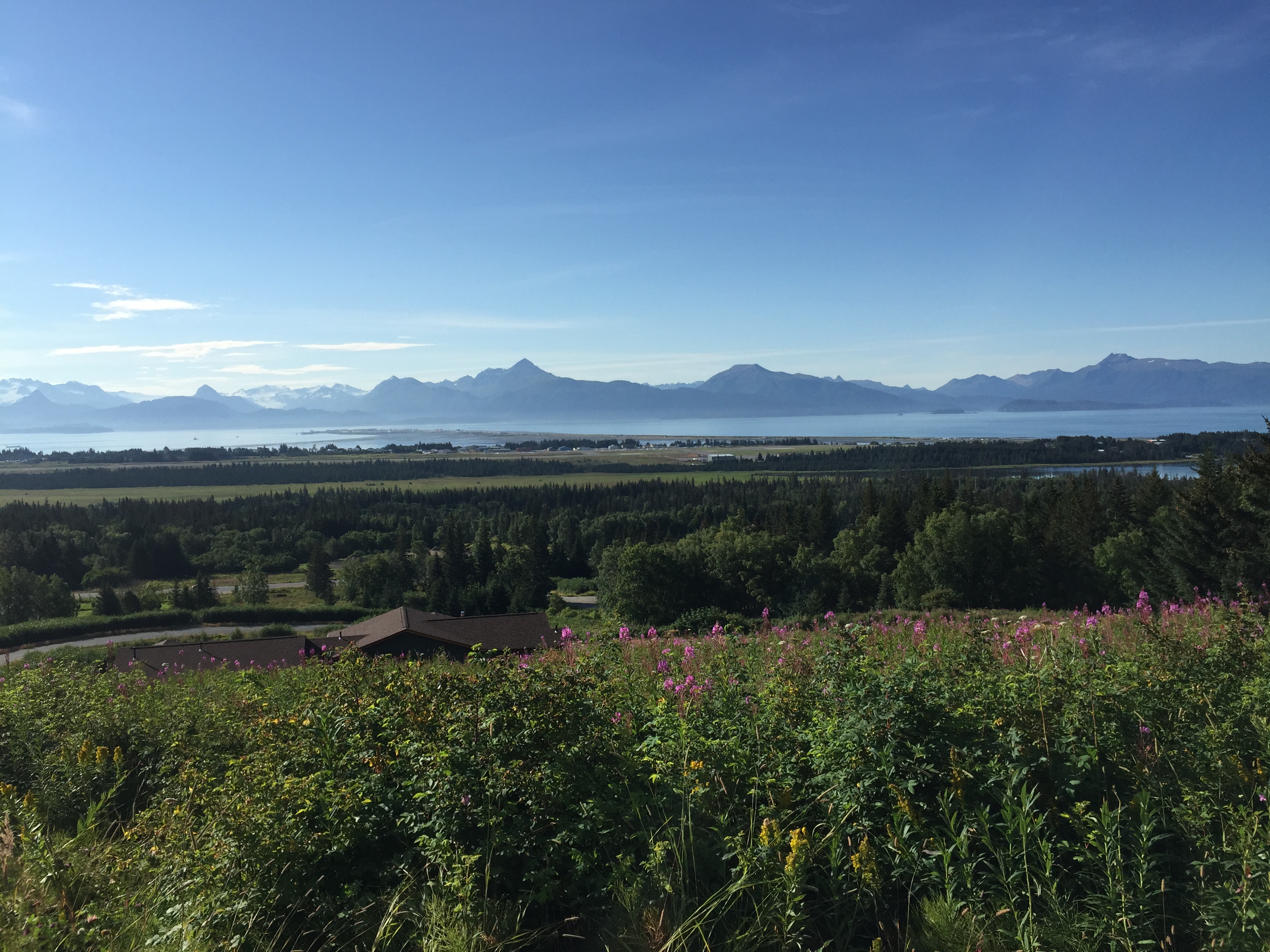
Homer is a beautiful town, and its reputation as such is deserved. The spit is center left. The road here is described as the most beautiful drive in America. One would be advised not to do the drive on a summer weekend.

On our return, through Soldotna, we noted again the sameness, the chain stores, “this could be anywhere in America.” True, the Kenai River runs through the city, and the green, glacial water is beautiful.  People were nice, but it was anywhere USA.

Skilak Lake, Kenai Peninsula. A beautiful lake, but it gets a lot of use.

We detoured south from busy Hwy 1 to the Skilak Lake area, where the lakes and trails looked interesting.  What we found was a moderate amount of traffic on a dirt road, trucks hauling big boats.  The launch points had several cars parked with people out on the water.  One might find a place to camp, but there would be many people nearby and considerable noise. Back on Hwy 1, along the Kenai River, we saw scores of people fishing and rafting.  A store that served food had no toilet, except a half mile away at a campground.  Wow, I thought that was illegal. This was a different Kenai from the one I visited in 2009.  Returning to Anchorage, traffic increased.  It became so heavy that if one pulled off, it took a minute or two to find a gap in which to merge.  At Bird Creek, I counted 13 fishing on a 50 yard stretch near Turnagain Arm and about 40 on a 400 yard stretch further upstream.  Many caught fish, but it wasn’t success or failure at fishing that bothered me.

It was that the place was jammed with people. Southern Alaska is jammed in summer.  Why should I be surprised?  I was contributing to it.

Fishing, Bird Creek, Sunday afternoon.

Fishing, Bird Creek, Sunday afternoon.

Once back in Anchorage, we went to a shopping mall that my wife commented was one of the ugliest she had ever seen.  Alaska has a mystique I think it should use, and good architects ought to be able to create it, not repeat architecture of the Lower.  Or do it worse.  We viewed bears on Crescent Lake, over in Lake Clark National Park, but the river out of the lake where we had hoped to view bears, had a plane by the shore, people fishing, and several loud John boats blasting by.  No bears there.
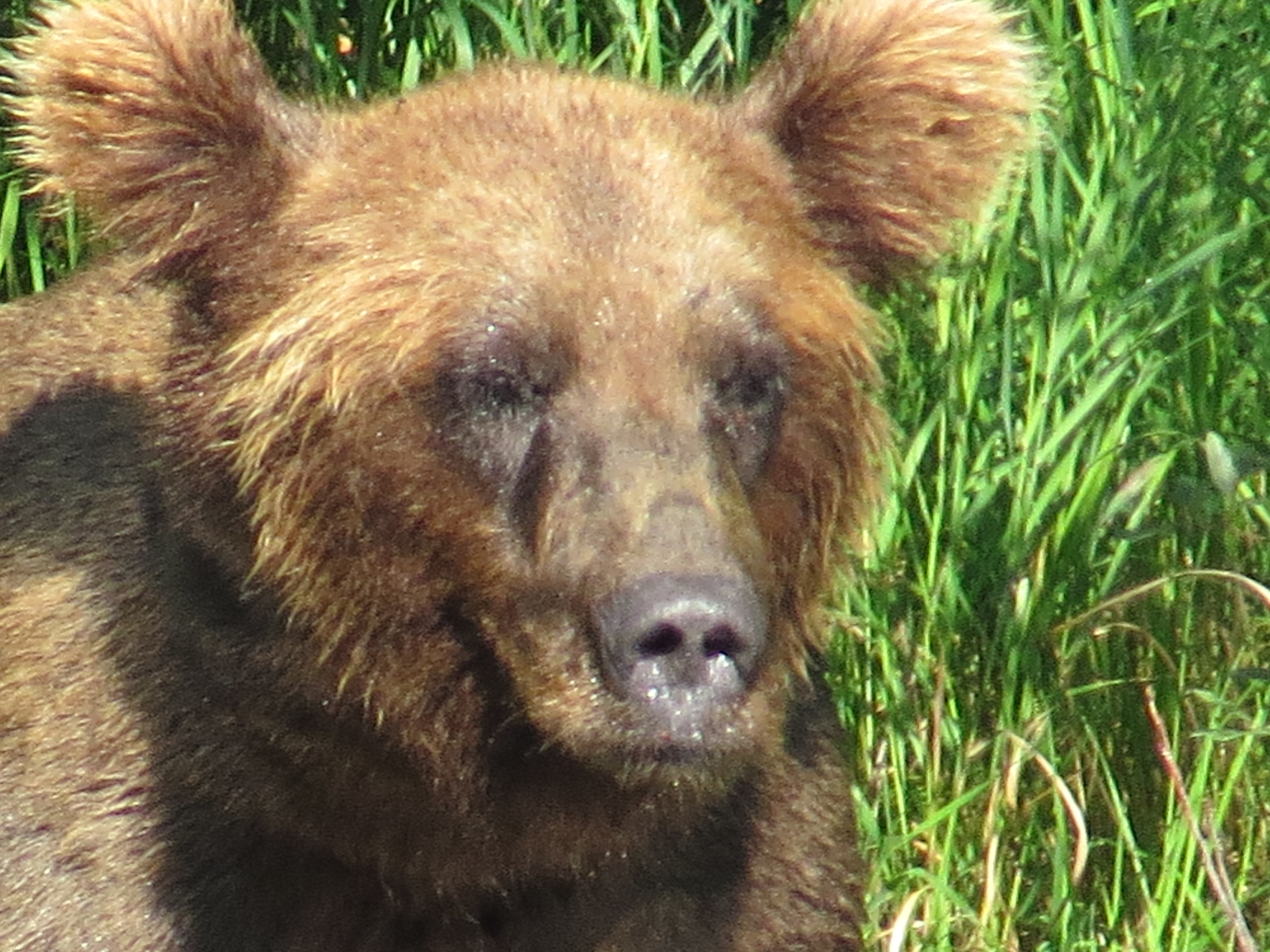
Brown bear at Crescent Lake, Lake Clark NP. Katmai has more bears, but they are viewed with many other people at a platform. This is a more intimate experience with far fewer bears but much more natural bear behavior.

Black bear sow with one of her two cubs, Crescent Lake. This was the first time I saw both black and brown bears the same day.

I’m spoiled; I admit it.  I’ve been above the Arctic Circle where there are few roads and one can hike for miles without hearing any unnatural sound.  There is a move afoot to build a road along the entire Brooks Range, from perhaps the Dalton through Bettles to Ambler, ostensibly so Native Americans can easily get to town to buy supplies.  There may be a village in support of this; the others are adamantly against it.  They’ve done fine without a road and know what it will bring:  hunters, to hunt their game, upon which the natives have subsisted for thousands of years.  The roads will bring Wal-Marts, liquor, gas stations, casinos, and people.  Yeah, they’ll bring people like me who want to see this country, although I come by plane, leave nothing except footprints in places seen by the dozen or so people who pass in a year.  The Haul Road to Ambler will become another Dalton Highway.  It’s not just acres of pavement that detract, noise and fragmentation destroy wilderness.

More pernicious is that roads will bring access to mines, several of which are proposed in the western half of the Brooks.  Red Dog Mine is already there, with 737-200 service out of Anchorage.  Who is going to say no in a solid Republican state and country?  We need jobs, although nobody says maybe having fewer kids would decrease pressure to create jobs.  Defunding Planned Parenthood makes birth control and women’s health difficult, but hey, Iran and Saudi treat women badly, too.  Mining jobs pay well, except when there are strikes, but new mines won’t be unionized if Mr. Walker gets into office.  The jobs will last until the ore isn’t needed, like one of the rare earth mines in California, leaving not only be a land scar but a permanent impact on the water supply, in places where there are wild and scenic rivers like the Noatak and Kobuk.  Yes, we need elements.  We also have learned to do without those that were once considered “essential.”

I worry about Alaska from the southeast Tongass to the Refuge in the north, and offshore.  I worry that the next eruption of Redoubt Mountain may flood the berms protecting four large oil tanks and foul Cook Inlet.  The mountain is steaming.  Whose idea was it to put the tanks near a river by an active, glacier covered volcano?  Sure, nothing may happen.  The last eruption was in 2009, and the berms barely held. We’re playing roulette with a huge unspoiled ecosystem.

Redoubt Mountain steaming, plug at upper left center. If the glaciers melt, the flow will run right by a bank with a low berm with four large oil tanks.

Fortunately or not, climate change will be a game changer; nature will win this game.  Virtually every glacier in the Chugach is retreating.  One, after being stable for more than a century, has retreated 12 miles in the last 40 years.  If Mr. Inhofe’s dropping a snowball on the Senate floor is evidence against global warming, how does he explain glacier retreat, why the caribou migration was a month later than usual in 2013, and the water of the rivers they crossed not nearly as cold as formerly?  The Elders in the Native Villages know there is change; the Senate would do well to have true Elders, not young, charismatic, angry, anti-science ideologues (who love their phones and private jets) and old diehards, who won’t believe compelling evidence contrary to their beliefs.

I started to write that Alaska disappointed me.  No, Alaska is wonderful.  I hope we don’t love it to death.  Or forget that wilderness has worth than cannot be measured in dollars.

DIGITAL DISTRACTIONS  AND THE KID WITH A SNOW COASTER

July 25, 2015

Thirty years ago, my wife and I camped out under the stars in Sonoita, Arizona, far from Tucson, Sierra Vista, and Nogales, when the nights were incredibly dark.  At 10 p.m., a large cloud appeared in the east.  At least, that is what it looked like, until we realized it was a different type of cloud, one of stars.  We were watching the Milky Way rise, and I never forgot that sight or the rest of that special night, wakening a few times, seeing the Milky Way further across the sky.

Just the other day, I received an email from a friend asking me to check out a picture she had posted on Instagram.  I usually don’t like these requests, believing that going into nature as I do gives me far better appreciation of the world.  The picture from a National Geographic photographer showed the southern Milky Way, from the Southern Hemisphere, with a time lapsed wind turbine in the foreground.

There were many of comments praising the picture.  I wrote, before erasing, “The wind turbine ruined it.” It did, by greatly detracting from the beauty of the Milky Way.  No picture can show the Milky Way as well as I have seen it, from the high grasslands of Arizona, deep in the Grand Canyon, or from the wilderness of the the borderland canoe country.  I didn’t have Instagram then, only a working occipital lobe and hippocampus, so those sights became part of me in a way that a picture cannot.  The beauty of The Great Rift, Vega, Altair, and Sagittarius is sufficient, not enhanced by a wind turbine in the foreground.

While I don’t look at many videos on social media, one about how different generations viewed free time was enlightening.  A man my age said he once used a stop sign for a toboggan.  I can relate to that.  Using a snow coaster as a sail, I once blasted alone on skates down the middle of frozen Honeoye Lake in upstate New York, doing 25.  That’s being a kid.  Parents nearby?  Nah.

Today?  A 6 year-old says she doesn’t know what she would do without her iPad.  Another kid bragged about watching 23 episodes of a TV show in 4 days. I wasn’t surprised.  One wouldn’t eat wild blueberries, because they weren’t wrapped in plastic.  Amazing. I love blueberries, and it reminds me some summer I’ve got to go back to Minnesota just to pick them.

I once posted a picture from northern California’s Redwood National Park,

I didn't lift this from the Internet. Redwood National Park, June 2012

I didn’t lift this from the Internet. Redwood National Park, June 2012

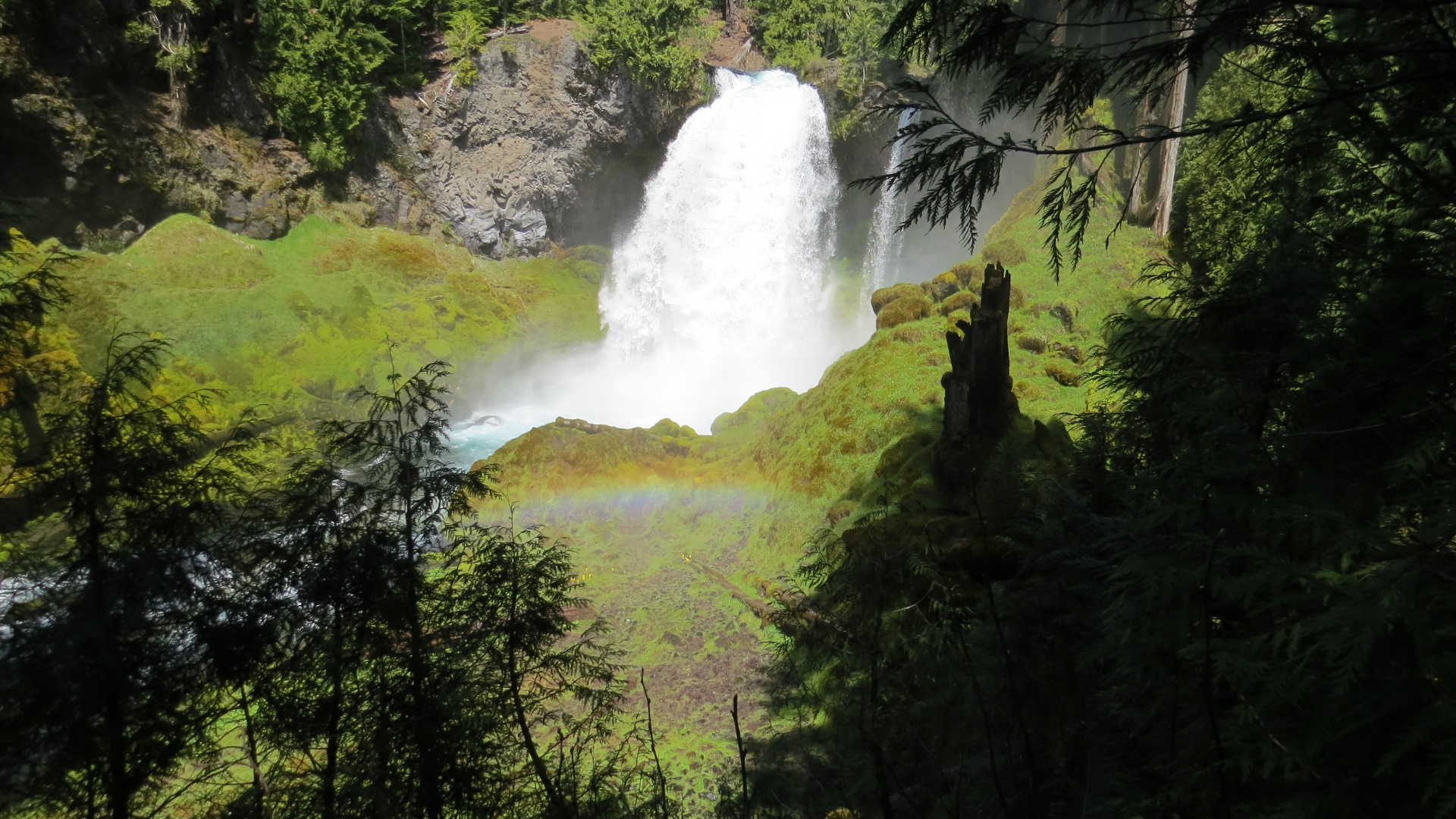
and saw a comment, “Where did you find that on the Internet?”  It never occurred to the writer that there are average folks like me who actually go to these places, where we can point a lens at a tree 120 meters tall and take a picture of its dwarfing a car.  The canopy of a redwood contains an ecosystem with plants and animals found nowhere else. I read it in The New Yorker; nobody sent me a link to “educate” me.  Sahalie Falls, Oregon, got a “Wow, who took that photo?” I replied, “I DID.”

IMG_5577

Sahalie Falls, Oregon, near Santiam Junction.

In the days of posting and sharing, I post rarely, usually views of special places in nature that I have seen, often having had to work hard to get there, an essential part of the picture. It is disheartening to me that so many see nature from a screen, rather than immersing themselves in it.  While I have had good fortune to see these lovely places, I made it happen, too.

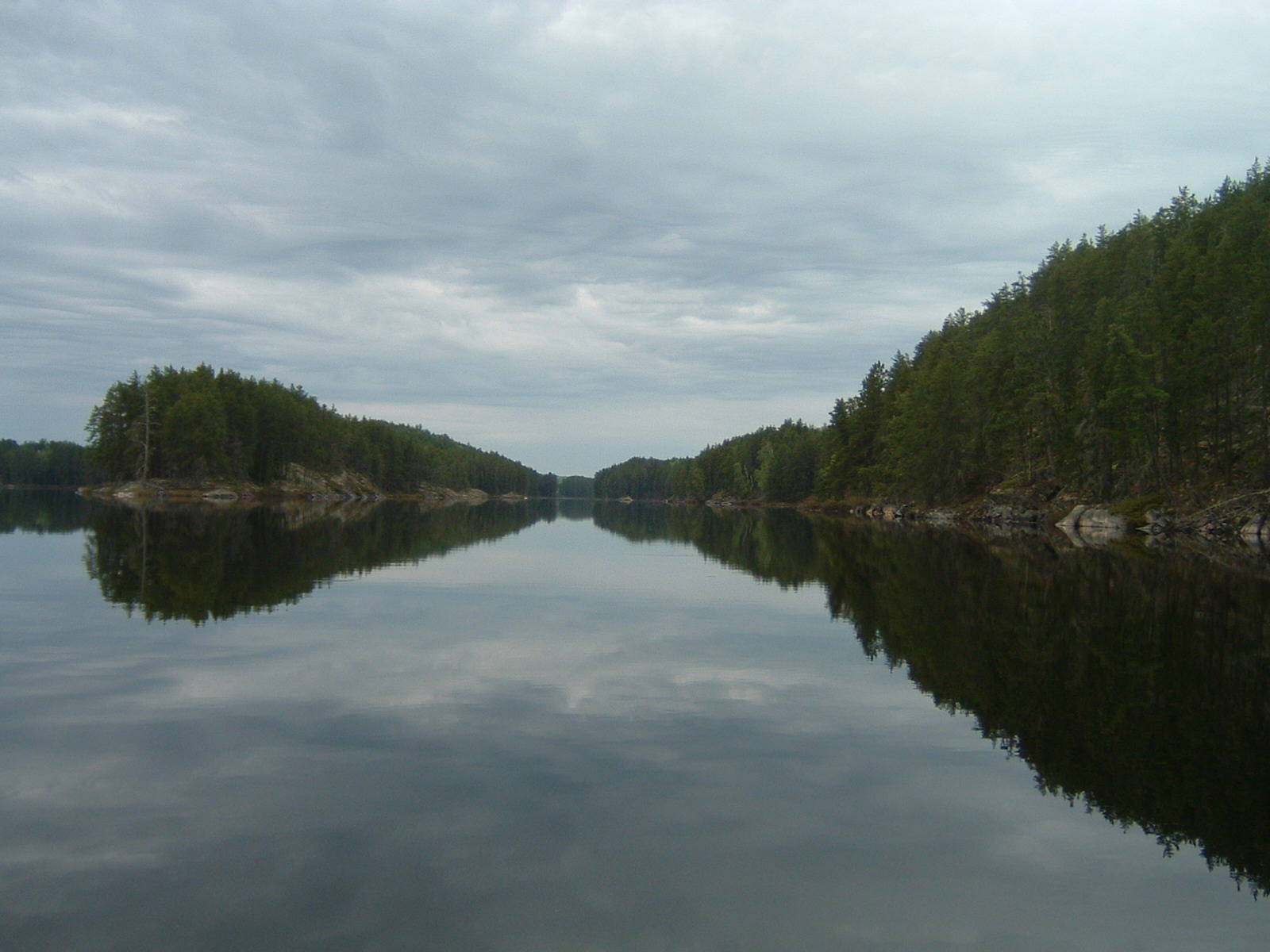
I changed the picture on my profile today to show a 2005 view of Kawnipi Lake in Canada’s Quetico Provincial Park,

"Bowling Alley," Kawnipi Lake, 2005.

“Bowling Alley,” Kawnipi Lake, 2005.

my last trip there.  Some like these pictures, amazed that such places not only exist but can only be reached by canoe, not by car, sailboat, or even hiking.  I was originally going to do that trip with a good friend from Ottawa, who introduced me to Sig Olson’s “Pays d’en haut,” in the Far North, 30 years ago.  We hiked the Chilkoot Trail (Klondike fame) together twice, and paddled the Nahanni, Liard, and Yukon Rivers.  We’ve portaged around Virginia Falls, twice as high as Niagara, and canoe sailed on Lake Laberge.

We had planned to see Kawnipi one last time.  Unfortunately, he had an animal emergency and had to cancel.  He was apologetic but knew I would understand. I did, deciding to do the trip solo.  It was difficult, even though I was a lot younger then, 56. I wanted to go further than 10 miles the first day, but my arms were dead.  The next day, I paddled to the north end of huge Agnes Lake, which was like glass.

Agnes Lake, Quetico Provincial Park, 2005.

Agnes Lake, Quetico Provincial Park, 2005.

On the portage out of it, where I hadn’t been for several years, I met two men, telling them I remembered the carry as a mess, with water and blowdowns. Good memory; there were fallen trees everywhere. It’s canoe tripping.

I spent the night on Kawnipi, content sitting on the ledge rock called the Canadian Shield, then the next morning, under threatening skies, headed south, taking the picture I posted today.  As I left Kawnipi, I turned around one last time and looked. In the back of my mind I thought maybe I could return, but I knew realistically I wouldn’t.  I don’t have to.  I’ve been there six times.  I’ve been on all the major bays of the lake. I’ve caught fish, found trails that cut through narrow peninsulas, had a cow moose charge into the water to protect her calf from me, and camped in lovely places.  That’s not on Instagram.  But wow, it’s in my brain.

I was lucky to have calm water back on Agnes.  I’ve paddled tandem on it in pouring rain and a headwind.  I soloed Agnes to Kawnipi in early ’92, when it snowed, and dealt with headwinds alone.  Nobody was out there.  It was great.  I’ve got print pictures somewhere, but no matter.  The memories are in my brain, where it matters, not on Instagram, where somebody might ask what Web site I found them.

There are many special places in wild country.  Getting there only by pack or paddle is a key ingredient.  I seldom give advice, because people neither want mine nor follow it.  I will simply state that for me the physical effort to go to these beautiful places beats looking on Instagram any day of the week.

Then again, it helped to have been raised a kid, free to rocket down the middle of a lake in mid-winter, using a snow coaster as a sail.  Or to be out in the middle of Agnes, on a beautiful day, looking at the huge sweep to the north.  Or doing the work needed to get to Kawnipi, blowdowns and all.

Because it was Kawnipi.

Heading to the campsite, Kawnipi Lake

Heading to the campsite, Kawnipi Lake

DSCF0039

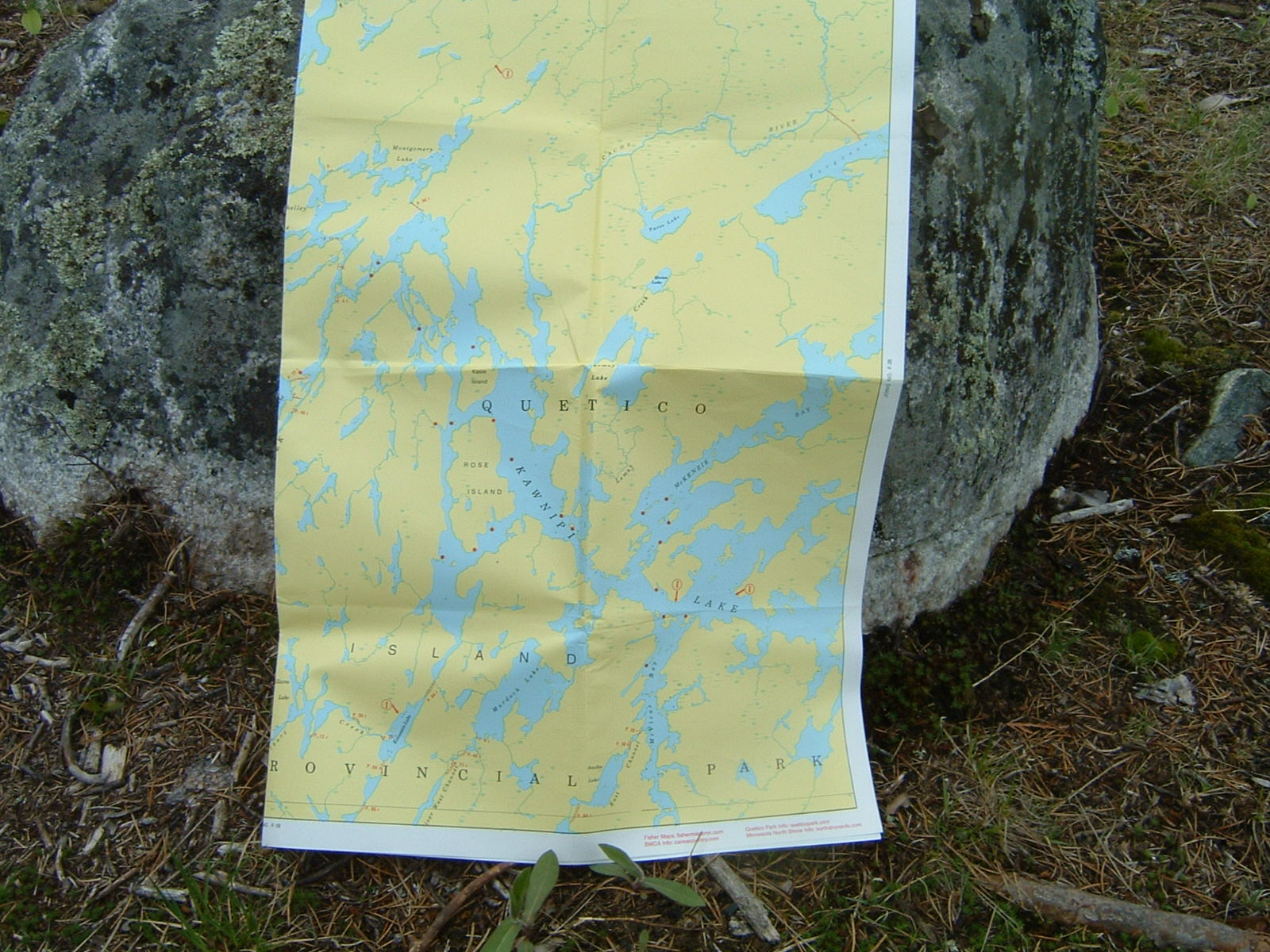
Kawnipi Lake on the map. It is big enough to be seen on road maps, although there is no road within 40 miles of it.

DSCF0047

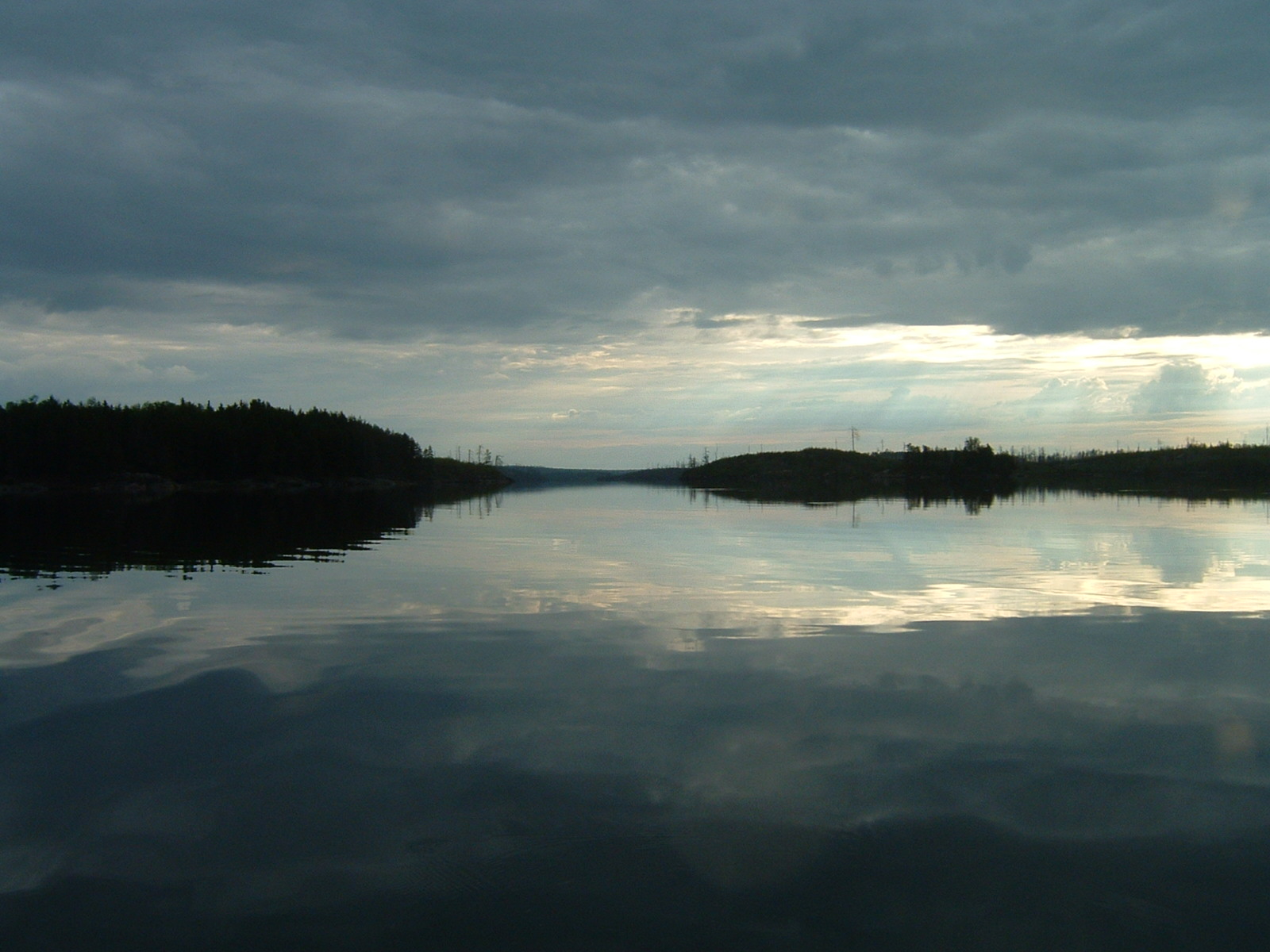
One of the last pictures I took of Kawnipi, 2005.

SAYING NO IN THE WOODS

July 23, 2015

I remember the date well: it was September 15, 2001, and we were among the few who had no idea what had happened to the country, 4 days earlier.  After portaging our gear around Wheelbarrow Falls, on the Canadian side of Basswood River, we saw two young men, early 20s, getting ready to shoot the rapids, without packs in an aluminum canoe.  They also had wore no helmets, PFDs, hiking boots, and were sitting upright.  This violates five rules of safety.

No, I said, unsuccessfully to these two, you should not do this, because portages up here exist for a reason.  People die in the Quetico-Superior shooting rapids.  Within 10 yards of launch, the canoe shipped water, then swamped, the two fortunately floated down the rapids and survived.  The canoe broached on a log and filled with water, and I later learned it took six hours to right it.  The two were lucky, something one doesn’t want to have to depend upon in the woods, lucky one didn’t get a foot caught under water and drowned.

I got a call the other day from another Obsidian hike leader, wanting to run some things by me.  The Obsidians feature hikes, climbs, bus and bike trips, and last year, after being a member for all of 2 months, I led my first hike.  I’ve now led 18.  I’ve gone on the caller’s hikes; she has gone on mine.  Leading hikes is work.  One has to organize the hike time, meet up place, describe the hike, deal with those who call wanting to know about the hike, but not wanting to register to read about it online, know how to get to the trailhead, know the trail itself, and decide whether a person is capable of doing it.  The online description should be sufficient to tell someone whether this is suitable.  If one wants short walks, a 12 miler of mine with 2500 feet of elevation gain is not suitable.  Don’t laugh, I’ve had people say, “I’m on my feet 10 hours a day,”  as if that helps climb Mt. Hardesty, 3400 feet vertical.  On hiking day, I arrive 30 minutes early, hoping everybody who signed up shows, but invariably, some don’t. We leave no later than 5 minutes past the start time, carpool to the trailhead, and hike.  No shows without cancellation delay departure.  Me generation.  Lots of technology to communicate, yet communication has worsened.

The two of us talked about recent hikes, where I finally added a statement to future hike descriptions stating that “training” was not allowed; I would not allow an individual to carry extra weight on the hike to get into shape.  This rule occurred because of two incidents: on one hike, a lady carried barbells in her pack, holding everybody up for 30 minutes, because the hike had a steep climb at the outset that she could barely manage. I let that go until the next hike, when a man lagged far behind the whole time and fell because of exhaustion.  We divvied up his pack between us.  We hike where cell phone reception is poor, and while we were lucky, depending upon luck in the wilderness is a bad idea.  Perhaps I’ve lost friends by my attitude, but I can’t lead a 12 miler with 2500 feet elevation gain and a 2 hour drive each way, and still return at a decent hour if people photograph everything in sight or need frequent rest stops.

Eventually, the caller asked me about a person on her upcoming weeklong backpack trip who had dislocated his artificial hip on a recent hike but got it back in the socket himself.  Luck.  She told him he couldn’t go; he was very upset with her.  I agreed with her decision.  He has no business hiking until given the green light by an orthopedist.  Maybe nothing will happen.  Those four words are often said before a cascade of bad things concatenate in the Cascades.  Things go wrong on backpacking trips.  We plan for many emergencies.  Hip dislocations are rare, but once somebody has dislocated one, he is at high risk for a second; it doesn’t make sense taking him.

Sometimes, one just has to say no, no to going backpacking with a hip that may cause trouble and no to “training hikes,” where others are inconvenienced.   Most of these “no’s” can be stated quietly: “I’m sorry, but as leader, I can’t take the risk of your hip’s dislocating, which will disrupt the entire trip should you not be able to reduce it.  I am responsible, and in my judgment you should not go.”  “No, please don’t carry extra weight.  This is a difficult enough hike with a day pack.”

No, I said on a November hike last year, we aren’t going to take a detour to see a place where nobody is exactly certain how to get to, because it’s going to snow later today, we will lose valuable time, and if we get into trouble, we are in the high country where early darkness and cold are life threatening concerns.

I wish I had been present to say “No” to a 15 year-old’s leader at the other end of Basswood River, when they decided the portage was too long and they would shoot the rapids.  Six hours later, most of which the leader was holding the 15 year-old’s head above water, because his ankle was wedged on an underwater rock, a helicopter, a Beaver float plane, and a lot of brave men put their lives at risk to rescue him.

I wish I could have said “No” to the 78 year-old who shot Upper Basswood Falls in high water shortly after ice out in 2013.  The river had changed, and he wasn’t wearing a PFD when they found his body well downstream.  His wife barely survived.

No, I told my wife on Lake One in a pouring rain, I do NOT want to camp after only two miles, but we ARE STOPPING ANYWAY to camp here, because we aren’t yet too wet, and we aren’t cold, but if we continue, we will be.  We stayed dry and safe that night.

I say a lot of “Yes” to life.  I say, yes, I am going to hike solo, because I want to see that country this year.  Yes, I said in 2005, I am going to solo into Kawnipi Lake because I know the route and have several backup choices if the winds are high on big water.  Yes, I am going to solo winter camp at 63, because I know the trail, and I just want to get into the woods.  My route and time of exit in all instances was known by my wife.  I don’t ever deviate from it.

Canada’s Kawnipi one last time and my snow camp on the Angleworm Trail, were smart, wonderful trips.

I likely will never see this again, but I saw it many, many times, and loved camping on the lake.

I likely will never see this again, but I saw it many, many times, and loved camping on the lake.

Kawnipi Lake, 2005. Many, including me, say this is the most beautiful lake in Canada’s Quetico. I have been on it six different times and consider myself blessed.

DSCF0049

I call this “bowling alley,” Kawnipi Lake, 2005. I’ve soloed to it twice, and it is 3 days’ paddle from town.

Author on the Angleworm Bridge, late April 2013, BWCA Wilderness

Author on the Angleworm Bridge, late April 2013, BWCA Wilderness

CONCATENTATION AND EXPECTED VALUES

July 18, 2015

A bloody picture of a cyclist adorned my Facebook page.  The writer was succinct:

How I joined the walking dead:

1. Rented a bike with defective brakes.

2. Started riding through a long dark RR tunnel.

3. Encountered a multi-family group with very small children in tow coming the other way.

4. Wiped out trying to avoid scattering kids like bowling pins.

This is a classic description of a fortunately not tragic accident.  Each one of those incidents alone might not have been sufficient, but together they caused a bloody rider. There was a concatenation of events.  Sometimes, we have a concatenation of errors.

I had my own sixteen years ago this month:

  1. Took part in a long distance bicycle tour only a few months after starting to ride a road bike.
  2. Ended up on a rainy day wet, tired after crossing 3 Colorado passes, and eager to get to the school where we were going to be camping.
  3. Saw a car in the turn lane headed towards me.  I had limited experience riding a bicycle in traffic.
  4. Assumed the driver saw me.
  5. The car suddenly turned in front of me.
  6. Too late, with wet brakes, I skidded and landed on my right hip, trying to avoid him.  I wasn’t the walking dead, but I didn’t walk normally for several months, and I’m lucky I can walk today.

It’s worth discussing the concept of the expected value of an event, like the lottery.  People see 2 winners in the last lottery and buy tickets, because after all, they could win.  It has to be somebody.  This is usually true.  If not, eventually the probability becomes so high that when the lottery has an unusually large payoff somebody (or several people) almost certainly will win.

If the probability of an occurrence is extremely small, invariable, and not zero, and the number of times the occurrence may happen is very large, the expected value is their product.  A probability of 1 in 110 million of winning x 440 million lottery tickets sold has an expected value of 4 winners.  It’s that easy.  Low probability events, like automobile fatalities, occur every day, because so many people drive. Expected values are just that.  They are expected, but they are not necessarily going to occur.

Aviation, perhaps more than any other endeavor, has taken safety to heart, because aviation is so unforgiving of errors.  Additionally, aviation has a large number of events, called flights, where there is a low but non-zero probability of a crash.  Aviation has tried to improve the probabilities and in commercial aviation, there have been multiple years, often consecutive, without a fatality.

Non-commercial aviation isn’t as safe.  Nearly two decades ago, a 7 year-old was trying to be the youngest person to ever fly across the country.  Being the youngest, oldest, first, most disabled, fastest, —st is often the first cause in a cascade of events that leads to tragedy.

A 7 year-old had no business being at the controls of an aircraft.  Period.  One of the last things to mature is judgment.

  • They took off to try to beat a thunderstorm, poor judgment, because wind shear is unpredictable in thunderstorms.  One must wait.
  • They were overloaded.
  • The runway was at a higher altitude where there is less lift for aircraft.
  • Rainwater on the wings diminished lift.  Airfoils are delicate; distortions of shape diminish performance.
  • They turned to avoid part of the thunderstorm.  Turning decreases lift.  The overloaded, slow moving, distorted airfoil plane stalled and crashed, killing all aboard.

Remarkable finding of evidence and piecing it together led to understanding why Air France 447 crashed in the mid-Atlantic in 2009.  Here’s a root cause analysis:

  • Why did the plane crash?  It stalled.
  • Why did the plane stall?  It was in the nose up position for the last part of the flight, reducing lift.
  • Why was the plane in the nose up position?  Because the co-pilots had taken control and saw that the altitude was low.
  • Why did the co-pilots take control? Because the autopilot had shut off.
  • Why did the autopilot shut off?  Because it wasn’t getting useful information from the pitot tubes, like altitude and speed; the altitude reading was faulty.
  • Why didn’t the co-pilots keep on the same course as the autopilot? Because they trusted the instruments.
  • Why weren’t the pitot tubes sending useful information?  Because they were faulty and needed to be replaced, but the airline was phasing them in.
  • Why was the airline allowed to phase them in?  That ends the questions.  That’s where action needed to occur.  Additional causes included the pilot’s napping (not wrong) so he was not in the cockpit when called.  There were other crew miscommunications.
  • What could have been done?  As soon as the “stall” alarm came on, the crew needed only to push the nose of the aircraft down.  Planes stall when they climb too rapidly.

**********

This root cause approach to errors is what medicine needs.  When a surgeon operated on the wrong side of the head, he got a letter telling him not to do it again.  Nothing changed.  Here’s what happened.

  • Patient in ED had a subdural hematoma and needed emergency surgery.  There are emergencies where one must act in a matter of seconds, and there are emergencies where one needs to act quickly, but can take a few minutes to think about the necessary approach.  A lot of people in and out of the medical field don’t understand that there is a huge difference between the two.  Unnecessary hurry is one of three bad things in medicine (others are lack of sleep and interruption).  A subdural hematoma needs to be evacuated, but unlike its cousin an epidural, it doesn’t need to be done in the emergency department, and there is time to plan the procedure.
  • CT Scans were relatively new and had changed the left-right orientation opposite to traditional X-Rays.  I practiced when CT scans showed this orientation, and it was extremely confusing.
  • Many people have trouble distinguishing left from right.  It isn’t a personality flaw, it is a biological issue, akin to being shy.  Approximately 15% of women and 2% of men have this problem.
  • Nobody spoke up to tell the surgeon they were concerned upon which side he was operating.

Without going into more detail, I reiterate the comments I made to the head of the operating room, who assured me that 99.9% of the time they did it right.

“No,” I replied.  “You get it right 99.99% of the time, and that isn’t good enough.  Counts matter, and wrong side surgery cases must be zero.”

We need better system design to decrease the probability of the wrong thing’s happening.  The stronger our systems, the more events will have to occur for something to go wrong, and that means people will be safer.

We will never know if a better system saved a life.  But probabilistically, it will increase the expected value of success, and I trust expected values.

TWO FLAGS

July 7, 2015

My wife noted a magazine from The Hermitage, an Arizona organization that rescues cats, animals near and dear to me.  The Hermitage had adopted 61 “unadoptable” cats from Animal Control in southern Arizona, finding homes for 42….so far.  My wife supports The Hermitage, which unfortunately had bad press several years ago from conflicts from within.

For once, I said the right phrase:  “Sounds like two groups, equally passionate about animals, couldn’t find agreement.”

I am not sure what the issue was, but it hurt the organization, which I doubt either side wanted.  Indeed, I am certain both sides had feline welfare as a priority.  It is possible for people to love something and have strongly differing views on how to best help it.  Not only is it possible, it is likely.  The irony is that squabbling hurts both sides and the issue they support.

This statement applies to the country at large.  I know people whom I call “friend,” in the true meaning of the word, with whom I have significant disagreements about what ought to be done by America.  Somehow, we usually manage to sort a lot of it out, usually with humor, sometimes by finding common ground where we do agree.  Too often I remain silent, because I could hurt them verbally.

Americans disagree, which should be expected, given that there are a third of a billion of us.  What bothers me a great deal is the idea that one side “owns” patriotism and love of country.  My detractors don’t own patriotism, nor do I.  Waving the flag everywhere is like two people in love who insist upon smooching in public.  It gets a bit tiring.  You love something or somebody far more by your behavior than by public showing of affection.

I don’t like stock phrases like “land grab,” when a national monument is created.  Yes, there are rules that now apply to that land that once didn’t apply, but much land has been taken over privately, and it is no longer able to be used at all by people who once could use it.  I think Mr. Bundy had a land grab of his own.  Had I decided to use the land on which his cattle were grazing, I reckon he might have been upset.  I don’t like “useless bureaucracy.” If a person suddenly wants the FDA to check on the origin of meat that comes from abroad, the FDA is suddenly not useless.  Nor is the CDC, when it tries to deal with a new viral infection.  Nor are the police and other first responders, paid by the public to protect the public. Nor was FEMA, when Governor Christie needed help after Hurricane Sandy.  A wise psychologist told me long ago that “all” or “nothing” statements are an entry into depression.  Are ALL governmental workers bad?  Are ALL politicians bad?  Is NO Democrat good?  Really?  NONE at all?

It is normal to contradict one’s own beliefs.  We all do at times.  It is also normal not to like laws or government except when it suits us.  I do, however, have a different take from those who think the Confederate Flag honors a “rebel” heritage while simultaneously spread the American flag out over an entire football stadium to show their patriotism.  Secession was treason, and rebel is a poor euphemism.  The Confederate Flag flew for four years over eleven states which seceded from the Union.  Had it not been for nearly three million Union soldiers, one-third of whom would become casualties, one-eighth of whom would die, we would have remained a fractured country.  That is the truth. The states have many rights, a problem for those of us who travel from one to another, be it with local taxes, customs, speed limits, medical care, or odd laws.  There are many things in the country that need standardization, and 50 states each doing it differently is not wise.  As for that flag, it can sit in a museum.  I don’t wish to see it.

Ironically, many who want States’ Rights have no use for “socialist” Europe, which to me is a classic example of States’ Rights taken to the extreme.  I’ve been to Europe eleven times.  We could learn a great deal from Europeans about health care, transportation, education, fluency in languages, and efficient energy use.  Europeans could learn from us about unity.  Are any of the 8 federated entities from the former Yugoslavia a player on the world stage today?  No way.  I can count 40—yes, forty—different countries west of the Black Sea and north of Turkey.  The European Union has had trouble with one currency.  The cultural differences alone should have negated Greece’s ever joining the EU, although the Greek statistician who was honest about the country’s finances was jailed.  I don’t find multiple languages, cultures, defense, and currencies a strength, but rather a weakness.  Make America 50 different countries, and our influence would be profoundly degraded.

We need mandatory national service by the young, to relearn that “civil servant” is an honorable career, the way it once was, denoting respect for one whose life was public service and whose service did not make him as rich as one who worked for a privately owned company. We don’t pick and choose which laws to obey.  There is a Constitution, and the states have many rights, all that are not specifically granted to the Federal government.

Many squabbles are ultimately arbitrated by the Supreme Court.  The Justices are appointed for life by the President.  Many who don’t vote for president, “because there is no difference,” might be chastened to realize what can happen to the Supreme Court for the next fifty years by a presidential election.  The law can be changed if the Court changes.  That may or may not be good.  Given the Citizens United decision, 5-4, where money was allowed to flood politics, I am worried about this Court.

But the law is the law.  If I don’t like it, I must work to change it, through words, active protests, economic boycotts, but always through legal means.  If I don’t like staying here, I have the choice to leave.  I don’t have the choice here to do what I want without regard to the law.  Nor does anybody who has the “Stars and Bars” on his pickup.

I was disturbed at the outcry about the Supreme Court’s ruling in Obergefell vs. Hodges.  I fail to see how love of another person who has the same variant of human sexuality is wrong.  Citizens United and Burwell vs. Hobby Lobby were both horrible decisions, far more reaching than gay marriage, which doesn’t affect me a bit.  In the final analysis, of the two decisions that momentous week, the Affordable Care Act was by far the most important, while Obergefell vs. Hodges was part of civil rights.  It was a week where two flags will soon be relegated to history for very different reasons: one because it was a sign of treason and failure, the other because it symbolized a wish that came true.

LIVING IN THE PUBLIC EYE

July 4, 2015

When I graduated from high school, 49 years ago, I got compliments from people whom I respected a great deal, my parents, and my homeroom teacher when I was a junior.  The latter wrote in my yearbook, “having grown up in the public eye, I know how difficult it can be.  You have emerged as your own person. I’m proud of you.”  My father was superintendent of public schools, sending me to one of the high schools in his district, for going to a private school, while perhaps offering a better education, would have been hypocrisy.  It didn’t hurt that his son was valedictorian.  He told me that my not getting into trouble made his job immensely easier.

Too many live in the public eye and refuse to deal with the big downside of such: everything you do is scrutinized.  I wasted three minutes of my life listening to “The Sarah Palin Channel,” as she opined about the California drought.  She advised them to build more dams, but in fairness, she did offer a water source, the ocean.  “There’s all that water around ya’.”  I don’t like “ya” in this context.  I know it sounds folksy, and she appeals to many, especially men, but she is now in her 50s and long since should have left the airwaves.

Let’s discuss desalinization.  It works.  I drank ocean water that went through the boilers on my ship, that took salt water, heated it to steam, and then let the steam power the ship.  Some of that steam was allowed to condense, and that was our drinking water and cleaning water, but not our toilet water. Desalinization requires converting water to steam, an energy-intensive process, because one needs to make steam and let the fresh water condense out.  I’m surprised Ms. Palin, important and tellin’ the truth, didn’t discuss the number of calories it takes to turn water into steam.  Heating water from freezing to boiling is not difficult.  It takes 100 calories/gram.  From boiling to steam is called vaporization, and it requires 540 calories/gm, nearly five and a half times the heat needed to get to boiling.  That, incidentally, is why sweat cools us, because body heat is used to convert water to water vapor, cooling us.  Evaporation cools, condensation warms. That is why when there is dew, the temperature stops falling, because condensation releases heat, limiting radiational cooling. In the sky, when clouds form, heat is given off, and if the atmosphere is unstable, the water tends to rise into cooler air, condensing and releasing more heat.  This is why we get convective thunderstorms.

Ms. Palin didn’t like the idea that the government should tell people what to do, although she would have had no problem as vice president telling people what to do.  I heard that in the first week of October 2008, when she debated then Senator Joe Biden, who schooled her in exactly what power the Vice President had.  Why, she said, government would dictate how long showers might last.  She didn’t mention that most of the water use in California is for growing heavy water consumers, like almonds, pistachios, alfalfa for cattle feed, and pasture.  Nor did she discuss the 250 different water companies and patchwork regulations, which is what happens when there isn’t a strong state government.  Nor did she discuss that voluntary measures had failed to help California save water.  Or the “blob” in the Gulf of Alaska, that may be changing climate on the West Coast.

She didn’t mention that many municipalities do not meter water, using far more than such desert cities as Phoenix, Tucson, and Santa Fé.   Government is bad, she said, taking her own advice and resigning governorship of Alaska after thirty-one months in office.  She has two children with out-of-wedlock pregnancies, which normally I could care less about, but had this been from a Democrat, people would have been screaming moral decay.  Even Mike Huckabee gave her daughter a pass on her out-of-wedlock baby, the couple later never marrying.  Lot of adults have out-of-wedlock pregnancies, but to tout abstinence only as the form of birth control we should use as a nation, as Ms. Palin once did, might first have begun in her home.

The problem with being in the public eye is that one has to behave to a different standard than the rest of us.  I knew that, and I am a nobody. I also don’t get into fights at parties where my children (not that I have any) rip off their shirt, flip people off, throw punches, while I yell at (other) jerks, “Do you know who I am?” That’s a shame, because another guy at the party yelled, “This isn’t some reality TV hillbilly show.”  Damn, I would have loved to have said that. I wouldn’t have been the first, however, as her family was referred to during 2008 as “Wasilla Hillbillies.” Ms. Palin denied having been at the party, but there were eyewitnesses.  She could have apologized for her behavior and that of her family, and slunk away quietly.

Palin didn’t read books, couldn’t name one major Supreme Court case (other than Roe vs. Wade), apparently forgetting Brown vs. Board of Education, along with Marbury vs. Madison or even Dred Scott.  She drew targets on the pictures of Democrats whom she wanted removed from office.  When Gabby Giffords, one of those targeted, was shot 4 miles from where I lived, the comment came back to haunt Ms. Palin, who replied that she didn’t mean gun.  I believed her.  “It wasn’t in good taste, and I apologize,” would have shown class.

Too many don’t like smart men and women; they don’t trust them.  They figure that if somebody is smart, they probably can’t ride a horse, camp outdoors, in a tent, or read the weather, things that real men and women can do.  Well, Ms. Palin, I can ride, camp, and read the weather, the latter two really, really well.  I also understand heat of vaporization and fusion.  I thought school was a good place, and I learned a lot.  What I learned much later was that people want an attractive somebody who will tell them what they want to hear.

Sarah Palin is one of those people. Most assuredly, I am not. I tell people what I think is right.  Then I prove it or open myself up to compelling evidence that will change my mind.  Ms. Palin would do well to follow my example. I’m not as pretty or as young, but I’m a lot wiser and more open to change.

I’ve hiked places in her state she can’t even pronounce.

Far more importantly, for the few times in my life I was in the public eye, I didn’t become a jerk.  And I was a teenager at the time, not a former governor and nearly Vice President.

TO ERR IS HUMAN; TO LEARN FROM THEM ESSENTIAL

June 29, 2015

In the movie “It’s a Wonderful Life,” George Bailey saved pharmacist Gower from mixing poison into a prescription.  Gower’s son had recently died from influenza, and Gower was thinking of his son, not the prescription.  Here’s the root cause analysis.  Why was poison there?  Because it always had been.  Why had it always had been?  The movie doesn’t tell us.  Why didn’t Gower notice it was poison?  Because he was still grieving his son’s death.  Why was he working?  Because he had to.  He had no choice.  Why had he no choice?  Because you worked or starved back then.  Why?  Because we had no safety nets.  Why not?  Because it had always been that way. Why?  I don’t know.  End of analysis.

Did Gower want to err?  Of course not. But he almost did.  Poison has always been present in pharmacies.  It’s called the wrong drug, the wrong dosage, or an unexpected interaction. None of us is immune from making errors.  “Be more careful” isn’t the solution.  We need systems robust enough to make errors impossible, for people may be preoccupied, sleep-deprived, hurried, interrupted, multi-tasking, under pressure to produce may all combine to produce errors. None of us is immune.  “Be more careful” isn’t the solution.

Compare how improvement doesn’t and does occur, respectively.   I once got a letter from the quality committee castigating me, because a nurse asked me, a consultant, if she could have an order to get a blood gas analysis.  I gave the order, the blood gas was mildly abnormal, and I neither got a call nor followed up on the result, which was wrong.  I felt worthless, a bad doctor.  Good doctors are perfect, and I wasn’t perfect.  Nobody asked why these results didn’t go to the attending physician, or weren’t even called to me.  Indeed, the idea of quality in medicine was to assign responsibility and blame.  It was my job to follow up on this blood gas, and I failed.  Don’t do it again.  You are reported.  What did I do after that?  I never ordered another blood gas as a consultant again.  Was that optimal care? Nope.  But I wasn’t going to be nailed again for not doing what the attending should have.

Here’s an example of how root cause analysis helps.  The columns on the Lincoln Memorial were eroding from power washings, and this was becoming a concern.  Rather than just replacing the marble, very expensive, somebody actually talked to the people doing the work, an amazing idea, since while management traditionally makes decisions, the people on the ground really know what is happening.  Asking why learned of frequent power washings, which came from bird poop.  Why?  Birds came to eat insects.  Why?  Because insects were attracted by floodlights.  Solution?  Shine the lights, not for two hours after sunset, but only for 30 minutes, which didn’t attract insects.

Oregon is the only state where pharmacies are included in the confidential error reporting system.  I was disappointed to learn how few errors are reported here with a full “root cause” analysis. The first pharmaceutical report was in 2012, a few years after the program began.  Of 200 total reports, only 28 were last year among 721 pharmacies state-wide.  I’m a retired physician, I take medications, and I have considerable knowledge of medical errors, having been on both sides of the error divide.  I regret my errors, but what has additionally bothered me was that I could neither unburden myself of my guilt nor could I allow anybody to learn from them.  Silence does not improve systems; it allows the same error to recur.

Thinking on one hand I might have something to offer, despite my age, I contacted the Commission, whose staff were most kind to meet with me.  I wasn’t seeking employment, hoping only that my passion for improving medical quality and safety might allow me to contribute.  I am willing to help in any possible way at any interested pharmacy or health care facility in the state.  Reiterate. No charge, free.  Every person in my small family has suffered from medical errors.  This isn’t surprising.  Nor would I be surprised if every pharmacist who reads this knows that he or she has made errors or had close calls.  And didn’t report them. Shame, fear of reprisal, no time, no harm no foul. Which one?

I was wrong about numbers of reports.  I expected that was crucial.  It is not.  Pennsylvania has a quarter million reports annually, but “fall” without knowing why doesn’t help, not even if you knew the numbers state-wide.  How do I know?  I asked that question.  A few thoroughly investigated reports, learning why something happened until the question can no longer be answered is effective.  The Commission has people who can and want to help with this. I could, too. However, the culture of medicine and management must also change, away from punishment, excuses, fear, shame, ridicule, silence and hiding, to one of openness, learning, sharing information and power, the goal being to improve systems to cause less harm.  I am pleased that the Commission has done so much.  I am disappointed that 14 years after I proposed a similar program, how far we still have to go.

Were each pharmacy to perform one thorough analysis on a mistake every other year, this volume would have vast potential to improve systems that currently hurt patients and shame those who make errors.  The information could be shared state-wide.  Far from desiring to punish well-intentioned, hard-working people, I want them and others to learn from errors or near misses.  We make mistakes.  The days of hiding them must end.  Top management must vigorously support reporting by encouraging front line people to talk candidly to the Commission about what happened, with absolutely no fear of reprisal.  That’s a tall order.  I do not want to hear about percentages of successes, because counts of serious mistakes must be driven to zero.  In 2001, 99.999996% of all domestic flights were safe, and I doubt anybody believes that was a good percentage.  One mistake that is investigated is not going to cause long waits in Eugene, Portland or Bend.  Mistakes are made.  That is a fact.  We need to understand thoroughly why they occur and how to prevent them.  “Double check” and “education” don’t cut it.  We don’t tell people to put their foot on the brake when they back the car.  Cars are designed so that people can’t shift into reverse before their foot is on the brake.  Repeating “we believe in safety” does not establish validity.  “You mean you once didn’t?” I want to reply.

For reporting the error, George Bailey was initially slapped on his bad ear by pharmacist Gower, who later embraced George, when he realized the scope of his error.  It’s time to end both the slapping and the fear of it.

For reporting an error, George Bailey was initially slapped on his bad ear by pharmacist Gower, who later embraced George, when he discovered the error.  It’s time to end both the slapping and the fear of it.

INATTENTIONAL BLINDNESS

June 26, 2015

I was relaxed and would soon arrive at the meeting point for our weekly Wednesday hike up Spencer Butte in Eugene, 6 miles, 1000 feet vertical.  It’s a good weekly workout, and I like the other hikers.  I came to a 4-way stop, looked left then right, focusing on the car to my right.  I let him turn; he was there first, and he was to my right.  I started to go, but for some reason, looked left.

I had NOT seen the bicycle just to my left.  I hit the brakes and stopped immediately, quickly enough that I didn’t get a dirty look, but still shaken.  Where did SHE come from? It was possible when I looked the first time, the cyclist wasn’t visible, but I doubt it.  I think I looked for a car, not a bike, didn’t see a car, so I then looked right. There’s a term for that, and it’s called inattentional blindness*.  We see what we expect to see.  If you are watching a video of a basketball game, asked to count the number of times people in white shirts pass a basketball, you might not notice the person in a gorilla suit that comes out, thumps her chest, and walks away.  Half the people viewing the video didn’t. Yes, really:

We operate on faulty assumptions, too.  Last year, I was driving east, when a cyclist on a cross street to my left made a right turn, heading west.  I didn’t give it another thought.  Slowing to make a right hand turn in heavy traffic, I eased over, fortunately not quickly, as I suddenly had this “where the hell did he come from?” moment.  The cyclist had made a U-turn behind me and came up faster than I was driving.  I almost hit him, and it would have been my fault.  On the other hand, had the cyclist, who gave me a very dirty look, realized how I interpreted his move, he might not be so quick to do that again.  Or he might, since he wasn’t wearing a helmet, and that to me is a strong sign of ignorance.  Helmets save lives, and they are a “go to the mat” issue for me, one upon which I will not compromise.

I bring this up because of a TED video about Dr. Brian Goldman’s experience with medical errors.  His video is nearly five years old, a decade after I proposed a system for dealing with doctor imperfections and system design failures, wanting what Dr. Goldman wanted—ability of doctors to come clean.  I approached it from the standpoint of reporting anonymously, he from the standpoint of allowing doctors to stop hiding what shouldn’t be hidden and admit what is normal:  people aren’t perfect.  Both of us agree that better system design is the answer, so that when errors are made—for they will be—there are backups in place to make it impossible or at least highly unlikely that the errors will propagate or concatenate into worsening problems.  Dr. Goldman is a young man, compared to me, so he doesn’t know that three decades ago, I knew that sleep deprivation, hurry, and interruptions were rampant in medicine and were wrong.  I was told by my colleagues to put up:  good doctors didn’t make mistakes.

Yes they did, but back then I believed the contrapositive—if you made a mistake you weren’t a good doctor.  Being sued for missing an acoustic neuroma was the first step that ultimately would lead to my leaving medicine.

I’ve mostly gotten beyond the bitterness of the lawsuit, but my wife tells me I take insults personally too long.  She’s right.  I do, although the lawsuit was personal.  It took me years to realize my not being a successful consultant in medical statistics was not entirely my fault.  Or that my medical safety reporting system, introduced 14 years ago, had no chance of passing in the state in which I was living. Dr. Goldman is personable, has a radio show, and is a somebody.  I was an average doc who hadn’t the personality, the drive or ability to convince people something is a good idea. I swore I’d never deal with medical quality again.

Moving to Oregon changed that.  Or maybe I grew up a little.

Oregon has a patient safety commission here that deals with doing root cause analyses on voluntarily reported errors.  I did a little reading, emailed them with my experience, and was invited to talk to them up in Portland.  It helps, if one is a volunteer.  Yes, you may get what you pay for, but you may get wisdom for free.  Or not.  It was interesting to talk about things I haven’t talked about in a long time.  I’m a bit rusty about how medicine is practiced today.  In some ways, there has been great progress.  In the matter of errors and patient safety, I haven’t missed a lot in the past decade since I left.  The head of the commission and I were both a little discouraged.  I had expected more progress, frankly.

I doubt I will do much for them, because I can’t make doctors and nurses report errors and investigate them.  Everybody is busy.  Too busy.  Too busy doing things to get by, too busy to fix systems that rob their lives of time to do other things.  I could tell the woman was in a hurry, although she was polite.  I recognize all the signs.  I kept a cautious eye on the clock.  Time is important.  Most people are important.  I’m not.

Twenty years ago, I made a list of things to do “if there is only a little time left.”  That’s the bad cancer diagnosis list of things to do, like take my wife to Hawaii or England, as promised.  There are also things to do while I can still do them, like one more time in the Refuge.  That’s ANWR.  That’s the “you aren’t going to be healthy forever,” list.  There are also things to do because I like them.  That’s the, “you are alive, and you have an opportunity. Do them” list.

If my  latest ventures don’t work, well, I can keep providing answers on algebra.com.  Look me up, under “Boreal”.  I’ve taught English, reading, and math.   I know English well, I taught myself to read when I was 2.  Math is just natural.  And fun.

*For inattentional blindness, the observer must (1) fail to notice a visual object or event, (2) the object or event must be fully visible, (3) observers must be able to readily identify the object if they are consciously perceiving it, and (4) the event must be unexpected and the failure to see the object or event must be due to the engagement of attention on other aspects of the visual scene and not due to aspects the visual stimulus itself. Individuals who experience inattentional blindness are usually unaware of this effect, which can play a subsequent role in behavior.

  I WASN’T THAT IMPORTANT, OR WAS I?

June 14, 2015

A few years back, we drove over to LA for the wedding of my youngest niece.  The other two had had their weddings on the East Coast, but we aren’t close to our families, and we didn’t go.  LA was a day’s drive away, and we thought we ought to make at least one of the weddings and see the family.  We both felt it was a duty, so we did it.  Family visits, of course, have a down side, but that’s families, and that’s duty.  You pick your friends, not your family.

On the plus side, I could get to see Channel Islands National Park, which was on my “See all the National Parks” list.  We drove over on a Thursday, mistakenly believing that staying up in Ventura would make the travel easier.  It didn’t.  We entered freeways where speed went from 75 to zero in a half mile.

We had a great visit on Santa Cruz Island the next day.

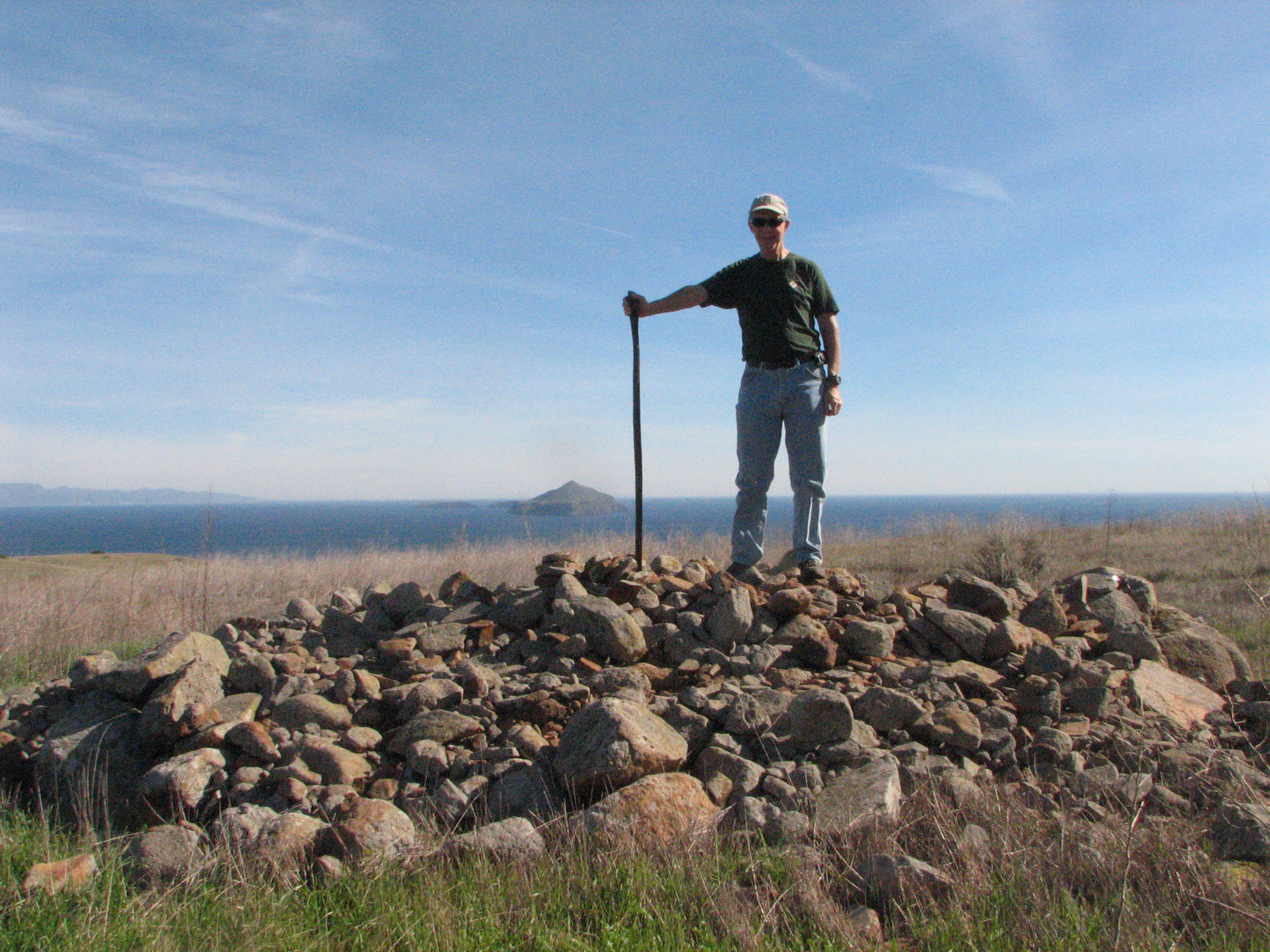
On Santa Cruz Island. Hard to believe 10 million people are right across the water.

On Santa Cruz Island. Hard to believe 10 million people are right across the water.

IMG_3667

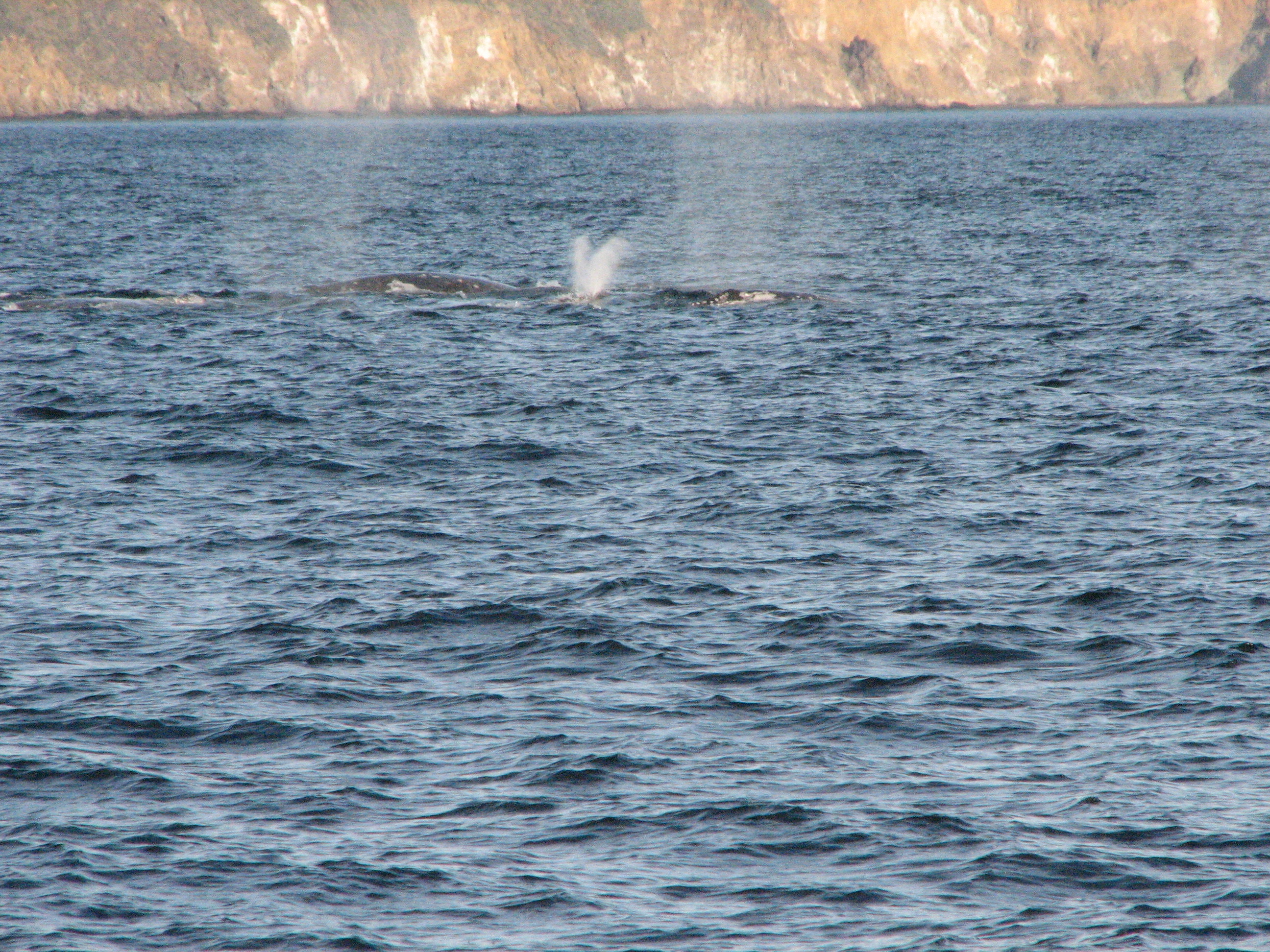
On a big plus side were some whales.

Anacapa Is. from Santa Cruz.

Anacapa Is. from Santa Cruz.

We thought we could easily make the rehearsal dinner that Friday night, but well, the boat bringing us back from Channel Islands was a little late, so we got to the hotel a little late, and check in was a disaster.  The first room had luggage present which wasn’t ours, and when we went back to the reception desk, a good walk in its own right, they looked at us with disbelief.  We did get a second room, except the room card didn’t work.  Back we went.  Bottom line was that we could get into the third room with about as many swipes of the card. We took it.  The hotel was deemed 10 stars; I wondered aloud whether “10” was binary notation.

Somewhere along the line, my observant wife noted both the clock and a Trader Joe’s next door, announcing to me that we weren’t going to the rehearsal dinner.  I had a brief moment of “we can’t do that,” followed by visions of driving in LA on a Friday night, which in my 45 years of driving in several countries, was in the top three for difficulty (Toronto and Cádiz, Spain are the other two). After the “we can’t do that,” came “wow, we could just relax and start the visit early tomorrow morning,” which is exactly what we did.

Saturday morning, we went to the bride’s house, offering our services for whatever she needed.  We weren’t part of the wedding party, but we had a car, which is a total necessity in LA.  My niece desperately needed a few things at a pharmacy and a store, and we got them with no problem.  She was grateful.  I thought that nice, given that what we got was easy to do.  For us, it was.  We then took my sister-in-law (SIL) out for coffee.  That got her out of the house, for which both she and my niece were appreciative, albeit for very different reasons.  We went to a coffee shop for about an hour and a half, and for the then 42 years I had known her, we had the best conversation I can ever remember.  I think the fact I was fairly relaxed, aside from being in LA, and my SIL really stressed had a lot to do with how well things went.

We went to the wedding early.  I hadn’t been looking forward to meeting my SIL’s estranged husband.  I didn’t like him on several levels, not the least was how he had treated her.  He had crossed Jerk Junction so many times that it no longer had a “Stop and Think” sign.  A short time after we arrived, a few older men showed up, and my wife and I went down to meet them.  Sometime after I shook hands with all, my wife commented, “That was xxxx, you know.”

I didn’t.  I don’t have prosopagnosia, or the inability to recognize faces, but I am not exactly good at placing faces on people, especially those whom I have not seen for 16 years.  I hadn’t a clue that I had just shaken hands with the estranged husband, which meant that I treated him like a stranger, which in many ways he was, politely, without giving away my dislike.  Wow, I couldn’t have scripted that better if I had tried.

The wedding went well, and at the dinner, I volunteered to sit between the parents of the bride, her near-ex’s voice booming out loud and clear, as he was the Master of Ceremonies.  It wasn’t a big deal, after all, sitting between the two of them.  I had to deal once with his trying to bring up Navy days, for we both served in very different ways, but I had no desire to talk either to him or about my time in the service 35 years earlier. I ignored him.  I made sure I turned towards my SIL, listening carefully to her and my wife, talking when I could, and somehow getting food into my mouth without looking at my plate, in order to avoid any further interaction with her then-husband.  When husband got up to make a toast, I shoveled food into my mouth.  The rest of the time, I kept the two of them away from each other, possibly avoiding a scene. When things were winding down, we left, got back to the hotel, and were on the road early the next morning, eastbound to the Colorado River and Arizona, LA in our rear view mirror.  Mac Davis in reverse, for those who go back to 1980 in their music.

We weren’t at all important in the wedding party.  Yet, I have fond memories of what I did that day.  We were the two most relaxed people present.  We had time to run errands, we had time to separate mother from niece, woman from husband, and we made good use of the time.  We did it quietly with no fanfare, no raising of voice, nothing at all.  We were there.

Maybe I was important.  For years, I gave my SIL and our nieces gifts during the holiday season.  The biggest gift I ever gave them, however, was that day in Los Angeles.  Maybe they remember it, maybe they don’t.   No matter.  I do.  Like most gifts, the giver gets a lot back in return.

My SIL still sends me e-mails.  I cringe when they come.  Family.

WHAT WAR? UPON WHOM?

June 11, 2015

A few years ago, many right-wing talk show hosts complained vehemently about a “War on Christmas.”  A few places, trying not to offend anybody, had required “Happy Holidays”.  Others tried to cater to Chanukah and Kwanzaa, as well as Christmas.  Back in the good ‘ole days, when we had Christmas, by golly, men worked, women stayed home, with 2.3 children, all the dirty dark secrets of everybody, including pedophile priests, remained hidden, and we had a Christian nation.  Back then, smoking and being drunk were cool, blacks were not called that, interracial marriage was a sin (but not interracial sex, as Strom Thurmond did), and gays were thought to be pedophiles.  The good old days weren’t so good.

If there is any war on Christmas, it is the daily financial report in December how sales, and by extension, our economy, are doing. I didn’t think Christmas was about shopping, but I’m not a Christian, so I may have missed something. Being brought up Unitarian, where in my world people were Catholic, Protestant, or Jewish, Christmas was an important holiday, even for kids, for while it meant presents, it also meant caring for those less well off and peace on Earth.  Unitarians believed we had a social duty to our fellow men during our only existence.

In June, I don’t want to write about a war on Christmas.  I am more concerned about those who say there is a war against Christianity, Christians are being persecuted, fascism is afoot, and this is the first step of Nazi-ism, which is a horribly inappropriate word to use.  I’ve seen Mauthausen, where people jumped—or were pushed (they had only those choices)— to their deaths (“Parachuters without parachutes”) with guards laughing. I’ve seen Stolperstein, the brass plaques on cobblestones, commemorating those who once lived at that place, deported and later murdered. Such comparisons by right-wing Christians are not only wrong, they demean those who died, including 1500 who deliberately chose death by crossing an electrified fence to escape rather than to remain imprisoned.

I’m not against Christianity, only against those who want to live in the 5th…or 19th century.  We are today a more diverse, overpopulated world, the last due in great part to religion’s requiring women to bear as many children as possible.

In addition to Christianity, we have Islam, Judaism, Hinduism, Buddhism, Wiccans, and the most hated group of all, the one group that won’t ever win the presidency in America:  atheists.  The world is not only more religiously diverse, there are those who have a variant of human sexuality, wanting same sex partners.  These people desire to marry, for without marriage, they have no civil rights should one of them become ill.  They do not sully marriage, but they have become hated by so-called Christians, who are supposed to be tolerant of others. It is so bad that some states are outlawing “conversion therapy.”

I have a deeply spiritual side that questions the reason for my existence, the nature of the universe, whether there is a Creator, and is intensely curious about the world.  I believe in the right of people to worship the way they choose, to marry whomever they choose, to live their life the way they choose, so long as it does not infringe upon my right to do the same.  I was against the Iraq war, which Christians started.  Many Americans placed yellow ribbons, with the shape of a cross, on their vehicles, making the war appear like a crusade, the word used by the prior president, later apologizing for a bad choice of words, but not for his bad choice of war.  Instead of “blessed are the peace-makers, for they will be called the Children of God” (Matthew 5:9), we had “shock and awe” (Rumsfeld; March:2003).

Too many of these so-called Christians hate blacks, vilify a half-black president, hate Mexicans and Central Americans who come here for a better life.  I don’t blame those who come here for a better life.  I sadly take the realistic approach that America can no longer save the world, either militarily or humanely.  There are things we can and should do, but policing the world and taking in every refugee is a non-starter.  How we go about changing that and remain true to our ideals is a difficult endeavor.  Banning birth control, which the religious right wants, calling women “a different cut of meat,” disallowing abortions when a raped woman becomes pregnant, which even Iran allows, saying a woman’s body can reject a rape-caused pregnancy, shows a profound war on women.  Want fewer refugees, fewer wars? Start with world-wide birth control, equal rights for women, and in two generations, we’d see a difference.

I reject that notion of a war on Christians.  I am against hate, anti-science hypocrites who use things science provides, megachurches, and Republican support, when it comes as a message of hate, intolerance of others, an armed society, make as much money as possible, destroy the environment, and not regulate anything.  They want their prayers in the public domain; politicians must be believers, preferably white, and non-believers are going to hell.  Regarding the latter, Christians, Muslims, and Mormons have all told me I was going to hell.  They all claim to be right, so either 5 billion people are wrong, or the few who think the way I do are right.  If I voluntarily help a students with math problems, teach adults and children how to read, teach English to people in 90 countries without pay, log on to an algebra site and help people with questions, organize and lead hikes, donate to humane societies, volunteer in several environmental organizations, is that not doing good?  One Muslim woman told me I was going to hell, even though she liked me.  She has since said I was the nicest person she has ever known, and her homeland is 99 per cent Muslim. What kind of disconnect is this?  If religion says that people who do good go to hell, then I want no part of it.

How can these Christians not believe in climate change, what we have done to the environment and to humanity?  Not one of the Presidential candidates on the other side admits that the climate has changed.  “God said, ‘Let the earth bring forth living creatures of every kind: cattle and creeping things and wild animals of the earth of every kind.’ ”  Where did it say, “thou shalt increase the extinction rate of species one thousand fold”?  Where did it say, “And thou shall rain fire and horror down upon a country that did not attack you, but whom you convinced your people it did”?  Where does it say, “Exponentiate” instead of “multiply,” and why has nobody to my knowledge other than me said, “Be fruitful, but you may multiply by one half or by one”?

War on Christianity?  No. But I am speaking out against those who profess to be Christians but whose behavior is completely counter to the teachings of Christ.  I’m not fighting Jimmy Carter.

I am, however, resisting those who say “God, Guns, and Guts made us great,” for they are cowards at heart, bully others with their weapons, and make a mockery of their God to whom they think they alone have a direct line of communication.