Posts Tagged ‘MATH AND MIKE’

LOOK HOW WE TURNED OUT

October 3, 2014

The other day, I saw this picture followed by a lot of negative comments about American education, including, “We didn’t do this and we turned out good (sic).” (it should be well, an adverb modifying “turned out”, and exactly how well did you turn out?)

What do you think?

IMG_2971

I looked at the picture and commented this is how I do mental subtraction.  A different example:  What is 427-78?  Can you do that mentally by “borrowing”? Perhaps, but with difficulty.   Here is how the above would work: They begin with the premise that subtraction is the difference between one number and another.  To get from 78 to 427, one adds 2 to get to 80, 20 more to get to 100 (22 so far), 300 more to get to 400 (322 so far) and 27 more to get to 427 (349, the answer).  I do that mentally.  I follow a basic mathematical principle:  I TURN ONE PROBLEM INTO SEVERAL SIMPLER PROBLEMS.  It is easier to add than to subtract.  I happen to go from 78 to 100 directly (22), add 327 (349) and am done.

If I do it mentally, I may also subtract 100 from 427 and add back 22.  I can subtract 78 by subtracting 100 (easy) and adding 22 (easy).

The other part of the complaint was that this is how children are learning subtraction.  Yes, but this is the “counting up method,” not the only way to subtract.  I suspect there are other methods taught.  Some children might want to use the borrowing approach; others might want to use the counting up method.  The fact I do it mentally by counting up suggests perhaps my way is easier.  It wasn’t taught back then.

I was disturbed by a comment that said, “I just want my kid to be on a horse and learn his ‘ABC’s’ .”  That isn’t going to cut it in the 21st century.  Math is everywhere; failure to understand math and science, where math is used extensively, will destroy the competitiveness of this country faster than illegal immigration, jihads, and even overpopulation, itself a math issue.  Want to ride the range?  You need to know cost of fencing and feed, cattle price per pound, per cent loss of herd, weather forecast interpretation, taxes, and transportation costs.

The doubling time for money/debt is 72/rate of interest in per cent.  This is a basic rule that everybody should know, but few do.  Borrow money on a credit card?  Invest the money you make ranching?  Need math.*

I could continue with dozens of examples of what needs to be learned by many who weighed in negatively on the above.  We need students to have an open mind and be good critical thinkers.  Most of the comments were poorly written by native speakers.  Good writing matters in the 21st century, as it always has.  Children need to learn how to write and the ability to discern the validity of information on the Internet.  Anecdotes, photoshopped pictures, astrology, and weird notions about the body abound.  California’s water crisis?  Blame it on the silver smelt, rather than poor conservation, limited rainwater harvesting, growing crops where they shouldn’t be grown, climate change, lack of water meters, not making fixing leaks a priority, allowing golf courses in the desert, 30 minute showers, brushing teeth with the faucet on, and not charging what water is truly worth.

Pray for rain?  That is silly.

A problem is I have just used 49 words to summarize, and not completely, the water crisis.  I would need several hundred more to give specific facts on water use for Fresno vs. Tucson, what is going on in the Colorado River Basin, and how much water usage occurs for things we want.  People want “the bottom line”; they are busy.  Just tell them “it’s a damn fish,” and it is all over Facebook with ten thousand likes.

Lack of critical thinking means 2-5 word simplistic solutions influence many: “boots on the ground,” “damned liberals,” “tree huggers,” “climate change is a hoax,” “drones will work,” “less government.”  We live in an extremely complex world; the ability to deal with multiple conflicting issues and make sense out of them is desperately needed in society today.  Do we arm rebels who may some day use the arms against us?  Do we understand that Kurdistan may want to be its own nation in return for helping?  Do we understand that carving out Kurdistan will impact at least 5 other nations?  How many Americans even know roughly where Kurdistan is?  Think defeating ISIS is difficult?  What happens if Hong Kong blows up now? The Ukraine and Gaza?  What about Ebola in the US?  How are we going to deal with extreme weather statistically likely to be due to climate change?  Congress ought to be in permanent session, looking for solutions with the president, doing the country’s work.

Unfortunately, it is getting worse.

America is in trouble when in 2014 we still have climate change debates, Bill Nye the Science Guy is debating the Earth’s age with a creationist, a third of Americans believe in astrology, three-quarters of adults don’t know why we have seasons, 9th graders in one school couldn’t divide 3 into 12 without using a calculator, writing skills have deteriorated, not one high school senior I asked while teaching knew the approximate size of an acre (so how do we teach an acre foot of water?), and a MATH TEACHER could not prove why Celsius=Fahrenheit at minus 40.

I taught English to a 23 year-old woman from Kurdistan, an engineer, who wants my advice whether her government-funded Master’s abroad should be in England or the US.  She is going beyond the ABCs and riding a horse. Europeans are moving ahead on renewable energy; we still are basically stuck on oil.

We will hang on for a while.  We have good universities with a lot of smart, young students in them, and we still have an innovative culture.  Unfortunately, we have tens of millions of students who are not doing well; educational debt and lack of skills will hurt our ability to compete.  Riding the range isn’t going to fund retirement.

I know how to subtract.  I saw immediately what the page showed.  The person who posted it could not, and that disturbed me.  Comments discussing past bad teachers, sympathy that kids today have to learn this awful stuff, and how bad the educational system is speaks to a culture gone awry.  Yes awry.  We are destroying public education then blaming it for failing.  We are creating for-profit charter schools, doing home schooling, where too many parents think they can teach their children or other children, and we disparage science and math, even as the former has allowed me to survive this long to write and the latter has been the foundation of my entire life.

By the way, the tripling time of money is 110/interest rate, 3 strokes on a calculator, although I assume people can divide 8 into 110.  Let’s see: 80 is 10 “8”s, 24 is three more, so 104=13 “8”s.  So it is 13 6/8 years, or 13 3/4 years.  Those who don’t learn math are going to face a world with a lot of locked doors.  Don’t blame me when you retire, poor.  I won’t be around, and it won’t be my fault.  I tried.

How did I turn out?  You decide. I couldn’t compete against the charismatic charlatans who told you what you wanted to hear, rather than what you needed to hear, but that didn’t make me less right.

*The Rule of 72: P=Principal at the end; Po=Principal at the beginning. P=Po exp(rt);  P/Po=exp (rt) and ln(P/Po)=rt.  When P is twice Po, ln (2)=rt; ln 2=0.693.  Change the interest from 0.08 (for example) to 8%, and 69.3=rt.  But 72 is an easier number to use, because it is divisible by so many other numbers, and we use it here.  All one needs to know is that 72/24=3, and the doubling time of credit card debt at 24% interest is 3 years.  The question that concerns me is whether people can divide 24 into 72 in their heads.  They should; it is the number of hours in 3 days.

TIME TO TEACH ABOUT MONEY

July 28, 2014

I saw a Dave Ramsey quotation: “Identify your motivation and your passion.  Find what you’re good at and become world-class in that area.”

The term “world class” is overused, and I think harmful, making average people like me feel they are failures.  Indeed, most of us are average.  World class should apply to Olympians, bicycle riders in Le Tour de France, Nobel laureates, best seller writers, and those young people who competed at the IAAF Track Meet I saw today, a few young people who truly are at the top of what they do.

Mr. Ramsey would have done well to have removed the words and replaced them with something like “the best you can possibly be”.  That is achievable.  World class is not.  In standardized math tests when I was young, I was at the 99th percentile.  That is fine, except that if there were 10 million students, 100,000 of them were as good or better than I, making me hardly world class.

Where Mr. Ramsey does help is with people who hate their jobs and are poor.  Suze Orman does the same thing.  Both are good; both are rich; both are famous and charismatic.  It would be nice to be charismatic, but one has to have the wiring.  It isn’t in me.  What I am wired for, however, is math, and I am very opinionated about what we ought to be doing about it.

Key issues today are student loans, houses underwater, insufficient retirement savings, and too many having to live on Social Security, which it was never intended to do.  A frightening number of people go bankrupt each year, because we have a subpar health insurance and medical care system in this country.  Very few hospitals are “world class,” and saying “Centers of Excellence” does not bring it.  Having been on the medical quality front lines, I think I have a notion of what world class might mean, and we are a long, long way from there at the moment.  But we can address the financial issues that people face.

We ought to be starting early, in the schools.  That won’t cure the problem, but in a generation or two, it would help a lot.  Dealing with finances means dealing with ….uh oh…..numbers and math.  Yes.  If one cannot understand numbers and math, basic math, there is no way one can understand finance.  This means that students must be held back from moving to the next grade until they understand the math necessary for the current grade level.  If that means that we slow down education to a crawl, and people howl, then let it be so.  Let’s do it right, learning one basic lesson of math right away:  if you grade children and adults on certain measures, there will be attempts to game the system and make the person or school look good.  This happened in Atlanta.  If 80% of the students coming to a local community college, which happened in Tucson, have to take remedial math, what exactly were we—and they and their parents— doing for the prior 12 years?

It is time to be honest with math (and other subjects, too).  If students can’t pass basic arithmetic, let’s figure out how to get them to learn enough to pass, not game the system, from the teacher’s side and not play “how clever can I be?” from the tester’s side.  Certainly, we ought to have enough smart people in academics who know what should be mastered at each grade level.  Students are going to need algebra and geometry, too, but basic arithmetic is absolutely fundamental to understanding algebra, and math builds on itself.  Fail at the bottom, and there is no way anybody is going to suddenly jump to the top.  Other subjects build, too, but few as strongly as does math.

What good does it talk about an emergency fund of $1000, if the concept of a thousand is not understood?  Indeed, one of the big problems we face in this country is that few in Congress can comprehend what a billion or trillion is.  Comprehension of these numbers is not easy, but it is both essential to know and may be learned.

Students need to learn about interest, where the formulas come from, then simple rules for remembering them.  Trust me, one will use it.  They need to learn the difference between “the rate of increase” is slowing and “it is decreasing”.  These two are not understood by the majority of students I have taught.  They need to know the difference between an average and a median. They MUST be able to work with multiplication tables automatically.  This cannot be given over to a calculator or be googled.  One has to memorize it.  Learn something well, and it is no longer memorized.  It becomes innate.

I don’t have the answers to learning math.  I do know, however, one place where math would become interesting to students and worthwhile: dealing with finance.  Everybody wants money.  Everybody wants things.  Dealing with money requires dealing with numbers.  Frankly, if we could teach children enough math so that they could deal with basic finance, we’d be way ahead of the concepts we think we should be teaching them.  I could live without teaching many kids algebra if they knew enough division that they knew that 24% interest rates on credit cards led to doubling of debt in 3 years.   If they could multiply by 52, they could figure out how much money they spend annually by eating out once a week.  If they could multiply by $2000, they would know what dollars per hour wages equalled in a year.

This isn’t and should not be America’s goal for teaching math in the 21st century.  We have to go far beyond what I have stated.  But if the millions of kids who can’t make change, can’t comparison shop, don’t know what a mortgage is, or understand the basics of investment can learn to deal with these matters, even on a rudimentary level, we would be a lot better off than we are today.  I would rather see an improvement for millions than wait for perfection that will never come.  No, Mr. Ramsey, these millions aren’t anywhere near world class.  They just need to pass the class of basic material THAT EVERY CITIZEN SHOULD KNOW.

Want kids to understand math?  They need to work with, and understand, numbers.  To me, the best place to start is with finance.

BEING MADE OF STAR STUFF IS SPECIAL: TIME TO ACT LIKE IT

March 5, 2014

13 February 1988, West Anklam Road, Tucson, 6 a.m. I’m standing with an ICU nurse looking at Saturn and Uranus in conjunction, the same longitude in the sky, near the hospital where we worked.  “They’re in Sagittarius,” I pointed to the “handle of the teapot,” noting the bright star Nunki, guide star for the Voyager 2 spacecraft, to pass near Neptune a year later.

“No,” J. replied. “They’re in Capricorn (sic).”

“No, there are the two, and they are in the constellation Sagittarius.”

“But astrologically, they are in Capricorn (sic).” (It’s “Capricornus”)

“Well,” I sighed, “you can say they are in the Big Dipper, if you want.”  This was the last conjunction I would see of the two planets, unless I live to 83.

The Dartmouth Alumni Magazine recently profiled a man, a professional astrologer.  The astrologer  stated  his beliefs; the first thing I do in these “last page” articles is to check the “fine print.”  He left Dartmouth before completing his studies; no reason was given.  That colored my opinion.  Yes, Robert Frost left Dartmouth without finishing, but to paraphrase Lloyd Bentsen in his 1988 debate with Dan Quayle, “You’re no Robert Frost.”

7  December 1972 shot of the Earth.

I’ve posted the above picture before, and it’s worth re-posting.

What month is this?

What constellation is the Sun in?

What are constellations, anyway?

What can you learn from this picture?

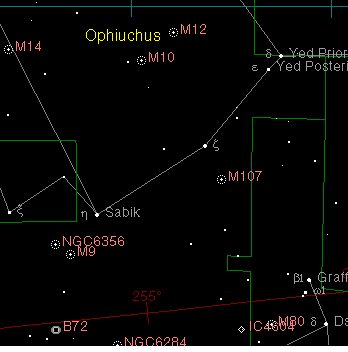
Notice Antarctica illuminated by the Sun, so it must be near the Austral summer solstice.    The actual date was 7 December.  The Sun is in the constellation Ophiuchus on this date, meaning that if one could see the Sun from space, where the light isn’t scattered by air molecules, it would appear against the background stars in that constellation, an arbitrary grouping of stars with arbitrary boundaries, not in Scorpius (the proper spelling) or Sagittarius, the astrological constellation for this date.

Notice the white comma, a major anticyclone, or storm, off the southeastern coast of Africa, and the large clusters of thunderstorms in the southern equatorial region of Africa, consistent with migration of the Intertropical Convergence Zone (ITCZ) this time of year.

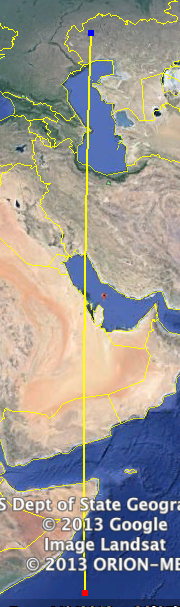
What predictions did the astrologer make?  In 1986, Bank of America was going to have problems.  He claimed he knew by looking at the rocks in the foundation; I would have looked at the internal books as a better foundation.  He said that the 50th degree of longitude, “that bisects the Persian Gulf,” would become a major factor in the world, and that the 35th parallel through the southern US would become very important.

Wow. The 51st meridian (or 27th parallel, another bisector, which was omitted) bisects the Persian Gulf better than the 50th.  Given the Gulf’s importance (he didn’t mention the Gulf of Oman and Somalian coastal waters), this prediction is not surprising.  All degrees of latitude in the US may be important; he omitted Kirtland and Edwards AFBs, near 35 N., but important Los Angeles is not.  What does “important” mean?  A chemical explosion, a nuclear weapon, or a great discovery?

50 E. longitude.  This might be considered important in the coming years.

50 E. longitude. This might be considered important in the coming years. This goes through oil-rich Baku, near Dagestan, through Iran, the Persian Gulf, the Gulf of Oman,  the Horn of Africa, and Somali waters.

I limit my issues about Astrology to four:  first, my “sign” of Sagittarius is defined by my birthday, not the Sun’s location when I was born. There are fourteen (not 12) constellations through the Sun may “travel.”  While it was in Sagittarius on my birthday 3000 years ago, it is now in Ophiuchus, north of Scorpius (the correct spelling).  I have no classical astrological sign.  Astrologers use celestial longitudes to try to deal with this fact, but they haven’t factored in precession; the Sun passes through 14 constellations during a 26,000 year cycle.  In 1991, $10,000 was offered to anybody’s showing the July 11 eclipse of the Sun against the background stars of then astrological Cancer, not the actual Gemini.  No takers.

Ophiuchus.  Scorpius is in the lower right; the curved red line with 255 on it is the Sun's path, 255 being the number of days after the vernal equinox.

Ophiuchus. Scorpius is in the lower right; the curved red line with 255 on it is the Sun’s path, 255 being the number of days after the vernal equinox.

Second, there is no proof why astrology works.  What happened before 1781, when Uranus was discovered?  How can a planet’s position affect us? It can’t be gravity, because I have more gravitational attraction with my car than I do with Saturn.  Gravitational force decreases with the square of distance.  I would like to know the reason using terms that a layman can understand. I practiced neurology, and it was my job to explain what I knew to people, not hide it to make money.

Third, lines of latitude and longitude are dimensionless, so there must be some “wiggle room,” or error.  How much?  Why?  We are 95% confident global warming is occurring.  If we ran 100 simulations, 95 of them would not contain zero.  Where is astrological uncertainty, required for any prediction?

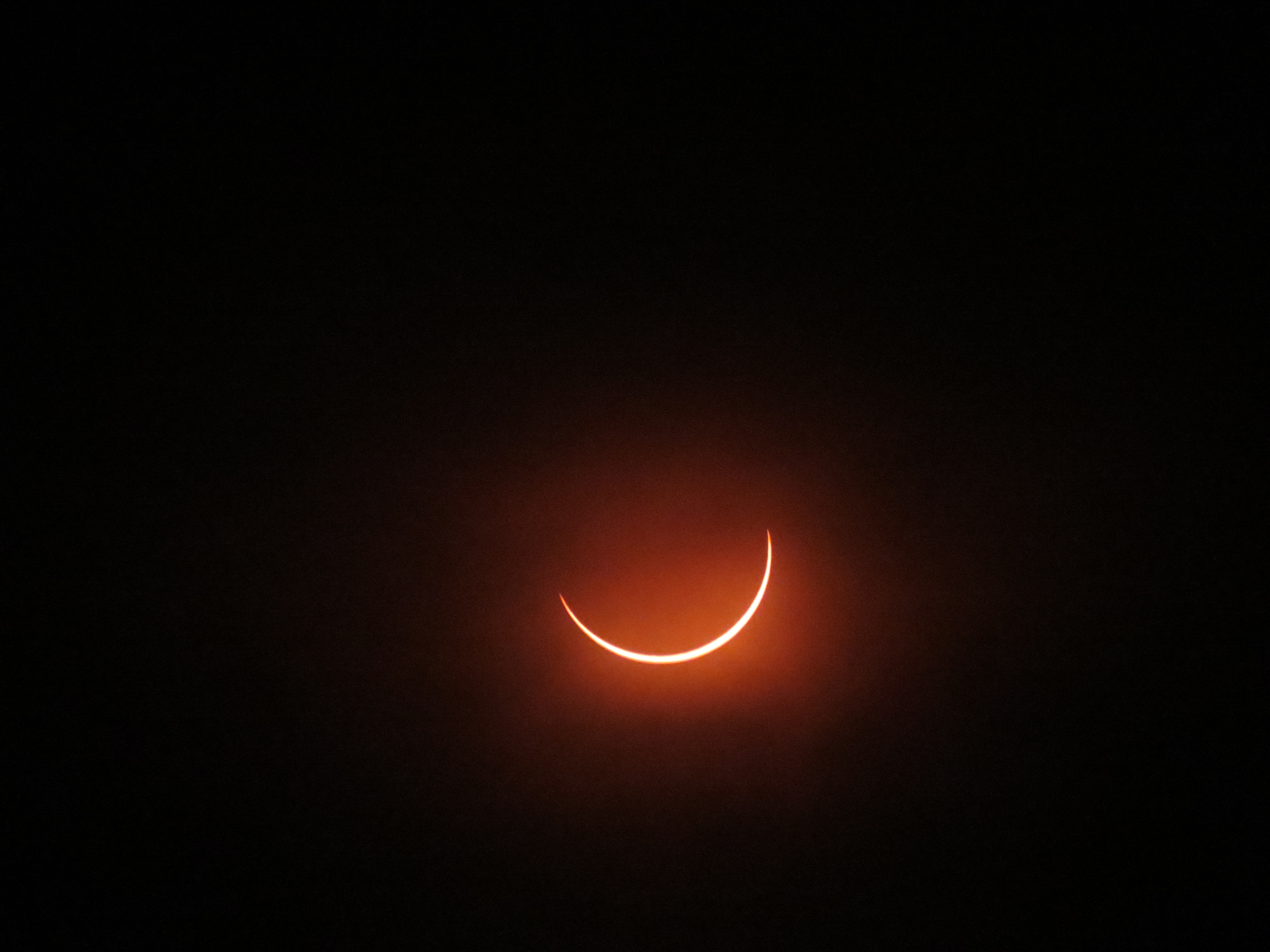
Just after 3rd contact or totality, Uganda, 3 November 2013. We had to be in a path 18 km wide to view 19 seconds of totality.  This path was known decades in advance, because we understand orbital mechanics.

Just after 3rd contact or totality, Uganda, 3 November 2013. We had to be in a path 18 km wide to view 19 seconds of totality. This path was known decades in advance, because we understand orbital mechanics.

Finally, too many never learn the actual sky, far more beautiful and fascinating.  I can tell time, date, and latitude by looking at the sky, and I can teach it.  Why seasons? The poles point in the same direction as the Earth’s orbits the Sun; sometimes they point towards the Sun (summer, more direct Sun); sometimes they point away (winter, less direct Sun).  I can predict full Moons and eclipses of the Sun and Moon; so can anybody, should they wish to learn.  It is science, not vague words.  Science has allowed me to see 20 central eclipses from all over the world.

Contrast that to my horoscope today, “You may want to let go of plans and let your spontaneous personality take over.”   “May”?  Why?  What is “spontaneous personality”?  All “plans” or some?

I once showed a minister the sky.  I scuffed my feet in the desert that night, explaining where the silicon in the sand came from–a star.  The iron in our blood came from a large star that accumulated iron in its core, which cannot be fused.  The star first implodes, gravity taking over when fusion ceases.  The ensuing explosion, equal to the Sun’s energy output during its whole existence, produces heavier elements.  The gold in a ring came from a star.  The magnesium in the pyrrole ring of chlorophyll came from a star, the carbon, nitrogen and sulfur in our bodies came from a star. The calcium in our skull came from a star.

Now, if the contents of that skull could appreciate this beauty, direct efforts towards improving the world, rather than making a buck through magical thinking, our life would be improved on this once-part-of-a-star world.

TIME TO STOP THE DUMBING DOWN OF AMERICA

January 12, 2014

“The dumbing down of America is most evident in the slow decay of substantive content in the enormously influential media, the 30 second sound bites (now down to 10 seconds or less), lowest common denominator programming, credulous presentations on psuedoscience and superstition, but especially a kind of celebration of ignorance.”

Carl Sagan (1932-1996)

Picture of Earth taken in December.  Notice how Antarctica and the Southern Hemisphere are accentuated and that the Sun is shining at a lower angle, therefore producing less heat, in the northern hemisphere.  This is why we have seasons.  The Earth circles the Sun, and in 6 months, the northern hemisphere faces the Sun.  That is why the Sun circles the sky in the Arctic in June. Seasons have nothing to do with distance from the Sun; they have to do with the tilt of the Earth’s axis.  The continent you are looking at is Africa, with the Arabian Penisula at the top.  Notice the comma shaped white areas over the blue ocean.  They are storm systems.   Notice the white over the middle of Africa.  This is the ITCZ, the Intertropical Convergence Zone.  The Sun is so hot at the equator that humid air rises, condenses when it cools in the upper atmosphere and produces thunderstorms.  Notice how there are no clouds over the Sahara, in North Africa.

Image

A financial consultant I know is deeply religious and went to Bible camps.  When his wife came ill with lymphoma, he took her to the hospital where she was put into remission for many years.  While he prayed for her, I found it interesting he took her to a hospital, where she was cured.  Dr. Sagan himself said much as he would have liked an afterlife, the chances as he knew it were zero.

When I was young, I had multiple strep throats.  Had it not been for penicillin, I would have likely developed acute glomerulonephritis or rheumatic heart disease, with subsequent kidney failure and mitral stenois.  I would either be dead or never have seen the world the way I have, by pack and paddle.  Uremia used to kill in the 20s: The sex symbol Jean Harlow died from it at age 26; Sean Elliott and Alonzo Mourning would not be alive today if science had failed to progress.

The dumbing down of America: where people don’t know why we have seasons (note picture above; rocket science got man to that distance) but can tell you what is happening in Hollywood; where rap stars are idolized, but Frances Oldham Kelsey is unknown.  Don’t know her, right?  Well, use science and Google her name.  She did more for this country than any rapper, actor, or artist.  Jonas Salk will probably be unknown in another 30 years.  He kept me from getting polio.  Now, we have to practically force otherwise intelligent people to vaccinate their children, the idea being that vaccines cause autism, rather than perhaps genetics, overstimulation, pollution, our obsession with cleanliness, and maybe even the water we drink and food we eat.

That is the dumbing down of America.  We used to say “UCD” in medical histories, for “usual childhood diseases.”  These diseases were removed, except a bunch of otherwise intelligent (one would hope) parents seem to think that they don’t exist because we don’t see them. These diseases are still out there, lurking, waiting for us to let our guard down.  Pertussis has already made a resurgence.  Pertussis kills.

In schools, we teach math to the tests, rather than to show where it can be useful and fun.  In 2011, I was requested to do a Nature by the Numbers course for a non-for-profit organization.  I did the work, asked for feedback, and heard nothing.  Some time later, I learned that schools didn’t have time to teach this material.  Perhaps if kids could see how knowing the volume of a cylinder determines cubic inch displacement in engines, how land use led to land grant universities, what a section is, what DNA is, what carbohydrates and proteins are, how chemistry and physics work in real life, they might be more interested.  I always teach the use of math when I substitute.  I show where algebra works, I teach why interest on money matters, where exponential functions are used, how quadratic equations are equations of motion of baseballs, footballs, basketballs and projectiles.  I teach about probability, so they learn the chances of winning Powerball are equivalent to guessing one minute, randomly chosen beforehand, since the Declaration of Independence was signed.  I teach them what year it was signed, because most don’t know.  I don’t even bother with teaching them the 50 states, because I’m lucky if they know 10.  I once made a comment about Delaware having the second highest cutoff rate in the nation for National Merit scholarships.  I joked, “I’d be a finalist if I lived in Arizona.”  Well, I have.  I asked the students to name all the states that border Delaware.  That is easy.  There are only three.  One named one.  The other responses were frightening.

I tell them about the 49 countries I have been in, courtesy of science and systems that has made aviation safer.  I tell them about solar eclipses, about wilderness so remote that even their cell phones don’t work.  I tell them about the 49 national parks I have seen, what they contain. I don’t treat kids as dumb, but I am stunned at the mindless guessing and their dependence upon electronic products that are the result of good science, not prayer, not wishing, not falling from heaven.

I teach them about cyclonic circulations in our hemisphere, and how they are necessary to balance the heat of the Earth between the equator and the poles.  Sometimes, I have an opportunity in the woods to show people the right directions, or even predict the weather.  More than one time, the barometer I wear on my wrist, coupled with a new south or southwesterly wind, has told me rain was coming.  In the wilderness, my life depends upon this knowledge.  I can read the sky, day and night.  I know where the Moon will be, where Polaris is, where the Sun will rise, and they can learn this, too.  This is our heritage.

Kids aren’t dumb.  They are curious until we drum it out of them, because we hate to be asked Why? when we don’t know.  In my youth, we had encyclopedias.  Now, we have access to the correct information, but we don’t know how to determine what is correct and what isn’t.

Every kid occasionally ought to be bored.  Every kid ought to be read to and learn to read.  Every kid should sit on the ground somewhere, where there is no asphalt, only natural grass, rocks, sticks, muck, or sand.  Every kid should put his feet in water and learn how to float.  Every kid ought to see the stars from a dark site and understand the phases of the Moon,  which drives the calendars of Islam and Judaism.

At one school I worked at, chess was allowed but cards were not.  Kids couldn’t learn how to play bridge, a fascinating game where bidding is allowed with only with 15 specific words, 7 of which are numbers.  It teaches partnership, politeness, probability, tactics, and when to be aggressive on offense or defense.  I am not very good at it, but the game ought to be allowed in schools, before it dies out, because most bridge players are old.

We allow dumbing down, because science and math aren’t cool.  Next time you use your computer, cell phone, car, wear clothes, shower, take a pill, sleep in a bed, walk upright, and listen to music, remember what brought it to you.  It wasn’t God, and it wasn’t prayer.  It was science.

If you have arms and legs, thank Frances Kelsey.  If you ever think that it is impossible to stand up to big business, thank her again.  If you think that science is only for men, think about her.  But if you are a guy, get busy.  The girls are going to run the world.  That might not be bad, but if you want a decent job, think about science and math.  Chances are very high you won’t be a famous athlete, rock star, or the next Steve Jobs.  I understand probability; too many don’t.

The world will belong not only to those who guess right but to those who adapt to the changes that will come.  You don’t have to be a Steve Jobs.  I found that being myself, adaptable to a changing world, has been a good ride.  I’ve been all over the world, I’ve seen the great wilderness areas, I’ve traveled alone and known solitude, and I have taught myself much.  I’ve adapted, and science has led the way.

I don’t want to die tomorrow or soon, but if I do, I’ve lived a full, interesting life.  I haven’t been a sports or rock star; I’ve been much, much more.

Thank you Jonas Salk and Alexander Fleming.  If you don’t know who they are, then you ought to.  Look it up.  Use science that is in your computer.  Or you can pray for the answer.  I know what I’d do.

BEEN DOING THIS STUFF SINCE I WAS 8….AND YOU CAN LEARN HOW, TOO.

January 8, 2014

A letter came in the mail from Humana, my Part D Medicare Drug Plan,stating my medication, 2 mg pills, was “excessive;” while I would be given a 30 day supply, I would need a letter from my doctor to get more.  I take 2 pills twice daily.  That is 4 *30, or 120 pills per month.

Getting a hardship letter from a physician is difficult. When I practiced, this sort of stuff was the norm.  Some of us did it as part of the job, others charged for it, still others ignored it.  I realize we live in different times.  I wrote off $30,000 annually for bad debts and poor people. In 1984, when Arizona went on the “successful” non-Medicare AHCCCS program, it worked, because we didn’t get paid for “AHCCCS Noncert” patients, but we saw them anyway.  You’re welcome.

I was not going to fight the doctor’s office staff.  I had a better idea.  I went on Humana’s Web Site and found the problem: only 90 pills were allowed a month.  I thought that odd, but Medicare is interested in preventing falls in the elderly.  Being Medicare, they set rules in stone.  Had my colleagues fixed the problem, we wouldn’t need government regulation, but I’ve been saying that for decades and would have had better luck saying it to the wall.  At least, the wall wouldn’t have yelled back at me.  But I digress.

I discovered that the 5 mg pills were restricted to 90 as well, odd, but I could buy them, use a pill cutter and do just as well with 1 1/2 a day.  That would be easy.  So, I went to my doctor’s office and asked for a prescription for 1 pill twice a day, 70 a month, to have a few extra.  I would do the cutting, and I didn’t want the staff to deal with fractions, for people don’t understand fractions and don’t like them, mostly because they were not taught how to deal with them. I should quit digressing.

Two weeks later, I got another letter from Humana stating the same thing, this time about the 5 mg pill.  I was annoyed.  I called their number, and entered a loop that sent me back to where I started.  At least I didn’t hear “Your call is important to us.”

Non-plussed, I called the line for those wanting to contest a denial. While on hold, I called another pharmacy to find I could get what I wanted off Medicare if I paid for it.  Good.  I had Plan B. I wasn’t really contesting the denial, but I soon learn to find the right number to talk to a real person.  I got a guy from Tampa on the line and told my story.  He explained the 90 pills was a precaution against falling.  I knew that. He then said that the pharmacy had given me an 18 day supply of the 5 mg pill, because it was the prescription was written for 4 a day.  I didn’t thank him for the extra pills: 18*4=72, and there is really an easy way to do that in one’s head. I was polite.  I know that, because after the call, my wife agreed.

In other words, I concluded, either the pharmacy or the doctor’s office made an error.  I wasn’t done.  I asked him to look up how many pills I could get of the 10 mg size.  I knew, because when I deal with irrational thinking I ask questions I already know the answer to.  Jeesh, I’m sounding like a lawyer.  That’s worse than digressing.

There was a pause, and then I heard, “120”.  I asked him what he thought about the number.

“I think I better get the clinical pharmacist on the line.”  Good answer. Now I’m having fun.

A few minutes later, I was speaking to the clinical pharmacist and the operator.  Wow, this is great.  I outlined the problem in simple math, since I am after all both a mathematician and a substitute math teacher.  In my last post, I said I was better than average with dealing numbers.  No, I am far better than average in dealing with numbers.  I always counted things; I still have a 1957 diary wherein I counted license plate tabs I saw.  Yeah, I did that stuff when I was 8.

I outlined my issue in simple math I thought an 8 year-old would understand:

“I can get 90  2 mg pills a month, right?”  Both agreed. “So,” I added, “I can take 180 mg a month.”  The pharmacist started saying something about Medicare, but I interrupted her.  Yes, I shouldn’t interrupt; the German verb for it translating literally to “under break”.  Gotta love the Germans for that.

“I know what Medicare says,” I continued.  “I can get 120 of the 10 mg pills a month, right?

The pharmacist and the operator agreed.  I then lay down my royal flush:  “That is 1200 mg a month, right?”

There was dead silence on the line.

I started arranging the Ace, King, Queen, Jack, and Ten spot and said, “So Medicare says I can only take 180 mg a month of the 2 mg size but 1200 mg a month if I take the 10 mg size.  Does that make sense to you?”

The silence continued a little longer.  Almost in unison, I heard, “I think we need to talk to our supervisors.”

I thought that was reasonable.  I doubt anything will happen.  It seldom does.  But once in a while there is real thinking about numbers at high levels of business, numbers that don’t have parentheses around them and lie at the bottom of the page.  Somebody might actually say, “Hey, some old codger from Arizona called and said he could get 1200 mg of this medication if he took one size pill, but only 180 mg if he took the smaller size.  We need to change that.”

“That can’t be true,” will be the reply.  “The codger doesn’t know what he is talking about.”

“But he said that was 6 2/3 x the lower dose.  He did that without pausing.”  Man, I’d pay a C note to be present at that conversation.

That was easy.  Been doing that since I was 8.

The harder part was multiplying the two, just for fun.  The product is 216,000.  It is meaningless, but I did it in my head.  It is not difficult to teach…..should you want to learn the technique.  It’s not like directing Swan Lake, for heaven’s sake.  It’s just working with numbers.  I gave the link.  We read left to right.  Learn to multiply left to right.  You may not have born with mathematical ability, but you can learn this.  I wasn’t born with musical ability, but I sure love to listen to Swan Lake.

Math really matters.

SURELY THE WEAK WILL PERISH, AND ONLY THE FITTEST SURVIVE (Robert W. Service)–MATH THAT OUGHT TO BE TAUGHT

January 5, 2014

I bought a car 10 years ago for $10,000 and financed it at 2% for 5 years, because I could get more on the money by investing it than the loan was worth, much as I hate loans for cars.  The salesman told me the payments would be $250 a month.

“You’re wrong,” I said, in about 3 seconds.

“That’s what the computer said,” he replied, as if he were quoting Genesis or a Sura from the Qu’ran.

“It should be about $190,” I replied.  “Go back and do it again, or I leave.”

He left, and returned, about 5 minutes later.  “Sorry,” he said, a little sheepishly.  “Your payments are $187.”

Was I unusually smart?  No.  Anybody with a calculator can do this.  I just happened to estimate, and I work with numbers a little better than the average person.

Here is my thinking, and notice the simple assumptions I make:  Suppose I pay nothing.  $10,000@2% is $200 of interest a year.  Yes, it is compounded and a little more, but learn to estimate and not worry so much about the damned exactness you need.  There is a time and a place for estimation, and it is being lost in teaching today.  I learned by computing batting averages on my favorite baseball players and by estimating cost per ounce, back when these things weren’t available.  It’s a lost art, and I use the word art exactly as it is meant to be.  I don’t need eight decimal places, like the math teacher who used the calculator to find the tangent of 67 degrees to 8 places, when I gave a decent estimate (about 2.25) in 5 seconds.  It is 2.35.  This isn’t a post about trig, but maybe I should do one on the uses of it, too.

Back to the car.

Suppose I don’t pay for 5 years.  My loan has “ballooned” to about $11,000.  Yes, it is a little more than that, but not much.  Five years,  60 months * $250/month is $15,000, far over $11,000.  $250/month is $1000 in 4 months, and 4 into 60 is 15. 

Alternatively, $11,000/60 is like 1100/6, and I know 1200/6 is 12/6  with two zeros attached, or $200.  The payments must be below $200, and not much.  I estimated between  $180-$190/ per month, and I rounded it upwards.  I saved $750 a year in payments.  Not knowing and using math is a tax that not only the Republicans aren’t going to repeal, by their refusal to fund education adequately, they are ensuring many people pay for it.  That is shameful, but again, I need to get back to the subject.

*****************************************

I listen to the Suze Orman show, often amazed at the financial stories people tell.  The latest was from a woman in Texas who had buried $300,000 in her backyard, and had it there for at least 20 years, because her grandparents had done this.  The woman said, rightly, that interest rates now were near zero.  Suze countered by saying  that the interest on that in the past 20 years would have been $50-60 thousand.

“I don’t think so,” replied the woman.

Based on what?  I wondered.  She doesn’t think so?  This is not a debate about who is going to win the wild card playoffs or the Super Bowl.  This is about pure math, where there is a pure answer.

The average interest rate in the past 20 years has been, by a quick look at a graph of CD interest rates, about 2.5%.  That is the worst possible CD.  It is not what would be gained by a 5 year CD, for example, which would have been at least 4%.

If she puts $15,000 a year away, she will make $375 a year using simple interest, which is not what is paid.  Interest is continuously compounded.  The second year, she has another $15,000, and she now doubles her interest, but that is an underestimate, too, so she has made $1125 in interest.  This now becomes even more in the third year, and the fourth, and so on.  There are online calculators that are fast at computing what she would have after 10 years of doing this at any interest rate you want, any way of compounding, and any way of depositing the money.  Suze was right.  The woman would have made at least $50,000 in interest during this time.

The woman might not “think so,” but she is wrong.  Burying money in a backyard, of course, is a horrible idea, since once it is gone, it is gone.  Survivalists believe big government will take everything; they would do well to worry about little people, like other survivalists, who watch what they are doing.  Survival of the fittest goes to those who are fitter in math.  That is today’s story.

*************************************

Here are a few mathematical rules you need to deal with finance.  They can all be proven, so to say, “I don’t think so,” requires you to show me a mathematical proof why it is not so, not assume that repetition establishes validity, a sadly common approach to things that don’t appear to make sense.  This approach is well on the way to ruining the country, but that, too, is a story for another time.

Rule of 72:  

72/interest rate in %  = years it takes to double money, debt, or any other growth rate. 

72/time it takes to double in years=interest rate in %.  

It is that easy.  Interest rates of 1% double money in 72 years.  Population growth of 4% doubles population in 18 years.  That should be scary, but I’ve been harping on that issue for 40 years with no success.  We have no children, and it won’t likely be our problem when nature readjusts matters.  I do digress a lot when I discuss this stuff.  My apologies.

Rule of 110:  Tripling time.  At 4% interest, money triples in 27.5 years.

Rule of 40:  Halving time, increase of 50%.  30% credit card debt interest rate increases the debt 50% in 1.3 years.

Actual return on a real estate investment:

You buy it for $50,000 and sell it for $100,000 8 years later.  You double your money in 8 years, and 8 into 72 is 9, so you make 9% interest.  Right?

No, wrong.

You buy it for $50,000 and pay $2000 in various fees.  During this time, you pay property taxes of $1000 a year, so your total cost is about $60,000.  Notice how I use the word “about.”  Math is a pure science, but estimation is valuable.

You sell it for $100,000 and pay $7000 in fees.  Your capital gain is $50,000, and let’s say you pay 15% on it.  That is $5000 + half of $5000 (15% is 10% + 5%; 10% of anything is the number minus the last digit.  Five per cent is half of 10, so a capital gain of $43,000 is 10%  $5000 (lose last digit) + half of it $2500, or $7500.

Your net on this is $100,000-$7000-$7500=$85,500

We’re going to do this without a calculator.  The money paid was $60,000 and you got 85,500.   Half of $60,000 is $30,000, and the two added together are $90,000.  True, that isn’t $85,500; the latter is about half as much but not quite, so the rate of return will be somewhat lower than the Rule of 40 will tell me.

Use the Rule of 40.  40/time=interest rate OR   40/interest rate=time

We have time.  40/8=5%, which is higher than the actual rate of return, because we assumed the gain was 50%, when it was in fact closer to 40%.  The actual rate of return is 4.3%, far below the 9% that the real estate people will tell you and in the ballpark of the predicted 5%.  In the real world, where I live, there are things called closing costs, property taxes, insurance, repairs, and capital gains taxes.  They have to be factored in, too.  You may or may not get a tax deduction for the payments.  In my world, I’d get rid of them for second homes or mortgages over $250,000.  But again, I digress.  I do a lot of that, when people ask how we are going to balance the budget.

I can prove all of this using the interest formula.  I know it and used a calculator to check the various rules many years ago.  What I wanted to show here is that estimation can be useful, a calculator may be used for the estimation, should one wish, but one can become very, very close to the actual rate of return, close enough to be useful.  Does it really matter whether the rate of return was 4 or 5% vs. 9%?  You decide. If it does, then use the exact formula.  It works.  But if you want an estimate, you are capable of doing it yourself.

Here’s how to determine good rates of return.  Google “calculator.”  Put in the amount you made and divide it by the amount you paid.

You pay in 80,000 and 6.5 years later you have $100,000.  Enter 100,000 and divide it by 80,000.  Then press the button called “ln” and “ans” and you will get 0.223.  Divide that by 6.5, and that is your rate of return.

Next  press ln and then 2.  You will get 0.693.  Converting decimals to percentages gives us 69.3, and we use the rule of 72, not 69.3, because 72 is evenly divisible by 2,3,4,6,8,9, and 12.

Press ln and 3, and you get 1.098.  Change to percent, and that is where the rule of 110 comes from.  Want the time for 3.5 x the amount of money?  ln 3.5 and you get 1.25.  That is the rule of 125, should you want that.  I showed that to a young man who wanted to be a stockbroker but couldn’t understand why he was learning crazy formulas.  Nobody had ever told him about these rules or the fact with a calculator, you could really do some really neat stuff. He walked out of the room a different person from the one who walked in.

“I don’t think so,” is a bad argument in math.  Don’t use it, unless you know what you are talking about.  Leave it for the social scientists, when we decide whether long term health insurance will save costs, factoring in net present value, likelihood of hospitalization, effectiveness of preventive care, and using multivariate analysis.  There are far more assumptions they have to make, like whether people can really see primary care doctors when they want to, or whether Americans are too impatient to wait and will go to urgent care.  This affects the results, but the math is still helpful.  But for earning power of money, and the cost of debt, learn the rules.  They work.

INTEGRATING LOG X

December 16, 2013

On an autumn day 15 years ago in Las Cruces, New Mexico, I sat in a Math Stats graduate class.  The teacher was discussing some function and came to the part where he said, “Oh, now we have to get the integral of log x.  I can’t remember what that is.”

With that question, my stats teacher had just opened a life changing door that neither he nor I knew existed.  The class, mostly in their 20s and early 30s, was silent.  I was the oldest person in the room, even having four years on the professor.  I quietly said,

“It’s xlog x – x”.  I continued, “you integrate it by parts.”  My classmates and professor looked at me as if Einstein had been reincarnated.

The class moved on to other subjects that day, about which I knew nothing:  moments of functions, and other aspects of beginning graduate level statistics.  I would have many difficulties in the coming 20 months, but that day changed my life, and my teacher’s, too.

He later became my advisor, and said when I left NMSU that it had been a long time since he had enjoyed a graduate student as much as he had enjoyed working with me.  I had a very difficult two years at New Mexico State, but I did pass with a 3.89.  I took graduate level statistics starting at age 49, and I got through the program in two years.  The last semester wasn’t pretty, but I finished it.  My advisor helped me finish in two years, when many stayed longer to finish their thesis.  I was grateful to him for that.

My advisor told me that the day I knew the integral of log x was the day he realized I was for real.  He did not give out praise often.  When I determined the mean and variance for a godawful hypergeometric function using a technique that I was frankly quite surprised I figured out, I showed it to him.  He agreed, and as I walked out the door, called to me: “That was a slick piece of work.”  I remember that as one of the top 5 compliments I got in grad school.

Chance occurrences one might say.  Perhaps.  I have, however  been amazed at how often supposedly “chance occurrences” appear.  I was volunteering in a calculus class when limits of the function: y= x squared, was discussed, when x was 0.999999.  The teacher said, “I need a calculator for that,.   From the back, I stated “no you don’t,” and gave the answer, exactly, to 12 decimal places.  The year before, I had seen that problem, wondered if there were a pattern to squaring numbers that were all 9, found it, and happened to be in the class the following year.

Or the day in a quality improvement course in Salt Lake City, where the discussion centered upon diseases common in “the three Scandinavian countries.”  Without thinking, a major flaw I have, I blurted out, “There are four.”  The teacher looked at me and said, “Name them.”  There was no problem with Denmark, Norway, and Sweden, I suddenly realized Finland wasn’t one, and somewhere from the recesses of my brain, I dredged up “Iceland.”

Why?  Am I unusually intelligent?  No, I am not.  Plenty of people are a lot smarter at many things than I, including math.  What I have learned over the years are two fundamental facts about learning:

  1. If you learn something really, really well, you will eventually forget it if you do not use it.  But if you ever need it again in the future, with a little reading, it will come back quickly.  It doesn’t matter if it is math or playing the piano.  I  had to relearn calculus after 30 years of never seeing a derivative or an integral.  One day, I happened to see the integral of log x, and for whatever reason, it stayed with me.
  1. Know your learning style, which is how you learn best.  Do NOT let teachers tell you,”You don’t have to write this down,” if you feel you should.  Write it down.  Do not let people say that we learn like children or “adult learning theory says…..”  We are not children, and adults have different learning styles, too.  Mine is very different from most adults, and I have struggled a good share of life until I understood what my learning style was.

I am a slow processor.   When a financial advisor explains a trust, a company’s prospectus, or a host of other issues, I cannot understand what they are saying.  I need time.  I understand numbers quickly; finance is a different matter.  I was also an average medical student in gross anatomy.

Being a slow processor, however, comes with a big, big advantage.  Once I learn something well, I keep it forever.  The first time I knew that was in my clinical rotation in surgery when somebody asked me where the nerve that eventually caused tearing left the skull.  “The hiatus of the facial canal,” I stated, and the expression on the surgeon’s face was priceless.  Nobody had answered that question right the whole year.  In anatomy, I was average; the following year, I had the same knowledge I had before, but the fast learners had forgotten it faster.  Both groups have advantages and disadvantages.  It isn’t only fast or slow processing, either.  It is a matter of vision, hearing, touch, taste, and smell–our senses–that help us learn, too.  Some are primarily one, other a combination.  It is useful to know what works for oneself; no, it is more than just useful.  It is essential.\

Education is never wasted, said Moira Gunn, when she was once told that a woman engineer from Purdue should not host a radio show about technology and science.  Today, her “Technation” show is arguably the best show-podcast for science information.  She knew how to interview people, and her life took a direction I don’t think she ever dreamed it would.

Jay Anderson was a Winnipeg meteorologist whose interest in solar eclipses and weather were melded into a climatology page for very solar eclipse.  Every “chaser,” and the number is increasing, knows who he is.  His page is free; the information astoundingly good.  He never would have believed he would be a household name in the eclipse chasing community.  I will be doing ground views of the eclipse path in Oregon the next three years, before the 2017 eclipse. I never thought I would chase solar eclipses; now I am helping a little with the climatology for the next one to cross North America.

Integral of log x? Something odd that you learned that you think is worthless?  Perhaps. Maybe, however, it will be life changing.  Keep your mind open to opportunities.  You can sometimes log a few more than you thought.

CREATIVITY: MUSIC, ART, CHEMISTRY, AND THE ABILITY TO SQUARE A NUMBER MENTALLY THAT NO COMPUTER ON EARTH CAN DO.

December 14, 2013

The other day, I went to a Christmas party held by a financial group who helps me deal with the morass of American finance.  One of the people in the group was a member of The New Christy Minstrals, a group that goes back to “my era.”  I was impressed.  He has entertained in each of the 50 states.

The party was held at an auditorium, and I had no idea what to expect.  I had a 1300 mile drive ahead of me the next 2 days, and I didn’t plan on staying more than a few minutes.

I stayed more than an hour.  Members of the group had made a band, and other employees danced when asked to appear.  It was wonderful.  My advisor was one of the musicians, and he knew the history of jazz and American music from a century ago.  I learned that “Barbecue” was once slang for “pretty woman”.  I didn’t know that.  When I open my mind, I learn a lot of things, which help me become smarter.  A lot of people call me young, but at 65, I am old.  I happen to keep my mind tuned to new things and try not to disparage or remove them from thought because of my preconceptions.

I listened, and I enjoyed.  I listened, and I started writing, in my head kind of writing, things that the music evoked in me.  What I was seeing on the stage did not evoke an article at all.  It just made me think. Five days later, what I saw on stage became, in five minutes, an article.

Writing is a lot like music in that regard.  Musicians sometimes “get a song” in their head and start to write and polish it.  Sometimes, they have jam sessions, feeding off one another.  A solitary writer like me can’t do the latter, but I feed off of what I see, almost never at the time, but days later, when I didn’t even know the initial moment was special.  I happened to see a video on Facebook that showed South American children making instruments from stuff in a landfill.  That reminded me of music,  the advisor  playing it, how I admired his creativity, and I started to write. There is a story in a lot of things in life; sometimes, it takes another story or an incident to trigger them.

I write.  That is creative.  Oh, it doesn’t bring people to the blog very often, but it allows me an outlet, just as much as the guy who plays on a city corner JUST FOR THE SAKE OF CELEBRATING LIFE BY PLAYING MUSIC.  I write for the sake of celebrating life by combining words and punctuation in ways they have never been combined before.

I never looked at myself as creative, because society often defines creativity as music and art.  That is wrong.  Every writer is an artist, and every artist a writer.  Both are creative.  So are mathematicians, statisticians and chemists, too.  Society calls mathematicians nerds, and it is acceptable not to be good at math.  Statisticians ask the right questions and help design (read: create) studies, and chemists create new compounds.  In 1970, I created ortho-phenyl benzhydryl chloride.  It never existed before, except in theory.  I made it.

Tell me, is it not creative to be able to multiply any pair of two digit numbers in my head faster than a calculator?  Is not the ability to do this in three different ways creative?  Is not my ability to have discovered arithmetical tricks that I have never seen in books creative?  Is the fact that I found the pattern for MENTALLY, NO CALCULATOR NEEDED squaring any number that is all 9s*, that no calculator on Earth can do, because it doesn’t have the space?  Or that I can square any three digit number ending in 5, as well, faster than anybody can with a calculator?

I write, because if I write well, I read it over and over again.  Not all my posts are that way, but some are.  Some of my words are so powerful to me, that I tear up when I read them.  That happens with music, and it happens with writing.

Inside all of us is some streak of creativity.  I hated it when somebody said, “We are all musicians.”  No we aren’t.  He was, but I was not.  What he needed to say was, “We are all creative, should we look deep inside ourselves.”  That is true.  We may not make a living at the creativity; my finance guy makes his living dealing with finance, but he makes his life, I would bet, from music.  It defines him, and it shows his celebration of life, just as my writing celebrates part of my life, just as an orthopedic surgeon’s work mending a broken hip celebrates hers, a trucker who knows how to back an 18-wheeler into a small space efficiently celebrates his, or a horse trainer who can without anybody seeing anything being done make a horse do a flying change and a half pass.

These manifestations of creativity have to be seen to be appreciated. I discover that my creativity sometimes lies in areas that I least expect.  I never expected to become a decent writer; I became one.  I never expected to do some of the things I do, such as canoeing all over the North American wilderness.  The ability to maneuver a canoe, to shoot rapids, to put it on one’s head and portage it, making it look so easy that anybody thinks they could do it, ah, that is creativity and the celebration of life.  It’s not a competition, it is a celebration.

Very blessed are those who can make a living from their creativity.  Very human are those who make their lives from their creativity.

9*9=81

99*99=9801    A nine, an eight, a zero, and a one

999*999=998001   Two nines, an eight, two zeros, and a one.

9999*9999=99980001

9 (n times) * 9 (n times)= 9 (n-1 times) 8 0(n-1 times) 1

I found playing the piano difficult.  I found this pattern in about 2 minutes.  Do I make a living from this?  No.  Do I celebrate life from it?  Oh yes I do.


QUANTIFYING UNCERTAINTY IN AN UNCERTAIN WORLD

February 10, 2013

In November, 1958, three boy scouts died on Mt. Wrightston, a 2900 meter peak (9453 feet) that rises 1200 meters from the valley floor.  Mt. Wrightston is my favorite hike in southern Arizona.  I have camped on Baldy Saddle (2600 meters) 5 different times, in snow and hot weather, and I have been to the top another dozen times.  On Baldy Saddle, one has simultaneous views below to the western desert, where Green Valley and I-19 are located, and to the eastern valley, where Sonoita and Sierra Vista are visible.  I’ve been on the summit at sunset, alone, with s spectacular 360 degree view and swifts soaring above me.

The scouts died because they hiked in a warm day, and a sudden cold front hit them, with a heavy early season snowfall.  They died from falling and hypothermia.  Today, this would not likely happen.  Weather predictions would have warned against a heavy snowfall, and the warm weather (“the warm before the storm”) would not have changed a winter storm watch, which today would have been posted.  This scenario is playing out in New England as I write.

Weather models showed that a storm would hit New England on the second weekend in February.  On Thursday night, New England was clear.  But every weather model and weather forecaster predicted that two storms, at the time about 1600 km from each other and from New England, would strike New England the next day.  This is exactly what happened.  This is science helping give people time to get emergency supplies and be prepared.  We aren’t praying our way out of this storm:  it is coming, we know where it will be, and we will have a good idea of how much snow will fall.  There will be some differences from what is forecasted, but the major event will take place, and it is science that is used to make this forecast.  I stress science, because members of the House Science Committee included Todd Akin, of “a woman’s body blocking pregnancy from illegitimate rape” fame, and Paul Broun, who, still present, doesn’t believe in climate change, the Big Bang Theory, and evolution.  He does believe in the pit of hell, for which I have no evidence; I have plenty of evidence supporting the other three concepts.  Broun and others would love to defund NOAA and the NWS, hoping, presumably that their states (Missouri and Georgia) would not be devastated by either tornadoes or hurricanes.  Given their location and climatology, this is not likely to occur.

Indeed, this is crazy thinking, and I can’t put it any other way.  We can predict with high confidence major tornado outbreaks and hurricane landfalls and strength.  To stop funding these organizations is akin to being the Taliban in this country, and I know exactly what I am saying.  Both of these men, in fact, are more restrictive on abortion than is the Taliban, and that is also a fact.  But back to science.

When I practiced neurology, I used to anti-coagulate patients with posterior circulation strokes, because at the time, this was felt to be the appropriate treatment.  It became evident that the consequences of anticoagulation were worse than any potential benefits, and I had to stop the practice.  That is science acting.  I did what I thought was best, and when it did not work, I changed what I did.  Many doctors, when faced with evidence that surgery for asymptomatic carotid artery stenois was more risky than no surgery, still operated.  I took a great deal of heat for my beliefs, but I changed my practice.

A while back, I got into a Facebook argument with someone who did not believe that manmade climate change was occurring.  He asked me to make my case without using models.  Why?  Perhaps it was because this individual was a realtor, and we all know what happened to the housing market, when mathematical models failed to include the possibility that prices might actually decline.  The fact that one is a realtor and not a scientist does not a priori make his arguments specious, but his quoting a magazine that was not scientific and had significant right-wing biases in unrelated articles hurt his case.

The Facebook argument occurred for a short while, before I quit, out of respect for the individual’s “wall” on which I was posting.  I let my “opponent” have the last word.  What he used as “proof” was an 8 year trend line, without regression diagnostics, that showed the Earth was cooling.

Let’s discuss trend lines briefly.  They are regression analyses of scatter plots, data points tracked on two axes.  For a regression analysis to be accurate, one has to assume the residuals, the difference between a data point and the line generated, are normally distributed (have a Gaussian distribution or a bell curve) with equal variance.  Regression requires this.  In addition, there are several other diagnostics one should use, looking at outliers and other aspects of the data.  Nowhere in the article that the person quoted was any of this mentioned.

Why would I not use models?  Statisticians use models all the time; most scientists do.  We model the weather using a variety of weather models.  I find some to be very good; the predicted rain and strong cooling that Tucson has as I write was a significant likelihood to me about a week ago.  I could see the jet stream predictions, and when they held up day after day, I became more confident.

We model the Earth’s climate the same way.  The fact that models may be wrong does not make them a bad idea.  The fact that models differ does not negate the whole concept of modeling.  Models may use different initial conditions and handle variables differently.  They change over time, as new data become available.  What we believe in science changes with time as we get more data.  But climate change models are all trending in the same direction; the biggest area of disagreement is that they appear to be underpredicting what is going to happen.

The classic issue of weather modeling occurs with hurricanes, where there are “spaghetti” models–several–each indicating a slightly different track.  Next hurricane season, follow these tracks from the beginning through the end of the hurricane.  Notice how the uncertainty gradually decreases; indeed, the uncertainty in forecasts is far less than it was 25 years ago.  There is not a weatherman discussing these models who does not allude to uncertainty and multiple possibilities.  The fact that there is uncertainty doesn’t mean the models are worthless and that we know little.  The world is uncertain, including the high temperature tomorrow, although we can quantify the uncertainty very well.

Let me quantify uncertainty a little better, using a common example.  If you throw two dice, there are 11 different sums they may show.  To some people, each sum has the same probability.  Anything can happen.  But if I were betting, I would put my money on the sum being 7, and if I were allowed three different sums, I would choose 6, 7, and 8.  These are far more probable then the others: a sum of 2 has a 1/36  probability; a sum of 7 has a 1/6 probability; 6,7,or 8 has a 4/9 probability.  Roll dice 100 times, and you won’t get these exact numbers, but you will be very close to them.  Roll them 1000 times, and you will be very, very close, but probably not exact.

I believe low probability events are poorly understood by many.  The probability of winning Power Ball is about 1 in 110 million.  If we have 220 million players, we would expect 2 winners.  We might, however, have 0,1,2,3,4,5,6,7 or 8 winners.  But 98% of the time there will be 5 or fewer winners, and there is a 1 in 7 chance that nobody will win.  An individual’s chance of winning, however, YOUR chance, is equivalent to picking a random minute I choose between today and the signing of the Declaration of Independence.  Small wonder some call gambling a tax on those who do not understand math or probability.

In Carl Sagan’s book , The Demon-Haunted World, Science as a Candle in the Darkness, he alludes to one problem that really bothers many religious people about science:  science is often right.  We can pray our kids don’t get polio, or we can vaccinate them.  Vaccination has practically eliminated polio in this country–for now.  I am concerned what will happen when a very large cohort of unvaccinated children here are exposed to the virus, which they will be.  Religion and science really aren’t at odds, but when either is misused, it causes a lot of problems.

I am going to Uganda in November, because on the 3rd, in the late afternoon, there will be a 22 second total solar eclipse.  I didn’t pray for this eclipse, I didn’t read it in any religious work, and I’m not wishing and hoping for it, except for clear skies in which to see it, because we cannot yet predict local weather months in advance.  Climatologically, there is a decent probability, but on the given day, it is quite likely I may not see the eclipse, even though it will take place.

I am alive today because scientists found cures for Group A Streptcoccus, which infected me many times, and I got neither rheumatic fever nor acute glomerulonephritis.  From science came the concept of putting a pin in a femoral neck fracture, so when I broke my hip, an orthopedist could put me back together.  So I could walk.  And run.

And hopefully see a total solar eclipse in Uganda.

DOUBLE STANDARD FOR WOMEN….AND A SCARY LOOK TO THE FUTURE.

October 14, 2012

While substitute teaching recently, I saw a large poster on the classroom wall showing 4 famous women mathematicians.  Two in particular struck me as interesting.

One was Grace Murray Hopper, a Navy programmer until she retired at 60.  She was so important that the Navy recalled her to active duty 4 months later, and she retired for good at 80, the oldest officer serving on active duty in the armed forces and the first woman admiral.  She was instrumental behind the development of COBOL.

Amalie Noether, a German, received her Ph.D. in 1907, but prejudice against women kept her from anything other than volunteer jobs until 1929.  She taught in Germany for 4 years as a full professor, until the Nazis came to power, when she emigrated to the US, taught at Bryn Mawr and worked nearby at the Institute of Advanced Studies at Princeton.

She died in 1935, and 22 years’ of skills were lost to the world due to prejudice against women.  Today’s Germany is far different; I know two physicists whose work is unbelievably good.  I was asked by one to check the English in her Ph.D. thesis.  Imagine, writing a Ph.D. thesis in a second language.  I’ve had a lot of math, but ich war im Kindergarten mit der Mathematik. I received a picture of the X-Ray Telescope she is helping build that will be launched from Baikonur in 2014 to L2, the second (of 5) LaGrangian Point, where the Earth’s gravity equals the Sun’s.

Here in the US, women may flip the ratio of men:women in science and math.  I like seeing a lot of women in these fields; as a past boy, I wonder what’s happened to the guys.  Hopefully, they will return; perhaps the President’s initiative to hire 99,999 math and science teachers (he said 100,000; I will work for free), may help.  We lost too many mathematicians to Wall Street, where some modeled the housing market with the incredibly stupid assumption that prices would never fall.  I once bought into the notion that the stock market always goes up, until I realized we had about 70 years of data.  We have a lot longer and better climate data saying the Earth is warming, but I don’t hear these same people saying the Earth will always get hotter, even as the Arctic ice pack this year shrank far below previous records, worse than experts predicted.  Oh, yes, that appears to have an effect on the jet stream’s waves, which affect ridges and troughs, high and low pressure.  I wonder if the 112th Congress knows that.  I doubt many; one on the House Science Committee believes women’s bodies can fight off “legitimate rape”; another thinks the Earth is 4000 years old.

I don’t worry that we will require women to teach without pay.  No, we will only forbid them to choose how to deal with their bodies.  Make no doubt about it.  The US is well on its way to making abortion illegal, including for rape or incest, which even Saudi Arabia allows, although like prohibition, it won’t be eliminated.  There are coat hangers and now Mexican drugs, which are given by non-licensed people, that will abort but desperate women who take these may bleed to death.

But that’s God’s will, right?  By the way, if you happen to believe that, what happens to the guy who made the woman pregnant?  Was he just “sowing wild oats” and the woman promiscuous?  Just curious, because there seems to be a double standard.  Wouldn’t it be nice if we had DNA testing to find the father?  Maybe, we could give him a choice:  support the baby equally or have him wear a large “F” around his head, for “I fathered a child out of wedlock.”  It could stand for another word, too, the 21st century version of The Scarlet Letter.

What particularly disturbs me, in addition to the lack of care of the unwanted child that is ignored by the far right, many of whom want to dismantle Medicaid (“block grants” sounds better than dismantle, don’t they?), is the assault on birth control, which prevents many unwanted pregnancies and therefore abortions.  I saw this coming, with attacks on Planned Parenthood.  Funding for PP, should Romney get elected, would be removed, and other services, like STD testing, curtailed.    The Church is against birth control, but did nothing about pedophilia for years.  It’s too bad boys can’t get pregnant.  I also find it interesting that the late Strom Thurmond, a racist senator from South Carolina, had a child by a black woman.  Wow, I can be hypocritical, but if hypocrisy were track and field, these guys would be Usain Bolt.

Perhaps I will be wrong.  On the other hand, five readings of The Rise and Fall of the Third Reich and studying the Challenger disaster taught me that small problems may become catastrophic if nobody speaks up.

Mankind is capable of unspeakable horror:  the Holocaust, Srebrinca, Katyn Forest, Rwanda, My Lai, stoning, and Maharashtra (a state in India, where an unwritable-by-me horror was committed upon a pregnant woman, and the perpetrators were not punished).

When a country is coming closer to banning abortion even in the case of rape or incest, what is the next step, forbidding women to have certain careers?  Oh, one says, this won’t happen.  Really?  Why not?  In 1925, Hitler wrote Mein Kampf.  Eight years later, he was Chancellor.

To me, the ultimate irony would be for women and others emigrating from the US to countries where their skills would be welcomed, and their bodies respected.  Think that is impossible?  Then you probably believe the stock market always rises, people don’t need regulation, we should be on the gold standard, the climate is just fine, and that many countries are as strict on abortion as is the Republican platform.  There are only 5: Malta, Dominican Republic, El Salvador, Nicaragua, and Chile.