Posts Tagged ‘Outdoor writing’

EXPLAINING ECLIPSES: MUSIC OF THE SPHERES

June 20, 2017

“Without music, my life would be a lot less enjoyable.  Without science, my life would have ended a long time ago.”   My letter published in Newsweek, many years ago.

It’s a honor to know that I think the same way Neil deGrasse Tyson does about both the night sky and about society’s tacit approval of math illiteracy.

I have spoken to several groups about the upcoming solar eclipse.  Oddly, the largest number to whom I have spoken was not an group of adults but children at “a little school” (the teacher’s comment, not mine) in eastern Oregon.  In an hour, I spoke to all grades, about 100 students, and then in another hour spent time with about fifteen in a class, showing them how to make a solar filter on their own.  The other talks have had fewer than twenty, sometimes under ten.  Last week, I spoke at the LIONS meeting, and despite the microphone’s being near the speaker at one point, making a god-awful noise, one man was asleep right in front of me within 5 minutes after I began.

My solar eclipse talks have been short:  It’s worth seeing totality; protect your eyes and drive safely to and from the event; if you are a first timer, don’t waste precious seconds trying to take a picture.  Then I answer questions, and if the Sun is shining, have people look at it through solar filters.
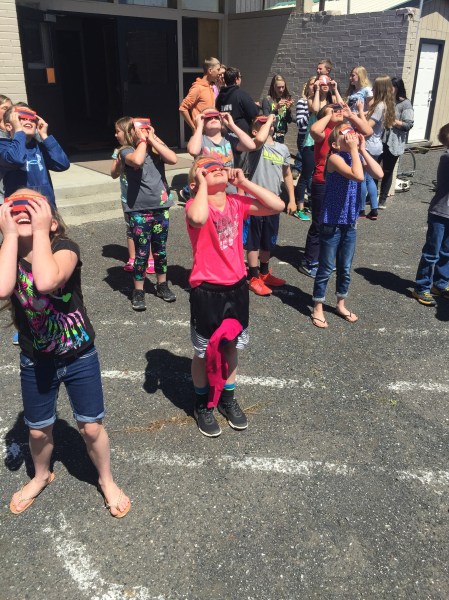
IMG_6316.jpg

Students at Prairie City school in Oregon view the Sun.  The total eclipse will last 2m6s there.

IMG_6526.jpg

Howard Elementary 5th graders in Eugene.

IMG_6324.jpg

Eastern Oregon, 1 hour after leaving Prairie City. My payment for the talk.

I’ve stayed away from the math explaining why a total solar eclipse occurs.  Much of it isn’t complicated, but people don’t like numbers.  On the 2006 eclipse tour to Libya, there were several eclipse talks, and I asked the editor of one of the astronomy magazines why he didn’t discuss the Saros cycle in detail.  His answer was short, “People don’t like to look at numbers.”

While perhaps readers don’t like to look at numbers, perhaps they might learn something interesting by viewing 6 of them.

223 Synodic periods (common lunar cycle we know)=6585.32 days: The Moon has to be new for a solar eclipse to occur.  That lines up the three bodies in one plane.

239 Anomalistic (from perigee, closest approach, to perigee)=6585.54 days; the Moon must be within a few days of its closest point in order to appear to have the same apparent size (we call it angular size) as the Sun. Too far away, and the Moon will appear smaller, “inside” the Sun, a ring or annular eclipse.

242 Draconic (crossing the plane of the Earth’s orbit)=6585.36 days; the Moon must cross the plane of the Earth’s orbit when new in addition to being the right distance from Earth for a total solar eclipse to occur.  Crossing the plane lines up the three bodies in a plane perpendicular to the synodic.

Divide 6585 days by 365.25 days in a year and one gets 18 years 10.3 days, meaning that eclipses repeat.  The 18 year Saros cycle means that eclipses recur, shifted a third of the way around the world, which is what the decimal 0.3 shows, but the same general path occurs on the Earth.  Ancient people without computers knew this, and they didn’t know the math we know today, an impressive feat.

While these cycles aren’t exact, they are so close that an eclipse “family” will continue for some 70 eclipses, give or take about three.  That makes a family last 1200-1400 years before the small changes in many cycles finally fail to allow an eclipse to occur.  I think the resonance of these cycles might be part of the Musica Universalis, the Music of the Spheres, an idea dating at least to Pythagoreas, yes, that guy, that music was part of the movement of the celestial bodies.  If those three cycles aren’t beautiful, one has amaurosis mathematica, math blindness.

It’s not OK to use “I’m not good at math” to explain away inability to calculate basic things in life.  When I taught statistics to adults, I once made the comment that I didn’t care for a lot of jazz, and the class hammered me.  Wow, one would think I was born with a major defect.  I think the idea of people jamming is neat, playing off each other, finding the right beat, the right chord, the right sense; that is special.  I can’t do that, but I appreciate those who can.  What bothers me about math is that people use “not being good” as proud excuses to explain away issues, rather than concerns that they might be losing money, being conned, or missing out on something special in the world.  Without jazz, my life would be less full; without math, I would not have practiced medicine or even gone to college.

If I could learn to play the piano, and I did learn, I think that it is appropriate to say that others should learn to do basic math and like it. An astronomer the other night at the Club spoke how he taught basic astronomy to students without using math.  Everybody thought that was great, including me, until I thought about it a little.  Why leave out math?  By doing that, one fails to show why math is important.  One fails to listen to the Music of the Spheres.  What’s so wrong about showing the difference between an ellipse and a circle, between a parabola and a hyperbola?  You’ve got a satellite dish, and that is a parabola. These four conics all have a square or a quadratic term present, and quadratics are essential to understand energy of motion, gravity, projectiles, tides, how the solar system works, why we should wear seat belts and not drive too quickly around curves.

Maybe if we understood math a little better, we’d realize the number e, yes, there is a number e, used in a variety of places, including continuously compounding interest.

$1 at 8% for nine years, compounded each year $1(1+.08)^9=$1.99; we make interest on interest.

Compound twice a year, it is (1+(.08/2))^18 or1.04^18= $2.025.

We can compound daily (1+(.04/365))^365*18=$2.0543.

We can continuously compound, infinitely, and 1+(.08/n)^nt=e^(.08t)=e^(0.64)=$2.0544; notice where the 0.08 goes.

This infinitely number of compounding times sadly doesn’t give us infinite riches but approaches a limit given by the number e, the exponential.  Interestingly, it is far easier to calculate continuous compounding than it is daily compounding.

Note the close resonance of the product (multiplication) of the interest rate in per cent times the number of years it takes to double money.  That product is 72. In other words, 8 per cent interest  means that debt, money, population will double in 9 years, 72/8.  At 24% credit card interest, debt doubles in 72/24=3 years.  One student once asked me why we learned the formula for compound interest.  When I explained to him how with punching 5 keys on a calculator, he could find that the tripling time of money at 8% interest was just under 14 years, he was stunned.  Divide 110 by the interest rate.

Yes, beautiful, essential, interesting numbers.  Enjoy the eclipse.  Enjoy the knowledge that three cycles are coming together in August the way they did on 20 July 1963, 54 years and 32 days from when I saw this same eclipse family, canoeing in Canada’s Algonquin Park, where I saw the reflection of the solar crescent in Dickson Lake.

Thrice 18 years 10.3 days.


SOLITARY LATE SEASON SNOWSHOE, WILLAMETTE PASS

May 31, 2017

I had no idea what I was getting into when I drove out of Oakridge, Oregon, headed up to Willamette Pass.  I said I was going to snowshoe solo—the first week of May—and while I knew there was snow in the high country, I didn’t know how much or what condition it was in. There is deep wet snow, deep dry snow, and hard packed snow, each of which makes for a very different snowshoeing experience.  I hadn’t yet discovered the list of Oregon Sno-Tels, which are weather stations spread around the Cascades, so I didn’t know what the depths were at various elevations.

I hadn’t believed in winter in Oregon after my first one, when we were doing hikes in the Cascades in early February, and there was patchy snow only above 6000 feet.  That year it was 80 in the mountains in January, and through October Tucson had had as much precipitation as Eugene.  This winter, however, had been different, with a lot of snow even in Eugene, more in the mountains, and I had snowshoed a dozen times, once even in the Coast Range, where snow is not at all common.

I parked the car off on a side road, walked across Route 58, noting the heavy snow in the ski area and nobody there.  I didn’t see a soul.  Indeed, I could have snowshoed straight up the mountain had I wanted to; it was closed for the season.  Instead, I went into the woods to the Pacific Crest Trail to put on my snowshoes.

Once I was on snowshoes, the trail was fine.  Great, as a matter of fact, with hard packed snow in which I didn’t sink.  The woods were quiet, and it took me just over an hour and a quarter to travel 3 miles to Lower Rosary Lake, where I had been two months earlier.  It was still frozen and snow covered, except for a small area of open water at the outlet.  I went around the lake, crossed a divide into Middle Rosary Lake, went around it, looking up at Tait’s Loop and Pulpit Rock high above me.  I had planned this trip to go by all three Rosary Lakes, climb up to Tait’s Loop and loop back to the trail on which I had entered.  Nearly 10 miles, it was an ambitious endeavor, and I was alone, but alone I could dictate the pace.  About this point I told myself this had the chance to be a very special day.

IMG_6270.JPG

Outlet of Lower Rosary Lake, Pulpit Rock upper right (about 6400′)

I am not leading many hikes any more.  I’ve led more than one hundred; only four active club members have led more, and they’ve been around for decades.  I joined just three years ago. Leading hikes has become more work than I want to do.  I run risks soloing into the backcountry.  In addition to the usual injuries one can get, I can at any time have a bout of paroxysmal atrial fibrillation, which I tolerate reasonably well, even being able to climb while hiking. But I’d much rather not have it. I like the solitude, the ability to go or stop when I want, and go places where I wouldn’t dare lead a group.  I did a 23 mile hiking loop solo last fall through an old burn that had not grown back, and it was an ugly 7 hour chore on a hot day.  I won’t do that one again, but on the other hand, I now know what’s out there, which is why I hike and feel an urgency to see as much as I can, sometimes more than once.  What does that country really look like?

IMG_6274.JPG

Upper Rosary Lake

After Upper Rosary, I didn’t see any blue diamond metal markers that were on the trees I passed.  I looked around, wondering if I would have to turn around, but I kept going a little further and saw one.  Then I saw a several day old ski track coming from uphill.  This was well past the ski area and represented a cross-country skier’s track.  Had I been leading a group, I would have looked for an easier way.  I wasn’t, so I went straight up the track.  Wow.  It was a 30% grade for a few hundred yards, meaning I climbed 300 feet per 1000.  After I caught my breath, I pushed further to the top and then headed towards Pulpit Rock, a large landmark.  I knew the trail went west of the rock, and I was northeast of it, so I stayed at that elevation, figuring I would get back on the trail soon enough, and I did.

IMG_6275.jpg

View from Tait’s Loop: Middle and Lower Rosary Lakes (left); Pulpit Rock (right)

Once on the trail, I found a place where I could sit on a log, eat lunch, and look out at Odell Butte, Maiden Peak, Odell and Crescent Lakes, and the frozen Rosary Lakes.  The place was completely quiet, not sunny with a few breaks in the thick stratus.  I finished lunch, enjoyed my views a little longer, then started snowshoeing again on a trail I had done earlier this year.  That way also led back to the ski area and I could return that way if I got into trouble with my navigation.

I didn’t and found a familiar sign showing me where I needed to go.  Unlike the prior time I had been here, this direction seemed right, and at last I was no longer climbing, my 1300’ vertical effort finished.  The loop then split where I had a choice to go to the ski area or back downhill to where I had come in.  The GPS was tracking fine, I could see how far it was until I rejoined the entry trail, and I checked everything with my map, too.  If in unfamiliar territory, I carry a paper map.  GPS batteries can die, and while I consider myself to have good trail memory, I have easily gotten off trail on a number of occasions.  I was doing well on time,  headed downhill, snow soft but not too much so, and the woods continuing to be absolutely quiet, except for my movement.

Within a half hour, I rejoined the trail where I had come in and then realized that something wasn’t quite right, so I turned around and just saw my faint tracks behind me, heading to my right in the hard packed snow.  From here, it was an easy snowshoe slightly downhill, avoiding dangerous tree wells, where one can fall in and get stuck, and continued back to the trailhead.

IMG_6284.jpg

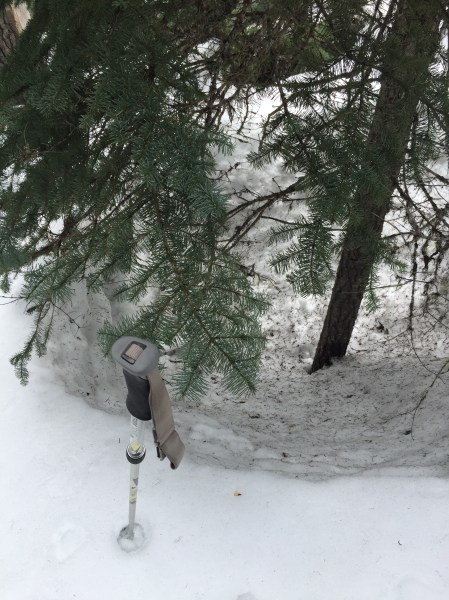
Tree Well. These can be very dangerous should one fall in head first.

IMG_6285.jpg

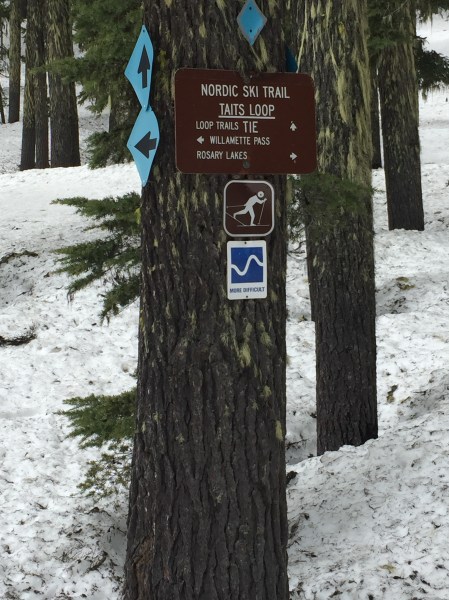
Signed Trail: I went out to the right and returned on the left.

This day was as special as I thought it would be; indeed, it was the best snowshoe I have ever done.  I had studied the loop several times, thought I could do, wanted to do it, put the pack on my back and did it: 9.5 miles, about 2 or 3 more than I ever had before, 1300′ of climbing, and explored a loop that not many do on snowshoe.  Nobody else was out there.  I covered distance, elevation, had great views, good snow, and quiet.  I went out that day thinking I might not even be snowshoeing and would drive right back home.  Instead, it was one of the best winter days I’ve had in the woods.

To qualify as a best day in the woods means I had a dream about doing something, did my planning, and made the dream come true.  To do such in my own way I find extremely rewarding.  I will lead a few more hikes this year, but this hike reminded me why I hike solo: the freedom and the quiet appeal to me.

IMG_6286.JPG

Woods at a lower elevation

IMG_6277.JPG

Middle Rosary Lake with Odell Butte in background.

IMG_6279.jpg

It’s a long climb up from the Rosary Lake below, and that is several hundred feet above where I started by Willamette Pass.

CRANE BEHAVIOR–HUMAN BEHAVIOR

April 14, 2017


Early in my stint volunteering at the crane migration last month, I thought four other guides, all women, disliked me.  For a day, I was unsettled, not certain what was going on, whether it was my issue, theirs, or no issue at all.

I perceived that some were taking control over the tours; since two people lead a tour to the viewing blinds, it’s incumbent upon them to be clear what each person will do, and this wasn’t happening.  To my blame, I wasn’t doing my part, either.  I trained when there was a lead guide and an assistant guide, and there isn’t a distinction any more.  I think there probably should be.  About four or five years ago, I was lead guide when we had to come out of a blind, in a blizzard, cranes in the field behind us, through which we had to walk, but which we didn’t want to disturb, with several very cold clients, and the hour was late.  My assistant was a woman who wasn’t afraid to voice anything with anybody.  I looked at her and asked for her thoughts.

“You’re the lead guide,” she told me straight up, “you decide.”

I decided to take our chance with not disturbing the cranes, and we left the blind, and got everybody to the vehicles, much colder, but now safer.  It was a nasty night out there.  Somebody needed to decide, and I was that person.

What I was seeing this year were guides who were stopping and giving talks, either before going to the blinds or coming back.  I don’t have a problem with this, so long as the clients are getting enough time to see the cranes and we aren’t disturbing the birds.  But I was cut out of the loop.  I was not talking, not being asked whether there is anything I should add, and I had been guiding many more years and times than three of the four women.

I wasn’t comfortable with the situation, and as I analyzed my thoughts, I realized the women weren’t abusing power; they just weren’t talking to me. They might have seen me as trying to assert power and they didn’t like it. They might have thought I didn’t want to talk, I don’t know.  I also didn’t know what these women did outside of their volunteer service, how their health had been, and how they perceived me. Stated bluntly, I was flying blind.

I told myself I had two choices: to stew over this or to learn something about who the women were, as difficult as this is for me, and if I were on a tour with one, make sure the tour ran as smoothly has possible, regardless of whether or not I spoke, and regardless of whether or not the clients perceived me only as a helper.  My job was to make the tour experience good, and I set out to do that.

In the gift shop, I approached one of the women and asked her about her job, which I knew had been with the State Department.  I learned a whole lot more.  She had had an interesting government career, working at the CIA, on The Hill, and finally at the South Asia desk at the State Department.  She went to work each day wondering whether two of the nuclear countries in her purview were going to go to war.  That’s stress.  She loved her job, going each day knowing she was making a huge difference in the world, for her desk covered a quarter of the Earth’s people and half the trouble spots, as she put it. I never guided with her, but I felt less tension working around her when we weren’t guiding, and I approached her with a lot more respect.  With her friend from DC, I didn’t have much contact, but approached her the same way.  The third woman was also from the East Coast and took over the guiding talks before we went into the blinds. One blind was reserved for people who had disabilities, so when we were both assigned to that blind, I offered to drive the golf cart to take the disabled clients there.  I arrived in the blind a few minutes after everybody else after most of the conversation had taken place.  I still had plenty of questions from clients, and the guide even asked me one, which after a little research, I was able to answer.  At the end of the evening, I drove the golf cart back and again missed the conversation the woman had with the clients at the conclusion.  I had helped, I did things that were necessary and stayed out of the way when it was wise that I needed to be out of the way.

I no longer have any great desire to be lead guide, but I do want to take people to the viewing blinds, because I get to view the cranes.  When I began guiding, 7 years ago, I wanted to be lead guide all the time.  I now have nothing to prove, I am willing to mentor, help, stay out of the way if necessary, but always be present if needed.  This third guide was never friendly towards me, but she was never unfriendly, either.  She seemed pre-occupied with personal matters, and I tried to be pleasant without prying. A wise male friend of mine once told me that when you have an interaction with another, you often have no idea what kind of day or life they are having.  It’s worth remembering.  I didn’t go out of my way to talk this woman, but I stopped feeling uncomfortable around her, too.

The last was a local who had more experience than I, who also liked to give talks to the clients.  I found that by taking care of other issues in the blinds, closing certain windows to keep the wind out, fixing one of the windows, making sure the spotting scope was set up, and doing little chores that needed to be done, that I was helpful and a resource during the tour.  By the end of my stay, she and I were having reasonable conversations.  We won’t ever be good friends, but we get along.  That is a big step above being uncomfortable or sullen.  I am a good guide, and I know it. I am working with other good guides, too. My job is to do whatever necessary to ensure the people have a safe, pleasant viewing experience, and I did that.  I do think there needs to be a lead guide, however, and I recommended it.

I’ll be happy to work under the woman who might have stopped a nuclear war in South Asia.  She will know what to do with a sedge of cranes or an unhappy client.


TOO MUCH BRISTLE

April 3, 2017

After leading one of my typical, long, difficult hikes, 16 miles with over 4400 feet of total elevation gain, one of the participants posted his pictures and said he hoped Advil and 12 hours of sleep would help him recover.  A club member, not on the hike, posted back that there was evidence Advil might interfere with his recovery, giving a blog reference.  This is not new information: non-steroidals, like Advil, have been implicated in slowing of recovery, slight intestinal compromise (coliforms in the blood), and effect upon renal blood flow which might be detrimental if one were dehydrated.  The blog link was posted with a comment that the writer, a physician, was still riding a bike in his eighties, “so he must know what he is talking about.”

I bristle at this sort of stuff, because I’m a doctor with a blog, too, and while I’m not riding a bike in my eighties, I’m doing a lot of hiking in my late 60s, and that makes me an expert in….maybe math or eclipses, but not much else.  Just because somebody is an MD and rides a bike in his 80s doesn’t make him an expert any more than a guy who speaks 5 languages can teach them.  Or a former neurosurgeon can run housing and urban development.  Doctors tend to think they’re experts in non-medical fields, too, so be careful what is taken away from my writing.  Let’s be clear.  I’m still hiking because I inherited good genes, and along the way I’ve tried to take care of myself.  The genes matter a lot.  The right genes make Olympic athletes, Tour de France riders, Track and Field champions in Eugene, and decent hikers.  Yes, we all have potential, which we reach by eating properly and training properly, eschewing bad things.  But make no mistake: all the training in the world isn’t going to make me into an Olympic athlete.  Miss a few key alleles, and you end up eighth in the Olympic trials—national class, but not on the Olympic stage, even if you trained harder than the winner.  I could no more run or perform at their speed with any amount of training than I could play the piano well with any amount of instruction and practice.  I tried the piano for three years.  I played in a couple of recitals.  It was good to be able to read and to play music.  But you never found me in an orchestra.  All men and women are created. Equal they are not.

I bristled again when I later read the link to the doctor’s blog, which detailed how NSAIDs can lessen recovery of muscle and hardening of bone with resistance.  The cohort was 90 post-menopausal women who for nine months were given resistance training three times a week followed by Advil.  To extrapolate this study to a 65 year-old man who took Advil once after a long hike—a very different sort of exercise—one time only, is inappropriate, because frankly the implication that he wasn’t going to have benefited from the hike was wrong. I commented on the study, left the comment up for all of 10 minutes and then deleted it.  I like the person writing and didn’t want to get into a discussion about inappropriate extrapolation.  I try to do all the right things in life in hopes that by improving the probability of a good outcome, I will live healthier and longer.  In fairness to the doctor, he did say more research was needed.  He’s right.

The fact that someone in the club immediately stepped in with advice not surprising, not only here, but in most instances where I have been doing group activities. I tend not to give advice unless asked, and even then I’m wary.  Most people neither want it nor take it, and these days there is too much to argue about.  I’m disappointed that many club members belittle my vegetarian diet (which thankfully no longer makes me bristle too much), when their consumption of meat is clearly harmful to both them and the environment.  I continue to be asked how I could possibly be getting enough protein, which I obviously do, or why I shouldn’t eat apple seeds (I eat the whole apple, with an occasional seed.)  It’s not arsenic, as I was mistakenly told, but cyans, which aren’t an issue unless one eats thousands. I’ve been asked how I manage my electrolytes (I don’t; that’s my kidney’s job, and I would be well advised to let them do it). I’ve been told my walking stick will make my legs weaker (really!), why I should have this or that energy/protein/carbohydrate drink, and how much and when I should drink water. I’ve been told to read such and such or such and such, enough to make me wonder how I could hike a 26.6 mile trail last year, set a pace for my partner, and get in 2 hours faster than everybody else, not counting the hour on the trail we waited, drive home that night and wake up the next morning feeling fine.  Genetics. Training for it.  Moving along steadily.  Not arguing about what I ate, using my mouth to breathe and not gab.

It’s easier to hike alone, and I’d do more of it, but there are some women and others in the club who want to do long, difficult hikes and also feel safe doing it, so I lead a few hikes for them. I feel alive by going out there and covering ground, getting deep in the back country, seeing what is out there, which is a lot, and coming out the same day.  If it is 20 miles, I don’t waste time.  If it is scenery, I go hard to get to the right place then enjoy it.  I’m grateful I can do these hikes; I don’t know how much longer I can.  In the meantime, there’s a lot of wild country to explore, far more interesting than discussing Advil, electrolytes, and diet.

My reply:

What sports medicine really needs is to get clear answers to a lot of questions like this, nutrition, and various trainings-du-jour or d’année. There are far too many conflicting studies (fat good/bad, carbo(hydrates) good/bad), protein good always, which it isn’t, especially in women, regression analyses of dubious value that people treat as gold standards (e.g. max heart rate that became a competition when I was on the bike). We need to get away from the idea that if some super star does something, it must be right. Most of them are genetically gifted. (To those who doubt me, I would reply that anybody can do mental math if they just work at it hard enough). As Joe Average, I do what seems to work for me. I try not to take Advil afterward any more, and I seem to be less sore, but that’s hardly a study. 

TRUE FRIEND

March 30, 2017

I got another one of those “copy and paste, don’t share” posts on Facebook from somebody who was trying to send a message against cancer.  I was told that “the true friends of mine” would be the ones who did that.

Initially, I felt the urge to do something.  After all, who among us turns down a chance to be a true friend?  Then the feeling turned into annoyance, and I started to wonder how well I knew this person, whom I do see every week.  It is emotional blackmail, and I don’t like it.  I practiced medicine for 20 years, was in the medical field for about 35, and diagnosed and treated many people with cancer.  I allowed many to die without prolonging their pain.  I lost a brother to esophageal cancer, and I treated thousands of people who had various neurological conditions affected by cancer.  That was my contribution.  I won’t be copying and pasting to my profile. The best message we could send would be to protest the billion dollar cut to the NIH, the current budget of which is the net worth of each of four Waltons. Stated another way, if each Walton donated his or her entire net worth, they could fund NIH for a year. Mathematically, that is a $1000 a second for a year.  That would do more to further cancer research than pasting a post.

I don’t do certain things on Facebook, such as to share whatever somebody tells me. I’ve shared three things in the eight years I’ve been on it.  I don’t put likes on pages where somebody wants a certain number of likes.  I don’t contribute money to undoubtedly good charities when asked; I have my own list.  I don’t post certain pictures, even ones of nature, for somebody’s collection.  I comment where I should and try not to comment where I shouldn’t.  I delete a lot of my comments.  The most likes I’ve had came from a comment I almost later deleted, because it sounded too hokey, about being a third generation American whose maternal grandfather came over from Ireland. I wrote that I while I was proud of my heritage, I was prouder that I served America as a shipboard naval officer, even though I didn’t do much more than fill a billet on an amphibious cargo ship in the Western Pacific for twenty-three months.  Sure, I did two appendectomies at sea, one by myself, probably reassured some on board, and maybe because of my presence a few slept better at night, but it wasn’t like I was “In Country,” that being Vietnam, which I was 25 miles off the coast of one night, but not in a combat role.  Anyway, that comment got 285 likes and a lot of thanks for my service, which I neither wished nor frankly deserved, since most of us had to serve back when I was in my 20s.

I’m not going to be a “true friend,” because true friends don’t ask others to do something to show their friendship.  Someone I call a good friend was chewed out at the hiking club’s executive meeting for having organized the first trail clearing we did after the ice storm devastated the city and the trails. Several of us showed up, including club board members, and we all worked together, nobody nominally in charge.  We took safety precautions, with hard hats, didn’t do things we weren’t comfortable doing, and cleared a lot of debris.

The head of the trail maintenance committee chewed my friend out at a board meeting, without involving me or two others who “led” trail clearing hikes.  That wasn’t fair.  My friend, one who did every hike he could, stopped hiking so much and started hiking in the closed area, since we had already knew what the trail condition was like.  The closed area was filled with dog walkers and trail runners, and the signs stating closure were poorly visible with no enforcement.  The club wasn’t hiking there, but one snowy morning, my friend called me and asked if I wanted to do a “rogue hike,” as he called it, up the mountain.  I was game, so I went by bus as far as I could, he picked me up, we went to the trailhead and up the mountain.  Frankly, it was the best hike I’ve ever done there, and I’ve done it well north of 100 times.  He later posted that I was a “true friend,” and I had I guess a warm feeling, but  I was more in it for myself.  I haven’t quite felt the same about the club ever since.  We did nothing wrong, and while I will participate in hikes and continue leading, both will be much fewer in number.  That’s too bad. I don’t look at some of my other friends there in quite the same light after this event.

There are people I know never read my posts.  No reason they should.  I’ve been unfriended twice, both from Germans; I prefer to block offending posts or offending people without unfriending them.  Each to his or her own; life is too short to argue about such matters.

I just got back from Nebraska where I had the honor, privilege and pure joy to take several hundred people over the space of eight days out to the viewing blinds where they could see the arrival of the Sandhill cranes at the Platte River at night and their departure in the morning.  I’m selfish there, too.  I go to Rowe Sanctuary because I want to see Sandhill cranes.  I get a big charge out of watching 25,000 birds lift off the river, or land that night.  If that means I have to staff the gift shop, clean toilets, or run the information desk, so be it. I will. I like doing those jobs, too. I like to teach, and I can tell people in all three places, including the toilets, why the cranes are there, where they came from, how long they will stay, and where they are going.

Yesterday on Facebook one of my friends said that after viewing my pictures and videos, his wife said they ought to go to Nebraska next year.  I replied that I don’t use the word “should” in the second person, for I find that too judgmental.  I simply wrote that I found the place unique and magical.  No volunteer at Rowe would dispute those two words.  Not one.  Most would add several other terms, like spectacular, mind-blowing, jaw-dropping, or once in a lifetime.  I hope he and his wife come there next year, but I won’t push it, any more than I am pushing people to see totality in August.

Good friends offer information and suggestions when asked, show up when they are needed.  Otherwise, they offer support rather than advice, don’t keep score or quote a price.

IMG_8447.JPG

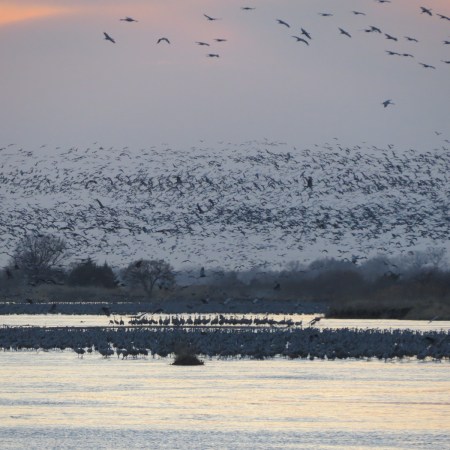
Sunset on the Platte, March 2017.  Sandhill Crane migration.


IMG_5215.jpg

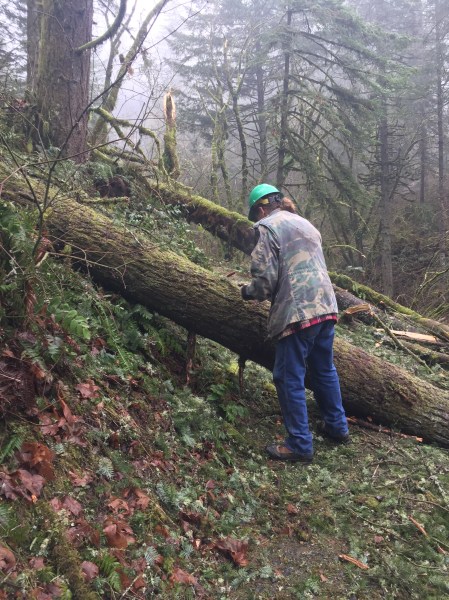
My friend tackling a downed tree after the ice storm.

GO YOUR OWN WAY

March 2, 2017

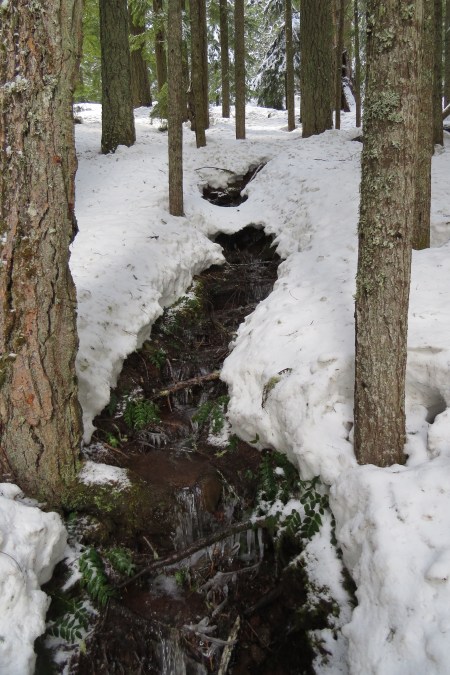
Returning through the woods from the lava fields at Clear Lake, I came upon a lovely seasonal stream that was flowing downhill from a nearby hillside through the thick Douglas fir forest.  I had seen the stream on the way out a few hours earlier and decided I would stop on the way back to look more closely at it.  Had we been doing a loop around the lake, I might have stopped right then, for I’ve decided while hiking that if there is any question I should take a closer look or a photograph, I do it.

The stream had a snow bridge, nice flowing water, and when I looked a little more carefully in front of me, a few icicles as well.  The noise was pleasant, and the knowledge that in a few weeks this place would be dry reminded me how dynamic nature is.

IMG_8229.jpg

Tributary of Clear Lake, Oregon.

I posted those comments, and a good friend wrote that if I traveled more slowly I would see a lot more.  He’s not the first to tell me that, and he won’t be the last. He’s right, in a way. I think many have the sense I go through life in a big hurry and miss seeing things that others see.  Perhaps, it is true.  My father was always in a hurry, and I emulated him.  I have distinct recollections of those times in my life I was hurried to do things that weren’t a rush.  I became a hurried, harried practitioner, and the more I hurried, the less benefit I got from it.  Little I did seemed to me to be soon enough, right enough or timely enough.

What is seeing a lot more?  Why am I out in the woods anyway?  I go my own way, and to me, there is so much to see and so little time to see it.  When I spent the summer of 1992 in the canoe country of Minnesota, I wanted to see every lake I could.  It was impossible, of course, but I got into more than three hundred.  I saw plenty—eagles, otter, beavers, moose, bear—but a big reason that I went was to cover ground or water, lots of it, every day.  It mattered to me.  Why?  It did.  Sure, I could have paddled four miles and found inlets with all sorts of interesting plant and animal life.  Occasionally, I did that, but the long days under pack and paddle was part of fulfilling my need.  I have wonderful memories of the 18 mile day in a cold October rain, where I saw nobody for the fourth consecutive day, a day that took me to Little Saganaga Lake, or the push the following day down to Alice, where I encountered a blizzard, solo, in October.  That trip has stayed in my mind as one of my great ones.  I went six days without seeing another soul.

I did the 26.6 mile McKenzie Trail hike last year, setting a good pace and finishing it in under 9 hours of walking.  The purpose was to hike the whole trail, my kind of hike, and I enjoyed it.  I did the 23 mile Duffy Loop, which carried me through an awful stretch burned over by the B and B fire 13 years earlier, solo.  I won’t go back, but I know what is out there.  There is no blank spot on a map when I look at it.  On the Noatak River, from near the headwaters by Mt. Igepak to Lake Matcharak, I know what that country looks like.  I’ve trod the ground, paddled the water.  I saw a lot of griz, caribou, and even a wolverine.

To me, the hard work, the long distances covered matter.  I have awakened and seen Orion’s reflection on a lake, the sunrise through thick fog, watched a smallmouth jump out of the water with my lure, and watched an osprey dive deep into a lake to come away with a fish.  It all mattered.  Speed on the trail is something I like.  I’m not the fastest, never could be, never would want to be.  I process nature as I go, and I process very slowly.  It is often later when I realize what a special scene I had encountered.  I saw it, and I spent as much time as I wanted to.  Then I moved on.  On the out and back trips, I remember certain areas as special to view, and as I return, the processing primes me for these views.

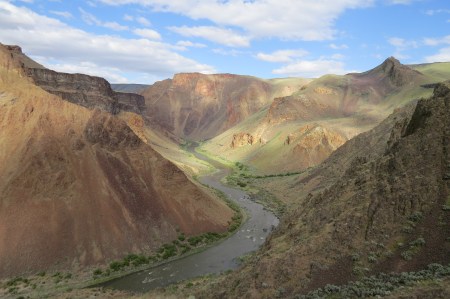
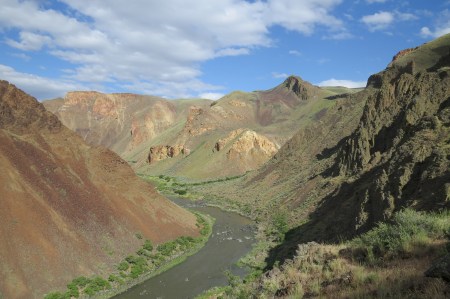
I posted a greatly abbreviated summary of the above, and then realized I needed to continue.  I was on the Owyhee River last year, where distance covered was not under my control, except on day hikes, and one of those I got dropped by a the guide and three other clients.  I realized finally that I couldn’t keep pace, and I didn’t much like the uphill bushwhacking that we did.  I stopped, said no more, and turned towards the river, taking the best pictures I took the whole trip.  Had I kept going uphill, I would have seen more and from higher.  But I went, which is what mattered, and I saw something very nice, by myself.

IMG_7096.JPG

Owyhee River, Oregon

Those who say I miss too much often don’t share the my values.  I don’t tell people what they should or shouldn’t see.  One clear night on the Owyhee, we had an opportunity to see the night sky from one of the darkest places in the contiguous states.  Almost nobody was interested.  I am encountering people who are not interested in seeing the total eclipse this summer, and almost nobody viewed the transit of Mercury that I had in my telescope last May.  These are all interesting, beautiful, and to me special.

IMG_6742.JPG

Transit of Mercury, 9 May 2016; large sunspot in upper center, with Mercury at the 4 o’clock position.

I could go as far as to say that if one is not interested in any of these, one is going through life too fast. But I don’t.  I want others to go through life at their own pace, listening to Nature, listening to the Earth, but listening more to themselves, always learning.

IMG_5809.jpg

Sunrise over Odell Lake, Oregon; 2 March 2017

NASSAU GROUPER

January 16, 2017

In nature there are neither rewards nor punishments; there are consequences.                           (Robert Green Ingersoll).

I recently went to Newport, Oregon on a Club Trip, planning to see the king tides, walk a lot, sleep in a yurt, and hike the nearby Drift Creek Wilderness.  I did all that, but the highlight of the trip came hearing Dr. Scott Heppell talk one evening about real biology—at a brewery no less.

The Nassau Grouper is an interesting fish.  Near the top of the food chain, it gets close to divers, not to eat them, but enough in the way where one really wants it to move. That is almost cat-like.  Yes, like some cats I know, they won’t eat lion fish, an invasive, unless it is speared.  And pointed out.  One apparently was over a reef pointing—“bird dog” was the term used—at a lion fish that he wanted speared.  Life is remarkable.

The Grouper has an interesting pattern of breeding.  They have special areas to breed, the same place, right after the first full Moon after the winter equinox, unless the full Moon is before the 15th of January.  Then they wait another cycle.  Why?  Good question.  Somebody needs to answer it.

When they breed, it is an explosion of sperm and eggs in the water, eventually producing fish larvae, and if a hundred thousand fish were involved, it must have been a remarkable sight.  I use the past perfect, because this number no longer exists in the Caribbean.  Indeed, had it not been for the work of a few people in the Cayman Islands and a few researchers like Dr. Heppell, it would never again occur in the Caribbean.

The Grouper breeds in certain small areas, and it isn’t clear why they do.  Unfortunately, when they breed, it is easy for them to be overfished, which has happened.  Equally unfortunate, once a breeding place is overfished, it never recovers.  This happened first in Bermuda, where they acted early—1970s—and have kept a reasonable population.  The US acted in the 1990s and today there is a 1 in 20 probability that somebody diving in the right waters will see one.  It was once ten times higher.

There were perhaps 50 known areas in the Caribbean where the fish bred, including several around the Caymans.  All have almost completely disappeared, the largest off Little Cayman. I have the GPS coordinates and the time when this will occur. The former area at the other end of the island is gone.  About 15 years ago, two men and a boat, just two, pulled 4000 groupers out of the last breeding area in a couple of days’ fishing.  Not having enough refrigeration, the fish were dumped and allowed to rot. That galvanized action. It is amazing how often when things finally rot, something changes.  It’s better than no change, but it would be nice if somehow we could act sooner.

The Cayman government wished to protect this last area, which  had about 1500 fish left. The fishermen objected for three reasons: (1) the fish would replenish themselves from somewhere else, (2) Babies came from somewhere (not stated) and (3) if it were too late, it wouldn’t matter, which I call the end of the world excuse.

The researchers began studying the fish more, and they did exactly what I was thinking while I listened, now with rapt attention, in Rogue Brewery in Newport, Oregon.  There is a monthly talk here, a great idea.  The researchers first tagged the fish to get an idea of numbers.  They marked a certain number of fish, so that when they looked later, once they knew the percentage of fish in the population that were marked, they knew the population.  It’s a good way to estimate; furthermore, the error of the estimate was known, error not a bad thing but a way of saying that different estimates would have certain values, and other values were just plain impossible, which eliminates common statements like, “anything can happen.”  No, anything cannot happen.  The researchers actually implanted chips into the fish to track them.  They studied currents at various depths by placing  sondes at a specified depth to track currents, learning that during the full Moon, the currents did loops.  Why?  We don’t know.  Why are certain places used for breeding?  We don’t know that, either.  But we know a lot more.

We know that the fish don’t swim from one Cayman to another, over a trench 6000 feet (1800 m) deep.  That fact wasn’t known.  We know that because sound buoys at the other Cayman islands didn’t hear these fish.  We knew where the fish tended to live, and it was all around Little Cayman.  At the time of the proper full Moon, we learned they didn’t all go at once to the breeding area.  They went individually, often taking several trips around the island before they arrived.  That last piece of information was important.  It meant that making the breeding area protected around breeding time was insufficient.  The fish were more on the move before and afterwards, and they needed to close the whole island to fishing for four months, where the fish were not so widely dispersed.

As for the comment that fish would be replaced from some other place, that was impossible, for there were no other places left of note in the Caribbean.  Overfishing has consequences; sure, it’s fine to have a job, but too many jobs in areas that aren’t sustainable lead to nobody’s having a job.  It’s sort of like logging. Somehow in all the “job” talk, nobody mentions “fewer children.”  Maybe that’s because we are stuck on “growth,” when “growth” can’t continue forever. Does anybody think China can grow at 8% for the next century?

Spearing fish was banned, along with limiting diving.  The fish weren’t coming from anywhere else.  Once the fell below a certain population, they stopped breeding.  They’re gone. No more job.  Once the fish are gone, work is gone. The researchers also learned that the fewer the fish, the more time they spent in the breeding area, and the higher their risk.

There was, however, good news in all of this.  The numbers have actually risen the past few years.  Mind you, they aren’t great, only about 2500 now in the breeding area, but they aren’t 500, either, and this increase had never been documented previously.  We have some understanding of their life cycle and biology, and the Cayman government not only continued the ban until 2019, they have written legislation citing the biology known.  The Caymans have become the model for how to manage a fish.  It’s a shame it took several thousand rotting fish and overfishing to make this change, but at least it was changed.  Whether the fish ever return to the area where they were before is not known. The fish do check out the old site near breeding time, but none has gone back there to breed.  If that ever becomes a breeding spot, it would be marvelous.

Doing the right thing has consequences.

A TIDE IN MY AFFAIRS

January 6, 2017

Warning: This post will contain some mathematical formulae and terms, which may scare or otherwise turn off some.  I hope such formulae do not detract from the beauty of what will be seen, because indeed, mathematics is beautiful.  It answers questions.  Is that not beauty?  In a week, pictures of the result will be shown.

I’m going over to Newport, Oregon next week to see the King Tides, something I had once never heard of.  I am almost a true Oregonian, but when I led a trip to the coast the last week, I forgot to look up the tides. That’s inexcusable.  Always know the tides when you are at the ocean.

Tides matter.  A lot.  In nature, many species thrive at border zones between one ecosystem and another.  They allow for organisms to live in varying degrees of wetness, rather than always wet or always dry.  They allow for tidal pools to become cut off from the ocean, where periodically they get refilled or organisms shuffled.  Without tides, the Earth would be a very different, far less diverse place.

What are tides, anyway?  They are common throughout the universe.  If one object tugs on another, it can deform the latter due to gravitational attraction, which may cause buckling or movement of the surface of the attracted object.  Jupiter’s moon Io gets tugged by massive Jupiter, causing volcanic eruptions on its surface.  The first was spotted by a woman, Linda Morabito, who saw a plume on Io, which had been once thought once to be dead, then had volcanism predicted.  Io is the most volcanically active place known in the solar system.

Both the Sun and Moon tug on the Earth.  While the Moon is much smaller, a mass 1/27,000,000 that of the Sun (mass is the amount of “stuff” something has; weight is the effect of gravity.  Diet removes mass; being in zero gravity does not, but it makes you weightless), the Moon exerts a majority (55%) of the tidal activity on the Earth.

For a long time, that 55% bothered me, because gravitation is proportional to the product of the masses but inversely proportional to the square of the distance, the distance between the two centers, or d, and the numbers didn’t work.

F=G m1 m2/d^2.

where G is the gravitational constant, m1 the mass of one body, m2 the mass to the second, and  d^2=d*d, the distance between them multiplied by itself.  The Moon is smaller, less massive, but it is much closer than the Sun.  Still, if one compares the large mass of the Sun with its admittedly larger distance from us (400 times further from the Moon, and the distance varies, which is important), the Sun ought have an effect 170 times greater than the Moon upon us.  It doesn’t, and that bothered me.  I show this below.  Gravity is the reason we circle the Sun and not the Moon; the Moon circles both of us.  I did not consider tidal forces, those which work differentially on a body, more on the near side than the far side.  These Ah-hah moments are one of the joys of life, when one understands a concept that has been murky for years.

The Moon tugs on the Earth, the oceans are pulled towards the Moon. Tides are maximal in general when the Moon is either overhead or at the opposite side, although that can vary considerably due to other factors and local conditions, which give rise to enormous tides at the Bay of Fundy or tidal bores on Turnagain Arm in Alaska.  The tide is greater (spring tides, nothing to do with the season) when the Moon is lined up with the Sun and the Earth, occurring about every 15 days, and lesser (neap tides) when the Moon is not aligned.  The square of the distance means that anything decreasing distance increases the tide, so when the Moon is close to us, which happens every 27.5 days, even not well aligned with the Earth and Sun, the tides are significantly affected. The Earth is 3 million miles closer to the Sun in early January compared to early July, and this increases tides as well, because while the Sun’s force is slightly less than the Moon’s, its distance from us is the least for the year. That’s why we’re going to Newport.

In Newport, king tides occur at full Moon in January, near perihelion.  The full Moon is opposite the Sun, meaning that it is in the northern part of the celestial sphere, over the northern hemisphere, and therefore is closer to the coastal cities there.

I also didn’t know why the Moon had a greater pull, given the gravity equation.  The numbers didn’t work. I thought—incorrectly— it was all gravity.

The tidal force looks at slight changes in the distance between the two bodies; the force is proportional to the cube of the distance between the bodies, d^3, or d*d*d, and a simplified proof is shown below.  Cubes are volumes, and the three factors are length, width, and depth.  When we compare the gravitational equation using the cube of the distance and twice the mass product, the Sun is responsible for about 45% of the tidal force; the Moon the rest.

Additionally, the lowest tide is not in January, as one would think, but is in the late spring early summer and at New Moon.  Why?  In May, the Earth is further from the Sun, so the Sun’s pull is less.  But at New Moon, which aligns with the Sun, the Moon is over the northern hemisphere. There are issues with the lunar nodes and the tilt of the Earth’s axis at different times of the year.  Tides are more complex than I thought, not due to simple gravitational pull but to a differential force that must be accounted for. When I go to Newport, I will be watching a 3 meter high tide and the -0.5 meter low tide, both a full meter higher than normal.


F(S-E)=Gm (S)*m(E)/d(S-E)^2. The Sun-Earth gravitational force is proportional to the product of the masses and inversely proportional to the distance between their centers. The same holds for the Moon-Earth.  It also holds between you and your computer, too.

F(M-E)=Gm (M)*m(E)/d(M-E)^2

Let’s take the ratio of the Sun-Moon forces which is dividing the top by the bottom.  Stay with me, because G and m(E) will disappear when we divide, because they are part of both.

Ratio=m(S)/d(S-E)^2 divided by m(M)/d(M-E)^2

When we divide, we invert the divisor, which is the value that is “going into” something.

If we divide 1 by 1/3, we invert the 1/3 and have 1 *3/1 or 3.  One-third goes into 1 three times.

If we do this math, we invert the denominators and have

Ratio=m(S)*d(M-E)^2 divided by m(E)*d(S-E)^2

We know these ratios.  The mass of the Sun is 27,000,000 that of the Moon.  The distance to the Moon is about 1/389 the distance to the Sun.  Let’s call it 1/400.  By the way, in the sky, the Moon is about the same angular size as the Sun, which is why we can just have total solar eclipses. The Sun is about 400 times the diameter of the Moon and is about 400 times further away, so they have about the same size when viewed from the Earth, one of the greatest cosmic coincidences there is.

The ratio of forces is about 27000000/400^2, or 169.  But the Sun is actually less powerful as the Moon in producing tides.  Tidal forces are differential and work differently on one side of the body versus the other.  Tidal forces are not the same as gravitational forces. They work as the inverse cube, not as the inverse square.  A cube here is d*d*d or d^3.  We measure volume when we know three factors—length, height and depth.

The ratio can be done by subtracting the force of the two objects from the front by the force from  the back.  Or, and this is why calculus was invented, we can take the derivative of the gravitational force with respect to the distance, because only the distance is changing, not the masses, and derivatives of constants are zero, making life a lot easier.  Here, we deal with the change of distance.

The derivative of Gm1m2/d^2 with respect to d is -2Gm1m2/d^3.  The bottom line, literally, is a cube, and the differential force for tides is a function of the cube of the distance, not the square.  If we look at the above ratio, we get 27,000,000/400^3 and it is 0.42.  If we use the average figure of 389 times further away, we get 0.46.  Tides are much more complex, but the idea of the inverse cube ratio is why the Moon exerts a greater tidal force on us than the Sun.

A second proof for tidal forces being proportional to the inverse cube of the distance is abbreviated, but goes something like this:

Force of Sun (Fs)= G(SE)/d^2, where G is the gravitational constant and SE is the Sun Earth distance.  We could make it the lunar distance if we wanted to.

The distance is slightly different on the other side of the Earth, so we will call that p.

F(SE-near or s1)-F(SE far or s2)=G (SE)/d^2-G(SE)/(d+p)^2

=G(SE){(1/(d+p)^2)-(1/(d^2)}, d is much greater than p or d>>p.  We have factored out G(SE), which is common to both.

Look at the parentheses, and using common denominator subtraction,

(d^2+2dp+p^2-d^2)/(d+p)^2d^2

=2dp+p^2/(d^4+2d^3p+d^2p^2)

=2dp/d^4,  skipping some steps, since as d gets very large, the denominator approaches d^4,

=2p/d^3

From earthsky.org, which is nowhere near scale but shows where tides come from.

Screenshot 2017-01-06 09.52.28.png

THERE WAS MORE TO BE LEARNED

December 19, 2016

I recently saw a video by the US Forest Service, detailing how six firefighters survived the Pagami Creek fire in the Boundary Waters (BW), their final, fortunately successful stand occurring on Lake Insula, a place my wife and I once knew as well as any person alive.

IMG_1693.JPG

Lake Insula sunset, 2009

IMG_3106.JPG

Where the four firefighters were talking, one year almost to the day after this picture was taken. Notice how  narrow the channel is.  September 2010, Insula.

BOUNDARY WATERS_2007106.JPG

Cold day on Insula, where four years later the four canoeists would paddle for their lives by this site.

The 2011 fire began by a lightning strike in Pagami Creek, a place where canoeists don’t travel.  After being quiescent for a few weeks, being allowed to burn naturally, the fire became more active, and suppression was begun.  The fire made a 12 mile run one day, catching everybody by surprise, including six firefighters, four of whom deployed their shelters on a small island and survived; the other two going into the water by their canoe, surviving first the fire and then hypothermia.  The lessons learned were: “canoeists in the face of a fire may encounter exceedingly strong winds and may swamp,” “shelters degrade when exposed to fire and water,” and “hypothermia is a potential problem for those escaping a fire by jumping into the water.”  Those are all good lessons, but there were far more to be learned.

When the fire became more active, Forest Service personnel in the field were told that the BW would have a “soft closure,” a term that one ranger said she had never heard, meaning, as near as she could tell, people would be asked to leave the woods.  Catchy phrases like “soft closure,” and “tweak the system” are ill-defined and potentially dangerous.  They must be strictly defined.  The woods should be either closed or open.  A campfire ban is clear but if people are told they ought to leave but aren’t required to, there is a mixed message. I have a simple solution: if there is a concern that people would be better off out of the woods, make them leave.

Two men went south, east and downwind of the fire, to check a hiking trail.  They were told the fire wouldn’t be in that area for a few days, but their senses told them that the lighting up of the nearby sky, even if they couldn’t see the fire, was a bad sign.  The wind had changed, and the fire had moved much closer than anybody thought.  Indeed, the two had to run back to their canoes to escape it.  Lesson: fire can move faster than predicted, and in the absence of knowing exactly where the fire is, one should use caution.  

The fact that the men had to go into Horseshoe Lake, unnamed in the video, but clearly the lake referred, in order to help campers close their camp and get back into safer Lake Three, should have been strong evidence to the supervisors that the fire was starting to become far more dangerous.  The campsite was burned; the campers barely escaped.

At one point, a telling comment was made when a firefighter called in and spoke to somebody who was not his supervisor.  The firefighter said that “they” (he and his partner) were uncomfortable with their current supervisor, so for their purposes, they were going to work with the person with whom they were speaking.  Wow.  That is a huge red flag for communication problems.

The next day, the firefighters were told to move further into the wilderness, towards Lake Insula, to move any campers there to the north end of the lake, away from the fire.  They were told they had a few days to do this, and the winds had shifted to the northwest, pushing the fire southeast, away from populated lakes.  I have traveled into Insula over a dozen times.  It is a long paddle with seven portages, and there are no options for safety once one leaves Lake Four heading east, until the middle of Insula.  I was puzzled why people weren’t flown in to do the warning and then picked up later that day.  Again, however, the fire was felt not to be a significant concern.  Lesson: Moving canoeists downwind of an active fire should be done only if there are significant escape routes.

Two women, camped at the last campsite on Hudson Lake, the last lake before Insula, took their  packs across the 105 rod  (525 meter) portage between the two lakes, spending time at the Insula end speaking to their two male counterparts.  All were concerned about the fire, and when some noise was heard, the women went back quickly to get their canoe, basically abandoning their campsite.  It takes thirty minutes to make two trips across the portage, and it was becoming clear to the four that they needed to get on the lake fast, because the first part of the paddle is channels and small islands, shallow water, and offers no protection against fire.  The four were now paddling for their lives, not to close campsites but to get as far east and north as possible.

Two other women moved off Campsite 7 (it was really 8) to escape the fire.  They realized the winds were too high to safely paddle and jumped into the water, using their fire shelter, something to my knowledge has never been done before.

Here are the “10 and 18” (italics are the issues that the firefighters had):

Standard Firefighting Orders

1.  Keep informed on fire weather conditions and forecasts.

2. Know what your fire is doing at all times.

3 . Base all actions on current and expected behavior of the fire.

4.  Identify escape routes and safety zones and make them known.

5. Post lookouts when there is possible danger.

6 . Be alert. Keep calm. Think clearly. Act decisively. (Done right).

7. Maintain prompt communications with your forces, your supervisor, and adjoining forces.

8.  Give clear instructions and insure they are understood.

9.  Maintain control of your forces at all times.

10. Fight fire aggressively, having provided for safety first.

18 Watchout Situations

1.  Fire not scouted and sized up.

2. In country not seen in daylight.

3. Safety zones and escape routes not identified.

4.  Unfamiliar with weather and local factors influencing fire behavior.

5.  Uninformed on strategy, tactics, and hazards.

6.  Instructions and assignments not clear.

7.  No communication link with crewmembers/supervisors.

8. Constructing line without safe anchor point.

9. Building fireline downhill with fire below.

10. Attempting frontal assault on fire.

11.  Unburned fuel between you and the fire.

12.  Cannot see main fire, not in contact with anyone who can.

13. On a hillside where rolling material can ignite fuel below.

14. Weather is getting hotter and drier.

15.  Wind increases and/or changes direction.

16.  Getting frequent spot fires across line.

17.  Terrain and fuels make escape to safety zones difficult.

18. Taking a nap near the fire line.

One of the firefighters said that they were violating nearly all of the 10 and 18.  He was not far wrong.  The bold in the 10 indicate what they did right. For the record, in Arizona’s 19-fatality Yarnell Fire, #1,2 and 4 in the first and #s 1,3,4,11,15 in the second were violated.  Unburned fuel between you and the fire, and cannot see the main fire are big concerns.

The group of four were lucky one of their number had experience on Insula and could navigate the lake, no easy feat. She also had the sense to tape her flashlight to the stern, so the canoe behind her could follow her in the smoke.  The fire traveled faster than canoeists can paddle.  Had the firefighters been a half hour further, had they not stopped to talk, they would have been at the east end, where they could have moved north directly away from the fire.  They of course had no way of knowing that the fire would do what it did.

Other lessons I would offer:

When several things seem to all be going wrong, recognize that you might be on a downward spiral (the words used here), regardless of what you might have been told. In neurology, my field, meningitis was so scary that when I argued with myself or others about whether we needed to do a spinal tap for diagnosis, not a difficult procedure, I did it. Perhaps that analogy could be applied here: when firefighters start arguing pros and cons of shelter deployment, just deploy. When you argue about whether or not to close campsites, just close them. Again, my deepest, deepest respect to these six and for all who put their lives on the line. I loved Insula as it was, but it wasn’t worth putting their lives at risk.

My final lesson here: time is one of the most valuable commodities in the woods. Use it wisely. 


Related

Plus


WHY WE SHOULD CARE FOR EVERY AMERICAN’S BIRTHRIGHT

November 24, 2016

Last May, deep in the Owyhee River Canyon in southeast Oregon, I held an Obsidian spear tip in my hand. Then the guide took it back and placed it high on a tree branch so that the next group of rafters he took down the river would be able to see it.  Obsidian and other artifacts in the nearby caves had been looted, and nothing remains. Had the tip been put on the ground, somebody would have picked it up and kept it.

IMG_7042.JPG

Obsidian point, still down in Owyhee Canyon

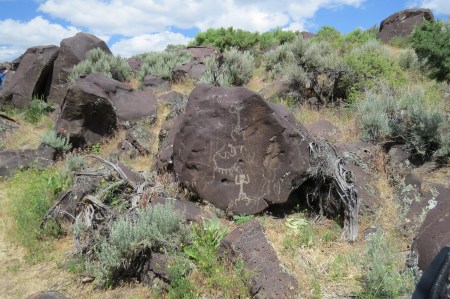
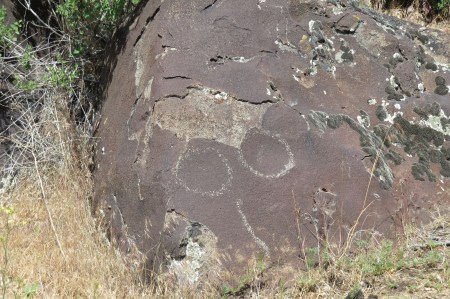
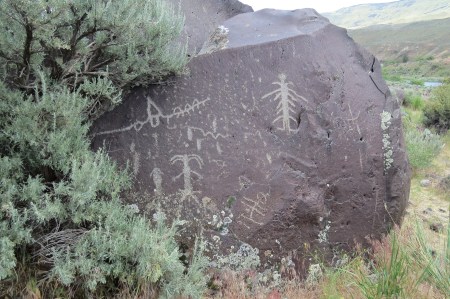
A day later, I saw a field of boulders with petroglyphs, wondering as others have wondered, what they meant.  In ancient times, some were defaced to rewrite history, but far too many, a few dozen, showed scars from petroglyph vandalism, sold for profit, forever lost from view. The scarring was ugly, detracting from what should have been a sacred site.  Instead, somebody profited greatly.  Maybe I should be grateful: so far, they haven’t had gang vandalism, often called “tagging,” as if such were a game instead of wanton desecration.

IMG_7078.JPG

Petroglyphs

IMG_7080.JPG

Defaced

IMG_7081.JPG

Rewriting history

IMG_7084.JPG

Removing history

IMG_7083.JPG

Allowing one to wonder

I often stood high over the cliffs of the Canyon and marveled at the views, watching out, of course, for cow pies, since it is possible to graze cattle on public land for a pittance, but if I happen to hit one of those cows while driving on a public road, I am liable.  Those in rural America often say they know how to care for the land better.  I’m not convinced. They know how to use the land, to be sure, especially for profit. The land knows how to care for the land better.  And some land should be left alone or visited very seldom, with strict leave no trace rules.

IMG_6915.JPG

Owyhee River Canyon, about 20 miles north of Rome, Oregon, with lava and sandstone cliffs.  It is possible to stand inside some of those spires and see the sky.

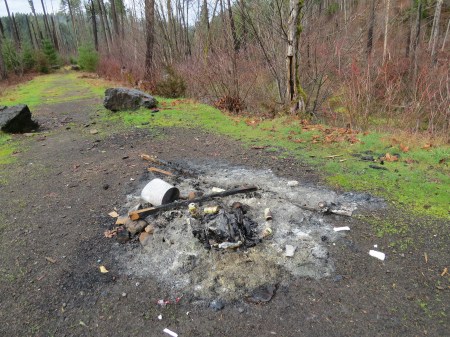
Earlier this year, I hiked Fall Creek, a nearby trail along a beautiful creek with many pools.  At the turn around point, where there was an old road, there was an abandoned fire ring with a pile of trash in it.  This is caring for the land?  Going somewhere, getting drunk, tossing your bottles on the ground, and driving home?

IMG_6171.JPG

Fall Creek trash

Last week, in Umpqua National Forest, I hiked down to the bottom of Picard Falls, a beautiful cataract, and found a Dr. Pepper bottle. Suddenly, the place was less pristine.  No, it’s not wilderness, but why can’t people take out what they bring in?  I brought out the bottle.  I find bringing out trash that somebody left an odious job, but it is one I feel compelled to do. If a place is littered, people tend to litter; if clean, they tend to keep it clean. When I returned to the car, I found a crushed Coors can. The rural folk drink while driving, too.

IMG_7996.jpg

Picard Falls, Umpqua National Forest, Oregon

On the drive over Patterson Mountain on the way home from the Umpqua, I saw a cubic yard of trash dumped on the side of the road.  I will haul out trash, but I have my limits, and so does the trunk of my car.  I doubt this was from a homeless man in the South Valley. The individual was almost certainly male, white, and probably between the ages of 25 and 45.  They voted Republican, because they don’t believe in regulation, big government, or recycling.  They get hurt by Republican policies but still don’t change. A disproportionate number of them died in Iraq and Afghanistan, wars started by Republicans who even they now say were a bad idea. They were devastated by the Great Recession, which also occurred under a Republican administration. The Dow has increased 1.5 fold under Obama.  Unemployment fell. Those are facts, not opinions.

Closer to home, I hike up Spencer Butte from Martin Street every week with other Obsidians.  It’s part of our responsibility to clean up the trail.  Today, I was the hike leader and almost walked by a bagged bit of dog poop. This is not uncommon.  I guess people who do that think so long as they bag the poop, they and their dog have completed their collective work.  Now, it is somebody else’s job to pick it up.  Maybe.  Or maybe an animal will rip the bag open.  I shudder to think of how much dog waste is in the woods, which infects the water with Giardia.

IMG_3470.jpg

Spencer Butte, walkable from downtown Eugene, although one saves time by taking the bus, which runs every half hour.

There are orange peels at the top of Spencer Butte, which won’t degrade, beer cans, clothing someone doesn’t want, and an occasional cigarette butt. I am frankly grateful when someone actually leashes their dog, which is the rule, but which is usually not followed, leading to an occasional dog fight or some dog putting his nose in my pants where I don’t want it.  I have cats, and I don’t want the smell and the germs of a dog in my house. Mind you, I’m not against dogs, for they are dogs. I even spent the money I earned for being executor of my father’s estate—$23,000—to neuter pit bulls in Tucson. What a waste.  No, it is not a dog’s fault to be born a dog.  It is the people who breed them, those who buy the puppies (without an apostrophe which is on the road sign) and don’t train their dog properly whose fault it is.

The idea that people will regulate themselves properly is a fantasy of the Ayn Rand cult. They won’t. I don’t care if it is in the woods or doctors; people won’t self-regulate.  In a perfect world, I’d leave the Owyhee alone, for those who live in Jordan Valley would ensure that the beautiful canyon remain as it is, that residents would carefully make a living from the land by not destroying the special parts, controlling access to the river from Rome and further upstream, the money going to the land.  The community would set its own rules for rafting, such as hauling out all human waste.  Actually, however, the rafting company already does that.

In a perfect world, people would take out all the trash they brought in to the woods, and no littering or dumping would occur.  Dogs would be leashed and all their waste collected and removed.  No dogs would be allowed in the wilderness areas. Campfires would either be at designated spots, or campfire rings would be destroyed after use and the rocks scattered.

For Ayn Rand, it was all about “me.”  For those who care about the land, it is all about future generations.

I know that, and I don’t even have children.

IMG_7095.JPG

Owyhee River Canyon, Oregon