Posts Tagged ‘Outdoor writing’

RESPITE

March 31, 2014

When I volunteer at the crane migration in March, I guide morning and evening.  I like seeing cranes, I’ve learned a lot, and I especially enjoy watching people get as excited as I, at seeing a few, a score, a hundred, or … twenty thousand simultaneously in the air.
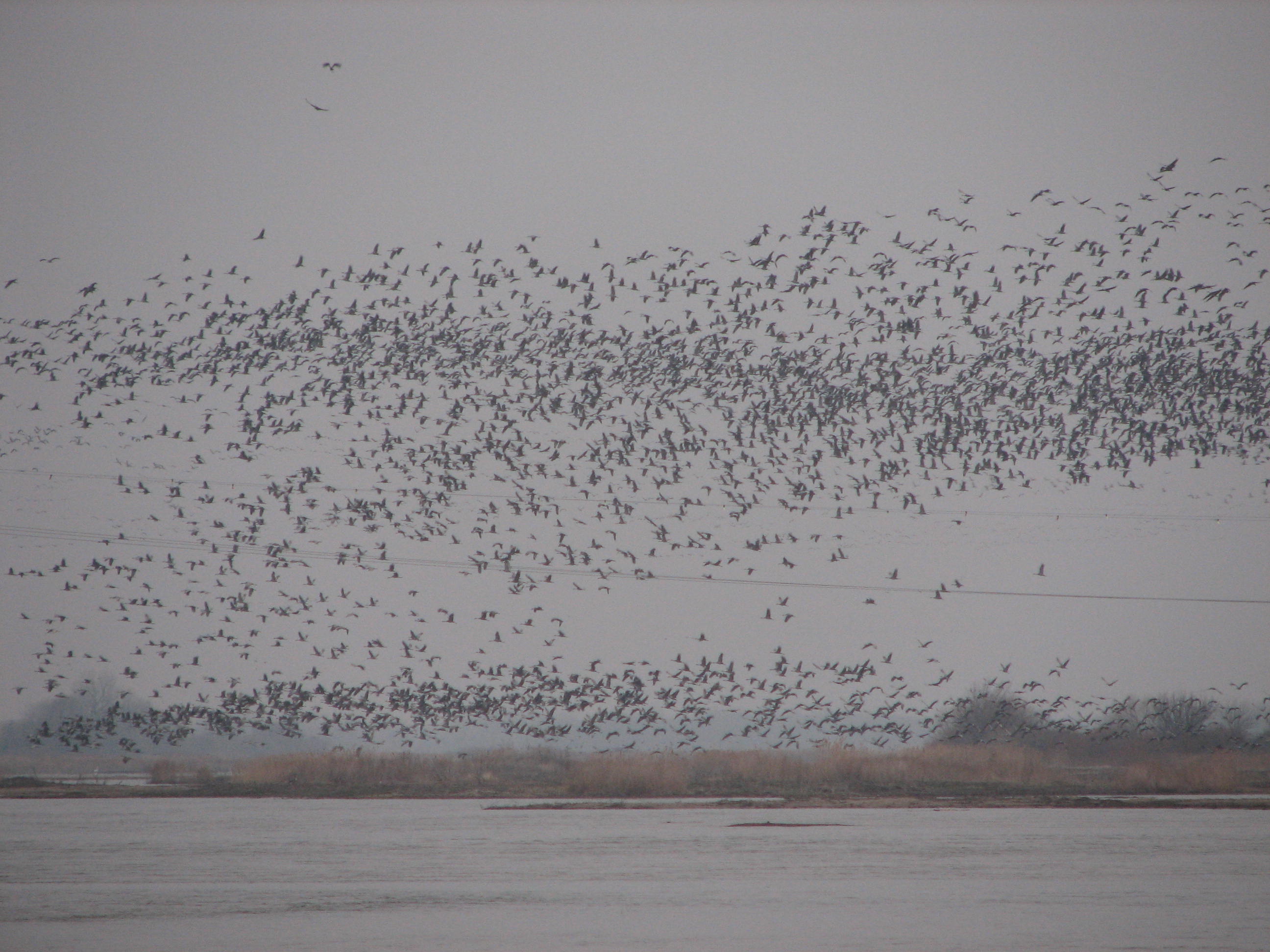
 

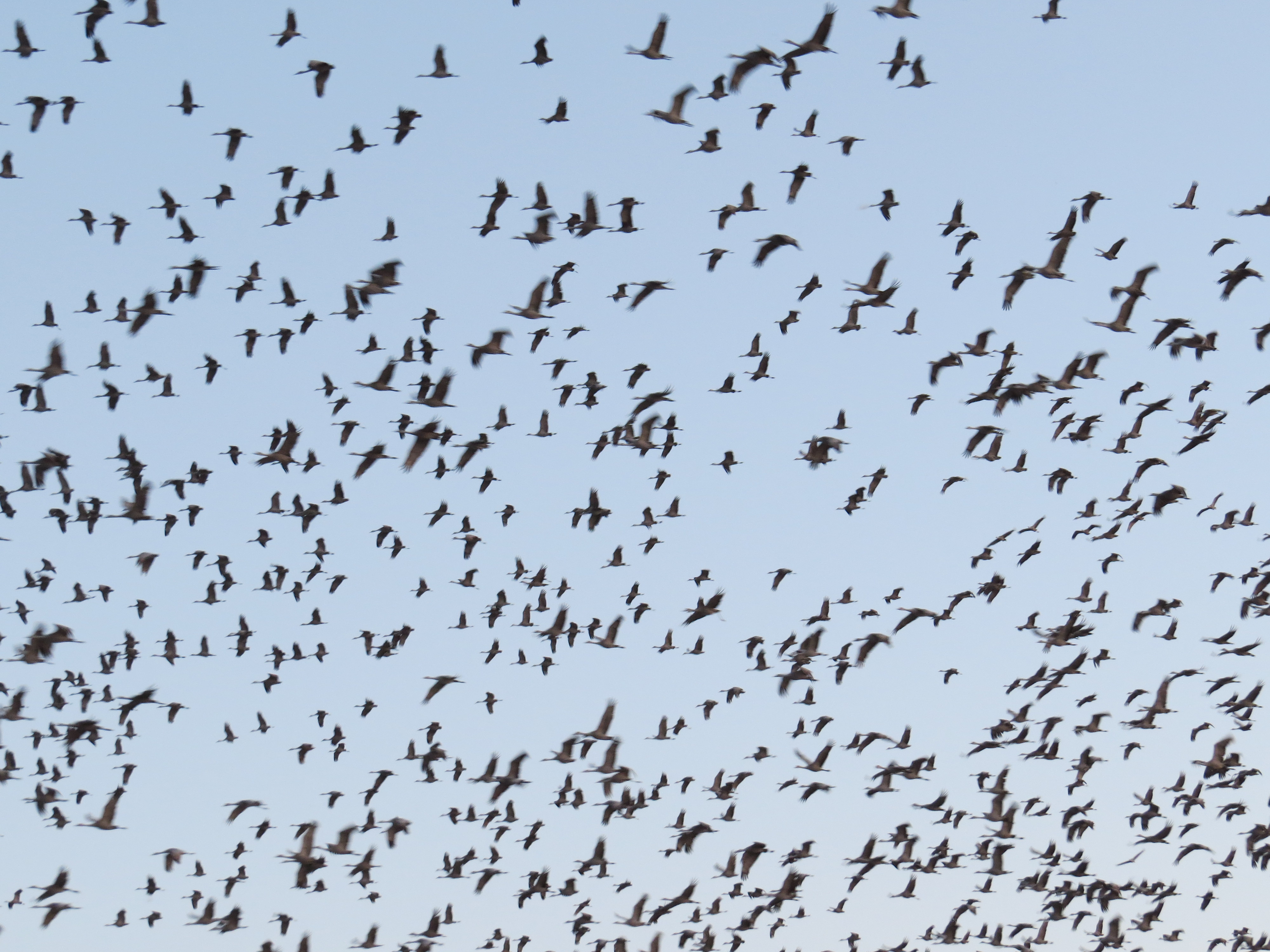
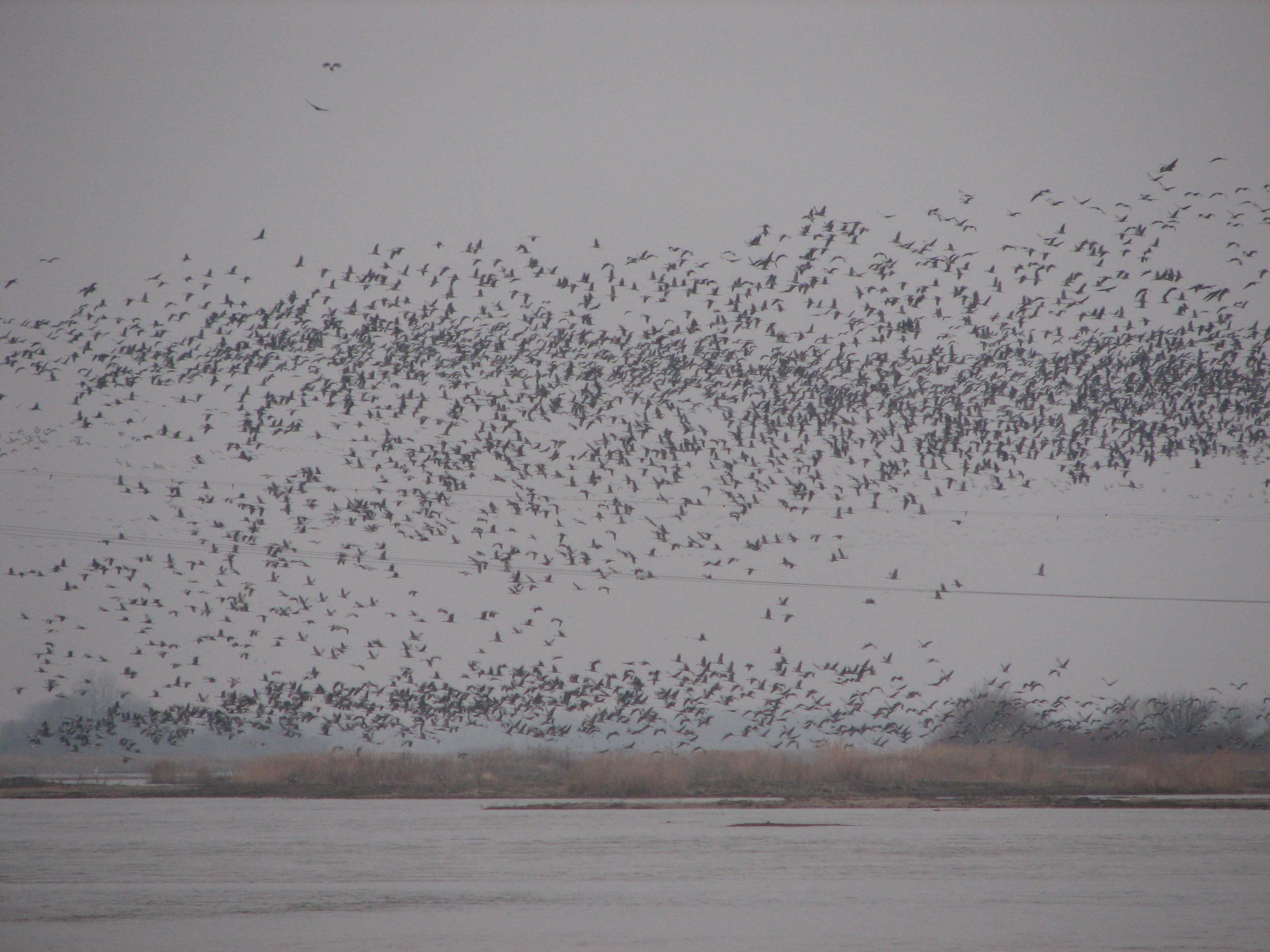
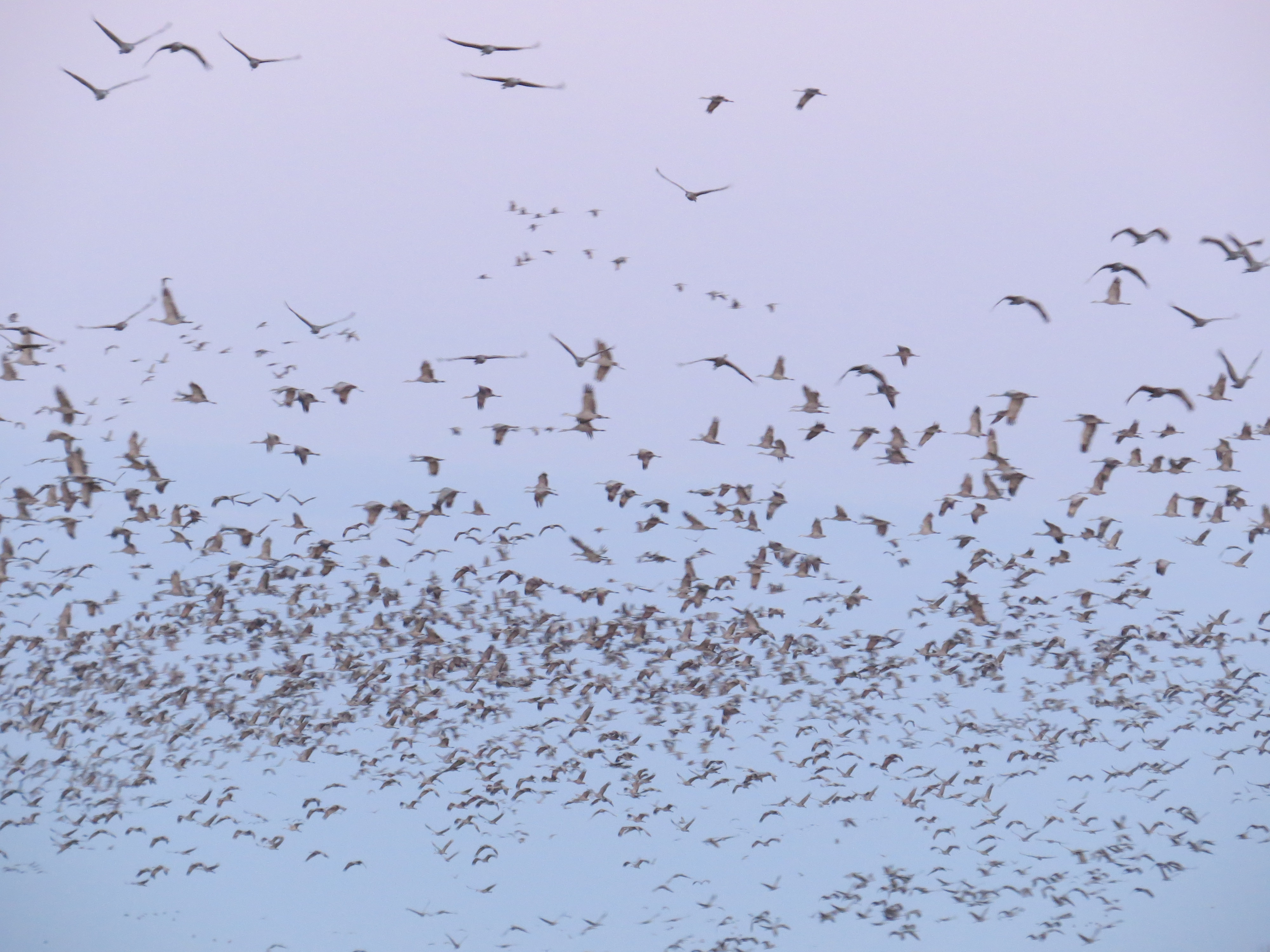
PART OF 20,000 CRANES SEEN OVERHEAD.  ROWE SANCTUARY, 2011
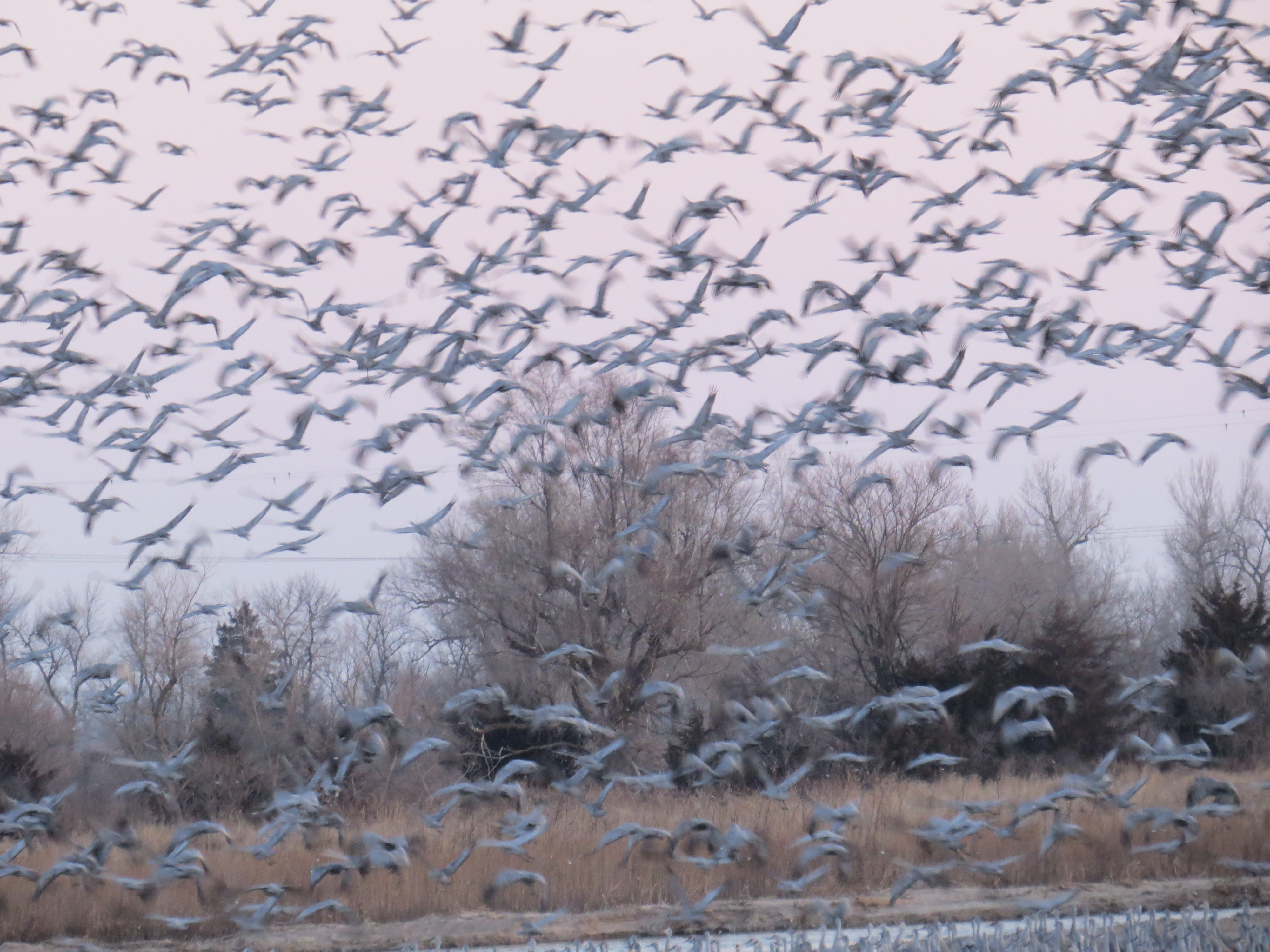
PART OF 20,000 CRANES SEEN OVERHEAD. ROWE SANCTUARY, 2011


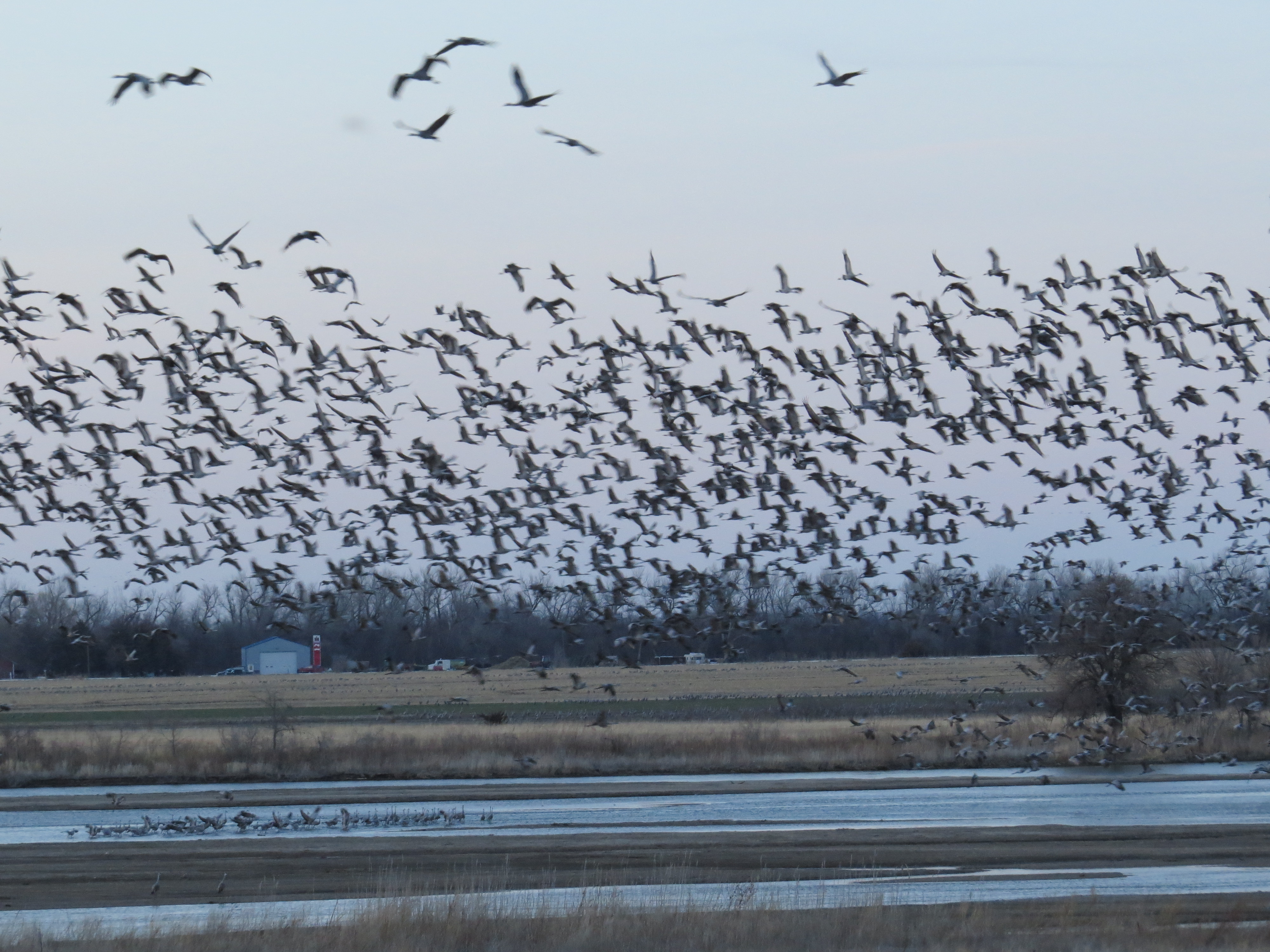
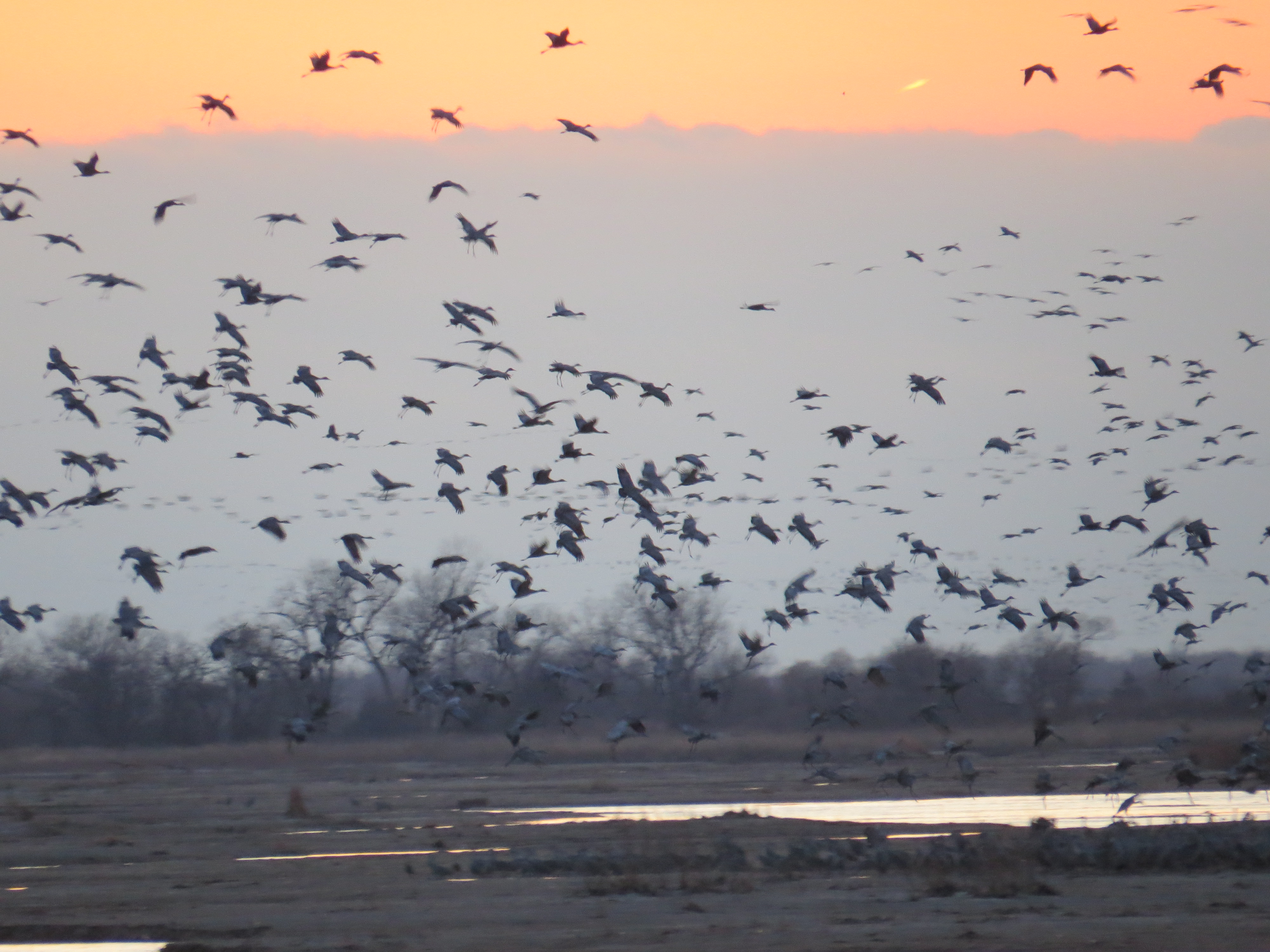
CRANES LANDING AT EVENING, ROWE SANCTUARY, 2014

CRANES LANDING AT EVENING, ROWE SANCTUARY, 2014

When I talk about the birds before we leave for the viewing blinds, I have everybody’s attention.  I am enthusiastic describing the migration, the distances the cranes travel, why they come to the Platte, and that it is one of the great sights of nature.  I am careful not to tell them what to expect, except they will see “cranes, plural.”  I tell them that we are not in control of the view; the cranes are.  I tell them that I’m going to learn something in the blinds:  I will learn about cranes, people, or myself, sometimes one, sometimes all three.


The last night I guide for a season is bittersweet.  I enjoy the trips, but I am physically exhausted.  I get up at 0440, make coffee, spend a little quiet time eating breakfast, for in 30 minutes, all the morning staff at the visitor’s center will be there.  Within an hour, there will be more than 100 people present, 85 of them tourists.  After the morning trip, I may be a roving naturalist, talking to people, I may be cleaning toilets, picking up people who went to the photo blinds, using an ATV, or running errands in Kearney.  I will get lunch and a 10 minute nap, answer questions.  Before I know it, the evening group is there.


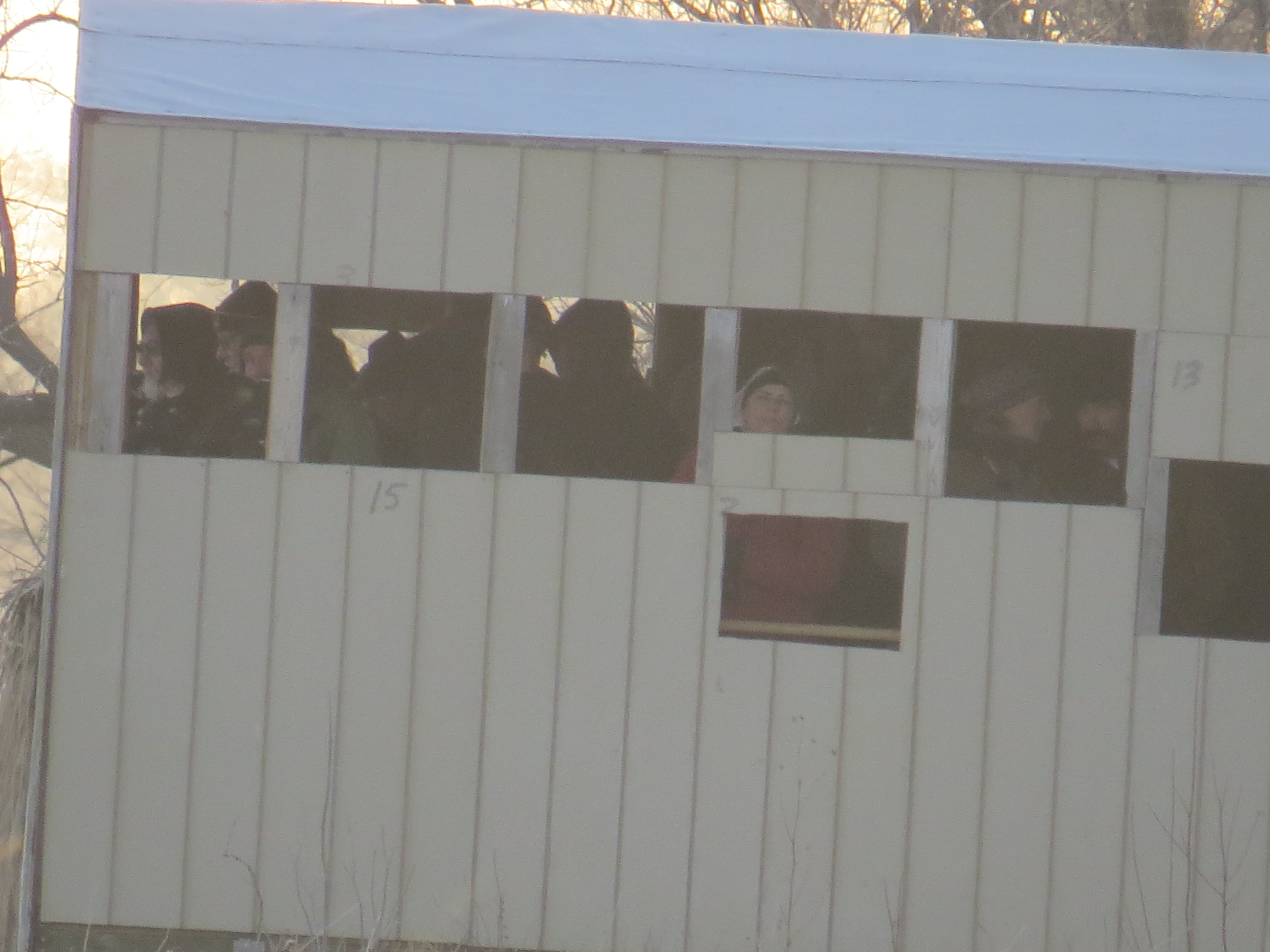
My last evening, I was groggy from a longer than usual nap, a sign I was very tired.  When my group appeared for the short drive to Tower Blind, I told each of the 6 cars where we were going, and where we would park.  It is a short drive and a short walk, but I didn’t say much else other than to introduce myself.


When we parked, I let my co-guide talk.  She is a sharp Nebraskan who knows her stuff.  She quickly laid out what the birds were doing, completely in sync with me about what was and was not allowed.  I was beginning to get less groggy, and the evening air, full of the haunting sound of cranes, was starting to energize me: last tour of the year, my 101st time in the blinds. I spent the first four with my father and wife, others alone, in pre-season, when I have been alone with a hundred thousand birds in the vicinity, shivering with the cold and wind that the Nebraska plains throws at one, but also with excitement, too.


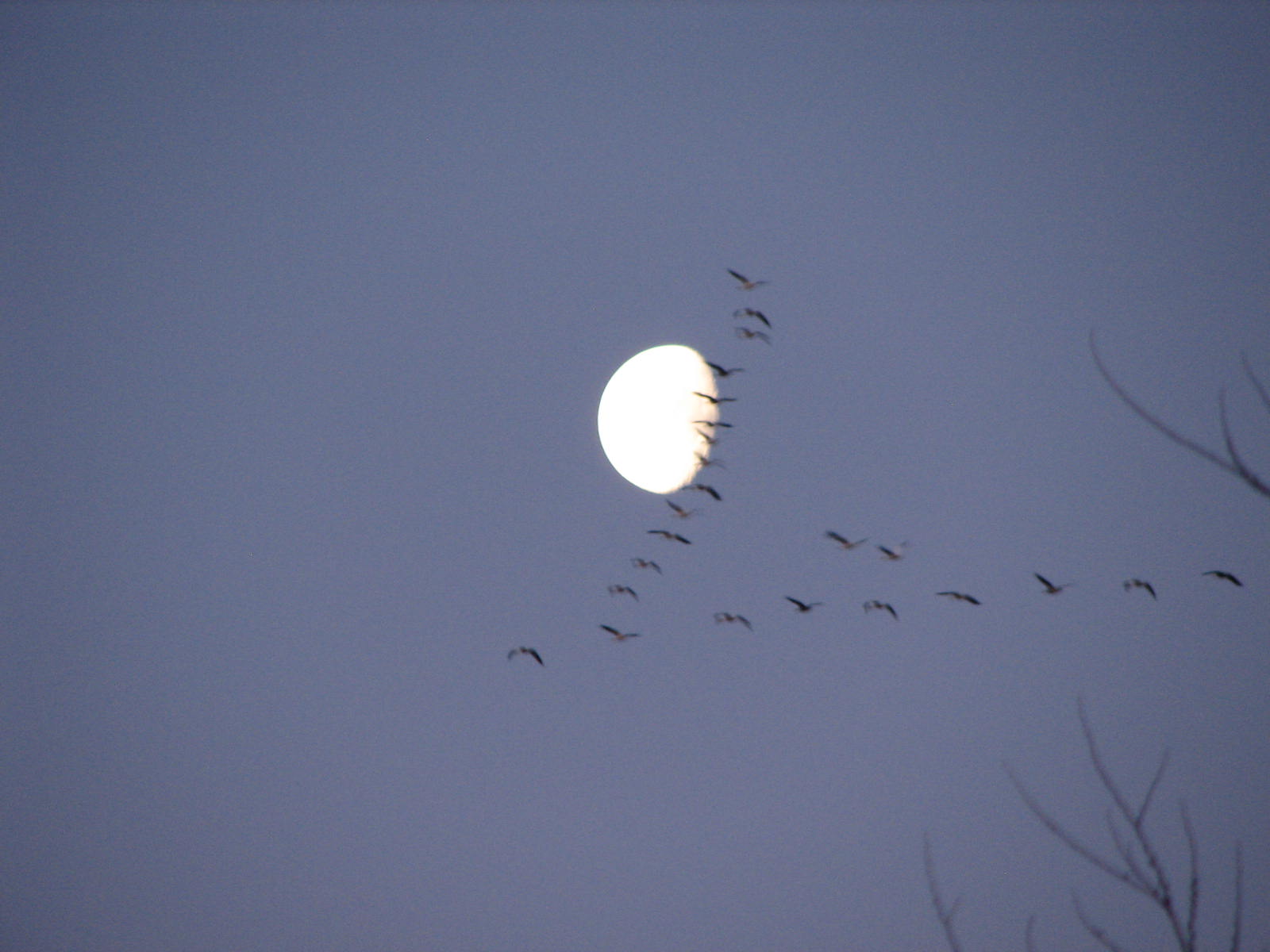
ONE OF MY TRIPS ALONE IN THE BLINDS, FEBRUARY 2010.  "CRANE MOON"

ONE OF MY TRIPS ALONE IN THE BLINDS, FEBRUARY 2010. “CRANE MOON”

We parked and walked 500 yards through a field and woods to 2-story Tower Blind, overlooking the Platte, back from the river, affording a panoramic view the other blinds didn’t.  I had been there three times that week; the other two OK, but spotty for cranes.  I was hopeful, however, for the previous night I was at East Blind, a mile upstream, no cranes landed there, but down near Tower, because of nearby eagles, which spook cranes.  I’m not responsible for the quality of the show, but I want my clients happy.  In any case, I will spend time by the river, see cranes, and I be outside.  That isn’t bad.
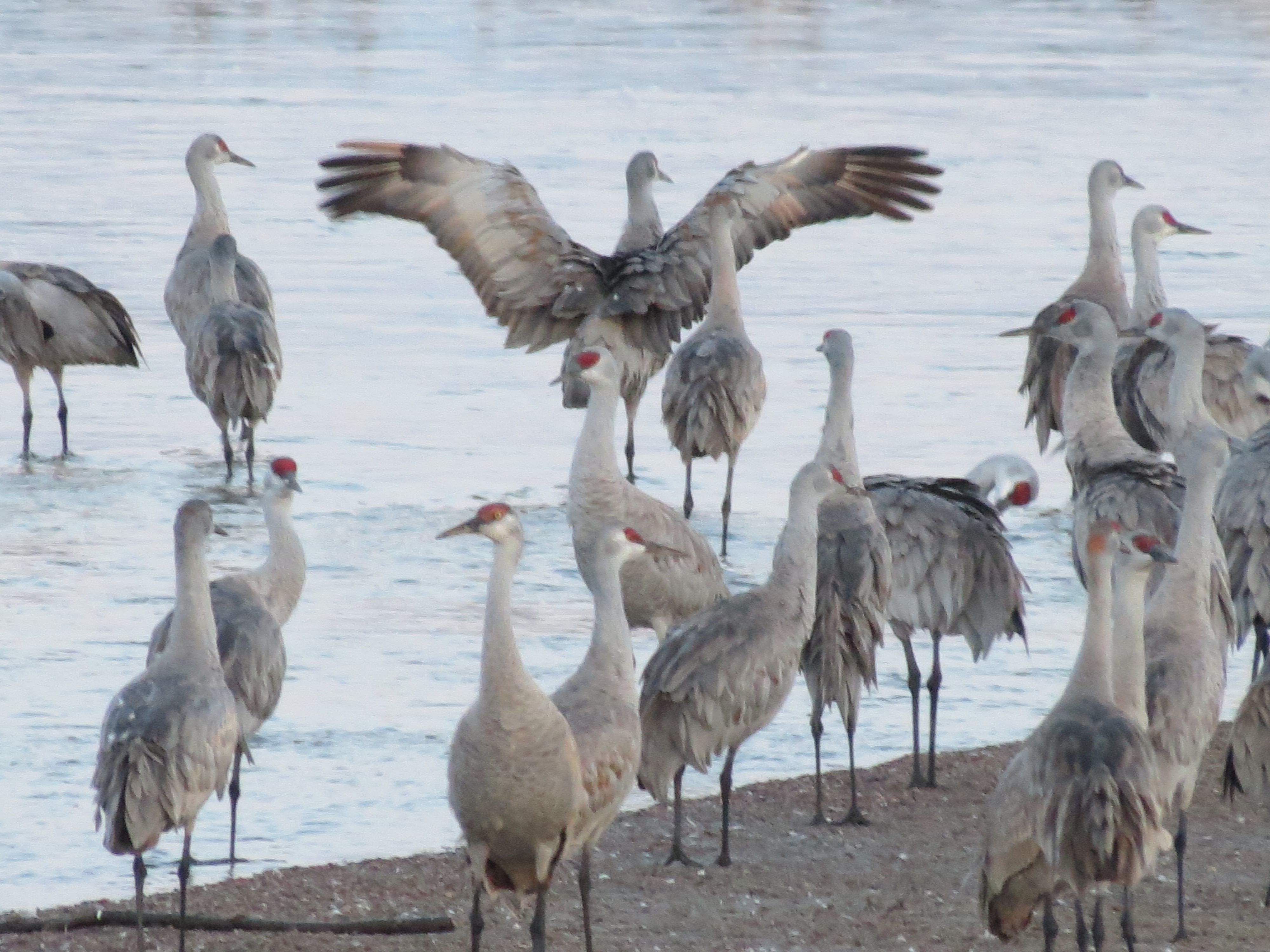
DANCING CRANE. THEY DO THIS TO RELEASE HORMONES.  CRANES HAVE THE SAME NEUROTRANSMITTERS WE HAVE.  LEARNING HAS BEEN PROVEN.

DANCING CRANE. THEY DO THIS TO RELEASE HORMONES. CRANES HAVE THE SAME NEUROTRANSMITTERS WE HAVE. LEARNING HAS BEEN PROVEN.


I had time to point out the flight of the cranes flying in, the group learning the asymmetry, a slow downbeat with a faster upbeat of the wings, so distinctive to these aerodynamically marvelous creatures, who may fly a quarter of a million miles in their lifetime and can, in 4 months, make a nest, lay eggs, incubate them for a month, and have the chicks flying several thousand miles south.  I found myself poetic that night, calling cranes “other nations, with senses, abilities, and feelings we will never have, experiences we will never share, and a language we can only begin to understand.”  I was getting people interested, and with cranes flying overhead, I am in my element.  I was getting energized.
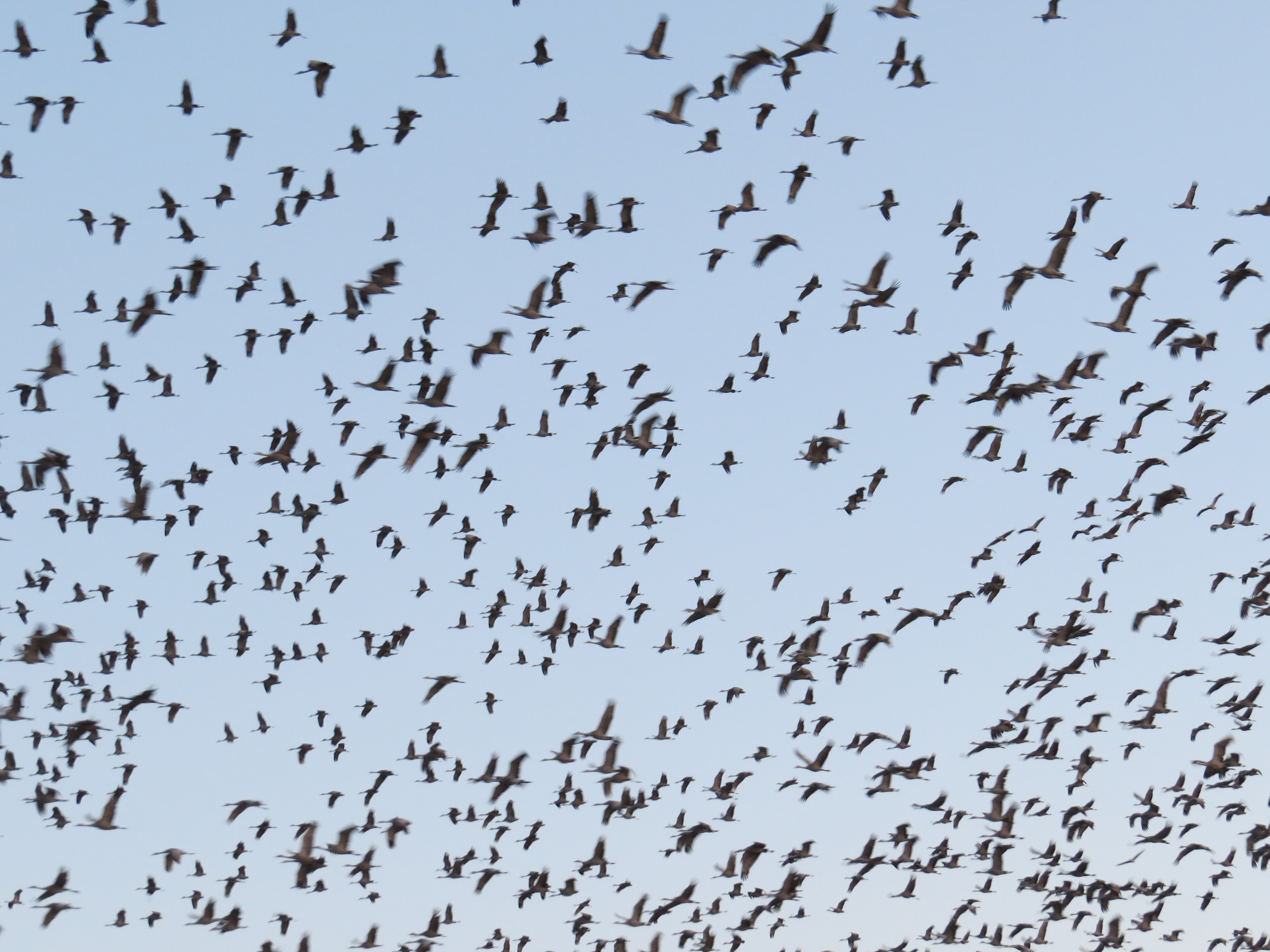
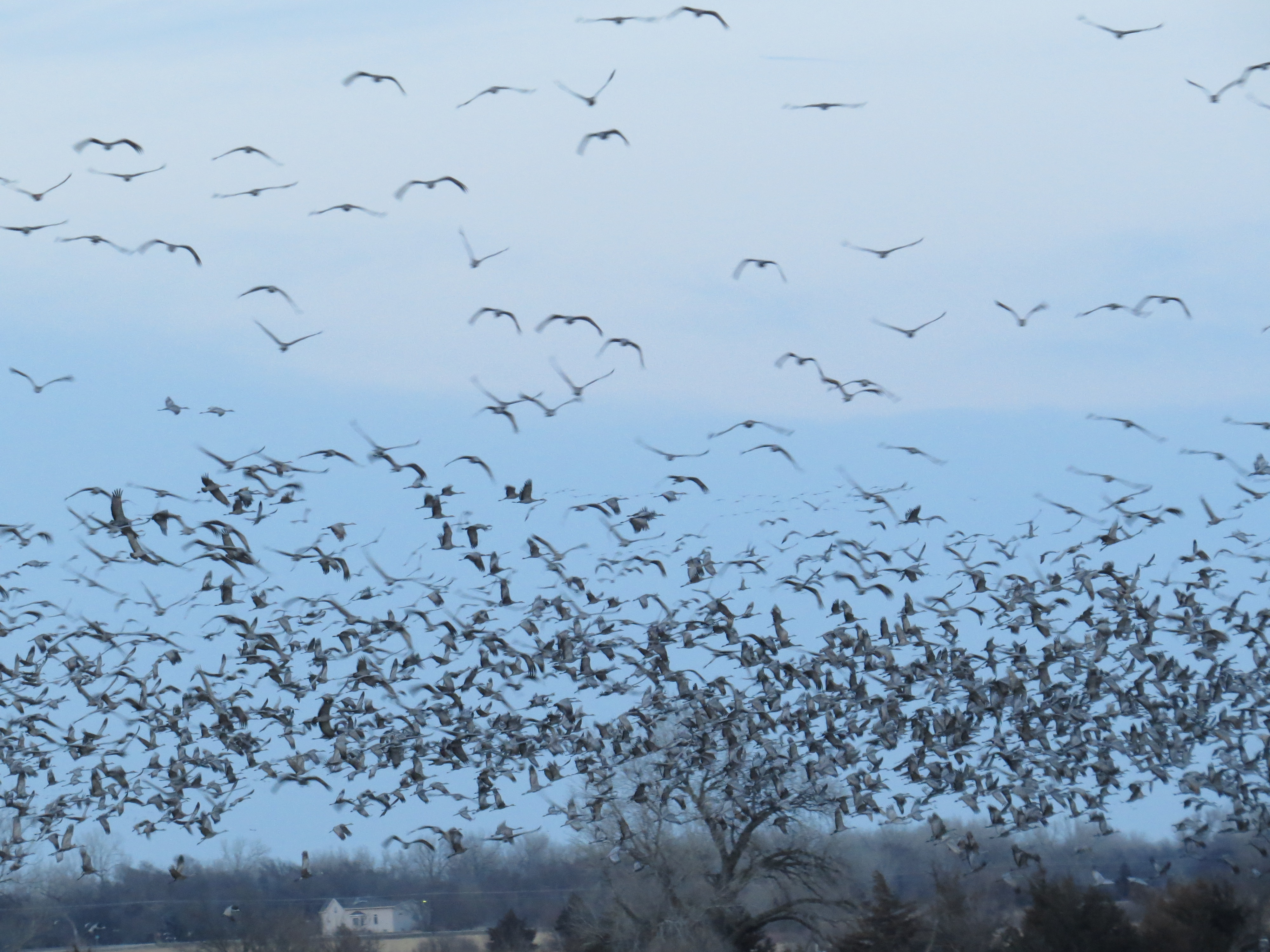
CRANES OVERHEAD. THIS IS LIMITED ONLY BY THE CAMERA'S VIEWFINDER

CRANES OVERHEAD. THIS IS LIMITED ONLY BY THE CAMERA’S VIEWFINDER


“Mike, turn down your voice.  They’re on the river.”  My co-guide, more observant than her talkative partner, had noted the first birds landing at 7:25, 30 minutes earlier than I had seen all week,  I shut up and let nature put on the show.
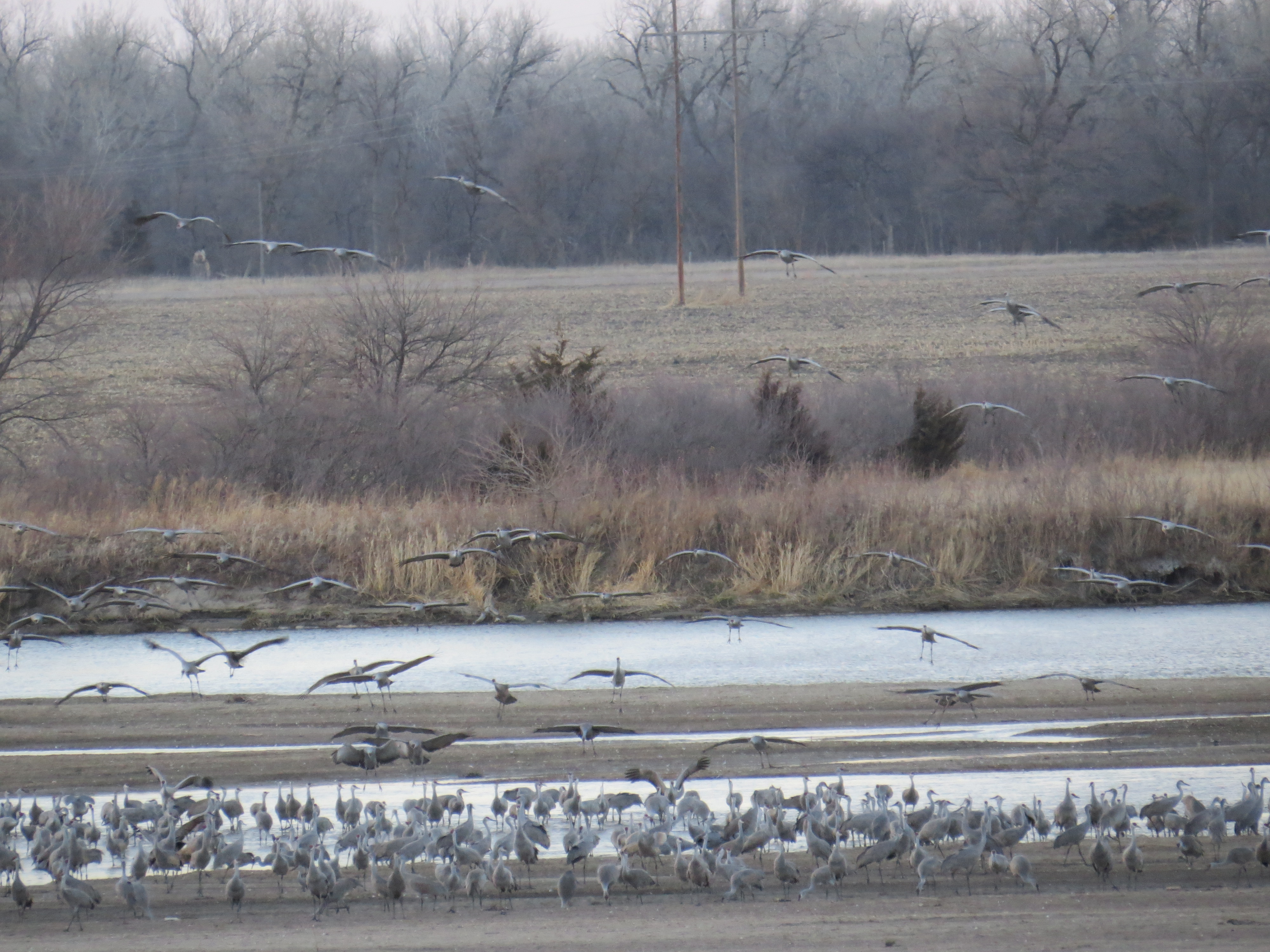
CRANES LANDING, FROM TOWER BLIND, 2014

CRANES LANDING, FROM TOWER BLIND, 2014


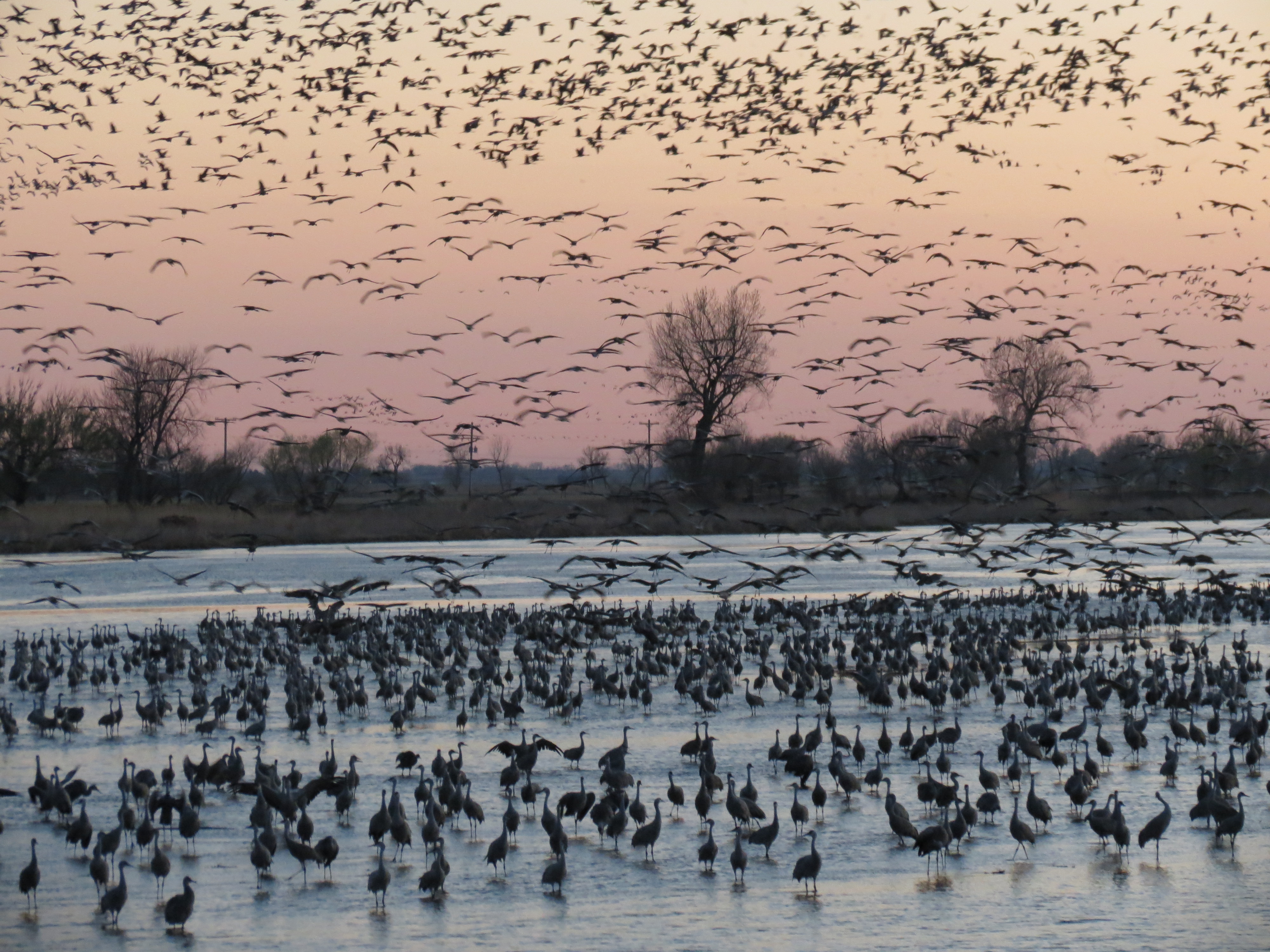
The birds arrived in enormous numbers, clumped in gray islands on the river, each with thousands of cranes, from the Gibbon Bridge to well upstream of us.  Twice, they flew off, perhaps spooked by an eagle.  That’s common morning behavior; to see it at night is special.  There were cranes everywhere, the noise, echoing across 9 million years cranes have graced the Earth, was essential to the visual show.  Like the loon, the call of the crane is every bit as important to the experience.
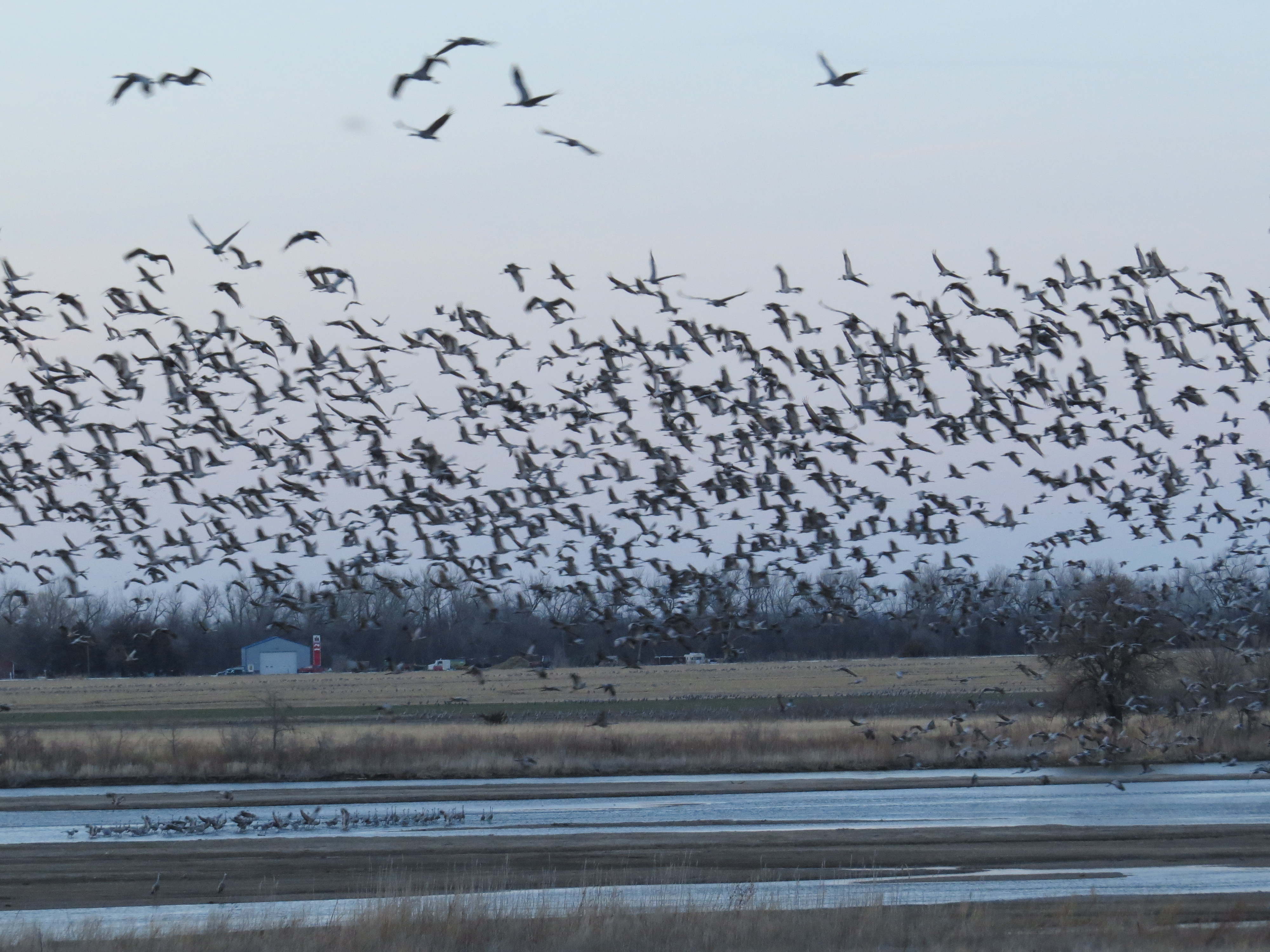
ENORMOUS NUMBERS.  I HAVE SEEN FAR MORE, BUT I NEVER TELL THE CLIENTS THAT.  THIS IS WHAT I CONSIDER "A GOOD NIGHT".

ENORMOUS NUMBERS. I HAVE SEEN FAR MORE, BUT I NEVER TELL THE CLIENTS THAT. THIS IS WHAT I CONSIDER “A GOOD NIGHT”.

When dark, we quietly left the blind, walking to the vehicles.  I was in the rear with a couple my age, discussing the show.  They were thrilled, asking me what I once did.  I told them I once practiced neurology, and they discussed their aging parents, 90 and 87, the same age as mine, when they died.  Their parents were demented; when I mentioned how I hoped might volunteer, not just to show people the beauty of life, but to give others help for the decision making how to die, the man said, “You’re preaching to the choir.”  We were almost back to the vehicles, when his wife said they were here for a respite from their caregiving.  Their gratitude for both the show and what came after on the walk was palpable.


The couple has a long road ahead of them, like the cranes. The road will not be easy for both;  one in twelve cranes will not return in 2015.  But the couple had seen something remarkable, life and hope, saw it together, glad they came, knowing they had a special memory to fall back upon during the hard times ahead.


I don’t usually say that a blind is “The best I’ve ever seen it,” to clients. But I said it about Tower that night. Paul Johnsgard’s “special conjunction of spring, the river, and a bird” mirrored my conjunction of learning about myself, others, and Sandhill cranes.


Godspeed to the cranes, on their way north, far from the Platte Valley, for it is time they must go.  Godspeed to the parents of the couple, on their way out of a long life, for it is time they, too, must go.  In the past, I helped many leave life with dignity; today, I helped others see the cranes on their way north to create new life.


I couldn’t have asked for a better ending to my guiding season.
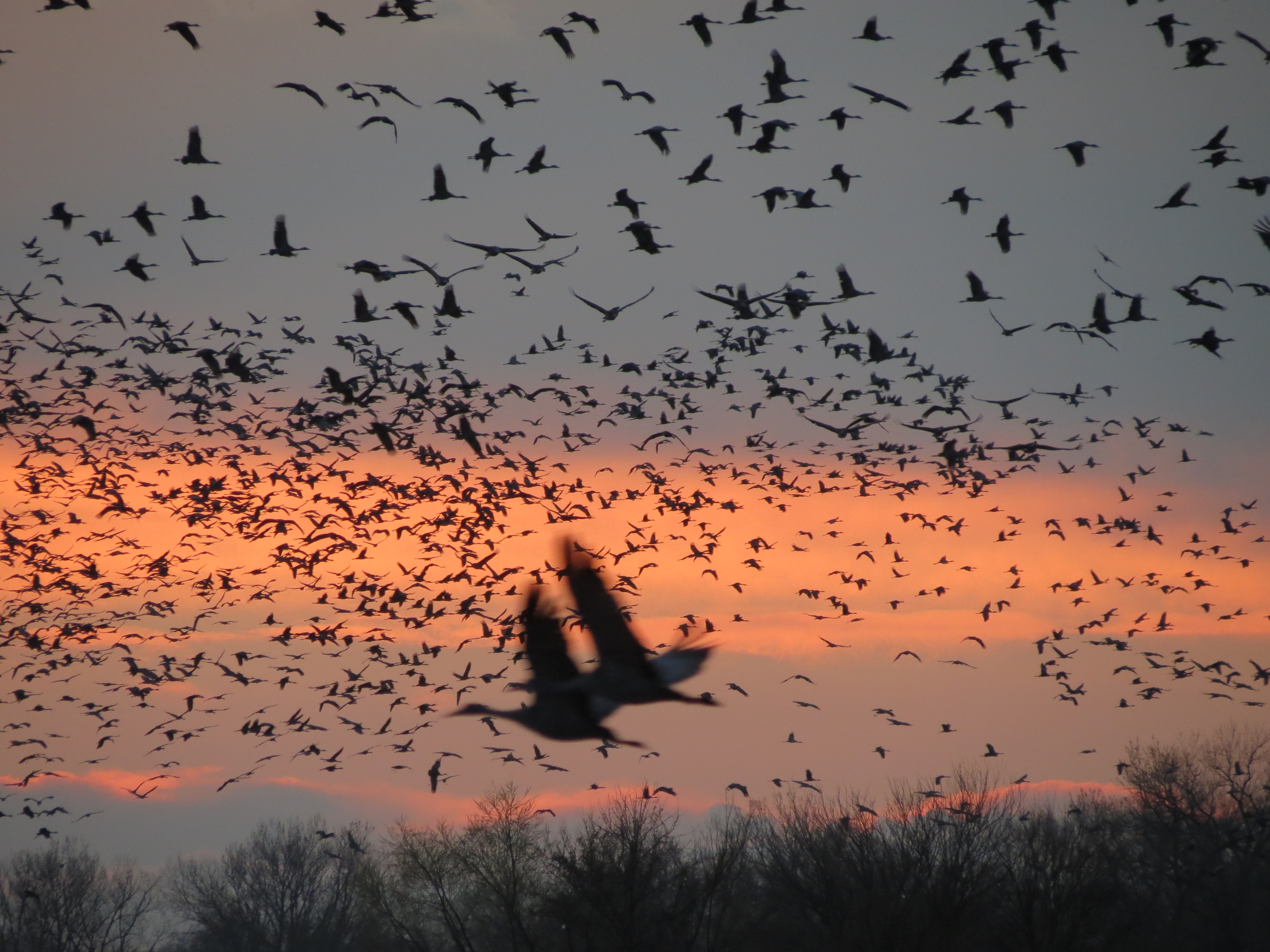
 

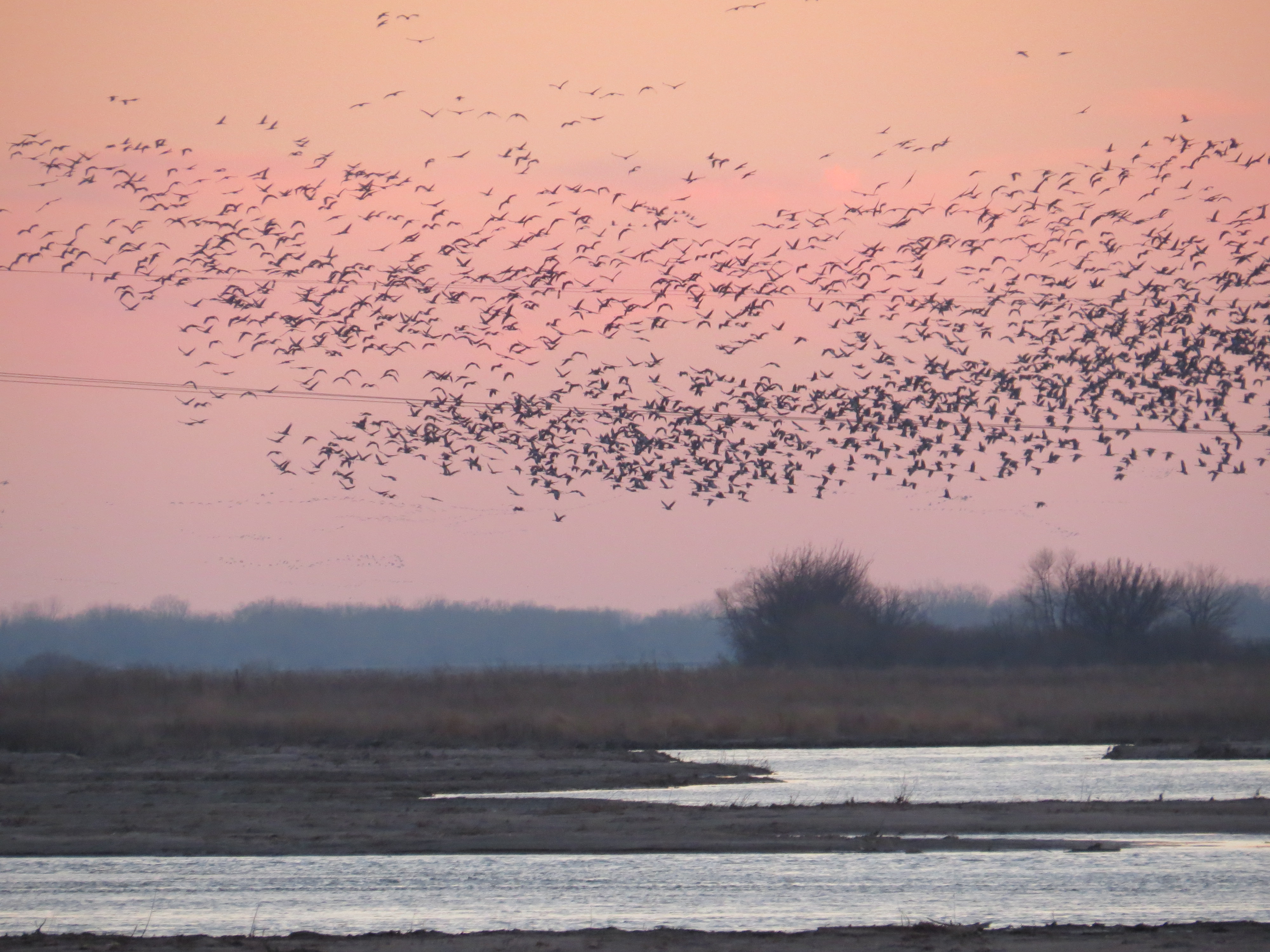
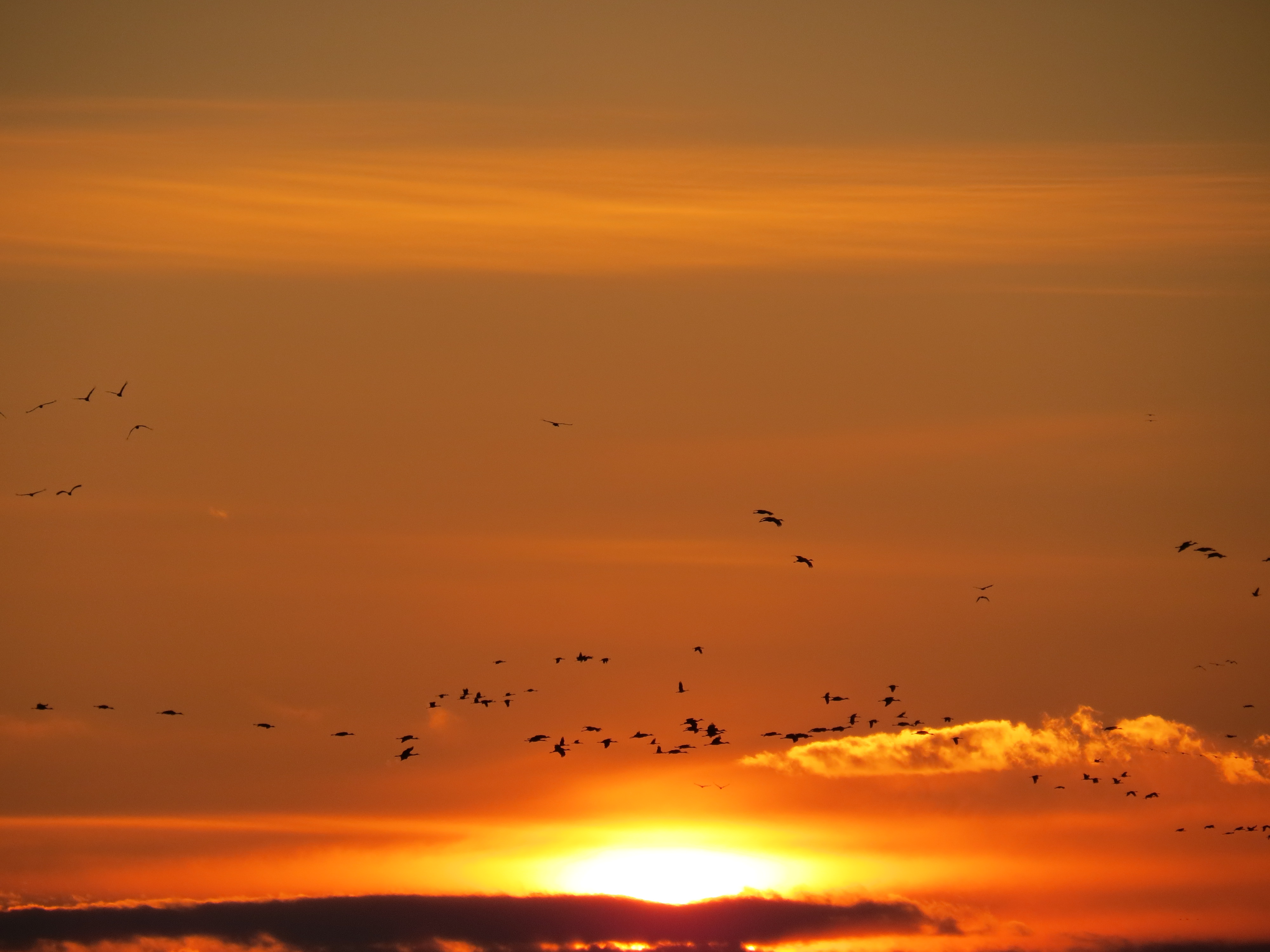
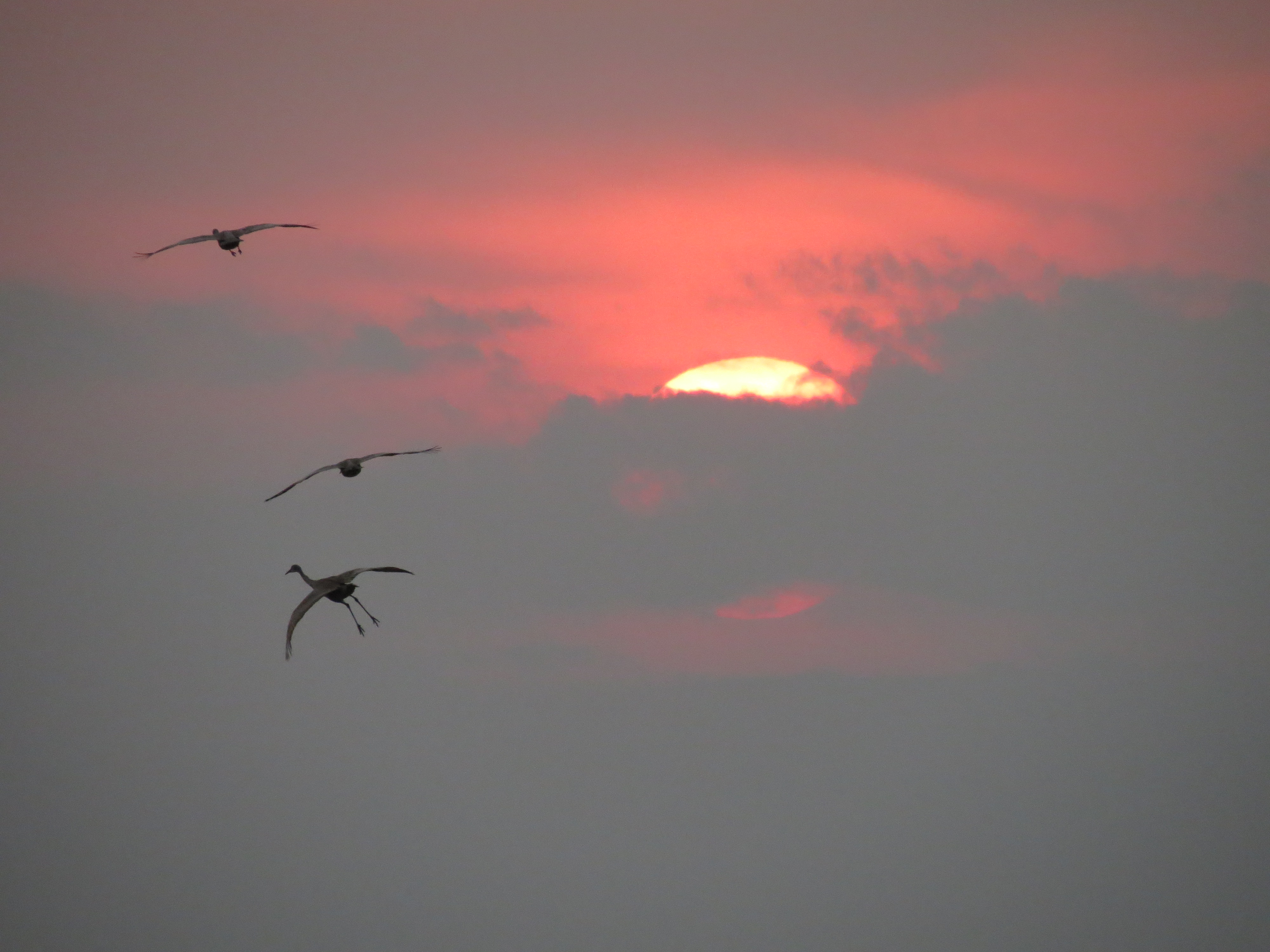
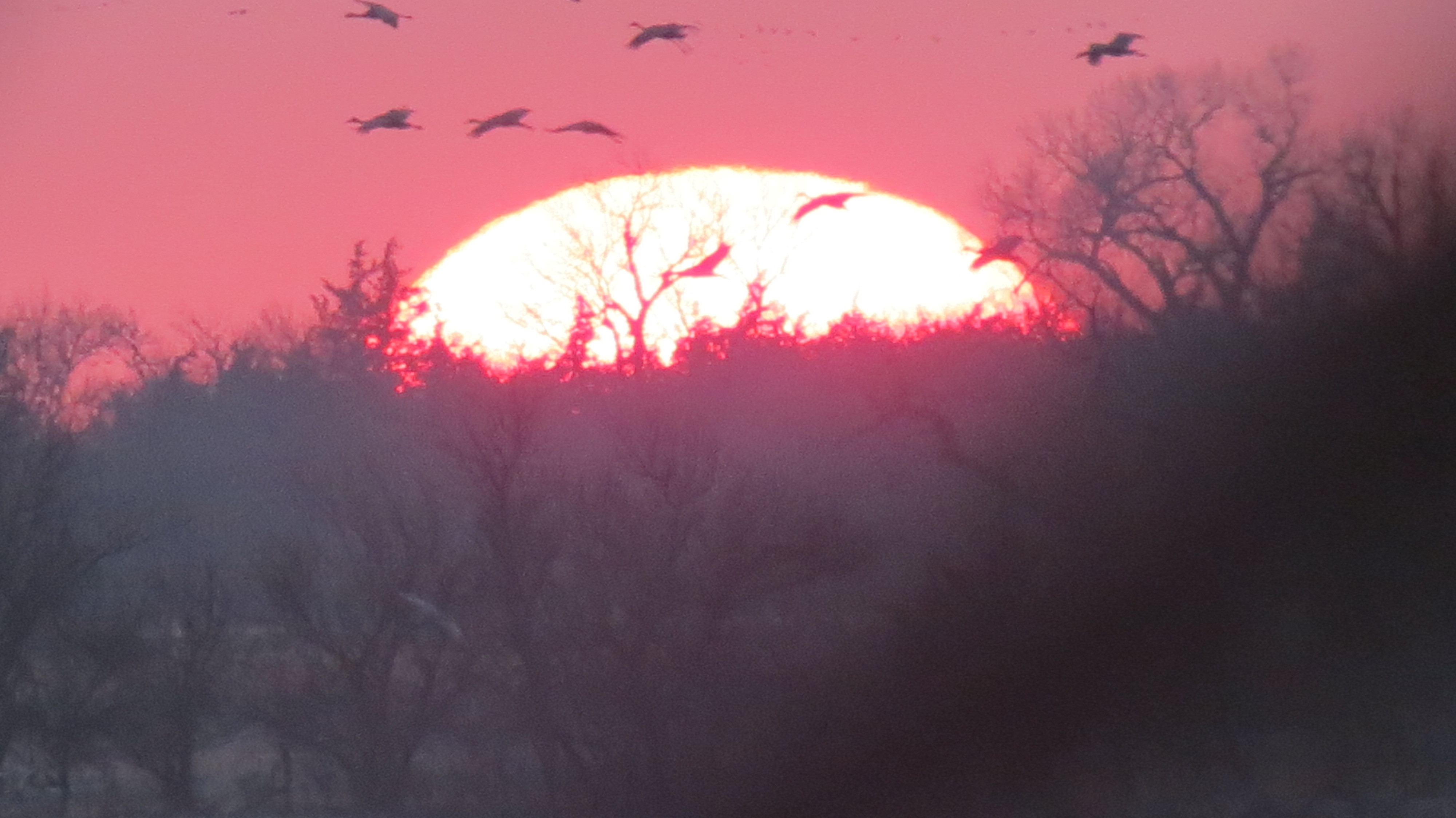
NEBRASKA SUNSET AND CRANES.  ROWE SANCTUARY.
NEBRASKA SUNSET AND CRANES. ROWE SANCTUARY.
BREAKING SOME OF THE RULES

March 31, 2014

I guide visitors to see the Sandhill Cranes in Nebraska, where in March evenings, they come to the Platte River in extraordinary numbers, leaving for the fields the following morning.  The birds are unable to perch, so they live on the ground, in the air, or in the water.  The latter acts as an alarm system, so no predator may get close to them.  The Platte, one of the most maligned rivers in US history, is perfect habitat, because it is shallow, with many channels, a braided river.
Cranes in the air.  This is a common sight in the morning or evening.

Cranes in the air. This is a common sight in the morning or evening.


I’ve guided for 5 years, and the rules for taking people to the blinds are strict.  Noise must be kept to a minimum.  I tell people if they can’t whisper, that is fine, just don’t talk.  Camera flashes are taped down in spite of “it’s turned off.”  That phrase is like “he never did that before,” when a person’s dog bites you.  The difference is whereas biting bothers me, a flash can spook ten thousand cranes into the sky, some injuring themselves fatally.  We also tape over the laser sensor, since that emits light, and at infinity focus, it isn’t necessary.  Nearly all are pleasantly compliant.  We put post-its over the display screen, to limit light reflection off one’s face out to the river.  We have strict rules about camera equipment.  We don’t allow automatic multiple exposures, for the sound detracts from the experience of hearing tens of thousands of cranes closeby.

Platte Sunset.  The river and sky are a mass of cranes.

Platte Sunset. The river and sky are a mass of cranes.


Yes, we are paranoid.  We walk out in groups with one guide’s leading and the other’s trailing.  We limit noise in the blind.  I tell client medical emergencies and their safety are my top priority, but when it comes to inconvenience, such as being cold, hungry, or bored (crane viewing isn’t for everybody), we stay put until such time as we may safely leave.  People may not leave when they choose.

Viewing Jamalee Blind from Stevie. These are memorials to Dr. Jamalee Fenimore and Stephne (Stevie) Staples.

Viewing Jamalee Blind from Stevie. These are memorials to Dr. Jamalee Fenimore and Stephne (Stevie) Staples.  There are 38 people in Jamalee, which is much larger than seen here.


We accommodate those with disabilities.  I took a man with significant Parkinson’s by golf cart to a viewing blind.  The carts are quiet, and the man had a set of photography equipment as advanced as anybody’s I’ve seen.  I helped him carry his equipment into the blind, and when the light was right, he set it up himself, quietly. He took his pictures and told me later, on the way back, it took him 26 years to finally get a sequence of crane dancing correct.  It hangs in the visitor’s center at Rowe.


We allow golf carts to two of the five blinds; the third one, East, does NOT allow for golf cart transport.  It is too exposed in the morning and the path too bumpy to make golf cart transport easy.  The other two blinds are near each other, so we can do multiple trips if necessary.


I sleep on the floor in the visitor’s center, awake at 4:40 seeing to what blind I am assigned.  I found I was going to East but we had two people needing a golf cart.  This was a mistake and a problem.  I discussed the matter with one staff member at 5:15.  She was concerned, too, and we thought about moving people from one blind to another.  That wasn’t going to work.  Another staff member made what I call a “command decision.”  I would take one man in a golf cart to East, parking it some distance from the blind.  This was breaking a rule, but we felt the situation called for it. I thought the solution good; I would quietly lead the group out in the cart, my co-guide keeping everybody behind me together.


East often didn’t have “good cranes,” as we guides call it, because some left very early in the morning, not allowing for pictures.  Indeed, the prior day, the guides got there too late for the “blow off,” which occurs if all cranes leave at once, such as being spooked by an eagle, a coyote, a dog, or some loud noise.  I heard that story, so I kept my morning briefing in the center…..brief.  It gets light in Nebraska early by late March, and I was in a hurry.  As my group entered, I taped all the cameras appropriately, explaining my reasons.  I told them this was the proper time to use the toilets in the center, so they would be ready to leave when I was.

Cranes at Sunset, North Blind, across the River.  They often secondarily stage (land) in the field here, coming in from several miles away from the river, where they fed on waste corn during the day.

Cranes at Sunset, North Blind, across the River. They often secondarily stage (land) in the field here, coming in from several miles away from the river, where they fed on waste corn during the day.

I told the group what the birds were, where they were coming from, migrating up to 7000 miles (one way).  They were feeding and putting on fat for the trip north, where they would build nests near Great Slave Lake; Bettles, Alaska; Siberia;  the Hudson Bay watershed.  I’ve seen cranes north of the Arctic Circle.  I told the 30 there it was one of the great sights in nature, one of Jane Goodall’s top ten, one of my top four.  I told them I was a volunteer, and I wanted them to have a wonderful time.

Then I told them the “don’t”s, including keeping body and camera parts inside the blind.

I didn’t ask for questions. I said we would talk in the blind later.  Some guides go into great depth.  I do, too, in the evening, when we have time.  In the morning, I want to reach the blinds early.  So do the clients, too.


Then we left, and I took the man needing the golf cart, the rest of the group in tow.  On the way out, the man told me he had leukemia and had just finished chemotherapy.  He wanted to see the cranes this year, even a few.  He hoped he would be back again.  I did, too, but leukemia is leukemia.  Then again, at my age, I start talking in terms of “if I am still around.”  This man may not be, and we both knew it.

East Blind was great. Cranes were on the river right out in front of it.  Ten minutes later, they all blew off into the orange sky of a Nebraska sunrise.  The man saw it.

In order to take a man with leukemia to East blind, I’ll bend the rules.  Had he asked to use a flash, I would have said no.

I hope he’s back again and again.  We’ll just be sure if he needs a cart, he goes to the other two blinds.

IMG_0402 IMG_0397 IMG_0399 IMG_0400


Crane sunset.

Crane sunset.

IMG_0137

Sky dark with cranes

Sky dark with cranes

HOOFING IT THROUGH THE DENVER AIRPORT

March 27, 2014

I was really pissed when I opened my e-mail in Portland, a month ago, as my wife and I were getting ready to fly back to Tucson, after a trip to Eugene. “Your flight to Kearney has been cancelled.” The online travel agency didn’t offer a suggestion, only a telephone number to call. This was not what I needed to hear in the morning. The good news was that I could get to Kearney that same day from Denver, in order to volunteer to help out with the Sandhill Crane migration at Rowe Sanctuary. The bad news was that I would land at about 4:45 p.m., 20 miles from Rowe, with the evening tours beginning at 6.

My stay this year was already shorter, because we were in the middle of a move, and I was lucky I could even go. But, I was about to lose an evening in the viewing blinds, which is my selfish reason to go. I guide people to the viewing blinds at Rowe Sanctuary, because the cranes may only be seen close up if people are hidden. Nebraska is the only state where they are not hunted. If I am not a guide, I will “tag along,” to be in the blind, if a space at a window opens up. One always does. I admit it, I am selfish. But I clean toilets, do odd jobs, make morning coffee, act as a roving naturalist, and sleep on the floor in the gift shop. In past years, I taught a beginning course on Cranes for interested tourists. I have taken people out to the photography blinds and brought them back, cleaning up the “chamber pots” they use during their all night stay along the river. That may sound gross, but I enjoy driving out and back, and almost everybody who goes there loves it. I’m not religious, but when I hear somebody say, “I feel closest to God when I am by the river with fifty thousand cranes,” I understand the spirituality. Yeah, I wanted to get to Rowe early in the day, and it wasn’t going to happen.

I found the flight had been cancelled, but I went on line two days before I left, discovering it hadn’t been cancelled, so I tried to get on it. No such luck. I would be leaving in the afternoon, getting there in early evening. The day I left, I arrived in Denver, at 1030, knowing the Kearney flight departed from a different concourse at 1035. But, as I walked from the far end of B concourse, I glanced at the first monitor, looking for the Kearney flight. “Whadda know,” I said to myself, glancing at the yellow “delayed” on the screen, “let’s give this a try.” I didn’t really think I had a prayer of making the plane, but I doubled my pace, weaving through the crowds like an expert slalom skier. “It never hurts to try,” is one of my mottos; another is “All they can do is say no.”

I was seriously hoofing it, so much so that I got on the moving walkway, in order to add another mph to my speed. When a walkway wasn’t working, I took it, because nobody else was on it, and I had a long empty straightaway. I caught the airport train perfectly, got to the A concourse, and blasted up the stairs so fast that the guy in front of me doing two at a time was in my way. I blew by him, not even running, and turned on the gas at the A concourse. I went downstairs to where the small plane check in counter was, asking if the plane were still there. It was, planned departure at 1100.

It was 1055.

I had gone from the plane, through 2 long concourses, a connection, a train ride, and some stairs in 25 minutes. This is hoofing. I jog-walked the last 300 yards to the gate, asking, a bit breathless when I got there if I could get on, assured I could. I then asked if I had time to go to the restroom, although that was really pushing my luck, but again, all they could do was say no. I had enough time to make the calls I needed to arrange a pick up in Kearney and send an SMS to my wife.

This isn’t the first time I’ve done this. I had an 8 a.m. flight to Dallas one time, and as I started walking to the gate, I noted a monitor that said the 8 a.m. flight was delayed. I saw there was a 7 a.m. flight not cancelled, and it was 6:45. I literally walked to that gate, getting on board the 7 a.m. flight, with more time for my connection in Dallas, which was tight to begin with. Lucky? Yes. Very. But I made my luck, too. I thought fast, looked at options, and asked unabashedly.

Much success in life is luck: a photographer who has a person bankroll a book he writes, becoming famous as a result. An amateur astronomer who happens to discover a comet, because he happens to be looking in the sky for one, was out on the right day, in the right weather, and looked in the right place. Some have become famous as a result of their luck. But they made their luck, too. They didn’t bemoan their failures or their work. They put themselves in the situation where the probability numerator might increase with the denominator. When both increase the same, the overall probability increases. It is a mathematical fact.

I could have just as easily sat in the airport and waited the 4 hours for my flight. Instead, I looked at the monitor, knowing these small planes are often delayed because of weather or not having enough pilots or flight attendants. I had nothing to lose by looking, except the few calories by hoofing. I made my luck. Life doesn’t often work out the way we want, but sometimes there are opportunities that arise, taylor made for those who aren’t quite ready to call it quits and are willing to go for the long shot. To most people, getting on that earlier flight wouldn’t have made a bit of difference. To me, it did.

Later, I learned the flight I would have taken was delayed 4 hours.


Cranes over the setting sun.

Cranes over the setting sun.


Evening cranes

Evening cranes

Morning crane "blowoff" from the Platte River.

Morning crane “blowoff” from the Platte River.

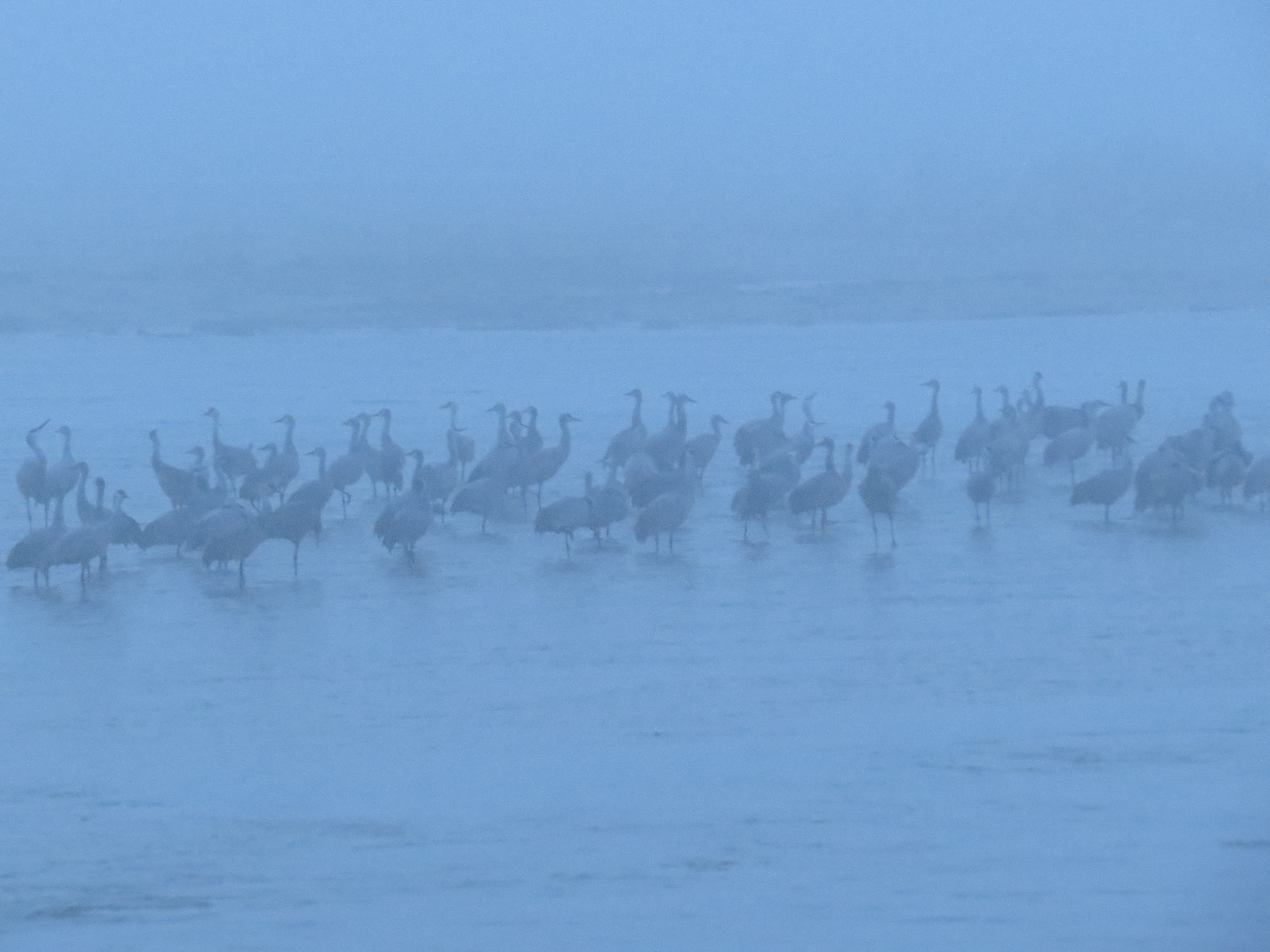
Fog cranes.

Fog cranes.

SNEAKER WAVE

March 19, 2014

Occasionally, I do something really dumb and wonder how I could have been so clueless.  Sadly, doing stupid things has not disappeared with age. I don’t usually state my major blunders in public, but my latest mistake is one from which some might learn.  Three years ago, two young men from Eugene were not so fortunate and drowned.  I wasn’t in danger, but I did something foolish, ruining my camera in the process.

I am new to the West Coast.  I am exploring Oregon by hiking; while I have extensive experience in the woods of northern Minnesota and the high country of Arizona, Oregon is different.  I have hiked in Washington State before, and I know about slippery rocks, need to carry rain gear, and taking the usual essentials before setting off alone.  Indeed, when I drove west to Sweet Creek Falls Trail, near Mapleton, I left a note on the kitchen counter, where I was going, what I expected to do, and the fact that the barometric pressure was steady when I left.  Rain was forecast for later the day.  I always leave notes when I hike alone. It makes searching for my remains easier.

The hike was pretty, not difficult, along a lovely river, with only a few areas where I needed to be careful.  However, I never forgot that a classmate in medical school died in 1973 when he fell on a rock in a stream and hit his head.  Bad things may happen, and may happen suddenly.  A slight misstep can become life-threatening or very inconvenient.  I got a lesson in the latter this day.

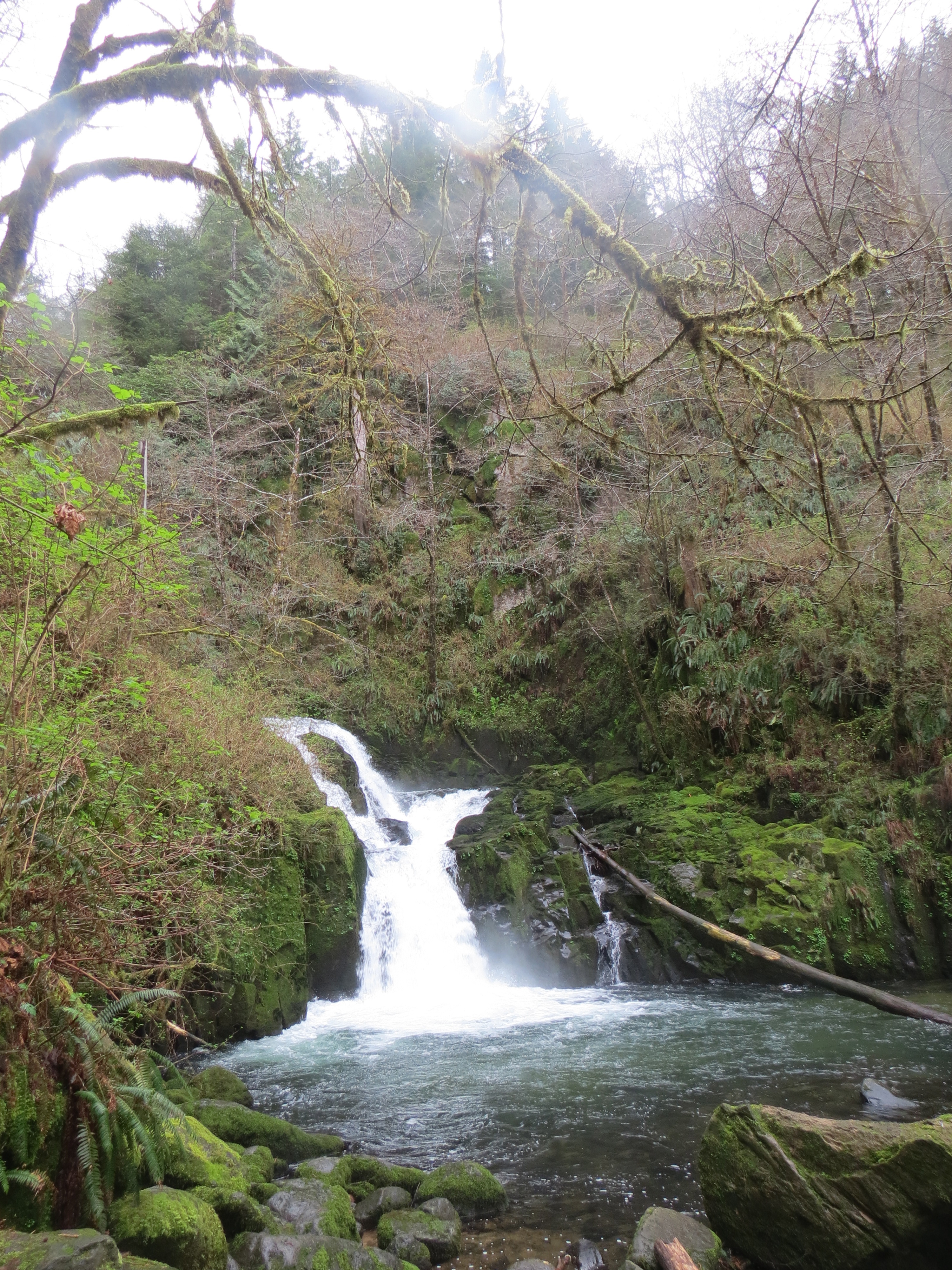
Sweet Creek Falls trail

Sweet Creek Falls trail

Sweet Creek Falls

Sweet Creek Falls

When I finished the hike, I decided to drive to the coast.  It was only 20 miles, and I thought it worth visiting the coast of my new home state.  When I arrived at the long stretch of  dunes, south of Florence, I found a deserted parking lot and texted my wife where I was.  I had deviated from my planned route, and any time I do such, I MUST communicate.  In the canoe country, I cannot, so if I am alone, I NEVER deviate from my route.  This is smart; what I did later wasn’t.

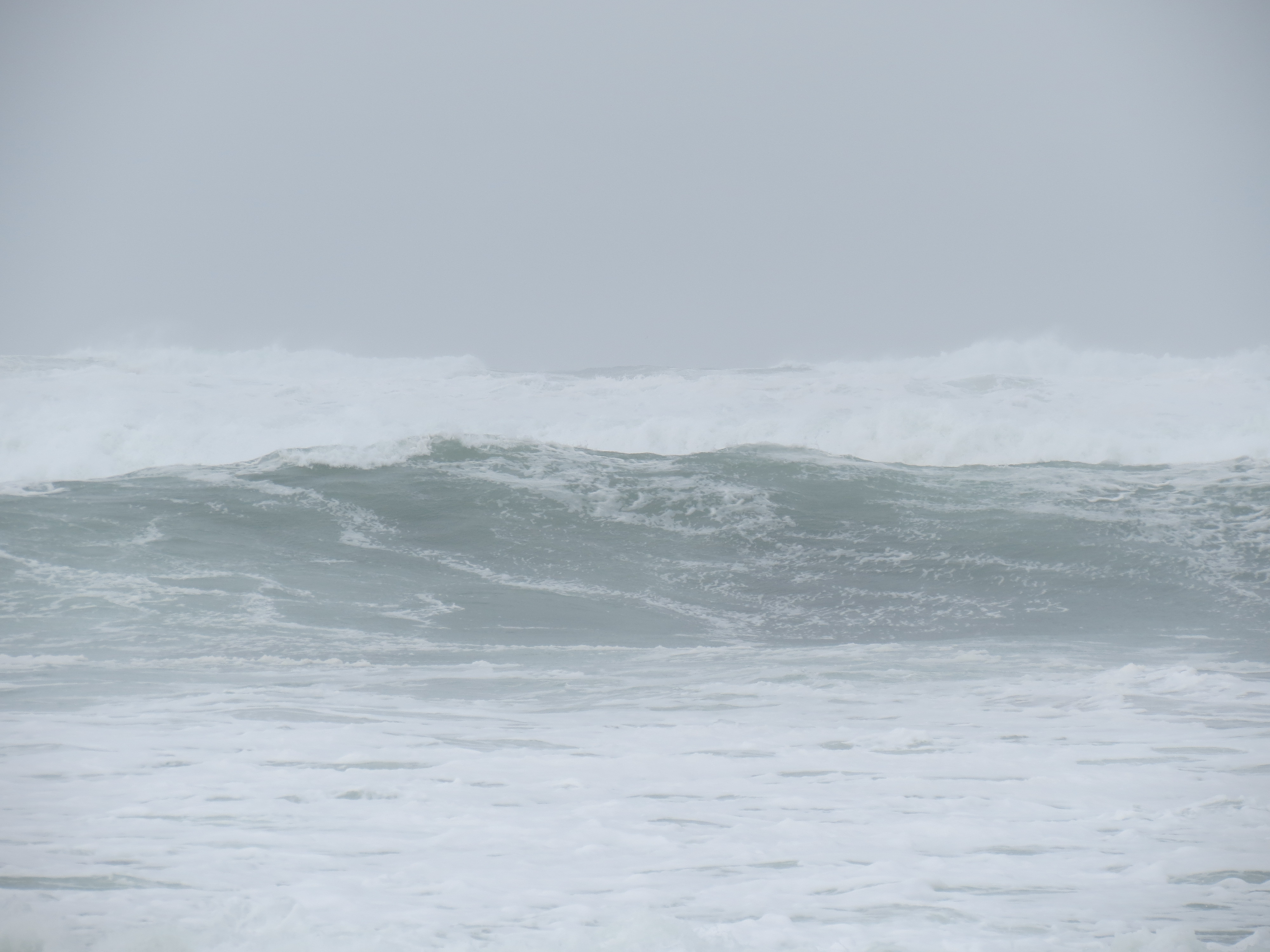
I went over the dunes, walking down to the nearly flat beach.  The waves were high, but there was a lot of wet beach that waves did not come up to often.  But wet beach=water, and I did not appreciate that obvious sign.  Suddenly, one wave appeared quickly.  I started to walk, but the wave overtook me, water reaching mid-calf and into my boots.  I laughed, thought it fun, as the shore was relatively flat, and wet feet weren’t going to ruin my day.  The ocean had warned me.  Nature warns, but we have to listen.  I did not.

Ten minutes later, I sat on a log down the beach, wringing out my socks, when another wave quickly appeared, but less powerful.  I raised my legs, the water went on both sides of the log, and I stayed dry.  I had been warned again.  The ocean was saying, “these are sneaker waves.”

Footprints in the sand.

Footprints in the sand.

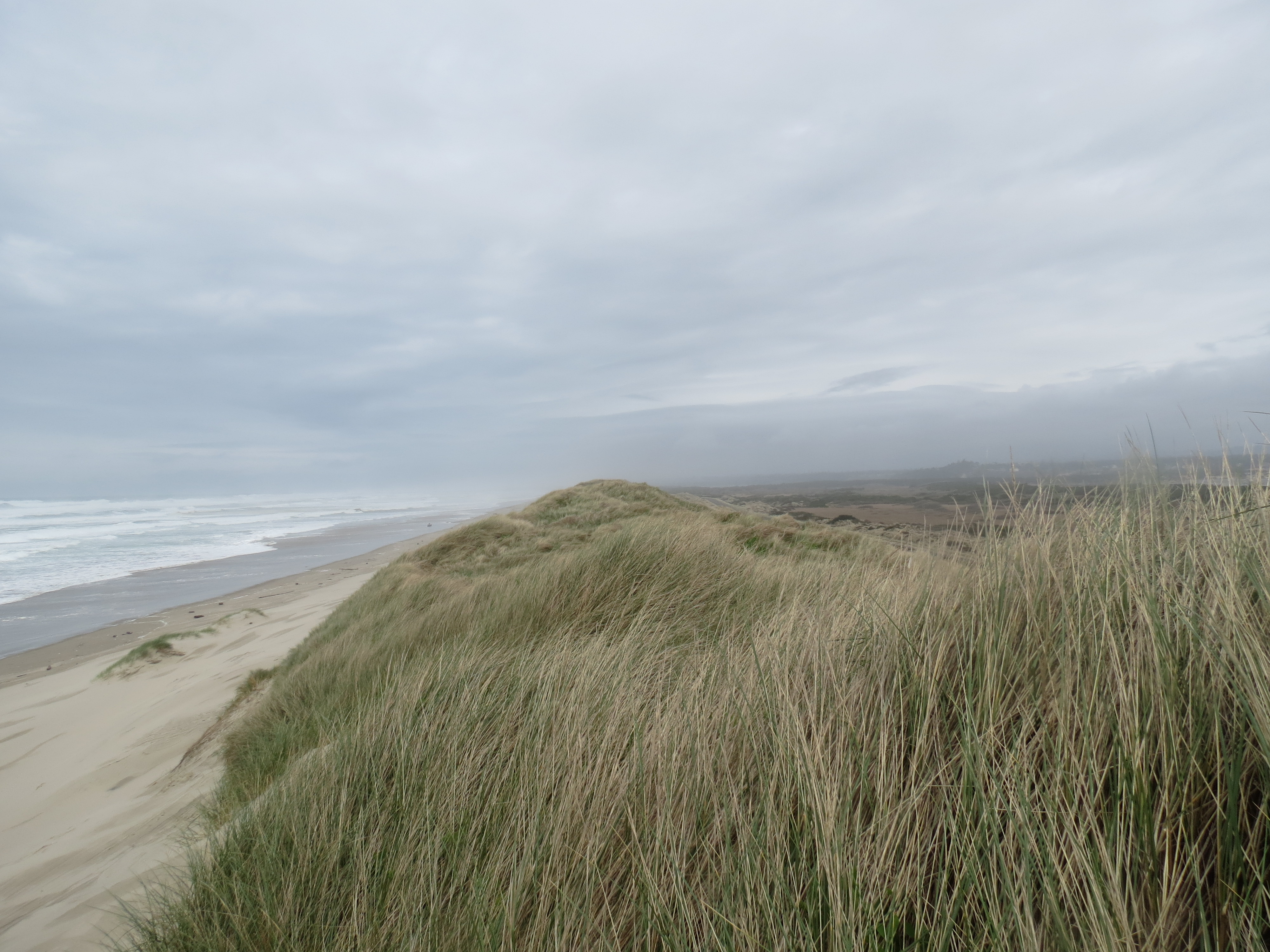
View at top of dunes, 50 ft (15 m) above ocean.

View at top of dunes, 50 ft (15 m) above ocean.

IMG_4166

View of the ocean from the dunes. The small log where I sat is left of center, on the beach.

I continued further south along the beach, climbing into the dunes, taking pictures of the ocean, the dark clouds that would herald rain later, and returned to where I came into the beach.  I constantly monitor the sky, I am less good about monitoring the ocean. I saw a large log, 18 inches in diameter and several feet long, with perhaps a foot wide flat surface on top.  I stood on the log, timed the swells, curious as how often a big wave would come in.  Nearly all waves crested about 50 yards away.

IMG_4174

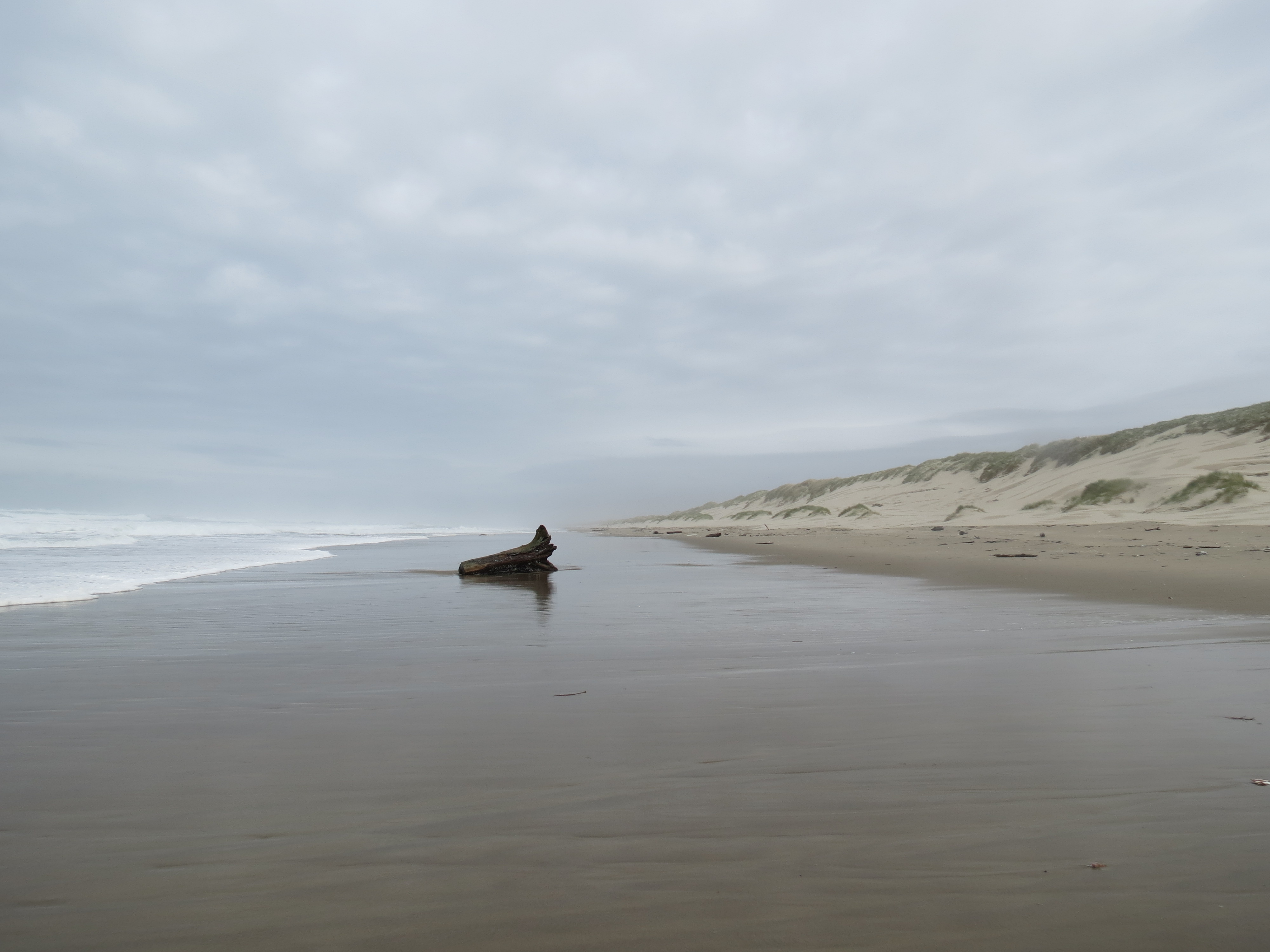
Soon to be a sneaker wave. No way to tell, except no water was flowing back into the ocean at the time.  Last picture taken from my camera.

The log where I stood

The log where I stood,  Notice how far up the water was capable of going.

Suddenly, one large one came in.  I felt safe on the log, above the water, but I had forgotten something I really should know–the power of moving water.  Two feet can float a car.  The water wasn’t that deep, but it was moving at 5 mph.  I could outrun it easily, but I could not walk faster than it.  Nine inches of water, 5 mph, and a 8 foot log is struck by 45 cubic feet of water a second–nearly a ton and a half.  This is equivalent to 3 defensive line football players running and hitting the log.

The force knocked me into the shallow, flowing stream.  I saw my camera under water; I took my phone out of my upward facing pocket, stunned, as I always am, when “this can’t be happening to me”  happens to me.  I got up, upset at myself, deeply embarrassed, muttered, “you really should know better,” and returned to the car.  I was soaked.

I started the car, turned on the heat, began drying my phone.  The phone worked later, as did the SD card in the camera; the camera itself did not.  I was alive; other than a lot of sand and wet clothes, I would eventually clean myself, the car, the garage, and those few places in the house I had tracked sand.

Thirty-seven months earlier, two young men from Eugene were standing on rocks out in the ocean near Yachats when a sneaker wave threw both into the cold ocean.  The rocks were too slippery to climb out; they died from hypothermia.

Sneaker wave.

There are some things we have to learn for ourselves, despite what people tell us.  Nature speaks, but we have to listen carefully to her language.  In 1991, I was ejected from a canoe when solo, I misjudged the force of current in Basswood River.  I didn’t, however, shoot the rapids a mile upstream, where 22 years later, an elderly man and his wife would.  She lived; he didn’t.  They had shot the rapids before, not ever recommended, and the water was unusually high, requiring they use a different route.  They were suddenly in extremely fast cold water with no canoe.  I was in warm, slow water next to my canoe.  I think all of us probably said, “This can’t be happening to me.” 

We all make mistakes, be it going up on a ladder when we shouldn’t, being outside when there is lightning, shooting rapids, or getting too close to the ocean.  What we must keep in mind are potential dangers and how rapidly things can go south.  Sneaker waves?  I know what they are…now.  I got away lucky.  I won’t get caught again.  Ever.

I wonder what the next stupid thing I will do will be.   Or whether I will be lucky.

THE ANNUAL CONJUNCTION OF SPRING, A SPECIAL RIVER, AND A SPECIAL BIRD

March 7, 2014

It’s late in the evening in March on the Platte River, bone-chilling cold in the viewing blind, where I stand alone.  I am in the center of what many call “fly over” country, about to witness one of the greatest scenes in nature.  It is one of my top four, but don’t take my word for it: Jane Goodall lists it in her top ten.

I hear the whining noise that sounds like a jet engine, but this sound is a lot closer.  It is the sound of thousands–no, tens of thousands–of Lesser Sandhill Cranes, coming into the river for the night.  Fly over country, indeed.  I am in fly over country; the birds are flying over the blind, in circles around the blind, at the blind, at me.  I am freezing cold, shivering with thrill, holding the video camera, exclaiming words I don’t usually say:

“I have never seen anything like this in my life.  The sky is black with birds.”

It is not often I post before I have completed what I want to say, but crane season is now, and I want to get some pictures up and some videos as well.

IMG_2729 IMG_3978

Platte evening

Platte evening

I’ve been in the viewing blinds 90 times, alone, with other clients, which I once was, and with clients whom I now guide to the blinds.  I have been in the blinds in 80 and 15 degree weather, thunderstorms and snow, gorgeous sunsets and with a biting wind that only Nebraska can dish out in March.  There is not one single time I have failed to learn something, about the birds, people, or myself in the blinds.

I am proud to be a Rowe Sanctuary volunteer.

IMG_2471 IMG_2920

Rowe was established forty years ago, now having a lovely visitor’s center, made of recycled wood from Nebraska schools, insulated with straw, and microphones to pipe in the sound of the cranes at night, which few hear, except in scattered farm houses along the river.  There are other buildings to house volunteers, with all sorts of tools and vehicles.  They now have a Crane Cam, too, which once I help put up, far upstream, so that when one “runs” the camera at night, the individual is showing the entire world the sight.

IMG_2809

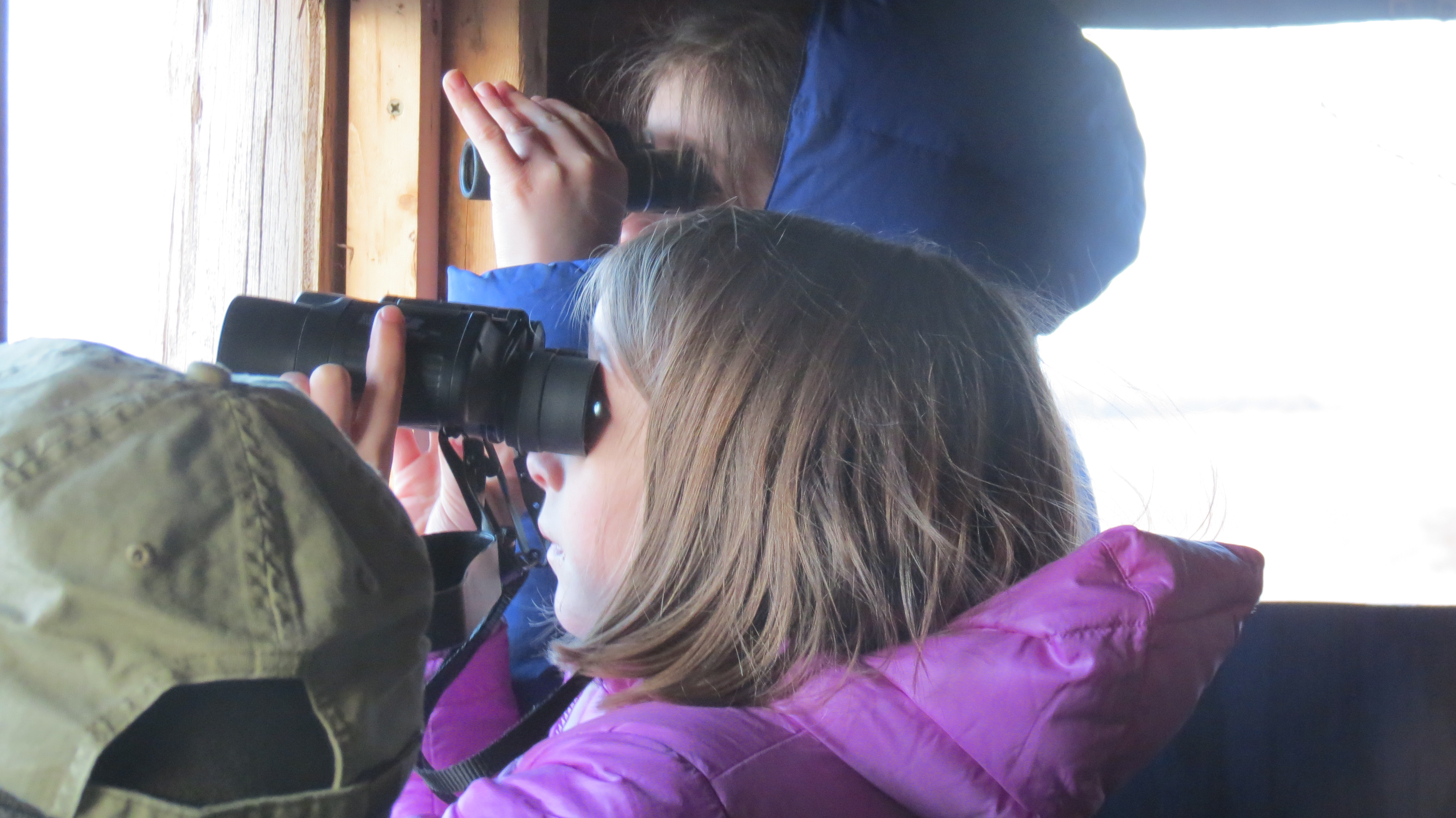
A big reason why I volunteer. It is for the children, so they will learn to love nature and the beauty of the world. Tower Blind.

Far more briefly than what I tell people, the cranes winter in the southern states and migrate to Arctic Canada, Alaska, and Siberia.  I have seen them in Bettles, north of the Arctic Circle. They do their final staging for their migration in the southern bend of the Platte.  They cannot perch in trees, so they live on the ground, in the air, or in shallow water, which keeps them safe from predators at night.  During the day, they feed on waste corn primarily in the fields near the river.  They go to the river at night for safety.  They gain 15% of their body weight in this period of time, the Platte’s becoming the largest single bar in the world for Sandhill Cranes.

Crane Moon

Crane Moon, 2010

From my bed, on the floor in the visitor’s center at night, I hear the cranes before I drop off into a brief sleep, for I will be awake at 4:30, getting Rowe ready for the 6 a.m. blind tours.  I may go as a guide, I may go to help a guide, but I will go.  The morning is different, because one arrives in darkness, hearing only cranes, or sometimes nothing, complete quiet, itself a rarity in this country today.  As the river wakes up, the cranes start to move.  Some “dance,” better than the stage, one lady told me, and they do it for courtship, pair bonding, and likely for fun.  Occasionally, all the birds leave at once, and one can see 25,000 in the air simultaneously.

Platte sunset.  So many nights I never thought I would see a good sunset.  So many nights I was wrong.

Platte sunset. So many nights I never thought I would see a good sunset. So many nights I was wrong.

The evenings are when the birds return.  They may stage in fields and wait until after dark.  One evening, I told a group we would leave a few minutes late.  “They are nearby in the field over there,” I said.  Two minutes later, several thousand erupted before us.  It made the tour.

large group on river

large group on river

The colors at sunset are remarkable

The colors at sunset are remarkable

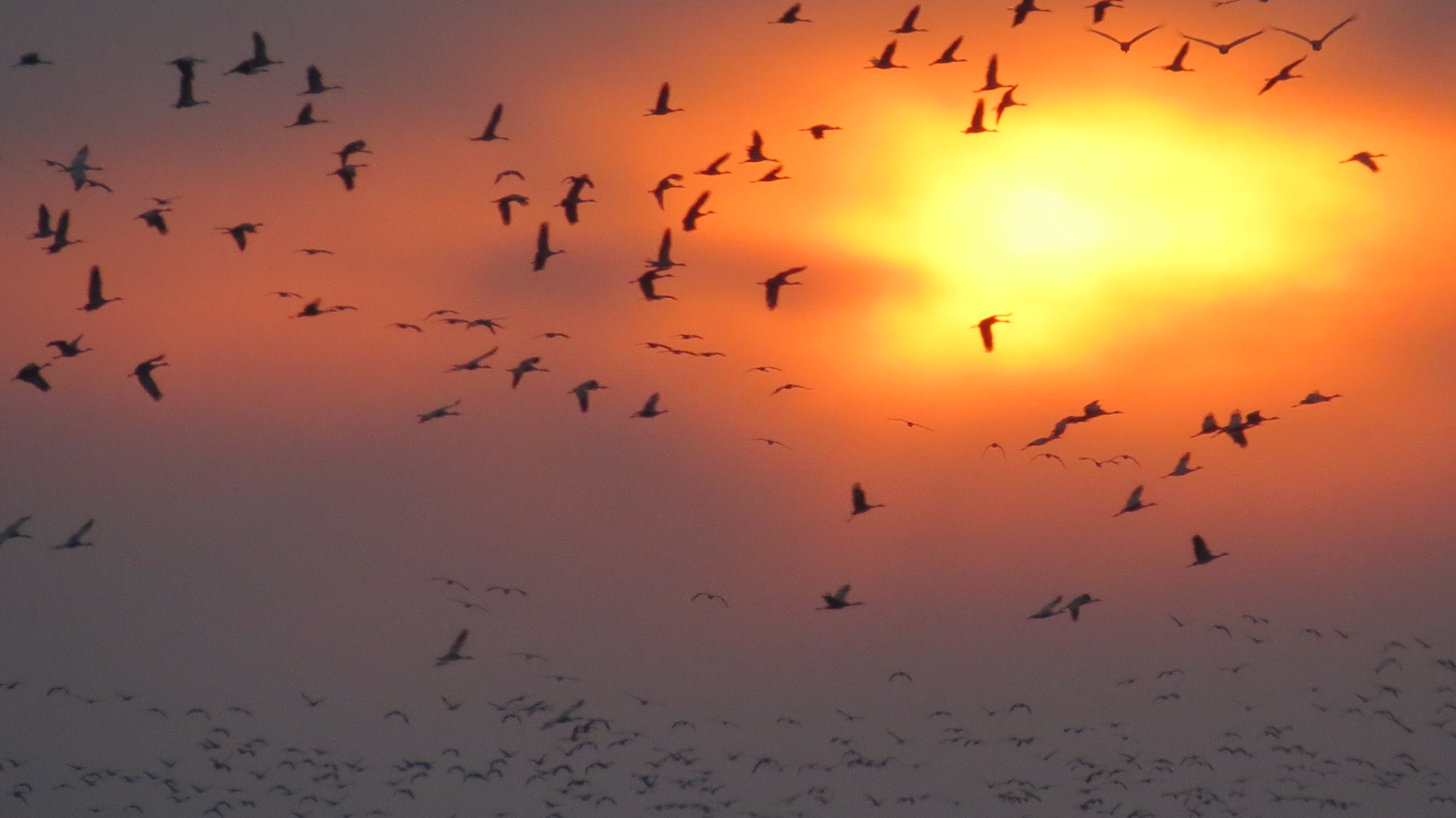
Birds and setting sun.

Birds and setting sun.

nother evening, I counted approximately 10,000 in 30 minutes. coming from one direction.  I’ve seen two flocks of 10,000 meet overhead.  I cannot describe the sight or the sound.   They come across the Sun, too.

IMG_2878

IMG_2955

When I became a neurologist, I learned that birds have “basal ganglia” brains, their behavior programmed, just like our walking, so we don’t think about it.  Last year, however, I learned the avian brain is configured differently.  The same neurotransmitters are present, and that was a tipoff maybe I could deal with my cognitive conflict: how can a bird with automatic behavior may appear to have fun.

The answer lay in the fact that birds can learn.  This has been seen and documented by a couple in Fairbanks, Alaska, who see the same pair of cranes return each year.  They see the cranes teach their young to fly.  A young crane who died was visited by the parents and sibling, who pulled grass over the body.  I don’t know what that means, and I am not even going to speculate, but I don’t think this is basal ganglia behavior.

Pair close by.  The red patch is featherless.  It becomes larger, should the bird be angry or aroused in any way.

Pair close by. The red patch is featherless. It becomes larger, should the bird be angry or aroused in any way.

I think my learning neurology forty years ago assumed things were later questioned.  Others may disagree with me, but they are disagreeing with a human neurologist who has seen pictures of how the avian brain is constructed, and has left, shaking his head, saying, “That is why they look like they are having fun.  They are.”

I have also learned how much fun I have, when I am at Rowe.  I work 17 hour days, occasionally with breaks to upload pictures or talk to people who visit–except that is supposedly work.  I clean toilets, drive ATVs to take people to the special photography blinds, expensive, but these are booked far in advance, and nobody ever complains about being cooped up in a 4 x 8 piece of plywood over night with a 4 foot high roof, 4 windows, and a chamber pot, not allowed to leave for any reason until morning pick up.  I’ve brought these folks back to the sanctuary, dirty, sleepy, and happy, with stories of what they have seen.  I’d be jealous, but I have seen most of this, too.  I am happy for them.

Tours run morning and evening, about 25-30 in a blind.  All tours are different, and sometimes a two minute period makes the day, or the week; the video I uploaded was 2 minutes, after about 2 hours of watching a pleasant river.

I meet volunteers from around Nebraska, with a few from neighboring states.  These people teach me common sense, how to work with tools, how to be a better person.  We don’t always agree, but we do whatever we can for each other.  Seldom have I had this experience anywhere else.  Last year, a 75 year-old woman taught me how to back a trailer.  She had been doing it since she was 8.

The cranes?  During the day, I have stopped driving the pick-up with the Buffalo or Hall County license plate, gotten outside, and looked up, sun reflecting off their wings of cranes, soaring at 500, 1000, or 2000 feet.  In late spring, they rise like a giant beehive, waiting to catch the south wind at 1600 meters, spread their wings, and as one volunteer put it, “Godspeed,” as they go to the Canadian Arctic, Alaska, or even Siberia to nest.   I’ve seen them migrate south over the Boundary Waters, and Hilt, California, the most northerly city in the state.

The few weeks a half million spend on the river are beyond compare.  I never tell people what they will see except “Cranes, plural.”  It is not my show, it is the birds’ show.  Almost everybody likes it, a few are changed a bit, and a lucky few, like me, are forever transformed, looking forward to the special time of year when as Paul Johnsgard puts it, the season, the river, and the bird all come into conjunction.

Spring, the Platte, and the Lesser Sandhill Crane.  All are needed.  All are sufficient.

BEING MADE OF STAR STUFF IS SPECIAL: TIME TO ACT LIKE IT

March 5, 2014

13 February 1988, West Anklam Road, Tucson, 6 a.m. I’m standing with an ICU nurse looking at Saturn and Uranus in conjunction, the same longitude in the sky, near the hospital where we worked.  “They’re in Sagittarius,” I pointed to the “handle of the teapot,” noting the bright star Nunki, guide star for the Voyager 2 spacecraft, to pass near Neptune a year later.

“No,” J. replied. “They’re in Capricorn (sic).”

“No, there are the two, and they are in the constellation Sagittarius.”

“But astrologically, they are in Capricorn (sic).” (It’s “Capricornus”)

“Well,” I sighed, “you can say they are in the Big Dipper, if you want.”  This was the last conjunction I would see of the two planets, unless I live to 83.

The Dartmouth Alumni Magazine recently profiled a man, a professional astrologer.  The astrologer  stated  his beliefs; the first thing I do in these “last page” articles is to check the “fine print.”  He left Dartmouth before completing his studies; no reason was given.  That colored my opinion.  Yes, Robert Frost left Dartmouth without finishing, but to paraphrase Lloyd Bentsen in his 1988 debate with Dan Quayle, “You’re no Robert Frost.”

7  December 1972 shot of the Earth.

I’ve posted the above picture before, and it’s worth re-posting.

What month is this?

What constellation is the Sun in?

What are constellations, anyway?

What can you learn from this picture?

Notice Antarctica illuminated by the Sun, so it must be near the Austral summer solstice.    The actual date was 7 December.  The Sun is in the constellation Ophiuchus on this date, meaning that if one could see the Sun from space, where the light isn’t scattered by air molecules, it would appear against the background stars in that constellation, an arbitrary grouping of stars with arbitrary boundaries, not in Scorpius (the proper spelling) or Sagittarius, the astrological constellation for this date.

Notice the white comma, a major anticyclone, or storm, off the southeastern coast of Africa, and the large clusters of thunderstorms in the southern equatorial region of Africa, consistent with migration of the Intertropical Convergence Zone (ITCZ) this time of year.

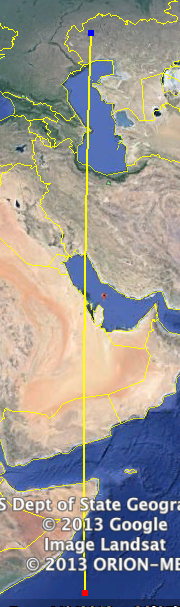
What predictions did the astrologer make?  In 1986, Bank of America was going to have problems.  He claimed he knew by looking at the rocks in the foundation; I would have looked at the internal books as a better foundation.  He said that the 50th degree of longitude, “that bisects the Persian Gulf,” would become a major factor in the world, and that the 35th parallel through the southern US would become very important.

Wow. The 51st meridian (or 27th parallel, another bisector, which was omitted) bisects the Persian Gulf better than the 50th.  Given the Gulf’s importance (he didn’t mention the Gulf of Oman and Somalian coastal waters), this prediction is not surprising.  All degrees of latitude in the US may be important; he omitted Kirtland and Edwards AFBs, near 35 N., but important Los Angeles is not.  What does “important” mean?  A chemical explosion, a nuclear weapon, or a great discovery?

50 E. longitude.  This might be considered important in the coming years.

50 E. longitude. This might be considered important in the coming years. This goes through oil-rich Baku, near Dagestan, through Iran, the Persian Gulf, the Gulf of Oman,  the Horn of Africa, and Somali waters.

I limit my issues about Astrology to four:  first, my “sign” of Sagittarius is defined by my birthday, not the Sun’s location when I was born. There are fourteen (not 12) constellations through the Sun may “travel.”  While it was in Sagittarius on my birthday 3000 years ago, it is now in Ophiuchus, north of Scorpius (the correct spelling).  I have no classical astrological sign.  Astrologers use celestial longitudes to try to deal with this fact, but they haven’t factored in precession; the Sun passes through 14 constellations during a 26,000 year cycle.  In 1991, $10,000 was offered to anybody’s showing the July 11 eclipse of the Sun against the background stars of then astrological Cancer, not the actual Gemini.  No takers.

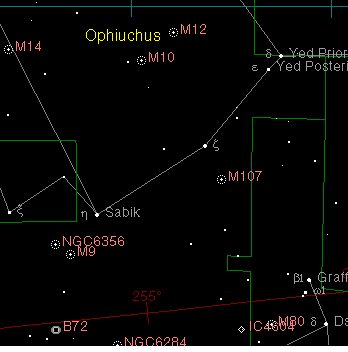
Ophiuchus.  Scorpius is in the lower right; the curved red line with 255 on it is the Sun's path, 255 being the number of days after the vernal equinox.

Ophiuchus. Scorpius is in the lower right; the curved red line with 255 on it is the Sun’s path, 255 being the number of days after the vernal equinox.

Second, there is no proof why astrology works.  What happened before 1781, when Uranus was discovered?  How can a planet’s position affect us? It can’t be gravity, because I have more gravitational attraction with my car than I do with Saturn.  Gravitational force decreases with the square of distance.  I would like to know the reason using terms that a layman can understand. I practiced neurology, and it was my job to explain what I knew to people, not hide it to make money.

Third, lines of latitude and longitude are dimensionless, so there must be some “wiggle room,” or error.  How much?  Why?  We are 95% confident global warming is occurring.  If we ran 100 simulations, 95 of them would not contain zero.  Where is astrological uncertainty, required for any prediction?

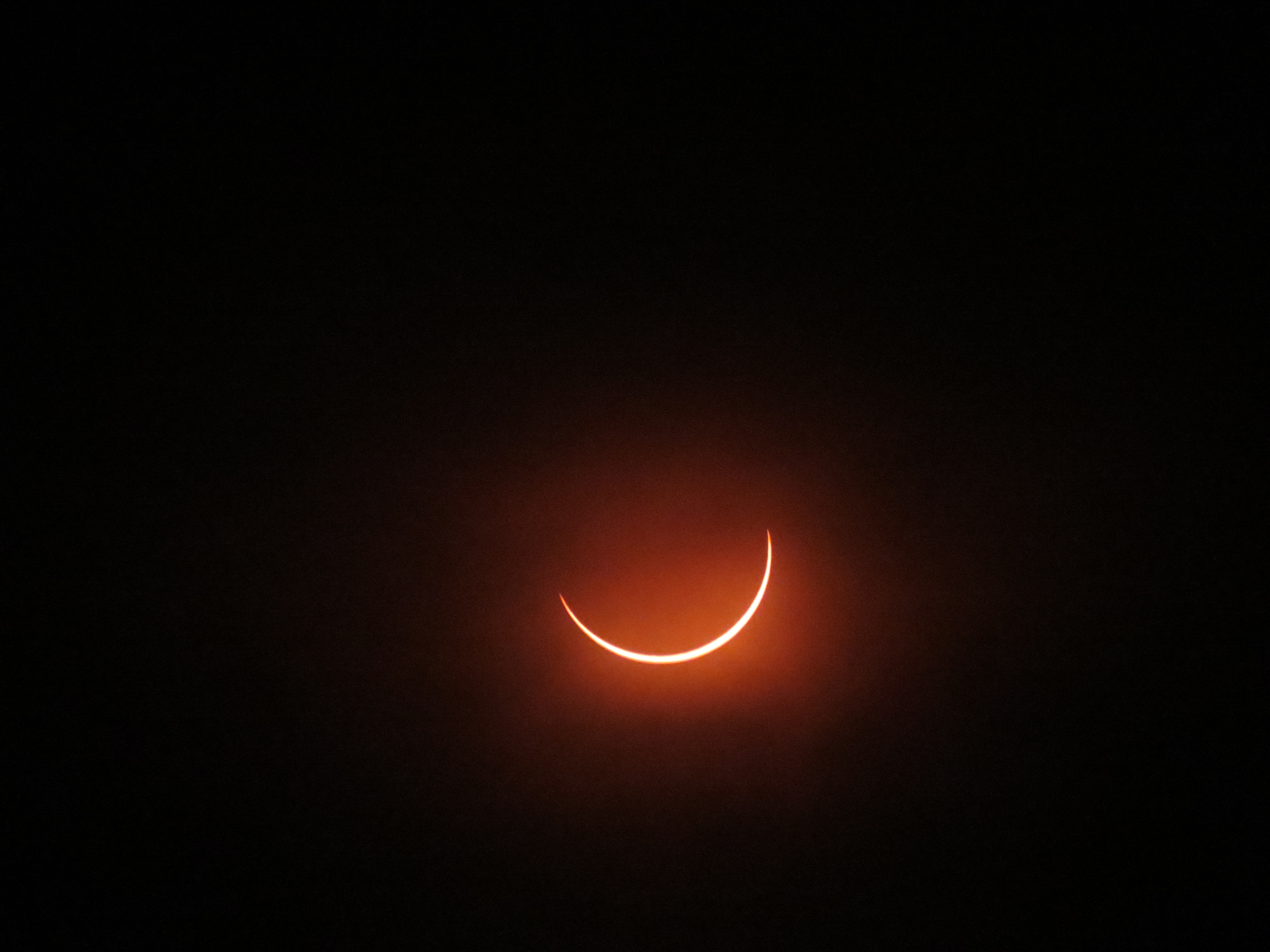
Just after 3rd contact or totality, Uganda, 3 November 2013. We had to be in a path 18 km wide to view 19 seconds of totality.  This path was known decades in advance, because we understand orbital mechanics.

Just after 3rd contact or totality, Uganda, 3 November 2013. We had to be in a path 18 km wide to view 19 seconds of totality. This path was known decades in advance, because we understand orbital mechanics.

Finally, too many never learn the actual sky, far more beautiful and fascinating.  I can tell time, date, and latitude by looking at the sky, and I can teach it.  Why seasons? The poles point in the same direction as the Earth’s orbits the Sun; sometimes they point towards the Sun (summer, more direct Sun); sometimes they point away (winter, less direct Sun).  I can predict full Moons and eclipses of the Sun and Moon; so can anybody, should they wish to learn.  It is science, not vague words.  Science has allowed me to see 20 central eclipses from all over the world.

Contrast that to my horoscope today, “You may want to let go of plans and let your spontaneous personality take over.”   “May”?  Why?  What is “spontaneous personality”?  All “plans” or some?

I once showed a minister the sky.  I scuffed my feet in the desert that night, explaining where the silicon in the sand came from–a star.  The iron in our blood came from a large star that accumulated iron in its core, which cannot be fused.  The star first implodes, gravity taking over when fusion ceases.  The ensuing explosion, equal to the Sun’s energy output during its whole existence, produces heavier elements.  The gold in a ring came from a star.  The magnesium in the pyrrole ring of chlorophyll came from a star, the carbon, nitrogen and sulfur in our bodies came from a star. The calcium in our skull came from a star.

Now, if the contents of that skull could appreciate this beauty, direct efforts towards improving the world, rather than making a buck through magical thinking, our life would be improved on this once-part-of-a-star world.

THIS JOB MATTERS

March 2, 2014

 In a Starbucks somewhere at Sea-Tac, I’ve seen an older man, around my age, working the counter. I go through Sea-Tac annually, if I am lucky, because I am on my way to Alaska and to the remotest country I know.  When I come out of the Brooks Range, I take the red eye back to Seattle, get 3 hours’ sleep, and head straight for a bagel and coffee, before the next flight south.  I’m getting a bit old for these trips, but there is a lot of country I still want to see.

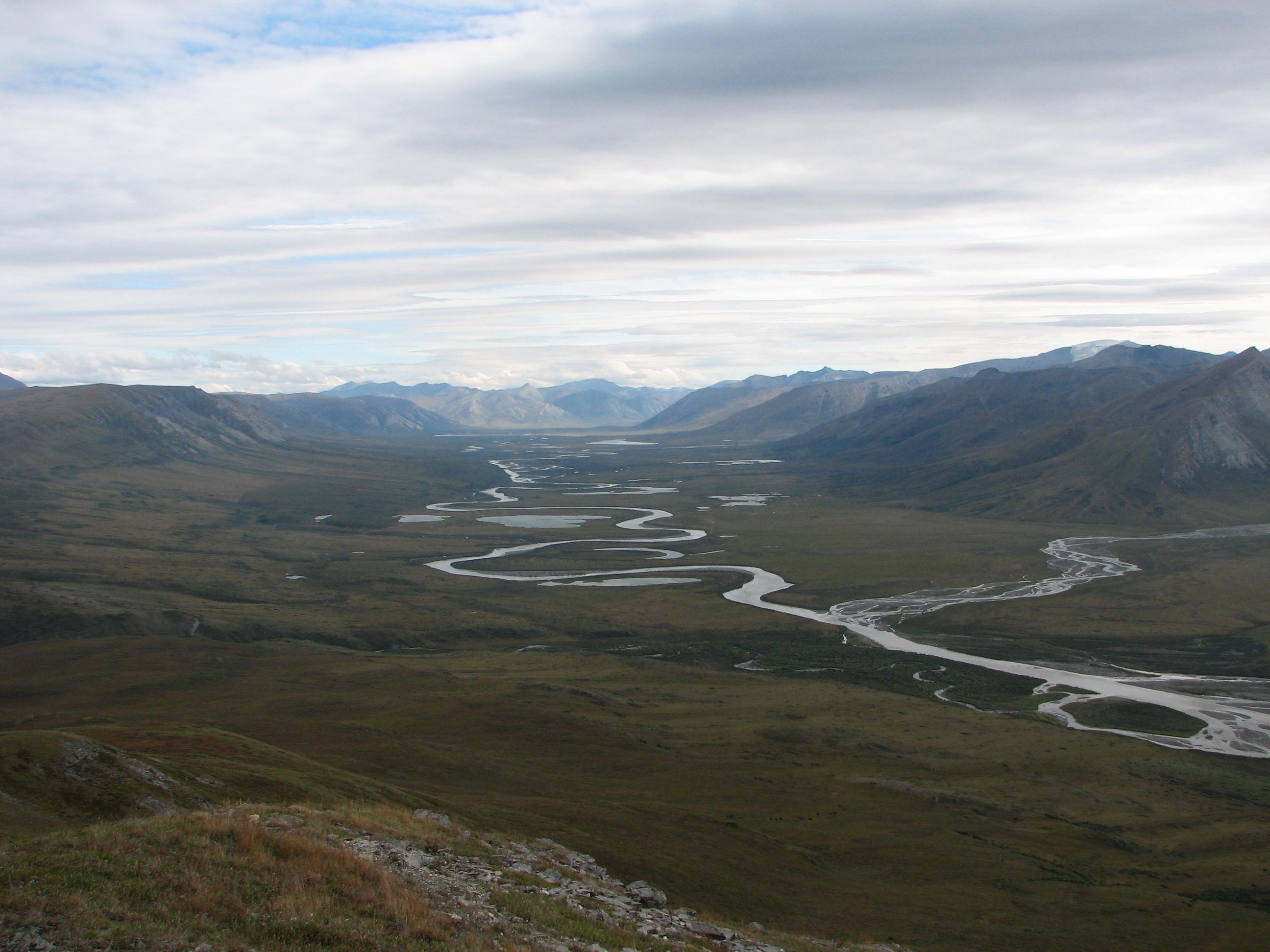
Noatak River, looking east, some of the most remote country in North America.

Noatak River, looking east, some of the most remote country in North America.

Dall Sheep above the headwaters of the Aichilik River.  This was one of the most beautiful areas to hike that I have ever been.

Dall Sheep above the headwaters of the Aichilik River. This was one of the most beautiful areas to hike that I have ever been.  This is in ANWR: to those who say this is a desolate place, I simply reply: “Hike the 120 miles there I have, and see what you think.”


The man works with many younger people.  He could be their grandfather. I know nothing about him: he could be lonely, a millionaire, and wants to be around people. Or he could be lonely, poor, needing every quarter people put in the tip jar.  I put in bills, because the workers divide the tips.  Divisors are fixed, but if the dividend increases, so does the quotient, a dividend in another meaning of the word.

What I do know is the man is dead serious about his job. He takes my order, and I sense I would be doing him a big favor if I were clear what I wanted and paid promptly with little hassle.  He doesn’t say this, of course, but his demeanor is no-nonsense.  He has a job, considered menial by many who walk through Sea-Tac catching a plane, but it is clear that doing the job well matters to him.

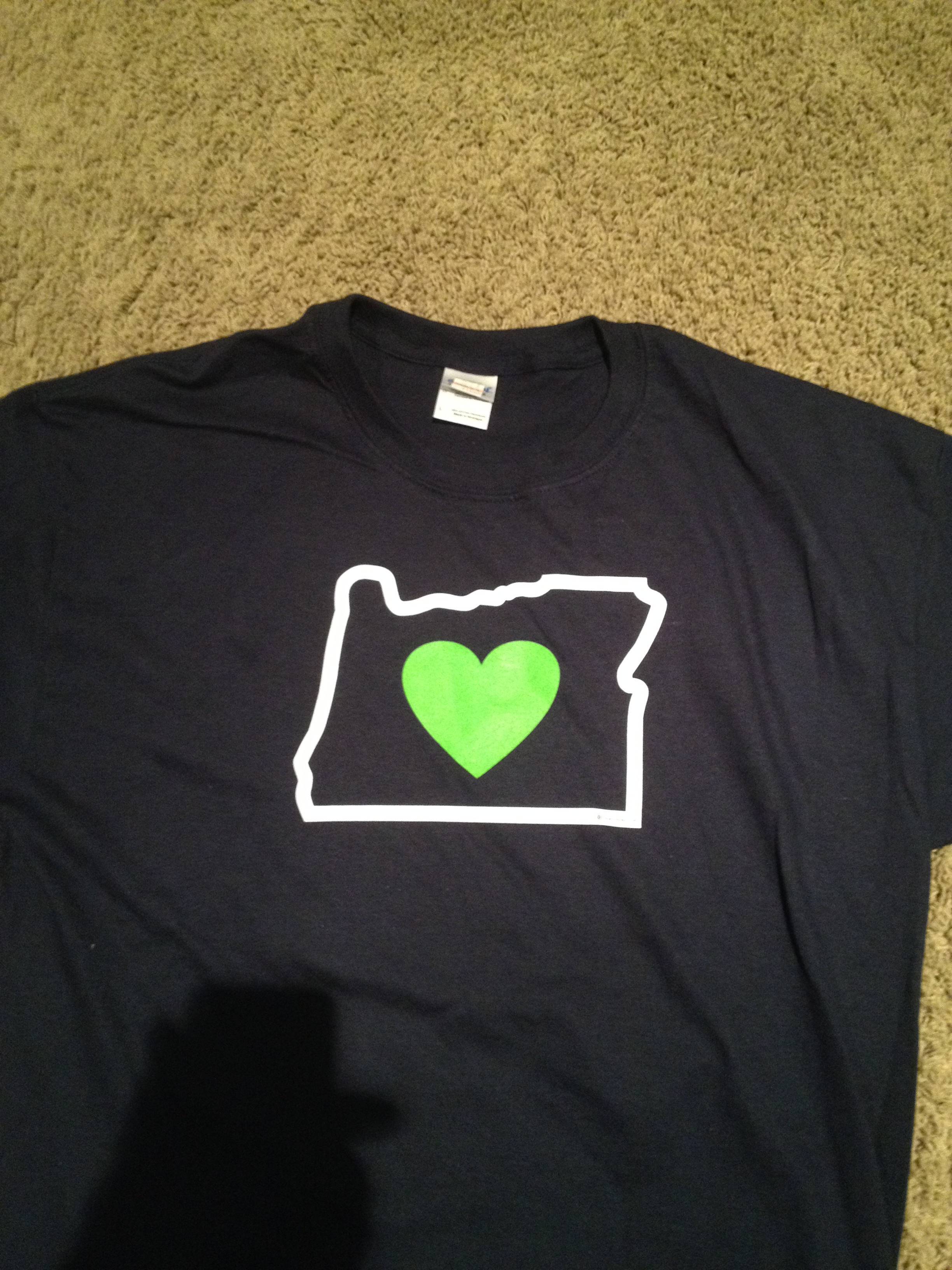
When I enter Hirons, a local drug store, I am greeted by a woman who recognizes both me and my wife.  “You back again?” she says, cheerfully.  Hirons is the only drug store I know where I had to ask directions how to find the pharmacy: I once got lost in there, overwhelmed by the inventory.  Just in time inventory doesn’t work in Hirons, and B-school students ought to visit to see how a place ought to run.  You don’t go online, like Amazon, you go there.   You walk in wanting Advil, you come out with it, a pair of lights to make walking at night safer, an Oregon shirt, maybe a mug, a dust pan, and a holder for soap in the shower. That’s how you move inventory, by having it available,  I once asked if they made keys.  That was stupid, but hey, I was new in town.

I called Hirons, because I need to move my Part D drug benefit pharmacy: three guesses what the answer was, the first two not counting.  Stupid call.  Now I can walk over there to buy a lot of other stuff along with the meds I need to pick up. Companies need to value employees who can remember customers.  It has no dollar value, or maybe it does, because people like to be remembered, and they will return.  I will of course use Hirons in the near future, like when I need a Dutch Brothers fix, at the kiosk nearby, at the EMX stop at Walnut.

Yeah, Dutch Brothers, with the red white and blue flags flying.  I don’t know how these places survive.  They do, in all likelihood, because when I arrive, there is music playing I normally wouldn’t listen to but end up liking.  There are two or three college students in there with personalities I wish I had been born with.  They could care less how I look.  They greet me warmly; people like this make me ask how they are, too, which I haven’t done for most of my life.  Not only do I ask them, I get a reply.  I get hot chocolate or coffee, and there are about 10 different kinds of both.  They work quickly and efficiently, their banter is interesting, they stamp my card, which means after 10 trips there, I get a free drink, so I will come again.  Think I tip them well?  Duh.  I go on my way, along the Willamette River, under the tracks, over Knickerbocker Bridge into Alton Baker Park, checking out the birds in the river.  My wife has never seen me so happy.

Autzen Bridge, over the Willamette River.  Hat reads Kobuk Valley, the most remote National Park in North America, and a real gem.

Autzen Bridge, over the Willamette River. Hat reads Kobuk Valley, the most remote National Park in North America, and a real gem.

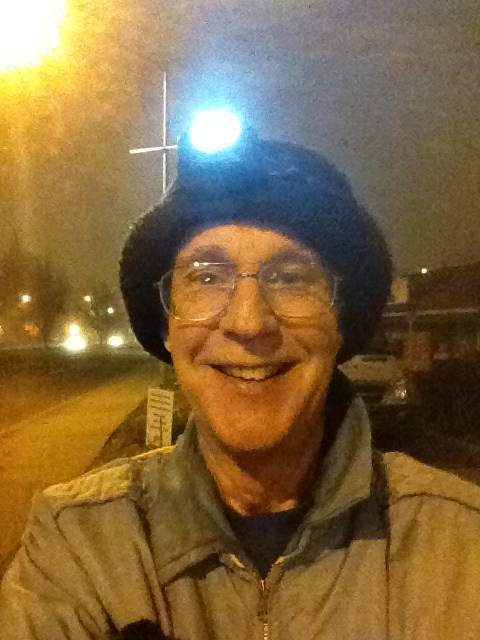
Foggy night; bought the light at Hirons, behind me to my right.  Think it was $7.95.  They should charge more.

Foggy night; bought the light at Hirons, behind me to my right. Think it was $7.95. They should charge more.

Maybe later, I will go to Evergreen’s, where they serve north and south Indian food.  I usually have a Nikasi Beer with dinner.  Yeah, for a dollar more, I get something brewed in Eugene, and I really like it.  A waitress and the owner herself recognize me, both knowing what I want.  I know the owner’s son’s name, birthday and age.  We were once immediately recognized after an absence of 9 months.  That’s impressive.  Think they get good tips from me?

Everybody knows places like the ones I described.  My late father-in-law went to Asquino’s, an East Providence institution with incredible Italian food.  They knew him, and if he had ever forgotten his wallet, I bet he would have eaten for free.  Asquino’s is no longer there. The world and families change.  These businesses are worth a great deal to customers, worth that doesn’t make the bottom line.  That’s the problem with bottom lines: they measure money, which people must make (teachers can’t eat “satisfaction,” my father, an educator, once said) but not customer satisfaction, ability to recognize repeat customers, and to have things the customer doesn’t realize they want.  I would bet much that “happiness” and “ability to recognize faces” is not on ExxonMobil”s bottom line.  Damage to the environment isn’t, which does have a dollar cost.

No money can buy good service and a pleasant person who remembers me, helping me have a better day.  I saw happier people in Ely, Minnesota, who worked half time, than my former partners, who made a half mil a year.  It was a rough life in Ely, but they were a lot nicer.  The average wage at Costco is double that of Wal-Mart.  The net worth of the CEO of Costco is 10% that of the CEO of Wal-Mart.  Throw in the rest of the Walton Family, and it is 1.3%.  The salary ratio between the worker and the CEO is still too large; when I practiced, the ratio was 1:7; 1:3 when hours worked were factored in.  Call me a socialist, but I lived comfortably.

I hope the man at Sea-Tac works to stay busy, but these days, that’s not likely.  I hope the Eugene places stay in business for a long time, along with Track Town Pizza, which hosts German Stammtisch Tuesday evenings. The whole lot are a 30 minute walk from my house.  I wonder how I got so lucky.  

Salary ratios ought to be on the bottom line; important things that can’t be measured ought to be mentioned, too.  Not everything in life has a dollar value.

Designed in 2003:  Follow your heart; it will lead you home.  Hirons charges more for this.  I really didn't need it.  No, I really did need it, for I have done what it means.

Designed in 2003: Follow your heart; it will lead you home. Hirons charges more for this. I really didn’t need it. No, I really did need it, for I have done what it means.

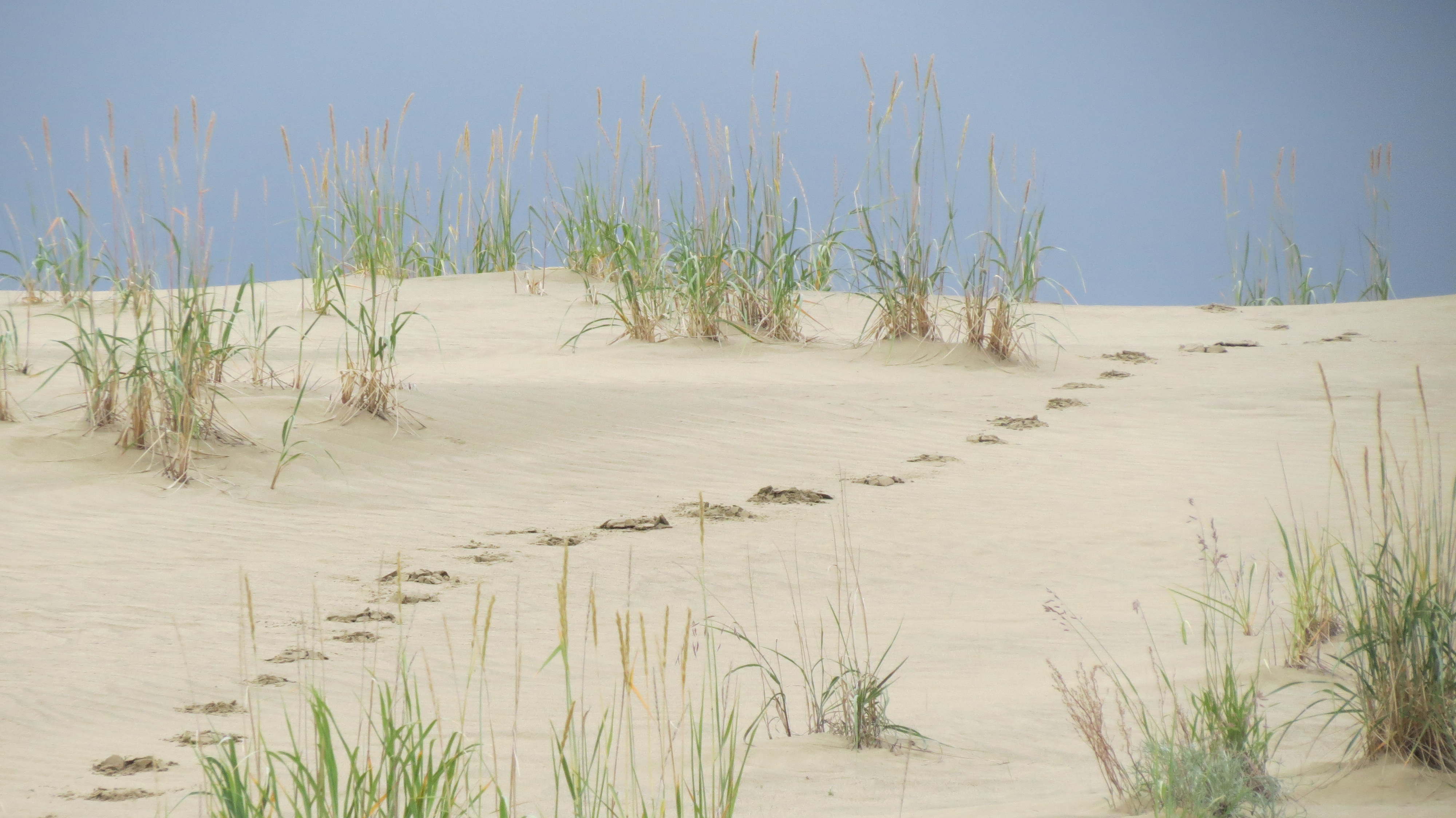
My footprints in the sand dunes at Kobuk Valley NP. It was one of those things that really is too expensive for the time spent, unless one factors in how much it meant to me, which was priceless.  What a lovely, quiet place.

My footprints in the sand dunes at Kobuk Valley NP. It was one of those things that really is too expensive for the time spent, unless one factors in how much it meant to me, which was priceless. What a lovely, quiet place.

FIFTIETH ANNIVERSARY

February 11, 2014

“A wilderness, in contrast with those areas where man and his own works dominate the landscape, is hereby recognized as an area where the earth and its community of life are untrammeled by man, where man himself is a visitor who does not remain.” –Wilderness Act of 1964

I am alone at 9453 feet, on a mountain top the way I imagine it, a quarter acre, maybe half, no trees, drop offs up to 1000 feet on all sides.  Above me, swifts are catching insects, their swept wings making identification easy.  I am dehydrated after hiking up on a hot June day, the 32 ounce drink I had at the start long gone before I even reached Josephine Saddle at 7200 feet. I am more than a vertical mile above Green Valley and 5 miles from the trailhead.  A million people live in the area I can see, but not one of them is within three hours of me by trail, and that is the only way up here.

My thirst doesn’t matter; I am higher than any other person in southern Arizona, seeing a wonderful sunset I will never forget, the reds and oranges stunning.  It was worth hiking up from my Baldy Saddle campsite to the top.  I must leave soon, as it is starting to get dark, and some of the trail will not be safe in darkness.  I will awaken tomorrow, away from the rush hour traffic of a large city, in one of the wilderness areas of Arizona, the trailhead little more than an hour’s drive from my house.  Few ever see this place, the Mt. Wrightson Wilderness, my favorite spot in southern Arizona, where I myself am a visitor and will not long remain.

I have camped here alone in a snowstorm, warm inside my sleeping bag, hearing the snow accumulate and then slide down the tent.  I have camped up here five times, a lot of work needed to haul a pack up the Old Baldy Trail, as it is known, but every bit of it worthwhile.  I have taken day hikes, once playing hooky from work for a few hours to come up in a snowstorm, returning to my job that afternoon, completely soaked, but absolutely happy and thrilled to be alive.  I have hiked up here and down the other side to Gardner Canyon, because I had never seen the Gardner Canyon trailhead.  I then turned around and came back up and over.  Wow, was I thirsty that day.  I came up the north side one day and stayed too long, hiking down in the dark with no flashlight, in old growth forest, never once cut, an owl’s sudden hoot making me almost jump off the trail.  That was a great hike.  They all are.  I know the trails like old friends.

From Baldy Saddle, reached from the west by 33 switchbacks, I see Green Valley and the Catalinas north of Tucson.  To the east, about 30 steps, I see Sonoita, Sierra Vista, and south into Mexico.  From the top, I see all of these by just rotating, as is the Earth.

It took much effort to get up here, but that makes wilderness special.  I am getting my reward tonight. I earned this view, through the thirst and soreness I endured. I don’t yet know that later tonight, I will hear a cougar close by.  I need wilderness.  I can’t explain it or put a dollar sign on it, but I need it.  Periodically, I reach a stage in my life where I know I need to get outside and hike somewhere.  It doesn’t have to be long, but it has to be away from people.  I can’t prove it, but I suspect others might become happier if they went into the wilderness, even a short distance, where they too would not long remain. I think mankind still needs wilderness, but perhaps the need has been allowed to atrophy too much.  I needed Mt. Wrightson tonight. Right now, I need to return to my campsite.  The swifts call, still catching bugs, as I start down the rocky trail, the last bit of red still visible in the west.

LOST

October 17, 2013

This is going to be easy, I thought.  I will drive to the base of a nearby mountain, climb 1.4 miles (2.2 km), 1000 (310 m) feet and come back down 1.4 miles.  I can do this in less than an hour, and I don’t need food or water.  It was afternoon; the Sun was in the southwest.

I arrived at the base, went up in 25 minutes to the summit, and came down another trail that had appeared on the Internet map to take a longer route, 2.4 (4 km) miles to where I had begun.  No problem.  I needed the exercise.  The trailhead where I started was west of me as I started down the trail.  All went well for 15 or 20 minutes, but then I noted by watching the Sun that I was heading south, and I needed to be heading north or at the very least northwest. I should have been walking with the Sun to my left, and it was to my right.

This concerned me a little, and right then I should have stopped and turned around.  The trail was wide and good, however, so I kept going.  When it bent towards the Sun and even a little beyond, I felt better, but I generally had the Sun on my right.  When I got towards the bottom, I saw a parking lot that was clearly different from the one I started at.  I saw a sign saying “west Trailhead 3.3 (5 km) miles.”  That was where I had started.  I was down the mountain but an hour’s walk from where I had started.

I saw a nearby road and thought that maybe the road would take me to the trailhead faster.  That was my second mistake.  I had no map of the road, and my Internet connection was not helpful, either.  But the road headed north.  That was where I wanted to go, until the road headed west and then southwest.  I thought more and more about turning around, and saw a woman walking.  I asked her if this road went near a certain landmark I had passed.

“I don’t know that place, but you’ve walked over the mountain and are on the back side.”

That is not what the Internet maps had shown.  I knew immediately what to do:  turn back. It’s a shame an hour earlier I didn’t do what I knew I needed to have done, for I would now be approaching where I wanted to be. When I reached the trailhead, I had two options:  completely retrace my steps, which was not a bad idea, but I would have to walk up to the summit again, 4.1 miles (6 km) in all, and why didn’t I bring water?  That way had a 100% probability of returning me to where I wanted to go.  Or, I could start on the signed trail that led north 3.3 miles.  The trail had a couple of forks that were not marked.  One led to the summit, which I considered, because that was familiar, but I stayed on the flat trail I had found–the Sun remained on my left, and within forty minutes was back at the car.

I was thirsty when I got back, and I thought what I had done is how people get into trouble.  Step 1, you have a sense of uncertainty., but you ignore it.  Step 2, you start fitting things into place so that you convince yourself you are going in the right direction.  Step 3, things aren’t right, and retracing your route seems too long.  Step 4, you try what turns out to be a shortcut, and it isn’t.  Step 5, you run out of daylight, you injure yourself, you panic, start burning energy and consuming water by running, get more lost, and you are stuck in the woods all night, with no food, water, or shelter.  I’m not young; my reserves are less, and while the young are often the ones who die of hypothermia, I am far from immune.

*************************

Seven years ago, on Isle Royale, I hiked in the dark after a wolf had visited my camp.  My flashlight was good, so I could see the trail, until there was a big blowdown in front of me.  I walked around the blowdown, and it took some time, but soon I was back on the trail.  Something nagged at me, however.  For whatever reason, I wondered if I had turned around. It happened to me once in broad daylight on the Appalachian Trail in 1998.  I stopped.  That was smart.  I took out a compass, which I had never used in the woods before, but always brought with me.  I needed to be going generally northeast, and my direction was southwest.  I had been turned around on the blowdown.  I thought I would come to it again, if I were correct, and I did just that.  I saw what I had done wrong and continued, northeast.  I listened to myself.

**************************

Twenty-one years ago, with nearly 90 days in the woods that summer behind me, I headed out on Burntside Lake for the Crab Lake portage several miles away.  I didn’t have a map for the particular part of Burntside I was on, but I had maps for the rest of the the lake.  My plan was to go due north and eventually reach the part of the lake that I had maps for.

About a mile from shore, I hadn’t arrived at the points listed on the map I had. I tried to “fit” some islands ahead of me into the map I had, and I kept going.  After a second and a third mile, the less certain I was whether I was on the map, or where the Crab Lake portage was.  I could still see the shore behind me, where I had launched.  I stopped paddling.

“You are lost,” I said aloud, to the waves.  “You have no idea where you are.  You don’t want to admit defeat and turn around, but do so.  Nothing good is going to happen if you try to keep going.”  I turned around, quite embarrassed, and two hours later was back in Ely.  The first place I went to was an outfitting store to see where I had been.

I never would have made the portage that night.  The next morning, I launched from a different point and had a good trip into the Burntside Unit of the Boundary Waters.  I didn’t get lost once, and I was comfortable the whole time.

Failure to prepare properly sets the stage for getting lost in the woods.  Take proper gear, even if it is a short hike.  I didn’t on the mountain.  A sprained ankle, a minor issue,  becomes a big issue on a remote trail. Check directions.  I had a compass, but the Sun was more than adequate.  If you can’t tell yourself, “I know where I am, how far it is to a certain point, and how I am going to get to the end,” you should be concerned.  Listen to your concerns.  Sure, it is fine to walk a few more minutes, but start considering turning around and going to the last point where you knew exactly where you are.  Don’t ever look for shortcuts through the woods.  Unless you have a clear line of sight to a distant trail, stay exactly on the trail you are on.

Don’t be afraid to tell yourself you are on the wrong trail.   Don’t be afraid to turn back to familiar surroundings.  Don’t be afraid of saying you don’t know exactly where you are. Don’t be afraid of later having people laugh at your getting lost or having taken the wrong trail.  Later being laughed at means later you are alive.

Be very afraid of being lost, in trouble, alone, and saying, “I can’t believe this is happening to me.”

TICK, TOCK

September 10, 2013

Tick, tock, TICK, TOCK.  In the past year, my internal clock has been ticking louder.  It’s telling me get out in the woods more, do the things I want to do, see the things I want to see, now, soon, this year, maybe next, but not put them off.  The sound is reminding me again there are no guarantees in either longevity or health.

I’ve always had a clock, but I didn’t hear it much for many years, when I had my neurology training.  I saw sudden catastrophic neurological conditions, many times in people who had just retired.  I started to hear the clock again.  Two young colleagues died in accidents within a few weeks of each other back in ’92, and the sound became louder.  An inner voice told me, “There’s a cost to taking a leave of absence to work for the Forest Service in the canoe country, Mike, but there is a cost to waiting. Go now.”  I didn’t wait until was 65, which I will soon be. I went early and never regretted it.

The same time, I made “The List,” years before “bucket lists” and “1000 places to see before you die,” many of which I neither need nor want to see.  The List is for me.  Others don’t need or want one.  That’s fine. I do.

In my 30s, life was busy, too busy.  I practiced medicine, chronically fatigued, interrupted, sued, and hurried until I finally got out at 43.  I had other jobs, went back to school, got a degree, couldn’t make a living at it, and started volunteering, to give my life more meaning.  I tutored math for 9 years, taught a man to read, led birding tours in the neighborhood, and removed buffelgrass.  I published articles.

One day, I happened to see The List, which had languished in a drawer.  The first item was “See the Sandhill Crane Migration in Nebraska.” I had put that one off for a decade. In 2004, I  told my wife and father that I was going, and they were welcome to accompany me, but Nebraska weather in March was unpredictable.  We all went and had a good time; I was transformed.  I am now a volunteer tour guide at Rowe Sanctuary and for 6 years have showed others the migration.  It is one of the top 4 sights I’ve had in nature (total solar eclipse, seeing a wolf in the wild, and Katmai bears are the other three.)

I chased a few eclipses in some unusual places, and indeed, seeing the next total solar eclipse became a permanent member of The List.  In 2005, I added a new item:  see all the national parks.  In December, I drove 550 miles to Guadalupe Mountains NP and climbed Guadalupe Peak the same day.  I was told it would be too windy up there and too dark before I got down.  I went anyway.  For 15 minutes, I was alone and atop Texas.  It was dead calm.  I got down just as it got dark.  Great hike. Eight years later, I have eight parks left to see.  The 19 trips I’ve taken, my odyssey, has been one of the best things I have ever done, carrying me into 13 states and 23 new national parks.

In the winter of 2007, the ticking became really loud, as it does when I fail to get outdoors enough, so I looked at The List and read: “See the Arrigetch Peaks”.  Oh yeah.  That one. These mountains, some of the most unusual in the world, are in the Brooks Range of northern Alaska.  I was 58; I wasn’t going to be backpacking forever.  I have a neck I have to take care of, and anything else could suddenly fail.  I wasn’t expecting problems, but I heard the clock:  GO!!  I  went the next summer.  The hike was the toughest 20 miles I have ever done, but I saw the Arrigetch.  It is one of the top items on my “Outdoor Resume,” which I keep for myself, although others may certainly look at it.  I am not competing with anybody, only fulfilling my dreams.

After that,  I planned my trips on a regular basis.  Hiking the entire Appalachian Trail is on The List, but I don’t plan to do it; there is too much else, and the AT requires too much time.  I’ve walked the southern 528 miles and hiked 20 miles in a day (another list item) 9 times, once 3 days in a row.  Damn, that was fun.  Maybe I should reconsider.

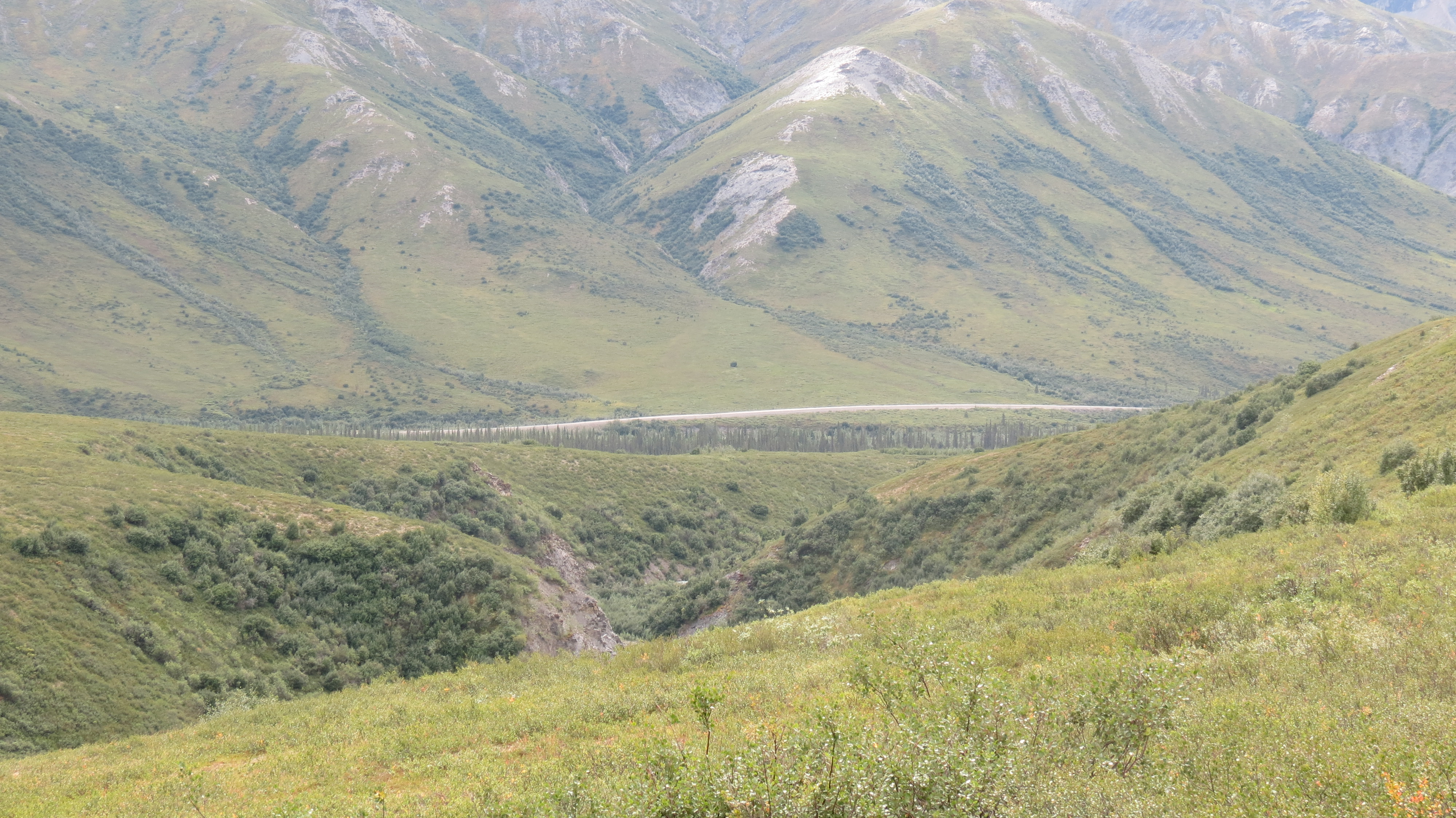
High above the Dalton Highway, just south of Atigun Pass.

Dall Sheep, Aichilik River headwaters, ANWR, Alaska.

TICK TOCK. I wanted to see the eastern “Gates”, Gates of the Arctic NP.  My guide and I bushwhacked in from the Dalton. I carried 75 pounds up a monster hill with a 20% grade, went over Oolah Pass two days later

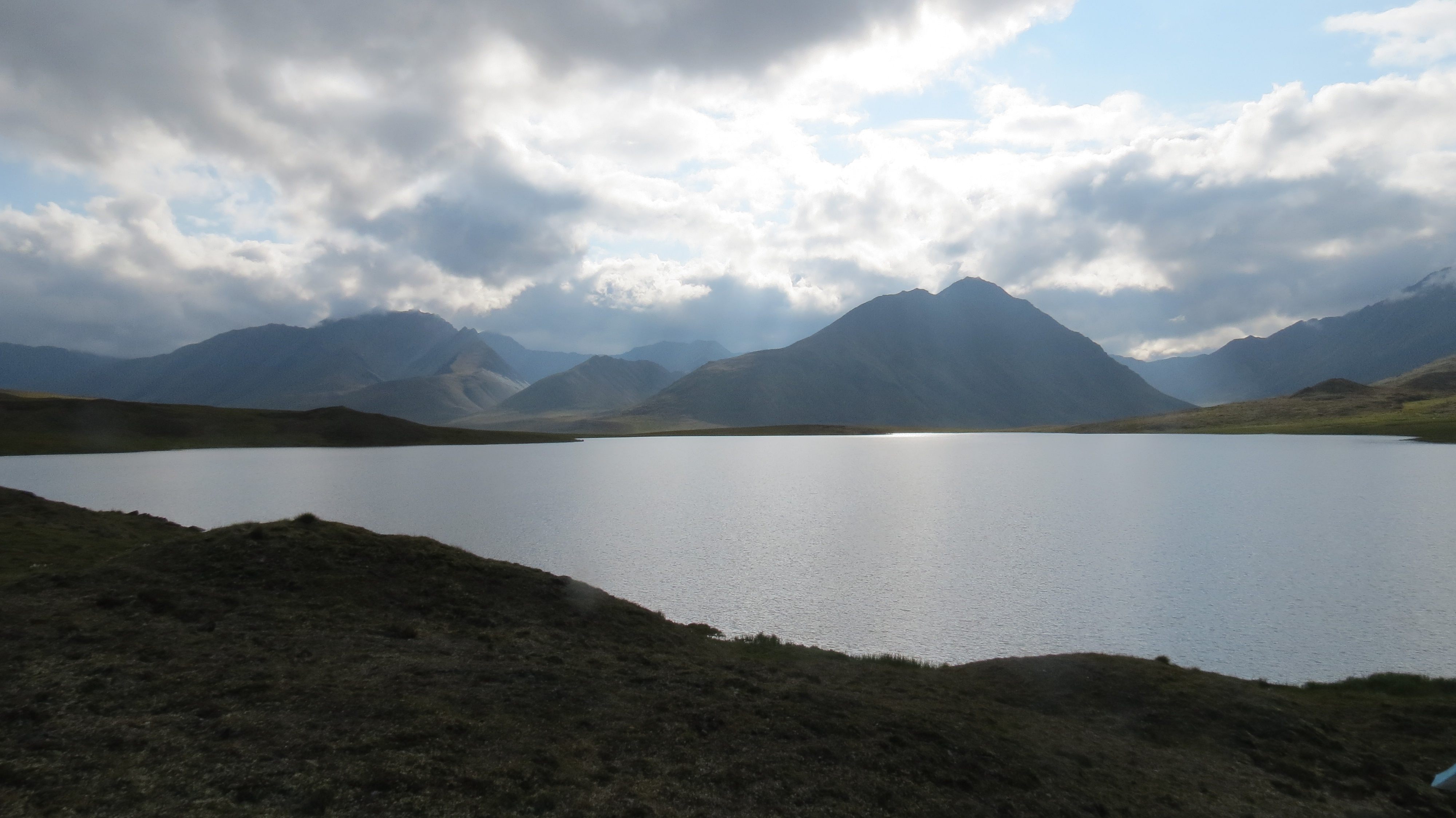
Oolah Pass and Lake

Oolah Pass and Lake

in a cold, pouring rain, up other steep hills, in rivers,over moraines, through incredible valleys, to Summit Lake.  We got picked up by float plane.  Hiking is better, but to fly over this country is incredible.  We flew between Frigid Crags and Boreal Mountain, the “Gates” of the Arctic”, named by Bob Marshall.

Summit Lake, Gates of the Arctic NP, on the continental divide (1200 m)

Summit Lake, Gates of the Arctic NP, on the continental divide (1200 m)

I now think that perhaps this hike was harder than the Arrigetch.  I thought it would be my last backpacking trip, but my guide told me about doing ANWR again. I remembered the wildlife on the  in 2009, got that faraway look in my eyes that said I needed to go back, know I won’t be happy unless I do, and that is on for 2014.

TICK TOCK.  Mike, you saw Alaska, but you need to see those parks.  This year, I took three week-long road trips.  I love planning these.  They were tough, but I did what I set out to do in each one.  The first one took me to Mammoth Cave, KY; I spent time with the Friends of the Boundary Waters in Minneapolis, went to Ely, winter camped solo, gave three scholarships at Vermilion Community College and came home.  The clock’s ticking was quieter.  I got into the woods.  Alone.  In snow.  And did fine.  It was one of the smartest hikes I had ever done, probably because I knew I had little margin for error.

My footprints in Kobuk Valley NP Sand Dunes (greater)

Noatak River, near the western edge of Gates of the Arctic National Park. Looking east.

Three months later, I saw four Alaska national parks.  I spent three nights after 1 a.m. in the Anchorage airport to do so, but I flew into Kobuk Valley National Park,  drove 7 hours to Wrangell-St. Elias and back, flew to Katmai and later to Lake Clark.  Great trip, but I missed hiking with a pack. Go back to ANWR one more time, Mike, go while you can.  If you’re lucky, you can raft the Killik, Nigu, Hulahula or Kongakut Rivers some day, to add to your paddling the Alatna and the Noatak.  Maybe do all of them.  Tick Tock.

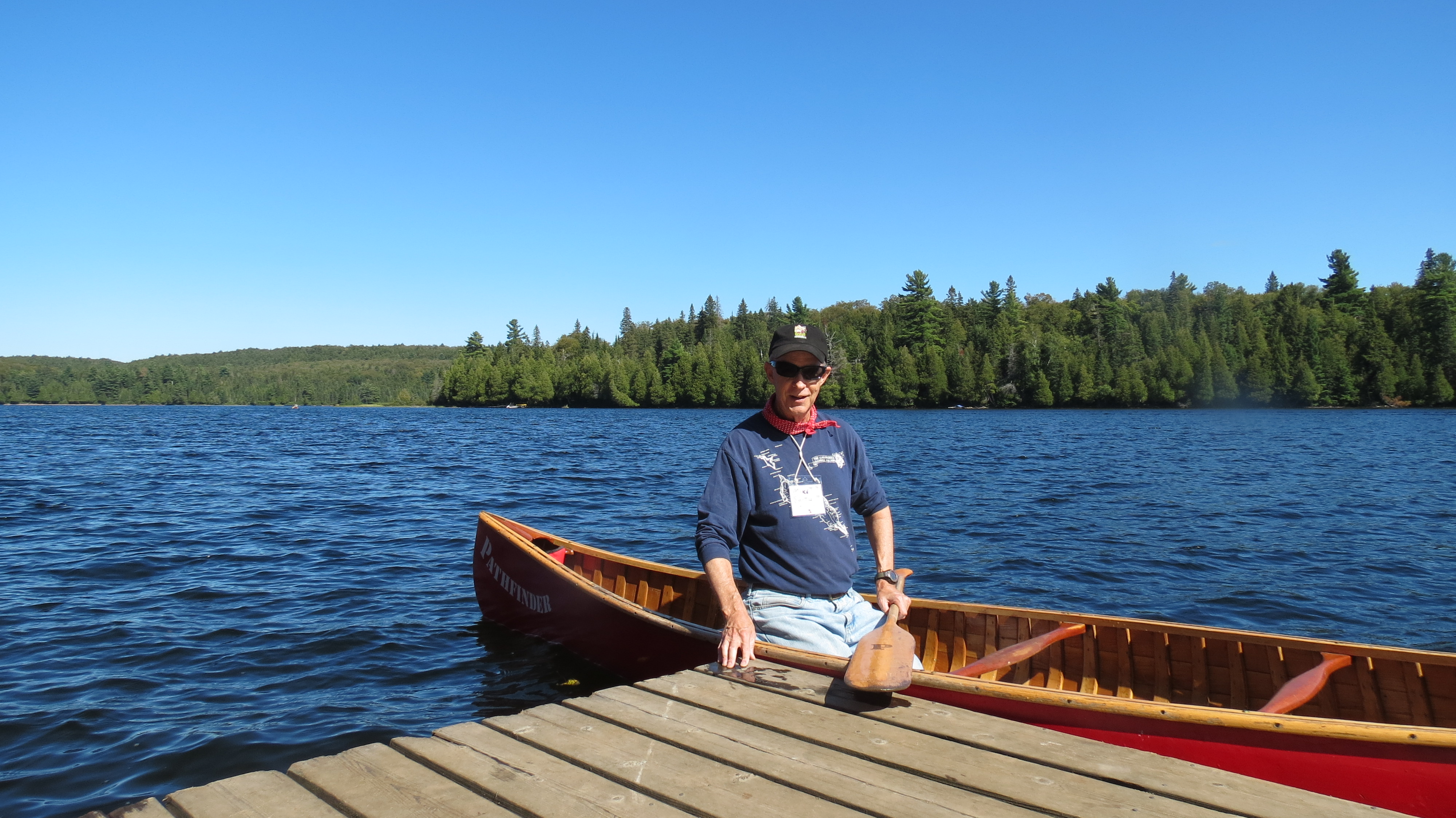
A month later, I flew to Rochester, New York, my home town, to see it one more time.  The next day I was in Cleveland, seeing Cuyahoga Valley National Park.  With a bad case of the GIs that night, and beginning a nasty cold, I drove from there to Algonquin Park, Ontario, for Camp Pathfinder’s 100th anniversary, where I learned to canoe, and did a day loop trip in Algonquin.  Being underway in a red canoe

Red canvas canoe that Pathfinder uses.

Red canvas canoe that Pathfinder uses.

that dented my knees  from kneeling on the ribs and planking was part of the thrill.  Pathfinder bowmen didn’t sit in the bow seat.  I even carried the red canoe a mile.  I texted that feat to my wife, and she simply replied, “Why?”  It mattered.

Day trippers at Little Island Lake, Algonquin Provincial Park, Ontario. I camped at this site 50 years earlier. I am in the blue in the back.

I didn’t know if I could get the 90 pounder on my head, but wisdom is more important than strength, and the canoe went right up. Then, of course, I had to carry it the whole way.  It’s not a man thing; it’s a Pathfinder thing.  I wore red there; to wear red and carry again was deeply satisfying. After Pathfinder, I drove to Ottawa to see a good friend.  He took me over the Chilkoot twice, introduced me to the big waters of the Far North, the Yukon and Nahanni Rivers, and we’ve been in the Quetico.  Lot of water under our keel.  He’s got me interested in seeing Western Australia, and he is nearly 70.  Tick tock.

Tick, tock, tick, tock.

I’m trying to learn two languages, too.  Tick, tock.  Will you ever be functionally fluent in German and Spanish, Mike?  Tick tock.  Are you getting out enough?  Tick tock.  Do you notice how easy it is to get stiff and sore?  Tick tock.  Do you remember your miserable illness in 2009, when you almost were housebound for 4 months?  Tick tock.  Are you teaching enough?  Tick tock.  Are you loving your wife enough?  Tick tock.  Are you caring for your animals?  Tick tock.  Do you look at the maps on the wall and wonder how you are ever going to see all that country before you die?  Tick tock.  Does it matter, if you can just get to the places you love again?  Tick tock.  Are you able to say every day, “If I drop dead now, I will have lived, loved, done good, and been worthy of calling myself a human being?”

Tick tock.