Posts Tagged ‘Philosophy’

STATISTICS AT THE PINNACLE-PART 2

February 15, 2017

I’d look at the audience and find two rows where I saw 22 people.  “What do you think the probability in these 22 there is at least one pair with the same birthday?”   I’d ask that because most people would think it is quite unlikely.  Our brains tell us that, but our brains can deceive us, not only the brains of others.  Turns out, the probability is about 50%.  I might even start with 7 rows containing 70 people, where the probability is 99.9%.  “This does not make intuitive sense,” I would add, “but is easily proven by taking the approach of the probability that two people don’t have the same birthday.”  My statistics advisor did this in a class where I happened to be attending as a graduate student, and the first student’s birthday matched mine.  He said the look on the face of the students was priceless. “Why does this matter?  It matters because sometimes the way you think is wrong, flat out wrong!  Your brain lied to you.  Your brain said the likelihood of two people in the same room’s having the same birthday was small, very unlikely with 22 people, which is not true.  Our brains lie to us about speed, direction, and up and down. They worry more about improbable losses than probable gains, and how certain major events in our lives shape our thinking, even if they are very unlikely to ever happen agan.   The solution to the birthday problem is also a good life lesson:  figure out what you don’t want and whatever is left over is what you want.”

I’d talk about the lottery and expected values. People play the lottery, because eventually somebody wins.  We can predict quite accurately the probability that somebody will win.  “You see,” I’d say, “low probability events happen; they just happen with low probability.  Take the lottery with a 1 in 110 million chance of winning.  If 330 million tickets have been bought, the expected value of jackpot winners is 3.  That doesn’t mean that 3 will win, but it is expected.  We can easily, and I mean easily calculate the probability of 0,1,2,3, and 4 with a calculator and a few key strokes.  Three people nationwide might win.  Three people, in the entire country.  Yes, it has to be somebody.  But do you think it is going to be you?”

If you have a disease, you have certain symptoms.  Medicine is the study of people who have certain symptoms and tries to figure out the probability of their having a disease.  Physicians and others would do well to understand the idea that not all who test positive for a disease have the disease.  “Suppose a disease has a 0.1% prevalence in the population, or 1 in 1000 people has it.  We would do well to teach percentages early in math and often, too.  Suppose if you have the disease, you test positive for it 98% of the time.  If you don’t have the disease, you test negative for it 99% of the time.  You test positive.  What is the likelihood you have the disease?

What is important here is the background frequency of the disease.  The fact the disease occurs in only 1 of 1000 means that it is unlikely somebody who tests positive will have the disease: only 9%.  

Anybody remember W. Edwards Deming?  He was ignored here but found the Japanese receptive to his ideas about data analysis and optimizing systems.  The Japanese cleaned our clocks in the automotive industry before the Big Three caught on, not because Japanese cars were fancy, but because they worked.  There is an apocryphal story about how a Japanese company was told by an American buyer that no more than 4% of ball bearings should be faulty.  In the next shipment, 4 at the top of every box were faulty.  When asked why they were there, the company spokesman said, ‘you didn’t want more than 4% faulty.  Here they are, on top.  The rest are perfect.’

“Deming taught that variability could be classified as “common cause” (noise) and “special cause” (signal, important).  It was he who said that considering every variation as significant was not only wasteful, such “tinkering” made the process worse.  How often do we hear comparisons of say a murder number in a city being more than last year’s and hearing somebody pontificate an explanation?  Have you ever heard that this is common cause variability, and that if you want to lower the murder number, you need to address the entire system?

Samples have to be random, which is a way of saying everybody in the population, the group of people one is studying, has a definable non-zero chance of being chosen.  That doesn’t mean, ‘They didn’t ask me, so the sample is no good.’  It’s no good if the sample is done in the Deep South and the sampler wants to extrapolate it to the whole country.  One living in New York or Ohio never had a chance of being sampled.  Most people think large samples mean more useful results, but bias in a sample of 200 continues to be bias in a sample of 200,000 if the methodology doesn’t change.  The mathematics of sampling are not difficult to understand, and if one wishes to be a little less confident, 90% rather than 95%, and the margin of error for a dichotomous (yes-no) question allowed to rise to 8 or 9%, rather than 1-2%, the sample size needed decreases dramatically.

“I’ve worn out my welcome, but let me finish by mentioning the concept of 2-3 standard deviations from the mean, which most people take as being a significant outlier.  That all depends whether the curve is Bell-shaped.  If it is, then the probability of something more than 2 standard deviations from the mean is 5%.  But it is possible, depending upon the distribution of the data, to have up to 25% of items more than 2 standard deviations from the mean, hardly a significant outlier.  For 3 standard deviations, it is 3 in 1000 chance with a bell-shaped curve, but with some distributions, up to 11% of the observations.  I wonder how many who have been 2-3 standard deviations on the wrong side of the curve have been punished unjustly.  Five standard deviations?  4%.  It is 1/25, which is 5 squared.  This is known as Chebyshev’s Inequality.

“Finally, I would like to see students learn how to make good graphs instead of the ones I see today.  I would make Edward Tufte’s books required reading.  I would like to see more line graphs, dot plots, and box-and-whisker graphs with fewer multi-color pie charts.  I said I could go on for three more pages about statistics.  I have. Statistics has many day-to-day encounters, it is often used poorly, both by those who don’t know it and worse, by those who want to fool you.  It’s not lies, damned lies, and statistics but rather lies and damned people who lie using statistics.” 

LIFELONG LEARNERS

February 12, 2017

The man had a lot of miles on him.  Smelling of tobacco and woodsmoke, my age or a little older, I had been helping him understand the rules of exponents.  His partner joined us briefly, and I wondered what both of their goals were.  I should have asked.  Then a young man in his late 20s or early 30s walked in to the lab, and since I was the only tutor in an uncrowded room, asked if I could help him solve a math problem he said his teacher couldn’t.  I had an “Uh Oh,” sort of moment, thinking I would face something awful, but the problem itself was fairly straightforward:

percent of opening= (air mixture-x)/(outside air temperature-x).  Solve for x.

It didn’t seem too difficult, and I solved it.  Then he said, “Oh, I forgot, this is an absolute value problem.”  Oh.  That made it a little more difficult, but I worked it out and came up with two solutions, which absolute value problems have, both of which checked, and looked at the rest of the problem, commenting, “so this might be how a thermostat works, right?”

“Yes,” he replied.  “This is a cooling unit, and this equation solves for how much the damper should be open.”

“Wow,” I said.  “I’ve just learned something.”

“This type of cooling industry has only been around for two years,” the young man said.  I didn’t ask him details, but without too much effort, later I found myself looking at Heat and Mass Exchange (HMX) technologies and found something that looked very much like the equation the student gave me.  Efficiency of cooling systems has increased significantly, to 60%; what I was reading sounded like science fiction.

I’m not surprised.  When I substituted in math in Tucson high schools, I told the students that they would be working at jobs that not only didn’t exist today, they couldn’t even be imagined today.  This student would have a job which didn’t exist when I moved here.

Thomas Friedman writes about these changes in Thank you for Being Late.  Friedman is a successful columnist leagues beyond my limited success, but I can relate to how chance meetings or chance thoughts can help create a column or produce a major change in one’s thinking.  Friedman writes how technology has moved well beyond the ability of society to adapt to it; technology is exponentially increasing, but our ability to adapt is linear with a small positive slope.  This is difficult for many, especially the twenty year-olds who entered the labor force and didn’t realize they would have to be lifelong learners.  The current president was elected in large part from many who think that somehow all we need to do is bring back the high paying jobs that were once available for people with limited education.  At best, those jobs are now modestly paying, higher paying being reserved for those who have learned enough to navigate Friedman’s “Supernova,” a term he likes better than the “Cloud”.

My student was becoming a lifelong learner.  Like the elderly man learning exponents, he is at the community college obtaining math skills that he never learned when he was younger.  The job he has is not likely to be his only one.  The days of being in the same field for 40 years are not gone; Thomas Friedman is still a journalist.  The days of doing the same work for 40 years are mostly over, except in simple work, the kind that is likely to be automated.  Journalists no longer queue up at a telephone to send a story.  It’s streamed.  In energy production, rather than having miners underground, the entire earth over a seam can be sadly removed.  But even coal’s days are numbered, at least as a primary source of energy.  I think most fossil sources of energy days’ are numbered, not because of climate change, but because the technological advances in cleaner energy are so rapid that they are competing favorably, even despite a non-level playing field.  Solar energy efficiency has doubled in the last 30 years to 20-45%;  I remember when it “jumped” to 6%.

The ability to connect and to do things is greater than ever before, but one must have a decent education, meaning STEM subjects and ability to write decently,  communicate, good interpersonal skills, and…., willingness to keep learning throughout one’s lifetime.  Put bluntly: you never finish school.  This isn’t going down well in places that were once manufacturing hotbeds, like Middletown, Ohio, in A Hillbilly’s Elegy.

Not only will people need to become lifelong learners, they must be collaborators, requiring social skills, too. We need well-educated socialized  graduates with proven competency, a tall order.  Here’s my world:  recently, a friend asked me to look at a paper she and three others wrote. She is Colombian, now in school in Germany, has learned 2 languages in the past 5 years, and studies VaR (Value at Risk) near Berlin.  The paper was written in decent English, 5000 words and well referenced.  I had never heard of VaR before, although I should have, for it is a statistical financial measure.

Education is different.  Research has exploded, open source software common, and people all over the world are collaborating.  I have my name on a meteorological paper written about pollution in Tabriz, Iran, because I helped an Iranian learn English.  She’s now living in Spain. A journalist friend of mine in New Delhi has changed jobs twice since I’ve known her, and she works hours that even I in my medical training didn’t work.  I’m not well connected, but through teaching English on various web sites I communicate at least weekly with people on five continents. I’ve communicated in German as well as English, and I’ve been offered teaching English jobs in both China and Brazil.  I bet I could get one in Iran too, if I dared go. A couple snowshoeing with me yesterday teach English in China, because the energy market crashed here.  She’s from New Zealand originally; both know a smattering of Mandarin.

A Kurdish woman I know in Iraq couldn’t find work as an engineer, so she re-invented herself as a travel agent and doing well.  A Syrian asked me to help her sister with her English writing.  How she survived the past six years I have no idea.  The next paper I get from her sister will be an essay about the war.  A friend is German, on her way to Moscow to prepare for the launch of a satellite she helped design to one of the Lagrangian Points (equidistant from the Earth and Sun) to look at X-Ray radiation.  Still another is Russian, learning two languages to be able to become a translator in Europe.  Another emigrated from Iran to Australia, has a permanent stay card in Australia and hopes to become a medical professional.  I helped with some geometry problems a while back.  I get all sorts of perspectives about America, good and bad.

If I were young, I’d be learning at least two other languages, probably German and Russian, and maybe studying abroad.  In this era, having connections world-wide is important and  not too difficult to obtain, given the connectivity today.

Education must be flexible with new courses quickly developed to understand new knowledge.  How we determine competency must also change, a piece of paper less important than proven skills.  Home and online study will be important, but isn’t the answer.  One needs a guide, a mentor, and a teacher all rolled into one.  How America will address education will be painful and very different from not only what it is today, but likely what we can even imagine. We will be required to deal not only with the Supernova-Cloud, collaborate internationally, but simultaneously educate people with limited means, financial and neuronal, so they have some floor under them to keep them grounded, rather than to looking for a wall to hang on, to quote Mr. Friedman.  Stay tuned.

Thank you for coming into the Math Lab, young man.  Had I not met you, I never would have seen so clearly what Mr. Friedman was writing about.  I don’t have the answers for society; I don’t even have them for me, but Mr. Friedman did write that knowing what questions to ask would be essential in the new world, and we statisticians make our living not by having all the answers, but trying to ask the right questions.


SAY MORE, ARTHUR BENJAMIN!–STATISTICS AT THE PINNACLE–PART I

February 7, 2017

One of my good hiking friends posted a TED talk by Arthur Benjamin on why we should teach statistics at the pinnacle of math education, rather than calculus.  I had only two complaints with his talk: first, it was too short, fewer than 3 minutes.  He should have gone on for an hour with that audience.  They would have learned a lot from him. Second, I’d add that statistics can teach us a lot about life lessons.

I commented briefly, saying that I could easily write for 3 pages.  Then I thought, “Why not?” Few will read it, because it’s math, and well….

Anyway, I’d start off with a deprecatory statement about my field:  “We statisticians are almost never right.  That’s remarkable. Never right.  BUT, we know how wrong we are likely to be, because our estimates have a margin of error.  Any estimate that does not have a margin of error is, to us, worthless.  If that fact went to the Halls of Congress, if somebody said that “Social Security will be bankrupt by 2028,” I’d like someone to ask, “What is the margin of error?”  Why?  Because somebody made a prediction about the future with data.  If somebody made a different prediction with slightly different assumptions, they would have gotten a different answer.  How different?  That is what margins of error are all about.  We’re talking about the future, and we can’t predict the future with utter confidence.

“What is confidence?” I would ask. “Let me first define probability: Probability is the likelihood an event will occur in the future, not the past.  It can be 0, no possibility at all; 1, certain it will occur, or any number in between those two.  Those who gamble know something about probability.  Good bridge players know probabilities of various distributions of cards; six missing cards in a suit are more likely to divide 4-2 than 3-3.  What we need to learn in this society is the idea that probability is not always equal if there are only two options.  Heads-tails is 50-50; boy-girl is close enough, although not exactly 50%. Millions of illegals voted in the last election or did not, or vaccines cause autism vs. they don’t, and you still have two possibilities, but now they aren’t equal.  I wish the media would learn that and not assume all sides deserve equal billing.  As a corollary, I wish the media would remember that strong statements require strong evidence.

“Roll a die, and there is 1/6 chance a 3 will come up; all 6 possibilities have equal probability.  But when you roll two dice, there are 11 possible sums, from 2-12 inclusive, and their probabilities are not all 1/11.  If you disagree, please see me with your wallet in hand and we will play, because the expected value of my winnings, which is the likelihood of my profit or loss over a period of time, will be in my favor.  If I can bet on the fewest sums that will in the long run pay me money, I will choose 7, which has a 1/6 probability, 6 and 8, which each have (5/36) probability, and either 5 or 9, each of which has 1/9 probability.  In the long run, the probability will be 20/36 in my favor.  We need to teach that competing ideas do not necessarily have the same probability.  That means we shouldn’t give equal time to people who think alien abduction occurs, because it either does or doesn’t, and they feel they should have equal say.  When we get to more significant probabilistic questions, such as smoking significantly increases the likelihood of lung cancer or heart disease, or that polio vaccination dramatically decreases the likelihood of contracting polio, we can and should make appropriate public policy.  Liberal theories?  Nope, just laws of mathematics that can be proven and which may be applied to everyday life.

“Furthermore, probability can be independent or dependent, and failure to remember that was in part was behind the Challenger shuttle disaster. Independence means that the results of one trial don’t affect the next.  Dice don’t have a memory.  Dependence means that they do.  When one O-ring fails, the likelihood of another’s failing increased.  Pull three aces out of a deck of cards, and the probability I will draw an ace from the remaining cards is now 1/49.  That is a conditional probability.

“When we make an estimate of something, we need a margin of error, a wonderful concept which teaches us to be humble and say, “I could be wrong,” four words every man ought to learn before getting married, and a breath of fresh air again in the Hallowed Halls of Power.  A caution, however, in that a margin of error doesn’t mean anything goes, that “anything is possible.”  Anything is possible if one’s idea of possibility is a one in a trillion event matters.  Statistics discusses things like million, billion, and trillion, so let me describe likelihoods for various scenarios:

  • 1 in 1000: about the likelihood of getting a straight flush in poker or correctly picking a second at random that I have chosen which occurred in the last 17 minutes.
  • 1 in 10000: about the likelihood of guessing right a kilometer I am thinking of between Chicago and Tokyo, or picking a minute correctly that I am thinking of that occurred in the past week.  
  • 1 in 100,000: correctly picking a millimeter at random that I am thinking about on a football field from the back of end zone to the back of the opposite end zone.  Correctly pick an hour chosen at random in the past 12 years.
  • 1 in a million: Correctly pick a person chosen at random in a large city; a second chosen at random in the last 12 days; an acre I am thinking of in a large wilderness area 50 x 30 miles size.
  • 1 in two billion:  Correctly pick a second, chosen at random, from the 1 January 1955 to now.  A single second. Correctly pick a randomly chosen acre in the US.
  • 1 in a trillion: Pick a day at random since the Earth was formed.  

I think that every legislator be compelled to know the differences among million, billion and trillion before they are allowed to run for office, so we don’t get silly statements of “billions and billions, and billions of acres are locked up by the federal government.”  The whole country has fewer than 2 billion acres.  If you don’t have the sense of what a billionaire is, you can’t appreciate how much money that is.  A billionaire could spend two thousand dollars a minute for a full year, day and night, before they would run out of money.  Ten million dollar house bought Monday morning?  Paid off Thursday evening.

“We use something called a confidence interval.  That is a range around an estimate where we state how confident we are that the true value lies in the interval.  It isn’t probability, it’s confidence.  You see, there exists a true value, but it is unknown and unknowable.  The range we have will either contain that true value or it won’t.  That is a 100%-0% question and not helpful.  We have 95% confidence intervals to explain that if we were to take 100 different samples, obtain 100 different estimates and confidence intervals, 95% of them would contain the true value, but we wouldn’t know which 95.  See?  We don’t know the answer.  But we are highly confident we can construct an interval wherein it lies.

Knowing confidence intervals would have been useful for journalists who reported on the once famous 44,000-98,000 deaths annually due to medical errors.  They rounded the latter figure up to 100,000 and used it, but the point estimate of 71,000 was the single best number.  Zero was not possible, nor 10,000, nor a million, not possible if we are going to remain sensible about the world.

“Global climate change likelihood is prediction, which lends itself to statistics and to confidence intervals, and the IPCC was more than 95% confident years ago, a strong statement of science.  It means that the interval they calculated was highly likely not to contain 0, no temperature rise.  It is incumbent upon those who disagree to come up with a confidence interval so that we can look at their data and see what assumptions and calculations their models have.  This would prevent a lot of unnecessary arguing, and the arguments we have would be more appropriate.

“Means and medians are basic concepts people should understand, because a mean, the average, is affected greatly by outliers, whereas the median is not nearly as sensitive.  Housing prices and salaries are much better described by the median.  

People talk about a non-existent term called the Law of Averages.  I’d not teach it, and maybe it would go away. There is The Law of Large Numbers, which says frequencies of events with the same likelihood of occurrence even out, given enough trials or instances.”

“I can see that a lot of you are yawning and looking fried.  I’m giving you a year’s curriculum in a few minutes.  Imagine, however, how useful all this stuff might be if I had a year to teach it to students.  I actually tried to do that in Tucson in 2011, for free, as a trial course, my swan song before leaving town 3 years later.  But I didn’t have an education degree, and the school had other priorities.  Such a shame, really.   OK, let’s take a break, and come back and I’ll finish the summary.”

TELESCOPES AND MARCHES

January 23, 2017

I was at the Eugene Astronomical Meeting the other night for the annual selling of astronomical stuff people no longer need, a sort of a swap meet-flea market atmosphere.  Several from the community came with telescopes they had received for Christmas and weren’t sure how to use them.

Because nobody had come forth to help one man in a wheelchair, who had a nice Newtonian ‘scope, I did what I could until another man came by giving me a curt “what are you doing, Bud?” before helping.  At my age, which was probably about 10 over his, I don’t like being called Bud.  I was a bit stung and left to wander around.  I don’t like being around a lot of people. Nearby, near the door of the planetarium, which is where we were meeting, I watched as a father, his presumed wife, and a pre-teen boy were getting help with a telescope.  This was clearly a father-son event, as the woman stood away quietly.  They got some help, then the father said he had to leave, because he was getting up at 1 am to work.  He was working two jobs.

Yeah, two jobs.  He’s looked like he was in his early 30s, got a son who is interested in the night sky, and bought a decent first telescope for both of them.  Two jobs. This is tough. Bringing up a kid, also tough, but he’s teaching the boy something about the night sky.  Good father.  Times are bad now, and they are going to be more so.  I have no idea what jobs the man was doing, only that nowadays, there exists the notion that somehow we can bring back the manufacturing era we once had, before just making steel was changed into making certain kinds of steel and other countries starting making their own, too.  We once made all the cars; we passed Japan in 2011 for second place, behind China, and have made as many as we ever have as of 2015.   As for mining, the big coal mining company Peabody went bankrupt last year, and coal, while cheap, is a less efficient-more polluting source of energy than natural gas, and renewables are competitive, especially if we factor in the environmental costs of coal and gas.  There isn’t a long term future in coal mining, only in trying to reclaim lands mined, and that’s a lost cause.

We could of course increase the forestry jobs in Oregon from the current 61,000 if we just cut everything down.  I use “cut down” over harvesting, because that is what we do.  Harvesting sounds a lot nicer, but harvesting corn works for me and harvesting trees doesn’t.  The forests are supposedly producing at a sustainable yield, but it sure bothers me to see the recent clearcut at the top of Cougar Summit on Highway 126 between here and Florence.  It will take decades to regrow. While replanting has to occur so that a tree is a certain height in 6 years, it will be a minimum of 60 and preferably longer years before the trees have begun to mature, in more or less a monoculture, meaning less biodiversity.  I realize we have to have wood, but we could do without a lot less paper, and the scars on the land, the aerial spraying of poison that wafts over people (documented high levels of atrazine in urine), and the loss of biodiversity.  If we had fewer kids, we wouldn’t need the 11-13 jobs paying $36K a year that a million board feet of lumber produces.  Of course, we could cut it all, damn the Murrelets and spotted owls, because we have a political party in power that can, but then after a flurry of jobs, there will be nothing, except complaints about how the Democrats killed the forest jobs.  It’s sort of like the collapse of the fishing industry off the Grand Banks.  The fish were thought to be infinite, but in the space of a few years they were gone.  If your time span of discretion, how long you plan ahead when you are dealing with life issues, is the next day, you cut everything down now.  If your time span of discretion is a decade, uncommon, then you don’t.

——————————————————

The two job guy had been on my mind for a while, when two days later I went to the Women’s March in Eugene, almost as an afterthought.  I don’t like to be around a lot of people, and I wondered whether it would really matter.  The one we had was big for Eugene, the biggest ever here, and we have a history of protests and marches. No, it wasn’t the half million in DC, but 7000 in a small town is impressive.  I was humbled by the diverse people who have always been around, only recently in a reasonable political climate able to exist freely and openly.  This includes women, LGBTQxx (the xx are mine, because I am frankly so far behind the curve in this area that I am probably missing something), and every group that voted for My Side last election.  I came because I thought I should.  I took the bus downtown, where we were stuck crossing the Willamette River in heavy traffic.  Eventually, the bus driver opened the doors for those of us who wanted to join the crowd, and I got off.

IMG_5476.jpg

IMG_5493.jpg

Harry Potter reference; personally, I have spent a lot of time in swamps, canoeing.

I took in everything I could, the energy of a heavily feminine crowd, the signs, the creativity of what they wrote, the anger they had about their treatment, yet anger tempered with a sense of humor, too.  I was in a group of mostly young, smart, articulate people who were damned if they were going to have to put up with what was coming.  As an old white guy, my presence probably helped some people realize not all of us are stodgy Republicans.

What struck me the most occurred later, when I saw an elderly woman, short to begin with, shorter still with the kyphosis of age.  She had to have been in her 80s or 90s.  She wore anti-white supremacy buttons and pushed a wheeled walker—in 43 degree temperature, rain, and significant wind.  She was there because this was a women’s rights march, she for whatever reason was not going to miss it.  I wondered what she did in life, her relationships with men, what she felt.  I was humbled by her presence and equally humbled seconds later by a couple my age standing on a corner, the woman dressed as a suffragette, carrying a sign saying “We Will Not Go back.”  Out in the street a group of women marched by holding a sign honoring women pioneers of all sorts, many of whose names I did not know. The young I knew would show up.  The middle aged ones I expected would.  The presence of the elders moved me deeply, and reminded me that half of humanity has not been allowed to reach its potential.

I needed to be there to support the elders; I needed to be there to be educated, to remember, and in some way to act.  I want to hide.  I must not, for I am in the position where I can help women, those less fortunate, and maybe those working two jobs.

1458.

IMG_5494.jpg

An Elder, marching.

IMG_5499.jpg


IMG_5500.jpg

Bernie’s supporters, se habla español también.

INTO THE LONG, DARK TUNNEL

January 18, 2017

A few years ago, I had dinner with an old friend, who brought his sister, an ED nurse.  In the conversation, she complained bitterly about people who didn’t have money who sought care in the ED.  They were dirty, smelly, unkempt, “frequent fliers” who misused the system.

My wife asked, “Should they just leave and die?”

The nurse replied, “Yes.”

I am not making this up.

I have been quiet regarding the future of the country.  In large part, I was worn out mentally from the sense I had had for months that the outcome would not be good.  I have long learned when people tell me everything is going to be OK, without solid facts to back up their assertions, it may not be.  I had said for a long time that the Democrats had a good chance of losing the election.  I was right.

We are now entering a time of darkness in America. I have been quiet, because I first had to process how this could have happened, then deal with conflicting emotions about what I was going to do or not do as a result.

I will start with the Affordable Care Act.  That is its name. Use it.  Words matter.  It will be repealed, should the Republicans have their way, and in the foreseeable future they will—8 years minimum in the Executive Branch (you don’t think the Democrats can win again in 4 years, do you?), a generation (20 years) or two in the Judicial, and judging by all the Democratic senators up for re-election in 2018, at least 8 years in the Senate, if not permanently—the ACA and other safety nets are on the chopping block.  I’m hoping the American public will eventually see through this unraveling, but I have little confidence in the American public, who could care less about ideas and competence and more about “scandals to go,” and fail to call bullies out on their lies.

The Republicans have had an irrational hatred of the ACA from its inception and now can kill it. If they had a solid plan to replace it (besides prayer, medical savings accounts, GoFundMe and staying healthy), that they were ready to roll out this spring, had the Democrats only been less intransigent, that would be another matter.  But no, the ACA is being repealed without a replacement.  The CBO (Congressional Budget Office) says this would increase deficits $137 billion by 2025 (about $350 billion total in the interval, from looking at their graph) and increase the uninsured 32 million , many of whom being poor rural whites who voted for the president-elect, ironically, because they didn’t seem to understand until now the consequences, because, well, Hillary couldn’t be trusted and what did we have to lose?….)

The incoming president says he will cover everybody with insurance, but Congressional Republicans have no knowledge of his plan.  Repealing something that is working, however imperfectly, without a plan to replace it is a bad idea.  I am reading letters and posts from people who complain that “the rest of us are subsidizing them.”  One who agrees, a good friend, has a pension and is on Medicare.  Those of us who bought his product and live in America pay for his health care, too.  It’s just not as obvious.  It’s like the Interstate Highway or the National Park System.  They are national, and those in the west for the most part enjoy them on the backs of taxpayers in the east, who are remarkably patient with us.  Of course poor people need subsidies to get medical care.  Did you think they suddenly became rich?  In the past, they were excluded by having pre-existing conditions or skipped care altogether, like columnist Nicholas Christoff’s friend, who one day saw blood in his urine, ignored it because of costs, and discovered months later he had Stage IV prostate cancer.  His friend is dead.  Is that what we want in America?  If I am wrong, please tell me, so I will know I no longer belong in this country, for I say it is NOT wrong to try to cover people who have illnesses that the rest of us should be glad we don’t have. The America I served in uniform overseas is about compassion, not a strict fairness/pull yourself up by your bootstraps/I made it by working and so should you/don’t be so damn lazy/it’s my money not yours. Each of us is a microbe, an aneurysm, a bad driver, a malignant cell, or a blood clot away from incurring a massive multimillion dollar hospital bill.  EACH OF US.  Not providing medical care when we could is immoral.  Yes, immoral.  Of course the ACA costs a lot of money.  Twenty million people are accessing medical care who either didn’t access it earlier or weren’t able to pay for it, and it was subsidized by medical personnel like me or hospitals, who couldn’t buy capital equipment or hire more nurses to improve staffing levels.  Some might say that hospitals should do that anyway and pay administrators less.  I agree, but as one who practiced medicine and became a medical administrator, let me assure you that practicing physicians have neither the knowledge, the discipline, nor the time to run a hospital.  Having a system that isn’t paying executives such outrageous sums would be a good start.  But it won’t insure millions of people.

The ACA has become like climate change, a hatred of something that goes beyond facts to an ideology that ignores facts. With climate change, there is a small definable chance the extremely high confidence we have that it is manmade is wrong.  To argue it can’t possibly be occurring means an individual knows all the salient parameters of the Earth and its atmosphere, how they interacted in the past and how they will interact in the future. That is simply not possible.  The ACA is working for many millions of Americans.  It is far from perfect, a fact due to the intransigence of Republicans who never planned to vote for it and who didn’t try to make it better, only tried to kill it, like the stimulus.  All sorts of catastrophes predicted did not come true.  The ACA hasn’t ruined America, but enough loud people have said that long enough that the public believes it without realizing the numbers of uninsured are at their lowest levels in since about mid-1960s,  when we had about 100 million fewer people in this country, medical care was far cheaper, back in the days when you called a doctor’s office for an appointment, the first question asked was about your medical problem, not your insurance.  Don’t remember that?  I sure do.

I remember In 1984, my colleagues and I basically bankrolled the Arizona Health Care Cost Containment System, Arizona’s answer to Medicaid, by not being paid for patients we saw (AHCCCS Non-Certified, which we pronounced Access Non-Cert) because the system didn’t find patients with no insurance until after they came to the ED.  We didn’t like it, but you know what?  We made good money anyway in spite of not being paid for these people. Yeah, I hated being called out at 2 am to see some uninsured drunk guy who wrecked his motorcycle and wasn’t wearing a helmet, because Arizona had repealed that law in 1976.  If the patient were lucky, he might have had enough brain function to cuss me out, threaten to sue me, and not end up in a nursing home vegetative.  It wasn’t fair to me, but life isn’t fair.  I got over it. You don’t let these people die at the side of the road, unlike what folk hero Dr. Ron Paul said, to great applause in 2008 and my friend’s sister said that night at dinner.  We don’t behave that way in my America.

Want to get rid of insurance company markups, high salaries and all sorts of exclusions?  Then expand Medicare, which has such a low overhead and high favorably rating by the elderly that some elderly argued against the ACA by saying, “Keep your government hands off my Medicare,” not even aware the Medicare was government subsidized medical care.  Yes, your taxes would go up, and you would lose money if you were not sick enough in a given year.  In exchange would be peace of mind that a major medical bill wouldn’t bankrupt you.  A physician friend’s husband had a $40,000 ED bill  for a kidney stone. Is it not a good thing to pay for insurance you may not use?  I consider it a good year if my veterinary medical bills are more than my personal ones.  If my house burns down, I have fire insurance. I have peace of mind, a concept apparently not appreciated  by many, because it doesn’t have a dollar sign preceding it.  People with peace of mind about their health tend to be happier. We learned that from the Oregon study where those who received insurance in a lottery didn’t spend time worrying about what would become of them if a child got meningitis, a person passed blood in their urine, they had chest pain, leg swelling, or a breast lump.  I don’t begrudge being taxed to pay for basic health insurance for everybody any more than I don’t begrudge repairing I-35 in Minnesota, for it is part of a national road system, or repairing tornado damage in Alabama. With the latter, however, to be honest, if those people are so anti-government, maybe they should try prayer, passing the hat, or just picking themselves up and doing their own repairs.  I protested paying for a war in Iraq that I felt was unnecessary and illegal, and I resent paying for the 75,000 major hospitalizations annually due to gun violence, when a few decide that we won’t even do background checks.  I resented paying for law enforcement to deal with the occupiers in Malheur, when they broke several laws, bullied people, ruined a small town, and tried to take over lands that belong to me, too.  Life isn’t fair.  Act to change things. I write. That’s my voice.

We have yet to deal with the quality of medical care, which the ACA addressed only slightly.  We haven’t adequately addressed end of life and preventive care, plus a host of other issues that would save money, help people and bring peace of mind simultaneously.  To repeal a major first step, because by God, nobody should get something for nothing in this country, is to condemn many people to bankruptcy, misery, and death.  I thought America was better, but I was conned.  Not by the presidential candidate, but by the gullibility and incredible cowardice of the media and the stupidity of the American public.

It’s time to enter the tunnel.  I will keep my light with me.  I also know which way north is.

NASSAU GROUPER

January 16, 2017

In nature there are neither rewards nor punishments; there are consequences.                           (Robert Green Ingersoll).

I recently went to Newport, Oregon on a Club Trip, planning to see the king tides, walk a lot, sleep in a yurt, and hike the nearby Drift Creek Wilderness.  I did all that, but the highlight of the trip came hearing Dr. Scott Heppell talk one evening about real biology—at a brewery no less.

The Nassau Grouper is an interesting fish.  Near the top of the food chain, it gets close to divers, not to eat them, but enough in the way where one really wants it to move. That is almost cat-like.  Yes, like some cats I know, they won’t eat lion fish, an invasive, unless it is speared.  And pointed out.  One apparently was over a reef pointing—“bird dog” was the term used—at a lion fish that he wanted speared.  Life is remarkable.

The Grouper has an interesting pattern of breeding.  They have special areas to breed, the same place, right after the first full Moon after the winter equinox, unless the full Moon is before the 15th of January.  Then they wait another cycle.  Why?  Good question.  Somebody needs to answer it.

When they breed, it is an explosion of sperm and eggs in the water, eventually producing fish larvae, and if a hundred thousand fish were involved, it must have been a remarkable sight.  I use the past perfect, because this number no longer exists in the Caribbean.  Indeed, had it not been for the work of a few people in the Cayman Islands and a few researchers like Dr. Heppell, it would never again occur in the Caribbean.

The Grouper breeds in certain small areas, and it isn’t clear why they do.  Unfortunately, when they breed, it is easy for them to be overfished, which has happened.  Equally unfortunate, once a breeding place is overfished, it never recovers.  This happened first in Bermuda, where they acted early—1970s—and have kept a reasonable population.  The US acted in the 1990s and today there is a 1 in 20 probability that somebody diving in the right waters will see one.  It was once ten times higher.

There were perhaps 50 known areas in the Caribbean where the fish bred, including several around the Caymans.  All have almost completely disappeared, the largest off Little Cayman. I have the GPS coordinates and the time when this will occur. The former area at the other end of the island is gone.  About 15 years ago, two men and a boat, just two, pulled 4000 groupers out of the last breeding area in a couple of days’ fishing.  Not having enough refrigeration, the fish were dumped and allowed to rot. That galvanized action. It is amazing how often when things finally rot, something changes.  It’s better than no change, but it would be nice if somehow we could act sooner.

The Cayman government wished to protect this last area, which  had about 1500 fish left. The fishermen objected for three reasons: (1) the fish would replenish themselves from somewhere else, (2) Babies came from somewhere (not stated) and (3) if it were too late, it wouldn’t matter, which I call the end of the world excuse.

The researchers began studying the fish more, and they did exactly what I was thinking while I listened, now with rapt attention, in Rogue Brewery in Newport, Oregon.  There is a monthly talk here, a great idea.  The researchers first tagged the fish to get an idea of numbers.  They marked a certain number of fish, so that when they looked later, once they knew the percentage of fish in the population that were marked, they knew the population.  It’s a good way to estimate; furthermore, the error of the estimate was known, error not a bad thing but a way of saying that different estimates would have certain values, and other values were just plain impossible, which eliminates common statements like, “anything can happen.”  No, anything cannot happen.  The researchers actually implanted chips into the fish to track them.  They studied currents at various depths by placing  sondes at a specified depth to track currents, learning that during the full Moon, the currents did loops.  Why?  We don’t know.  Why are certain places used for breeding?  We don’t know that, either.  But we know a lot more.

We know that the fish don’t swim from one Cayman to another, over a trench 6000 feet (1800 m) deep.  That fact wasn’t known.  We know that because sound buoys at the other Cayman islands didn’t hear these fish.  We knew where the fish tended to live, and it was all around Little Cayman.  At the time of the proper full Moon, we learned they didn’t all go at once to the breeding area.  They went individually, often taking several trips around the island before they arrived.  That last piece of information was important.  It meant that making the breeding area protected around breeding time was insufficient.  The fish were more on the move before and afterwards, and they needed to close the whole island to fishing for four months, where the fish were not so widely dispersed.

As for the comment that fish would be replaced from some other place, that was impossible, for there were no other places left of note in the Caribbean.  Overfishing has consequences; sure, it’s fine to have a job, but too many jobs in areas that aren’t sustainable lead to nobody’s having a job.  It’s sort of like logging. Somehow in all the “job” talk, nobody mentions “fewer children.”  Maybe that’s because we are stuck on “growth,” when “growth” can’t continue forever. Does anybody think China can grow at 8% for the next century?

Spearing fish was banned, along with limiting diving.  The fish weren’t coming from anywhere else.  Once the fell below a certain population, they stopped breeding.  They’re gone. No more job.  Once the fish are gone, work is gone. The researchers also learned that the fewer the fish, the more time they spent in the breeding area, and the higher their risk.

There was, however, good news in all of this.  The numbers have actually risen the past few years.  Mind you, they aren’t great, only about 2500 now in the breeding area, but they aren’t 500, either, and this increase had never been documented previously.  We have some understanding of their life cycle and biology, and the Cayman government not only continued the ban until 2019, they have written legislation citing the biology known.  The Caymans have become the model for how to manage a fish.  It’s a shame it took several thousand rotting fish and overfishing to make this change, but at least it was changed.  Whether the fish ever return to the area where they were before is not known. The fish do check out the old site near breeding time, but none has gone back there to breed.  If that ever becomes a breeding spot, it would be marvelous.

Doing the right thing has consequences.

MEDICINE BY SCREEN

December 30, 2016

I had been satisfied with my internist.  She once saw me on short notice for a problem, which I really appreciated, but unfortunately left the mega-group to join a smaller local practice.  I decided to stay with the mega-group, since my records were there and I was seeing 3 other specialists there as well. A retired internist told me that a lot of doctors came to the mega-group and didn’t stay long.

On the appointed day, I arrived for what I thought was a Medicare Wellness Exam, taken back to the exam room by the medical assistant.  I gave her my unclothed weight, so as to avoid the issue I had at cardiology, where they took my weight fully clothed and then used that to compute my BMI to two decimal places.  One is plenty; too many feel that adding decimal places improves accuracy.  In some circumstances, it does.  This wasn’t one.

The medical assistant then took my history.  I am a surprised these days how many non-physicians not only have access to my medical information, but take it from me.  There was a time when we physicians actually did all this ourselves.  We didn’t have scribes, we dictated notes, and some of us even read them before signing.  It may have been slower, but all those people have to be paid, too.  I called people in from the waiting room myself, because neurologists learned a lot about a patient by watching how they arose from a chair, walked, spoke, shook hands, and sat down.  I diagnosed many with Parkinson’s before they ever reached the exam room.  I diagnosed myopathies when patients couldn’t get up easily from a chair, foot drops and hemiparesis from their gait.  Now, the exam room has become almost an inner sanctum, given by some of the routes I take to get into one.

Anyway, in these days of extremely busy physicians, I figured I better say whatever was on my mind in a hurry so it got into the record. The assistant then recommended a DEXA scan for my bones, which I thought odd, since I don’t have any risk factors I know of for osteoporosis except age.  But knowledge changes.  She finished and said the doctor would be right in, since the latter was done with the previous patient.

I waited 20 minutes.  That’s a lot in the inner sanctum.  Yeah, I know.  Doctors keep patients waiting.  I seldom did.

The physician came in and introduced herself.  I stood, as I always do, then sat down.  She then placed herself in front of the computer and started reading from the screen, first concern being my diazepam dosage.  I told her I took it for a GU condition where it was the only thing that worked (leaving out the story how I had discovered that, nobody else).  I told her I had tapered the original low dose more than 60%, but she was still bothered, because of federal regulations about this sort of drug.  She barely glanced at me, eyes instead fixed on the computer screen.

Diazepam is quite safe in low doses, yet we allowed Oxycontin to be marketed as a first line drug for musculoskeletal and chronic pain, which anybody with sense knew was a bad idea.  My internist, fixated on Diazepam, couldn’t find it in my records who prescribed it for me.  I finally said who had, but it wasn’t in the computer, and during this time, she continued to be look more at the screen than at me.  This is apparently the new medicine.  Everything is electronic, which can be good.  I get neatly typed records online, which are helpful, except for BMI to 2 decimal places and no comment about the little things in aging, like hearing, vision, sleep, and moods, affect me, and a diagnosis of Chronic Pelvic Pain, when I had no pain, only discomfort, which is a significant difference, trust me.  I almost didn’t get my needed blood work, because she didn’t appreciate that the last I had was in 2015, not this year. At least the DEXA wasn’t necessary.  Nobody asked about dental care.  It matters now, because we know now that periodontal disease affects health a great deal. The human cost of medicine by screen is failure to look at the patient, from whom much information comes.

Additionally, if something is inputted wrong, it tends to stay there. Imagine if you are my age, not a physician, with a lot of medical problems, and aren’t thinking clearly.  What happens to you if something is missing, not noticed, not picked up, not addressed?

At my age, I start answering questions like that with, “You die.”

By now, I felt like a major drug abuser.  I stopped mentioning my other concerns, like what she thought about statins. She dismissed my concerns about weight and waist with “do crunches,” which don’t fix the problem. She felt a little edema in my leg, assured me it wasn’t heart failure, which I knew, and said it was probably venous insufficiency, and I should lift my legs up when sitting. I decided that wearing support hose, like I did when I was an intern, was better.  She quickly listened to my heart and lungs and I was done.  At least I thought I was.  I was told to call a week prior to wanting the nasty drug I was taking, because these things took a week to fill.   Why? This stuff should be done electronically in seconds.  I filled requests the same day when I practiced, and I often called the pharmacy myself.

In her position, I might have moved from the computer to where I was sitting to directly across from the patient, asking about retirement, Medicare, money, meditation, depression, sleep, support systems, what it’s like when your body can’t do what it once did or does what it once didn’t. She would have heard a lot, and that’s the problem, because hearing a lot takes precious minutes that could be used to ….  well, do what, pray tell?  Help a patient?

A few minutes later, yet another medical assistant came in to hand me the papers that were printed.  I certainly get nice notes at the end of my visits, which my patients never did.  Indeed, if I had a question about my BMI to 2 decimal places with my clothes on, I could request a change at my next appointment.  The problem was I wasn’t given any other appointment.  I was told to see her if I needed to.  The appointment time to get into see a new internist in Eugene is 11 months.  Followups? For GI, 5 months.  For Derm, 4 months.  For GU 2 months.

Four days later, I got a call telling me that my doctor wanted me to come in in March—only four months’ distant—for a Medicare Wellness Exam.  I thought that is what I had had.  Did they want it in a new calendar year?  Or was there something else I didn’t know about?  I’m not sure what to do at the moment.

If I only had that screen, it would tell me.

THERE WAS MORE TO BE LEARNED

December 19, 2016

I recently saw a video by the US Forest Service, detailing how six firefighters survived the Pagami Creek fire in the Boundary Waters (BW), their final, fortunately successful stand occurring on Lake Insula, a place my wife and I once knew as well as any person alive.

IMG_1693.JPG

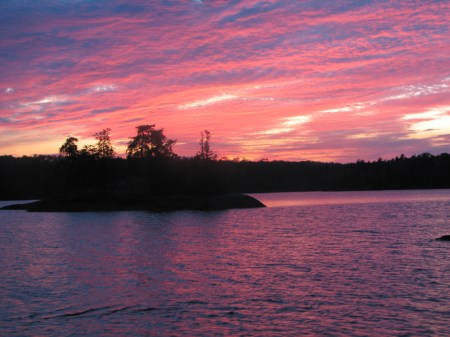
Lake Insula sunset, 2009

IMG_3106.JPG

Where the four firefighters were talking, one year almost to the day after this picture was taken. Notice how  narrow the channel is.  September 2010, Insula.

BOUNDARY WATERS_2007106.JPG

Cold day on Insula, where four years later the four canoeists would paddle for their lives by this site.

The 2011 fire began by a lightning strike in Pagami Creek, a place where canoeists don’t travel.  After being quiescent for a few weeks, being allowed to burn naturally, the fire became more active, and suppression was begun.  The fire made a 12 mile run one day, catching everybody by surprise, including six firefighters, four of whom deployed their shelters on a small island and survived; the other two going into the water by their canoe, surviving first the fire and then hypothermia.  The lessons learned were: “canoeists in the face of a fire may encounter exceedingly strong winds and may swamp,” “shelters degrade when exposed to fire and water,” and “hypothermia is a potential problem for those escaping a fire by jumping into the water.”  Those are all good lessons, but there were far more to be learned.

When the fire became more active, Forest Service personnel in the field were told that the BW would have a “soft closure,” a term that one ranger said she had never heard, meaning, as near as she could tell, people would be asked to leave the woods.  Catchy phrases like “soft closure,” and “tweak the system” are ill-defined and potentially dangerous.  They must be strictly defined.  The woods should be either closed or open.  A campfire ban is clear but if people are told they ought to leave but aren’t required to, there is a mixed message. I have a simple solution: if there is a concern that people would be better off out of the woods, make them leave.

Two men went south, east and downwind of the fire, to check a hiking trail.  They were told the fire wouldn’t be in that area for a few days, but their senses told them that the lighting up of the nearby sky, even if they couldn’t see the fire, was a bad sign.  The wind had changed, and the fire had moved much closer than anybody thought.  Indeed, the two had to run back to their canoes to escape it.  Lesson: fire can move faster than predicted, and in the absence of knowing exactly where the fire is, one should use caution.  

The fact that the men had to go into Horseshoe Lake, unnamed in the video, but clearly the lake referred, in order to help campers close their camp and get back into safer Lake Three, should have been strong evidence to the supervisors that the fire was starting to become far more dangerous.  The campsite was burned; the campers barely escaped.

At one point, a telling comment was made when a firefighter called in and spoke to somebody who was not his supervisor.  The firefighter said that “they” (he and his partner) were uncomfortable with their current supervisor, so for their purposes, they were going to work with the person with whom they were speaking.  Wow.  That is a huge red flag for communication problems.

The next day, the firefighters were told to move further into the wilderness, towards Lake Insula, to move any campers there to the north end of the lake, away from the fire.  They were told they had a few days to do this, and the winds had shifted to the northwest, pushing the fire southeast, away from populated lakes.  I have traveled into Insula over a dozen times.  It is a long paddle with seven portages, and there are no options for safety once one leaves Lake Four heading east, until the middle of Insula.  I was puzzled why people weren’t flown in to do the warning and then picked up later that day.  Again, however, the fire was felt not to be a significant concern.  Lesson: Moving canoeists downwind of an active fire should be done only if there are significant escape routes.

Two women, camped at the last campsite on Hudson Lake, the last lake before Insula, took their  packs across the 105 rod  (525 meter) portage between the two lakes, spending time at the Insula end speaking to their two male counterparts.  All were concerned about the fire, and when some noise was heard, the women went back quickly to get their canoe, basically abandoning their campsite.  It takes thirty minutes to make two trips across the portage, and it was becoming clear to the four that they needed to get on the lake fast, because the first part of the paddle is channels and small islands, shallow water, and offers no protection against fire.  The four were now paddling for their lives, not to close campsites but to get as far east and north as possible.

Two other women moved off Campsite 7 (it was really 8) to escape the fire.  They realized the winds were too high to safely paddle and jumped into the water, using their fire shelter, something to my knowledge has never been done before.

Here are the “10 and 18” (italics are the issues that the firefighters had):

Standard Firefighting Orders

1.  Keep informed on fire weather conditions and forecasts.

2. Know what your fire is doing at all times.

3 . Base all actions on current and expected behavior of the fire.

4.  Identify escape routes and safety zones and make them known.

5. Post lookouts when there is possible danger.

6 . Be alert. Keep calm. Think clearly. Act decisively. (Done right).

7. Maintain prompt communications with your forces, your supervisor, and adjoining forces.

8.  Give clear instructions and insure they are understood.

9.  Maintain control of your forces at all times.

10. Fight fire aggressively, having provided for safety first.

18 Watchout Situations

1.  Fire not scouted and sized up.

2. In country not seen in daylight.

3. Safety zones and escape routes not identified.

4.  Unfamiliar with weather and local factors influencing fire behavior.

5.  Uninformed on strategy, tactics, and hazards.

6.  Instructions and assignments not clear.

7.  No communication link with crewmembers/supervisors.

8. Constructing line without safe anchor point.

9. Building fireline downhill with fire below.

10. Attempting frontal assault on fire.

11.  Unburned fuel between you and the fire.

12.  Cannot see main fire, not in contact with anyone who can.

13. On a hillside where rolling material can ignite fuel below.

14. Weather is getting hotter and drier.

15.  Wind increases and/or changes direction.

16.  Getting frequent spot fires across line.

17.  Terrain and fuels make escape to safety zones difficult.

18. Taking a nap near the fire line.

One of the firefighters said that they were violating nearly all of the 10 and 18.  He was not far wrong.  The bold in the 10 indicate what they did right. For the record, in Arizona’s 19-fatality Yarnell Fire, #1,2 and 4 in the first and #s 1,3,4,11,15 in the second were violated.  Unburned fuel between you and the fire, and cannot see the main fire are big concerns.

The group of four were lucky one of their number had experience on Insula and could navigate the lake, no easy feat. She also had the sense to tape her flashlight to the stern, so the canoe behind her could follow her in the smoke.  The fire traveled faster than canoeists can paddle.  Had the firefighters been a half hour further, had they not stopped to talk, they would have been at the east end, where they could have moved north directly away from the fire.  They of course had no way of knowing that the fire would do what it did.

Other lessons I would offer:

When several things seem to all be going wrong, recognize that you might be on a downward spiral (the words used here), regardless of what you might have been told. In neurology, my field, meningitis was so scary that when I argued with myself or others about whether we needed to do a spinal tap for diagnosis, not a difficult procedure, I did it. Perhaps that analogy could be applied here: when firefighters start arguing pros and cons of shelter deployment, just deploy. When you argue about whether or not to close campsites, just close them. Again, my deepest, deepest respect to these six and for all who put their lives on the line. I loved Insula as it was, but it wasn’t worth putting their lives at risk.

My final lesson here: time is one of the most valuable commodities in the woods. Use it wisely. 


Related

Plus


WEIGHTY TOPIC

December 13, 2016

“Hey Mike, you’ve got a little bulge in your stomach,” I heard, as I reached to the base of the final climb to Larison Rock.  At this point, I had climbed 2000’ in 3.5 miles. As hike leader I had bushwhacked around an impassable blowdown, found an alternative route, and made sure everybody got around it without difficulty.  I wasn’t even breathing hard on this hike.

IMG_4828.jpg

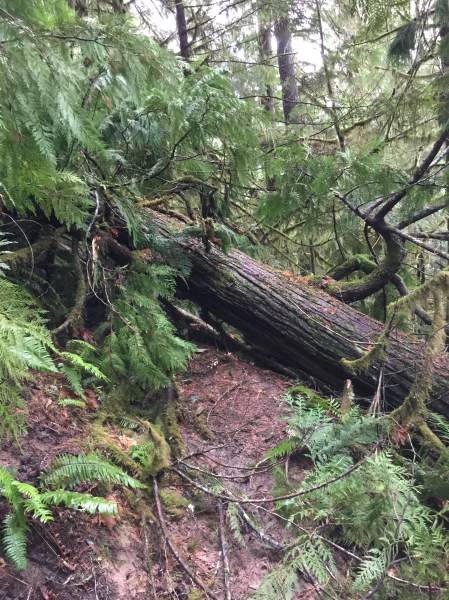
Douglas fir blowdown, Larison Rock Trail; November 2016

IMG_2062.jpg

Sun through trees, top of Larison Rock Trail; November 2015

I knew I had a waist bulge.  I have an apple pattern of weight distribution, and while I have never been overweight, and my Body Mass Index (BMI) is about 23 and change, I have a problem.  Turns out that waist circumference is an important risk factor for cardiovascular disease, more than weight itself.  Indeed, the waist:hip circumference ratio is more important than just being overweight. This is relatively new on the obesity scene, but it wasn’t just discovered yesterday.

The realization bothered me.  I looked for all the stats that said I was healthy, and I came up short each time.  I started to lose weight, from 170 to 165 at least.  I did it the way I have controlled my weight in the past— I looked at my diet and started finding how many calories I could easily remove.  In the past, it has been peanut butter, which I love, olive oil, fatty veggie hotdogs, all cookies and cake, and adding low calorie yogurt.  It takes a while, but I’ve always lost weight.  This time around, it was removing evening cheese, substituting dark chocolate for scones at lunch, again stopping the peanut butter, and changing the decaf white chocolate mochas I was having to decaf sugar free.   The last cut out 240 calories right there. My weight started to fall.  I was hungry at night; hell, I was hungry a lot.  It was the holidays, the worst time to lose weight, but each morning I got on the scale, I liked the numbers.

In 3 weeks, I weighed 165.  I don’t know if my waist had changed, because I didn’t measure it originally. My contour looked better, but still not right.  But I had reached my first goal, and I planned to go further.

During this time, I had my annual cardiology appointment.  I was weighed with my clothes on, and because there was freezing rain, I wore a lot, for I took the bus to the clinic.  I weighed 170, which isn’t bad with clothes on, but my BMI was listed as 23.71, which isn’t true.  It’s fine for doctors to weigh patients the same way each time, but if they are going to use that weight for BMI calculations, to two decimal places even, they either have to get rid of the clothes or subtract a few pounds.  That was only my first issue.

Everything had gone reasonably well this past year.  My Afib had recurred, as I knew it would, but I was doing well enough that the doctor didn’t think he needed to see me in a year.  I wondered, however, why he called the echocardiogram of my aortic root, 40 mm, “dilated”.  First, if it is a problem, I need to be seen annually.  Second, many don’t think it is dilated at that figure.  Third, if one looks at the recent literature using height, weight, body surface area, and age, I am below what is considered dilated.  Fourth, while I agreed we needed a second data point to see if anything has changed, he decided I didn’t need another echocardiogram for a year.  Yet, I am labelled as having a dilated aortic root, a big deal if I have a thoracic aortic aneurysm.  I don’t think I do, but I don’t like treating myself.  Nor do I like having my BMI measured to two decimal places with my clothes on and having to look online to learn about normal aortic root size. What do people do without a medical background?

I was told I was doing everything right.  True, I’m active, seldom drink, never smoke, don’t use caffeine, am vegetarian, not diabetic, have good cholesterol, normal weight and BMI (to 2 decimal places), and my systolic blood pressure is 110.  But I am concerned.  My waist-hip ratio is high, 1:1.035, and it should be less, the reciprocal.  My waist-height ratio was 0.538, and it ought to be closer to 0.5, less than at least 0.533.  I asked for a dietitian referral and at this point am waiting for a call back.  It’s the holidays, and maybe they don’t believe anybody is really serious about losing weight during the holidays.  Well, I am.

My weight continued to drop, holding at 165, and I counted all the calories I was consuming daily:  I measured the sunflower seeds on my salad, I was eating more carrots, cauliflower, and broccoli, not corn and peas, I ate apples, blueberries, strawberries, and tomatoes, and I watched the croutons I was putting on my salad, although how one measures a crouton using tablespoons is a mystery.  They are about 3 cal a pop. I used a teaspoon of olive oil on my salad. I found ways to cut calories I had never found before.

I think the cardiologist missed an opportunity.  He was busy.  I knew that as soon as he came in the room and stayed standing.  Bad form.  I always sat when I talked to patients.  Sitting conveys a sense of having time.  I realized I needed to say what I wanted and be quick about it. The waist issue didn’t bother him.  It should have. This stuff should be posted in the cardiology clinic, along with “know your BMI,” “Ready for the ratio test?” “risk factors to try to reduce,” rather than “we care about every mile of your blood vessels.”  Dietitians should be available, and frankly Medicare would do well to cover the cost, instead of only for diabetics and those with kidney disease or transplants.  Health is health.  I now know my Basal Metabolic Rate (1540 calories), how much walking for 3/4 an hour or hiking for an hour burns.  I know how to get a decaf sugar free White Chocolate Mocha and a 120 calorie Peppermint mocha at Starbucks.  I know how many calories many fruits have and that sunflower seeds have 170 calories per 2 tablespoons.  Hell, I should be counseling people.

I’m serious about weight, and it’s important to know what matters and how to count it properly.  BMI is almost always a good predictor of being overweight, but it is not a good predictor for wrong fat, fat in a bad place.  There are other numbers that address that.

I had showed up early for my appointment, but I knew the time was up.  The cardiologist didn’t even have to start walking towards the door. I have become good at reading people’s body language when they don’t want to talk to me.  At that point, I quit, because they likely haven’t been listening to me for some time.

This is now the fourth business day and I haven’t heard from the dietitian yet.  That worries me, because my original referral with the cardiologist got lost. How difficult is it to pick up the phone and take care of scheduling an appointment? If nothing else, a guy whose numbers most people would love to have thinks he should be even healthier.  Wouldn’t that be refreshing to be able to advise him, if you were a dietitian?

Maybe I will have better luck with my internist.  I will have to prepare carefully, however, needing to make sure I have all my ducks in a row and get through all my questions. I’d bring a list, but when I was in practice I hated it when patients brought in lists of things to ask.

Then again, I sat down when I talked to patients.  I listened without interrupting, too.

BMI calculator: 

Waist-hip ratio:

Waist-height ratio, BMR


WHY WE SHOULD CARE FOR EVERY AMERICAN’S BIRTHRIGHT

November 24, 2016

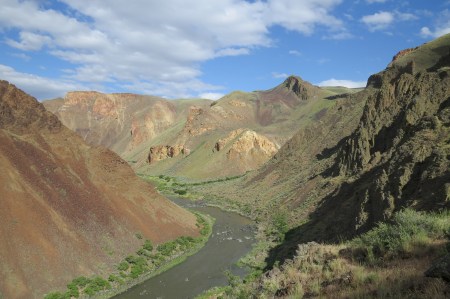
Last May, deep in the Owyhee River Canyon in southeast Oregon, I held an Obsidian spear tip in my hand. Then the guide took it back and placed it high on a tree branch so that the next group of rafters he took down the river would be able to see it.  Obsidian and other artifacts in the nearby caves had been looted, and nothing remains. Had the tip been put on the ground, somebody would have picked it up and kept it.

IMG_7042.JPG

Obsidian point, still down in Owyhee Canyon

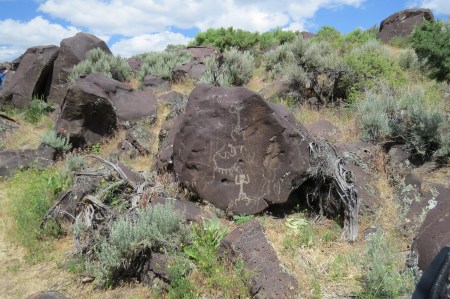
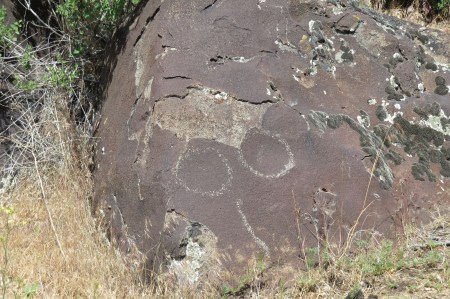
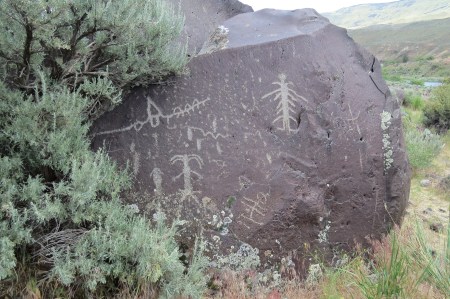
A day later, I saw a field of boulders with petroglyphs, wondering as others have wondered, what they meant.  In ancient times, some were defaced to rewrite history, but far too many, a few dozen, showed scars from petroglyph vandalism, sold for profit, forever lost from view. The scarring was ugly, detracting from what should have been a sacred site.  Instead, somebody profited greatly.  Maybe I should be grateful: so far, they haven’t had gang vandalism, often called “tagging,” as if such were a game instead of wanton desecration.

IMG_7078.JPG

Petroglyphs

IMG_7080.JPG

Defaced

IMG_7081.JPG

Rewriting history

IMG_7084.JPG

Removing history

IMG_7083.JPG

Allowing one to wonder

I often stood high over the cliffs of the Canyon and marveled at the views, watching out, of course, for cow pies, since it is possible to graze cattle on public land for a pittance, but if I happen to hit one of those cows while driving on a public road, I am liable.  Those in rural America often say they know how to care for the land better.  I’m not convinced. They know how to use the land, to be sure, especially for profit. The land knows how to care for the land better.  And some land should be left alone or visited very seldom, with strict leave no trace rules.

IMG_6915.JPG

Owyhee River Canyon, about 20 miles north of Rome, Oregon, with lava and sandstone cliffs.  It is possible to stand inside some of those spires and see the sky.

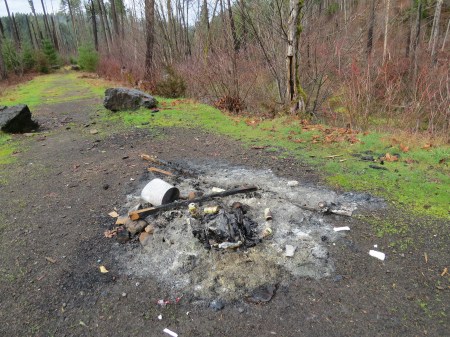
Earlier this year, I hiked Fall Creek, a nearby trail along a beautiful creek with many pools.  At the turn around point, where there was an old road, there was an abandoned fire ring with a pile of trash in it.  This is caring for the land?  Going somewhere, getting drunk, tossing your bottles on the ground, and driving home?

IMG_6171.JPG

Fall Creek trash

Last week, in Umpqua National Forest, I hiked down to the bottom of Picard Falls, a beautiful cataract, and found a Dr. Pepper bottle. Suddenly, the place was less pristine.  No, it’s not wilderness, but why can’t people take out what they bring in?  I brought out the bottle.  I find bringing out trash that somebody left an odious job, but it is one I feel compelled to do. If a place is littered, people tend to litter; if clean, they tend to keep it clean. When I returned to the car, I found a crushed Coors can. The rural folk drink while driving, too.

IMG_7996.jpg

Picard Falls, Umpqua National Forest, Oregon

On the drive over Patterson Mountain on the way home from the Umpqua, I saw a cubic yard of trash dumped on the side of the road.  I will haul out trash, but I have my limits, and so does the trunk of my car.  I doubt this was from a homeless man in the South Valley. The individual was almost certainly male, white, and probably between the ages of 25 and 45.  They voted Republican, because they don’t believe in regulation, big government, or recycling.  They get hurt by Republican policies but still don’t change. A disproportionate number of them died in Iraq and Afghanistan, wars started by Republicans who even they now say were a bad idea. They were devastated by the Great Recession, which also occurred under a Republican administration. The Dow has increased 1.5 fold under Obama.  Unemployment fell. Those are facts, not opinions.

Closer to home, I hike up Spencer Butte from Martin Street every week with other Obsidians.  It’s part of our responsibility to clean up the trail.  Today, I was the hike leader and almost walked by a bagged bit of dog poop. This is not uncommon.  I guess people who do that think so long as they bag the poop, they and their dog have completed their collective work.  Now, it is somebody else’s job to pick it up.  Maybe.  Or maybe an animal will rip the bag open.  I shudder to think of how much dog waste is in the woods, which infects the water with Giardia.

IMG_3470.jpg

Spencer Butte, walkable from downtown Eugene, although one saves time by taking the bus, which runs every half hour.

There are orange peels at the top of Spencer Butte, which won’t degrade, beer cans, clothing someone doesn’t want, and an occasional cigarette butt. I am frankly grateful when someone actually leashes their dog, which is the rule, but which is usually not followed, leading to an occasional dog fight or some dog putting his nose in my pants where I don’t want it.  I have cats, and I don’t want the smell and the germs of a dog in my house. Mind you, I’m not against dogs, for they are dogs. I even spent the money I earned for being executor of my father’s estate—$23,000—to neuter pit bulls in Tucson. What a waste.  No, it is not a dog’s fault to be born a dog.  It is the people who breed them, those who buy the puppies (without an apostrophe which is on the road sign) and don’t train their dog properly whose fault it is.

The idea that people will regulate themselves properly is a fantasy of the Ayn Rand cult. They won’t. I don’t care if it is in the woods or doctors; people won’t self-regulate.  In a perfect world, I’d leave the Owyhee alone, for those who live in Jordan Valley would ensure that the beautiful canyon remain as it is, that residents would carefully make a living from the land by not destroying the special parts, controlling access to the river from Rome and further upstream, the money going to the land.  The community would set its own rules for rafting, such as hauling out all human waste.  Actually, however, the rafting company already does that.

In a perfect world, people would take out all the trash they brought in to the woods, and no littering or dumping would occur.  Dogs would be leashed and all their waste collected and removed.  No dogs would be allowed in the wilderness areas. Campfires would either be at designated spots, or campfire rings would be destroyed after use and the rocks scattered.

For Ayn Rand, it was all about “me.”  For those who care about the land, it is all about future generations.

I know that, and I don’t even have children.

IMG_7095.JPG

Owyhee River Canyon, Oregon