Posts Tagged ‘Philosophy’

THE POSTS I DELETED THIS WEEK

July 19, 2016

When we were staying up in Kotzebue, the Internet was slow, so I did a lot of reading, especially the day it was rainy and windy.  I like those days.  After years in the desert, I equal “beautiful sunny days” with drought. I read “Wheelmen,” how Lance Armstrong was able to cheat in the Tour de France and hoodwink millions, including me. I also helped students on algebra.com, a math help site.  I find it relaxing; the students are mostly grateful.

When we got to Anchorage, with faster Internet, I posted some of pictures from my America the Beautiful Series on Facebook—the Western Caribou Herd migration seen from the air, Kobuk Vally NP, Serpentine Hot Springs, red raspberries picked from a vacant lot next to the hotel, and pictures of the brown bears salmon fishing at Katmai.  I commented on several posts…and quickly deleted my comments.

IMG_7313.JPG

Western Caribou Migration north of the Arctic Circle. This line went on for 7-8 miles.
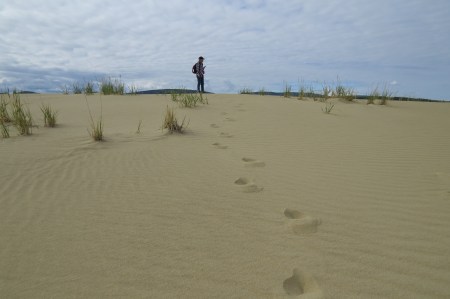
IMG_7360.JPG

Kabuki Valley NP, Alaska.  This is reachable only by plane or boat.
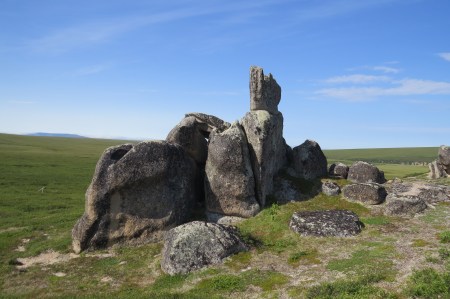
IMG_7405.JPG

Serpentine Hot Springs, Bering Land Bridge Preserve, Seward Peninsula, Alaska

I don’t often give advice to people, because few either want or follow it.  You will seldom hear me use  “should,” like “You should do xxxx,” because I think it arrogant and presupposes my values should be somebody else’s.  I am not advising anybody to do what I did here, only stating that I have found deleting a comment on Facebook—before or shortly after posting— is a good way not to have to eat my words later or get into an argument with somebody I don’t know….or do know.

The first comment I deleted was on a post that said “Take this test to see if you are racist.”  I think we are all racist.  Humans evolved that way.  We are tribal. Listen to the Kingston Trio’s Merry Minuet sometime, and you will understand that racism is not new.  I don’t have conversations about race, and I try not to treat people differently based upon race, dress or sexual orientation.  If they are trying to convert me to something, I’m generally not interested, although in the face of compelling evidence I may change my mind.  I might be more willing to listen if they gave me the same courtesy to offer my opinions.  They won’t, for they alone know the Truth.  I can’t remember what I deleted, but it was along the lines that given my 17 years of expected longevity I wasn’t going to change much, so please don’t tell me how racist I am. Delete.

The second came from a relative who posted  that the Earth was going to be destroyed at midday tomorrow, a time that has come and gone.  It was on some “truth” site, and if I were going to comment on every bit of bad science that found its way to Facebook, I wouldn’t have time to tell some kid how to solve a mixture problem or complete the square of a quadratic equation.  I started….then I just went to a new page.  FB is nice enough to give me a “Do you really want to leave this page?” to which I reply quietly “You betcha, delete that mother that I wrote.”  Problem solved.  No trolls to come after me, nobody to say I used the wrong word, and nobody telling me I was going to hell (I did but they kicked me out for bootlegging ice water becomes too trite after a while).

I have a few rules I use on FB.  I don’t de-friend people, only stop seeing their posts.  It’s easier that way, because they don’t know that I am not following them but I show up on their friend list.

I don’t share things that people ask me to share.  That’s their banner to carry, not mine.  I don’t read things for the most part that people tell me I must read. The “watch how xxx just slammed xxx in Congress” in general is not much of a slam; indeed, there are very few perfect squelches.  I can think of exactly four times where I have said exactly the right words at the right time, and it was devastatingly powerful.  Most “classic putdowns” are not worth reading.

Some have political or religious beliefs I don’t share.  It’s easier to delete all posts coming from Right Wing News or Oliver North.  It helps my heart stay out of dysrhythmias if I don’t read stuff I want to challenge and squash.  Few will read my post, and I will only annoy someone.

The third one I deleted was easy.  It was about how much money was being spent to build a replica of Noah’s Ark in Kentucky to spread the gospel that humans walked with dinosaurs (appalling in 2016 that some believe that.)  I commented the ark could be used for low-income housing, especially since the toilet and septic system were likely good, given all the bs.  It felt good for a few seconds.  Then I deleted it.  I had other more constructive things to do, like help kids with their math homework.  Interesting sidelight: I tend to answer questions where kids beg for aid, like “I am totally lost,” or “Please, I haven’t a clue how to do this,” and I can, easily and clearly.  That is doing the Lord’s work, although I don’t follow the Lord’s posts, because…well, I don’t.  I just try to be a decent guy.

The last post was how the Western world was at WAR (capitalized) with radical Islam, and that we didn’t have Facebook memes and blabs when we dealt with Natsis (Nazis—her spelling and grammar leave a lot to be desired, but I’d never dream of telling her that) weren’t going to be the solution. She’s right on one count—changing one’s profile, calling ourselves French…or Turkish…or whatever—doesn’t change anything.  I’m pessimistic. History is on my side. And I wish in the meantime we would stop using the word “solidarity,” for it lasts as long as it takes for the next tragedy to strike.

I posted that before we go to war, I’d like to know the endpoint when we will stop warring.  We didn’t have one for Afghanistan, and we may be there forever.  We screwed up. I had hoped after Vietnam in 1975 we had learned our lesson, but we didn’t.  I continued: if we go to war, I want a War Tax (50% marginal rates) and a draft of men and women.  Next war, everybody serves, and we pay as we go. That sort of personal and financial commitment gets people thinking whether it is worthwhile. I said in 2003 we would create a lot of terrorists by invading Iraq, so I am not surprised by what I am seeing now.

Why did I delete this post?  I like the person.  Her son will be draft age in 6 years. He’s going to fight the next war, not me.  She is going to worry, and she will learn in spades what going to fight the bad guys means.  She won’t remember my words.  She will likely blame My Side for it.

After I left Alaska, posts deleted, I have found myself spending less time on Facebook.  It’s too damned depressing.  And there is far too much life to be lived, far too much good to do, like math homework.  Or math help in person.  Or reading a book.  Or hiking.  Or showing a kid the night sky.  Or an adult for that matter.  Or seeing places in the world while I still am able to.

Don’t bother sharing. It’s just my way of living. Your results may vary.
AGATE: THE CASE FOR A SINGLE PAYER SYSTEM

July 7, 2016

Years ago, in the doctor’s lounge, one of my colleagues said, “I admit it.  I make money off CT scan referrals to the center where I invested.  I’m greedy.”

While honest, he was not fulfilling a fiduciary duty, a legal obligation to act solely in another party’s interests. Parties owing this duty are called fiduciaries.  That meant when I practiced, I had to act in my patient’s best interests.  I could not order a test to make money unless the patient needed the test. For example: I might see a patient with classic carpal tunnel syndrome, 5 minute history and exam. Confirmation, if surgery were a consideration, was a nerve conduction velocity, testing to see if the velocity of conduction were decreased through the carpal tunnel of the wrist. I billed either for a simple new patient visit, $95 then, or 2 nerve conduction (NCV) studies, one in each arm, to confirm, $86.  I could have billed for both and charged $181, but it was a 5 minute evaluation, and a 5 minute NCV, and that seemed excessive.

I knew some who charged an extensive new patient visit ($165), two NCVs plus sensory conduction (the other way) on both arms with electromyography (EMG) both arms, to see if the muscle were damaged (almost never, these days) done by the tech, while they were seeing another patient, nearly $800.  Physician time: 10 minutes.  We were paid by amount billed.  My wife ran a CT scanner back then, but I did not send patients to her.  Her readings of scans were better than other radiologists, but there was an appearance of a conflict of interest had I sent a patient to her.  Many colleagues did not have such worries.  They invested in CT scanners then sent patients to them, a nationwide practice so bad that the Stark laws, named for the California congressman who introduced them in the late 80s, were passed, limiting referrals by doctors to places in which they had invested.

The Oregon Health Plan is Oregon’s Medicaid plan, Medicaid being a joint federal and state program that helps with medical costs for some with limited income and resources.  In 1996, because insurers wouldn’t cover Medicaid services in Eugene, physicians created an IPA, not the beer one, an individual practice association.  Each physician ponied up $6000 for a set number of shares; many were not happy about doing it.

For-profit Agate Healthcare bought out the IPA, claiming in 2001 they had covered 30,000 Medicaid patients and had stayed within budget. For-profits do not have a fiduciary responsibility to their patients but rather to their stockholders.  Stated another way, costs to cover medical care from beneficiaries are called “Medical Losses,” the amount paid divided by the amount received called the Medical Loss Ratio, a term I dislike, because it has the sense that delivering medical care is bad.  Doctors with shares got dividend checks every year and they could buy and sell shares.  This is OK.  It’s capitalism, and for risking $6000, doctors got some reward.

Agate later contracted with Trillium Healthcare to manage the Plan, and now with 94,000 patients Trillium has rapidly increased their revenues from a quarter to a half billion in the past two years.  Over time, stock options, something most of us don’t have, exercise, or even understand, allowed executives to obtain more shares.

Successful companies are often bought by a larger one.  Centene, based in Missouri, with $16.1 billion in revenue and $261 million in net income, bought Agate. Yet in 2015, 13,000 Lane County patients still did not have a doctor.  Big problem.  Eventually, they did, but that’s not “high-quality care” that payers, hospitals, and doctors are often trotting out.  There was concern that Agate kept some of the Medicaid money to make them look like a cash cow, a company with a lot of cash on hand.

When the buyout occurred, Agate had marketed themselves well, their share price increasing 600% overnight.  My bank pays me 0.15% annually.  When Agate was bought for $109 million, the proceeds went to the shareholders, not for medical care for homeless or paying medical debts people had in Lane County, but rather to rich, connected locals, all white and mostly men.

The CEO got $5.7 million, the CFO $4.2 million, and the entire 13 member board of directors received $34.2 million.  Another 77 doctors got a total of $41 million; 128 shareholders got $34 million. For a $6000 investment, continuously compounded, the last received a 19% return over 20 years.  The whistleblower, an investor, felt he came by his half million “somewhat honestly,” whereas the board, he said, “well, that’s an awful lot of money.”  Yeah.  It is.  But “somewhat”?  The letters to the editor blasted the whole lot of them, not that much will change.

From medical loss ratios to “managing ED use and bed days,” for profits have dictated care.  We doctors put ourselves here by fee for service and cranking up the service. For profits manage the number of bed days by discharging patients early and denying some care, but in all fairness, I saw many patients who stayed in the hospital with either no visits on the chart during a long weekend, or a bunch of “doing well”  with no documentation why they needed continued hospitalization. This isn’t and wasn’t optimal utilization of hospitals. As for denying care, in my day, carotid surgery for asymptomatic narrowing was not indicated, heavily abused, with high complication percentages. I had the data.

There is too much money flying around in medicine, but fiduciary responsibility to patients must not be lost. Fiduciary responsibility to patients often requires one to leave money on the table, rather than taking all the groceries that were supposed to feed everybody.  Like not charging $800 for carpal tunnel workups.  Or doing unnecessary surgery.

How did the Agate issue become public?  The board president, a physician, put out talking points to defend its sale.  Who got how much was kept secret; the company hired lawyers to keep the sale results private.  The media sued, and all was to be contested in court, because Agate shareholder felt it was private information whereas the media felt the money came from public funds, which indeed it was.

The newspaper knew that prior to the sale of the company, many on the inside bought shares from others who didn’t know what was happening.  This is dishonest, but it is the way people work. The paper finally received 218 pages from a disgruntled member whose own share was about a half million (the somewhat honestly guy).  He was disgruntled because share owners were asked to fund the legal costs for a minuscule amount, enough to irk him to go public. When you stand to get $5.2 million, a little thing like asking others to pay legal costs tends to annoy people.  It’s remarkable how the whole secret house of cards came tumbling down over a buck a share issue.

We need a single payer system.  This sort of stuff is what Bernie Sanders railed about all spring.

We need to tax capital gains progressively, so that when somebody makes an investment that grows 6 fold overnight, they will pay a much higher rate.  I like 80%, but 70% would be acceptable.

Finally, I noted that every doctor named but one was a surgeon.  That one got individually blasted in a letter to the editor.  Seemed that he disappeared when a woman’s father was in his final hours. She never forgave him. Would you?

Fiduciary responsibility would have dictated different behavior there, too.

WHY I LEAD HIKES

July 5, 2016

After I joined the Obsidians, an outdoor club in Eugene with 500 members, I thought it might be interesting to eventually lead a hike or two.  One of the women in the club, a dynamo now 75, has led perhaps 500, and strongly encouraged me to lead.  I told her I couldn’t lead anything that I hadn’t hiked myself, so I spent my first summer in Oregon soloing many trails in the Willamette and Siuslaw National Forests.

In August, two months after I joined, I led my first hike on the Obsidian Limited Use Trail, requiring a permit, for no more than 30 are allowed in any given day, post the hike online, meet everybody at a given time and place, assign cars and drivers to get to the trailhead, then hike.  Somehow, everything worked out fine.  The first reason I lead hikes is that the club needs hike leaders.

During the next two years and the 51 hikes I led, some were easy, like in-town ones that required little driving and were on a trail or path that was familiar to everybody.  Most, however, were out of town.  I had hikes where people were spread out on 2 miles of trail, others where some people were fast and had eaten lunch before the stragglers got to the turn around point.  I had hikers who wanted to video the whole trail, some who wanted to photograph, others who used the hike as training, slowing down the group, and one, who was late to the meeting point, joining us at the trailhead and didn’t say one word to me the whole hike.  I treated falls, heat exhaustion, and often hiked a mile extra each hike.

We leaders are volunteers, but to hear some talk, one might think that only certain people lead.  I got behind two discussing various merits of leaders on an in-town Thanksgiving Day walk.  Why, I thought, don’t they lead, if they don’t like a leader’s style?  That is what I did.  So the second reason why I lead hikes is because I like having control.

Leading, however, is work.  It’s easier to show up at a hike and just do it, without having to organize it, write a description of what is expected, field phone calls from members or non-members who often would have such questions answered if they logged on to the site and read the description, ensure that the people going can do the hike and have adequate equipment, worry about drivers, know where everybody is, make sure the hike moves along, take care of any problems, and get everybody back to the trailhead safely.

I want those on my hikes to know what to expect. We leave promptly, I give the approximate speed on the trail, regrouping points, the lunch stop, and when we can expect to get back home.  If you want to hang loose and walk around in the woods, I’m not your hike leader.  If you want to see some good backcountry where not many people go, cover some ground, and get home at a specific quoted time, I am.

I put Obsidian Loop on the schedule for 1 July this year, figuring the hot June would take care of the snow.  The Forest Service told me the snow level was at 5200 feet.  I had done a hike in early June to 5600 feet, encountering only one small patch of snow.  I suspected there might not be much snow left, but to be sure, I scouted the hike 5 days prior.  Scouting is a full days’ work.  I’m doing the whole hike, including the drive. I had to buy a permit, then a few days later drove to the trailhead, the last 20 miles on a winding, curving, narrow road.  Finally, I hiked the loop, 12 miles—solo.  There was a lot of snow, although not as much as two years before.  I got off trail several times and navigated by GPS.  It was a difficult day. The Obsidian Trail is beautiful, but it takes a lot out of people— some is on volcanic rock, a lot of snow was present in this instance, there were six stream crossings, some of which were deep. Still, I was glad I did it, because I knew exactly what we could and could not do. I returned home fine, but I put on the trip description that we might be doing an out and back to Obsidian Falls, and to be prepared for snow. Two people cancelled.  One other, who had been on the waiting list, joined, and I was glad to see him, for I knew he was a good hiker.

IMG_1045.JPG

This is the Obsidian Trail after a snowy winter, 3 July 2014.  No trail visible, and one either knows the route or uses GPS.

Friday, eleven of us met, driving up in three cars.  We always carpool.  I had a good group, and we got an earlier start on the trail than I had hoped.  We stop at trail junctions, and as leader, I usually am not in front but somewhere in the middle, trying to have a sense where the front and back are, who is fast, who isn’t, and anything else I observe.  When we reached the first regrouping point, I discovered that one of our hikers had continued on, which was clearly not something we do. I hoped he would go directly up the proper trail to the Falls, because there were side trails that could be taken.

IMG_7274.JPG

Obsidian Falls from above.  The passage here was the area I was most concerned about, for it was on a 45 degree snow field where sliding was dangerous.  

From here on, I led from the front, because I knew the trail and wanted to keep the group together.  When we reached the Falls, I saw the missing person and went down to talk to him.  I first quietly asked him how he was, and when he told me he was fine, told him firmly that we waited at trail junctions.  He hadn’t heard me say that, but I had, and others on the hike could verify that, and in any case it’s a Club rule.  I had been worried about his well-being and a bit angry, but I kept my anger in check and he apologized.

IMG_3789.jpg

100 meters off trail, we came down this area, some choosing to glissade.

After lunch, I thought with less snow, we could complete the loop, and we did, slowly coming back down off trail through snow, my navigating by GPS and memory I had of the trail, which I knew ran near a creek.  More than once, I was concerned about not knowing exactly where I was, despite having been in the area five days earlier, but yet I knew we were going the right direction.  The map on the GPS was off by 400 meters.  Eventually, we finished the loop and hiked almost 4 miles to the cars.  For the second time in 5 days, I had to drive back down the winding road, tired, back to town.

People loved the hike.  One called it his favorite, another said he wanted to do anything I led, and a third said “That is what I call a hike.”  That’s a good day.  They aren’t all that way.  Why do I lead hikes? My third reason: Had I not decided to do this hike, no Obsidian–indeed, no person–would have seen the vast stretches of snow in the Three Sisters Wilderness that we saw on 1 July 2016.  Nobody would have glissaded, nobody would have seen a lake emerge from its winter ice, nobody would have seen the Winter Wren calling, and nobody would have known what they had missed.

IMG_3750.jpg

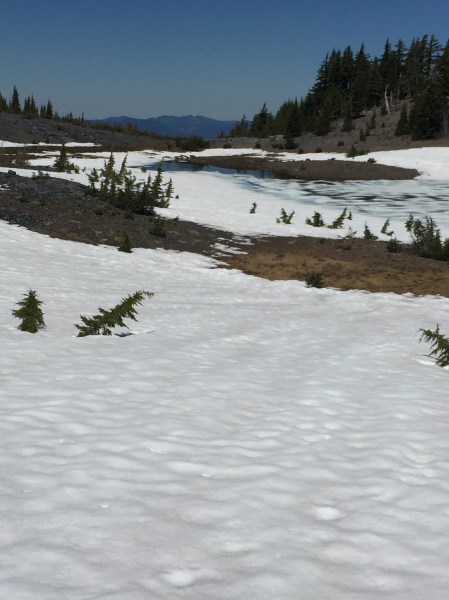
Lake emerging from ice at 6800′ elevation.

IMG_3788.jpg

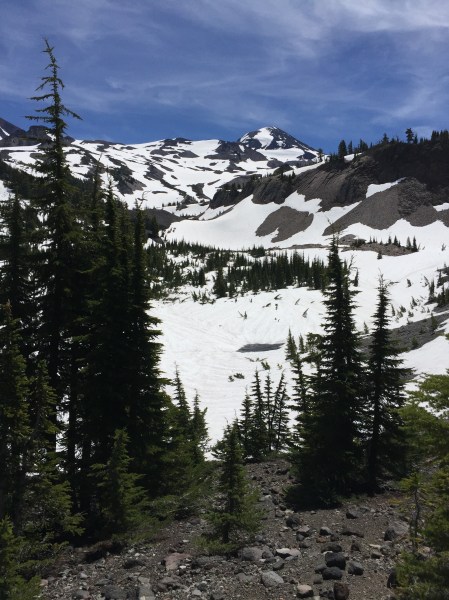
Nobody saw this area that day but us.  Middle Sister in the right center.

IMG_3794.jpg

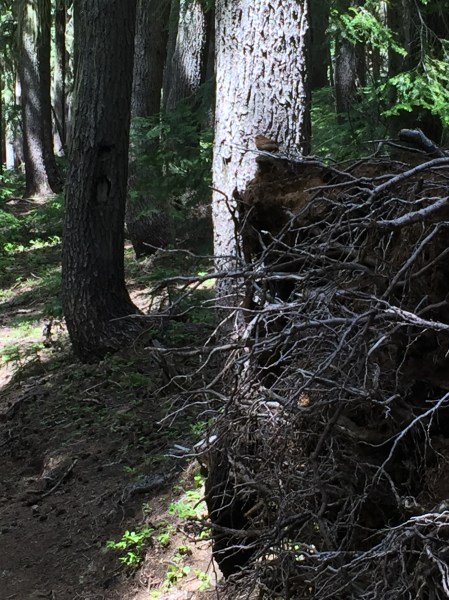
Winter Wren.  Interestingly, five days earlier there was one on this root ball, so a nest is probably nearby.

DROUGHT MONITOR—IRRELEVANT.  FACTS—IRRELEVANT

June 3, 2016

I have been quiet about the depressing primary season.  I kept hoping, starry-eyed, that there would be an honest, thoughtful discussion about the many serious issues that face the country today.  Instead, when I did listen, I heard a litany of racism, xenophobia, simplistic solutions, and inane slogans.  An incredibly boorish, impolite, narcissistic man who doesn’t listen, talks over people, and screams without thinking has a high probability of becoming president, because his boorishness resonates with many.  The House Speaker  can work with Mr. Trump, and the other side is too busy squabbling to deal with the clear and present danger.  The boor is telling crowds what they want to hear, even if 85-95% is not true, according to fact checking.  Facts don’t matter much in America these days.  Repetition of lies wins.  How people look and sound is more important than what they have to say.  Tweets matter.  Nerdy stuff about water on a third-rate blog changes nothing.

The Republicans sowed the wind and the country is now reaping the whirlwind.  The nastiest people in the Party couldn’t stop Trump, and too many Democrats tend to stay home when they don’t get their way.  Or, worse, they decide purity matters and cast their vote for a perfect candidate who has no chance of getting elected.  How did McCarthy work out in 1968, Nader in 2000?

Worse, a third party candidate like Gary Johnson could siphon off enough votes to throw the election into the House, where the Republicans will pick the president.  I wonder how many have thought of that scenario.

If fewer than 540 people in Florida had changed their vote from Nader to Gore in 2000, we wouldn’t have elected Bush.  Had the Democrats united in 1968, Nixon’s secret plan to end the Vietnam War wouldn’t have occurred, I doubt there would have been the Christmas bombing, and we wouldn’t have had Watergate.  I am going to be “taught a lesson” by the purists: they will teach me what happens when the Republicans control the Court, Congress, and the country.  When we are at war, in debt from emergency authorizations, have destroyed public education, sold off the national parks, wildlife refuges, and the wilderness, and gutted safety standards, yes, they will have taught me a lesson.

When Medicare is privatized and Social Security is removed, I will survive.  When Roe vs. Wade is overturned, and birth control is made illegal, I will be asked for money.  I always am.  But few will listen to my ideas or thoughts.  Want my thoughts without reading further?  Unite and work to extend voting hours and days, push vote-by-mail, and get every last voter on our side out.  Every one.

OK, back to Mr. Trump, who said that there was no drought in California.  Oh, some were quick to say that California has to allocate water better and at the proper price.  But California is in drought. Not only is 86% of the state in D1-D4 categories, only 6% of the state is not in drought, and those 9000 sq mi are in the far northwestern part of the state.  A fifth of the state is in D4, exceptional drought.  Drought is about measurement and science, not about what one states.  Trump is dead wrong, but people believe him. He said it, people believe it, and that settles it.  California does have a water allocation problem, but that only exacerbates the 5 year drought that shows no signs of abating, after two other multiyear droughts since 2000.  Two of those years, San Francisco had zero and 0.01 inches rainfall in January, which had never occurred once, let alone two years in a row.

The economists who deal with California’s water problem invoke the market, but they don’t factor in the price of endangered species and are curiously silent about the quarter million homes and businesses in California that lack water meters.  The law mandating water meters doesn’t fully take place until 2025.  Not metering water is about as stupid as charging people $30 a month for gasoline and letting them use all they want.  Incredibly, Bakersfield and Fresno have actively resisted meters.  What century are they living in?

Because of groundwater use, the Central Valley is sinking: near Mendota, 9 meters, 29 feet, from 1925 to 1977.  Many places have sunk a meter between 2006 and 2010. This affects the canals, which must be repaired because of shifting.  Ground water pumping has changed the aquifer from deep to shallow, which gets more irrigation recharge with salts, making the water less useful.

Some crops are more water intensive than others, and as the climate changes, we need to change what is being grown.  Or, people like Tom Selleck may try to get truckloads of water from elsewhere hauled to their property.  Mr. Selleck got off cheaply for his “me first” approach, paying the P.I. (probably not Magnum, I would guess) who caught him $22,000.  He denies ever receiving letters telling him he was out of compliance.  Ignorance of the law is not justifiable, but he’s famous.

Trump is good at telling people what they want to hear, even if it flies in the face of science and common sense.   Sarah Palin at least admitted California needs water: she just thought it could be obtained from the ocean and placed in reservoirs.  Are the voters that dumb? One example.*

Trump could have been presidential:  he could have taken the high road and said  that we are now seeing the “new normal” of climate in the western US—higher temperatures, less rainfall, more extreme events— and offered solutions.  We need to meter water, for money drives use.  We need to harvest rainwater, not let all run into the ocean or evaporate.  We need to have better ability to fix leaks, be they in houses or canals.  We need to change our usage at home and regionally. Neither lawns nor golf courses belong in arid regions.  We need to consider desalination if it can be done safely and with renewable energy.  That is a tall order.  Mr. Trump could have said that climate is going to change what happens in California, and the citizens must start preparing for it.  Instead, he catered to what people want to hear: everything is fine, if only the Democrats, the environmentalists, and “Big Government” would get out of the way.

This is an election where the Democrats, environmentalists, and “Big Government” may all lose.

And this time, I won’t likely live to see the damage from another bad president get repaired.


*2006 AP polls showed that a majority of Americans were unable to name more than one of the protections guaranteed in the first Amendment of the Constitution — which include speech, assembly, religion, press and “redress of grievance.” Just 1 in 1000 could name all of these five freedoms. However, 22% were able to come up with the name of every member of the Simpson family.  Author’s note: I never once watched the show.

TRAIL MEMORY

May 28, 2016

We were descending Marys Peak in the Coast Range to the cars, the last part of the hike’s being on a service road used to oversee the Corvallis watershed.  No vehicles were present, and from the blowdowns on the road, none had been there for some time. After about a mile, there was a trail heading off into the roadside brush, with a sign: “Trail Closed due to Operations in Area”.

The person hiking with me said, “Was that the way we went up?”

“No,” I replied.  “We entered about a half mile further.”

IMG_0530.JPG

Three Sisters from Marys Peak (April 2014)

I am no longer surprised by these comments.  I was the trip leader, and there is no way I would take a group past a sign saying “Trail Closed.”  The trail we had taken 3 hours earlier ascended immediately in forest and this one stayed low and in brush.  But, as I have learned, what is sometimes obvious to me isn’t obvious to others.

“Where was that hike where I got so exhausted with the pack I was carrying that I fell?”

“Browder Ridge.”  I know where on the trail it occurred, too.

IMG_4761.JPG

Browder Ridge Summit with Mt. Jefferson in distance (2014)

“What mountain were we trying to climb last fall when we turned around because of weather?”

“Crescent Mountain.”  I know exactly where we turned around, and I will see it in a week when we go there.

IMG_1953.jpg

Crescent Mountain, on a day people did not belong at the top.  We turned around (2015).

IMG_1013.JPG

Crescent Mountain in June 2014, with lake of same name below.  It is about 5 miles and 2100′ vertical to the summit, where there was once an lookout.

IMG_1019.JPG

Mt. Washington (far left) and The Sisters from upper meadows of Crescent Mountain

Granted, many of these hikes I have done before, but after one time doing them, I have a sense in my mind of the trail.  I’ve only hiked Middle Pyramid once, but I can visualize the bottom of the trail, the open area with the cliffs high overhead, and the gradual climb up through the cliffs to the top.  My memory is good enough to help me as trip leader.  I am not a Jon Krakauer, who saved his life on Mt. Everest during the 1996 disaster, because when the storm hit, he had a sense of where the trail was and how to get back to shelter on the South Col.

IMG_2819.jpg

View down from summit of Middle Pyramid, 2014

IMG_2810.jpg

Author, summit of Middle Pyramid.  It’s a little more than 2 miles but climbs steeply.

I think trail memory is both natural and observational.  I remember trails without usually thinking about it.  I am not as good at remembering steep ascents or descents, perhaps because I tend to hold my speed constant on them, so they don’t stand out so much.

This isn’t to say I haven’t gotten turned around a few times in my life.  In 1998, on the Appalachian Trail, I rested sitting on a rock, and when I got up, retraced my steps about a mile before I realized the traffic I was hearing was a road I had previously crossed.  There was no road the way I was supposed to be going, and bells were going off in my head that something wasn’t right.  That was deeply embarrassing and likely due to fatigue.

In 2006, on Isle Royale, I was hiking at night back to Windigo after a wolf had visited my campsite.  It was late, but I wasn’t going to stay there with a wolf in the vicinity.  I knew that wolves didn’t attack healthy humans, but knowing that intellectually and being alone ten trail miles from the nearest person were two very different things.  It was time to sleep, not hike, but I was going, sunset or not.

Or what passed for sunset under thick clouds that promised snow.

In any case, with a small light, that I hoped would keep working, I went around a blowdown and continued.  But something didn’t seem right.  I had walked around a lot of the blowdown, maybe too much, and I couldn’t say for sure that the trail I was seeing was similar to where I had just been.  Jon Krakuer might have known.  But I had a sense—an uneasiness—that I was going the wrong way.  I stopped, found my compass, and took a bearing roughly the direction I was headed.  It should have been northeast; it was southwest.  I turned around and walked back to the blowdown, confirming my error, and found the trail sooner on the other side, eventually making it to Windigo.

ISLE ROYALE 154.jpg

Young moose, Isle Royale, taken from the campsite where 2 hours later I would see the wolf.  10 May 2006.

I’ve been cultivating these senses lately.  I’ve been slow to do this, because I am mostly a linear, analytical person who hasn’t much believed in them.  As I have spent more time in the woods as I got older, I started realizing if I weren’t sure where I was, it was wise to admit—out loud—that I was lost and do whatever was necessary to get myself on track again, usually meaning backtracking, sometimes back to the beginning and quitting the trip.  Trail memory is fine, unless I am on a trail that I have not trod.  I did that on Burntside Lake in 1992, when my map didn’t quite show where I entered the lake, but I reasoned the distance was short so that I would soon be navigating by my other maps.  That didn’t work, I was lost, and I backtracked the whole way.  I felt stupid, but at least I didn’t compound my mistake by continuing.

The last time I really messed up was on Mt. Pisgah, practically in Eugene’s city limits.  I hadn’t lived in Eugene at the time, and Pisgah is famous for two things: a large network of trails and even more poison oak.  The first time I climbed it, I thought I found a different route back to the parking lot.  I soon realized that the trail was not going there, or the Sun had moved its position in the sky.  Finally, I realized I was descending to a different parking lot.  Once there, I walked to a road I thought would take me where I wanted to go.  After a mile, I admitted I had no idea where I was, retraced my steps, and took a chance that a trail along the base of the mountain would get me back.  Had it not, I would have backtracked to the summit and down the trail I originally ascended.

Getting lost still embarrasses me, but I learn from it.  With GPS, I am able to know where I am and can try a different route.  Still, GPS is sometimes not enough to counter a sense that one’s direction is wrong.  GPS is also dependent upon not only battery power, but having a good connection with satellites.  Such connections may disappear In deep woods, and especially canyons.

Trail memory is also useful on those winter nights or difficult times in life, when one wants to escape civilization and find solitude in those hundreds—no, thousands—of trails across the continent.  I can go there in my mind: climb, breathe the air, hear the birds, see the flowers, and be alone.  I get great pleasure at looking at maps and saying to myself, “I’ve been out there.  I know what it looks like.”

IMG_6841.JPG

High Desert from the top of the canyon overlooking the Owyhee River, 2016.


JUXTAPOSITION

May 15, 2016

I found interesting a juxtaposition of articles in the newspaper about excessive classroom size in Eugene, and bonuses paid to Oregon football coaches 3 seasons ago.  The University (UO) paid $688,000 in bonuses, $490,000 for an insurance policy that was supposed to cover their cost, but apparently didn’t, and finally accepted a settlement of $242,000, lawyer fees not stated, meaning it cost UO at least $936,000 that year for football staff bonuses.

They didn’t win a national championship.

I knew Eugene was a big football town, but I underestimated how big. The head coach makes $3.5 million; the rest of the coaching staff altogether makes another $3.5—before bonuses.  The Science Factory, a small children’s museum near Autzen Stadium, gets a significant portion of its income from renting space on their lawn for tailgaters during home games. That’s “trickle down.”  For $7, a child can spend several hours in the exhibit hall with a lot of cool exhibitions.  Plus, there is a planetarium show where kids and parents learn about the night sky. They can find the North Star, which escaped slaves knew 150 years ago, and which very few Americans can find today.  Yet, 40% believe in astrology, and some wonder how Trump might become president.  Education matters.

For “$29 and up” (well into three figures for decent seats), one can see the Ducks play my alma mater Colorado in football this year, stay 3 hours, likely longer, because TV timeouts have lengthened the game considerably.  Parking is a minimum of $10, a mile from the stadium.  I don’t know what food costs. You won’t learn about the night sky, except that we light it up so much, wasting electricity, because we light the sky and the ground, that many have never seen the Milky Way.  Football may be played any night of the week.  The concept of “school night” has disappeared, along with the stars.

The local school district had many complaints about classroom size, a surrogate measure of educational quality.  I find that interesting, because when I was young, our classes had about 30 students.  Research has shown that large classroom size doesn’t mean bad outcomes.  Granted, it is a different world today.  We didn’t have cell phones when I was in school.  The teacher’s rule was law, and if we disobeyed, our parents believed the teacher, not us.  We had standardized tests, but they didn’t count for promotion.  “A”s were given for results, not effort.  We lined up for polio vaccination in school, rather than cite medical or religious reasons not to get it.  We all knew somebody with polio. Science eradicated the disease.

Diversity is prominent today, along with a change in gender dominance.  I grew up when boys were better students.  Schools didn’t push girls as hard.  Today, girls are pushed to excel, and do, but boys in general are falling behind, an unfortunate observation I made where I volunteered.  Parents question exam grades and the difficulty of the material.  I tutored a student in chemistry, whose parents were teachers who felt the material too difficult.  It was analytical chemistry for high school.  We learned how to write, both the action and the content.

Back then, however, we called one black student integration.  We had bullying, fights, and more deaths in motor vehicle accidents.  Gays were quiet.  They must shake their heads today when they hear that being gay is a choice.  Back then, you stayed quiet. Smoking cigarettes in the bathroom was bad; we didn’t know what transgender was.

We liked our sports, too, but we didn’t worship them.  Our football stadium seated maybe 1000, not the 12,000 a town in Texas is going to build for $60 million. Goodness, the whole city of Wilmington couldn’t find a venue that sat 12,000.  It was only football, for heaven’s sake.  We didn’t have a state basketball or football championship.  We didn’t rank our sports teams nationally, and there wasn’t a McDonald’s All-American team, because McDonald’s had barely opened restaurants.

Sports at colleges weren’t big business.  There was a time when freshmen couldn’t play varsity, only on a freshman team.  Athletes didn’t leave early for the pros.  In 1971, Roger Staubach was MVP of the Super Bowl and made $50K a year.  Now, the average salary is twice that per game, called by “Business Insider” magazine as “Poorly paid.”

We can find money for a new stadium, and for the world track and field championships—in Eugene—the whole state is going to have the lodging tax increased.  Thirteen of the $100+ million cost will go for trophies and a gala gathering place, but we don’t have money to house the homeless, get meningitis vaccine for students, or hire more teachers.  Additionally, the UO blew nearly a million buying out the contract of the last president.

Some still say that children are our future, but state of the art stadiums trump state of the art schools. I see license plate frames with “Duck Athletic Fund Supporter.”  I have never seen one with “UO Scholarship Supporter,” or “Eugene Public Schools Donor.”  People have the right to send their money where they wish, of course.  It’s America.  It’s just that football stadiums are used fewer than a dozen times a year and schools 180 days a year, often more.  Furthermore, football is harmful to the brain, and I haven’t heard of any significant changes in the game.  Schools are built to increase the intelligence in the brain.  Our priorities are backward.

Lack of support of public education is part of both the dumbing down of America, an anti-science agenda supporting for profit and religious schools.  The Other Side calls higher education “liberal bastions.”  There are plenty of conservatives in those schools, but liberal arts tends to mean liberal thinking—the search for truth, new ideas, and extolling intelligence.  Instead, the Republican standard bearer is bashing two and not offering anything regarding the third.

I’m perhaps a cantankerous grouch, but one who embraces the changes in the world, questioning changes that I don’t think are improving it.  Those families and groups who support education tend to have children who are successful in life, success being defined by a career that is considered honorable and important.  We all know the stereotypes who succeed; their families believe with education an individual has a strong chance to succeed in life.

Football

72,788 NCAA Players

16,175 Draft Eligible

256      Drafted.

The NCAA says the probability is 1.6%, but when compared to the number of NCAA players, it is 0.35%, and being drafted does not guarantee playing, let alone succeeding. 

We need to pay teachers appropriately, making teaching a profession many aspire to become.  Let’s expect much from our teachers, but give them training, support and respect they deserve.  We should make teaching a profession the best and brightest aspire to become. We’re running out of time to fix the problems that will end humanity in a century or less.  Education may or may not succeed; nothing else comes close, not even a national championship in football.

TRANSIT (OF MERCURY)

May 10, 2016

I have shown many the night and daytime sky. Twenty years ago, I went to a conference in Palm Desert, during which time Saturn’s rings happened to be edge-on, an occurrence every fourteen and a half years.  I was driving, so I took my telescope, set it up in the parking lot the first night and had maybe 5 takers.  The second night, I had 30.  The fourth and final night, I had a continuous line.  People were thrilled.  One woman almost cried when she realized she was looking at Saturn.  Another guy told me about his childhood, when he once knew the planets and stars.  He finished looking and got back in line.  Loved that trip.  It had been nearly 4 years since I last did a telescope-aided “star party,” when I showed maybe 50 people the 2012 transit of Venus across the Sun, an exceedingly rare event that won’t be seen again until 2117.

IMG_1129.JPG

TRANSIT OF VENUS, 5 JUNE 2012

Mercury transits the Sun as well as Venus, about 13-14 times a century, but I had never seen one. I looked during the November 1999 transit, when I was a grad student in Las Cruces, New Mexico, but I had no telescope, and binoculars were insufficient.  This time, I was prepared with my telescope, Mylar solar filter designed for it, and camera, with which I would shoot the transit, using a solar filter designed for binoculars that could be held over a camera lens.  I put the event on the Obsidian hike schedule, where it appeared as a “class”.  Where asked, “number of people allowed to join,” I wrote “100.”  Exactly 6 eventually signed up, including me, and one of them cancelled.  I decided to set up just south of Autzen Stadium at 7:30, during which time the transit would be well underway.  From Eugene, the transit started before sunrise.

I knew of two other local sites where people had telescopes, one downtown, the other on Skinner Butte, a wooded hill 300 feet above the city, near the Willamette River.  I hoped I might have several visitors, since my site was near a dog park and a lot of walkers were out, but it was quiet.  I arrived with my wife at 7:30, and one of the Obsidians joined us about 20 minutes later.  It was quiet, except in the celestial arena, where interesting things were happening.

Once I had the telescope focused on the Sun, I saw Mercury immediately.  It was small, but compared to the sunspot near it, the planet was a sharply defined black sphere. I shot pictures of it using high power, letting the camera gradually get the Sun into focus.

IMG_6724.JPG

Mercury is below the sunspot in the lower middle of the picture.


A few came by, but they were either wearing earphones and couldn’t hear me or not interested.  Four other Obsidians came and kept us company.  I don’t push people to view something in the sky.  I will tell them what I am doing, and if they seem interested, I suggest they take a look.  Some are very interested, some not; a woman with two dogs was more interested in showing her dogs than she was in Mercury.  She never made one move to come over and look.  People have their reasons.

Perhaps it was just as well.  I hadn’t read up on transits.  That’s inexcusable for me, and I’m a bit ashamed that I didn’t prepare my lesson plan.  Kepler predicted the first known transits of Mercury and Venus, incredibly occurring within a month of each other in 1631, but ironically and sadly, he died the year before.  His predictions were not only verified (he said to check a day on either side of the prediction, because he didn’t trust his calculations), but were within 5 hours of the correct time.

Why did it all matter? In the 17th century, we knew the relative distances the planets were from each other but not the Sun-Earth distance. Knowing that distance, known as an astronomical unit (AU), would allow us to know all the distances. The path of a planet’s crossing the Sun is different depending upon one’s location.  In other words, the path will be a different chord on the circle of the Sun for observers in different locations.  By knowing the location and the chords, one can determine the distance from the Earth to the Sun, an astronomical unit (AU).

At 11:30, four hours after arrival, we saw Mercury near the edge of the Sun.  It then became internally tangent to the Sun (third contact).  Finally, there was a slight irregularity, a little hole, on the edge of the Sun.  Mercury was continuing on its orbit, in several days becoming visible in morning twilight.

IMG_6743.JPG

Mercury approaching the edge of the Sun.

After I posted my pictures on Facebook, some of which were actually decent, I saw in “trending news” something about the transit, referring to it as an “astrological event.”  Worse, it was accompanied by a NASA picture.  I posted a scathing comment about the inability of so many people to know the difference between astrology and astronomy, and the distressingly large number of Americans who believe in astrology.  I later deleted the comment.

I became disheartened when I heard from a friend that not one classroom he knew of, and he was recently a teacher, had kids go outside and see REAL (caps his) science in the REAL sky.  He continued: “The kids who looked through my scopes today were awestruck at seeing a live event right before their eyes and experiencing the size of the solar system via this transit. Heard lots of ‘wows’ and ‘cools.’ Funny, I never heard that when they were watching a video on a Smartboard.”

I would have loved to have shown the transit at a school.  Had I tried, however, the first thing I would likely have heard would have been, “Who are you?”  (now, one has to be somebody, not just an experienced amateur astronomer).  Then I would have heard how busy teachers are, require fingerprinting and have a background check.  Yet, in 60 minutes of having 100 kids look at Mercury’s crossing the Sun, I bet more of them would remember this day than the day they would have at school.  It would stay with many, just like when I talk about eclipses, people remember days in school where they made pinhole cameras to view a partial eclipse.  I could have made trig, geometry and space exploration come alive.  Instead, I showed this to 10 other people.  Ten.  And I told passersby what I was doing.

Still, the fact that only 10 others saw it with me was immaterial. I made my choice; they made theirs.  We will have to wait until November 2019 for another chance here.  Climatologically, that is a cloudy time in Oregon.  Whether I would go elsewhere to see it is not clear.  I enjoyed this transit more than I thought I would, and if eastern Oregon were clear, it might be worth a trip.

Nah.  Definitely will be worth it.

IMG_6754.JPG

Mercury almost at the edge of the Sun.

Screenshot 2016-05-10 08.47.17.png

Talking to Evelyn N. of the Obsidians about the Transit. Photo courtesy of David Lodeesen.

THROWING OFF THE BOWLINES

April 26, 2016

“Twenty years from now, you will be more disappointed by the things you didn’t do than by the ones you did do. So throw off the bowlines. Sail away from the safe harbor. Catch the trade winds in your sails. Explore. Dream. Discover.”

Mark Twain

But be rational about it, remember to pay your debts, carry some form of health insurance, fund your retirement, and give back to society.

I admit it.  I’m jealous.  I’m jealous of the young guy with whom I hiked who had time and money to hike the three main N-S trails in the US: the Appalachian, Continental Divide, and the Pacific Crest Trails.  I’m jealous of those who have the time and money to travel the world, seeing places I will never see, doing things I will never do.  They have caught the trade winds in their sails, and they have explored, dreamed, and discovered.  I just wonder where they got the money and the time, how they are going to pay medical and other bills, how they are going to retire, and whether they are giving back to the world.  I never ask them, however, for it would be impolite. Besides, I might not like the answer.

Two years ago, I backpacked with a group in western Alaska.  One, 32, was a nurse who had been all over the world.  She made good money.  I made more at her age, but I back then didn’t feel then I could afford long trips.  Still, I knew almost nothing about her.  Another was a man who had a two month old back in England, and he was flying around the world alone, stopping at various interesting places.  After the backpacking trip, he was going to canoe in southeast Alaska. I needed to get home.

I didn’t ask where they got the time to throw off the bowlines.  I threw mine off for the first time in 1975 when the Navy ship I was on backed away from the mooring, turned the bow westward, and started steaming across the Pacific.  I saw a lot of things, mostly water, a young doctor—the only one on board—with a lot of responsibility and not nearly enough knowledge.  Back then, we had to serve in the military, and I was one of the fortunate ones who avoided combat duty.  But I still served, making good money, about $11,000 a year.  It wasn’t enough so I could bicycle the Silk Road, hike the Appalachian Trail, camp out on Easter Island, or take a year off to see Europe.  We had to serve, period.  Taking a year off cost money back then.  I think it still does.

Two decades later, a friend of mine was jealous of my traveling to South Africa for the 2001 eclipse.  I was 52, hardly young, and she and her daughter had not traveled much after they both had a month-long trip to Europe when her daughter was 21.  Why be jealous?  When I was 21, I was in college.  It would be eleven years before I saw Europe, and I was then in my first year of private practice.  First year.  At 32. I had debts to pay and a retirement to fund.  I couldn’t afford to stay long, and it would be a quarter century before I went back.

My generation didn’t have the chance to throw off the bow lines, except when the 1MC intercom on board blared, “Underway, Shift Colors.”

I didn’t have the opportunities that so many of the young today have, for I had to save enough, pay off debts, pay a mortgage and buy-in to the practice I had joined.  I was lucky.  I had no student loan debt, and the practice buy-in wasn’t onerous.  I was dealt different cards.

I was fortunate to live long enough to discover that I needed to get back into the outdoors more, so in addition to yearly trips to Zion NP to backpack, I started doing the same at the Grand Canyon.  In 1981, I took my first trip to the Boundary Waters in northern Minnesota, not returning for 5 years, but returning every year thereafter.

Most don’t get the breaks I did.  I took a leave of absence when I was 43 and volunteered for the Forest Service.  I didn’t go until I paid off the house, was debt free and had my retirement under control. After I returned, I slowly added each year to my portfolio of canoe trips in the US and Canada.  Along the way, I started chasing solar eclipses, the phenomenon’s dictating where I was going to visit.  I tried to see as many national parks as I could, one here, one there.  I discovered Alaska.

If you live long enough doing this, you see a lot of places in the world.  But you have to be fortunate.  You need a decent job—at least most of us—so you can have the money.  My philosophy is first things first:   We drove old cars, and our house, with all our cats, was not a place we invited people to visit.  We chose to have animals, but we chose not to have expensive toys.  Memories matter, so while I could have made more sooner,  I waited.  I wonder how many do that today.

Having voluntary military service helps.  Except not the country.  It is disturbing that a few serve multiple deployments and only one in eight of 25-34 year-old men is a veteran.  Half the men my age are.

As I entered into my 50s and 60s, I realized that my legacy to myself might be the places I had seen and camped, but my legacy to society was what I gave back.  Volunteering became important.  Still is.  I do have some skills that are useful at the Community College, so I help with math.  The hiking club needs leaders who organize hikes, the local planetarium occasionally needs somebody to do a show.

Explore.  Dream. Discover.  Yes, do all that, and do it when you can while you can, for there are no guarantees.  But remember that you also have to take care of yourself when you get old.  Many can’t.  I can afford to do this, and I can because I stayed in school a long time, worked long hours at a good job for which I was trained, and saved money.  I had the right genetics, too.  When I had time and sufficient money, I took it and used it.  I did what I could.

Every week, I update the calendar  with how many hours I volunteered.  I don’t know how much is enough, but I do what I think I can.  It’s my job to donate money, too, because I can, although I’d rather donate my time and my mind.  Few want the last.  Only the money, please.

If I live long enough and become crotchety enough, I may ask one of these younger folks how they got the money to travel and how they are going to fund their retirement.  But not now.  It would be impolite.

But I am quite curious.

HOLDING COURT

April 18, 2016

“Excuse me, but this is a library.  Could you please be a little quieter?”  My wife asked two couples who were talking rather loudly in the ship’s library, where the rest of us were reading.  We were close and had looked over twice.  Another lady had looked over, too.  We were on a cruise to see the 2016 eclipse, lucky to go there, but our room number was a lot lower than theirs, I would bet money.  The first deck was for those who paid a lot less for the cruise.

Not only were they loud, the men were bragging.  They were talking about their season tickets to Ohio State football games, being on the Board of something or other, how they had taken “hundreds of cruises,” and all the places they had traveled.  They had seen stuff I never had or will, and I’ve been to fifty different countries. I had seen a few more total solar eclipses than they had, not that I was going comment.

I am not an OSU fan, something that isn’t rational, so hearing the specifics of a loud conversation about the Buckeyes added to the unpleasantness.

The quieter of the two couples were standing, the loudmouth, probably our age, was sitting, leaning back in a chair, as if he were holding court.  My wife and I decided to move, and I left first. I’m not confrontational.  The few times I have been have not turned out well, for I have a very nasty sarcastic streak, which makes me feel badly later, when I have a clearer mind.  If it is easier for me to disengage, I will.  As I left, I turned around to see my wife saying something to the foursome.  She then joined me. My wife isn’t afraid to call people out on boorish behavior and does it well.  Maybe as a woman, she has an advantage, maybe not.  I am afraid I probably will be slugged. Or shot.  This is America, after all, although we had all gone through a metal detector to come aboard ship.  I felt safe from that.

The comment from the guy holding court to her was, “What, did we wake you up?”

That was completely uncalled for.  It was not true; it was rude, boorish, and frankly shocking that a person called out on loud speech in a library, one who has taken so many cruises, obviously rich and powerful, for he was a member of so many boards, would say such a thing.  I’ve served on only two boards my whole life—the local and state medical society ones—and have never once been asked or considered to be put on the board of anything else.  Maybe it is because I’m not a high-powered loud opinionated person.  Or maybe because my knowledge, wisdom, ability to listen, and to stay quiet long enough to put things together at the end of a meeting is not welcome.  I’m an introvert and a slow processor; the loudmouth idea generators, who don’t have time to allow those of us who are system builders to make ideas reality, sit on the boards in the world I live in.  Maybe it is a reason why the world is such a mess.  I often wonder how much potential is lost; that is definitely one reason why the world is such a mess.

Boorishness is in these days.  Donald Trump brought it back and has been very successful with it, at least with a disturbingly large segment of the American electorate.  Worse, apparently it is stressing out teachers and children, too.  Some teachers are not discussing the upcoming election.  Others have abandoned neutrality for the first time.  Anti-bullying work in schools is being stressed to the limit—and failing.  “I want to kill Muslims,” was said by a fifth grader.  “You are going to be sent back to Mexico,” was said to another.  Currently, I’m being flooded by requests for money from organizations to help stop Trump, when frankly, I think that is the Republican Party’s problem now, not mine.  Stopping Trump in favor of Cruz and avoiding a convention floor fight does not do my side any good.  I’m less worried about Trump than I am that Sanders’ supporters won’t support Clinton, should she get the nomination.  I would have thought what happened in 2000 would have been remembered, but our collective memory is short in this country.

I have been called out on my talking too loudly, the last time being when I came out of the woods after a winter camping trip and was having breakfast at The Front Porch, in Ely, Minnesota.  Fresh from camping in snow at 14F (-10 C), I was now warm and eating, and I called home from my corner table to tell my wife how interesting it was to be in the Minnesota woods in winter with nobody else around.  When one comes out of the woods after a solo trip, there is a natural tendency to speak loudly.   After a few minutes, a man sitting near me, who was in a conversation with three to four other people, came over and asked if I could be quieter.  Not a little quieter.  Quieter.

I was deeply embarrassed.  I apologized to him and went outside to continue the conversation.  When I returned, I didn’t say anything to him—or to anybody.  I remained silent.

Look, people make inadvertent errors or do things that they shouldn’t.  Speaking loudly in a quiet room is not unheard of.  We shouldn’t do it, but a lot of us forget.  I did.  The appropriate way to handle it was the way the man did to me and they way I responded.  Blaming the other person is narcissistic.  That’s the narcissistic way, the “I am too important to be bothered with such stuff” way, the “I can’t possibly be wrong” way.  I apologized and left the room to talk.

After we left the foursome, the other couple also left, with what my wife described as “relief” on their faces, as they exited a conversation that had gone on too long for them.  We ran into the guy holding court and his wife as they were walking the opposite direction, away from the library.  I looked through him, treating him as a non-existent being.

We were in the Java Sea, not Columbus.

DRUNK WITHOUT ALCOHOL: SLEEP DEPRIVATION

April 14, 2016

After the second long flight on the trip, from Tokyo to Singapore, we arrived in the Lion City about 1 a.m.  Fortunately, we had booked a hotel at the airport, and all we had to do was find it.

Biologically, it was about 10 a.m. the next day for me, and I had not slept well on the plane.  I seldom do.  Usually, my head flops over and wakes me up, and I couldn’t find a way to rest it elsewhere that worked.  Yet, I felt surprisingly sharp, as we walked through the terminal.  The terminal wasn’t quiet; indeed, the world isn’t quiet, even when it ought to be.

I wasn’t sharp,  although I didn’t realize it.  I had trouble finding the right tram, and the “T2” sign didn’t click with me as meaning “Terminal 2.”  I thought it meant “Tram 2.”  Nevertheless, we got to the hotel and slept a little.

The next morning, I realized how much clearer I was after even 5 hours of sleep.  There was so much I had missed in the airport the prior night.  I didn’t realize the shortness of the tram and the various shops present.  It wasn’t like I was totally stupid the night before, but I thought I had been functioning well, and instead I had acted like I was mildly drunk.

Exactly.

Being sleep deprived for 24 hours is akin to being drunk.

When I learned German online, I was often teaching English to people all over the world.  I was amazed at the hours when they were awake.  No, not the hours in my time zone, but hours in theirs.  People were up at 2,3 or 4 a.m.  I can’t fathom this.  I have often wondered if the one of the big problems in the world is that a good share of humanity is functioning half or fully drunk because they aren’t sleeping enough.  It sure would explain a lot of the world’s problems.

If I am separated from the felines who live with me, like when I take a canoe trip, I find I sleep even more than the 7 hours I usually get, although eventually I return to that number.

I knew sleep deprivation was bad when I was a physician.  I felt awful, the telephone’s ringing jarred me, I occasionally dozed, and I often sat writing a note on a patient, only to realize I was staring at the paper and nothing was appearing on it.  Had I been drinking and practicing medicine, I would have been thrown off the hospital staff.  Instead, they tolerated me for years functioning at a sub-optimal level, called “not enough sleep,” and actually expected it.  My partners did, my colleagues did, my teachers did, for the “giants” of medicine, those who in my view made the mess American medicine is, were purportedly able to function without eating, sleeping, or vacations.  They were held up as paragons of medical virtue.

The only bad evaluation I received as a medical student was when I gave the wrong order at midnight and fell back asleep.  The next day, the patient needed a ventilator.  I felt badly, for good doctors give the right order any time day or night.  I obviously was not good.

Eventually, medical programs recognized the need for doctors in training to get enough sleep.  Pilots have known about sleep deprivation for a lot longer.  The airline disasters in the Marianas and Colombia were in large part due to pilot fatigue.  Pilots take brief naps on long haul flights, for a nap has been shown to improve performance.  I wonder sometimes how many errors I made because I was too tired.  We all gave orders over the phone at night and had in the future to sign off our phone orders.  There were always orders I gave at say 3:27 a.m. that I had no recollection of  giving.  No recollection.  That’s scary.

More than one has teased me for the brief 10 minute afternoon nap I often take and have taken for years.  Because I have animals, I am up at 5.  I am in bed by 9, when most I know go to bed a lot later.  Indeed, I often wonder if they go to bed at all.  There appears to be a gap between 2 and 5 in the afternoon on the US West Coast, when the rest of the world is quieter.  Three hours.  Then in the evening the messages start, and when I awaken at 5, there are often messages sent to me at 1,2,3 a.m. as if I were awake at those hours.

Nope.  I’m not.  I can’t function awake at 24 hours.  Nobody can.  Oh, people can be awake that long, but they are kidding themselves if they think they can function.  They are missing things in life, because we just aren’t able to function normally.