Archive for September, 2014

FOOTBALL MATTERS; WOMEN, MINIMUM WAGE WORKERS, SQUIRRELS NEED NOT APPLY

September 22, 2014

This past week, the current Heisman Trophy winner (football’s best player last season) was seen and heard outside on campus shouting obscenities related to a woman’s anatomy.  This was well documented, as most shocking events are, and he was suspended for the first half of the next football game.

A half game suspension.  You might need him the second half.  Football matters.

There is a code of student conduct at this university, and the spokesman assured the media they would investigate to see if the player’s behavior required greater sanctions.

It did.  Two days prior to the game, the player was suspended for the whole game.  Wow. The coach’s name was not part of the signatures on the suspension document, and he had no comment, the significance of such not clear.

The press reported more:

  • At the news conference following the incident, the player said, “I have to tone it down.”  TONE IT DOWN?  To what?  Using proper medical terms?  This is a man in the public eye; a downside of which is having to control one’s speech and behavior better than the rest of us. If I swear loudly in public, I am told to shut up.  If I continue, I get arrested.  I won’t make the news.  This person is one of the best football players in the country, a role model, yet he feels that outrageous, obscene behavior in public needs only to be “toned down”?
  • While playing baseball for the same university, he was suspended 3 games plus community service after stealing $32.72 of crab legs.  This is theft.  Does the university have sanctions about students who steal?  I noted he didn’t steal a textbook.
  • A student complained he assaulted her in 2012.  The state attorney declined to pursue the case, which is not necessarily wrong.  The location, type, and evidence of the assault may or may not be easily prosecuted, and if you were that woman, would you take on a famous football player in court?  It would require immense courage. The university is reported to be still investigating.  Two years later?  Why the delay?  Until the end of football season?
  • He is under investigation for another 2012 incident where he broke 13 windows in a “BB gun battle”.   How long does it take to decide innocence or guilt and bring justice?  Admittedly, my medical background biases me, because I didn’t have two years to figure out what was wrong with a patient.  Sometimes, I had only two minutes.
  • He was held at gunpoint by campus police for shooting squirrels on campus.  The year wasn’t mentioned, but this behavior is not only sociopathic (shooting squirrels on campus is not equal to hunting deer), but animal abuse, which correlates highly with sociopathy and human abuse, bringing me back to his comments about and behavior towards women.  There is a short step between screaming obscenities and assaulting women. Oh, he did allegedly assault a woman, so that step was likely taken, unless the university finally finishes their investigation.  When does he go from abuse of women, BB gun fights, and shooting squirrels to shooting people?  How much warning does the university need to conclude this man is trouble?
  • A Burger King employee called police because the player stole soda. The media did not mention what happened, but I suspect a minimum wage working person’s comment against a Heisman Trophy winner’s behavior was not going to carry much weight.  Crab legs are more expensive than soda, but theft is theft.
  • The university in question was becoming “less tolerant” towards this person’s behavior.  That is encouraging to know:  apparently in this southern state, there are limits: assault, shooting animals, a BB gun fight, theft on two occasions, breaking windows, and screaming obscenities is enough to decrease tolerance.  My mother’s tolerance for my behavior was making me pay and apologize for stealing a 3 cent fireball when I was 8 and washing my mouth out with soap when I swore.  Yeah, nearly 60 years later, I still remember that.

The student-athlete, since that is what the NCAA calls him, was suspended for one game.  The concern has been raised that such behavior will affect his professional career in football.  Wow.  He’s a sociopath with access to firearms.  My concern is that he will some day injure and perhaps kill a woman, a minimum wage worker, companion animals or have his name on another US shooting rampage, and everybody will wonder how this could have happened.  I won’t. I will know that the university considered football; money from it and alumni donors were more important than dealing with an armed sociopath, and I say that term as a 1982 diplomate of the American Board of Psychiatry and Neurology.

As a neurologist, I have issues with football:  it damages the brain, but people love the game.  There is a tremendous amount of money involved, none goes to the “student athletes” or to scholarships, other than athletic ones.   Far too many alumni still have their lives revolve around the team’s record.  It was sad in Friday Night Lights that many who played high school football felt that was the high point in their lives.

I believe compensation for football-related brain injuries was overdue, if not overdone.  However, I believe if the game is not changed, those who now play it are voluntarily choosing to do something dangerous. I don’t feel I should be taxed to pay for their medical care, should it be related to multiple concussions. Let the NFL, the highly paid players, or the coaches pay.

I admit it: I believe those who make millions playing with a ball should be taxed at a higher rate than the rest of us. I am not jealous.  I live comfortably on far less.  I don’t believe “He who dies with the most toys wins.”  I believe my retirement should be spent volunteering in my community.  America is the land of opportunity, not outright greed and outrageous behavior by stars and willingness by many to buy their apparel, pay big bucks to see games, pay coaches in the glory sports 6,7, or 8 figures, yet pay assistant coaches in other sports (track and field, for example) $20-$40 K.

Let the market decide?  NO.  The markets have not been shown to self-regulate, any more than physicians or any other group.  If we self-regulated ourselves, there would be no litter on the roads, limitation on campaign donations, and those who pass on the right and cut in front of you, when the right lane is closed ahead, would not exist.  You have seen them, I’m sure.

America is the land of opportunity, not unbridled greed or uncontrollable behavior.  It is an opportunity for the university to stand up for what is right, regardless of the cost. Justice for all?  Yes, for those who were harmed by the player’s words and actions, and for those who will be spared harm by removing him from the society until or unless he shows his remorse through appropriate actions.

You see, I don’t listen to what people say.  I watch their feet.
“DEAD AIR” vs. A SINGLE SQUARE INCH: SILENCE

September 20, 2014

Maxwell Butte is a 5 mile hike into the Jefferson Wilderness, climbing 2500 vertical feet to the top, just over 6200 feet.  From the Butte, one can see the high Cascades from Mt. Hood to Broken Top.  On a clear day, one might see Diamond Peak, too.  It is a steady climb, and good trail work by the Obsidian Hiking Club, of which I am a member, has made the big gouge in much of the trail a resting place for downed trees, in an effort to stem erosion.

The best part of the hike came when I least expected it.  That usually happens.  It did not come when I reached the top, nor did it come when I had a great view of Three-fingered Jack right in front of me.  It wasn’t the fact that I was alone, but that was getting close.  It had been windy all the way up, but as I came down, the wind subsided.  Completely.

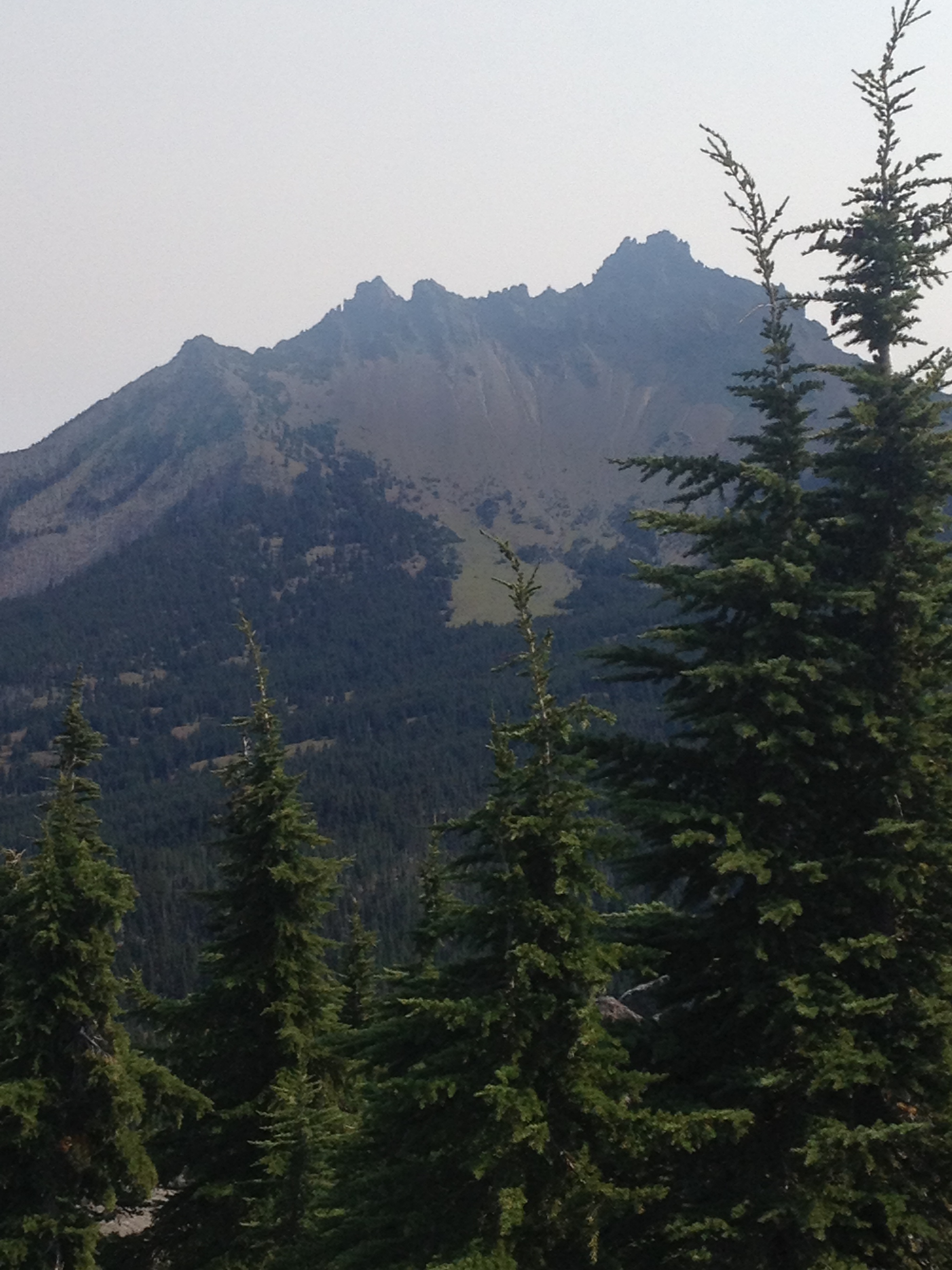
THREE-FINGERED JACK

THREE-FINGERED JACK

Outside the wilderness, in deep forest, Douglas firs dominant, with a few Silver Firs,  I was still alone.  But, I now, I appreciated something that I had not yet experienced on this hike.

SILENCE.

I mean QUIET.  NO NOISE.

There wasn’t any wind, no sound from a bird, a squirrel, a car, another person, or a plane overhead.  There was NO SOUND.  My ears rang, it was so quiet.

I know my hearing is gradually worsening.  But the silence was not due to my hearing problems.  There was no sound, and in America today, that is a rarity.  True, one can be in a sound-proofed room or wear sound canceling headphones, but silence in the wilderness is special, for there usually is some noise in the woods.  I’ve experienced total silence in the Grand Canyon, the Boundary Waters, and the Brooks Range.  Usually, the lack of sound has come at night, but on the Maxwell Butte trail, it was in daylight.

I sat there and listened….TO NOTHING…and thought, because without sound one starts to think…..about the Silver Fir near me, the name of which I learned only the prior week on Lowder Mountain.  I thought about the soil beneath me, the beauty of the trees, hundreds of years old, the fact that I was here, had trod these woods, and nobody was near me.  I reveled in my good fortune: SILENCE, NO NOISE.

I didn’t think of the dropped cup in the coffee shop earlier that week, where the acoustics made the noise hurt.  Or how somebody moved a cart by me as if they wanted to make as much noise as possible, as often seems the case today.

I enjoy music, but there are times I don’t want to hear it.  I don’t want to hear ANYTHING, not a beep with more information that often clutters my life.  To be outdoors in silence, away from people, is special beyond words. I believe, albeit without proof, that people need this sort of silence, yet we have countered with a barrage of sound, believing constant information is what everybody needs.  It isn’t. Multi-tasking is overload.  Many of our schedules are overloaded.  I believe there is harm from the constant beeping of messages, many unimportant, programmed voices in a car, sports announcers that feel they have to keep talking, or 24 hour a day television, where “dead air” is something to  be avoided and filled with comments, whether valuable or garbage.  Why can’t we shut up for a few minutes?

A man was once separated from a tour  group in Mammoth Cave, Kentucky.  He was found 36 hours later, alive and relieved.  In the cave, there is not one lumen of light.  If the cave is dry, there is no noise at all.  The man said what bothered him the most was the silence.  He cracked rocks together to make noise.  Darkness was a problem, but silence was difficult.   I don’t know if I would feel the same way, but I do label wilderness, total silence, and totally dark skies the “outdoor triad.”  We live less fulfilling lives, I believe, because many people never experience one of these three, let alone all of them together.

Mammoth Cave, Kentucky

Mammoth Cave, Kentucky

Light pollution has been a problem for years, affecting nature and man in nature, too.  We have lost our night sky heritage; the National Parks are trying to deal with light pollution.  Sound pollution is more insidious.  Europe doesn’t have places like the Olympic Peninsula, where the One Square Inch Project is occurring.  Excessive sound damages our hearing.  This is a fact.  It hurts other animals.  That is a fact, too.  It isn’t good for us, and the damage it does to our thinking, the believed necessity to process more information, which I don’t think healthy, is poorly recognized and the consequences not completely understood.

Eventually, a high flying jet broke the spell that I was in.  Jet engines at any altitude can be heard on the ground.

I will eventually live in a silent world, should I remove the hearing aids I will some day need to wear.  What I want now is to periodically spend time in places where there is silence, where no sound is transmitted to my cochleae.

I don’t know why at that particular moment I decided to sit on the log.  Perhaps silence ironically called me.


View from the log.  SILENT

View from the log. SILENT

http://www.utne.com/mind-and-body/search-for-silence-quiet-art.aspx?PageId=7#ArticleContent

CHALLENGER MOMENT

September 14, 2014

“The goal of the (backcountry responsibility) code…would be to encourage simple things like speaking up when someone is doing something unsafe….”  Outside magazine, article dealing with avalanche safety.

“I don’t like this!” I called, and stopped hiking.

The day hike we took on the third day of the Wulik Peaks backpack trip was going to be easy.  The whole trip had been.  While hiking in Alaska is seldom synonymous with the word “easy,” the abundance of caribou trails, low water in creeks, and hard ground made 2.5 mph possible, triple what I had been used to in my five previous trips to the Brooks Range.  My feet had stayed dry, and in my prior 50 days of backpacking in the Brooks, never had I ever finished one with dry feet.

We camped early, had lunch, then took a day trip up a long valley, over a pass, into a second valley, climbing to a ridge overlooking two mountains and a beautiful green cirque.  The Sun was out, the air clear, the wind light, and the way to the high ridge overlooking our camp easy.

People reaching summit of unnamed mountain in fog.  This one was safe.

People reaching summit of unnamed mountain in fog. This one was safe.


Cirque at top of second valley.

Cirque at top of second valley.


Once on the ridge, however, we realized we had to skirt a large slope of rock scree at about a forty-five degree angle.  There was the hint of a caribou trail there, but then the guide went one way, and I did not want to follow.  I saw no good route, and while falling on the rocks would not likely been considered life-threatening, in remote Alaska, there is no such thing as a “minor injury”.  This wasn’t the South Col, but it was more than I had bargained for on this hike.

I promise my wife before each trip that I will be careful, and I broke my promise.  I got away with it this time, much like the Space Shuttles got away with O-ring problems before Challenger didn’t, on 28 January 1986.

The guide called back, “It is only 100 feet around.”  A hundred feet means a lot of different things, and vertical vs. horizontal is a big difference.  I took it as meaning very short, without considering what modifiers “short” had.


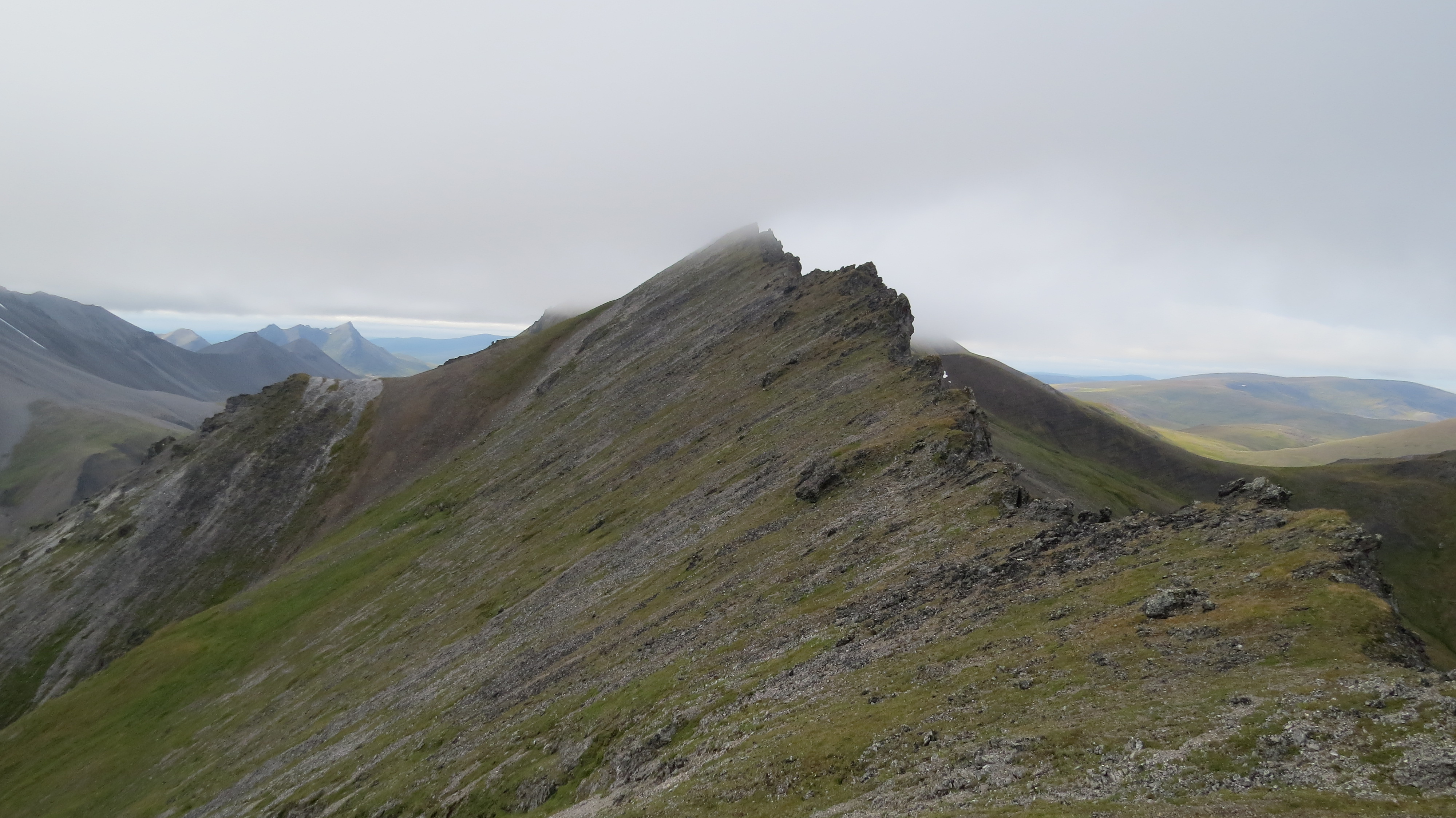
Top of the ridge, after the crossing.

Top of the ridge, after the crossing.


Where the ridge turned from rocky to grassy.

Where the ridge turned from rocky to grassy.

I replied about my not being one of Outside magazine’s world class climbers. Every other person on the trip seemed comfortable, but one offered to go back with me.   Against my promise, and therefore against my better judgment, I went forward.  I reached the bottom of a 25 foot steep climb up to the guide.  I took large steps, stayed close to the mountain, being told by the guide I was going too fast.

I don’t like criticism, and I spend most of my life trying to do well to avoid it.  I ignored him, wanting very quickly to get to the top.  The guide had convinced me to do something I didn’t think safe and then criticized how I did it.  I said nothing about the event then or for the rest of the trip.  We had been required to hike single-file, and I didn’t like having to set my pace with another person’s.  When there are sharp-pointed walking sticks involved, people can easily get hurt, if they aren’t paying attention, and follow too closely.  I erred there, too, because I did not mention that problem at the outset of the trip, and I should have brought it up.  But the guide and another client had far more Alaska experience than I.

After the trip, when I got to a telephone, I told my wife about the incident and apologized.

Up on the ridge, I should have turned around and gone back.  The fact that I made it safely did not mean it was safe.  This concept is poorly appreciated by many, who feel if one “gets away with something,” it is safe.  No, one played the probabilities and succeeded, but the probabilities significantly predicted a bad outcome, and we read about those in newspapers.

In the Alaskan bush, one has already taken significant risks.  There is simply no reason to cross a potentially dangerous ridge that does not need to be crossed.  Going back around would have been safe and taken 30 more minutes.  Big deal.  But we didn’t do it.  I didn’t go back; I got caught up in “Group think,” and I didn’t want to disappoint anybody.  As it was, I felt like I was the worst hiker on the trip, as if it mattered, as if I were going to see any of these people again.  I disappointed myself, breaking a promise, because of a bunch of rocks.

The guide erred, and I erred, too, by not pointing it out to him.  He should have told me to turn around, rather than say, “It’s good that you know your limits” before making me violate them.  He should have decided to either have people look before proceeding or deciding on his own not to do the traverse.  That is what a guide really gets paid for, not for cooking a meal or leading a single-filed group of 6 on caribou trails in northwestern Alaska.

It is one thing to know a person’s limits.  It is quite another to respect and not violate them.

I suspect the rest of those on the trip have either forgotten the incident or thought I was a sissy.  I didn’t make a stink.  I moved on. But I didn’t forget it.  If I am a sissy, so be it.  I’m alive to hear the words.

Many of us don’t like to say anything negative on a subsequent survey, especially if either our name is known or our identity obvious from the response.  Those who survey should remember that their questions may not capture significant complaints.  People must feel safe to report problems, straddling a fine line between wanting to state their case without getting somebody in trouble with their bosses, many of whom do not have the gift of constructive criticism. I did not feel safe commenting.  The guide erred. I erred twice, when I didn’t turn back and when I did not discuss the issue with him, out of earshot of others.  That would have been best.

It is one matter to wrench a knee during a necessary stream crossing; it is inexcusable to risk injury on a day hike to a ridge.  The former is a significant problem, but stream crossings are a necessary part of Alaska hiking. Crossing hazardous ridges on day hikes were not necessary on this trip.  Had I fallen and broken a few ribs, at 65, my life would have been in jeopardy.  Day hikes are not necessary; often, they are treated with less, rather than more, care.

I regret my silence and not turning around.  Fortunately, I am alive to regret it.

WULIK PEAK BACKPACK, 2014

September 8, 2014

The Wulik Peaks area of Alaska is separate and west from the Brooks Range  and lower, not rising much above 3600 feet (1100 meters), compared to twice that in the central Brooks and nearly thrice at the highest peak.  I hadn’t even heard of the Wuliks before this year, but when one Alaska trip to the Refuge (Arctic National Wildlife Refuge) didn’t pan out, I discovered this trip, a part of the Brooks I had never seen, and one that immediately intrigued me.   Wilderness I haven’t seen intrigues me.

The advantage of living in Oregon meant that I could get there in a day, arriving in the evening, and leave on the trip the following morning, which I hadn’t been able to do on my five previous trips to the Brooks.  I did so, met the 5 other people who would be along, representing England, Germany, and the states of New Jersey and Alaska, as well as mine.  Our guide was finishing a trip in the Wuliks, and we would fly in to meet him the next day.

I had dinner with the Englishman that night, and the next morning, we all flew into the Wuliks in two planes.  It was a smooth trip, over the Noatak Delta, inland, and landing on a slight uphill rocky strip.  The planes left, and it was quiet.  There are not a lot of birds in the Brooks, especially in mid-August, and it is a very quiet place.

Noatak Delta in the morning.

Noatak Delta in the morning.


Landing spot.

Landing spot.

The guide gave us instructions on bear spray and dealing with bears, and we hiked as a group.  We covered about 5 miles the first day, typical for Alaska, camping where two creeks joined.  We would stay there two nights, doing a day hike the next day.  Hiking up here was much easier than I had been used to: we were often on caribou trails, and while caribou go places I don’t want to tread, their trails are a very useful highway.  The grass was low, dry, and the creeks and streams, all having a good amount of flowing water, were not difficult to ford.  I stayed dry, and I would have dry feet the whole time we were out there, which I never would have expected in the Brooks; it had never happened in the 50+ days I had hiked in five different parts.

The second day, we climbed in fog to the top of a mountain nearby, gaining about 1100 feet (340 meters) and having lunch in the shelter of a rocky area.  We returned to camp and then crossed the river and climbed up into another area, not as high, but with a view back to the north.  The nights were cool but not cold; heavy cloud cover limited radiational cooling, but the high humidity plus any wind made one cold.

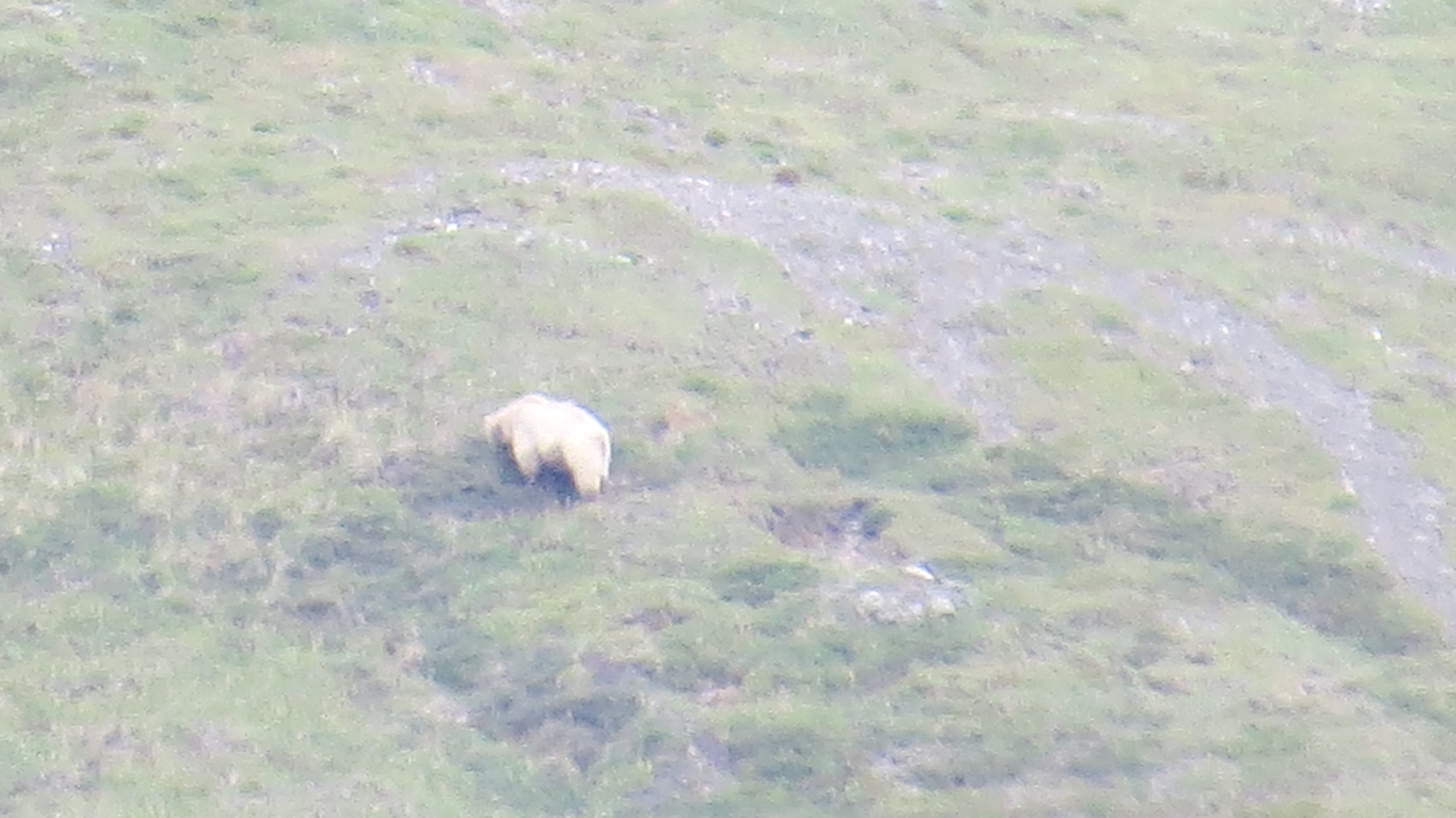
Bear, from 800 meters. He was the only one we would see.

Bear, from 800 meters. He was the only one we would see.

People reaching summit of unnamed mountain.

People reaching summit of unnamed mountain.

Wheatear

Wheatear

The third day was the only day we saw sun, as we headed up to a divide between two streams, climbing about 700 feet (210 meters) and descending almost as much.  We set up camp on a bluff a little above a stream and then day hiked into the mountains, doing a loop that at one point reached a narrow edge with a scree slope with large rocks at a 45 degree angle.  I did not want to go on, but I allowed myself to be talked into it, crossing without incident.  That was my only regret on the trip: we had “group think,” and had I turned around, somebody would have gone with me.  The fact I could negotiate the area without incident did not make it safe, something I refer to as “Challenger thinking,”  after the 1986 disaster, which had plenty of prior warnings, but since nothing bad had happened, the warnings were not heeded.

Forget-me-not

Forget-me-not

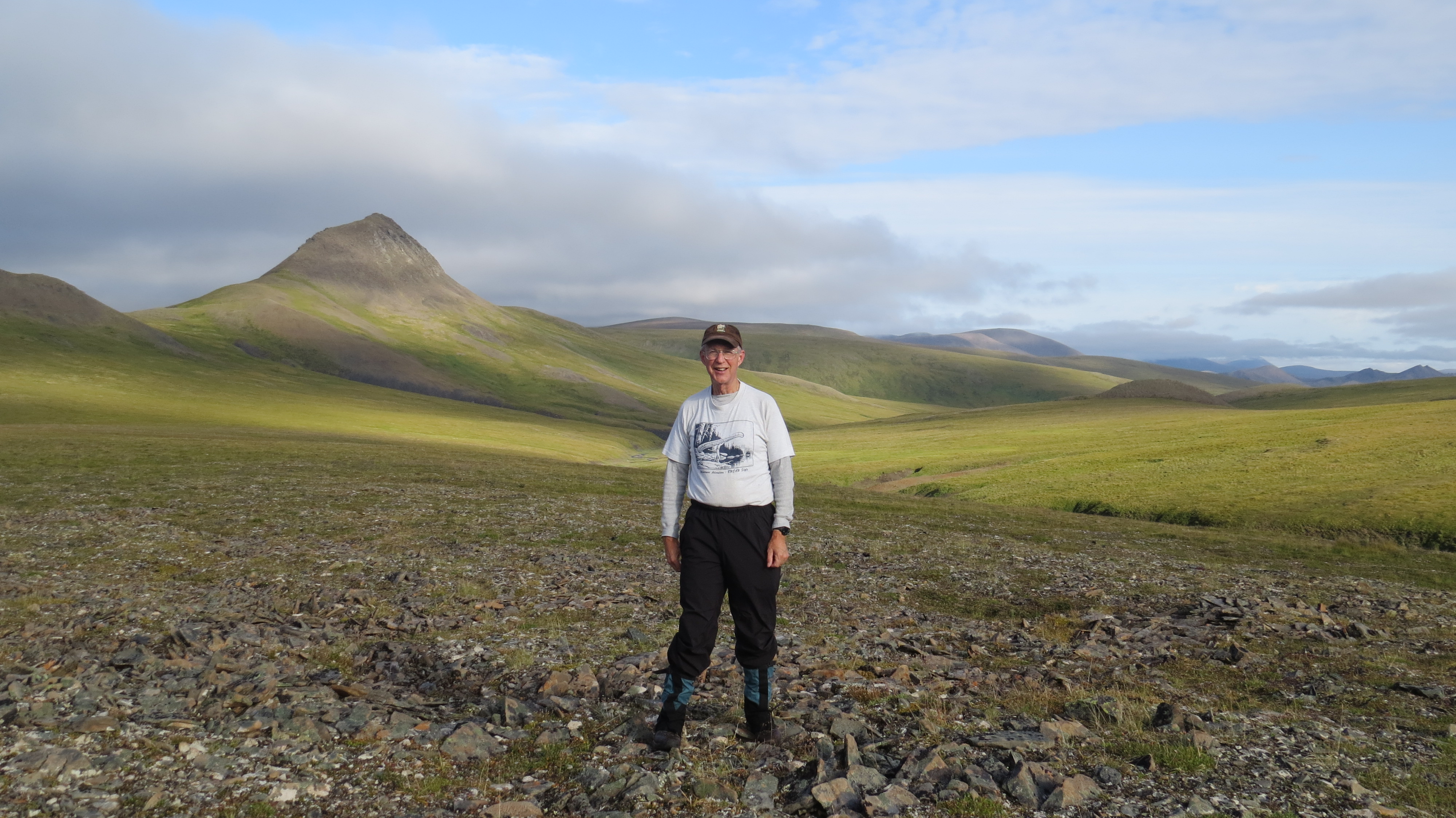
Author on a plateau at 1800 feet (550 m)

Author on a plateau at 1800 feet (550 m)

The vastness of the Alaska mountains above the Arctic Circle

The vastness of the Alaska mountains above the Arctic Circle


We then hiked downstream to where the West Fork of the Wulik River widened and camped, climbing another 1000 foot peak nearby, without the issues of the prior day.  The fifth day, we went up another stream, through the fog, across many side channels, where there was a steep drop on uneven ground to the stream bed, followed by an equally steep climb out.  After crossing a divide between two watersheds, we camped in what was later called “rain camp,” for the moisture appeared to funnel through the mountains and turn into rain here, but not in adjacent valleys.  Indeed, as I would later learn, there was moisture funneling into the Wuliks, but the surrounding area outside the mountains was relatively dry.

West fork of Wulik River.

West fork of Wulik River.


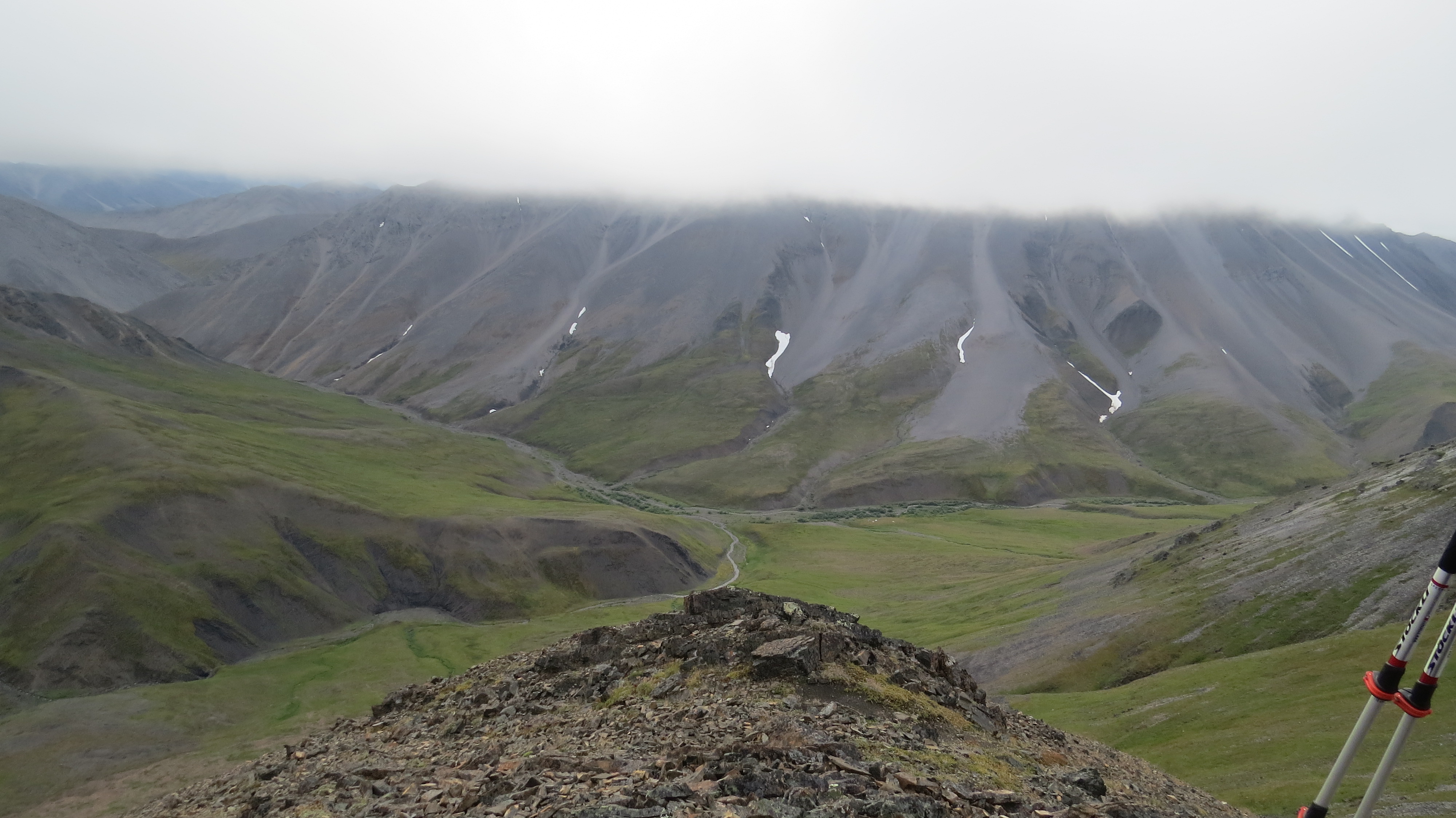
View from unnamed mountain.

View from unnamed mountain.

Water slowly moving down a stream bed.

Water slowly moving down a stream bed.

It was a short walk from rain camp to where we were to be picked up.  We could see the stream beds, previously dry, start to flow, the water moving downstream about 1 meter a minute, slowly, but steadily.  Whether the water, and the few fish present, would reach the main river, was not clear.  With more rain, the water would make it, and the fish survive; if not, they would die.

We camped our final night in a foggy valley, where we could clearly see the moisture funneling into the area from which we had come.  We were mostly dry.  I had hoped that on the flight back, we would fly over the coast and see the musk ox, that were clearly there.  That didn’t happen, but when we landed, I spoke to the pilot, who agreed to take me and one of the people on the trip out off Cape Kreusenstern where we could see them.

And so a high point of the trip came, not in the mountains, but at sea level.  I asked for what I really wanted, and the answer was yes.


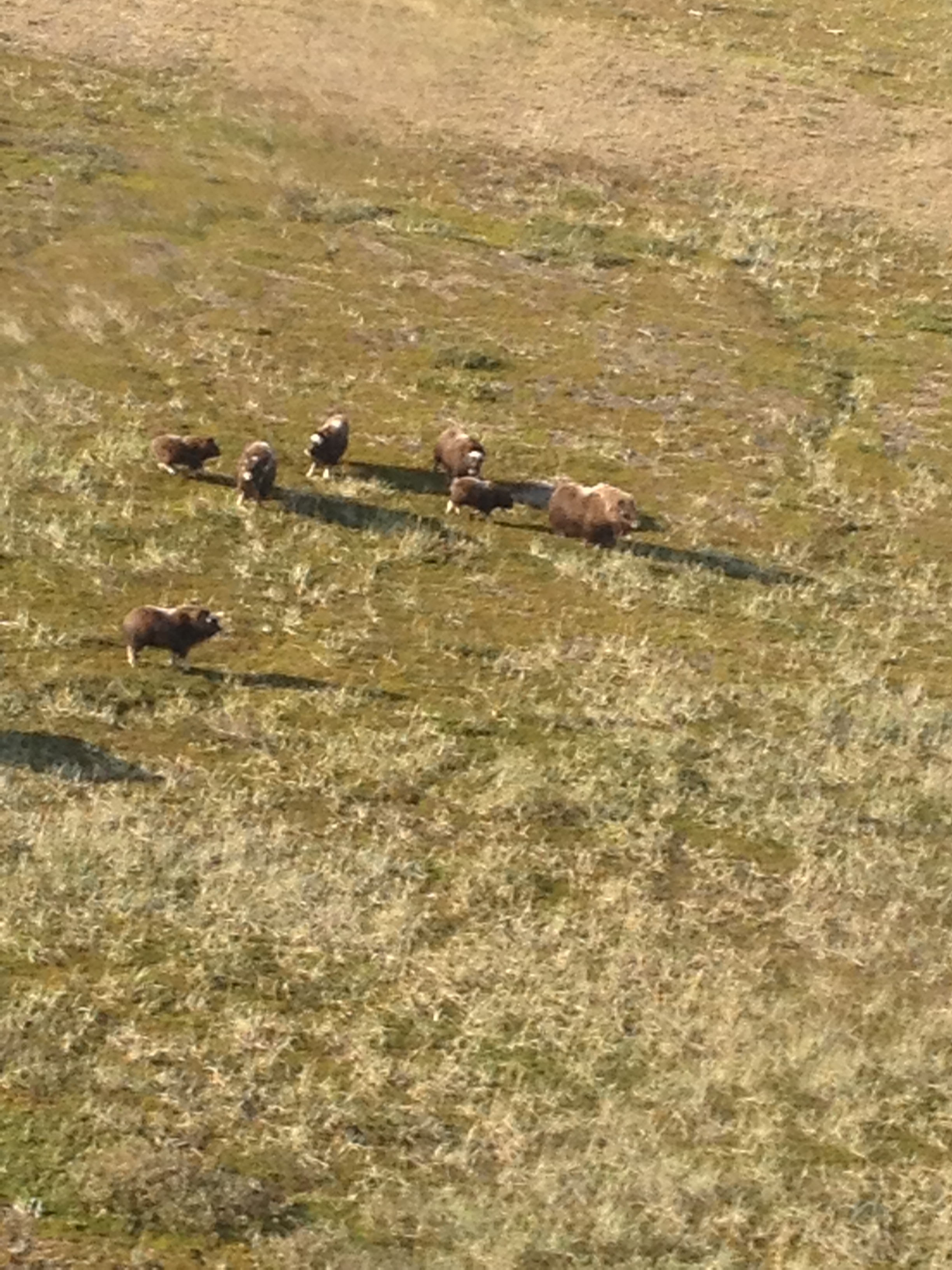
Flying over a herd of musk ox.

Flying over a herd of musk ox.

Pair of musk oxen

Pair of musk oxen


Head on from 400 meters.

Head on from 400 meters.


Much larger than I had anticipated.

Much larger than I had anticipated.

THE LAST STEP ON THE FINAL PATH

September 5, 2014

I remember one time where I “owned” the ICU at the hospital where I worked.  I was the consultant on eight patients – eight – who were severely, irreversibly brain damaged, or brain dead.  I don’t remember all the diagnoses; there were a couple of aneurysms, an intracerebral hemorrhage, hypoxic encephalopathy, a bad surgical outcome and some devastating strokes.

During my harried week, the staff were superb in using my time efficiently, shepherding me from one family group to another.  It is easy to get jaded when one often sees lethal brain damage, and such patients need to be seen a few times a day.  I tried not to become too cynical, but I don’t know how successful I was.  Taking time to talk to families is necessary, deeply appreciated but stressful, since many grieve using anger.  Nobody who is acutely grieving comprehends much of what a doctor says, so there needed to be constant repetition, and I had to bite my tongue more than once when a nurse said, “The family said you didn’t tell them anything.”  As much as I tried to talk to one designated family member, who would relay the information, that didn’t happen often.

All it took to undo a day’s work was a lung or heart consultant who told the family, “He’s doing well,” when the consultant meant the organ system.  The family didn’t hear that.

It was often the family’s first time dealing with death; it might have been my thousandth time saying, “there is nothing that can be done,” “he will not wake up,” “I am sorry.”  Doctors need to do it and to do it well.  Many do not.  Many made rounds when the family wasn’t there.  Sometimes, the nursing staff had to pressure the attending to contact a neurologist, and they often called me.

Not that it mattered, since I was busier than I wanted to be, but the time spent dealing with families was uncompensated, whereas a carotid endarterctomy, in my hospital a proven worse way of managing carotid disease than leaving it alone (I had the data), was compensated well into four figures.  We pay doctors to do procedures far more than we pay them to listen to a grieving family, say a grasping of a hand is reflex, not voluntary, see the expression of disbelief on their faces, when we give them the bad news, and hear the same stories about “some miracle” that wasn’t.  Small wonder we have expensive medical costs compared to the rest of the world, vegetative patients receiving futile care, because nobody acted when they were irreversibly brain injured and were clinically unstable.  The longer a patient lingers, the more hope a family has.  I was frequently castigated for “taking away hope,” when what I avoided was doing the worst thing of all, “giving false hope.” We pay a lot for the final months of life, but to me that statistic is misleading, because most people don’t know when they are going to die.  We do, however, pay for a lot of unnecessary care.

If we dealt with death well, we would have fewer patients lingering in a way the vast majority would say they never wanted, since the diagnosis of irreversible brain injury may often be made when the patient is clinically unstable, and support discontinued then.

If I returned to medical practice, which I won’t, I would be a far more compassionate physician than I was during the twenty years I did practice.  I thought then I was fairly good.  Now, I am not so sure. I thought I was skilled at allowing patients to die at the right time with more dignity and less stress on the families.  When it came time for my parents to die, I did everything I promised them; neither lived more than eight weeks from the time they started to die.  Ensuring quiet, quick, painless dignified deaths of my parents was the second best thing I’ve ever done in my life.

I wrote about the change in my relationship with my recently widowed father, probably the best article I will ever write.

Having lived through my parents’ deaths, I now look at life differently.  I would be far more compassionate to those who were facing death of a family member.  I would be able to tell families that it is normal to feel guilty when the time comes to stopping life support.  I could tell them how one will miss having that loved one to talk to, all the conversations one would want to have in the coming years, dreaming of the person, a decade later, the way they were in life.  I could tell families how the relationship between children and the surviving parent would change.  I would be good and far more effective.

As I enter a new phase in my life, I am considering once again dealing with death, not as a physician, who cares for a patient, but as a volunteer helping people to navigate the complexity of care and options when they have illnesses that are not going to be cured, problems that are not going away, time that may no longer be present, helping them find their own path, perhaps their last steps on that path.

In doing so, I will help myself.