Archive for May, 2015

CAUTION: BEFORE GOING TO WAR, READ INSTRUCTIONS CAREFULLY

May 28, 2015

Early March 2003:  I remember speaking to my father about how many people alive that day would not be in the coming year, due to the impending invasion of Iraq.  I was against the war, because I believed Saddam Hussein had nothing to do with 9/11, there was no convincing evidence of weapons of mass destruction, starting wars was a lot easier than ending them, we would create terrorists by being there, and we would have an influx of refugees.

2015: my father is no longer alive, I still am, and every one of my concerns was correct.  Several thousand Americans and perhaps more than a million Iraqis died; the consensus recently was that the war was a mistake.  Really? Those who made the mistake are alive and rich; incredibly, some of them are still being considered for high level governmental jobs:  Mssrs. “the war will pay for itself” Wolfowitz and Bolton, the latter one of the nastiest men on earth.

With that background, I read American Sniper, by Chris Kyle.  I had some misgivings about whether I really should or wanted to read the book, but did so.  Not surprisingly, there were  things I didn’t like.  He and I were from two different worlds, generations and belief systems.  But we were both Americans, and we both served.  There were areas where I found myself nodding assent.  Mr. Kyle was a warrior, not a writer.  I am a writer, not a warrior. He was a warrior like Patton, for he loved being at war.  He loved it more than family, he and his wife both admitted it.  He had a chance to quit the military but stayed.

What Mr. Kyle wrote should be discussed every time we go to war.  He de-humanized the enemy, referring them as savages.  This is not wrong; it is how people bring themselves to kill other people.  We used “gook” in Vietnam.  He referred to killing simply as “got him.”  He was a superb warrior and sniper who lived for action, had incredible luck, much of which he made, whereas literally millions of others did not have the luck or live.

While Mr. Kyle said he had only one brief “flashback,” he was changed by the war.  I don’t know how he couldn’t have been. Diving for cover when a car backfires is not normal.  I don’t know how any individual can live through war and remain normal.  He and his fellow warriors fought in bars over minor issues and got drunk often.  It doesn’t make them bad; they were young men at war.  Being at war makes such behavior more likely in young men.

We glorify warriors; mankind always has.  When we need them, we want good ones, and Mr. Kyle was the best of the best.  He was humble in his story, lavished praise upon others, and had many narrow escapes.  One man next to him was shot in the eye and was permanently blind.  He lived, but not long.  Another died in Mr. Kyle’s arms. Every person “down” ended up either in a body bag or in the hospital.  This was an ugly war in an ugly place fought by an ugly enemy.  The smells of Iraq cannot be described.  I have smelled similar places.  The smell of blood, the sight of bad trauma I know, although not like what occurred in Iraq.  Mr. Kyle survived an IED and just missed another one; several hundred Americans did not; thousands survived mutilated and beyond repair.  Many are homeless today. Having video games extolling fighting and killing disturbs me deeply.  War is horrific.

Mr. Kyle was a patriot.  Sadly, he fought in a war started by old men who had never been warriors and who had no business starting this one.  He spoke out strongly against politicians giving rules of engagement, lawyers wanting to know if a “kill” should have been done.  Mr. Kyle wrote that once the military is in place, it should be allowed to do its job.  He was dead right.  That is why going to war must be carefully thought out, for the military’s doing what it should do is ugly, often based on misleading intelligence, and many will die unnecessarily. That is war.

The run-up to the Iraq war was a lot of flag-waving and jingoism.  It was “Mission Accomplished,” when 3 years later, the country was nearly a failed state and in 2015 may become one.  The war was illegal and marketed to the American public. The strategy was flawed by men who chained warriors like Mr. Kyle, so he could not be as effective as he could have been.  It made contractors like Blackwater rich for shoddy work, frank murder and showed an uncaring nation in our handling of Abu Ghraib, Guantanamo, Walter Reed, and care for veterans.

I laud the late Mr. Kyle for including comments by his wife, her experiences.  She built her own walls against pain, walls against a person whom she loved.  She did not enjoy war action, for she was raising children and wondering if she would be visited by two men, informing her that her husband was dead, which happened to thousands of others.  As bad as death is, having a husband come home who is blind, had his legs blown off, or his brain damaged in a way that can never be made whole again may be worse.  It is an ongoing hell, and those who go to war leave behind those who worry and deal with “boring,” tedious, necessary day-to-day life.  Warriors fight and have glory, thinking they are immortal, until something happens that ends it all….forever.  Their spouses must bring up children who don’t know a parent.  Some are widowed mothers at 19. That tragedy visited Tucson after Fallujah.

Mr. Kyle’s death at 38 was at the hands of someone he was trying to help, who turned on him at a range, shooting him six times, so sad and ironic.  Mr. Kyle no longer feels, but his wife does and has her own hell to go through, alone.

I’ve served in the military, but I’ve never been a warrior.  Nor have I been or ever will be a hero.  I’ve fired a rifle exactly ten times, 40 years ago.  I never have touched another firearm.  Not once. I don’t shoot bullets.  I write words, try to help people understand the world we live in, and give of myself to causes I believe in.  I won’t be famous, and when I die, few will grieve.  I have lived as an imperfect human being, done some good, seen more of the world than many, been blessed with skills others have not, and tried to speak out against injustice, evil, and wrongdoing.

Had we stayed out of Iraq, the late Chief Kyle would likely be alive today, as would perhaps a million others.  In 2003, few knew Mr. Kyle.  In 2015, most of the country knows of him.  I salute both his memory and his wife, for what she had to do.  I cry out against the injustice, the lies, the waste, my being labelled a traitor, and all the other things the Iraq war did to individuals and to us collectively.  It was wrong, and in 2003, I was in the 16% who said it was wrong.  I wasn’t prophetic.  I’ve read much about war, from the Romans, The Rise and Fall of the Third Reich, and every word Samuel Eliot Morison published.  I walked on Corregidor; I’ve seen Pearl Harbor, the Memorial Cemetery in Manila, gone ashore on Okinawa and Inchon, seen rusted hulks on Eniwetok.

In 1970, we seniors at Dartmouth were asked to answer a question:  “Is there a war that you would want to fight in?” I never forgot the words one of my classmates wrote, back when we were involved in another wrong conflict.

“I can’t imagine there ever being a war I would want to fight in.  I can imagine one I ought to fight in.”
“IT DON’T COME EASY”  

May 24, 2015

Quite by accident, which is how my life usually occurs these days, while tutoring at the community college, I went to an algebra site to check something.  I don’t remember what it was, but when I tutor, I frequently encounter problems I remember but don’t recall exactly how to solve. I understand ellipses and hyperbolas, but I forget how to find the foci or the latus rectum.  I have to look it up.

While on the site, I discovered the solutions were posted by volunteers, so when I had a quiet stretch, I gave myself a user name and logged in, solving a few problems that afternoon.  I found it relaxing, which I am sure would surprise many for whom math is an odious chore.  What I have learned, besides hyperbolas and ellipses, was more than math itself.  Those who do not like math might read on, for you will be surprised.  Those who do like math will likely shake their heads in agreement.

The first lesson comes early in Ringo’s and George’s lyrics:  “You’ve got to pay your dues, if you want to sing the blues.” MATH TAKES PRACTICE, just like the piano.  I practiced the piano an hour a day and took lessons for three years.  I got better.  Oh, I never got past a couple of recitals, where a dozen of us played solo to our parents and a few others.  Wow, I was nervous.  But I did fine.  I played “By the Sea,” which I had memorized.  I played it well and everybody clapped.  I never thought I had musical talent, and to be sure, I don’t have much.  But I could play the piano; I could read music and even change it into different keys.

I think latent math talent exists, too, but one has to follow the guidelines, of which practice is the most important.  Practice allows one to solve problems, but it has a bigger advantage.  When one needs such math in the future, while it may have been forgotten, it returns quickly.  I never forgot the slope of a line.  I did forget the point slope formula and quickly relearned it.  I forgot how to integrate by parts, but I re-learned it enough to astound a few people in graduate school, 30 years later, when I blurted out the integral of log x one autumn afternoon in Las Cruces.

Sit with me as I tackle online a routine problem.  Routine problems are ones I can do without pencil or paper.  People submit them to get help.  Watch my thinking, but more importantly, WATCH HOW I MAKE MISTAKES.

Joel and Nicole each together have 350 coins.  When Joel gives away half of his and Nicole a third of hers, they now have the same number of coins.  How many did they start with?

I love mixture problems; I’ve never had to review them.  It’s sort of like a guitarist who learned “Don’t Think Twice” in the 60s, never played it since, and tries to play it at a gathering.  He may not tune the instrument quite right, and he gets a few chords wrong, but he plays the song, and it is appreciated.  Math is intertwined with music; an eighth note is held twice as long as a sixteenth.

I let Joel’s coins = x  and Nicole’s = y.  I could let Nicole’s equal 350-x, a trick I use, if I choose to use only one variable.  Musicians have tricks when they play, too.  They put a song in D major, rather than in D.  They invent stuff.  I have in math, too. Back to Joel and Nicole.

x + y =350.  That is a fact.  Translate: Joel and Nicole together have 350 coins.

Joel gives away half his coins.  He has half left, (1/2)x.  I put parentheses around the numbers, because 1/2x is not the same.  Hey, you play in E minor on a piano, you may touch the D major key, same one, but it doesn’t sound the same.  (1/2)x is not the same as 1/2x.  We’re no different in math.

Nicole gives away 1/3 of her coins, so I first write she has (1/3)x.  I am not correct, and when I later check the problem, it isn’t right.  I return to the beginning, BECAUSE SOMETHING ISN’T RIGHT.  I don’t convince myself it is right, I don’t dictate it is right.  It is NOT RIGHT.  I have an open mind and start over, asking WHERE DID I GO WRONG?  A lot of politicians ought to ask themselves this question.  The guitarist knows when it doesn’t sound right, too, asking himself where he went wrong.  I and the guitarist are on the same wavelength.  WE KNOW IT JUST ISN’T RIGHT.  Oh, I discover, Nicole has (2/3)s of her coins left, not (1/3).  What was I thinking?

Can you see that somebody like me, good in math, makes a simple mistake?  If you aren’t good at math, did you ever realize how many mistakes mathematicians make?  We make them all the time!!!

OK, so (1/2)x=(2/3)y .  Now, there are at least three different ways to solve this, but I’m not going to play the song in 3 different keys, just one.  I’m lazy, and I like my math simple.  If I double (1/2)x, I get x.  If I double (2/3)y, I get (4/3)y.

x=(4/3)y,  I like this.  It feels right, just like hitting the proper chord feels right.  You sense it.  We’re brothers here.  The sense is well known in sports, where it is called “the zone”:  Bill Bradley was once interviewed during practice.  He made a 20 foot hook shot while talking:  “You have a sense where you are.”

Now instead of x+y= 350, I have (4/3)y + y=350.  One variable. But y = (3/3)y.  You’d be amazed how often we math guys multiply by 1, which doesn’t change anything.  Not only that, we multiply by really strange “1”.  Here, it is (3/3).  Sometimes, it is (√7 + 2/)(√7 +2).  That is also 1.  Even stranger, we may add 0, because it doesn’t change them.  Crazy.  Until we add 36-36 to an equation that has (x2+12x), allowing us to write (x+6) – 36.  Both of those are equivalent, but we can do things with the second that we can’t with the first.  I now add the y’s: (4/3)y + (3/3)y =(7/3)y, which equals 350.  I flip the fraction over, because (1/2)(2/1)=1 and (7/3)(3/7)=1, and I want 1y or just y on the left.  I must multiply the right by (3/7), too, and without boring anybody, y=150.

I make another mistake, a rookie one.  I usually solve for x, but if Joel had 150 coins, Nicole had 200, and one can’t divide 200 evenly by 3.  I WAS WRONG.  Two minutes later, I realized I had solved for y, and when I went to the top, I had CLEARLY WRITTEN BUT FORGOTTEN that y was Nicole’s.  She had 150; that checked just fine.

This is a simple example to a math guy.  We make many mistakes.  All of us.  We copy the problem wrong, we forget a minus sign, we add wrong.  Yeah, that too.  I’m just a guy who plays with math to relax, hitting a lot of wrong notes along the way.  Like the guitarist, I make good music, but “You Know, it Don’t Come Easy.”

I paid my dues.

ZWEI ALLEIN (TWO ALONE)

May 14, 2015

The man was adamant.  “My wife will not have chemotherapy.  We survived the concentration camps, and we will both go together.”  His wife had cancer metastatic to the brain, and other than radiation, there wasn’t anything else we were going to be able to do except control brain swelling.  I had the sense the man was challenging me, but I wasn’t about to fight them, not a pair of concentration camp survivors fighting their own losing battle.

A few weeks later, I read in the newspaper that there had been a murder-suicide in an elderly couple.  The name was familiar, and I knew exactly what had happened.

I watch German videos online every day.  I no longer spend 3-4 hours daily learning vocabulary, memorizing lists, or studying grammar.  I did that for a few years, but I moved on to other interests, as I knew I would.  I like exploring the world; there is so much to see and do, and I find the time short.

Today, I listened to a video where the ending was not perfect, unfinished.  It was real. It was powerful. The plot was simple enough.  A woman, Henriette, and her sister were walking in a park, when suddenly a robber jumped out, stole the sister’s purse and shot Henriette in the abdomen.  The sister was unhurt and got help, but Henriette died in the hospital during surgery.  There had been 4 murders in the park in the past several months, so this appeared to be another.

Benedikt, her husband, was a bus driver.  The next day, he went to work, confused, and drove the bus past people waiting, through a red light, and was pulled over by the police.  When they learned his wife had died the day before, they told him they would take him home.  Benedikt suddenly left the bus and took a cab, not home, but by places where he had spent time with his wife.  For the next several days, he acted like a grieving man. Flashbacks were shown, one finally showing the Henrietta with him, months earlier, suddenly collapsing from abdominal pain.

It dawned on me that perhaps this shooting was intentional.  Indeed, it soon became obvious.  The woman had visited a gynecologist and had a malignancy, likely ovarian cancer, although it was not stated.  She and Benedikt had discussed her disease, decided against further treatment.  The police in the meantime, had discovered the perpetrator, but the latter stoutly denied anything to do with this murder, even as he laughingly admitted to the others.

At the end, it was obvious that Benedikt had shot his wife, with her prior consent.  His sister-in-law finally discerned the truth and watched helplessly at the end, as Benedikt held a gun to his chin.  He suddenly fired the gun at the sky, at God, he said, and the movie ended. There was no “closure,” a term that needs to be used less, since many seem to believe that candlelight vigils and other memorials will help speed closure.  They don’t.  Closure takes time, and Americans, for whom time is precious, want to speed up something that has its own schedule.

In Oregon and four other states, Benedikt’s wife and the woman with metastatic cancer could use Death with Dignity.  Both women were had a life expectancy fewer than 6 months, mentally competent, and would have qualified for a prescription, if two physicians, one of whom could be the individual’s personal one, agreed that she were terminal. Two requests have to be made 15 days apart.  This is not a “I want it tomorrow” issue.   The prescription is then taken to a specific pharmacy, filled by a specific pharmacist, because some pharmacists refuse to fill it.  Then, at a time of the patient’s choosing, the patient takes the pills, becomes unconscious and die.  No gun, no jail for the spouse.  It is terribly sad, but the individual is in control of the dying process, which was going to occur soon regardless.

Do we think that people don’t know they are dying?  Do we have to let the soon-to-come death come on its terms, rather than on a patient’s terms?  Oh yes, there is palliative care, and while it is good, if I have pancreatic cancer or a glioblastoma I don’t want death on death’s terms.  I don’t want to lose half my weight, become jaundiced, lie in a bed for weeks, slowly dying, even with pain control, seizure control, and being kept clean, all a very tall order, because not all palliative medicine is the same.  There won’t be a sudden miracle, and anybody who practices medicine as I have is far more an expert than those who live in a dream world of fluff and unicorns, where there are happy endings.  No, I wouldn’t want to die.  But I would not take my life, the disease would.  If it is a matter of one day vs. a few weeks, why should I not have control?  Isn’t that a civil right of mine?  What is more private to an individual, more of a right, than their right to exist?

Oh, I know the arguments.  Hospice can do this, except there are hospices that don’t do it, and I don’t want to end up in one of them.  One charged Barbara Mancini for murder when she handed her father morphine that he asked her for.  It wasn’t even clear he wanted to end his life then.  He wanted it for pain and was taken to the hospital against his wishes and given naloxone to reverse the morphine.  He died a few days later, the way he did not want to.  About $100,000 later, jail time, and national press, Ms. Mancini was acquitted, with a 42- page scathing report written by the court against the prosecutor, who may now be in Congress.

I am not on a pedestal shouting this to the world.  Or maybe I am.  In any case, the slippery slope that the Catholic Church and others predicted would happen in Oregon didn’t.  The thousands of people predicted to die every year hasn’t reached one thousand yet, and the law has been on the books for 17 years.  A third of the people who get the drug never use it.

I say all this as a former neurologist who spent 17 years practicing in a Catholic hospital, where I had no trouble pulling tubes and stopping feeding of those on whom I diagnosed irreversible brain injury and the family told me “he never wanted to be like this.” I wasn’t playing God.  The Church and I had no disagreement about discontinuing futile treatment.  Many of my colleagues disagreed with me, and I wasn’t popular, although a dozen referred their families or themselves to me, even if they didn’t refer me patients.  The ICU nurses, who frequently dealt with death, respected me.  That respect mattered.

The probability we will live to 90 in great health and suddenly die is highly unlikely.   I’ve seen and dealt with the reality.  We need to remain compassionate, accessible to families, and allow in all 50 states this final civil right.  It isn’t suicide, and it isn’t forced.  It’s humane, sacred, and its time has come.

DAY OF RECKONING

May 8, 2015

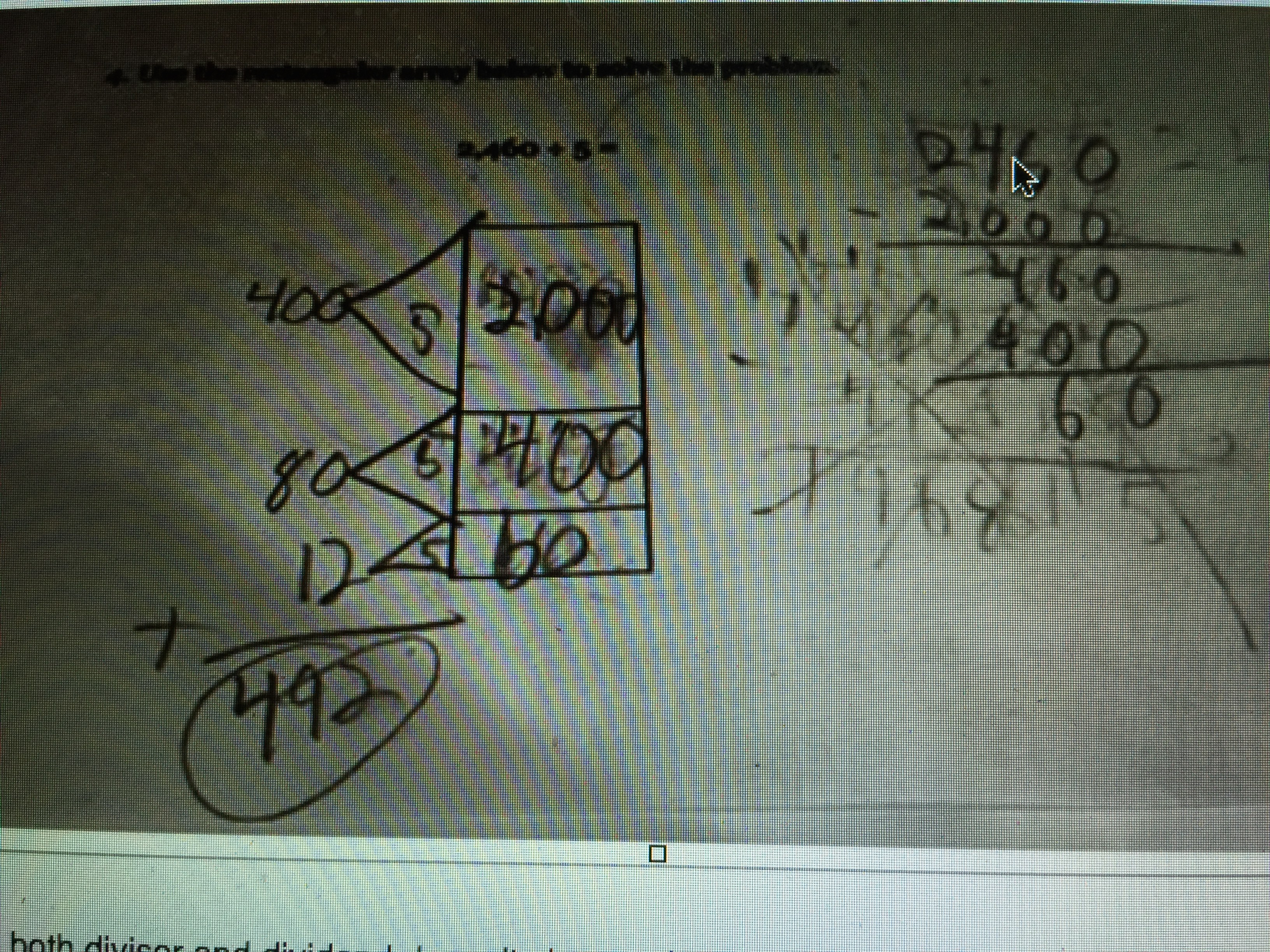
A recent Facebook post showed a way to divide that the individual said “made no sense” to her.  Others weighed in with similar comments, saying they learned division differently.  They didn’t say whether they could still divide.  The complaints were leveled at Common Core, which now is to blame for everything wrong in education the way Mr. Obama is to blame for everything wrong in America.  Teachers are now getting on the bandwagon, in some instances bragging how many children are opting out of the test.  Before I tackle that problem, let me address this division problem, for there are several ways to do it.  First, if one doubles 2460 to get 4920, and divides by 10 (doubling both divisor and dividend doesn’t change the answer), one gets 492.    IMG_1117

That is how I would do it in my head.

Here, one is breaking down 2460 into numbers easily divisible by 5; namely, 2000, 400, and 60, and adding them.  Same answer.  This would be my second choice.

What I asked was how many could divide 4 into 3586.  To me, if one cannot do that problem quickly, the way they learned division didn’t work for them, and the issue isn’t with Common Core but with how to divide.   I divide 4 into (3600-14), to get 900-3 1/2= 896 1/2

As for parents not being able to do their child’s homework, my father, a science teacher, wasn’t able to help me with my geometry homework, either. That’s not common core; it’s the fact that  over time we forget how to do things.  If one learned how to divide but no longer can do it, with brief practice, one could again do it well.  I re-learned calculus 32 years after I took it.  I wasn’t brilliant, but I had once learned the concept.  When I saw it again, and saw the instructions, my ability once again returned.

One good comment posted was “how do you divide by 7?”  I answered that in my response to the original post.  Suppose we want to divide 7 into 3817:  I break 3817 into 3500 +280 +37.  If I divide 7 into each of the three dividends, I get 500 +40 +5 remainder 2, or 545 2/7.

The issue with Common Core, just like No Child Left Behind, from the “Education President,” is that American children as a whole are not doing well in math and other subjects, lagging behind the rest of the world. The rise of charter schools, the decline of public schools, the lack of funding for the latter, while we are building prisons and cutting taxes for upper income earners and businesses are all contributing factors.  The public also demands accountability.  That is fine.  The response has been to create various forms of testing to prove competence.  After all, at some point in the educational process, somebody needs to be proven competent.  How one proves such without testing I do not know; proof of knowledge has traditionally required showing one’s ability to do something, and I call that a test.  The fact a student may be nice, easy to talk to, gets along with others, gives hugs, or helps out at home or in the community is fine, but I want more from my mechanic, doctor or pilot.  I like hearing a friendly voice at Dutch Brothers.  I also want them to make change properly and serve drinks with safe water and safe ingredients.  I want my automobile properly engineered so it doesn’t break down and the seat belts and air bags work.  I want the dam up river to be constructed so it doesn’t break, which it did a while back, and lack of attention to prior broken parts caused the one of the sluices to be left open, because the motor at the time couldn’t be trusted.

We often don’t see the results of competence first hand, so we tend to disparage tests; we do, however, see the results of lack of competence.

Arizona had the AIMS test, testing English, math, and science.  The problem with AIMS was that not surprisingly, many students failed it.  If they failed it too often, they didn’t graduate.  A child’s not graduating from high school upset parents and others, because for years, children had been passed on up the line to graduation, leaving high school with the inability to do math, speak well, know geography, history, including American history, and ability to write properly.  But they graduated.  Eighty per cent failed the local community college’s math placement test.  I tutored for years in an affluent high school where students in the 10th-12th grade worked on simple arithmetic problems at the third grade level, all along being allowed to listen to music.  When I objected, stating music was a distraction, the students said they needed music to perform.  I then asked why they were in the class in the first place, since their performance to date hadn’t been acceptable.  The school allowed music to be listened to; I thought that a bad idea.  I often wonder what these students are doing now.

AIMS became watered down, so that as long as a student had a decent GPA, they could graduate without it.  Finally, AIMS disappeared altogether.  In its place, we have new national standards.  I am not saying I agree with what is on the test, and I don’t agree teachers should teach to the test.  They shouldn’t have to. Too often, math tests are written by those who want to show how clever they are.  I think we might well do better with at least two tiers of math, one for those who are likely to go to less intensive (regarding math) fields, and the other for those who are going to college and need a certain degree of math to continue.  Germany tests its students earlier in their educational career; it is clear that some should not go to college but belong in other careers, important to society, a better fit for the student, but without the math that is needed for higher level education.  I might require basic statistics, so that students would understand something about sampling, margin of error, mean-median difference, how to make and read a graph, and how to count things that matter.

Like it or not, people need to learn how to add, subtract, multiply and divide.  They absolutely need to memorize the multiplication tables, and eventually multiplication will become automatic.  They need to be able to use calculators but also understand when a calculator’s answer makes no sense.  Students must show knowledge of math for a given grade before they are promoted, the proof being one with which any reasonable adult would agree.  Some high school diplomas will not contain the same words as those for students who took four years of high school math.  Parents need to fish or cut bait.  If we want children to be properly educated for the 21st century, then we need to prove it.  It is distressing to see and hear both parents and teachers alike complain about Common Core unless they are developing alternatives.  I’m open to suggestions; I’m not open to continuing to pass students along to the next level, delaying the day of reckoning.

That day has long come.

OOPS, OCCUPIED!

May 3, 2015

A week ago, driving out of the Cascades near Santiam Junction, I stopped at a Forest Service Trailhead to use a restroom. Because the door was ajar, I started to open it.

“HEY!!!!”  I heard.

Had I been a better person, I would have apologized.  I think I did mutter “Sorry.”  But I took the coward’s way out.  The car was still running, I got into it and sped out of the parking lot to US 20 and hightailed it back out of the mountains.  I didn’t want the user to see me.

My wife laughed.  “Why didn’t he lock the door?”  “Or,” she continued, “why didn’t he just say ‘Occupied!!’”   Good question.  He should have been more embarrassed than I.

****************************************************

I went out to the community college today, since it was my day to tutor.  It had been a good week with no further “HEY’S”. I  did a difficult but worthwhile exploratory hike in the Cascades, where I hadn’t been before but was going to lead a hike there in a month.

When I got to the college, the parking lot looked empty.  I had a sense something was wrong, and sure enough, the doors were locked.  I returned to the car, googled the college’s calendar, and found there was a conference that day, so no school.  I was annoyed.  This sort of stuff happened when I volunteered in Tucson schools, too.  They would have a holiday and nobody told me.  I showed up and wasted my time.  I didn’t get much of an apology, either. It was so bad, I had to check each Friday to see if there were any days the following week where I wouldn’t be needed.

Sometimes, “I’m sorry” isn’t enough. In 2003, I interviewed for a teaching position in quality improvement with the American College of Physician Executives.  After not hearing from them for a month, I sent an e-mail, a letter, and phoned them.  I received no reply.  That’s uncalled for.  Yes, people are busy, but this is a 30 second e-mail (“we will not be hiring you” takes about 24 seconds.  I timed it).  I left the organization, and as I expected, they would notice. Money counts.  I received a call to ask why I hadn’t renewed my membership.  I told them why.  Within a minute, the Executive Vice President was talking to me.  I didn’t mention the name of the man who should have notified me.  I didn’t want to cause trouble for him.  It was a classy move on my part. I got a call a day later from the individual at fault, who said, “I guess I should be sorry.”  YOU GUESS?  I wasn’t demanding a job; I only wanted to know what the results of the interview were (which I had long since guessed).  That is not an apology.  You don’t guess with apologies.  That makes the situation worse.  You make an apology CLEAR.

I’ve done a lot of wrong in my life, so I have gotten a lot better at apologies.  For those who haven’t apologized much, the first rule is do it with empathy.  Mean it.  You would be amazed at how much that helps.  That means you must convey a sense that you really are sorry, even if you aren’t. That is step one.  Guys, take note of this, when you deal with women.

Yes, step one.  For there are two more steps.  Good apologies must be done right.

Second, say what you believe the consequences of your action caused.  Yes.  I apologized to my wife for something once, and I apologized for the wrong thing.  Yeah, really. What I thought I had done badly was not the issue, it was something else.  Wow, that’s being clueless.  I plead guilty.  But at least by saying what I thought I did wrong, I discovered my real error.  That mattered.

The third and final step is to say what you will do in the future to ensure, as best as you can, that the mistake does not occur again.  My mother once refused a CT head scan, and we were told the scan was normal.  Yes.  Really.  Five months later, when we took her for a “repeat” scan, we learned that she had never had one.  My father and I went to the CEO of a hospital to ask how this could happen.  All we heard was how many printouts of data the CEO had to deal with daily.  Think we cared?

Witness a good apology:  A psychiatrist reamed me out over the phone about an opinion I had given about a patient he was seeing.  “You didn’t spend enough time with the patient.”  I was speechless, and in that time of “less”, he hung up.  That was skunk anger, which is not good coming from a psychiatrist.  Important rule in medicine: never believe what a patient tells you another doctor said.  Come to think of it, it’s a good rule in life, too.

Two days later, the psychiatrist called me, apologized for his behavior, which he said must have stunned me.  “I have since spoken to a several other people about you, and they told me what a good doctor you are.  I am sorry I treated you that way.  I hope you will forgive me.”

Forgive?  Hell, it made my day.

Here’s how apologies should not be done:  A man from Comcast was to look at the house when we wanted to install wi-fi.  He gave me a window of time when he would show up, and he didn’t come.  I had his number, calling it periodically for 3 hours, getting voice mail and no responses.  It wasted my whole afternoon.  About 4:30, I got a call with a cheery, “How are you doing?”  I think most of us might say that we weren’t doing particularly well at the moment, and I told him that.  “Oh, sorry about that.  We had a sudden meeting I couldn’t miss.”

I’ve been in management.  People have meetings.  Sometimes, they are “right now” meetings.   But when the guy who installs my phone can’t get a message, doesn’t call me until three hours later, it doesn’t give me confidence in the telephone service.  What should he have done?  “I’m really sorry, but I’m going to be at least three hours late.  I have an urgent meeting, I didn’t know about it, and I will work late if you will allow me to come over at 5 tonight.  I know it is important for you.  Again, I am sorry.”

That works.  Instead, the next day, when he finally arrived, he mentioned how overloaded he was, with work, but the fact he had driven back from Boulder to Eugene after the Oregon-Colorado football game.  Do you think I cared?  Most people aren’t interested in a service provider’s using their vacation as an excuse.  A lot of people don’t get to take vacations.

I’ll go back out to the school on Tuesday.  They forgot.  It’s an honest mistake.  They are entitled to that.  They will apologize.  If they don’t, I won’t call them out on it.

But I will be disappointed in them.