Archive for June, 2015

TO ERR IS HUMAN; TO LEARN FROM THEM ESSENTIAL

June 29, 2015

In the movie “It’s a Wonderful Life,” George Bailey saved pharmacist Gower from mixing poison into a prescription.  Gower’s son had recently died from influenza, and Gower was thinking of his son, not the prescription.  Here’s the root cause analysis.  Why was poison there?  Because it always had been.  Why had it always had been?  The movie doesn’t tell us.  Why didn’t Gower notice it was poison?  Because he was still grieving his son’s death.  Why was he working?  Because he had to.  He had no choice.  Why had he no choice?  Because you worked or starved back then.  Why?  Because we had no safety nets.  Why not?  Because it had always been that way. Why?  I don’t know.  End of analysis.

Did Gower want to err?  Of course not. But he almost did.  Poison has always been present in pharmacies.  It’s called the wrong drug, the wrong dosage, or an unexpected interaction. None of us is immune from making errors.  “Be more careful” isn’t the solution.  We need systems robust enough to make errors impossible, for people may be preoccupied, sleep-deprived, hurried, interrupted, multi-tasking, under pressure to produce may all combine to produce errors. None of us is immune.  “Be more careful” isn’t the solution.

Compare how improvement doesn’t and does occur, respectively.   I once got a letter from the quality committee castigating me, because a nurse asked me, a consultant, if she could have an order to get a blood gas analysis.  I gave the order, the blood gas was mildly abnormal, and I neither got a call nor followed up on the result, which was wrong.  I felt worthless, a bad doctor.  Good doctors are perfect, and I wasn’t perfect.  Nobody asked why these results didn’t go to the attending physician, or weren’t even called to me.  Indeed, the idea of quality in medicine was to assign responsibility and blame.  It was my job to follow up on this blood gas, and I failed.  Don’t do it again.  You are reported.  What did I do after that?  I never ordered another blood gas as a consultant again.  Was that optimal care? Nope.  But I wasn’t going to be nailed again for not doing what the attending should have.

Here’s an example of how root cause analysis helps.  The columns on the Lincoln Memorial were eroding from power washings, and this was becoming a concern.  Rather than just replacing the marble, very expensive, somebody actually talked to the people doing the work, an amazing idea, since while management traditionally makes decisions, the people on the ground really know what is happening.  Asking why learned of frequent power washings, which came from bird poop.  Why?  Birds came to eat insects.  Why?  Because insects were attracted by floodlights.  Solution?  Shine the lights, not for two hours after sunset, but only for 30 minutes, which didn’t attract insects.

Oregon is the only state where pharmacies are included in the confidential error reporting system.  I was disappointed to learn how few errors are reported here with a full “root cause” analysis. The first pharmaceutical report was in 2012, a few years after the program began.  Of 200 total reports, only 28 were last year among 721 pharmacies state-wide.  I’m a retired physician, I take medications, and I have considerable knowledge of medical errors, having been on both sides of the error divide.  I regret my errors, but what has additionally bothered me was that I could neither unburden myself of my guilt nor could I allow anybody to learn from them.  Silence does not improve systems; it allows the same error to recur.

Thinking on one hand I might have something to offer, despite my age, I contacted the Commission, whose staff were most kind to meet with me.  I wasn’t seeking employment, hoping only that my passion for improving medical quality and safety might allow me to contribute.  I am willing to help in any possible way at any interested pharmacy or health care facility in the state.  Reiterate. No charge, free.  Every person in my small family has suffered from medical errors.  This isn’t surprising.  Nor would I be surprised if every pharmacist who reads this knows that he or she has made errors or had close calls.  And didn’t report them. Shame, fear of reprisal, no time, no harm no foul. Which one?

I was wrong about numbers of reports.  I expected that was crucial.  It is not.  Pennsylvania has a quarter million reports annually, but “fall” without knowing why doesn’t help, not even if you knew the numbers state-wide.  How do I know?  I asked that question.  A few thoroughly investigated reports, learning why something happened until the question can no longer be answered is effective.  The Commission has people who can and want to help with this. I could, too. However, the culture of medicine and management must also change, away from punishment, excuses, fear, shame, ridicule, silence and hiding, to one of openness, learning, sharing information and power, the goal being to improve systems to cause less harm.  I am pleased that the Commission has done so much.  I am disappointed that 14 years after I proposed a similar program, how far we still have to go.

Were each pharmacy to perform one thorough analysis on a mistake every other year, this volume would have vast potential to improve systems that currently hurt patients and shame those who make errors.  The information could be shared state-wide.  Far from desiring to punish well-intentioned, hard-working people, I want them and others to learn from errors or near misses.  We make mistakes.  The days of hiding them must end.  Top management must vigorously support reporting by encouraging front line people to talk candidly to the Commission about what happened, with absolutely no fear of reprisal.  That’s a tall order.  I do not want to hear about percentages of successes, because counts of serious mistakes must be driven to zero.  In 2001, 99.999996% of all domestic flights were safe, and I doubt anybody believes that was a good percentage.  One mistake that is investigated is not going to cause long waits in Eugene, Portland or Bend.  Mistakes are made.  That is a fact.  We need to understand thoroughly why they occur and how to prevent them.  “Double check” and “education” don’t cut it.  We don’t tell people to put their foot on the brake when they back the car.  Cars are designed so that people can’t shift into reverse before their foot is on the brake.  Repeating “we believe in safety” does not establish validity.  “You mean you once didn’t?” I want to reply.

For reporting the error, George Bailey was initially slapped on his bad ear by pharmacist Gower, who later embraced George, when he realized the scope of his error.  It’s time to end both the slapping and the fear of it.

For reporting an error, George Bailey was initially slapped on his bad ear by pharmacist Gower, who later embraced George, when he discovered the error.  It’s time to end both the slapping and the fear of it.

INATTENTIONAL BLINDNESS

June 26, 2015

I was relaxed and would soon arrive at the meeting point for our weekly Wednesday hike up Spencer Butte in Eugene, 6 miles, 1000 feet vertical.  It’s a good weekly workout, and I like the other hikers.  I came to a 4-way stop, looked left then right, focusing on the car to my right.  I let him turn; he was there first, and he was to my right.  I started to go, but for some reason, looked left.

I had NOT seen the bicycle just to my left.  I hit the brakes and stopped immediately, quickly enough that I didn’t get a dirty look, but still shaken.  Where did SHE come from? It was possible when I looked the first time, the cyclist wasn’t visible, but I doubt it.  I think I looked for a car, not a bike, didn’t see a car, so I then looked right. There’s a term for that, and it’s called inattentional blindness*.  We see what we expect to see.  If you are watching a video of a basketball game, asked to count the number of times people in white shirts pass a basketball, you might not notice the person in a gorilla suit that comes out, thumps her chest, and walks away.  Half the people viewing the video didn’t. Yes, really:

We operate on faulty assumptions, too.  Last year, I was driving east, when a cyclist on a cross street to my left made a right turn, heading west.  I didn’t give it another thought.  Slowing to make a right hand turn in heavy traffic, I eased over, fortunately not quickly, as I suddenly had this “where the hell did he come from?” moment.  The cyclist had made a U-turn behind me and came up faster than I was driving.  I almost hit him, and it would have been my fault.  On the other hand, had the cyclist, who gave me a very dirty look, realized how I interpreted his move, he might not be so quick to do that again.  Or he might, since he wasn’t wearing a helmet, and that to me is a strong sign of ignorance.  Helmets save lives, and they are a “go to the mat” issue for me, one upon which I will not compromise.

I bring this up because of a TED video about Dr. Brian Goldman’s experience with medical errors.  His video is nearly five years old, a decade after I proposed a system for dealing with doctor imperfections and system design failures, wanting what Dr. Goldman wanted—ability of doctors to come clean.  I approached it from the standpoint of reporting anonymously, he from the standpoint of allowing doctors to stop hiding what shouldn’t be hidden and admit what is normal:  people aren’t perfect.  Both of us agree that better system design is the answer, so that when errors are made—for they will be—there are backups in place to make it impossible or at least highly unlikely that the errors will propagate or concatenate into worsening problems.  Dr. Goldman is a young man, compared to me, so he doesn’t know that three decades ago, I knew that sleep deprivation, hurry, and interruptions were rampant in medicine and were wrong.  I was told by my colleagues to put up:  good doctors didn’t make mistakes.

Yes they did, but back then I believed the contrapositive—if you made a mistake you weren’t a good doctor.  Being sued for missing an acoustic neuroma was the first step that ultimately would lead to my leaving medicine.

I’ve mostly gotten beyond the bitterness of the lawsuit, but my wife tells me I take insults personally too long.  She’s right.  I do, although the lawsuit was personal.  It took me years to realize my not being a successful consultant in medical statistics was not entirely my fault.  Or that my medical safety reporting system, introduced 14 years ago, had no chance of passing in the state in which I was living. Dr. Goldman is personable, has a radio show, and is a somebody.  I was an average doc who hadn’t the personality, the drive or ability to convince people something is a good idea. I swore I’d never deal with medical quality again.

Moving to Oregon changed that.  Or maybe I grew up a little.

Oregon has a patient safety commission here that deals with doing root cause analyses on voluntarily reported errors.  I did a little reading, emailed them with my experience, and was invited to talk to them up in Portland.  It helps, if one is a volunteer.  Yes, you may get what you pay for, but you may get wisdom for free.  Or not.  It was interesting to talk about things I haven’t talked about in a long time.  I’m a bit rusty about how medicine is practiced today.  In some ways, there has been great progress.  In the matter of errors and patient safety, I haven’t missed a lot in the past decade since I left.  The head of the commission and I were both a little discouraged.  I had expected more progress, frankly.

I doubt I will do much for them, because I can’t make doctors and nurses report errors and investigate them.  Everybody is busy.  Too busy.  Too busy doing things to get by, too busy to fix systems that rob their lives of time to do other things.  I could tell the woman was in a hurry, although she was polite.  I recognize all the signs.  I kept a cautious eye on the clock.  Time is important.  Most people are important.  I’m not.

Twenty years ago, I made a list of things to do “if there is only a little time left.”  That’s the bad cancer diagnosis list of things to do, like take my wife to Hawaii or England, as promised.  There are also things to do while I can still do them, like one more time in the Refuge.  That’s ANWR.  That’s the “you aren’t going to be healthy forever,” list.  There are also things to do because I like them.  That’s the, “you are alive, and you have an opportunity. Do them” list.

If my  latest ventures don’t work, well, I can keep providing answers on algebra.com.  Look me up, under “Boreal”.  I’ve taught English, reading, and math.   I know English well, I taught myself to read when I was 2.  Math is just natural.  And fun.

*For inattentional blindness, the observer must (1) fail to notice a visual object or event, (2) the object or event must be fully visible, (3) observers must be able to readily identify the object if they are consciously perceiving it, and (4) the event must be unexpected and the failure to see the object or event must be due to the engagement of attention on other aspects of the visual scene and not due to aspects the visual stimulus itself. Individuals who experience inattentional blindness are usually unaware of this effect, which can play a subsequent role in behavior.

JUST A NOBODY

June 18, 2015

JUST A NOBODY

A recent article in an environmental magazine discussed a trip by a small group to the Aichilik River in the Arctic National Wildlife Refuge (ANWR).  The group included the executive director of the organization, a multimedia artist, one looking to tie racial justice to environmental movements, a photographer, an author, and their guide.  These were important people, head of a national organization, published authors, international exhibitors, go getters.

And they didn’t belong in ANWR.

The first inkling was laughable.  The musician saw caribou and walked towards them holding out his hands in a gesture of peace.  This is Alaska, not a petting zoo.  It quickly became worse.  Shortly after they had set up camp on the Aichilik River, where I backpacked in 2009, a bear came downstream on the other side of the river, then crossed to their side.  The photographer and a club director then went towards the bear, soon retreating, running, hollering, and using their bear spray in such a way that it formed a mist.  The bear came close, later lay down and rolled before departing.   I quote:

“Fortunately—especially considering that …executive director….was part of the trip, dispatching a beautiful grizzly was not necessary.  The bear turned and fled as suddenly as it had approached…”

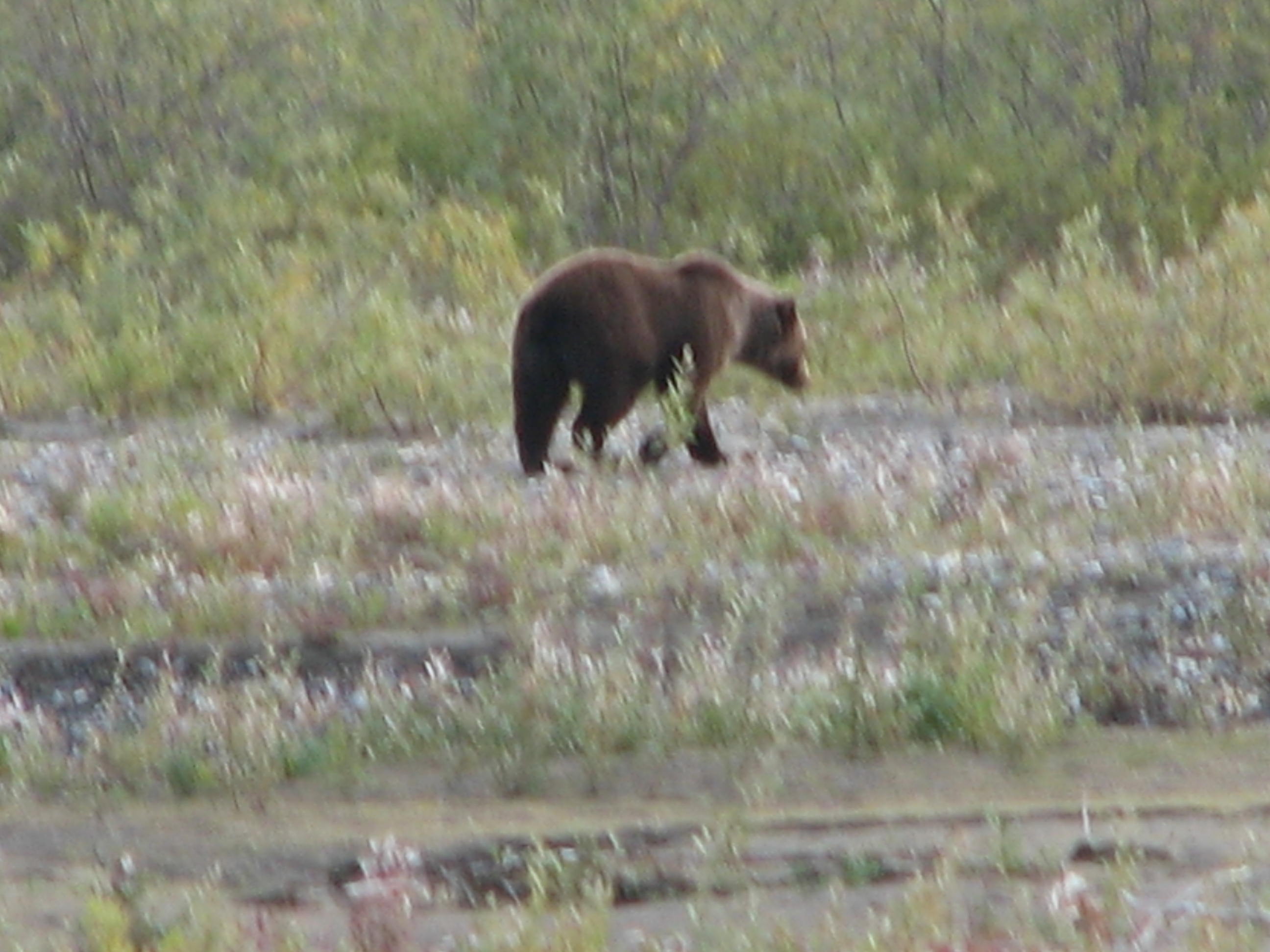
Sow with one cub crossing a side stream on the Noatak. River.

Cubs crossing a side stream on the Noatak River.

moving away

moving away

I was appalled.  “especially”?  “dispatching”?  The verb is “to kill.”  A bear that was minding his own business until two humans appear, a species he may never had encountered before (that happens in northern Alaska) scream, run, and spray something that he can smell but isn’t bothered by?  Twenty feet from camp?  Why weren’t you backing up quietly long before the bear came?  Why did you approach a bear?  Why would you run, potentially provoking a chase?  And why would you use bear spray nowhere near a bear?

More practically, why would you publish what you did? I would have been embarrassed as hell.

I’ve had a sow, two cubs, and a 2 year-old grizzly suddenly appear out of brush and walk through our camp.  We were obviously alert but hardly shouting, spraying everywhere, and causing a ruckus.  We stayed quiet and still.  I’m a nobody photographer, but I got nice pictures, and I certainly didn’t approach the bear.  Later, on the same trip, a bear came down the shore of a lake towards our camp.  When he got within 100 yards, the guide stood up, said, “Hey Yogi.  Out.”  The bear turned and ran off.  They run about a mile when this happens.

I’m a nobody.  I’m neither an executive director of a club, nor a famous musician, nor a famous author, nor an organizer.  I’m just a guy who has been in ANWR twice, knows the Aichilik basin, been in the Brooks Range four other times, and encountered 17 bears. Lot of people have done a lot more than I.  A lot. True, a couple were killed by a bear 10 years ago on the Hulahula River in the Refuge, the first fatal attack there.  They had done all the right things, but the vast majority, and I am not exaggerating when I say vast majority, of bear encounters end with the bear’s running away, no spray needed.

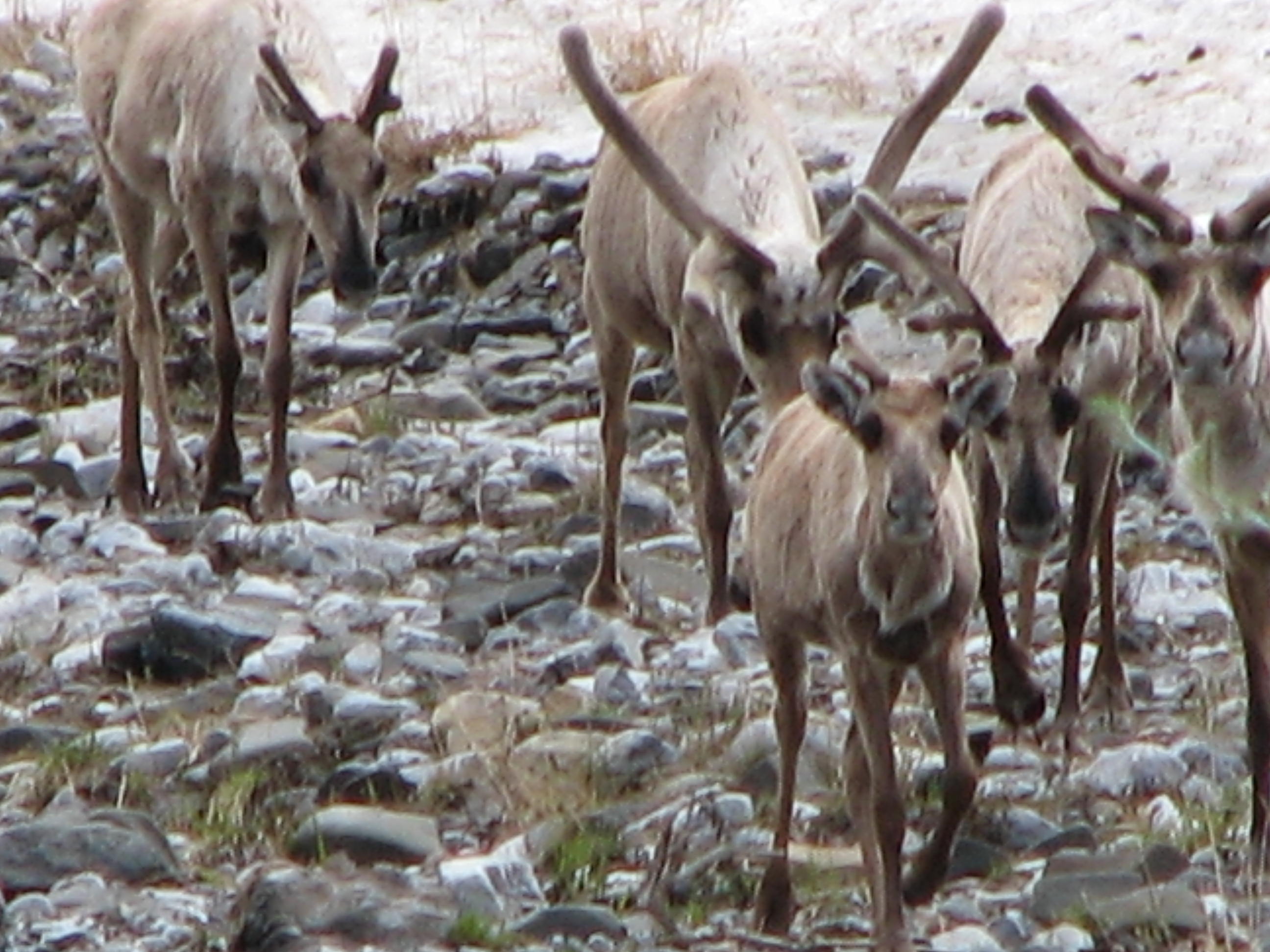
As for caribou, if one sits down on the ground and stays quiet, and they will walk close by.  The animals don’t see humans as a threat when humans are quiet and low.  Stand up with hands outstretched, and caribou quietly but determinedly move away.  I was new in Alaska once, and I tried to approach one.  It left.  I didn’t state my mistake until now, because as I said, I’m a nobody.  I expected better from world class important people, who write articles for environmental magazines which are well read by millions.  I expected them not to approach a bear for a “perfect picture,” certainly not to shoot bear spray into the air, which does no good at all, and absolutely not run, which will have the bear potentially chase.

Caribou with no telephoto.  I was sitting quietly on the ground.

Caribou with no telephoto. I was sitting quietly on the ground.  Upper Aichlik River, 2009.

Just curious.

Just curious.

The part about “dispatching,” or killing the bear, was most appalling.  Nowhere did the author discuss Alaskan hunting regulations, which require the head and hide of the bear be brought out, which is a huge deterrent to shooting bears.   Had this environmental leadership group been involved in killing a grizzly, I, a life member, would no longer be a member.  My wife, another life member, had a better thought for a letter to the editor:  “You were a disgrace to the organization and should quit.”

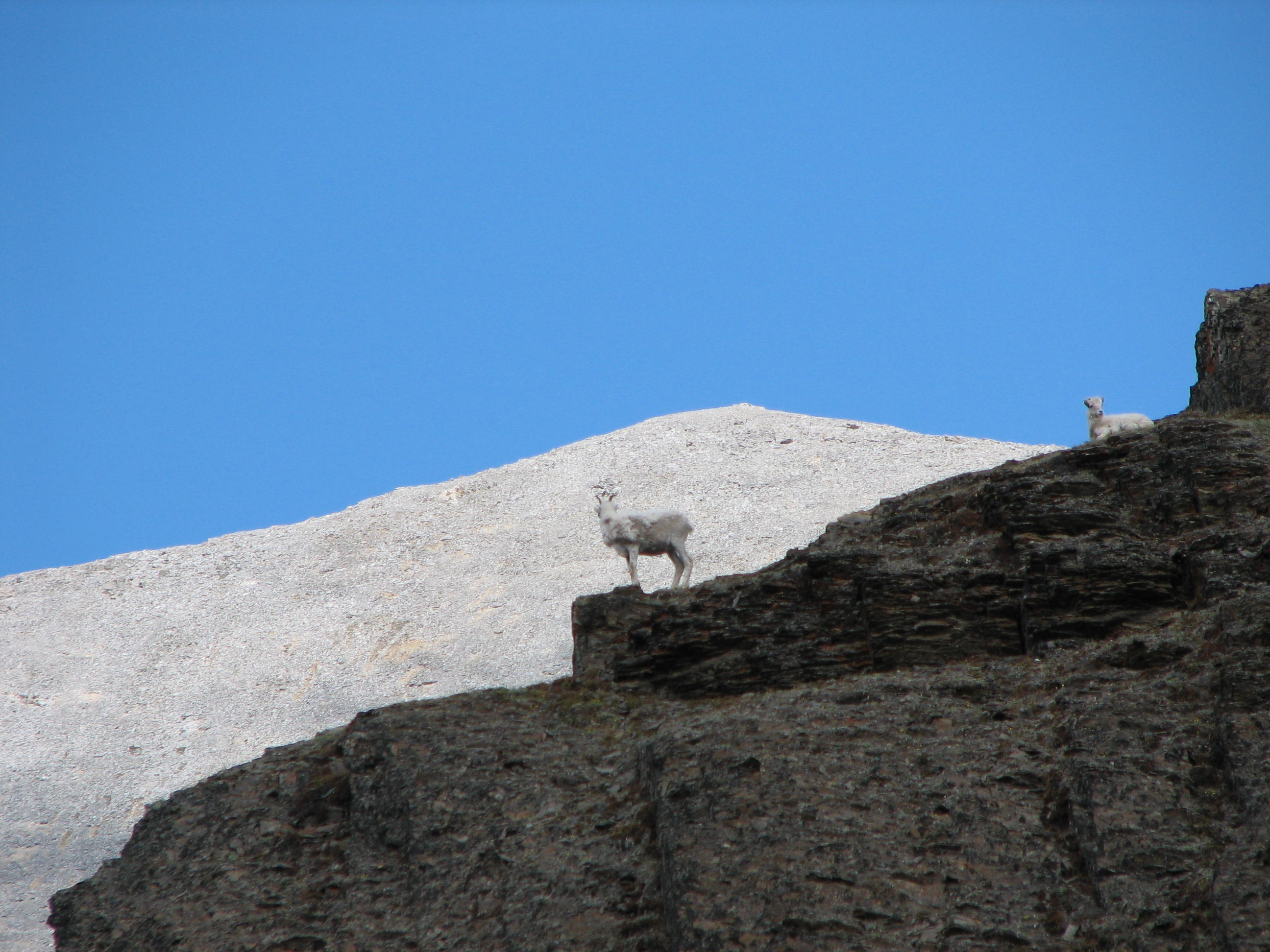
Fortunately, at least for the wildlife, it appeared that the group didn’t float the upper reaches of the Aichilik, which may well have been too low.  It was there where I saw Dall Sheep, 10 meters above me and used my camera to view them, not try to approach them “in peace.”

Dall Sheep, upper Aichilik River, 2009.

Dall Sheep, upper Aichilik River, 2009.

IMG_1279 IMG_1281

IMG_1286

I’ve had a wolverine on the Aichilik run right by my tent.

Wolverine, running away, lower Aichilik River, 2009.

Wolverine, running away, lower Aichilik River, 2009.

I’ve seen the Sun well above the horizon at 2 a.m., and I’ve walked the banks in a pouring rain.  In short, it is part of Alaska, and one accepts the land as “It’s Alaska,” not trying to mold the country into what suits you, but to deal with Alaska on its terms, what comes your way—hunger, thirst, bugs, no bugs, heat, cold, dry riverbeds, floods, wildlife, no wildlife.

I’ve seen solo hikers in Alaska.  This isn’t smart.  Some have had trouble—a sprained ankle is life threatening— and set off emergency locator beacons to get hauled out.  A German did that once up near Summit Lake, not because he was hurt, but he got into more difficulty than he realized.  ELBs are non-specific.  He needed a satellite phone. Frankly, that area is fairly easy hiking for Alaska.  Walking in the stream is fast, walking far from a stream avoids tussocks.  You learn that when you’ve been up there a while.  Alaska hiking is not Europe. He was flown out, no easy feat, costing American taxpayers $15,000.  Our wilderness is for real here.  I could hike the Aichilik alone if I wished.  But I would never do it.  There are far too many risks.

I’m an experienced Alaska hiker, which is to say I am several levels below guides.  I know enough to take weeks getting into shape before I go, have good gear, which isn’t new, but which I can trust, know my limits, and take only what I know I will need.  I’ve gone with one other, I’ve gone with six others.  I’ve hiked in every condition imaginable except freezing rain, and that was close.  I’ve seen wonderful sights up there, from Kotzebue to the Canadian border.  I trust the bush pilots and the guides.  I’m a nobody, a guy from the “lower” who loves the country, respects it and knows his limits.  I’ll never have my experiences published in an environmental journal, but do note the picture at the top of the page you are reading.

I took that in 2010, on the Noatak, from my tent.  She had two cubs, too.  I played by her rules, stayed silent, and she could have cared less about me.

Just like Alaska.

  I WASN’T THAT IMPORTANT, OR WAS I?

June 14, 2015

A few years back, we drove over to LA for the wedding of my youngest niece.  The other two had had their weddings on the East Coast, but we aren’t close to our families, and we didn’t go.  LA was a day’s drive away, and we thought we ought to make at least one of the weddings and see the family.  We both felt it was a duty, so we did it.  Family visits, of course, have a down side, but that’s families, and that’s duty.  You pick your friends, not your family.

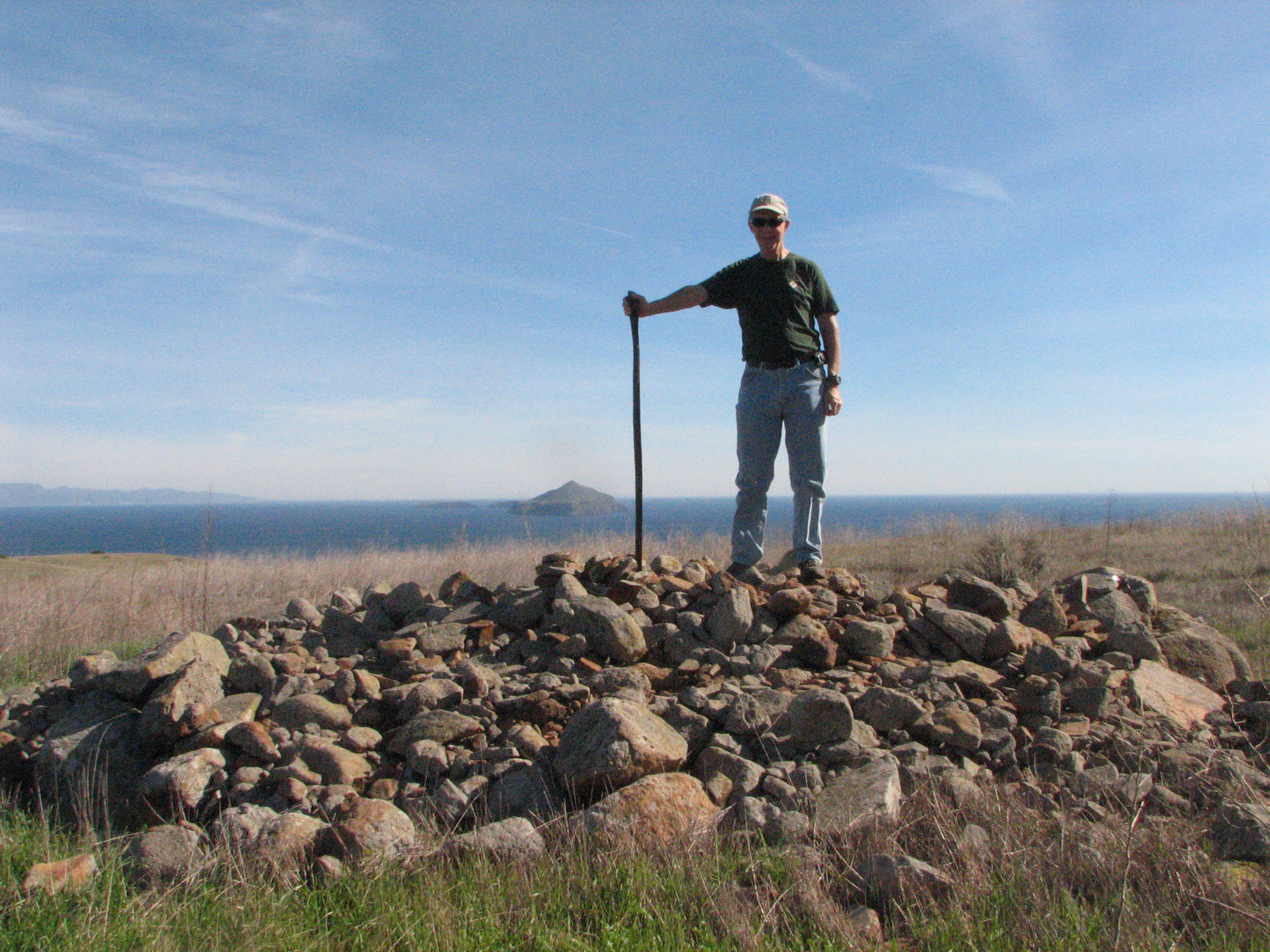
On the plus side, I could get to see Channel Islands National Park, which was on my “See all the National Parks” list.  We drove over on a Thursday, mistakenly believing that staying up in Ventura would make the travel easier.  It didn’t.  We entered freeways where speed went from 75 to zero in a half mile.

We had a great visit on Santa Cruz Island the next day.

On Santa Cruz Island. Hard to believe 10 million people are right across the water.

On Santa Cruz Island. Hard to believe 10 million people are right across the water.

IMG_3667

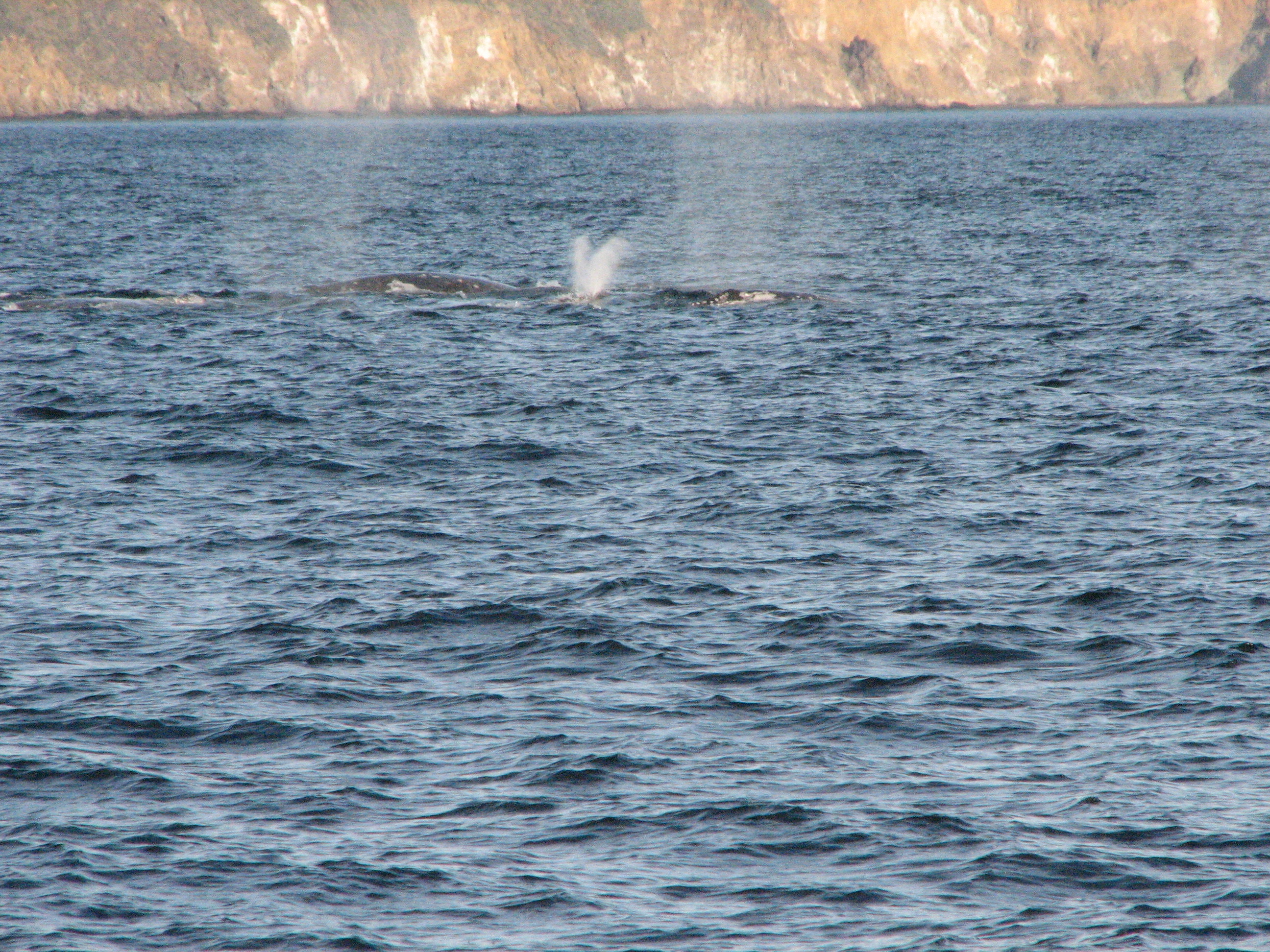
On a big plus side were some whales.

Anacapa Is. from Santa Cruz.

Anacapa Is. from Santa Cruz.

We thought we could easily make the rehearsal dinner that Friday night, but well, the boat bringing us back from Channel Islands was a little late, so we got to the hotel a little late, and check in was a disaster.  The first room had luggage present which wasn’t ours, and when we went back to the reception desk, a good walk in its own right, they looked at us with disbelief.  We did get a second room, except the room card didn’t work.  Back we went.  Bottom line was that we could get into the third room with about as many swipes of the card. We took it.  The hotel was deemed 10 stars; I wondered aloud whether “10” was binary notation.

Somewhere along the line, my observant wife noted both the clock and a Trader Joe’s next door, announcing to me that we weren’t going to the rehearsal dinner.  I had a brief moment of “we can’t do that,” followed by visions of driving in LA on a Friday night, which in my 45 years of driving in several countries, was in the top three for difficulty (Toronto and Cádiz, Spain are the other two). After the “we can’t do that,” came “wow, we could just relax and start the visit early tomorrow morning,” which is exactly what we did.

Saturday morning, we went to the bride’s house, offering our services for whatever she needed.  We weren’t part of the wedding party, but we had a car, which is a total necessity in LA.  My niece desperately needed a few things at a pharmacy and a store, and we got them with no problem.  She was grateful.  I thought that nice, given that what we got was easy to do.  For us, it was.  We then took my sister-in-law (SIL) out for coffee.  That got her out of the house, for which both she and my niece were appreciative, albeit for very different reasons.  We went to a coffee shop for about an hour and a half, and for the then 42 years I had known her, we had the best conversation I can ever remember.  I think the fact I was fairly relaxed, aside from being in LA, and my SIL really stressed had a lot to do with how well things went.

We went to the wedding early.  I hadn’t been looking forward to meeting my SIL’s estranged husband.  I didn’t like him on several levels, not the least was how he had treated her.  He had crossed Jerk Junction so many times that it no longer had a “Stop and Think” sign.  A short time after we arrived, a few older men showed up, and my wife and I went down to meet them.  Sometime after I shook hands with all, my wife commented, “That was xxxx, you know.”

I didn’t.  I don’t have prosopagnosia, or the inability to recognize faces, but I am not exactly good at placing faces on people, especially those whom I have not seen for 16 years.  I hadn’t a clue that I had just shaken hands with the estranged husband, which meant that I treated him like a stranger, which in many ways he was, politely, without giving away my dislike.  Wow, I couldn’t have scripted that better if I had tried.

The wedding went well, and at the dinner, I volunteered to sit between the parents of the bride, her near-ex’s voice booming out loud and clear, as he was the Master of Ceremonies.  It wasn’t a big deal, after all, sitting between the two of them.  I had to deal once with his trying to bring up Navy days, for we both served in very different ways, but I had no desire to talk either to him or about my time in the service 35 years earlier. I ignored him.  I made sure I turned towards my SIL, listening carefully to her and my wife, talking when I could, and somehow getting food into my mouth without looking at my plate, in order to avoid any further interaction with her then-husband.  When husband got up to make a toast, I shoveled food into my mouth.  The rest of the time, I kept the two of them away from each other, possibly avoiding a scene. When things were winding down, we left, got back to the hotel, and were on the road early the next morning, eastbound to the Colorado River and Arizona, LA in our rear view mirror.  Mac Davis in reverse, for those who go back to 1980 in their music.

We weren’t at all important in the wedding party.  Yet, I have fond memories of what I did that day.  We were the two most relaxed people present.  We had time to run errands, we had time to separate mother from niece, woman from husband, and we made good use of the time.  We did it quietly with no fanfare, no raising of voice, nothing at all.  We were there.

Maybe I was important.  For years, I gave my SIL and our nieces gifts during the holiday season.  The biggest gift I ever gave them, however, was that day in Los Angeles.  Maybe they remember it, maybe they don’t.   No matter.  I do.  Like most gifts, the giver gets a lot back in return.

My SIL still sends me e-mails.  I cringe when they come.  Family.

WHAT WAR? UPON WHOM?

June 11, 2015

A few years ago, many right-wing talk show hosts complained vehemently about a “War on Christmas.”  A few places, trying not to offend anybody, had required “Happy Holidays”.  Others tried to cater to Chanukah and Kwanzaa, as well as Christmas.  Back in the good ‘ole days, when we had Christmas, by golly, men worked, women stayed home, with 2.3 children, all the dirty dark secrets of everybody, including pedophile priests, remained hidden, and we had a Christian nation.  Back then, smoking and being drunk were cool, blacks were not called that, interracial marriage was a sin (but not interracial sex, as Strom Thurmond did), and gays were thought to be pedophiles.  The good old days weren’t so good.

If there is any war on Christmas, it is the daily financial report in December how sales, and by extension, our economy, are doing. I didn’t think Christmas was about shopping, but I’m not a Christian, so I may have missed something. Being brought up Unitarian, where in my world people were Catholic, Protestant, or Jewish, Christmas was an important holiday, even for kids, for while it meant presents, it also meant caring for those less well off and peace on Earth.  Unitarians believed we had a social duty to our fellow men during our only existence.

In June, I don’t want to write about a war on Christmas.  I am more concerned about those who say there is a war against Christianity, Christians are being persecuted, fascism is afoot, and this is the first step of Nazi-ism, which is a horribly inappropriate word to use.  I’ve seen Mauthausen, where people jumped—or were pushed (they had only those choices)— to their deaths (“Parachuters without parachutes”) with guards laughing. I’ve seen Stolperstein, the brass plaques on cobblestones, commemorating those who once lived at that place, deported and later murdered. Such comparisons by right-wing Christians are not only wrong, they demean those who died, including 1500 who deliberately chose death by crossing an electrified fence to escape rather than to remain imprisoned.

I’m not against Christianity, only against those who want to live in the 5th…or 19th century.  We are today a more diverse, overpopulated world, the last due in great part to religion’s requiring women to bear as many children as possible.

In addition to Christianity, we have Islam, Judaism, Hinduism, Buddhism, Wiccans, and the most hated group of all, the one group that won’t ever win the presidency in America:  atheists.  The world is not only more religiously diverse, there are those who have a variant of human sexuality, wanting same sex partners.  These people desire to marry, for without marriage, they have no civil rights should one of them become ill.  They do not sully marriage, but they have become hated by so-called Christians, who are supposed to be tolerant of others. It is so bad that some states are outlawing “conversion therapy.”

I have a deeply spiritual side that questions the reason for my existence, the nature of the universe, whether there is a Creator, and is intensely curious about the world.  I believe in the right of people to worship the way they choose, to marry whomever they choose, to live their life the way they choose, so long as it does not infringe upon my right to do the same.  I was against the Iraq war, which Christians started.  Many Americans placed yellow ribbons, with the shape of a cross, on their vehicles, making the war appear like a crusade, the word used by the prior president, later apologizing for a bad choice of words, but not for his bad choice of war.  Instead of “blessed are the peace-makers, for they will be called the Children of God” (Matthew 5:9), we had “shock and awe” (Rumsfeld; March:2003).

Too many of these so-called Christians hate blacks, vilify a half-black president, hate Mexicans and Central Americans who come here for a better life.  I don’t blame those who come here for a better life.  I sadly take the realistic approach that America can no longer save the world, either militarily or humanely.  There are things we can and should do, but policing the world and taking in every refugee is a non-starter.  How we go about changing that and remain true to our ideals is a difficult endeavor.  Banning birth control, which the religious right wants, calling women “a different cut of meat,” disallowing abortions when a raped woman becomes pregnant, which even Iran allows, saying a woman’s body can reject a rape-caused pregnancy, shows a profound war on women.  Want fewer refugees, fewer wars? Start with world-wide birth control, equal rights for women, and in two generations, we’d see a difference.

I reject that notion of a war on Christians.  I am against hate, anti-science hypocrites who use things science provides, megachurches, and Republican support, when it comes as a message of hate, intolerance of others, an armed society, make as much money as possible, destroy the environment, and not regulate anything.  They want their prayers in the public domain; politicians must be believers, preferably white, and non-believers are going to hell.  Regarding the latter, Christians, Muslims, and Mormons have all told me I was going to hell.  They all claim to be right, so either 5 billion people are wrong, or the few who think the way I do are right.  If I voluntarily help a students with math problems, teach adults and children how to read, teach English to people in 90 countries without pay, log on to an algebra site and help people with questions, organize and lead hikes, donate to humane societies, volunteer in several environmental organizations, is that not doing good?  One Muslim woman told me I was going to hell, even though she liked me.  She has since said I was the nicest person she has ever known, and her homeland is 99 per cent Muslim. What kind of disconnect is this?  If religion says that people who do good go to hell, then I want no part of it.

How can these Christians not believe in climate change, what we have done to the environment and to humanity?  Not one of the Presidential candidates on the other side admits that the climate has changed.  “God said, ‘Let the earth bring forth living creatures of every kind: cattle and creeping things and wild animals of the earth of every kind.’ ”  Where did it say, “thou shalt increase the extinction rate of species one thousand fold”?  Where did it say, “And thou shall rain fire and horror down upon a country that did not attack you, but whom you convinced your people it did”?  Where does it say, “Exponentiate” instead of “multiply,” and why has nobody to my knowledge other than me said, “Be fruitful, but you may multiply by one half or by one”?

War on Christianity?  No. But I am speaking out against those who profess to be Christians but whose behavior is completely counter to the teachings of Christ.  I’m not fighting Jimmy Carter.

I am, however, resisting those who say “God, Guns, and Guts made us great,” for they are cowards at heart, bully others with their weapons, and make a mockery of their God to whom they think they alone have a direct line of communication.

PUSH BUTTON EDUCATION

June 2, 2015

“You guys have all given me different answers, and I don’t know what to do.”

The math tutoring room at the local community college has two parts, one for advanced math—trigonometry, pre-cal, and calculus; the other is for basic math, from carrying and borrowing up to college algebra.  I work in the latter, but as somebody with a Master’s in statistics, I am often the “go to” person for statistics questions.  The fact I have seldom used statistics in the last decade has made me rusty, but the material comes back, so long as one learns it well the first time.

When the individual came to me stating the conflicting opinions she had received, I should have either turned her down or told her she was going to have to decide up front whom to believe.  If I were not that individual, she should leave, and not waste her time.  The issue itself was a 1-sample proportion test, one of the M &M problems, where a certain proportion of different colors are put into the bag, people count out the number of each type to see if the proportion corresponds with the claimed proportion, within a reasonable margin of error.

The student had used the instructions given to her what to input into the calculator and found a probability that made no sense to me.  I looked at the question and came up with the correct probability.  The example she copied looked at the probability’s being greater than a specific number; the problem she asked me looked at the probability’s being less than a specific number.  She didn’t understand that the example given to input and the problem were asking opposite things.

I tried every way I could think to explain the issue to her.  I have become more adept at calculators, finding them fast and helpful.  This woman, as are so many students today, was faster with the calculator than I.  Her problem, however, was something that it took me some time to figure out.  I had drawn a diagram of the probability curve, the Bell-shaped normal or Gaussian distribution, and she had looked confused.  That led me to finally ask a simple question:

“Have you ever computed these probabilities using a normal probability table?”

“No.”

I now understood her problem.  She was being asked to input data and push a lot of buttons.  Unfortunately, she had no idea what was being done to the data and why.  A lot of statistics is finding the difference between the sample and a postulated or known mean/average, then dividing by the standard error, a measure of variability.  The concept of variability is critical to understanding not only statistics, but everything statistics is used for, be it political campaigns or climate science.  Natural processes, like heart rate, body weight, stock market prices, or temperature, are not the same when measured over a period of time.  They fluctuate, and statistics helps us understand the fluctuation.

Dividing the mean by the standard error normalizes the data, allowing it to be compared to one standard, this instance to a table to find a probability.  By doing many problems where I had drawn a bell-shaped curve and looked at probabilities, I understood the concept well enough to teach it to undergraduates in Las Cruces for two years and in Tucson for another four.

This woman was from another generation of students, however, and in the decade where I have not been heavily involved with statistics, drawing a picture of how the data were distributed and having a sense of what the data were trying to say has atrophied, at least where I am tutoring.  The argument I was having with the student had a lot to do with the arguments I needed on the calculator;  she did not understand them, only that she was obtaining different answers.  Put simply, she did not have the background to be using a calculator.  I could say that about many students.  When I taught for a private for profit college, when a student saw a probability “6 E-4,” they wrote “6” as a probability, both impossible and showing no sense of what E-4 means, which is a power of 10 to a minus number:  6 E-4 =0.0006.  I don’t expect the average person to know that; I do expect somebody taking statistics and using a calculator to understand it.

That is only my opinion, from one who learned the material from first principles and is still slow to pick up a calculator, because I am often more comfortable performing my own calculations.  It remains to be seen whether we will continue to teach by calculator or teach by understanding the material, using the calculator as a tool to speed up the process.  I fear that in our rush to educate people, we are giving them instructions as to what buttons to push in a lot of subjects, without any idea of what is going on inside a calculator or more importantly, inside the system we are analyzing.

This is not idle philosophical musing.  When I taught, more than half the class did not understand what “the rate of increase in health care costs is declining” meant.  To them, the statement meant that the costs were decreasing, rather than the number was still increasing, but less rapidly than it was before.  This term is commonly used. The concept of statistical error to many people means that statistics is wrong, so it doesn’t matter.  Statistics is unable to tell us the exact results in a population, because from a poll, we do not know what the exact result is for the people in whom we are interested.  Where we differ from other fields is that we quantify the error in terms of confidence and probability, and we know the difference between the two terms.  We reject the concept that “anything can happen,” because we define a priori what “can happen” means.

We need to learn what calculators can do; equally importantly, what they cannot do.  Data that are not collected randomly have limitations what we can say about them.  Calculators do not have the ability to discern that. Calculators answer only what we ask them; they neither ask questions, nor do they tell us what we might want to know.

Calculators and computers are wonderful tools to get information that one needs, but education, critical thinking, and understanding remain timeless.