Archive for May, 2017

SOLITARY LATE SEASON SNOWSHOE, WILLAMETTE PASS

May 31, 2017

I had no idea what I was getting into when I drove out of Oakridge, Oregon, headed up to Willamette Pass.  I said I was going to snowshoe solo—the first week of May—and while I knew there was snow in the high country, I didn’t know how much or what condition it was in. There is deep wet snow, deep dry snow, and hard packed snow, each of which makes for a very different snowshoeing experience.  I hadn’t yet discovered the list of Oregon Sno-Tels, which are weather stations spread around the Cascades, so I didn’t know what the depths were at various elevations.

I hadn’t believed in winter in Oregon after my first one, when we were doing hikes in the Cascades in early February, and there was patchy snow only above 6000 feet.  That year it was 80 in the mountains in January, and through October Tucson had had as much precipitation as Eugene.  This winter, however, had been different, with a lot of snow even in Eugene, more in the mountains, and I had snowshoed a dozen times, once even in the Coast Range, where snow is not at all common.

I parked the car off on a side road, walked across Route 58, noting the heavy snow in the ski area and nobody there.  I didn’t see a soul.  Indeed, I could have snowshoed straight up the mountain had I wanted to; it was closed for the season.  Instead, I went into the woods to the Pacific Crest Trail to put on my snowshoes.

Once I was on snowshoes, the trail was fine.  Great, as a matter of fact, with hard packed snow in which I didn’t sink.  The woods were quiet, and it took me just over an hour and a quarter to travel 3 miles to Lower Rosary Lake, where I had been two months earlier.  It was still frozen and snow covered, except for a small area of open water at the outlet.  I went around the lake, crossed a divide into Middle Rosary Lake, went around it, looking up at Tait’s Loop and Pulpit Rock high above me.  I had planned this trip to go by all three Rosary Lakes, climb up to Tait’s Loop and loop back to the trail on which I had entered.  Nearly 10 miles, it was an ambitious endeavor, and I was alone, but alone I could dictate the pace.  About this point I told myself this had the chance to be a very special day.

IMG_6270.JPG

Outlet of Lower Rosary Lake, Pulpit Rock upper right (about 6400′)

I am not leading many hikes any more.  I’ve led more than one hundred; only four active club members have led more, and they’ve been around for decades.  I joined just three years ago. Leading hikes has become more work than I want to do.  I run risks soloing into the backcountry.  In addition to the usual injuries one can get, I can at any time have a bout of paroxysmal atrial fibrillation, which I tolerate reasonably well, even being able to climb while hiking. But I’d much rather not have it. I like the solitude, the ability to go or stop when I want, and go places where I wouldn’t dare lead a group.  I did a 23 mile hiking loop solo last fall through an old burn that had not grown back, and it was an ugly 7 hour chore on a hot day.  I won’t do that one again, but on the other hand, I now know what’s out there, which is why I hike and feel an urgency to see as much as I can, sometimes more than once.  What does that country really look like?

IMG_6274.JPG

Upper Rosary Lake

After Upper Rosary, I didn’t see any blue diamond metal markers that were on the trees I passed.  I looked around, wondering if I would have to turn around, but I kept going a little further and saw one.  Then I saw a several day old ski track coming from uphill.  This was well past the ski area and represented a cross-country skier’s track.  Had I been leading a group, I would have looked for an easier way.  I wasn’t, so I went straight up the track.  Wow.  It was a 30% grade for a few hundred yards, meaning I climbed 300 feet per 1000.  After I caught my breath, I pushed further to the top and then headed towards Pulpit Rock, a large landmark.  I knew the trail went west of the rock, and I was northeast of it, so I stayed at that elevation, figuring I would get back on the trail soon enough, and I did.

IMG_6275.jpg

View from Tait’s Loop: Middle and Lower Rosary Lakes (left); Pulpit Rock (right)

Once on the trail, I found a place where I could sit on a log, eat lunch, and look out at Odell Butte, Maiden Peak, Odell and Crescent Lakes, and the frozen Rosary Lakes.  The place was completely quiet, not sunny with a few breaks in the thick stratus.  I finished lunch, enjoyed my views a little longer, then started snowshoeing again on a trail I had done earlier this year.  That way also led back to the ski area and I could return that way if I got into trouble with my navigation.

I didn’t and found a familiar sign showing me where I needed to go.  Unlike the prior time I had been here, this direction seemed right, and at last I was no longer climbing, my 1300’ vertical effort finished.  The loop then split where I had a choice to go to the ski area or back downhill to where I had come in.  The GPS was tracking fine, I could see how far it was until I rejoined the entry trail, and I checked everything with my map, too.  If in unfamiliar territory, I carry a paper map.  GPS batteries can die, and while I consider myself to have good trail memory, I have easily gotten off trail on a number of occasions.  I was doing well on time,  headed downhill, snow soft but not too much so, and the woods continuing to be absolutely quiet, except for my movement.

Within a half hour, I rejoined the trail where I had come in and then realized that something wasn’t quite right, so I turned around and just saw my faint tracks behind me, heading to my right in the hard packed snow.  From here, it was an easy snowshoe slightly downhill, avoiding dangerous tree wells, where one can fall in and get stuck, and continued back to the trailhead.
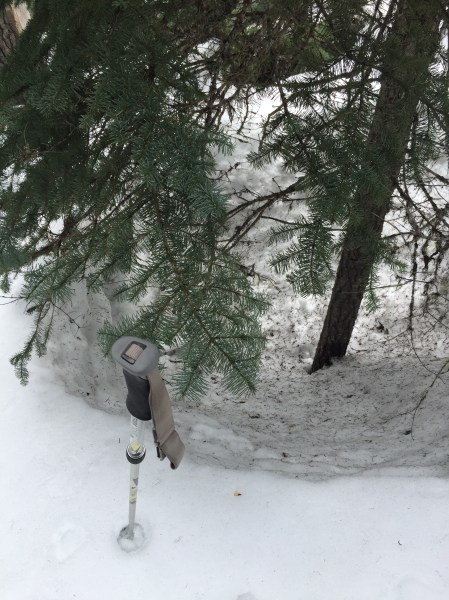
IMG_6284.jpg

Tree Well. These can be very dangerous should one fall in head first.
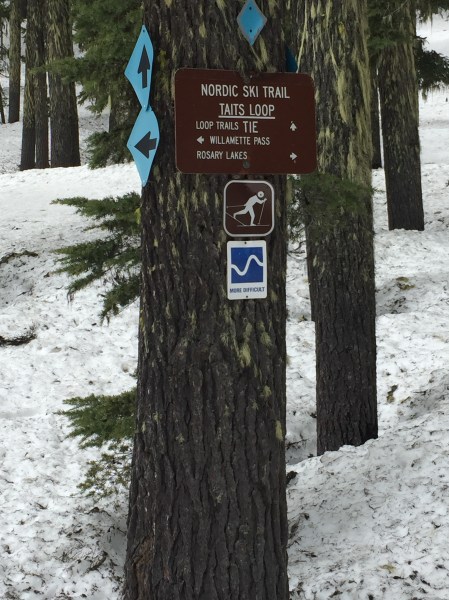
IMG_6285.jpg

Signed Trail: I went out to the right and returned on the left.

This day was as special as I thought it would be; indeed, it was the best snowshoe I have ever done.  I had studied the loop several times, thought I could do, wanted to do it, put the pack on my back and did it: 9.5 miles, about 2 or 3 more than I ever had before, 1300′ of climbing, and explored a loop that not many do on snowshoe.  Nobody else was out there.  I covered distance, elevation, had great views, good snow, and quiet.  I went out that day thinking I might not even be snowshoeing and would drive right back home.  Instead, it was one of the best winter days I’ve had in the woods.

To qualify as a best day in the woods means I had a dream about doing something, did my planning, and made the dream come true.  To do such in my own way I find extremely rewarding.  I will lead a few more hikes this year, but this hike reminded me why I hike solo: the freedom and the quiet appeal to me.

IMG_6286.JPG

Woods at a lower elevation

IMG_6277.JPG

Middle Rosary Lake with Odell Butte in background.

IMG_6279.jpg

It’s a long climb up from the Rosary Lake below, and that is several hundred feet above where I started by Willamette Pass.

UNDERSTANDING THE UNTIED STATES

May 27, 2017

Now, I am beginning to understand, thanks to budget director Mick Mulvaney.  When asked by Sen. Debbie Stabenow of Michigan why money for water protection in the Great Lakes was zeroed out in the budget, he said we had to look at this through the eyes of a taxpayer in Arkansas: “Should I really take some of his tax dollars to do something in Michigan?”

Stabenow commented, “that’s called having a country, with all due respect.”  She went on to say that 20% of the world’s fresh water bordered 8 states. I wonder how many Americans can name all the Great Lakes.  I wonder if Mulvaney could even name the states; he’s from the South.

I would have gone right back at Mulvaney asking why I, here in Oregon, should give a damn about a trailer park in Arkansas that gets leveled by a tornado, something that happens virtually every year.  Or some chicken farmer, when I’m vegetarian.  Why should I care if some cattle rancher’s herd dies in a winter blizzard?  That doesn’t affect me.  Why should I pay to truck sand into some North Carolina beach, so it will get eroded away the next storm?  Or to fight grass fires in Texas, build levees in Louisiana, where the ground is sinking and the Atchafalaya River needs to flow naturally again, which means taking over from the Mississippi.  Why should I care about floods in South Carolina?  That’s Mulvaney’s home.  Let him pay for it.  I’m not going there again.  If there is an EF-5 in Oklahoma, why should I care?  It’s a red state, most of the people there wish somebody like me would drop dead, and they certainly wouldn’t want my money.  Why then?

Because we are the UNITED States, not the UNTIED States.  We fix things in the country that matter.  We help people who need help.  We protect the environment for the next generation, and if I, a guy who neither desired nor wanted nor had children, thinks that helping those who lives have yet to begin is important, why can’t the president’s budget address this fact?

How local to we go, Mr. Mulvaney?  Do we go so local that we only pay for medical bills that affect us?  That our taxes shouldn’t go to medical research because I may see no benefit, to building trauma centers I may never use, to research that tries to cure other childhood cancers, like we cured acute lymphoblastic leukemia (it wasn’t prayer that did that, you know) even though I will never in my life have a child who could have it?  Mr. Mulvaney, it should be noted, failed to pay payroll taxes incurred by a nanny for his triplets from 2000-2004, arguing she was a babysitter.

Why should I pay for somebody who has head trauma and wasn’t wearing a helmet?  Or somebody with a gunshot wound when I think the NRA ought to pay for it? They use firearms, I don’t.

Are we becoming a nation of crowd source funders, passing the digital hat, without a clue what a country is about?  Is this the rugged individualism approach that sounds good when you hear Sheriff Richard Mack, of the Constitutional Sheriffs and Peace Officers Association, the same Mr. Mack who hated Mr. Obama and his ACA?  Sheriff Mack, to remind some and to educate others, had a heart attack and his wife became ill as well.  They went to GoFundMe to try to get their medical bills paid for, since they didn’t have insurance. Crowd sourcing isn’t the answer, because medical bills are far more than most realize, and Sheriff Mack, your bill and many others with similar conditions can’t be anticipated, so that’s why we have a thing called insurance.  Now insurance isn’t all that great when it restricts what you can use it for, so it was changed.  Personally, I would have the government cover all medical care to a certain extent, but I am open to honest, fair debate as to what that extent should be.

For example, I think medical care for heart conditions, cancer, aneurysms, blown out knees, fractured clavicles, broken necks, concussions, childbirth, strep throats, ought to be available so that people—even right wing, red state folks who hate me and everything I stand for—get it when they fall ill, rather than dying and as Charles Dickens would have said, “decreased the surplus population.”  I think a 30 year-old, uninsured, in a coma, should be given medical treatment to try to save his life, not “let him die,” which is what the audience yelled at a Ron Paul rally in 2011. Paul himself said, “let people assume responsibility for themselves.”  Really?  People in a coma can assume responsibility?  Old people can shop for the best value medical care?  Should those who were too stupid not to wear a helmet be left at the side of the road to die?  Granted, I didn’t like coming in at 2 a.m. to care for them, but these people needed medical care, unless or until there was a time when in the my judgment where care would no longer help. I wasn’t, of course, trained as an OBG like Paul, just a neurologist, and I was a few years behind him in medical school, so I didn’t hear the part about having the churches take care of these people.  That’s been tried in this country, and it doesn’t work, although if some of the megachurches put their dollars towards actual hands on care, we could probably make a moderate dent in the scope of the problem.

By the way, Paul’s 2008 campaign manager died at 49 from pneumonia, leaving behind a $400,000 medical bill, because while he could raise money for Paul, he couldn’t afford a few hundred a month for COBRA coverage.  Paul managed to extol the man’s skills and tried to raise money for his medical bills.  Is this the America he envisioned?

Are we united or untied?  Will my America be money for defense, tax cuts for the rich, where the money will not trickle down, but we will continue to hear that it is true? Will my America be where the president’s family uses the office to generate money and virtually nobody will try to stop it?  Where Mr. Putin’s approaches to journalism and money are copied here?  Is it here where we make a budget based on unrealistic growth expectations?  What happens when a Cat 5 hurricane levels Miami, storm surge again wipes out New Orleans, or a cluster of EF-4 tornadoes takes out Birmingham?  Are those people expected to take care of themselves?  What happens if the San Andreas or Cascadia Fault slips, and Los Angeles, San Francisco, Eugene, Salem, Portland or Seattle is leveled?  Or we have an oil spill from a pipeline that a lot of us didn’t want, and the Ogallala Aquifer or Lake Superior are polluted beyond repair?  You’ve heard, I assume, Mr. Mulvaney, of the Enbridge 5 pipeline under the Straits of Mackinac.  What happens if this 65 year-old pipeline, whose supports have failed, leaks? Who fixes Lake Superior?

This is what I finally understand.  I know now where we are going: we are to become a nation of take care of yourself, because nobody else will.  That’s the case in many places in the world today.  I’ve seen those places and those people, in Manila, La Paz, Caracas, Lima, Djakarta, New Delhi, Johannesburg, Cape Town, Lusaka, Nairobi, Cairo, and Tripoli.  Of course, we have them here, too. And we will have a lot more.  You see, the AHCA will remove insurance from 64,000 in Oregon Congressman Greg Walden’s district, and he helped craft the bill.

You know what?  He will be re-elected in 2018.

PREMATURE CHICKEN COUNTING

May 24, 2017

Social and other media have been abuzz the past few weeks about impeachment of the president, a display of both magical thinking and forgetfulness of with whom we are dealing.  In the same vein, the “resistance” is taking credit for things that perhaps are not worth crediting.  In short, while I support all steps that fight the current administration and run down the clock, I want to inject a harsh dose of reality into our lives, too.

I wouldn’t bet against the current president.  He survived insulting of McCain, the Pope and Ted Cruz’s wife, dissing a Gold Star family, giving away Graham’s phone number, and took apart not only the entire Republican field, but the Democrats as well.  He was shrewd enough to bring several of his rivals into his cabinet. He has gotten away with all of it, and other than a few brave judges slowing down some executive orders, is quietly moving to dismantle health care, give a big tax break to the wealthy, remove food stamps, Medicaid, Social Security, and Medicare, and all environmental restrictions.  Maybe this can be stopped, but I am not betting on it right now.

The rules have changed.  While the media is finally stepping forward with investigations into his ties and his campaign’s ties to Russia, already there are those who may find a way to weaken the investigation.  I’ve heard countless times of the dysfunction in the White House and how this can’t continue.  And yet it continues.  He can fire the current special counsel should he choose, like Nixon, more than 40 years ago, and there would be a huge outcry…but nothing to show for it, were I betting.

Despite all the transgressions the current president has made, his approval rating stubbornly remains in the mid to high 30s, back to 40% when we had our $90 million raid on Syria.  Oh, I read that the firing of Comey had a 29% approval rating, but the disapproval rating is today barely over 50%.  The president would get at least 40% of the vote were the election held today, and until or unless I see polling numbers in the 20s, I will not be impressed much has significantly changed.  It doesn’t matter that Mr. Obama ran a scandal-free administration, stymied every step of the way, had unproven conspiracy theories abound, and would have been impeached in a New York minute had he secret conversations with the Russians.  This president has the backing of the Republican Party, who sees more what they can get from him than what is right or wrong in the country. I heard before the election all the Republicans who weren’t going to vote for him. And they all did anyway.  I’m not sure what—if anything—will take this man down.  I suspect if something does, it may be a minor sleeper that takes everybody by surprise.

Currently, I am trying to unsubscribe from the voluminous number of emails I get from so many different groups.  Today was the Democratic Governor’s Association.  I fought the battle 10 years ago, back when Napolitano and Sebelius were still red state governors, until Mr. Obama’s ill-timed use of them in his cabinet.   If the Democrats were too stupid to realize what they needed to do, it isn’t up to me to be their money tree.  I’m retired.  It’s time for somebody else to step forward. I’m tired of losing, of candidates not wanting the national organization to come to their district, because national is out of touch, running candidates with high disapproval ratings who worry more about raising money than going to the heartland in all 50 states and just discussing matters like health care, defense, taxes, and trade.  I’ve had it with voters who demand perfection in race, gender, sexual orientation, medical plans, fighting terrorism, or they will stay home.  These same voters are getting creamed by this administration, and frankly a tax cut would be economically beneficial to me.  If they are too stupid to realize that only the Democrat can beat the president, not a Libertarian or a Green, and that down ballot measures like Congress and School Boards matter, then they deserve what they get.

Resist, yes.  But don’t think for a moment that the resistance killed the AHCA.  It didn’t kill it the first time, the Freedom Caucus did.  And whether the town halls will make a difference at the voting booth, I’m not optimistic right now.  People have short memories.  People are stupid, when they think “Obamacare” was different from the ACA.  I’d predict that if the AHCA became law today, the House wouldn’t change much in 2018. Nobody is protesting the lack of enforcement of the ACA, which is causing more insurers to pull out, the Blues now from the KC area.  Enforcement of the law is a presidential duty.  At least it was for a Democratic president.

Worse, it may be too late.  An estimated 300,000 in Wisconsin alone were disenfranchised because of harsh rules to vote.  It is more difficult to vote now, the districts were gerrymandered, the voting rights act was gutted, and now we are going to have a commission to look into voter fraud, most of the single digit cases of fraud being by Republicans.  In 2020, the census will be politicized, and minorities will be undercounted, underrepresented, and districts drawn by Republicans, because most of the states are run by Republicans now.  The Democrats in power were too busy doing—well, I don’t know what—while the Republicans took 1000 offices nationwide.

It’s not up to me.  If it were, I’d have mandatory national service, military out of South Asia, single payer health care, and a tax plan I’ve discussed here many times.

People would do well to cool it a little bit.  Nobody is going to impeach the president in a Republican run Congress.  Even if that happened, conviction would require two-thirds of the Senate, and other than an occasional feel good bill, there aren’t two thirds the votes for even free enemas in this country.  Maybe the guy will resign.  Or just quit.  Or die or get Alzheimer’s, assuming he doesn’t have that right now.  Then we get Pence, whom I would bet money that very few people in this country realized what those implications might be, because the media was so focused back then on the presidency.  Pence may be investigated too, but to count on that is counting a second generation chicken.

The media is helping uncover a lot of bad stuff now, true.  I’m glad that they are doing their job.  I can be forgiven for not being a fan of theirs when they gave untold amounts of free advertising to this president, who is a candidate still, with packed rallies and a lot of strong support, people who will vote.

I am remaining hopeful that something will end the darkness that has ensnared this country, but I do not underestimate the resiliency of this president, the desire of his party to keep him in office, and the damage he can do.  If one wants to have a feel good moment, that’s fine.  From time to time, we need one.  But it is important to be realistic, look at appropriate sources of news, fact check information, and stay realistic, focused on results, and keep reminding people why elections matter.

THE NINTH LIFE

May 11, 2017

It was ironic that Suzy of all people, the ditz, brought Gryffindor and his two brothers into our lives. It was the one decent thing she did for us.  Out in Benson, where my wife and her horse trainer/best friend once kept their horses, Suzy showed up one day, 14 years ago, with three kittens that she brought from the feed store, thinking they would be a nice addition to the barn, but doing little to care for them.  The kittens, two orange and one black, had their litter, food and water in the same place with a netting to keep them in. My wife was upset at their care.

The morning one of the orange ones got stuck in the netting was the final straw.  “I’m taking those kittens,” she said, taking them first to the vet to be checked and then to our house.  Suzy never noticed. I was out of town at the time and thought we would adopt out the kittens.

I was naive.

When I came home, the kittens were in the back room, playing with each other, and Gryffindor, the first one named, because of Harry Potter’s popularity and the fact that he looked like a little lion, was top guy.  When we served kitten milk, a nice concoction, Gryf would push the black one away, or just put his paw on the black one’s head.  Gryf was a beautiful dark orange with a uniform striped tail and a solid frame.  Needless to say, we kept all three.

Over the years, Gryf didn’t become the top cat but bonded with one of the adults and enjoyed his days in the sun on a bed or on the carpet, catching the last rays of the daylight.  When HC arrived, a silver gray stray tabby, Gryf attacked him from the first moment, and HC ended up with three rooms he could live in, darting from one to the other.  We asked Gryf not to do it, but we got used to the loud spit, a crash, “Gryf get out of there,” stomping our feet, and watching Gryf, tail huge, trot proudly out of the room.

Gryf loved being rubbed on the dining room table, and combing was a treat, although we overdid it one year, leaving him almost bare on his back. The woman who cleaned our house, took care of our cats when we were gone, and was a great friend besides had a special bond with him.  Whenever she got ready to leave, Gryf would jump on the dining room table, meow at her, demanding to be rubbed.

Gryf tolerated the move to Oregon poorly, traveling in a horse trailer with seven other cats and becoming dehydrated on the 60 hour trip.  He arrived at the house with a loud screech that could be heard throughout the neighborhood, and a few days later the smell of acetone on his breath told me we had a problem.  He was in Class 4 renal failure and we had a few minutes to decide whether we should euthanize him.  I looked at the lion face and said that he looked better than his lab numbers and we would try to cure him.  Incredibly, Gryf normalized his kidney function, although he needed chronic potassium supplementation, which he hated, and eventually hypertension treatment.  Taking him to the vet was done with a lot of screeching, and we both hated the trip, but he needed the care.  He got through dental visits and did well for three years. I think Gryf might have treated me differently after this, but of course he was a cat, so I had no idea.

In the spring of his fifteenth year, he decided it was safe, if I were in bed, to come, announcing his presence by a loud meow, demanding to be petted and to lie by me, purring.  The middle of the night visits were a bit hard on my rest, but I rationalized it as his thanking me for what I did three years earlier.

I should have thought maybe he was telling me he was leaving soon.

Gryf weighed 13-14 pounds, slightly more than normal, but far less than the other ones, for whom meal time was most of the time.  He held his weight, and because we were concerned a little about his eating, we stopped his blood pressure medicine and potassium.  He remained stable and ate with gusto, although still a little finicky.

One Friday, a day before my wife flew to Arizona, Gryf was fussy.  I didn’t think much about it, but Saturday, he was definitely off.  He didn’t look comfortable, and when he didn’t have much dinner, I weighed him at 12.8 pounds.  I called my wife, and we thought it was dehydration, so I gave him subcutaneous fluids.  I thought that he would be better Sunday morning, but there was no change.  I decided then to take him to the 24 hour emergency vet service.  Gryf screeched as usual on the drive over.  He was checked in, and I had a list of concerns—dental issue, renal failure, hairball, and at the bottom, “Cancer ???”

The vet came back with the lab, showing his renal function was fine, but his liver tests were elevated.  They wanted to keep him to do an abdominal ultrasound.  I hated to leave Gryf, because he literally quivered with fear when he was at the vet.  But he needed a diagnosis.  Unfortunately, my wife was in Arizona and I was leaving Monday for a two day trip 300 miles away.  The ultrasound was called to us that night as showing a mass in the liver, and he needed a biopsy, which could be done nearby, but we needed an appointment and had to take him ourselves.  I thought I could return by early afternoon Tuesday to take him.  We were hoping for an abscess or easily treatable tumor.

Monday I left, Gryf still at the vet, still scared.  The appointment was scheduled for Tuesday morning; my wife would fly home Monday.  I felt that I had abandoned him.

My wife arrived late Monday, and Tuesday morning I left Baker City for Eugene, 320 miles. When I reached John Day, she had got Gryf, who at last was smelling a familiar scent after 46 hours.  He was taken to the other facility for the biopsy.  Just before I crossed the Cascades, my wife texted that Gryf was about to have the biopsy.

Gryf tolerated the biopsy poorly and was in bad shape.  I made the drive to Springfield in just under 6 hours, arrived at the clinic, went back to a room with my wife and waited.  The biopsy showed a solid mass, not the hoped for abscess.

Gryf had been prodded, shaved, handled by strangers, abandoned, and was scared.   He was taken into a room where he finally smelled something—someone—familiar.  He was placed in his favorite bed and felt a pair of hands, hands that had rubbed him, combed him, fed him, and yes, even put the hated potassium pills down his throat.  What lovely hands. He started to purr.

He didn’t understand the words “5 cm mass in his liver,” “lymphosarcoma,” “everywhere,” “8 weeks at best,” “horrible disease.”  He didn’t understand my words that I wanted him at home one more time, but that would be treating me and not him.  All he knew was those hands were picking him up and placing him on a shirt and lap that smelled oh so familiar and nice.  He heard two people—his people—crying. He felt the stroking on his back he loved so much.

He purred and purred, sticking his head into my armpit where he could hide and I couldn’t see his face.  It was enough that he felt the hands he loved so much, the love from the crying person he loved so much.  He purred, now feeling a finger on his throat.  The person would care for him, love him, take him away from this lonely, painful place.

He felt the strange woman move his leg, but his person hadn’t moved, still stroking him, saying his name, finger on his trachea feeling the vibration.  He heard the crying, but he didn’t understand “propofol”.  It didn’t matter.  The hands kept stroking him.  He was with his person at last.  The person would care for him….

It was important to the person that the last sensation he felt from Gryf was a purr.

ANOTHER LOSS

May 5, 2017

The following three commentators won today:  “I want my money going to fight North Korea, not to pay for somebody else’s knee.”

Joe Walsh’s tweet: “Sorry Jimmy Kimmel: your sad story doesn’t obligate me or anybody else to pay for somebody else’s health care.” Well, Mr. Walsh, I don’t want to pay for yours, either, but I recognize that any of us can be that somebody else, and a malignant cell, blood clot, virus, drunk driver, nut with a gun, bad choice in deciding to fix a roof, can make any of us easily a million dollar consumer of health care.

A hiking friend of mine won, the guy who couldn’t see why his taxes should go to pay for somebody else’s health care.  I liked him a lot until I heard that.  He carries too much weight.  Yes, I may end up using more medical resources than he, but insurance actuaries would rather insure me than him.

America’s greatness in no small part comes from our willingness as a nation to contribute to the collective good.  That means we pay taxes for a lot of things that never benefit us. I learned young that most of the land, parks, and other places in the West were paid for by people in the East who never saw them.  A trillion dollars in 20 years—yes, a trillion, and that would be a one followed by 12 zeros, with a “net” after it—went from my once home New York State to the federal government over the past 20 years.  Most of the red states in the Deep South got a net infusion of money from the government that so many of them despise.  This is either hypocrisy or ignorance.  Knowing the South, and I have walked across Tennessee, yes—walked, I suspect it is both.  The highest percentages of people with pre-existing conditions are in southern red states.  They have high percentages of teen pregnancy and gun violence, too.

I shouldn’t have to pay for the levees in New Orleans, when they are doomed to fail because of ocean rise, subsidence, and the Atchafalaya River. I would not have rebuilt the city after Katrina.  I no longer wish to pay for sand to be trucked in to East Coast beaches, and rebuilding in the same places after another hurricane, ocean rise, storms, bad building, and because nature reshapes beaches.  I am tired of paying for defense that goes on offense and causes worse problems than we started.  I didn’t think the Iraq war was right and my judgment was correct.  And yes, I don’t like paying for health care for people who smoke, use drugs, drink too much, don’t wear helmets when they should, eat too much meat, and are obese.

You know what?  I get a lot back from this country, even though I gave a lot to this country in time and taxes, and until now, I haven’t been keeping score. Now I am.  Conservative commentators who don’t want to pay for people’s health care have no problem driving on roads and crossing bridges in their state that I helped pay for.  Or laud the firing of cruise missiles that I also helped pay for.  Or send their children to good universities that I helped fund.  I have no kids, but I gladly pay to support education, because an educated population is a lot better than an uneducated one, as we have learned in spades these past 18 months.  The Republicans put together a crappy bill, rammed it through the House without hearings or CBO knowledge, not because the country was in dire straits because of health care issues (mostly their fault, since if they had worked to make the ACA better, it would have not been a problem), but because they wanted some legislative victory to go home to.  I hope they enjoy their town halls.

I’d wish the lot of them to be thrown out of office next year, but that won’t happen, because people have short memories, those who don’t get health care will be told it was Obama’s fault, and while the Democrats are great at asking for money, they aren’t so great when it comes to running good campaigns.  When I have given, all I heard was another email:  Give. They mean well, but let’s face it, we have this guy in office for at least four years, and the other night the news media started discussing his “first term,” so it’s likely to be eight.  The Democrats will blow it again in 2020, I’m sure.  True, the president might become incapacitated, but Pence is after him, and he believes that going to church would cure pre-existing conditions.  How he would deal with pregnancy, a pre-existing condition, and abortion, isn’t clear. Paul Ryan is after Pence.  I’m not going to be politically active for another 8 years, not after dealing with Nixon for 6, Reagan for 8 and Bush 43 for another 8.

I’m almost in the David Brooks camp about how the president is really a 3-4 on the worry meter, not the 11 so many of us peg him at.  But Brooks isn’t looking at the big picture: climate change, which neither he nor I will live to see wreak its full havoc, the educational system, and the results of our misadventures in Iraq, Afghanistan, and probably Syria and North Korea before this is all over.  Oh, we are marching, and the Democrats are running better than expected for open Congressional seats, but they are still losing.  The Democrats are really good at losing, and almost getting there isn’t a victory or even a message.  It is another loss.  “Wars aren’t won by evacuations,” as Churchill said after Dunkirk.  Ask the average American high school senior who Churchill was and why Dunkirk mattered, and you’d get a dumb stare.  Half the country can’t find the Ukraine within 1500 miles on a map of the world.  A significant number can’t find north, which these days might be useful in the US.

I am wondering at what point the American public is going to look at how the Republicans rammed through a bill that is going to make health care unaffordable, therefore inaccessible, for millions, clobber hospitals, who have to care for sick people who can’t pay, all in the name of a tax break to the wealthy.  There was no hurry to do this, other than to make the president look good, a president all of their other candidates last year tried to stop.  Now, they are embracing him, which means they own everything that happens to the country.  Everything. The Republicans complain of government overreach, yet they reach right into a woman’s life all the time, telling her what she cannot do.  They say people should be free to choose their doctor and health care, when the average person doesn’t have a clue how their body is put together and doesn’t have the money to pay for just one ED visit. I’m a physician, and when I moved to another city, I had no way to know who was a good doctor. The data are so bad that 19 years after I left practice, I was still given a 5-star rating online.  We’re not talking about Consumer Reports for Toyotas or Leafs, but medical care.  People need care, care that doesn’t bankrupt them.  I could ask that the care be better, but that’s next.

What’s unfortunate is that many of those who voted for this Congress and this president are going to be very hurt by what has happened, and they are not even aware of it.  Nor will most change their vote the next election.  But if 1% of them switched, which is the percentage Nicholas Kristof found, there might be hope.

1% to fight the 1%.