“Without music, my life would be a lot less enjoyable. Without science, my life would have ended a long time ago.” My letter published in Newsweek, many years ago.
It’s a honor to know that I think the same way Neil deGrasse Tyson does about both the night sky and about society’s tacit approval of math illiteracy.
I have spoken to several groups about the upcoming solar eclipse. Oddly, the largest number to whom I have spoken was not an group of adults but children at “a little school” (the teacher’s comment, not mine) in eastern Oregon. In an hour, I spoke to all grades, about 100 students, and then in another hour spent time with about fifteen in a class, showing them how to make a solar filter on their own. The other talks have had fewer than twenty, sometimes under ten. Last week, I spoke at the LIONS meeting, and despite the microphone’s being near the speaker at one point, making a god-awful noise, one man was asleep right in front of me within 5 minutes after I began.
My solar eclipse talks have been short: It’s worth seeing totality; protect your eyes and drive safely to and from the event; if you are a first timer, don’t waste precious seconds trying to take a picture. Then I answer questions, and if the Sun is shining, have people look at it through solar filters.
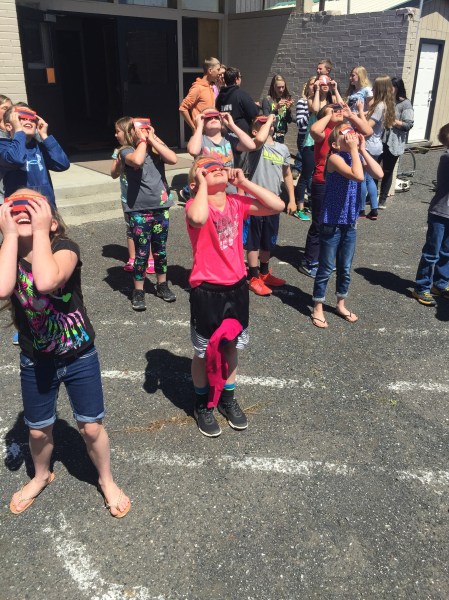
Students at Prairie City school in Oregon view the Sun. The total eclipse will last 2m6s there.

Howard Elementary 5th graders in Eugene.

Eastern Oregon, 1 hour after leaving Prairie City. My payment for the talk.
I’ve stayed away from the math explaining why a total solar eclipse occurs. Much of it isn’t complicated, but people don’t like numbers. On the 2006 eclipse tour to Libya, there were several eclipse talks, and I asked the editor of one of the astronomy magazines why he didn’t discuss the Saros cycle in detail. His answer was short, “People don’t like to look at numbers.”
While perhaps readers don’t like to look at numbers, perhaps they might learn something interesting by viewing 6 of them.
223 Synodic periods (common lunar cycle we know)=6585.32 days: The Moon has to be new for a solar eclipse to occur. That lines up the three bodies in one plane.
239 Anomalistic (from perigee, closest approach, to perigee)=6585.54 days; the Moon must be within a few days of its closest point in order to appear to have the same apparent size (we call it angular size) as the Sun. Too far away, and the Moon will appear smaller, “inside” the Sun, a ring or annular eclipse.
242 Draconic (crossing the plane of the Earth’s orbit)=6585.36 days; the Moon must cross the plane of the Earth’s orbit when new in addition to being the right distance from Earth for a total solar eclipse to occur. Crossing the plane lines up the three bodies in a plane perpendicular to the synodic.
Divide 6585 days by 365.25 days in a year and one gets 18 years 10.3 days, meaning that eclipses repeat. The 18 year Saros cycle means that eclipses recur, shifted a third of the way around the world, which is what the decimal 0.3 shows, but the same general path occurs on the Earth. Ancient people without computers knew this, and they didn’t know the math we know today, an impressive feat.
While these cycles aren’t exact, they are so close that an eclipse “family” will continue for some 70 eclipses, give or take about three. That makes a family last 1200-1400 years before the small changes in many cycles finally fail to allow an eclipse to occur. I think the resonance of these cycles might be part of the Musica Universalis, the Music of the Spheres, an idea dating at least to Pythagoreas, yes, that guy, that music was part of the movement of the celestial bodies. If those three cycles aren’t beautiful, one has amaurosis mathematica, math blindness.
It’s not OK to use “I’m not good at math” to explain away inability to calculate basic things in life. When I taught statistics to adults, I once made the comment that I didn’t care for a lot of jazz, and the class hammered me. Wow, one would think I was born with a major defect. I think the idea of people jamming is neat, playing off each other, finding the right beat, the right chord, the right sense; that is special. I can’t do that, but I appreciate those who can. What bothers me about math is that people use “not being good” as proud excuses to explain away issues, rather than concerns that they might be losing money, being conned, or missing out on something special in the world. Without jazz, my life would be less full; without math, I would not have practiced medicine or even gone to college.
If I could learn to play the piano, and I did learn, I think that it is appropriate to say that others should learn to do basic math and like it. An astronomer the other night at the Club spoke how he taught basic astronomy to students without using math. Everybody thought that was great, including me, until I thought about it a little. Why leave out math? By doing that, one fails to show why math is important. One fails to listen to the Music of the Spheres. What’s so wrong about showing the difference between an ellipse and a circle, between a parabola and a hyperbola? You’ve got a satellite dish, and that is a parabola. These four conics all have a square or a quadratic term present, and quadratics are essential to understand energy of motion, gravity, projectiles, tides, how the solar system works, why we should wear seat belts and not drive too quickly around curves.
Maybe if we understood math a little better, we’d realize the number e, yes, there is a number e, used in a variety of places, including continuously compounding interest.
$1 at 8% for nine years, compounded each year $1(1+.08)^9=$1.99; we make interest on interest.
Compound twice a year, it is (1+(.08/2))^18 or1.04^18= $2.025.
We can compound daily (1+(.04/365))^365*18=$2.0543.
We can continuously compound, infinitely, and 1+(.08/n)^nt=e^(.08t)=e^(0.64)=$2.0544; notice where the 0.08 goes.
This infinitely number of compounding times sadly doesn’t give us infinite riches but approaches a limit given by the number e, the exponential. Interestingly, it is far easier to calculate continuous compounding than it is daily compounding.
Note the close resonance of the product (multiplication) of the interest rate in per cent times the number of years it takes to double money. That product is 72. In other words, 8 per cent interest means that debt, money, population will double in 9 years, 72/8. At 24% credit card interest, debt doubles in 72/24=3 years. One student once asked me why we learned the formula for compound interest. When I explained to him how with punching 5 keys on a calculator, he could find that the tripling time of money at 8% interest was just under 14 years, he was stunned. Divide 110 by the interest rate.
Yes, beautiful, essential, interesting numbers. Enjoy the eclipse. Enjoy the knowledge that three cycles are coming together in August the way they did on 20 July 1963, 54 years and 32 days from when I saw this same eclipse family, canoeing in Canada’s Algonquin Park, where I saw the reflection of the solar crescent in Dickson Lake.
Thrice 18 years 10.3 days.
 Boreal B[l]og