Archive for December, 2017

LIFE EXPERIMENTS

December 27, 2017

“Experimentation is an act of humility, an acknowledgment that there is simply no way of knowing without trying something different.”  Sendhil Mullainathan

I read this in the New York Times, somewhat surprised by that Mr. Mullainathan had yet to perform the experiment that he said would be an act of humility.  The experiment was whether or not to change the diet soda he was drinking, that’s all.  He did mention an example of a brief tube strike in London; when it ended, about one in 20 riders had found different means to get to work and got there faster.  The others resumed their old ways.  I don’t consider changing diet soda’s being a significant life experiment, but then again, I’ve kept shirts for 25 years.

Experimenting is a life style choice, not necessarily a virtue: my wife has had two major interests, aside from me and our cats.  The first is horses, which has been as close to lifelong as could be possible; the second, radiology, she spent 40 years doing before retiring.  Many of the new things she tried were through me, but horses and films are her world, where she has been content and extremely competent in both.  She is exceedingly good at considering new alternatives when I bring up issues in my life, priorities, or time.  Her father took up hobbies of carpentry, gardening, sailing and golf.  He tried them long enough until he was comfortable with his competence, and then he did something new.

I’m the same way.  I admit it takes me a while to change computers, morning habits, or routes to places I commonly go.  Habits are an efficient way to get things done, and most of my life I have had to be efficient.

When it comes to experimentation, however, I go far beyond what kind of diet soda I drink (none, for I gave it up years ago).  I even go beyond the experimentation with becoming vegetarian, which was a big change in my life 27 years ago, but hardly the biggest.  Or doing without caffeine and even alcohol.

In 1984, I saw three bright planets in the sky, thought others probably saw them as well and might wonder what they were. I wrote the newspaper, asking if they were interested in an astronomy column.  Not hearing back, which didn’t surprise me, I wrote again and finally called, reaching a staff member who asked for 3 different length columns, which I submitted for consideration.  I ended up writing 750 columns, self-illustrated, over a 20 year period.  I had no formal training in astronomy, but I knew how to observe, write, and find answers to questions, even before the Internet.

A few years later, at 43, I decided, not on a whim, that I was going to take a 6 month leave of absence from a busy neurology-neurosurgery group to go volunteer for the US Forest Service as a wilderness ranger in the Boundary Waters of Minnesota.  I was going to be away from home, in a place where I had no reputation, nobody I knew, and a job I wasn’t at all sure I could do but thought I could and would like.  I suspect more than one of my colleagues thought I would be back at the office in a month, but I found I could do the work, loved it, became competent, stronger than ever before in my life, and left somewhat sad, because I knew I had a very special experience, one I would never repeat.

I then did another experiment after I returned when I changed jobs at the peak of my earning power.  I left practice to become medical director of a hospital, a hybrid individual neither physician nor administrator, distrusted by both groups.  I stayed in the role 5 1/2 years, grew, became interested in quality improvement, rising to vice president in both state and local medical societies, respected for the analytical knowledge and approach I brought to my job.

Lest one think that I went from one high powered job to another, without any risk of failure, I then undertook, at 49, one of the biggest “experiments” of all.  I bet my career on being able to become a Masters trained statistician who was also a physician.  To do that, I had to apply and get accepted at an out of state university, review calculus I hadn’t seen for 30 years, and then commute nearly 300 miles one way, every week, to be a graduate student, about as lowly as a medical student, for two years.

Somehow, I got through the first semester of Mathematical Statistics, my happening to know (in class) one day the integral of log (x) dx*, which the professor, later my advisor, told me, “I realized then you were for real.”  School wasn’t easy, and every night I cussed at integrals, matrices, computer programs, at the same time as I was teaching two days a week and caring for my class.

When I got my Masters, alas, I had not taken a course in marketing.  I found minimal work discovering I could understand “no” by the sound of the disinterested voice on the other end.  I failed economically, but by then, despite my bitterness at the medical community, which took me 5 years to get through, I looked for new opportunities and found them in several other fields.

I became interested in medical errors, their similarity to aviation with the exception that aviation had a system where one could learn from them, and back then medicine did not.  I wrote two bills for the Arizona legislature creating a reporting system for medical errors.  The bills died, but from that failure, I was asked to write a monthly column for the medical society.  I became a writer.  I wrote three different monthly columns at one point: astronomy and reasons we make errors being the two others.  I won the Creative Expression Award for Human Values in Neurology in 2003 and my article “Astronomy for Writers and Editors” was a finalist in the Writer’s Digest Competition.

I brought my math to bear in the public schools as a ten year volunteer, before becoming a substitute teacher for four years in one district, my statistical and real world knowledge of math helping me immensely with the students.

In 2008, I became a volunteer at Rowe Sanctuary in Nebraska, and two years later, after seeing my eleventh total solar eclipse with a German tour group, I decided to learn German. I had no idea I would teach people about cranes, see as many (17) total solar eclipses as I have, all over the world, and could learn, if only to the intermediate level, a foreign language.  I watch German Krimis (crime movies) for relaxation.

Life is to be lived.  I sometimes envy my wife, who is satisfied with a deep knowledge and love of horses. I have never been able to stick with an interest as long.  On the other hand, to any who might envy my interest in so many facets of the world, I say simply to keep your eyes and ears open, for opportunities are common but are not often announced.  Failure is a big, often recognized, opportunity. It is your life to live, and it is your decision—nobody else’s, unless you cede authority—to choose.  Finding yourself truly content is a sign you are probably living properly, regardless of whether you run “experiments.”

*log(x) dx is integrated by parts

u=log x; dv=dx

du=dx/x; v=x

From this, the result is uv-int(v*int(du))=xlog(x)-int(x*dx/x)=xlog(x)-x or x(log(x)-1) (+C).
RAIN GETS A BAD RAP

December 22, 2017

I arrived home from the hardware store just in time for the rain.  Note: I didn’t say I just beat the rain home, but rather I arrived home in time to enjoy the rain.

Rain has a bad rap, and since I like rain, it means that once again I am on the wrong side of  conventional likes and dislikes in society.  I live in the city but love the wilderness, but I don’t fully belong in either.  I am an introvert in a society that extols extroverts.  I don’t like the idea that everything has to be set to music, which puts me at odds with conventional likes. The other day, I was sent a YouTube video of the Geminid meteor shower, which was a collage of pictures set to music.  I commented:  “Nice.  Nicer without music.”

I think summer is overrated, too.

I’ve felt this way most of my life about rain.  I enjoy being inside reading a book, while listening to the rain.  But lest one think that being indoors is somehow cheating, I love nothing better than being warm in my sleeping bag and listening to the rain on the roof of the tent.  Oh, I’m sure I will have to get up in the middle of the night and go out in it, but then it’s that enjoyable to be able to go back inside and hear it as I again get warm.

I led a hike to Heckletooth Mountain outside of Oakridge, Oregon, last October, when we had an atmospheric river hit us the night before.  An AR is a plume of moisture spreading from places like Hawai’i, Saipan, or Japan all the way in a continuous feed to the Northwest US.  Recipients can get several inches of rain.  I had some cancel that morning, calling me to say how they were staying home and not coming.  I initially envied them a little, but when we started hiking, the rain gear worked just fine (October hikes are great for testing rain gear), fall colors were beautiful, and while we were wet on the outside, we were warm.  Sure, we had to be careful about hypothermia, but hiking uphill helps warm one up, and so long as one hikes back down steadily, cold is not a problem.  Great hike.

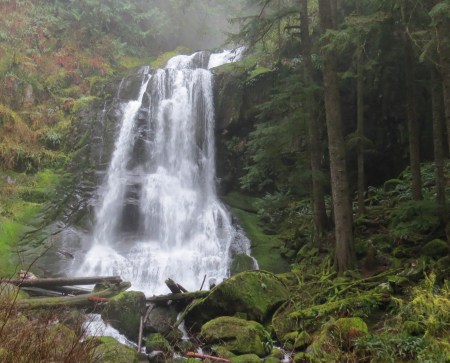
Several of us hiked into to Kentucky Falls last January on what has been the wettest hike I’ve been on in Oregon.  We ate lunch standing up, in rain that managed to get to the forest floor through 600 year-old Douglas fir trees.  Hiking back out, we were totally soaked, and I loved it.  I knew I would dry off eventually, I wasn’t going to get hypothermia, and we were getting what we needed in winter—a long, cold rain.

IMG_8168.JPG

Part of the Kentucky Falls area

IMG_8173.jpg

Eating lunch by a 600 year-old Douglas fir

IMG_8175.JPG

Kentucky Falls, one branch.  I stayed so long that when I turned to leave, the rest of the group was long gone.  Rain makes for beautiful waterfalls.

I’ve backpacked during a 6 day rainy spell in Alaska’s ANWR when the temperature never went past 40, our boots were completely wet, our tents, too, but we stayed warm by hiking, then pitched those wet tents and got into our mostly dry clothes.  The cook tent we set up had enough shelter for eating.  We saw snow on Bathtub Ridge in Drain Creek in June.  Yes, I had to put on wet wool socks first thing, but it was only cold for a few minutes, then my feet were warm.

IMG_1050.JPG

Alaska’s North Slope, ANWR, shortly after being dropped off to hike south through the Brooks Range (2009).

IMG_1167.JPG

Hiking through fog.

IMG_1336.JPG

Brown bear rolling on ice, Drain Creek, ANWR.

IMG_1344.JPG

Snow on distant Bathtub Ridge, after climbing out over a pass.  The prior picture was taken far down the valley and to the right.  

Years ago in the Boundary Waters, out on the waters of Crooked Lake, just south of the Canadian border, I got packed up, while everything was dry, then on the lake got hit with a downpour  I had to pull ashore on an island to empty water from the canoe, and I was really wet, but since I was paddling and portaging the whole day I stayed warm enough.  Once I reached my campsite, I had a dry tent—at least briefly—and dry clothes awaited me.  I had a quick dinner and got into bed, staying warm, listening to the gentle, steady rain.

I remember rainy days on the trail better than sunny ones.  I remember the cold rain in Temegami, when rain gear wasn’t as good, but our young bodies were able to deal with cold. I wasn’t as happy with it back then.  A quarter century later, and ago, I remember the Fourth of July week on Basswood Lake with the Forest Service, where it rained every day, and I worked to have dry socks each morning.  The woods were empty that weekend, the lakes were beautiful, and we patrolled a vast wilderness alone. That was the weekend I learned how to stay fairly dry during days of rain.

I missed the rain when I lived in Arizona.  We had summer thunderstorms, and if I were lucky, we had at least one nighttime boomer, where I could watch the lightning, hear the thunder, and hope the desert would soak up the water.  I hate droughts, and the 22 year one in Arizona was something I complained about often.  The few times it did rain, I heard weathermen and newscasters say that it was a “bad day,” as if we could live our lives with no water at all.

Before I moved to Oregon, I was at a party talking to somebody who heard I was moving.  He began berating me about its climate.  “It rains all the time up there!” he said.

“Yeah,” I replied.  “Great, isn’t it?”

After I moved, we were in a drought for 18 months.  I heard how it would rain all winter, but we got a third of what we needed.  When it was 80 in the mountains in January, an acquaintance told me how “spectacular” the weather was. I stayed quiet. I was told that March could be rainy, but it wasn’t, and that spring could be very wet, which it wasn’t, either. I was told that hot weather was not common, but that summer we broke the record for number of days over 90.  In October, my neighbor asked me how I was, and I replied, “nothing that 10 inches of rain can’t fix.”  In December, the “fix” came, not all at once, and never for 24 consecutive hours.

In November, a woman said on the radio that soon it would be cold, but it wouldn’t last long, and before we knew it March would be back, then spring, and then summer.  We had just gone through a summer with multiple days over 100, no rain for three months, wildfires that burned a quarter of the huge Three Sisters Wilderness and the Gorge, 20 days of bad air quality in Eugene, requiring special masks.  No thanks.  I can wait a long time for summer.  It’s overrated, at least in the American West, where it starts a month or two sooner than formerly, lasts a month or two longer, drier, and with more fires.  Arizona and southern California now have 12 month a year fire seasons.

I like rain.  I know it’s possible to get too much of it, but I have not had that experience in decades.  I had forgotten how many different shades of green there are in the Pacific Northwest.  In the desert, green is washed out by comparison.  I like flowing water, just to watch it, in the wild, not in some fountain.  I like the Sun when it comes out after a good long rain.  Then it is nice.  I enjoy it.

But only for a while.

IMG_4908.JPG

Storm coming in, Lake Insula, BWCA, 2009

IMG_4952.JPG

After the storm, next morning.

I REALLY SHOULD HAVE STAYED HOME

December 8, 2017

I really should have stayed home that Tuesday evening and not gone to the German Stammtisch at Track Town Pizza.  I go there most Tuesdays to practice my German, to listen, speak, and to talk to people there.  It’s good to get out.  I only stay an hour, because the place has low ceilings, serves alcohol, and gets noisy fast, so that I have difficulty enough understanding English, let alone German.

Last Tuesday, I got into a political argument, first one in a long time.  It was my own fault.  Oh, I can blame the other individual, but I shouldn’t have taken the bait.  Unfortunately, however, a lot of things that have stewed inside me for some time came to the surface.

Normally, I try to steer clear of these arguments, with the exception of climate change, where I immediately put out my four rules: no pejorative attacks, required p-value, confidence intervals or margin of error, what happens if one side is wrong, and verifiable predictions locally, nationally, and globally.  That has always ended the discussion.  I need that approach for politics, although I admit difficulty these days in avoiding pejorative attacks, since my default mode when I get angry is a severe case of sarcasm.  It’s one of my huge flaws.

Anyway, the initial trigger was discussion about an upcoming lecture being given by a German official about immigration.  The individual with whom I was talking—an immigrant himself, I think—was saying how the speaker from Germany was lying.  I had no facts, so I let it go. I’m a grandson of an Irish immigrant, and I believe are that if more countries were problem solvers, rather than problem causers, there would be fewer immigrants. But the fundamental cause of immigration woes is overpopulation,  and unless we control population, immigration, with its attendant problems, will increase.  There are two major realities: one, we can’t grow indefinitely and two, we must control our numbers.  Unfortunately, population control is not on the agenda of The Other Side—or for much of my side, either for that matter.  A lady recently profiled in Sierra, the Sierra Club magazine, had three children.  I almost wrote a letter about it then thought better.

We then got into a discussion of weapons, after the individual mentioned a recently deceased friend of his who had several machine guns and a half million rounds of ammunition in his home.  I was shaming myself silently for being secretly glad his friend—63, massively overweight—died suddenly at home. Half a million rounds of ammo and at least one machine gun.  Wow.  Another listening to our conversation asked why the dead man—or anybody else—needed a machine gun.  We got the usual Second Amendment response, and that is where I started getting angry.  I wasn’t going to argue the wording, but I wagged my finger at him—something I inherited from my father—and said “I hope some day you feel the same kind of pain those who have lost people to gun violence feel.”

I’m not a Christian, and while I don’t have to be a jerk, I don’t have to be nice, either.

I’m not honestly sure what else was discussed, but the individual blamed Obama for the drug trade in this country. I was a bit stunned, saying that we have had a war on drugs that began when Mr. Obama was a child, and that he hardly was the person responsible.  I mentioned the Bush years, which seem to have vanished into the murky morass of 21st century history so far, the two wars and one recession have been blamed mostly on his successor, but while the man said he didn’t like Bush, he had absolutely no use for the Democrats.  Social programs, he said.  That was the reason.  So I asked him what sorts of social programs were a problem.  Unlike Mr. Obama, who is a centrist, or Ms. Clinton, who is center-right, I’m a liberal, but I can find wrong with some social programs.  I couldn’t get an answer, and as angrier I became, the quieter my voice was. I kept asking which social programs he was against.  I could have said that Social Security should have means testing.  I certainly would limit the tax deduction for children, in a somewhat feeble attempt to try to decrease population, and limit the mortgage deduction to $500,000.  This man couldn’t come up with anything, despite my quietly asking him “Which social programs?” five times.  All he could come up with was disability: “I see people getting disability who are better off than I am.”  OK.  That’s an issue, but it is hardly budget busting, and are we going to end disability payments because some cheat? The answer to some is yes. The Other Side wants to restrict voting because some cheat, which I believe was fewer than 10 in the last election, the first one’s documented being a Republican.  I am ignoring the almost certainty of one party’s involving the Russians and the definitive asking by the nominee for the Russians to publish every email they had.  That’s illegal and treason.

I didn’t mention my relief that a person with a half million rounds of ammunition was dead. When the individual stated with some outrage that the ATF (Alcohol, Tobacco, and Firearms) was in the house and planned to destroy the weapons, not give them to the dead man’s heirs, I didn’t know the law, so I kept quiet.  Destroying them sounded like a good idea, like beating swords into plowshares, but I’m no expert on Isaiah.

I remember that during a break in the arguing, the other man said that he wished the conversation hadn’t gone on because “I don’t want you to think badly of me.”

“I already do,” I replied.  And I suddenly got up and left, walking out, not turning back to look.  I cared not a whit for what he thought about me.

Several days later, it’s difficult for me to remember what it really was that pissed me off so much, and I’m ashamed I spent so much anger accomplishing almost nothing.

I should have quietly exited the conversation, rather than getting into a pissing contest with a skunk.  It’s difficult these days to read the news, see the direction of the country, and not be worried, lose sleep at night (unless this is age), and feel powerless to do much about it.  I’m frankly weary of dozens of emails clamoring for money for some candidate, promises to impeach (which doesn’t solve the problem; conviction is then necessary, and I also know who the second, third, and fourth in line people are), and the continuous surprise that things turned out the way they did. I find it stressful that I wish for bad things to happen climatically so I can say “I told you so,” and I hope those who voted for this government get hurt.  That’s petty, considering these people won’t vote Democratic even if their candidate is a pedophile or groped women.  We already know that.

I walked outside into the pouring rain.  Wonderful. I love the rain.