Archive for January, 2018

PREPOSITIONAL OBJECT AND EQUAL PAY

January 22, 2018

I try not to get into too many arguments online.  It’s not possible to convince some that contrails are just condensate from aircraft exhaust and that yes, we really did land on the Moon.  I stopped arguing online about global climate change a few years ago.  I wasn’t going to change anybody, and I got tired of hitting my head against a wall.  I’m rooting for Mother Nature.

The other day, however, I perhaps influenced two men.  I should probably quit, and I probably will remain silent.  The first was an individual whose arguments were basically contrary to most things I believe in.  He is not stupid, but he certainly is on The Other Side. Yesterday, he and a friend of mine had about as nasty an exchange as I can think of.

I read where he used “whom” following “to,” which is acceptable, if whom is an object, like “To whom it may concern.”  In this instance, however, the “whom” should have been “who,” for the personal pronoun was the subject of an objective prepositional phrase.  Here’s an example: “I will give this to whoever can clearly explain the difference.” The last six words are the object of the preposition to, and it is an independent clause, the whole object.  “Who” is used for the subject.  “I will give this to whomever you recommend.”  Here, it is whomever, because the subject is “you” and the phrase “you recommend whomever” has whomever as an object.  I later deleted the comment, because it wasn’t necessary, but the individual saw it before deleting and agreed with the grammar.  OK, he leaned something, which is good, and so did I, along with the fact that the individual could be wrong.

Being wrong, and admitting the possibility one could be wrong is important to me before I engage in arguments.  Otherwise, I either remain silent or do a monologue. Silence makes me wish I had done something; a monologue makes me wish I hadn’t.   The woman’s march had just occurred, and another individual was in a Facebook Fight with a few women about unequal pay between the sexes.  He didn’t believe in the gap, and demanded evidence.  I went ahead and Googled an article about unequal pay and read it.  That led me to an American Enterprise Institute article, from the conservative think tank, and I read it, too.  While perhaps two or three points were reasonable, they were drowned out to me because of all the pejorative language against liberals and Obama’s statement in the Lilly Ledbetter case. I really expect more professionalism from AEI writers.  Frankly, I write better.  The title, referring to the evidence “as elusive as Bigfoot,” turned me off.  I suggested in my post that I would review the AEI article in detail if he would review another article in support of the claim.  I also mentioned that willingness to admit one might be in error (which I did in the post) leads to a lot more fruitful discussions.  Three hours later, with no comment, I just wrote, “I’m still waiting.”

To his credit, the individual answered, and so I went to the AEI article about unequal pay. It led me to a fact checking site, along with a few others, and in about 30 minutes I had a considerably more information about unequal pay between men and women.  This is the post I put out.

“It’s actually very interesting.  If one controls for the same job title, employer, and location, there is a gap—about 4-6%.  This is considerably less than the 23% (or 21%) often quoted, although over a career, it amounts to maybe a half million dollars both in earnings and benefits.

The AEI article has a point here, although one of their unanswered questions—have you ever heard of a female real estate agent making less than a man?—should have been answered by them, for it is one of the largest discrepancies of all, as is the female personal financial advisor, both cases showing that women make half as much as men or even less.  For cashiers, it is 92%, computer programmers 95%.

“The 21% comes from definitions of full time and comparing across all jobs.  Seniority has typically gone to men, which explains some of the gap.  It’s fair to examine seniority, but not in the context of equal pay for equal work.  This is not appropriate, although it has been used.  On the other hand, it is equally inappropriate to disparage all the data, because here and in all developed countries their is a gap, just not as large as is often stated.  Still, I chastise the latter (My Side) for saying it will be 70 years (or 170 for another measure) for full equality.  Yes, at the current rate, but that is not a sensible extrapolation in my view.

“I think the AEI would have done better to have admitted that equal pay for equal work is not present, what the number is, and dispensed with the statement referring to “Bigfoot sightings,” which given my propensity to hike in the Pac NW wilderness might actually occur (!)

“What I hope comes out of this argument is some learning by both sides as to the scope of the problem.  I certainly learned something from this, how the statistic is calculated, what should be measured, the fact that there is a gap, and in some professions very significant.  I’d like to think that most of us will look at some of the “sacred cows” in society and find the truth.

“Not that I want to discuss the following in detail, but other examples include that most gun deaths are suicides and the number of deaths per 100,000 is flat.  I’m not saying that is good, but it is factual.

“I’m just tired of spending my days arguing and decided it was time to get both sides to look at an example of the other, and find where the grains of truth are.”

With some trepidation, I read the reply:  “That is truly beautiful.  Thank you.”

I tend to delete most of my posts on Facebook.  I try not to read too much, because it’s depressing what my friends post, it’s depressing what some believe, and it’s depressing to spend a day arguing with people who dig in and aren’t going to be swayed.  For some reason, I rightly picked a misplaced personal pronoun written by one who was not only intelligent enough to know what one was but also likely the type who would not want to have his post contain an error, I gently corrected his grammar, leaving the argument alone.  That action may have led me to decide not to assume the equal pay issue was what I had been told until I first fact-checked it, surprising me when I found that some data was misconstrued, even as the argument, if not quite as strong, was still valid.

I still remember a debate in junior high school about paving all dirt roads.  Back then, I was adamantly against it.  I had a wise teacher who made me argue in favor of it.  I hadn’t thought of that in years.


BLESSED NERD

January 13, 2018

I didn’t know there was a “nerd” icon, but I sure recognized it on my post.  I wasn’t surprised.  I’m blessed, really.  Blessed that I can see not only the beauty in nature that others see, but additionally another way, too, that most others don’t. I see it in understanding what is happening and why it is happening.

The post was a picture I had taken from the top of Spencer Butte showing the clouds rising from the valley floor.  A week prior, we had an inversion, where a cold air mass filled the valley floor, and as one ascended, it became warmer, not colder.  The normal pattern is cooling with height, as anybody knows who has traveled into the mountains on a hot summer day.  I took a picture of the scene below, then I googled the Salem weather sounding, which was the closest sounding to me.  It’s easy to find these things online for those who are curious.  I just typed in uwyo sounding, and two taps later, a map of the US appeared, with a bunch of three letters all over the US, airport call signs for various cities.  People know many if they fly regularly.  Salem (SLE) is one of two in Oregon; the other is MFD (Medford).

Salem’s temperature was about 7 C (45 F) at the valley floor, and it became progressively colder up to the freezing level of about 1900 m (6000 feet), a normal pattern, although I didn’t bother to look at the “Lifted Index,” which is a description of how strong the tendency is for warm air to rise.  We can determine that, too.  A week earlier, Salem was 0 C, and at 800 m or 2600 feet, it was 13 C or 55 F.  That’s a classic inversion.  I posted the picture and the weather sounding.

Inversion

Fog layer in Springfield, Oregon with smoke rising and then reaching warm layer where the temperature of the smoke is less than the temperature of the layer, and it can no longer rise any further. Mt. Jefferson in the distance.

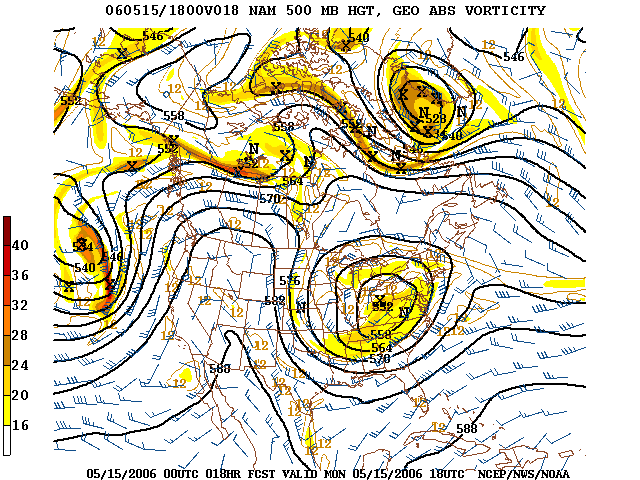
It earned me “nerd of the day,” to which I simply say, “I’m blessed to find things fascinating that are lost on nearly everybody else.”  The individual who placed the icon knows I am a weather junkie but has never expressed any interest in much more detailed forecasts than he gets from his Weather Channel app, which he broadcasts to everybody near him.  It’s taken me a while, but I now just stay silent.  He’s not interested in weather models or much else I say.  Seeing a Rex Block (a high pressure system north of a low pressure system, which blocks normal flow of west to east air) or an Omega Block, and knowing the weather is going to be very unchangeable days before it is announced, is interesting.  It’s also good practice to learn to curb my tongue.

Omega block over SW US. Low pressure systems force upper level winds northward, producing a stable high pressure system in the SW US.  Numbers represent the dekameters above sea level where half the atmosphere is above and half below.  Higher numbers mean higher pressure and more stable, dry, warm air.

Rex Block over the eastern Pacific.  High pressure (notice the barbs moving clockwise) is over Vancouver Island with low pressure (counterclockwise flow) is off the southern California coast.  The upper level winds from the Pacific are directed northward to SE Alaska and then turn southward and enter the US in Montana.  These last for several days and produce often stagnant weather.

I’ve had a lot of these moments.  I understand why solar eclipses occur, and indeed, I think the mathematics of an eclipse is every bit as beautiful as the eclipse itself.  Most would disagree, and I feel a little sorry for them, because I get to appreciate both the natural beauty and the mathematical music of the spheres.  The two interact; they are not mutually exclusive.  Before the Libyan eclipse in 2006, a senior editor at one of the astronomy magazines gave a talk about eclipses, not mentioning a word about the Saros Cycle. I asked him later, alone, why he didn’t bring it up.

“Nobody is going to be interested in that.”  Maybe he needed to make it interesting.  He was the editor, after all, not me.  Maybe nobody knew that such beauty existed.

In 2007, at Big Bend National Park in Texas, I was hiking on the South Rim Trail, when out near the edge of a steep cliff, 2500 feet above the valley floor, I looked ahead to see something that looked like smoke.  I got closer and realized it was water vapor, condensing, right in front of me, as south winds from the North American Monsoon brought moisture-rich air up against the walls, where the air was forced to rise and in doing so cooled and condensed into clouds (for the Lifted Index was negative and hot air was going to rise, not layer out) right in front of me.  This is called orographic lift.  I have seen orographic lift from a distance, watching cloud tops develop on mountains, eventually leading to thunderstorms, but I had never before seen it right in front of me.

I sent a picture to the Weather Channel, but this wasn’t a powerful storm, a great sunset, or any one of a number of non-nerdy things.  I never heard back.

DSC02053.JPG

Orographic Lift, Big Bend National Park, June 2007. The moist air is condensing right in front of me.

When I was a first year medical student, I was allowed to see a C-Section in a Denver hospital.  When asked afterwards what my impression was, I said it was interesting, and all I could think of were the enzymatic reactions that were closing the ductus arteriosus, the shunt between the pulmonary artery and the aorta, that needs to close so that de-oxygenated blood can go directly to the lungs for the baby’s initial breaths.  Knowing this stuff to me makes life more interesting.  I am able to appreciate both the sheer beauty of what I am seeing with the knowledge of knowing why it is.  Or, in the case of orographic lift, I find beauty where most would not.  That’s being blessed.

I don’t think too many amateur astronomers saw the Saturn-24 Sgr occultation in 1989. That’s nerdy stuff.  Saturn passed in front of a star (Saturn’s being closer to us, so it is possible), and as it did so, the star appeared to pass through Saturn’s rings.  That was remarkable.  From the Earth, with a moderate size telescope, I was treated to an hour long show of exactly how thick Saturn’s rings were, and believe me, they are very different for each layer.  Finally, the star was visible between the globe of Saturn and the rings, very odd appearing, before it gradually blinked out behind the globe, the gradual loss being proof of Saturn’s atmosphere. (When the Moon occults a star, it happens suddenly, because there is no lunar atmosphere).  This was a top 5 astronomical event for me, and I’ve spent a lot of time observing.

I get made fun off a lot, and when I taught, whether it was my being enthusiastic about the Rule of 72 for doubling time of money or population*, proving why the quadratic formula is what it is*^, understanding the age of a tree by its diameter**, the distance of an object if I know its height, or why the Sun sets earliest in early December rather than on the solstice, where the full Moon is going to rise*** and why or how to tell clock time using the Big Dipper.****

It’s a remarkable world around us, worth exploring, worth understanding, worth finding answers to the many questions we have about it. Nerds are blessed.  So there.

*Rule of 72: The doubling time of money in years is 72/interest rate in per cent.  9% rate doubles in 72/9 or 8 years.  It has to do with P=Poe^rt. P is twice Po so 2=e^rt.  ln both sides is ln 2=rt, so t=ln2/r, and if we use per cent, this is 69.3/r, close enough to 72, which is evenly divisible by 2,3,4,6,8,9,12,18,24, and 36.

*^ax^2+bx+c=0; x^2+(b/a)x=-(c/a); complete the square, x^2+(b/2a)x+b^2/4a^2=-(c/a)+(b^2/4a^2); [x+(b/2a)]^2=(1/2a)(b^2-4ac), and x=(1/2a)(-b+/- sqrt(b^2-4ac)

**For a Douglas fir, about 5 years per inch of diameter at breast height (DBH).

***Directly behind where the Sun set, basically.

****Let the pointer stars be the hour hand and Polaris the center.  Every two hours, the clock moves counterclockwise 1 hour.  Over a month, this changes, but for typical outdoor camping experiences, it works well.  A quarter turn is 6 hours, and American cowboys knew this and when it was time to relieve or be relieved. If one is Down Under, sorry!


KEIN SCHÖNER TOD (Not a good death)

January 11, 2018

A recent op-ed in the New York Times (“This was not the good death we were promised”)  was a poignant piece written by a woman whose father recently died from pancreatic cancer.  Note: I use die and death here, not pass, pass on, pass away, cross to the other side or expire.  There is a reason to use die and death, finality.  Pass on and crossing over have the sense of traveling somewhere; when I die, someone else is going to be moving my lifeless body.  I’d like to believe I will travel to the Rainbow Bridge, but I will cease to exist.

The elderly man developed severe pain the night before, as it would happen, he died.  There was an hour delay reaching a nurse (not the physician) who told the family to give the man an extra oxycodone, the only pain medicine he had received.  The family became desperate and found some lorazepam and morphine from a prior hospitalization of another family member and gave them, too.  When the nurse came at midnight, she had no analgesics with her.  Eventually the morphine wore off and the crisis nurse who was supposed to come by in the morning didn’t because she was ill. The morphine pump that the patient needed, and one of the nurses was surprised that he never had one, came at 4 p.m., 8 hours after it was expected.  By then, the man was comatose and died shortly thereafter.

He died at home, in pain, although realistically, his last few hours were spent comatose. That doesn’t matter.  He became comatose while the family was trying to get help, they didn’t say their good-byes, and from their view, his last hours were spent in pain.  The author I suspect felt guilty that she failed her father, that she didn’t say good-bye, and that his last hours were so difficult.  That I can relate to.  My parents both died quickly and not in pain, but I still felt guilty about what I did and did not do.

This death should have been easier, recognizing that dying is not easy for any loved one.  The man should have had plenty of pain medicine available and the family needed to know how to give it.  We have a major problem with pain in this country: on one hand, we allowed an opioid epidemic to occur based on the idea that pain was a 5th vital sign, which it never should have become.  Chronic pain, especially “failed back syndrome,” should not be treated with narcotics, because they don’t work and risk addiction. I still am astounded the medical community and accrediting companies once felt that no patient should suffer pain.

On the other hand, we often under treat cancer pain, thinking, inappropriately, that patients will become addicted.  They won’t. This sort of pain does not lead to addiction; the patients will soon die. They should receive whatever necessary for their pain, even if it suppresses their breathing so that they may get pneumonia or even die.  I thought we had dealt with this issue forty years ago.  Palliative medicine specialists have told me that it is possible to deal with end of life pain without using Death With (DWD) laws, such as in Oregon and four other states.

I disagree, know of those who saw the deterioration of their body, felt the pain, and did not want to go through the long, difficult natural process of death.  I respect that; much of medicine is determining where nature should and should not take her course.

Nobody from palliative care physician saw this man in his final hours. The author wrote that she was never aware that 24/7 care was based on staffing, not a promise, as she had been led to believe.  Hospices self-evaluate their pain management, and this hospice weighed in at 56 per cent.  The head of the National Hospice and Palliative Care Organization was quoted as saying that “good hospice experiences ‘far outweigh’ bad ones.”  Their organization should remain silent on DWD until they have their act fully together on the “bad ones.”

End-of-life care is difficult, although there is lack of pressure of finding a cure or healing. The problems here were lack of planning, limited staffing, lack of follow-up, and lack of family education, to name four.  This man was close to death, since with virtually no care, he survived 22 hours after the crisis started.  It wasn’t like he would require many resources.

Am I being too hard on my colleagues?  No.  Do I have a bone to pick with some?  Yes.  Stories like this are likely to increase as more hospices become for profit, for staffing cuts are easier to make than system fixes that can address problems.  I know such, because I bet my latter medical career on helping medical personnel fix bad systems, and I lost. With family education and a morphine pump, this man would likely have had a peaceful death.

Back to DWD:  at their time of choosing, alone or with others, those who have been suitably screened want to be able to say “no more” and take something that puts them into a coma where they will die. This has been vigorously resisted as “assisted suicide,” but such  is pejorative, because the word “suicide” is interpreted to mean an otherwise healthy (but depressed, perhaps) individual ends their life and would not be expected to die soon. Instead of allowing someone to choose their peaceful end surrounded by family, we admit some terminally ill patients to hospitals, pump on their chests, do heroics, ignore Durable Power of Attorney papers, leading some, as the husband of a patient I once consulted upon to commit murder-suicide, dying alone.

I read about the double death weeks after I saw the woman.  She had a metastatic brain tumor, the treatment was minimal, other than radiation, which was going to buy her a short period of time. Her husband challenged me that if I couldn’t do anything, he would take care of the matter. They both survived the concentration camps but not cancer. Yes, we all have to die, but there are good deaths and bad deaths.  Theirs were bad.

DWD is for those who want control over the end of their days and don’t want to take their chances with hospices, whose care has more variability than it should, especially with the rise of for profits.  DWD has many safeguards, with two physicians—one not a treating one—certifying that the patient qualifies, and then having a prescription written for usually a barbiturate.  The patients are followed by volunteers, on call, who will be there if desired if the patient is ready to die.  Since 1997, since the law was passed, 1250 people have died using it.  One-third of the people who get the drug never use it, dying naturally.  The “thousands who would die” took twenty years to reach 1000, and every year in the state, 32,000 natural deaths occur.  Those are the facts.  DWD is fewer than 0.02% of the natural deaths in Oregon.

Richard Rettig, a medical historian, wrote, “the moral cost of failing to provide lifesaving care was deemed to be greater than the financial cost of doing so.”  He was referring to ESRD (End Stage Renal Disease), why dialysis is covered by Medicare.

The moral cost of failing to provide end of life care is greater than the financial cost of doing it.

I’ve looked at the Hospice Data Collection, and I don’t see anywhere how anyone determines the patient died a “good death.”  A German movie I know defined ein Schöner Tod (a good death) as not dying alone. I would add adequate control of pain, patient and family’s questions answered, no system failures in the final week of the patient’s life, and not dying alone.

ENDING TALK, BEGINNING ACTION

January 5, 2018

“When are you going to stop talking about the hike and actually do it?”  Dave, one of the hiking club’s officers, was ribbing me about a hike I was planning to do in Eugene.  We have two major mountains of sorts, Spencer Butte in South Eugene, which rises 1700 feet from the valley floor to about 2200 feet, and Mt. Pisgah to the east, rising 1000 feet to about 1500.  Most people in Eugene are either Pisgah lovers or Spencer Butte lovers.  I am firmly in the latter camp.  The Butte has better woods, more significant climbing, and better views of the Cascade and Coast Ranges.

The Butte also is part of the Ridgeline Trail System, which is about 6+ miles east to west, with three spur trails leading to city roads for easy access.  Pisgah has more trails but more difficult access.  I can take the bus to trails that lead to Spencer Butte and the Ridgeline system; I have to drive to Pisgah to hike its savannah-like trails.  Or do I?

Dave had recently led a hike from the Ridgeline into Suzanne Arlie Park, an area that has some power lines and buried natural gas lines, but also a 1920s ruin of a homestead, and a nice oak forest, too.  More importantly, during that hike, I saw Pisgah many times, and when we exited at Lane Community College (LCC), much closer to Pisgah, I got the germ of an idea. We usually hiked one mountain or the other.  Sometimes, the full Moon evening hike up Pisgah coincided with our conditioning hike up the Butte in the morning, so we hiked both, several hours apart.

I had something larger in mind: I wanted to hike both the same day without driving between them.  It’s part of a grander scheme I have of seeing the Eugene to the Pacific Crest Trail completed, so one can hike from Eugene to the PCT.  There is a sign in Eugene: “Waldo Lake, 94 miles,” but there is no trail between Eugene and Lowell, about 14 miles to the east.  Mt. Pisgah is far enough outside of Eugene to allow one to see to Lowell, and if one could walk in town to a trailhead to the Ridgeline, then to Pisgah, well, there might be hope for other trail segments.  Dave, who does a lot of trail maintenance in the Cascades, has an interest in this trail as well, and kept asking me when I was going to do both summits in one day in one hike.

I figured I would do it eventually, climbing Pisgah, descending, walking the busy country road back to a frontage road, crossing I-5, going through LCC, picking up the trail through Suzanne Arlie Park to the Ridgeline, and eventually finishing.

One night, lying awake at 2 am, the idea hit me.  I was leading two hikes on New Years’ Day, maybe a Club first.  I would lead the hike up Spencer Butte from the west side, split off from the group going back to the cars, and then hike the Ridgeline west, the opposite direction to what I had planned, to Mt. Pisgah, then lead the hike up it in the afternoon.  The more I thought about the idea, the better I liked it.  I figured the mileage between 16 and 17, the starting time was later than usual, which was good, and the full Moon’s rising that night was early, since it was New Years’ Day, and winter full Moons rise earlier. I thought I had enough time to walk from one to the other but not so much time so that I would wait long.  I had been through Suzanne Arlie Park only once, so I took my GPS, mostly to let me know where I was in relation to LCC.

Two days before, I led a difficult conditioning hike up the Butte, and the day prior, I was on my feet 3 hours leading a walk through the riverwalk’s 1:1 billion solar system model.  I had been standing and walking more than I had wanted, but I was still planning to go.  The night before, Steve, one of the newer members, wanted to know if he could join me.  I wanted to do the hike myself, but Steve was a solid hiker and it would be good to have a second person along.

At 8 am on New Years’ Day, I left my car at Pisgah, and a friend drove me to the other side of town to start the hike up the Butte in foggy conditions.  We summited at 10, joining 30 other Club members, and after 15 minutes in bright sunshine, Steve and I left the group, hiked down to the Ridgeline Trail, and arrived an hour later at the poorly marked trail into Suzanne Arlie Park.  We hiked downhill in deep fog, through the woods, breaking out in an oak savannah.  With a little effort, we found our way through the park, and after 3 miles, reached LCC.  I had some food and we then walked out of the college’s parking lot, across I-5, stopping at a Shell station.  It was cold, foggy, and windy.  Ahead of schedule, we spent about an hour there, off our feet, getting warm, then left and walked the road to the Pisgah trailhead.  After 13 miles of hiking, we were at the base of the second mountain, needing only to wait for the group hiking Pisgah to arrive.

After they did, we started up.  Climbing again after climbing, descending, walking, and sitting, is not easy, but Steve and I both felt remarkably good.  Pisgah is a steeper but shorter hike than the Butte, and we were at the fog line on top, where I could see across to Spencer Butte, over a line of thick clouds.

Right on cue, the full Moon rose near Middle Sister far to the east, then everything was obscured by fog.  Our group of 20 had enough, and we headed down to the cars.  We had done the hike between the mountains and up both.  It was 16.3 miles, had 3000’ vertical, not difficult, and showed that it was possible to cross Eugene mostly on trails, and safely well off a road.

I’m not sure how we’re going to get to Lowell and to do the other hikes necessary to connect to the PCT, but I’m going to start looking.

Spencer Butte from Mt. Pisgah