Archive for the ‘MY WRITING’ Category

BEING SOOOO OUT OF DATE

March 29, 2020

In my daily analysis of Covid-19 statistics, I went to a twitter feed by Marc Lipsitch of Harvard, a leading epidemiologist.  I almost became an epidemiologist rather than being a statistician.  I thought at the time that statistics was more appropriate for my math background, but epidemiology might have meshed better with my medical background. It would have been more helpful now.  I probably would have found work as an epidemiologist back then, too, although maybe I wouldn’t have written as much, and maybe I wouldn’t have gone to so many wild places in this country.

Anyway, I never used Twitter, which is my first Luddite confession. I can go online to Twitter feeds without dealing with the rest of the platform.  I haven’t missed it, either. That is sort of how I look at my past.  If I have regrets, I am sorry, I missed something.  If I have no regrets, then so be it.  I look at Twitter feeds online with meteorology, climate change, and now Covid.  Those people are smart, really smart. I wish they would be heard. 

From Lipsitch, I went to a data group about Covid, where they welcomed new people.  I was interested, since I have what I thought were a few data skills, so I clicked on and saw a list of people who gave their skills. 

OMG, I was immediately over my head. I had never heard of Python, at least the non-slithering kind, and at least two-thirds of the recipients (I count that sort of stuff, but it’s kind of low tech) had machine learning, AI (Artificial Intelligence), and a host of other skills I clearly didn’t have. I realized that I was so far out of my league that I left the site.  I then looked at python online and realized that I could probably learn it, but why would I want to at this stage?  First, I need to survive this virus, which at may age is about an 86-95% probability, maybe less because of gender, maybe more because of my current health.  Second, I have done fine the last nineteen years after grad school without doing this.  I never even learned the new statistical program “R,” which was called “old” on the python web site.

You know you are old when the things you didn’t learned when they were brand new are now considered old, and you still haven’t learned them.  

I have gone from being a guy who counts everything in his life and does mental arithmetic for kicks to a has been in the field of data analysis.  If the economy totally meteor craters I am out of luck for any data analyst job.  Nobody wants a guy who as a kid updated batting averages every Sunday from the results on Saturday, doing it by long division. Or can multiply two digit numbers by two digit numbers every time he sees them—during a conversation without missing a beat.  If you have ever talked to me, there is a good chance I once did that. Scary, isn’t it?  

On the other hand, I got back to being me.  I have the data from China, Italy, Spain, Germany, Iran, and the US, and I am checking the UK and Netherlands, too.  I was doing doubling time analysis before I read about them online.  I didn’t need the graphs; I could visualize what the data were doing. I could look at long strings of numbers and decide what ratios I needed to look at: Deaths to Cases, Deaths to Recoveries, doubling time of cases, deaths, daily changes, where a country was on its curve.  It’s not like these statistics are the final word—deaths to cases is definitely NOT a mortality percentage because of lag time—but the change in them is useful.  My watch altimeter I hike with isn’t accurate, but the absolute change is accurate and exceedingly useful.  

So, my data skills and a few bucks will buy one a medium, hot, decaf white chocolate mocha with almond milk at Dutch Brothers, where they know me at the Franklin Street kiosk, but they don’t take cash right now, and I would have to walk up to the drive-in window if I want anything these days. I go by on my 4 mile loop every day.

Italy is slowly seeing the doubling time increase. That’s easier to comprehend than the percentage rise is dropping each day.  While true, it is the first derivative of the curve, and a decrease of something that is increasing confuses people.  Lengthening doubling time doesn’t.  I read a lot, I look at good graphics, which I am not good at creating myself, I do my own poor ones, and because I lost my calculator, I am doing it with a phone calculator until I get a new one.  Heck, last week, when I was having trouble getting back to sleep, I was doing logs in my head.  I got them right.  I made a prediction of the world cases and deaths for the next day and was within 500 for both of them.  

While I can’t do data analysis that will help save the world from this pandemic, I can keep myself busy looking at the data, comparing my conclusions to others’, and when it is all over, go back to tutoring math, explaining things to people who need someone competent  who can do that.  After more than 60 years, I can qualify as that person for at least some things.  The community college has had me for six years, and they still want me.

No, I don’t have Vimeo on my computer, I tried DropBox, and it was a pain, so I don’t use it. I left Oovoo and I haven’t used Viber in years. I still use WhatsApp and Telegram, I can’t make sense out of the Safeway app, and probably a third of the apps on my phone I haven’t used in months, if ever.  

I’ve got a meeting on Zoom next week with the Cascade Volunteer board. A month ago, I had never heard of it.  Should be interesting.  

Cherry blossoms
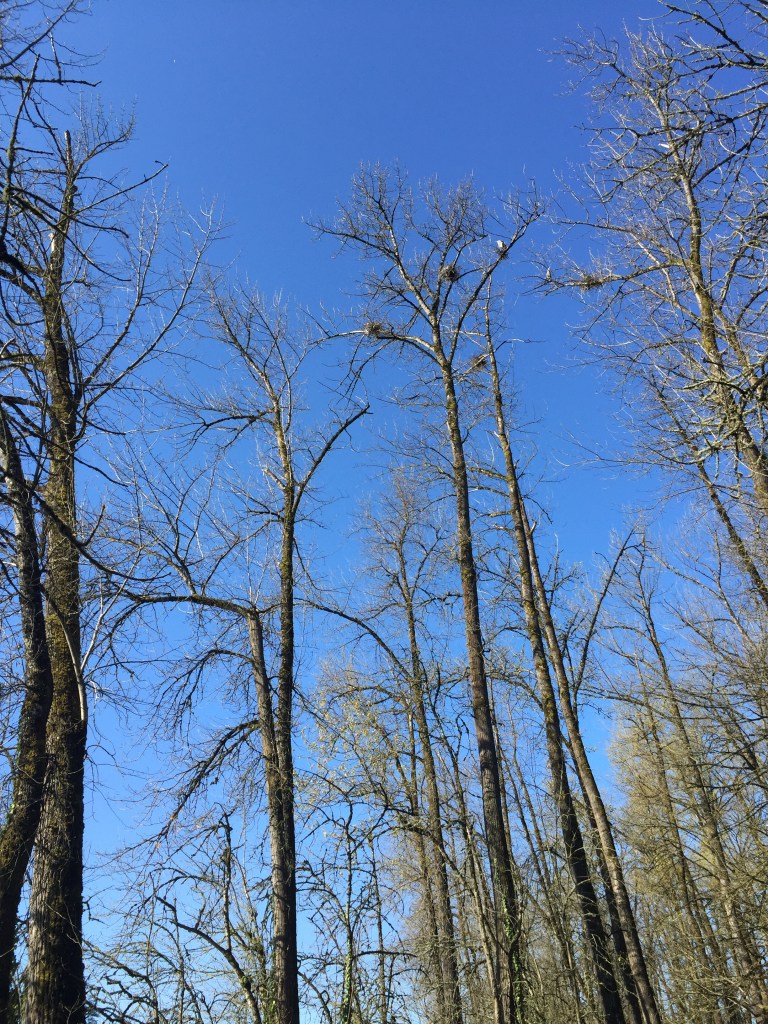
Great Blue Heron nests

ETHICS AND OTHER THOUGHTS IN THE ERA OF SOCIAL DISTANCING

March 24, 2020

I was one of the first hike leaders in the Club to lead a group hike after the world changed, and I appear to be the last for awhile.  We normally do a Wednesday hike up Spencer Butte, meeting as a group at the bottom, and hiking up 3 miles with 1400’ elevation gain.  Several usually walk up together, although I go ahead if I can, using the hike as both conditioning time and as alone time, unless I end up being the Pied Piper with several breathing down my neck behind me but not passing.  I hate that.

Last snowshoe before I left the high country for quarantine. Arrowhead Lake, Diamond Peak Wilderness, Pacific Crest Trail.

Anyway, social distancing comes naturally to me, since I have always been one of those who stands in a corner at a party, assuming I even go to one.  As hike leader, I started by having the sign up sheet in my control, the bag for money several feet away on the ground ($1 per person), and as people came to sign in, I signed them up myself, had them drop the dollar in and start up the trail.  I went last, which worked worked well.  At the top, I had to dodge a couple of children who were running around and ask a few hikers to leave the larger group which had congregated up there. It’s difficult for many to avoid being close to another person.  I’ve seen it in camping, where people camp near me despite having a lot of area to use, and in parking lots, where they park next to me when there is more room elsewhere.

On the way down, I was last, but I saw the front group too close together following one another.  This is a bad habit on the trail, especially during this time. The Butte gets a lot of use, and somebody trying to pass a large group (it was once 18) has difficulty doing it when the front two are taking their time, and the people in the back just join in the parade.  I’ve not been able to change that. I got back to the trailhead and left.

Later, I got a text from someone telling me the coffee shop was open.  I didn’t answer.  On the trip description, I told people what they did after the hike was their business.  I should have been more forceful, recommending people not go to the coffee shop.  That seemed obvious to me, but we are in a new era: right now, get food, medicine, or exercise.  That’s it.  Not socializing. 

Pandemics have bookended both ends of my life.  I remember dimly the polio ones of summers when I was a young boy; my brother caught it. Now I am old and have another RNA virus to worry about.  

I walk daily in Alton Baker Park, where there are dirt and paved paths close together, the former for only pedestrians.  The problem is that I see pairs of pedestrians, not likely living together, walking maybe 3 feet apart, leaving no space for me. If one doesn’t move behind the other, so I can pass, I have to step off and waiting or even going to the asphalt trail. It’s one of the few times I am less annoyed about unleashed dogs.

The suddenness at which I changed surprised me. On 10 March I tutored at the community college, only wiping down the desk, with close contact with several students. The next day, I went to a meeting with the board of the Cascade Volunteers, feeling a little uncomfortable in the room, sitting about 3 feet away from anybody else.  Thursday, I did trail work, but two of us drove ourselves; others still carpooled. That day, 12 March, the world changed. Friday, I called in to the community college, saying I wouldn’t be coming. I went shopping that night, deciding not to wait another 12 hours, but I was what I would consider now “sloppy.”  Between my age and my sex, I am high risk.  I will not likely qualify for ventilator support should we run low on them. I am 14 days since the last time tutoring, 13 days since the last meeting, 4 days since I went to the UPS store. Counting to 14 matters a lot these days.

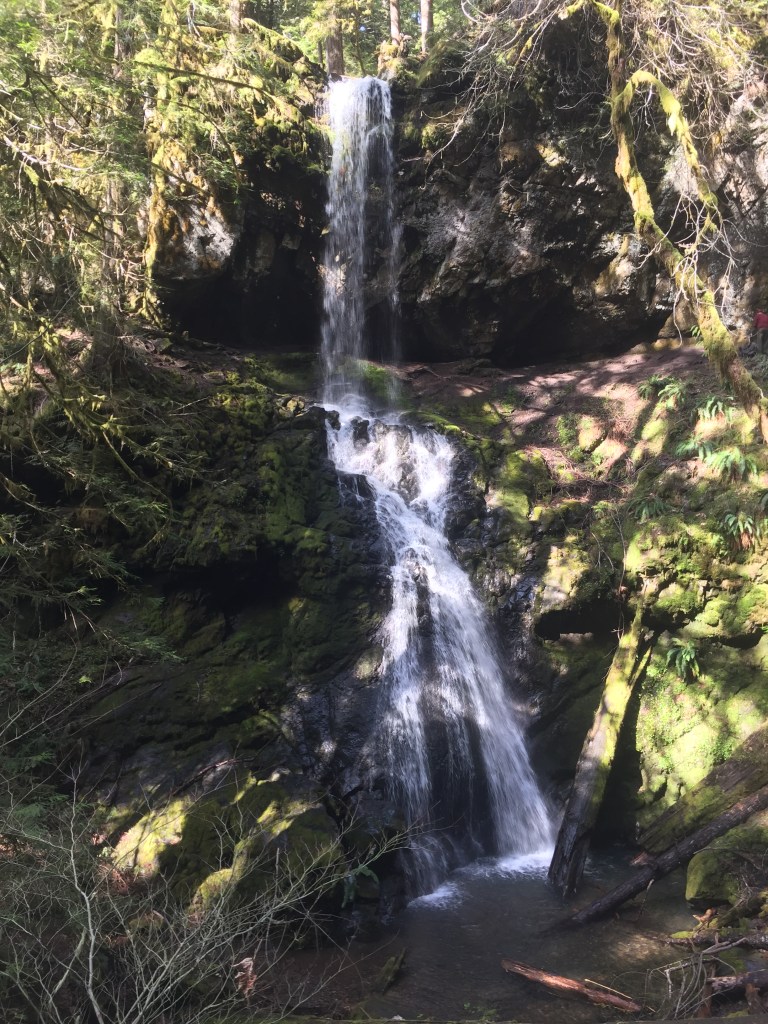
Upper Trestle Falls, Brice Creek, Umpqua National Forest. Trail work doesn’t mean one never sees anything; I had my lunch here that day repairing trail away from the group.

Counting the doubling time of cases and deaths matters, too. Increasing the doubling time is a quantitative way to see if we are flattening the curve.  The number of cases in the US is doubling a little more than two days, although some of that is on the basis of more testing finally being done. I am watching doubling times carefully, because it is easy to do, and Increase Doubling Time is a quantitative way of Flatten the Curve. 

Exponential growth doubling time per unit time is easy to learn. Divide 70 or 72 (easier to work with) by the time it takes to double, and one has the growth rate in per cent.  Doubling every two days is a growth rate of 35%; Spain is at 4 days (18%). 

Another way to look at it is that 29 consecutive doubling times are more than the US population, and right now we are between the 15th and 16th doubling times (32768 and 65536).  At a continued rate every two days, in less than a month the whole country would be infected.  If we push the doubling time back to 4 days, we would have closer to two months, same number of cases, but twice as much time to care for them, have more equipment, maybe have some anti-viral treatment.

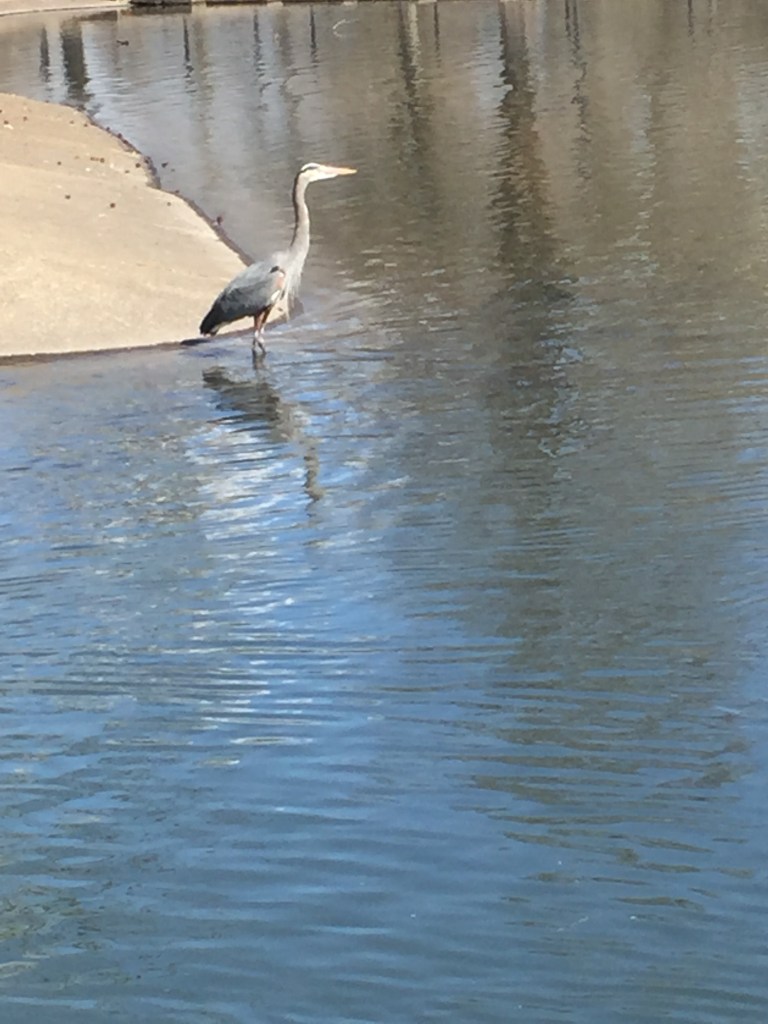
I have a daily routine right now, and I was happy to see astronaut Scott Kelly suggest that. I learned last night that we can still exercise, so long as we stay apart from people.  My park is perfect for that.  I can walk four miles every morning, the hyacinths, Persian speedwells, wild cherries, and Oregon grape are in bloom.  The song sparrows call; the redwing blackbirds are building nests. A Great Blue heron is at the canoe canal.  Several are nesting upstream.

I just want to get through this time. My wife, the cats, a routine, math, and nature are all a big part of it.  

Riley, adopted from the Humane Society about 18 months ago. We kept the name.

OPEN SCHEDULE AND AT PEACE

March 15, 2020

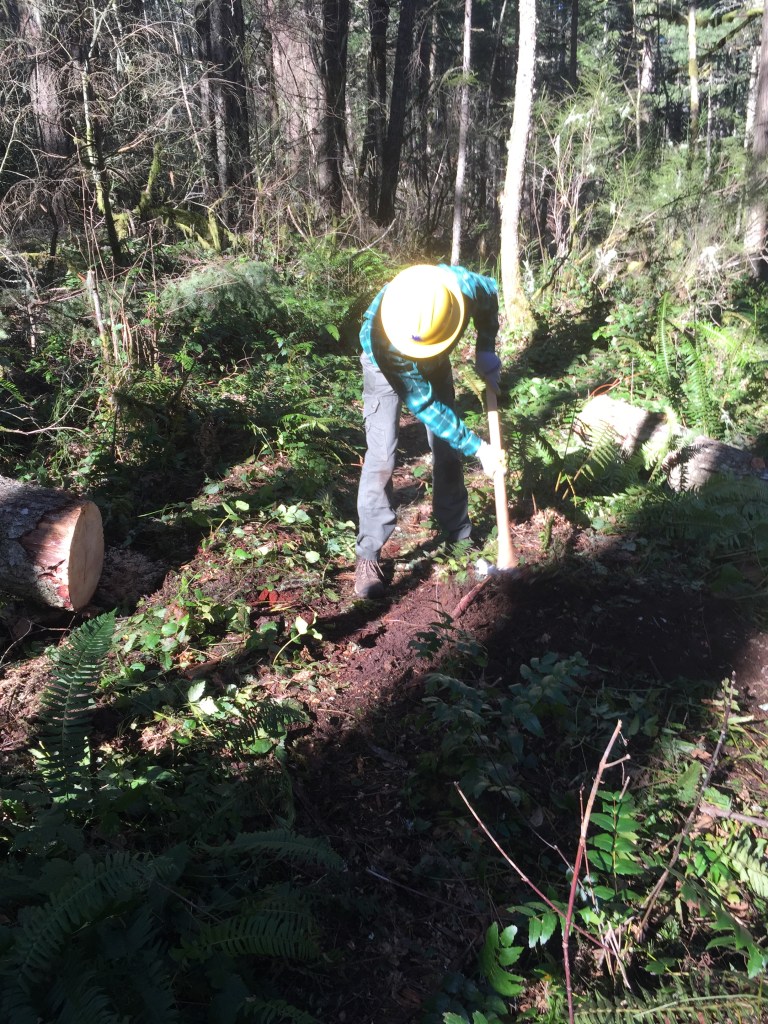
Last Thursday, I went with the trail crew to work the Clark Nature Trail over in Fall Creek.  Half the crew would be doing puncheon work with the Forest Service crew; the rest of us would do grunt work on the trail.  That was fine by me. I have become more and more comfortable doing trail work, widening trails, removing rocks, closing trails, diverting them. 

We met at the Shell station south of town for our “tailgate season” where we discuss what we will be doing, specific safety hazards and review general safety behavior.  Normally, we then divide up into vehicles to carpool to the trail head, but this time I said I would be driving myself.  I had decided to do that two days before; I didn’t want to ride in close contact to several others. I wasn’t the only one doing this in a group of 60 and 70 year-olds. 

At the trailhead, we had another tailgate session with the Forest Service and a specific discussion of the job we were to do. Several of us started by each picking up a 4 by 4, about 9 feet long, and we had to carry it through the woods uphill a half mile to the work site.  That is a cubic foot of wood, and it was heavy. I hoisted mine and was last in the group heading out.  I wasn’t sure how long I could walk without having to take a break, but I found that by stretching my right arm out along the wood ahead of me, it was like carrying a canoe.  

I stayed in the back of the group, but about half way there, the person ahead of me set his 4 x 4 down to change arms.  I told him I was passing, so I wouldn’t get hit by his wood, went around him and then kept on to the top. It wasn’t a competition, but I wanted to get to the top without stopping, and I did.  I walked back down to the bottom, got a second 4 x 4, and did the same thing.  After that, we did trail work in the mud, making a new trail and closing off an old one with nearby downed branches and logs. We made a small stream diversion, filled in holes from past posts, and pulled out a fence post deep in the ground.  It was a pleasant day in the woods among the pioneer violets, trilliums, snow queens, running streams, giant trees, Pacific wrens and spotted towhees. 

Before leaving that afternoon, I talked with one of the other guys, very experienced from working years for the Park Service.  He is about my age, has had cancer, and drove alone, too.  Neither of us was scared of the coronavirus, but we both knew that we needed to be cautious.  In the woods that day, the outside world had changed.  When I left that morning, many things were still planned, I had  a schedule with some things I needed to do.  When I returned, the stock market had plummeted again, basketball was over, baseball too, my trip to Nebraska in April was cancelled, Forest Service meetings I was to go to, scheduled for next week, became virtual, It was a different country, almost the way it was after 9/11, 1/28/86, or 11/22/63.

I was asked if I were panicked.  I answered no, and I’m still not.  I am at peace. My schedule is empty. I don’t have to get up earlier for anything, although I will still do trail work if I can.  I lost money on plane reservations that I can’t keep, but I am not trapped on another continent or a cruise ship in quarantine.  Or worse, sick. At least not yet. I won’t be tutoring in person, but I can do it online. I can still snowshoe and hike. I am concerned, yes.  Three days ago I was tutoring in the math lab.  Two days ago, I was at a meeting, but I sat separately from others. A week ago, I had two long distance trips planned. Now, I have none.

I read how retired physicians might be able to help.  I am not sure what is meant by help, in that we are at high risk by age and many of us have additional risk factors for severe or fatal illness.  Aside from liability issues, it seemed obvious that prolonged close contact to sick patients led to more severe illnesses among medical workers. Now, if they wanted to have my ideas on system design, that would be fine, but only if we did it by telemetry. 

I want to be one less person who needs to be tested, brought to a hospital, given supportive treatment, and adds more stress to the medical care system. Our hospitals are not geared for this, and nor is our national system, if one can call it that. We got hit with a bad virus that was certainly predictable, if not knowing when. If not a virus, an earthquake would have stressed the system in some areas.  But when one is working to make a profit, getting the right patient mix, advertising, minimizing costs wherever possible, usually by limiting personnel, and asking first about insurance and second what is wrong with the patient, there can be no room in such a system for idle beds, idle machines, or idle people. I suspect many hospitals are near full capacity without coronavirus.  If they haven’t been, they are likely to soon go under.  When everything depends upon workers staying healthy, nothing going wrong, a pandemic is going to be a disaster.  The system is taxed with routine care; here where I live, it is overtaxed and medical issues of the population require month long waits. It is sort of like Canadian care that people complain about.  It isn’t like there is a lot of elective surgery that can be cancelled to free up beds; there is plenty of emergency and necessary surgery, requiring ventilators, every day.  

Many have resisted increased public support of medical care or public health because they aren’t affected by certain conditions.  I’ve long said that each of us is subject to a cancer, a ruptured aneurysm, a drunk driver, or a mutation.  Now, we have an example where any of us can become ill.  Each of us is subject to a virus that has a significant likelihood of killing us. Good public health helps all of us, yet public health has had its budget cut severely in the last decade.  For each dollar spent, public health delivers far more value than any other branch of medicine.

So, as I do the some of the things I like outdoors, hope I won’t be quarantined on the basis of age, or fall ill, I am at peace.  Nothing major to do tomorrow. No big trips on the horizon, no meetings, just a lot of reading, maybe a snowshoe, trail work, or even tutor math online.

I hope that out of this time we find our way to decent coverage of medical conditions, recognize we are all in this together, and make sure public health—where all the major strides in longevity are made—is funded far better than it has been.

For once, being an introvert in a land of extroverts is a blessing.  

Avoid crowds?  No problem.

Pioneer violet (yellow) with Snowqueens

Diverted trail (left), with old trail (right)
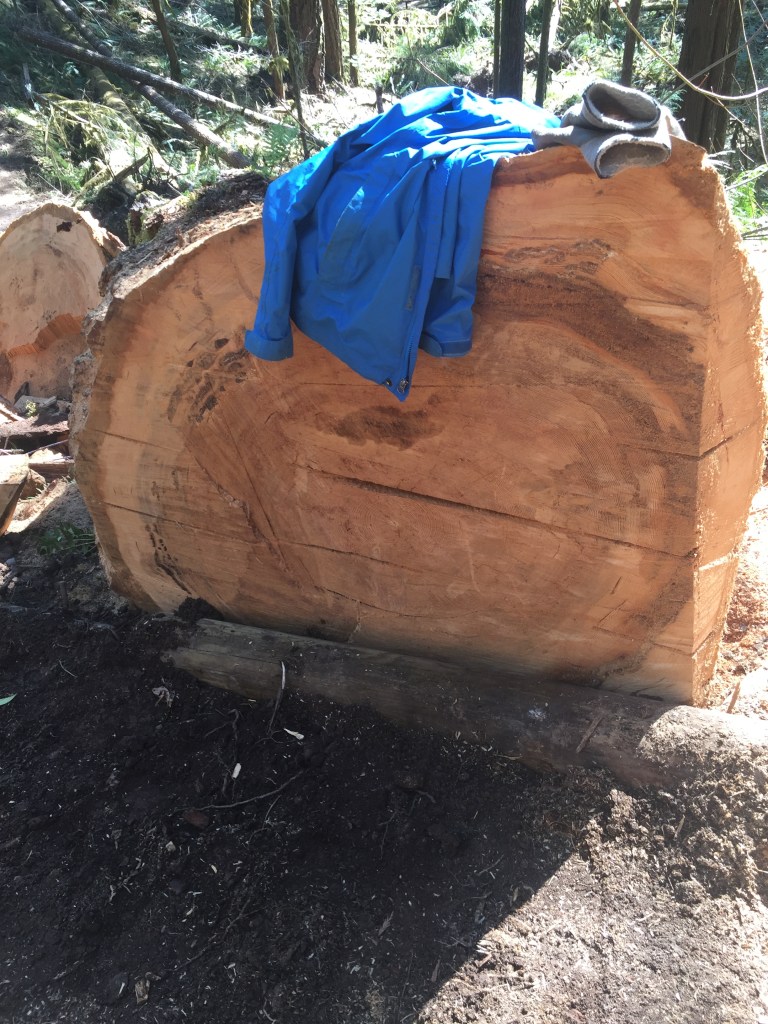
The nice thing about trail work is I can usually find time to count the tree rings. This Doug fir was 430 years old, at least.

TIMBER ISSUES

February 29, 2020

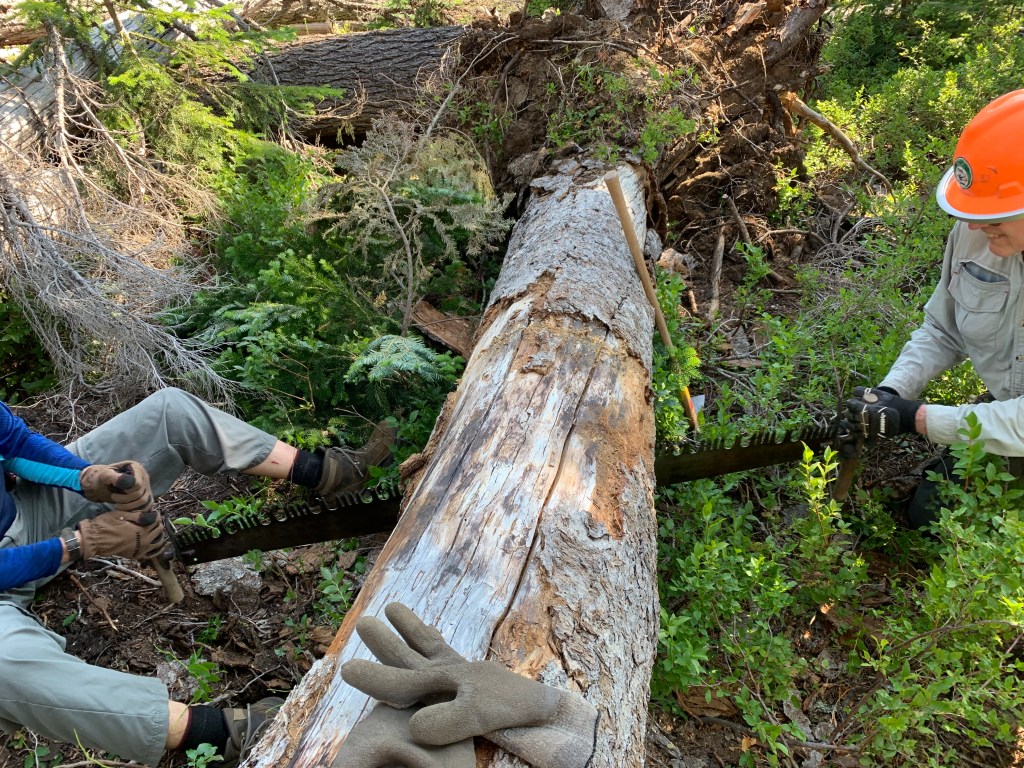
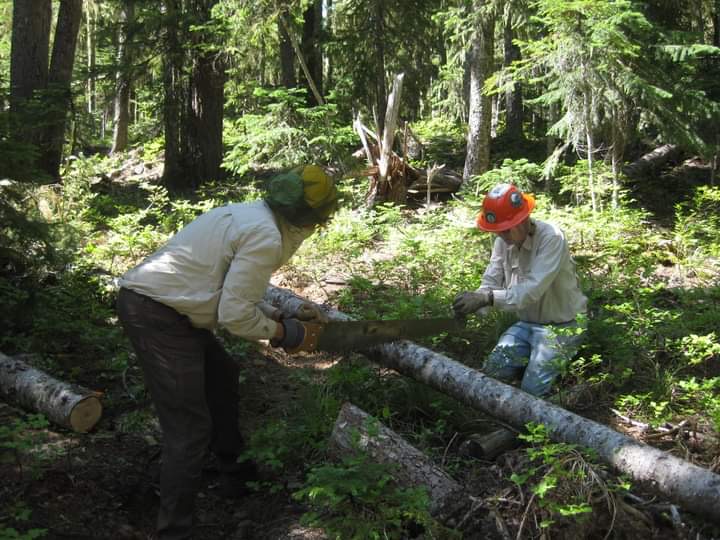
Last weekend I went to the annual Oregon Logging Conference, where our volunteer trail crew had set up an exhibit about our trail work and brought several small logs and two large crosscut saws, about 80 teeth each, for people to use, with supervision, to get an idea of how we clear wilderness trails, where chain saws are not allowed. 

The night before, Oregon Wild, an organization to which I belong and donate, demonstrated out front.  I felt a bit traitorous going inside the exhibit hall, but my trail clearing crew has many ex-loggers on it.  They are experienced sawyers and have a lot of woods experience, and I have learned from them.  Showing the public that volunteers are doing significant work to help the public access their national forest is important. 

There is now hashtag Timber Unity, Stand up for Working Oregonians, web page Dear Oregon, which is more of the same, and a year after the attempt failed, Stand up for Oregon, Legislators want to take your guns.  The legislature Republicans have left the state so there won’t be a vote on the cap and trade bill or anything else. Last year, they did the same thing.  They feel put upon as a minority.  Well, I lived in southern Arizona for 37 years and was a minority when it came to stuff that was passed up in Phoenix. We talked about Baja Arizona and seceding, but it was a joke. I feel like a minority in my country right now, run by the rural and put upon folks, who rub it in whenever they can.  Apparently, when the Republicans get put upon, they walk out.  It reminds me of the kind of stuff I did when I was a boy and what some physicians I know did when medicine changed and hospitals had to change, too.

On my way from the car to the exhibit hall, I went by a house with a sign up on a tree: “Log it, Graze it, or watch it burn.”  And one of the first people I saw in the hall had a Trump 2020 hat on.  This is not a friendly group.  Many think we are forcing them all into Priuses and want to outlaw diesel, red meat, gluten free, LED bulbs, transgender, the thought of climate change, think the eastern two thirds of the state should become part of Greater Idaho, and only one side owns the flag.  At least with Greater Idaho, they wouldn’t have any more senators and not another representative, either, unlike the State of Jefferson folks, who think the 40,000 there deserve two and one.  

I hear much about how we have more trees than we did a hundred years ago.  Sure, because then, there was mass cutting without concerns about ecosystems, resources, animals, or anything else.  But there isn’t more old growth now, where carbon storage is huge and the ecosystems fully developed.  I don’t count seedlings as “trees” in that sense.  If we had more trees now, the pictures of the state over the last 20 years would not be an example of how much clear cutting has been done, and Oregon Wild would not have put pictures of clearcuts on the MAX trains up in Portland.

A friend told me her father was a logger many years ago and said everybody thought the forests were infinite.  I also see signs saying that young trees take up carbon at a higher rate than older ones. That’s a tipoff to the fact that the trees are small.  Here’s how I know “higher rate” comparisons are a sign of something small: 

2018 2019

Paul’s Pizza sales    $1 million                $2 million  

Big Cheese Pizza.   $175 million         $180 million

Paul’s has grown 100%, impressive; Big Cheese has only grown 2.9%. Wow, Paul’s is growing more than 33 times faster than Big Cheese.  

But Big Cheese has gained $5 million in sales, compared to Paul’s $1 million.  That is 83% of the market increase. As to market share, Paul’s has increased from about 0.6% to 1.1%.  Now, extrapolation can be misleading, but I could hardly be faulted here for noting at the current rate of increase of market share, it will take Paul’s at least a century to catch up with Big Cheese, which is well named.

A century is about the minimal time period we should let planted trees grow, not 40 years..  Do clearcuts affect the soil long term?  One reference, which was put out by a logging group, pointed to the need to keep slash, the branches and other material, at the site and that the nutrients quickly came back to normal.  It’s perhaps not fair, but the reference looked at only minerals, did not define ions properly (calling them “nutrients”) and said new approaches used non-toxic chemicals, including “agua regia” (sic).  I heaven’t studied chemistry in a half century, but the term is “aqua regia,” a mixture of nitric and hydrochloric acids, a bit toxic.  Another article looked at fungi and bacteria in the soil and found that even 10-15 years after a clearcut, the soil had not recovered.  Compaction from heavy equipment, with anaerobic conditions developing, was a significant problem. It was clear to me that the second article gave a better idea of what was going on than measuring only minerals and ions, and using Spanish where Latin belonged.  Don’t laugh; mistakes like agua regia (even spell check picks up the error) hurt one’s cause. It is the coffee stain on an airplane meal tray. If you can’t check spelling or grammar, what else are you missing?

A significant number of fires start in slash left behind after clearcuts, including the Milli fire in 2018, where Black Crater’s wonderful trail was destroyed.  We used to have “teepees” to burn waste. I remember them when I traveled through the state 50 years ago. Many think we should bring them back; in this administration, who knows, maybe we will.  Never mind that smoke from them and once allowable grass burning once led to a multi-car, multi-death pileup on I-5, in 1988, where 7 were burned to death and 37 injured, many severely, from smoke.  Twenty years later, the rye grass group still had 10% of the fields burning every year.  

These organizations want to go back to the days when we could do all this stuff, but we didn’t know better then, the land was less crowded, and life was supposedly better—assuming, of course, one didn’t get seriously injured in an accident, didn’t die of diseases we can cure today, and one wasn’t a person of color, immigrant, female, different, gay, lesbian, or disabled.

What I noted in the exhibit hall were young parents with several children.  I wondered, while looking at them, how they would adapt to climate change, which is real, to changes in timber management, which must happen, if not now, after this administration, and to health care.  Their representative in Congress, Greg Walden, wrote the bill that would have taken a couple of hundred thousand of them off Medicaid.  He still got easily re-elected.  

Our priorities need to include education, family planning, better access to affordable quality medical care, better environmental stewardship, adaptability to climate and world demographic changes.  COVID-19 is another warning shot by nature.  We would do well to listen. There will be more of these, and neither nature nor viruses cares a whit about jobs, ways of life, families, or those who feel they have a monopoly on “hard work.”

OLC 2019
Using two man competition saw for first logging this year of a trail blocking log on the S. Willamette Trail, February 2020.

WE ALL OWN BEAUTY, NOT JUST A FEW

November 25, 2019


I had noted the temperature was actually getting warmer as I did the weekly hike up Spencer Butte with the Club.  No, it wasn’t just that I was working hard, but it was cold at the bottom, and it wasn’t nearly as cold a thousand feet higher.  We hike up to the top from the city, 3.2 miles gaining 1400 feet of elevation.  Slower hikers leave earlier; sometimes, I decide to leave early if I am rehabbing part of me, and other times I leave early so I can hike alone.  Often, I have a line of people behind my, liking my pace, but making me feel like the Pied Piper.  I don’t like such a situation, for I tend to walk faster, when I am already at cruising mode, and I get tired sooner.  Once I stopped suddenly on a hike to take a picture and got run into by the guy behind me.  I learned that backpacking through Alaska willows and other brush. Don’t crowd the person in front. They may have to suddenly stop, and they have sharp hiking poles. That can slip. Anyway, the summit of the Butte is finally reached after a series of rock steps, about 130 altogether, not counting the occasional smaller ones, and I looked down on a foggy, cold valley from the land of blue skies and sunshine.

Off to my northeast, the mill in Springfield had a plume of smoke rising in the sky then flattening out and spreading along an invisible barrier like a river.  I could see about fifteen miles of the smoke river, coming first towards me then moving away to the northwest.  

Wow, I thought, a classic inversion.  Warm air normally rises, and it normally keeps rising as the atmosphere usually gets colder with height. Valleys during winter collect heavier cold air as it sinks, and set up an inversion, where warm air rises through the cold air until it reaches the warm air above—not below—and stops rising. I first noted it in southeastern Arizona, back when I was commuting from Tucson to Las Cruces for graduate school.  Once, on a bike, I went through a thick fog bank going up to Mt. Lemmon, breaking out at about 4000 feet into bright sunshine and a dew point temperature, where water will condense into clouds, 30 degrees fewer than just a few hundred feet below.  Those who turned around in the fog missed a sunny day, which was about five minutes’ ride further up the mountain.  

My wife and I hiked through an inversion in the Grand Canyon in February 1989, when the whole canyon was full of clouds and bright sunshine up at Yaki Point.  We hiked down the South Kaibab, entered clouds, then broke out below into overcast conditions.  It was remarkable.  

Jan at Yaki Point, South Kaibab Trail, Grand Canyon. February 1989. Microspikes are on the toes of the boots.
Coconino Sandstone (the largest vertical layer visible), viewed from South Kaibab Trail

Back on Spencer Butte, I waited for others to come up and googled the University of Wyoming’s weather sounding page.  The closest weather balloon released was from Salem, about an hour north, and indeed showed a change in temperature of 0 C (32 F) at ground level and 10 C  (50 F) at 1500 m or 5000 feet.  Classic inversion, I noted, staring at the river. I told a few people about what we were seeing, but nobody seemed interested.  

Back then, I was still posting on Facebook, and I later posted the picture and the weather sounding as a textbook example of an inversion.  Here is another example, with a link to the actual weather at that hour.

Salem, Oregon sounding from 4 am 23 Nov 19. Notice the temperature C, third column from the left, gets warmer as one ascends, from roughly 33 to 46 degrees at 923 m or roughly 3000′ above sea level. Then the “normal” cooling with elevation gain begins. The 98% humidity at ground level suggests fog was occurring. The actual weather was indeed foggy.

Facebook is not the land of people’s liking textbook examples explaining physical phenomena.  I got exactly one comment, a nerd icon, which I didn’t even know such existed. It wasn’t the reason I left the platform, but it was one of the accelerants.  I haven’t missed the sniping, arguing, or ignorance since I left it.  Nope. I try to walk in beauty the way the Navajo Prayer says.

A decade prior, I had been hiking on the South Rim Trail in Big Bend National Park up to the overlook over the Chihuahua Desert.  I was alone, and as I hiked on the rim, I saw an area that looked like smoke, then steam, a quarter mile ahead of me.  I arrived at the area and saw water vapor condensing to form a cloud, right in front of me.  I was on top of a cliff, and the humid southerly wind from deep down in Mexico, had slammed against the cliff, forcing the air upward, where it cooled, since in summer the inversions are usually shallow and break.  Cool air condensed once it reached the dew point, which is higher in summer, and a cloud formed right in front of me.  This is orographic lift, and I was absolutely enthralled at the example I was seeing. 

Condensing water vapor, Big Bend NP, June 2007.

I was naive enough to think that The Weather Channel might be interested in a picture, so I sent one to them.  I didn’t hear anything, not surprisingly, but I was disappointed.

I get great pleasure out of seeing things in nature that are not only beautiful but enhanced because I’ve been fortunate enough to be brought up curious about the world.  A total solar eclipse is beautiful not only because of the color of the chromosphere or the thin strands of the corona, but because it is the resonance of three separate lunar cycles—the synodic, the anomalistic, and the draconic—which every 18 years and 10 1/3 days are almost exactly the same, so that the eclipses repeat every 18 years and change plus 1/3 of the way west around the world. I find that fact fascinating.  

On the Libyan cruise to the 2006 eclipse, an editor of Astronomy magazine discussed eclipses to the audience.  He didn’t mention the cycles, and I suggested afterward that perhaps people might like to know that.  “Nah,” he saiid, “that’s too nerdy.”  

That came from an astronomer.  

Just after the eclipse, Libyan desert 29 March 2006. The next eclipse in this family will occur in Mexico-US-Canada 8 April 2024

Normally, I don’t write about this sort of stuff, because most people aren’t interested.  I would simply say that 

In beauty I walk…

In beauty all day long may I walk.

Through the returning seasons, may I walk.

On the trail marked with pollen may I walk.

With dew about my feet, may I walk.

With beauty before me may I walk.

With beauty behind me may I walk.

With beauty below me may I walk.

With beauty above me may I walk.

With beauty all around me may I walk.

In old age wandering on a trail of beauty, lively, may I walk.

In old age wandering on a trail of beauty, living again, may I walk.

My words will be beautiful…

Rim of Four in One Cone, near McKenzie Pass, 6400′ elevation. There were many views of the major northern Oregon Cascade peaks that day, but the rim of snow all along the cone was my biggest memory. In photography, especially in relationships, and likely in life, the little things are often the big things.


ON AND OFF BUTTONS

November 1, 2019

The chain saw was wedged in the bottom of the 40 inch diameter log.  DAMN!  This had to have been the fourth or fifth time we had to deal with a wedged saw today, and it was now late afternoon.  

Our crew of three—the fourth had to leave early to get back to town by 5—looked at the log, which was mostly cut through, but obviously not completely. I hadn’t been impressed by the top bind, but the sawyer thought there was some.  If the top part of a fallen log is compressed, such as being in the middle of two parts that are supported, so there is a slight sag, the wood on top will tend to compress and grab or bind a saw, keeping it from moving.  If the saw is deep enough in the log, we can pound a plastic wedge into the cut or kerf, allowing the saw more freedom to move. If the log is under tension, a cut will tend to open and release the tension. When the kerf was opening up earlier in the cutting, a rather than narrowing, it suggested bottom bind, not a top one, but I didn’t say anything. I wish I had, for I might have been able to prevent a wedged saw.

I’m relatively new out there, now past the “Stay (the &%$) out of the way!!” instructions, so I tend to be quiet.  That is a mistake in the woods, just as it is in the cockpit or an operating room.  People don’t like criticism or comments.  The culture isn’t what it ought to be.

The sawyer, I later learned, had an on button but no off button.  She was a dynamo, one of those I learned who would be happy to still be out here at 8 pm cutting. I didn’t feel the same way.  In addition to my pack, I was carrying a Pulaski, my hand saw, gloves, a pair of loppers, plastic blue diamonds to place on trees for markers of winter trails, nails, and a hammer.  I was tired, and it made me more cranky and prone to mistakes.  We were cutting out a mile or two of trail, not a lot, but we had several hundred yards to go to the road and then a 2 mile walk back to the vehicles. Then we had to drive another 90 miles home.  I doubt the other two in the crew had made that calculation.  I had been refining it the whole day. It is useful to me to know where I am time wise  and trail wise in the wilderness. It is not considered a virtue by most of the people whom I am around, but I tend to arrive at where I want to be about when I expect to, without surprises, and I like that.

I was the only crew member who had been previously been on this trail, both in winter snowshoeing and in summer trying to place diamond markers.  I had been so upset about  missing markers in winter that I said someone ought to be out here putting therm in, and “someone” turned out to be me.

In June, I walked the trail.  That is not easy, since winter trails do not need to be cleared the way all year trails do.  A couple of feet of snow will cover a lot of plants and many downed logs, so only the big logs or logs over the trail have to be taken out.  The trail does have to be wide enough to be seen in winter, and that was a big problem with Nickerson Loop. I had been stopped on another person’s snowshoe trip at a brushy field with no clear path. In June, there was still no clear path, just a lot more brush to walk through, but I worked my way through it from both ends and placed a few diamonds.  It wasn’t perfect, but it was better.

With the chain saw crew, I had a chance to get the trail open for people to travel the loop.  We had cleared some brush and cut out about a half dozen logs earlier, the saw’s being stuck several other times.  I was later told the sawyer was relatively new, and I realized the bar of her saw, the metal semi-elliptical protrusion on it, was not long enough for the logs we would be cutting;  I knew beforehand and had mentioned that we would have at least a 36 inch diameter log to cut out. 

Anyway, the saw was stuck, and without another chain saw to free it up, we had a problem.  The so-called “walk of shame” is when a sawyer leaves the bar in the log, removes the motor and comes back later with another bar and chain to cut the first bar out.  I had some wedges used to keep the kerf open, and I put one below the saw and tried to pound it in, hoping I could move something enough to free the saw.  No luck.  We started with a hand saw in the cut to try to open it a little.  No luck.

The sawyer then took a handsaw and began sawing the log for a second cut.  This log was 40 inches in diameter—a meter—and handsaws are good up to 6 inches, 8 on a good day. I told her that wasn’t going to work.  She had a Katana 650 one person hand saw back at the car (650 mm), and the other crew member asked me how far it was.  I figured two miles, and then to myself multiplied that by 2 (round trip) and divided by 3 (walking speed, maybe) to get the round trip time in hours, and realized he might not be back here until 4:30 or 5.  He stayed.

So for lack of anything better to do, I took my hand saw to the kerf above the bound saw and started cutting.  The wood was obviously hard, but I went at it for a few minutes, trying to make sawdust while ignoring how much wood was below the saw, and then heard a noise—a slight crack.  

Hope.

I cut a little more vigorously and heard a louder crack.  The log was talking to us.  I gave the saw to another crew member, since he was stronger and I was tired, and within thirty seconds of his sawing, there was a large crack, the log started to fall, and the chain saw was free.  

Dodged that bullet.

We still had a couple more logs I knew about, because I had scouted the trail ahead of us, and after losing it, and cussing the people who didn’t replace diamonds (that would be me in part), found it again, and led the group to the next cut.  In addition to diamonds, I was using strips of pink ribbon that I could tie to plants.  Pink or orange ribbon has helped me find trails many times.

There was a pair of logs to be cut out that the other two dealt with while I put diamonds on both sides of a tree.  Then there were some logs that would be cut on a regular hiking trail, but I leave alone since snow will cover them, at least if we get a normal snow year.  They were cut anyway.  More time on trail.  I had said several times to the crew who was opening up the trail that this was a winter trail.  The bottom didn’t have to be perfect; people just needed room to pass through it.

I got home well after 6 and considered myself lucky.

I respect people with no off buttons, but I am not one of them, and I don’t think that is a particularly healthy lifestyle.  I could be wrong.  But I am correct when I say it is not good for me.  That kind of behavior reminds me of medicine, some of my mentors and partners, who appeared to be able to work without sleeping, eating, and perhaps even toilets for all I knew.  I just knew I couldn’t do that.  It was a reason I first left my group and then left medicine.  I’m hoping I don’t have to leave trail work for the same reason.  This isn’t trying to fix people, it is keeping trails open and is a volunteer duty.


The author (left) cutting out a log at Potato Hill Sno-Park, near Santiam Pass, Oregon.
Trimming branches at Little Nash Sno-Park,

TRAINING DAY

October 27, 2019

We saw the vehicle with hazard lights on, just before we arrived at Box Canyon, at about 3700 feet, where we were going to log out part of McBee Trail in the Waldo Lake Wilderness as part of crosscut saw training.  It was raining something that looked white. Good hypothermia weather, although sawing logs might keep us warm.  

Nobody at the car flagged us down, and we didn’t see anything, so we pulled into the parking lot, got into all our rain gear and personal protective equipment—hard hats, gloves, safety glasses– had our day packs on and were ready to go to work.  Five of us were getting some training, and while I had been in the woods crosscutting with the crew 19 different times, I figured I could learn some more.  It was my first time working with a saw since I broke my hand backpacking around Mt. Hood two months earlier.

We crossed Highway 19, the Aufderheide, a scenic but not often traveled 60 mile road between Highway 126 from Eugene to Santiam Pass and Highway 58 between Eugene and Willamette Pass.  Box Canyon was equidistant from each side.

While crossing the road, the truck that had had its hazard lights on stopped and asked if we could help. 

 
“There’s a car over the edge with a guy pinned in there.”

We had completely missed seeing the car.  Anybody could have.  The details weren’t completely clear, but the car was apparently driving west from Oakridge and heading towards Terwilliger Hot Springs the night before.  The hot springs are closed at night, but that didn’t stop people from using them. There were three in the car; the driver and one passenger were hurt but were able to leave and apparently flagged a car down and had called emergency.  An ambulance was heading up from the McKenzie River side, the north, but it was probably 40 miles, and the last 30 on the Aufderheide were narrow and bumpy.  They would be at least an hour and a half, maybe longer.

We walked towards the accident scene, about two hundred yards. My leg was bothering me, so I lagged behind.  We brought our tools, because we weren’t going to be doing any logging for a while until we understood the situation.  

A small, red car had collided with a fir and left a 7-8 inch gash in the bark, but not too deep.  The car had somehow turned and faced perpendicular to the road, engine compartment smashed in on the right, the windshield ready to give way, and the car was on some sort of stump, suspended, so it remained horizontal with the rear wheels several feet above the sloping forest floor under it. 

The other passengers or the hunters had put blankets on the victim, who was conscious but in a lot of pain from what appeared to be a fracture of the femur.  There was little we could do: one of the others in our group, who knew I was a physician, looked at me like I was supposed to do something.  We did not want to touch the car, and everything appeared relatively stable, so we waited for the emergency personnel to arrive.

About an hour after we knew about the accident, an ambulance arrived, a crew of first responders, someone from Eugene Mountain Rescue, and an Oregon State Police officer soon after.  They stabilized the car, started removing the passenger side front door, and got a backboard ready. They wanted to take the patient directly up the bank, which had a lot of brush.  

“Do you guys have loppers to cut out this brush?”

“Does the Pope have a Bible?” I thought.  We are a bunch of wilderness trail workers.  We had five loppers among us and cleared the bank in as minutes.  Then there was another issue.

“We encountered two logs coming in on the road.  We winched one out of the way, but the other needs to be removed.  Can you do it?”

Why yes, we can, but unfortunately, we aren’t the chain saw group. Still, we had bodies and we had a 5 foot, 2-man crosscut.  Four of us left and drove north down the Aufderheide about 6 miles, where we found a 75 foot western Hemlock down, the top covering about three-quarters of the road. This would be a big part of the training, cutting the tree out.

Of the four, one was an experienced crosscut sawyer, two were beginners., and I knew enough to be helpful. I was able to work with the two new people; we had to make two separate cuts because the log had such a top bind, or compression, we couldn’t get plastic wedges in to the kerf, or cut, to open it. We had to “chunk” the log by cutting and then using a Pulaski to remove wood. Eventually, we got through the log and with 4 of us pushing with our legs, moved it off the road, opening about 80% of the road there.

We then got back in the car and drove back towards the accident site.  Not five minutes later, a small group of cars, including one ambulance, came the other way.  

We had lunch standing up, by the trailhead in the rain, and then hiked into McBee trail, clearing about a mile of it.  When we came out and drove back to Oakridge, we came upon the tow truck with a red car, crushed front end, but no longer with a person in it.

Upper McKenzie Fire District first responder at the vehicle. The brush we would remove is in the upper right corner.
Log cut out. We didn’t cut from the road edge, because it was a lot thicker there and there was some time pressure to get the road open. The cut section is at the top.

COULD WE FINALLY GET A DOCTOR TO SEE THIS PATIENT?

September 8, 2019

A physician-friend of mine consulted me the other day about an unusual symptom.  I don’t get consulted much these days—I’m old, out of date, and nowadays just about everybody seems to be a medical expert either through being or knowing a first responder, nurse, PA, or some of the people I know in the hiking club.

Anyway, my friend had flexed his neck and felt a shock go down his body for a few seconds. He wondered if he were crazy.  Few things are as clear to a neurologist as this Lhermitte’s sign, named for the Frenchman who first wrote about it.  This means there is a problem in the cervical spinal cord, either due to MS, if the person is young; or arthritic changes or cervical spondylosis if older, with a spinal cord tumor,  foramen magnum meningioma, or Arnold-Chiari malformation, where part of the cerebellum, called the tonsils, tries to join the cervical spinal cord rather than staying in the skull. I did a brief exam, which showed no weakness, and told him he needed an MRI of his neck. 

He saw a nurse practitioner and convinced her that he needed an MRI.  That was done, and the radiologist wrote a report and sent it to the office.  The nurse in the office, not the NP, and certainly not a physician, read the report to my friend over the phone, which showed “moderate changes at C3-4,” mild changes elsewhere.  Nothing else. No future care was offered.  

In my practice, I not only saw the report but felt I should look at the films, often with a radiologist, and then call the patient and discuss what was next. The radiologists loved it when a clinician showed up by the alternator where the films were stored, and I learned a lot, too. I called my patients with the results and returned their calls. I wasn’t paid to do this and I never expected to be.  It was part of the office visit, in my opinion. It was not a fun part of the job, but it was part of the job.  I can’t remember any time in the past six years a treating physician—or a midlevel, for that matter—called me.  Even with email queries, only once has a physician has ever responded to me.  Something has been lost.

I told my friend he had to get a diagnosis.  Lhermitte’s is not some minor ache and pain associated with growing old.  It isn’t mild deafness or an early cataract.  This is a potential problem when mid-levels take over a lot of care and physicians don’t closely oversee it. Midlevels are excellent physician extenders but should not be considered complete physician replacers, either. I told the physician to get the CD of the images and I would look at it with him.

When I looked at the images, spinal cord compression at C3-4 jumped right out at me.  There was a 2 mm offset in a person with a small spinal canal to begin with, meaning that there wasn’t ever a lot of room for the spinal cord, and the slight change in alignment had removed 2 additional mm.  This was severe.  It explained the Lhermitte’s sign, and the question was how it should be dealt with.  He then called his primary physician, who made a referral to the spine clinic.  

My friend got an appointment six weeks out—-with a PA.  

This is discouraging.  This problem is a major cervical cord issue that explains a classic symptom that needs to be addressed sooner rather than later, and it shouldn’t have to be screened again six weeks later by another mid-level.  It’s frankly insulting. It’s time for a doctor to see this patient.  The referring physician dropped the ball, too.  At least it’s real pathology. This isn’t a person with a little osteoarthritis.  When I saw “headache, emergency, rule out bleed,” the headaches were almost always tension.

My friend has to wait, and it is a grim reminder that Oregon is not physician friendly and has a hard time attracting and keeping doctors.  I still haven’t a new internist a year after my other one left, although I’ve seen a physician assistant twice.  

The more recent appointment was for my injured hand which I got losing an argument with a rock on a river crossing on a backpack of the Timberline Trail around Mt. Hood.  I had a second metacarpal fracture, closed and non-displaced, and the diagnosis made, after which I elected to go to the local orthopedic institute to make sure my hand was going to be properly treated.  It is, after all, a broken hand. I did a lot of reading about broken hands, just like I do with other conditions I have.  

I went to the orthopedic center and saw…a NP.  She put me into a splint, which made sense, but again, I have to wonder, why aren’t doctors seeing routine real pathology?

Don’t get me wrong. For years, I spoke to first responders in Benson, Arizona, about head injury.  I had a video made at one hospital showing my dissection of a human brain, one of many I did, a crowd of nurses around me, so they and others could see the structures.  I did this, because I like to teach and I wanted ancillary personnel  who saw patients to increase their knowledge.

I now feel I need to direct my care a lot more than I thought I ever would. I’m on my own, the way I was on Mt. Hood, deciding to keep hiking another 30 miles with an injured hand rather than bail out at Top Spur Trailhead.

I worry, however, how I will deal with something serious in the future, and given the opiate issue, I worry greatly should my wife or I develop a painful condition— like metastatic cancer.  There are too many barriers between us—both retired physicians—and a treating physician. They are physical as well: I go into a medical office these days, and I need a GPS to find my way back out.  It didn’t used to be that way. 

I find it odd that when I was in medicine, I treated all sort of things that my training never touched upon and didn’t treat many things—carotid artery disease, and MS, to name two—that I had the training for. Internists would treat those conditions and send me people with obvious tension headaches.  Now that I am away from medicine, I am subject to non-physicians as gatekeepers and wonder what will happen if I am not mentally sharp enough to check what is happening. I am starting to be far more assertive about what I think needs to happen.

I also wonder what my friend would have done, if he were not medically trained and hadn’t contacted me. He would have eventually become diagnosed, but he might have had deficits from a myelopathy (spinal cord damage) assuming he didn’t have a fall first and become paralyzed. How many people are out there who are not getting full evaluations because physicians have delegated much of front line care and it isn’t clear to me who might be falling through the cracks? 

At the minimum, when I am given an appointment with a medical practitioner, I want to know before I go who it is. This does not always happen, unless I specifically ask.  Second, if I have seen a midlevel, I want to know whether a physician has signed off on my medical record. Third, I can afford my care, but why is the cost the same with a midlevel as with a board certified specialist, or in one recent case, $100 more for less workup?

Finally, if the electronic health record is too burdensome, some day we are going to have a new health care system. If you are a practitioner and don’t like the time spent on an EHR, assert yourself and design something better. Take back control, like I’m trying to.

LEVEL TWO AWARD

May 12, 2019

A while back, my computer flooded when a cat jumped on my arm, which was controlled by my brain to hold a cup of coffee, and not a landing cat.  The arm jerked, the coffee flew (along with the cat), much of the former landing on the keyboard.  I don’t remember where the cat landed.

After replacing the computer (keeping the cat), I loaded from my back up disk and noted that I had different emails.  I had three different computers storing data on the backup disk, and two were almost the same regarding information.  Some of the emails, however, I hadn’t seen in 15 years.  I had written a piece “A Wise Owl,” which with the help of the late Dr. David Goldblatt, a neurologist, writer, fellow Rochesterian, gentleman,  critic, and friend, brought back memories I had long forgotten.  I miss David, who died in 2007 from ureteral cancer.  His editing brought out the best in my writing.  He hated it when I confused “as” and “like,” and he once said he read one of my eclipse articles completely only, “because I was committed to doing it,” which unequivocally stated his opinion.  

“A Wise Owl” was about the night my widowed father asked to come to view a total lunar eclipse with me and others at Sabino Canyon, a reasonably dark sky site in Tucson with ample parking.  Dad was having a difficult time being alone after 63 years, and his memory suffered.  But that night, under the eclipsed Moon, he explained the phenomenon to two young women in a way that left me agape, and I was a local astronomy columnist who knew a great deal about eclipses.  

I wrote the article in response to a request for submissions to Nisus, a section in the journal Neurology dealing with the human condition and neurology.  This section wasn’t about research but rather neurological conditions with their effect on individuals, society, and humanity.  My mother had a rapidly progressive dementia and my father had a pseudodementia as a result of depression.  Once I knew clearly my mother’s diagnosis, and she stopped eating and drinking, we put her in hospice and she died five days later.  She had once made me promise never to put her in a nursing home and I didn’t“A Wise Owl” was about my relationship with my father shortly before and after her death.

David saw promise in my article and made important suggestions. I rewrote the piece, and it appeared in Neurology in late 2003.  That December, David called me (referring to me as Admiral Byrd, since I had just returned from an eclipse flight over a good portion of Antarctica), telling me that I had won the Creative Expression Award for Humanity in Neurology, and it would be presented at the Academy’s annual meeting in 2004.  I was stunned.  I was a real writer.

The next spring, I flew to Oakland and took the BART to San Francisco, where the meeting was held.  That evening, I was guest of honor at a small gathering where past winners of the CEA and interested others were present.  The award came with a $1500 check, which was donated to the charity of the winner’s choice.  I said a few words, saying that I chose MSF (Doctors Without Borders), and talked briefly with some there, until people trickled away to dinner with other neurologists at the meeting.  David finally left, saying that I would probably want to spend some time with neurologists from Arizona.  

I knew there were no Tucson neurologists there.  And if there had been, I would have been hard pressed to name more than two with whom I would have wanted to have dinner and who would have wanted to eat with me. I returned to my hotel.

The next noon was the Academy luncheon honoring award recipients, and my table was way in back labeled “Guests.”  My name was on the back of the program as a recipient of a Level Two Award. There was a short blurb about me and an ezine I wrote about hearing wolves howl in the wilderness that had recently been published.  Nobody at the table knew me, my name tag didn’t say anything special, and I don’t remember if I got to stand with the other award winners, which included some non-neurologists.  In short, I didn’t really need to be there; it didn’t matter.  Level One awardees were feted.    

I later expressed surprise to David about the luncheon.  He had had another commitment that day and couldn’t attend.  I learned that he long had difficulty convincing the leaders of the Academy to allow articles such as mine in the journal, that humanity was an important part of neurology, not just research into neurological conditions.  When I read his emails on my computer, I was astounded at his passion for Nisus, how well he expressed himself, how much I missed his wisdom over the years, and that he was one of the true elders in the field.  David copied me on many letters over the ensuing two years, trying to ensure that never again would a CEA winner be treated as anything other than an “true” award winner at the annual meeting.  During that time, I left the Academy, because I was moving further from neurology and medicine and the Academy was no longer relevant in my life.  The letters I read from David reminded me that the Academy’s feeling was mutual.  

I wrote one more article that appeared in Nisus.  David and I wrote with very different styles; he was a far better writer.  He had exchanges with The New Yorker about his letters to the editor, none of which was ever published. Having one published was an unfulfilled goal of his.  I wish I could have told him I got one published in the magazine several years ago.  He would have laughed and said he was jealous.

The day I looked at the letters written long ago, I sent a comment to the New York Times about an article detailing what social media has brought us.*  I wrote it quickly, on my phone, while eating a small breakfast at the Portland airport.  It became a Times pick.  At the other end of the day in Ely, Minnesota, I wrote a second comment that became another Times pick.^  David would have been pleased, but I bet he would have found a way to have made both better.  He made so many things better.  

Deep in a closet upstairs in my house is a box that contains a folder of handwritten thank you notes I received as a neurologist.  For many years, when I felt really down, I would read them.  I saved most of these letters. Technology makes it more and more difficult to open and read ancient emails.  I was fortunate enough that the ones I had still could be opened, for they reminded me of a man who helped me write the best article I will ever write.

*“I’d gladly trade my right to comment here for no comments and no social media. The world was better without the online hatred, false conspiracies, ignorance, poor spelling and grammar that we got in return for doctored videos and digital narcissism.”

^On Jacinda Ardern, Prime Minister of New Zealand: “As a yank who loves both countries and probably should stay quiet, I appreciated Ardern’s neither mentioning the name of the perpetrator nor allowing his face to be shown. As a result, he has disappeared from the media (although probably not from the Dark Web). When there is a mass shooting here, the perpetrator has his name blabbed for days and his picture stays on the screen for 30 seconds at a time. This may not be a minor point: a lot of copycats want to end their existence making big headlines and having everybody know their names.”

PUBLIC SHAMING

March 30, 2019

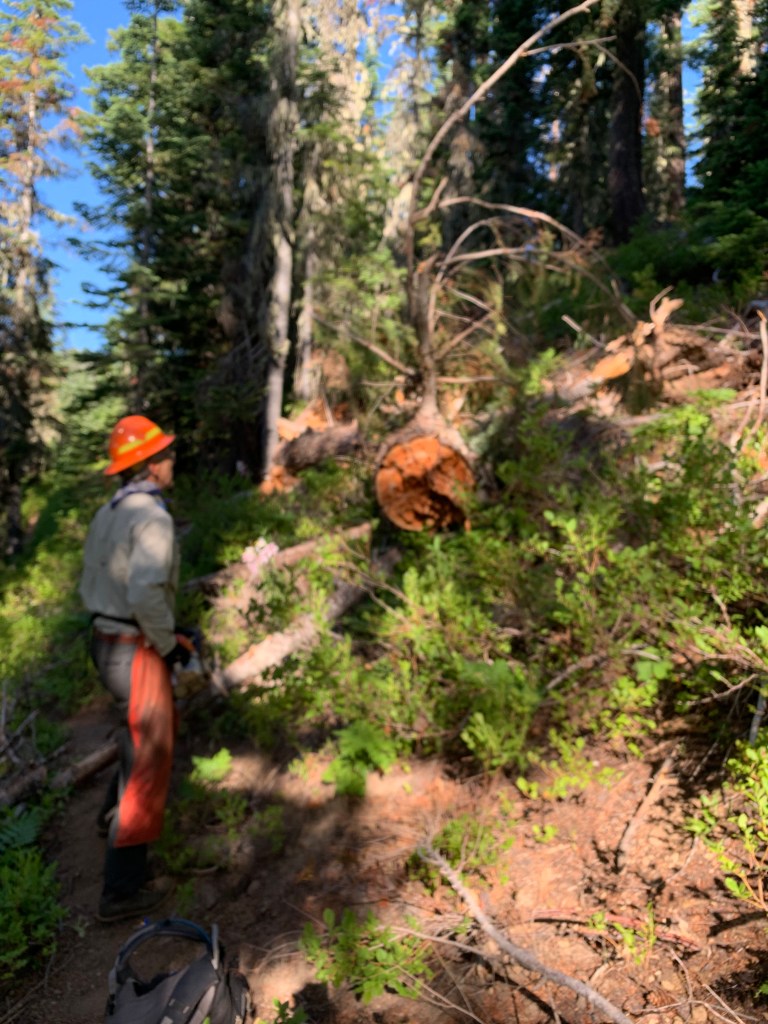
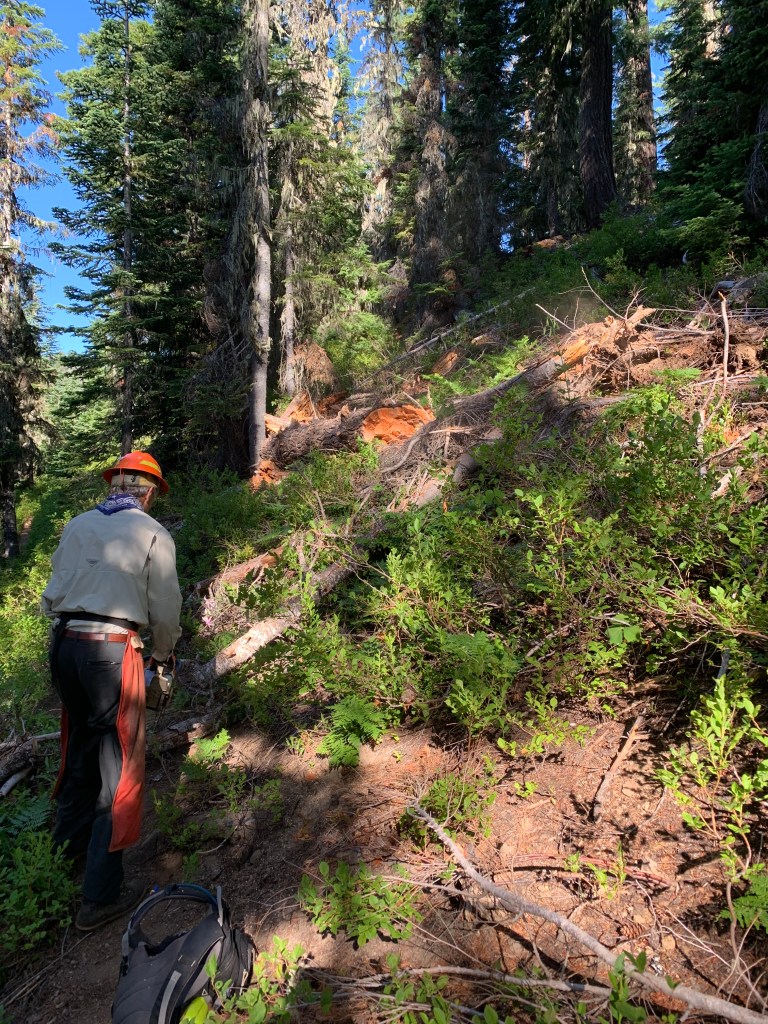
As soon as I took a step towards the other side of the trail, right behind a crew member starting his chain saw, I knew it was a bad move. Oh well, I jumped quickly to the brush on the other side of the trail just I heard the chain saw roar behind me.  That was stupid, I thought, and I won’t do that again. I was carrying an axe and a hard plastic wedge, and my job was helping the sawyer by being ready to pound the wedge into the top cut to keep it open and keep the saw from binding.  But I should have waited before going to the other side.  

For the second straight week, we were clearing trail out by the Middle Fork Ranger Station near Oakridge.  The Wren Trail was normally a short, easy walk, but scores of large old growth and other trees had been brought down by the winter storm that shut down the county for a week, and the prior week the smaller chain saws used were limited in what could be cleared.

Today, we had cleared a couple of dozen big trees, 2+ feet in diameter, 200+ year-old Western hemlocks with a few Douglas firs and Western red cedars as well.  The trail was open for use again, and we were finishing a spur trail to a nearby road, making several cuts in a downed Douglas fir. It had been a good day, and the eight of us felt good about what we had done.  Nobody got hurt, although one man with whom I was working had a log brush his knee brace.

Before, during, and after. Each area that is cleaned needs to be planned, each log has to have its cut planned, and we need to be better at planning how we will get the logs off the trail. Near Middle Fork Ranger District office, Westfir, Oregon.

Shortly before we drove home, we gathered for a “tailgate session.”  I had been out more than thirty times with this group, and while we did morning tailgate safety sessions, this was the first afternoon one I had encountered. 

One of the two leaders, an experienced man in his 70s, who had spent decades cutting, looked around at all of us.  He looked at me, and then again at others, and I knew what was coming.  He finally looked at me again:

“You,” he said, pointing his finger at me, but not menacingly, “went around the saw as it was being started.  That is the worst possible time to do it.” The sawyer next to him with whom I had been working the whole day nodded agreement.

I don’t know who was looking at me, but I’m sure everyone else was.  I hadn’t been dressed down in public in a long, long time, and it stung.

“As soon as I went, I knew it was wrong,” I stammered.  And I heard again that saws starting up are most unstable.  That I didn’t know.  But I knew I was wrong.

The group discussed a few other things about safety, at least not involving me, but not involving any one individual.  I wasn’t going to say anything more, a decent approach, but I decided I would anyway.

“We need to stop and think before pushing logs off the trail that have just been cut,” I said.  This has been an issue on many of the outings I have been on, and it bothered me.  “I want to help, but if I’m not sure what the plan is, I am not going to hurt myself moving something until I get into position.”

Nobody said much. I’d seen far too many people in the woods push, lift, pull, or otherwise move logs without proper lifting care.  We were all old; sooner or later, bad technique causes problems.  Even good technique can.  I hurt my knee last summer by pushing in a way I thought was appropriate, but with which my knee disagreed.  I said probably the most important thing of all, although I didn’t appreciate it until later, and the others may not have even noticed: “we need to pay as much attention to moving the downed logs as we do to cutting therm.”

The worst thing that happened?  Being called “You.” He didn’t even know my name. I have worked with this man at least a dozen different days in the woods.  I’ve ridden in his vehicle three times 2 hours to a place and 2 hours back.  I talked to him at a benefit for the Crew at a bar because he was standing by himself and I didn’t see anybody else familiar.  OK, some people are bad at names, and I am one, so I wrote my name on the back of my hardhat.  He didn’t take the effort to know whom he was criticizing.

He should have taken me aside right then in the woods and told me why I did what I did was wrong.  That’s how you learn. Then, he could mention it at the tailgate briefing as something he has seen. I would have known it was about me, but I would not have been shamed. Instead, I felt “I’m once again at the bottom of the experience ladder and everybody else knows I’m a screwup and I shouldn’t come out here any more with the group and I just want to go home.”

If nothing else, he could have at least asked my name.

He didn’t.  He dressed me down in public, which my father and the military both taught me you never, ever do.  On board my ship, I heard a lot of yelling behind closed doors, and I saw chastened people afterwards, looking like they had been through a verbal wringer, but they at least had the dignity—yes, the dignity—of knowing that nobody else saw the scene.

Medical training was full of public dressing downs.  Woe to the physician, who, after having been up all or most of the night, didn’t have all the lab tests or a complete differential diagnosis on a patient right at his (usually his) fingertips.  It stings.  It can bring tears.

I saw a public dressing down of one of my classmates at New Mexico State when I was in grad school, and as one not involved in the issue, I felt so uncomfortable that I wanted to be somewhere else—anywhere else—at that time.  It was really ugly, and until this issue in the woods, I had repressed that day some twenty years ago.

When there is a dressing down, here are the reactions:

1. Try to become perfect, even if it is impossible, because perfection avoids mistakes, and mistakes are bad, bad, bad.  Rational? Of course not. But this is not a rational matter; it’s a deeply emotional one.

2.  Defend by attacking.  This same person who didn’t know my name was cutting a log a few weeks ago and not wearing a hard hat.  I deleted the picture I took of him. We don’t want to show that stuff.  We had too many people working in too small of a space today. That was unsafe, and nobody spoke up. We don’t lift properly, as I mentioned earlier. I did at least try to speak up, but it went nowhere. But none of that absolves me from my error, and bringing up examples of other errors is distracting and wrong.

3.  Stick to yourself, stay quiet, stay out of the way.

4.  Hide the error if possible.  A lot of doctors hide errors, because the ultimate dressing down in public—malpractice trial, which I have gone through—is intellectual rape

I’ll still work trails.  I know with whom I will try to work, however, and with whom I will try not to.  I’m a volunteer, after all, and while I’m not experienced at trail work, I’m not a beginner any longer or even a novice.  I go out to be in the woods, try to make current trails accessible again, and do good. I can go alone if I wish.

I’m a natural teacher.  Today, when the young woman at the drug store couldn’t make change properly, and I had to patiently explain the transaction to her two different ways, I did not berate her.  She felt badly enough and apologized for her lack of math.  I told her quietly not to worry about it.  If she’s good, she will worry about it, and she will get better,  but at least it was between me and her.  Nobody else.