Archive for the ‘MY WRITING’ Category

THIS LAND IS YOUR LAND, THIS LAND IS MY LAND

April 16, 2014

AZ 83 is one of the “people’s roads;” the east side public land.  For a decade, I cleaned litter on 2 miles of it, every piece a violation of state law, cigarette butts causing many wildland fires.  When beer cans were thrown at me by passing drivers, that was frank assault.  I was cleaning public land, not running cattle on it, but no “militia” protected MY rights with guns and threats. Why?  Perhaps it was because I’m not an outspoken, charismatic, handsome cattle rancher, miner, or farmer.  I was an old, white, male veteran, Irish to boot, out trying to clean up part of my state.  Throwing litter is illegal; if you don’t like a law, change it by electing those who will try.  Non-violent illegal acts are punishable by a fine and time. Force against the State is treason, a word I don’t use lightly, but as a veteran, I know damn well what it means.

I was deeply disturbed by the recent fiasco in Nevada, where many said “Give the land back to the people,” and a supporting Congressman, who represents the “hated” government people wanted to fight, used a graph to show how much land in the American West is owned by the government.

Let me be clear:  if land is owned by the government, it is owned by you, me, and ALL of  US, for we ARE the government.  I’m not a great fan of the BLM, but if a guy is grazing cattle where he shouldn’t, not paying for it, he is trespassing on MY LAND.  I’m  vegetarian, and I don’t want cows ON MY LAND.

That is the fundamental reason we need government and laws:  we have to adjudicate differences among people with different viewpoints.  We ARE the government, and we govern by laws.  I am willing to allow those to graze cattle on public land if they pay for the privilege and follow all laws.  Those who choose to violate laws must be prepared to take the consequences.  It happened to war protestors during the Vietnam era.  It did NOT happen to the southern whites who willfully violated federal desegregation laws, called those who came to their states “outside agitators,” and said “the laws are wrong.” I didn’t hear “outside agitators” used during the Nevada crisis.  Nor did I hear “law and order,” which George Wallace spoke, except when he found a law he didn’t like.

I think some laws are dead wrong.  But I write letters, blog, and work to get people elected to change those laws, not take a gun and threaten enforcers, be they local or federal.  I have to wonder how many of the treasonous “militia” ever served in the military.  Only 7% of us have.  Words matter; these people were NOT a militia.  They were rabble rousers, outside agitators, troublemakers, and terrorists with no uniforms, spoiling for a fight and martyrdom (preferably somebody else).

Interestingly, the Congressman didn’t show how many people lived in states with the most public land. Let’s look at facts:  starting from the most densely populated state to the least, California is the highest ranking state west of the Mississippi, 11th.  One has to go to 25th to find the next state–Washington.  Of 15 at the bottom of the list, only one–Maine–is east of the Mississippi.

Why does this matter?  Eighty per cent of all national parks–our crown jewels–are in the sparsely populated West.  Few live there, but they don’t own the land any more than a guy in New Jersey.  If the “people” take over this land, three times as much should go to New Jersey residents than to Nevada ones.  Do I get equal say?  Will we protect the parks, forests, places with beauty that has no price tag, or allow them to be used for mining, timber, and grazing that do have a dollar value?  Who gets a say?  The corporations?  ORV people?  Hunters?  Cattlemen?  Farmers?  Mineral extractors?  Who pays for the upkeep of these lands?  People in the East.  When many of our parks were formed, those who lived in the West had practically sole access to land that was paid for and often never seen by those whose taxes paid for it.

I think I have the right to go into wilderness without seeing mines, cattle, cowpies, off road vehicles, loud noises from drilling, beer drinking yahoos who shoot off guns, guns in general, and test myself–without leaving trace of my passage–and my skills in the outdoors.  Where am I going to do this, if the “people” own the land?

It is ironic is that the “people’s land” sounds a lot like the rallying cry of my generation protesting Vietnam.  I remember my brother’s saying the land should be given to the people.  My late mother replied, “Who gets Wyoming?”, when Wyoming was known only for two national parks and an awful lot of tumbleweed.

Public land?  Who gets the Mexican border?  Who gets the Great Basin, with water shortages, exacerbated by Las Vegas’ tapping into the aquifer?  Who gets the Sandhills in Nebraska, the Badlands in South Dakota, pretty to be sure, but difficult to reach and to eke out a living?  Who gets the land near I-40 in San Bernardino County? Who gets the land near US 95 in California, south of Needles?  I’ve seen these places. I don’t want to live there.  If it were easy to, people would.

More importantly, how do we decide?  Do we take to guns and anarchy to deal with the issue?  Is this the new America?  We get ours, and we will fight anybody to the death over it?  Who gives anybody the right to graze cattle on MY public land (it is as much mine as it is theirs) for a pittance?  WE DO, also allowing mineral extraction, polluting the water, an outdated mining law that helped kill thousands of birds in Montana (but they are only birds), poisoning the groundwater near Barstow with defense-industry perchlorate use.  By the way, the “people’s defense” means that everybody has to serve.  Who organizes the “people’s militia”?  Is anybody honestly thinking about this?

I am calling out everybody who is against and wants to fight “the government.”  We ARE the government.  We are a government OF the PEOPLE, BY the PEOPLE, and FOR the PEOPLE.  The problem is not government; it is the people who vote in people whose decisions are ruining the environment and the country.  I won’t delve into the incipient destruction of public education, vaccination, infrastructure and safety nets.  “People” like me don’t matter.  Have I written “people” too many times? Yes. That is the fundamental problem:  we have too many people with too many opinions, unwilling to yield on anything.  We need fewer people in this country, meaning easily accessible family planning and no tax breaks for large families.  Sadly, the “people” apparently don’t want this, because if they did, we wouldn’t be so overpopulated, acting like animals when their populations reach critical mass.

Is this land made for you and me?


(Woody Guthrie)

This land is your land. This land is my land
From California to the New York island;
From the redwood forest to the Gulf Stream waters
This land was made for you and Me.

As I was walking that ribbon of highway,
I saw above me that endless skyway:
I saw below me that golden valley:
This land was made for you and me.

I’ve roamed and rambled and I followed my footsteps
To the sparkling sands of her diamond deserts;
And all around me a voice was sounding:
This land was made for you and me.

When the sun came shining, and I was strolling,
And the wheat fields waving and the dust clouds rolling,
As the fog was lifting a voice was chanting:
This land was made for you and me.

As I went walking I saw a sign there
And on the sign it said “No Trespassing.”
But on the other side it didn’t say nothing,
That side was made for you and me.

In the shadow of the steeple I saw my people,
By the relief office I seen my people;
As they stood there hungry, I stood there asking
Is this land made for you and me?

Nobody living can ever stop me,
As I go walking that freedom highway;
Nobody living can ever make me turn back
This land was made for you and me.


CALIFORNIA: YOU HAVE A COMMON SENSE PROBLEM, NOT A WATER PROBLEM

April 14, 2014

I drove through drought parched Kern County on my way through California, stopping north of Bakersfield to have dinner at a Denny’s.  There had been little snow in the mountains, it hadn’t rained much this year, and last year was the driest on record.

I walked into Denny’s, sat at the counter, and asked only for “a little water.”   I was served a pint of ice cold water.  That wasted 400 cc.  Multiply that by every person who eats at Denny’s in California, and you are dealing with a significant problem.  How many Denny’s are there in California?  About 400. This is one chain.  How many wasted pints in an acre foot?  About 2.6 million.  How many restaurant visitors get served unnecessary water in California every day?  Multiply that by 365, divide by 2.6 million, and you have the number of acre feet wasted.  No, the quotient isn’t a million that California needs, but it is a good start.  Damn, I like math.  It helps me understand the world better.

I next went to the men’s room, where during my two minutes there, I saw a faucet on full, the basin full and draining, while a man brushed his teeth.  Wow, people still do that in the 21st century.  He easily used 4 gallons to brush his teeth, faucet still on full as I left.  I wonder how often that happens in California.  I use about 1/4 pint a day, and most with a Water-Pik.  I muttered “what a waste of water” as I walked out, because much as I wanted to shut off the water and lecture the guy about droughts and water, I didn’t want to get slugged….or shot.  This is America, where people have rights, including the right to waste water and shoot others.  People also have responsibilities, which include paying for resources they use, not wasting them, and not selling weapons to those who can’t prove they can handle them safely.  I’ve given up on guns.  The NRA won.  I’m not yet giving up on water.

After dinner, I drove by signs along CA 99 saying “Pray for Rain”, “Food grows where Water Flows,” and others by the Family Water Alliance.  I was annoyed.  Yes, these people get their livelihood from growing crops that feed America.  Have any of them been to a Denny’s lately?  How long do their showers last?  Are all the leaks in their houses fixed?  Do they know that for a fact?  What do they pay for this resource?  And do they harvest rainwater, like they do pecans?

Pray for rain?  What will that do?  How about doing something useful, like educating people?  Here are my suggestions, so that those who disagree, may, for this is America.  However, I challenge those who disagree to state workable, specific solutions.  “Get big government out of the way” is not specific.  Indeed, in California, the myriad of different entities dealing with water suggests perhaps it might be handled best by one entity.  Here, I am going to be that one.  Wow, fun.  I get to tell the state where I was born what to do.

  1. Immediate state-wide cessation of automatic water serving in restaurants.  This is simple and has been done in other places.
  2. TV ads, at no cost, telling people how to conserve water: first, fix leaks.  If you have a meter, (see 5 below) turn off all water, and if the dial moves in an hour, you have a leak.  No brushing teeth or shaving with the faucet on.  Shorter showers, too, and low flow toilets.  I take Navy showers: water on, get wet, water off, soap up, water on to rinse, soap off.  Learned that in California waters.
  3. These ads must be in restaurants, hotels and all public places.   Options for hand sanitizer and not water should be present.
  4. In hotels, low flow toilets and for people who stay more than one night, no sheet washing, only bed make ups.  You have no choice.  You don’t wash your sheets or towels at home every day; you don’t need them washed in a hotel, either.  Some hotels have given this option for decades. I didn’t see it in California.
  5. Requiring every house owner in Sacramento and state-wide to buy and have a water meter installed.  Suck it up.  Everybody should pay for long showers, brushing of teeth with a faucet’s running, and violation of “if yellow, be mellow, if brown, flush it down.”  Live in the desert, as I have, and this stuff is easy.  We meter gasoline; water is 21st century oil.
  6. Stop irrigating bare ground that has no crops, and give one warning before fining somebody who does.  I saw this in Kern County last fall (date, place on request).  I wonder how much more I missed seeing.
  7. Non-essential water use (golf courses) must pay a high premium.  If you can afford golf, you can pay for water use.  The money goes to build rainwater harvesting barrels, education, or low flow toilets.
  8. A statewide campaign to have plumbers fix leaks and have people look for water wasting.  Are we going to be water cops?  I prefer not, but if a guy is watering his lawn and flooding the street, I think he has given up his right not to be bothered.
  9. Require cities over 100,000 (California has 69) to rainwater harvest a minimum of a square mile of roofs.  A foot of rain a year would generate 44,000 acre feet.  This requires 16,000 houses or fewer houses with large buildings.  I would offer tax credits.  Imagine the savings, if this were state-wide.
  10. Basic water prices for normal use should be cheap, rising rapidly for larger families and larger usage.  In case people haven’t noticed, we have a population problem in California, the country, and the world as a whole.

I’d have the media come out monthly with how much has been accomplished, so that people could see the progress made.  That is important.

A pipeline from the Willamette River, where I live, to Lake Shasta would provide jobs, and spills wouldn’t exactly be toxic.  Two months‘ flow at high levels would be a million acre feet.  But I’m damned if I will support a pipeline if people are going to brush their teeth with the faucet running, grow crops where they shouldn’t be grown, and act like there is no tomorrow.

I’m old and can waste water, but I don’t.  Nor should California.


IRISH LUCK

April 4, 2014

A couple showed up at Rowe Sanctuary to view the cranes as the evening crowd arrived.  They were passing through and thought it might be a good idea.  Smart people.  The migration is a splendid sight.

Unfortunately, all the viewing blinds were booked in advance, as they are in late March, but the couple asked if they could wait to see if anybody didn’t show up.  Greg, who was checking visitors in, decided that while we didn’t have waiting lists, maybe this once he would allow them.  He made what I call a “command decision.”  I liked that, and I like Greg.

“My Irish luck may work,” said the woman to her husband.

I overheard the conversation.  I was going to North Blind, the smallest, requiring a drive through backroads, across the river, followed by a 600 yard walk through an open field.  North was taking 8 per tour this year, and I had 8 booked.  Ten minutes before departure, six had shown up, and I was waiting for the last car.  I wanted to get over to North early, because the cranes often come from more distant fields near the Platte and have a “secondary staging site” in the fields near the river right by North Blind.  Last year, we had ten thousand there one night, and when they took off over us, it was really fun.

From these secondary roosting sites, the cranes will go to the river around dark, although the time varies.  They are cranes, and they don’t tell me their plans.  I observe what happens, noting the various possibilities, and see how the evening will play out .

I happened to tell the Greg I was waiting for two more people, so if they didn’t show up, the other two might be able go.  He thought for a moment, and he said on the spot “this is right, this works, this will help, and the heck with the rules.”

Mind you, command decisions are not reasons to violate rules of safety, hurt individuals, destroy natural scenery, and things like that.  Sometimes, however, there is a sense of justice, rightness, and timing that makes these decisions sensible.  I was on a time schedule, and I could not afford to delay.  The secondary roost for the cranes could be in the field where I was going to be walking.  I have seen it before, and I disturbed a few hundred cranes then, which bothered me, because they were expending calories they might need further north, when they nested in Fairbanks the first week of May, in snow, no food, and living off the fat they were putting on.

Five minutes before I wanted to depart, I looked down the long dirt road that is called Elm Island, and I saw no cars coming.  If somebody were coming to my group, they would be at least five minutes getting here and getting checked in.  This was going to delay me.

“What do you think?” I asked Greg.  He had decision authority.  I was just asking.

“Do you want to take this couple?”  He replied.

“Yeah, let’s do it.”

I told the couple the good news, heard the woman nudge her husband and say something about “Irish luck,” and told them to pay inside, get right back out and where to meet me for the drive.  They were out in a minute, we left on time, and we drove over to North Blind, where there were no cranes in the fields.  That was lucky.  Had there been a few thousand, I would not have gone to the blind.

We walked into North, got settled, waited for the show.  A little while later, the birds staged behind us in a nearby field where we had just been.  We made it in time.  There had to have been a few thousand cranes there.

The Sun set in a glorious blaze of light, the cranes came off the field and landed on the river.  They were out in the middle, where they belonged, and all was right with the world.

Irish luck.


Cranes leaving the field behind us, North Blind

Cranes leaving the field behind us, North Blind

RESPITE

March 31, 2014

When I volunteer at the crane migration in March, I guide morning and evening.  I like seeing cranes, I’ve learned a lot, and I especially enjoy watching people get as excited as I, at seeing a few, a score, a hundred, or … twenty thousand simultaneously in the air.


PART OF 20,000 CRANES SEEN OVERHEAD.  ROWE SANCTUARY, 2011

PART OF 20,000 CRANES SEEN OVERHEAD. ROWE SANCTUARY, 2011


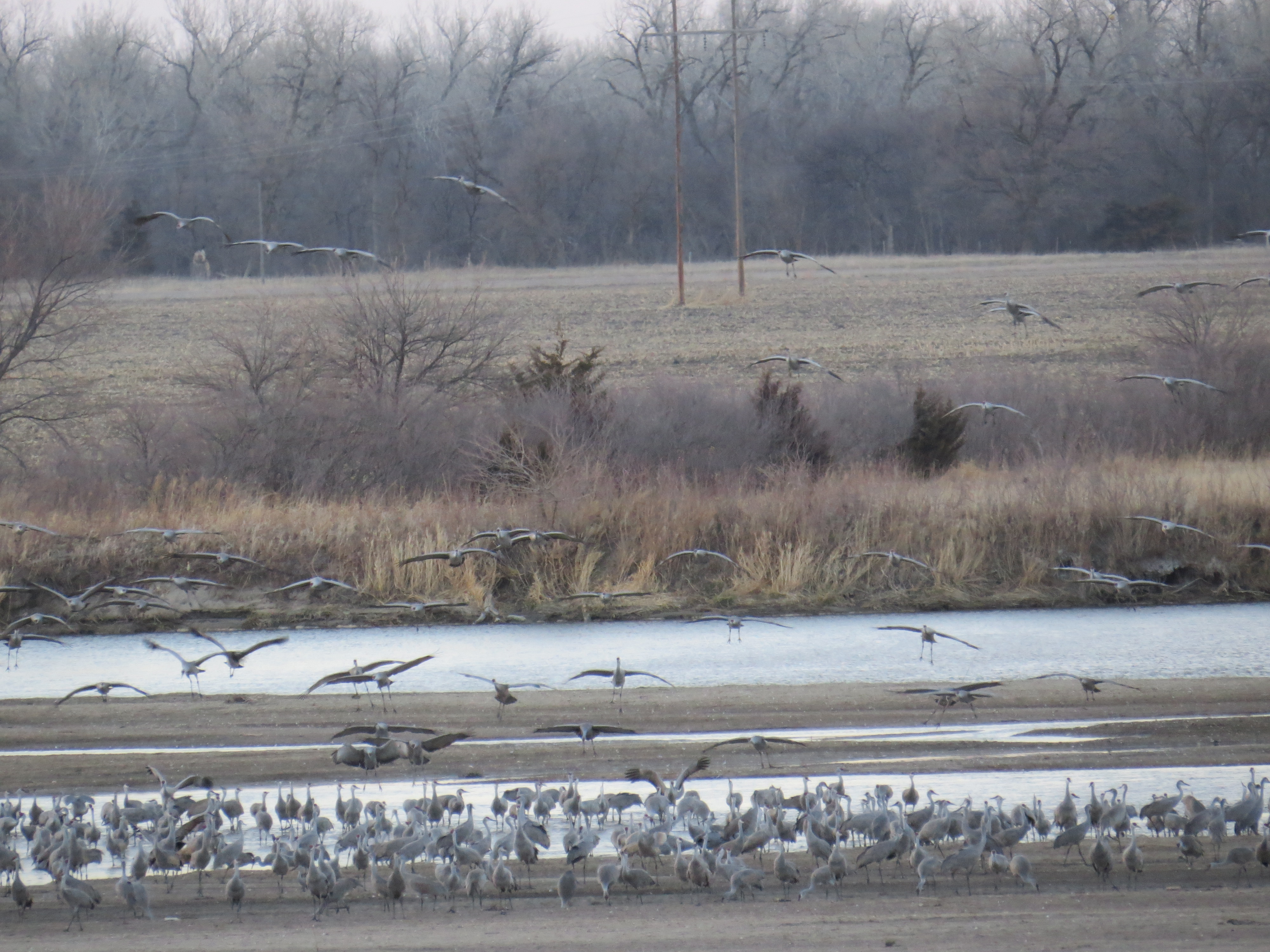
CRANES LANDING AT EVENING, ROWE SANCTUARY, 2014

CRANES LANDING AT EVENING, ROWE SANCTUARY, 2014

When I talk about the birds before we leave for the viewing blinds, I have everybody’s attention.  I am enthusiastic describing the migration, the distances the cranes travel, why they come to the Platte, and that it is one of the great sights of nature.  I am careful not to tell them what to expect, except they will see “cranes, plural.”  I tell them that we are not in control of the view; the cranes are.  I tell them that I’m going to learn something in the blinds:  I will learn about cranes, people, or myself, sometimes one, sometimes all three.


The last night I guide for a season is bittersweet.  I enjoy the trips, but I am physically exhausted.  I get up at 0440, make coffee, spend a little quiet time eating breakfast, for in 30 minutes, all the morning staff at the visitor’s center will be there.  Within an hour, there will be more than 100 people present, 85 of them tourists.  After the morning trip, I may be a roving naturalist, talking to people, I may be cleaning toilets, picking up people who went to the photo blinds, using an ATV, or running errands in Kearney.  I will get lunch and a 10 minute nap, answer questions.  Before I know it, the evening group is there.


My last evening, I was groggy from a longer than usual nap, a sign I was very tired.  When my group appeared for the short drive to Tower Blind, I told each of the 6 cars where we were going, and where we would park.  It is a short drive and a short walk, but I didn’t say much else other than to introduce myself.


When we parked, I let my co-guide talk.  She is a sharp Nebraskan who knows her stuff.  She quickly laid out what the birds were doing, completely in sync with me about what was and was not allowed.  I was beginning to get less groggy, and the evening air, full of the haunting sound of cranes, was starting to energize me: last tour of the year, my 101st time in the blinds. I spent the first four with my father and wife, others alone, in pre-season, when I have been alone with a hundred thousand birds in the vicinity, shivering with the cold and wind that the Nebraska plains throws at one, but also with excitement, too.


ONE OF MY TRIPS ALONE IN THE BLINDS, FEBRUARY 2010.  "CRANE MOON"

ONE OF MY TRIPS ALONE IN THE BLINDS, FEBRUARY 2010. “CRANE MOON”

We parked and walked 500 yards through a field and woods to 2-story Tower Blind, overlooking the Platte, back from the river, affording a panoramic view the other blinds didn’t.  I had been there three times that week; the other two OK, but spotty for cranes.  I was hopeful, however, for the previous night I was at East Blind, a mile upstream, no cranes landed there, but down near Tower, because of nearby eagles, which spook cranes.  I’m not responsible for the quality of the show, but I want my clients happy.  In any case, I will spend time by the river, see cranes, and I be outside.  That isn’t bad.

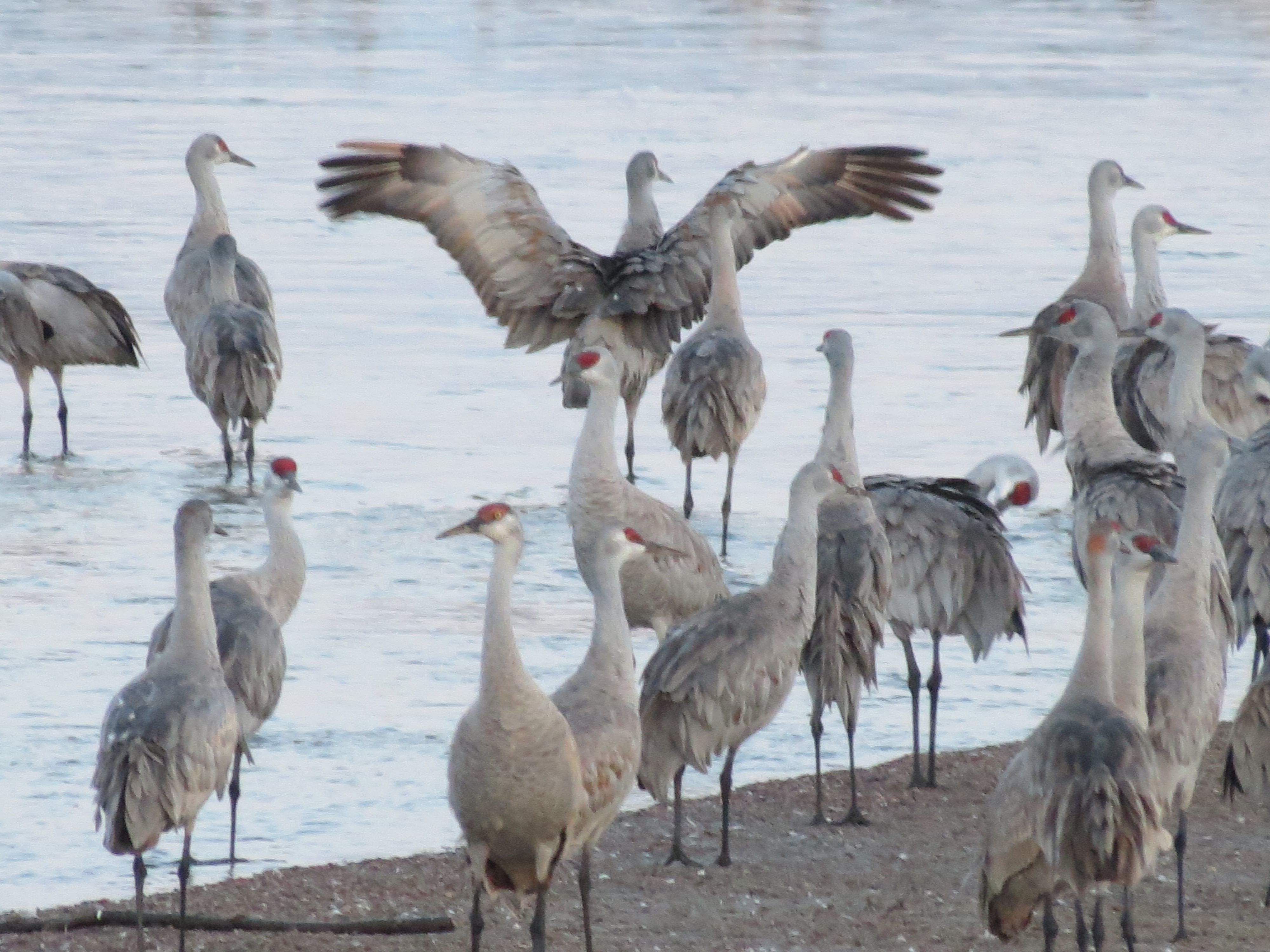
DANCING CRANE. THEY DO THIS TO RELEASE HORMONES.  CRANES HAVE THE SAME NEUROTRANSMITTERS WE HAVE.  LEARNING HAS BEEN PROVEN.

DANCING CRANE. THEY DO THIS TO RELEASE HORMONES. CRANES HAVE THE SAME NEUROTRANSMITTERS WE HAVE. LEARNING HAS BEEN PROVEN.


I had time to point out the flight of the cranes flying in, the group learning the asymmetry, a slow downbeat with a faster upbeat of the wings, so distinctive to these aerodynamically marvelous creatures, who may fly a quarter of a million miles in their lifetime and can, in 4 months, make a nest, lay eggs, incubate them for a month, and have the chicks flying several thousand miles south.  I found myself poetic that night, calling cranes “other nations, with senses, abilities, and feelings we will never have, experiences we will never share, and a language we can only begin to understand.”  I was getting people interested, and with cranes flying overhead, I am in my element.  I was getting energized.

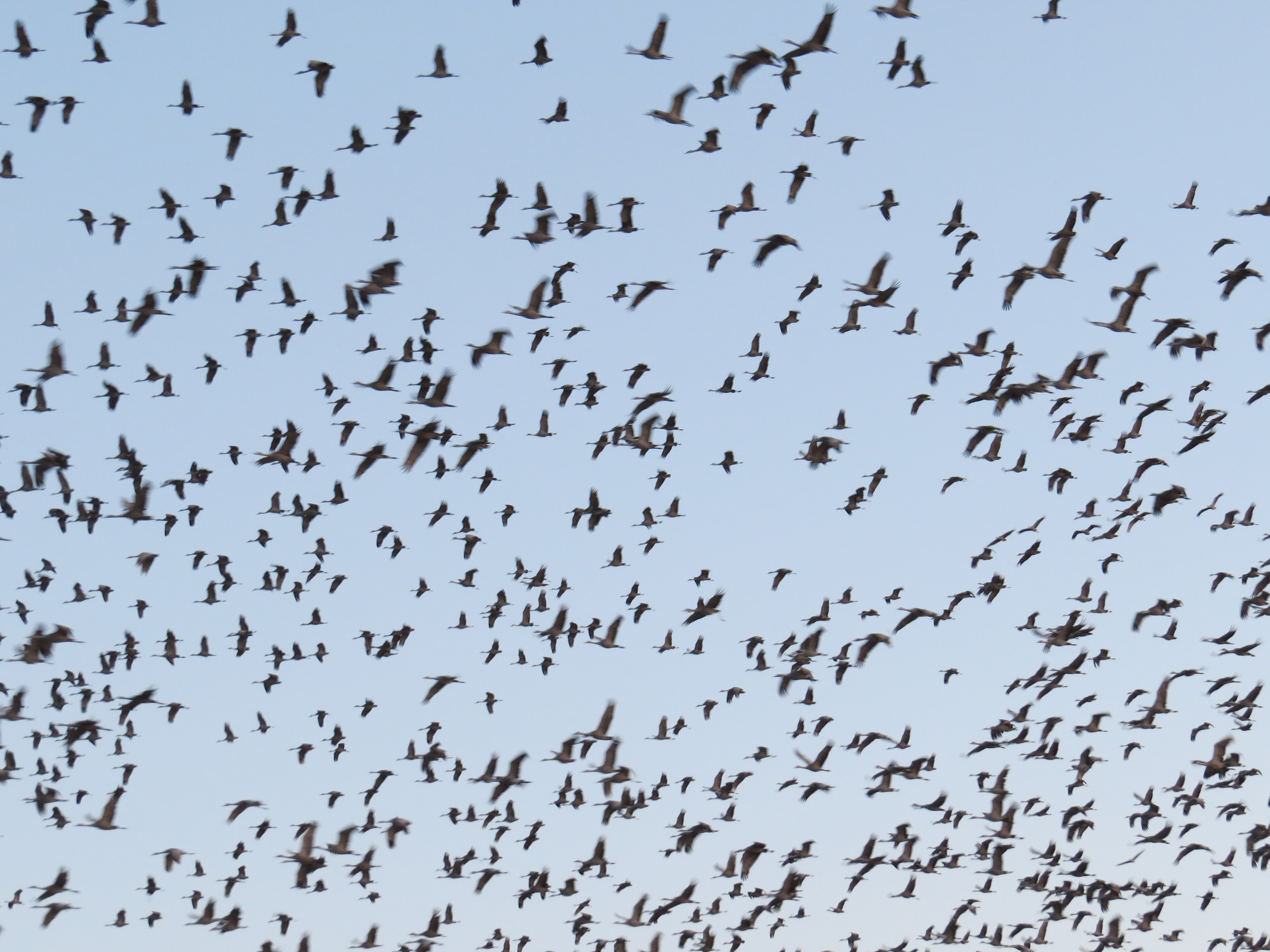
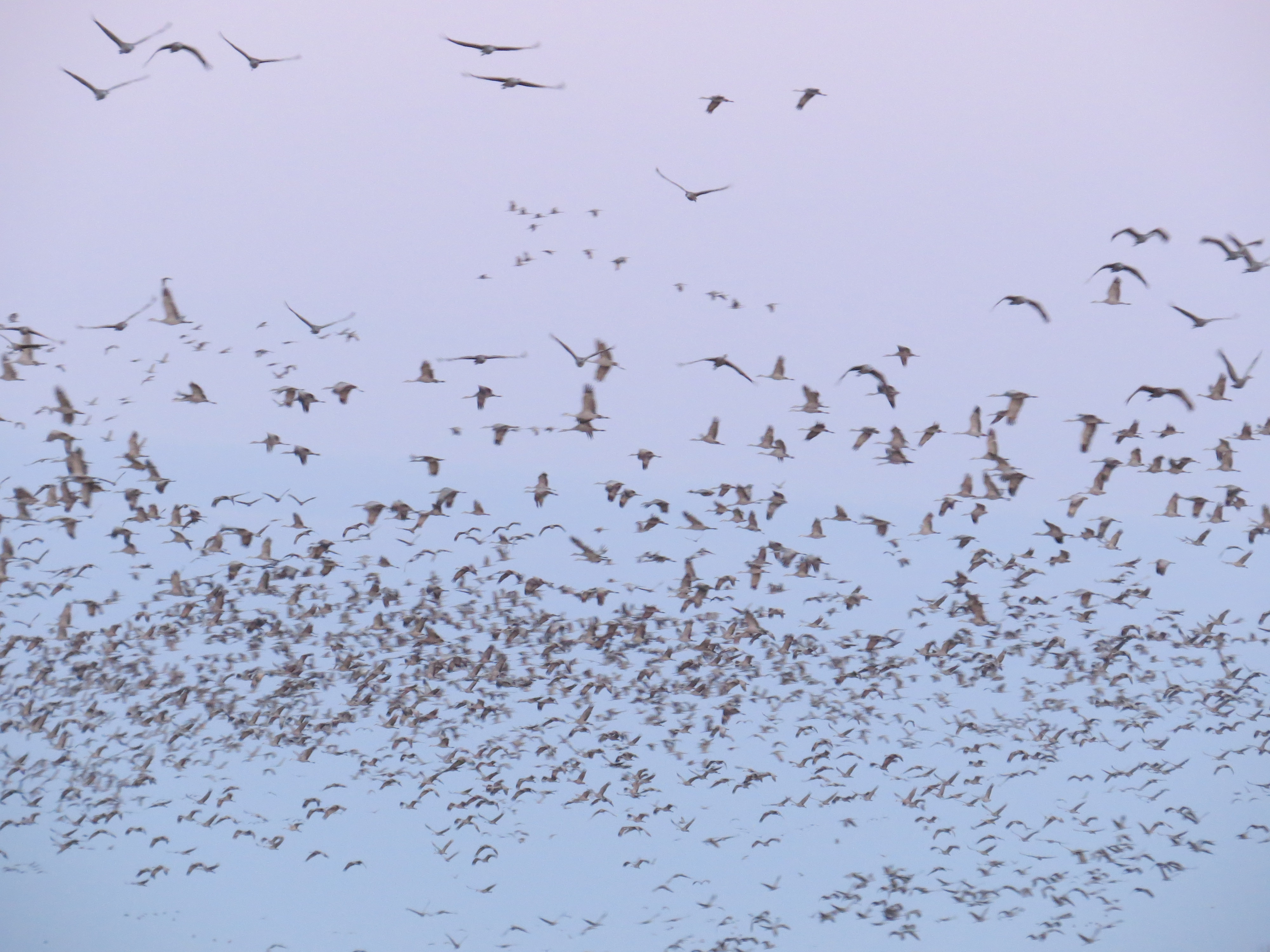
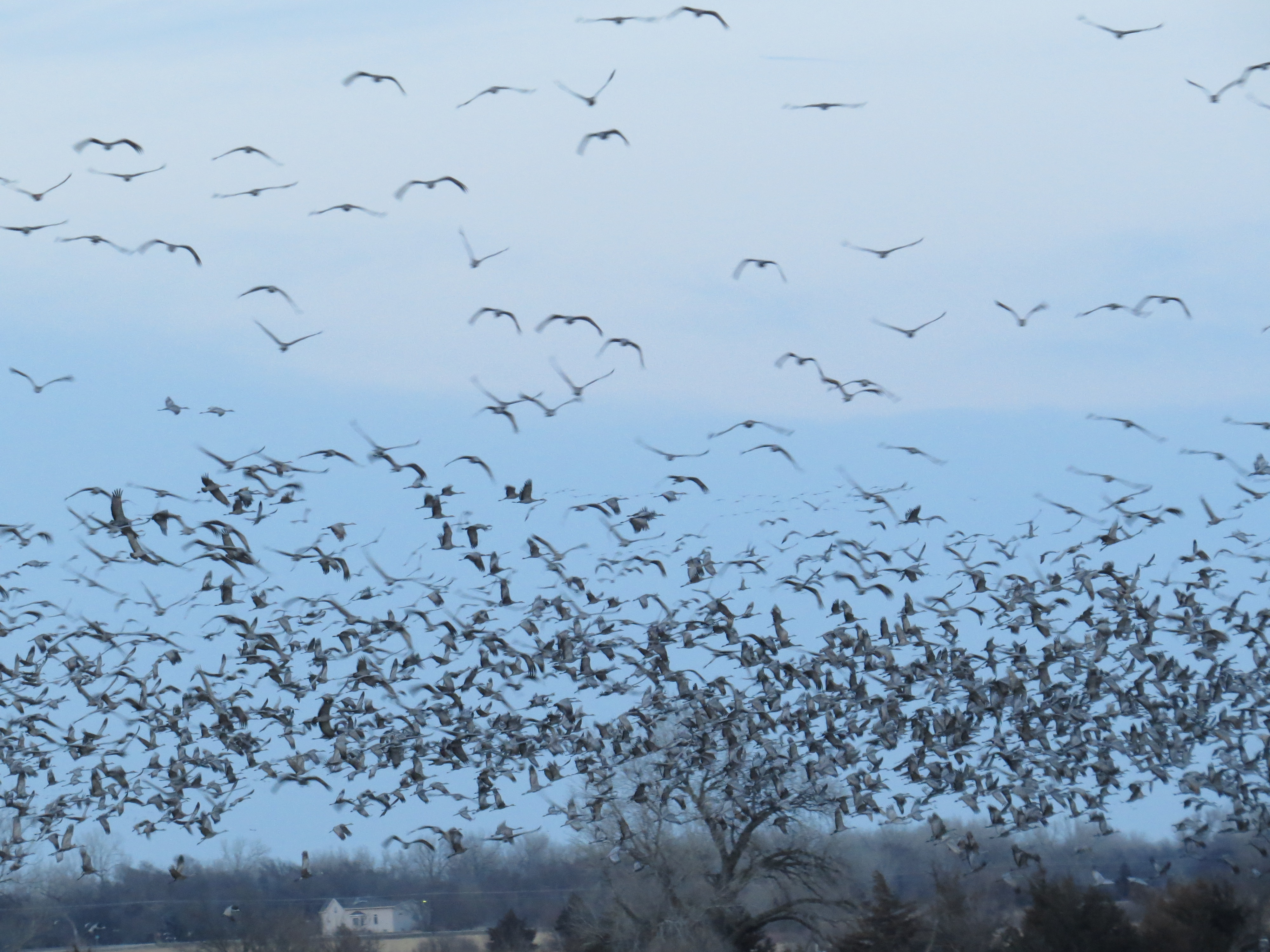
CRANES OVERHEAD. THIS IS LIMITED ONLY BY THE CAMERA'S VIEWFINDER

CRANES OVERHEAD. THIS IS LIMITED ONLY BY THE CAMERA’S VIEWFINDER


“Mike, turn down your voice.  They’re on the river.”  My co-guide, more observant than her talkative partner, had noted the first birds landing at 7:25, 30 minutes earlier than I had seen all week,  I shut up and let nature put on the show.

CRANES LANDING, FROM TOWER BLIND, 2014

CRANES LANDING, FROM TOWER BLIND, 2014


The birds arrived in enormous numbers, clumped in gray islands on the river, each with thousands of cranes, from the Gibbon Bridge to well upstream of us.  Twice, they flew off, perhaps spooked by an eagle.  That’s common morning behavior; to see it at night is special.  There were cranes everywhere, the noise, echoing across 9 million years cranes have graced the Earth, was essential to the visual show.  Like the loon, the call of the crane is every bit as important to the experience.

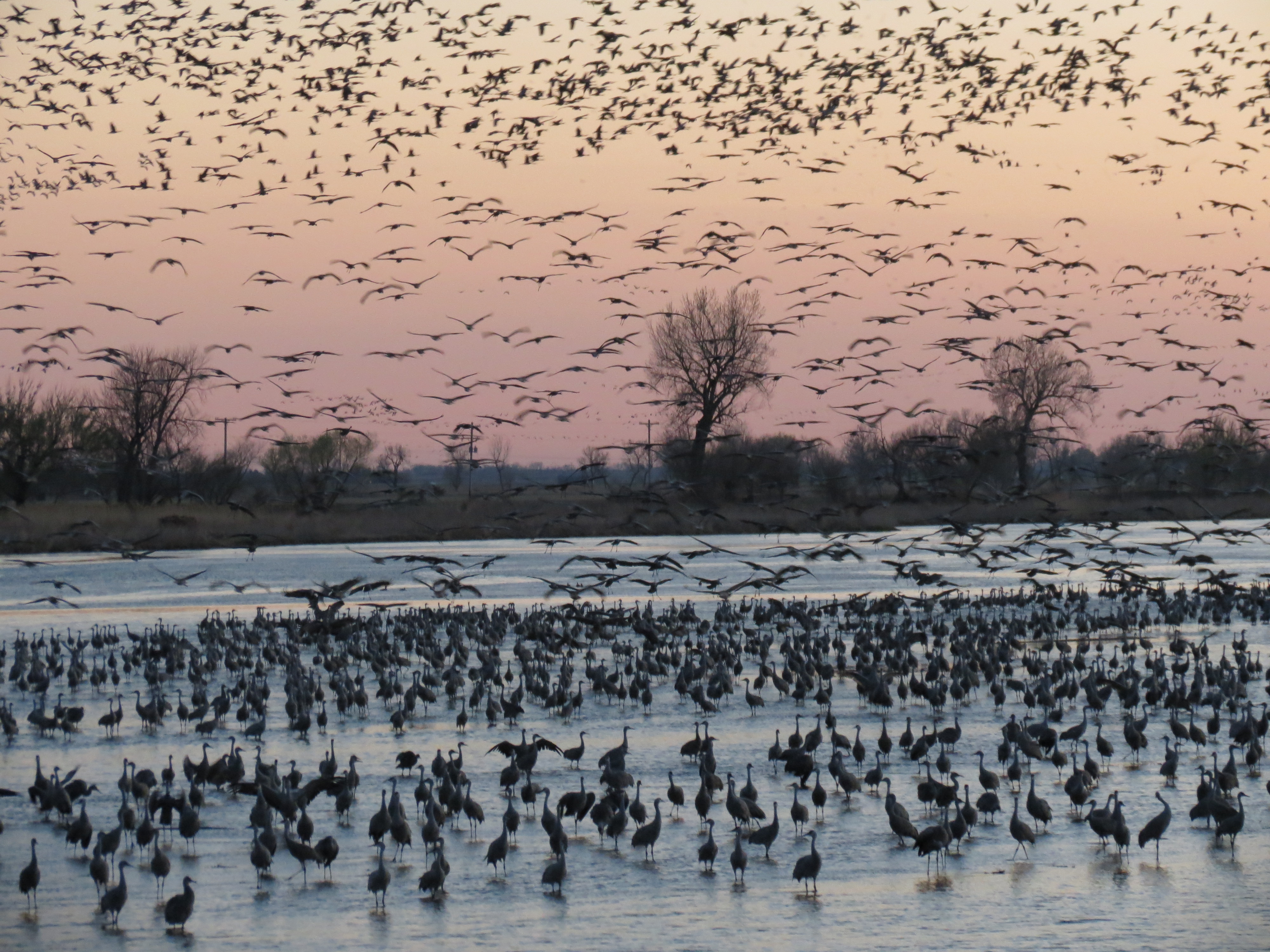
ENORMOUS NUMBERS.  I HAVE SEEN FAR MORE, BUT I NEVER TELL THE CLIENTS THAT.  THIS IS WHAT I CONSIDER "A GOOD NIGHT".

ENORMOUS NUMBERS. I HAVE SEEN FAR MORE, BUT I NEVER TELL THE CLIENTS THAT. THIS IS WHAT I CONSIDER “A GOOD NIGHT”.

When dark, we quietly left the blind, walking to the vehicles.  I was in the rear with a couple my age, discussing the show.  They were thrilled, asking me what I once did.  I told them I once practiced neurology, and they discussed their aging parents, 90 and 87, the same age as mine, when they died.  Their parents were demented; when I mentioned how I hoped might volunteer, not just to show people the beauty of life, but to give others help for the decision making how to die, the man said, “You’re preaching to the choir.”  We were almost back to the vehicles, when his wife said they were here for a respite from their caregiving.  Their gratitude for both the show and what came after on the walk was palpable.


The couple has a long road ahead of them, like the cranes. The road will not be easy for both;  one in twelve cranes will not return in 2015.  But the couple had seen something remarkable, life and hope, saw it together, glad they came, knowing they had a special memory to fall back upon during the hard times ahead.


I don’t usually say that a blind is “The best I’ve ever seen it,” to clients. But I said it about Tower that night. Paul Johnsgard’s “special conjunction of spring, the river, and a bird” mirrored my conjunction of learning about myself, others, and Sandhill cranes.


Godspeed to the cranes, on their way north, far from the Platte Valley, for it is time they must go.  Godspeed to the parents of the couple, on their way out of a long life, for it is time they, too, must go.  In the past, I helped many leave life with dignity; today, I helped others see the cranes on their way north to create new life.


I couldn’t have asked for a better ending to my guiding season.


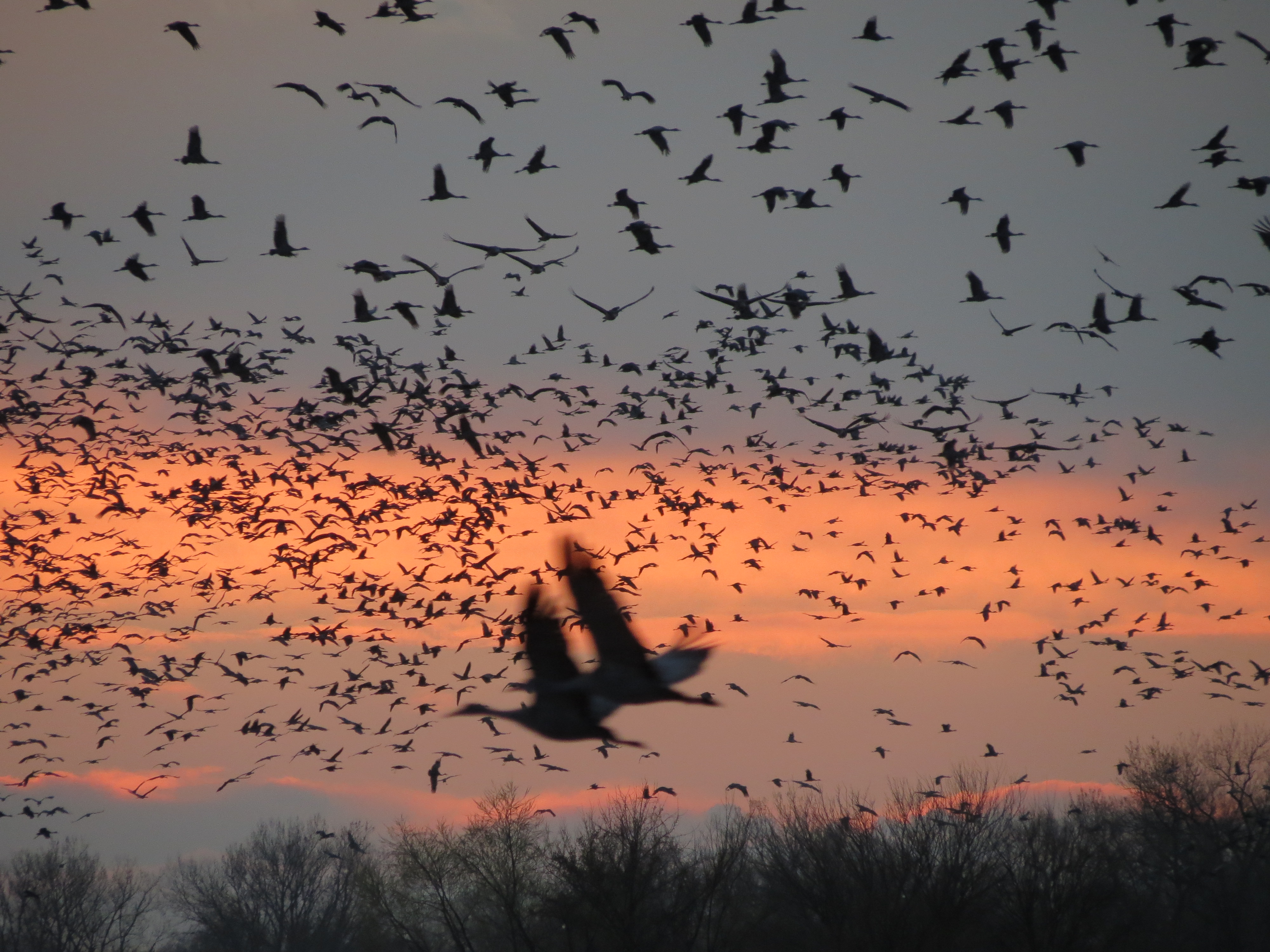
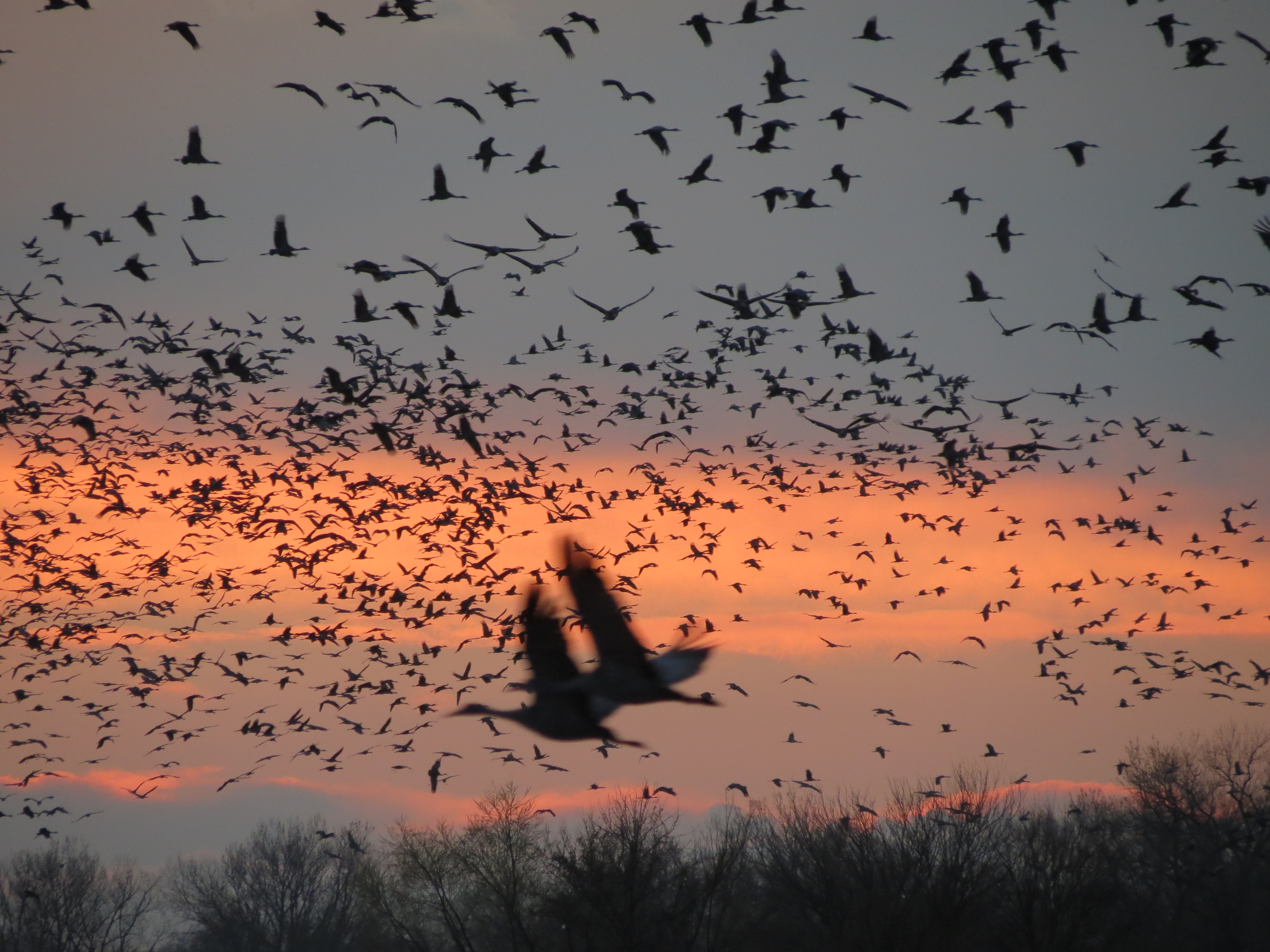
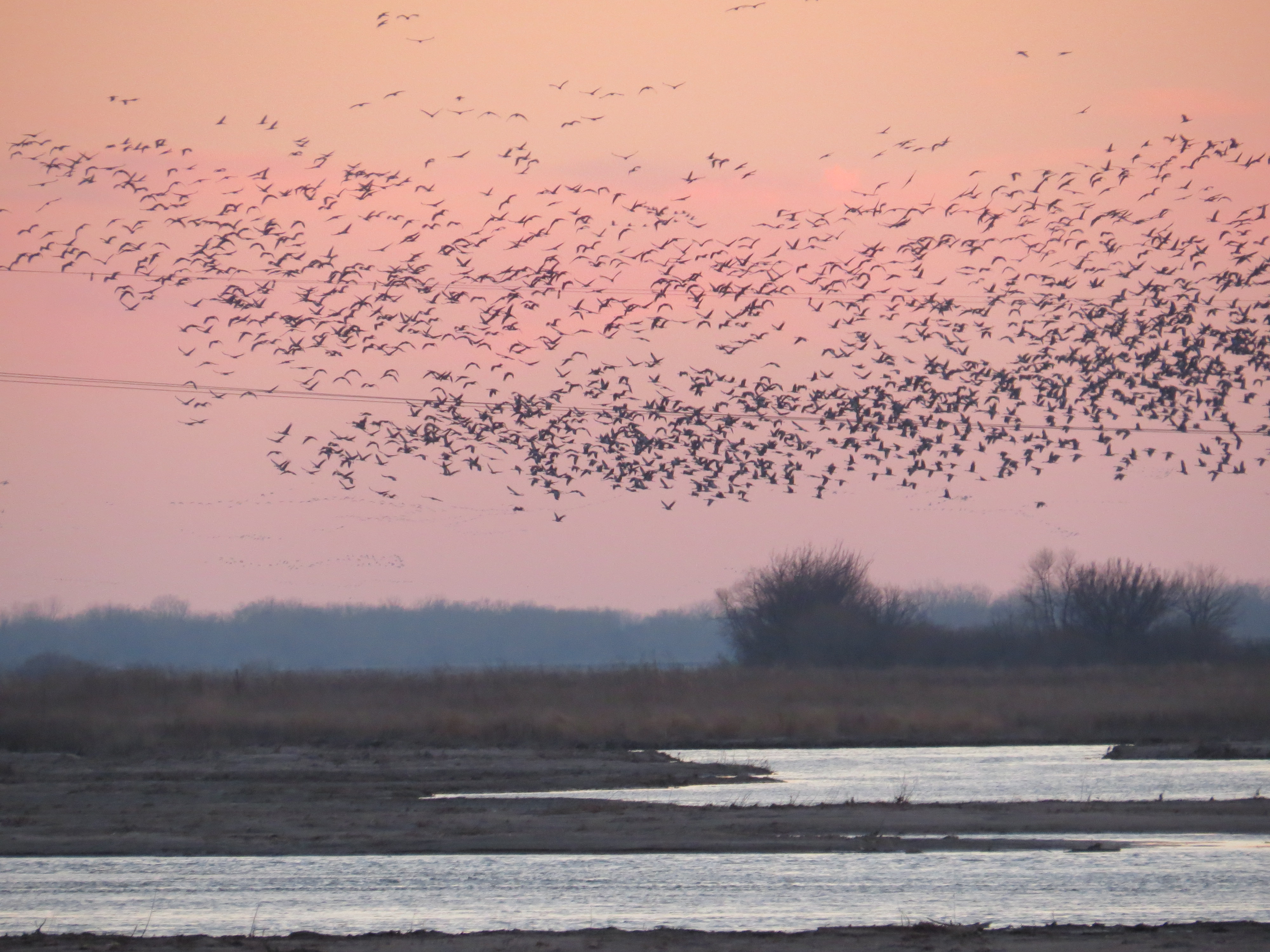
NEBRASKA SUNSET AND CRANES.  ROWE SANCTUARY.

NEBRASKA SUNSET AND CRANES. ROWE SANCTUARY.

BREAKING SOME OF THE RULES

March 31, 2014

I guide visitors to see the Sandhill Cranes in Nebraska, where in March evenings, they come to the Platte River in extraordinary numbers, leaving for the fields the following morning.  The birds are unable to perch, so they live on the ground, in the air, or in the water.  The latter acts as an alarm system, so no predator may get close to them.  The Platte, one of the most maligned rivers in US history, is perfect habitat, because it is shallow, with many channels, a braided river.

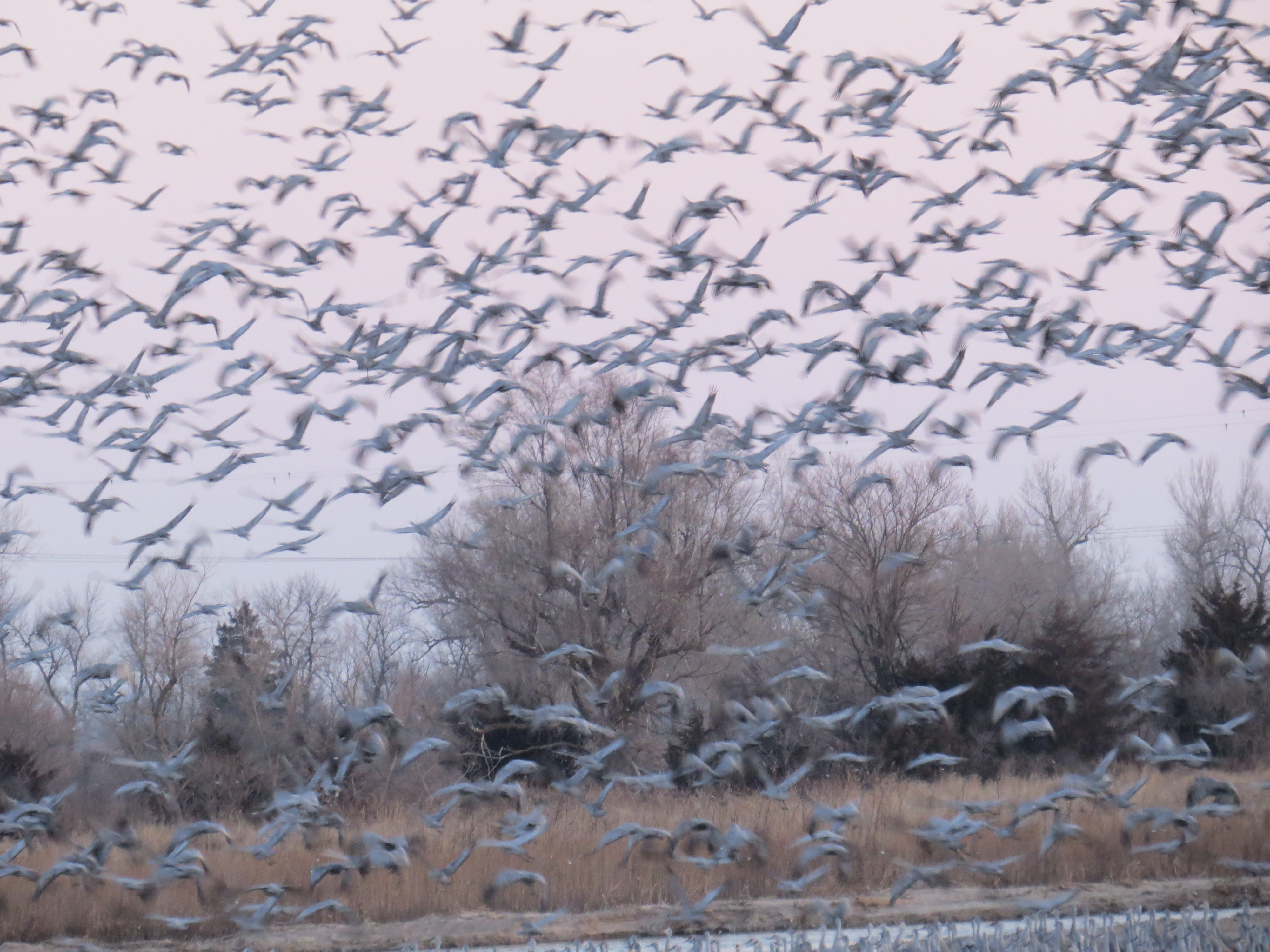
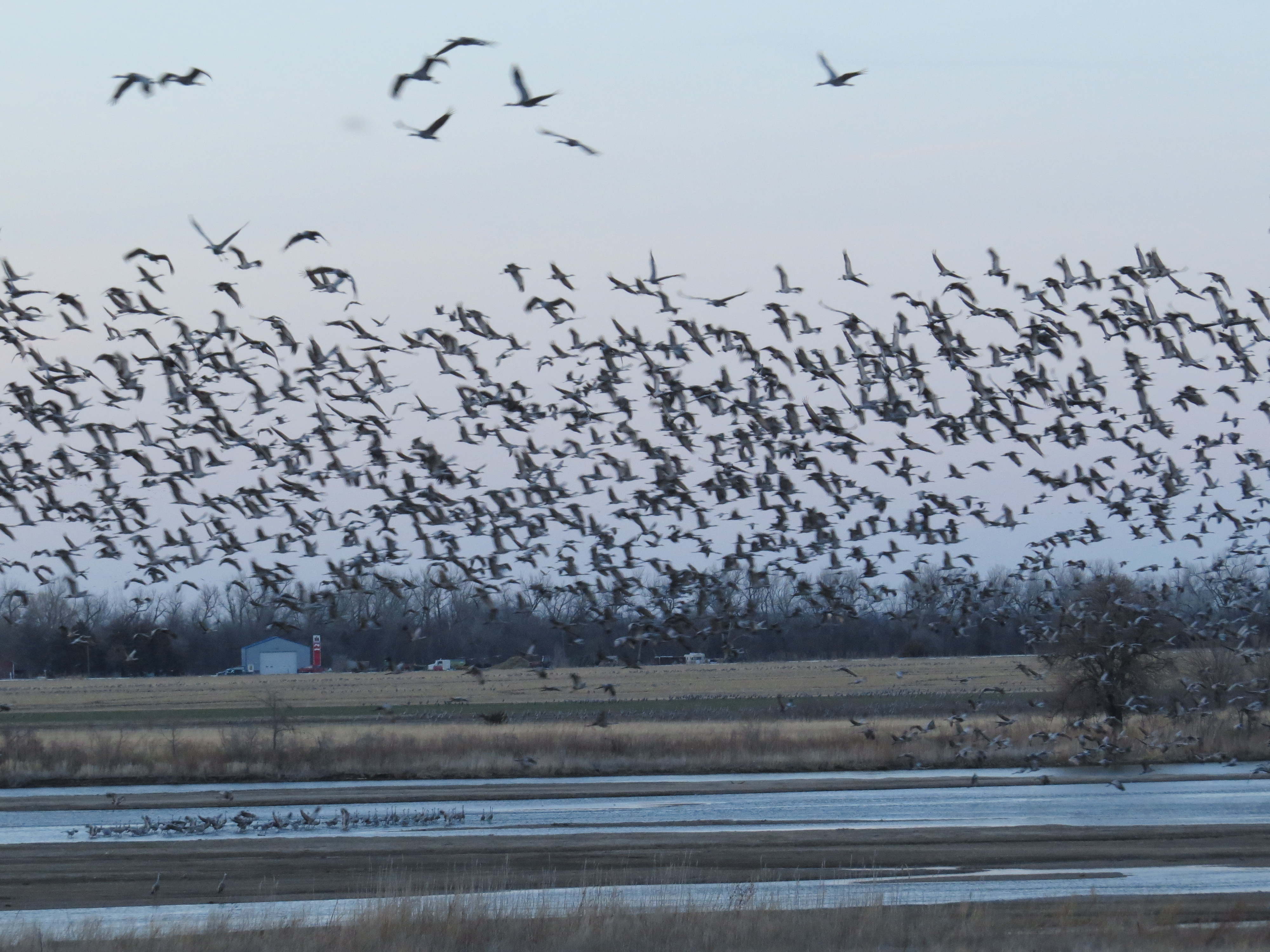
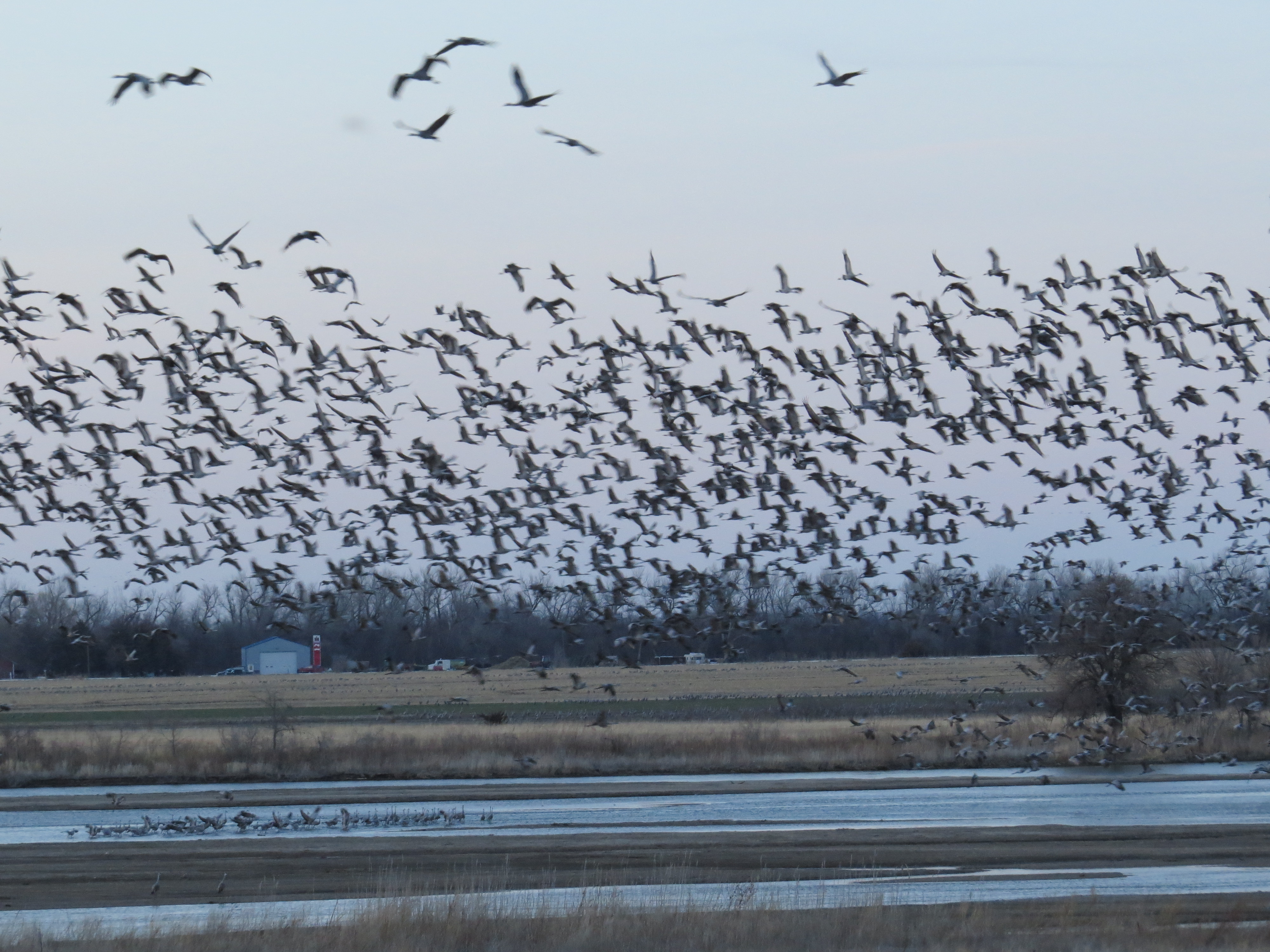
Cranes in the air.  This is a common sight in the morning or evening.

Cranes in the air. This is a common sight in the morning or evening.


I’ve guided for 5 years, and the rules for taking people to the blinds are strict.  Noise must be kept to a minimum.  I tell people if they can’t whisper, that is fine, just don’t talk.  Camera flashes are taped down in spite of “it’s turned off.”  That phrase is like “he never did that before,” when a person’s dog bites you.  The difference is whereas biting bothers me, a flash can spook ten thousand cranes into the sky, some injuring themselves fatally.  We also tape over the laser sensor, since that emits light, and at infinity focus, it isn’t necessary.  Nearly all are pleasantly compliant.  We put post-its over the display screen, to limit light reflection off one’s face out to the river.  We have strict rules about camera equipment.  We don’t allow automatic multiple exposures, for the sound detracts from the experience of hearing tens of thousands of cranes closeby.

Platte Sunset.  The river and sky are a mass of cranes.

Platte Sunset. The river and sky are a mass of cranes.


Yes, we are paranoid.  We walk out in groups with one guide’s leading and the other’s trailing.  We limit noise in the blind.  I tell client medical emergencies and their safety are my top priority, but when it comes to inconvenience, such as being cold, hungry, or bored (crane viewing isn’t for everybody), we stay put until such time as we may safely leave.  People may not leave when they choose.

Viewing Jamalee Blind from Stevie. These are memorials to Dr. Jamalee Fenimore and Stephne (Stevie) Staples.

Viewing Jamalee Blind from Stevie. These are memorials to Dr. Jamalee Fenimore and Stephne (Stevie) Staples.  There are 38 people in Jamalee, which is much larger than seen here.


We accommodate those with disabilities.  I took a man with significant Parkinson’s by golf cart to a viewing blind.  The carts are quiet, and the man had a set of photography equipment as advanced as anybody’s I’ve seen.  I helped him carry his equipment into the blind, and when the light was right, he set it up himself, quietly. He took his pictures and told me later, on the way back, it took him 26 years to finally get a sequence of crane dancing correct.  It hangs in the visitor’s center at Rowe.


We allow golf carts to two of the five blinds; the third one, East, does NOT allow for golf cart transport.  It is too exposed in the morning and the path too bumpy to make golf cart transport easy.  The other two blinds are near each other, so we can do multiple trips if necessary.


I sleep on the floor in the visitor’s center, awake at 4:40 seeing to what blind I am assigned.  I found I was going to East but we had two people needing a golf cart.  This was a mistake and a problem.  I discussed the matter with one staff member at 5:15.  She was concerned, too, and we thought about moving people from one blind to another.  That wasn’t going to work.  Another staff member made what I call a “command decision.”  I would take one man in a golf cart to East, parking it some distance from the blind.  This was breaking a rule, but we felt the situation called for it. I thought the solution good; I would quietly lead the group out in the cart, my co-guide keeping everybody behind me together.


East often didn’t have “good cranes,” as we guides call it, because some left very early in the morning, not allowing for pictures.  Indeed, the prior day, the guides got there too late for the “blow off,” which occurs if all cranes leave at once, such as being spooked by an eagle, a coyote, a dog, or some loud noise.  I heard that story, so I kept my morning briefing in the center…..brief.  It gets light in Nebraska early by late March, and I was in a hurry.  As my group entered, I taped all the cameras appropriately, explaining my reasons.  I told them this was the proper time to use the toilets in the center, so they would be ready to leave when I was.

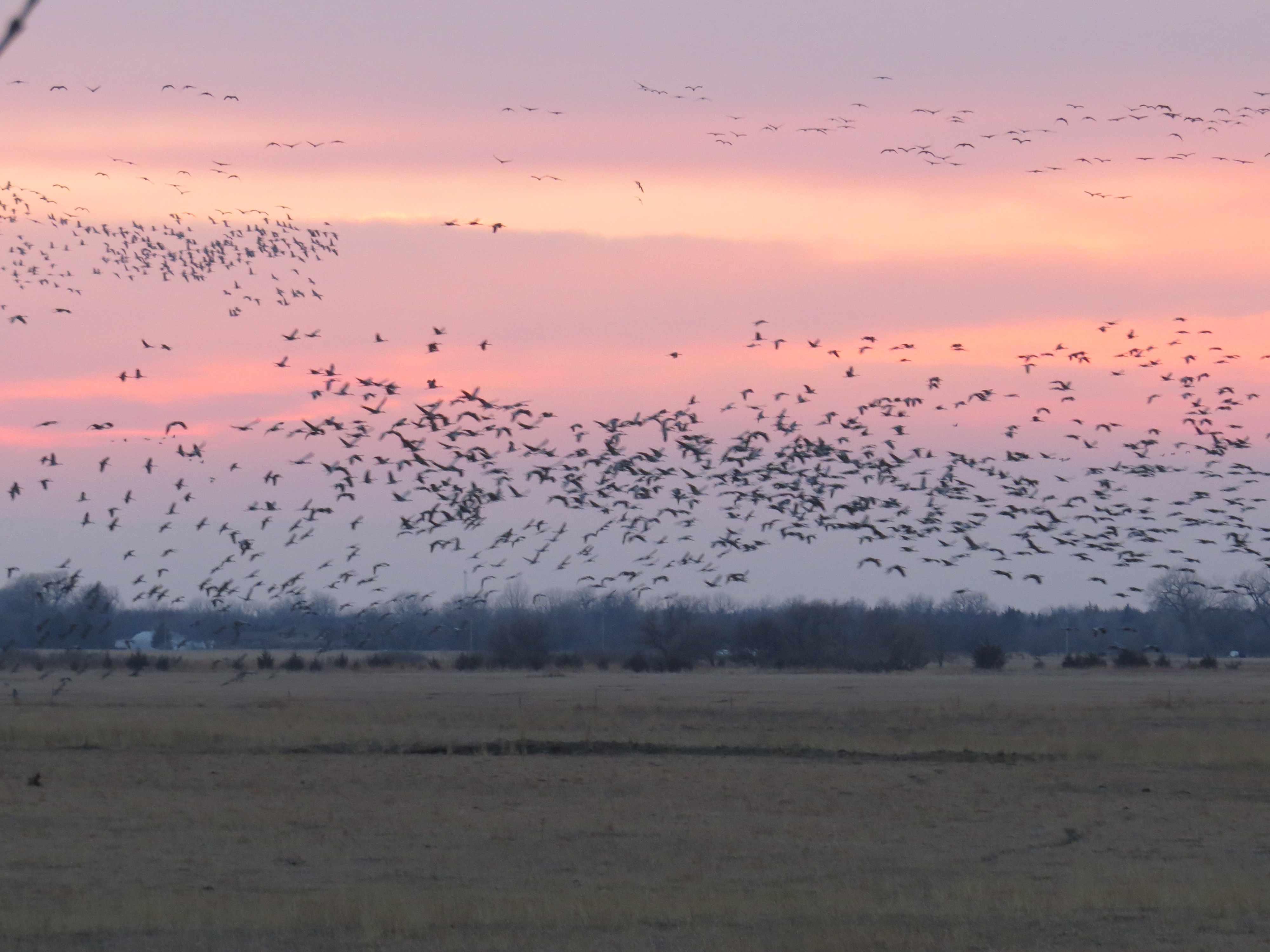
Cranes at Sunset, North Blind, across the River.  They often secondarily stage (land) in the field here, coming in from several miles away from the river, where they fed on waste corn during the day.

Cranes at Sunset, North Blind, across the River. They often secondarily stage (land) in the field here, coming in from several miles away from the river, where they fed on waste corn during the day.

I told the group what the birds were, where they were coming from, migrating up to 7000 miles (one way).  They were feeding and putting on fat for the trip north, where they would build nests near Great Slave Lake; Bettles, Alaska; Siberia;  the Hudson Bay watershed.  I’ve seen cranes north of the Arctic Circle.  I told the 30 there it was one of the great sights in nature, one of Jane Goodall’s top ten, one of my top four.  I told them I was a volunteer, and I wanted them to have a wonderful time.

Then I told them the “don’t”s, including keeping body and camera parts inside the blind.

I didn’t ask for questions. I said we would talk in the blind later.  Some guides go into great depth.  I do, too, in the evening, when we have time.  In the morning, I want to reach the blinds early.  So do the clients, too.


Then we left, and I took the man needing the golf cart, the rest of the group in tow.  On the way out, the man told me he had leukemia and had just finished chemotherapy.  He wanted to see the cranes this year, even a few.  He hoped he would be back again.  I did, too, but leukemia is leukemia.  Then again, at my age, I start talking in terms of “if I am still around.”  This man may not be, and we both knew it.

East Blind was great. Cranes were on the river right out in front of it.  Ten minutes later, they all blew off into the orange sky of a Nebraska sunrise.  The man saw it.

In order to take a man with leukemia to East blind, I’ll bend the rules.  Had he asked to use a flash, I would have said no.

I hope he’s back again and again.  We’ll just be sure if he needs a cart, he goes to the other two blinds.

IMG_0402 IMG_0397 IMG_0399 IMG_0400


Crane sunset.

Crane sunset.

IMG_0137

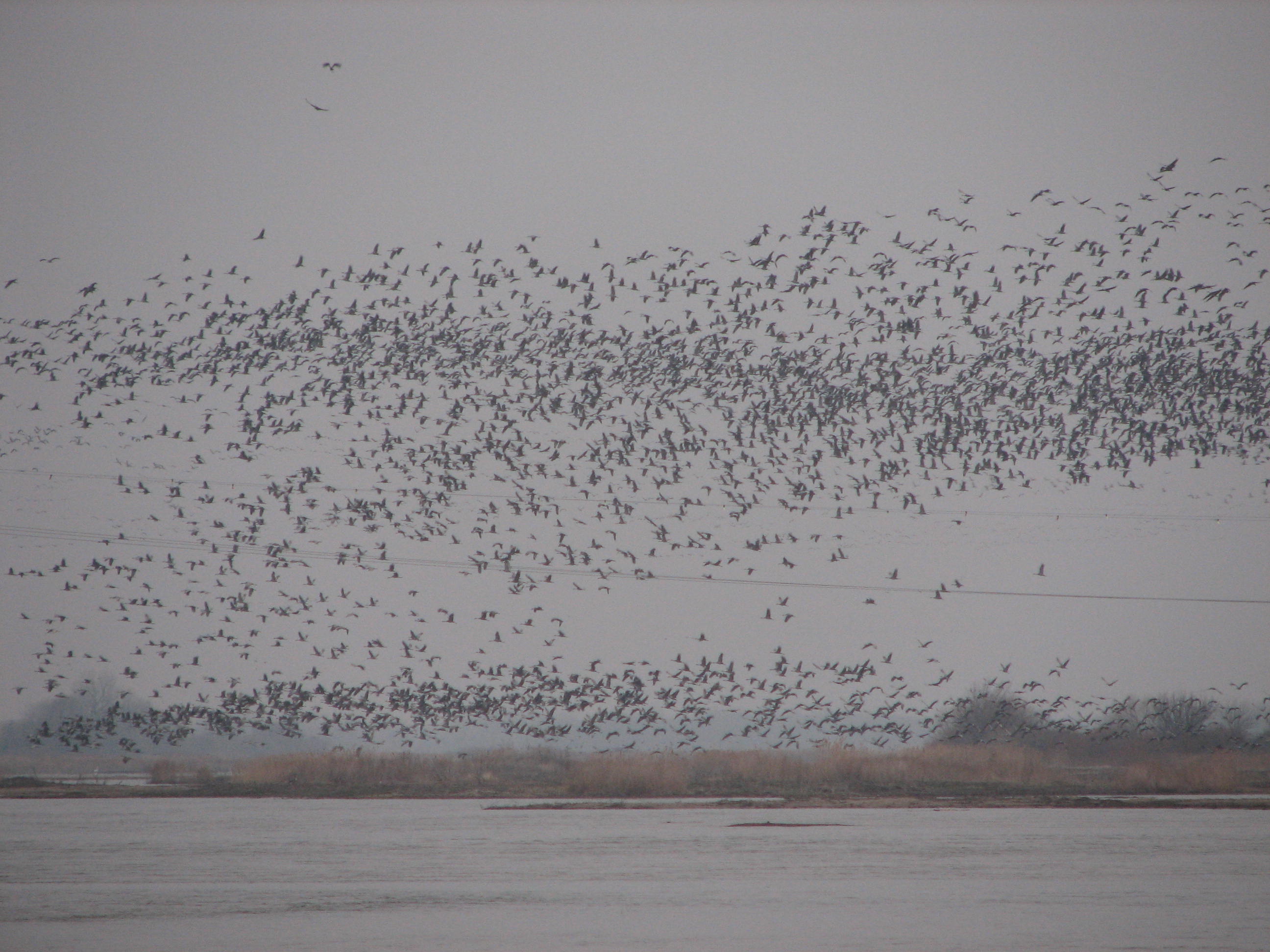
Sky dark with cranes

Sky dark with cranes

PAGE 107

March 31, 2014

Despite difficulties with the Affordable Health Care Act, I have had no problem with Medicare, “big government” medicine.  I have, however, had problems with one private insurance company.  I will call it “X,” to avoid any semblance of libel, although I am not telling an untruth.  Part D was enacted by the Bush administration, and while a step forward, I expected perfection, since Bush was a Republican.  I did not expect a “doughnut hole,” cost overruns, and failure to negotiate with pharmaceutical companies.

Anyway, I signed up online with X and a local pharmacy for my two prescription medications.  I used my Arizona address, because at the time I lived there. I soon discovered that I got what I paid for.

I take Drug “A,” 2 mg, 2 pills twice a day, 240 mg monthly.  Drug A has 3 sizes:  2, 5, and 10 mg.  Representatives from company X told me that Medicare regulations limited the number of pills per month to 90, in order to prevent falls, a potential side effect.  This restriction was not true, I later learned.  Rather than to ask my physician for an emergency authorization to take my usual dosage, I procured a prescription for 5 mg, 60 a month, although I needed to take my daily dosage in a different fashion.  It wasn’t ideal, but I could live with it.  Notice that I could take 300 mg a month.  That was a tipoff that Medicare restrictions were not the issue, private business restrictions were.

I called a special number to X and had a 3-way conversation with their clinical pharmacist and their sales representative.  I had no problem with Medicare’s restriction; I did have an issue with the monthly allowed dose, which made no sense.  Knowing the answer, I asked my next question:  How many 10 mg pills may I take a month?  They both answered: “120”.

I continued:  “So, I can’t take 120 pills of the 2 mg dosage a month, or a total monthly dosage of 240 mg, right?”  They agreed.

“But,” I continued, “I can take 120 pills of the 10 mg dosage a month, 1200 mg total, 6 2/3 times the allowed 2 mg dosage, right?”  I teach high school math; I knew this stuff when I was about 6.

There was sudden silence on the line, then, “we need to talk to our supervisors.”  In other words, apparently somebody at X realized the restriction of dosage for the smaller amount did not obviate the issue of prescribing a larger number of pills for the larger dosage.

That is Part 1.  On 7 March, I went to the pharmacy to get my prescription, only to be told I had been “disenrolled” from X on 28 February.  No reason was given.  Nobody at X answered the telephone on the weekend, so now I was without Part D coverage.  Suppose I were 75, on chemotherapy, needed a key anti-arrhythmic, didn’t have money, and had moderate dementia?  These things occur, even to elderly Republicans.

Becoming concerned about coverage, I called AARP-recommended United Health Care, spoke to a person, and enrolled, effective 1 April.  I will have no coverage during March.  Fortunately, I have enough medication.  If I didn’t, and the medication were expensive, I would be in trouble.

One may change address for coverage of drugs under Part D, and I planned in March to inform X that starting in April, I would be living in Eugene, not Tucson.  I don’t know how X got my Eugene address, except private information is easy to find nowadays.  Amazon, most of West Africa, and every medical organization worldwide appears to have mine.

On 14 March, I received a letter from X, dated 7 March, saying “Your Prescription drug coverage ends soon” .  In fact, when I got the letter, I was already two weeks without coverage; when the letter was written, I was already a week without coverage. Given the letter was written in the future tense, I wonder how X treats the past.

I quote part of the letter, my comments in bold:

“Thank you for letting us know about your change of permanent address”  (I didn’t.  I would have in March, had I not been disenrolled.)

“You now live outside X Prescription Drug Plan service area. To be a member of our plan, you must live in X’s service area, although you may be out of the service area temporarily for up to 12 months. How did you know the address wasn’t temporary? For that reason, we’ll disenroll you from X’s Prescription Drug Plan on 02/28/14.  “Because” is a better word than “for” in this instance.  The tense was wrong, they waited several days to send the letter, it was dated a week after the fact and took 7 days to travel 2000 miles.  

X did nothing illegal.  On page 107 of my coverage document, the wording was quite clear.  It wasn’t in fine print, but I wonder how many people go through these documents word by word, especially elderly folks, who may not understand a lot of these terms.   The individuals involved at X did not appear to know the English language, judging by the tenses; further, they did not mail the letter in a timely fashion, I had no chance to appeal, and without warning, I lost my coverage.  That was not mentioned on page 107.

While the Affordable Health Care Act has become a whipping boy for all that is wrong with medicine, this is an insurance company issue. The one organization that has worked is Medicare.  I suggested two decades ago that we would do well to expand Medicare to cover everybody:  It would be a one page bill, solving many problems. Costly?  Sure.  What cost can one place on not having insurance and being ill?  A lot of people pay that cost, especially the ill person.  Is that what America is about?

Perhaps X is a good company.  In my experience, however, they drop people suddenly, then later use the future tense.  I teach English online to people in 90 different countries and know the difference between the past perfect and future.  Their letter was signed:  “The X Enrollment Team.”  I am old enough to remember the jokes about “the 20 Mule Team.”  This would be funny, if it weren’t so potentially dangerous to the elderly.

I must be careful; “scorn or ridicule” are part of the definition of libel.


HOOFING IT THROUGH THE DENVER AIRPORT

March 27, 2014

I was really pissed when I opened my e-mail in Portland, a month ago, as my wife and I were getting ready to fly back to Tucson, after a trip to Eugene. “Your flight to Kearney has been cancelled.” The online travel agency didn’t offer a suggestion, only a telephone number to call. This was not what I needed to hear in the morning. The good news was that I could get to Kearney that same day from Denver, in order to volunteer to help out with the Sandhill Crane migration at Rowe Sanctuary. The bad news was that I would land at about 4:45 p.m., 20 miles from Rowe, with the evening tours beginning at 6.

My stay this year was already shorter, because we were in the middle of a move, and I was lucky I could even go. But, I was about to lose an evening in the viewing blinds, which is my selfish reason to go. I guide people to the viewing blinds at Rowe Sanctuary, because the cranes may only be seen close up if people are hidden. Nebraska is the only state where they are not hunted. If I am not a guide, I will “tag along,” to be in the blind, if a space at a window opens up. One always does. I admit it, I am selfish. But I clean toilets, do odd jobs, make morning coffee, act as a roving naturalist, and sleep on the floor in the gift shop. In past years, I taught a beginning course on Cranes for interested tourists. I have taken people out to the photography blinds and brought them back, cleaning up the “chamber pots” they use during their all night stay along the river. That may sound gross, but I enjoy driving out and back, and almost everybody who goes there loves it. I’m not religious, but when I hear somebody say, “I feel closest to God when I am by the river with fifty thousand cranes,” I understand the spirituality. Yeah, I wanted to get to Rowe early in the day, and it wasn’t going to happen.

I found the flight had been cancelled, but I went on line two days before I left, discovering it hadn’t been cancelled, so I tried to get on it. No such luck. I would be leaving in the afternoon, getting there in early evening. The day I left, I arrived in Denver, at 1030, knowing the Kearney flight departed from a different concourse at 1035. But, as I walked from the far end of B concourse, I glanced at the first monitor, looking for the Kearney flight. “Whadda know,” I said to myself, glancing at the yellow “delayed” on the screen, “let’s give this a try.” I didn’t really think I had a prayer of making the plane, but I doubled my pace, weaving through the crowds like an expert slalom skier. “It never hurts to try,” is one of my mottos; another is “All they can do is say no.”

I was seriously hoofing it, so much so that I got on the moving walkway, in order to add another mph to my speed. When a walkway wasn’t working, I took it, because nobody else was on it, and I had a long empty straightaway. I caught the airport train perfectly, got to the A concourse, and blasted up the stairs so fast that the guy in front of me doing two at a time was in my way. I blew by him, not even running, and turned on the gas at the A concourse. I went downstairs to where the small plane check in counter was, asking if the plane were still there. It was, planned departure at 1100.

It was 1055.

I had gone from the plane, through 2 long concourses, a connection, a train ride, and some stairs in 25 minutes. This is hoofing. I jog-walked the last 300 yards to the gate, asking, a bit breathless when I got there if I could get on, assured I could. I then asked if I had time to go to the restroom, although that was really pushing my luck, but again, all they could do was say no. I had enough time to make the calls I needed to arrange a pick up in Kearney and send an SMS to my wife.

This isn’t the first time I’ve done this. I had an 8 a.m. flight to Dallas one time, and as I started walking to the gate, I noted a monitor that said the 8 a.m. flight was delayed. I saw there was a 7 a.m. flight not cancelled, and it was 6:45. I literally walked to that gate, getting on board the 7 a.m. flight, with more time for my connection in Dallas, which was tight to begin with. Lucky? Yes. Very. But I made my luck, too. I thought fast, looked at options, and asked unabashedly.

Much success in life is luck: a photographer who has a person bankroll a book he writes, becoming famous as a result. An amateur astronomer who happens to discover a comet, because he happens to be looking in the sky for one, was out on the right day, in the right weather, and looked in the right place. Some have become famous as a result of their luck. But they made their luck, too. They didn’t bemoan their failures or their work. They put themselves in the situation where the probability numerator might increase with the denominator. When both increase the same, the overall probability increases. It is a mathematical fact.

I could have just as easily sat in the airport and waited the 4 hours for my flight. Instead, I looked at the monitor, knowing these small planes are often delayed because of weather or not having enough pilots or flight attendants. I had nothing to lose by looking, except the few calories by hoofing. I made my luck. Life doesn’t often work out the way we want, but sometimes there are opportunities that arise, taylor made for those who aren’t quite ready to call it quits and are willing to go for the long shot. To most people, getting on that earlier flight wouldn’t have made a bit of difference. To me, it did.

Later, I learned the flight I would have taken was delayed 4 hours.


Cranes over the setting sun.

Cranes over the setting sun.


Evening cranes

Evening cranes

Morning crane "blowoff" from the Platte River.

Morning crane “blowoff” from the Platte River.

Fog cranes.

Fog cranes.

SNEAKER WAVE

March 19, 2014

Occasionally, I do something really dumb and wonder how I could have been so clueless.  Sadly, doing stupid things has not disappeared with age. I don’t usually state my major blunders in public, but my latest mistake is one from which some might learn.  Three years ago, two young men from Eugene were not so fortunate and drowned.  I wasn’t in danger, but I did something foolish, ruining my camera in the process.

I am new to the West Coast.  I am exploring Oregon by hiking; while I have extensive experience in the woods of northern Minnesota and the high country of Arizona, Oregon is different.  I have hiked in Washington State before, and I know about slippery rocks, need to carry rain gear, and taking the usual essentials before setting off alone.  Indeed, when I drove west to Sweet Creek Falls Trail, near Mapleton, I left a note on the kitchen counter, where I was going, what I expected to do, and the fact that the barometric pressure was steady when I left.  Rain was forecast for later the day.  I always leave notes when I hike alone. It makes searching for my remains easier.

The hike was pretty, not difficult, along a lovely river, with only a few areas where I needed to be careful.  However, I never forgot that a classmate in medical school died in 1973 when he fell on a rock in a stream and hit his head.  Bad things may happen, and may happen suddenly.  A slight misstep can become life-threatening or very inconvenient.  I got a lesson in the latter this day.

Sweet Creek Falls trail

Sweet Creek Falls trail

Sweet Creek Falls

Sweet Creek Falls

When I finished the hike, I decided to drive to the coast.  It was only 20 miles, and I thought it worth visiting the coast of my new home state.  When I arrived at the long stretch of  dunes, south of Florence, I found a deserted parking lot and texted my wife where I was.  I had deviated from my planned route, and any time I do such, I MUST communicate.  In the canoe country, I cannot, so if I am alone, I NEVER deviate from my route.  This is smart; what I did later wasn’t.

I went over the dunes, walking down to the nearly flat beach.  The waves were high, but there was a lot of wet beach that waves did not come up to often.  But wet beach=water, and I did not appreciate that obvious sign.  Suddenly, one wave appeared quickly.  I started to walk, but the wave overtook me, water reaching mid-calf and into my boots.  I laughed, thought it fun, as the shore was relatively flat, and wet feet weren’t going to ruin my day.  The ocean had warned me.  Nature warns, but we have to listen.  I did not.

Ten minutes later, I sat on a log down the beach, wringing out my socks, when another wave quickly appeared, but less powerful.  I raised my legs, the water went on both sides of the log, and I stayed dry.  I had been warned again.  The ocean was saying, “these are sneaker waves.”

Footprints in the sand.

Footprints in the sand.

View at top of dunes, 50 ft (15 m) above ocean.

View at top of dunes, 50 ft (15 m) above ocean.

IMG_4166

View of the ocean from the dunes. The small log where I sat is left of center, on the beach.

I continued further south along the beach, climbing into the dunes, taking pictures of the ocean, the dark clouds that would herald rain later, and returned to where I came into the beach.  I constantly monitor the sky, I am less good about monitoring the ocean. I saw a large log, 18 inches in diameter and several feet long, with perhaps a foot wide flat surface on top.  I stood on the log, timed the swells, curious as how often a big wave would come in.  Nearly all waves crested about 50 yards away.

IMG_4174

Soon to be a sneaker wave. No way to tell, except no water was flowing back into the ocean at the time.  Last picture taken from my camera.

The log where I stood

The log where I stood,  Notice how far up the water was capable of going.

Suddenly, one large one came in.  I felt safe on the log, above the water, but I had forgotten something I really should know–the power of moving water.  Two feet can float a car.  The water wasn’t that deep, but it was moving at 5 mph.  I could outrun it easily, but I could not walk faster than it.  Nine inches of water, 5 mph, and a 8 foot log is struck by 45 cubic feet of water a second–nearly a ton and a half.  This is equivalent to 3 defensive line football players running and hitting the log.

The force knocked me into the shallow, flowing stream.  I saw my camera under water; I took my phone out of my upward facing pocket, stunned, as I always am, when “this can’t be happening to me”  happens to me.  I got up, upset at myself, deeply embarrassed, muttered, “you really should know better,” and returned to the car.  I was soaked.

I started the car, turned on the heat, began drying my phone.  The phone worked later, as did the SD card in the camera; the camera itself did not.  I was alive; other than a lot of sand and wet clothes, I would eventually clean myself, the car, the garage, and those few places in the house I had tracked sand.

Thirty-seven months earlier, two young men from Eugene were standing on rocks out in the ocean near Yachats when a sneaker wave threw both into the cold ocean.  The rocks were too slippery to climb out; they died from hypothermia.

Sneaker wave.

There are some things we have to learn for ourselves, despite what people tell us.  Nature speaks, but we have to listen carefully to her language.  In 1991, I was ejected from a canoe when solo, I misjudged the force of current in Basswood River.  I didn’t, however, shoot the rapids a mile upstream, where 22 years later, an elderly man and his wife would.  She lived; he didn’t.  They had shot the rapids before, not ever recommended, and the water was unusually high, requiring they use a different route.  They were suddenly in extremely fast cold water with no canoe.  I was in warm, slow water next to my canoe.  I think all of us probably said, “This can’t be happening to me.” 

We all make mistakes, be it going up on a ladder when we shouldn’t, being outside when there is lightning, shooting rapids, or getting too close to the ocean.  What we must keep in mind are potential dangers and how rapidly things can go south.  Sneaker waves?  I know what they are…now.  I got away lucky.  I won’t get caught again.  Ever.

I wonder what the next stupid thing I will do will be.   Or whether I will be lucky.

KEY WORDS SPANNING THE AGE DIVIDE

March 17, 2014


When I was a first year medical student, I worked for a neuroanatomy professor 31 years my senior, who became a good friend.  He was still the professor, however.  When I once became upset, he became stern and calmed me down.  When I called a co-worker  “Little man,” (a college nickname), the professor, with the same last name as I, took me aside, told me my comment was demeaning and never to use it again.  I haven’t.

I offered suggestions in his research but never corrected him otherwise. Dr. Stuart Smith greatly influenced me, never knowing he was a big reason I became a neurologist. In 1981, I sent him a card announcing the opening of my practice.  His widow wrote me he had died two weeks earlier, at 63, from a ruptured aortic aneurysm. I wished I had written sooner. I can still hear his booming laugh.

I am now older than he lived to be and have had different experiences with those in their 20s.  One posted an article on Facebook about a scientist who had found a possible breakthrough that “might” help Alzheimer’s patients.  The individual wrote that the man deserved the Nobel Prize, hoping a grandmother, afflicted with the disease, would be helped.

I posted that the key word was “might,” and there was a long way from the lab to clinical practice.  I was measured in my response, not commenting, as I could have, that my grandmother also had Alzheimer’s, my mother died of a rapidly progressive dementia, and that doctors like the limelight, too, so any possible breakthrough is often taken directly to the press, rather than waiting to see whether it will work.  I didn’t add that I had evaluated thousands of Alzheimer’s patients and had seen many possible “cures” appear and disappear.  In short, I tried to inject a dose of needed reality into hope. Taking away hope is bad; giving false hope is worse.

The young person quickly retorted, “No, MIKE (caps added), the key word is hope.”

I am fairly informal about being called by my first name, but the Internet has allowed the young to call elders by their first name and slam them, because it is easier to write something nasty than to say it directly to somebody 40 years your senior.  On the bus, I am often called “Sir”; that is rare online.  I chose to remain silent, showing both restraint and wisdom.  I found the comment disrespectful and am not particularly eager to communicate again with the individual, whom I suspect would not notice.  I was once that age; the person has not been mine.

I never would have dreamt to correct Dr. Stuart Smith by using his first name and thinking I knew more than he did. He would have slammed me verbally, and he was one of the best English grammarians I ever met. Times have changed.

Many scientists want to report they have discovered a possibility that may lead to a possibility that possibly some day might possibly help somebody.  The use of the same base word here is deliberate, for new, safe, effective drug production is a long process.  There are few “miracle drugs” in medicine.  In my training, I learned an adage: “to write anything positive about treatment of multiple sclerosis is a good way to ruin your career.”  Forty years later, the adage is not far off the mark.  I have no doubt we will eventually prevent, stop, or cure MS, but that day is not yet visible to me.

The young person might feel I was too sensitive to take the comment as an insult. As both as a neurologist and as an older person who has seen and experienced far more, I was insulted.  Hope mattered a lot to the person, which I understand; realistic hope, however, based upon a great deal of experience, matters more to me.  Others in their 20s have said worse to me, but they were from other cultures, not familiar with mine, so I gave them more leeway when they said or did things I found appalling.

I can count on the fingers of both hands the numbers of patients in my practice I called by their first name.  I was formal.  I used “Mr.”, “Mrs.”, “Ms.” or “Dr.”    Thirty-five years after I met him, I still call the retired chairman of neurology where I trained, “Doctor.”  I always will. My parents resented being called by their first name.  I was furious when my dying father had a chest X-Ray performed by a technician, referring to Dad as “buddy.”  My father began his career as a science teacher and became superintendent of schools in three cities.  He wrote two science textbooks and could fix cars.  At 90, he was interested enough to see the Sandhill Crane migration; the following year, he explained to two young women why a lunar eclipse occurred and traveled alone to his 70th college reunion.

I think a key difference today is that the young have equal access to information that I have.  They don’t, however, have the same life experiences as I; many do not have critical thinking skills necessary to carefully analyze “breakthroughs.”  In my youth, every cashier could correctly make change, not now.  We learned grammar and how to hold a pen and write, uncommon today.  We called adults “Mr.” or “Mrs.”, less now.

Perhaps I should have apologized for being too old, sensitive and experienced to write what I considered a careful response.  I certainly know how to apologize, but felt then what I did was appropriate.  If not, I’ve had a lot of practice apologizing.  That comes from age, too.

Also from my parents, my wife, and Dr. Stuart Smith.


BEFORE THIS GAME, WILL THE VETERANS PLEASE STAND, THEN EVERYBODY, THEN SILENCE, THEN SING

March 13, 2014

A recent Facebook post from a Republican-leaning group showed the picture below:

Screen Shot 2014-03-06 at 8.13.35 PM

Here is what I suggest be done, and it requires only about 4 minutes:

  1. “Ladies and gentlemen, will all veterans present, and only those veterans, please stand for one minute.  All others remain seated.” 
  2. One minute later: “Now, will everybody stand for 1 minute of silence honoring those who died for America, both at home and abroad.”
  3. A minute later: “Now, let us all sing our national anthem.”

I served this country in uniform abroad, deployed on a ship as the sole physician for an 8 month and a 3 month deployment.  I serve America as an individual every time I volunteer, help somebody, follow the laws, and try to be a good citizen.  I know the words of the National Anthem.  When played, I face the flag, come to attention, remove my hat, stay silent, and sing quietly.  When it is finished, I sit down. 

When asked to pledge allegiance to the flag, I face the flag, put my hand over my heart, and say the words with meaning, especially “to the REPUBLIC for which it stands, ONE nation,” then the next two words, added in 1954, (they weren’t Francis Bellamy’s original ones), with especial emphasis on “INDIVISIBLE, with LIBERTY and JUSTICE FOR ALL.”

Rote pledging and rote singing lessens value:  I’ve seen shabby treatment of the Pledge by both students and teachers in schools.  Every time I hear the national anthem, I am distracted by someone on a cell phone, people walking by me to find their seat, the guy in front of me with his hat on, or my neighbors chatting.  I don’t know if they are Republicans or Democrats.  They are likely both…and rude.

Before the national anthem, I find the nearest flag. Then, when the music starts, I look at the top star on the left, Delaware, the first state, where I grew up.  I look at the thirteen stripes, remembering 13 colonies winning independence against heavy odds, we fought the bloodiest war in our history to keep the Union intact from those who fought to divide us, what has happened so often in Europe. The Union is our strength, even the parts I don’t like, parts that are now patriotic, but fought us 150 years ago under another flag.

I look at the red stripes, meaning courage.  I remember the Americans who died at Bunker Hill, Belleau Wood, Corregidor,  Midway, Guadalcanal, Chosin Reservoir, in the skies over Europe, Okinawa, Da Nang, Hue, Fallujah, or Kabul; every one of these places should be known by every American, regardless of how necessary the conflict was. “I have not yet begun to fight;” “Retreat?  Hell no, we just got here;” and “Nuts” should be taught in the schools. I bet kids would enjoy learning where they came from.

The white stands for honor and purity: the Marshall Plan, counting our dead. The Flag and Pledge deserve respect, regardless of one’s feelings.  So does the office an elected official holds.  One may dislike the holder, but the office deserves respect. I disliked the senators in the state where I once lived, but I dressed appropriately and was polite if I went to their offices to complain.   Disagreeing with the Pledge, Flag, or Anthem is a right; that is what America is about.  So is respect and honor.

The blue stands for justice, the most difficult of the three, which is why I emphasize the word when I recite the Pledge.  If I don’t like a law, I work to change it, not willfully violate it.  We are a REPUBLIC, not a free-for-all, pick and choose society.

  • The flag should be lighted at all times, either by sunlight or by an appropriate light source.  
  • The flag should be flown in fair weather, unless designed for inclement weather use.       
  • The flag should not be used as part of a costume or athletic uniform, except that a flag patch may be used on the uniform of military personnel, firemen, or policemen.  Sports teams may have individuals of their sponsors contribute to any number of veterans organizations or the USO (my words). 
  • When the flag is lowered, no part of it should touch the ground or any other object.  To store the flag it should be folded neatly and ceremoniously. [Try to do that properly sometime.  It is difficult.] 
  • When a flag is so worn it is no longer fit to serve as a symbol of our country, it should be destroyed by burning in a dignified manner.

In 2005, I was one of 300 correcting AP Statistics Papers in Lincoln.  At one meeting, all the veterans in the audience were asked to stand.  I was pleasantly honored, but there weren’t many of us.  Maybe this is how we get children to serve.  Some day, maybe they want to stand up and out from the crowd.  Before the minute of silence, I suggest the organizers dedicate the time to honor those Americans, here or abroad, who fought with weapons or words.  The choice should be respectful, meaningful, and educational, not jingoistic.

“Tonight, a minute of silence preceding the singing of the national anthem will be to remember the courageous Marines who served and died at Belleau Wood, Chosin Reservoir and Guadalcanal.”  Every American ought to know these places.  Yes, every.

“Tonight’s minute of silence is dedicated to those who kept West Berlin free during the Berlin Airlift, their honor and courage a proud moment in our history.”

“Tonight’s moment of silence is dedicated to those who died in the continuing struggle for Civll Rights in this country, seeking justice under the law.”  Some in the South might object; the African-American players they idolize would not.

“Tonight’s moment of silence is dedicated to those who stood up for science against tremendous pressure and saved American lives, like Dr. Frances Kelsey (banned thalidomide) or Dr. Richard Feynmann (Challenger disaster).”

Then, we can sing the national anthem with meaning, proud of who we are as a people.

I don’t care what we pick, so long as it is American.  Controversial?  Use judgment. Perhaps a young boy will Google “Guadalcanal” and learn about Henderson Field, the Sullivan Brothers, “The Slot,” and Ironbottom Sound.  Or remember another Philadelphia, in a southern state, that I’ve never forgotten.

Perhaps some man will be at a business meeting the next day and hear, “We can’t do that in fewer than two weeks.”

He might reply, “They said that about the USS Yorktown, but fixed her in 48 hours.  She was sunk at Midway, but her planes helped sink all 4 Japanese carriers, and stopped Japanese expansion in the Pacific.”

Click yes if you think that teaching Americans at sporting events what this country stands for is a good idea.  Might even be a step towards getting people to serve her and bring us together again.