Archive for the ‘MY WRITING’ Category

SADLY, FACEBOOK IS NOT FACE-TO-FACE

July 21, 2014

I read a post in Facebook saying that doctors hid cures in order to make money.  I posted back:  “How dare you!!  I practiced for 20 years and wanted nothing more than to see a cure for the stream of patients with headaches, backaches, limb pain, dizziness, Workmen’s Compensation cases and depression (back when depression, a treatable disease, was not a mainstream diagnosis, and people equated the disorder with being crazy).  I actively de-marketed my practice.  Yes, I wanted to see fewer patients.”

Then, I deleted the post.

The two best things I’ve done on Facebook are:

1.  Been silent.

2.  Deleted a post shortly after I wrote it.

Over time, I have seen people disappear from Facebook for a month or so, a so-called “digital vacation”.  The idea is tempting, and with a trip to Alaska coming in the near future, I may just add a couple of weeks to my disappearance.

Facebook has been helpful in that it has allowed me to know about the few family members I have left.  I know about my nieces, whom I would otherwise not, and I connected with a camp where I guided canoe trips in 1967.  The late Steve Pawlowski, whom I unfortunately never met in person, was part of the Arizona Water Sentinels; his posts about the drought in the West and climate in general were excellent.

Unfortunately, there is a great deal of other stuff I have seen on Facebook which doesn’t sit well with me.  I’m sure some of my posts don’t sit well with others.  Research has shown that looking for certain posts can be beneficial, but “Facebook surfing” is correlated with depression. That is my impression.

Each of us approaches Facebook differently.  The attitudes of others aren’t necessarily wrong; however, they are not likely to be consonant with mine. I don’t, for example, agree with all the “fluff” sayings I see, like if one just tries hard enough, one can succeed at anything.  Indeed, I find that cruel, for it implies that if one fails, he just didn’t try hard enough.  It ignores the possibility that maybe one was not suited for the task, did not have the physical or mental ability, or could not devote his entire life to the task.  For me, wisdom is knowing when to quit, to give up, to stop.  Some disagree.  Having failed to change medicine after five years didn’t make me want to continue a sixth.  I found that a wise decision.

The lack of face-to-face interaction, ironic for the name “Facebook,” allows people to easily insult others, the young to insult the old, which I find rude, and to post comments I find reprehensible, racist, in bad taste, ignorant, and poorly written.  People don’t ask themselves, “Do I really want to say that in public?”   Face-to-face, many of these posts would not be said.  De facto anonymity is on Facebook; a third of my “friends” I have never and will never see; most of the others I will not see in the next year.

The worst posts, the most depressing, have been clips from right-wing news sources.  It took me too long to figure out that I could selectively block these sites and still see other posts from the rational side of the poster.  Facebook for many is an outlet for spiteful comments directed towards people who view the world the way I do:  I see posts on politics that may or may not be true, comments written by Americans who are either ignorant of the English language or don’t proofread what they write.  If something bad happens, it is my fault, or “the government’s fault” (the Democratic Party part, that is), showing lack of awareness that we are the government; any of us can run for office to fix things.  People I have never heard of and never will meet say astoundingly horrible things.  An American Mormon posted, “we ought to nuke all of Mexico.”  Wow, that is really godly behavior.  On a language web site, an Algerian saw my profile and told me it was a shame that as a non-Muslim, I would be going to hell.  Both would have done well to be silent.  I was.

Two young women, each a third my age, who insulted me got no rejoinder, only permanent silence.  Defriending is too strong and noticeable.  Silence is…..silence.

Many of these posts and comments deserve to be called out on their nastiness, spite, vitriol, and outright falsehood or looseness with the truth. But what’s the point?  Those who post these “news” items will not be influenced by anything I write.  They see their posts as truth, espousing simple solutions to complex problems, getting many “likes” from similar-minded people.

I am at a disadvantage in answering, because I process slowly, writing better when I have time to think about what I say, before I allow others to read it.  Many would do well to follow my example.  There is no sense becoming embroiled in a climate change debate with one who believes that everything is fine, that it is a plot by environmentalists, uses poor or no statistical evidence, and makes no predictions as to what will happen in the near future.  I won’t influence them.  I am capable of being influenced, but not by unscientific, hateful comments.

The best comments are short; long missives aren’t going to be read, any more than a bumper sticker on a car that tries to say too much will be.

Shortness works on Facebook.  Humor works.  Well written comments work.  Silence works really well.  I’ll make my posts here, because I have as much time as I need to try to say what I want.  Even then, I won’t always get it right.


NOT WHAT WE WANT TO HEAR

July 14, 2014

Years ago, soon after I began practicing, a colleague brought his wife to see me.  After a workup, I diagnosed her with probable MS.  About a month later, the colleague somewhat gleefully called, telling me he had his wife seen at University Hospital by an expert, who felt she did not have MS.  I don’t remember my reply.  I probably was quiet, concerned I had erred.

At a medical meeting dinner, years later, this same colleague was seated at the same table as I, and he told someone aloud about his wife’s treatment at UCLA for “MS.”  I stayed quiet; he didn’t show any sign of having made a faux pas. I was wise enough not to remind him. Being right doesn’t require one to say it.  My mistake that first day?  I told both of them what I thought was wrong, not what they wanted to hear.

Ted Cruz said the President was acting outside the law on immigration, when in fact Mr. Obama’s actions are in accordance with a 2008 law, signed by Mr. Bush, requiring deportations from countries other than Canada and Mexico to be processed here.  The Central American refugees came through not only a hole in the border but a hole in a law Mr. Cruz and his colleagues are in charge of making.  Mr. Boehner won’t move any law on immigration through this year.  He has the power to do something great, but he won’t.

DML News tells listeners what they want to hear: “we’re screwed,” bad immigration stories, things wrong in Washington, nuclear material missing, how Obama is destroying the country and wasn’t born here (which has become really tiresome), Benghazi an impeachable offense, and we should take action in Iraq.  The big problem in Iraq didn’t happen this year; it happened when we invaded it.  Remember Colin Powell’s “Pottery Barn” comment?  Remember the horrible year, 2006?  No, that is ancient history, and people don’t like to hear about inconvenient history.

Mr. Obama inherited two wars, an economy in shambles, a banking system almost shut down, an incipient depression, a horrible deficit (the war funding was kept off budget) and a divided Congress.  If one doesn’t want to hear that, I’m telling it anyway, because I tell people what I think, if it is truthful.  Surprise:  Obama hasn’t fixed everything yet.   Surprise:  He has had nearly zero Republican support.  If Ted Cruz or Rick Perry becomes President, by golly, we will have everything fixed and right with America in 100 days, max.

To those who believe that, please comment in detail exactly what needs to be done, and send to me, because I‘m curious.  Please address the following: how we will balance the budget, give every American health insurance, deal with immigration, the EU, Iraq, Iran, Palestine, North Korea, Russia, China, fix infrastructure, schools, and climate. I want details.  Please, tell me how we should deal with California’s water crisis using knowledge of what an acre foot is.  In this blog, I have addressed the budget, Iraq, schools, climate, and California’s water crisis.  It isn’t what a lot of people want to hear.  I may be wrong, but I used facts and offered detailed suggestions.  An acre foot is about 325 K gallons of water, by the way.

People don’t want to hear about climate change, because it bothers them.  People want politicians to tell the truth, until they do, and then vote for the opponent, because the truth is so unappealing.  The world is not simply a matter of US troops fixing what is wrong.  Superheroes don’t exist.  We cut FEMA to save money but then complained when government wasn’t immediately present after Katrina.  Remember Katrina?   Remember Sandy?  Who was president during each, how was the response and in what year did each occur?  If you are an American and can’t answer at least 7 of those 8 questions, shame.

Tell me how we fix unfairness that gives the Deep South more government money than they send, yet has taken a trillion dollars from New York State in the last 20 years.  Yes.  Look it up.  Incredibly, the South gets money from big government, hates same, and many of its states rank 45th or below in major health care indicators compared to the rest of the country.  What gives?

We live in a complex world, unable to be simplified in 30 seconds.  Immigration is no exception. I think overpopulation is the most significant issue we face, along with consequential environmental degradation and climate change.  In my lifetime, not likely to be more than a decade or two, I will survive. People, like Ted Cruz, in their 40s, are going to reap the wind they have helped sow.

I am a strong believer in public education, not only because people with education get good jobs, they have fewer children.  Complex problems are not addressed with simple answers: it is easy for Mssrs. Flake and Cruz, who don’t have to run the country, tell people what they want to hear.  Like my doctor colleague, they blast guys like me who conclude something else.  You are wrong, they say, and yes, I might be, words not one of them has used.  I have been right on evolution, climate change, the stock market bubble and Iraq, not because I am particularly brilliant, but because my education taught me to think about issues, open my mind, look at all sides, and draw conclusions, which subsequently I may change.  

We need good ideas about immigration; we need skilled workers who are legally here.  The 2008 law needs to be changed, and Mr. Cruz should be leading, not using his charisma and debating ability to tell people what they want to hear.  We must deal with illegal immigration, not win a debate, and there is no perfect solution.  Nobody wants to hear that.  Nobody is even saying it.

Nobody can balance the budget or pay for everything we want without raising taxes.  This is a mathematical truism.  Instead, politicians tell us what we want to hear:  “I will protect America’s elderly and borders, we will have a strong military, and I will do it without raising taxes.”  If we believe that, we are either downright stupid or believe in magical thinking.

I was sorry the woman had MS.  I was sorry for all the families to whom I told a loved one was either brain dead or irreversibly brain injured.  I am sorry for the people whom I told had metastatic cancer to the brain or carcinomatous meningitis.  I told the truth.  Many of my colleagues disliked me, for I said things that people didn’t want to hear.  Many referred patients elsewhere, not to me.

What interested me was that a dozen of these physicians—I counted— brought themselves or their family members to me, even though they sent neurological consults to the other guy.


OBSIDIAN LOOP 3 JULY 2014

July 8, 2014

I’m now out alone in a huge expanse of snow, cliffs to my south and east, South Sister towering 1500 meters, about a mile, above me, and only my tracks behind me to tell where I had been.  I had turned around about 50 yards ahead, stood there, wondering.  “Do I go back?  Or do I go on, and see what happens.”

“Obsidian Trail Loop, July 4” was posted on the Obsidians Web Site.  That was what I had been looking for, but there was a waiting list, since I was the 16th to sign up, and only 12 could go.  Since the hike was scheduled for the fourth, I figured I could go the third.  A club member was going with me, but when she called the Ranger’s Office, were told there was “serious snow” 3 miles in and there were so many mosquitoes, they would chase a person back to the car.  I was on my own, updates were 1-2 weeks old, which in the high country, are ancient history.  Snow accumulates and disappears quickly at 6000 feet in the Cascades.

I decided to do the hike, realizing that if I couldn’t do the 4 mile loop (with an additional 4 miles in and out) gaining 1800 feet, there were other places I could go to hike.  As I left Eugene, bound for the high country, a dark wall of clouds and fog were ahead of me, about where I would be.  This did not bode well.  I kept going, turned on Highway 242, soon was past 2000 feet.  There was fog above me, and I figured by 3000 feet I would be in it.

Fog below in the McKenzie Valley.

Fog below in the McKenzie Valley.


The road narrowed and climbed, and suddenly I was in sunlight.  So much for the fog, which now lay below me in the valley.  I got to the road in to the trailhead, which two weeks earlier had a 3 foot high snowdrift blocking it.  The snow was not only gone but the road dry.  I parked the car, shouldered my pack, and turned on my GPS.

I am new to GPS.  I have had one 20 years for marking points, but I never used one with a trail marker before, and I had loaded mine with high definition topographical maps of Oregon and Washington.  Those came on a mini-SD disk, a few mm on a side.  I can’t believe how much memory we can put on small objects.

I had on gaiters to keep water and snow out of my boots, so long as I was in fewer than 18 inches.  I had a light shirt on, because I was climbing and knew I was going to be warm.  I had my day pack on with my nine essentials, a whistle still missing, and a few other things added.  On a warm day, most people don’t think a jacket is needed; should one get lost and have to spend a night out, having an extra waterproof layer is essential.  That has never happened to me, but it can.  It is insurance, and the premium is carrying it with me.  The first 2 miles were a gentle climb on a dry trail.  The third mile had a large series of snowdrifts, upon which I was able to walk on top.  No problem, and I reached the lava flow area.


Life grows in some of the most inhospitable places.

Life grows in some of the most inhospitable places.


First view of South Sister from lava field.

First view of South Sister from lava field.


After I got the above view, serious snow was on the trail, and I realized there was no more trail for me to see.  The Forest Service had placed orange ribbons on the trees, so from one tree, it was possible to see the next.  And this navigation got me uphill to about 6200 feet, 600 feet below where I would top out.


Orange ribbons to navigate by.

Orange ribbons to navigate by.


Open snow field

Open snow field


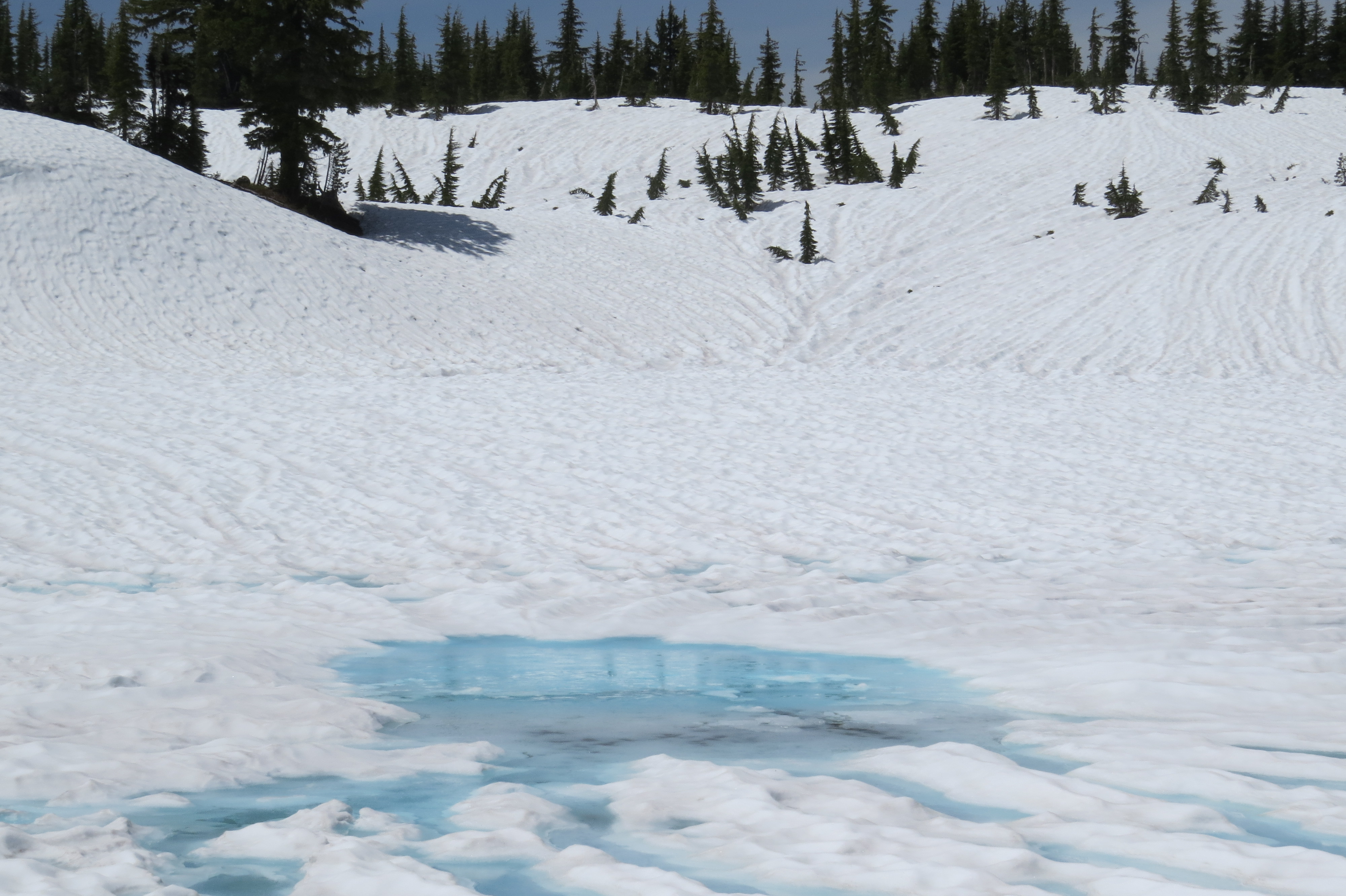
One man had come down the trail recently, and I followed his prints back up a steep hill,  switchbacking in snow, so that I could work less hard. This was not going to be easy.  It already hadn’t been, and if my Achilles Tendon still bothered me, I would have stopped.  But I felt fine.  I crossed a ridge and saw a gorgeous blue lake that was starting to melt.

Lake beginning to appear.

Lake beginning to appear.

I bypassed the lake and realized that my sense of direction was different from the GPS.  I was supposed to be on the “open” Pacific Crest Trail, but what looked like a trail was a creek with a lot of snow on it.  I started navigating on GPS, because now there were no footprints to follow, except those I had made leading back.  I was in a beautiful blinding white bowl of snow, somewhere in the middle of the Obsidian Loop.  I stopped by a tree which had no snow under it, heard a waterfall, and looked down at obsidian at my feet, beautiful black volcanic rock, that touched no water as it ascended to the Earth’s surface.  I picked up a piece and then dropped it,   leaving it where I found it, which is required in the wilderness.  The Trail here has a permit system, because there is so much use.  If each person takes one stone, in a few years, there will be fewer left.  Below me was Obsidian Falls, and I then realized my sense of direction had me on the wrong side.

Obsidian Falls

Obsidian Falls


Obsidian

Obsidian, lava that reaches the surface without touching water.

For the remainder of the loop, I seldom saw a trail, but the route tracker had me going by the trail, or at least near it.  Occasionally, I went into the woods, but the direction arrow had me clearly going the wrong way, and I had at one point to climb a rocky area to get back near the trail.  When I got near the end of the loop,I saw the trail about 50 feet below me, so I could slide down the now softer snow to reach it.  I knew from the stored track that I was close to where I had started the loop, and if necessary, I could walk over to my track.  But I continued, reaching the trail junction, not quite where the GPS said it would be, but close enough.  GPS accuracy is somewhere between 4 and 10 meters, depending upon satellite reception.  I then retraced my now familiar route back to the car.

Back in the lava field.

Back in the lava field.


A Sister.

A Sister.

I had wanted to see the loop, but I saw it without the summer wildflowers.  On the other hand, I saw the loop in a way few do—in snow, alone, and having to work much harder than expected.  I also learned how to trust my GPS, and I learned again other ways to navigate, should they be available.  What was perhaps the most important thing I learned was again not to “trust” my sense of direction.  It isn’t bad, but it can be very flawed, be it on the Appalachian Trail, the Canoe Country, or in the Oregon Cascades.  Using the Sun, when available, is helpful.  A compass is better.  A map is even better.  Knowing when to quit is important, and periodically asking oneself:  “Do I know exactly where I am?”  is essential.


PULLING UP THE FOOTBALL

July 4, 2014

In the famous Peanuts cartoon, Charlie Brown is running to kick the football, when Lucy pulls it up, and Charlie kicks at air, falling down.  Every time, he thinks the result will be different, and every time, he is wrong.  That is the famous definition of insanity.

So maybe I am insane.  I’m getting better, but it has taken me a long, long time to do so, because I still kick at air.

Last summer, I got a call from a younger alumnus from a canoe tripping camp that I attended in the ‘60s, both of us going to the camp’s reunion in August.  There was a special request to create a special endowment for this centennial year, and I planned to give.  I thought that was obvious, since I give financial support to young people who cannot afford the camp’s fees.

Yes, fifty years ago, I was in a select group of canoe trippers that canoed Temagami Provincial Park in northern Ontario.  It was a difficult trip; I still remember my knees hurting from kneeling in the bow in 2-3 foot waves.  We were never allowed to sit in the bow seat.  We knelt. In the stern, the staff man sat. To this day, if I am in the bow of a canoe, I kneel.  Every day on that trip it rained, but it was a good trip. We saw remote country, and while I never will see Temagami again, the memories of places called Lady Evelyn, Ostergut, Makobe, and Fat Man’s Misery Portage are part of me.  I have trod that country.

The caller was interested in my subsequent canoeing experience, and I gave him a brief rundown of my outdoor water resume:  the Nahanni, the upper Yukon Basin from Lake Bennett to Carmacks, the Alatna and Noatak Rivers in Alaska, and 32 years canoeing the Boundary Waters-Quetico.  I have been blessed.  The caller had canoed Labrador, which I thought cool, but he especially wanted to see my Nahanni pictures, a trip he had always wanted to do.

Yep, sooner or later, it came to money, and I told him I would contribute, as I had planned to.  The conversation ended soon afterwards, and I felt a little used, but hey, maybe he was busy, and we would learn at the reunion about each other’s trips.  Maybe. These things almost never pan out:  the call was about money, interspersed with feigned interest of what I had done.  People seldom call me curious about what I’ve done.  The calls are usually about money or medical advice.

I arrived a day early for the reunion in late August, back on a lake where I spent 6 summers, and I got to see the island, 46 years later, with relatively few people present.  The next day, the rest arrived; I was present at the dock where they came in.  I heard the name called of the individual who had phoned me, and I went over to introduce myself. He greeted me semi-warmly then saw somebody else he knew and disappeared.  For good.

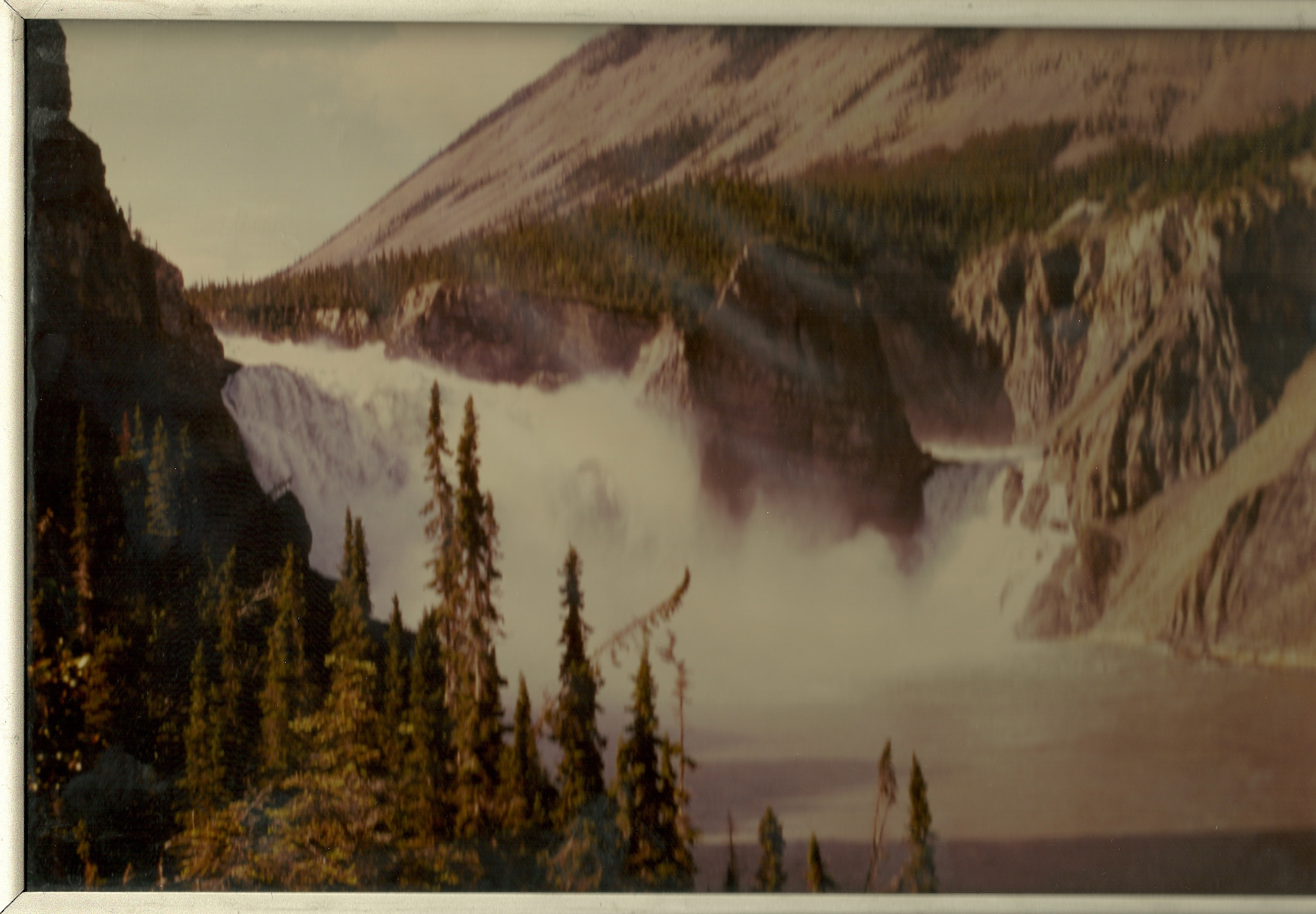
The football had been pulled up.  I had the Nahanni slides with me, for we took slides in 1985.  I had lost the roll of film, wrote Parks Canada, saying it might be in the campground at Fort Simpson, where we had stayed on our last night.  Incredibly, six weeks later, the roll was sent to me.  Canadians do those sorts of things.  I had pictures of a remarkable area very few people will ever see.  After arriving at Fort Simpson, we flew to the Nahanni in a Twin Otter with 6 people and 3 canoes, landing on a sandbar.  The Nahanni was a difficult trip through Class III rapids, the worst mosquitoes I have ever seen—and I have seen more than most— but I saw the highest waterfall, Virginia Falls, in North America.  I paddled through four canyons almost as deep as the Grand Canyon itself, sat in some natural hot springs, came out on the Liard River and saw the great Mackenzie.  The Nahanni was pure wilderness.  It is the crown jewel of my outdoor water resume.


Virginia Falls, South Nahanni River, NWT, July, 1985.

Virginia Falls, South Nahanni River, NWT, July, 1985.


I should have known better than to bring the slides.  Getting money from me was the issue, not what I did or who I was.  I’ve felt that way a lot, these past 16 years, after I left medicine.  I give on my own terms to those I wish.  I do what I can, hope to make a difference, and wish some day one of my ideas will be accepted, improved, and have a significant impact.  I had many such ideas in medicine.  My wish to be a busier volunteer in the public schools has yet to be granted.  We ought to have paid universal mandatory national service, which would give young people a sense of purpose and direction, lessening the likelihood of student debt catastrophes.  We ought to be saving water every way possible.  We should ban companion animal breeding.  I have written about all of these in this blog.

We should have had incremental single payer medical care, starting with the very young.  This would have been easier, cheaper, and less likely to have been voted against.  We should have tracked a whole host of quality issues in medicine.  We need free, unbiased, end-of-life counseling to elderly people to help them understand what “all those tubes” mean, and what their options are.  By ignoring the elderly, we ignore elders, wasting resources I can’t begin to fathom.  In short, we need incremental changes, keeping both the enemies of change and the perfectionists at bay.

I wish I hadn’t brought the pictures of the Nahanni back up to the country where they were taken.  I knew he would not be interested, but I persevered, hoping, like Charlie Brown, it would matter. People are busy, too busy for guys like me.  I tried to travel light, and those pictures and his call were excess baggage.

But I was lucky.  I have seen the Nahanni, drunk the water, know what’s out there. There is no blank spot on my map.  While it’s on my resume, far more importantly, it is in my brain.  I can call it up any time I want:  the magnificent falls, Fourth through First Canyons, Pulpit Rock, and the Gate. Wow. I was there!  I got back up to the camp one last time, and I don’t ever need to go again.  I have taken my last look.  Yeah, the football was pulled up, but I had a soft landing.

It was his loss, not mine.  That line is in Peanuts, too.

OUTFOXED

June 30, 2014

A recent Fox News show claimed Minnesota was the first state to allow Sharia Law.  The reasoning included Somali cab drivers at MSP Airport, who refused to transport people who carried alcohol and a Muslim cashier at Walmart, who refused to handle bacon.  The latter was re-assigned.  The former?  Well, if a cab driver doesn’t want to take me, there are a lot of other cab drivers who would be more than happy to jump the queue.  We all must decide whether we are willing to take the financial consequences of our beliefs.

Assuming this is true, and given Fox, I would have liked to see this for myself, these are scare tactics, NOT news.  Sharia Law says that a nonbeliever must be put to death after first being allowed to convert to Islam and refusing.  I have been to Minnesota well over forty times, I have spent more than 300 nights in the state, and I haven’t even seen a mosque.  Fox plays on American fears of Muslims, the 25% who believe Mr. Obama is a Muslim (as if it mattered if he were), and Muslim beliefs.  Let’s look at a few of those beliefs: eschewing alcohol (like Mormons), not eating pork (like Jews), praying in hundreds (which every large Church does during its service).  Fox omits saying Islam requires charity outside of taxes, limits loan interest, which we would do well to adopt, believes in prayer as a time to reflect upon one’s life (doubt many do that), and fasting to remember how the poor feel. I respect these tenets, just as I respect many in Judaism and Christianity.  There is a lot of good in religion.  The Holy Books have beautiful passages.  The idea is good; the execution often is too good, using a different meaning of “execution”.

In other words, Fox News was cherry picking, and the cherries weren’t ripe to begin with.

Let me demolish the argument right now by going back to 1960, before most of the anchors were born.  John F. Kennedy was seeking to be the first Catholic President of the US.  Back then, people then said that if Kennedy were elected, the Pope would be making American policy.  Yes, I remember that.  We also know that the Pope did not make American policy.

Now, we have over 60 million Catholics in the US, our vice-president is one, and I didn’t hear anybody’s saying that an Argentinian (good heavens, a LATIN-AMERICAN) would order, from ITALY, of all places, Mr. Biden or 20% of our population what to do.  Fox missed the boat on that one.  Indeed, in the process of googling this, I saw a picture of women whose hair was covered, and thought they were Muslims.  They were NUNS. Why is it fine for a nun to cover her hair but not a Muslim woman who desires to do so?

This particular clip upset some.  One said the Somalis should “become Americans.”  What is that?  I think she meant waving the flag (even if you don’t look at it when the national anthem is played), have a yellow ribbon on your car (but never have served), go to a Christian Church every Sunday (but deny people who love each other the right to marry).  We have the right to believe what we wish in this country, no matter how detestable it may be.  They believe life begins at conception, have no idea how the fetus develops, but do not care about the baby’s welfare after birth, especially if a person of color.  The Declaration of Independence said all men are created equal, but didn’t say “physically equal”: some have bad genes and really rotten luck.  As a doctor, I saw many with horrific conditions, some preventable, most not.  How do we handle them?  By dismantling safety nets?

What is an American? Somebody who believes what Fox News says, or somebody who thinks about what they say and disagrees?  Somebody who believes food stamps should be outlawed because of an abuse story, yet thinks guns should be available despite very deadly countable daily abuse?  Food stamps have less fraud than Medicare. Illegal gun sales are common, not just anecdotes.

What is an American?  Somebody who thinks America right or wrong, but tosses litter out the window, or puts a box of kittens out in the desert?  Somebody who obeys laws they don’t like, or grazes cattle on public land without paying?  What is an American?  Is it prayer at public events, Christian prayer, that is, insulting non-Christians and non-believers, like me?  Who is “big government” we love to hate?  Do we hate ourselves?  WE ARE THE GOVERNMENT.  Would we demand government tell a Somali cab driver whom he should carry?  He has the right to refuse to serve a person.  Or do rights belong only to “native born” Americans?

Does being an American mean we need to start speaking and writing English better?  I’d welcome that.  Is it knowing American history?  Then why didn’t we learn from Vietnam and not attack another country in a part of the world that we have little understanding of?

Jews eat Kosher; their diets forbid pork, so I don’t see a problem with a Muslim who doesn’t want to touch pork.  I am vegetarian and don’t want to touch meat. The Native American Church is allowed to use peyote, otherwise illegal.  The Catholic Church uses wine, alcohol, in its services, forbidden by Islam.  Ironically, “blue laws,” which restrict the sale of alcohol on Sundays, affect me, although I neither abuse alcohol nor am a believer.  I have to obey religious doctrine in buying alcohol on Sunday.

How is a Somali’s refusal to transport alcohol Sharia Law?  Do we have Jewish, Catholic or Mormon Law in this country?  No, we have religious beliefs of many types, and we try to accommodate those beliefs.  The NCAA doesn’t make BYU play tournament games on Sunday.  Jews don’t work on their holy days, and we allow that.  Catholics celebrate Holy Week, most of of us Christmas.  Sharia Law?  No.  Are there women who wear the Hijab here?  Yes. Sikhs wear head coverings.  So do nuns.  What’s wrong with that?  At the last funeral I attended, the number of people wearing jeans appalled me.  And we worry about covering hair?  I’m ex-Navy, and I soon learned when one did and did not cover.  One salutes only when covered, not otherwise.  Sounds like covering the head is special.

People have strong beliefs.  I have mine, too, that one may read in the nearly three hundred posts here on the blog.  Some are perhaps irrational; others may appear to be but are not.  Decide for yourself this belief of mine:  Fox News promotes hatred and fear, is biased, too often appears in public places, and violates the interpretation of the First Amendment. There are limits to “free speech,” and Fox has crossed them.  If I am wrong on that, correct me.  Then try to convince me Fox is “fair and balanced.”

If my wife wears a cover in Minnesota, it is to protect against mosquitoes, not Sharia Law.


STUDENT-ATHLETES

June 17, 2014

At the recent Track and Field championship in Eugene, I heard numerous announcements and saw commercials on the big screen about “student athletes”. I don’t like big screen ads during competition, since it is distracting, and I doubt the money generated goes to help students in financial difficulty or to pay grad students better,

It appears the NCAA is pushing the term “Student athlete” vigorously, as former UCLA basketball star Ed O’Bannon is suing them about not receiving compensation for the NCAA’s use of pictures of former “student athletes”.  He was joined by Oscar Robertson, who puts Mr. O’Bannon in lofty company.  O’Bannon was one of the few who succeeded professionally in his sport.  He led UCLA to the NCAA basketball championship in 1995.  He was drafted 9th but played only 2 years in the NBA and 8 years in Europe.  He now sells cars in Las Vegas.  He disappeared, but his reappearance now may be the most important thing he does in his life: change the sham that college football and basketball are played by “student athletes.”

Universities generate $4.5 billion from football and basketball alone, enough to cancel 190,000  student loans of $24K, the average for Oregon.  Or pay grad students better.  Or pay the players who actually do the work, not those who benefit from such work.  Alabama’s football coach makes $5.5 million; Arizona’s basketball coach $2 million, and he is far from the best paid.  The median salary of an associate (tenured) professor of physics is $70,000.   In Eugene, Matthew Knight Arena cost $227 million, a 2002 “facelift” at Autzen Stadium was $20 million.  The NCAA generates nearly $1 billion, mostly from the “March Madness” basketball tournament.  I heard numerous times 89 championships and 450,000 “student athletes,” with 90% of the revenue returning to the schools.  Why would the NCAA be saying what per cent goes back to the schools, unless they felt they were under fire?

So, $100,000,000 remains, and I write the number, because seeing it is often useful. The $4,500,000,000 ($4.5 billion) is one-seventh of what America spends on the NIH, which I think does a lot more good for people, but I might be wrong.  Sports are perhaps more important than finding cures for diseases like Alzheimer’s.

The issue the NCAA doesn’t appear to understand, or at least doesn’t want to admit, is that football and basketball are different:  athletes and coaches involved in these sports are not the same as athletes and coaches in other sports.  John Calipari at Kentucky has well over a $35 million package for the rest of the decade.  An assistant football coach makes 6 figures, one has made a million; an assistant track and field coach makes about $20-40K.  Look it up.  I did.

The question for the NCAA is this: how much should men’s basketball and football players be paid?  It isn’t “whether” but “how much?”  These players are abusing their young bodies, not mentally mature, and vulnerable to being used.  They often do not finish college, taking a slim chance they will have a pro career, that in the case of even O’Bannon was short. The probability a college football player’s playing professionally is 2%; basketball is 1%.  OK, 1.2%.  The probability of graduating without a degree and without playing a professional sport is a minimum 15-30 times higher, approaching 70% in some places. These players are not going to find good jobs, their joints worse than mine, and I am 3 times older.  Football brain damage isn’t even being factored in here.

The concept of “student athlete” works if it is a Dartmouth runner who loves to run but must meet high standards of an Ivy League school.  The runner may perform well enough to be in the 5000 meter finals in Eugene, but he was lapped well before the end. This is a student athlete.  He loves track, but his life work will be something else.  Dartmouth, like all Ivy League schools, does not offer athletic scholarships.  If a university does, it is subsidizing an athlete, not a student.  This to me, a Dartmouth alumnus, is an important distinction.  Only a third of the 450,000 get athletic scholarships; four sports: football, men and women’s basketball, and women’s volleyball, give full rides.  Is that payment?  If it is, then they aren’t primarily students.

Football and basketball players are too often athletes who happen to attend classes.  Their graduation rates approach 70%, better than it was, but a significant number of programs graduate fewer than half. What was their major? I doubt it was physics, chemistry, mathematics, English, or literature.  Many athletes on full athletic scholarships are a farm team for the pros, leaving college when they believe they can turn professional.  To put their faces or names on a shirt, while they are in college, so that the NCAA or the school can make money, is using them as pawns.  This happened to Michigan’s “Fab Five” 20 years ago.

There are student athletes, and there are student athletes.  The NCAA compares both equally, and they are not.  The volleyball coach at the University of Arizona knew full well that successful recruiting and funding of his program depended upon a successful football and basketball program. Eleven of Arizona’s 13 programs listed lost money, including volleyball.  The profits from men’s football and basketball were about $26 million, more than enough to compensate.  Graduation percentages are tricky, and I don’t like the 6 year definition; I got through Dartmouth in 4, and the Dartmouth man who ran the 5000 at the NCAAs will likely do it in 4, too.

I am concerned about big corporations buying advertising, using handsome young men and pretty young women with nice voices to push a toxic agenda, be it chemical, like ExxonMobil, or sport, like the NCAA.  Money talks, it talks too much, and it is time to shut it up. Money could be used to pay for good professors, not coaches, lessen the burden of student debt, develop first rate researchers, writers, educators, and try to lift more poor out of poverty.  Ads? Request retired people like me to help tutor or use our experiences and wisdom.  Bet they wouldn’t cost much on a Jumbotron.   This is the 21st century.  We need educated people to understand the growing complexity of this world. Fox News has a simple answer for everything.  There are few simple answers, and that makes life difficult. Instead of embracing complexity, we pay tens of millions to a coach to help young men put a ball through a metal rim.  If your team wins, you feel better about life. Is escape the point?

When I cared about basketball, O’Bannon was a name to be feared in Arizona.  Now, I wish him every bit of success off the court.  Stay with this cause, sir, for this is where you may make your mark in life.  I bet you never expected that.


BROKEN SYSTEM: C2 FIXING IT

June 11, 2014

An elderly man is seen in a major hospital in a large city with neck pain following an automobile accident.  He is evaluated with neck X-Rays, read as normal, and discharged in a cervical collar.  A day later, he goes to another hospital in another large city with the same complaint and is found to have a fracture of C2, the second cervical vertebra, the so-called “hangman’s fracture”, because this bone is broken in hanging, compressing the spinal cord above where the phrenic nerve, which runs the diaphragm and breathing, exits.

The man will survive, and he will survive without deficits, although he will require a surgical procedure to stabilize the fracture.  Elderly people tend not to complain about head and neck pain the way younger people do.  When I practiced, new onset headache and neck pain in the elderly was something I took seriously.  You won’t read about this in books; a lot of neurology I learned in practice.  I noticed things, and I counted.

Had the man been rear-ended or even had a minor fall, he could have died suddenly.  At his age, with no autopsy, he might have been diagnosed as “heart attack,” with the outpouring of grief and comments about his life cut short.

And nobody would have noted the error.

The system will continue unchanged, with the first hospital’s staff thinking they provided high quality care, not knowing that they made a major error; they missed an odontoid (the name of that part of C2, the axis) fracture.  Somewhere in their clinical evaluation, they failed.  They don’t need to be sued, nor do they need to be publicly humiliated or embarrassed.  They need to learn from this error.   I learned medicine through gamesmanship and humiliation when I made a mistake; making people feel fearful, stupid or embarrassed (or sued) isn’t how they learn.

Ironically, 12 years ago, I went to this hospital and explained to the CEO why we needed a reporting system for medical errors.  He told me that they had one of the best systems in the country.  If that were truly the case, for this problem to occur a dozen years later says the quality of our programs to prevent errors needs immediate attention.

Doctors make mistakes.  They are human.  They make errors for all sorts of reasons: There may be insufficient knowledge, hurry, distractions, interruptions, lack of sleep, shift changes, miscommunications, and other reasons.  To assume a doctor is perfect is to deny reality.

What is needed is recognition of this reality and building of systems robust enough to find problems before they become critical.  How the system works is a matter of involving those who are involved.  It doesn’t come from the government, although if the medical profession doesn’t change, it will some day, and will have all the problems that come from government regulation.  Changes don’t come from the CEO or the head of the emergency department either.  They come from involving the doctors who work in this department, the nurses, the technicians, the people who first see these patients, the first responders who bring them there, and the radiology department.

The question to be answered is this:  How do we ensure we never miss this problem again?  The goal should be 0 misses, which means that part of the solution has to be followup with the patient, the way my veterinarian calls me at home the day after she does dental surgery on my cat.  If a cat can get better followup medical care than a human, then I have a major complaint with the medical system in America.

Hubris.  “World class.”  “We will take care of it.”  “We don’t need you.”  “Centers of excellence.” “99.99% of our patients do fine.”  The last I particularly worry about, because it means that 1 in 10,000 does not do fine, and if it is wrong-sided surgery, that is 2 cases a year in a busy hospital.  There are some things where percentages are appropriate, and there are others where counts are better.  There should be 0, null, zero, cases of missed odontoid fractures after an automobile accident.  Does everybody need a CT scan of the neck?  No.  Who should get one?  Look at the literature.  We put people in cervical collars routinely, when they have no neck pain, no neurological findings, no drug or alcohol abuse, and no tenderness to palpation of the neck.  Having all of these negatives was shown two decades ago not to require a collar.  Yet, we do it anyway, “just in case”.  In case of what?

I am telling the medical community to fix their broken systems, for they are broken when an important bone is broken and not recognized.  We have the ability to easily diagnose these problems when they occur, and we know enough about algorithms to know when we should work these patients up further, and when we do not need to.

I get follow-up surveys from nearly every company I deal with.  Amazon now surveys the packaging process.  I don’t know if anybody actually does anything based on these surveys, but if there is a mistake, they sure hear from me.  I would bet a great deal of money the hospital never called the patient to find out how he did.

If Comcast, for heaven’s sake, surveys, and if my veterinarian calls me to ask about my cat, it would appear maybe medicine ought to start doing the same thing.  Aviation has been investigating errors and disseminating the results for 40 years.  In 2001, I suggested medicine do the same.  I contacted 64 different groups.  Nothing happened.  Fine, don’t use my system, but put something in place to address this problem, because it happened once and it shouldn’t happen once; you guys aren’t learning from your mistakes, and you aren’t even counting.  

I wonder in the past 13 years how many hangman’s fractures were missed, causing death.

I wonder if in the next 13 years we will address the issue.  The smart money bets no.


OLD SCHOOL

June 9, 2014

While hiking today, a woman my age commented that her 89 year-old father, an “old school” doctor, loved medicine more than anything else, volunteering in medicine after he had retired, 27 years earlier.  I was jealous.  I burned out in medicine, and nobody needs a neurologist as a volunteer abroad, where most major medical issues are handled by surgeons. Come to think of it, not much was needed from neurologists here at home, either, except when it came to people with normal tests, post-surgical disasters, and chronic pain.  Looking back, probably the best thing I did was to know when enough was enough and did the thankless job allowing patients to die without further intervention.

I was the one who heard the comment, “We won’t know the extent of damage until he wakes up,” and replied, “he won’t wake up.”  People didn’t like this truth.  I used the word “die,” one of the strongest words in the English language, not “pass on” or “expire.”  I took issue with miracle full recoveries after years in coma, when these people were either vegetative or severely disabled.  Misquoted anecdotes and reflexive smiling in vegetative states has led to numerous patients being supported in irreversible coma for weeks, months, or in some instances years.  I discontinued tubes, when doctors and nurses both believed once a tube was placed, it had to stay.  No it didn’t.  I took the first responder “saves” and stopped the ventilator a week later, when the patient still showed decerebrate rigidity and would not survive.  I told more than one family I was a “hard marker,” and “he squeezed my hand” did not count, if a patient could not hold up three fingers to command.  I listened to “he never wanted to be like this,” and if the time were right, acted.  These actions in retrospect had a great deal of value, but made me unpopular.  I was told I would deal with my parents’s deaths differently, but I didn’t. I kept my promise to them.

When there were no living wills, my job was more difficult, which is why I was incensed when the concept of paying doctors to discuss death with the elderly was referred to as “Death Panels.”  I hope many of these ignorant people may some day understand.

To me, “old school” doctors remind me of “the good old days,”  during which we had legal segregation, unsafe cars, frequent plane crashes, drunkenness was funny, smoking was cool, and adult women were “girls.”  On the other hand, we didn’t have the singing commercial, “your call is important to us,” and weren’t addressed by our first name by a stranger a third our age. In the “golden years of medicine,” when I trained, doctors were king.  Nobody questioned their actions, when questioning should have occurred.  “See one, do one, teach one,” was a problem to those of us who simply couldn’t do one right.  We didn’t track outcomes, we hid errors, we referred to friends, rather than those who had the best outcomes.

In the “good old days,” patients didn’t expect as much; we couldn’t do as much.  Medicine was simpler, costs were less, charity care was expected, and patients stayed in the hospital a lot longer.  It was a different world.  We had poor ventilators, so pneumonia was called the friend of the elderly, except now a ventilator can tide some over and lead to resumption of normal life.  Cancer was a disease of children, not adults, as it is today.  We did disfiguring radical mastectomies and kept heart attack patients in bed 6 weeks, both procedures harmful and long since abandoned. Mental illness was treated by commitment to awful hospitals, although the present “right” to not take medication and to live on the street is the current price.  I’m not sure where we should go with that one.  No firearms for them would be a start.

Technology changed the world, along with a medical arms race among hospitals from CT, MRI, and helicopters (about 10 deaths a year are caused by medical helicopter crashes, making it one of the most dangerous occupations).  Scans are expensive; CT radiates more than most doctors realize.  Doctor’s labs were found not to be good, privacy wasn’t, leading to HIPAA, which has created issues for non-relative “best friends,” and the profession almost bankrupted the country by charging fees they set and expected to be paid.  Lawsuits occurred, which seldom brought justice to many who deserved it, adversely affected the physician-patient relationship, and a reason I left medicine. 

Medicine in the old days I compare to Phoenix in the old days.  It was nice, a lot smaller, people liked it, and all was fine, but completely unsustainable.  We have known for a long time medicine limits access; good care isn’t affordable for everybody.  We haven’t wanted to address the issue, but it won’t go away.  [Phoenix is unsustainable, for there is no way we can continue growth where rainfall is diminishing, the climate is warming, and water supplies are tenuous.]

Medicine has opportunities and a potentially wonderful future.  The solutions to the problems, however, will not be implemented, because as much as voters say they want politicians to tell the truth, no politician, no matter how charismatic, can tell the truth and be elected.  I don’t have the charisma that the Republican challengers for Arizona’s 8th CD have had, but I am smarter than they are and better educated.  But try to tell voters that we can improve access to and quality of health care only by increasing tax rates, including a net worth tax, an investment tax, and concomitantly decrease military spending to true defense, not wars.  We need a reporting system for medical errors, and in the era of computers our inability to have medical statistics 6 months after the end of a year, rather than 4 years later, is inexcusable, appalling and achievable. There is absolutely no way anybody can get elected saying the above, but I think the above is close to the “truth.”

Old school medicine was easier.  We didn’t worry about cost of hip and knee implants, because we didn’t do joint replacement.  Trauma patients died, “tragically,” because the skills we now have didn’t exist.  Breast cancer presented as an eroding mass, not a minimally invasive lesion that could be excised, radiated, and treated with aromatase inhibitors.  We didn’t have HIV, pulse oximetry, and colonoscopy, which saved my life.  GI bleeds were irrigated with ice water, rather than treated quickly with endoscopy.  People with ulcers had infusions of milk, rather than drugs, occasionally exsanguinated, not cured with endocscopy.  Cholecystectomy was 2 weeks in the hospital, not outpatient.  Prostate cancer presented with fractures due to bone metastasis, not caught early.

Where will we go with medicine?  Every generation of doctors is at the dawn of a new era.  The “giants” in medicine and the “golden years” were neither large nor golden.  They performed in their world.  We must now perform in ours….better.

NO ANONYMITY WITHOUT RESPONSIBILITY

June 3, 2014

“I can’t find a goddamn parking place in this  f——- town!” we heard, while walking to the Prefontaine Classic.

The middle-aged man walked away from a series of parking meters that were good for 2 hours, not quite long enough to see the event.  On the other hand, had he been willing to walk a few more blocks, he would have been able to park for free.  Had he anticipated the potential problem parking, he might have left home earlier, wherever home was.  He had “skunk anger,” and I quickly recalled my arm, after I had begun to point out parking spots.  Nowadays, it doesn’t take much to set some people off, and with the only restriction on firearm possession these days appearing to be price, I thought it wise to quietly walk away.

Public displays of anger are scary.  I vividly remember a fist fight breaking out over who was next in line at a gas pump during the 1973 oil shock.  I saw a man pummeled in Nairobi once, and stayed far away.  Over the phone, it is too easy to express anger, for one doesn’t see the effect upon the other person.  Sadly, many who receive these nasty calls weren’t involved in setting up the faulty system or designing the flawed product.  Highly paid executives are shielded from much of the difficult work that is “customer service.”

Letters may also be hurtful. Virtually everybody has regretted at some time hitting “send” too soon.  Angry letters require rereading and preferably should sit 24 hours before being sent.  It is remarkable what will be deleted after waiting.  Many such letters I never sent.  Still, angrily written letters have a name and an address; they are not anonymous.

The Internet has brought anonymity to public discourse, which I find both disconcerting and dangerous.  Read the comment section of an online newspaper article.  The comments do not sit for a day before posting, the grammar and spelling are often atrocious, the venom almost visible, the comments close to libelous, and the points often not factual.   Anonymity allows every frustrated individual to write whatever he wants: a free pass for hate mongers, the ne’er do wells, a public voice for those who used to say their indecent words in private, or at least not in my presence.  People I never will meet vent about all sorts of topics, truth being the greatest casualty, the beautiful English language a close second.

Letters to the editor are difficult to get published, because they require knowledge of basic English grammar, which many do not have.  These letters have an approximate 150 word limit, requiring careful thought, not a long-winded exposition.  I find it ironic that many who decry the use of Spanish—a language I wish I could speak fluently—cannot write a decent English sentence.

Online, every time I read one’s advocating physically fighting the government or secession, I wonder why these people don’t have their IP addresses tracked and informed their comments are treasonous. Many say the government is incompetent, rather than taking the small step to say some people who work for the government are incompetent.  Yet, this same “incompetent government” is somehow able to keep secrets about Area 57, currency reform, 9/11, the New World Order, and faked the Moon landings.  The inconsistency of these two concomitantly held viewpoints baffles me.

What I almost never read in diatribes are detailed suggestions how we might fix problems.  Perhaps many of us have given up. Ideas are seldom seriously considered by any organization I’ve sent them to.  Message to those in power: you do not have a monopoly on good ideas; they can come from anywhere, not just your staff or the same people that have been in the public eye for decades, some of whom need to move on.  You might be surprised what we have to offer.

Simplistic suggestions: “Deport all of them,”  “lower taxes,” “repeal Obamacare” are not solutions.  Mandatory national service, encouraging national volunteerism and using the experience of older people are starting points. I have been open to different ideas, so long as they have data, inferences, margin of error, ways of tracking effectiveness, and are well thought out.  My name is visible, and information about me is available.  It’s is clear what I believe, and it is clear that I may be influenced.

I had no idea the jerk I heard—and the man was a jerk, continuously swearing at the top of his lungs in a quiet neighborhood about a city I happen to love—would lead to an article.  It didn’t quite, until I read online in the Green Valley News (Az.) that a Hispanic shot and killed by the Border Control was an unarmed US citizen.  He had a prior record, was stopped and allegedly fled on foot, not at all a physical threat.  He was hauling marijuana, not human flesh.  He broke several laws, no question, but he didn’t deserve death.  I wonder whether those who have decried illegal immigration will speak out against killing our own citizens in these circumstances.  I chose not to read the comments, because I suspected I would read “the man deserved it”, “most of these people are illegal,” “his papers were probably forged”, “we still need a wall”, and of course “this is only one instance,” which in the issue of death happens to be irreversible. Is there no shame?  The Border Patrol has a difficult job, but we cannot use that as an excuse.

Anonymity is used by cowards.  My name is on my posts and letters; I don’t hide behind “Blueheeler2”. Stating comments in public requires thought. I suggest we edit these sites, in order to make some of the comments readable, shorter, and enforce common decency.  We used to, and violent threats online ought to be investigated.  They have led to shootings, which takes me full circle.

Some say anonymity is the price we pay for the Internet.  I say we shouldn’t pay it. If WordPress wants to edit me, fine.

Please, however, don’t have your editors make grammatical mistakes in their comments.  That annoys me no end, but I will try to be polite in my letter to you.


Michael S. Smith, MD MS (Stat.)


WHERE’S THE BEEF?

May 30, 2014

Twenty years ago, medical director of a hospital, I took a call from a woman who wanted to know how many Abdominal Aortic Aneurysms (AAA) her husband’s surgeon had repaired the prior year at our facility.  She asked a good question, because the surgery is difficult, fraught with risk, even when done electively, which in this instance it would be.  Too often, it is done after the aorta ruptures.  My cousin’s husband died of a ruptured AAA; I have dealt with the issue emergently, and it is difficult to control the bleeding while simultaneously repairing the vessel.

I didn’t know the answer.  Therefore, I had no idea her husband’s chances of survival, how long he would likely be hospitalized, or his condition six months later.  We didn’t track that.  It took me four years to get the hospital to track outcomes from cardiac surgery, after I exploded one night in the ICU saying that I had been consulted 26 times in 270 open heart cases in one year.  Consulting a neurologist after a heart case usually doesn’t bode well.

I mention this, because AAA is one of the outcome measurements Leapfrog uses in determining how well a hospital performs.  So is Aortic Valvular Replacement.  The Tucson hospitals that used Leapfrog scored no better than “C”; one scored “D”.  Some of these hospitals had marketed themselves as being “one of America’s top 100 hospitals.”  It seemed that they were not quite as good as they thought they were.

Leapfrog tracked drug errors, too, and no hospital in Tucson scored better than “C”.  On 2 May 2002, I met with administrators at University Hospital in Tucson to outline my reporting program to reduce medical errors.  A year earlier, I had met with their cardiac surgery program to help track outcomes better.  I can’t believe I was so naive to think that I, who had practiced, been an administrator, had a Master’s in statistics, and 2 months earlier had written an op-ed on an error reporting system we needed in medicine would take on Big Hospitals.  Capitals mine.

Both groups wanted to know, in an unfriendly tone, who I was.  Being from the same city was a minus; had I been from outside, I might have had more credibility.  It would have helped if I were good-looking, exuded charisma, and showed glossy paper with colorful bar graphs, rather than having sound ideas and a quiet demeanor.

Needless to say, the cardiac surgery program wasn’t interested, and I was assured, that second of May, that University Hospital had “one of the best safety records in the country.”  They gave me no data.  They wanted to know what software I would use. I didn’t need software; I needed reports of errors in order to understand them better.  Unfortunately, computers and charisma mattered more to them.

Leapfrog was initiated by a group who had the smarts, the looks, the networking ability, and the leadership skills I lacked.  My ideas were ahead of theirs.  In 1974, I was counting outcomes in medicine when I was an intern.  I was selecting my surgeon to do carotid surgery in the mid-1980s, based upon his outcomes.  I raised concerns about our cardiac surgery program in 1990.  I wasn’t surprised that hospitals were graded “C.”

Every member of my immediate, now small family, has suffered from a medical error.  People make mistakes.  I accept that.  People should learn from them, too, which they often don’t.  For years, we had lousy data and lousy tracking systems.  No, we had no data and no tracking systems.  We hadn’t a clue, and we let Big Medicine, called the Joint Commission, dictate what hospital quality was.  I met with the Joint Commission, too, on 14 August 2001, in Chicago, at my expense.  They were quite interested, so they said, but I never heard again from them.  No e-mails, no calls, no response to my written requests, nothing.

It takes 30 seconds to compose and send an e-mail saying one is not interested.  They weren’t  too busy.  They were rude, arrogant, and wrong, as wrong as Condoleezza Rice had been 8 days earlier and the Bush administration would be four weeks later.  The only difference is a lot more people die from medical errors every year than died on 9/11.  We just don’t know how many.  Our estimates are bad, and the margin of error of those estimates is seldom given.  That violates a basic rule of statistics.

We should be tracking outcomes of common procedures in medicine.  When I broke my hip in an accident, the surgeon had no idea I had done well until I wrote him.  I fractured my fifth metacarpal, had a cast for four weeks, and told that alcoholics often took off their casts with no sequelae.  When I was told I needed two additional weeks of the cast (which did not change the angulation of my metacarpal), the comment my father made was “that is what your doctor learned to do where he trained.”

“Why?” I asked, “don’t we know whether somebody with a broken metacarpal even needs a cast?  Why don’t we know the optimal time? Do metacarpals heal depending upon geography?”  This is not a rare injury.  If we don’t need a cast, wouldn’t that save money and time?  How many other conditions don’t we know the results?  Perhaps some shouldn’t do certain procedures, like colonoscopy, lumbar punctures, bronchoscopy or angioplasty.  How many of these have you done, doctor?  And what happened to the patients?

We physicians like to say we are scientifically trained, and non-physicians don’t have data to show they make a difference.  Where are the numbers?  What should they be?  And what are we doing to achieve those numbers?   Too many ideologues argue using rhetorical questions, which I find annoying.  A statistician’s job is to ask questions.  Ours are good questions, answered with data, uncertainty and appropriate inferences.

We don’t need high speed computers to measure outcomes.  Pen and paper work just fine, with a lot of curiosity, and an open mind.