Archive for the ‘MY WRITING’ Category

DREAMS

July 25, 2013

I was in the Anchorage airport, late one night on my way home from my tenth trip to “The Great Land.” I stopped in the men’s room, and before I saw the pair, I recognized the smell that to me characterizes one thing: “we’ve just come out of the woods.”

It’s a difficult odor to describe.  It is woodsmoke plus something more.  Many people would just say the person needs a bath, and they wouldn’t be wrong.  But in the woods, we neither notice the smell nor particularly want a bath.  I can attest to that with a great deal of experience.  It is when one comes out of the woods that one notices the odor and really wants a shower.

As I washed my hands and turned from the sink, I accidentally brushed the pack one was carrying.  He apologized.

“Been there a lot,” I replied.  While I’m shy, I knew these young men were kindred spirits.  “Where did you guys go?” I asked.  They knew I wasn’t talking about cities but wild country.  I wasn’t going to hear “Juneau” but the Chilkoot, not “Homer” but “The Kenai”.

We started to talk.  The pair was young, at least 35 years younger than I, and this was their first trip to Alaska, where they spent 2 weeks in Denali and the Kenai.  They had wanted to do this trip now, while they could, because their lives were going to be busy in the coming years.  They did it.

Been there, too.  I told them about my 5 trips to the Brooks Range, and their eyes showed a gaze I’ve seen many times, and which I have shown others. It’s a far away gaze of longing, of thinking about wild country, of rivers nobody down here has ever heard of, like Kongakut, Aichilik, Nigu, Itchilik, Kobuk or Noatak.  It’s mountains and remote valleys.  It’s slogging through tussocks, in rivers, in swamps, in bear country.  It’s aufeis hiking and bugs in June, blueberries in July, rain and autumn colors in August.  It’s the most difficult country to hike that anybody can imagine, and it is also the most beautiful.  It is a country that kicks one’s butt, until finally one accepts it with the simple words, “It’s Alaska.”  Everybody up here understands that.

Normally, I don’t talk much to strangers, but when I’ve been out the bush for awhile, I find myself pretty talkative.  These guys were me, 35 years ago.  Then, my dreams took me to the Boundary Waters Canoe Area Wilderness, every year, to get into the backcountry, away from people, civilization, only me and the wild lakes and rivers.  I explored that country until I knew it as well as my home town.  Maybe better.  I sure loved it more.  Always will.

It was much later that I discovered Alaska.  Oh, I did the Chilkoot Trail in ’84, the Nahanni the following year and the Chilkoot and the upper Yukon in ’87, but I didn’t camp above the Arctic Circle until 20 years later.  By then, I knew if I didn’t start to make my dreams come true, they never would.  I hiked to the Arrigetch Peaks in Gates of the Arctic National Park, and then decided I’d come back to see ANWR.  I thought once to ANWR would be enough, but when Christmas came I got a letter from the guide saying he planned a real special ANWR trip the following year.  I had to do that one, of course, because I had the longing in my eyes. I could see the Dall Sheep and Caribou, a river I knew would be special, so I accepted and did the trip.  Tough? Very.  Weather issues?  Plenty.  But we saw wildlife I couldn’t believe, and I came out of there saying I had seen the ANWR I wanted to.

Except I still haven’t.  Probably never will, either.  I did two more trips into the Gates, one combining backpacking with a paddling.  We saw a dozen bears, four of whom walked blithely through our campsite one night. Alaska.

I still want to see the Sheenjek Drainage in ANWR.  I would be 65 if I did it, but I think I can. A guide-friend is willing, and I know a pilot who would get us to the jumping off point.  No question that we could do this trip.  When I think about it, I know I have the look in my eyes those young men had.  Age  doesn’t destroy that look.

I didn’t tell the pair to follow their dreams, as I have tried to follow mine.  They didn’t need me to say anything; they were already dreaming.  I could see it in their eyes.  They didn’t know how they were going to get up here again, where they would go, or what they would do, but they were going to do it.

They will see the Brooks Range, ANWR and deal with all the issues Alaska throws at those who go into the bush.  They will come out of the country filthy again, smelling, but not of woodsmoke, because they will have been north of the treeline, where night doesn’t exist in summer.  They will again take the redeye to Seattle or the Bay Area, where they live, thrilled to have done the trip, and already planning the next one.  They would have had adventures I would be jealous of, but only a little.

No, the two needed no encouragement to come back. Had I shown them my pictures of the Arrigetch, the Aichilik, or the Noatak, they might have cancelled their flight and stayed.  Some people do that.

To the wife of one of them, should either some day be married, I apologize.  I just happened to run into a fellow dreamer, somebody who reminded me of myself, and planted a few more dreams in his head.

Let him go to the Far North.  He has to do it. He will come back better for it.

But he will want to go the following year.

And maybe some day he will be 64, in a men’s room in an airport, talking to a 30 year-old who has just finished his first backpacking trip in Alaska…..

2 year-old griz on the Noatak. Out of focus because my hands were shaking. Distance: 25 meters. Anything between us? Air

Bull caribou, Noatak.

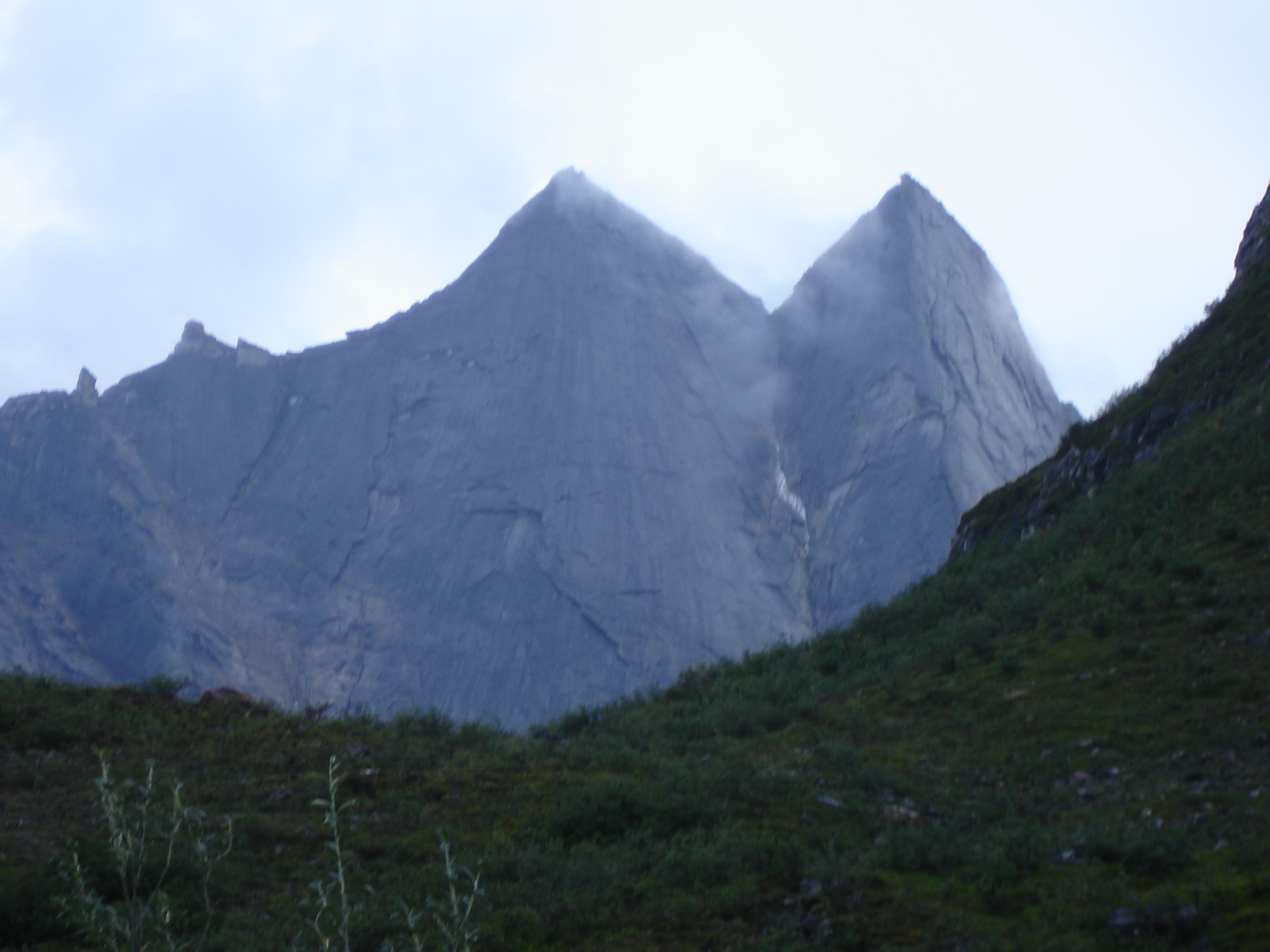
The Maidens, part of the Arrigetch Peaks, Gates of the Arctic National Park.

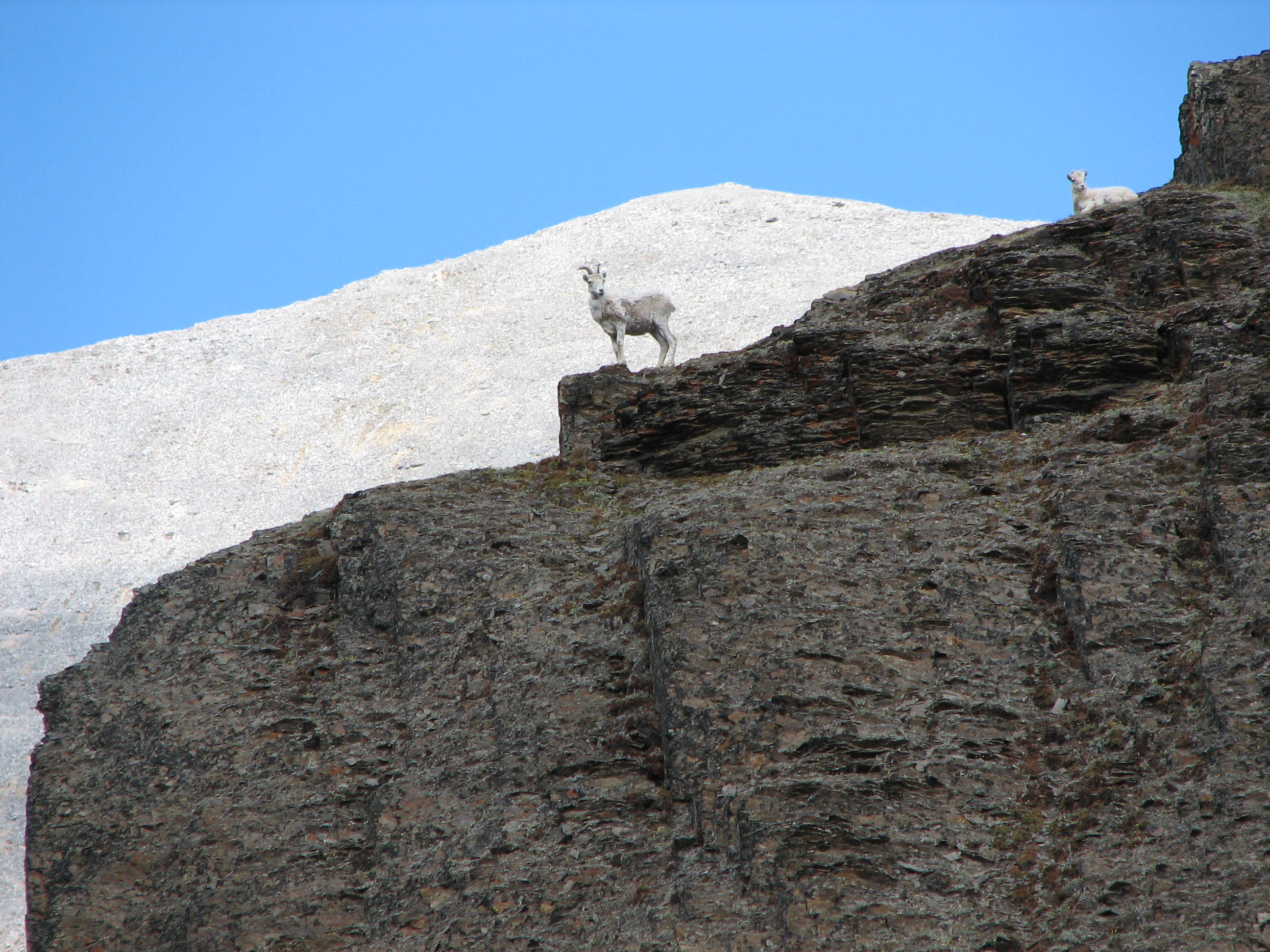
Dall Sheep, ANWR, Upper Aichilik River drainage.

LIKE LOCUSTS DESCENDING ON A FIELD OF WHEAT

July 23, 2013

Forty years ago, I was sold a $50,000 Whole Life insurance policy that cost me $750 a year in premiums.  When I cashed it out last year, it was worth about $84,000.  This is a rate of return well below 2%, and I paid the premium for several years.  It was a bad investment.  It was a good deal for the broker.

Back then, I didn’t know how to say no.  I was a first year medical student.  Life insurance salesmen descended on medical students like locusts on a wheat field, asking each one to give a couple other names of fellow students.  I refused to do that. Credit card companies in 1975 wouldn’t give me a card, when I became a physician (no way students ever got credit cards back then), because I was only an intern earning $10,000 a year.

I would have been much better off buying a 20-year $1 million term policy that I could afford. Every young married couple should have term insurance.  This is a time when people are usually healthy, their incomes are low, their debts are high, they may have children, and sudden death can devastate the survivors.   They can afford $500,000 term policies.  A whole life policy of that size is unaffordable.

Insurance salesman, however, make more money selling whole life policies, so that is why I got one.  It was an introduction to the world of people acting in their own self-interest. Having a fiduciary responsibility to a client means one does what is best for the client, not what is best for the provider’s income. As a physician, I had a fiduciary responsibility to do what was best for my patients, not me.  It meant that I got up at 2 or 3 a.m. to treat a drunk who had fallen, or a guy who had gone off his motorcycle and wasn’t wearing a helmet.  I was spat upon, had to hold a drunk still in a CT scanner, where the scans took a half hour to do, not a few seconds, yelled at, often not paid, but  able to be sued if I screwed up.  The next day, I was exhausted and functioned at a level of being legally drunk. Back then, in the “good old days,” doctors worked while exhausted.  I said at the time it was wrong, and I was slammed by my partners for saying so, because good doctors functioned well for 36 hours straight.  Research long ago showed that notion to be false.

Over the years, I have made many financial and medical mistakes:  I invested in a few REITs (Real Estate Investment Trusts), but not many.  I had suspicions that something was amiss in 2007, but I listened to my financial adviser explain them away.  He gave me an article by a Wharton professor, who ensured the reader that 2008 would be a great year. Financial advisors cannot be given carte blanche. I was executor of my father’s estate, and half of the legal advice I received was wrong.  Even the lawyers can’t understand our financial system, which is in my view deliberately made complex.

Credit card debt is a major problem and a classic example of how lack of regulation allowed banks to do well at the literal expense of their customers.  I pay the balance off every month.  Always. By doing so, I get an interest free loan from the bank.  Credit card debt has astronomical interest rates that only recently have been made public.  Many think that making the minimum payment on a credit card is all they need to do.  It is not.  The interest is charged on the full amount.

A brief comment on rate of return.  One will hear that a security has a 4% rate of return.  That rate does not include fees to buy and sell the security, nor does it include the taxes one pays on the gains.  It isn’t dishonest for the financial community to do so, but it isn’t realistic, either.  If I make $1000 on a stock but pay $400 in taxes and $50 in fees, I haven’t made $1000; I have made $550.  My wife and I had a house in rural Arizona.  We sold it for double of what it cost to build it, but after fees on both ends and capital gains taxes, over 20 years our rate of return was 1.8%.  That is a real rate of return:  money we had.  The doubling was simply a number, before costs of selling and taxes were factored in.   I take my net worth and multiply it by 70%, and that is my real net worth, because selling everything will be taxed.

I recently watched a story on Suze Orman about a 69 year-old woman, whose husband’s pension died with him.  She had a house underwater in Florida, and she was nearly destitute.  Indeed, she was living on social security, as do many Americans.  What happens to them if we “privatize it”?  Like the insurance agents descending on medical students, financial experts will descend upon the elderly.  Good looks and saying what people want to hear trump truth and fiduciary responsibility for the buyer’s best interests. A lot of elderly can’t understand finances and money, don’t think clearly, and are going to get burned.

I made many financial mistakes, and I teach math.  We don’t value math teaching and teachers;  the financial industry exists to do three things very well:  take your money in the form of high fees, move it around electronically, and generate paper.  Research has shown little value to society to moving money, compared to, say–a teacher.  I receive thousands of pages of financial paper annually (I sampled and made inferences), most of which are not understandable. I don’t have the time to read it.  Can you imagine how a poorly educated 80 year-old will handle it?  The few million words I get basically can be summarized with 12:  “you might lose all your money and we are not at fault.” Every other week, I receive a class action lawsuit notification about some company, often 4-5 copies, each 20 or so pages.   I have to decide whether to throw it away or try to research when I bought the stock and how long I held it.  I used to look up the information, but when the suit was settled in my favor, I got vouchers for something the company made.  I throw this stuff away now.  At least I can recycle it.

If I, a mathematician, who can tell you right away what the doubling, and tripling time of money is for a given interest rate is (divide the interest rate into 72, and 110 respectively, and the quotient is the number of years), cannot understand much of American finance, what chance does an elderly woman who has just been widowed have?  Or a young person out of school?  Mortgages should require a 20% downpayment and consume no more than 1/3 your income.  You don’t throw away money on rent; you have somebody else taking care of things that break, and you can leave when you want to.

Many live only on Social Security, never its intention, but now their only choice.  Many in Congress would like to destroy it and privatize Medicare, because the “market” will do a better job.  In Ayn Rand’s mythical world, the market does well.  In the real world of greed and grab, birth defects, viruses, auto accidents–heck, appendicitis–the market needs regulation, which it isn’t getting.  The “market makers” almost took down the world’s economy in 2008.  Many of them got bonuses worth more than I made in my lifetime for doing it, and I practiced medicine. Five years later, we still are not back to where we should be, many will never recover, and we are talking about removing the safety nets from those who need it the most.

While the paper continues to flow into my mailbox.

KOBUK VALLEY, NP, ALASKA

July 17, 2013

I really wanted to see this Park, the most remote one of the 57 Parks in the 50 states. It is about 100 air miles east of Kotzebue and about 150 west of Bettles. Many people haven’t heard of either of these places.  Had I thought about it after the Noatak River trip in 2010, I would have been able to have gotten a trip from Bettles.  I had a Gates of the Arctic backpack in 2012 that I decided to add a Kobuk Valley trip on.  The good news was that we had an early pick up at Summit Lake, on the Continental Divide, because the pick up pilot knew we were there and that the weather was going to deteriorate.  We got out before the storm hit.

Unfortunately, the fact that the storm was coming from the west meant that the next day’s trip was not likely to be easy.  A group of 5 of us, a family of “park collectors”, like me, and me got into a float plane (Beaver) and got over Ambler, a town near Kobuk Valley, on the Kobuk River.  Twenty miles from the Dunes, we turned around because of low visibility.  We were over the Park, and I thought that might be sufficient, but it wasn’t.  It never is sufficient not to see something the way you want to see it.

Let me digress on that last statement.  I wanted to see Kobuk Dunes.  I didn’t want to camp there for a week, hike the whole park, or canoe the river through the Park.  Those are all worthwhile activities for some people.  For me, seeing the Park was seeing the Dunes.  Pure and simple.

In 2013, I decided I was going to see all the rest of the Alaska National Parks (there are 8, and I had been in 4).  I decided to set up a week trip do see the southern 3: Katmai, Lake Clark,and Wrangell-St. Elias.  I started thinking, and I realized I could fly to Kotzebue and try Kobuk from there.  Kotzebue is on the Chukchi Sea, and that in itself would be worth seeing.  I booked the trip.  I flew from Phoenix to Anchorage, stayed a day in Anchorage, flying that evening to Kotzebue.  With no obvious taxi, I schlepped everything to the Nullavig Hotel and stayed the night.  I was told by Jim Kincaid of Northwestern Aviation that we would be flying the next day, probably in the afternoon.  The following morning, he confirmed that for me.

I took a walk right after an early breakfast, and I headed over to Northwestern Aviation’s office.  I don’t know why I did, but in Alaska, one does things like this.  Right after they opened, I walked in, and Jim met me, saying, “I’m really glad you’re here.  Can you go in 30 minutes?  I have some people I can’t pick up this morning, but I need to go this afternoon.”

I said that if he could take me back to the hotel, I could get my luggage and be back in 30 minutes.

It took 13.  I had everything pretty much packed before I had left the hotel the first time, so when I went in, I stopped at the desk and asked them to get my bill ready, while I went up to my room.  When I came down, the bill was ready, I paid and left.

We had to push the airplane into position, we got in, and we were on our way out over Kobuk Lake, brackish, and then to the north side of the river, passing Kiana.  We then crossed the river and went through a couple of small squalls until we reached the Dunes.  I didn’t even see the runway on the sand until we were 100 yards away.  We landed, got out, and I had a half hour.  Only a half hour?  Not less than a half hour!!  I sprinted up the ridge to a large dune, where I could look out over trees and a stream.  It was quiet, the sand was damp and firm, the size of the dunes huge, with a copse of trees and a stream nearby.  I immediately thought of it as a place to camp.

Time passed quickly, I got my pictures, we got into the plane, and we headed back to Kotzebue.  It was a wonderful trip, and I got into my 45th park on the second try.

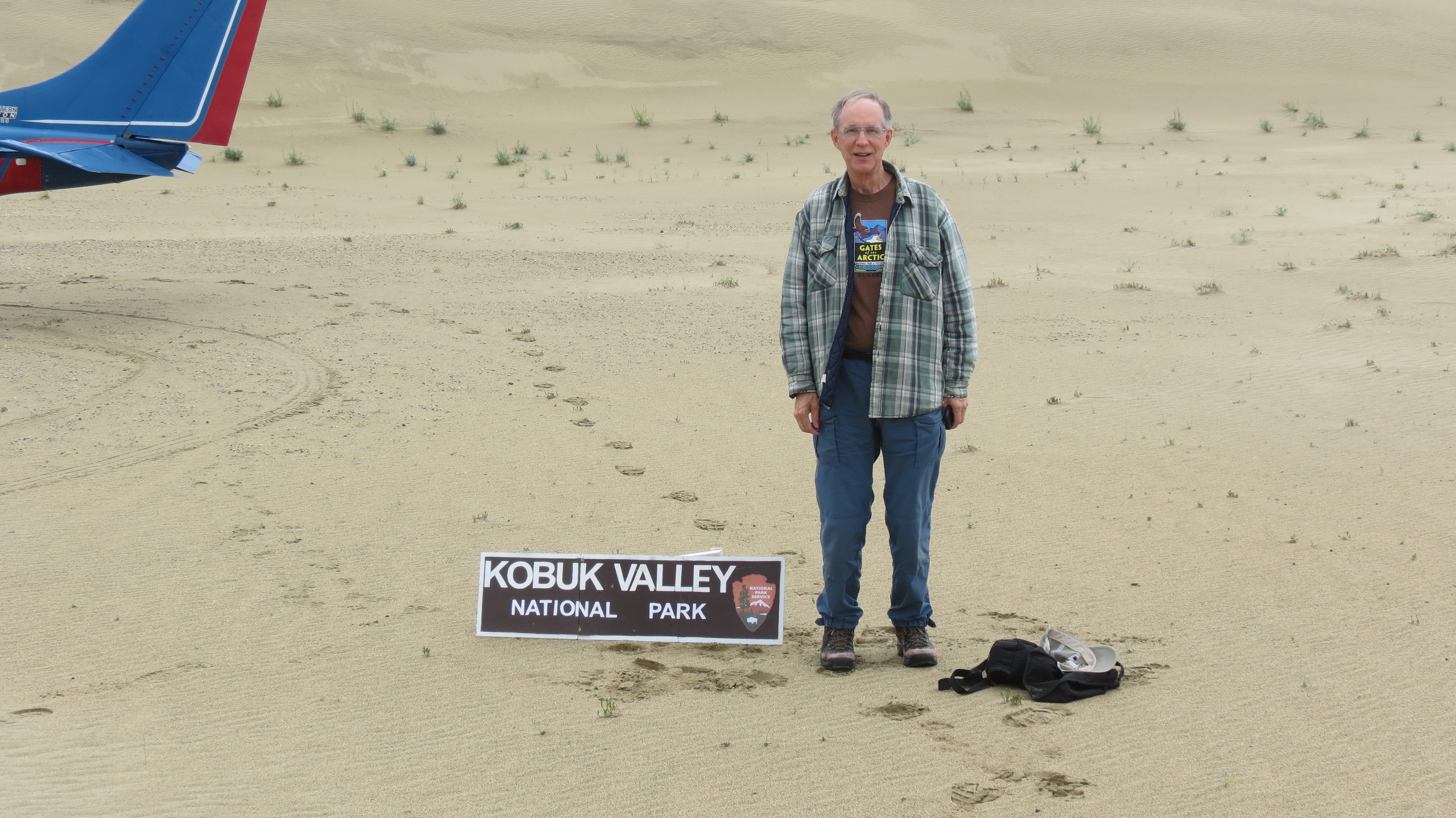
We brought in the sign and put it in the sand. Kobuk has no trails, roads, NPS office (except in Kotzebue).

The copse of trees was by a small stream. To camp there would be lovely.

Plants can grow almost anywhere.

The size of the dunes is remarkable.

I suddenly realized that my footprints were a nice addition to nature.

More of the same.

Just such a lovely spot.

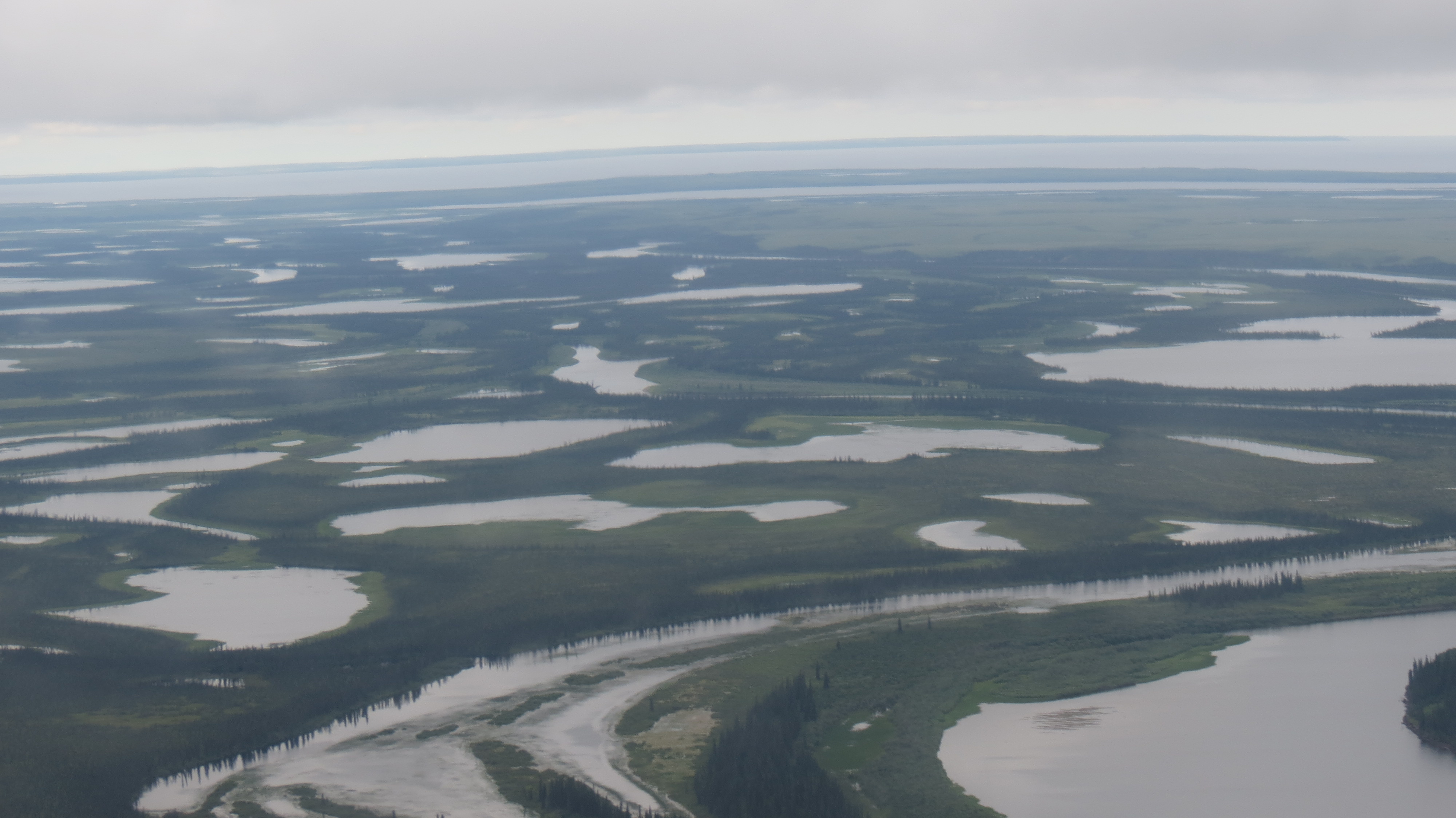
On the return trip. The Kobuk River has six channels, and this was only one of them.

Runway two seven at Kotzebue. It is too short for full size 737s, which have a special dispensation to land here. I thought when we came in, there was a bit more thrust reversal than usual.

IMG_3172

WILDLAND FIRE IS INHERENTLY DANGEROUS; NO MORE PURPLE RIBBONS

July 6, 2013

Ten Standard Fire Orders 

  1. Fight fire aggressively, but provide for safety first.
  2. Initiate all actions based on current and expected fire behavior.
  3. Recognize current weather conditions and obtain forecasts.
  4. Ensure instructions are given and understood.
  5. Obtain current information on fire status.
  6. Remain in communication with crew members, your supervisor, and adjoining forces.
  7. Determine safety zones and escape routes.
  8. Establish lookouts in potentially hazardous situations.
  9. Retain control at all times.
  10. Stay alert, keep calm, think clearly, act decisively. 

Eighteen watch-out situations 

  1. Fire not scouted and sized up.
  2. In country not seen in daylight.
  3. Safety zones and escape routes not identified.
  4. Unfamiliar with weather and local factors influencing fire behavior.
  5. Uninformed on strategy, tactics, and hazards.
  6. Instructions and assignments not clear.
  7. No communications link with crewmembers/supervisors.
  8. Constructing line without safe anchor point.
  9. Building fireline downhill with fire below.
  10. Attempting frontal assault on fire.
  11. Unburned fuel between you and the fire.
  12. Cannot see main fire, not in contact with anyone who can.
  13. On a hillside where rolling material can ignite fuel below.
  14. Weather is getting hotter and drier.
  15. Wind increases or is changing direction.
  16. Getting frequent spot fires across the line.
  17. Terrain and fuels make escape to safety zone difficult.
  18. Taking a nap near the fireline.

I’m going to be a Monday morning quarterback, but on the other hand, accidents and their investigation interest me, for we must learn from them. Commercial aviation has done so to a remarkable extent; medicine has not.

1949: Mann Gulch fire.  Thirteen died when the fire blew up due to strong winds.  From the time trouble was recognized until the men were dead was 11 minutes.  Those who died did so running uphill.  They died from asphyxiation or burns.  The fire was not affecting houses or civilian lives.  We had a culture from the 1910 fire, where 87 died, that all fires were to be put out before 10 a.m. the next day.  Ironically, this has created many problems we face today.

1994: South Canyon fire, near Glenwood Springs, Colorado.  In early July, a lightning strike started it.  Because some residents complained about smoke, a decision was made to fight the fire, which was not endangering any structures or lives, and was 5 acres when a decision was made to attack it, despite its being one of the lowest priority fires in Colorado at the time, where there were at least 35 fires burning, and resources were stretched.  When the fire was initially scouted, the difficulty and the risk were noted, and recommendations were made not to fight it in that particular area.  Catastrophes occur when there are major errors, but they also occur when there is a concatenation of smaller errors.  This fire was an example of the latter.  It was attacked because a person complained of the smoke–an inadequate reason.  Had the fire grown, it might well have been clearly inaccessible to attack in the place where the people who attacked it subsequently died.  It might have been fought differently.  I do wonder whether those who complained about the smoke ever wondered whether they were culpable.

Fourteen people died, including most of the Prineville, Oregon hotshot crew, when they descended a hill, in this worrisome area, in thick growth to build fire lines. Several members thought this maneuver was dangerous, because they had unburned fuel, extremely volatile fuel,  between them and a fire they couldn’t see (Watch out #9). Nobody spoke up, except some smokejumpers elsewhere on the fire, who did not think what they were asked to do was a good idea.  Eight of the ten major rules for fire fighters, 12 of 18 Watch Out guidelines were eventually compromised or violated.

A dry cold front came through that afternoon, predicted, but the information wasn’t relayed to the firefighters.  At 1520 hours, concerns were raised, and some left the area.  At 1600 hours, all left, but sawyers were still carrying their saws, and many were walking.  Twenty minutes later, they were dead, shelters not deployed.  Not only can fire move faster than we can run (this one moved 14 mph), superheated gases and radiant heat can kill people at a great distance, and winds can knock them over.  On Mann Gulch, winds lifted a survivor up and down three times.  The idea that fire suddenly erupts and people die with no warning is not true.  Fire does suddenly erupt, but usually there are hints.  There were such hints at South Canyon.  There were draws, and there was wind, an ideal situation for fire spread, and one that had been previously noted.  Many firefighters didn’t appreciate the severity of the situation until it was too late, for the safety zones were too far away and uphill.

The recommendations after South Canyon were hoped to make fire fighting safer.  They didn’t.

Thirty Mile Fire, Washington State, 2001.  Four fire fighters died after deploying their shelters in a rock field when a small fire earlier in the day suddenly exploded, overwhelming the crew. The problem was many small errors–virtually no sleep the night before (impairs judgment equivalent to being legally drunk), going suddenly to a fire that they hadn’t planned on, faulty equipment, slow start, and pulling in the lookout.  At the lunch spot, not a safety zone, two spot fires were noted up a dead end road (which had not been previously appreciated when the group arrived at the fire), and tankers were sent to the spots.  At this point, the hauntingly sad video given by survivors stops, and the listener is told to put himself in the position of the fireboss, rather than knowing what happened later.  The fireboss sent more help to the spot fires, had no lookout to look at what the main fire was doing, and ultimately, the whole group was cut off from escaping from the lunch site the other way.  Instead, they went up the dead end road (which also had civilians present) to what appeared to be a safe area, with a stream to the east, a rock slide with no growth (but fuel between the rocks), and the road.

Thirty minutes before the fire overwhelmed the crew, many were taking pictures of themselves, not looking for safe spots or beginning shelter deployment, not knowing this would be the last picture of them alive.

Shelter deployment means that people were in an area they should not have been in.  They were too far from the safety zone.  That happens.  Shelters are a last ditch effort to save oneself.  Had everybody deployed on the road, they would have all survived.  But some deployed on the rocks.  They died of asphyxiation.  Many at the time were not adequately trained to deal with shelters, which one must be able to get in either standing or lying.  Several wore fusees and backpacks into the shelter; fusees burn at 375 degrees and can ignite if in contact with the shelter itself.  Some lost gloves, which were in retrospect available and nearby, and others left backpacks too close to the shelter, where they burned, adding fire near the shelter.  I don’t know what I would do if I were in that situation.  I haven’t been trained; all of these people were.  Many deploying shelters do so when there is a great deal of wind from the fire, sometimes ripping the shelter from a person’s hand. When I saw this haunting video, I said to myself, “When the tanker on the downwind spot fire radioed that they needed additional help, that is when I would have pulled out.  Everything is going wrong on this day, and we need to regroup.”

We get back to the basic part of fire fighting.  It is dangerous, and everybody who fights fire knows that.  My experience is nearly nil, only having driven a water tanker on a controlled burn in 1995.  The culture had been not to question orders, and there is a degree of pride in being able to handle adversity.  Nobody likes to lose a fire, nobody wants to say that they couldn’t attack it.  Nobody wants to see houses destroyed.

What I don’t remember about 1994, although I could be wrong, was that we didn’t refer to the fallen firefighters as heroes.  They were professionals, and they were sadly victims. The fire should have been allowed to burn, nobody should have been deployed in any area that was unsafe, regardless of the risk to property and especially not because somebody complained about the smoke.  And that brings me to 19 years later, a lot closer to home.

2013:  Arizona.  Nineteen firefighters die fighting the Yarnell Hill fire.  We don’t know many details yet.  A lookout was posted, and he radioed that the winds had shifted and he was leaving.  We’ve heard he did all the right things, but I know nothing yet of whether his messages were received, or what else was said or not said.  Shelters were deployed, unlike Storm King, so there was more time for the firefighters to realize they were in trouble.  There wasn’t much time, but the early reports saying “nothing could have been done, the fire was on them in seconds” may not be accurate.  I don’t yet know.  More than one report is comparing the Yarnell Hill fire with the South Canyon fire.  Both were initially small, both were in difficult terrain with extreme drought, and both were handled by hotshots.  Both had a major, predictable wind event, both had unburned fuel between the firefighters and the main fire, and both led to disasters.

I suspect by the end of August, most of the investigation will be completed.  Lack of a meteorologist will be one issue, I suspect, or at least under appreciation of what the winds would be.  Working in dense fuels with fire nearby, not seen, will likely be another.  An adequate escape route will be another.  Beyond that, I would not speculate further except to unequivocally state, this was NOT an Act of God.  That statement to me is a copout, an excuse for not trying to understand circumstances that people should understand, and a way to sweep the matter under a rug.  Unfortunately, the mistakes made will be publicized, likely inflaming many communities as much as the fire did.  But mistakes were made.  Thunderstorm downdrafts, erratic winds, Venturi effects, plentiful dry fuel, and a burning fire are all understandable.  Whether we can predict what they will do is another matter, and evidence is beginning to mount that our modeling of fire behavior is inadequate due to increased size of fires because of suppression, climate change allowing bark beetles to survive winters, and more houses in the wildland-urban interface.  Ability to recognize danger and to speak up is part of firefighter training.  If we cannot adequately predict the worst case scenario, and plan for it, then we have no business sending people into harm’s way, except to save lives, not property.  Worst case scenario planning is why firefighters are required to have safety zones and exits to them, both hopefully plural.

Just as Challenger repeated 17 years later with Columbia, almost to the day, with many of the same cultural problems still persisting in NASA, so did South Canyon repeat 19 years later with Yarnell Hill, almost to the day.  I suspect, like NASA, there are still cultural problems in the firefighting community.  Hopefully, the investigation will uncover these issues, and the wildland firefighting community will address exactly how we will approach fires, what we will do, and what simply will not be tolerated.  Whether one wishes to call the men heroes dying doing what they loved is a matter of choice.  I call the men tragic victims who died, not one of whom expected to that day in Yavapai County.  I don’t call dying doing what I loved great.  If I love doing something, dying is not the outcome I want. But that is a my opinion.  We didn’t learn from Mann Gulch in 1949; 45 and 52  years later we had South Canyon and 30 Mile fires respectively.  We didn’t learn enough from them, and 12 years after 30 Mile we had Yarnell Hill.

To the Watch Out situations, I would add:

19. Size of fire does not matter.  Small fires can kill you.

20. Always be aware that you may have only 10 minutes to live, should things turn sour. Act accordingly.

My prediction:  another catastrophe will recur.  My hope:  It won’t.

CONTEXT

June 29, 2013

“A fanatic won’t change his mind and won’t change the subject”  

Winston Churchill

Twenty-seven years ago, I went to trial for malpractice and was not convicted.  Many people say, “You can’t be convicted in a civil suit.”  My reply: “When you have been sued and have gone to trial, then come back and tell me what word you would choose.”

During the pre-trial deposition, quotations from a textbook of neurology came from the prosecutor, and I did not question them.  I learned something that day:  people quote out of context.  At the trial, the prosecutor grilled me on the stand: “Is it not true, doctor, that Adams’ Textbook of Neurology says, “a brain tumor is not likely to be missed.”?

I looked at the prosecutor and quietly said, “May I see the book, please?”  He handed me the book.  I read the paragraph before and after the quotation the prosecutor had used, which stated essentially that with classic symptoms and signs and good imaging techniques, yes, certain kinds of brain tumors were not likely  (italics mine) to be missed.  That is a lot different.

A little later, the prosecutor quoted the textbook again, and again I read the pertinent passages before and after the quotation, politely handing the book back to him.  A third time, this happened, and again I asked for the book.  The prosecutor literally threw the book at me from four feet away.  I never have forgotten that.  At least one juror gasped at the rudeness.  I stayed calm, again reading the passages before and after.  I wasn’t sure what the jury was going to do, but after I stepped off the stand, the bailiff came up to me and said, “You’re a hell of a witness, doc.”

Of course, not losing didn’t mean I won, and I was never the same again.  A few years later, I left medicine.  I still feel like I was a bad doctor, nearly three decades later.

Out of context quotations are dangerous, and one recently surfaced when an Austrian woman came and spoke in Boston about the lack of free speech given to those who speak out against Islam. She spoke at a synagogue, and a person I know in Germany sent me the article.  This individual and I have very different political beliefs, although we share a concern about young women–often girls–who are forced into marriages with older men, have limited rights in their society, and can be killed by family members for not agreeing to these marriages.  These are well documented facts.

The woman who sent me the article is to me quite typical of those who are politically far right of me.  They have several common approaches.  One is to write comments with questions, rather than making statements.  A second is to send me articles, the implication (to me) that if I only would read this article I would come around to their way of thinking.  Third, they have never–that is true, the number is zero– read anything I have sent, so I no longer send articles.  A fourth characteristic is they take things out of context and often use words I don’t.  That’s how I know they are talking out of context. At a medical meeting once, I quietly asked one of my detractors  and the rest of the group if I had used a word she just had.  The room remained quiet.  The point was made.

The first article I got from the woman in Germany, a non-scientist, was that climate change wasn’t occurring.  The article, written by a non-climate scientist, good looking woman, paid by ExxonMobil, quickly stated, “Don’t let them fool you.”  Those words are not scientific, and it violated the first rule I have in dealing with those who disagree with me on science–personalization of the issue.  To a high level of confidence, we are causing climate change.  The confidence is not 100% (meaning we could be wrong), because climate is complex; but to disagree, one must offer high confidence limits that include 0, no change.  I have not seen any such articles.  I won’t discuss my other rules here.

The article about the Boston speech mentioned several men who allegedly had their rights infringed upon for speaking out.  I researched  the first man and found disturbing parts of his past behavior.  I wondered why he was used as an example.  Then the woman mentioned what “Barack Hussein Obama” had said, and my hackles rose.  Obviously, she knew Hussein is a charged word in today’s society, and she used the President’s name in a way that I consider rude, especially from a foreigner in my country.  I realize others might not agree, but to me, she was playing “loose” with Mr. Obama’s name.  I doubt Mr. Obama would care, but I did.

The quotation was “The future must not belong to those who slander the prophet of Islam,” and this was meant to imply that Mr. Obama supported those who were offended by complaints against Mohammed.

Personally, there is no love lost between me and fundamentalists of any breed, including Christianity.  Others feel differently. But I thought that Mr. Obama had said more than what was quoted, and I found the rest of the paragraph quite easily.  First, one had to recognize that the President spoke at the UN about the infamous video insulting Mohammed was circulating on YouTube, inciting violence.  That context was crucial, because it meant that Mr. Obama was criticizing the video maker, not everybody who criticized Mohammed. He continued:

Yet to be credible, those who condemn that slander must also condemn the hate we see when the image of Jesus Christ is desecrated, churches are destroyed, or the Holocaust is denied. Let us condemn incitement against Sufi Muslims, and Shiite pilgrims. It is time to heed the words of Gandhi: “Intolerance is itself a form of violence and an obstacle to the growth of a true democratic spirit.” Together, we must work towards a world where we are strengthened by our differences, and not defined by them. That is what America embodies, and that is the vision we will support.”

This is a very different view from the first line, and the quoting out of context meant that the speaker was deliberately choosing what she wanted to choose.  This is done by many, including the man who prosecuted me for malpractice, but it is wrong, and violators need to be called out on it.  To me, the speaker had lost credibility, and I wanted to call my German contact out on it.

How I did that was difficult, but I know exactly how I must do it.   I am incapable of writing what I feel and sending it immediately.  I am an emotional person, and if I am not careful, my emotions will hijack me into using sarcasm and hurtful, non-factual comments.  In short, I become the person they often are.  I thought about the comments for three days, then I sat down and suddenly, opened the computer and wrote 1200 words–in English.  I then let the writing sit for a day, removed the anger, the sarcasm, the nastiness, stayed factual where there were facts, and translated it to German.

Eventually, she wrote me back, and I sent the article.  I was disappointed in the response, not because she disagreed, but because she did not even acknowledge my comments about context, which are as basic to arguing what people believe as statistics is to arguing whether a trend exists. My last paragraph discusses the words I use–probably, possibly, I think, I once thought, I am 95% confident, and “I could be wrong.”  These are words of science, of probability and uncertainty, of openness, of being human.

My letter to her in German is not good German, but I am self taught, and it was important to write her in her language.

Es ist nicht einfach, diesen Brief zu schreiben.  Ich bin absichtlich verschwunden, um Deinen Artikel zu denken und endlich darüber zu schreiben.  Ich war enttäuscht und ein bisschen wütend.  Wahrscheinlich würde es besser verschwinden, weil diese kürzlichen Tage sehr schwierig für mich gewesen sind.  Ich will schreiben, ohne Sarkasmus, ohne wütend, und mit allen Tatsachen.  Ich werde in meinem Brief nur zwei Fragen stellen, weil viele Radikalemenschen mir die Frage stellen mögen, wenn sie mir schreiben, und das gefällt mir nicht.  Ich schreibe, ich stelle oft keine Fragen, die ich die Antwort schon wissen.

Vor mehrere Tagen hast Du mir eine Frage gestellt (vide infra).  [Übringens habe ich gesagt: Seit 20 Jahren gab es keinen Krieg in den Balkan, nicht die Welt.  Achttausend Muslimen sind in Srebrinica gestorben.  Ich erinnere mich daran.  Dieser Krieg hat in Dayton, Ohio, mein Land beendet.  Unser Präsident war Clinton, ein Demokrat.  Es war das erste Mal, dass einen Krieg beendet wurde, mit nur den Luftverbomben.  Die Republikaner hatten gesagt, dass es unmöglich sein würde.]

 1. “Syrien?”  Es ist eine Tragödie des Menschens.  Mein Land können nicht mehr die Welt retten. Ich frage mich, ob diese Frau und Europa wollen, dass Amerika in Syrien mit unseren Soldaten, mit unserem Geld kämpfen sollen.  Wenn es viele Probleme stattfinden werden, und vertraut mir, es wird viele Probleme geben, wird man sagen, “Verdammten Amerikaner.”  Plötzlich wird niemand sagen: “Vielen Dank.”  Es hat immer stattgefunden.  Immer.  Ich bin alt, und ich habe es oft erlebt.

 2. Deine zwei Artikel haben mich beleidigt.  Ja, beleidigt. Das letzte Mal, dass ich so beleidigt war, eine muslimiche Frau, die Dagestan auskam, hat mir geschrieben, dass meine Regierung 9/11 verursacht hat.  Wieder bin ich sehr enttäuscht, und ein bisschen wütend. 

Die Wahrheit macht uns Frei.  Aber sie ist die ganze Wahrheit, nicht ein bisschen Wahrheit. Es ist sehr wichtig, der Unterschied zu erkennen. 

Sie hat “Barack Hussein Obama” gesagt.  Das ist unglaublich unanständig für eine Ausländeringaste in meinem Land zu sagen. Ja, wir haben unsere First Amendment.  Sie können sagen, was sie willst.  Wir bedürfen nicht, höflich zu sein.  Er ist President oder Mr. Obama.  Sie hat absichtlich “Hussein” gesagt, um ihre Zielgruppe zu beeinflussen.  Ich bin voll überzeugt.  Ich werde alle Opfer nicht hier diskutieren.  Ich habe ein paar schon erforscht, und ich war nicht beeindruckt, besonders der erste Mann. 

Sie hat seine Ansprache nicht im Zusammenhang zitiert.  Das war völlig falsch, und sie soll sich schämen.  Mit diesem großen Fehler kann ich ihre ganze Ansprache nicht glauben. 

Hier ist der volle Absatz.  Meine letzte Frage: hast Du dieser Absatz gelesen? Wenn ein Zitat merkwürdig erscheint, lese ich immer den Zuhammenhang.  “Ich liebe die Muslimen, die nicht zu Europa kommt” kann “Ich liebe die Muslimen” werden, und nicht mehr. Leider habe ich mehrmals gesehen.  Hier: 

“The future must not belong to those who slander the prophet of Islam (Es war sehr wichtig zu verstehen, was passiert ist, wenn Mr. Obama darüber gesprochen habe.  Es gab ein schlechtes Video auf YouTube, das von den USA auskam.  Es gab nichts mit Sabatina oder mit anderen muslimischen Kritiker(in) zu tun.  Es geht ein Video.  Du mußt  in diesem Rahmen erkennen, darüber Mr. Obama gesprochen hat). Yet to be credible, those who condemn that slander must also condemn the hate we see when the image of Jesus Christ is desecrated, churches are destroyed, or the Holocaust is denied. Let us condemn incitement against Sufi Muslims, and Shiite pilgrims. It is time to heed the words of Gandhi: “Intolerance is itself a form of violence and an obstacle to the growth of a true democratic spirit.” Together, we must work towards a world where we are strengthened by our differences, and not defined by them. That is what America embodies, and that is the vision we will support.” 

Das war der ganze Absatz.  Das ist die ganze Wahrheit.  Sie hat absichtlich das Zitat nicht im Rahmen, um die Menschen zu beeinflussen.  Ich kann ihre Ansprache nicht vertrauen.  Es gibt keinen Grund zu tun.  Meine Frau konnte es auch nicht glauben.  Man muss immer im Rahmen zitieren.  Es ist traurig, weil die Tatsachen sich sprechen können.  Sie hatte genug Tatsachen, ohne diesen Fehler zu machen. 

Ich kann verschwinden.  Wenn Du etwas diskutieren wollst, kann ich bleiben.  Du kannst entscheiden, ob ich ein wertvoller, aufgeschlossener Mann bin, mit wem Du schreiben willst.  Ich kann Dir sagen, dass ein Fundi hier gesagt hat:  Weil ein LGBT Umzug in New Orleans geplant war, ist warum Hurricane Katrina kam.  Der Gott hat New Orleans bestraft.  Ja, hat gesagt.  Oder eine Frau, die ist vergewaltigt, wird nicht Schwanger werden, weil ihr Körper eine Verwaltigung erkennen, und kann eine Schwangerschaft verhüten.  Jedoch muss die Frau das Baby haben. (32K Babys gebären nach den Vergewaltigen hier jedes Jahr).  Vielleicht wird Sabatina diese Tatsachen wissen wollen.  Oder nicht.  Ich weiß nicht, aber ich denke, dass es hier ein “Republikanerkrieg gegen Frauen” gibt, ein Missbrauch der Frauen.   

Wenn Du über Deinem Garten, über der Erde, über deine Familie, uber dem Leben, schreibst, würde es gut sein.  Alles Artikel gefällt mir nicht.  Ich habe Dir keinen Artikel geschickt.  Es ist für mich höflich nicht zu tun.  Du wirst ihn wahrschinlich weder wollen noch lesen.   Ich werde ein Artikel lesen, aber wenn ich etwas voll Unrecht finde, würde ich den ganzen Artikel wegwerfen.  Jetzt bist Du null für zwei.  Mein Brief über Syrien wird diese Woche  in The New Yorker Zeitschrift erscheinen.   TNY ist sehr wohlbekannt hier, und einen Brief ist sehr schwierig in diesem Zeitschrift zu haben.  Ich bin ein guter Wissenschaftler, Arzt und Stastiker.  Ich bin sehr neugierig.  Ich kann gut schreiben, und ich lese sehr vorsichtig.   

Endlich schlage ich die Leute vor,  diese Wörter zu lernen, dass ich oft benutzte:  “Vielleicht,”  “Wahrscheinlich,” “Ich denke,” “Ich dachte einmal, aber jetzt denke ich nicht”, Ich habe 95% Zuversicht” und am wichtigsten:  ICH KONNTE UNRECHT HABEN. Man würde gut tun, diese zu lernen. 

THE NEW YORKER LETTER

June 23, 2013

One has to be a writer to appreciate fully how we want to get our work accepted by the top publications in the world.  The New Yorker has a circulation of over a million.  The articles are extremely well written; I have long been jealous at the medical writers, who put me to shame.  But I read every word they write.  A very good friend, writer, and neurologist helped me write A Wise Owl, which won me the Creative Expression Award for Human Values in Neurology 10 years ago.  His goal was to get a letter published in the magazine.  Sadly, he died before that could happen.

I don’t set out to write letters to get published.  I read something, and if it connects with me in some fashion, I write.  It is difficult for me to do so, because I am under a time pressure, which adversely affects my writing.  I am under a word pressure, too, but I have learned to cut words.  Some will say, “You should have said such and such.”  Maybe, but if the letter is too long, it will never appear, so all the wisdom is lost.

The current letter had to do with an article about Syria.  I thought Senator McCain, who represents me in the Senate, was allowed too much space and did not see the same picture I did.  I thought maybe I had something to impart on the debate, so I wrote.  I never expected anything to come of my letter, but last week, I was told it was a “finalist,” which gives one some idea of how difficult it is to get writing into the magazine.  I said to my wife that I got lucky, but both of us realized it wasn’t just luck.  I get a high percentage of my letters to the local newspaper published, because I pick my battles carefully and keep the letters short.


Filkins reports that Senator John McCain has pushed for military intervention in Syria. But I doubt Republicans in 2013 will tolerate “emergency authorizations,” even if they raised no objections to these off-budget costs a decade ago. Indeed, overruling a national security team might show more wisdom than McCain might think. President Obama overruled his Secretary of Defense in 2011, when he authorized the raid that killed Osama bin Laden. Obama is weighing morality, costs, and unintended consequences of another conflict after learning the hard lessons of exiting the military morass in Iraq and Afghanistan. Perhaps he is heeding the proverb, “The more we sweat during peace, the less we bleed in war.” 

Michael S. Smith

Tucson, AZ


BELIEVING IS SEEING

June 14, 2013

My wife read a CT Scan of the heart recently, done to check coronary artery calcification, and told the referring physician the patient had breast cancer.

Whoa!  What does that have to do with heart disease?  The answer: nothing, and that is the point: we need radiologists to read films formally and not clinicians, and I say that as a former clinician who read CT head scans really well.  It’s fine for a medical group to have its own X-Ray facility and for clinicians to read the images.  But every image must have a formal reading by a radiologist, for that individual is both unbiased and trained to look at everything on the image, every corner, every part.  There is no law in nature that says a person will have one thing wrong.  It is entirely possible for a neurologist to look at an MRI of the spine and miss a large abdominal aortic aneurysm.  We see what we expect to see.  Seeing isn’t believing.  Believing is seeing.  We believe something, and we tend to look for it.

On a CT scan, there is a side view, which shows the skin.  This isn’t a mammogram, but it certainly is capable of showing a breast cancer.  In addition to the breast cancer, there was a “ground glass” area in the lung suggesting there might be an early lung cancer, too.  Wow. A CT scan of the heart is done for coronary disease, and two other systems have primary cancers.  Maybe the cardiologist would have found those, but I doubt it.  I doubt when I read CT scans of the head that I would have found a throat cancer, even though the throat was scanned and on the film.

In my defense, I was once sent a patient with leg pain, with a concern that this was due to pinched nerve in the back.  The lady had pain near the knee, but it was point tender, and I obtained a bone scan, looking for a fracture.  I found a hairline fracture of the proximal  tibia.  I got a lot of pleasure diagnosing something correctly out of my field.  Most specialists do.  There is a cardiologist in town, whom I met 31 years ago when he was new here.  I had seen a man in the emergency department who had driven 2500 km to Arizona and presented with sudden, brief unconsciousness.  I saw him and noted he seemed to be breathing a little faster than normal.  I obtained an arterial blood gas and found pronounced hypoxia.  Thinking that a cardiac arrhythmia would cause unconsciousness (strokes seldom do), and thinking of pulmonary emboli as a cause of both that and hypoxia, I did a lung scan, since that is what we did back then, and there were pulmonary emboli, because of leg clots that occurred during prolonged sitting on his drive to Arizona from Minnesota.  The cardiologist happened to be present, and I referred the patient to him.

Several years later, one of that cardiologist’s partners referred a patient to me on whom he had diagnosed an occipital lobe infarct.  For a neurologist, that is not difficult, but I was impressed the cardiologist had picked it up.  Most non-neurologists miss it.

So when the MRI of my neck was unchanged from 9 years ago, that was good news, I was a bit chagrined, however, when the radiologist told me that I had a significant thyroid nodule.  It never occurred to me look for thyroid disease on my MRI.  It is sort of like people’s being surprised when I tell them the Moon is visible in broad daylight.  “It is?” they say.

“It’s there, isn’t it?”  I reply.  The thyroid nodule was quite present.  Once I looked, there it was, plain as can be, like the first quarter Moon in the southeastern sky in the afternoon.  Try finding the Moon in daylight, sometime, if you haven’t seen it.  You will discover a whole new world–literally., and wonder why you never noticed it before.  That’s the problem.  We notice only what we are willing to notice.  Once we are willing to notice many things, a brand new world opens up to us.  Like the Moon, or even Venus, which you can often see in broad daylight, if you know where to look.

Look around you.  See, smell, touch, hear, and taste the world.  Notice things.  Life becomes very interesting when you do.

Even when you have an “interesting” thyroid nodule.  By the way, it was benign.

“THIS CAN’T BE HAPPENING TO ME”

June 8, 2013

Last week, an elderly couple, experienced canoeists, capsized in Upper Basswood Falls, which straddle the Canadian border, and the 78 year-old man drowned.  His 75 year-old wife made it to the Canadian side.  She heard him say, “I can’t move,” but was unable to help.  I can imagine that.  Ice out was 3 weeks ago, and she probably was hypothermic.

I don’t like Upper Basswood Falls.  Never have.  A couple once left their young daughter at the end of a portage, while they returned to get the remainder of their gear.  She fell in the river, and that was the last time they saw her alive.  I was there on September 12, 2001, and that’s where I first heard the news that the world had changed forever.  In 1991, I did one of the most stupid things I have ever done in the woods.  Solo, I was coming upstream, on the Canadian side, and moved forward in the canoe to deal with the current.  I later learned that there are three things that a solo canoeist cannot manage:  wind, muck, and current.  I was  thrown out of the canoe, without its capsizing.  I found myself suddenly underwater thinking “This can’t be happening,”  usually the first thought people have in these circumstances.  It isn’t a good one. Quetico maps often don’t show portages, and when I went ashore, there was a short carry.  Fortunately, the water was warm, and all that was hurt was my pride.  I could have drowned, because back then I didn’t wear a PFD (Personal Flotation Device), either.  I know that, because I was underwater, which wouldn’t happen with a PFD.  I made two bad decisions and got away with them.  In 40 years of canoeing, it is the only time I dumped.  I’ve worn a zipped up PFD since, for it cannot come off.  The victim was found without one.

Upper Basswood Falls is not a waterfall but a series of falls, and there is a long portage around them.  The Horse Portage, as it is called, is 340 rods (1700 m).   It is longer, should one choose to set in downstream a little further, which I have also done.  The trail is not good, and the put in spot isn’t, either.  But in high water, it is safer.

The couple had reportedly discovered they could paddle Upper Basswood Falls and avoid the Horse Portage. The thought of bypassing the Horse Portage has never crossed my mind, and I’ve paddled 5 miles (8 km) of Class III rapids in the Far North on the Nahanni, a week’s travel from civilization and no way out other than on the river. This information shocked me.  A solid rule in the Boundary Waters-Quetico is never to paddle rapids if a portage exists.  In known high water, with 3 feet of snow on the lakes a month earlier, probable water temperatures of 45-55 F., Upper Basswood is a killer.  The widow isn’t sure whether he scouted the rapids; that means that both of them did not decide together whether to continue.  In any case, he took a different channel from usual, and that was that.

A few people die annually in the Boundary Waters-Quetico from falls or drowning; lightning is another cause.  Rapids must be avoided; further downstream I once tried to dissuade a pair not to run Wheelbarrow Falls.  They asked me to take pictures.  I have some good ones, which first show the pair with no helmets and bare feet.  Not wise.  Then the pictures show the canoe tipping, going broadside, and two guys in the water being taken downstream.  They survived, unscathed.  The canoe was perpendicular to the rapids, full of water.  They said they could handle it, although a canoe full of water weighs about 600 kg.  I later learned they did get the canoe out, before the keel bent and the Grumman became scrap metal.

I told my wife last night I would never stay on shore if I heard her say in the middle of the river, “I can’t move.”

“I’d get you out, or we’d both go together.”  I really meant that.  She reminded me that we have animals.  I reminded her that we have each other.  I wouldn’t live with myself if I did anything less.  But, I said, “I wouldn’t put us in that situation.”  I won’t, and I haven’t.  I hope to be 78 and still canoeing, although I would be exceptionally careful in rivers, high winds, rain, and thunderstorms.   I insist she speak up any time something doesn’t seem right.  That took a while to get her to do, and for me to listen, but we’re better off for it. The man’s widow didn’t know if he had a life jacket on.  If I forgot to put mine on, my wife would tell me.  These are little things, perhaps, but in the woods, as in so many other places, it is the concatenation of little things that produces the disaster.  Was the reason the victim couldn’t move was that he was pinned down?  Would a PFD had prevented it?  We will never know.

Bad things happen.  Some are simply not preventable.  Lightning strikes kill, although if one pitches a tent where there are no tree roots and uses a pad, there is a good chance of avoiding ground currents.  Trees fall;  high winds are frightening, because healthy trees can be suddenly splintered like matchsticks.  I’ve seen it.   I will sleep during a thunderstorm; during high winds, I stay awake listening for the first loud “CRACK,” for once I hear it, we are out of the tent, until the wind dies down.  The BW had a derecho in 1999, wiping out 30 million trees.  Incredibly, nobody was killed.

Fire is another concern, and even small “distant” fires can blow up into monsters, which almost killed a pair in 2011, when the Pagami Creek fire ran 12 miles in a day, and the couple had to turn their canoe over in a river, stay underneath it, breathing the air that was there.  Getting caught in a fire that day was nothing anybody could have foreseen.  The couple survived a freak occurrence by doing the right thing.

I am not afraid to solo.  I did that in April in snow into Angleworm Lake.  Or almost.  The snow got too deep, the trail difficult to find, and the map showed more distance left than I had hoped for.  I didn’t spend time analyzing; I automatically turned around to return to a known dry spot on the trail that I had noted on the way in.  I was fine.  What I told my wife after the trip was simple:  “I think this was the smartest I’ve ever behaved in the woods.”  But being smart just makes the stupid things less likely to occur; freak occurrences and unexpected illnesses are wild cards.

I’m sure some might say that dying in the woods is not the worst way to go.  Maybe.  The problem with dying “doing what you loved,” is that people who love you are left behind, and others often have to put their lives at risk to recover your body.  It is clear if I am ever in the position where death is a real possibility, there is a good chance I did something wrong.  I’d like to think if I got on a river that was unusually high, a lake with huge waves, or a thunderstorm that looked really bad, I would tell my wife we were going to stop to think about our options.  Nature isn’t out to kill us.  Nature just is.  We decide whether we run rapids, deal with waves, lightning, bears, and falling trees.

It’s a real shame what happened.  I never dreamed an elderly couple would shoot the beginning of Upper Basswood in spring.  I’m just filled with sadness, hoping some learning will come from this.

If there is one, only one rule I would tell people in the woods, it is this:  if you aren’t certain what to do, stop immediately and think of your options, remembering the best one likely is to turn back or change what you are doing.  It may be inconvenient and annoying, but you will survive to have those emotions.

If you allowed me a second rule, it would be this:  “Nobody ever drowned on a portage.”

DRESSING UP A PIG

June 1, 2013

In 1967, when we began heavily bombing North Vietnam, we called it a “protective reaction.”  Doonesbury asked “what are the casualties?”  The answer, in the same cartoon, was, “On language, very great.”  The following year, we heard, “We had to destroy the village in order to save it.”  We use derogatory terms I won’t write here to de-humanize an enemy, since it is easier to kill somebody one doesn’t think is human.

In many instances those somebodies are women and children.  Let’s start with circumcising women, which I will call by a proper name: “Genital mutilation.” This has no medical reason, unlike male circumcision, which completely prevents penile cancer and makes HIV less prone to be transmitted.  I don’t remember mine, and I don’t believe it caused lasting harm, but I am open to evidence on the latter, just not the former.

I read recently that Reuters refuses to use the term “Terrorists,” and the Associated Press now refuses to use “Islamic terrorists” or “illegal aliens.”  This is equally bad as dehumanizing an enemy.

I’m a liberal, but I am a strong believer in using the proper word to describe a situation or condition.  An improper word or phrase, used frequently, can become harmful if it becomes ingrained in the vocabulary.

Examples of the latter include “The Death Tax,” which is the estate tax.  There is a threshold over which the estate is be taxed at about 40%.  The threshold varies and is now $5.25 million. The proper term is “Estate Tax.”

“Death Panels” were used when during the debate on the Affordable Health Care Act (called Obama Care, another misuse of the language, since the Congress passed the law, and the Supreme Court upheld it).  One part of the bill was to have Medicare pay for counseling on End of Life planning.  As a neurologist who dealt with end of life issues, often when no other physician was willing to do so, I found that lack of advance directives was a significant impediment to decision making families had to make, when a member had irreversible brain injury.  I saw families torn apart over the issue.  Paying to have these discussions with competent people in advance seemed to me to be a good use of money, since the amount was 1-5% of the cost of one day in intensive care, and many of these people languished, and that is the proper word, in intensive care for days, weeks, or in some instances months. I saw this often.  Many elderly want their estate going to their offspring, not for futile, unwanted care. ICU beds are in short supply, so having them used to house patients who were going to die soon, when seriously ill people could benefit from those same beds, made no sense.  I made sure neither of my parents lingered.  They made me promise not to let it happen to them.

I practiced in a Catholic Hospital, and the Church had no problem with discontinuation of futile care.  Nor should anybody else.  I used terms like “die,” and “death”, hard words, but final in meaning.  “Expire” is too soft, and “pass on” implies something I don’t believe in.

Some of the terms we use would be funny if they weren’t so pernicious in their ability to dress up a pig in such a fashion that people forget it is still a pig.  “Pre-owned” means “Used”, half the letters and twice as easy to understand.  “Fastest growing” is another term for “smaller,” since large firms need proportionately more money to grow a given per cent. If my firm grosses $1 million a year, and next year it grosses $1.1 million, it has grown 10%.  If my competitor grosses $100 million a year and next year grosses $105 million, his has grown 5%, but his share of the market has increased nearly 4%, from 100/101  to 105/106.1.  The amount of new business in the market has increased $5.1 million, and nearly 98% of that increase went to my competitor.

We can say “undocumented immigrants,” and the term is correct.  But people who cross borders without going through customs and immigration are violating the law.  That is why we have the word “illegal.”  There may be all sorts of reasons for the person to do so, and there may be appropriate words for those reasons–fleeing a repressive regime, starvation, an epidemic of disease.  But the person is still performing an illegal act.  Whether the act is immoral is another matter altogether.  We saw during the last financial crisis that people did immoral acts that were not necessary illegal.  We should not confuse immoral and illegal.

Beheading a British soldier in broad daylight and saying that his country is responsible for killing millions of Muslims daily is a gross act of religious terror and exaggeration.  [Mathematical note:  “millions of people daily” would require about 5 years to have no Muslims on the planet, using a minimum number of “2” for the plural and 2 billion for the number of Muslims.  This error was not brought out in any article.]  Terror scares people, and that act scared the hell out of me.  Since this was a brutal act carried out in the name of religion, both the act and the modifier belong. I fail to see why Reuters won’t use the term.  Indeed, a mullah interviewed on British television refused to call the beheading an “abhorrence,” using only the word “shocking,” which is far milder and has many different meanings.  Abhor is very clear, and the man refused to use the word.

My liberalism has limits.  When I saw Corregidor, the American Cemetery in Manila, the prison where men drowned during high tide, I felt strongly that we had a place in the world that we had earned through the blood of men who fought and died in places not many people know of today, like Guadalcanal, Tarawa, Leyte and Lingayen Gulfs, Bataan, Kwajalein, Enewetak, and Saipan.

The issue we face as a country is how we deal with a very nasty world without compromising our values.  For if we become what our enemy is, then we have lost.  But if we allow the enemy to proceed without resistance, then we have lost as well.  The world is not black and white but a large shade of gray.  Any time the gray hides something evil, we need to shine a spotlight on that evil and address it.

With a carefully chosen word or phrase, because it is proper, regardless of who may be offended.

THE TERM IS NEITHER “PASS ON” NOR “EXPIRE”. THE VERB IS “TO DIE” AND THE NOUN IS “DEATH”

May 11, 2013

A 90 year-old man presents in an emergency department with abdominal pain and is found to have an abdominal mass.  It is likely he has colonic cancer with impending perforation.  He refuses colonoscopy, and he refuses surgery. “I am ready to die,” the man says, who is competent.  The surgeons think they can help him.  The man refuses again.  The surgeons say that without surgery, this will be a painful way to die.

This scenario is being played out as I write in a nearby city.  I was asked, as a former member of a hospital ethics committee, what I would do.

It’s difficult to say, without really talking to the patient and whatever family members are available.  I don’t know whether the man has a living will or a health care power of attorney.  If you don’t have either, I would do so at the earliest possible opportunity.  Don’t think because you are in your 20s, this isn’t an issue.  Accidents can leave people in permanent coma; Terri Schiavo, Nancy Cruzan, and Karen Ann Quinlan were all young, when a catastrophic event left each of them vegetative.

If the man is truly competent, he has the right to his decision.  Patients have the right to refuse things that we physicians think they ought to have.  This doesn’t hold for children, and more than one physician has given blood to a Jehovah’s Witness.  But one is on shaky ground to treat a competent patient who has refused such treatment.

That doesn’t mean we have to take care of that patient for that particular illness.  I had people refuse to take anti-convulsants for epilepsy.  I said that I would provide a list of physicians to whom they could go, and they had 30 days to do so.  I could not, in good conscience, have a patient whom I thought was a danger to himself and others be under my care, yet refuse my recommendations.  But, I also would not, as some did, fire the patient and dump the case on the hospital medical director, which more than one time happened to me.

The “painful death” part disturbed me.  Yes, peritonitis is painful.  So is colonic surgery, with a colostomy likely, and the possibility of further surgery, poor healing, infection, or pulmonary complications, for major surgery on a 90 year-old will be complicated by definition.

We can control pain.  We have palliative medicine physicians, and we have hospice.  There is no reason for somebody to die in horrible pain.  There are those who worry about addiction to morphine, which would be laughable in a dying patient, if the problem weren’t laughable and people really didn’t say that.  But they do.  We have a conflicting dichotomy in this country:  hospitalized patients are asked constantly about how much pain they are having.  Once you are an outpatient, then narcotics are bad things.  Oh, it isn’t quite that simple; however, the truth is not all that distant, either.  This dichotomy is grist for another mill.

There are others who worry that we will kill somebody by giving them so much morphine that they will stop breathing.  Morphine depresses respiration, but if a patient dies by receiving too much morphine, isn’t that in fact what was going to happen anyway?  What in the world are we so afraid of?

Death.

Not passing away, not going on to a “better place,” not “expiring”.  Death.  Dying.  Ceasing to exist as a human being.  I always used the term “death” in talking to families.  I wasn’t always popular, but I was far more often respected by people I cared about than I was despised by those whom I did not respect.

Yes, I do worry about contracting certain conditions.  I know medicine, and I know what can befall the human body.  But I am also worried about being kept alive when I would not want to be.  If I am vegetative, I wouldn’t be aware of it by definition, but it would be hell on my wife, and I would not want her to go through that.

I worry a great deal that I might end up in an ICU with a bunch of “keep him alive at all costs” folks working on me, long after it is obvious that the result will be poor and counter to my living will.  I worry that somebody will point out a “miraculous cure after 20 years in coma,” when in fact the person was vegetative and happened to smile, which vegetative people do.  I do not want my name associated with a court case, like the three women I mentioned above.  Nor do I want to hear “you never really know what will happen,” when we do know with extremely high probability what will happen. The best thing I did in medicine was not curing people, for I did little of that.  The best thing I did was allow people to die when it was time.  I knew when it was time, not to “give up,” but to accept reality.

The next day, both hospice and palliative care people talked to the man and his family.  He died soon afterwards.  For me, he no longer exists.  For others, he has gone to a better place, and they have memories of a long, happy life.  For all of us, he is no longer suffering.