Archive for the ‘MY WRITING’ Category

SOME THINGS DON’T COME WITH A PRICE TAG

January 21, 2013

Because my wife works in the Phoenix area on weekends, I often hear of unusual cases.  A 60-ish woman developed hemoptysis, coughing up blood.  While a strong  sign of lung cancer, hemoptysis is also a hallmark of tuberculosis.  Now, it is often MAC disease, Mycobacterium aviae complex, a non-contagious cousin to TB, often affecting lungs previously damaged from pneumonia, where the bronchioles, the small airways, dilate, a condition called bronchiectasis, a nidus for such pathogens.  We used to say hemoptysis was a manifestation of bronchiectasis; I wonder today how many of those people in retrospect had MAC disease.

MAC can be treated with “triple therapy”–3 antibiotics, many used for TB.  If  widespread, the antibiotics have to be taken for life.  If localized, then part of the lung containing the disease may be taken out, and the disorder cured.

That’s pretty nice, to take somebody who is coughing up maybe a cup of blood periodically, and curing them.  Surgery can cure many bad problems.  I have three pins in my right hip after a car turned in front of my bicycle in 1999. Without surgery, I’d be limping or not walking at all.  Since surgery, I’ve backpacked Alaska five times, climbed mountains, canoed, and traveled all over the world, walking normally.  My surgeon gave me back my life.

The downside is that surgery is expensive.  So is anesthesia.  And hospitalization.  There are a lot of people employed in hospitals to check you in, care for you, get your medicines, your meals, get you out of bed, clean your room, and so forth.  But what is the price of good health?  Until you’ve had bad health, you probably don’t think much about good health’s being worth something.  It’s just that we can’t put a price tag on certain important things in life, like no longer having a condition that makes life pretty miserable and limits activity.  A lot of people no longer die quickly from conditions that may not be curable, but can be controlled for many years, like COPD, CLL (Chronic Lymphocytic Leukemia), CHF (Congestive Heart Failure), HIV, and many others.

Being poor is both highly correlated and likely causative of ill health.  There are a lot of poor people in this country, a whole lot, for whom a lot of medical advances simply are too expensive for them.  They hope…..the abdominal pain will go away, the chest pain on exertion isn’t their heart, the recent onset of headache isn’t a brain tumor, or the recent fever isn’t something bad.  I hope, too, when I get one of these problems, but I can get it checked out and either be treated or reassured.  I don’t know what reassurance is worth, and I don’t think the Republicans in Congress think it is worth much either.  I can look up the price of Raytheon stock; I can put no price on my ability to be able to walk normally.  Most of us take our health for granted.

Until something bad happens.

The woman with MAC had insurance.  What if she didn’t?  The antibiotics are expensive in their own right–$60-$100 a month.  I know many people who need that money for other things, and not booze and cigs, either.  They have kids who need things, their cars break down, they need a new heater in their trailer.  Yes, trailer.  What if she can’t afford it?  She might be a great candidate for surgery, but she doesn’t have $25,000 or more to pay for the diagnostic tests and surgery.  So what does she do?

Coughs up blood and hope it goes away.  Maybe pray that she doesn’t exsanguinate.  There is a place for prayer, but not here.  We have the ability to treat these people.  Not to do so is betraying the ideals this country was founded upon.

In America, many believe that is the way it should be.  If you don’t have insurance, well, you don’t have insurance.  The market will deal with you.  Maybe you are lazy and on the dole, not doing real work like moving money around, which has been shown not to add value, unlike the minimal wage Nurse’s Aide who has to clean a patient who soiled himself (crapped in bed and was lying in it). I’ve done that, by the way, hundreds of times.  As a doctor, too.  Some weren’t born to wealth, had bad genes, parents who didn’t read to them, had a husband leave (after fathering a few kids, perhaps), and don’t have “connections”.  Or, they are unemployed, because unregulated fools believed in stupid models, made bad bets, got bailed out and were paid nice bonuses for doing it.  That is basically why our unemployment rate is so high.  You are out of luck, and there are 50 million “you’s” in America today.  The thought of insuring somebody, called the Affordable Health Care Act, derided by many as “Obama Care,” is an anathema to many.  Let the market take care of it.  Really?  We aren’t talking pork futures here; we are talking about people’s health.

What I find ironic is many who were angry about the AHCA were elderly and retired military, both of whom were getting government subsidized medical care.  The military earned it, although how much longer we as a country can afford to pay it remains to be seen.  If Medicare is going to be on the table, then so must defense spending.

The millions of poor people here don’t have the loud voices that Bill, Rush, Ann, Mitch, John and Eric have.  The Republican Party, who has voted in the House more than 33 times to repeal the Affordable Health Care Act, appears not to realize exactly how many poor people there are  It’s easy to forget, when one has insurance and can get any medical condition taken care of without worrying about bankruptcy.  But these 50 million are mostly silent, and not in the news.   I don’t see that cutting medical safety nets will do these 50 million much good.  Indeed, I see that expanding the safety nets to cover these people is a better idea, and I am willing to be taxed to do it, even though I already pay double the percentage of Mitt Romney.

There are conditions I saw as a neurologist that are totally devastating–like an anterior communicating artery aneurysm that blows out the frontal lobes, leaving somebody permanently in a nursing home physically intact but with the judgment of a 6 year-old.   That could happy to anybody–Republican, Democrat, rich, poor.  I’ve seen devastating strokes, infections, trauma, rapidly aggressive cancers ravage people or kill them outright, often with no warning.  A former colleague of mine was practicing cardiovascular surgery and was dead 10 weeks later from leukemia.  I can get T-boned by a red-light runner tomorrow, or run over by a distracted driver, when I am out for a walk.  I was almost at my Safeway store, the day of the Tucson Massacre.  My congresswoman is paralyzed and partially aphasic for life; her replacement was shot that day, too, uses a cane and now has to defend the 2nd amendment to get re-elected.  While there are scathing attacks on abortion, I haven’t seen legislation pass to ensure every child under the age of 18 gets covered for medical care.  This to me is right to life, which ends at birth.  There are those who espouse Christianity who call fetuses children but who are against covering all children’s medical care.  Since that passes as Christianity in this country, small wonder I am not religious.

Should people be responsible for themselves?  Well, it depends.  In the Ayn Rand world, every human does the right thing, and there is no cerebral palsy, no devastation from herpes encephalitis, no people tied to ventilators or oxygen tanks.  Ms. Rand was no saint, with a personal life that made Bill Clinton’s look normal.  I’ve read her books; they sound fine until you suddenly realize that she writes about a different universe from the one you live in.

To Rand Paul, and the others who think we should just care for ourselves, illness is our problem.  According to Mike Huckabee, God is punishing you, just as God punished Newtown.  Yes, godlessness in the schools caused Newtown.  I wrote Mr. Huckabee about that and never heard back.  I’ve seen thousands of lives devastated, families in pain, and many who have gone bankrupt. You?  Maybe some day it might be you in the bed looking up at somebody, hoping for relief of your misery, and being able to resume the life you took for granted.  That assumes, of course, that your brain is not the source of your being hospitalized, in which case you may not recognize anybody.  This stuff happens, you know.  I worked for 20 years in a small city caring for people with these things, and I was really, really busy.

Those of you who called paying for end of life decisions, derided as “Death Panels,” might walk a few meters in my shoes (that’s a few yards for Americans who read this), and think about those derogatory comments.  Here’s my op-ed four years ago 

You see, we can decide to be rugged individualists, which is really romantic, until other rugged individualists assert their rights over ours.  That’s a problem.  Or until we need help in a hurry, be it a flood, a fire, an earthquake, a horrible illness, or a car wreck where we are trapped in a vehicle with leaking fuel and a hot engine.  When that happens, most of the money you’ve got, the gold in your safety deposit box, the few bucks on your money clip, the spare jewelry you think will be worth a lot won’t be worth a tinker’s damn.

And then, just maybe then, you will learn that health insurance, Obama Care, clean nursing homes and freedom to die the way you choose, may be more important than you thought.

Finally, you might understand why it is worth spending taxpayer money on medical care.
COLD SNAP

January 17, 2013

Tucson recently went through a cold spell, where for 3 days the highs were under 50 F (10 C) and two record lows occurred, the coldest being minus 8. C.  It has been about 40 years since we had 4 straight days under 10 C.

A letter appeared in the paper calling it “global cooling.”  It is a fact that there were no  letters to the editor stating “global warming” when the National Weather Service announced two weeks ago that 2012 tied 1989 as the hottest year on record in Tucson.  Why would three cold days, not a record, constitute global cooling, yet the hottest year on record not be global warming?  For that matter, while the western US is very cold now, the eastern US is warm.  This is typical of jet stream waves to produce such a pattern.  I don’t expect everybody to understand the patterns of the jet stream; however, those who do not understand those patterns should not be writing letters saying this is global cooling, and the newspaper should not be publishing those letters.

A friend, who lives on the East Coast, well educated, although not in science, commented when I visited that 5 days in a row that Philadelphia didn’t break 40 F (5 C) was evidence against global warming.

The letter, the comment from my friend, and those who say that 3 feet of snow in their backyard is evidence against global warming exemplify that too many do not know the difference between weather and climate.  Many are so convinced that there is no global warming that they seize upon any cold weather event and ignore the warm weather ones.  We all are capable of this heuristic:  we hear about something crazy happening, and we say “There must be a full Moon.”  The times the Moon isn’t full (23 days a cycle, since 6 days it is 90% or more illuminated and looks full) are ignored.

We are warmer in June than we are in January.  The weather service has a line trending upward for the average highs and lows during this period.  But we all know that hot and cold days occur.  Once, about a decade ago, April was cooler than March in Tucson.  That had only happened once before in over 100 years.  Yet, nobody would consider thinking that May and June would be cooler, too.  I fail to understand then why a few cold days are treated as evidence against a long term, unheard of in our history as a species, trend.

We know that temperatures change in a jagged fashion trending upward in the early part of the year and trending downward at the end of the year.  One year, fewer than a quarter of Harvard seniors knew why.  This lack of a basic fact taught in elementary schools (my father 60 years ago authored textbooks that included this issue) suggests we have major flaws in educating our children about science.  I am further puzzled by the anger of many of the comments, which are often aggressive with frequent, irrelevant personal attacks.  Why the anger? I consider climate science a matter of models, of ocean level, pH and [CO2], ice core analysis, atmospheric aerosols and other variables, which can be checked for validity.  Al Gore, cap and trade, and so-called radical environmentalists are irrelevant.  The Earth requires storms to balance heat between the equator and poles; a warmer Earth will require frequent, more powerful storms.  I predict this will in fact happen in this century.  I may be wrong, but those on the other side offer very few predictions as to what they think will happen.  If we aren’t truly in the throes of global climate change, then I would like a prediction of the Earth’s temperature range during the next decade as well as to sea level, which currently is rising 3 mm a year. (due to glacier melt and expansion of warmer water).  I want a prediction with confidence intervals, since all predictions are prone to error, and the error must be quantified.

One way to look at this is to split the data in half, from 1930-1970, leave out 1971, a unique middle, and then look at 1972-2012.  We compare 1930 with 1972, 1931 with 1973, and so forth.  This is the Cox-Stuart Test, and it does not require the data to be normally distributed.  It is a non-parametric statistical test, and it is both easy and useful to apply.

1930-1972      67.3         67.9

1931-1973      67.2         66.4

1932-1974      66.4         67.3

1933-1975      66.8         66.3

1934-1976      69            68.3

1935-1977      66.5         69.4

1936-1978      67.9         69

1937-1979      67.2         68.3

1938-1980      67.5         69.4

1939-1981      68            69.6

1940-1982      68.9         67

1941-1983      67.3         67.8

1942-1984      68.5         68.1

1943-1985      70.2         68.7

1944-1986      67.4         70.3

1945-1987      67.2         69.2

1946-1988      68            70.5

1947-1989      68.1         71.4

1948-1990      67.8         69.6

1949-1991      67.3         69.1

1950-1992      69.4         69.8

1951-1993      68.3         70.2

1952-1994      68.2         70.9

1953-1995      68.5         70.3

1954-1996      70.6         70.6

1955-1997      67.4         69.8

1956-1998      68.8         68.1

1957-1999      69            69.6

1958-2000      68.9         70

1959-2001      68.2         69.7

1960-2002      67            70

1961-2003      67.1         70.7

1962-2004      68.2         69.3

1963-2005      68.6         70.8

1964-2006      66            70.2

1965-2007      67.1         70.5

1966-2008      67.4         70

1967-2009      68.1         71.2

1968-2010      68.1         70

1969-2011      68            69.9

1970-2012      67.3         71.4

We begin by assuming there has been NO change in the temperatures, since the status quo is usually taken to be accurate. If we find a change, which we will, we may determine the probability that change is random or is unusually high or low.  Therefore, we set the probability of 50% that one pair will be warmer/colder than the other.  If there has been no change in the past 82 years, then we treat the data as a simple coin toss 41 times.  We would expect 20-21 heads, but we would not be surprised if we had 22, 20, or frankly anywhere between 14 and 28, if we allowed chance intervals to have a probability of at least 5%.  “Anything is possible” is not an appropriate statement here.  I would consider a probability of  0.000001 or 0.049 unlikely, and that is typically where we draw the line in statistics, at 0.05.  Anything outside this range is considered not to be a chance event.  We define what is possible before we collect the data, so we don’t change around the probabilities to call something significant or not significant because it suits us to do so.

There were 32 instances where the second half was warmer than the first, 7 where it was cooler, and 2 ties.  Could this be a chance event?  Yes, it could, but the probability of its occurring if chance were operating here is far less than 1 in 10,000, much smaller than our 0.05 probability we stated at the outset, so we say this is not a chance event, and in fact the temperatures are increasing.  True, the increase is not linear, but we wouldn’t expect annual temperatures to be increasing linearly any more than we would expect the temperature between January and June to increase linearly, either.  That is one of the biggest concerns I have about people talking about a “cool year”.  There is natural variability, or common cause variation, and there is other variability, called special cause variation.  In Tucson’s case, it is likely that there is both heat island effect and global climate change causing the changes.  It is a fact that Tucson is becoming hotter, and this was just proven.  This being a  chance event is not only highly unlikely,;we defined ahead of time what that chance event interval must contain, and the value we obtained, the test statistic, was outside that interval.

To summarize the data in one more way:

  1. Six of the last 10 years ranked in the top 10 for warmest.  That is a fact.
  2. Since 1995, there have been 6.7 times as many high temperature records set as low temperature records (last year’s ratio was 18  to 2).  I counted them.  There were 161 record highs, 24 record lows.
  3. 3.  Last year, 7 months were in the top 10 for warmest; over the past 15 years. about a third have been in the top 10 for warmest.  I counted them.  
  4. 4. The probability in 2013 of Tucson’s being warmer than normal is greater than 99.9%, since there is a 14 year streak, and that would be expected to occur 1 in 16,384 times if it were random.  Since climate is not completely independent (one year’s temperatures may affect another’s) I decreased the probability slightly.

These are facts.  They are on the NWS Web Site .   There is no question among scientists that heat island effect has raised city temperatures in general and affected rainfall as well, and that by definition is manmade climate change. I’m stating facts.

For January in Tucson:

  1. Since 2003, five January average temperatures have been in the top 10.
  2. None has been in the bottom 10, the coldest January since 1934 was in 1937 with the average temperature 41.3.
  3. As of 16 January, Tucson’s average temperature is more than 43 F.  We are now in a warming trend, and long term models out the next 9 days suggest this will continue, although not be excessively warm.  Tucson will almost certainly not set a record low for January; it may yet be in the top 10 coldest, but that is by no means certain. What is clear is that this January is nowhere near a record OR a trend, for one cannot call a trend from a single point.

I mention these data, because too many seize upon a cold day or a freak snowfall to make their case, and few seem to challenge them. Others think that global warming means every spot on the Earth is getting warmer every year.  It doesn’t.  Publishing letters like that one at the outset allows obvious misperceptions to see the light of day, which they should not.  Precipitation patterns will change in a warmer world; in winter, that will take the form of snow, so heavy snow does not imply a cooler world.  Australia’s temperatures, now over 51 C in places (122 F.), are exactly what was predicted.  The shrinking of the Arctic Ice Cap was predicted.

I wish to be clear: the Earth is a greenhouse.  This is basic science; it explains why Venus is warmer than Mercury, although it is almost twice the distance from the Sun.  Were it not for water vapor and carbon dioxide, we would not be able to survive as a species.  We have changed the concentration of both key gases, as well as having a worrisome contribution from methane, should the permafrost melt, which I have seen in Alaska.  This is also a fact.  If anything, climate models appear to under-predict the severity of ice melt.  We have known acidification of oceans, because they buffer rising CO2 by absorbing it in the surface. The ocean rise will become a huge problem later this century, and warmer water will increase water vapor, the biggest greenhouse gas of all, causing a positive feedback loop.  These are all facts.  Whether specific extreme weather events are due to global climate change is not always clear (the Texas drought was caused, with 95% confidence, by climate change; Bangkok flooding was not), but the trend would certainly appear to be that way.

All this January cold spell will do is make it less likely that in 2013 Tucson will have the warmest year on record.  I predict with 99.9% probability 2013 will still be warmer than normal.

Those who deny climate change may be correct, but they must produce clear science from refereed journals (or refereed Internet sites) including confidence intervals or probability of error.  The IPCC is 95% confident, an admission that they may (unlikely) be wrong, because there is necessarily a degree of uncertainty in predicting the future behavior of a complex system.  I am clear what it would take for me to change my mind: a downward trend of global temperatures and Arctic ice melt through 2020, and the end of sea level rise.

I would request those who disagree to say what would change their mind.  If the answer is “nothing,” then the issue is no longer about science but faith or ideology, for uncertainty must exist about this issue. If Tucson had two consecutive years with below normal temperatures and normal rainfall resumed, I would reconsider my views.  We are in a severe long term drought with a 2 year deficit in rainfall in the last decade.  The normal rainfall of 12 inches was changed to a new “normal” of 11.5, and the annual average for the past 19 years has been fewer than 10 inches (fact).  That is why I call it climate change and not global warming; it’s more than temperature that is changing.

I am glad I am old and have no children to ask me, “Why didn’t you do something about climate change, Dad?  You knew it was occurring, and you could have changed the direction in your lifetime.”

Writing a letter, or even a column, as I did for the Medical Society (getting many negative comments from doctors), or posting on my blog seems like a pretty weak answer.  “I’m sorry” is even weaker.  And “I told you so, but you wouldn’t believe me” doesn’t help, either.  I hope I am wrong, but the probability of that is unlikely, and I know how unlikely.

Note on 21 January:  We are now looking a record heat for 2 days this week and the first 27 C (80F) day about 3 weeks earlier than normal.  The current January temperature is now 10th coldest and may remain below normal, although that remains to be seen.  I do not expect to see letters about the end of “global cooling”.


Final note:  January was 2.8 F below normal.  This is about in the 33rd percentile for January.  While the first half of the month was the 4th coldest, the second half was the 10th warmest.

Note for comments:  I went to great pains to try to avoid pejorative statements and to remain factual where there are facts and probabilistic where there were not.  Since I have the ability to delete comments, I will delete those that personalize the issue, which fail to meet my standards of decency, fail to show sound science, using peer-reviewed scientific journals, with p-values, confidence intervals, and models that show disagreements. Trend lines are unacceptable as proof of warming or cooling unless accompanied by regression diagnostics that show validity of the assumptions of normality and equal variance.  It is  expected that these terms are understood by the commenter.  If that sounds like a tall order, it is.  

SABATINA e.V.

January 11, 2013

I don’t know why I looked down the block in Melbourne, before I was about to cross a street, but I did.

I saw a sign “Bookstore: Books in Other Languages” and was immediately intrigued.  I have reached the stage in my German learning where I am reading books, and I thought there might be some good ones there.  I was not disappointed.

I found one by an author I knew, and then I picked up a paperback that said “Sterben Sollst Du für Dein Glück”  (You should die for your Happiness), by Sabatina James.  I read the back cover and was intrigued even more.  I bought both books and that night decided to start the James book.  It has changed me, just as Sabatina James has changed the lives of many.

Sabatina James was born in Pakistan and at an early age moved to Austria with her siblings and mother, to join her father, who was living near Linz, a small city in the northeastern part of the country, not far from the Czech Republic.  She went to school there and became a typical Austrian teenager–she became fluent in German, she liked the music, she had her friends, she did well in school.  But she had issues at home, where her mother had adhered to Pakistani traditions, Islam, and had learned no German.

Eventually, James had issues with her parents about her clothing, her hours, and where she went.  Her mother struck her several times.  James learned that she was betrothed to her cousin in Lahore, whom she had met only a few times.  Eventually, the family went to Pakistan, did the tour of the family in various parts of the country, and set up a betrothing–not a wedding–with Sabatina’s cousin.  She balked, loudly, at the betrothing, shaming her family.  When her parents and her siblings left, Sabatina remained behind, with her aunt, who ran the house.  Sabatina was put into two different Koran Schools, one so filthy that she was constantly sick, the other where the cleric at least listened to her ask questions about the Koran.  It should be noted that Sabatina’s having lived in Europe disqualified her from attending many such schools.

Eventually, Sabatina went along with the instruction, became a quiet, good Muslim young girl. She slept in the house where her betrothed lived.  He tried to get her to sleep with him; she was able to avoid that, but not his touching her while he masturbated. When her parents came back, they found a different girl.  Sabatina returned to Austria, where again, she slowly tried to regain her circle of friends.  Her parents kept pressing her to work on getting her fiancé’s visa for Austria.  She refused, and one day he came, the visa having been obtained by her parents.  She refused to marry him, and he parents put out a “death judgment” on her.

Since then, Sabatina has been on the run, occasionally her telephone number being found, and having to change it.  She converted to Christianity, because she found love in the Bible, and a lot more equality between the sexes than in Islam.  This makes her life even more dangerous.  She lives between the Islamic and Western worlds, and she founded Sabatina e.V. in 2006, a foundation for “Women in Chains”.  To say the stories are horrible is a gross understatement.  Women are burned, stoned, have acid thrown in their faces, beaten, and of course raped, even as young a 2 1/2 year-old, whose only crime was being born to a Christian family in Pakistan.  Five operations later, the child and family are safely in Canada.  Occasionally, one of these people is saved, but it is a drop in the bucket compared to the need.

About every day, the Facebook Site has pictures of women who have been beaten, raped, or otherwise severely abused.  Some commit suicide as their only escape from such a horrible existence.  I post on the site, but not often, and only when I am sure my German is acceptable.  I have pointed out issues here in the US.  We have yet to renew the Violence Against Women Act, because of LGBT concerns.  I am astounded that those who detest big government are quick to tell women what they should and should not do with their bodies, and that nearly all the testimony is from men.  I am astounded that  big government haters want the government to decide with whom somebody can live and love.  A woman who wants to have birth control covered by insurance was basically called a slut by Rush Limbaugh, whose gender, past drug abuse and body habitus hardly make him much better.  I’m told old people listen to him.  I’m old, and I find the man detestable.

We hear almost nothing about Ciudad Júarez, the most dangerous city on Earth, four hours from where I live, where every day in broad daylight, people are kidnapped without reason.  Others are gunned down, 120,000 dead in the last several years.  This information I pointed out to Sabatina e.V, noting that I did not hear about it in our local media, but in a German documentary, for apparently some Germans think this is a more pressing problem than how well the U of A basketball team is playing.

Why even try?  After all, this is liking trying to save companion animals, who die in the millions every year, without homes, because people want purebred breeds, the more exotic the better.  I call these “designer dogs,” because I seldom see a run-of-the mill mutt any more.  Sabatina is working for the tens of millions of abused women, and the female children, who in some places in India are killed at birth, because the family can’t afford a dowry.

Why even try?  A man, out for a walk along a beach, saw another man in the distance, throwing starfish into the sea.  “Why are you throwing them?” said the first man. “There are millions on this beach, and you can’t possibly make a difference.”

The second man threw another starfish into the sea.  “I made a difference for that one.”

Abnehmen und Zunehmen….weighty topics.

January 8, 2013

It was a chance event, as is so often the case.  About to take a shower, I happened to look in the mirror.  What I saw shocked me.  I had a protuberance in my abdomen.  No, it wasn’t ascites, or fluid, it was fat.

I got on the scale, to discover I weighed 172 pounds, about 78 kg.  I was shocked.  I hadn’t weighed that much in years.  What had happened?  I was older.  Apparently, my lifelong ability to eat just about anything I wanted was no longer lifelong.  I’m just under 6 feet tall (1.81 M), and I can carry about 180 pounds (82 kg) before I am officially overweight.  I was not overweight, but I didn’t like where I was.

I was a chemistry major in college and think in terms of thermodynamics.  If you burn more calories than you take in, you must lose weight.  You must.  It takes a deficit of 3500 calories to remove a pound of fat.  So, the first thing I did was start to exercise more, until I realized that while one burns calories, and fat calories, exercising, it takes a great deal of exercise to do such. One burns perhaps a net of about 100 calories running a mile and half that walking.  Net means the increase over doing nothing during that period.  I increased my runs to 2 miles and my walks to 3 miles, but that was only 350 calories.  If I doubled what I did, I could get a pound off in 10 days.  But that is a lot of time spent, and I was likely to get hungrier doing it.

So, I looked my diet as well and got a couple of shocks.  I was putting olive oil on my salad.  When I saw the calories it contained, I was astounded.  I shouldn’t have been, but I had never in 63 years looked at the calories something contained.  I stopped the olive oil and also eating peanut butter, which is arguably my most favorite food.  Peanut butter has 180 calories per tablespoon, 110 of them fat.  In short, I was really hungry several hours a day.

For two weeks, nothing happened.  I knew that would occur.

Then something nice did happen.  My weight started to fall.  I dropped to 170, stayed there another 2 weeks or so, then dropped to 168.  It took me about 4 or 5 months to get down to 162, where I wanted to be.  I looked better.  I started again with peanut butter, and I let my weight rise to 164.  It stayed there.

Then I made another mistake.  I stopped monitoring my weight, and we took a trip to Australia, where the food was good and the walking was less.  When I came home, I took another look in the mirror, and I didn’t like it.  I stepped on the scale,and I didn’t like that, either.  I was at 169.

The holidays are not a good time to lose weight.  There is a lot of food around.  But I decided I could eat that food, just not all at once.  I again stopped peanut butter, and I again put up with the annoying hunger between 8 and 11 in the morning.  After I ate lunch, I could get through to the afternoon.  After a week, I was holding around 168.  I could even see a slight change in the mirror, but it wasn’t enough.

Along the way, I have noted more cold sensitivity, too.  My metabolism has changed, and my weight goes to where it usually does in a man–the bad “apple” pattern.  From now on, I have to be careful.  But I didn’t wait until after the holidays to start. If I had, I might have been starting at 172 or higher, and I would then look wishfully at 168 on the scale and wonder why I didn’t stop sooner.

I’m lucky.  Most people would give their eye teeth to have my problem.  On the other hand, I don’t let friends talk me into eating something.  Fortunately, I don’t have a lot of friends.  But I know many who say “just a little, it won’t hurt.”  They aren’t true friends.  True friends keep you away from food.  They support you.

A recent video I saw in German chronicled a former British singer, who has dealt with 25 kg weight changes, 55 pounds, or almost 4 stones.  (I thought pounds were bad; the video was in German, and I was fascinated to hear the quick translation of stones–14 pounds– to kg.)  This yo-yo effect is not healthy.  The singer tried hypnosis so she would hate ice cream, and various other diets.  Part of the problem was her husband, who was not interested in controlling his weight, and thought she looked just fine–the “I like big butts”– approach.  This woman was a model,, and she had to keep her weight down.  She was frequently in places where there was a lot of food available, which didn’t help.

The saddest scene was her vacation, where she tried to see what would happen with ice cream, her favorite food. That was fine, but she should have had a small amount.  Instead, she ordered a glass that was about 20 cm tall.  She ate it all, and later said she had only gained 6 pounds that week.  That is a huge gain in a short period of time; when 6 pounds gained for a person with a weight problem is not a “big deal”, there is a problem.

Controlling weight is easier for me than it is for others.  It requires a change in lifestyle, which is terribly difficult to do.  But there are plenty of ways to fill up a stomach without gaining a lot of weight.  Get on a scale daily or every other day.  Look for low calorie recipes. Make good tasting food invisible.  Shop after eating, not before.

Obesity is a problem.  Too many look for sites where it is claimed that obesity is healthy, pretty, or fine.  It isn’t.  We used to say staying thin was a matter of willpower.  In part, it is, but only in part.  A lot of foods have become truly addicting, and it is difficult to break an addiction.  The Food Pyramid is a new concept; the old way of looking at a balanced diet favored milk farmers.  But, there are things people can control.  Early in life, we need to address obesity, when it is less and easier to change behavior.

Using an on line Body Mass Index calculator , we calculated the BMI in every sixth grader in one school district, 1100 children in 5 schools.  Seven per cent were over the 99th percentile, 14% over the 95th percentile, and the median was the 89th percentile.  Put succinctly, the typical child was overweight.  Nothing was done, when these data were presented to the school district.  Nor were these numbers known or repeated when there was a $15 million federal grant to reduce obesity in Tucson.  We have a willpower problem in our city; lack of will to measure problems that need measurement, and lack of will to deal with them.  We have an addiction problem, too; we are addicted to fluff TV ads to tell people to exercise and eat right.  Everybody knows that; if we started in childhood and really were serious about the problem, I suspect the numbers would change.  That, of course, requires yearly measurement, which is hardly rocket science, but is ironically not being done in an area that hosts Raytheon and the Titan Missile Museum.

I hit 166 the other day.  I look forward to lunch like I never have before.  The Christmas food gifts will last until late-January.

PURISTS

December 29, 2012

In 1992, Arizona had a proposition banning leg hold traps, a particularly cruel way to hunt animals.  Unfortunately, a few decided to add some hunting restrictions to the proposition, and it was defeated.  Two years later, the same proposition, sans hunting restrictions, passed easily.  The purists caused two additional years of leg hold traps in Arizona.  They as well as the trappers were to blame for the pain of the animals.

In 2000, purists thought that Al Gore and George Bush were both bad choices.  They backed Ralph Nader, who had about as much chance of winning as a foot of snow has of occurring  in Tucson in mid-June.  We know how that turned out.  Florida may or may not have been stolen.  Without Nader, Gore would have won the state without any question.  The purists stayed pure, and they, as well as the Republican supporters, are responsible for George W. Bush. I don’t know whether the 9/11 attacks would have occurred; Condoleeza Rice, Secretary of State, ignored the warnings, yet few commented on that when Susan Rice, another black woman, was blamed for the 4 deaths in Libya.  In any case, I doubt we ever would have gone to war with Iraq, and as a result, more innocent people would be alive today, we’d have less debt, and Iran would not be so strong as it is.

In 1996, I did a quality improvement project in my hospital as part of my course work for Intermountain Health Care’s Advanced Training Program for Quality Improvement.  With a small team, we decreased time from ordering antibiotics to giving them to patients in the emergency room 80%, in statistical control.  This can save lives and reduce time in hospital.  It cost no money to implement.  I presented my project, the only one completely completed, and there were 30 taking the course.

“Did they give the right antibiotic?”  was asked by many.  I replied that the right antibiotic  was not the pertinent question, only the timeliness.  “Well, the type of antibiotic matters,” I heard,  this time becoming annoyed, replying that if I tried to ensure the right antibiotic and the timeliness, the study would have failed.  It was difficult enough to improve timeliness.  My critics were purists, and they can be dangerous people, for they prevent incremental improvement.

I can deal somewhat with the right wing, because I know immediately that they disagree with me.   Purists, however, are more insidious.  While they agree with my basic premise, they cannot tolerate an imperfect world, so they are able to block progress, and I often forget to watch for the danger.

In 2010, I decided to help clear buffelgrass from southern Arizona.  Buffelgrass was brought to Mexico as cattle forage from Africa.  Unfortunately, it spreads by burning, and it burns hot, too hot for native desert plants to survive.  I “adopted” an 8 acre wash (arroyo, dry stream bed), and in the next eight months, removed 20,000 plants, by digging them up, putting them in a large bag, and throwing the bag about 4 meters up a cement berm.  Each plant could be a meter tall with a base of about 30-50 cm. in diameter.  It was difficult work; I had to battle the occasional rattlesnake, heat, and fatigue.  I got a parking ticket for my labors. Part of a grass stem went in my nose, leading to a nasty infection that required antibiotics.  I filled more than 1500 bags.

Because I was throwing the bags, which was the only possible way to move them out of the wash, one of the dispatchers said seeds were falling out.  That annoyed me.  Seeds were going to fall simply by manipulating the plant, and if they did not like my work, they were free to come and help.  They didn’t, nor did a group that had “adopted the wash,” help.  That group was “fluff,” another annoyance.  Fluff is doing “feel good” things that don’t fix problems.  It is important to do things to feel better after a tragedy, but it is far more important to prevent future tragedies.  A memorial by the side of a road where a person died in a motor vehicle accident may make the living feel better, but where is the outcry for legislation for mandatory seat belt laws, requiring teenagers to be alone or with an adult if there is more than one teen in the car, and publishing monthly counts of deaths, so as to keep the issue in the public eye?  Fluff is cutsy commercials telling people that exercise is fun, rather than publishing numbers showing that the median Body Mass Index in 1100 local 6th graders was at the 89th percentile, 7% were over the 99th percentile, and we should screen every 6th grader in the county to determine the scope of the problem, which we never did, despite its being possible with virtually no cost.  I did all that in 2010.  Without knowing the baseline, you cannot determine whether there was any improvement.

In any case, four months after I cleared the wash, the buffelgrass had grown back, because I had failed to monitor the area.  I made a comment to the Sierra Club  chapter, to which I belong, that we needed to spray poison on the plants, only to hear that spraying was bad, and we mustn’t do it.  The next–and last–time I cleared buffelgrass was in the same area where I had first cleaned it a year earlier, with a group of 7.  Unless Tucson has several thousand people clearing buffelgrass, it will be impossible to eradicate without poison.  We will be pure, we won’t spray, but we will lose the battle.

NASA’s James Hansen is one of the leading scientists dealing with climate change, for decades speaking out on the issue.  Virtually all of his predictions have come true.  Without going into great detail about the science, Hansen’s key point is that we need to stop burning coal, period, and use breeder nuclear reactors, to buy time.  Is he concerned about their safety?  Certainly.  But he sees no other viable alternative to keeping the [CO2] from rising to 450 ppm, and indeed, he now believes that 350 ppm is required.  By climatic evidence, I mean that [CO2] has correlated strongly with sea level, and that a level of 450 ppm (we are at about 391 now), correlates with a rise that would flood many major coastal cities, including the US, which might get our attention.  I am ignoring acidity, coal dust causing earlier snow melts, and stronger storms from a warming ocean, since cyclonic storms (anticyclonic south of the equator) exist to shift warm air to colder regions, trying to keep the Earth’s heat balance.  Such storms must exist.

The Sierra Club is so pure on this issue, that even as a Life Member, I don’t bring it up.  But the reality is that we are not going to get out of our difficulty by conservation, Copenhagen conferences, Kyoto accords, or with renewables.  It’s nice to think, but conferences are fluff, and the rest is magical thinking.  Perhaps we can develop a solar powered way to remove CO2 from the atmosphere and a solar powered way to pressurize it into tanks and put the tanks somewhere safe, but I am not counting on that occurring.  Reactors have a lot of problems; we know that. but they are potential, not certain; whereas continuing to burn coal is a 100% problem.

I think that incremental health care reform might have worked, rather than what happened in 1993 and again in 2010.  We could have tried to expand Medicare to pregnant women and children under 5 or 10.  It might not have passed, but those not voting for it would have been on record as voting against the health of some of the most vulnerable people in our society.  Fixing health care reform means going against the ideologues on the right, many of whom are military retirees whose health care is ironically taken care of by the government, and the purists on the left, who want a national system.

Would I like a national system?  Yes.  Is there a chance we will have one any time soon?  No.

The perfect truly is the enemy of the good, until the purists learn that small, incremental steps in the right direction are better than no progress at all.

RATIONAL AND IRRATIONAL THOUGHTS

December 19, 2012

I’m a local substitute math teacher considering making an irrational decision not to teach any more.  A substitute teacher was one of those killed at Sandy Hook, and 14 of his students with him.  This was in a school that was locked at 9:30, had good security, intercom warnings, and somebody running down the hall warning teachers.

I teach in a school with only an intercom warning system.  The campus is spread out, and it is unlocked.  There are numerous entrances to the campus and to most buildings.  In the morning, there is a congregation of well over 100 students I jostle through, getting to where I teach.  I imagine what one shooter with an assault rifle–or two (rifles or shooters or perhaps each shooter with two assault rifles)–would do to this crowd.  It would be as Nate Silver calls it, an 8th or 9th magnitude earthquake in the analogy of school shootings, with over a thousand rounds fired.  What if there were 3 shooters?  We haven’t had that yet, but it does not mean it couldn’t happen.  After all, people wouldn’t fly a plane into a building–until they did.  It would be an order of magnitude worse than anything we’ve seen, and we’ve seen horrific scenes.

Yet statistically, I am far more likely to die in a car accident than in a school shooting.  But all of us use cars daily; far fewer use firearms daily, so my decision isn’t perhaps quite as irrational.

School shootings are American terrorism, and if Islamic fundamentalists did this, we would probably ban all Muslims from school, a very irrational–but would be popular–approach.  Terrorism deeply affects us.  Other drivers aren’t trying to kill me. But I worry about being the substitute who happens to be behind the door a shooter opens. Excessive worrying about unlikely events happens when we are terrorized.  After 9/11, we hid the mayor, and somebody who found powder in a men’s room called 911.  It was baby powder, not anthrax.  We were scared and a little irrational.

What if there are 20 shooters?  Twenty, you ask?  Yes, because now there are calls to arm teachers.  Some even want to arm students.  Here are 3 thoughts I have, first as a mathematician, then as a person in a school yard, and finally as a substitute in a room.

I carry a gun, which I don’t like, and which introduces an element of danger already.  Every teacher has one, and accidents can happen.  Oh sure, you say, they are unlikely, so let’s assume 1 in 10,000 has a gun go off accidentally on a given day, and let’s say one in a 100 of those produces injury and one in 100 of those produces a fatality.  That’s pretty conservative, don’t you think?  A teacher leaves a gun in a drawer, and a student takes it.  Of course, it could happen.  A teacher shows a curious student the gun, and drops it.  Or, and this is really scary, a teacher walks by a student’s desk, and a student takes the gun quickly from the holster.  All of these are possibilities, plus a few others I have not thought of.  Teachers are not well-trained in gun safety, and I doubt we will find the money to teach them, many of whom would be like me–scared–to handle a gun.  We have about 6 million teachers and 180 days of school a year.  That is 1.08 X 10^9 teacher-days a year.  With the above probabilities, because we can assume independence, we would have a 1 in 10 million probability of a fatality every day (wow, that is really low), but multiplied by the number of teacher-days, that would be 100 deaths per year.   That is the mathematical approach.  Low probability events, when occurring many, many times, produce winners.  The probability of winning the lottery is 1 in 110 million.  But if there are 330 million people buying tickets, the expected value of number of winners is 3.  That’s lottery winners, not dead people.

Here’s the second scenario, in the schoolyard:  Can you imagine an totally chaotic scene with students falling, others running into the line of fire, screaming, panicking, and crying?  Do you think you are going to know whom to shoot at in this situation?  Worse, if you start shooting, how will anybody know that you are one of the good guys?  This is a romantic, bad idea that would kill a lot of people.  When the police arrive, how will they know who is the perpetrator?  I am not being irrational when it comes to imagining a shootout at a school. Have we gone back to the OK Corral?

Here’s the third scenario- my biggest fear.  I am substituting, when a gunman walks in (or shoots his way in) the door.  My first–and last–thought is “This can’t be happening.”  Now my gun is available for the shooter.  I am not going to likely carry my gun on my hip, and even if I do, taking it out to shoot will take far too long to deter any assailant.

Guns for students, for whom a breakup or bad grade can easily hijack their brain, are a recipe for disaster, for it takes only a brief flexion of a finger of an emotionally distraught person to destroy a life. That is the fundamental danger with guns and unstable people–an impulsive response, a brief movement, are all that is required.

If we don’t change our laws, I am completely certain we will have another mass shooting with more than 10 deaths.  There is no credible evidence to suggest otherwise.  There is a high probability it will occur in the next 5 years, and a lower, but still a very significant probability a much worse future incident–10 times the numbers of deaths–a true 9/11 in our world of gun violence.

We must not kowtow to the perfectionists; attempts to ensure complete safety are impossible, may backfire, produce a backlash, and get no changes at all. This happened with leghold traps in 1992.  The purists wanted hunting regulations, too, and that killed the proposition.  We had to wait two more years to introduce a bill banning leghold traps only, which did pass.  We must ban true weapons of mass destruction in America, fund mental health care adequately, and stop sales at gun shows.  Finally, no male under 20 should have unsupervised access to a firearm, because we currently cannot separate the “strange” from the “strange and dangerous.”  These are all rational approaches that, while far from perfect, will greatly decrease the probability of mass shootings.

I’ll probably teach, but I will lock the door.

“OH CHRIST, SMITTY, YOU CONTAMINATED THE TUBE. DAMN YOU!”

December 18, 2012

The words might not be completely accurate, as this happened in the operating room of Presbyterian Hospital, when I was an intern, 37 years ago.  I spent the worst 24 days of my internship helping two cardiovascular surgeons during my surgical rotation.  I scrubbed on 12 cases, and was thanked on only 5.  That 41.6% rate is entirely accurate.  I am formal when it comes to thanking people, I count things, and I would bet any amount of money on those statistics’ being accurate.

I despise being called “Smitty.”  The older of the pair was in his 50s, and I got some perverse pleasure out of the fact that he had made a pass at the most beautiful ward clerk in the hospital and had been politely stuffed.  I knew that, because she told me.  She also told me one night, “It’s a shame you’re married, Mike, or I’d take you home with me.”  She was gorgeous, but I had been married 3 years to the same person I am married to today. Besides, I was chronically tired.  If I had been “taken home,” I would have certainly have slept …..and done nothing else.

The partner was in his late 30s, equally irascible, and ultimately had a nervous breakdown.  It was foreseeable, and it was to my credit that when I heard the news, I felt sorry for him.  The two surgeons beat up on me, as did their scrub nurse who, as we said in the Navy, “wore their stripes.”  They drove me to tears one day, and a visiting doctor from New Zealand, who wanted to become a cardiac surgeon, not only left the OR in the middle of the case, but I heard later he said he would never be a heart surgeon.

The only thing I could do well in the OR was answer their questions about anatomy.  The two would point out vessels and ask what they were, or where they came from, and I would spit out the answer like it was the easiest thing I had ever heard.  There was nothing they asked about anatomy I didn’t know.

I was a “Little Person.”  Oh, I had potential to earn money, power and influence, but as an intern making $10,000 a year, on call every third night (worse in the Denver General Emergency Room, I was a little person.  These guys had power over me, and they intimidated the hell out of me.

And that’s why I contaminated the tube.  They were going to put a chest tube in a patient in an unusual manner, and I was shown how the tube was to be held.  I didn’t understand completely, but I was too scared to admit my ignorance.  So, the tube was handed to me, and WHAP!  The sterile tube hit me in the nose, a most definitely non-sterile area.

This is why in 1978 a plane crashed in Portland, out of fuel, killing 10.  There was a problem with the landing gear, and while the pilot addressed it, the co-pilot noted the fuel situation.  Rather than forcibly confront the pilot, who was known for being….unsavory….the co-pilot chose to stay silent, and the plane crashed.  Aviation has addressed this problem in 1980 with Crew Resource Management and it has saved lives.  Medicine would do well to do it, too.

The Little People are the ones who can’t defend themselves, and I learned early in life from my mother that I was never to beat up on those who couldn’t defend themselves.  We were well off enough that once a week a black cleaning lady came to the house.   This was in the 1950s and early 1960s, when being a black woman was a whole lot different from how it is now.  If they knew that in my lifetime Michelle Obama would be in the White House, they would have dropped dead from shock.

Florence and Tillie were to be called that, and I was to treat them well at all times.  I was to say “Please,” “May I?” and “Thank you.”  They were “Little People.”  I could have told my mother lies about them, and they would have lost their job.  It never crossed my mind; my mother had power over me.

As a Navy doctor, I had to keep space between me and my enlisted corpsmen and chief, because I was an officer.  Still, I did well enough that the few times I went to the Chief’s Club in Subic Bay, in the Philippines, I never had to buy a beer.  I usually had 2 or 3 put in front of me.  I outranked them, and we all knew it, but I respected them for who and what they were, and they appreciated it.  We helped each other.  And we had a good time doing it.

During my residency, I “lost it” one stressful night in the Emergency Department.  The next day, I apologized to the nurse.  She appreciated it.  Like most, I don’t like to apologize, but deep down (or not so deep down) I knew I was wrong.  It only hurts for a little while.  I learned that apologizing defuses a lot of tough issues.

In my practice, I wasn’t always the greatest guy, since I was chronically tired and too busy.  But I thanked people.  I said “Please,” and I asked nurses often what they thought of the patient. I treated them as …. people.

I cleaned up after myself after spinal taps, and if one reads  Code Team, one will understand that I wasn’t afraid to clean up after patients, either. That astounded nurses.   I realized that social workers, dietitians, PT, and OT could help my patients.  I talked to all, and asked them what they thought.  I learned a lot, including the notion that people like to be asked what they think about something.  It is flattering, respectful, and makes one feel wanted.

Because the nurses weren’t afraid of me, they told me things I might not have been aware of. They learned about neurology; I learned about nursing.  I learned that abnormal cardiac rhythm strips were destroyed, because the nurses were afraid of telling the doctor on call, for fear they would be shouted at.  How does that make you feel about cardiac care?  Bad heart rhythm, throw away the evidence!

In 1992, I took a leave of absence.  I had an outpouring of good wishes from the hospital staff, which frankly surprised me.  I received several cards, which I still have today.  But there is one that I treasure most of all.  It came from a Dietitian, a young woman who was going to leave the hospital too, to go to pharmacy school in Washington State.  She wrote a simple note:  “You were always good to the ‘Little People.’ “

COME ON, MAN!

December 4, 2012

We now have one million people who have signed petitions for their state to secede from the Union.  We fought a war over secession 150 years ago; my side won.  The South has never really forgotten.

A half century ago, LBJ got the Civil Rights Act through the Congress.  I can still remember my mother telling me that there was “cloture” (end of debate), while I wondered what cloture meant.  It changed the US, and the South has been Republican since. That has cost us dearly: 6 years of Nixon (28,000 American deaths in Vietnam under his “secret plan to end the war, Watergate), 8 under Reagan (terror attack in Lebanon, Lockerbie, Iran-Contra, first known President with Alzheimer’s), and George W. Bush (9/11, 2 unpaid for wars, polarized country, Guantanamo, Patriot Act….)

When Nixon-Agnew were running the country, until each of them had to resign separately, there were a lot of bumper stickers that said, “America, Love it or Leave.”  I can’t remember when I last saw one of those.

Without doubt, had McCain-Palin won in 2008, my wife and I would have emigrated to Canada. We wouldn’t have talked about secession, because it is treasonous.  We had a choice, and Canada would have been viable.  It is a very different place from America, but I like Canada, have traveled it extensively, having spent 2 years of my life there.

I’m not sure why people are so upset, except that we have a black president that was elected to change things, and he has tried to do that.  Change is admittedly difficult.  Health care reform was incredibly polarizing, although many who complained about it were getting government benefits through Medicare or were military retirees.

Fact is, we have over 300 million people in this country, and at least 50 million don’t have insurance. The other day, my wife had some blood work drawn, and the man in front of her needed 16 tests.  Cost:  $2000.  Insurance?  None.  As the ESPN commentators say, “Come on, Man!”  How often is this scene repeated daily?  How often do people come into the ED and don’t have money, yet rack up five figure costs?  This remains the biggest cause of bankruptcy in the US.  Nice that you have yours, but what about the others?  Should they just die, untreated?  Is this America?  Is this how we solve medical costs in this country?  Let people die?  Come on, Man!

Back to the secessionists.  Eleven states have reached the 25,000 signature level for a White House response.  Eight of the 11 have had major hurricane damage in the past decade, the rest get major tornado damage every year.  Some get both.  We saw what Hurricane Sandy did to New Jersey, not a poor state.  Chris Christie, the Republican governor, who two weeks earlier had lambasted the President, praised him.  Governor Christie knew that New Jersey could not rebuild without the federal government’s help.  So to the secessionists:  If a Cat 5 hits Houston, another Katrina floods New Orleans, or an EF5 takes out Nashville or Montgomery, exactly what are you going to do, pass the hat?  Come on, Man!  Do you have any concept of how much a billion dollars’ damage is?   Let’s assume $20 billion, and divide it by say 5 million people in the state.  That is $4000 for every person in the state.  So, if you have a family with three kids, you owe $25,000.  If you aren’t employed, that is too bad.  You owe $25,000.  But the single mother with no income and 3 kids, because the man left her owes $20,000, and she isn’t going to pay.  What are you going to do?  Come on, Man!

Median health care costs are about $15,000 per year per family.  You will no longer have insurance.  Of course, if you have a bad accident, get the wrong virus, rupture an important vessel, your costs have just skyrocketed.  If you are younger, they may not; if you are over 65, they are likely to be more.  Your new state-country will need first responders, have to educate people, protect against crime, and maintain infrastructure.  Do you think that will be free?

Let’s look at how taxes were divvied up from 1990-2009.

                  Federal aid minus taxes paid

The 11 states                                            + $400 billion

New York, NJ, Illinois (alone)         – $2,400 billion

Number of blue states in top 10 for receiving less                9 

Number of blue states in bottom 10 for receiving more       4

In other words, the states with the most secessionists are getting MORE from the federal government than they are paying.  Two of them are Florida and Ohio, which are barely Democratic.  All the others were members of the once Confederacy.

I’ve known that for decades.  Growing up in New York State, which alone is $1 trillion in the hole to the feds in the past two decades, I heard often how the national parks and forests were paid for in large part by people on the east coast, many of whom would never see these places.  Then again, we believed in the Union and a strong country.

When my side lost elections, I whined, too, and I said that the country was wrong.  But I never said we should secede.  I would have simply moved to Canada.  I would have taken the advice to “Leave,” but I would have only affected myself.  The secessionists want to affect the others in their state who might not want to leave.  These people have rights, too.  Many of them get Medicare, SSI, and FEMA help, the last under Mr. Obama  again worth something.  The secessionists would hurt more people, poor people, who would no longer get the benefits that the federal government provides.

If you want to leave, then go.  You have that right.  But don’t insist others have to go with you.  Grow up, too; try to make the country you currently live in better.  It’s easier than making a brand new country. Quebec learned that.  Oh, Quebec is in Eastern Canada.

ULURU

November 19, 2012

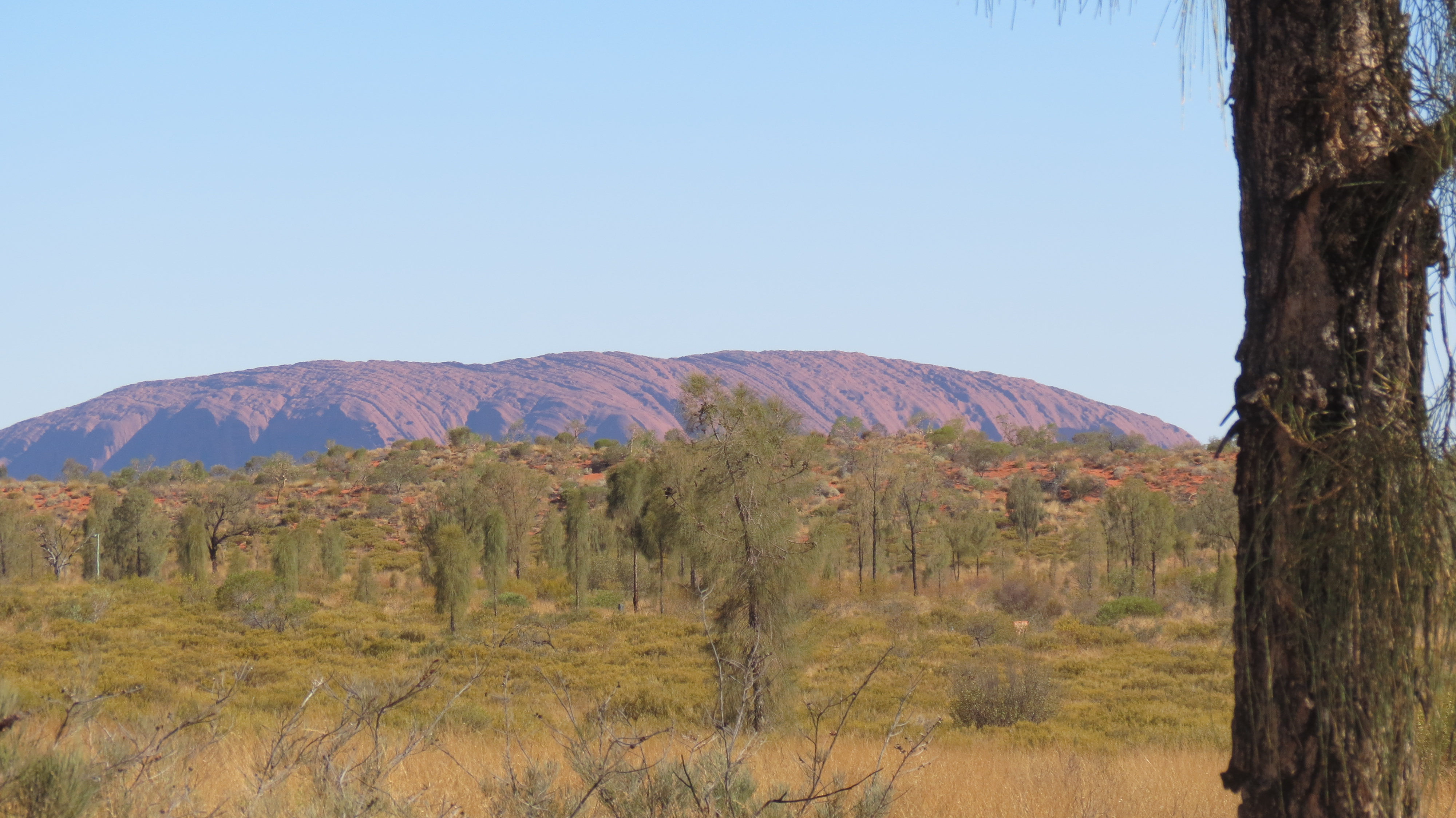
From 20 km, I finally saw the monolith, Uluru (Ayers Rock), that for years had been at the top of “The List,” of things I have wanted to see or do ever since I saw a wolf on Isle Royale, six and a half years previously.


The day after we flew in, we took a sunrise tour, where we saw the low rays of the Sun, in a few days to be briefly eclipsed by the Moon, strike the sandstone.  Then we approached it.


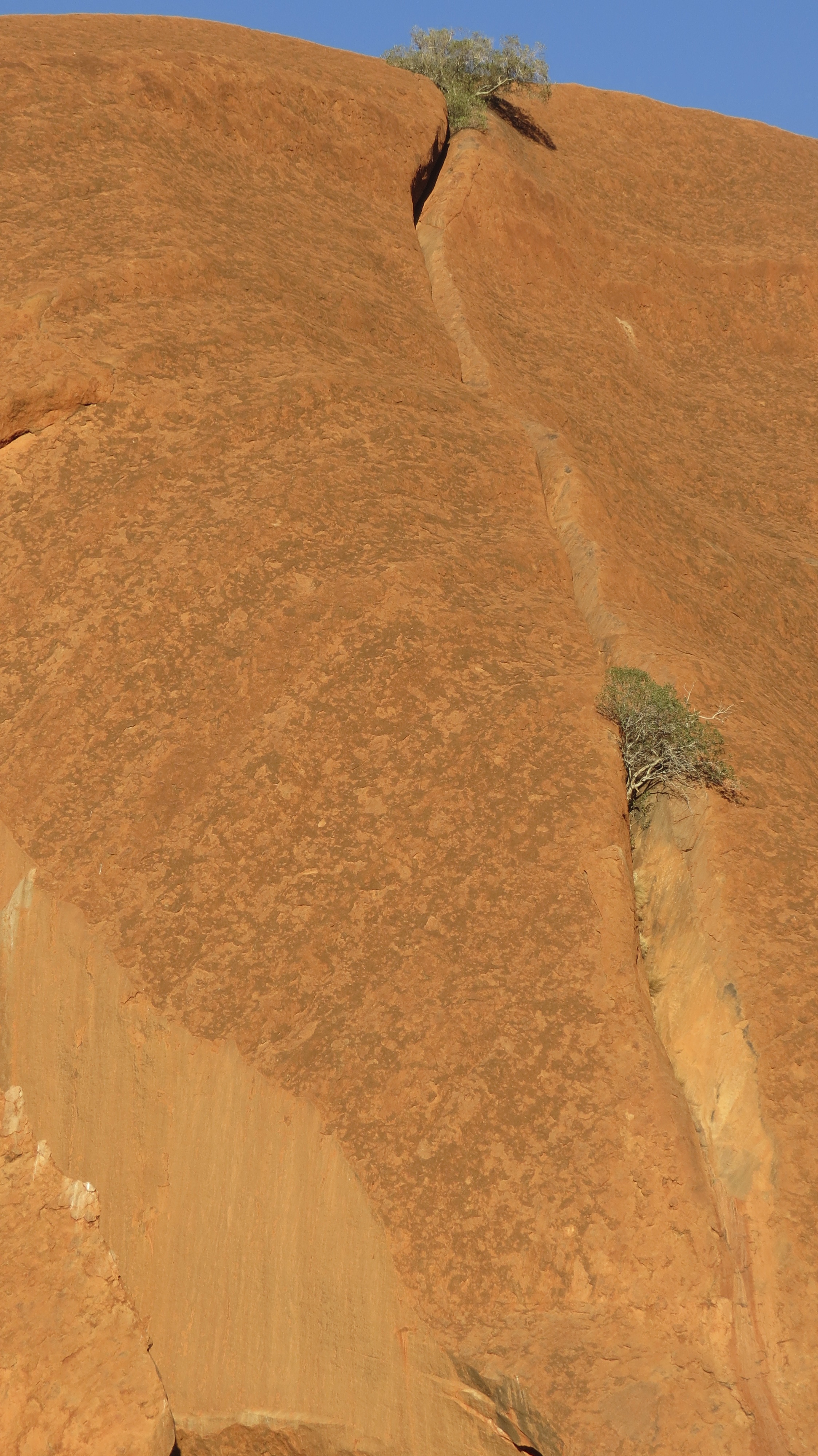
Uluru has been around for 350 million years.  What we see is the tip of a large uplifting, with rock extending about 2 km below the surface.  I didn’t know that, and that was only the beginning of discovering what I did not know.


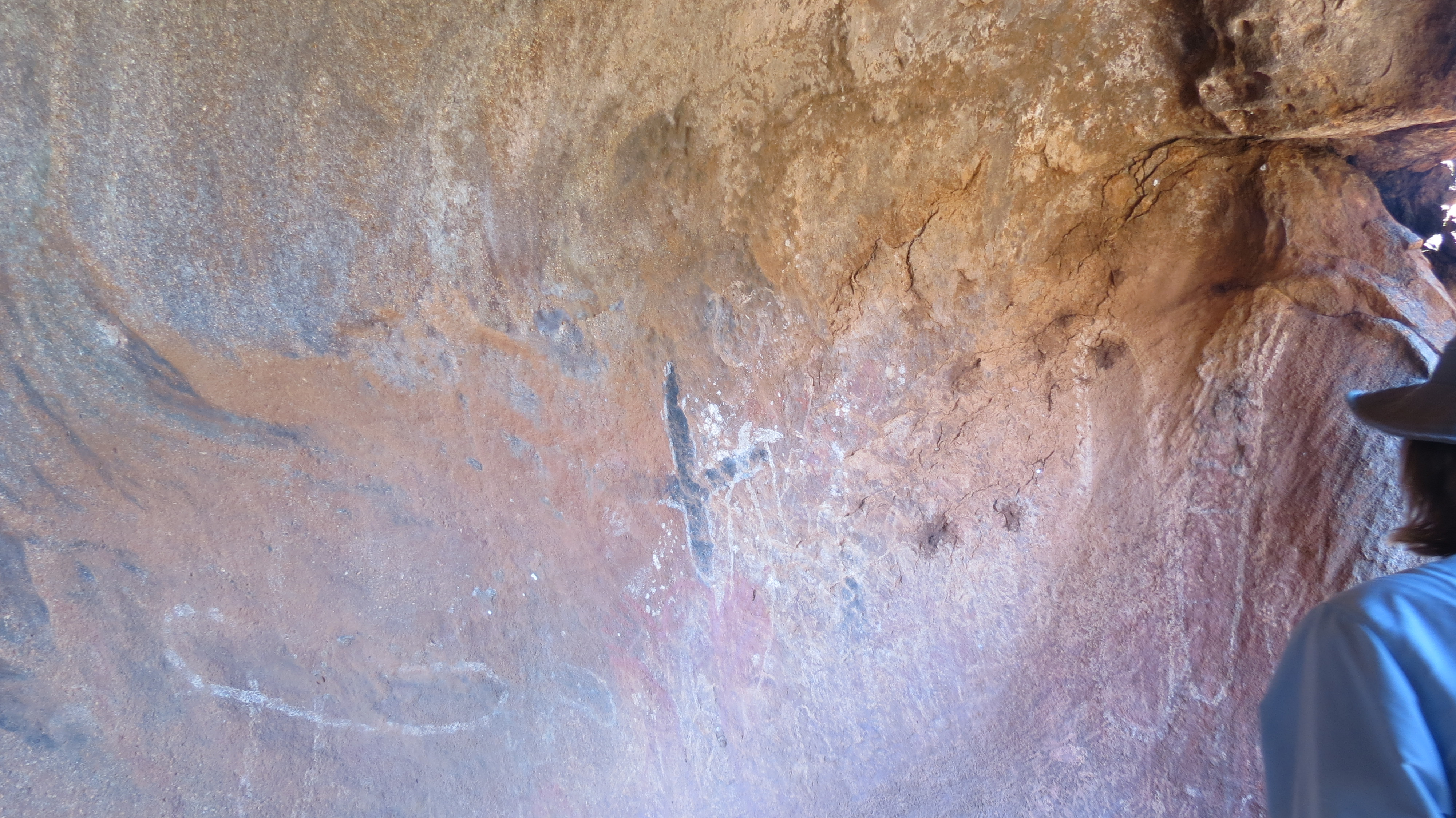
For example, we visited numerous caves and inlets to the rock.  Uluru is not simply a rock with vertical faces; there are many places where water can collect, places where people can–and have–hidden, lived, and practiced their faith.  The aborigines, who were once shot on sight by the first white men on the continent, have been present in this area for 60,000 years.  That is roughly thirty times the existence of any other major religion on the Earth.  To them, Uluru is sacred.  There are places along the trail where one is not allowed to photograph, just as it is considered insulting and wrong to photograph an aborigine without their permission.  The visitor’s center is off limits to photography as well.

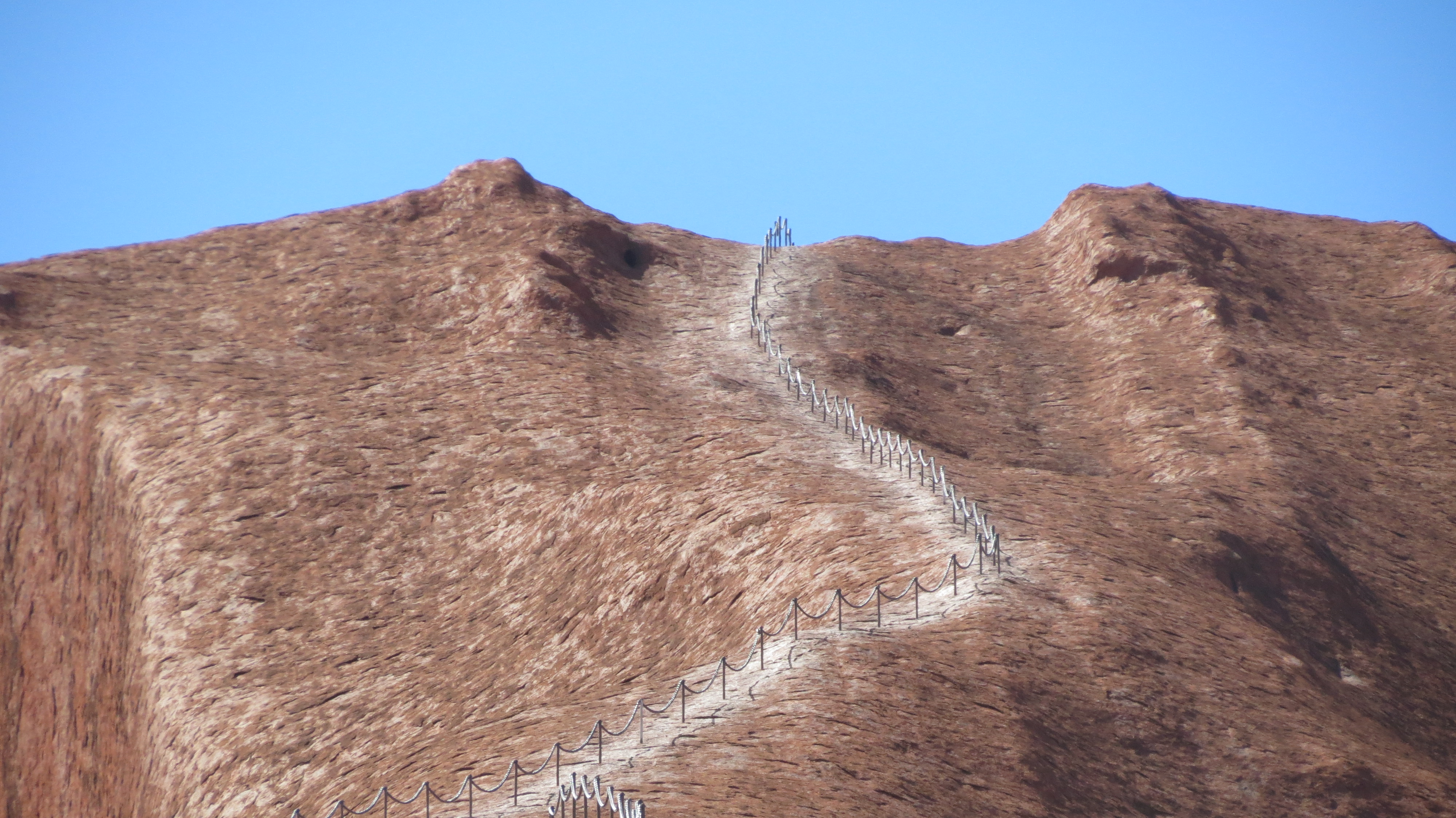
As one leaves the visitor’s center, there is a request–not a requirement, since there are no requirements at Uluru, only requests–not to climb what is considered sacred to the aborigine people, who never climb the rock.  There is a chain that allows people to climb the monolith, but the day I was there, the rock was closed because of high winds.  It didn’t matter to me, since I had not planned to climb it anyway, knowing it was sacred and ought not to be climbed.


Thirty-six people have died on Uluru from climbing, and for each the natives have required a ceremony to help those who died into the afterlife.  There are several memorial plaques that were placed on Uluru as well, although there are no new ones, because that affects the monolith, too.


Frankly, I found it good to go to a place where there were no extreme sports allowed.  There were no races up Uluru, no helicopter rides or hot air balloon rides to the top.  Indeed, the airspace over Uluru is also off limits.  There were no people BASE jumping, or using other conveniences to fly off the mountain.  Other than the chain fence, and the worn path into the Sandstone, there were no marks on Uluru other than a few paintings in the lower caves.

I can only imagine what Uluru would be if left to the white people.  There would be multiple routes to the top, the sandstone would be pockmarked with pitons, there would be ropes hanging off it, old campfires, tents, mountain biking, tours to the top, marathons ending at the top, races around the monolith, human waste and other litter.


I don’t have a problem with any of the above races, so long as they take place where it is appropriate, not one sacred to people who have existed in an incredibly harsh environment for sixty thousand years and have not destroyed it.

Theodore Roosevelt once said about the Grand Canyon, “You cannot improve on it.  Leave it as it is.”  We have not done that.  South Rim Village is large, although it is a relatively small area on the Rim.  There are trails, although they are limited as well, and they require a great deal of effort to walk.  We have, however, filled the airspace with fixed and rotary wing aircraft, creating a great deal of unnecessary noise.  By Uluru, one hears the wind, the birds, and very little else.

That evening, we took a sunset tour, again watching the change of colors that were a function of the Sun, the sandstone, the caves, and the black stripes where water drained off the monolith with each rain.  It was spectacular.  A group of Austrian tourists were nearby, and I practiced my German with them.  I lent them my binoculars so they could see parts of the monolith that I now knew something about.  It was the first time I had taught about nature while speaking only German.  I explained the pools along the rock that collected water and then overflowed to pools below.  I found words that I knew as I needed them.  It wasn’t great, but they understood what I was saying.  In two roles that I was comfortable in, teaching and nature, I was able to relax and speak.  It made the view even more magical.  How many different languages had been spoken at this site during the past six hundred centuries, I cannot imagine.  But one man spoke two that night, and for him, and that was special.


It’s nice for once to see something truly unique, virtually unspoiled, and will stay that way, except for the path to the top, which may some day be closed.  I hope it will be.


I went to Uluru to see the largest monolith in the world.  I came away thinking how nice it was that Australians, most specifically the most maligned ones–the aborigines–have not allowed the large numbers of people who have to show they are the best at whatever sport they decide they must do.  World class is to me an overused term, but at Uluru, the term is deeply appropriate.

What a blessing.


“WHY DON’T POLITICIANS TELL THE TRUTH?”

November 1, 2012

Whoever becomes president must raise taxes.  My opponent won’t tell you, I just did.

Walter Mondale (1984).

“They say, give ‘em hell, Harry.

“I never did give anybody hell. I just told the truth and they thought it was hell.”
Harry S Truman

While waiting for some prescriptions at my doctor’s office, I overheard two men talking about the presidential debates. I wasn’t in the mood for politics, but I didn’t have much choice but to listen.

“Yep,” said one man, “I heard Obama get asked a question about something difficult, and he started talking about education.”

“Yep,” said the other, “they just don’t answer the question.”

That’s right.  We want politicians to tell the truth, except then we won’t vote for them.  I started thinking about the truths that we supposedly want to hear, except we really don’t.  Mondale lost by a huge landslide, and Reagan raised taxes.

With more than 300 million people, we need rules and regulations to keep order, because one person’s right to do something affects another’s right not to have to pay for it.  As a neurologist, I took care of hundreds of people in motorcycle accidents who weren’t wearing helmets.  Where does a person’s right not to wear a helmet infringe upon his family’s right to have him alive and whole?  Or society’s right not to have to pay for preventable damage to an individual, since many of these people have no insurance?  Does his right infringe upon the cost to society of a hospital that can’t buy new equipment, because its unpaid bills are so high–unnecessarily?  Unless you live in the wilds of Alaska, you can’t always do what you want.  Our rules define us as a society.

We need a government that will defend us from harm.  How much defense we need is a matter of question.  So, if we went to war, I’d institute a draft and a war tax.  That might get people thinking how important the war really was.  Only 7% of us are veterans.  Eighty-four per cent of Americans agreed with invading Iraq, nobody was taxed for it, and only a small percentage of Americans served in it.

Many people don’t like government interference until it is convenient for them. A lot of people against big government are going to be really glad big government’s FEMA will be there to help them rebuild after Hurricane Sandy.  I remember Katrina, when FEMA was so watered down–pun-intended–that the news media were present well before the federal aid.

If we want smaller government, then it needs to be too small to interfere with a woman’s control over her body, which is her right, whom we may marry, which is our right, or the way we wish to die, the most fundamental right of all.

I trust government over private enterprise in fighting fires (NIFC), safety in the skies (FAA), the National Weather Service, Hurricane Center, and Severe Storms Center.  We all want something for ourselves, but we don’t want to pay for what others get.  That’s human, but it’s inconsistent.

Lowering taxes and cutting the deficit is akin to dieting by eating more and exercising less.  We need more of us with means to vote against our economic self-interest for the good of the country.  Taxes pay for cleaning up weather disasters, too, which given climate change, are likely to become more common.  Does anybody think we can do this by passing the hat….or by praying?

We need a sensible energy policy that gradually takes us off all carbon based fuels.  It is crazy that Arizona is not in the top 10 states for producing solar energy.  I’d recognize the unmeasurable costs.  Coal is suddenly no longer cheap when we factor in environmental damage; gasoline is not cheap, factoring in the cost of our Middle East policy.

I’d like to see taxes based more on our choices.  Buy a megamansion, and your property taxes should go up exponentially, your mortgage tax deduction capped at $500,000.  That money will help pay down the deficit.  You should pay extra for a car getting <25 mpg, and get a tax break if your car gets >35 mpg.  The money gained would go to pay down the deficit, by people who made choices. I’d end child tax deductions after the second child.  Want more children?  It’s your choice; you just won’t get a tax break for them.  House destroyed by coastal flooding?  You get one chance to rebuild.  If another storm washes it away, you are stuck. Once.  It’s your choice. I have a right not to pay taxes to rebuild houses multiple times in places prone to flooding.  Valmeyer, Illinois moved high above the Mississippi after 1993,  They learned.

The NYSE has roughly a trillion dollars of stock trades per month.  I would tax all 0.1% ($1 per $1000), the money going to pay down the deficit.  You want to invest?  Fine.  That’s your choice. This would raise a $100 billion by 2020.

I’d require mandatory–no choice– secular national service (infrastructure repair, schools, homeless shelters, humane society, Forest Service) by our youth, which would help many grow up and give them time to decide what they want to do.  Many would benefit from their modest stipend, seeing different parts of the country, being told (for once, in many instances) what they must do, and GI benefits.  Cost?  Modest.  Benefits? Cheap labor, this time here at home.

I would ask for retirees to volunteer, using the skills and wisdom they have.  My experience with nine years of volunteering in the schools was that I wasn’t busy enough, and I knew the relevance of math better than the teachers.  Not using retirees is wasting resources.

We must define what basic health care coverage is, then ensure every American has access to it.  From the experience in Oregon, this will cost more in the short term (the long term is not yet clear), because patients will use the medical system more.  This is not bad; increased rates of mammography and cholesterol screening will improve health, and it has been proven there have been fewer bankruptcies.  Moreover, the patients had peace of mind, which I contend has worth. Each of us is a virus, a burst aneurysm, an accident away from bankruptcy.

We need to address climate change, not factored into the cost of a product by economists.  Climate change has barely been mentioned during the campaign; it and firearm regulation are “third rails” of politics–touch them and you die.  Indeed, I predict we will not address climate change until major environmental catastrophes occur that cannot possibly be blamed on any other cause.  Hurricane Sandy may be due to climate change.  “Anomalous” has become common weather parlance.

Firearms?  No assault weapons in the hands of non-military, non-law enforcement people, period.  Everybody who is now less than 16 must later serve in the National Guard, law enforcement, or the military for at least a year, in order to earn the right to own a gun, as part of the “A well regulated militia” which are the amendment’s first words.

Want the truth?  There’s a small portion.  Hell, isn’t it?