Archive for the ‘MY WRITING’ Category

COME ON, MAN!

December 4, 2012

We now have one million people who have signed petitions for their state to secede from the Union.  We fought a war over secession 150 years ago; my side won.  The South has never really forgotten.

A half century ago, LBJ got the Civil Rights Act through the Congress.  I can still remember my mother telling me that there was “cloture” (end of debate), while I wondered what cloture meant.  It changed the US, and the South has been Republican since. That has cost us dearly: 6 years of Nixon (28,000 American deaths in Vietnam under his “secret plan to end the war, Watergate), 8 under Reagan (terror attack in Lebanon, Lockerbie, Iran-Contra, first known President with Alzheimer’s), and George W. Bush (9/11, 2 unpaid for wars, polarized country, Guantanamo, Patriot Act….)

When Nixon-Agnew were running the country, until each of them had to resign separately, there were a lot of bumper stickers that said, “America, Love it or Leave.”  I can’t remember when I last saw one of those.

Without doubt, had McCain-Palin won in 2008, my wife and I would have emigrated to Canada. We wouldn’t have talked about secession, because it is treasonous.  We had a choice, and Canada would have been viable.  It is a very different place from America, but I like Canada, have traveled it extensively, having spent 2 years of my life there.

I’m not sure why people are so upset, except that we have a black president that was elected to change things, and he has tried to do that.  Change is admittedly difficult.  Health care reform was incredibly polarizing, although many who complained about it were getting government benefits through Medicare or were military retirees.

Fact is, we have over 300 million people in this country, and at least 50 million don’t have insurance. The other day, my wife had some blood work drawn, and the man in front of her needed 16 tests.  Cost:  $2000.  Insurance?  None.  As the ESPN commentators say, “Come on, Man!”  How often is this scene repeated daily?  How often do people come into the ED and don’t have money, yet rack up five figure costs?  This remains the biggest cause of bankruptcy in the US.  Nice that you have yours, but what about the others?  Should they just die, untreated?  Is this America?  Is this how we solve medical costs in this country?  Let people die?  Come on, Man!

Back to the secessionists.  Eleven states have reached the 25,000 signature level for a White House response.  Eight of the 11 have had major hurricane damage in the past decade, the rest get major tornado damage every year.  Some get both.  We saw what Hurricane Sandy did to New Jersey, not a poor state.  Chris Christie, the Republican governor, who two weeks earlier had lambasted the President, praised him.  Governor Christie knew that New Jersey could not rebuild without the federal government’s help.  So to the secessionists:  If a Cat 5 hits Houston, another Katrina floods New Orleans, or an EF5 takes out Nashville or Montgomery, exactly what are you going to do, pass the hat?  Come on, Man!  Do you have any concept of how much a billion dollars’ damage is?   Let’s assume $20 billion, and divide it by say 5 million people in the state.  That is $4000 for every person in the state.  So, if you have a family with three kids, you owe $25,000.  If you aren’t employed, that is too bad.  You owe $25,000.  But the single mother with no income and 3 kids, because the man left her owes $20,000, and she isn’t going to pay.  What are you going to do?  Come on, Man!

Median health care costs are about $15,000 per year per family.  You will no longer have insurance.  Of course, if you have a bad accident, get the wrong virus, rupture an important vessel, your costs have just skyrocketed.  If you are younger, they may not; if you are over 65, they are likely to be more.  Your new state-country will need first responders, have to educate people, protect against crime, and maintain infrastructure.  Do you think that will be free?

Let’s look at how taxes were divvied up from 1990-2009.

                  Federal aid minus taxes paid

The 11 states                                            + $400 billion

New York, NJ, Illinois (alone)         – $2,400 billion

Number of blue states in top 10 for receiving less                9 

Number of blue states in bottom 10 for receiving more       4

In other words, the states with the most secessionists are getting MORE from the federal government than they are paying.  Two of them are Florida and Ohio, which are barely Democratic.  All the others were members of the once Confederacy.

I’ve known that for decades.  Growing up in New York State, which alone is $1 trillion in the hole to the feds in the past two decades, I heard often how the national parks and forests were paid for in large part by people on the east coast, many of whom would never see these places.  Then again, we believed in the Union and a strong country.

When my side lost elections, I whined, too, and I said that the country was wrong.  But I never said we should secede.  I would have simply moved to Canada.  I would have taken the advice to “Leave,” but I would have only affected myself.  The secessionists want to affect the others in their state who might not want to leave.  These people have rights, too.  Many of them get Medicare, SSI, and FEMA help, the last under Mr. Obama  again worth something.  The secessionists would hurt more people, poor people, who would no longer get the benefits that the federal government provides.

If you want to leave, then go.  You have that right.  But don’t insist others have to go with you.  Grow up, too; try to make the country you currently live in better.  It’s easier than making a brand new country. Quebec learned that.  Oh, Quebec is in Eastern Canada.

ULURU

November 19, 2012

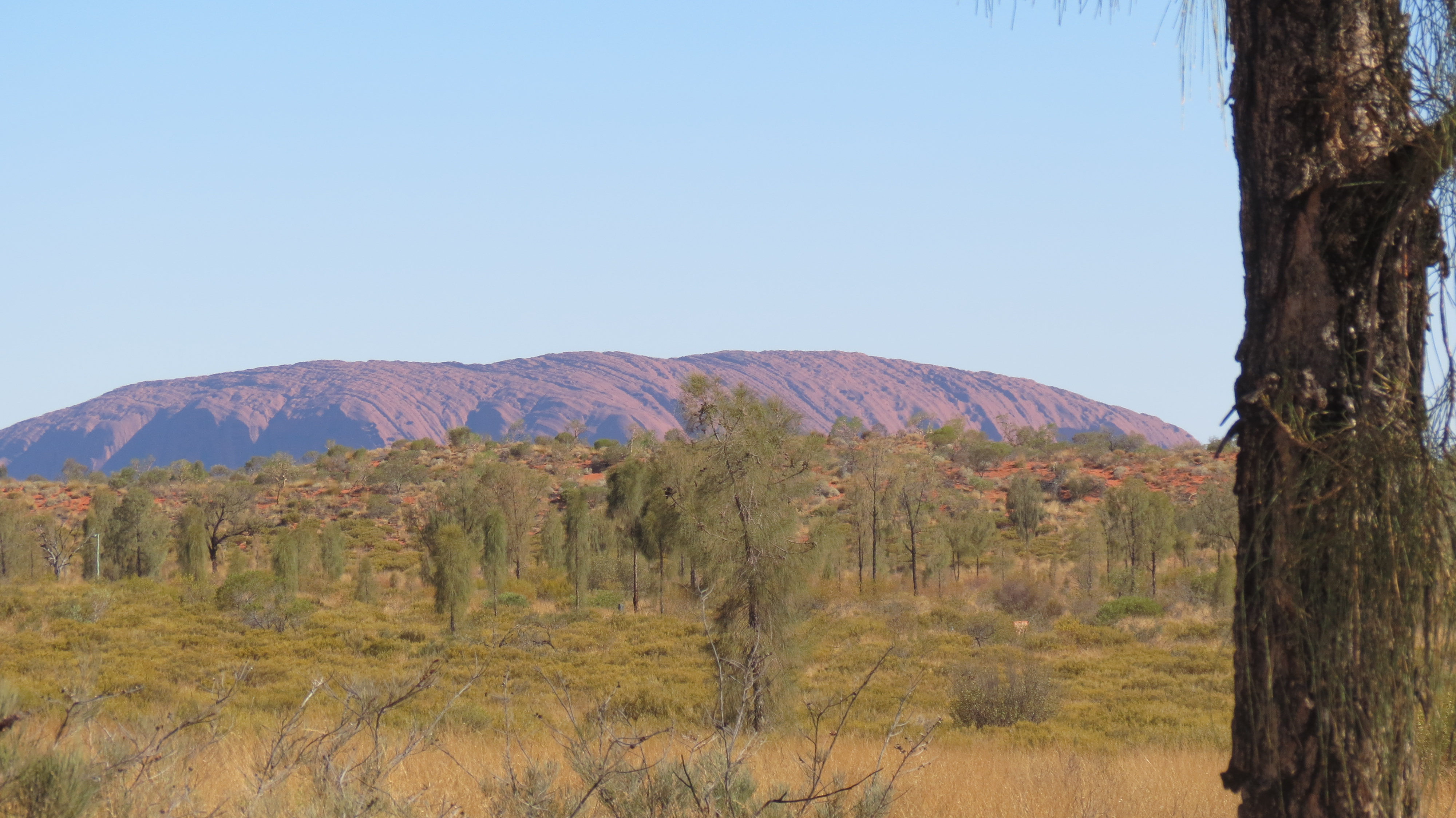
From 20 km, I finally saw the monolith, Uluru (Ayers Rock), that for years had been at the top of “The List,” of things I have wanted to see or do ever since I saw a wolf on Isle Royale, six and a half years previously.


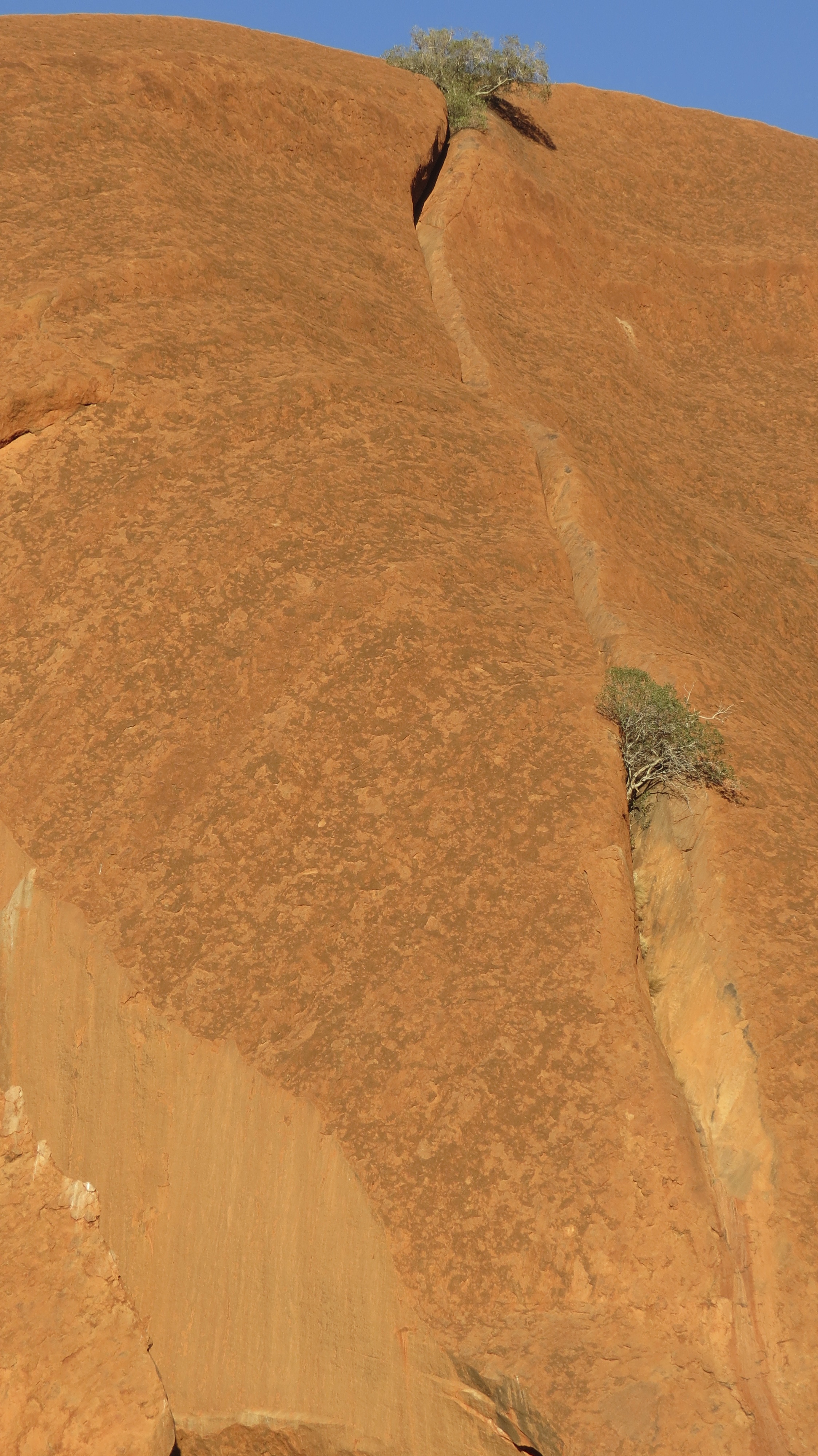
The day after we flew in, we took a sunrise tour, where we saw the low rays of the Sun, in a few days to be briefly eclipsed by the Moon, strike the sandstone.  Then we approached it.


Uluru has been around for 350 million years.  What we see is the tip of a large uplifting, with rock extending about 2 km below the surface.  I didn’t know that, and that was only the beginning of discovering what I did not know.


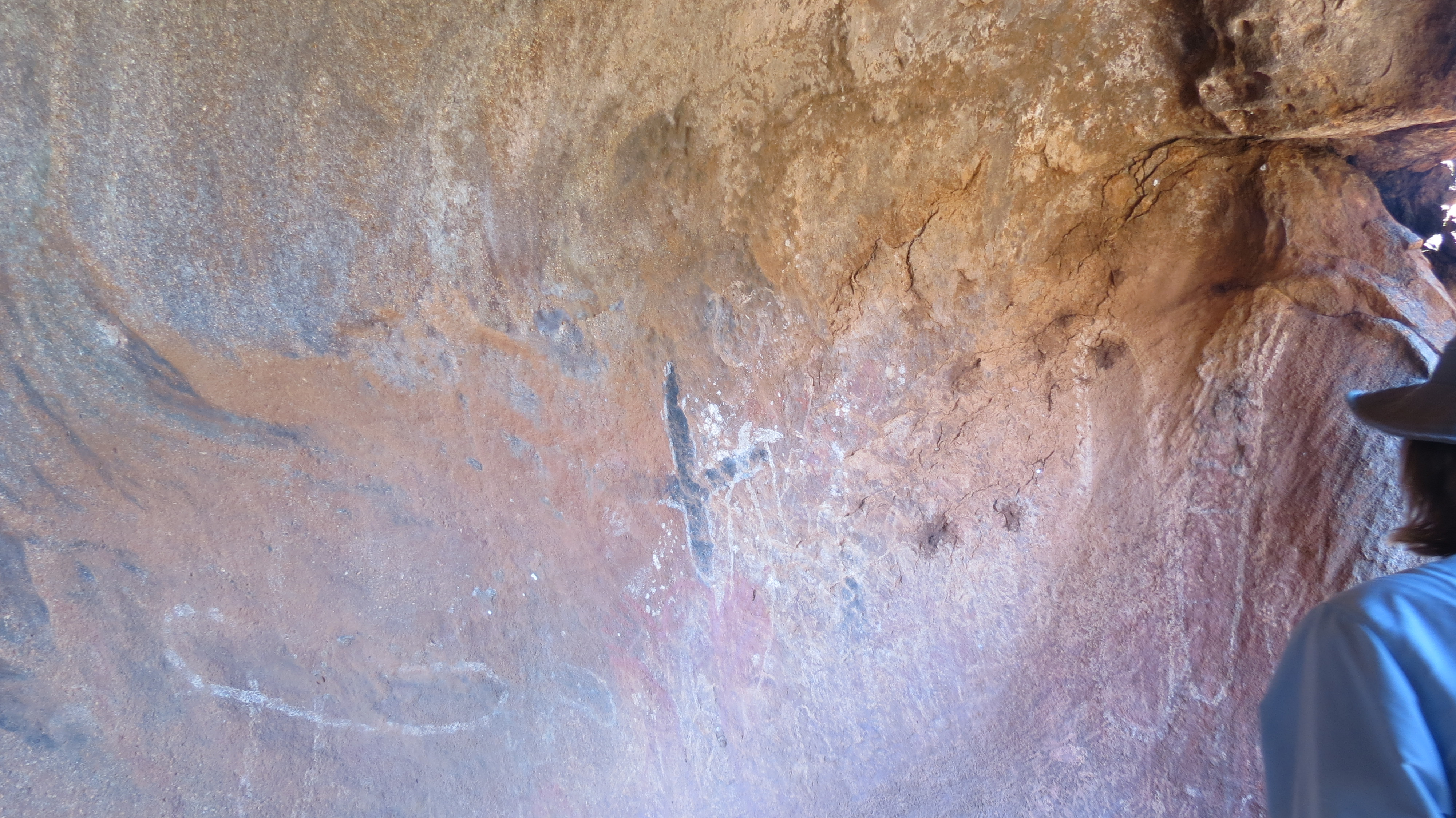
For example, we visited numerous caves and inlets to the rock.  Uluru is not simply a rock with vertical faces; there are many places where water can collect, places where people can–and have–hidden, lived, and practiced their faith.  The aborigines, who were once shot on sight by the first white men on the continent, have been present in this area for 60,000 years.  That is roughly thirty times the existence of any other major religion on the Earth.  To them, Uluru is sacred.  There are places along the trail where one is not allowed to photograph, just as it is considered insulting and wrong to photograph an aborigine without their permission.  The visitor’s center is off limits to photography as well.

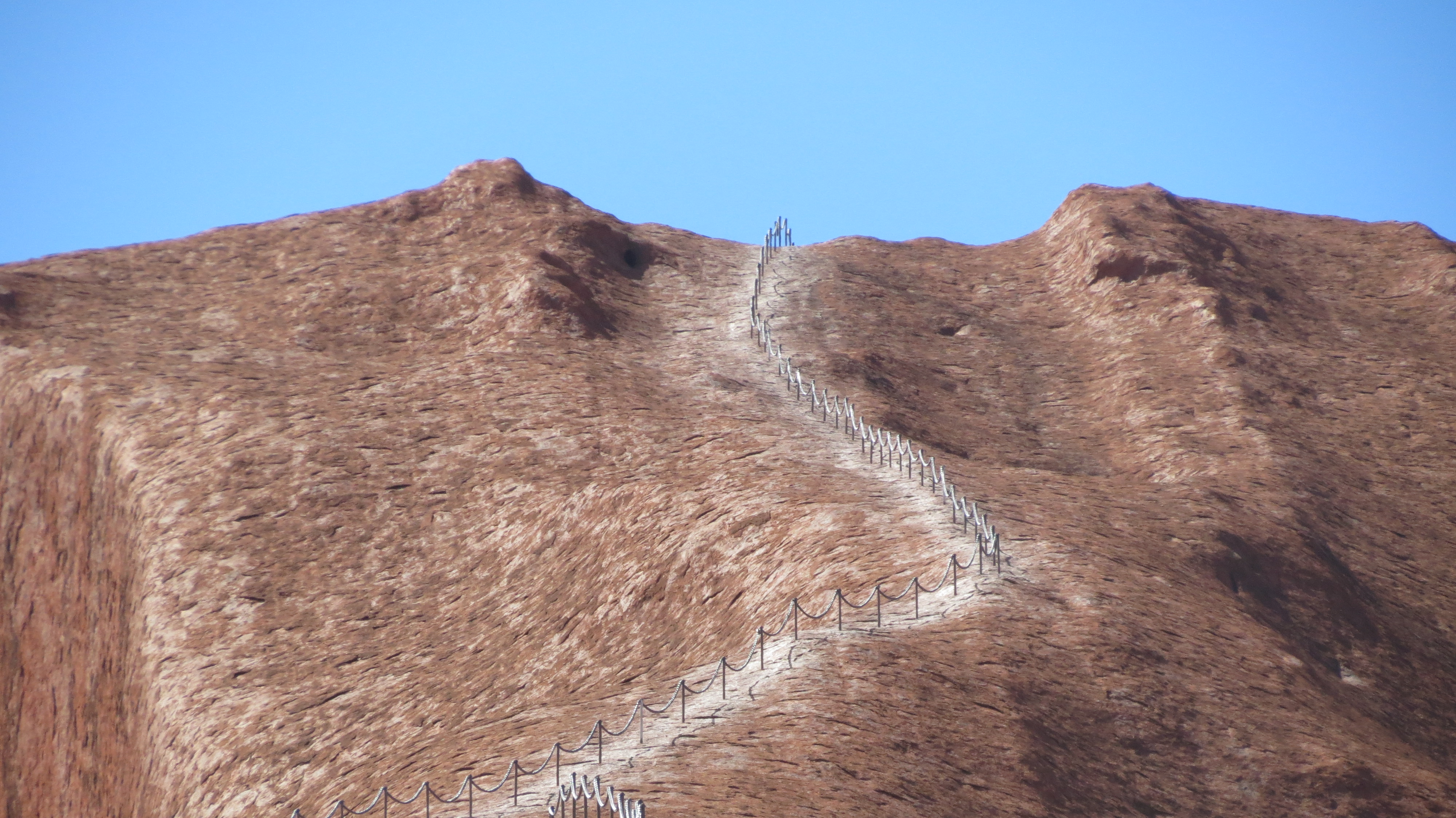
As one leaves the visitor’s center, there is a request–not a requirement, since there are no requirements at Uluru, only requests–not to climb what is considered sacred to the aborigine people, who never climb the rock.  There is a chain that allows people to climb the monolith, but the day I was there, the rock was closed because of high winds.  It didn’t matter to me, since I had not planned to climb it anyway, knowing it was sacred and ought not to be climbed.


Thirty-six people have died on Uluru from climbing, and for each the natives have required a ceremony to help those who died into the afterlife.  There are several memorial plaques that were placed on Uluru as well, although there are no new ones, because that affects the monolith, too.


Frankly, I found it good to go to a place where there were no extreme sports allowed.  There were no races up Uluru, no helicopter rides or hot air balloon rides to the top.  Indeed, the airspace over Uluru is also off limits.  There were no people BASE jumping, or using other conveniences to fly off the mountain.  Other than the chain fence, and the worn path into the Sandstone, there were no marks on Uluru other than a few paintings in the lower caves.

I can only imagine what Uluru would be if left to the white people.  There would be multiple routes to the top, the sandstone would be pockmarked with pitons, there would be ropes hanging off it, old campfires, tents, mountain biking, tours to the top, marathons ending at the top, races around the monolith, human waste and other litter.


I don’t have a problem with any of the above races, so long as they take place where it is appropriate, not one sacred to people who have existed in an incredibly harsh environment for sixty thousand years and have not destroyed it.

Theodore Roosevelt once said about the Grand Canyon, “You cannot improve on it.  Leave it as it is.”  We have not done that.  South Rim Village is large, although it is a relatively small area on the Rim.  There are trails, although they are limited as well, and they require a great deal of effort to walk.  We have, however, filled the airspace with fixed and rotary wing aircraft, creating a great deal of unnecessary noise.  By Uluru, one hears the wind, the birds, and very little else.

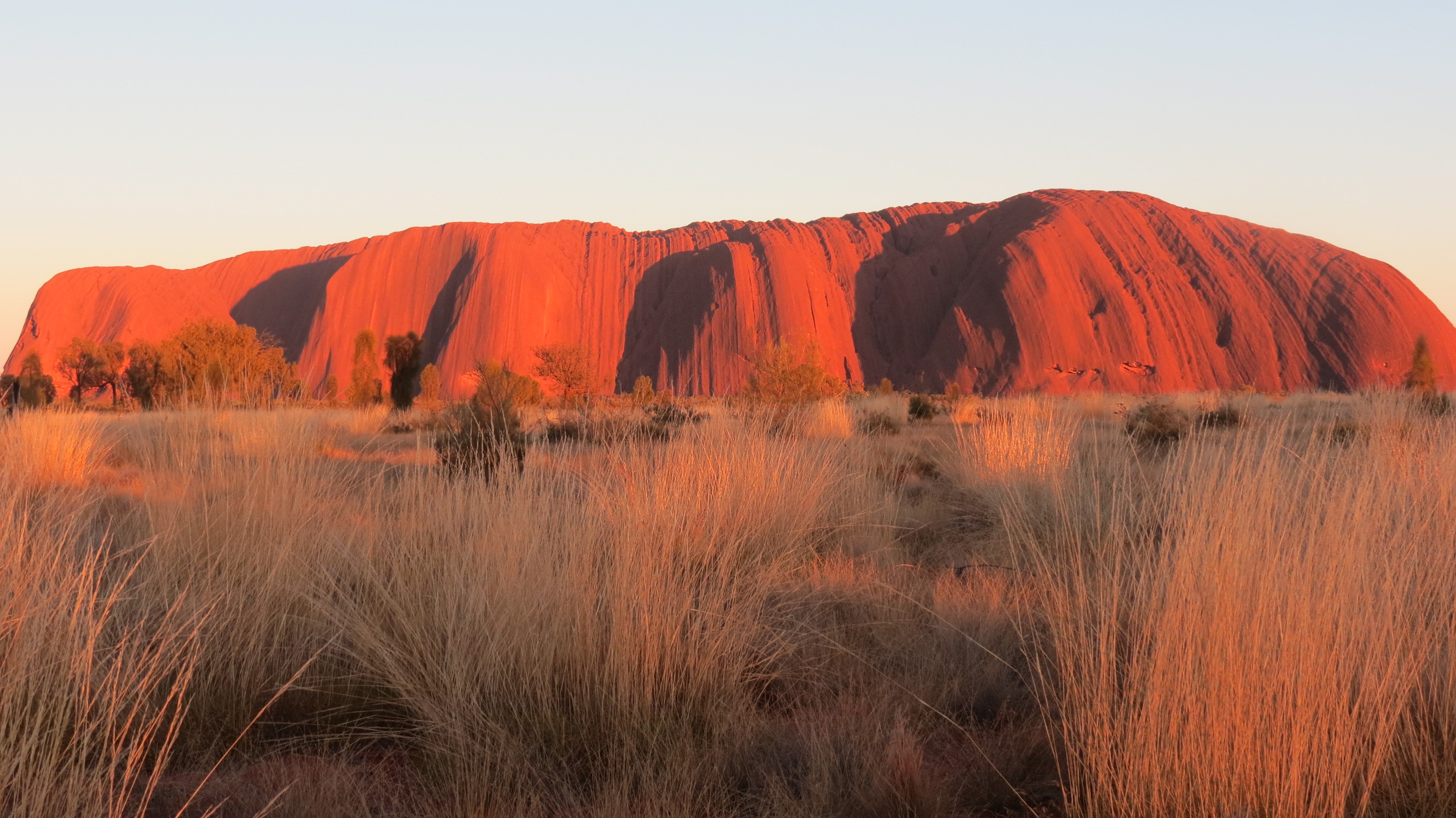
That evening, we took a sunset tour, again watching the change of colors that were a function of the Sun, the sandstone, the caves, and the black stripes where water drained off the monolith with each rain.  It was spectacular.  A group of Austrian tourists were nearby, and I practiced my German with them.  I lent them my binoculars so they could see parts of the monolith that I now knew something about.  It was the first time I had taught about nature while speaking only German.  I explained the pools along the rock that collected water and then overflowed to pools below.  I found words that I knew as I needed them.  It wasn’t great, but they understood what I was saying.  In two roles that I was comfortable in, teaching and nature, I was able to relax and speak.  It made the view even more magical.  How many different languages had been spoken at this site during the past six hundred centuries, I cannot imagine.  But one man spoke two that night, and for him, and that was special.


It’s nice for once to see something truly unique, virtually unspoiled, and will stay that way, except for the path to the top, which may some day be closed.  I hope it will be.


I went to Uluru to see the largest monolith in the world.  I came away thinking how nice it was that Australians, most specifically the most maligned ones–the aborigines–have not allowed the large numbers of people who have to show they are the best at whatever sport they decide they must do.  World class is to me an overused term, but at Uluru, the term is deeply appropriate.

What a blessing.


“WHY DON’T POLITICIANS TELL THE TRUTH?”

November 1, 2012

Whoever becomes president must raise taxes.  My opponent won’t tell you, I just did.

Walter Mondale (1984).

“They say, give ‘em hell, Harry.

“I never did give anybody hell. I just told the truth and they thought it was hell.”
Harry S Truman

While waiting for some prescriptions at my doctor’s office, I overheard two men talking about the presidential debates. I wasn’t in the mood for politics, but I didn’t have much choice but to listen.

“Yep,” said one man, “I heard Obama get asked a question about something difficult, and he started talking about education.”

“Yep,” said the other, “they just don’t answer the question.”

That’s right.  We want politicians to tell the truth, except then we won’t vote for them.  I started thinking about the truths that we supposedly want to hear, except we really don’t.  Mondale lost by a huge landslide, and Reagan raised taxes.

With more than 300 million people, we need rules and regulations to keep order, because one person’s right to do something affects another’s right not to have to pay for it.  As a neurologist, I took care of hundreds of people in motorcycle accidents who weren’t wearing helmets.  Where does a person’s right not to wear a helmet infringe upon his family’s right to have him alive and whole?  Or society’s right not to have to pay for preventable damage to an individual, since many of these people have no insurance?  Does his right infringe upon the cost to society of a hospital that can’t buy new equipment, because its unpaid bills are so high–unnecessarily?  Unless you live in the wilds of Alaska, you can’t always do what you want.  Our rules define us as a society.

We need a government that will defend us from harm.  How much defense we need is a matter of question.  So, if we went to war, I’d institute a draft and a war tax.  That might get people thinking how important the war really was.  Only 7% of us are veterans.  Eighty-four per cent of Americans agreed with invading Iraq, nobody was taxed for it, and only a small percentage of Americans served in it.

Many people don’t like government interference until it is convenient for them. A lot of people against big government are going to be really glad big government’s FEMA will be there to help them rebuild after Hurricane Sandy.  I remember Katrina, when FEMA was so watered down–pun-intended–that the news media were present well before the federal aid.

If we want smaller government, then it needs to be too small to interfere with a woman’s control over her body, which is her right, whom we may marry, which is our right, or the way we wish to die, the most fundamental right of all.

I trust government over private enterprise in fighting fires (NIFC), safety in the skies (FAA), the National Weather Service, Hurricane Center, and Severe Storms Center.  We all want something for ourselves, but we don’t want to pay for what others get.  That’s human, but it’s inconsistent.

Lowering taxes and cutting the deficit is akin to dieting by eating more and exercising less.  We need more of us with means to vote against our economic self-interest for the good of the country.  Taxes pay for cleaning up weather disasters, too, which given climate change, are likely to become more common.  Does anybody think we can do this by passing the hat….or by praying?

We need a sensible energy policy that gradually takes us off all carbon based fuels.  It is crazy that Arizona is not in the top 10 states for producing solar energy.  I’d recognize the unmeasurable costs.  Coal is suddenly no longer cheap when we factor in environmental damage; gasoline is not cheap, factoring in the cost of our Middle East policy.

I’d like to see taxes based more on our choices.  Buy a megamansion, and your property taxes should go up exponentially, your mortgage tax deduction capped at $500,000.  That money will help pay down the deficit.  You should pay extra for a car getting <25 mpg, and get a tax break if your car gets >35 mpg.  The money gained would go to pay down the deficit, by people who made choices. I’d end child tax deductions after the second child.  Want more children?  It’s your choice; you just won’t get a tax break for them.  House destroyed by coastal flooding?  You get one chance to rebuild.  If another storm washes it away, you are stuck. Once.  It’s your choice. I have a right not to pay taxes to rebuild houses multiple times in places prone to flooding.  Valmeyer, Illinois moved high above the Mississippi after 1993,  They learned.

The NYSE has roughly a trillion dollars of stock trades per month.  I would tax all 0.1% ($1 per $1000), the money going to pay down the deficit.  You want to invest?  Fine.  That’s your choice. This would raise a $100 billion by 2020.

I’d require mandatory–no choice– secular national service (infrastructure repair, schools, homeless shelters, humane society, Forest Service) by our youth, which would help many grow up and give them time to decide what they want to do.  Many would benefit from their modest stipend, seeing different parts of the country, being told (for once, in many instances) what they must do, and GI benefits.  Cost?  Modest.  Benefits? Cheap labor, this time here at home.

I would ask for retirees to volunteer, using the skills and wisdom they have.  My experience with nine years of volunteering in the schools was that I wasn’t busy enough, and I knew the relevance of math better than the teachers.  Not using retirees is wasting resources.

We must define what basic health care coverage is, then ensure every American has access to it.  From the experience in Oregon, this will cost more in the short term (the long term is not yet clear), because patients will use the medical system more.  This is not bad; increased rates of mammography and cholesterol screening will improve health, and it has been proven there have been fewer bankruptcies.  Moreover, the patients had peace of mind, which I contend has worth. Each of us is a virus, a burst aneurysm, an accident away from bankruptcy.

We need to address climate change, not factored into the cost of a product by economists.  Climate change has barely been mentioned during the campaign; it and firearm regulation are “third rails” of politics–touch them and you die.  Indeed, I predict we will not address climate change until major environmental catastrophes occur that cannot possibly be blamed on any other cause.  Hurricane Sandy may be due to climate change.  “Anomalous” has become common weather parlance.

Firearms?  No assault weapons in the hands of non-military, non-law enforcement people, period.  Everybody who is now less than 16 must later serve in the National Guard, law enforcement, or the military for at least a year, in order to earn the right to own a gun, as part of the “A well regulated militia” which are the amendment’s first words.

Want the truth?  There’s a small portion.  Hell, isn’t it?

UNCOMMON MANIFESTATIONS OF COMMON DISORDERS

October 24, 2012

A 28 year-old woman comes to the hospital with significant left-sided abdominal pain, and the imaging study is read as showing a small left-sided inflammatory process felt to be diverticulitis, despite no diverticulae being seen.  No comment was made about the appendix. Diverticulitis with perforation in the large bowel may occur in the young, but it is an older person’s disease.  As a former clinician, I would be bothered about that diagnosis.

But, four days later, the patient was better.  A repeat study was performed just to be certain nothing was awry.

Something was.

The patient now had an abscess in her left side of the abdomen, and there was inflammation throughout the peritoneum.  This time, a different radiologist looked at the scan in a different plane.  There are 3 anatomical planes for viewing: sagittal, coronal, and  transverse.  In the coronal plane, it was clear that the appendix had ruptured.  In the sagittal plane, where the prior reading had been made, the appendix wasn’t visible.  Radiologists don’t always look at all the planes.   They get paid by numbers of cases reviewed, just like most physicians, and there is a lot of pressure to take care of many patients.  Before you say this is wrong, remember that many people complain of emergency department waits.  If a radiologist takes a lot of time to read a scan, people wait.

But the appendix is on the right side of the abdomen.  What gives?

I have a book from my late father-in-law called “The Early Diagnosis of the Acute Abdomen,” by Sir Zachary Cope, the 8th edition, written in 1940.  It should be required reading for every medical student.  The appendix is attached to the cecum, and the cecum is on one side of the iliocecal valve, leading from the ilium to the large bowel.  The first radiological report did not mention the cecum.  This was a major oversight.  Unless the cecum is identified, the appendix cannot be identified, either.  If those two cannot be seen, appendicitis as a cause of the problem cannot be excluded.  In a young person with significant abdominal pain, appendicitis is always a consideration until proven otherwise.  When I was a shipboard doctor, I had read Cope’s book 5 times, because diagnosing appendicitis meant either an operation on board (I did two, one by myself) or an expensive Mede-vac, with a helicopter landing on the small flight deck of a ship.  I’ve done that many times, and it requires skilled pilots.

The cecum can be not only in the right side of the abdomen, but in the middle or other parts.  The appendix, therefore, can be anywhere in the lower abdomen, the pelvis, in the middle, and even in the right upper abdomen, mimicking gall bladder disease, should it be retrocecal, or behind the cecum.  The appendix can irritate the bladder, mimicking urinary infection.  If the appendix is pelvic, ruptures, and forms an abscess, the abscess will move up the left side of the abdomen, the path of least resistance, exactly what happened here.  Two of the best medical adages are: first, uncommon manifestations of common disorders are more likely to occur than common manifestations of uncommon disorders; second, when you hear hoofbeats, think horses, not zebras.

The woman will be operated upon and should survive, but she will have extensive scarring in her abdomen, which will likely lead to future bowel obstructions and multiple operations.  If she has children and needs a C-section, it will be a very difficult procedure, since bowel may adhere to the uterus and perforate during surgery.  She would have had future problems had she been diagnosed promptly, but not nearly to the extent that she is likely to have now.

It just isn’t the fault of the radiologist, however.  Where were the clinicians?  Why would a clinician accept diverticulitis in a 28 year-old with no other diverticula being visible? Why was there no statement why this could not be appendicitis?  Such a statement would show that the clinician had at least thought of the diagnosis.

I made a lot of mistakes in practice, but any time I was bothered by a diagnosis, I either kept looking at the patient or asked a colleague what he or she thought.  I also wrote a provisional diagnosis on my reports for X-Rays, not just “headache” or “abdominal pain.”  I wrote, headache, slight left sided weakness, glioma a possibility,” or “abdominal pain, left-sided, high white count.”  The radiologists loved having the information I provided them, and I got better reports, too.

I recently learned from a pathologist the astounding fact that with the advent of imaging procedures that supposedly allow us to look inside the body without surgery, that autopsies, the few that are done, show NO CHANGES, repeat, NO CHANGES in the pathology that was MISSED by the clinician and the radiologist during life.  This is scary.  It means that our assumption that we know what is going on with a patient on the basis of an imaging test may not be correct

This is the second time I have discussed a major problem with appendicitis in a young person.  The first patient died.  This person walled off the abscess, which the body used to do fairly successfully, in the days before good diagnosis and good surgery.  My grandfather had unoperated appendicitis and survived.  It can happen, and it did in 1940.

I would like to think in 2012 that we might be a little better.  I’m not really so sure we are.  And that bothers me as much as a diagnosis that doesn’t make sense.  It makes me worry and think, “What else could be going on?”

There is one other adage we would do well to remember, the most basic rule of all:  “Listen to the patient.  She is trying to tell you what is wrong with her.”

DOUBLE STANDARD FOR WOMEN….AND A SCARY LOOK TO THE FUTURE.

October 14, 2012

While substitute teaching recently, I saw a large poster on the classroom wall showing 4 famous women mathematicians.  Two in particular struck me as interesting.

One was Grace Murray Hopper, a Navy programmer until she retired at 60.  She was so important that the Navy recalled her to active duty 4 months later, and she retired for good at 80, the oldest officer serving on active duty in the armed forces and the first woman admiral.  She was instrumental behind the development of COBOL.

Amalie Noether, a German, received her Ph.D. in 1907, but prejudice against women kept her from anything other than volunteer jobs until 1929.  She taught in Germany for 4 years as a full professor, until the Nazis came to power, when she emigrated to the US, taught at Bryn Mawr and worked nearby at the Institute of Advanced Studies at Princeton.

She died in 1935, and 22 years’ of skills were lost to the world due to prejudice against women.  Today’s Germany is far different; I know two physicists whose work is unbelievably good.  I was asked by one to check the English in her Ph.D. thesis.  Imagine, writing a Ph.D. thesis in a second language.  I’ve had a lot of math, but ich war im Kindergarten mit der Mathematik. I received a picture of the X-Ray Telescope she is helping build that will be launched from Baikonur in 2014 to L2, the second (of 5) LaGrangian Point, where the Earth’s gravity equals the Sun’s.

Here in the US, women may flip the ratio of men:women in science and math.  I like seeing a lot of women in these fields; as a past boy, I wonder what’s happened to the guys.  Hopefully, they will return; perhaps the President’s initiative to hire 99,999 math and science teachers (he said 100,000; I will work for free), may help.  We lost too many mathematicians to Wall Street, where some modeled the housing market with the incredibly stupid assumption that prices would never fall.  I once bought into the notion that the stock market always goes up, until I realized we had about 70 years of data.  We have a lot longer and better climate data saying the Earth is warming, but I don’t hear these same people saying the Earth will always get hotter, even as the Arctic ice pack this year shrank far below previous records, worse than experts predicted.  Oh, yes, that appears to have an effect on the jet stream’s waves, which affect ridges and troughs, high and low pressure.  I wonder if the 112th Congress knows that.  I doubt many; one on the House Science Committee believes women’s bodies can fight off “legitimate rape”; another thinks the Earth is 4000 years old.

I don’t worry that we will require women to teach without pay.  No, we will only forbid them to choose how to deal with their bodies.  Make no doubt about it.  The US is well on its way to making abortion illegal, including for rape or incest, which even Saudi Arabia allows, although like prohibition, it won’t be eliminated.  There are coat hangers and now Mexican drugs, which are given by non-licensed people, that will abort but desperate women who take these may bleed to death.

But that’s God’s will, right?  By the way, if you happen to believe that, what happens to the guy who made the woman pregnant?  Was he just “sowing wild oats” and the woman promiscuous?  Just curious, because there seems to be a double standard.  Wouldn’t it be nice if we had DNA testing to find the father?  Maybe, we could give him a choice:  support the baby equally or have him wear a large “F” around his head, for “I fathered a child out of wedlock.”  It could stand for another word, too, the 21st century version of The Scarlet Letter.

What particularly disturbs me, in addition to the lack of care of the unwanted child that is ignored by the far right, many of whom want to dismantle Medicaid (“block grants” sounds better than dismantle, don’t they?), is the assault on birth control, which prevents many unwanted pregnancies and therefore abortions.  I saw this coming, with attacks on Planned Parenthood.  Funding for PP, should Romney get elected, would be removed, and other services, like STD testing, curtailed.    The Church is against birth control, but did nothing about pedophilia for years.  It’s too bad boys can’t get pregnant.  I also find it interesting that the late Strom Thurmond, a racist senator from South Carolina, had a child by a black woman.  Wow, I can be hypocritical, but if hypocrisy were track and field, these guys would be Usain Bolt.

Perhaps I will be wrong.  On the other hand, five readings of The Rise and Fall of the Third Reich and studying the Challenger disaster taught me that small problems may become catastrophic if nobody speaks up.

Mankind is capable of unspeakable horror:  the Holocaust, Srebrinca, Katyn Forest, Rwanda, My Lai, stoning, and Maharashtra (a state in India, where an unwritable-by-me horror was committed upon a pregnant woman, and the perpetrators were not punished).

When a country is coming closer to banning abortion even in the case of rape or incest, what is the next step, forbidding women to have certain careers?  Oh, one says, this won’t happen.  Really?  Why not?  In 1925, Hitler wrote Mein Kampf.  Eight years later, he was Chancellor.

To me, the ultimate irony would be for women and others emigrating from the US to countries where their skills would be welcomed, and their bodies respected.  Think that is impossible?  Then you probably believe the stock market always rises, people don’t need regulation, we should be on the gold standard, the climate is just fine, and that many countries are as strict on abortion as is the Republican platform.  There are only 5: Malta, Dominican Republic, El Salvador, Nicaragua, and Chile.

THE WAR OF 1812

October 6, 2012

A friend of mine in Bosnia, whom I help learn English, has a 16 year-old daughter who is an exchange student at a high school in southern Illinois.

Her daughter got the best grade in her class on an essay about the War of 1812.  She knew that part of American history better than her American classmates.  They would not be expected to know much about Bosnia, although I was shocked at two of the questions they asked the young woman, when she arrived at the school:

  1. Did you come here by train?
  2. Do you take showers?

I often say there are no dumb questions, except asking one that was just answered.  Questions reveal a great deal about the one who asks them, and the above two questions revealed a shocking lack of education or curiosity.  Personally, I would have asked, “What is it like to live in Bosnia?” or “What languages do you speak?”

I don’t expect most Americans to be able to accurately find Bosnia on a map, although the 1984 Winter Olympics were held in its capital, Sarajevo, and there was an horrifically devastating war and genocide there in the early 1990s.  Considering that the US was part of ending that war (the Dayton Accords), it was at the time the first instance where air power alone was able to end a war, that is something worth knowing.

Instead, we have a large number of people who can’t find important countries on a map, countries where geography determines history, and history determines behavior.

Indeed, at a time when many Muslims in the world do not like America, to put it mildly, it would not hurt to remind them that we were helpful in ending the genocide against Muslims in Bosnia.  The mother and her daughter are Muslims, and the former has taught me a great deal about Islam.  She is one of best, purest, nicest people I know, who lives her religion.

She taught me that “Balkans” is a word that means “blood and honey,”  probably one of the best descriptors of the region.  This area will likely explode again.  There is no Tito, no Yugoslavia, now Serbia, Croatia, Bosnia/Herzegovina, Kosovo, Montenegro, Slovenia, and Macedonia.  I tell many of my European friends that one thing many Americans cannot understand is why Europeans appear to lean towards dividing into smaller groups.  We now have Moldova and Romania.  The USSR was divided into 14 different countries. People in Dagestan are Russian, but they call themselves from Dagestan.  (It’s west of the Caspian Sea.)

I often have discussions with my wife about what American students ought to know, and she says, probably correctly, that I am too strict.

But, given student loans and credit cards, students ought to know something about debt.  They ought to know the Rule of 72, which says that the doubling time of debt is 72 divided by the interest rate in %  (not decimal).  Debt at 8% interest doubles in 9 years (72/8); at 24% in 3 years (72/24).  That is why credit card debt is so deadly.  Yes, and students ought to be able to quickly convert decimals to percentages and vice versa.  I am not asking that students be able to derive the Rule of 72, which is P=Po[(exp(rt)], which is [P/Po]=exp (rt), and since P=2Po, we have 2=exp (rt), ln 2=rt  and t = ln2/rate (decimal).  ln2=0.693) so if I multiply numerator and denominator by 100, I get 69.3=t .  Seventy-two is a much easier number to deal with than 69, so we use that.  I do expect knowledge that 1/4=25%  and 0.62 is 62%.  Yes, really.

I think American students ought to know the difference between a billion and a trillion.  Politicians discuss money figures of this magnitude frequently.  There ought to be a simpler way to explain, and perhaps this would be a good debate question to ask politicians, along with the age of the Earth. The Earth has existed more than a trillion days, assuming, of course, we are teaching that the earth is 4.5 billion years old.  A billion is the number of seconds old we are in our early 30s.  A million is the number of miles the Space Station travels in about 2 days, 40 trips around the Earth, the number of miles a busy driver will drive in a lifetime.

I think American students ought to be able to name nearly all the states without looking at a map.  I think they should be know Canada is our biggest trading partner, and that it and Mexico border the US.  I think they should be able to name most of the original 13 colonies, know when the Declaration of Independence was signed, and the Constitution ratified.  I think at least half of the Bill of Rights should be known, at least 3 Supreme Court justices, and the last 5 presidents.

We should require more writing, more research projects, more math and science.  Students ought to understand the basic concepts of statistics, such as means, variance and the concept of error.  They might then recognize the chance they could be wrong.  Music and art should be studied, care of animals, the mistreatment of which is a red flag for sociopathy.  The students ought to periodically go outside for exercise and learn about the plants, water, and sky.  They should spend one evening under a clear sky and see the Moon and stars.  They should learn at least one foreign language, and if they already know one, to learn another.

Students should be taught that being unique and being special are not the same.  One is given, the other has to be earned.  Wow, we have a lot to do in a short time.

Fortunately, we have a lot of retirees who could help, and it would be great for them and great for the schools, too. The War of 1812 is not particularly difficult to understand.  It’s not like when it happened is a mystery.

SPAMMED ON JACKFISH BAY

September 27, 2012

My wife and I got spammed on Jackfish Bay on our last canoe trip.  No, I didn’t have a computer; I saw a plastic bag in the forest behind the campsite, and it had three full cans of SPAM, the real deal.  Minnesota is the Spam capital of the world; for those who don’t know the etymology, it is shoulder of pork and ham.  When I first canoed, 50 years ago, Spam tasted pretty good.  Then again, in the woods, most things taste good, even pine needles.

On the same campsite were two empty beer cans and a burned out can in the fire area.  We carried all of this garbage out, along with our trash. The white pine in the center of the campsite had dozens of scars from people who had to chop at it.  Despite that, the tree was tall and had no signs of blister rust, unusual for a tree this age.  White pines are the most beautiful tree in the woods; the wood from them is prized.  Why anybody would deliberately chop at a tree that was likely a sapling when the Voyageurs came through 225 years ago is beyond me.

White pine (Pinus strobus), scarred by prior campers.

But, give a guy (usually a guy) an axe, and everything in the woods becomes fair game.

On the way out of the woods, we passed a campsite where somebody had cut a few dozen balsam pine boughs for a mattress.  There was a time, half a century ago, when we cut balsams down for tent stringers, used their boughs for mattresses, put cans in the campsite can pit (or in the lake), and threw axes at trees.  These days I thought were gone.  Having cleaned some 500 campsites in the Boundary Waters, those days are not gone.  Note to campers:  aluminum foil does not burn completely in campfires.  No, it does not.

The Wilderness Act of 1964 establishing the Boundary Waters (BW), made most of it, except for a few lakes, including Basswood, non-motorized.  Cans were not allowed, green trees were not allowed to be cut (they don’t burn, and there is no reason to do so), permits were required (and were free for more than three decades), and the number of people who could congregate at one spot was limited to 9.  The BW was and is the largest roadless area in the contiguous states.  This did not sit well with some, and Sig Olson, one of the first great wilderness writers, was burned in effigy in his hometown of Ely.

Sig knew, far before many, that wilderness was no longer something to be conquered or to be lived off but something to be protected.  It was a massive shift in thinking that many still have not embraced.

We now have lightweight and safer gear: air mattresses, chairs, small saws, rain suits, good tents, barbless hooks, food packaged in plastic, but not metal, that it ought to be easy to travel in the wilderness without harming it.

I write this to those who do not know the rules but wish to abide by them; I hope maybe a few of the others might think about what they are doing as well.  The BW is not pristine America post-glacial era.  Most has been logged, about a century ago, and it has been burned by natural and human-caused fires.  I’ve seen a third of the campsites with hot ashes or frankly burning fires and no inhabitants.  I’ve seen many other fires built outside the fire area.  Given the dryness of the soil–dig a latrine, as I have and you realize this fact–fires can spread underground.  Fire is a natural phenomenon, lightning sparked fires, such as the Pagami Creek Fire last year, clear the forest for new growth.

The debate should be about whether we let naturally caused fires to burn.  There should be no debate whether somebody should be allowed to leave an unattended campfire.

The BW is open to fishing and hunting.  Fishing has to change too, from a half century ago.  Catching large stringers of fish–or one huge fish, a breeder–has to stop, and catch and release, except for a meal, with barbless hooks should be done.  Is this inconvenient?  Sure.  But what about the upcoming generations?  BW lakes are not sterile, but the northerly climate makes them far less productive of fish than many lakes at lower latitudes in the US.

The world changes.  We are no longer voyageurs with canoes in an unmapped wilderness.  We are a quarter million annual visitors in the wilderness the size of Rhode Island.  While there is much room, large numbers of people put pressure on the wilderness with human waste, human trash, and other impacts.  Humans belong in the BW, but as our numbers increase, our impacts must lessen.  Even the best camper may break rules when caught out in severely inclement weather.  I’ve seen hundreds of pounds of abandoned gear.  The late Mike Manlove referred to this as “being out of one’s comfort zone.”

Wilderness is not only subject to attacks from within but from without.  Fish have mercury, lakes become acid.  Water quality may deteriorate from sources far from the wilderness.  Careless boaters can transfer invasive species from one infected lake to a previously normal one.   Heavily log or burn much of the forest, and streams and lakes will become muddy.  This affects fishing.  Eventually, such damage may clear.

Mining, on the other hand, is forever.  A sulfide mine, planned near the wilderness, is a huge concern.  Communities need jobs, but sulfide mines are particularly toxic to watersheds, and the BW is a watershed if ever there was one.  Another pillar of the local economy is tourism.  Destroy the watershed, and tourism will disappear.  I am told the mine will be safe; things tend to be “safe” until they are suddenly not safe.  Then, everybody is sorry, the money made, the rich folks gone.

One hundred fifty years ago, the virgin pine stands of northern Minnesota were thought to be inexhaustible.  Forty years later, the state was importing lumber.  Log enough, and the jobs eventually end, along with the forest.  Mine enough, the jobs eventually end, along with the surrounding area.  If we have an unemployment problem, one good solution would be for many families to have a lot fewer children.  The US population has more than doubled in my lifetime; we have one of the highest birth rates in the industrialized world.

This is the 21st century, and we need natural resources, wise use of land, and a lot fewer people than we are producing.  If we continue to act the way we did in the 18th century, nearly exterminating the beaver, the 19th century (the buffalo and the forest), and the 20th (treating wilderness like a playground), there will be a large emptiness in the 21st.

Nature can recover, but within limits, and often with very different outcomes than even the best biologists can predict.  Enjoy the wilderness, carry out what you brought in, and maybe a little stuff that others brought in, too.

SEASONS OF THE CANOE COUNTRY….AND LIFE

September 25, 2012

“Come on in,” called Dorothy Molter, as I had paddled up to shore on her island home on Knife Lake and knocked at the door.  Dorothy was a legend on Knife Lake.  She left nursing and Chicago around 1930 and lived on an island in Knife Lake, which straddles the border between Minnesota and Ontario.  Called “The loneliest woman in America,” Dorothy had hundreds of visitors every year.  She was grandfathered (or mothered) and allowed to live the rest of her life on Knife Lake after the Wilderness Act of 1964 required resorts to be taken down, power boats removed, limits on numbers of people who could go in, and even how low planes could fly overhead.

Dorothy was a legend.  She gave me some of her famous root beer, and as we talked, I commented that it was a little more difficult to canoe trip when I was 32 then it had been when I was 18, guiding canoe trips in Algonquin Park, wearing the coveted red neckerchief that only guides wore.

“Yes,” Dorothy replied, completely straight-faced, “I don’t paddle and carry as well as I once did, either.”  Dorothy had forty years on me and she would live for 5 more, her statement a lovely put down to my complaint about age.  I never forgot that.

In the ensuing 31 years and twice as many trips I have taken into the Quetico-Superior, not exactly easy from Arizona, I can count lots of things–wildlife sightings, fish caught, bear charges (1), aurorae seen.  What has fascinated me the most, however, has not been the three seasons in which I have paddled, but the changing seasons of my life with the canoe country.

I first put a canoe on my head 50 years ago, in the spring of my life.  I was an apprentice guide, and I carried wooden Old Towns, slept in canvas tents or under a canoe.  Nobody practiced Leave No Trace camping.  We had can pits, cut live balsam for tent stringers every night, and washed dishes in the lake.  I carried up to 140 pounds, dragged reluctant canoes down rivers, and fought waves so large they hurt, when the bow crashed down on the other side.

In my 30s and 40s, in the summer of my life, I discovered and then explored the Quetico-Superior, covering as much distance as I could.  I had a map on the wall in my office, and after each trip there was new ink on the blue and green splotches.  Miles mattered, new routes mattered, single carrying portages mattered.  I was up early, paddled hard all day, and slept well at night?  Rain?  I got wet.  Headwinds?  I worked.  Portages?  They were a chance for me to show what I had.

When I was 43, I volunteered in Ely for the Forest Service, spending six months away from my medical practice and 100 days in the woods between mid-May and mid-October.  I was a third again older than the guy who visited Dorothy Molter, in far better shape, but I now learned about the trees and the plant life that I had walked by, cut, and burned.  I learned that giving back to the wilderness was more important than having my own personal proving ground.

As I approached 50, I brought my wife along, a previous non-camper, and taught her how to travel.  She in turn taught me how to enjoy the woods–together.  I stopped single carrying portages in 2001, when I was 52.  I had nothing to prove and a lot I could hurt.  I enjoyed walking back in the woods for a second trip.

When I was 56, I soloed into Kawnipi Lake one more time.  Many of us who ply the canoe routes of Hunter’s Island feel Kawnipi is the most beautiful lake on either side of the border.  I may go back again, but it doesn’t matter now whether I do.  I have been there six times, love the place, and am thankful for what I’ve seen there.

“Bowling alley.” Kawnipi Lake.

The northern sweep of Agnes Lake, on the way to Kawnipi.

The year after, my wife and I sponsored a scholarship at Vermilion Community College (VCC).  We have no formal tie to the school, but Ely has given both of us a great deal, and we get great pleasure from helping the next generation of wilderness enthusiasts, many of whom not only live at the edge of wilderness but at the edge of poverty.  These young–and older–men and women are doing great work, and each year at the spring banquet, I meet them and hear their stories.

After 2003, my wife and I started base camping in Lake Insula.  I never thought I would base camp, but I enjoy the day trips where we explore side bays, sometimes finding trails that lead to interesting views.  It is nice not to have to set up camp every night and break it down every morning.  Do I miss the long days and the multi-lake trips?  No, I look back on them with fondness.  My pictures have faded; neither the diaries nor my memories have.

We’re now well into our 60s, the autumn of our lives, and every autumn we come up and base camp somewhere else.  We find a nice place, explore, relax, and forget about the “road, steel and towns” that Sig Olson wrote about.  We are in his “back of beyond.”  We enjoy canoeing and we work well together.  The lakes are old friends; the campsites second or third homes.  Every year we can come up is a gift–one more chance, one more trip, a few carries, the automaticity with which I put a canoe on my head, or deal with a 2 foot chop.  I have watched with great joy my wife become an excellent canoe tripper who also loves the woods, and helps me make a comfortable camp, in all sorts of weather.

Fall colors on Jackfish Bay.

We established a second scholarship at VCC and contribute to a third.  VCC has become family.  I come up for the banquet in April and take a solo trip for a day or two.  I don’t go far, I just want to be out there, alone, thankful for those who saved this wilderness from damming, clear cutting, and roads.  In the autumn of my life, I get to see others in the spring of their lives and canoe in spring, too.

We don’t know how long we will be able to canoe.  The autumn is a brilliant time in Ely, and it is a brilliant time in our lives.  This past trip, I saw Lesser Sandhill Cranes fly high over me on Pipestone Bay.  Next March, I will be in Nebraska, at Rowe Sanctuary, showing people these same birds during their spring stopover along the Platte, one of the two great North American migrations.

We will camp as often as we can in the Boundary Waters.  We know there are no guarantees reagarding ability or longevity.  We hope to canoe into our 70s.  I dream of going out in the winter of my life when I am 80; I took my father into the Quetico when he was 78.  We hope there will be enough of those with sense to guarantee the future of this region to those whose lives are not only drawing to a close, but those whose lives have yet to begin.

Eventually, we will die, like every living organism we have seen in the wilderness.  Our ashes will be spread in the area, finally being part of the wilderness we have travelled, loved and supported.

GOLDEN PEARLS AND DIE LIBELLE

September 15, 2012

One of the interesting experiences about learning is a new language is the new world that opens up to one who can read books written in that new language and listening to videos narrated by speakers of that language.  Translations are important, but there really is a difference when one reads a book written in the original language.

Reading several German books has nearly doubled my vocabulary in the past six months, for while I can understand the meaning of a book, it is essential to look up specific words I do not know.  This flies in the face of some advice, to learn words in context, but when I took my PSAT exam years ago, my contextual definitions were often wrong.  From that day forward, if I am uncertain what a word means, I look it up.  I have multiple different lists, and I memorize….daily.

I am not going to use all those words, but if I am to understand German–.and now Spanish, too, for I am learning that — I need to know what those other words mean, for while I may not say them, others will.  I am continually amazed by words I thought I would never need to know that were said a few days later.  I learned “die Libelle,” dragonfly, and wondered when I would ever to use it.  A week later, on German radio, there was a description of research done about die Libelle, and I immediately thought “wow, something is going on about dragonflies”.  The something was how they caught die Stubenfliege, fly.  Every word that I can understand gives me more pieces of the puzzle that is called conversation.

My experience with German is one person’s.  I am mostly self-taught, because there have been few with whom I have been able to speak or write on a regular basis.  Good grammar books are not common.

German videos have shown me all parts of the world.  Many are from Germany itself, so I have seen the large cities and the northern coast–North and East Seas–separated by the Danish peninsula.  I have seen parts of Bayern–Bavaria–that I did not have time to see when I was in München.

Still other videos have shown me, narrated in German, apricot harvests in Turkey;  nomads in the high arctic of Russia, dealing with the “gas rush”; salt mining in Bolivia; tree houses for research in Costa Rica; research on the Andean Condor in the Argentinian Patagonia; a women’s co-op in Yemen and water filtration in Peru.  One was about Portland, Oregon, describing the lifestyle.  Another in the US showed homeless eking out a living in the California desert, living in conjunction with snowbirds.  A third showed Detroit beginning to turn into a farming city, using empty neighborhoods to grow crops.  I miss some meaning, but I don’t miss much.  A lot of the translations are slow, and I know enough Spanish and French to know when there is not a full translation into German.  That is a lot of fun to recognize.

A recent video was about harvesting pearls in the Philippines, off the coast of Palawan, the long island at the western end of the Archipelago.  I never saw Palawan, but I have spent a lot of time in the Philippines.  I was struck by not only the way pearls were harvested, but the science being used to run genetic crossing of the mussels, trying to produce the most valuable golden pearls.

There are other problems, too, that I hear about.  Virtually every video that discusses the environment comments on climate change, viewed from the local perspective. On these videos, I have not heard one word saying that climate change is a hoax.  Perhaps the videos are biased; perhaps not.  Coral reefs are bleaching, which is not news.  The northern end of Palawan is too warm (32 C., or nearly 90 F.) for growing mussels.  The oceans are getting warmer.  This is a fact, not fiction, not a hoax.  They are also growing more acidic, which is also a fact, due to carbon dioxide.  For those who say that man is not changing the environment, ocean acidification is the smoking gun that says we are.  This has made the news in the last several months; I knew about acidification in 2006.

Water vapor is, of course, the most prevalent greenhouse gas.  As air warms, there can be more water vapor present, because warming makes gas molecules move faster, keeping them from condensing.  Air at 31 C, all else equal, may contain 2 grams more water per cubic meter than air at 30 C.  The amount of air over the tropical ocean would best be measured in millions of cubic kilometers.  Does it prove anything?  Perhaps not, but there is a lot of circumstantial and non-circumstantial evidence to suggest we have a problem.  Water expands with heat, with a coefficient of expansion of about 0.0002/degree C.  Warm water 1 degree C. and the worldwide 110 million square kilometers of ocean surface plus a significant depth expand a lot, when multiplied by 0.0002/C.  Add glacial melt, and we get ocean rise, which is well documented to the tenth of a millimeter per year.  This rise will be at least 70 cm this century, but some think maybe a meter, and can easily flood a coastline where there is a shallow angle from sea to land.  In addition, salt can easily contaminate the water table.   If you live in Kansas, that is no big deal, unless we prove that the drought of 2012 was due to climate change.  It may not be.  Or, it may be.  The question goes back to Clint Eastwood in “Dirty Harry”:  “How lucky do you feel?”

What continues to interest me is how nearly every place these videos are shot has an environmental overtone.  Water in Peru is a problem because of the receding glaciers.    Drought in Yemen is the cause of decreasing biodiversity, which is important both for the planet, and for humans, because many of our ideas for new medications or molecules come from natural compounds.  There are just too many of us, and the planet is showing signs of big signs of wear.  I haven’t heard much about this in English, but I sure am hearing about it in German.

ALL MODELS ARE BAD; SOME ARE USEFUL

September 10, 2012

On a recent science podcast, climate models were being discussed, one conclusion of which was that droughts like the 2011 one in Texas were 20 times more likely to occur today then they were 50 years ago, and that this was due to climate change.  However, floods that devastated Bangkok recently were felt not to be due to climate change, but rather a cyclical issue that was worsened by the way Bangkok had built since the last such flood.

There was a call from a listener, and as soon as I heard the tone of voice, I said to myself, “Uh oh.”  Some listeners call in with questions, some give speeches.  This one did both.  He wanted to know if the models were so good, what the temperature was going to be in a certain city in the Midwest next July 4 and for the following 3 July 4ths.

He had a very angry, challenging tone of voice.

Climate models are not the same as weather prediction.  We cannot predict the weather accurately more than a few days in the future.  Does that make the GFS, ECWMF, NAM, AVN and other models wrong?  Yes….and No.  As a statistician, I learned the following:  “All models are bad.  Some are useful.”  Weather forecasts are based on atmospheric models, which differ according to initial conditions and the relative weight of the known variables.  I remember 50 years ago, when weather forecasting was done by a non-meteorologist on television, and the forecasts were not very good.  We have gotten a lot better; short-term forecasts, in the 24 hour range, are exceptionally good; I use the GFS 9 day model as a rough idea of what to expect in the coming days, but I know matters will change.

Climate forecasting is another science altogether, taking into account different long range variables.  From 40 years ago, when climate scientists, unaware of key variables, thought there might be cooling, to now, where virtually all believe warming is highly confident (95% being considered highly confident), there has been much research and ability to get information about the past.  The fact that a confidence interval is used means that statistical techniques have been taken into account, and while the conclusion may be wrong, it is highly unlikely that it is.

Let me explain a confidence interval:  it is NOT a probability, or it would be called such.  It is a range, based on the evidence, of where the parameter (the true measurement) is expected to be.  The parameter is unknown and unknowable, so that the interval either contains or does not contain the parameter.  This makes no sense with probability, so we call it confidence.  If we are able to repeat the experiment 100 times, we would expect 95% of the intervals generated to contain the parameter.  We would not know, of course, which 95 would.  The fact that models are not perfect is taken by far too many to allow them to take the other view, that they are wrong.  One may, of course, choose to do so, but it behooves those who disagree to come up with their own margin of error, p-value, and confidence interval, so the data can be appropriately discussed.  To say,”models are wrong,” is inappropriate for a scientific discussion.  Of course they are.  Statistics as a predictor is wrong, but good statistics state the likelihood an error of a defined amount will occur.

Probability is forecasting the future.  There is almost nothing complex in our world that we can forecast perfectly.  There must be some error.  Every responsible scientist quantifies that error in some manner; to do otherwise is to say that one can predict with absolute certainty what the future will bring.  We don’t do this with temperatures in Iowa on July 4th, where the next hurricane will form, or even its 10 day path.  Nor do we say, with absolute certainty, that the Earth is warming.  But the range that the models are giving us does not include zero or a negative number with high confidence, and that means the conclusion is, based on the current data, that the Earth is warming.

While correlation does not equal causation, there may be factors that make such causal.  Because we know that one greenhouse gas has increased (carbon dioxide), that another, in the face of warming, has increased (water vapor), a third and fourth (nitrogen oxide and methane) are increasing, we have reason to believe that the conclusions are not in error, and that there is a causal factor.

Anybody who follows hurricane forecasts is familiar with the cone of uncertainty, and the fact that the cone changes with time.  We saw this with Irene last year, and we saw the gradual westward shift of Isaac this year, as the initial forecasts showed Isaac to strike Tampa.  With time, the models showed a westerly drift of the hurricane’s expected path, and for it to ultimately strike New Orleans.  The models were constantly updated, and the gradual change was noted.  What did not happen was that the hurricane dissipated, it curved into the western Atlantic, or it went south into the Caribbean.  The models were good.  They were not perfect, but they were very good, and three days before Isaac made landfall, it was predicted to hit very close to where it eventually did.

Nate Silver says that the cone of uncertainty for hurricanes was 700 miles in diameter 25 years ago and 200 miles in diameter today.  He is studying models to understand why some work and others do not.  But the poster child for good models is weather and climate science.

Models to some have become the new “Bad Boy” of climate science.  Every responsible scientist develops models, if it is all possible.  Indeed, the dawn of simulation was about 15 years ago, and I remember running simulations in graduate school in 1998.  We are now able to do this so much better than we once did.  Debate should be over what models are used, their initial factors, the variables, and the conclusions, not whether or not we should use them.