Archive for the ‘MY WRITING’ Category

TOUCHING OTHERS

November 13, 2011

I never knew Jamalee Fenimore or Stephne Staples.  Nobody who reads this knew them, either.  Both of them loved the Sandhill Cranes, as do I.  Both have a viewing blind named for them at Rowe Sanctuary in Gibbon, Nebraska, at the southern bend of the Platte River.

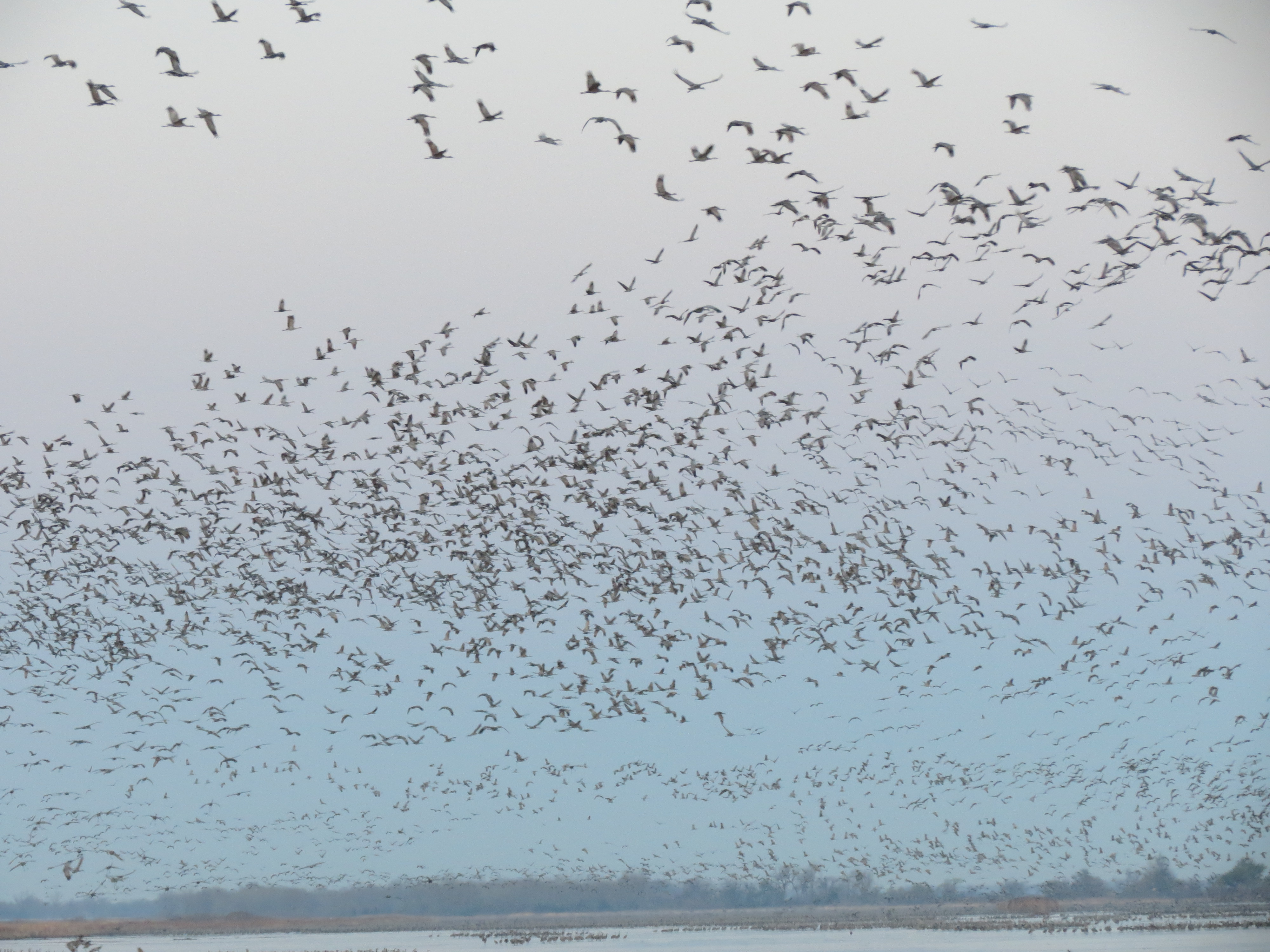
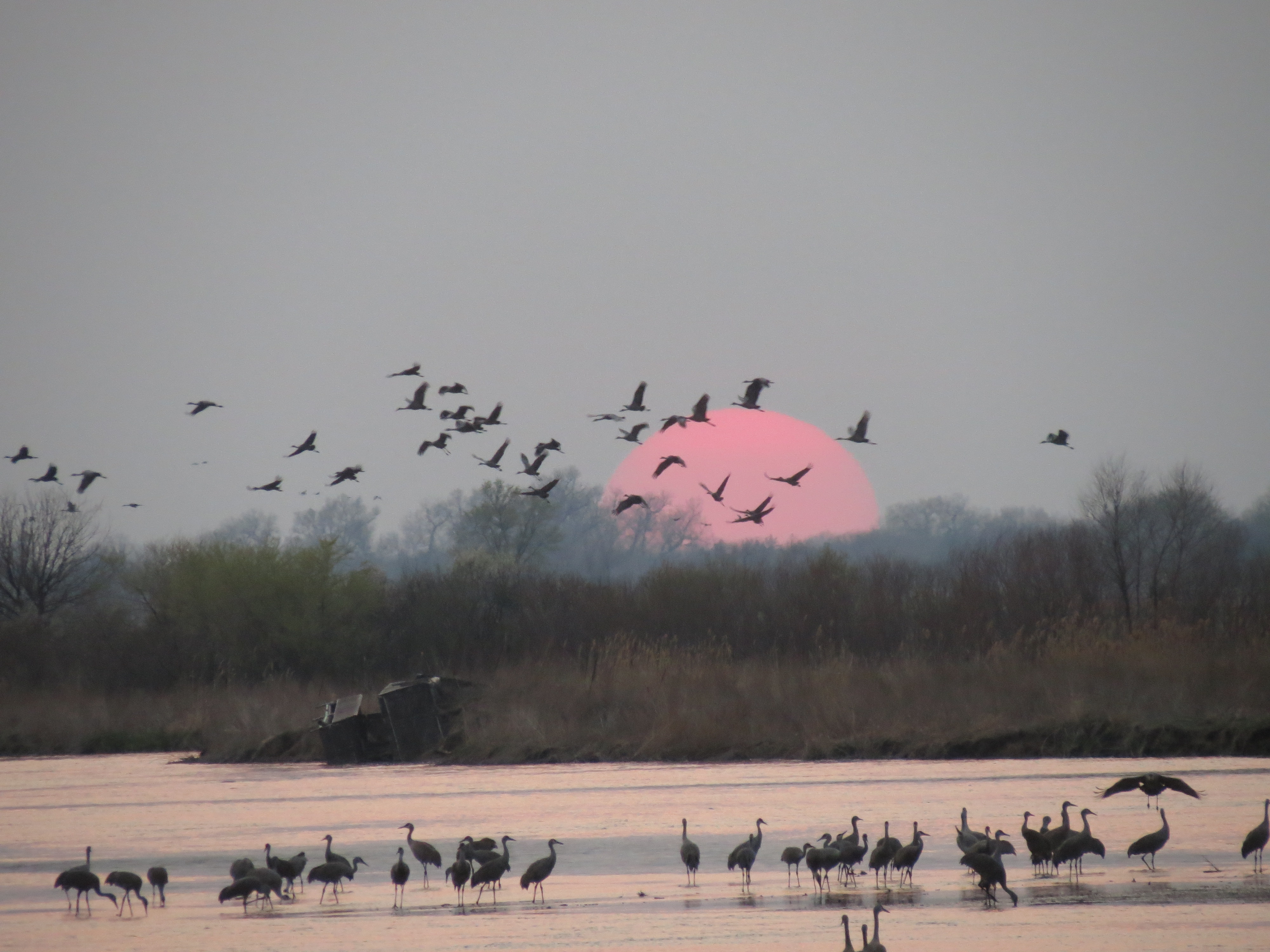
Every spring, the Sandhill and the Whooping Cranes, the most and least common of the 15 worldwide crane species, begin their 5000-7000 mile migration to the subarctic in North America and Siberia.  Their final staging area is on the Platte River.  They go to the Platte because there is food nearby–formerly small animals, but now mostly corn–and because of the safety that one of the largest braided rivers in North America affords.  They feed in the adjacent fields by day and roost in the river at night, where the shallow water allows them to hear predators approach.  Before the Platte was dammed and water used for irrigation, recreation and drinking, it was a mile wide and an inch deep, “too thick to drink, too thin to plow.”

Now, the Platte in many areas contains less water, has invasive species and many trees nearby, limiting the suitable habitat to 50 miles from the former 200.  Rowe Sanctuary manages 4 miles of river and owns 1900 adjacent acres, preserved as habitat.  Every night, for 6 weeks in March and April, up to 600,000 Sandhill cranes, 90% of the world’s population, roost in the river.  Every morning, they leave.  It is a spectacle that Jane Goodall has called one of the world’s best.  I’ve been fortunate to have seen many great sights in nature.  This one is in my top three; seeing a solar eclipse and a wolf in the wild are the other two.  I love the cranes so much that I volunteer at the Sanctuary, along with dozens of others, helping the full time staff of four–that’s right, four–show visitors the cranes from viewing blinds, for cranes are shy birds and will not let people near them.

Many talk about the cranes that migrate to Arizona.  I simply reply, “You don’t understand.”  And you can’t, until you witness the a flock of fifty thousand cranes, darkening the sky.

Stevie Staples mentored one of the Rowe Staff and lived 74 years, dying in 2006 from cancer.  She was a former canoe racer and a real character.  I once raced canoes, and I would have loved to have discussed racing with her.  She touched the staff at Rowe.  She knew it, for she did live to see a beautiful picture of a Sandhill Crane in flight with her volunteer tag with “9 years of service” on it.  The picture hangs on the wall in the hallway of Rowe.  A picture of Stevie’s receiving the picture from the Rowe staff hangs in Keanna Leonard’s office.  Keanna is the dynamic educational director at Rowe.

Jamalee Fenimore grew up in Nebraska and practiced veterinary surgery in Washington State.  She died of cancer far too young at 49, donating her estate to Rowe.  Nobody at Rowe knew or remembered her being there.  But obviously, she was touched by the river, the cranes and the sanctuary.  We volunteers learn that we may touch visitors in ways we never know at the time.

When I volunteer at Rowe, I work 17 hour days, sleeping on the floor in the sanctuary so I can hear the cranes on the river in the middle of the night.  I guide people to the viewing blinds, and I teach them everything I know about cranes.  Mostly, however, I let people look at the sight, staying silent, so they can hear the birds.  I clean toilets, paint, greet people, make a noonmark, build a sundial, do whatever needs to be done.

On one tour, I took a disabled person to Stevie’s blind in an electric golf cart.  Had he been able to walk, all of the group would have gone to Strawbale blind, which had better views at that time.  But we still saw many cranes, American white pelicans, and unusual crane behavior.  My rider loved the view and tried to tip me, which I of course refused, asking him to put the money in the container at the sanctuary.  I planned to talk to other clients, because as the lead guide, I hadn’t spent time with them.  But I spent time with this man.  He was originally from Singapore; when I told him I had been there twice, his first comment was “Thank you for saving my country.”  I’ve never heard that before, and it did me good.  I hope I and Rowe did him good.

We touch each other in ways we may never know.  Good people spread kindness throughout their world.  The lucky ones receive that kindness or are those who live long enough to discover that their kindness was deeply appreciated and honored.  But all who spread kindness are fortunate that they have the ability to do so.  Stevie knew in her final days that her kindness was appreciated.  I hope Jamalee Fenimore did, too.  But if not, I know she knew she was doing the right thing.  I deeply appreciate what she did.  And every time I guide people to either of the two blinds, I tell them the story. Both women deserve to be remembered.  To have a viewing blind named for you on a river where a half million cranes visit every March is a wonderful honor.  I really can’t imagine a better one, frankly.

JUST CUBANS

October 27, 2011

In 1900, Cuban meteorologists knew a big hurricane was going to strike the US.  We had our own US Weather Bureau (as it was called at the time), and since we were Americans, and Cubans were–well, Cubans–we did not believe them, even though Cubans had a great deal of real world experience with hurricanes.

The 1900 hurricane that destroyed Galveston is to date the single biggest weather disaster to strike the US.  The destruction of the city was not preventable; the massive loss of life was.  Unfortunately, arrogance trumped science and listening to people who might know what they were talking about.  It is a recurrent theme.  Congress passed a resolution stating that man-made climate change is not occurring.  I wonder when they can tell me when Tucson’s average temperature for a year will again be normal.  It has been above normal every year since 1984, and the normals have been raised 3 times.

While they are at it, perhaps these same people can tell me when Tucson will again have normal rainfall.  It isn’t just warming, it is ocean acidification, changes in rainfall patterns with floods and droughts longer lasting, and earlier springs, affecting animal life.  Two-thirds of the birds in the Christmas bird count have moved significantly northward.  Dust from Chinese pollution is falling on snow in the Rockies, leading to earlier snow melts and changes in water level.

A while back, a person challenged me to “prove” global climate change without using models.  As a scientist, and especially as a statistician, I use models as a way to depict the world.  A model is a map, and I would no sooner work without models than I would go into the wilderness without a map.

Perhaps this particular individual, who sold real estate in Phoenix, had no use for models.  After all, the mathematicians who created models for the housing market assumed that housing prices would never fall, which is a remarkably dumb assumption.  Worse, purportedly smart people believed these mathematicians.

I work with models in statistics; I use and am familiar with at least nine different weather models for predictions.  Would we do away with models for predicting a hurricane’s path?  Maybe we will, in the new America.  After all, models are an attempt to use science, and many presidential candidates are already anti-science, even as they use aircraft, electronic devices, and the media, all of which were developed by science.  Many are alive today, like me, because of science.  To deny science is to turn back the clock, and  that deeply disturbs me.

I hope everybody noted the science used with Hurricane Irene.  The models originally had Irene hitting Florida, then progressively changed as new data came in.  This is science at its best, changing predictions in the face of new data, not being afraid to admit that the Hurricane might miss the East Coast altogether, but that it would be unlikely to do so.  Should we just hope?  Is that the new America?

Why should I have my hands tied when I am asked to prove something?  We do guess what natural phenomena will occur.  But why should we do uneducated guessing?  Are the models right?  No, they aren’t.  If anything, they are under predicting the severity of climate change.  And they might be wrong, although they have confidence intervals, which is a measure of uncertainty.  If you don’t understand confidence intervals, that is fine.  You just shouldn’t be arguing against climate change.  True scientists admit where there is uncertainty, try to define it, and draw conclusions, just as clearly as physicians tell their patients what they can expect, knowing that there is a certain degree of uncertainty.  Unfortunately, many physicians, being human, are often shocked when they learn how their brain can play tricks upon them in dealing with uncertainty.  (How many people do you need in a room before it is more likely than not that 2 have the same birthday?  Answer:  23)

If I lived on the east coast, I certainly would not be using my spiritual beliefs to predict whether a given hurricane would strike near my house.  I would be tuned into the National Weather Service and looking at what the models show–the cone of uncertainty and the probability of a hurricane’s striking me.  To do anything else would be stupid.

Since I live in this world, I am using what scientific models I can find to determine what the world will be like in the next 30 years, hopefully my lifetime.  I know these models aren’t accurate, but I believe in facts such as ice core analysis, oceanic warming, oceanic acidification, and what appear to me to be major changes in rainfall patterns, with three 500 year floods in North Dakota in the last 15 years, a prolonged drought here, and in Africa.  Perhaps I am just over worried and not scientific, but again, maybe this is all normal.  If it is, perhaps somebody could tell me when we will return to the temperatures and the rainfall that we used to have.

I just want an answer with a number, the word “years,” and a confidence interval. I don’t need any reading material.  How long?


HARRY TRUMAN WOULD HAVE KNOWN WHAT TO DO

October 26, 2011

I had a a screening colonoscopy recently, which went very well.  The process for check in, the procedure, and the departure went smoothly.  It ought to.  This center does thousands a year.

The bill for everything was about $4000.  We know that screening colonoscopies catch early cancers and can be treated at the same time.  It is a great test.  It helped me 10 years ago.  Early colon cancer, as far as we know, is completely treatable, and this is one of the common cancers.  We cannot say that for sure about breast cancer, because it is entirely possible that many of the early cancers might stay that way.  But certainly screening mammography has some value.

Here we are, with an expensive test that clearly can save lives.  You can think of many others.  I had insurance.  If I didn’t, well…. I guess I take my chances and hope.  Many Americans do.

How do we as a country provide better medical care to our citizens?  It is clear that our care is suboptimal.  Nobody counts errors in care, which I tried to know more than a decade ago.  Nobody knows what percentage of people who need screening colonoscopies–those over 50 and those with a family history–get them.  And I am not even mentioning the other cancers and the other biochemical screening that we should do.

Of course, I don’t have time here to mention how we provide after illness care without bankrupting the country.  I just think we should do better than we do.  My detractors will probably say we have the best care in the world.  Perhaps, at some places, we do.  I would like to see good data.  But nobody can convince me we have the optimal care for people given costs and illness burden.  We do not.

And we will continue not to.  I saw what happened during the insurance reform debate.  It was called health care reform by the media, and it had nothing to do with care.  I bet my career on improving care and lost.  This was about insurance reform and little else.  We polarized the country, and those who have not treated as many dying patients as I have (including family members) had the gall and the audacity to call end of life planning, something only 30% of us have, “death panels”.  We polarized the country, in large part because those who had theirs cared not a whit for those who did not have care.  Many decried government’s role in health care, even as they were receiving Medicare or were in the military.  This is a fact.

What is the best answer?  I have my thoughts.  I want my detractors to come up with an answer, and I want it now.  I want it to be put to the House of Representatives and the Senate, and I want it enacted now.  If America can afford a trillion dollars for one war that was not necessary and another that is no longer necessary and cannot be won, then America can afford a trillion dollars for improving what we have now.  We can call it an “emergency authorization,” as Mr. Bush did, and keep it off the budget, so our finances don’t look so bad.  It worked for Mr. Bush, so it should work now.

I’ve offered my solutions to deal with waste and to improve the care we give.  I have been slammed for it.  So to my detractors, I ask, time to stop slamming me.  I have offered my solutions.  You offer yours.  No rhetorical questions, please.  Just tell me, how do we screen people for colon cancer in this country?  How do we screen for other issues?  How do we care for those who do not have 7 or 8 figure net worths and do not have the good fortune to have medical insurance?  How do we prevent things better, and how do we have efficient treatment for the most common medical conditions?  How do we allow people to die when it is time, and how do we deliver good care to those who bodies are failing but whose brains are fine?  How do we deliver good care to those whose brains have failed but whose bodies are fine?  How do we quit when we should, and how do we know we have done this appropriately?

I have offered my solutions to these problems for the past quarter century, without success.  I am now dealing with my own medical issues.  I want solutions, I want them clearly defined, I do not want personal attacks, which are cowardly, I just simply want the country to run better.  That to me is patriotism.  If the Republicans do it and take credit, good.  They should deserve it.  If the Democrats do, then also good.

We would do well to heed the comment by one who cut waste in government, and was called by one of the leading House Republicans as a patriot–Harry S Truman. Mr. Truman once said, “There is no limit to what a man can accomplish if he doesn’t care who gets the credit.”

YOU ARE ON YOUR OWN…THIS IS THE NEW AMERICA

September 3, 2011

While waiting in a physician’s office, I heard a conversation between an elderly man and the receptionist about what Medicare covered.  It was obvious the man had difficulty understanding, and from his demeanor, I suspect he had difficulty understanding day-to-day matters, too.  The prevalence of dementia doubles every five years over 65.  An 85 year-old has an even money chance of dementia.  No, 90 is not the new 50; don’t plan on it.

That sad fact was emphasized by my later hearing a story from an acquaintance who helps an elderly woman with shopping.  She called the woman asking what she wanted.

“I won’t have money for food this week.  They are going to take away my Social Security.”

Of course, this has not yet happened, although many bullies, loud and unwilling to negotiate, want to kill the program.  Imagine being 85, a widow (a plurality of 85 year-olds are widowed women), no longer think clearly, have a failing body, and start hearing about Social Security being taken away.

We must couple spending for Irene’s damage with cuts–incredibly, both NOAA and the National Hurricane Center are on the chopping block.  I find that incredibly stupid and shortsighted.  Maybe we end Social Security and Medicare, too.  Suppose, given 32 C temperatures in the Gulf of Mexico, since the oceans are getting warmer, that a Cat 4 Hurricane enters, headed  northwesterly.  We can take Mr. Perry’s approach with Hurricane Rita in 2005, and pray that it stops and turns around, OR, we can be sensible and have scientific forecasts, which while imperfect, will save thousands of lives.  I am assuming, since Mr. Perry once considered secession, that he will not take federal money for the $30 billion that it would cost to rebuild Houston. Texans can pass the hat. We certainly won’t cut socialized defense or $2 trillion for wars that we could not afford and lied our way into.  No worries, however.  The climate is fine, since Congress passed a resolution saying there was no manmade problem. Maybe Congress will forbid hurricanes, too.  In the new America I see, you take care of yourself.  If you don’t have money, you don’t get medical care.  Vaccines are bad, public education is bad, and the private sector does everything right, from half finished jobs in Iraq that have wasted more than $60 billion to having the airlines regulate security through 10 September 2001, that indirectly cost more than a trillion in the past decade.  How many times do I have to say self-regulation does not work before I am believed?

My screening colonoscopy cost me $4000.  I have insurance.  Those over 50 without insurance will roll the dice.  When the current President finally put the money spent on the wars in the budget, I could hear the howling in Washington from Campbell and Skyline.  Mr. Bush did it, and not I did not hear one person outside my house who complained.

Many people barely make it.  In the new America, they will go bankrupt, medical costs the single biggest cause.  I wonder how much colon surgery for advanced cancer costs.  Oh well, that won’t be my problem, so why should I care?

But I do care.  Liberals care about those who aren’t as fortunate as they.  The current radicals were remarkably quiet when Mr. Cheney said “deficits don’t matter”  in 2005.   If Mr. Obama said that, he would be impeached.  If he kept emergency authorizations off budget, he would be impeached.  If he asked for a trillion to restore our infrastructure, providing jobs, I would need earplugs.  If he asked to raise the top marginal tax rate back to 39%, where we last ran a surplus (under Mr. Clinton), repealed the Bush tax cuts and put a 0.125% tax on stock transactions ($1.25 for every $1000, raising $600 billion by 2020 just on the NYSE alone), a progressive tax, we might get the deficit under control.  He could also put an 80% marginal tax rate on bonuses given to financiers, who have been shown by excellent research not to add value for what they are paid.

There is waste in medicine, too. But my neurosurgeon saved me from neck surgery, my dermatologist saved my face from disfigurement, my gastroenterologist saved me from colon cancer, and a Durango orthopedist’s quick actions on my right hip allow me to backpack today.  We should do better in medicine, but we add value.  I think the teachers who inspired me deserve better, too, and I fail to understand why if the free market is so good, teachers and others, who add clear value, are consistently undervalued.  Lack of oversight and self-regulation severely damaged the world’s economy.  Those who did it made billions.

The elderly lose their bodies, their minds or both.  The young need care, too. What do we do?  Do we remove their benefits and make them fend for themselves?  Do we decrease the surplus population?  Is this America? Where is the outcry demanding we will NOT allow our poor, elderly, disabled and those who did not get a break in life to live a better life?  This is one of the most religious countries in the world.  Where is organized religion?  Where are the voters to elect people who believe America tries to help those less fortunate?

I hear two sides of a story, as if both sides have equal validity.  They do not.  One side lied on Iraq, climate disruption, and vaccine safety, and dared say end of life discussion was “death panels”.  I will never forgive them that, any more than the physician who argued against evolution by saying “it debased man to the level of the animals,”  which is about as unscientific as it gets.  You are wrong, your data are flawed, you bully, and you pervert science.  Sadly, more believe you than I.

I’ve offered my solutions.  I’m ready for the usual attacks, the flawed reasoning, the rhetorical questions and lack of solid solutions from those in the majority. Maybe I need to live in Canada.  America has lost her way, and those of us who have been saying it for a decade are ignored.

ON THE MEDICAL-SURGICAL FIRE LINES

August 14, 2011

In 1984, I had data about surgical outcomes by surgeon for carotid endarterectomy (CEA) in two Tucson hospitals.  There was a 14% major complication rate and a 23% overall complication rate, clearly worse than the results that we knew about medical management of the condition.  I referred my potential surgical cases to only one surgeon, whose outcomes were comparable to medical management; many patients, when told that the local outcomes, refused surgery altogether.  I took a great deal of heat from my colleagues for my stance.  So be it.  My patients mattered more.

I saw far too many complications post-operatively when I had not been involved pre-operatively.  In my view, many of these procedures, especially every asymptomatic CEA, were not indicated.  Some agreed with me.  Not many.  That of course, isn’t the only turf battle in medicine.  There are many. Patient care quality is often mentioned; I wonder today how much outcomes data is collected, how well it is collected, and whether decisions are made based upon it.  I would hope so.  However, as a physician with advanced training in statistics and quality, I never was called upon in this state to offer my opinion.

Before last summer’s fires, I wondered how many in Sierra Vista, a conservative city, had decried big government, only to realize that they needed the resources of the National Interagency Fire Center to save property, lives and indeed the city.

The National Interagency Fire Center was created by combining of three governmental agencies to cut duplication (waste)–the US Forest Service, the Bureau of Land Management and the National Weather Service.  Eight different federal agencies are now part of the NIFC, which has no single head. That isn’t to say that firefighting is done without an incident commander.  There is one.  But the organization itself has no CEO.

Aside from cutting waste, the NIFC did one other remarkable action: they coordinated nationwide firefighting.  Instead of each state having its own cadre of firefighters, on duty only for that state, the condition of the COUNTRY was looked at, so that wild land firefighters in Oregon might be called upon to fight a fire in Utah, because the latter was more severe than any fire burning in Oregon at that time.

This approach required that firefighting managers in a state give up local turf for the good of the country.  Incredibly, they did.  And we are better for it.  Congress would do well to follow that example.

That isn’t to say that the NIFC always gets it right.  The Fire of 1910 colored our wild land firefighting thinking for decades as sure as a missed diagnosis often colors a physician’s thinking for the rest of their practice.   Sometimes fire fighters, in spite of their training, do the wrong thing, as in Colorado’s Storm King fire in 1994 or the Thirty Mile Fire in Washington in 2001.  But there were no calls to dissolve the NIFC, to hand it over to the states, or worse, to local people, to handle matters themselves.  The fire deaths were investigated thoroughly, and the mistakes publicized, in hopes that they would not be repeated, although the Storm King fire deaths unfortunately paralleled those of the Mann Gulch fire in Montana in August 1949.

Without the NIFC, Sierra Vista, Alpine, Greer, Springerville, Pinetop/Show Low would not exist as we know them.   To me, that smacks as government doing something right, something that government should do, that individuals on their own, no matter how motivated, simply cannot do.   It is quite easy to set government up to fail.  I see that today.  It is far more difficult, but far more rewarding, to set government up to do good, to step in where individuals simply cannot deal with circumstances that are overwhelming, like severe poverty, catastrophic medical emergencies, education, or natural disasters.  Katrina was bad; the gutting of FEMA prior to that put the US on world-wide display as an incompetent country.  How many died because of that?

How much government we should have is a matter of opinion.  Frankly, I am willing to pay taxes, and a lot of them, to ensure we have a country that properly helps lead the world.

Like the NIFC, government won’t always get it right. But I am incapable of defending myself from wild land fires or knowing if my food, water or an aircraft are safe.  I depend upon somebody in government to have firefighters in place, mandatory food safety inspections, oversight of the financial system, and an aircraft control system, so that the results of unpreventable disasters are minimized and we prevent what can be prevented.

I want to know which physicians are best for me, should I need a bronchoscopy, colonoscopy, back surgery, or have a carotid event.  I hope my colleagues have sorted this problem out by now, but I don’t know, despite bringing a wealth of skills to the table.  Perhaps we need a National Interagency Medical Quality System, assuming we can find enough people to give up some turf and do what is right for the patient.  Like the NIFC, they wouldn’t get it right all the time, but it would be a step in the right direction.  Heck, I might come out of retirement to serve, should anybody ask.


EUROPEAN ODYSSEY, LANGUAGE ODYSSEY

July 27, 2011

I am a lucky person, but I think I make my luck, too.

I started learning German about a year ago.  I didn’t plan to, but on an eclipse trip in Argentina I met two young astrophysicists from Munich, both fluent in English.  We corresponded after the eclipse, and because there is a ring (annular) eclipse in the US in 2012, I invited them over.  I promised I would learn a little German.  Well…a little turned into a full time 5-6 hours a day for 9 months.  I did most of it alone, until I found a couple of language learning websites.  These allow people to correct each other, and through that I met people on line in several countries.  I don’t like to use the word “friend” for somebody I have never met, but on the other hand these people have been available for me to bounce things off more than many of my friends over here.  I regularly correspond with people in Europe and Brazil.

Originally I planned on a short visit to Europe to see the two women I met.  I figured 4-5 days was enough, trying to heed the adage that guests are like fish, after 3 days they begin to smell.  But two of my online “friends” invited me to stay with them when I went over, one in Switzerland, the other in Austria. They were serious, so I changed my plans.  Now 62, my 4 days in Munich turned out to be 26 days abroad in 3 countries.  I spent 8 days in Munich, another 4 in Switzerland, and 14 in Austria, in a small town where people speak dialect and don’t lock their doors.  Yeah, those places still exist.

The first thing I realized was how difficult German is to learn, and that what I spoke was not at all as good as I hoped, nor was my comprehension anywhere near what I hoped.  But the people around me were astounded at my progress, and they were pleased that I was speaking their language.  Not one person said anything derogatory.  Not one.  Oh, I made some funny mistakes, but we all laughed….and moved on.  I asked questions and more questions.  Some things I picked up right away, others just didn’t stick for the longest time.

One of my hosts, Niki, met me in Munich.  He spoke German immediately and I later learned that was his plan–to be “grausam” or cruel–as he put it.  I responded in German, and within 2 days, I decided that in public, I would speak German, no English at all.  There was a lot I would not say, much of which I wanted to, and a great deal I would not understand, but I decided I had to go with the flow, knowing I would do some stupid things and ask a lot of dumb questions.  But I spoke German in Europe almost exclusively.  In Austria, I explained the US financial crisis to Elisabeth in English, both because it was easier, and because I am so angry at what happened that the anger affected my ability to speak German.

As I got more comfortable with Europe, I noted things to compare with here.  Europe sure isn’t perfect, any more than we are.  There are things people on both sides of the Atlantic could learn from one another.  There is too much smoking in Europe, although they are making progress eliminating places where people may smoke.  While many bicycle, there are far too few with helmets, although motorcyclists do wear them.  Yes, I am in favor of helmet laws; as a retired neurologist, I think my credentials to say that are  solid.

Europeans have good public transportation.  With gas $8 a gallon, they need to move a lot of people efficiently.  No, it isn’t perfect.  I missed a train in Salzburg.  But there was another one two hours later.  I was able to get all around Munich using the S and U-Bahns.  They work.  Not knowing the system, I still got around.  Speaking some German helped, but it wasn’t necessary; people were just happier with me when I did speak it.  We need the same public transportation system here.  It can be done, and Portland, Oregon is a good example of how a city can work.  I doubt it will in Tucson.    I have stopped listening to my detractors and those who confuse average with “world class.”  Tucson has major climate problems, educational problems, and an immense number of far right wing people living here.  They are old people, regardless of their age, and they have damaged the state perhaps irreparably.  We need good public transportation, and if it is good, people will use it.  Yes, it will cost money, but it will pay for itself in many ways, not all of them monetary.

The food was great in Europe, and I must have walked most of the calories off, because I did not gain weight, and I ate cheese and pastries by the kilogram.  Oh yes, we need the metric system here, too.  There is no excuse for not using it.  None.  I have for decades, and most Americans don’t know the English system well.  Think you do?  Answer these without looking them up:  How much does a gallon of water weigh?  How many ounces in a gallon?  How many yards in a mile?  How many acres in a square mile?  How many square feet in an acre?  To the nearest hundredth, what is 7/16ths in decimal form?  What is the scale in inches to a mile of a map that is 1:100,000?  What is the approximate conversion for nautical to statute miles?  If you can’t answer most of those questions quickly without looking them up, I rest my case.

Restaurants in Europe open later than I am used to, and you have to get the waiter or waitress to give you the bill.  What that does is allow you to stay longer with your friends, and generally order more food and drink.  I can’t say how many times an American waitress has lost money for the restaurant by shoving the bill under my plate without asking if I wanted anything more.  I would have ordered dessert, but decided it wasn’t worth it.

Internet service fails in Europe, as it does here.  But I had cable high speed Internet in homes, even if I didn’t have wi-fi.  Phone service had its problems, but my National Geographic phone was a nightmare that I finally stopped using.  Customer Service was a long wait, and if you didn’t have minutes you couldn’t call to order them. One has to have a toll free line to the service center, and this telephone did not have that.  Nor did it fill 80% of my request for minutes.  Is that stupid or just American?

In truth, despite National Geographic, I really didn’t spend a lot of time comparing Europe and America.  I simply saw parts of the world I had never seen before with people I had never met until recently.

Europeans usually can speak another language, but I learned that their English was often like my German, passable but not fluent.  That was fine by me.  They spoke English to me, and I spoke German back.  We communicated, and we had fun doing it.  Many have been to America and have a good opinion of the country, especially Mr. Obama.  They wonder why we don’t have national health insurance and why we don’t do something about guns.  I have wondered both of those for years.  I bet my career on improving medicine and lost, and I have long since not bothered trying to fight the National Gun Association (it really is about guns, not rifles, but ‘rifle’ sounds so much better than ‘handgun’).  I don’t interpret the 2nd amendment the way the Supreme Court does, and most of those who tote guns are not US Veterans.  Am I sure of that?  Yes I am, since only 7% of Americans served this country in uniform and a lot more than 21 million people (minus me) have guns.  So much for a militia, unless the Tea Party forms one, in which case I am off to Canada.

Here is a list of what I saw that I doubt I would have on my own or with a tour:

  1. Two visits to a family on a farm outside of Munich.  On my own, I had to deal with Bayern dialect, not understanding a lot of it, but learning a few words and realizing a man my age was calling me “du”, which is something one has to be careful about in Germany.  On the second visit, there was a party of 20 young people, half my age.  Three times, for a protracted period, one of the people engaged me in a conversation in German.  They spoke slowly enough, but still at reasonable speed, that I could ask about them and tell them about myself.
  2. A tour of Munich with one of my friends from the Argentina trip and her husband.  The weather was terrible, but it did not matter a bit.  We had a lot of fun. 
  3. A trip to Chiemsee, a large lake in southern Bayern (Bavaria).  Got out to Herreninsel, and walked around the island, seeing King Ludwig’s Castle.                                4. A visit to the Max Planck Institute for Extraterrestial Physics, and a look at the work going into EROSITA, an X-Ray telescope to be launched in early 2013 to L5, the LaGrangian Point (where Earth and Sun’s gravity are equal, so the orbit is stable), beyond the Earth’s orbit.  5.  A visit to Poing, a lovely wild animal park with room for the animals.

Yes, I walked around Erding, a suburb, and I had dinner and coffee with and without others.  I talked German with complete strangers, but these would have been normal parts of a visit. 

In Switzerland, the German is more difficult to understand, and I was with a family where English was spoken only by one son.  I stayed 4 nights in their house in Kerzers, a suburb of Bern.  I got off the beaten track.

  1. I was met at the Bahnhof and immediately taken to Enrico’s workplace (the husband of Teresa, whom I met online).  It was a clear Sunday afternoon, and we had unfettered access to the rooftop, where the view of the Alps above the powerlines and houses.  The views were stunning.2.  That night, I was shown a book about the first 26 hour flight with a plane whose wings were completely covered with solar panels.  The propeller driven plane used no fuel, only batteries at night, and flew as high as 8700 meters.  I also saw a DVD of the flight.  There were no American firms in the consortium.  I never heard about this flight.  If we can power an airplane with solar panels, why not a car, an air conditioner,  hot water heaters, and automobile accessories?   3.I was on the tourist track when Teresa took me through the three lakes and two canals on a boat ride.  We saw Merton through her experience, climbing high up into an old church above the old town.  We took the train to the boats, and we walked to the train again.  No cars.4.  One night, the family cleared the table quickly and I noted everybody dressing up.  I was still in shorts, so I decided I ought to put on decent clothes, really not knowing what was going to happen.  Teresa’s look, after I had changed, told me I had done the right thing.  We drove with a son to a school.  I saw a piano and drums on the stage and figured this was a concert.  I could have asked, but wasn’t sure I needed to or should to.  Sure enough, three young women appeared and played two numbers, one on the piano, one on a sax, and the third on a violin.  

But then things changed.  A man started talking, and from a few words, I realized this was their son’s graduation from school!  I was asked to take pictures, which I did, and later there was a reception, where I took the family’s picture.  There might have been other Americans there, but somehow I doubt it.  I was really deep into another country’s culture.

5.  On my second day, Teresa had to work, so I went into Bern, where I met the sons of my only cousin.  Peter lives in Bern, is the oldest, and I met him in Tucson in 2006.  He speaks four languages.  I had never met Richard, who looks like my late uncle.  Both spoke English and German to me, I spoke German back.  They were amazed, pleased, and we had a lot of fun.  They had lived in Bern for years when they were children, so we had a lot of fun together and I saw Bern through their eyes.  I have no parents living, only one cousin, and so to meet anybody in my family was truly special.6.The last day, Teresa took me to Freiburg, where there is an old church and a tower where one can walk to.  We climbed up to the tower, where really quite by surprise, a nearby lightning strike caused me to yell for Teresa to get off the tower.  She said, all in German, that everything was OK.  I screamed at her, again in German, that all was indeed NOT OK, and we needed to get out of there.  We did.

One has to be prepared for changes.  Teresa had mentioned nothing about the last morning, and I had a 0745 train to catch from Bern, meaning I needed to catch the 0650   train from Kerzers.  I was up at 5, and at 6 the house was still quiet.  I ate, expecting to take a walk to the Bahnhof.  At 0615, Teresa appeared in a bathrobe, so I assumed I would still be walking.  About as I got ready to leave, Enrico appeared at 0625, sleepy eyed and saying he would take me.  So I did get a ride, although I didn’t know it until the last minute.

I had no problem getting the train from Bern to Zurich, but I had to ask for directions for the train to Salzburg.  That was no problem, as it turned out, although the train itself was slow, frequently stopped too long, and I realized I would not make my connection in Salzburg for the trip to Oberösterreich, where Lambach was located.  I texted Elisabeth, who told me to take another train that left later, going to a different stop, which would be easier for her.

I have learned that the posted schedules at Bahnhofs are not always accurate, so I went to information to confirm my trip.  I found the train and got off at Wels, where Elisabeth met me.  People don’t use signs very often, but we had chatted on the Internet, and there were not many departing the train at Wels.  She took me to her house, where we had dinner.  I would stay there for two weeks.

Lambach is small, on the Traun River, but has good transportation.  The stores are all closed on Sundays, which is a throwback to many years ago here in the US.  

  1. I went to a school, where I was asked to speak English at Elisabeth’s English class.  She is fluent in English and is the school’s English teacher.  I soon realized that those teachers who spoke English with me were less fluent than I was in German.  I answered in German, they spoke English.  This was a recurring theme in Europe.  The students loved having me there, had many questions, surrounded me afterwards, peppering me with questions.  Later, we had a computer class where I showed them pictures of the US, solar eclipses, and explained the latter phenomenon in German.  I had a blast.2.The next day, we hiked to a Laudachsee, a small lake east of Traunsee in the mountains.  It rained, but not hard, and we walked around the small lake and then had lunch in a restaurant.  The inside was taken up by a wedding party, so we ate outside.  It was cold, but we were given blankets and stayed dry.    We walked back down the mountain and took a visit to Traunsee and a church on a small island accessible from shore.  I almost died on the walk over.  One of my big fears is riding in a car, the other is being a pedestrian.  Most cars will stop for people in a crosswalk.  Fortunately, in this crosswalk, I looked.  A black Mercedes sped through at 80 kph (50 mph), never once stopping.  Illegal, yes.  That would not have saved my life.
  1. The following day, we took the train to Salzburg.  Elisabeth had lived there 3 years, so I had a tour guide.  We saw the city, the Feststellung, high on the hill, had lunch in a lovely old place dating at least 300 years, and at the end of the day had drinks with her sister and brother in law, who lived nearby.  Again, it was a chance to work on my German with strangers, and again I was told I was understandable.  This had been my biggest concern, and I was greatly relieved to know I was able to speak correctly.  Elisabeth and I took the train back and walked back to the house from the station.
  2. I was invited to go to Linz, for a program where schools in the surrounding area (Linz is the capital of Öberosterreich, one of the nine states in the country) put on a show.  Unfortunately, the dancing, athletics, and the fair atmosphere was considerably dampened by the rain.  Still, I got to see the Danube, Brown, not Blue.
  3. On my own, I visited the farmer’s market, several bakeries, and had conversations with people in town.  I had to see a doctor about a small infection that wasn’t healing, and it was interesting to see medicine from a patient’s side abroad.  The visit was 15 euros, the medicine about 7.5.  All drugs are 5 euros for residents, regardless of what the drug is.
  4. Elisabeth and I went to a concert with a Russian pianist, held in a local church.  I figured with a town of 4000, there would be few attendees.  There were 400, and the pianist was superb.  So was the church.
  5. We visited Epps, the oldest city in Austria (800 years next year), and then went to Mauthausen, the main concentration camp in the area.  It took in just about anybody the Third Reich didn’t want, which in this instance led to 122,000 deaths.  It was perhaps the cruelest of all the camps.  Prisoners had to haul 55 kg blocks of granite (120 lb) up an incline which today has about 200 stairs and had me puffing.  Many were lined up at the top of the quarry and told to push the person in front of them over or to jump themselves.  The guards laughed as they called these people “parachutists without parachutes”.  Several thousand were shot as they tried to escape; at least 1500 committed suicide by touching the electric fence.  When liberated by the Americans in 1945, a day before V-E day, they buried 1200 the first day and 300 a day thereafter.  The surrounding countryside is so beautiful, but one cannot not escape the memorials by more than 40 countries, with words almost all in languages other than English. The words struck me deep to my core, as did the place called “Gaskammer”, and a beam where hundreds of Russian prisoners died painful deaths.  These places existed.  I had never been to one.  It is said Austrians won’t take people there, but Elisabeth takes her school children there to show them what their country was capable of.  America has MyLai and Iraq.  No country is immune to evil.  The evil at Mauthausen, however, was beyond compare.
  6. The next afternoon, we had dinner at a house of a friend–fellow teacher–and again, I had to speak German at length.  The way people opened their houses was deeply appreciated by me.
  7. We spent two days in Hallstättsee, spending the night in Obertraun.  The first day, we went up the Dachstein on the Gondola where we saw two caves, the latter the Ice Caves, where there are stalactites and stalagmites, made of ice.  The backlighting was superb, and the caves remarkable.  We spent time on the summit, over the 5 Fingers, which are projections built out over the cliffs.  It became foggy, but we were up there and again beat the rain down.  The next day we explored the town and the gondola up to where the salt mines were.
  8. That night, we had dinner at a local pizza restaurant in Lambach.  Perhaps America has better pizza, perhaps, but if we do, that is the only food I ate over there where our’s was better.  I have never just savored the taste of bread, pastries, and other food the way I did in Europe.  We were part of a group of 8, and again, many were curious about me and my life.  I spent some time talking about German grammar with a man, again, all in German.
  9. Elisabeth and I rafted the Traun, with a friend driving us upstream.  There is a 10 mile stretch with no houses, only clear water and lovely woods on either side.  It is a gentle river and with a raft, no problem.  There are plenty of places to swim or to camp.

I was not allowed to clean the house or the yard, although I did take it upon myself to empty the dishwasher, take out the trash, and feed her two cats.  We split up expenses, although I paid for dinner one night and gas one time as well.  There were just too many things she was doing for me that I needed to repay somehow.

I brought gifts for Teresa, Enrico and Elisabeth.  I had no idea and still don’t, how they will work, although the SW jewelry bracelet Elisabeth received has been worn several times.

I spoke English with Elisabeth twice, as mentioned earlier.  A third time was at the train station the day I left.  I wanted to be certain I could express myself clearly.

I then had to return to Munich, where the schedule changed, and I went from the Bahnhof to the S-Bahn and then the U-Bahn, taking that to MPE.  I met Maria and Anita and had a snack at MPE.  Maria, Niki and Maria’s uncle had dinner with me in Erding, my last night before flying home.

I was pleased that my German was understood, but I was disappointed that I still could not understand completely the news, although I knew the drift.  Nor could I read the newspaper well, although I read it daily.  I have two German books I am reading, I am spending sometime every day listening to German, and I decided to join the University of Arizona German club so I can meet with them on Thursday nights and both speak and hear German.

I do want my life back, where I am not spending every day learning German.  But I do not want to lose what came at great expense of time and effort, and is really appreciated by the German speakers whom I met.

I’ve seen the ads “Learn German in 20 minutes a day,” or “you will be nearly fluent using Rosetta Stone.”  Do not believe these.  Learning a language is hard work.  It requires mastery of vocabulary, and in German, the noun gender and plural.  It requires knowledge of grammar, which in German requires knowledge of cases and verbs/prepositions that take certain cases (in some instances two different cases for a preposition, depending upon how it is used).  I spent 5-6 hours a day for 9 months. I wrote, I listened, I practiced, I had lists of words, file cards of nouns, whose gender I needed to learn.  But it was worth it.  I could talk in sentences, and I could do more than just order things in a restaurant.  I could speak correctly, and my grammar was good.  There is just so much more I need to learn.  LiveMocha.com defines fluency as being able to carry on a simple conversation with somebody.  I don’t agree.  Fluency is speaking the language clearly with anybody, about anything, at any speed.  I am not fluent.  But I am conversational.  I can talk about any topic I want to.  Sometimes it is slow, and sometimes, I need help for verbs or nouns.  But I can make myself understood.  I just want to do better.  And that will take years.  Being “in country” was essential for the nuances that every language has.  This is a journey that won’t end, but on this particular journey, I not only spoke German, but I got to see a side of Europe that tourists just don’t see.  And I am a different and I hope a better person for it.

Posted in Uncategorized | Leave a Comment

Be the first to like this post.

Leave a Reply

SWIMMING WITH THE ORCAS

July 17, 2011

“In nature, there is no right or wrong, only consequences.”

An Alaskan cruise ship happened upon several deer swimming across an inlet.  Suddenly, several Orcas appeared, attacking the deer, killing the whole group.  The passengers screamed, begging the captain to “do something.”  There was, of course, nothing the captain could do.  Or should have done.  This is how nature works, predator and prey, survival of the fittest.  It is terrible to see it, but deer feed other animals as well as to breed and make more deer.  It is the way of the world.

Unfortunately, I didn’t like the way of the world when lightning caused Minnesota’s Pagami Creek Fire,  It was monitored, because wilderness fires are beneficial phenomena to the ecosystem. Jack pine seeds can only open after a fire, and I’ve seen large forests of young jack pines 10 years after a major burn. Unfortunately, one day the fire exploded, running 12 miles, ultimately burning 92,000 acres.  Regrowth has already begun, but I will never again travel my favorite route to Lake Insula.  It is the way of the world.

Large fires have burned huge swaths of Minnesota, the last big one in 1918.  That fact has not stopped many on the Iron Range from blaming the fire on the Forest Service or “radical environmentalists” like me. Scientists know fire belongs; if there is anything “radical”, it is the idea that forests, like life itself, are immutable.

Often, those who decry big government are first to ask where government is when there is a disaster.  FEMA was decimated in the name of smaller government, until Katrina, proving the adage to some that government can’t do anything right. I might counter with “Lehman Brothers.”  Wildland firefighters, who save so much property and risk their lives, are part of “big government”.  A PCMS member once made a pejorative remark to me about “government doctors.”  I think those of us who were medical officers, including the VA physicians who trained all of us, might feel differently. The previous Vice-President, who never wore a uniform, referred to those 16% of us against the Iraq invasion as traitors.  I want every president to succeed, because if they fail, we are in big trouble. If being against a war is treason, wishing a president to fail is the same, unless there is a double standard.

Big government cleaned the air (under Nixon) and the rivers, because corporations would not do it voluntarily. Accountants do not factor environmental costs in the bottom line.  When free markets fail because of greed or poor planning, big government must step in. If government is bad, then it must not interfere in the bedroom, marriage, and how I should decide to die. Drowning government in a bathtub would appear, in my world, to drown national defense. I don’t want that.

We did canoe in Minnesota, just not where we had hoped. While the fire was beneficial, we are likely to see more of these as boreal rainfall patterns are changing to a savannah-like ones with floods and droughts, rather than even, a phenomenon ascribed to climate change.  The oceans are more acid, the Ksp (solubility product) of calcium and phosphate will now, with 30% more hydrogen ions, cause deterioration in shell formation.  This is a major concern, since the oceans are acidifying at a rate 100 times faster than ever recorded during the past 20 million years.  Carbon dioxide + water=carbonic acid.  Nearly every glacier is retreating, and the volume of cubic kilometers of fresh water entering the ocean will further change the climate.  This isn’t bad, it just is, unless you are human, live on a coast, eat seafood, or get your water from a glacier, as do Peruvians and Indians, in which case it is a huge concern.

Every prediction of the future must quantify uncertainty; to do otherwise is unscientific. Not one argument I have heard against climate change has stated a p-value, confidence interval or margin of error. The late Sen. Moynihan said “you can choose your opinions but not your facts.” The IPCC is 95% confident, which we statisticians consider high. Using a cold week or a record low as a counterexample shows an inability to distinguish between local weather and global climate, which is basic to understanding climate change. For the record, in Tucson there have been 6.5 times as many record highs than lows since 2001 (142/22). This is a fact.

Not one argument I have heard against climate change has been free of personal attacks.  These attacks, having nothing to do with science, obscure the issue, ironically diluting and degrading the writer’s thesis. The subject is climate change, not what hikers wear.  I have discussed the science using statistics, which may be confirmed.  To clarify, I have been to ANWR twice, hiked 120 miles in three of its major river valleys, including 1002, and I find it and Antarctica among the most beautiful places on Earth.  I strongly disagree with those who disparage ANWR or climate change without having ever seen or understanding each respectively, and I have considerable knowledge of both topics.

Of course, some scientists, ever fewer, do not agree, but the vast majority of reputable scientists believe manmade climate change has occurred. Per cent occupancy of the globe is statistical misuse: 70% of the planet is water, and vast stretches are desert.  Fukushima is 0.0003% of Japan’s area, but radioactive Cesium contaminated 10% of the country. It is the way of the world that as a statistician, I frequently see statistics misused (99.999996% of aircraft flights in the US were not hijacked in 2001).  Mankind has never encountered CO2 levels this high.  We are running an uncontrolled experiment; worse, models are under-predicting the consequences. The average temperature has risen, overall weather patterns have changed and the higher sea level has already caused problems. These are facts.  It is the current way of this world.

When I was a neurologist, I often delivered bad news.  I do so again as a scientist and writer.  As a physician, I changed my patient management in the face of convincing evidence.  I believe I have convincing evidence about the world’s climate. I believe if nobody speaks out against those who disagree, and I continue to be polite with my word choice, misinformation will continue. I am calling them out; I will not be silent.  It is the way of my world.

The voters who elected this Congress believe that they will benefit from smaller government.  Ironically, many of these voters will need SSI and Medicare, which may be cut.  They are deer, and they actually want to swim with the Orcas.  It is, sadly, the way of their world.

NO MORE

May 26, 2011

We don’t learn enough from our mistakes.

Back in 1949, eight months to the day after I was born, 14 smokejumpers died in the Mann Gulch fire in Montana, when the fire suddenly exploded and beat them up a hill.  Fire always wins races uphill. It was a small fire when the jumpers dropped, but it got out of control.

Act of God? I don’t buy it. Study accidents, as I have, and you soon learn that it is seldom one failure but a concatenation of them, as happened here. We fix flawed systems by redesign, not by telling people to be careful.

The famous 1910 fire that killed 86 people brought a change fire management systems. But not enough. Or the lessons learnt were soon forgotten. Proof? About 700 wildland firefighters have died since. Consider this:

* 1994, Colorado: Storm King Fire, Prineville. Ring any bells? Same thing as in 1948. Fourteen dead, caught on a hillside, when a predicted dry cold front caused the wind to shift. A few outran the fire, 14 Prineville hotshots did not. For what? To keep land from being “scorched”, “destroyed” or other jargon which denies that fire changes, not destroys. It is necessary for nature to clear out old growth to allow new. Many trees need fire, either to open seeds or to allow competing species to die.

Both fires were extensively investigated and books were written, one the father of the other. One hoped the mistakes wouldn’t be repeated.  But they were:

* July 2001, Washington State: The smoldering Thirty Mile Fire on a lazy summer day killed four young people, who even a couple of hours before, had no inkling of death. This fire was unimportant, burning where nothing mattered, with plenty of chances to be extinguished. But a pump failed, there were communication breakdowns, the weather changed, safety shelters were deployed wrong….

We talk about firefighting costs in the millions. As a statistician, I count stuff. I learned years ago what is important and countable must be counted. What is important and not countable must be honored. And we need to know the difference.

Deaths in fires can be counted. Not the potential and pain of the lives lost. But we end up counting the money spent and give it the most attention.

“Acts of God” are due to insufficient knowledge or poorly designed systems. We no longer have “Acts of God” deaths from smallpox, measles, polio, rheumatic heart disease, puerperal fever, or infected hangnails. We no longer have commercial aircraft crashes every month.

Deaths from fire are preventable. The firefighters know the rules. We have excellent weather forecasting, every firefighter knows that property destruction is not worth one human life.

The National Interagency Firefighting Center was founded to coordinate firefighting efforts among states, so high priority fires got the most resources. Many gave up turf and power for the greater good. This is almost unheard of in my experience, and those who created the NIFC were remarkable people.

But their job isn’t complete so long as there are purple ribbons.

(Read, edited and improved by Anindita Sanyal of the Hindustan Times, New Delhi, India)

HUNTER’S MOON

May 7, 2011

Muddy and wet, I reached the end of the portage to Little Saganaga Lake an hour before sunset on a dreary October day.  I pushed the canoe off my shoulders, flipped it over, caught it on my knees and gently lowered it to the ground, pushing the bow into the water.  Wearily, I removed my pack and dropped it in the bow compartment, the sound echoing from the woods across the small bay.  I picked up the wooden paddle, grasped both gunwales, and carefully stepped in, pushing off from the rocky landing.

The rain had finally stopped, but once clear of a nearby point, the cold northwest wind caught me full force, as if to say winter had nearly arrived in northern Minnesota and canoeists were no longer welcome.  For perhaps the tenth time that day, I asked myself aloud why I was out here instead of back in town.  The previous day I had spent in the tent, rain-bound.  After eighteen grueling miles of solo travel through a dozen lakes and as many portages, I was back on schedule but needed to find camp soon, pitch the tent, put on some warm clothes and eat.

The lake, dotted with islands, was undoubtedly pretty in summer, but my mood matched the dark water and low nimbus clouds.  Only with difficulty was I able to keep the canoe on course as I crossed the quartering waves, the splash further chilling my mitten-covered hands.  I was therefore satisfied to land in the lee of a half acre rocky island containing a few groves of cedar and scraggly jack pine.  The campsite would have to do; it was too late and I too tired to continue looking for another one.

I carried the pack thirty feet uphill from the shore to a flat spot, then pulled the canoe up and turned it over, tying the bow to a nearby root.  I unpacked, placing food, tent and personal gear into three piles.  Grabbing a pot, I slid down the gravel bank to the lake to scoop up some water.

I lit the stove and started heating the water as I erected the tent under a small group of cedars.  With a half hour, I had changed into dry clothes, stowed my gear and had a few handfuls of trail mix with hot chocolate.  Marginally warmer, I obtained more water and started preparing my usual macaroni and rice dinner.  As I worked, a change in light heralded sunset, but clouds were too thick to show either color or detail.  The night would again be cold, but I hoped to sleep warm.  Eleven lakes and fifteen miles awaited me the next day.

Eating my rapidly cooling meal, I looked at the gray and rapidly darkening scene, wondering yet again why I had come out here.  At least I was dry and my tent sheltered from the persistent wind.  Had anyone been near to ask, I would have said there was a Hunter’s Moon that evening.  But I hadn’t seen anybody in four days, and seeing the Moon was far from my mind.  Under skies that threatened snow, I retired early, quickly falling asleep in my cedar hollow.

The geese awoke me.

I didn’t know the time, but I immediately recognized the sound.  I hadn’t heard geese since my childhood in upstate New York.  Their honking triggered fond memories when I was a young boy, looking up, fascinated by the formations, wondering how and why they did it and where they were going.  Realizing I still didn’t know those answers made me smile, as I listened to the different calls high over the island, heading south, away from the frozen waters of Ontario and Manitoba.  From the light on the roof of the tent, I realized something else as well.  It was clear.

I unzipped the tent door and slowly crawled outside, stiffly standing, barefoot, on the hard soil.  It was cold, but I was barely aware of the temperature.  I saw a brilliant Hunter’s Moon above the darkly forested south shore, its light rippling towards me across the nearly calm water of a wilderness lake.  Overhead, heading towards the Moon, were scores of geese, honking.  It was magical.  Knowing at last why I had come out here, I watched and listened, silent, until the geese were no longer visible and their calls blended with the light wind that just stirred the trees.

This appeared in the first edition of Firegrate Reviews, put out in 2010 by The Friends of the Boundary Waters

TRYING TO BE CIVIL DURING A CIVIL WAR

March 10, 2011

Twenty-five years ago, I went to trial for alleged malpractice.  During the trial, the plaintiff’s lawyer kept quoting a neurology book, trying to make it appear that I practiced below the standard.  Each time, I asked to see the passage, and each time, I read the paragraph before and after the lawyer’s quotation.  He was quoting out of context.  He was lying, to make a point.  The third time I asked for the book, he literally threw it at me, on the stand.  Several jurors actually gasped.  For the first time, I thought I might not lose.  I didn’t, but of course in a malpractice trial, a physician never wins: it is lose or not lose.

I question whether the U of A’s new to promote civility will be successful.  I will try to be civil in my comments.

I find it difficult to be civil to those who did not serve this country in uniform, but are quick to support our military in our many misadventures that have cost hundreds of thousands of lives and trillions of dollars.  I was among the 16% of Americans in 2003 who thought invading Iraq was a bad idea.  I was right.  I am often right on the big issues, not that it matters much.  The bullies and the jerks usually win.

I find it difficult to be civil to bullies who use ideology, rather than facts, to call those who disagree with them unpatriotic, and sold a war that has been so costly.  These bullies polarized the country.  Worse, the media supported them in the name of “balance.”  We allowed the debate on health care to be uncivil, allowing words like “death panels” into the national discourse.  My opinion piece was entirely civil, factual, and appropriate, since I have dealt with death and dying many times when my colleagues were quite happy that I, and not they, would.

During the last total lunar eclipse, CNN interviewed two astrologers, no astronomers, because the eclipse happened to occur near the solstice.  Is this what America has come to?  I will ask:  what does a total lunar eclipse require, and why does it occur?  Can you tell me why we have seasons?  Can you tell me how you would determine the number of square feet in an acre and how many square kilometers equal a square mile?  Can you tell me what case follows the word “between”?  Do you know where Guadalcanal is, why it was important and what Marine Division has it on their emblem?

I find myself difficult to be civil to those who disparage science, want to take us back several centuries, at the same time enjoying their cell phones, cars, food and water so safe we don’t think about it.  I find it difficult to be civil when I am in a minority of Americans who believe global climate disruption is occurring and man caused.  And I will not argue this with anybody, unless they (1) avoid all use of pejorative language, (2) use statistical terminology and (3) state the consequences if they should be wrong.  I have yet to find anybody who can do this. I find it difficult to disagree so without being disagreeable, for I see these people and others destroying a country that I served as an officer in uniform, and at least 98% of Americans have not.

I find it difficult to be civil, when 10 years ago I proposed a reporting and counting system for medical errors, which failed.   And do we know the scope of the problem in 2011, and have we improved our care?

I find it difficult to be civil to those who received complete data on 6th grader obesity–from 5 middle schools–promised to help, and didn’t.  Tucson has a grant to deal with this problem, when with a few volunteers from PCMS and the school of nursing, we could have obtained data from every middle school in the county–free, since I would not have charged for my data analysis.

Do we have any data this year?  None that I know.  The principal at one of those middle schools yelled at me, uncivil, although we were helping him meet his mandate.  What is happening in his school?  Is the median BMI still at the 89th percentile, rather than the 50th?  Are 14% of his students still above the 95th percentile and 7% above the 99th percentile, 3 and 7 times the expected values, respectively?  Is his school representative of the county?  Does anybody care?

What we need in America are volunteers, service, ideas, hard data, willingness to say “I was wrong,” and polite, respectful discussions with willingness to listen.   It is time we say “no more” to those who deliberately lie to push an agenda.  It is time that we and the media gasp, like the jurors did in January 1986, call these bullies out on their lies, because equal time requires equal facts.  Bullies must be stopped, whether high school students, lawyers or fat old non-veterans who deliberately lie on the public airwaves.

I took my skills out of medicine to other fields.  I now wonder whether I take myself and my skills out of this country, which I see as in major decline, because of lack of MY “family values”:  education, politeness, population control, caring for the Earth and all its living beings.