Archive for the ‘MY WRITING’ Category

CHECKERSPOT

September 3, 2024

I dropped my pack by the sign at the bottom of Horsepasture Trail next to FS 1993, a narrow single track road that led one way 20-odd miles on occasional pavement and two other dirt roads back to main highway 126. The other way the road continued about two miles to where a landslide blocked it. The rest of the crew would join me in a few minutes, but we were ahead of schedule and nobody was in a hurry to get down. It felt good to have the pack off, the breeze cool my wet back after a day’s work clearing the logs off the trail to the summit.

I walked over to a patch of Cascade Asters by the side of the road. They were filled with bees. That was good. While I am concerned about the yellow jackets later in the summer, I like seeing bees. We have wiped out many insects, and while few care for mosquitoes, we need Insecta in our lives. As I watched the bees, I put myself in let my thoughts wander mode. 

These insects were living, not in designated wilderness, but where there were few visitors and the insects could live their lives—even if shortened by predators—without almost no human contact. Horsepasture trail joined Olallie Trail 100 yards in, to the right about 10 miles to Olallie Mountain, where I had worked the prior week; the other way about 6 miles to FS1993, near Horse Creek. Ironically, horses can’t come in here by trailer.  I didn’t see Indian Paintbrush, Cascade or Mariposa Lilies down here like I did up top, but the asters were just fine.

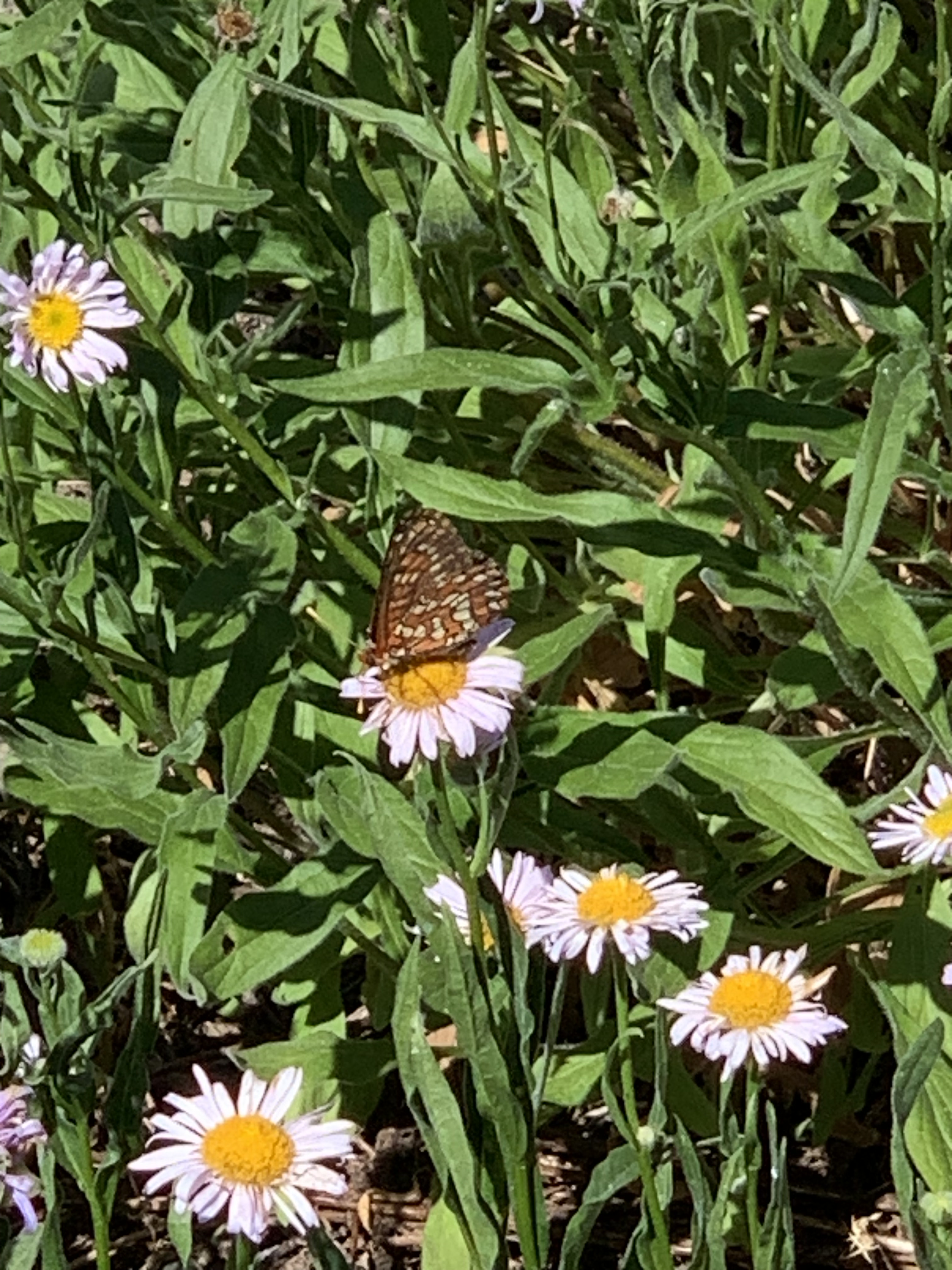
A movement caught my eye, and a patterned black butterfly, a Variable Checkerspot, had landed on my thumb. It didn’t seem to mind what I was, just a landing or a resting place. It stayed there for the better part of a minute before flying to an Oxeye Daisy.  I watched it flit from flower to flower. It didn’t appear to be in a hurry, either, like me. I can watch little things in nature—and some big ones, too—for an extended time.  I once spent 15 minutes observing an ant carry a pine needle. That was in wilderness, and there wasn’t anybody else there that day, either. On a lazy summer’s day in the Boundary Waters, I have watched many an eagle soar out of sight among the clouds.

My animal sightings are often minor in the current age of seeking uniqueness.  What isn’t minor about many of these sightings are the memories have stayed with me for years: watching a  porcupine’s feeding by Jackson Lake one night in 1971; crows by a stream feeding their large, demanding young at Glacier Bay in 1988; watching a butterfly exit from a chrysalis seventy years ago in Crow Lake, Ontario; my first meteor sighting one night from one of the Finger Lakes; a beaver I snuck up to see while in a canoe on Kekakabic Lake. I then backed away and left it alone. During a “working” canoe trip to rate all 47 campsites on Lake Insula on categories from landing to latrines, my wife and I had a hermit thrush visit us in the middle of our campsite one afternoon. We stayed quiet until it left. Hermit thrushes are worth remembering, especially their song. I remember deep down on the Tonto Platform of the South Rim of the Canyon hearing a raven’s call echo off the curve of the Redwall Limestone  known as The Abyss. 

I’m analytical. I know that the deepest blue sky is about 95 degrees upward from a low sun. I enjoy seeking out that deepest blue,  If I know where to look, I can spot Venus in daylight, a small golden dot.  I follow the Moon through its phases and relative height above the horizon, as well as the angle the crescent makes with the horizon. They all change and are predictable. As for wind, in familiar country, I try to identify the tree by the sound the wind makes blowing through it. I also note wind direction, especially when it is strong from the south or southwest, harbinger of a storm. 

The rest of the crew was starting to show up; the Variable Checkerspot had long since left. Time to leave this area of curious butterflies and a reminder of other special places.

See you on the trail.

Variable checkerspot on Oxeye Daisies.

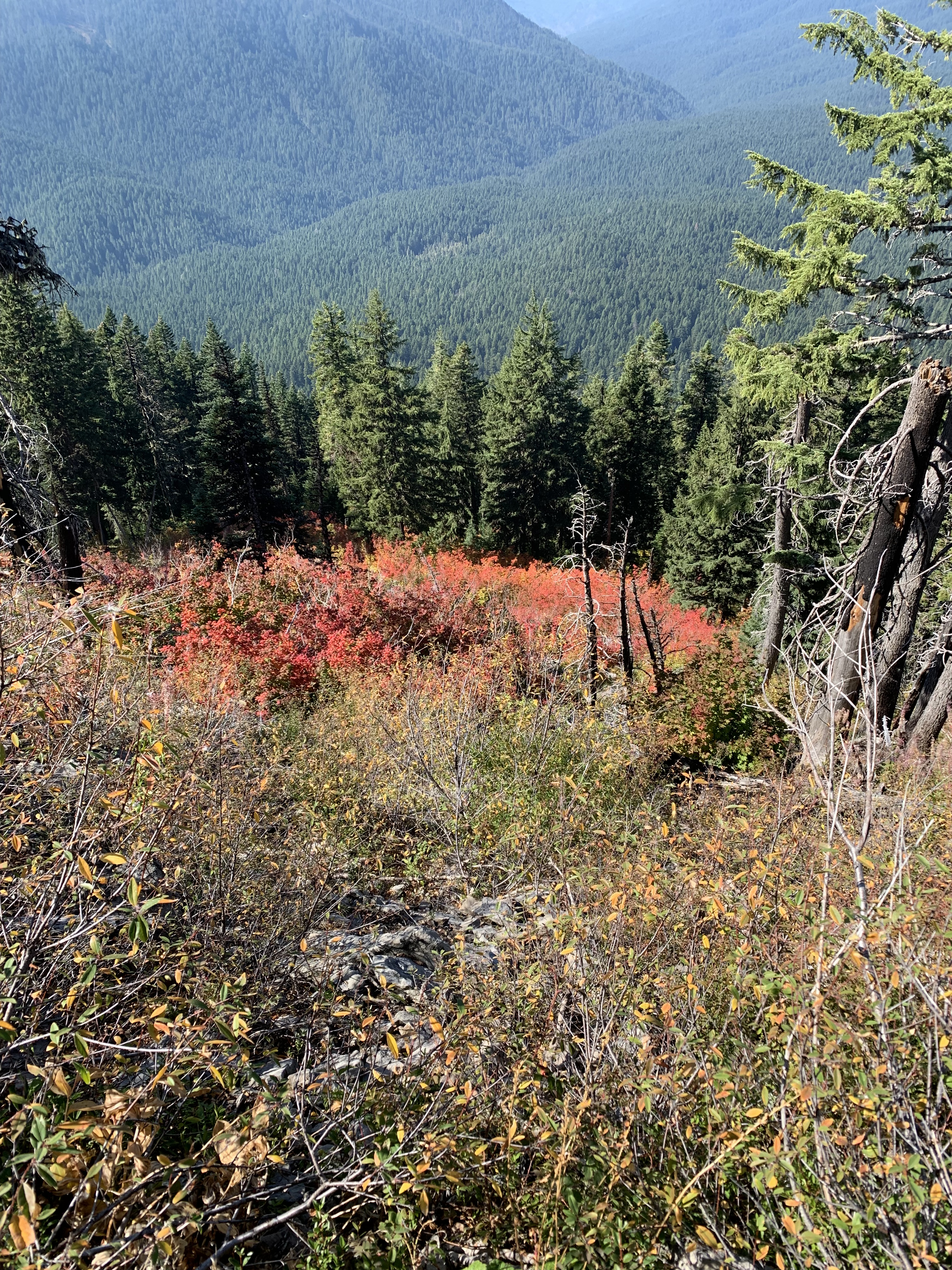
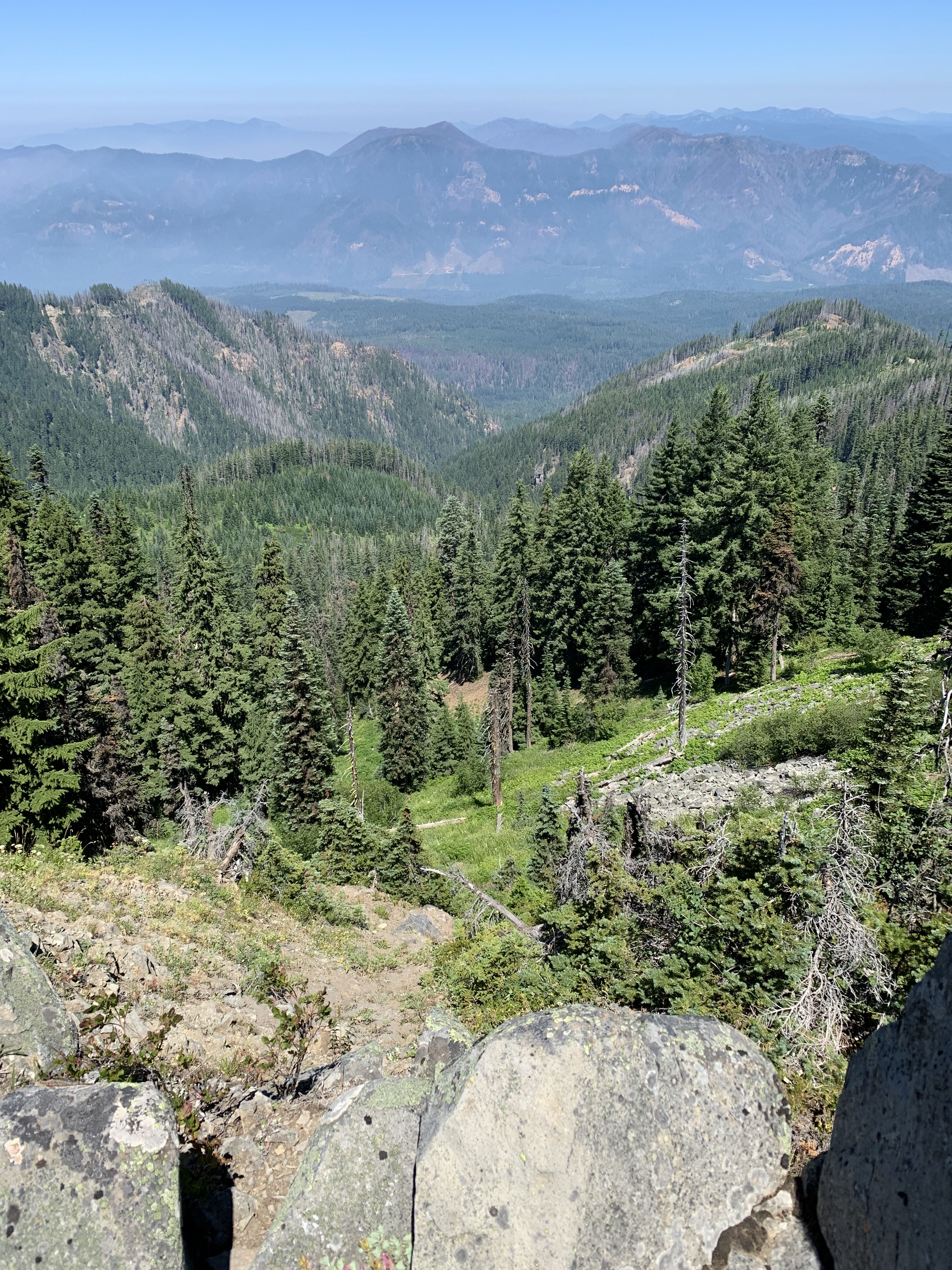
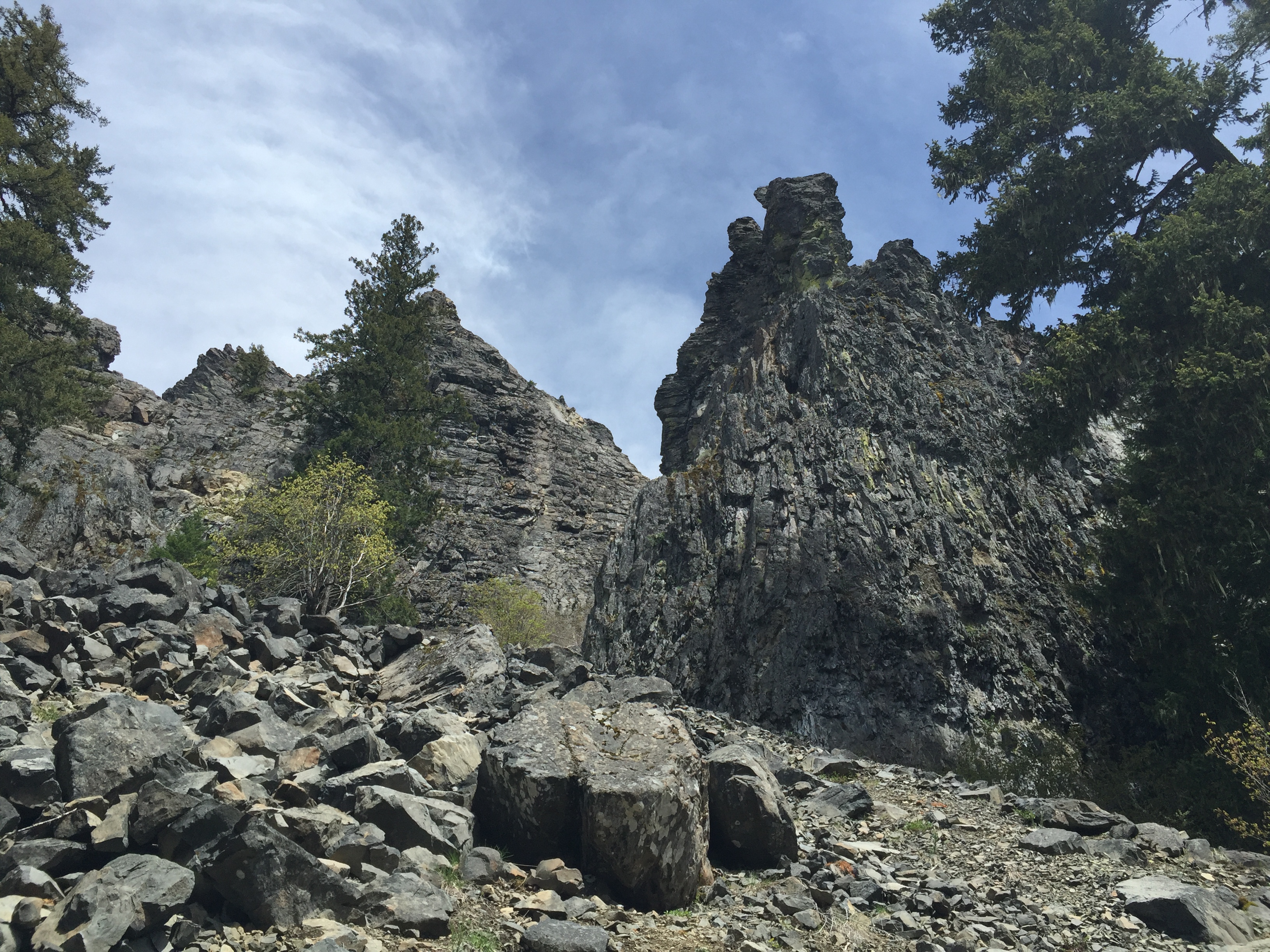
View from top of Horsepasture Mountain.

CAMPFIRE

July 22, 2024


We pulled up to an empty campsite on Knife Lake, just east of the Eddy Lake portage, and I hopped
out of the canoe to check it. Seasonal ranger Mark Ringlever and I were doing an eight-day circle of the Kawishiwi District, checking permits and campsites, talking to people, picking up litter, digging new latrines, and covering old ones, but basically a long canoe trip into deep wilderness with Mark’s being paid to do it. Knife Lake is a large, beautiful border lake with many arms, clear water, and is featured often in northland wilderness writer Sig Olson’s books. Earlier that day, we came upon a
group of seven young women with an older man leading the trip. Mark said to the man, “Wow, I want your job.” The man’s reply was, “Wow, I want yours.”

At the Knife Lake site, I saw something I vividly remember three decades later: a fire’s burning in the woodpile just outside the fire grate, flames four feet high, fed by the wind, about to reach a grassy area and trees nearby. Fire inside a fire grate is almost friendly; fire outside the grate, burning uncontrolled, is scary.


We each used our shovel and Pulaski, threw some burning wood into the lake, and used some of our pots to put water on it until the fire was finally out. Had the summer been drier, this fire could have been off to the races. There would be no Knife Lake Fire this year—we continued our trip uneventfully. Later that summer, I did a trip on the Kawishiwi River and fully a third of the sites we visited had outright active fires or warm ashes.


I learned years ago that a campfire will burn itself out overnight. We left camps that way. We know now that fire can spread through duff underground and reappear on the surface. I put my fires dead out which I define as when deep ashes are cold to my bare fingers.

Five years after the Knife Lake incident, I was a volunteer helping Mike Manlove, another ranger. We paddled into Good Lake, and at the first of two campsites on the lake there was a tent up, nobody there, and a fire burning. The leader of the trip, a guide, returned while we were there. As Mike wrote him a $100 ticket for an unattended fire, the man was upset, embarrassed, and apologized, saying he had spent over four hundred nights in the Boundary Waters and nothing like this had ever happened. I wonder how many fires he had left unattended during that time.


Mike told me a story about a Forest Service employee’s arrival by power boat at a recently used campsite on Basswood Lake where the fire was still burning. (The Wilderness Act allowed up to 25 hp motors on part of Basswood as a compromise.) He saw the culprits’ canoes out on the lake and chased them down, ordering them to return to the site to put the fire out. The campers worked in law enforcement in south
Florida. As the employee wrote the ticket, one of the Floridians asked whether there would be professional courtesy, you know, one cop to another.


The Forest Service employee responded, “What would you do if you caught me running coke down in Dade?”
“We’d bust your —. We deal with drug running real seriously down there. It’s costly.”
“Well, we deal with unattended fire real seriously up here. It’s costly.”

The 2007 Ham Lake fire in the Boundary Waters began when a man burned garbage, convenient but illegal (air pollution), and did not put the fire fully out. Seventy thousand acres and over 150 buildings were burned, valued at $10 million, another $11 million spent to control it. Cary Griffith wrote in Gunflint Burning of the effort to control the fire and the tragedy that followed. It is a powerful story.

Build fires on rock or hard dirt, not duff. Don’t just kick dirt over where the fire was. You must touch the deep ashes and the nearby ground and ensure both are cold.

See you on the trail.

CREW LEADER FOR A DAY

June 22, 2024

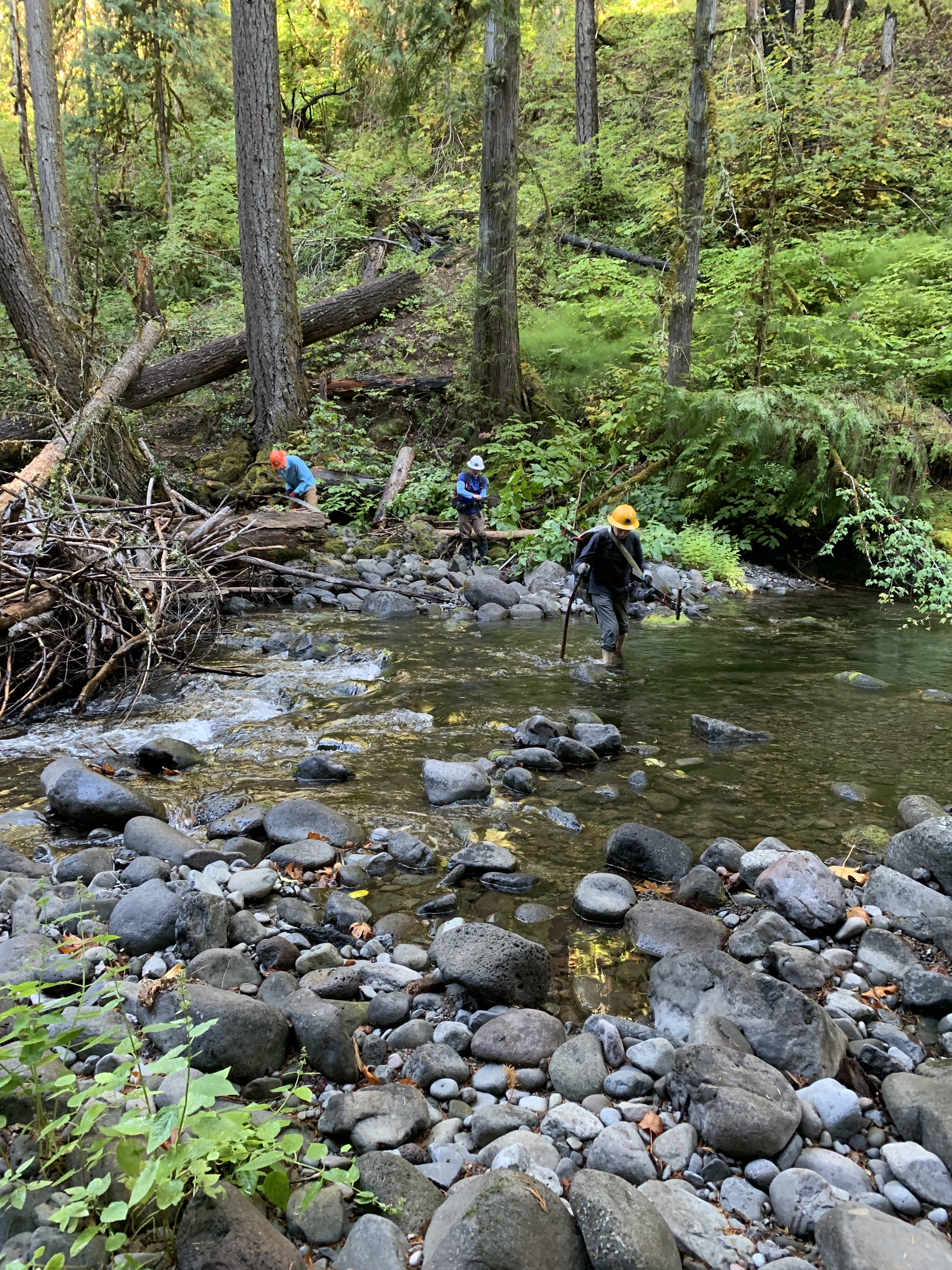
The brief but intense sting on my left palm from the force of my axe striking dense heartwood was another reminder the day wasn’t going well. Nine of us were logging out Horse Creek trail in the Three Sisters Wilderness, entering by a log bridge over Horse Creek itself that one needs to carefully cross, 1500 feet of climbing over 3 miles with gear to get to our spot, the second time this year I had been to this point. The trail climbs further and we needed to clear it to a trail junction 5 miles in.

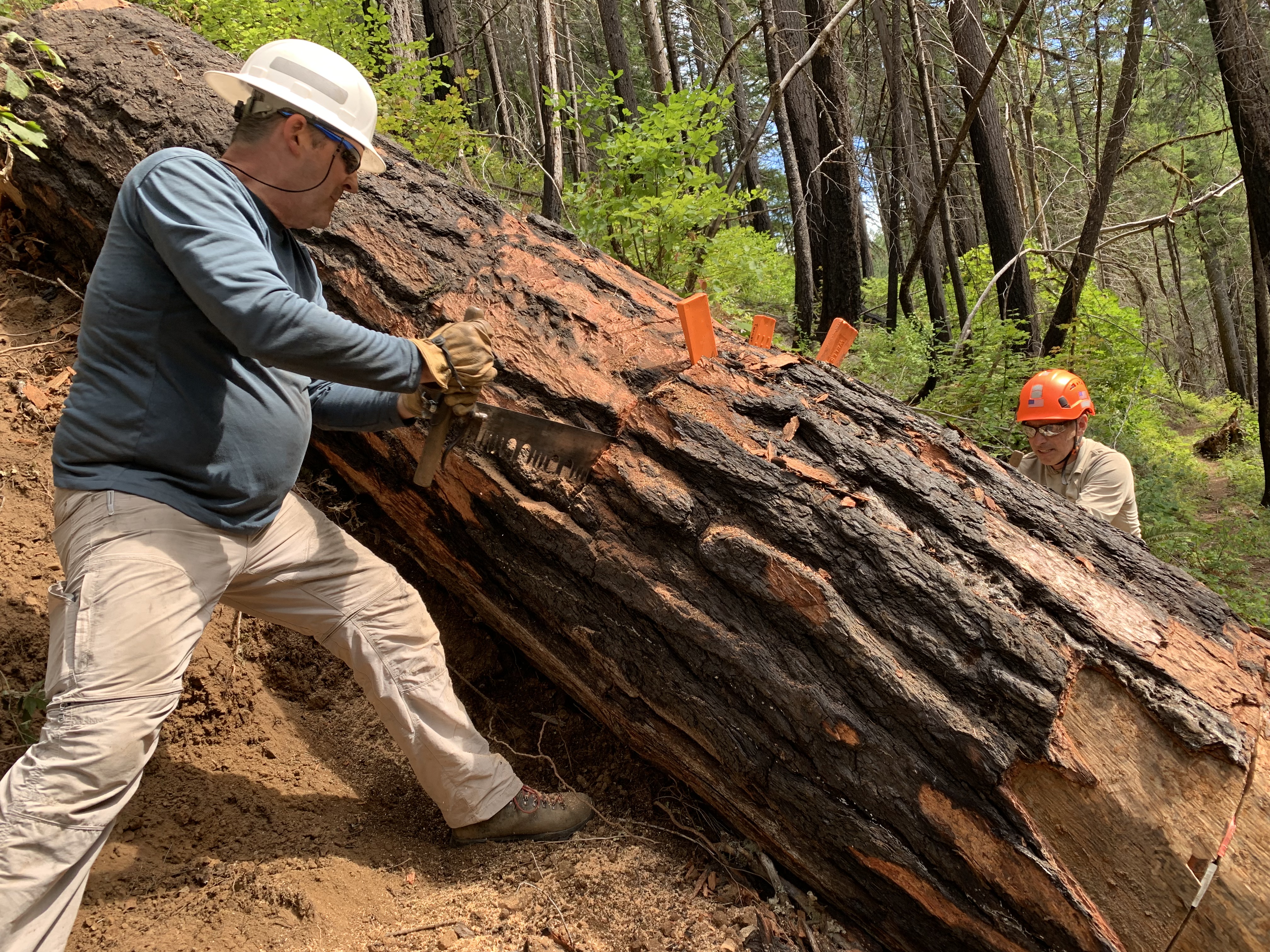
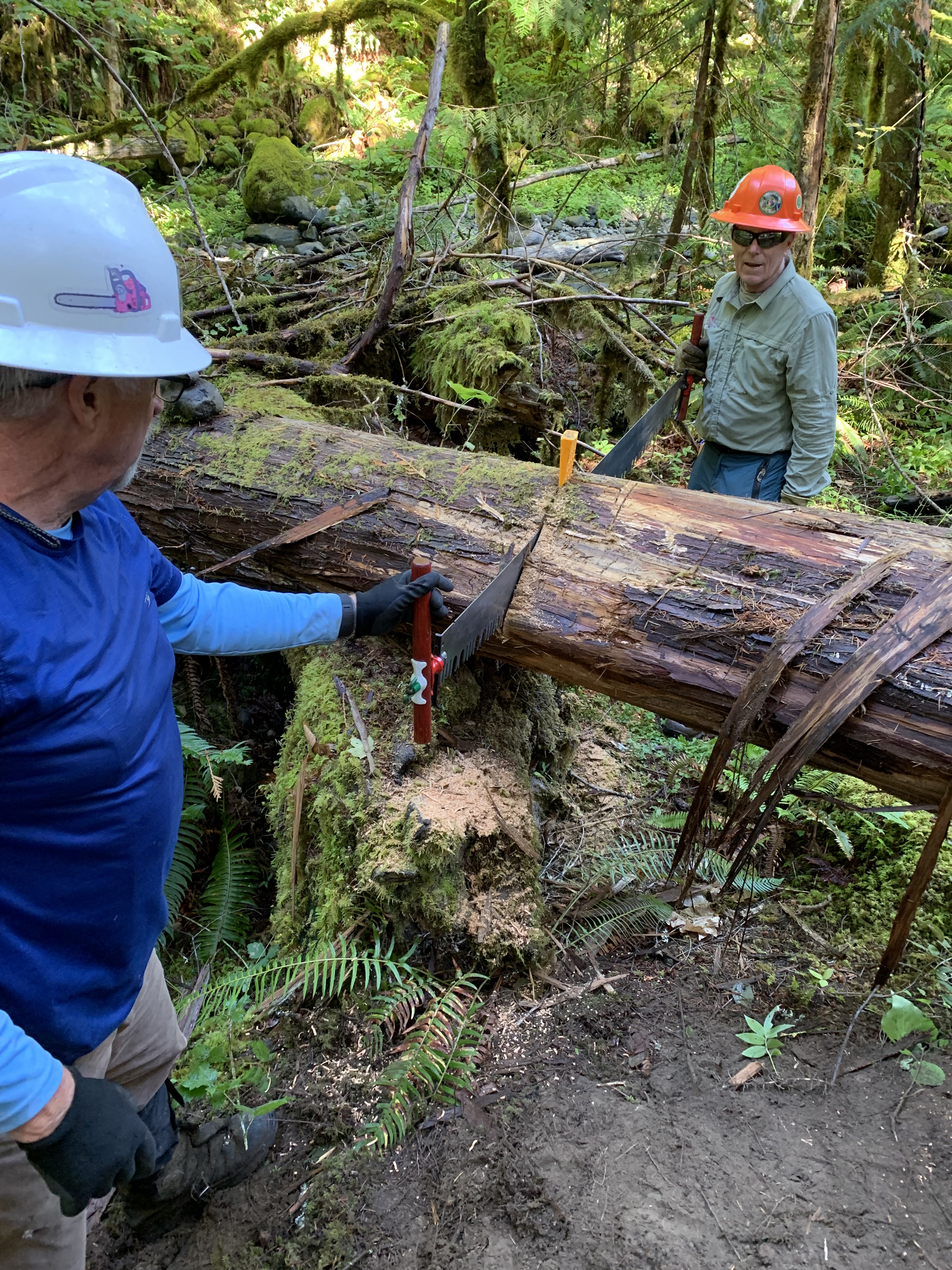
The 17 inch diameter log angled over the trail with the end some 60 feet up the hill, giving it significant end bind, meaning the saw blade was grabbed due to force coming from above down the log. Plastic wedges only keep the cut or kerf open if the saw is deep enough to drive one into the kerf or cut, and we were nowhere near that. It took several of us more than two hours to dispose of this blocking log, and there were 16 more of various sizes and difficulty in the next half mile to Roney Creek.

Bridge entering Three Sisters Wilderness

We had been on Horse Creek a month earlier, on a cold, rainy day, reaching this point with two logs, both with end bind, right together. We worked on one, then left it for another time, since the upper trail still had snow and it was getting late in the day with a long hike out. Today was the next time. I thought my sawing the previous outing was decent, considering my arms were not in saw shape, but on this day it seemed like every log had an unusual problem, either in the cutting or the disposal. I was on my hands and knees clearing debris from the trail, most of it still holding water from the deep snow that had only recently melted. There was another log angled about 40 degrees up a cliff, requiring my partner and me to climb part way up the cliff to pry it loose, where it eventually became a side rail along the trail.

Small cliff where log was present.

I was too hard on myself, I realized later, after we reached Roney Creek and could turn around to hike back out, arriving back at the trailhead after 5 pm with a long drive home.  I was the crew leader for the day, the 21st time I have been one, only the third time, however, on a logout. The crew leader doesn’t need  to be the most experienced person, and I am not. I have been on over a hundred days of logouts, but I seldom make the decision how to cut a big log. I like to think about it a little, but there are plenty who know right away what they want to do, others who think they do and discuss their thoughts aloud, throwing words like branches into the air. Lot of egos in the woods, like the rest of society.

My role as crew leader was to make the arrangements online, file a comms or a communication problem with the Forest Service, and be at the meeting spot in Springfield early when we met in town to make sure everybody was there. As it happened, one we were going to meet in the mountains showed up in town, and we didn’t have room in the vehicles.  I made the quick decision to drive myself so we didn’t have to cram everything and everybody into two full vehicles.

Usually on logouts, we leapfrog each other, skipping a few so each crew works on several logs in a defined area then moves on past the other. I made the decision before the day started to send 3 of the 9 of the group, the strongest, up the trail 3 miles to start logging from there. They would cut their way to the end, informing me by radio of their progress. The rest of us had to deal with left over logs that were not used for sawyer certification plus the remainder to Roney Creek. There were 4 B/ C certified sawyers among us, including me; I elected not to lead a saw crew but to float, so one of the other B certs would have a crew. He was stronger and more adept at reading logs than I.

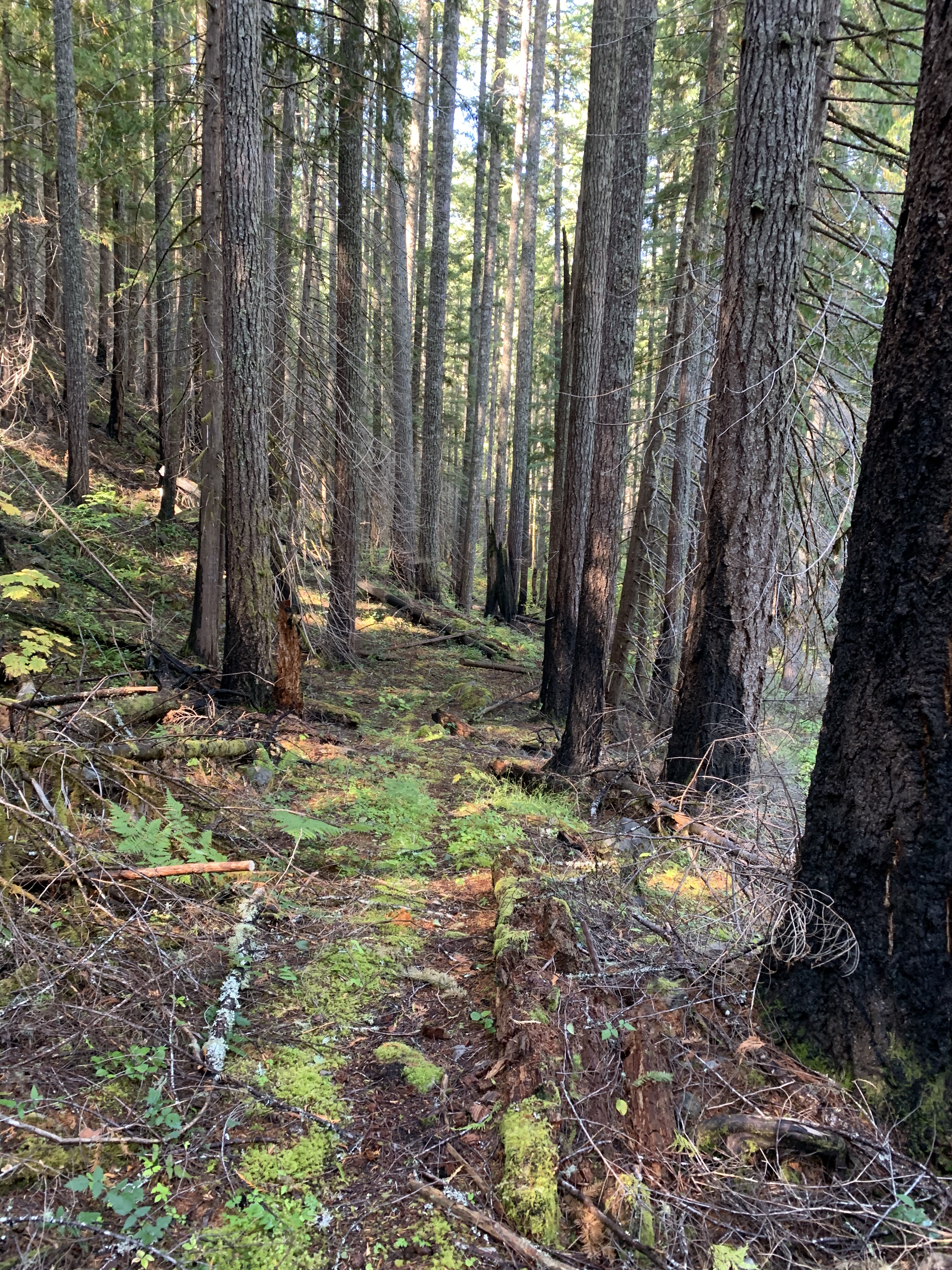
I knew the people, the trail, I the conditions, that several logs we had left for certification uses were probably still there, and that further up at least one log, maybe more, would take an unusual amount of time. I hoped that the three I sent beyond could clear the trail from the creek to the end, a possibility since unlike us, they would not work in a burn area, where we would be, and could expect fewer blowdowns. 

I have a good sense of time on the trail, and when I called in to the Forest Service from the trailhead, said we would plan checking out at 1700, or 5 pm. It would be a long day. 

We removed logs that had been left, along with nearby brush on the trail. I then heard from the lead group that he had seen what was ahead of us and would start clearing from the creek,, ,so we wouldn’t have to go past it. After we finished the original certification logs, we hiked up to work the problem logs. By lunch, we were ready to make the final push to the creek; the upper group was about 1.3 miles from the end.

I bring other skills to the group, neither easily seen nor commented upon. I removed several  smaller logs by myself on the way up. It’s part of the job. I knew how far we were from the creek, thought we had a decent chance of making it there by 3, which would get us back at the trailhead about 5. I also knew four of the people came together in one vehicle and when we finished, they could go down the trail and leave. I doubt others had those thoughts, but I did.

We reached Roney Creek after we cut out the last two logs. I got a call from the lead group telling me they were near the junction. I gave the go ahead to start hiking out, and when I was a half mile from the trailhead ninety minutes later heard from the now trailing group that they were at the creek. We got the trail cleared and were at the trailhead not long after 5. No way we could have done this by leapfrogging each other. 

I radioed the Forest Service that we were done, drove home, and that night wrote the report and credited the crew with their hours. Horse Creek had been cleared for another year.

LIVING RIVER

May 19, 2024

The final year I guided at Rowe Sanctuary, I seemed to be the only one who hadn’t seen a Whooping Crane.  Many had seen them on the river; others who came into the Visitor’s Center saw Whoopers in the nearby fields as they drove in. 

One night, I operated the Crane Cam and was able to put the camera on three Whoopers in the river at dusk. That was nice, but it was virtual seeing; anybody in the world could have seen it, at least the 1973 who had logged on. 

I was a little jealous, but I try to be realistic; rare sightings in nature are just that: rare.  If one shows up often enough in the right place, success is more likely. I had never seen Whoopers closeup, and while I hoped I might, I wasn’t expecting to.  Low expectations coupled with willingness to try are good approaches to viewing wildlife.

As I arrived at the Visitor’s Center one morning, another volunteer flagged me down in the parking lot.  She was an expert birder, one who frequently had seen Whoopers, in part because she was often in the right place at the right time.  Experts find a way to do that.  She came to the driver’s window and whispered somewhat conspiratorially to me:

“Mike, a half mile east of the Lowell Bridge, on the river.”  I didn’t have to ask what. 

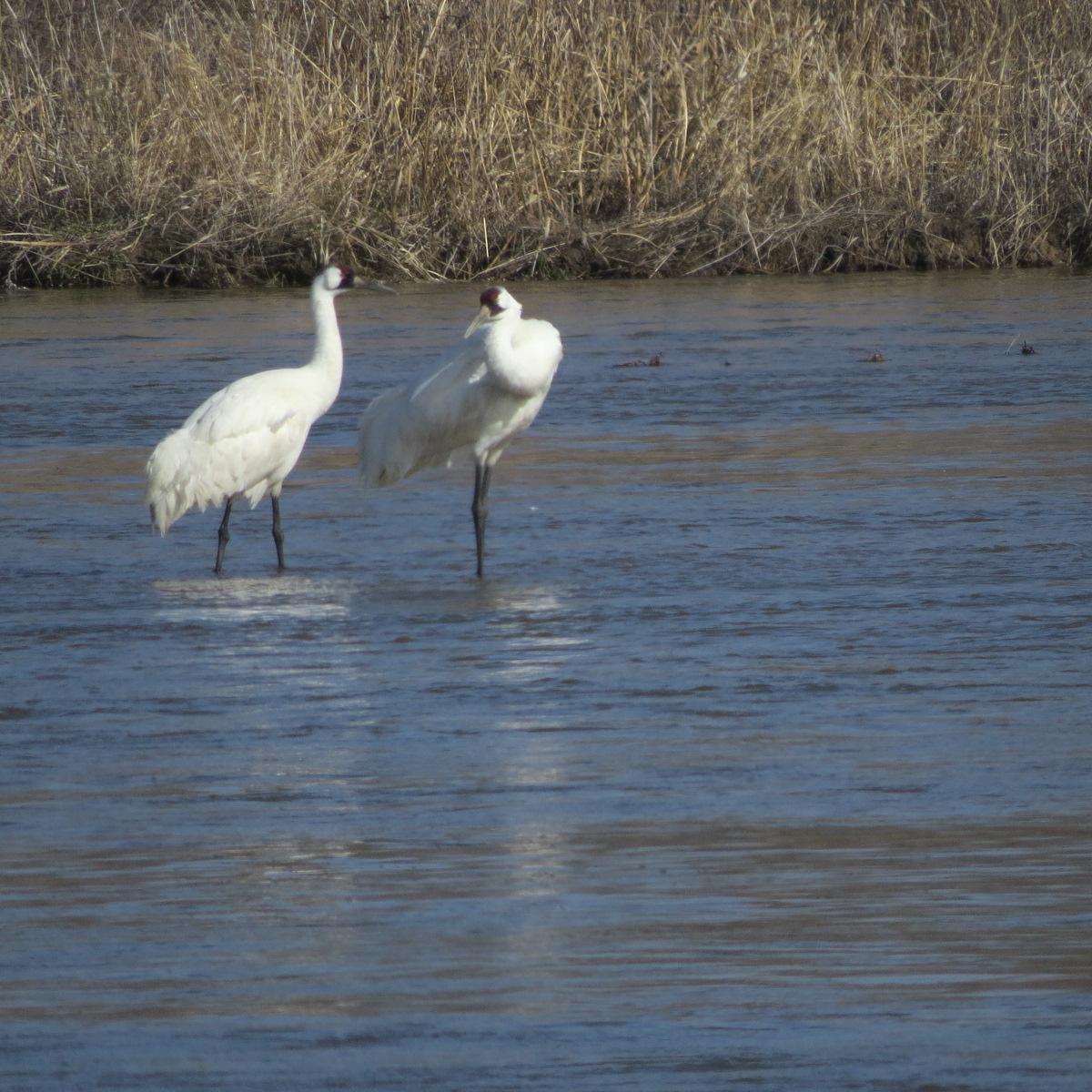
I did what one must do in those instances.  Go. I drove forward, did a U turn, all the while computing where exactly I was going. Within five minutes, I had passed Lowell bridge and was on a dirt road heading east. I spotted two parked cars, a sign in Crane Country in spring that Whoopers are nearby. Four large white birds were in the middle of the river. The rules for viewing a crane from the road are simple: stay quiet, stay in the car, and don’t do anything stupid.  

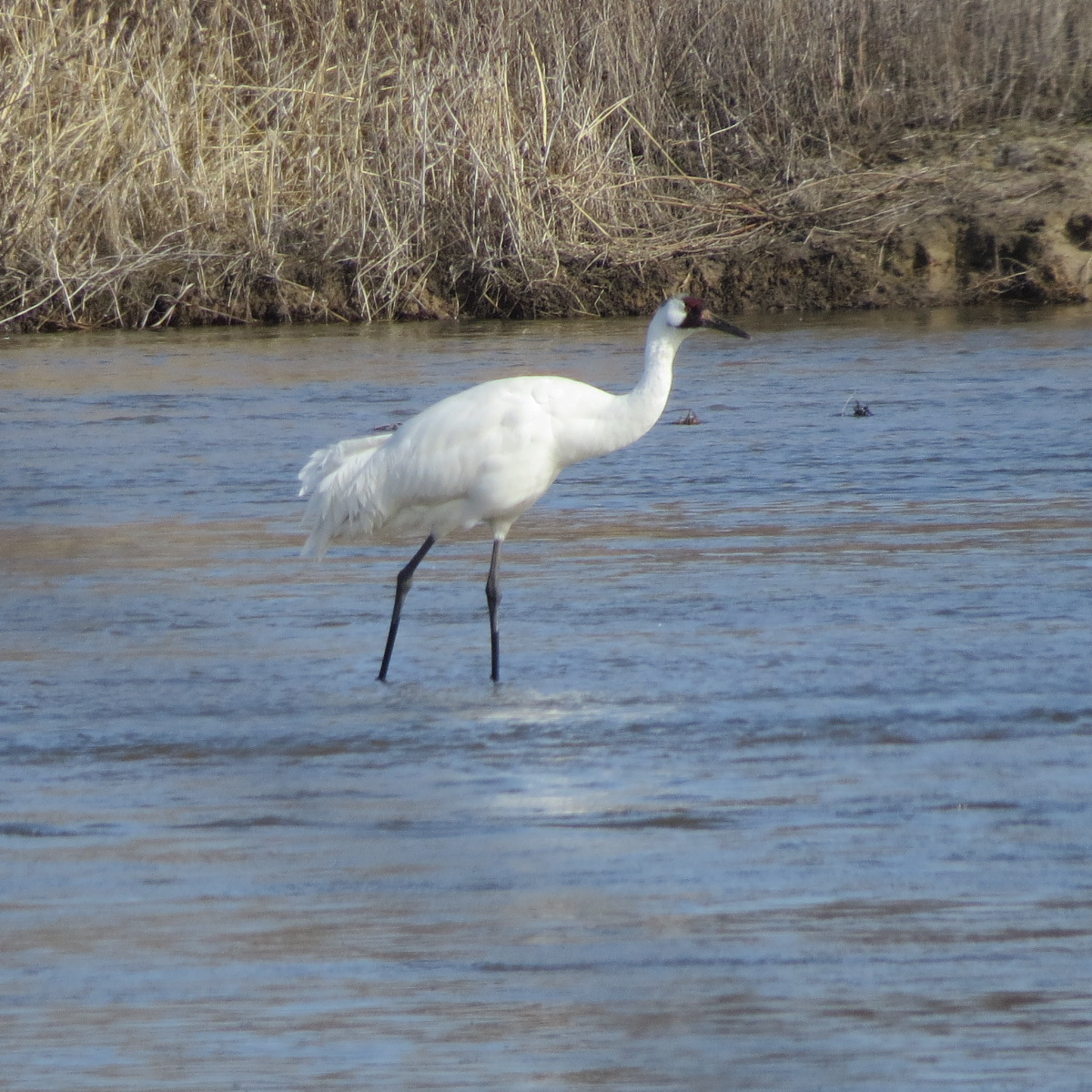
After years seeing tens of thousands of Lesser Sandhill cranes, I was struck by the far greater size of the Whoopers, with their striking white body, black legs and crown. I took some pictures, stayed quiet, stayed in the car, and did nothing stupid. I told myself this might never happen again, rolled up the window and quietly drove away.  

I was at the right place at the right time by knowing the right person and having a bit of luck.  Two minutes on either side, I might never had the experience.

The second to last day, I still looked for Whoopers from the viewing blinds.  I didn’t expect to see any more, but I enjoyed observing the thousands of Sandhills, they and I waiting to see what the day and the river offered.  I was viewing in perfect light; sunlight’s reflection off the cranes turned them into flying copper and the browns of the prairie grasses became pure gold. I watched the birds dancing on the river in front of me, upstream and downstream, bowing to and hopping over each other, circling, running towards and away from each other, individuals, pairs and groups dancing, when I suddenly saw, both out from the corner of my eyes and in front of me, the entire river rising and falling as one huge living wave of birds. The wave was remarkable, beautiful, unexpected, and brief, and then vanished. Two seconds.

It would be hours before I sorted out what happened. Frankly, the spiritual explanation of a “Gaia” river—a living river— seemed better at the time. The river rose and fell.  I saw it happen, even if nobody else in the blind commented on it.  Maybe I saw it because I am an expert in viewing cranes, and I was at the right place at the right time when the river rose and fell.

The late Paul Johnsgard, famous crane researcher and writer, wrote eloquently of a magical time when season (spring), river (Platte) and bird (Lesser Sandhill crane) came into conjunction.  He was so right.  I saw so many cranes dancing in so many places, in so many ways that at some point all the dancing became—if only for two seconds—a perfect wave. Experts are ready for the unexpected.

Two days later, I left the Platte, closing my tenth season, thrilled to have seen several Whooping cranes close up. It was a “finally” moment, which I never have again.  But I had it once. 

I expected the sighting east of Lowell Bridge would be the most vivid memory of my trip. But by being ready for the unexpected, my most memorable moment was two seconds the following morning when the living Platte danced before my eyes.   

TURNING AROUND

May 12, 2024

I reached Young’s Rock after an hour’s hike with a half-mile elevation gain from Camper’s Flat, 25 miles south of Oakridge, and promptly ran into snow on the north side. While the snow wasn’t deep, I had the first inkling that I might not be able to reach Moon Point. I continued a quarter mile further until three large logs, covered in snow, blocked my way.

The first I could cross, the second was more than three feet in diameter, too big to climb over, nowhere to go under, the downhill bypass involving a steep drop I didn’t want any part of. Going uphill offered wet snow, was slippery, steep, and impassable.

I turned around. I didn’t spend much time thinking about it, I just reversed course. Even if I could have gotten through, the trail was going to have more snow, and I had to do the log crossings on the return, doubling the probability of having a problem. Moon Point was not going anywhere; I would try again.  Six weeks later, I made it, and I led the hike three months after that, but from road FS 2129, a full thousand feet above Camper’s Flat, making the trek more reasonable.

It wasn’t the first time I had turned around because of obstructions. Years earlier, snow stopped me just short of the summit of Mt. Wrightston in the wilderness of the same name in southern Arizona. This was one of my favorite hikes, rising four thousand feet from the valley, but because there was no safe way to cross one stretch without my being at significant risk for sliding 50 or more feet. I failed to reach the summit, with its splendid views. I still had a morning off work, got to hike in deep snow in southern Arizona, and returned safely to work later that day, wet feet and all. It was great.

Sometimes it isn’t what is on the ground but what is coming down that changes plans. I led a late season hike to Crescent Mountain in November 2015. I thought we would miss the rain, but I was wrong, and the steep trail had small waterfalls all the way to the beginning of the meadow, about 1300 feet vertical above Maude Creek. There we encountered wind, snow, and fog. We were still warm, if wet, but it didn’t seem like a great idea to go to the summit for nonexistent views. We turned around, and back at the parking lot tried unsuccessfully to dissuade two young women from starting out, especially with their wearing running shoes with their feet in plastic bags.

This year, I cut short both a snowshoe and a ski attempt to deal with my adopted winter trails, the 9.5 mile trek on the PCT from Willamette Pass to Maiden Peak Saddle and Tait’s Trail. I was too exhausted both times to finish, and it took me fewer than ten seconds to make the decision to turn around early. I had no regrets, other than not having the stamina. Winter trips are dependent upon snow conditions, and either the wrong equipment or the wrong snow (or both) will make for an arduous, perhaps unsuccessful outing.  I finally completed the loop, checking and replacing the blue diamonds as needed, but it was April and excellent snow conditions before I succeeded.

In late spring 2009, I  turned around at Bridalveil Creek in Yosemite, because I wasn’t sure I could get across the springtime flow safely. I looked and looked, finally said no, not worth the risk, and reversed course with no regrets.

See you on the trail. If a trail is unknown, especially in early season, consider that snow, downed logs, streams, weather, or physical ability may stop you. Turning around is not failure; stuff happens. Listen to your gut. If you are uncomfortable, turn around. You know the way back. Hiking should be enjoyable.

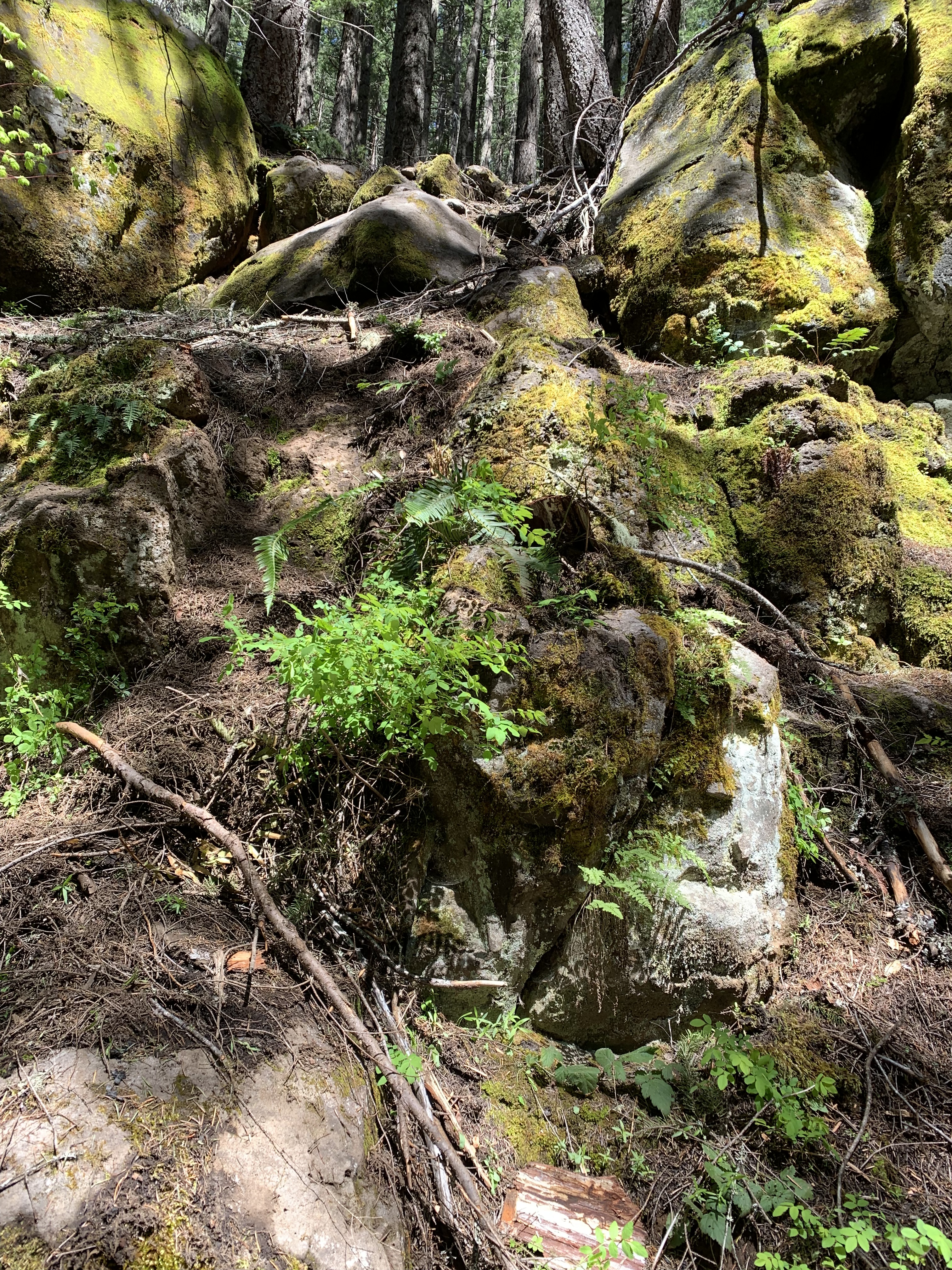
Young’s Rock; Blowdowns, April 2016

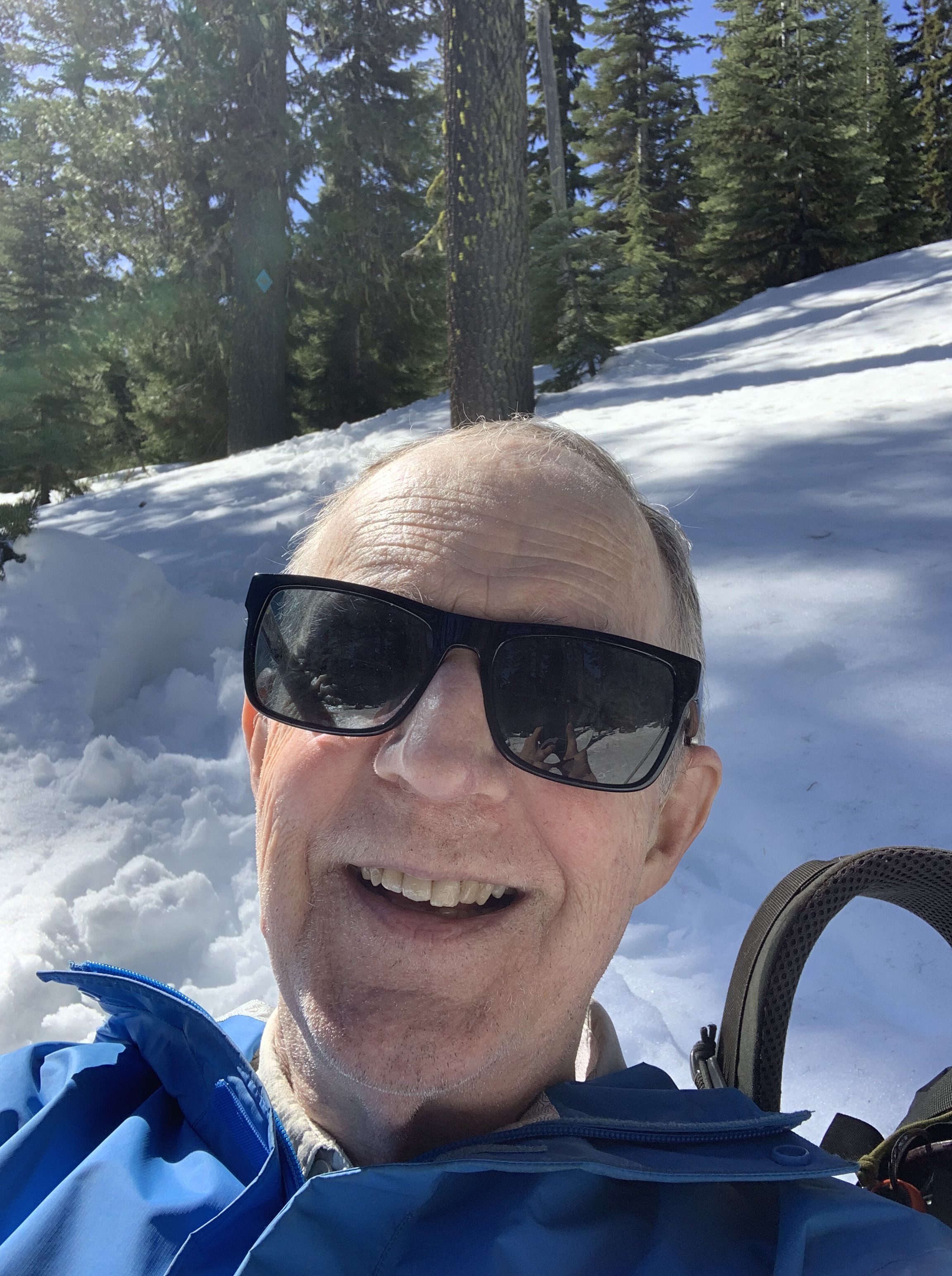
Bottom of Tait’s Tie Trail. Now just 2.5 miles to snowshoe out. March 2024.

NEW GENERATION

April 30, 2024

Six of us started up the Larison Rock trail outside of Oakridge. There were supposed to be seven, but one person who thought he knew where the trailhead was, did not. There are two of them, one at 1200 feet (350 m)elevation, across the river from Oakridge; the other was a longer drive around the mountain and at about 2800 feet (850 m). We hoped he would find the right place and catch up.

I was last and figured I would catch the others fairly soon. Two looked like they were in their fifties, one maybe forties, and the other 67. The trail goes uphill 1500’ (450 m) in the first two miles (1.3 km0, steep, but steady and good tread. It doesn’t waste one’s time gaining altitude—my kind of climb.

I started to catch up to the first person as he adjusted his poles, thinking that I hoped he would be faster. His poles adjusted, he moved on ahead, and for the next mile, I was still in the back, not gaining any ground on him at all. That’s unusual. I’ve had some knee and Achilles tendon issues, for which I walk carefully on steep grades, but I wasn’t hurting, and I was climbing well. At least I thought I was.

I passed two of the group who had removed layers, and about a quarter mile later, I did the same, making a quick change and moving on ahead. The three in front of me were out of sight and stayed that way to the rest stop where I wanted to regroup. The two behind me arrived not long after I did. I had a drink and something to eat, and the first four were off going up the trail to the upper road, where we would stop again. I was going to go last, but the guy who adjusted his poles at the bottom was still working on his pack, so I decided I would go on ahead. 

After maybe a half mile (800 m), a little more, I encountered a pair of mountain bikers coming the other way, went around them, and then heard footsteps behind me. I realized the last person was right behind me, so I pulled over to let him go by. He moved ahead about a hundred yards before I lost visual contact. I finally caught up with him and others at the upper trailhead. These guys were fast.

The year prior, when we went the last part to the top, which switchbacks steadily, I had someone behind me, and I just kept my pace the same to the top. I climb at nearly my flat ground cruising pace. This day was different. The group took off, and while I climbed at a decent pace, I was the last one to Larison Rock itself, where we had lunch. I wasn’t breathless, I wasn’t sore, I was fine. I was also dead last.

I had not “led” the hike at all; in 8 years of leading this hike, that had never happened before.

While we ate lunch, the missing person showed up. He had driven to the upper trailhead, turned around when he realized there was another trailhead down below, and had come up the same trail as we, quickly. He was more than a half hour behind me at the start, and I had only been on top twenty minutes.

I’m not as fast as I once was. Doing trail work, I am used to carrying more and hiking less. But there is no need to make excuses. Things are what they are. I am observing a generational change, this time from the other end. I’m fine with that.  I don’t need to train with longer hikes—like doing Hardesty weekly—to see if I could improve. I can enjoy what I still do, and do well, sparing myself Hardesty’s 3300 foot (1000 m) vertical climb. That sounds a lot better.

View from Larison Rock

Larison Rock from below

WOODS WEALTHY

March 3, 2024

I began to hear a gentle tapping on the tent fly. Then it stopped for a bit, began again, and increased. It was raining, and judging by how the clouds had looked all day and earlier this evening, the rain was likely to continue for some time.

Fine by me. Great, even. I was in my tent on Basswood Lake in the Boundary Waters, warm, had a book, a light, no place to go, and nobody nearby. Dinner had been eaten, the dishes cleaned, everything put away, food secured, canoe tipped over, tied to a tree, some dry firewood underneath. I hadn’t heard or seen a soul for two days. The tent wasn’t going to leak, water wasn’t going to soak the floor, my clothes were dry; I was at total peace with the world. 

I’m not sure what such peace is worth, but in the woods, where pudding cups or chocolate of any type is currency, tundra swans on the wing are news, loon calls are music, autumn reds and yellows are art, entertainment is turning my full attention to a single leaf with interesting drops of water on it, or watching an eagle catch a thermal and soar out of sight, a rainy night after a day’s work makes me woods wealthy. I had paddled around a nearby bay that morning when I noted a beaver’s swimming off the starboard bow of the canoe. I could not reach my camera, so I contented myself by paddling without removing the paddle from the water, quietly pulling of the paddle followed by turning it perpendicular and feathering it through the water, staying the same distance behind the beaver for about a minute. Eventually, the beaver dived, but with no tail slap. That’s ideal, to be so close to an animal without obvious disturbance.

It was a gift, I concluded, after a great day such a pleasant night in the wilderness. I turned off the light and lay in the dark, listening to the tapping, occasionally increasing when a light wind blew water off the white spruce above me. I would later drop off to sleep, awakening some time after midnight to no sound. When I went outside, there was a dense mist just this side of rain, but not so dense as to hear it on the tent. It was cloudy, not because I could see clouds, but because I couldn’t see any sign of the Moon that I knew was above the horizon.  I can’t remember if I awakened later that night to the sound of heavy rain. Maybe I just dreamt it. Morning would come with gray skies, but I had no place I needed to be, other than by a warm, crackling fire having my breakfast, looking out over the lake wondering what awaited today for a woods wealthy person.

Chosen as part of the Winter’s Writing Series by McKenzie River Trust. Read at Tsunami Books in Eugene Sunday 3 March 2024. https://mckenzieriver.org/woods-wealthy/

IN THE ZONE

February 29, 2024

The day was going well. I was in the zone, strapped to a Stihl power brusher, felt fine, and was swinging it back and forth across the trail comfortably, clearing the Salal, ferns, and Oregon grape encroachment. My goal was to reach Harper Creek, which looked like a sure thing; if we could work up the other side, that would be icing on the cake. I had added cotton to my ears and they and the hardhat ear muffs dulled the sound well. The brushers can be fussy; I have the touch to start them, knowing how much to choke (1 pull) and can have been known to fix them, unless a blade has sheared off, in the field. The crew boss was cleaning the filter one time and said it would be better if he could burn the gunk off but he didn’t have any matches. I said that I had a lighter in my pack, and he couldn’t believe it. Hey, it is one of the essentials. 

We were clearing the South Willamette Trail, a 5.1 mile path paralleling route 58 from Eula Ridge trailhead west to Hardesty Trail. It completes a 14 mile loop that starts at Hardesty trailhead, goes to the top of Hardesty Mountain and down Eula Ridge, gaining 3200 feet net vertical plus another thousand feet plus up and down on the South Willamette. Mountain bikers love the trail. There is additionally a trail running race on this route that one has to complete in four hours to be considered a finisher. I hiked it once in four and a half, in full hiking gear, and while I thought I could knock thirty minutes off my time by going light, I wondered why I would want to do that, so I never did. 

The trail has an entry at Crale Creek Road, about a third of the way from Hardesty to Eula, and we had worked both directions from there. The next step was to hike in from Crale and continue east, but I had checked a map and did some scouting to discover that I might be able to join the trail further along where the road and trail were close. I look at maps a lot and see possibilities for shortcuts. I should do a post sometime on the ones we do as trail workers. After I had scouted the trail, I hiked out to Crale, bushwhacking 100 yards, then having a decent track to the road. This track wasn’t the closest way to the road, but the elevation change was minimal, the path good, and the hike was much shorter and flatter. Short distance and many contour lines equal hills or worse.

I took the crew to the new spot I had found, and we parked near an RV that was there for the winter. I held the usual Tailgate Session reminding people to call out, whistle or touch a person ahead of them if they wished to pass.  It is unsafe to try to sneak by somebody working with a brusher or a saw, and going off trail to pass can lead to tripping. I spoke about controlling bleeding, since that is one of the few emergencies out here where quick action can save a life.  As a former neurologist, I can attest to many cardiac arrest “saves” who became vegetative, and I was the one who had to deal with telling the family the person wasn’t going to wake up.  Bleeding can’t wait, as a tragic death on the Dutch Creek Incident showed in 2008, where a tree that was cut down hit another which broke off, fell, and shattered the femur of a young man on his first fire. He bled to death. We deal with many sharp objects, and bleeding is a major worry of mine in the woods. A heart attack or a stroke out there is going to do what it will, and we can’t do much about it. Bleeding, however, we can and must control. I carry an Israeli bandage in my pack and I told everybody where it was. I also mentioned optimal places where we would try to get an injured person to.

I also was the only one who knew the route in, which gave me some credibility. I had organized the work party and chose the trail, brought the brushers, fuel, rake, and Pulaski. I knew where I was, the distances, the creek, the elevation, everything necessary. On the way in, I discovered another marking ribbon different from mine, and without missing a beat, moved towards that ribbon that showed an opening in the woods that turned out to be a user trail I had missed when I was trying to find a way from the other direction. I went straight to the main trail, no bushwhack necessary.  One of the other workers asked me—the only one who did—where the bushwhack was that we were supposed to do, and I told him that I saw the new ribbon and on the fly I took it.  The others either didn’t notice or were happy enough just to get to the trail, saving a few hundred feet of climbing and a three-quarters of a mile hiking. I love finding these shortcuts and can think of many instances where they have helped. New parking area, significant shortcut, favorable weather, everybody working well, yes, I was in the zone.

At lunch, we stopped just above Harper Creek, trail visible on the other side. I knew the area well; I have hiked the SWT many times, having cleared the trail in parts in fifteen to twenty different outings. After we finished, well above the creek on the other side, a few days later I would scout the far end and then lead a crew there the following week, either brushers only or having a sawyer along, too, depending upon what the scouting showed.

We don’t clear each trail every year; every other is usually sufficient. And necessary. 

LIFE CHANGE

December 25, 2023

I had snowshoed to the upper part of Willamette Pass Ski Area from the west side, puffing, tired, having gained a thousand feet elevation in 3 miles, but the novice trail, not steep,had only light snow accumulation. I was surprised at my fatigue.  I still had to climb higher in deeper snow to reach Maiden Saddle so I could go down the back side to the Pacific Crest Trail to check it for diamond marker placement on the trees. I trudged back and forth, switchbacking up the hill, sometimes on the marked trail, usually not. At the top, I was puffing even more, and after it quieted, I worked my way down. I was beat, and while the altitude of 6400’ (1900m) was significant, this day was taking more out of me than I planned.

Tie trail coming off the Pacific Crest Trail about 400 m south of Lower Rosary Lake.

I have adopted a snowshoe trail that I visit every fall before snow to see if there are logs that will impact winter skiing and replace any diamond markers that have fallen off the trees or have been on trees that have fallen. I try to get someone to remove the logs, and I replace missing diamonds.  In winter, I return to the trail, move diamond markers further up the trees, in case there may be so much snow that the markers could be buried.

On the way down, I left the winding, barely tracked trail, and went straight down the fall line to Upper Rosary lake, snowshoeing directly to and on the lake to the isthmus between it and Middle Rosary, where I had lunch.  Cutting switchbacks in heavy snow is not harmful to the trail, unlike when there is no snow.  That saved me at least a half mile’s trudging. I still had 4 miles to go to get out. I divvied up the distance into finishing the Rosary Lakes; the area between Lower Rosary, the largest of the three, and the tie trail junction that went back up the mountain; to the junction where the trail started to head west, rather than south.  In that way, I broke up the distance in my mind and eventually made it back to the parking lot. I have been snowshoeing for several years, and while this trip had some deep snow, much was not.

Spring came, the snow melted, and I was fine, until I got tendonitis, which slowed me down, so  I rested my leg in June and did fine until August, when the Crew worked the lower part of Olallie Mountain.  I wasn’t the only one that day tired when the heat, humidity and the activity called an end to our work on the logs on the lower two miles. But it took me a full day to recover, not a half day, and that was new. Still, we worked the same area a few weeks later, when it was cooler, and I didn’t feel as tired as I had the first time.

The Crew then worked Crossing Way, a trail that goes into the Three Sisters Wilderness, a few weeks later. I had worked it in 2021 and found it long, uphill, and hot.  It was the same this year, and I found myself fading after lunch; I didn’t bother stopping for a log loose in the middle of the trail and had to go back to deal with it. I was getting sloppy, being in plodding hiking mode rather than clearing trail mode. Thirty minutes later, we worked on several logs, and when we finished those, I was done. It is an uncomfortable feeling to know there is a 4 mile hike ahead to get back, carrying gear, when one is tired. I was still within myself, but I didn’t like the sensation I had. Others felt the same way, and we hiked out a very long hour and a half.

This log was cut so that it balanced, and we could move it with a finger. We pushed it off the log below.

The last log out of the year, as it turned out, was Olallie Mountain again, this time the summit trail, 2 miles climbing about 1000 feet, after first hiking in the 2 miles we had done two other times that summer. We had three crews working, and there were single logs, multiple logs, logs with branches, one after another. We thought it would be cooler in October, and some of us took less water to lighten our load. I was tired by lunch. After lunch, I had what was becoming the all too familiar sensation of climbing slowly. The logs seemed more difficult, the Sun hot, my water starting to dwindle. I reached a plateau with the summit still nearly a mile and 70 logs away, impossible to complete this day. I took a break and lay down in the shade in the woods. Someone came by and I told them I would be getting up in a couple of minutes, but I felt comfortable but tired, and didn’t want to get up.  

I had been thinking as I had climbed how much more further I had to return, and I needed the ability to return. I heard a person behind me on the trail who was starting down, and I finally got up and joined him. More than an hour later, with a half mile to go, I was out of water. I filled my water bottle in a stream, planning to purify it when I got to the vehicles. Fortunately, when I arrived, one of the vehicles was open and I got the water I had left behind. I realized then that I could no longer do a full day of climbing and working at altitude beyond certain distances.

I’ve seen many changes in myself in my mid seventies. I am more cold sensitive now, whereas I used to hike in shorts and short sleeved shirts. Even in summer, I often will use long pants in the morning. I also notice other hikers on the trail, other walkers in town, are faster than I am, not that I am racing—I’m not—but I am slower. The Club has fast hikers, and shortly before the winter episode on Willamette Pass, I found myself at the back of a hike and never seeing the leader except at the mandatory stops at trail junctions.  That was new.

Every year I can hike, snowshoe, and do trail work is a gift. It has been the last  few years. Many are denied that gift. I’m looking forward to snowshoeing this winter, but with a wary eye on distance. I’m a volunteer, not the paid help. Protect the brain, and then let the brain take care of the body.

The author on Olallie Mountain, July 2023

TIDES

November 7, 2023

“There is a tide in the affairs of men.” (Shakespeare; Julius Caesar)

Eclipse Day on Green Island, off the coast of Cairns, Australia, and by morning twilight I was on the beach, ready. We had arisen at 1 am, were aboard the boat from Cairns at 2 and were on the island by 3. I had plenty of room on the beach, which should have been a warning.

The eclipse began shortly after sunrise, and so did morning high tide, a true spring tide, a king tide.  With a total eclipse, by definition the Sun, Moon, and Earth were lined up and the Moon was near perigee, its closest point to us. I had to rather unceremoniously move inland, apologizing to the locals that I lived in a desert and didn’t appreciate how quickly water levels change with tides. The beach where I had stood was soon several feet under water. The eclipse was stunning; so were the tides.

King tides, a non-scientific term, are high tides when the Earth is closest to the Sun in its orbit (perihelion), which happens to be early January, the Moon is new or full and is close (perigee) to the Earth. The lineup doesn’t have to be perfect. There is one new and one full Moon a month, and for each of about three days for three consecutive months there will be such tides.

Spring tides are when the Sun, Moon and Earth are in alignment (sygyzy), when the Moon is new or full. For a day or two on either side of that alignment, there isn’t much difference.  Both the Sun and Moon pull on the Earth; the Sun has half the tidal effect of the Moon on the Earth. I experienced king tides in Australia for the November 2012 eclipse. A month later, at new Moon, the tides were still higher. The Moon wasn’t in exact alignment with the Earth, but it was closer than it was in November, the Earth closer to the Sun, and proximity overcame the loss of perfect alignment.

Why do tides occur later each day here? Suppose the Moon is culminating (due south) at 9 p.m. and there is a high tide. A day later, at 9 p.m., the Moon, which is constantly moving eastward among the stars, another way of saying it rises later each day, is not quite due south at 9 p.m. It will be some time later, and that average time is about 50 minutes. This is split up into two high tides a day, so each one is about 25 minutes later. Two important disclaimers; first, 50 minutes is not exact; it varies with the season and the Moon’s orbit; second, the configuration of the ocean bottom near the shore affects the time as well.

Every object exerts a gravitational attraction with any other object—your phone with you; two people with each other; Saturn with a car, proportional to the product of the two masses (think of mass* as “stuff”) divided by the square of their distance. We know gravity is universal, but we didn’t always know that until the observed changes in the double star Porrima (in Virgo) over several years showed that gravity worked in deep space as well as on Earth. Richard Feynman once said about a globular cluster of stars, “if you can’t see gravity operating here, you’ve got no soul.”

If the Sun is so large, why is its tidal interaction with the Earth only half that of the Moon, when its gravitational effect is so much more, which is why we orbit around it?  The answer is because tidal forces are inversely dependent not on the square of the distance but the cube, the third power.

Centripetal force directed into a circle is inversely proportional to the distance from the center, or radius; gravitational force is inversely proportional to the distance between two bodies squared; tidal forces are inversely proportional to the distance between two bodies cubed. For those with a calculus background, the rate of change of gravity is the tidal force the same way the rate of change of velocity is acceleration. The derivative of an inverse square, (1/x^2) is (-2/x^3). I find the derivation as beautiful as seeing a king tide right up to the rock wall in Newport.

The Sun, 330,000 times more massive than the Earth, is also nearly 400 times further away than the Moon, so the tidal force exerted by the Moon on the Earth is almost double that of the Sun. We are held in place by the Sun’s gravity; our tides are more a function of the Moon. When it all lines up in early January, all bodies closest to each other, we have a king tide!

If you go to Anchorage, look up the time of the tidal bore in Turnagain Arm. If you are lucky, you may be able to see it and hear it moving southward as a long wave across the arm.

*“If you want to lose weight, go into space. If you want to lose mass, diet.”