Archive for the ‘MY WRITING’ Category

COMPASS

February 19, 2023

 I have been invited to submit monthly articles for the Obsidians (Eugene outdoor club) bulletin. This article was adapted from my article Thump, which occurred in 2006 and was posted in 2009. Many articles will have single word titles, my choice.

11 p.m., somewhere on the southwest corner of Isle Royale, the national park island in Lake Superior, part of Michigan, but closer to both Minnesota and Ontario.

It’s cloudy and dark, but the rain and wind have stopped, and I hope my mag lite will keep working. I have seven miles to go to Windigo, where I can camp, unless my light quits and I have to camp on the trail. 

Three hours earlier, I had been lying supine on my bag, almost dozing, shoes off, when I heard a few thumps outside the tent. One more thump, I told myself, and I’m going out there to see what is going on.  

Thump. 

I put on my shoes, opened the screen and looked in front of me.  Nothing. I crawled out, stood up, and turned around. Twelve feet away, separated only by air, was an adult wolf.

“Oh. My. God. “ I said. What I was seeing had been for decades at the top of The List of things I wanted to see.  But like this?  The wolf and I stared at each other, and he slowly circled the campsite for the next 3 minutes, looking up at my hung pack on a nearby tree. His jumping at it was perhaps the thump I heard. Then, suddenly, he was gone. 

I intellectually knew there was no documented case of a healthy adult wolf’s attacking an adult person. That’s fine to know, but it means little should one be ten trail miles from the nearest other person, where there was no way whatsoever to communicate. No way I would stay put; I packed up and shortly before sunset under an overcast sky was back on the trail.

I thought on this May night, it might be light enough in the woods, but not when overcast. The trail was easy to follow at first, and I only had to worry about moose that might bed down near it. I made decent time despite my having already hiked ten miles and now doing another ten, rather than sleeping. I admit to occasionally turning around and looking behind me.

I approached a large jackstraw of logs in the middle of the trail and started to pick my way around. I kept going until I finally found the trail and started hiking normally again. A few minutes later, something didn’t feel right. I’m analytical to say the least, and while I don’t pooh-pooh gut feelings, I like to have hard evidence. Then again, this evening, I went with my gut and got out of that campsite. What I was feeling now was every bit as disquieting. 

Am I going back the way I came?

I generally have good trail sense, but I have become turned around before, and I was now seriously concerned, so much so that I stopped, took off the pack, opened the pocket where I had a compass, something that I have almost never used on the trail.  I took the compass out, didn’t worry about the declination, held it away from me in the direction I was now going, shone the light on it and asked one question: am I facing SW or NE?  

The direction was SW. I had turned around. 

I put the compass away, turned around, and started hiking again. Sure enough, I soon reached the blowdown, this time more carefully finding the trail continuing northeast. At 1:30 a.m., I arrived at Windigo, pitching my tent on the lawn at the Ranger station. When I awoke a few hours later, I was 50 yards from an empty three-sided shelter.

See you on the trail.  Bring a compass.

DO IT YOURSELF

February 1, 2023

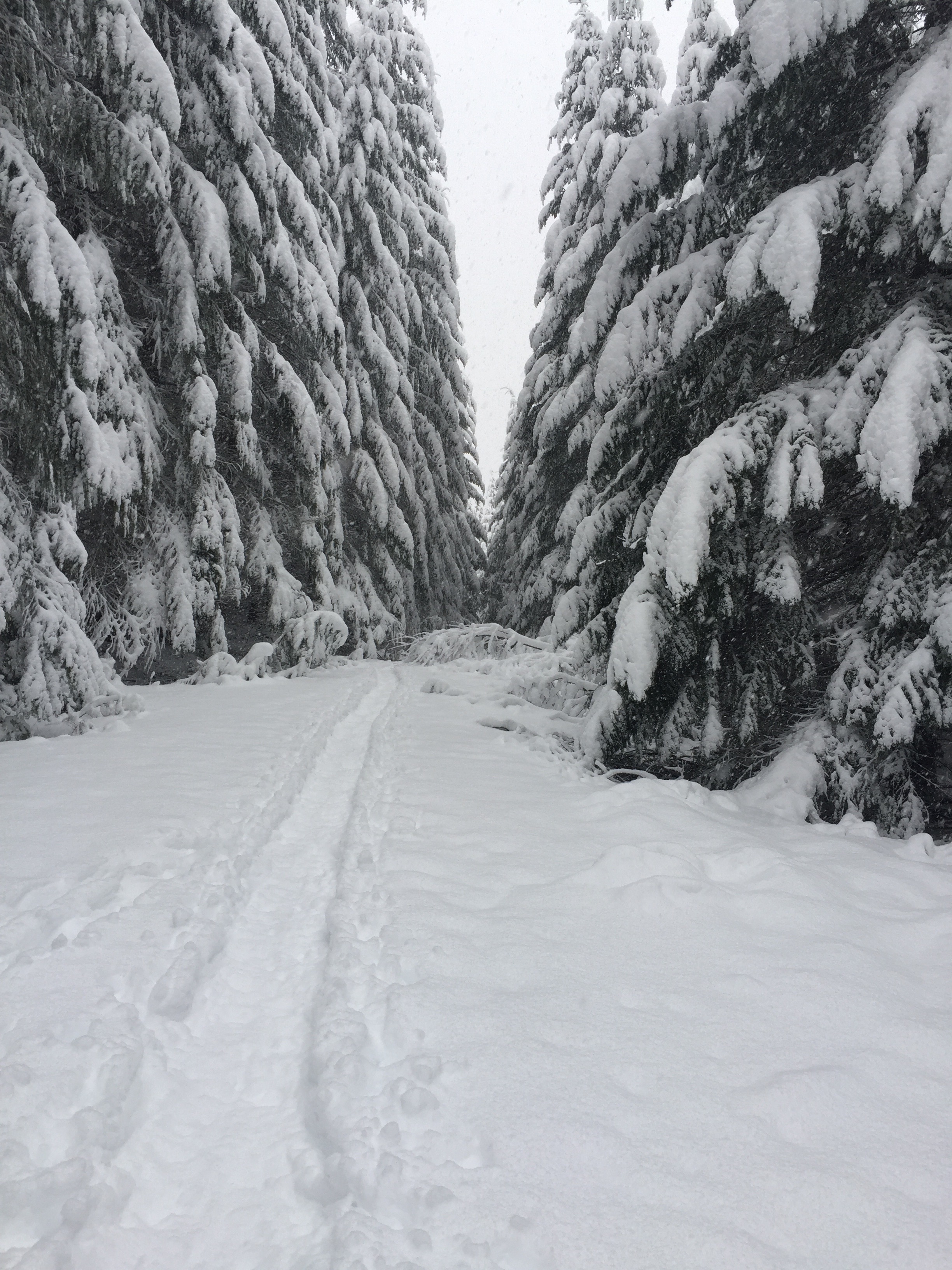
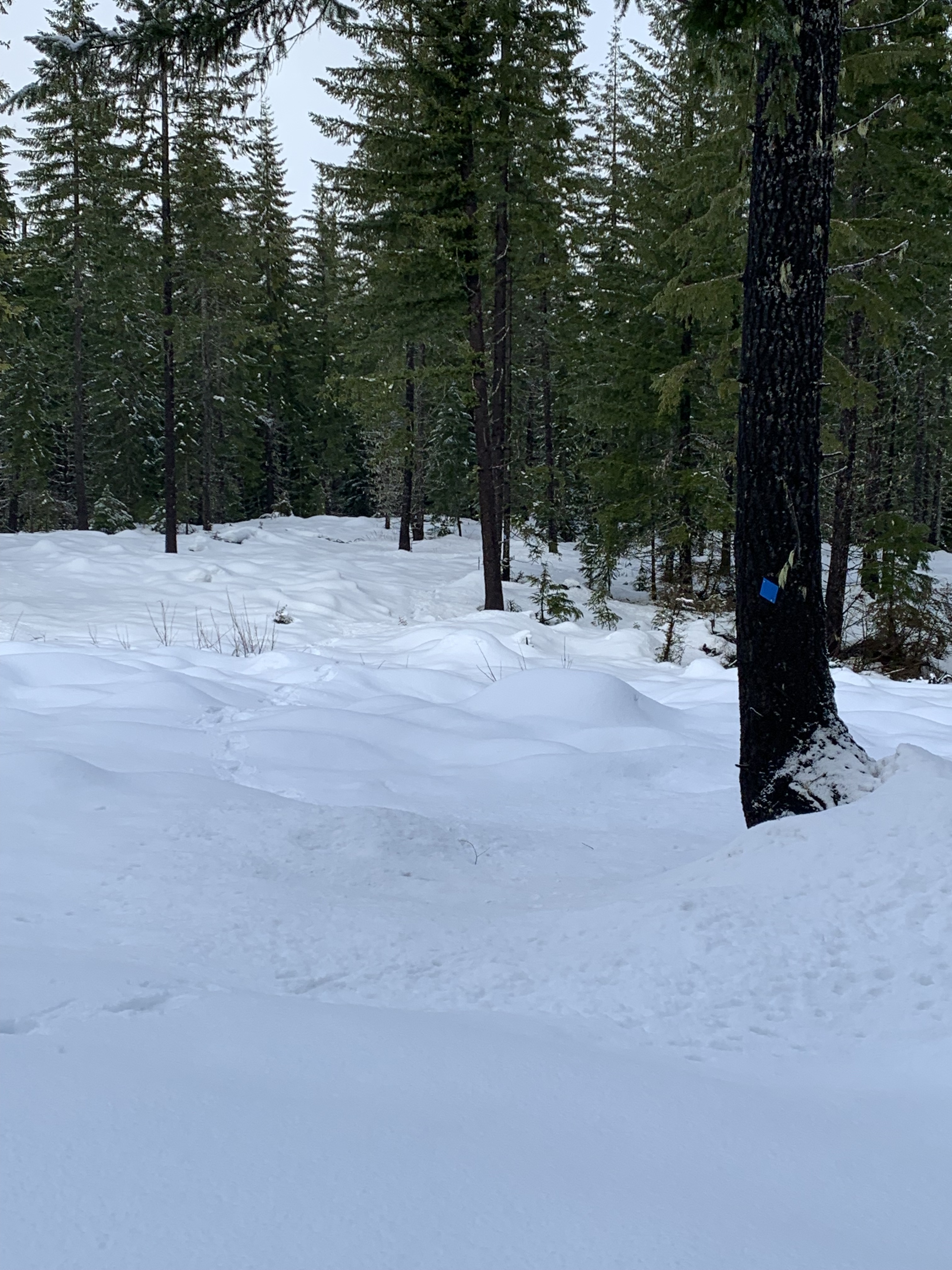
I pulled up my ski pole, and the basket was gone. Just like the other one 10 minutes ago. I was flailing in deep snow in a pile of Ceanothus brush, pretty in summer, a royal pain right now, thinking I would find the trail, but in snow, a lot of gaps look like trails. Eventually, we gave up and backtracked to a road that led to the other end of the loop where we had tried to go. Two of us went in, found some blue diamonds on trees, and kept going. We got to within 100 yards of where we had been, before realizing we needed to rejoin the rest of the group, and we hightailed it—as much as anybody can hightail it on snowshoes— back to the vehicles. The leader was not happy with us. Not a great decision of mine to explore, but I knew more about the trail.

Nickerson Loop

A month later, same Sno-Park, same leader, different trail, same thing happened. The markers disappeared, and after a sufficient amount of floundering, this time in a stream bed as well, we gave up. I muttered, “This is crazy. There are no loops where they should be, and somebody needs to fix this.”N

I knew (1) that fixing wouldn’t happen soon, if ever, unless (2) I was that somebody.

After snowmelt, I went back to Nickerson Loop, the first trail, followed the road to where it ended in a the trail through the woods. There were many logs down that needed to be removed and a few diamonds needed to be put on trees in order to mark the trail better. 

I reached the meadow and after an hour or so realized the trail was never in the meadow but rather at the edge of the woods along the meadow. I found a few beat up plastic blue diamonds on trees and started to see where the trail went. Then I saw nothing. After another half hour, during which my GPS recorded a bunch of slashes like a drunk person’s using an Etch a Sketch, I decided to bushwhack to the Forest Service road where the trail came out. That in itself was a lesson in how one gets lost.

I knew the road was about 3/8 of a mile through the woods, and I thought I was going in a straight line. But there are trees, downed logs, gullies, and brush to dodge, and I made changes to my route and more changes. It took me a while to get to the road, and when I did I realized I had veered 45 degrees to my right from the track I had projected. I had no idea I was that far off, and I consider myself to have fairly good trail sense, except this wasn’t a trail. This is why people get lost. We go in a straight line, then in another straight line angled to the first, then in another angled to the second….

I walked up the road to where the trail began and worked my way back to the meadow from the opposite side, and after a couple of hours had the trail marked. 

Four months later, in autumn, I worked with the Salamander Trail Crew out of Salem to help log it out, remove the downed logs, put up a few more diamonds, cut out some brush, and the next winter, I was clearing a few logs when I saw a group coming the other way on snowshoes. I asked them if they had had trouble navigating.

“No. Everything was great.” 

**********

The second trail, Prairie View Trail, was more problematic. I started to mark it the following autumn by going to the far end of the loop, off a Forest Service road, where there was a trailhead marker and followed the diamonds to…..nowhere. In the meantime, my feet got tangled in blackberry bushes, and I face planted on the ground. This was going to be more of a problem. I went out to the road, made a different track, and had a rough idea of where the trail markers could be placed.

That winter, I went out with the diamonds, nails, and hammer from the other end of the loop, the Sno-Park parking end, found where the second meadow portion left a road, put up several diamonds and got two-thirds of the loop done before I ran out of diamonds and had to use orange ribbon to mark. I didn’t bother to go to the old trailhead.  I had marked the trail with ribbon or diamonds, and more importantly, I now had it on my Gaia map on my GPS.  I never got back there later in the winter, mostly because I was nursing some ailments from too much vigorous snowshoeing into other places.

This winter, I began by going out from the Sno-Park, realized the snow was too heavy to complete the whole trail by myself, and came back out a week later, with diamonds, when the snow was a little easier to walk on, cleared brush, and came to the second meadow part. I was pleased with how well the diamonds guided, and I added several more in place of the ribbon, some of which was still present, going to the road. The diamonds have to be placed for both directions, and it should be possible to see the next one from the prior one.  Hiking with a hammer, diamonds, nails, all in a canvas bag, at the same time snowshoeing, requires some skill. The effort was not without a misplaced glove, falling into a snowdrift, but I reached the road, and the trail cleared. 

This winter, I will lead a Club snowshoe over the trail.  There aren’t views of any prairie, but there are some nice wooded and meadow areas, and it is a flat snowshoe for the most part, good for beginners and novices.

I’ve finally got both trails, both loops, marked in the Sno-Park. They 4.3 and 6.4 miles respectively, give or take. Maybe next year I will try to snowshoe both in a single day. Not sure why, but it’s the kind of thing I would think about doing.

Nearly 11 miles qualifies, however, as a “vigorous snowshoe,” which has produced physical consequences in older people.  

Like me.

Prairie View marker at the beginning. It is slightly angled to the left to show that the trail is to the left of the tree.

GOOD TIMING-short version for Cascade Volunteers newsletter

January 10, 2023

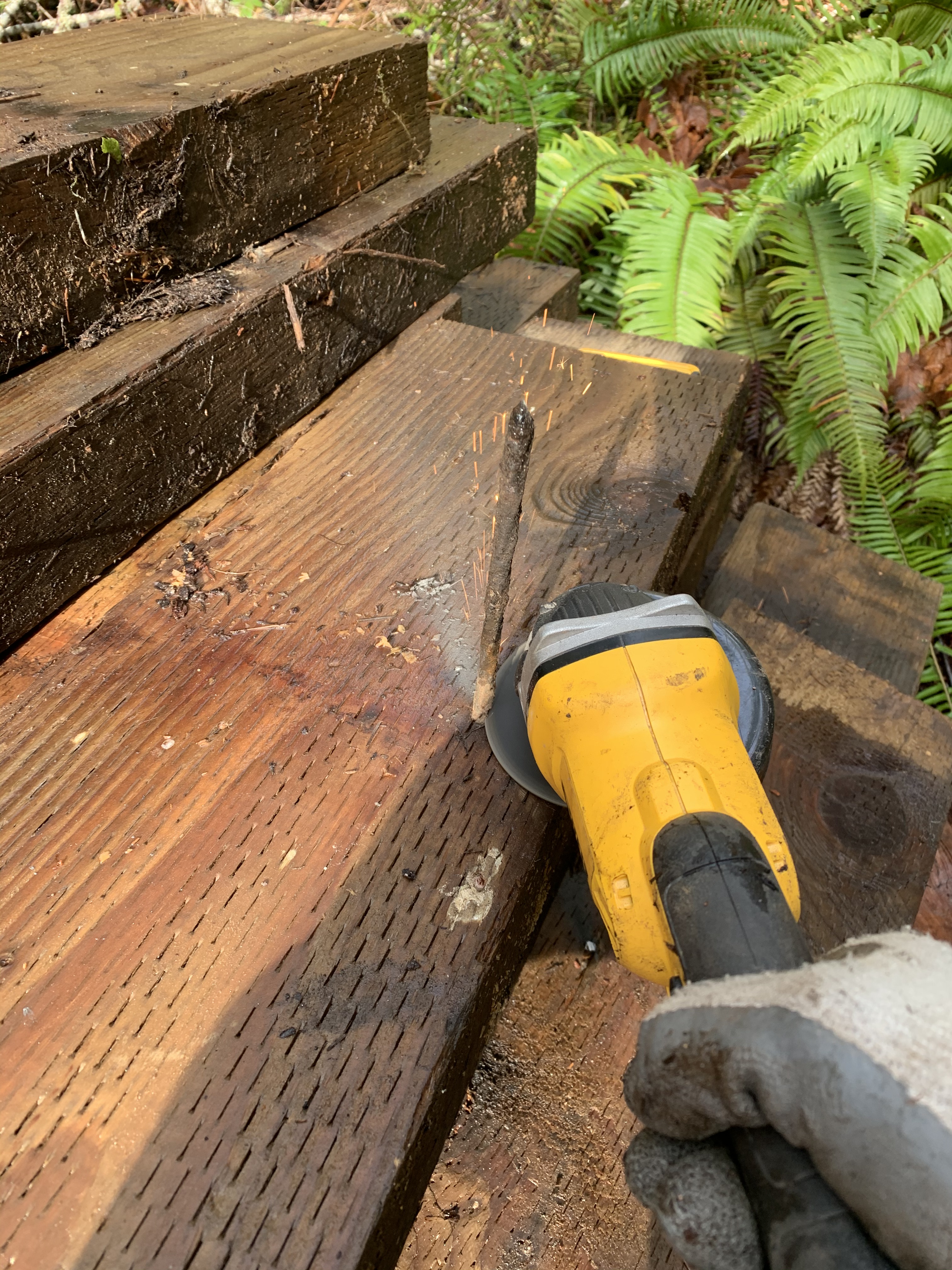
There were only three of us working a short day on the North Fork of the Middle Fork of the Willamette River, a wild and scenic river that flows out of Waldo Lake into the main Middle Fork just below Westfir. We had two vehicles, because I had  both power brushers in my car, and there was only room for me. I might be the only guy in the crew without a truck or other suitable hauling vehicle; for a while, I was the only one who didn’t know the difference between an Italian grinder and a DeWalt grinder. The former you eat; the latter can cut metal.

DeWalt Grinder working on a nail

Our job was to brush out the northern end of the North Fork Trail, starting from its northern terminus and moving south along the North Fork of the Middle Fork River. That’s three norths and three forks, but I can only use one fork on a grinder, not the DeWalt one.

The Crew has worked a good share of the trail two years ago, logging it out, deconstructing three failed bridges, and filling in root wads.  We hadn’t been back until now, and while the Traill had recently been logged out, it needed to be brushed. The forecast was for rain, which had started in Eugene, but the front had held up, and it was dark but dry at the trailhead. Good day for brushing.

We started off with two brushing and I acted as swamper to move everybody’s gear up the trail with them.  If I am behind the brusher, the way I like to swamp is to move two packs forward, along with a rake, then drop the packs when I am close to the brusher.  Then I rake the trail back to where I started, trying not to fall backward or trip over a blackberry runner that has my leg. When I reach where I started, I pick up anything else, like fuel, and move it forward. It’s a real bummer if one is in the groove brushing, which doesn’t last too long, runs out of fuel, and has to go back a quarter mile to get more. It’s also a bummer to want a drink, or lunch, and have to walk back a half mile to get the pack. On Winberry four or five years ago, I was by myself with the brusher, got a mile past my pack to the end of where I needed to go, had to walk back all the way to get my pack that had my lunch, and when I got back to the brusher, the rest of the group was on their way back to the vehicles, having eaten lunch. 

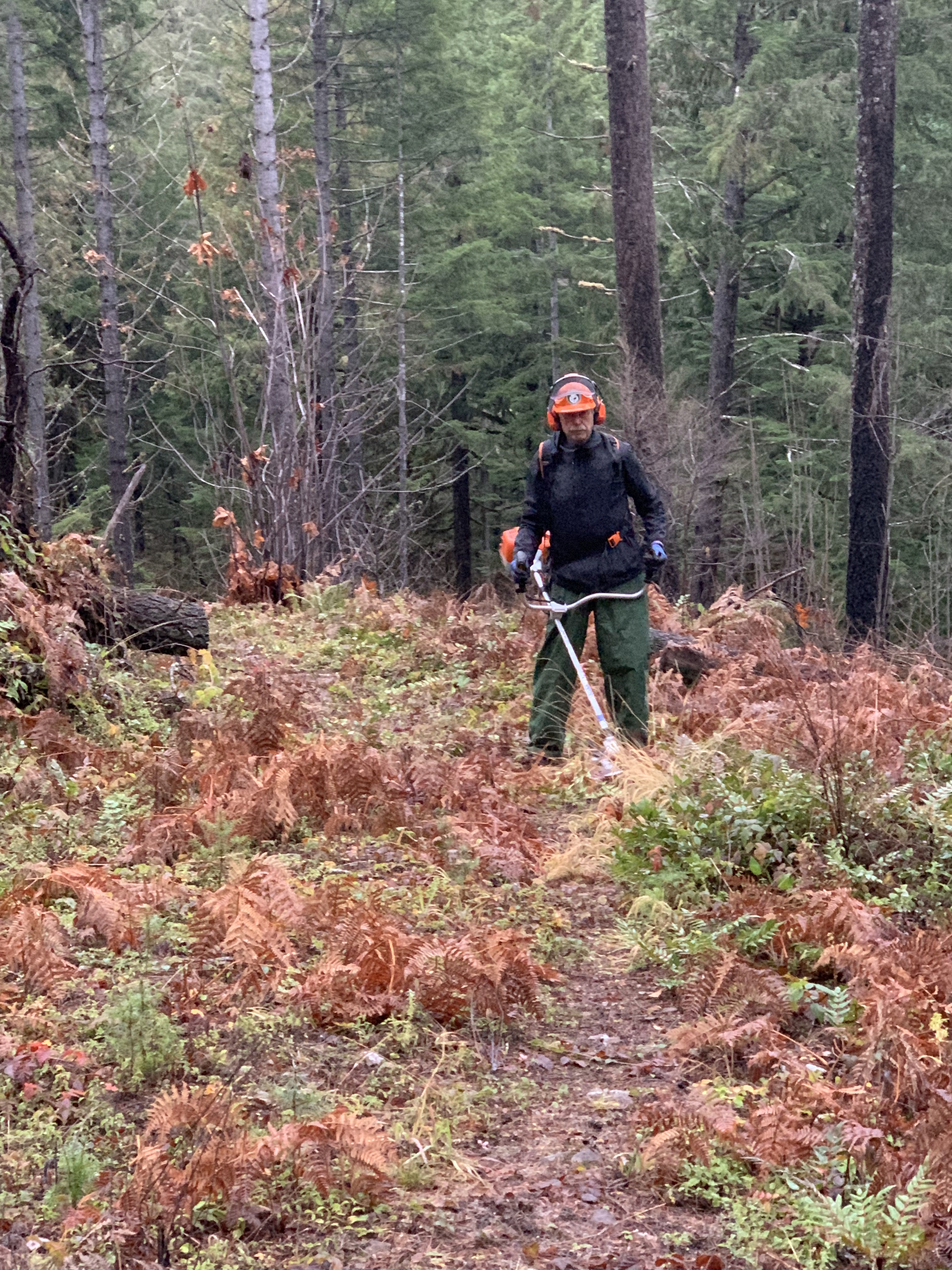
When it was my turn on the 25 cc Stihl brusher. I put on my yellow hard hat with ear muffs attached. I like brushing; I have reached a point where I can troubleshoot the beast. It starts for me right away (that would be fewer than five pulls) even having been stashed in the rain for a week. I went ahead cutting low to the ground, swinging the brusher back and forth across and the trail to the sides, and worked my way uphill for a third of a mile before a gradual descent.

Stihl power brusher with blades folded for storage

We stayed dry until about 11, when it became flat out dark suggesting the front was moving in. With a hardhat on and a motor running, the only way I can tell it is raining is to look at my shirt or gloves. If it is raining hard enough, I can then see it come off the hardhat in rivulets. My gloves were wet, but my shirt wasn’t as I started the descent to the creek, swinging the brusher, cutting out plants near the trail, occasionally a thick blackberry bush, sometimes repeating the swing to cut out some ferns that I had missed. Blackberry bushes are difficult, because in addition to having thorns they can grab feet and trip, and some of the stems are thick.

Soon enough, I arrived at the creek, followed by the other brusher and the swamper moving the packs. We had deconstructed this bridge two years ago in the rain and mud. Two of us went into the water further than we had planned. I remember moving about 20 good sized heavy planks up on to the bank, briefly carrying, mostly pushing and cursing from below. The remains of the bridge looked about the same as they had then. I went down to the stream, discovering the the logs were smooth like ice, and the crossing, while safe enough, would be significantly more difficult if we tried to pass a brusher from one person to another. Once we were across the stream, we would have to come back, too, an important reminder in the woods when one does an out and back hike. You have to get back.

Deconstructing a failed bridge, 2021

One of the guys asked me what my goal was for the day.  I didn’t have one other than to take a crew out, brush the trail as far as we could get, and not overdo ourselves. Stopping here seemed reasonable.  None of us wanted to go further. We don’t take a formal vote on such matters; usually we are all in agreement.

It would rain harder on the way back to the vehicles. We ate lunch in one at which time it was pouring.  Nobody commented that it was nice we weren’t on the other side of the stream working. The brush would be there another day. It was a good feeling to be on the way home after a productive day’s work in the woods, especially when we beat the rain.

Brushing the Hardesty Trail, 2022.

GOOD TIMING

December 20, 2022

It was my eleventh time as crew leader, only three of us and a short day on the North Fork of the Middle Fork of the Willamette River, a wild and scenic river from where it leaves Waldo Lake until it flows into the main Middle Fork just below Westfir. 

There is a trail running from Westfir up the west side of the river, crossing various Forest Service roads, going about 10-12 miles, and we were at the northern terminus. The Crew has worked a good share of the trail, logging it out, deconstructing three failed bridges two years ago, filling in root wads.  We were not working there last winter, and in a short period of time a good deal of work accumulates on any trail. We are trying to get in the mode of having people scout the trail in advance, looking not only for downed logs, but for the need to brush plant life off the trail and repairing the tread.  That way, we know what size crew we need for the job and the tools required. I scouted a trail last year for a joint crosscut log out. Knowing how much work we had to do was valuable in the planning.  The North Fork trail had been scouted and logged out; our job was to brush it to High Creek, maybe a mile, perhaps beyond, depending upon what it looked like and the weather, which was forecast for rain.

With three of us and two brushers, a mile is a reasonable day, too much if the trail is overgrown, too little if it isn’t. I took the brushers in my car, leaving no room for anybody else other than me; the other two drove together up to the trailhead.

We started off with two brushing and my job as swamper to move everybody’s gear up the trail with them.  That meant a lot of walking back and forth, making sure that the gas for the brushers was nearby when one of them needed to be refilled. If as the swamper, I had time, I needed to rake the debris off the trail.

After an hour I asked one if he wanted a break. He agreed, and it was my turn on the Stihl brusher. I wear ear muffs attached to my hardhat to dampen the sound; I like brushing, and I know how to start the brusher, how to use it. A year ago, I was told in front of the crew to brush lower to the ground, not high up, which I had been doing. Someone asked how low?  I said “sea level,” which got a laugh. Next year I should be able to change out and clean the spark plug on a regular basis, which I could probably do now, although I am not mechanically gifted. I went ahead cutting low to the ground, swinging the brusher back and forth across and the trail to the sides, and we worked our way uphill for a third of a mile before a gradual descent. When the brusher runs out of gas, it quits suddenly. I filled up and started cutting again.

It had been raining when we left town, but the front had stalled out briefly, and we were 30 miles east of town. Being December, in the woods, it was dark enough, and the ground damp, but we stayed dry until about 11, when it became flat out dark suggesting the front was moving in. With a hardhat on and a brusher motor running, the only way I can tell it is raining is to look at my shirt or gloves. If it is raining hard enough, I can then see it come off the hardhat in rivulets. My gloves were wet, but my shirt wasn’t as I started the descent to the creek, swinging the brusher, cutting out plants near the trail, occasionally a thick blackberry bush, sometimes repeating the swing to cut out some ferns that I had missed. Blackberry bushes are difficult, because they can grab feet and trip one, and some of the stems are thick.

Soon enough, I arrived at the creek first, soon followed by the other brusher, and the swamper moving the packs. We had deconstructed this bridge two years ago in the rain and mud. Two of us went into the water further than we had planned. I remember moving about 20 good sized heavy planks up on to the bank, briefly carrying, mostly pushing and cursing from below. The remains of the bridge looked about the same as they had nearly two years ago. I went down to the stream, discovering the the logs were smooth like ice, and the crossing, while safe enough with just ourselves, would be significantly more difficult if we tried to pass a brusher from one person to another. Once we were across the stream, we would have to come back, too, an important reminder in the woods when one does an out and back hike. 

One of the guys asked me what my goal was for the day.  I didn’t have one other than to take a crew out and brush the trail as far as we could get. Stopping here seemed reasonable.  None of us wanted to go further. We don’t take a formal vote on such matters; usually we are all in agreement. If not, we discuss what the best option is, which usually is to stop and return.  

It would rain harder on the way back to the vehicles. We had lunch in one at which time it was pouring.  Nobody commented that it was nice we weren’t on the other side of the stream working. The brush would be there another day.

Below: Left the day deconstructed in 2021; right, late 2022,

ROLLING THE ROAD

November 16, 2022

Last winter, I spoke with the Executive Director of Rowe Sanctuary in Nebraska, where I volunteered for a decade, leading well over a hundred trips to the viewing blinds.  I donate to Rowe, and every year the ED calls me to catch up for a few minutes. I know his family well; his daughter is almost exactly 50 years younger than I and now a biologist in the Deep South.  I first met her when she was ten. I do miss seeing the Sandhill cranes, teaching people about them, hearing the unique call from an ancient species, and viewing their migration is one of the top three events I’ve seen in nature (the other two were a wolf in my campsite on Isle Royale, and a total solar eclipse, of which I have seen 18).

At one point, the ED asked me what a “logout” was, which I had mentioned, without realizing it, several times. I explained it to him, although I didn’t delve further into the fact that the word may be used as a noun or a verb. We go to the woods in order to log out or cut out the logs blocking the trail (the verb form) the trail. On the last logout (noun, object of a preposition), I hurt my arm.  

I wasn’t using the term to impress, which as a newcomer I might, to try to show people I understood the work, when I really didn’t.  No, I used it automatically, because for the past 25 weeks, I had participated in at least one two man crosscut logout each week, sometimes two, spread out in five wilderness areas.  This work is a big part of my life, and so comfortable with the words that I didn’t realize they had two different grammatical forms until now.  

Learning the vocabulary of a new subject is an essential step en route to becoming competent. I would call it necessary but not sufficient. Learning the vocabulary takes time and effort; it can’t be pushed, and using the vocabulary before one has really lived or understood it brands one as a beginner, a layman, or otherwise not part of the group, unless, and this is important, one admits their newness at the outset. I know the vocabulary of medicine, but if I am explaining a skin problem to a dermatologist, I will preface my comments as, “I think it is one of those actinic thingies, or whatever you guys call it.” That means I am sort of using the language, but I admit to my ignorance. The dermatologist nods, smiles, and continues the evaluation. I told my urologist I couldn’t pronounce the generic name of the med I was on, only that it was an alpha-blocker, alfu-something or other. He laughed and told me what it was. 

In the Navy, I had to learn nautical language: I knew about knots, port and starboard, but I had to learn about deck, overhead, bulkheads, topside and below, reefers (refrigerators), scuttlebutt (water fountains), heads (bathrooms), wardroom, officer’s country, the difference between the 01 (oh-one) deck (first deck above the main deck) and the 1 (first) deck (first deck below the main deck), forecastle, after steering, CIC (Combat Information Center, or “Christ, I’m Confused’), snipes (engineers), pork chop (supply officer), First Lieutenant (head of the Deck Department), or dog down something (tighten it). For some, a gig is a side job; in the Navy, it has two different meanings; 1) the Captain’s personal boat (noun) that we carried, with an outboard motor, and (2) a verb that meant to discipline someone, often used in the passive voice. Nearly a half century after leaving the Navy, I occasionally will use gig, along with gundeck, which means one has accomplished a job when in fact one did nothing. Like certain words in other languages that describe things better than we have in English, Navy-ese still is used by me along with “scosh,” from “scoshi” or a little (Japanese), example: “Give me a scosh.”  

On a ride back from a logout a while back, I explained the injury I had suffered to my forearm when I slipped and slid down a rootball wad flat on my back, fortunately cushioned by my pack. My forearm immediately swelled, and I knew I had a hematoma. My explanation of it I later heard had the guy in back think that I had to be a physician, because I was talking so smoothly about something medical.

Having started at the bottom of many ladders in many fields (chemistry, medicine, statistics, medical administration, amateur astronomy, guiding canoe trips, learning a language, and now doing volunteer trail work), is that learning the vocabulary is the first big step towards competence. Pathology, which I took the second year of medical school, is where I really learned the vocabulary of medicine, even more than anatomy. The pathologist who taught the class said the first day, “This is where we turn medical students into doctors.”  Well, at least vocabulary-wise.

When I went to the canoe country to work, or to wilderness trails in the Cascades, I originally knew nothing about the work. I asked about strange words, like kerf (the opening in a saw cut), bind (where the saw is grabbed by the wood), leaner, buckskin (light brown log), or “how a log can talk to you,” for logs certainly have all of those characteristics. While knowing the vocabulary doesn’t make one competent, someone who neither knows the words nor pronounces them correctly stands out as a beginner, not to be ridiculed if the person is trying to work, but perhaps needs a slight toning down if they are trying to impress you.  I learned from an old timer, on a snowy drive to doing trail work one winter morning, that “to roll the road,” is to drive breaking down the sides of snow (or mud) that will form tire grabbing ruts if one doesn’t do that.

Little by little, through now eight-five logouts, the noun form, I have graduated from Apprentice, past Beginner, to some Competence, to Deal with more difficult logs, to Explain my work to others, and to Follow the Great masters whom I know. 

The route begins with learning the language of the field, asking questions, and showing up, for a large part of success is showing up. When I started, I thought a raker was an individual, not a piece of a crosscut saw that acts like a small chisel during sawing. I now speak the language, and while I will never stop learning, will neither be a C Sawyer nor an instructor, I have reached a skill level I never once dreamed existed, either in life, let alone for me.  

I’ve come a long way, far to go, but with good people who have “rolled the road” for me.

LAYERS

November 6, 2022

I noticed the cold for the first time this season when I got out of the car at Patjens Lake Trailhead. I had already noted how dark the morning was when I left town, a predictable astronomical phenomenon for this time of year. Less predictable was when I would note the day each year, usually in August, when one felt the first tinge of autumn. I was doing a straightforward hike, a seven-mile loop into the Mount Washington Wilderness with a few hundred feet of elevation gain, scouting the trail in preparation for an upcoming one-day logout by the joint Scorpion-Salamander Scorpomander crews. I was expecting to find between 75 and 150 logs needing removal. Knowing the location and size of the logs would help the crews plan the day, as they worked the loop from opposite directions.

I had my rain jacket on when I drove in but had removed it before starting, knowing I would warm up as I moved. After all, it was I who told people at the onset of a hike, “If you’re warm now, you’ve got too much on.” People listened po- litely, nobody took anything off, and the hike proceeded, with my being the only one cold. It was only uncomfortable for ten minutes.

I learned this approach of starting a hike cold 38 years earlier on the Chilkoot Trail in Alaska. The second morning of that backpack, ten miles up the trail, it was cold, and the leader suggested I remove my shirt, because we were going to be carrying packs uphill all day, over Chilkoot Pass into Canada. When we stopped to rest, sweaty, we could put on a dry shirt and be warmer, until we started again. I was a ‘layer minimalist’ for years afterward, until my body changed.

Twenty years ago, I stopped wearing shorts when I canoe tripped in Minnesota in September; five years later, I stopped bringing shorts altogether. On winter trips, my fingers now are cold for the first mile in the morning and for the first mile right after lunch, too. Along with losing hair, vision, memory, and hearing, I’m losing degrees. The world changes; my body is no exception.

Now standing near the kiosk at the trailhead, pack on, ready to go, I stopped. Admit it, I said to myself. You’re cold.

I shook my head, dropped the pack, retrieved my jacket and put it back on. I don’t have to be cold right now. If I get too warm, I’ll deal with it. I then shouldered the pack and began hiking. My, it felt comfortable. Sure enough, a half mile into the burned area, when I needed to stop to measure the diameter and location of a downed log, I removed my jacket and stuffed it back in the pack. I was warm the rest of the hike, noting 79 logs for removal, in addition to the 13 smaller ones I removed as I went.

Those who are naturally comfortable in certain situations or subjects often have difficulty understanding others who don’t share or have such comfort or skill, whether it be interacting with strangers or dealing with the ambient temperature. But that day at Patjens, I finally understood and could admit that layers are for putting on and taking off, and it really doesn’t matter when one does what, so long as one is comfortable.

See you on the trail.

The above appeared in the Obsidian Bulletin November 2022. I was “commissioned” to write something after I followed up to a favorable comment about “Lunch Time,” which appeared in Cascade Chronicles (below). Readers of my blog will know of my strong belief that opportunities come disguised in many forms. As a Navy veteran, I have always liked the motto, “Fortune Favors Boldness,” the Cruiser-Destroyer Squadron motto.

Lunch time

Thirty years ago, when I was a summer volunteer wilderness ranger in the Boundary Waters Canoe Area Wilderness, I was so hungry that I downed a large Hershey Bar mid-morning out on the trail or water. In the interim, I have become a little healthier in my food choice, but I still like a mid-morning snack and may often be seen wolfing down a protein bar, either at rest, while hiking, or even sawing. Around 11:00, I start thinking “lunch is within an hour, I hope.” Sometimes it is earlier; sometimes we want to finish a log and it is later. Either way, I have a half hour where I can eat, often lying down, which I probably shouldn’t do but do anyway, and gaze at whatever is to be gazed at. 


There is much to see; I’ve spotted hawks, woodpeckers, nesting holes, squirrels, aircraft, the Moon, interesting tree shapes, and spider webs, the latter’s crisscrossing the forest at all sorts of angles and elevations. I listen to conversations around me for my mouth is too full to talk as I rapidly scarf down the modest five course lunch I made the night before.


Unlike group hikes, where we look for waterfalls to sit by or mountain tops with views, on a work day, lunch is where we are. On the Erma Bell log out, I was ahead of the rest of the crew when I was called on the radio asking for my position. I wasn’t exactly certain, and I wasn’t going to give a smart aleck answer like “near the county line,” which I once told dispatch at noon when we were working Hand Lake Trail (it was true). I said I was a few hundred yards ahead and would eat where I was. I had plenty of work ahead of me, but food is food, and I sat in the shade, watching ants, marveling at the deep blueness of the sky, and enjoying the quiet.


Lunch in winter is finding a sunny spot or a dry area under a big tree. I remember to bring a warm hat in my pack, because hard hats aren’t good insulators. I also keep lunch breaks shorter, because I cool off so rapidly. Summers, of course, I look for shade, which sometimes disappears, because I didn’t plan on the Earth’s rotation. I’m an amateur astronomer and should have factored that in, but when I am working the trail, I think of other things. Working the Middle Fork Trail several months ago, I sat on a thick pile of moss, my back against a log. It was so comfortable, but I realized that must be a one and done spot. My feet were in danger of kicking the moss, and it takes time for it to grow back. I worked in the same area several more times, but I never ate lunch there again, often on the bridge we were building, feet hanging over the edge, rushing water below.


We had a particularly good lunch spot working Rebel Creek, where we could sit on the trail, lean against the bank, let our legs drop over the edge, the creek far below, and I stared at one particular fir where it began far below and ended far above me. I bet I could find that same tree again. This past week, I led a crew to brush out Lowder Mountain Trail, and I timed it so we could have lunch on top, overlooking the Cascades as well as Karl and Ruth Lakes. The choice of lunch spot impressed a newcomer. Made my day.


Nobody formally calls an end to lunch. With varying degrees of stiffness, we get up, make needed adjustments to our gear, and move on. More work awaits us.

OCCUPATIONAL LANGUAGE

October 31, 2022

Last winter, I spoke with the Executive Director of Rowe Sanctuary in Nebraska, where I volunteered for a decade, leading over a hundred  trips to the viewing blinds.  I donate to Rowe, and every year the ED calls me to catch up for a few minutes. I know his family well; his daughter is almost exactly 50 years younger than I and now a biologist in the Deep South.  I first met her when she was ten. I do miss seeing the Sandhill cranes, teaching people about them, hearing the unique call from an ancient species, and viewing their migration is one of the top three events I’ve seen in nature (the other two were a wolf in my campsite on Isle Royale, and a total solar eclipse, of which I have seen 18).

At one point, the ED asked me what a “logout” was, which I had mentioned, without realizing it, several times. I explained it to him, although I didn’t delve further into the fact that the word may be used as a noun or a verb. We go to the woods in order to log out or cut out the logs blocking the trail (the verb form) the trail. On the last logout (noun, object of a preposition), I hurt my arm.  

I wasn’t using the term to impress, which as a newcomer I might, to try to show people I understood the work, when I really didn’t.  No, I used it automatically, because for the past 25 weeks, I had participated in at least one hand crosscut log out each week, sometimes more.  I live with this daily, so comfortable with the words that I didn’t realize they had two different grammatical forms until now.  

Learning the vocabulary of a new subject is an essential step enroute to becoming competent. I would call it necessary but not sufficient. Learning the vocabulary takes time and effort; it can’t be pushed, and using the vocabulary before one has really lived or understood it brands one as a beginner, a layman, or otherwise not part of the group, unless, and this is important, one admits their newness at the outset. I know the vocabulary of medicine, but if I am explaining a skin problem to a dermatologist, I will preface my comments as, “I think it is one of those actinic thingies, or whatever you guys call it.” That means I am sort of using the language, but I admit to my ignorance. The dermatologist nods his head, smiles, and continues the evaluation. I told my urologist I couldn’t pronounce the generic name of the med I was on, only that it was an alpha-blocker, alfu-something or other. He laughed and corrected me. 

In the Navy, I had to learn nautical language: I knew about knots, port and starboard, but I had to learn about deck, overhead, bulkheads, topside and below, reefers (refrigerators), scuttlebutt (water fountains), heads (bathrooms), wardroom, officer’s country, the difference between the 01 (oh-one) deck (first deck above the main deck) and the 1 (first) deck (first deck below the main deck), forecastle, after steering, CIC (Combat Information Center, or “Christ, I’m Confused’), snipes (engineers), pork chop (supply officer), First Lieutenant (head of the Deck Department), or dog down something (tighten it). For some, a gig is a side job; in the Navy, it has two different meanings; 1) the Captain’s personal boat (noun) that we carried, with an outboard motor, and (2) a verb that meant to discipline someone, often used in the passive voice. Nearly a half century after leaving the Navy, I occasionally will use gig, along with gundeck, another verb/noun, which means to say one has accomplished a job when in fact one did nothing. Like certain words in other languages that describe things better than we have in English, Navy-ese still is used by me along with “scosh,” from “scoshi” or a little (Japanese), example: “Give me a scosh.”  

On a ride back from a logout a week ago, I explained the injury I had suffered to my forearm when I slipped and slid down a rootball wad flat on my back, fortunately cushioned by my pack. My forearm immediately swelled, and I knew I had a hematoma. My explanation of it I later heard had the guy in back think that I had to be a physician, because I was talking so smoothly about something medical.

Having started at the bottom of many ladders in many fields (chemistry, medicine, statistics, medical administration, amateur astronomy, guiding canoe trips, learning a language, and now doing volunteer trail work), is that learning the vocabulary is the first big step towards competence. Pathology, which I took the second year of medical school, is where I really learned the vocabulary of medicine, even more than anatomy.

When I went to the canoe country to work, or to wilderness trails in the Cascades, I originally knew nothing about the work. I asked about strange words, like kerf, bind, leaner, or “how a log can talk to you,” for logs certainly have all of those characteristics. While knowing the vocabulary doesn’t make one competent, someone who neither knows the words nor pronounces them correctly stands out as a beginner, not to be ridiculed if the person is trying to work, but perhaps needs a slight toning down a little if they are trying to impress you. 

Little by little, through now eight-five logouts, the noun form, I have graduated from Apprentice, past Beginner, to some Competence, to Deal with more difficult logs, to Explain my work to others, and to Follow the Great masters whom I know. 

The route begins with learning the language of the field, asking questions, and showing up, for a big part of success is showing up. When I started, I thought a raker was an individual, not a thing on a crosscut saw that acts like a small chisel during sawing. I now speak the language, and while I will never stop learning, never be either a C Sawyer nor an instructor, I have reached a skill level I never once dreamed existed, either in life, let alone for me.  

I’ve come a long way, with far to go, but with good people with whom to travel that road.

Before and after log out of a trail in Gold Lake Sno-Park. This log would be trouble on a snowshoe. Power saw used, because we were not in the wilderness.

JOINT EFFORT AT PATJENS LAKES

September 27, 2022

I almost quit the Crew three years ago while clearing Patjens Loop Trail, which runs from Big Lake into the Mt. Washington Wilderness and then back out to Big Lake. Perhaps a third of the trail is wooded; the rest is in a burn that has standing dead tress that topple over during high winds. One doesn’t hike in Oregon, especially in an old burn, if there are high winds forecast, because trees lose branches or just fall over. A Club hike a few year to Patjens during a wind storm was quickly aborted, when dead trees started falling all around the hikers. 

That day only five of us logged out about two miles of trail and at one point when a hiker went by, we asked how many blowdowns there were between us and the wilderness boundary. He told us maybe 20, but two dozen minus four logs later, we were nowhere near the boundary, and when the Crew leader asked if people wanted to quit, I alone answered an unequivocal yes. That was a 13 hour day, counting the drive, and Patjens was dusty, hot, with very little shade.

Two years ago, we began a joint annual project with the Salamanders, a crew out of Salem, where we had four crews, two crosscut and two chain saw, go in opposite directions; the latter’s cutting out logs outside the wilderness and the crosscut teams hiking to the wilderness boundary to start clearing. We finished clearing 7 miles in about 5 hours. 

Last year, we did the same thing, more logs, but strong crews, and while we didn’t have a golden spike, we were happy to see the other workers and finish the loop hike on newly cleared trail.

This year, nobody had said anything about the trail. I brought it up a couple of times but was met with silence. Finally, the trail crew lead for the district asked if we could clear Patjens. I said I would scout the trail, and a few weeks back drove up to Santiam Pass-Big Lake, and got on the trail in early morning.

The purpose of scouting is to locate all the logs that need removal, and measure their diameter. If the person scouting has been on a crew before, the individual has a good idea of how many people are needed and what equipment. I had a GPS, not for the latitude longitude components, although that can be useful on Gaia maps, but just the mileage in on the trail. I told the Crew Boss that I measured the circumference of the logs and multiplied by the reciprocal of pi, but basically I divided the circumference by 3 and subtracted an inch. He had pity on me and presented me with a tape measure with a built in pi factoring for converting circumference to diameter. 

I headed south on the trail, which is covered with a fine powder. I know Patjens well and once I reached the wilderness section, went by numerous logs that I had once cleared. The higher part has good views of the Three Sisters and exceptional views of nearby Mount Washington.  Then the trail descends into a wooded area where I went by a pair of logs the cutting of which I remembered from 3 years ago, a pond where I’ve eaten lunch twice, and an open area at the half way point that invariably has a lot of cutting in an place with no shade. 

At each blowdown, I would obtain the mileage and measure the log diameter, commenting if I thought we could push the Iog off or if it were rotten. I wrote down all the information, and then went to the next. The last part of the wilderness had about a log every 50 yards for a while, but there were no large logs. I found 79 altogether, not counting a few that I removed because they were small enough and annoying enough for trail walkers. A couple I decided to push off with my legs. Altogether, 79 is a small number for Patjens, and I suggested we could even clear it with crosscut teams alone and not use chain sawyers.

As it turned out, there was a full restriction on power equipment in the forest the day we cleared the trail, anyway, so we had four crosscut teams and fourteen people. We held our tailgate briefing in a big circle at the trailhead, split into the teams and went on our way.  It was cloudy for once, with a slight breeze and very comfortable to work out in the open. 

Our crosscut teams from the west entrance leap frogged each other, but the group passing tried to go several logs down the trail, so we wouldn’t be running into each other on each log. Sometimes, we will have the other group go about 10 logs down the trail, especially if the load is expected to be light and the cutting at each log quick. Other times, with larger logs, we stay close together, so we can have the whole crew work on a log if need be. Patjens was one of the easier log outs we had. To our surprise, there had been no new logs fall in the two weeks since I had scouted the trail, despite even a strong windstorm. 

We had lunch by one of the small lakes there. There are four such ponds, none more than a few acres, but they are nice oases in the junction between the forest and the burn. Right afterwards, we met up with one of the other crosscut groups from the east entrance.  Seven miles of trail cleared, and we were back at the trailhead by 2.

Patjens was burned in 2011, and it is past the time of the most trees that will fall over. Still, we expect plenty of work there the next few years. One advantage about trail work is job security.

One of the Patjens Lakes

Three Sisters from Patjens, August 2022

We left this leaner alone because there was some risk in cutting it out and there was an easy bypass. A year later, it had fallen and the trail bypass is the new trail. Ribbon is warning of danger–here, a dangerous log, other places for hornet nests or partially cut logs.

Clearing Patjens in 2021

THE FUN GUY

September 4, 2022

Years ago as a volunteer wilderness canoe ranger in the Boundary Waters, I and the Forest Service lead had lunch at the Fall-Newton portage, just inside the wilderness, our last night out on a trip.  We heard a metallic crash in the nearby woods, so I went to see what happened, figuring it had to be on the portage.  Sure enough, about 100 yards down the trail a canoe was sitting upright in the middle of the trail. Nobody was there.

Figuring the owner went back to get more gear, I picked up the canoe, put it over my head and carried it to the lake, placing it on the shore. A few minutes later, a man showed up grateful that I had moved his canoe. He had a pack and some fishing gear with him, and my partner and I asked him where he had been.

“I was on Basswood Lake, and it was just awful,” the man moaned. It took me hours to get to the campsite because of the wind.”

“Yep.” I nodded. “We were out there. It can really be windy.”

“It rained every day.”

“Yes, it has been a wet summer,” I replied. “The difficult days are the days you remember.” I heard those words years ago, and they are correct.

“The fishing was awful.”

“Yes, you have to know where to look, but they are there.”  

The man looked at me somewhat exasperated. “And the bugs!”  He paused, looked right at me.  “Or are you into them, too?” 

I laughed. I had come across for the first and probably only time as Mr. Fun Guy. He lived in Florida, and he wasn’t coming back. 

***************

This year the Crew finished the Benson Trail, connecting FS road 640 and Scott Mountain Trail in the Mt. Washington Wilderness, about noon, 1500 feet higher, 3.5 miles farther, in,  two dozen cut logs behind us on a hot day, just in time for lunch, a shady spot with a small pond nearby. Benson Lake itself was about a half mile away, along with Tenas Lake and a few others in the area. Some of the Crew decided to go visit them. I knew the lakes were pretty, but I wanted to sit down, eat lunch, look up at the sky or the pond in front of me. I was tired, but happy we got the trail done.

Nearby pond at lunch spot

The log out was a typical day.  We had to carry our packs and take a tool: shovel, Pulaski, axe, big saw.  Logging out a trail while climbing, taking off and putting on your pack a couple of dozen times, taking out a saw, taking the cover off a saw, dealing with a downed log, is work, especially when it is hot and buggy, as it had been. I need a full day at home to recover, and I am in pretty good shape, unless my knee or Achilles tendon is bothering me, which are two current problems that receive daily ice. Drinking enough is critical.

While we were there, a man came by and recognized the Scorpion sticker on my hard hat. We are the Scorpion trail crew.  I also have a Salamander sticker as well for the Salem crew, since I have done joint work with them. He was with the Salamanders and was hiking on our side of the forest with his wife, seeing Scott Mountain, which wasn’t far away and at 6000+ feet  has a great view of the nearby Sisters and the upper McKenzie River valley.

The man was tall, dressed perfectly to be where he was, as was his wife. We started talking about what we had just logged out, and he was interested. The Salamanders work on the forest mostly to our north, where we don’t work, and he kept saying how much he enjoyed the log outs. “They are fun,’ he said, at least twice.

Fun. Wow. I can’t say I find them fun, but on the other hand, I definitely look forward to a good logout of a couple of miles of trail with a decent crew. That means we will be working together to size up what a log is going to be like to cut, where to cut it safely, and how to get it off the trail. We will maybe do a loop or have a car shuttle, but more likely we will hike back the way we came, enjoying the now clear trail. Fun? Hmm. Need to think more about it, but I liked his attitude. He talked with us for about 15 minutes before leaving. After he left, one of the guys said, “What was his name?” None of us knew.  That made me feel better, because I seldom recognize people. I do better with voices, but I had not heard this person’s voice before. I am far too reluctant to ask people’s names. Many don’t know mine, but it’s on the back of my hardhat.

Five days later, I was further north and west, working with the Salamanders on Maxwell Butte. I didn’t know until two days before whether I would do it, for the trail itself climbs over 2700 feet in 5 miles, but it is a good trail that goes into the Mt. Jefferson Wilderness, where I had not previously worked.

Shortly after I arrived, a tall man saw me, recognizing me from the prior week.  As expected, I did not know him by sight. This time, however, I asked his name, hearing “Bob” in return. OK, Bob is the tall guy with real blue eyes whom we ran into at Tenas Lakes.

We had a nearly full crew of 11. Beth divided us into 4 crews, and my group would log out from the wilderness boundary a mile in to Twin Lakes, about 2 miles in. We did that during the morning, while others went to Twin Lakes and worked to the top, a third group, including Bob, used a chain saw to clear logs to the wilderness boundary, while Beth worked from Twin Lakes up the Lava Lake trail. 

After lunch at Twin Lakes, we worked over a mile up the Lava Lake Trail the next hour until I caught up to my group and said that I was just plain tired. It was hot, we had cut out many logs, and I did not like each step carrying me further from the trailhead. To my surprise, the others agreed, so I radioed Beth and said we were turning around.  Within 20 minutes, all of us had turned around, including the group that got to the top of the Butte, where there are splendid views of Three-Fingered Jack and Mt. Jefferson. We heard, “It must be 450 degrees up here.”

Working with the Salamanders on Maxwell Butte. Notice the deeply scooped trail.

I was the first back to the trailhead, not because I was fast, but because I was closest to the trailhead, and because huckleberries were late, I didn’t spend time picking. After dropping my unused tools by the vehicle, I lay down in shade, changing my hiking shoes for running shoes, and swallowing 500 cc of water in two gulps. I knew that I had pushed my limits for getting heat related problems, which is why I turned around. 

Others soon appeared, and we sat in the shade, talking, or in my case, just resting. I asked Beth if it was OK if I left before the last group, the ones who had been at the top, and had a lot longer day than I, returned.  She gave me the green light.

On my way out, Bob came up to the car and stuck his head in the passenger window. “I know where I know you, “ he said. “You are on the Finance and Fundraising Committee. I recognized your voice.”

Wow, that’s impressive. For one thing, I don’t talk much at the Zoom committee meetings, and my picture usually is not visible, because I eat dinner during the meeting.  Additionally, he put my presence in the field together with the voice at the committee meeting to identify me.

As I drove off, I thought about fun. Not sure today qualified as fun, but I was deeply satisfied. The Salamanders are working on Turpentine Trail in the Mt. Jefferson wilderness in a couple of weeks. It’s a bit far to drive there, but a big pile of downed trees—a jack straw—needs work, the hike is shorter, and yes, it just might be fun to do it.

Maybe.

WEARING RED…AGAIN

August 22, 2022

I looked at the log on the side of the trail, tempted to leave it where it was. The trail wasn’t blocked badly, it was hot, and the log looked heavy. We had another two miles to log out.

Then I said to myself, you’re in charge, so deal with it. I picked up the end on the trail end and lifted the log up to the uphill side. I didn’t like that, however, for I knew it was going to roll back into the trail sooner or later. So I went above the log, sat down, put my feet against it, and gave it a push. It rolled down across the trail on to the other side.

Much better.

In nearly 200 trips I have taken with the Crew, someone else was in charge, responsible for posting the work party online, ensuring we had permission, filling out the comms (communication forms with the Forest Service) report, setting the meeting point, radioing in our location and number to Eugene dispatch, holding the tailgate session at the trail head as a final check before we headed into the wilderness with saws, Pulaskis, and other tools to clear them.

Six times I had led, but on non-wilderness trails where we had to fill in root wads, do tread work, or power brushing. I can carry a power brusher, I can start one, and I know how to use it, so those were easy. Winter trail days are shorter, closer to home, and if the weather is not suitable, we just leave.

Logging out a wilderness trail is something in which I have participated 75 times. Twice this week on Olallie Mountain, I was to be the Crew leader, in charge. It was my job to have the equipment there, to know what needed to be done, to be responsible for what went on, to radio in to the Forest Service before and after. This is a job of a B-certified sawyer, and when I got my certification, I expected and was expected to do this.

The first day, there were only three of us: one well experienced who just wanted to be out in the woods; the other with some experience, but not as much as mine. We worked our way up the trail, all of us staying together, plenty of good ideas from the oldest, but for the first time, I was the person of record. We moved about three dozen logs over a mile and a half, making good time, until we reached a 17 inch one over the trail.  I called a time out for lunch, because I knew this log would take time, and we needed to sit, eat and to cool off. 

It was different being in charge. It always has been for me. When I was at Pathfinder in Algonquin Park in the sixties, I went from a camper to third man, second man, and finally head man, in 1967. There was a long, not always pleasant learning experience on the way, as I grappled with how to lead without being a jerk but still getting things done and helping the campers have a good trip. The person in charge always thought of the whole group. Like all head men at Pathfinder, I wore the red neckerchief. The canoes were red, the email address today contains the word “redcanoes,” and they enjoyed my blog post on the subject years ago. I wore my red neckerchief on solo canoe trips the past forty years, for it reminded me of those days. I even put a red neckerchief on the teacher’s desk by me the first day I substituted in a math class as the teacher of record, nobody else responsible. Eleven years later, I had my red neckerchief on again at Pat Saddle Trailhead for Olallie Mountain, for I was again in charge, doing my work, but watching everybody else, where they were were, and then schlepping my pack up Olallie.  I made sure nobody was lagging or looking badly. I realized it was I who needed to be listening to the radio chatter to make sure there were no new fires on the forest, for this time of year, we have to be ready to move out of there quickly.

After lunch, we had to underbuck the low end of the log across the trail, cut it from below, because sawing from above was going to lead to binding. Then, as the log dropped, as it would, we were able, with a strap, to pull it to one side on a long, concave piece of trunk that we had removed earlier, where the cambium was unbroken and slick. With the cut end of the  log on it, with one pulling from each side and my pushing with my legs from the far stump, the log slid slowly but definitely on the cambium layer off the trail. The whole process took over an hour, and after a couple of more logs removed, we headied back down the mountain.

Two days later, I had a more typical crew of seven to deal with the rest of the trail. We met at the usual place in Springfield, drove 40 miles to the Aufderheide Road, which connects the roads to Santiam Pass and Willamette Pass, to and across Cougar Reservoir dam, 15 miles up FS 1993 to Pat Saddle trail head. At the tailgate safety session which I led, I outlined the day’s plans. We then started hiking 1.75 miles in to where I had finished two days earlier.

We have to hike in some distance, often 3-4 miles, before we begin logging. It’s a long hiking day by itself, and that doesn’t include the multiple times putting the pack on and taking it off, plus all the saw work. We reached the area I had turned around, and started work. 

After I had pushed the log off the trail, the next one across the trail had 30 additional feet of above the trail on a hill. When we cut out the round over the trail and pushed it off, the remainder started to slide down the hill, covering the trail again. That is most annoying. Cutting again was likely to produce the same result, so we put a person on the hill pushing the end down towards two of us below the trail, who pulled and guided the log over a smaller one below hoping it would more or less smoothly move down the hill. It worked; problem solved. 

At lunch, between two fire scarred areas where there was shade, I asked to carry the D-handle saw, so we could have three saw teams working at once in the afternoon. We had a couple of leaners where we needed a strap on one part, cutting off the end in the ground or pulling it up, while pulling hard on the top strap to bring the tree down to where we could cut it, in the case of the first, or if it were off the trail, just leave it, which was the second. When everybody is working well, there is a lot of give and take, exchange of ideas, people quietly helping to lift when two others have stubborn top bind but don’t need a wedge. Nobody keeps score; we just are out there to open up the trail.  In that way, we leapfrogged our way up the rest of the trail and finished by 2. It helped that the last, steep half mile to the top of Olallie Mountain had been previously scouted and there were no logs to cut.

Everybody hiked down safely, including the Crew Boss, who was not leading, who spent the day cutting brush off 200 yards of trail, all by hand.  We had some cold drinks, discussed the day, signed out with dispatch, and headed home. We’ll be back next year.

Chris with a typical log; a leaner with some bush needing to be cleaned up; most of the way through; South Sister; a high meadow at about 5000 feet (1500 m).