Archive for the ‘MY WRITING’ Category

CAN’T PLEASE EVERYONE

August 13, 2022

But it’s all right now
I learned my lesson well
You see, you can’t please everyone
So you got to please yourself
.

(Ricky Nelson)

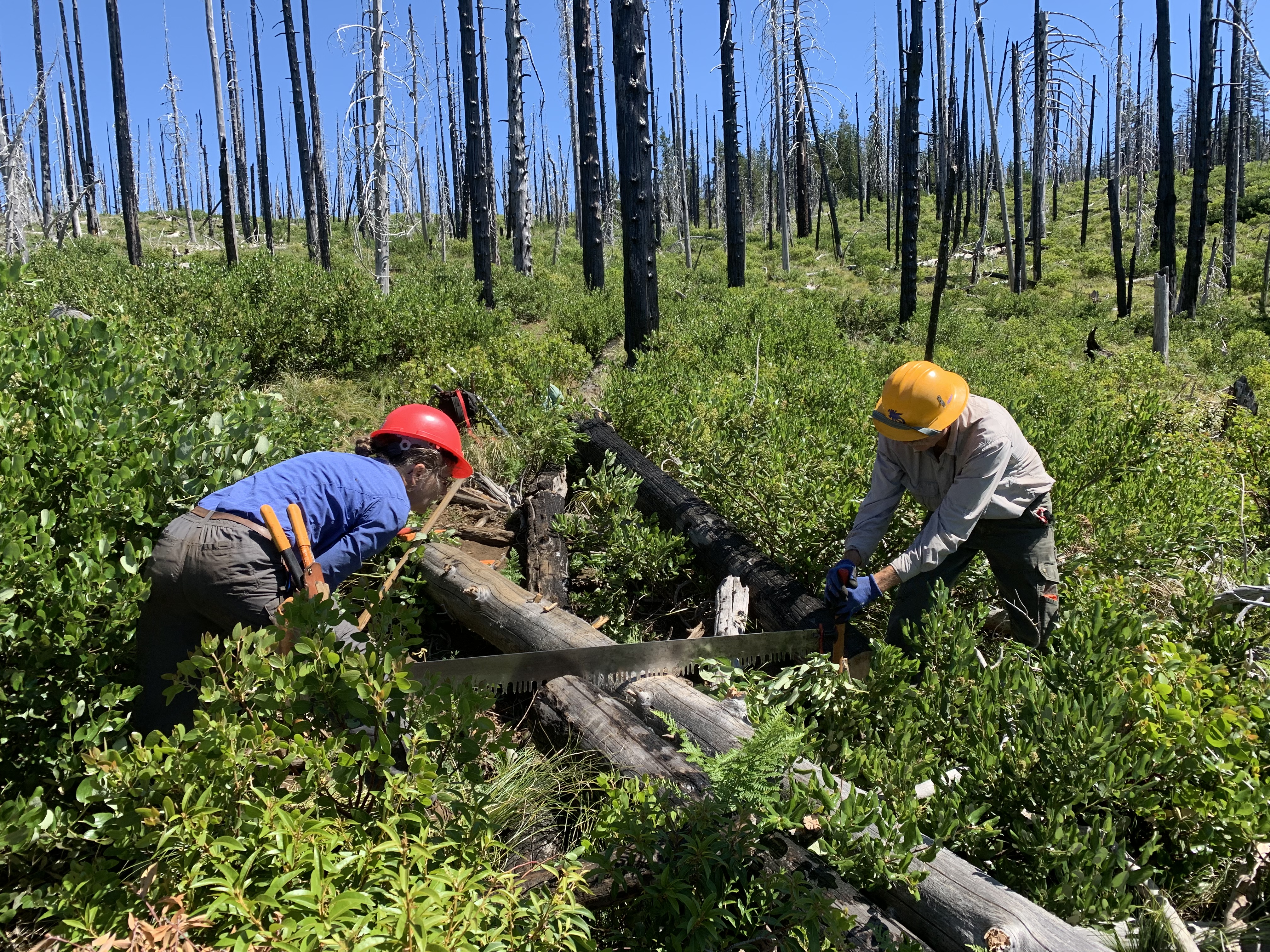
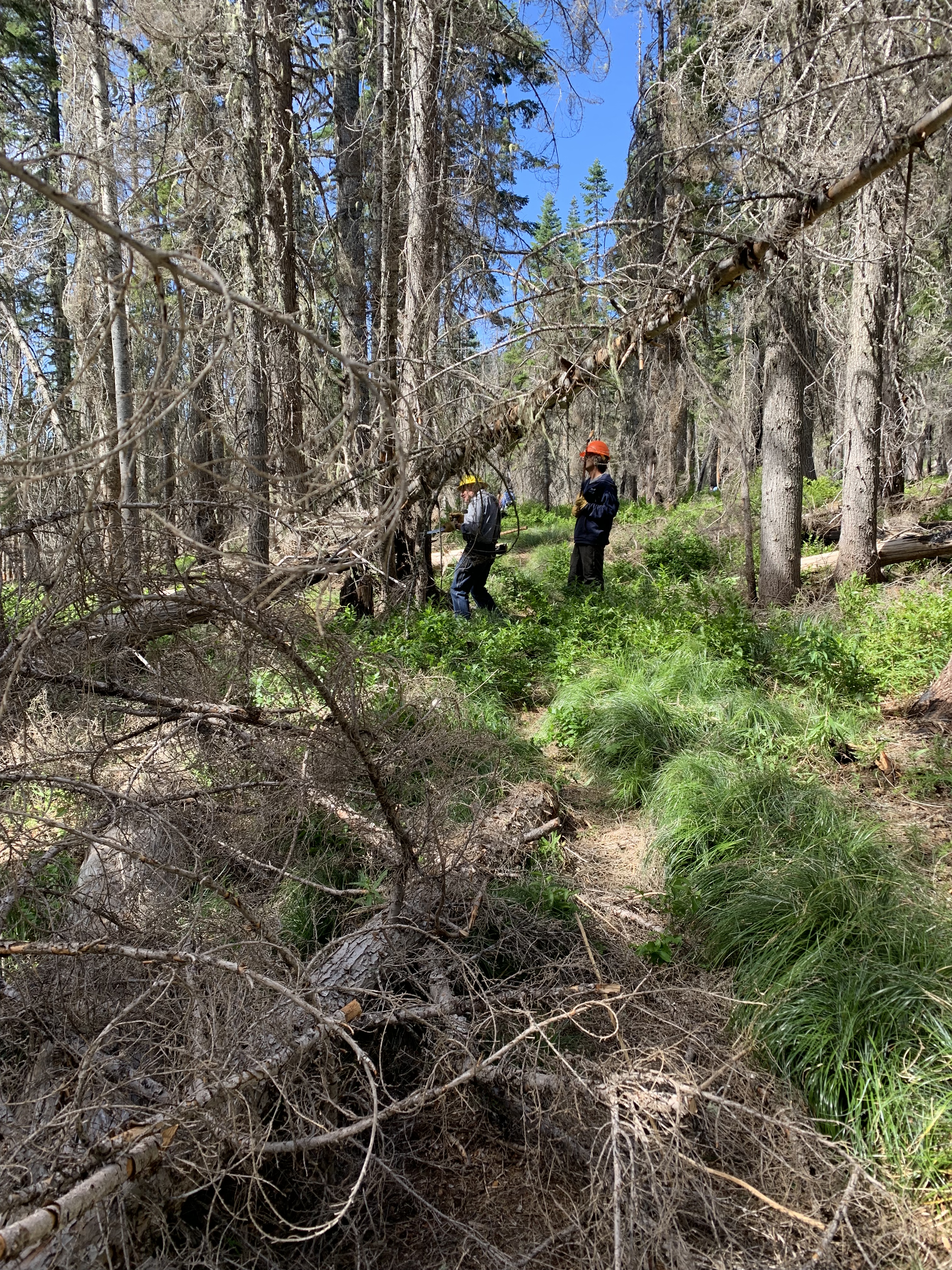
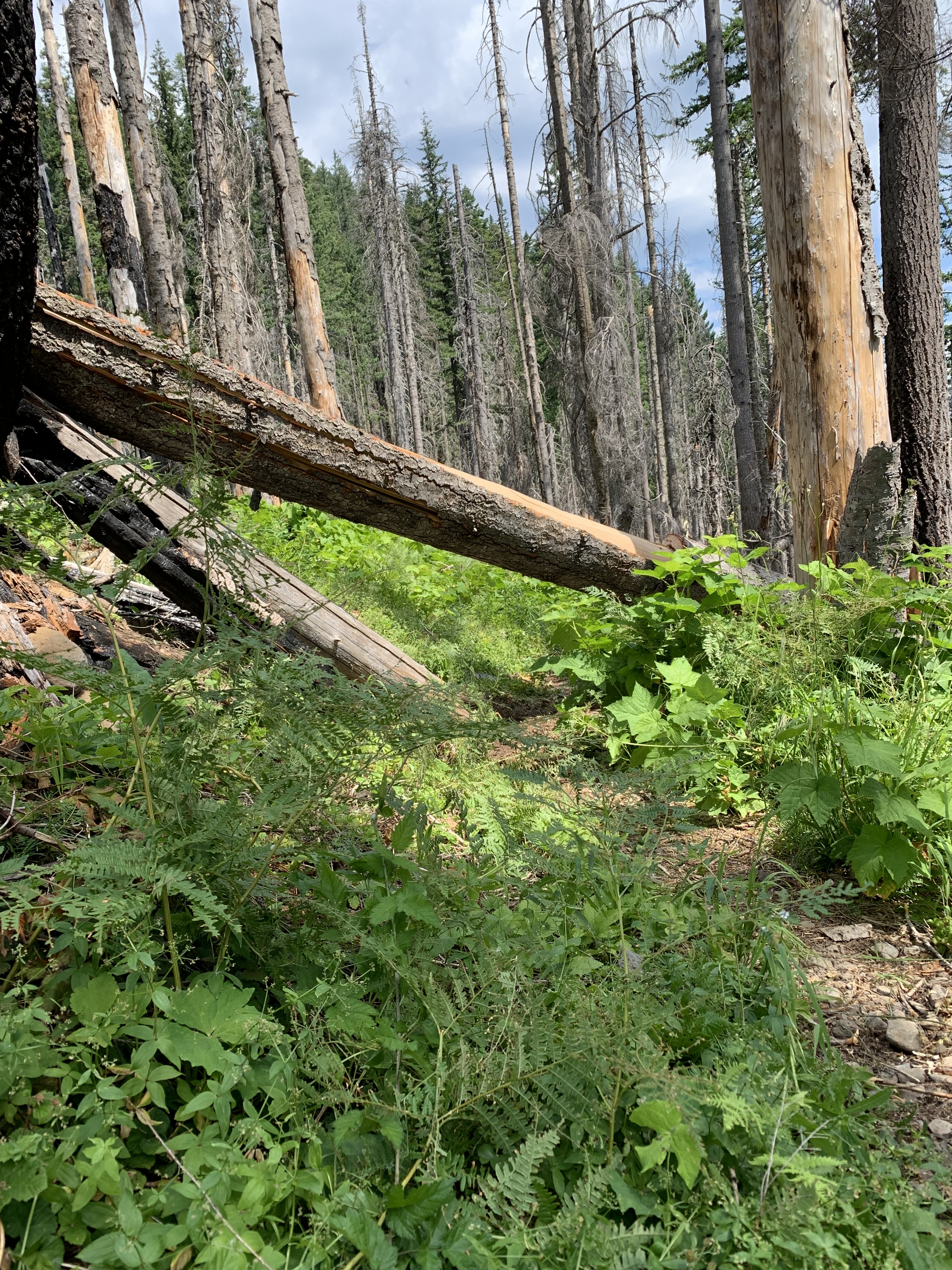
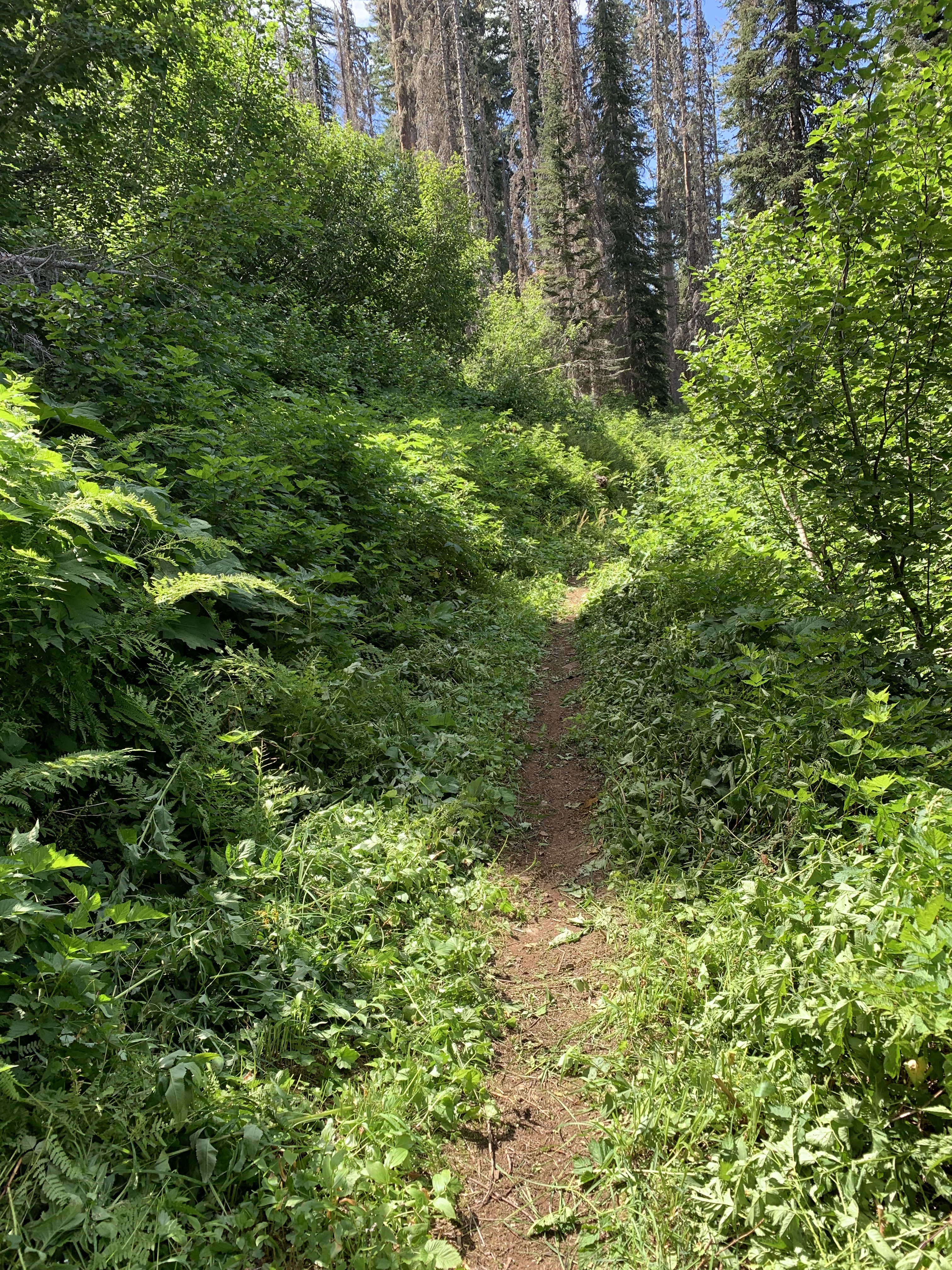
Last spring, the Crew cleared Separation Lake Trail to Separation Creek, descending several hundred feet in 5.6 miles through the Three Sisters Wilderness, the first of four days we would end up logging out trails in this region. Not a week later, I received a complaint passed to me from one of the Club’s hiking leaders that the lower part of the trail was brushy with plants, and because it had been wet, she and a friend got soaked when they hiked the trail.  

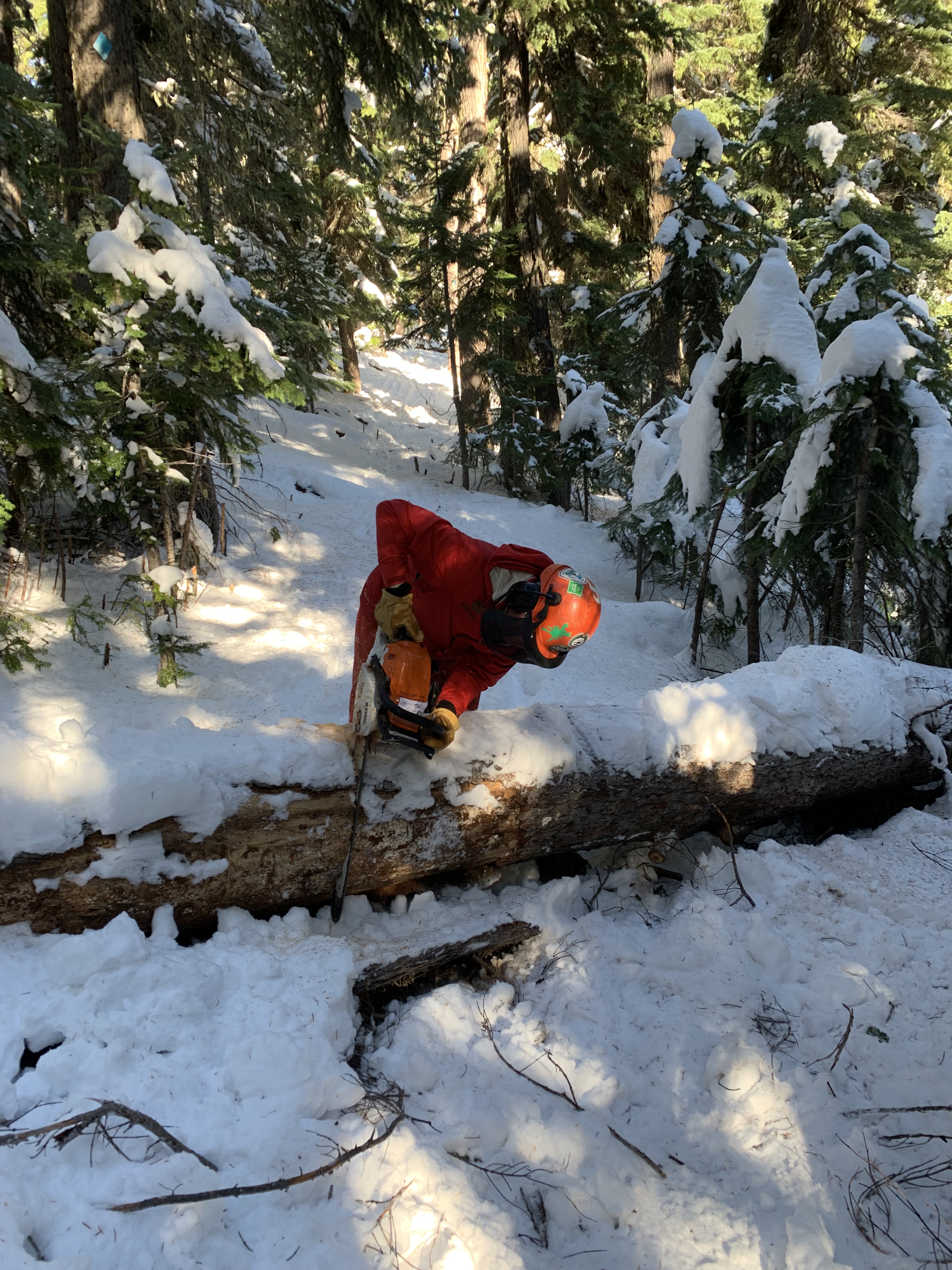
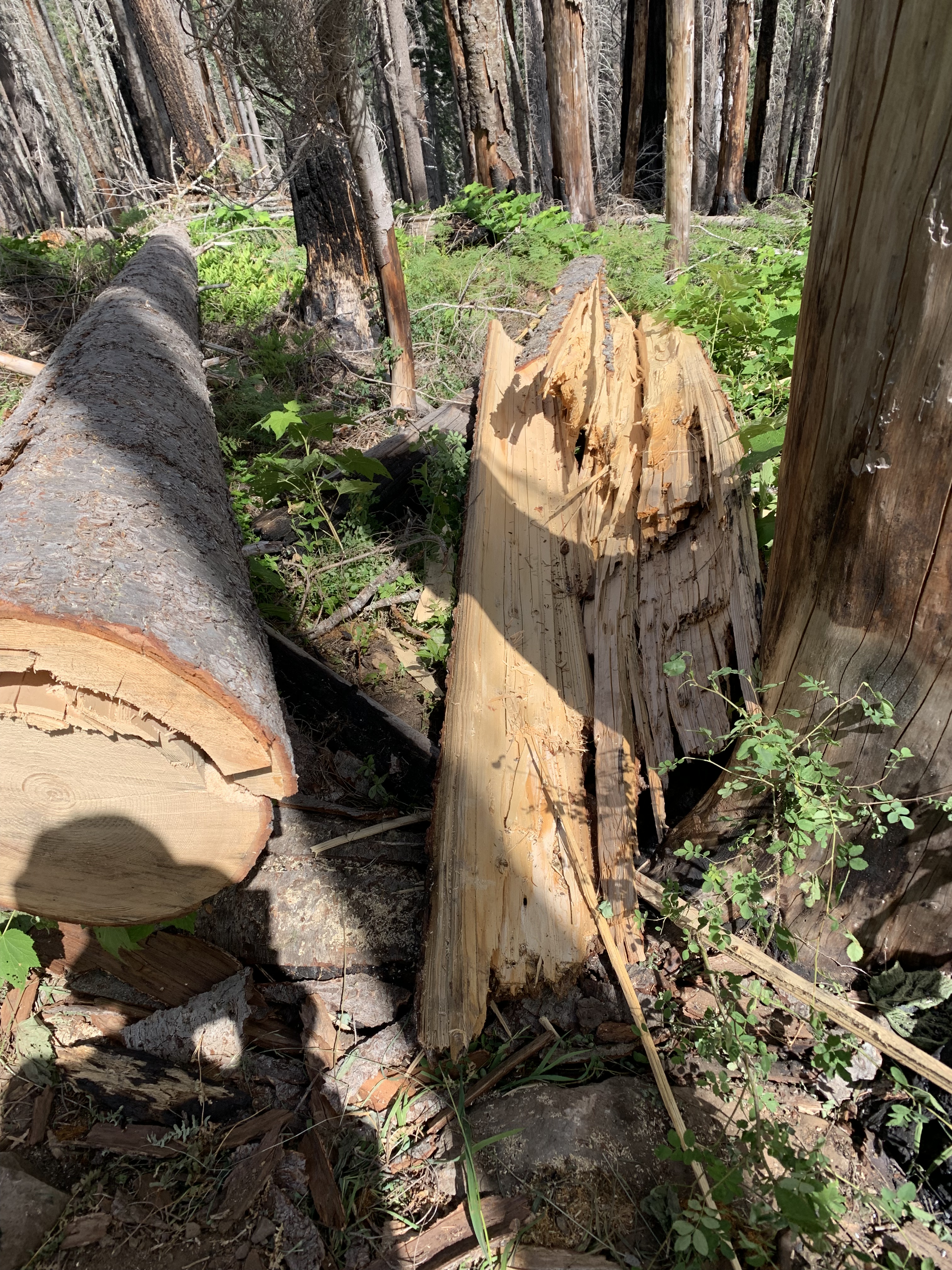
Garrett beginning to cut a log with dangerous side bind. The bend means the log will explode away from him, which it did. He is standing in the safe zone.He is also cutting far away from the area of maximum tension, which is on the convexity. We had two videos of this, one in slow motion.

Why didn’t you clear the brush?

I know the feeling. Several years ago, I hiked Cummins Ridge Trail on the Oregon Coast in the wilderness of the same name when I hit a stretch of tall, wet ferns about 3 miles in. I thought I could deal with the dampness without putting on my rain pants, but then I realized that wasn’t going to work, so I ended up stopping, pulling off my boots, putting on my rain pants, putting on my boots back on again, and continuing hiking, the only difference being that my wet pants were now covered and while they would not get wetter, they would certainly not get drier as long as I had the rain pants on.

Why didn’t they clear the brush?

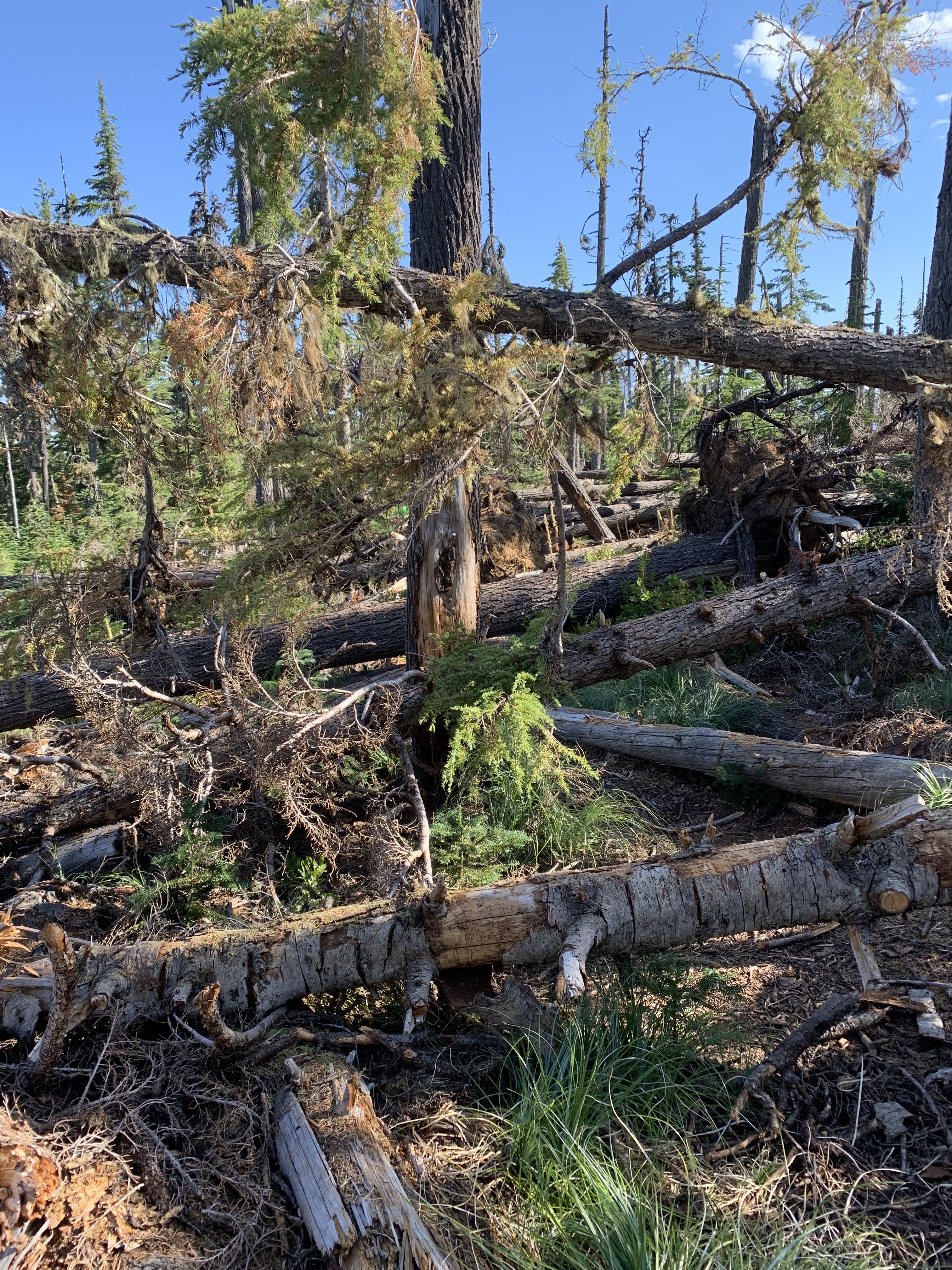
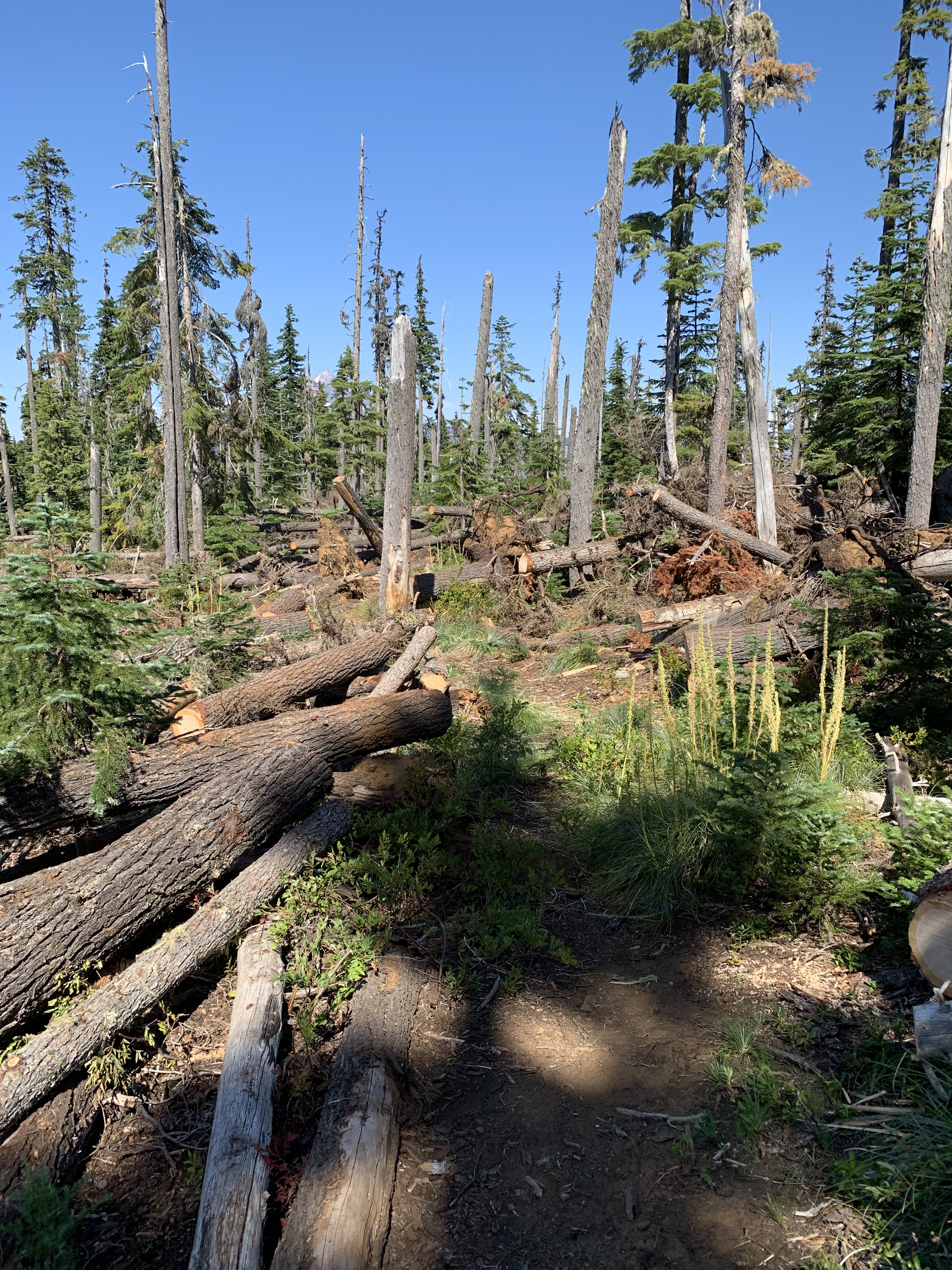
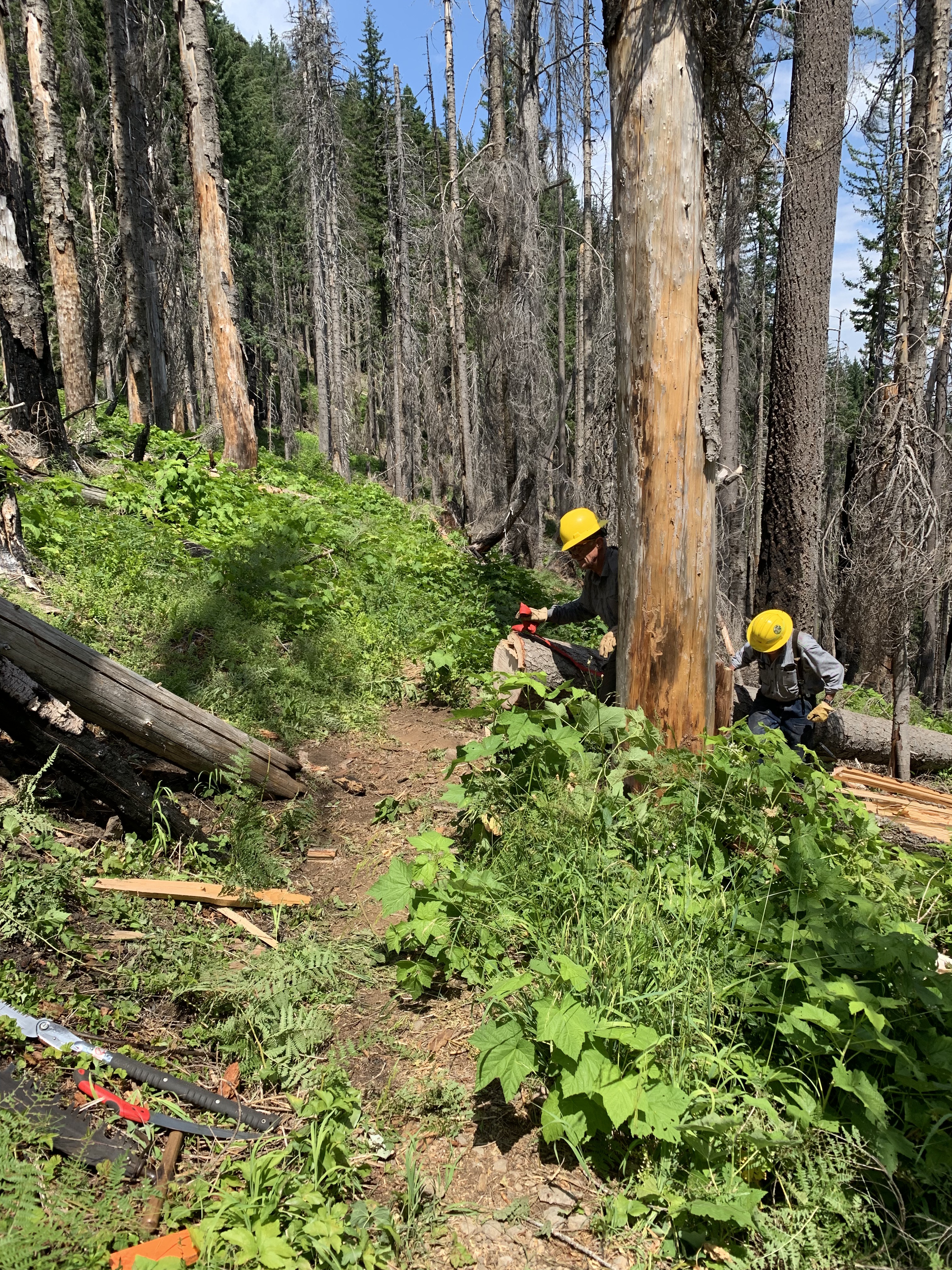
Well, the trail is is wilderness, a place where many think there shouldn’t be signage or work done at all.  There are limited numbers of crews to do the work, which is why we have volunteer crews, like the one, the Scorpions, with whom I work. We try to log out the trails first, so we can get through them, because if the trail is blocked by a big blowdown, it doesn’t matter how up to specs in tread and width and erosion control is for the rest of the trail, one can’t use it. You can hike through brush and get wet, maybe lose the trail in places, but you aren’t trying to go under, over, or around fallen, potentially dangerous logs.

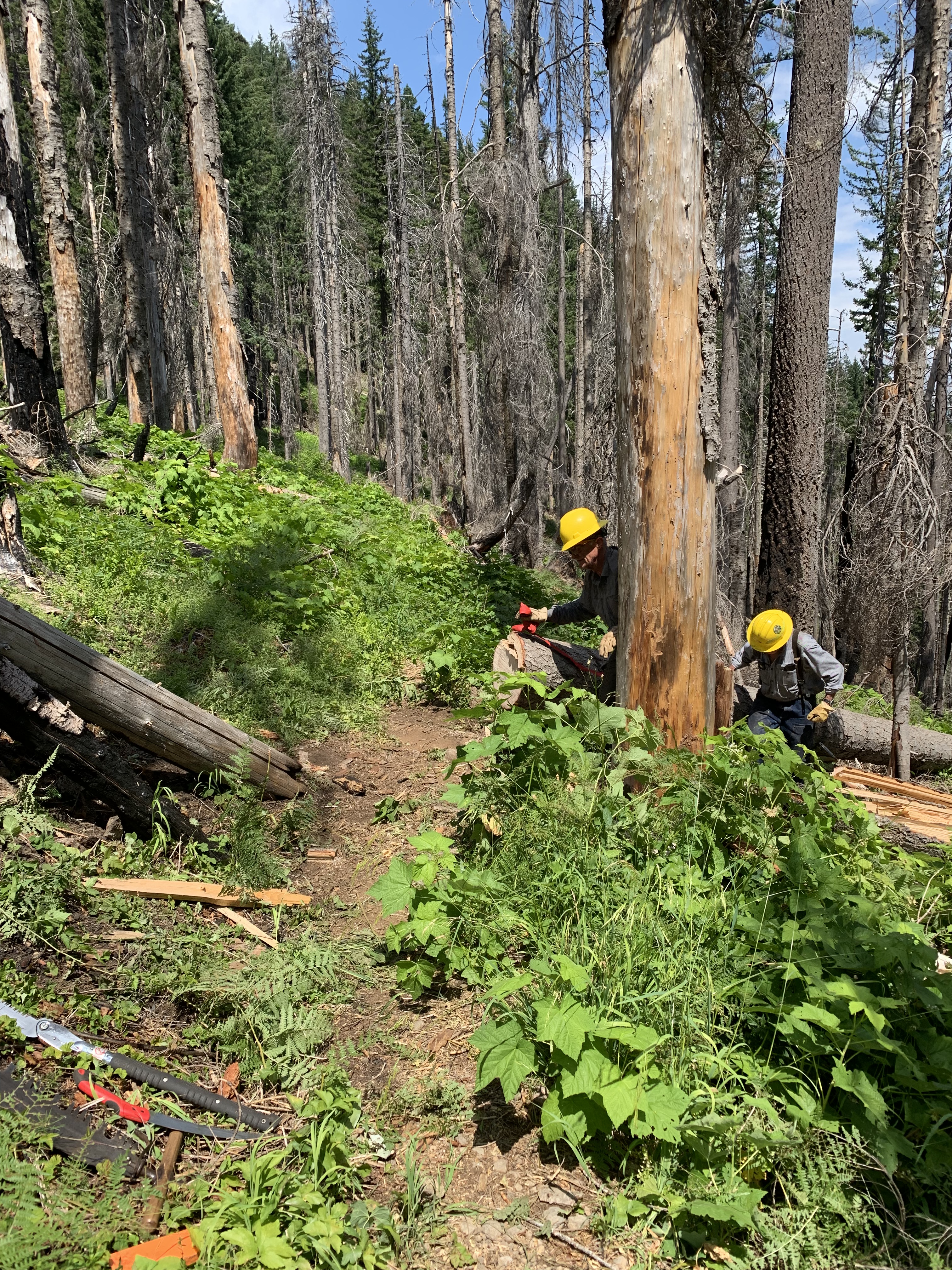
If we have time, we try to remove brush, too, but this is a massive chore. A log may be able to be pushed off or require one, two, maybe even three cuts, but those are done and the log pushed out of the way, the trail now open until the next log. Remove one, two, three dozen plants along the side of the trail and it looks the same. Remove maybe 300, and you can see a difference, until you reach the next plant. Every foot of a trail in the region of heavy brush has to be removed by clippers or loppers. How much can one remove in a day? With a pair of power brushers, which aren’t allowed in wilderness, where we can swing the brusher back and forth, we might be able to clear a mile of trail in a day.  A mile. The Crew Boss spent one logout trying to clear brush by hand over a particular difficult area of a different trail. He did perhaps 250 yards that day.  Separation Lake Trail is several miles to the creek. Even with power brushers, which are not allowed, it would take two or three days. For the record, there is another seven miles around to Horse Creek trailhead; Louise Creek Trail is comes off Separation and needs brushing, too, but it was a full day to log out 3 miles, which was only part of the whole trail.  It is wilderness, and one must understand that wilderness trips may entail more hardship. 

Working on the Louise Creek Trail.

BTW, it drizzled when we logged out the trail, so we all were soaked when we got to the turnaround point, too. So we do know how you felt. 

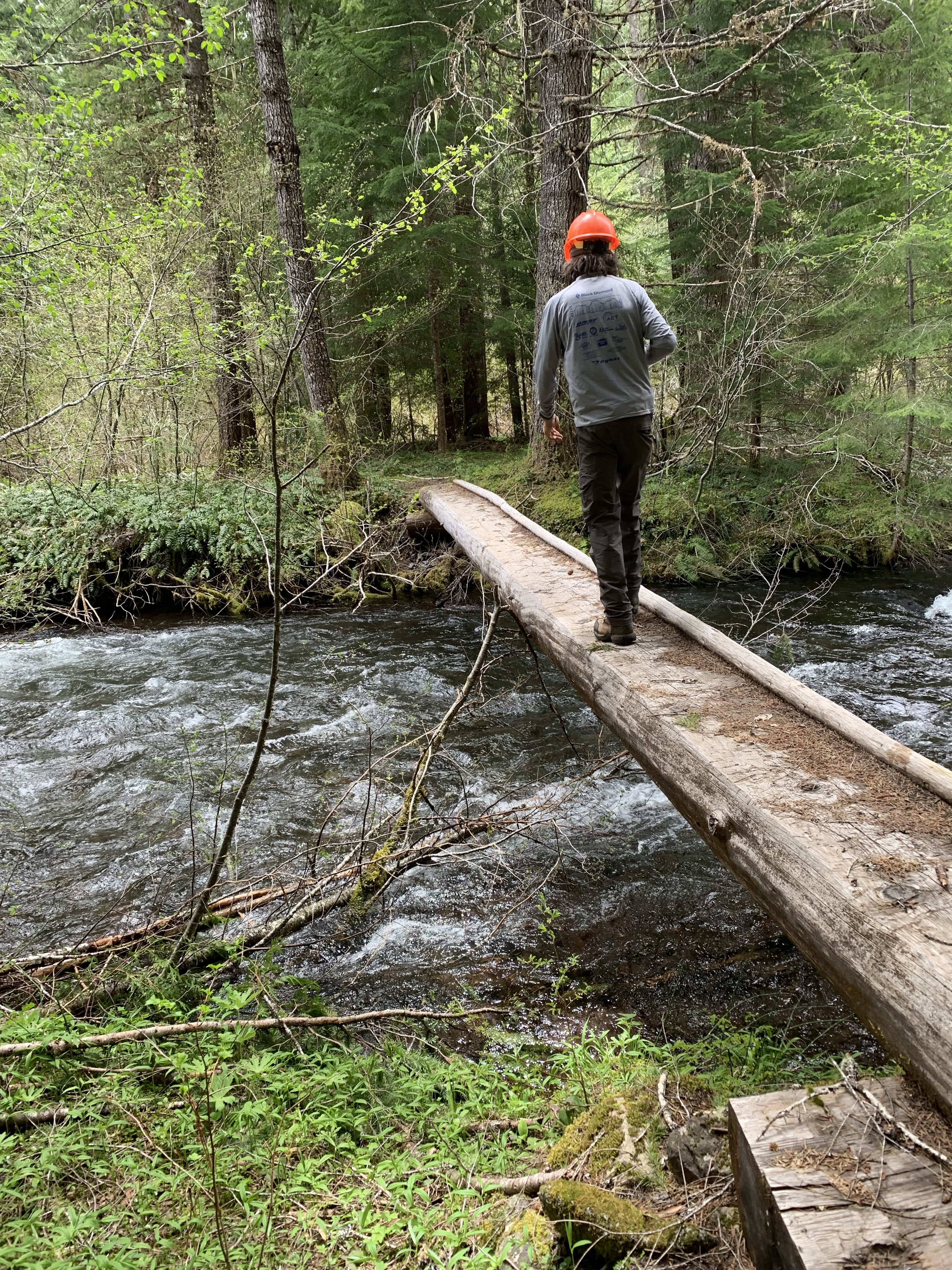
Bridge over Separation Creek. The turnaround point unless one wants to go another 7 miles to the Horse Creek Trail

Madam, the trail is now dry, because it hasn’t rained for a month. Good time to go.

***********

“….(Olallie Mountain Trail) Was not maintained- overgrown with brush and blow downs, We turned back. I called the Forest Service and they said trail crew just worked on it NOT TRUE. I read this  AllTrails.

Where were the work crews? Where was the Forest Service? How dare they keep these trails in disrepair?  He didn’t write that; I did.

Poor guy. He was 6 days too early. I don’t know why I should have felt responsible for the issue. I am an unpaid volunteer who got up early two mornings one week to drive out to the trailhead, including the last 13 miles on a dusty road with potholes, in order to work in the hot sun (especially the first day) with only two others, logging out 35 logs in 1.75 miles, including some difficult, complex ones. The second trip, two days later, we had seven out there, and six of us finished the rest of the trail, removing some 50 logs, including a couple of leaners and one on a hill that kept on giving every time we made a cut.  That means that every time we removed a chunk, the log slid further down the hill, still blocking the trail. We needed one person uphill to push on the log with his legs while two of us were below the trail pulling the log our way. Eventually, we moved the whole thing off the trail.

Sir, Olallie trail is NOW CLEAR. At least until the next tree falls. I don’t normally post on such sites, but I did post something more polite on All Trails. You can read it there. And no, currently, I don’t want a premium account. 

The Crew Boss spent the day brushing this–and a lot more– by hand.

NAUTICAL LOGOUT

July 29, 2022

On 30 June, the Crew worked Black Creek Trail, which traverses 3.7 miles from the trailhead at the end of FS 24 to Waldo Lake, climbing about 2100 feet.  A little more than a mile in is step-cascading Lillian Falls, after which the trail climbs steeply and steadily. We had logged out the lower 2.3 miles of trail; prior scouting by one of the Crew said there were no more logs until there was a wall of snow up at Klovdahl Creek, a mile from the end. We would have to wait for the snow to melt to do more, and in the meantime we tackled other projects. 

Lower part of Lillian Falls. There are numerous steps.

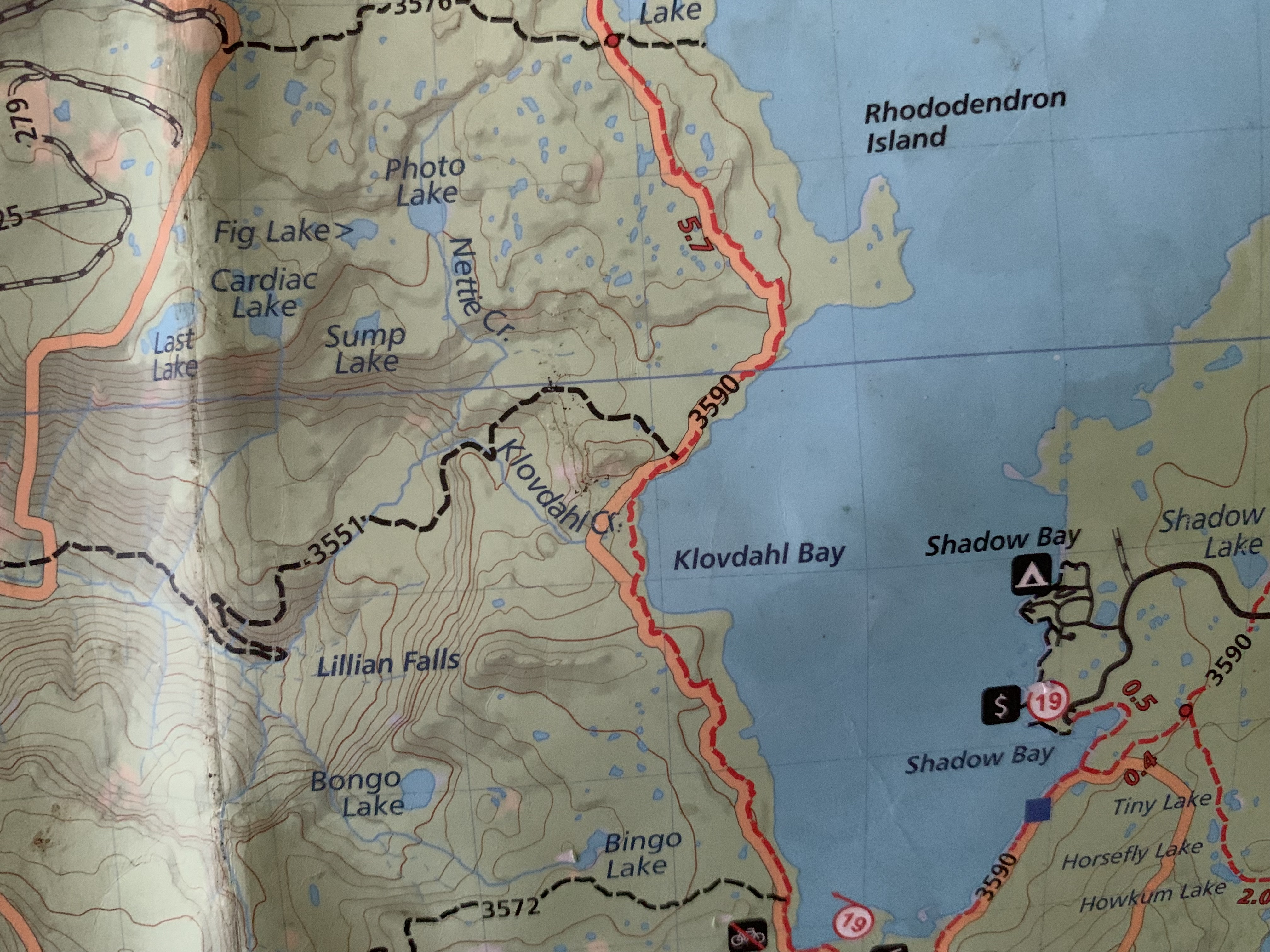
There were two obvious options to finish the last mile of the trail: one was to hike back in from FS 24 to finish the trail, which meant carrying the tools nearly three miles uphill before using them. A second option was to go to Shadow Bay on Waldo Lake and hike around the lake 4 miles on the Jim Weaver Trail that circles the lake to the other end of the trail, attacking it there. 

Closeup view of the area. The trail from shadow bay goes SW then NW.

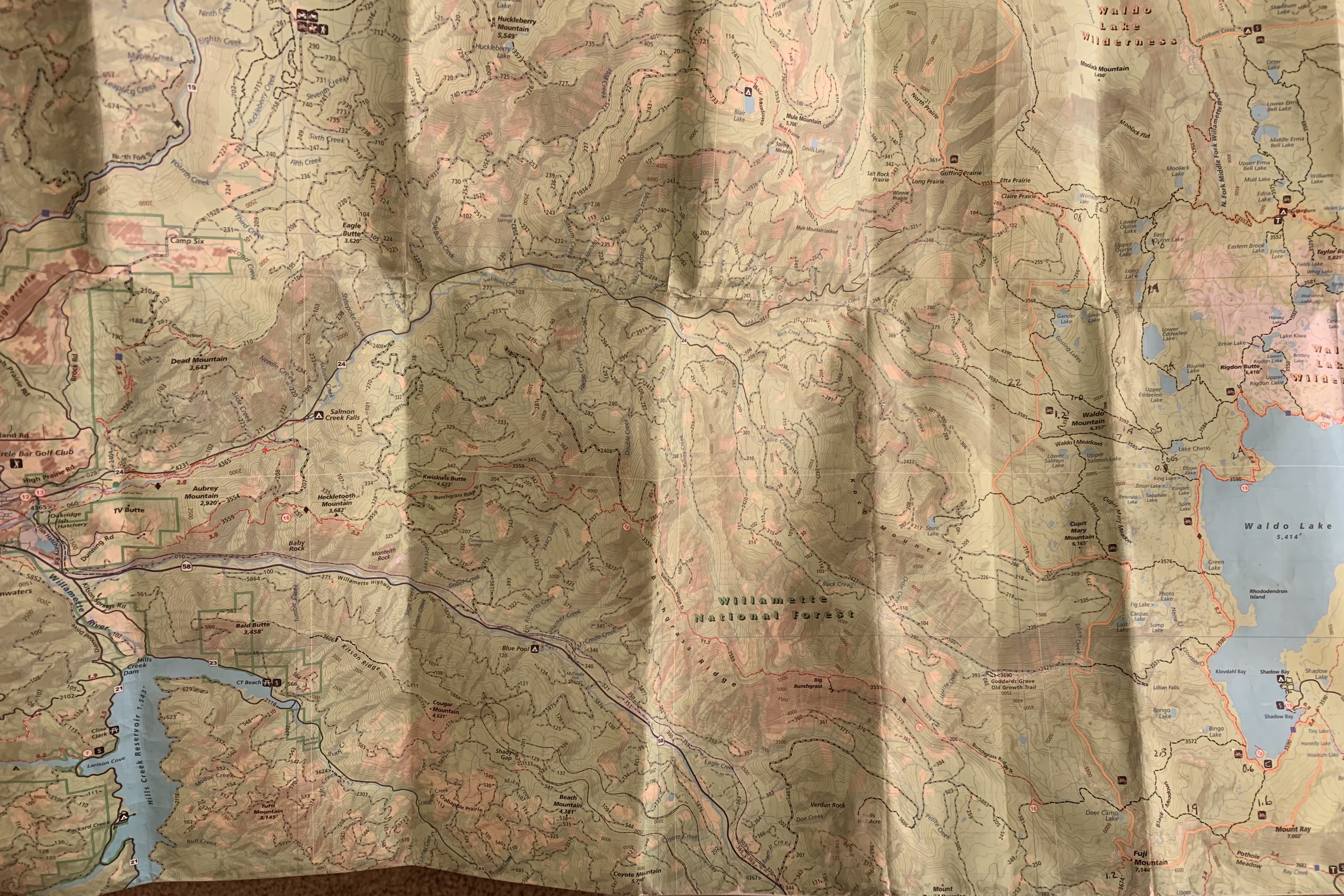
Large scale view: Oakridge is about 2/3 down the left side and is about 25 miles west of the lake.

I had seen the possibility on a map of canoeing across Waldo Lake a couple of years ago, mentioned it, and some others had, too, for last year, two canoed from Shadow Bay a mile and a half to the trail’s end and logged it out. Last week, the Crew Boss called me and asked I wanted to canoe over to the other side to help him log out the last mile of the trail.

I haven’t been to the Boundary Waters since 2019, the best place I have ever canoed, all 69 different trips have taken there. I miss it terribly. But I am not ready to deal with airports and flying quite yet. I know several in the Club have had Covid. I am less worried about dying of it than I am of having long Covid, which will be devastating to a guy like me, who like a shark, has to be moving all the time. We are on track for 140,000 deaths from Covid annually in this country, the new variant is a problem, and I mask inside and when I ride with others in a vehicle to the trailhead. I don’t want the virus. Covid is not done with us yet, regardless of whether or not people are done with it.

I’ve thought of driving to the Boundary Waters, but it is 3 days each way, maybe 2 1/2, and it doesn’t appeal to me, although I haven’t ruled it out.

But canoeing on Waldo Lake?  Wow!  I emphatically agreed, and at 8:15 last Monday, we were at Shadow Bay with a We-No-Nah Heron canoe and our gear. I additionally had my paddle and rubber boots. It was incredibly buggy, as only Waldo Lake can be in summer, and this being my ninth summer here, I can say that Oregon finally approached Minnesota for bug issues. The NW Territories and Alaska are in a higher league with bugs, just the way they are with wilderness.

Sig and I loaded the canoe. I put my paddle in the bow, a paddle given to me in 1992 when I took my leave of absence from my practice, one that was used on 22 trips that summer and has been used only twice in the intervening 30 years, once on the canoe canal in Eugene, and once to practice my stroke three years ago after I broke my hand on Mt. Hood. I wanted to see how paddling might affect it (not enough to cancel a trip).

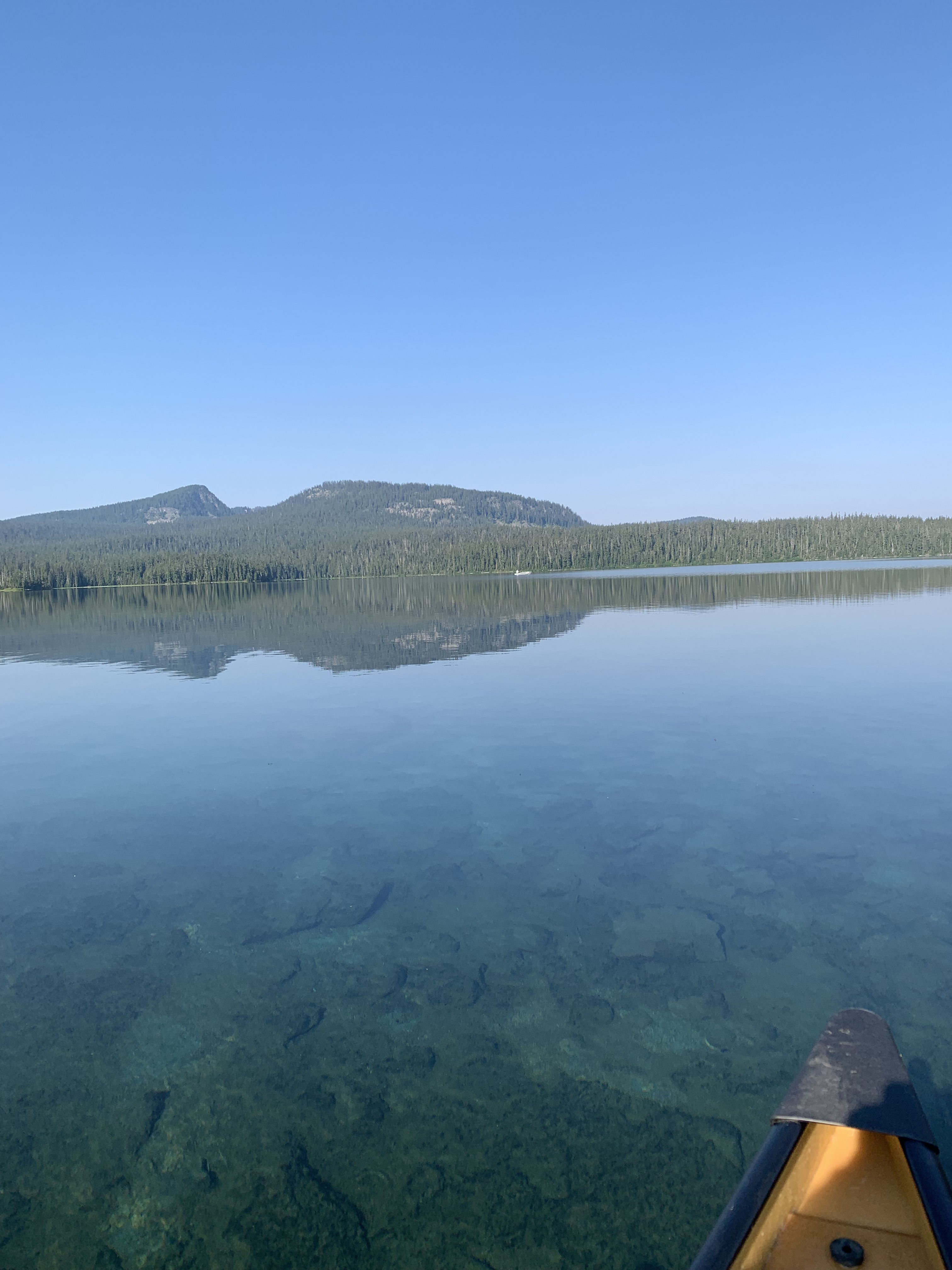
Wearing my rubber boots, I waded into the lake steadying the canoe while Sig got in. Then I got in the bow, and off we went, packs, saws, Pulaskis, hiking boots, lunches, and GPS, as the blue colored water passed under us, bottom plainly visible. It felt great to be pulling again, and I looked across the long expanse to the other side, the Open Horizons that another Sig—wilderness writer Sig Olson—wrote about.  Waldo is about 6 miles long,  2 miles wide in places, and 10 sq.mi., or about 40% the size of Basswood Lake.  I love canoeing open horizon country. There are no internal combustion engines allowed here, the spring-fed lake one of the purest in the world. There were two other boats in Shadow Bay, nobody out on the main body. I had a rough idea of where we were going; Sig had done this before and showed me about where we needed to head. For awhile, it didn’t seem like we were making progress, but we were making a good wake; there was light wind and eventually no bugs. 

Open Horizons. Note the color and the bottom.

A half hour later, we saw bottom again, closed on the western shore, and landed. We unloaded, pulled the canoe up on shore and put our work gear on. We stashed the paddles under a nearby bush, although there wasn’t anybody over there, and bushwhacked about 50 yards to the trail around the lake and then another 200 to the junction of Black Creek Trail with the Waldo Lake Trail, which led directly into the wilderness.

Within 100 yards, we found our first blowdown, and for the next mile there were at least a dozen more. I was able to chunk out a rotten one with a Pulaski to open up the trail, I pulled another two logs off trail, used Sig’s KatanaBoy 650mm on two more, and both of us used the 5 foot saw for the others. It was going to be 102 in the valley, and at 5400’ that translates to mid-80s. We wanted to get done in the morning if we could, and we did just that. We reached Klovdahl Creek at 1130, nearly six hundred vertical feet below where we started. We didn’t have to hike to where we had cleared from the other side, because we knew there were no logs. The wall of snow was history.

Klovdahl Creek

Years ago, Simon Klovdahl was the engineer who designed the head gates and the tunnel to start to run the water out of Waldo Lake down towards Oakridge/Westfir and generate power and irrigate Willamette Valley. For a variety of fortunate reasons, this did not work out. The lake and about 100-200 yards outside of it is National Forest; beyond on three sides is the Waldo Lake Wilderness. The Jim Weaver Trail around the lake is about 20.3 miles. I have day hiked it twice, fairly flat, many different views of the lake, different forests, and plenty of huckleberries.

Finished with the logout, we had to retrace our steps uphill in warmer conditions, with less shade, back to the lake. Fortunately, there was no hurry; each of us went at his own pace. We passed all the logs we had cut out, and at the lake was greeted by a slight but most welcome breeze. We had lunch on the shore, then reloaded the canoe. Sig asked me if I wanted to be in the stern on the return trip. That suited me just fine. We took a last look around the landing for any gear then pushed off and headed southeast towards the distant point near Shadow Bay. Rigdon Peak was to our north;  the Twins just to our left and east, Pulpit Rock straight ahead, and Mt. Ray to our right. There was a very slight following wind, and it took us only 20 minutes to get back to shallow water again. We had to make a hard left turn to get to the dock, I made a partial draw stroke out of a sweep without thinking much and turned the canoe on a dime.

Once ashore, we loaded everything back into the truck, changed out of our water gear, and headed for home.

Waldo is not the Boundary Waters, but it’s got open horizons, campsites, and plenty of places to explore. I think I’ll have to go up there later to camp. Besides, huckleberry season is soon.

Waldo Lake from the west, from Waldo Mountain. Rigdon Peak is on the left, The Twins center.

Looking due north from the SE corner. Rigdon Peak is in the distance.

“EASY DAY”

July 25, 2022

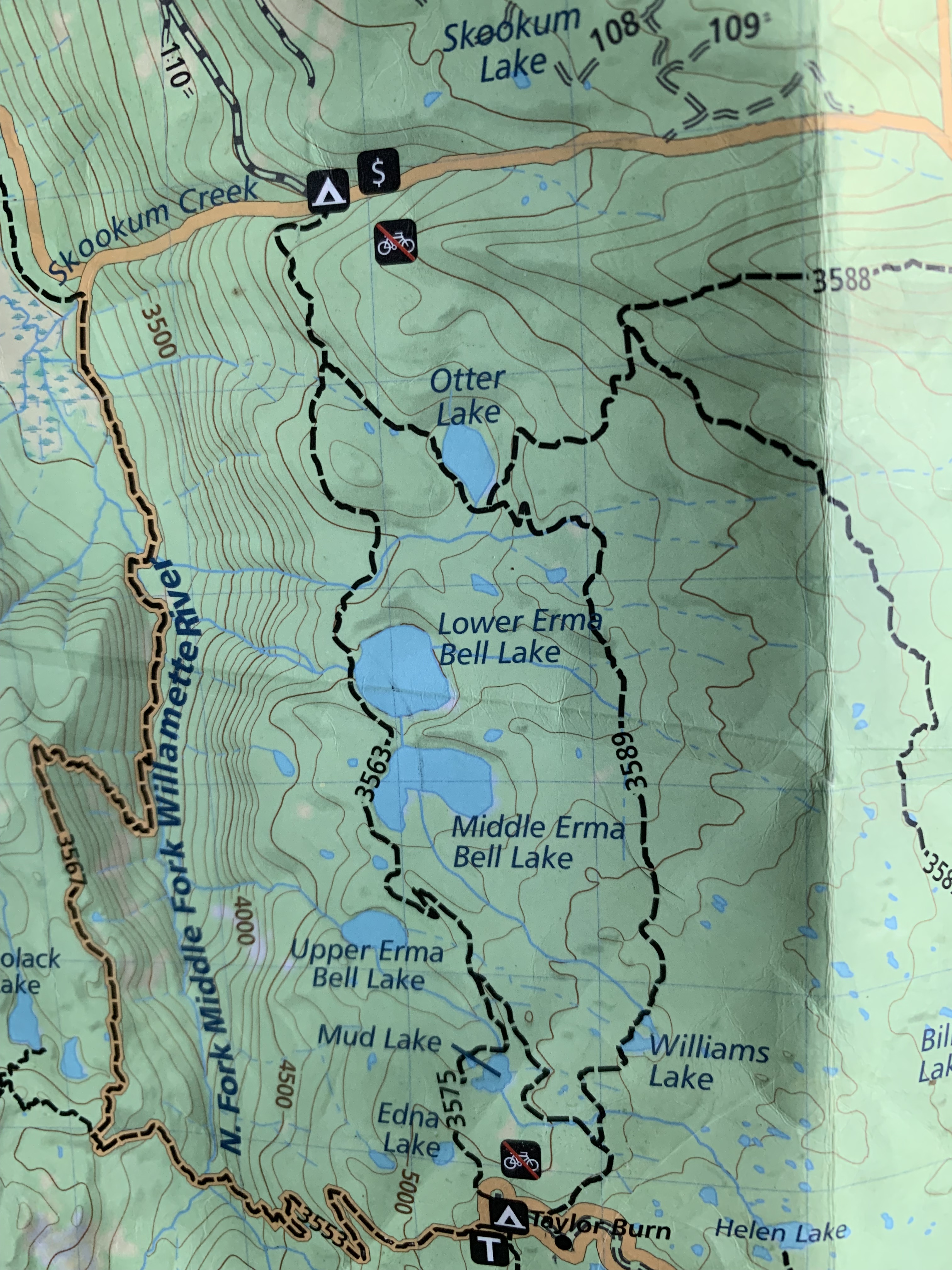
That line headed the email the leader sent out last week to the whole Crew and interested parties in the weekly summary of trail work.  I had to read the words again: “Easy Day.” Say what? We had a 10-person crew for logout of the Erma Bell and Mud Lake trails, the former being a 9 mile loop around the three Erma Bell Lakes in the Three Sisters Wilderness; the latter’s adding a smaller loop south past Mud Lake to Taylor Burn. That’s enough people, right?

Well, by the end, I didn’t think the day was easy; I was beat. On the drive to the trailhead, we encountered a large maple that fell on the Aufderheide at MP 6 requiring the four of us in the vehicle to exit. Two of us cut the maple with a hand saw and a D-handle saw; the other two picked up debris and cleaned the road. Here I was, a half hour from starting to work, and we already had done a tough one. At the trailhead, we split into two groups, one doing a lighter log load on the west side of the lakes, the side that allows one to actually see them.  I wanted to hike the east side of the loop, having logged out the west side the prior year, when snow at the higher south end prevented us from finishing the loop.

It was buggy, about as buggy as I’ve seen in Oregon, but I was the only one not wearing bug netting. I’m lucky; I don’t react badly to mosquito bites, and I figured—correctly, as it turned out—that once I started working, it wouldn’t be too bad. We got on the heavily shaded trail, fairly flat, which crosses the Skookum River entering the The Three Sisters wilderness.


The trail splits after the first 0.7 miles. There was a single log down early that I started to move off the trail, pushing without success with my legs, finally waiting to get help from two more behind me.  Log moved,  I soon turned eastward, where the two others ahead asked me, at the second log, to cut the branches that hung down. They had the big saw and were going to cut just larger logs, skipping the small stuff. I had three different size smaller saws and took care of the branches. As I moved forward again, I caught and passed the pair’s working on the next log. I soon cut out three small logs and pushed four others off the trail. Some I had to break apart to do so, but they broke easily and it didn’t take much time to move them. I was briefly passed, and then, as there was a bigger log, I would again be out in front.
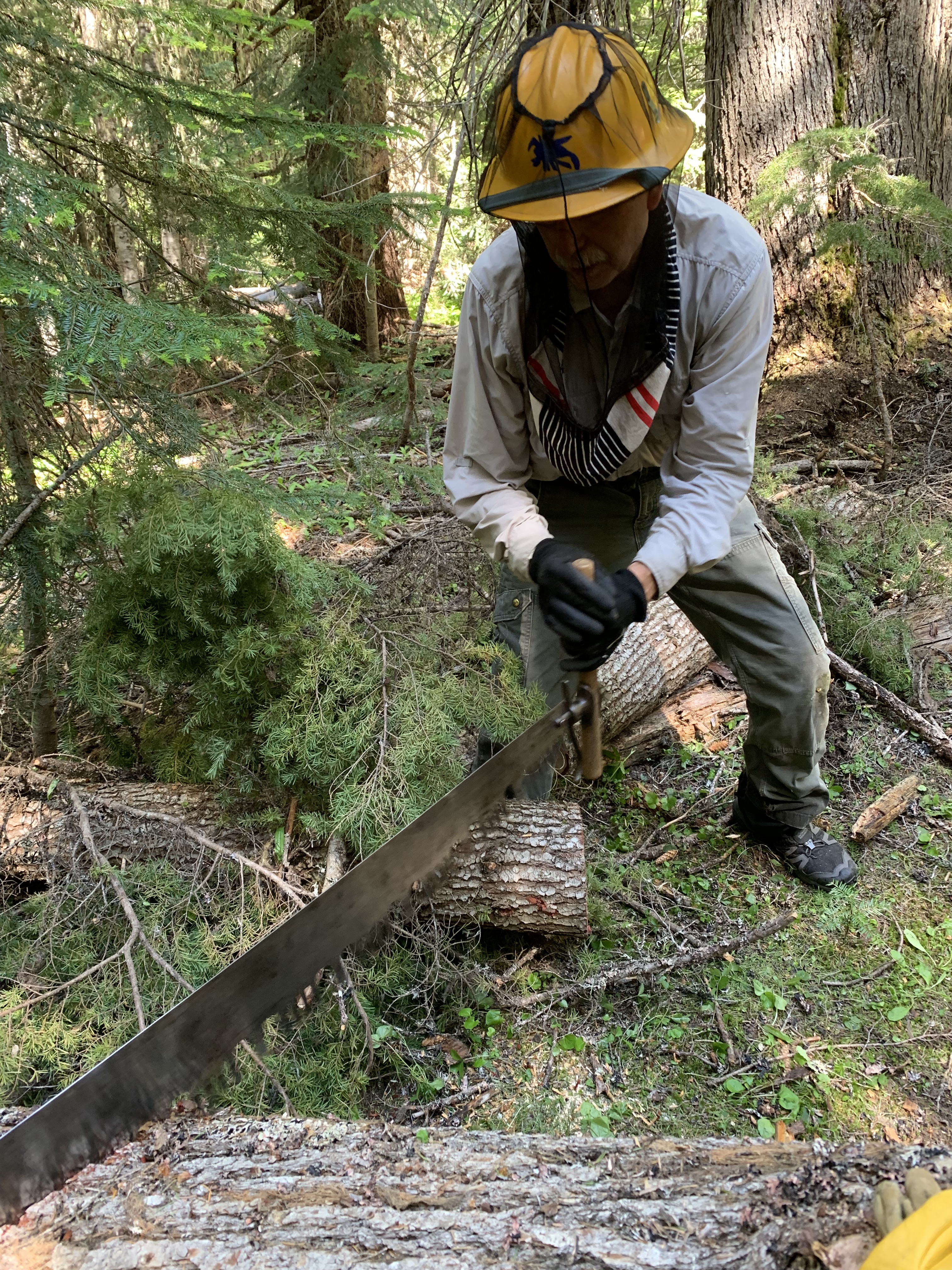
I have had easier days. I crossed a stream that was fairly deep, managing to stay dry with my gaiters on that allow me approximately three seconds to do my business in 12 inches of water before I feel it. Three seconds was enough.  From the crossing, the trail climbed steadily until I encountered a pair of 6 inch logs. I had the D-handle with me, a 4 foot one or two person saw, and was able to cut out the first, having to make two cuts to do each and move them off the trail. I moved along and found small trees across the trail. Some I could move myself without cutting, others I had to cut, some on the ground I could lift an end and move; others were not so easy. I moved at least 10 logs without cutting. That took a lot out of me. I cut out another 5 small ones, but each one, along with some of the ones I moved without cutting, required me to take off my pack, do the job, and put the pack back on.  When I used the D-handle, I had to unsheath it, use it, and then put the sheath back on. I finally fell behind, because of some of the cutting I was doing went slowly. I was, however, finally becoming competent with sheathing the D-handle quickly.

Further up the trail, I saw the two who had leapfrogged me looking a pair of logs, one about 12 inches, the other twice as much. As I approached, one asked how my face was, since he was using a bug netting. I was doing fine. He was having trouble adjusting his netting; it’s hard to wear under a hardhat or even over a hard hat. He and I cut out the smaller log  and then the three of us took turns with the larger log, a nice one, where I could stand, take long slow strokes, and rock back and forth, almost like a dance. 

Further along, briefly with the pair, I came upon another log.  Two of us cut it out, and I suggested we lift and move it on top of a nearby downed log. We did that, and the log rolled down and away.  Moving the log itself is an important part of cutting. It is very seldom that one finishes a cut and the log drops and rolls to where one wants it.

At the next large log, about 15 inches, the pair told me to go on ahead. I soon encountered a mess of branches from several small trees that I needed to move out of the way. As I worked, the Crew leader called me on my radio suggesting I eat where I was, somewhere ahead of them. I asked if he could dispatch for the noon report, since I was busy. He said he would, I finished my log and moved to a shady spot, where I had lunch, along with the mosquitoes. I have taken to eating my lunch nearly horizontal. I can hydrate, eat, cool off, and look up.

After lunch, there were only two more logs to remove before we reached Williams Lake, nearly 5 miles into the hike. I had a choice to either go on and finish the loop, or go back the way I came.

Last year, I had a similar choice on the other side of the trail and opted to go back the way I came rather than forward on to snow on a trail I hadn’t been on before. That was a smart decision. I got back a lot earlier. This year, I decided to continue, past Williams Lake, loop around back along the Erma Bell lakes, the way I did the prior year. That trail is in much better shape, there was more shade, no creek crossings, and it is scenic.

I wasn’t hiking fast, I took a break, but otherwise I kept a steady pace and expected to see several back at the parking area, since I had further to go. Nobody was there, but they came soon after. 

I was tired. Normally, I try to take pictures. But working alone and the volume of work made photography a lower priority. Cutting, breaking apart, pushing logs, and putting my pack on a couple of dozen times took a lot out of me. I do not wish to work two or even three consecutive days, like I did four years ago. I find myself puffing after just pushing logs with either my hands or my feet; pushing a log with the legs is like hiking a significant distance. Erma Bells ranks as “moderate” for an Obsidian hiking group trip. But the Club members don’t have to size up and remove logs. Still, I’d rather do this work than just the hike. I have helped make the trail passable and know the area so much better.

Falls between Middle and Lower Erma Bell Lakes

PREP WORK IS PART OF THE JOB, TOO

July 13, 2022

We ate lunch high above Rebel Creek, which below us would fall another 600 feet to the south fork of the McKenzie River. I lay perpendicular to the trail with my legs hanging over the steep drop a few hundred feet down to the rushing water.  I kept staring at a huge Douglas fir below that went straight up past me, ending in a crown of branches high above.  There was a 12 inch log that needed to be cut out where we stopped, but my partner and I were both ready to eat.  Often, I like to eat after I cut out something rather than before, but we had been cutting out stuff all morning, after we finally entered the Three Sisters Wilderness after a 2 mile hike in.

Rebel Rock and Creek trails were burned in the 2017 Rebel fire, and I could see areas on trees that were scorched, but not badly. My first trail work outing with the Crew was on Rebel Rock trail, on the other side of a high divide above me, and there, the burn was more significant, damaging more trees, but clearing out the understory. In any case, this trail hadn’t been cleared in 5 years, and it looked it. Back in early spring, a small crew logged out the first mile using chain saws, since they were not yet in the wilderness. They stopped at Rebel Creek where there was no bridge, and the day before a small chain saw crew had crossed the creek and cut about half a mile further up the trail.

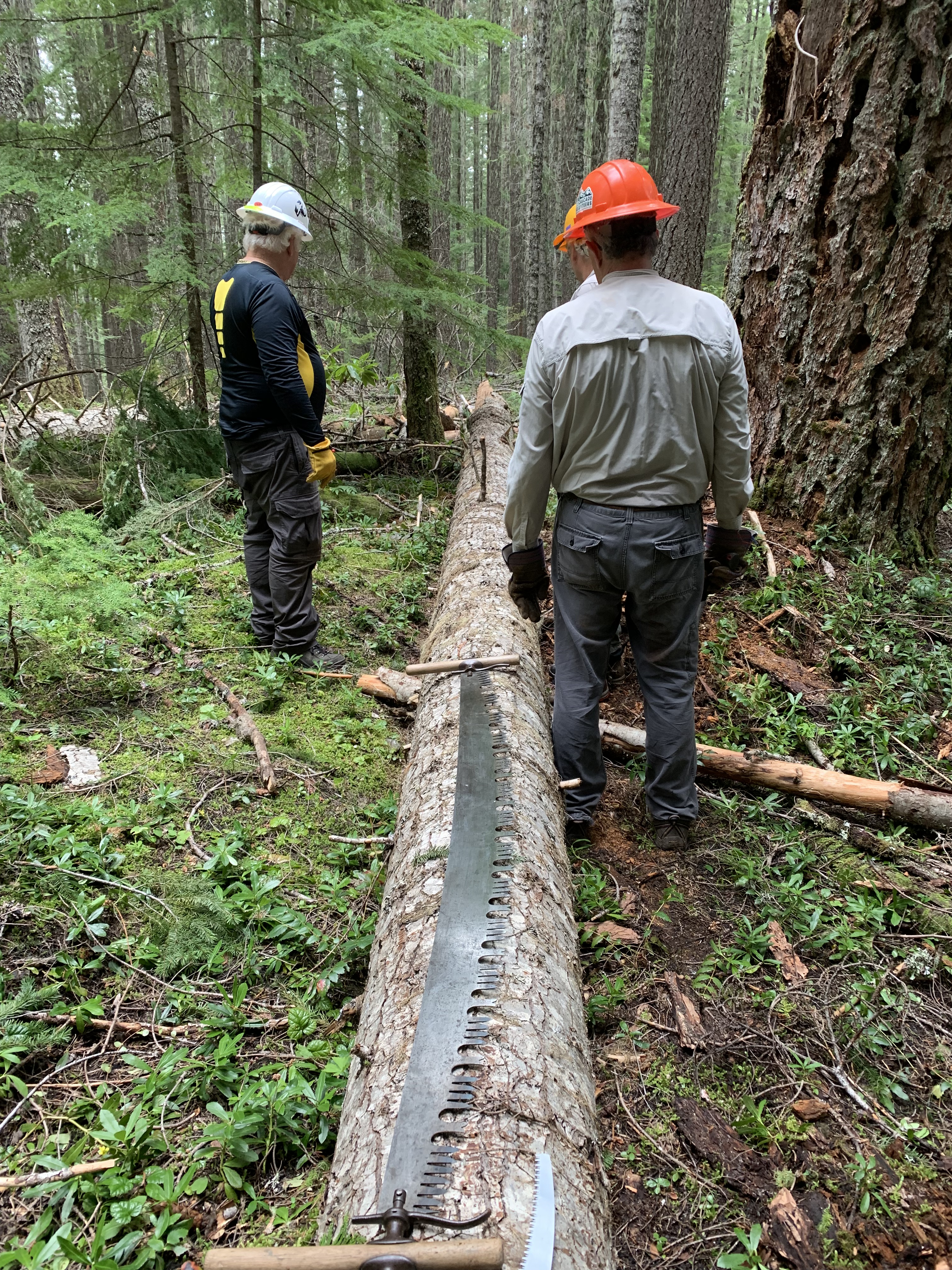
This day, there were two chain saw crews to finish logging out the trail to the wilderness boundary, and two crosscut teams, with my partner and I in the lead. We had to first hike through the remaining uncleared area outside the wilderness, trying to find the trail in a jumble of downed logs and a lot of brush, and then, when we found the broken off wilderness boundary sign, start clearing the trail from there.  We weren’t just cutting out an occasional downed log; there were considerable amounts of brush and downed branches, the size of small trees, crescent shaped, that if one kicked or picked up properly, could be easily moved off the trail.  Then we would come to actual logs, which I could tackle with my pocket saw, Corona hand saw, KatanaBoy, or the 6 foot saw my partner was carrying. It took some time for him to take it off and take the sheath off to get it ready for use, so I would use the small saws where I could. We had removed a 20 inch log right after the boundary and a few others where the big saw was needed.

Finally, the other pair caught up to us, and we returned the favor shortly later at a place with a few trees over the trail and a 20+ inch Western cedar chest high over the trail. We were about to cut it, but the other crew told us to move on up the trail. So we left, cut out a few more logs, more brush, threw branches over the side, until we turned a corner with the 12 inch log, where we had lunch.

Western Red cedar across the trail

After, we continued to climb above the creek, slowly putting cleared trail behind us. We came to a pair of leaners and used my strap on the outer one pulling it down and getting it off the trail. The other one was stable.  A hundred yards further, I took out a four inch leaner by cutting it off near the bottom, and when part of it came down, lifted it over a root in hopes it would slide more, but it hung up. So, I made another cut, shortening the leaner and finally broke it free. It slowly dropped towards me, and I guided it over the edge. 

The leaners. We left the inner one.

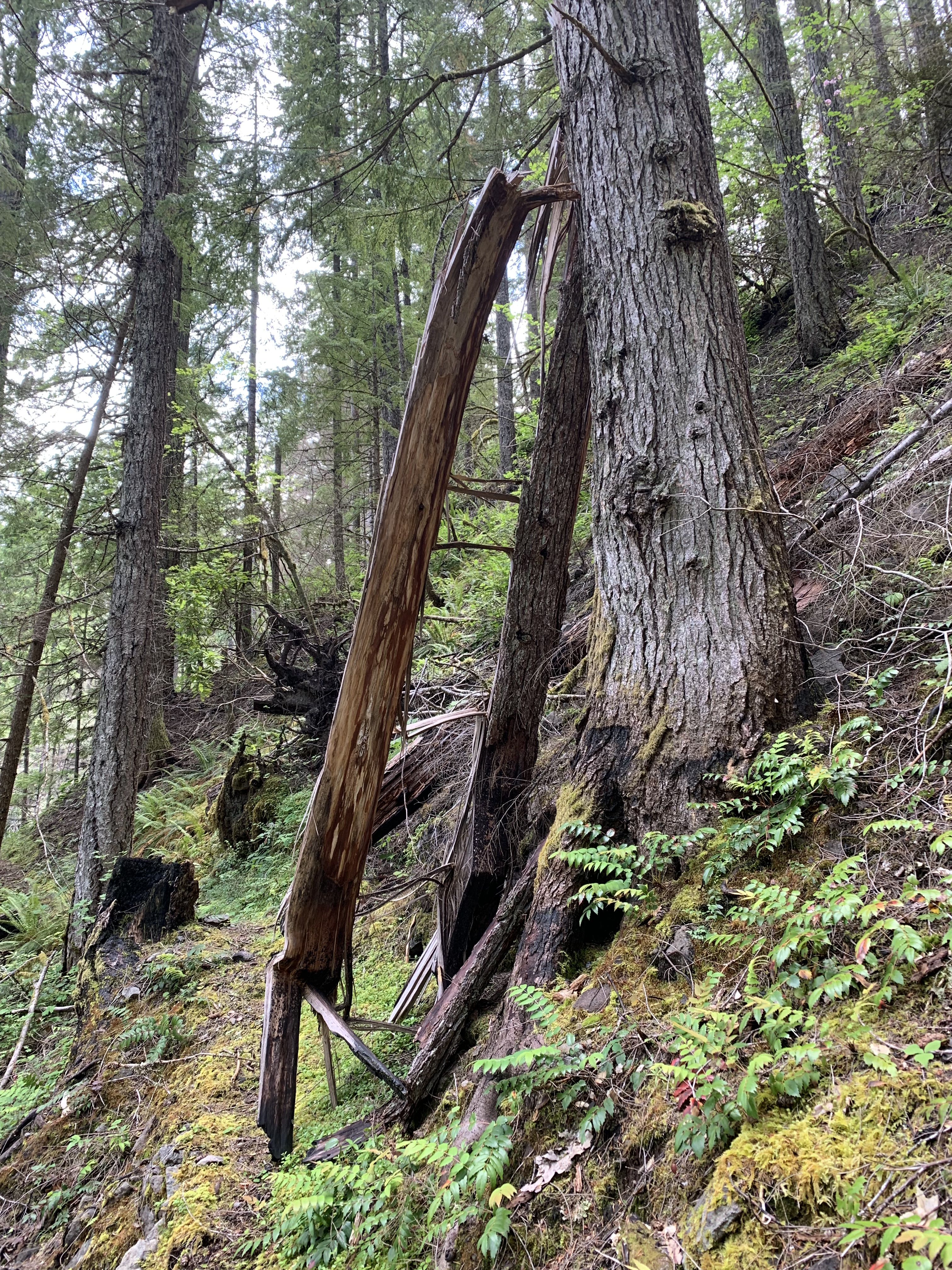
Up ahead, my partner was at a big, big log. The hemlock was across the trail, several inches of ground clearance, large 4 inch diameter branches on it, one of which looked like it was supporting part of an old burnt out log that was over the one we needed to cut. From that log 15 yards up the trail were a series of trees downed or over the trail. There was plenty of ground clutter where we were.

Steve evaluating the log. The trail goes towards the upper left corner.

Log outs aren’t just 2 folks on a crosscut going from one log to the next.  Aside from all the brushing work we had to do in between logs, like the leaners, or the 2-6 inch logs that sometimes were part of the ground and could be surprisingly difficult to remove, there was a lot of prep work.

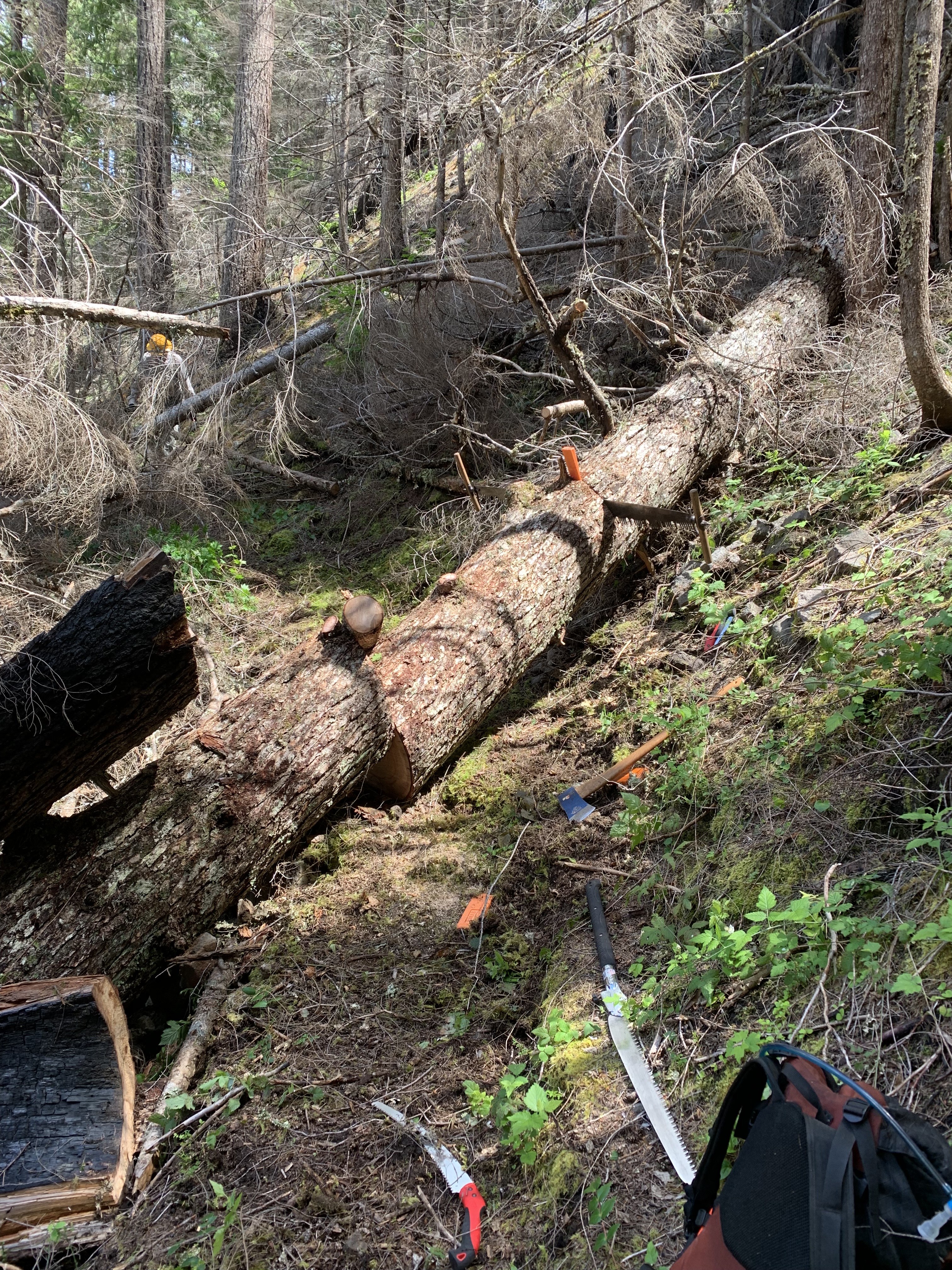
Part way through. The axe needed to be sheathed or in a log.

OHLEC, or the approach to cutting, is Objective, Hazards, Leans/Binds, Escape Routes, Cutting plan. THEN, it’s time to cut. I also consider “Overhead’ as part of the O, to remind myself to look for dead trees or other hazards right above the log to be cut. This log had several large branches that needed to be removed, one of which looked like it was supporting a slab of wood above us. It might not have been, but we don’t like surprises, and might not happen is a poor approach to cutting hazards.  

There were also hazard branches over us, stobs, or broken branches that either could support the log off the ground and might be useful left alone, or interfere with the cut log and make it difficult to roll it off the trail. Each had to be addressed, and as noted, some of these were the size of small trees we had been removing. There were also small bushes that could trap the saw briefly, get in the way of cutting, or brush our faces while working.  My partner trimmed the slab, then removed the branch that might have been supporting it, which as it turned out, it was not.  We cut off the burned slab, not difficult given its limited thickness. It took us the better part of an hour just to clear the area of hazards.

The log is cut out and more of the trail needs work. The pry log I carried is right underneath the axe.

Removing the log needs to be planned for before the cut, too. I suggested getting a pole to put under the log that would help guide it off the trail. I looked behind me at a 5-6 inch log I had cut out 30 yards back down the trail. I could cut a chunk of that out. In the meantime, my partner went up the trail and started clearing the next 15 yards of debris.

The 5 inch log was on a slope, and true to form, difficult to deal with. I was able to pull it down a little to get a long enough chunk to use.  Unfortunately, as I was cutting through, the log began to shift and slid down several feet, meaning I had to start over. There was some top bind on the log, so I did a top cut and then finished with an undercut  doing part of the work below the trail on a small flat rock, where the log was trying to slide past. Once I got the 6 foot length cut out, I moved it to the trail, the rest of the log slid down to partly over the trail, not what I wanted. 

Nobody else was coming, so I didn’t worry about the remainder and carried the pry log back. We put it under the big log and then made two cuts from the top, dropping the log on to the pry log. Once it was there, we turned it about 60 degrees, since it was easy to pivot, and then with our legs, two slight pushes, rolled it off to the side of the trail. Finally done.

I would later check the next 250 yards of trail before the next big log. I would throw several branches off the trail, and with a small pull, have 25 feet of log go smoothly by me over the edge, with minimal effort. We made almost a half mile today. There are 3 miles at least to go on the trail to finish. My partner was kind enough to remove the log I had taken the pry log from.

We’ll be back here again, but we’ve got other trails that are higher priority right now. 

Trail after the hemlock was removed, and the four other logs below it.

NOT RACING

July 5, 2022

I dropped my pack at the Horse Creek Trailhead, opened it up, took my foam pad out, sat on the ground and lay back on the pad against my pack, knees up in the air. We had just completed 13.2 miles of the Separation Lake and Horse Creek trails, logging out the middle stretch of 2.7 miles. Three weeks earlier, we had logged out Separation Lake Trail’s 5.6 miles to the bridge over Separation creek. Two weeks ago, we had done the same at Horse Creek, on the far side of the drainage, finishing 5 miles later on a ridge, climbing 1700 feet in the process. Last week, we had cleared 3 miles of Louise Creek to the snow line, and this day, we did what we called the Horseshoe Loop, with a car shuttle, even finding a few newly fallen logs since our last visit.

Horseshoe Loop; Separation Lake to right of straight line. Start was “T” by Rainbow Creek

“When did you get here?” came from Julie, well less than half my age, who showed up a few minutes later. “I couldn’t catch you!”

“I haven’t been here long,” I replied.  I don’t tell people how far they were behind me any more than I ask how long others have arrived before me. It’s not a race. Once I am in cruising mode on a trail, I don’t vary my speed too much, barring logs or beautiful spots. I can’t go faster longer, or that would be my default speed. And I don’t want to go slower, especially if there is a lot of ground to cover, time is limited, or the weather is unfavorable.

Moving a log on Horse Creek. Note the PLT, the “Precision Leveraging Tool,” many of which are lying around the woods.

I started the hike in front. However, I encountered a new log, fallen in the past two weeks after we had cleared the trail, and stopped to remove it.  I was then at the back of the group. I don’t mind being at the back as long as I can see the next person or know I am relatively close, for I know that I am still connected to the group. I moved up a place when we got to the bridge across Separation Creek. I had passed one person on a stream crossing, since I tend to go right across if the water isn’t any deeper than a foot. My gaiters will keep me dry for a few seconds at that depth.  I briefly caught up to Julie, who hadn’t hiked this trail before and wondered if we were still on the right trail. We were, and shortly afterwards, she was long gone ahead. The upstream trail part was in the 4th and 5th miles, and I was already tired, given the tools I was carrying. This was going to be a long day. We were in a canyon, and we were going to have to climb out before the long descent to the end. I tried not to think about the climb.

After crossing the stream, on a bridge that was a bit dicey, we started the logout part of the trip, 2.7 miles to the Horse Creek Trail via Separation Lake, half way, where we would eat lunch.  

Four logs later, we arrived at the campsite. We take a half hour for lunch, but I left a little earlier to avoid becoming too stiff. If I started flagging, I wanted to at least start to fall back from the front. But there were two new logs to cut out, so after two of us dealt with them, I was once again at the back. There were two stream crossings where log bridges again were narrower than I liked, not because the water was fast moving—it wasn’t—but it was deep enough that I didn’t want to have the weight of wet clothes to add to what I already was wearing and carrying.

The steep section was straight up, no switchbacks, suggesting it was an old trail, since most trails switchback to prevent erosion. Again, I arrived at a log needing removal, but the crew leader behind me told me to go ahead. I was hoping he would say that. I was in the middle of the group on a steep climb recalling  my 45 mile backpack around Mt. Hood, where leaving Tilly Jane going to 7000,’ I was taking 40 steps and stopping to breathe, then 40 more. This one I was making only 50 steps.  Two were above me, and I had no idea how they were doing it, only that I wanted to be where they were, so I kept going, 50, stop and breathe, check the altimeter, 50 more.I reached where they were, and they were again further up.  It was 600 brutal vertical feet straight up the ridge over maybe a half mile. When we reached the junction, at 3 pm, five miles yet to go, I was concerned at how slowly I did the climb. I wasn’t carrying an excessive amount of weight, my knee was behaving, and I was just doing what I could, but I felt like I was hanging on for dear life.

5 miles to go.

I told the crew leader for the third time that day I was going to start early, again to avoid stiffness.  And for the third consecutive time, within a short distance there were two new logs that we had to cut out. After removing them, I was now in the back, but we were going downhill, so the hike became easier. At stream crossings, I looked for the shallowest place and went. I had done the same on Mt. Hood. My feet were already wet and as a canoeist, wet feet don’t bother me much. They weren’t going to dry before I finished the day, so I just kept going. And finally, the cruising speed I have after several miles of hiking started to kick in. I was still tired, but my legs worked automatically it seemed, especially downhill on a familiar trail. The crew leader later passed me; I kept him in sight for the most part and finished about 5. The others came in behind me “a few minutes” later.

I might do the loop again next year, but with lighter pants, a few extra wedges in my pack, and maybe see if I can get into better shape before I do it, although at my age, better shape has a low ceiling.

STRAIGHTFORWARD DAY

June 27, 2022

The Salmon Lakes Trail was going to be an easy logout, a vacation compared to the prior week’s 13.2 mile trek through the Three Sisters Wilderness. I had scouted the trail 4 days earlier and had found 6 logs starting two miles east of the trailhead, inside the Waldo Lake Wilderness, which surrounds Waldo Lake on three sides, but does not include the lake itself. Once those logs were removed, I would hike about a half mile further to Upper Salmon Lake checking for logs. I doubted there would be many there.  It is fairly open on that stretch and the last few years has had few obstructions.

Waldo Meadows area

Half of the group would then head north up Waldo Meadows Trail where I had found another half dozen logs within a half mile, before being turned back by snow.  It was warmer, and there had been rain, so it was possible that enough snow had melted that perhaps the group could reach the junction with Waldo Mountain Trail a mile from the meadow and hike that back to the trailhead, logging it out and finishing the loop. In any case, it had all the makings of a straightforward day.

Two miles in, I took care of two smaller logs myself, moving both of them, helped cut out a third, and we all regrouped at Waldo Meadows, which was entirely visible, the snow’s having left probably not more than a week or two earlier. In summer, the plants are so high, one can hide in it. Indeed, 4 years prior, almost to the day, was the first time I saw the meadow, and I could barely find the trail. I thought that was the default view of the meadow, but the grasses and flowers are all annuals, and in early season it looks bare.

Waldo Meadows 8 June 2021
Same place 23 days later, 1 July 21

I headed to Salmon Lakes while three others in the crew with me took care of a log. The trail as expected was clear, the outflow of Upper Salmon Lake, which becomes a major tributary of the Middle Fork of the Willamette River in Oakridge, was flowing well. A patch of snow was near the lake, presumably in a shady spot or other cool microclimate. 

When I returned to the meadow, the log had been cleared, and I radioed the crew leader, who was above me on the Waldo Meadows Trail heading away. I told him we would continue logging out the trail another mile or so, heading towards Chetco Lake 2 additional miles east, before turning around. Before reaching Chetco, another trail turns northward and then west, climbing Waldo Mountain, 1000 feet above us, which now was still covered in snow and inaccessible, before descending to the junction to which other crew was heading. The full loop is about 9 miles, with 1700 feet of climbing, but the views from Waldo Mountain are spectacular.

Waldo Lake from Waldo Mountain. The paired Twins are across the lake

I put my pack on and started walking east through Waldo Meadows, the trail climbing slightly through grass, thinking that few trees are out here that are going to fall on the trail, so I will get some free mileage without logs.

I was so wrong. 

A 250-300 year old hemlock, part of a small island of a few trees in the meadow, had fallen smack across the trail, and its 47 inch diameter size gave new meaning to DBH (diameter at breast height). The downed log literally came up to my chest. I cleared a few branches while waiting for the rest to arrive.

After some soul searching and group discussion, we decided to remove the log. Making a bypass of the log in a trail in a somewhat fragile meadow is not something we want to do. We started one cut on the main log and a trimming cut on the end closer to the stump, where it had fractured. 

I’ve worked on several project logs, where most of the day is spent in one area sawing or digging. One was on the Vivian Lake trail where a tree had come down on an angle and had end bind, where the weight of the tree compressed the entire log that was lower. If one removed a wedge, it was possible to see the kerf, or the saw cut, slowly close. End binds have no easy way to cut. Last year, we had another end bind in a 30 inch log on Black Creek.  We finally had to saw parallel kerfs a few inches apart and then with a Pulaski knock out the chunk of wood in between. That means cutting an inch, maybe a little more, twice, chunking out the wood with a Pulaski, and continuing inch by inch through the diameter. This log took 5 hours to remove.

Two years ago, on Shale Ridge, in the same wilderness northwest of where we were, where I had just been certified, another log also had a bind problem, and one person spent 5 hours chunking it out while the rest of us logged out 3 miles of trail. We cut a small notch in the log for people could pass, but this was not adequate for horses, and a year later the job was to open up the trail fully. Seven of us worked together and cut a larger passage through. It turns out a huge branch which we couldn’t see had pushed straight into the ground, and only with a pry log, a lot of digging, and a great deal of time, we finally succeeded in pulling it out, which was essential to remove the round, or the cut piece. I saw the branch on my B-cert trip and had forgotten how large it was, the size of a moderate tree, explaining why it took so much effort to remove the log.  We have joked that we wanted to move the wilderness boundary sign past a problem log. 

Our current VLL (very large log) was able to be cut to ground level. Below that, however, we had to dig the dirt out and use care that the teeth of the crosscut not get into the dirt, which is damaging. Dirt isn’t good for small hand saws, either, but they are more easily replaced. We would dig out, saw, and finally use a KatanaBoy to finish the cut, which we did on the first cut after 3 hours and an hour later for the second cut, much of which was fortunately through a rotten area of the log. 

Moving the round, once it was cut, was another matter. We had to break it out of the ground and try to make the path to the side of the trail more gravity friendly. That took 3 people on as many PLTs (precision leveraging tools which were long logs used as lever), and all four of us pushing our legs, digging out blocking soil underneath, until at long last nearly 100 cubic feet of wood started to move. 

At least once it began to roll, it moved just off the trail and stopped.  Had it stopped in the middle of the trail, I think we all would have cried.

The author (right). Multiple hard plastic wedges are keeping the kerf open, or at least trying to.
The round off the trail. All that remains is a 3 mile hike out, with our gear.

BEING TESTED

June 18, 2022

“The National Crosscut and Chainsaw Program standardizes training, evaluation, safety procedures and certification among sawyers operating on public lands” managed by organizations like the Forest Service or Bureau of Land Management. Cascade Volunteers, affiliated with the Willamette National Forest, has a saw program where volunteers may be trained and certified within the organization, both saving the Forest Service time and making certification easier to obtain and renew. We require experienced sawyers as instructors as well as in the field.

Trail work requires bucking, or cutting, not felling. We don’t bring down trees, alive or dead, unless they are small diameter ones blocking a trail or being a hazard. We do, however, cut downed trees; we need are certified crosscut sawyers (bucking).  I felled dead trees in the Boundary Waters 30 years ago, and it takes a different set of skills to do that. 

The ratings are sawyer trainee, A (apprentice), B, certified and C certified, the last able to do major complex log outs, B sawyers are able to work independently and may supervise A sawyers. A sawyers must work under B or C certs.

When I began, I was unclassified.  I wasn’t even a trainee, which was fine by me, since I didn’t know what I was doing. With time, I did more logouts and became better at handling saws, knowing what to do, and being a part of a crew. In 2020, two of us were invited to the first saw certification program by Cascade Volunteers at Fish Lake, an old way stop on the Santiam Road on what is a beautiful lake three months a year, a meadow another 3-4 months, otherwise ice covered. The first day was didactic, learning about saws and their use. It was well done, and we had some practical experience nearby.  I learned, for example, that sometimes a difficult cut can be avoided by doing two simpler ones in a different part of a log.

That night, we camped out, awakening the next day in light rain to go over to nearby Patjens Lake Trail up on Santiam Pass, where we traveled in groups of 5, three trainees, an evaluator, and an evaluator of the evaluator, to hike in and clear logs. I had hoped maybe I could go for A and B certification, rather than just A.  I spoke to an evaluator whom I knew, and he asked if I were willing to be a crew leader. I didn’t see how I could lead without having the skills, but I couldn’t get the skills if I didn’t lead. Confused, I decided to get just A cert that weekend. The day was misty, cold, with periods of rain and wind, and we were in an old burn, where dead trees fall not infrequently, more when it is windy. I knew the evaluator. I didn’t know the two other trainees, one of whom was my age, the other had never used a crosscut. We each had three logs to supervise, and we all obtained A certification. One of our trainees was not well dressed for a day of rain and wind in the Oregon Cascades in late October. He was lucky. I was told not to comment on other people’s evaluation of their logs, but I got many comments when it was my turn, which broke my train of thought, so I couldn’t process as well, and it didn’t help my score, not that such mattered too much. Still, I got certified, knew what I needed to work on, and have carried my saw card ever since..

That winter, I was crew leader twice for trail work, mostly because I knew where the trail was and what needed to be done. Last summer, while doing 25 day trips for crosscut log outs, I wondered whether I was ready to try for B certification. I decided not to push matters, did my job, learned more, bit my lip when one of the guys with the same experience as I always managed to tell me when we were out together that I was “pulling” the saw in some direction he didn’t like. 

This past winter, I was crew leader four more times, doing trail work without crosscut work, but in charge, since I was running the power brusher, teaching people how to use it, and working a trail that I knew better than anybody else out there. It wasn’t a big deal, but my being crew leader was noticed. 

This spring, I decided I wanted to try for B certification. There were two others interested, and in March we were about to go to King Castle Trail to cut out some logs when someone with a chain saw and gas cut them out a few days before our visit. End of that. I did not hear of anything else, but there an online application where I signed up asking to be considered. The same evaluator to whom I had spoken earlier said that he would be willing to take me out. He had a trail in mind, and he wanted us to log it out, doing my B cert simultaneously.

Now I was nervous. How good was I? There were some A sawyers who were likely better.  Why weren’t they upgrading?  All I knew is that I felt ready. I had been working independently for some time.

I went online to the national program and noted what the Pacific Crest Trail (PCT) and University of Montana were doing, looking at pages and videos. I took a practice test, read the lengthy Forest Service saw manuals again, focusing on OHLEC, the mnemonic for approach to a log: Objective, Hazards, Lean or Bind, Escape Exits, and Cutting plan. I wrote down things to remember: O for me was also to look overhead for hazards, but also on the ground, in or on the log (bees, rotten wood), around me with other people, weather, and myself. Some were constant, like the ground, others, like human factors, could vary.

I went out with my evaluator to Shale Ridge, a trail that heads south from FS 19 into the Waldo Lake Wilderness. We got to the trailhead early, and I handed both my saw and first aid cards to the evaluator. I showed all the safety equipment in my pack, put on my gaiters, knee pads, carried my strap and wedges, put on my pack, picked up the heavy bucking saw, and we headed to work.

The first log, 20 inches, was right at the beginning. This time, I was making the decision on the cutting, nobody else. Wow, this is really my show. I voiced my thoughts: the objective was to come home safely, we were to cut this log and move the round (what was cut) to the side of the trail. There was a small tree hanging over the site that needed to come down. We needed to clear the site of growth so we could saw. I and my evaluator were fresh, comfortable, and ready to work. I first cut the small tree away by making a cut into the compression side, where the trunk was concave. Then I cut the convex side, where there was tension that I had lessened by the first cut. The tree fell where I wanted it to go, and I pulled it off the trail. 

Cutting is only part of the job. A few hundred pound log or round has to go somewhere. That is why I carry a strap, and we both use our legs if we have to push. The tree I cut at the beginning will keep the log from rolling back into the trail. Shale Ridge Trail in the Waldo Lake Wilderness.

With the log’s hanging over the trail, there was likely top bind or compression that might bind or catch the saw, and I discussed two possible plans, with emergency exits easy for each of us. As we cut, I told my partner about my keeping a rhythm, using the whole saw, listening to the wood, the saw, watching the kerf, watching the sawdust for changes in color, and feeling how the cutting was going. When the compression in the wood bound or pinched the saw, I put in a plastic wedge and pounded it in with the poll, or back side, of my axe. If my partner pounded in the wedge, I ducked my head in case the wedge flew out, keeping my hand on the saw, feeling it start to move freely, as the pinching lessened.  We finally cut through the log, keeping the saw from falling to the ground. We couldn’t pull the saw back up through the kerf, but I could take off the handle and let my partner pull it back through. Then I put the handle back on. That used to be difficult for me but is now automatic. We cut the log on the other side of the trail and pushed it away. I sheathed the saw, and we moved on.

We cut several 24 inch logs. On one, we made a third cut, rather than to try to push it off after two, because there were only two of us, and sometimes cutting is easier than pushing. The evaluator liked hearing my thoughts. I discussed similar logs I had encountered, because I have been involved cutting hundreds of them. What worked? What didn’t?  I became tired, because we were sawing and pushing large logs. I was short of breath from doing that. By the end of the day, the human factors included “tired, so be cognizant of that.”  But I added, “my spirits are good,” for they were. I knew I was doing well.  I was caring for the saw, discussing the kerf as we cut, commenting on how the saw sounded, noting roughness when we were cutting through a knot, and the darker colors of the bark in the sawdust when we were nearly finished with the cut. 

I passed. I knew I had. We hiked back out to the trailhead, past the logs we had cut.  When I signed out to dispatch on the radio, I looked down the deserted road, seeing something that looked like a large tire 75 yards away. Except there weren’t big tires there. And it moved. It was a bear. 

Great way to end the day.

HYBRID VIGOR, JUST NOT HYBRID HIKE

June 11, 2022

I had such a great time clearing rocks and small trees from FS 23, I decided on a recent Monday to check out FS 24 and check for obstructions.  FS 24 leads to trailheads for the Waldo Lake Wilderness, trails which are still under snow, being mostly above 4500 feet.  The road in to them is notorious for a lot of leaners (trees that are in the pre-fall condition) and downed trees. The Forest Service cuts out the big logs that block the road, but there are a host of smaller trees and other obstructions that scratch the vehicle and are not easy to avoid. If the trees or brush allow passage, even with the high pitched squeak on metal, few want to get out of the vehicle and clear them. In one direction, the trail is calling; in the other direction, people are too tired to get out of the vehicle and do more work.  On log outs, we always talk about clearing something minor on the trail “on the way back,” but it seldom  happens. We consider ourselves trail workers, although now I am adopting some back roads.

Two years ago, we had a chain sawyer help us on the Waldo Mountain Trail. The first mile was out of the wilderness, so he and I took care of the logs there. On his way home, he cut out several logs that were encroaching on the road. It was a pleasure to drive back. We need to do more of that.

Two days before I was going out to scout 24, I got an email from one of the Crew asking if I were free “next Monday” to help out to scout another trail, doing a car shuttle with him. Next Monday was tomorrow when I got the email, but I reasoned that I could help him scout the trail and then take the short drive to Oakridge and beyond to check out 24. 

The job was easy: I’d drive to Hardesty Trailhead; he and I would take his truck up Goodman Creek Road to the middle trail head for Eagle’s Rest Trail, then hike back down, scouting the trail for downed trees that needed to be cleared with a chain saw.  We’d get to the bottom,  I would drive us both back up to where we started, and we’d depart in separate vehicles. Four miles, elevation change: minus 1200 feet. Nice hike. Two hours, max. My big contribution came before the hike when I told my partner that we didn’t have to scout above the middle trailhead. The Crew had already cleared that part of the trail and I had walked down to the middle trailhead. That knowledge saved us several miles of hiking.

The weekend was rainy, although Sunday afternoon wasn’t, and Monday wasn’t supposed to be too wet, at least in the valley. Further east, conditions were a little different. Actually, a lot different. I don’t do day hikes out of town without taking some sort of rain gear along. Still, not impressed that there might be more rain than I expected where we were going, I put on some old rain pants and wore an old rain jacket. After all, it was 4 miles of downhill. I have rubberized rain gear, but hiking in it in warmish temperatures did not appeal to me. 

The problem I had was this was a hybrid hike: it wasn’t a typical day hike, because we were checking out logs and might be removing small brush. It wasn’t a work hike, because we wouldn’t be cutting out the logs, so I figured I did not need my saws, knee pads, gaiters, or both my trekking poles. I could have both a day hike pack and a trail work pack like some, but that duplicates everything. I can move something like a first aid kit back and forth, but that is easy to forget, and I have done that. I use one pack, and if I am on a day hike, I remove the wedges, the sharpening stone, the axe, and the radio. They all go in the trunk of the car in a box that I keep things that I may or may not use on the hike, like an extra bottle of water, a warm hat, or a second hand saw. Hybrid hikes have me now rethinking the whole process.

The trail was downhill, we would shuttle, and we would be working a short time. We both knew the trail was muddy and had stream crossings, but it was easy.

In other words, I was over confident and somewhat underprepared. I wore jeans under my suboptimal rain pants, because I work in trail jeans. I never hike in them. My rain jacket hadn’t been recently waterproofed; my rubberized gear for work is waterproof. I wore a hat, not a hard hat, and I had one trekking pole, not two, even though I wasn’t carrying anything. I just plain forgot to put on my gaiters and knee pads, although they were in the trunk of my car. The gaiters would keep my feet dry when I plowed through streams. I forgot my hearing aids that morning, although given the rain, that was a smart move. Even a monkey eventually hits the right key.  I did wear my heavy boots, although I wanted to keep them dry, because I had a saw certification test the next day, and I would need all my working gear dry and in order.  When I left Eugene, it was cloudy. Ten miles later, it was raining. The rain subsided for a while, but maybe a half mile into the hike it started to rain significantly.  A lot.

When one changes a routine, unless there are strong checks present, there is a high probability that something will be forgotten or go wrong.  Note to self: next time you change a hiking system, take 5 minutes to write out a new checklist. And use it.

We got wet. That was not unexpected. We found 15 logs that needed cutting, also not unexpected. Two of the logs were long enough to cross the trail twice. Another was 48 inches in diameter, and it would require a large saw bar to cut. I asked my partner how he got over that big log, since I went uphill around the root wad, where there was a small trail made by other users, and then came back down. He clambered over it, telling me that at one point, he was spread out on top of the log, holding the bark, and hoping he would not slide down the 20 degree angle into the stream. I shuddered, but I did feel like I made a smart decision. My rain gear is smooth, and I feared I might start sliding downhill on the fir express. 

Brad near the 45 inch log.

It took us only two hours to complete the hike. The brush was dense and wet, and I was first to pass through it.  When we finished, we loaded our gear and our wet selves in my car and I drove up Goodman Creek Road to return my partner to his truck. I stayed until I heard it start, then I drove back down and home, both front seats wet. I wasn’t going out that day to look at FS 24. I was wet, not cold, but not in the right condition to do road clearing, either.  It took my jeans two days to dry inside in Oregon humidity. 

Tomorrow I go for my B crosscut (bucking) certification. I plan on wearing my work clothes, knee pads, gaiters, having my saws and axe with me, along with wedges, a strap and hopefully a functioning brain.  I hope everything dries in time.

ROAD WORK

June 9, 2022

My left knee has bothered me off and on for a few months, the problem beginning last winter after a strenuous snowshoe up to Fuji Shelter from Waldo Lake Road. There is an easier way to get to the shelter, but the way I took had fewer people, and yeah, it was more difficult, the way I like it. Anyway, I got better and then snowshoed again, not as far, but apparently far enough to bother the knee again. Three more weeks off snowshoes and I repeated with another snowshoe, not too strenuous, but apparently my knee continued to protest. No change.

Canada jay with Diamond Peak in the background. Fuji Shelter

I was looking for a hike that I hadn’t done, interesting, and not too strenuous. A friend told me last year about Pool Creek Falls up FS23 out of Oakridge towards Vivian Lake, 19 miles uphill. We actually were driving by the trailhead at the time, but I couldn’t see anything. Turns out that at about mile 13, there is a small grassy pullout, and if one looks carefully, there is a trail. I had been by this a dozen times or more, usually dodging a big depression in the pavement there—AKA “sunken grade.” 

I drove up FS23, dodging a 75-100 yard long pile of rocks in the downhill lane 7 miles up and a few scattered rocks further on.  I stopped at a grassy area,I parked the car, saw the trailhead sign, visible only when one was not on the road. I got my gear on, and started up the trail. When I had gone about 20 yards on the trail, I realized I had to be on the other side of the stream to my left and had to turn around..  Great start.  I crossed Pool Creek on a bare, slippery log that fortunately needed only one foot to briefly touch, then started switchbacking up the muddy path.

To help my knee, I used trekking poles, rather than my Saguaro walking stick. I like the stick, a veteran of 500 miles of the Appalachian Trail, several national parks, including Gates of the Arctic in Alaska, where it was invaluable in stream and rock pile crossings.  The trekking poles supported my weight better than a single pole, and other than having to cross two close logs, the first by crawling over, the second’s having a notch cut through it, the trail wasn’t too bad; a quarter mile put me right in front of the falls. Simply beautiful.  Close to the road, but not easy to reach. 

Pool Creek Falls

I hiked another quarter of a mile around the falls and uphill, before I decided that I was by myself, there was plenty of mud to slip on, and I didn’t need to be adventurous. I turned around and slid back down. My knee was still fine, and I wanted it to stay that way.

Back at the car, I tried to go further to the Vivian Lake trailhead, going four of the 6 miles before I hit snow, which rapidly deepened. I stopped well before I was going to get stuck and turned around. 

On my way back down 23, I again saw a small tree across the the road.  I had driven over it on the way up, but I don’t like doing that and had time, a saw, and ability to take care of the problem. So I did.  There are several roads into trail heads in spring where there are blowdowns. The Forest Service cuts them out, sometimes with scanty clearance. It’s amazing what people will do on a road to avoid hitting a blowdown or getting out of the vehicle to deal with it. I plead guilty. The drive to Horse Creek Trailhead is a veritable zig zag from one side to the other. On the way in, we want to get started on the trail and don’t want to stop to clear the road. We’ll get it on the way out, except when we drive out, we are all so tired, we don’t. And so nothing changes. The rocks that had fallen on FS23 needed to be removed as well.  One can dodge these rocks, but on a trip to a work site along Hills Creek Reservoir a few weeks earlier, the driver thought his pickup would clear such a rock. A moderately loud scraping noise—the kind that makes you immediately think “oil pan”— told us we hadn’t. Fortunately, there was no damage, and on the way back I got out and removed the offending rock along with a few others. Remembering that day, I decided to clear rocks on this road as well. It was a nice day to work.

As I came down further, there was a tree branch over the opposite lane. Sure, it could be dodged by uphill traffic, but it was better if I cut it out. So I did. My knee was not bothered by road work, and there seemed to be a need for it. I finally reached the long stretch of rocks from where a good chunk of cliff had collapsed from the winter precipitation. There was mud over part of the road and a rock field out in my lane and even part of the other lane. This was a hazard. 

I turned off the engine, put on the flashers, since I was parked in the middle of the road, fortunately on a straightaway, so I would be easily seen in time. Anyway, I hadn’t seen a car since I had left Oakridge. The first two rocks were tossers, but then there were push hard rocks, lift and roll rocks, hike rocks, like a football, and a couple that weren’t going anywhere without a front end loader.  I worked my way down the road, wishing I had brought a shovel and a rake, but I had gloves and I had—uh oh not on—a hard hat. If ever there were a place I needed a hard hat, picking rocks out off a road below a cliff would seem like a good idea. I went back to the car and put on my hardhat. Twenty minutes later, the rocks were clear. The mud might last, or the next rain might wash it off. Then again, the next rain might bring down more rocks. Still, the road looked a lot better. I drove down to the nearly full reservoir and had lunch in the sun. Nice day for a hike and a little road work.

Before
After

This weekend, I am going up FS 24 to one of the Waldo Lake Wilderness trailheads. I don’t expect to do much hiking yet: the trails go well above 5000 feet, and there will be snow. But the roads will be heavily traveled by people this summer, people too busy to stop and clear the road going in and too tired and eager to get home to clear it when they leave. Maybe I can help.

THE BRIDGE

May 22, 2022

One of the competing projects with the Winberry trail restoration was finishing the Indian Creek bridge on the Middle Fork of the Willamette River. The creek flows into the Middle Fork about 8 miles south of the reservoir, 23 miles south of Oakridge. The Forest Service was able to move a pre-built footbridge, with no rails, from a nearby road, through the woods, and install it on both sides of the river. One could cross the river, but with no rails, it was a bit dicey doing it.  Our job was to put in posts to support a thick kick or base log and two hand railings on each side of the length of the 60-odd foot span. We had to get our own wood, finding the right size Western red cedar trees for logs 8-9 inches in diameter and 4 feet long for the 10 posts on each side of the bridge. In addition, we needed 3-4 inch diameter smaller logs to support the posts. Then we needed 4-5 inch logs to put in two sets railings on both sides.  We used red cedar for its tannins which resist rotting.

Bridge with cut and de-barked logs

To access the crossing, we parked on a Forest Service road, bushwhacked 200 yards downhill to the Middle Fork Trail, which runs 30 miles from the reservoir south to Timponagas Lake, then walked another quarter mile to the bridge.  Fortunately, near the site were many cedars we could use. The diameter-appropriate logs were cut to the right length. These were stripped of bark, a process in the right time of spring is easy, for the bark will peel away from the underlying cambium. We were initially a little early, however, and on each log we needed to scrape with more difficulty, about 30 square feet for a 14-foot long, 8-inch diameter log, where each scrape might clear maybe 10-20 sq inches. The debarked trees were then carried to the bridge. A good sized cedar would produce several logs, of which we needed 20, ten on either side. Close by meant within a quarter of a mile, which we had to do with the logs on our shoulder alone, with another, or with a large one, 4 people each pulling on a strap. Many of these logs had to be moved uphill to the trail, then along the rocky trail mostly downhill to the bridge. The old trail went to the river further downstream so when we found logs in that area, we had people on the other side of the stream throw a line across and then pull the logs over. From there, it was about 100 yards to the bridge, saving an immense amount of walking.

Putting in the posts and the supports was fairly straightforward, and the structure started to appear.  I wasn’t involved with this part, because I was helping find red cedar, trying to distinguish it from incense cedar, which has a more scaly bark, and then obtaining longer 5-6 inch diameter logs to be used for the railings. Cedar grows more conically than firs or maples, so a large log at the base tapers significantly in 20 feet. For debarking, I used a a U-shaped scraper, where one straddles the log and scrapes towards oneself. There were also long scrapers for those who wanted to stand. We scraped the larger diameter logs first, taking at least an hour each. We first scraped in the woods, then we carried the logs to the work site.

Later, we carried the logs down to the work site, debarked, and when we had enough bare logs, the following week we could send 3 people back to the bridge to work on it, while the rest of us worked on another trail.  One day, when we ran low on logs, two of us left the work area to go further afield to find cedar. We found several three miles away along a small track that barely admitted a vehicle, felled them, stripped the branches, and while the cutter looked for more, I dragged the trees to the truck and put them in the bed. We got six such logs in the afternoon by slogging around the hillside, measuring diameters, either with an appropriate tape measure, or doing the circumference and dividing by pi, my preferred method. I helped the driver back out a half mile on the road to where we could turn around, drive back and dropped off the logs. 

It was clear we needed even more logs to finish than the six we had, so two of us were charged to go out the following Tuesday, not our typical work day, to find at least ten more logs for approximately 150 linear feet.   Because we needed certain lengths of logs to fit together, we would require somewhat more than the linear foot measure.  This time, we backed in a half mile initially and then started looking for trees. It was not a good day for my knee, because I was climbing on uneven, unstable ground. At one point, I slid down a hill part way, taking a large chunk of moss with me, which I did not want to do. Worse, when I tried to put the moss back, I started sliding more. I finally realized the best way to avoid even more damage to the moss and me was just to get off the hill.  The first three hours we were out, we found only 3 trees, but we found 8 more early that afternoon and drove back to the parking area by the bushwhack, took each log out and slid it down the bank with the others. Some poor guy was going to have to carry those logs downhill through the woods to the trail and then to the bridge for debarking.

Two days later, I was one of those guys.  I carried 3 of the shorter ones, 10 feet long, on my shoulder to the bridge. Then I worked with another with the longer logs, carrying on our shoulders for three more trips. He told me, after the first, “I sure am glad these are light.”  I cringed. I thought they were heavy enough, thank you, and was glad when we got to the work area to unload them. He realized he needed a pad for his shoulders. I was involved with carrying at least 9 of the 16 logs, de-barking ten. Fortunately, the sap was running, and the bark came off in long strips. It looked like we would have enough logs.

The logs had to first be placed for the top railing, where there were junctions between them. That was time consuming, cutting the junctions, until Mac joined us with his power tools, including a cute little Makita chain saw, which was like a Stihl or a Husky that hadn’t been fed. That and his large supply of 5 Ma portable batteries, an inverter in his jeep, so he could recharge them, and we could cut out sections with electric hand saws, grind them with a rotary sander, fit them together, and screw them into the posts, all with power tools. Every 15-30 minutes another log was attached to the bridge. We could have finished the bridge that day if we had stayed to sunset, but it was after 2, and we were all tired.

The last week, I worked one more day with Mac and Steve, just the three of us. It was supposed to rain all day, but it was partly cloudy with only a few sprinkles, as we secured the last four logs on the upstream railing. The rain had pushed the stream up a great deal, and the roar drowned out the sound of the electrical equipment. The bridge was finished, after ten visits by the Crew.

We had to clean up, putting the bark into the woods, where it would decompose, taking the cut pieces of logs and doing the same. We raked up the area, took our pictures, and bade farewell to this part of the Middle Fork River. Then it started to rain hard. The woods recover quickly. The trails we had to the vehicles will be overgrown and not visible in two years. The bridge will outlive me by a lot.