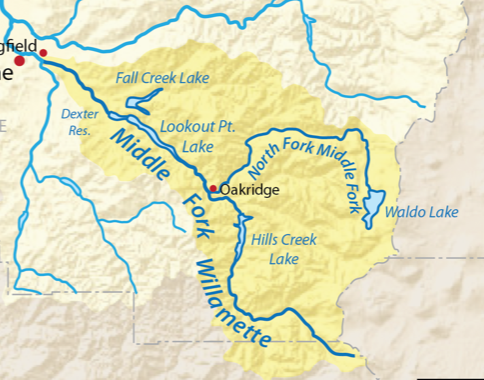
The North Fork Trail parallels the river of the same name (well, the North Fork of the Middle Fork of the Willamette River), an Oregon Wild and Scenic River, for about 11 miles upstream from Westfir/Oakridge and Highway 58. The river itself flows from Waldo Lake to the Middle Fork of the Willamette near Oakridge. The Aufderheide, Highway 19, one of the original 50 of national scenic byways, is across the river on the east side and connects in 60 miles to Highway 126 heading to Santiam and McKenzie Pass. The trail is for hiking and mountain biking at low elevation but hadn’t been fully assessed or addressed after the Snowmageddon event three years ago, and it looked it. The Crew had hiked in the first time from FS Road 1919 at the north end with power brushers to clear encroaching plants and Pulaskis for the root wads—made by falling trees whose roots pulled out of the trail, but soon realized what we needed to do was log the whole thing out–over 400 trees in 5 miles needed removal– in addition to taking apart three failed bridges, or maybe four, I can’t remember. There were other bridges considered passable, but many might not choose to cross them. I can understand their concerns.
Map of upper Willamette River. Lookout Point, Fall Creek and Hills Creek are actually reservoirs.Four wheel drive doesn’t do well here without some help.
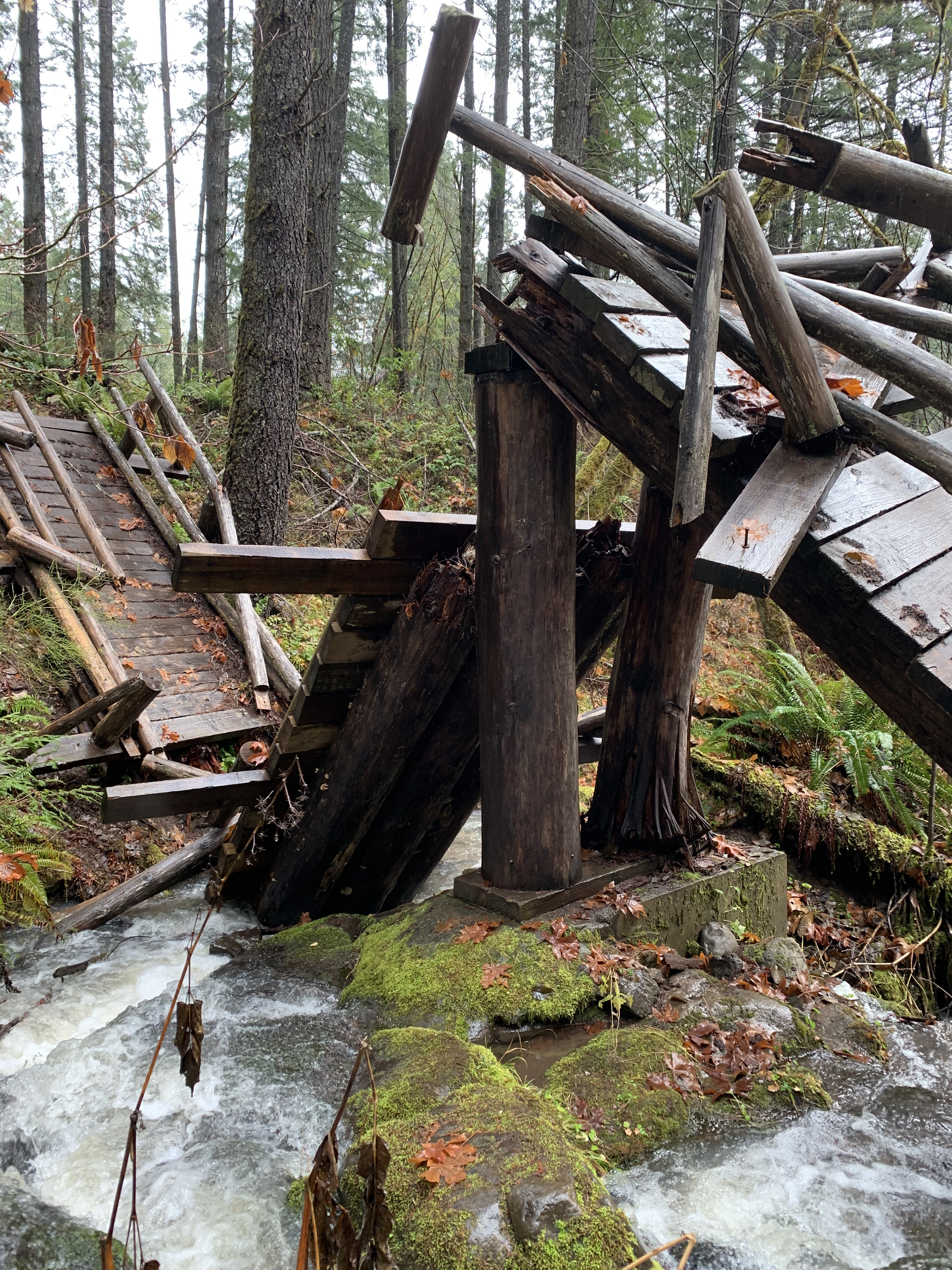
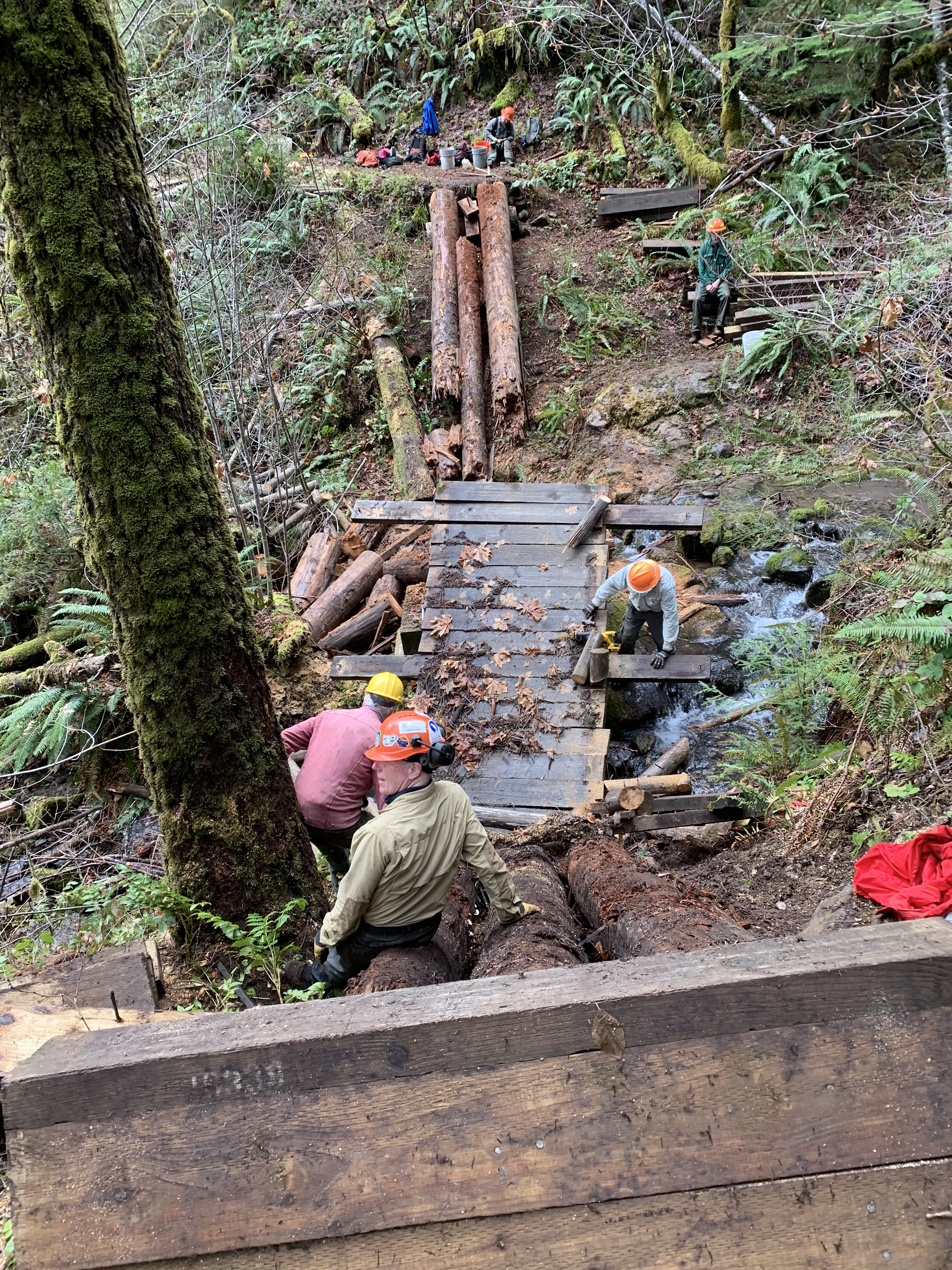
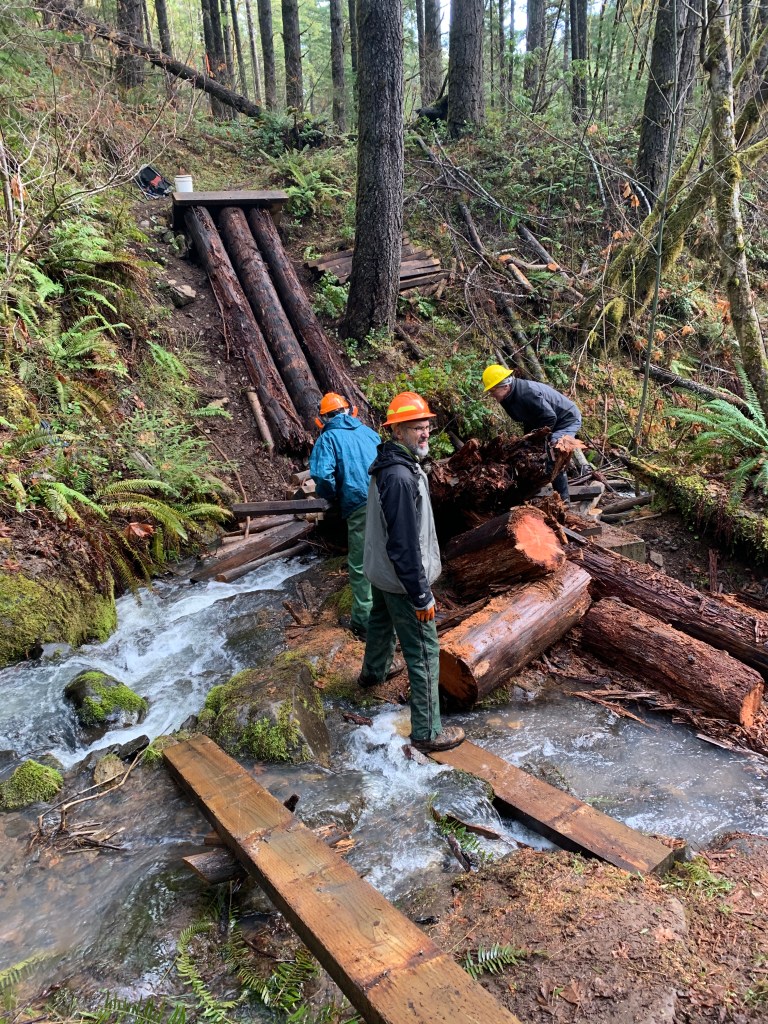
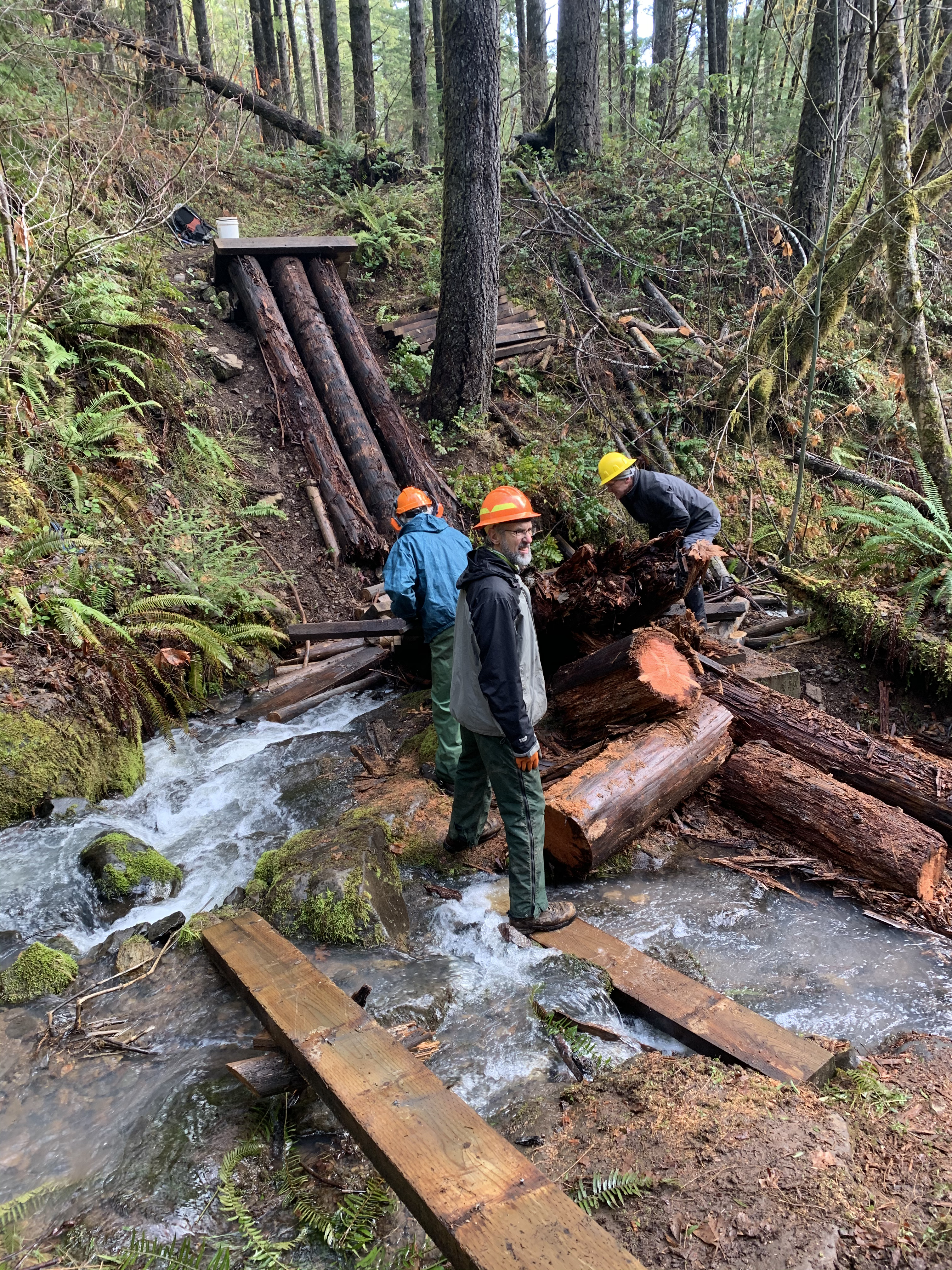
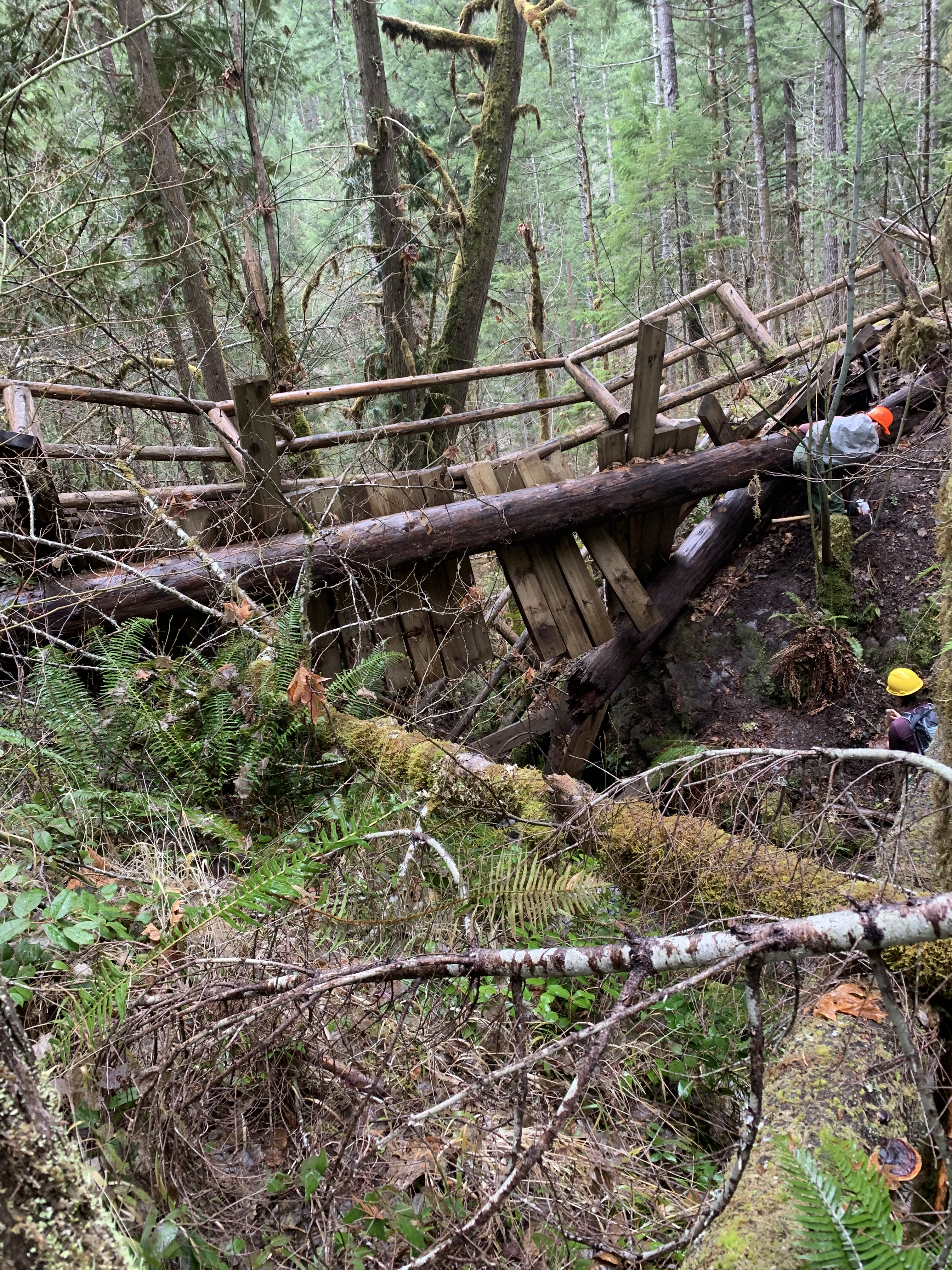
Anyway, after the logging was completed, a brief phrase describing 175 man hours, long days driving in on roads that we sometimes had to log out to drive on, hiking to the trail, then cutting out and moving the rounds (cut logs), we tackled the spectacularly failed bridge north of FS 1912.
Not usable.
Getting there was interesting. We could hike in a mile from lower elevation, climbing a little then descending to a creek where the bridge was. But since 1912 paralleled the trail, above it, we drove in about 3/4 of a mile, parked, where it was about 200 yards to the trail, 60 of those yards vertically down, on somewhat muddy ground, over a few logs, to reach the trail. Once there, we crossed a serviceable bridge— “passable” although I wouldn’t lead a hike with the Club over—that canted about 5 degrees to the downstream side and was slick on even a dry day. Then it was a quarter mile downhill to the worksite. Downhill sounds nice, but downhill on mud is dicey.
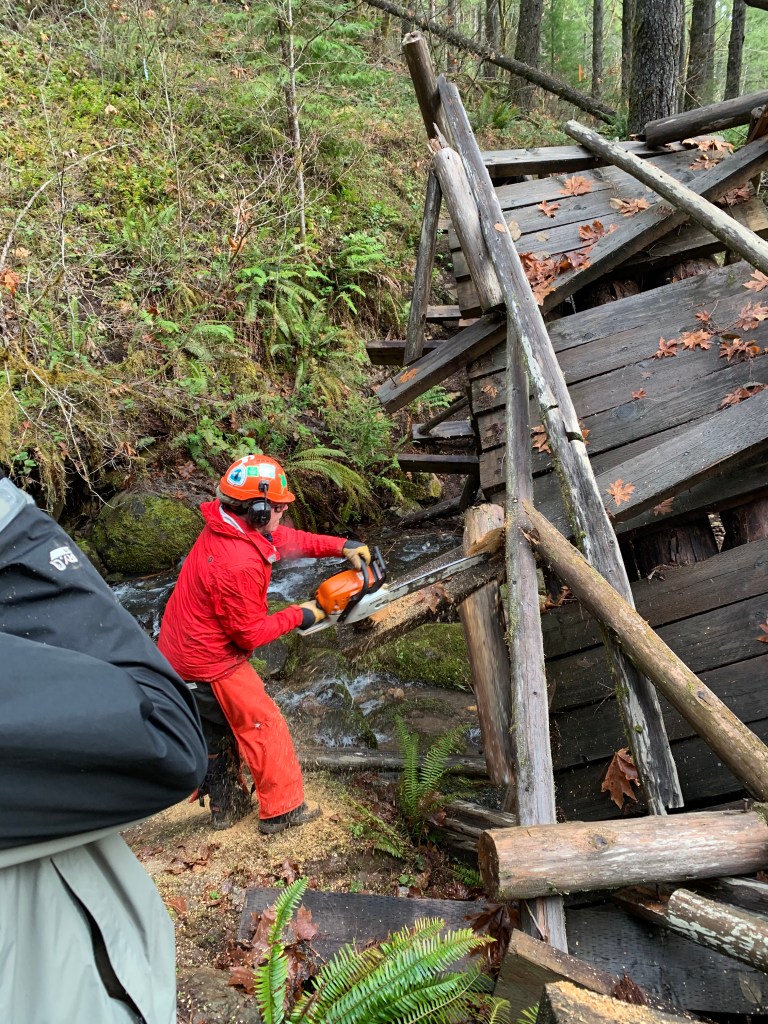
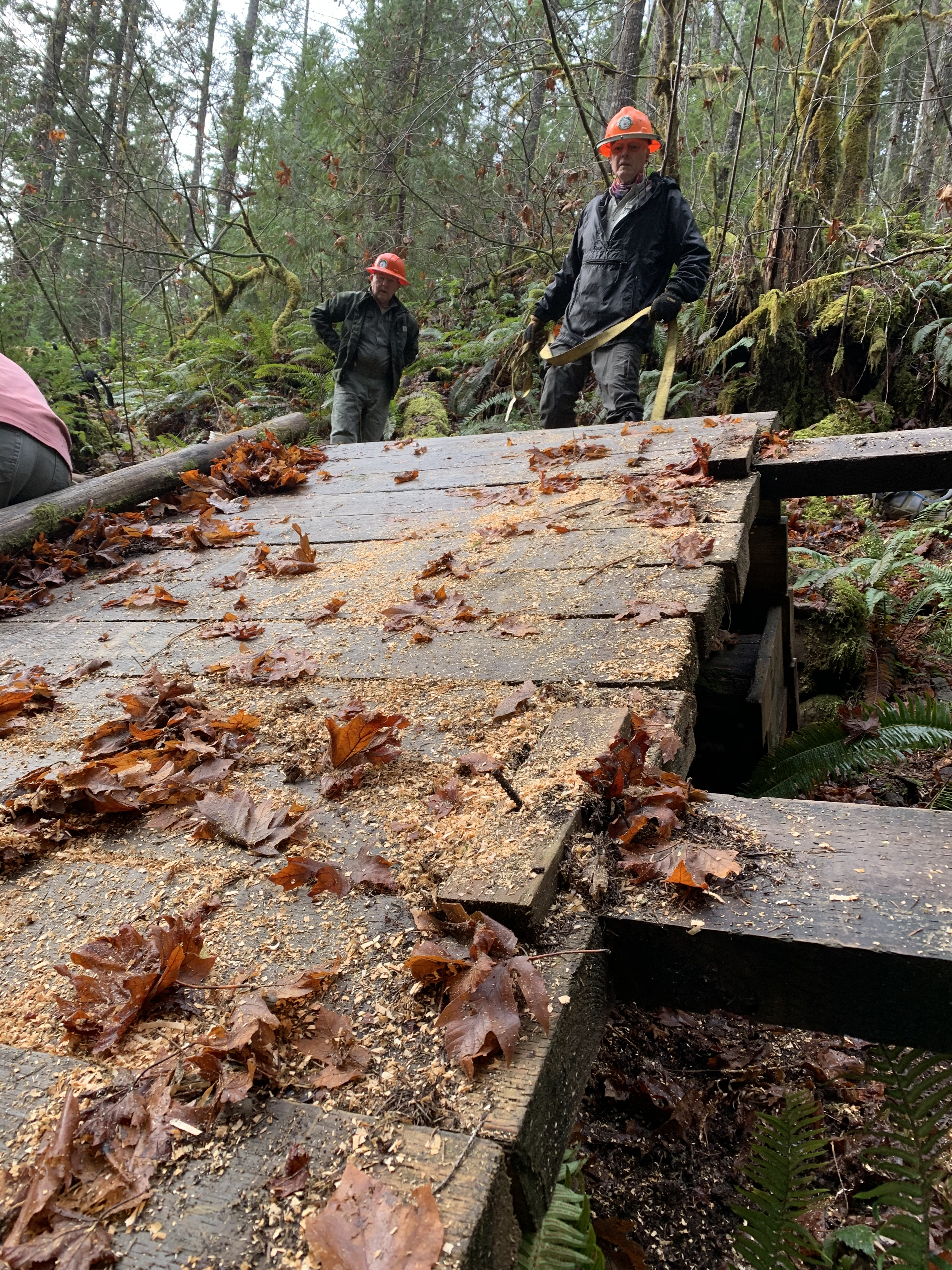
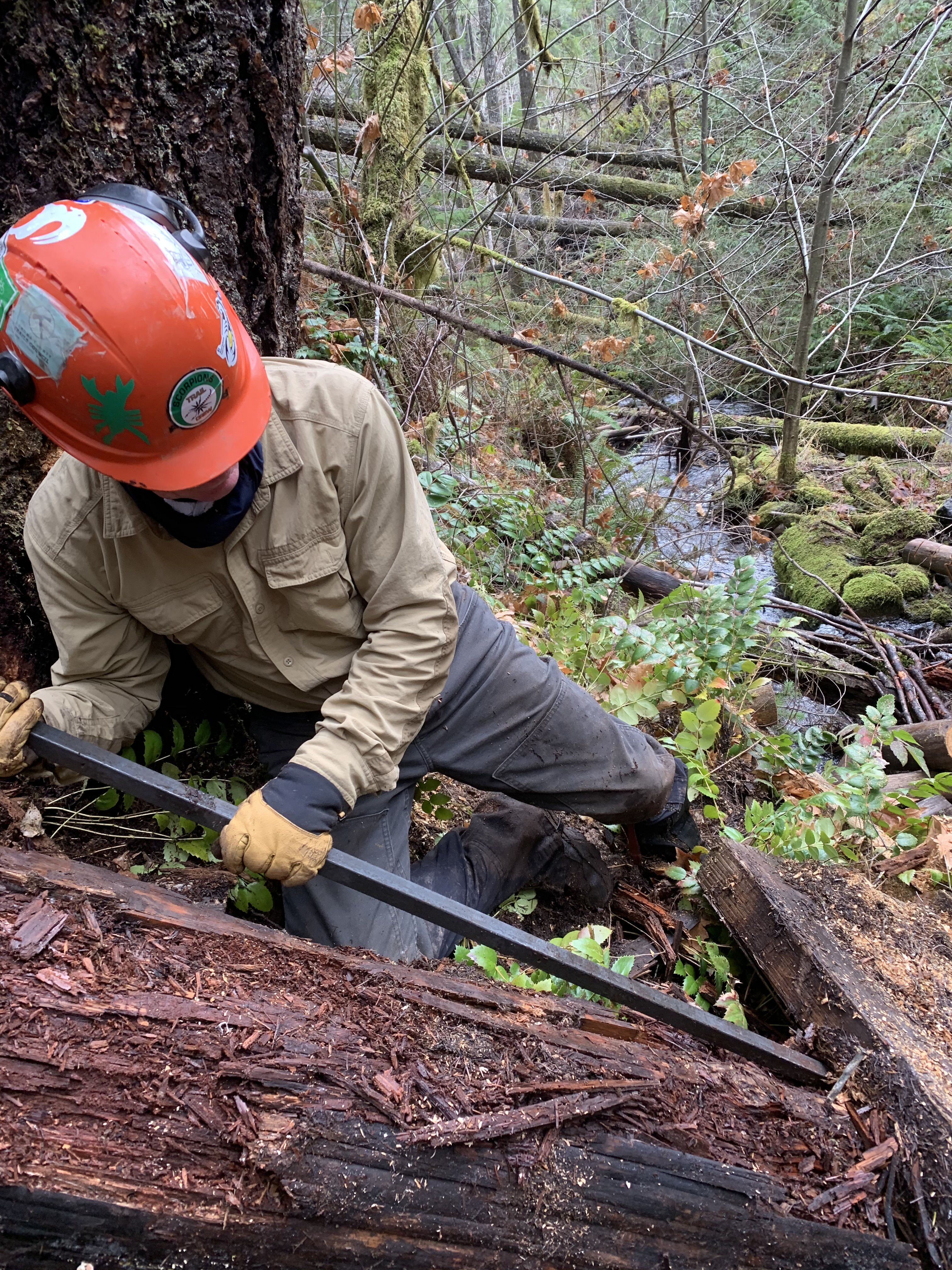
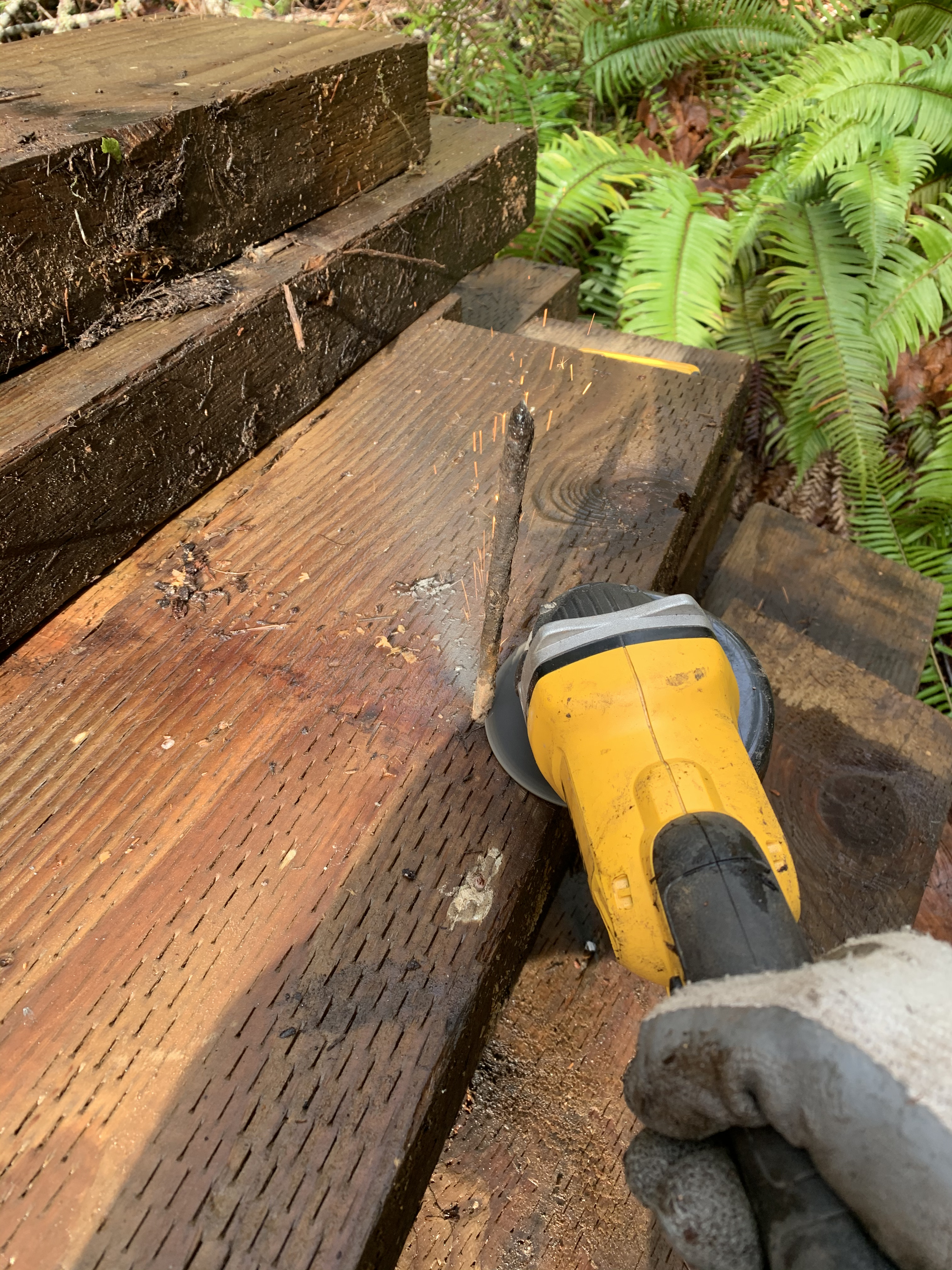
We first had to cut down bridge parts that were hanging in the breeze, then pry up the thick planks that were once tread from the large logs in which they were all pounded into with long spikes. I’m sure there is better terminology, but one gets the gist. We wanted to save the planks for reuse, piling them nearby, but we first needed to get the spikes out. They were about 8-10 inches long, and pounding them out, using the claws on the hammer or chisels was a difficult undertaking, because the claws weren’t deep enough to grab the spikes. It would take us 10-15 minutes to remove a plank and then someone would spend 30 minutes or more on some of the spikes. We then used cawsalls, battery powered metal cutting saws. They would cut, and I learned once the nail started to smoke, and then smelled like boiled metal, although boiled metal isn’t in our smell repertoire, one could then stop and break the nail off. The cawsalls chewed up batteries like a dog a toy.
Remember that we have to carry this stuff in and out as well as use it.
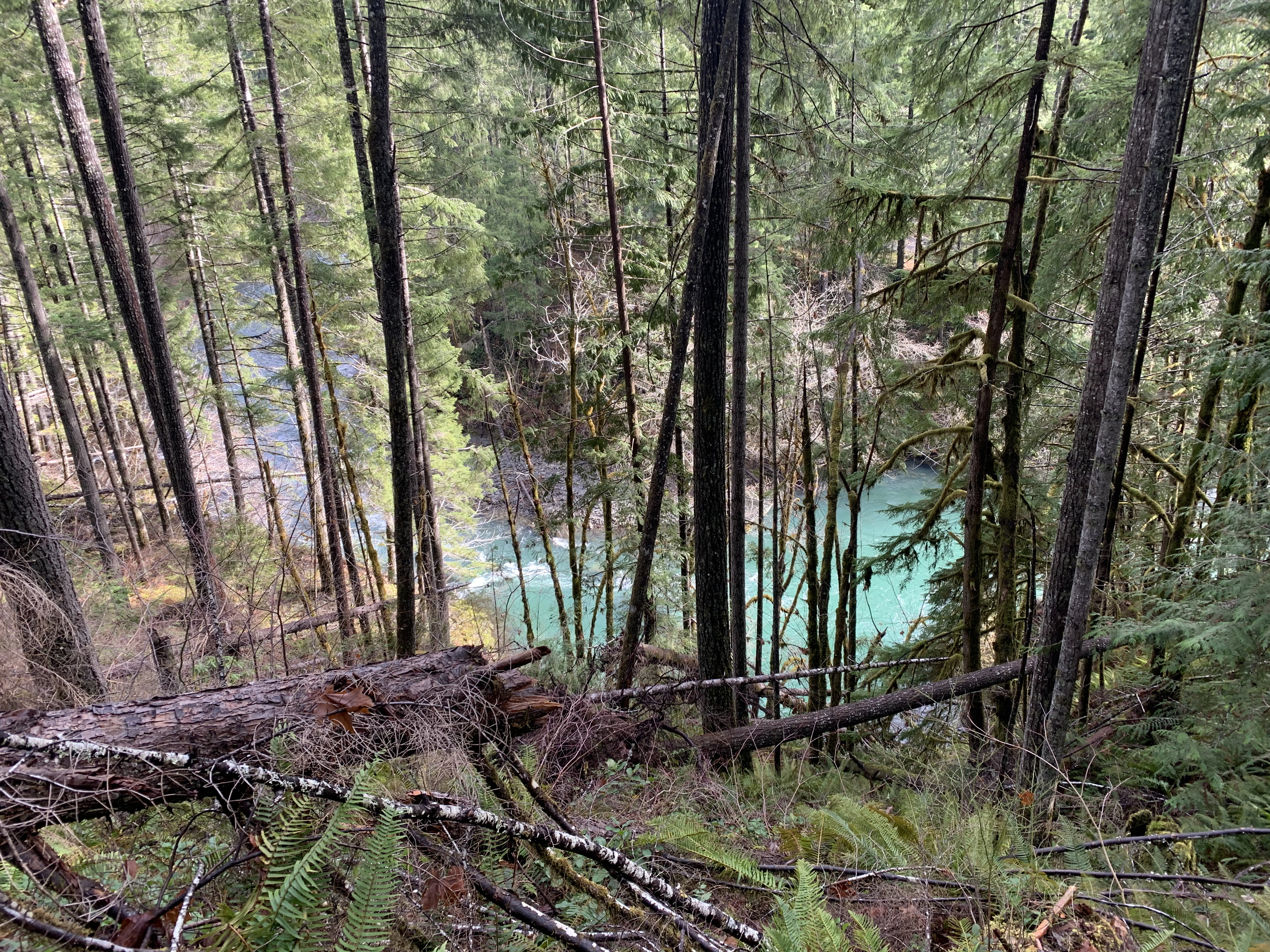
The stream was pretty, about 50-100 feet vertical above the river, but of course the nearby rocks were mossy and slippery, the far side muddy and steep, making any river crossing an undertaking in itself. The first day, we managed to cut out about two-thirds of the planks and stack them, each of the thirty to forty weighing well over 100 pounds, requiring two or more people to move on terrain that was, shall we say, friction impaired. We finally quit, stashing the pry rod, hammers, spikes removed, and a few other tools in a bucket on the other side of the creek. We hiked out, across the 5 degree canted bridge, back up the awful hill to the cars, each puff of breath telling ourselves it was better than hiking a mile back to the bottom of the 1912 road.
We planned one more day on the bridge the following week, this time bringing in more Lithium 18V batteries and a grinder, which I had never seen before. Most of the Crew have their own Home Office for hardware at home. I have a hammer and at least now a voltmeter to check the car battery, not much else. We split up in two groups, one on each side of the creek to remove the remaining planks, cut out some of the logs underneath, continuing to stack everything salvageable on the near side, and leave the cut big stuff by the creek. I watched one of the guys use the grinder to cut a spike out, and then he handed me the grinder. It seemed easy to use, the disk whirred around fast, and I cut the next spike with the usual smoke-stink-bend and break, before the battery died. OK. I picked up another battery, sure didn’t want to have to ask how to put it in, but fortunately figured out how. I pushed the start button, things started to rotate, and went through the smoke-stink-break off spike process again. With the machine stopped, I looked at the disk, which resembles a CD, and while cutting through metal, plays 100+ db screechy music that isn’t much different from some of the stuff my OK Boomer ears listen to today. Heavy metal, indeed.
No teeth. Uh oh, I thought, I ground those things right off. Damn.
“Hey,” I called. “The teeth are gone.”
The crew leader came over. “It doesn’t have teeth. It’s a grinder.”
Oh. I could have sworn I saw teeth when I started. Nope. I guess I have OK Boomer eyes, too.
We got the fifty odd heavy planks out and stacked, spikes removed or pounded into the center of the plank, finished cleaning up what we could and the leader called the job complete. Wow, lot of big logs on both sides, many cut ones down in between, and this is done. Well, I don’t want to move those. Better to walk out of there, back uphill where each week the steps were becoming progressively more muddy.
This week, it’s another mile to the next bridge. The planks hang down vertically and it is even more slippery. If it is too wet, we will deal with root wads. That’s safer, but one spends the day walking on boots that have 3 inches of mud caked on them.
We waited 35 minutes at the 12 mile mark for the rest of the group to catch up. By then, the two of us had had lunch, stiffened up, I had hiked back a quarter mile looking for the others, and we still had to finish the last 14 miles of the McKenzie River National Scenic Trail. We waited earlier 15 minutes at the 3 mile mark. Unless we got permission from the hike leader, it was going to be a long day with more waiting to hike the 26+ mile trail. I had been told we would be hiking at 3 mph, but the leader invited a friend who was still recovering from a leg injury, and there were others that were not hiking anywhere near that speed.
I convinced my partner to ask if we could go on ahead, and we got permission. There was a climb out from where we ate lunch, and at first, I was slow, but then I got warmed up, and before long, I was in cruise mode. I’m not a sprinter. I like endurance activities, and once I find my zone, I can hold my speed for a long time. We started cranking out a mile every 17 minutes, and at the 18 mile mark, took a break for 5 minutes by the clock. I emptied my boots of some dirt, drank some water, had something to eat, and put my boots back on. Off we went, along the beautiful free running McKenzie River to our left.
McKenzie RiverBlue Pool. The water goes underground and comes out here, but in heavy snow years, the water floods the woods about a mile away and comes over the part at 11 o’clock like a waterfall. This is a third of the way.
I wasn’t stiff, and we continued making good time. We hit that special moment when the odometer reads “20.00,” and took another break at 22 miles, doing the same routine we did earlier. Seventeen minutes later, I knew the end was coming, an hour more, maybe, then a half hour, a quarter hour. There was the highway nearby, the trail left the river and paralleled the highway at the end. I was there, along the road, and I was done. I felt fine. I could have done 30 miles that day. Five minutes later, my partner finished.
Lighter than a GPS, and every gram carried matters. End of the trail.
That’s being in the zone. I would do the hike a year later with a faster group, but one person took videos to post on his Facebook page, costing us 20 minutes of prime hiking time when it was still cool, on a day which we knew would be much hotter. One woman had diarrhea, another developed a blister, and I hiked four miles in atrial fibrillation, which was an interesting experience. I converted to normal rhythm at lunch. It took us almost nine hours.
* * *
I was at an elementary school in Oro Valley, Arizona, 30 years ago, shooting free throws. I was by myself and had to fetch the ball, so I reset each time I shot. I hit two in a row, then 5. OK, not bad. I dribbled once, held the ball, flexed my legs, then shot. Six. A short while later, 10. Hmmm. Swish, swish, swish, swish, swish, and I was at 15, finally ending my streak at 20 in a row. It was amazing. I felt like I couldn’t miss, and I wasn’t getting any gifts, like bouncing off the back iron 5 feet in the air and dropping straight through. Normally, I was a 65% free throw shooter. Assuming that, a streak of 20 in a row had an expected value of 1 in 5000 tries. If I shot 20 five times every day, which I didn’t, maybe once in 3 years I could do this.
Mind you, I know there is a considerable body of evidence to say the hot hand really doesn’t exist, but the evidence isn’t conclusive. There are days where difficult tasks don’t seem difficult, where everything comes easy. That day, I was beyond any performance limits I knew of. I was in the zone. Everything clicked, and I shot like I never had before…or ever would do again.
* * *
Nearly 30 years before that, I swam the 400 free in a high school meet—that would be 400 yards—and I was ahead. Way ahead. I felt like I could swim forever. I won the race by 35 yards with the best time I ever had—5:19.3. The fact that I remember that race, never forgot my time, slow as it is today, among all the races I did, and even the ones I won, is testimony to the power of the feeling. I was in the zone. A team member told me it looked like I wasn’t even working. But let’s be real: the national record for 500 yds, 25 yd length pool, is 1 minute 12 seconds faster than I swam 400 yds.
* * *
I ran only one marathon, with three goals—to finish, to finish without stopping, and to finish without stopping or walking. I did all three. My time was not particularly stellar—3:25.48—but again, I remember it exactly. What else I remembered about the race was that 5 miles into it, I actually felt I was sitting in a car watching the scenery go by. I was detached from all the effort my body was going through. At 5 miles, I was just getting started, for whatever my athletic skills are, and they don’t amount to a lot, I do well at distance. Indeed, my time for the second 10 miles—77 minutes—was exactly the same as it was for the first 10.
* * *
In 2002, I rode the 160 mile Tour of Cochise County, the second longest of the four rides the Perimeter Bicycle Association of America sponsors (the longest was 252 miles) that day. I was with a group of five, and we had to have our own Sag support. For the first 70-80 miles, much was flat with some downhill, and I stayed in the back drafting off the sprinters. I remember going through Tombstone upwards of 25 mph, drafting, and I was barely turning the pedals.
After lunch, at about 100 miles, I was doing fine, “just warmed up,” I told others. There was almost no wind, a gift in Cochise County. One of the sprinters went to the front, seemed to be tired, so I said, “pull over if you wish.” He immediately pulled over. Two of us took over at the front, the sprinters drafted, and I did two-thirds of the pulling. I stomped out the cadence, over and over again, two miles at a crack, 540 strokes, then sat in the pack for a mile, before going back out to pull. I was in the zone, and it took us 8 hours to do the ride, the best single ride I ever did or will do.
* * *
On skis, some days I could hit a mogul field and pound myself down one after another—air, turn, hit, compress; stand suddenly, air, turn, hit, compress; stand suddenly,…down the bumps, until I finished or stopped because of exhaustion, and shook my fist in the air. That’s being in the zone. It’s a dopamine high, receptors reacting, a sense of everything working.
I was in the zone once on a portage, when I was 100 yards on the trail and didn’t remember putting the canoe on my head. I knew it the other day, when I took over the power brusher duties, wanting to finish the trail, and didn’t stop until I did. I know it on hikes, when I say to myself, “this is a special day out here,” when I am covering ground and thoroughly enjoying myself.
I can’t predict when I will be in the zone: the day before and the day after, nothing is special. But for a short time or a day, a glorious day, everything is in sync, in tune, and alive.
These guys are for real. They have the right genes, eat right, train right, but only two of them will go to the Olympics, Men’s 3000 m steeplechase, US Olympic Trials, Eugene, Oregon, June 2012. I’ve seen performances here that for one day a specific individual was in the zone, smashing his personal best, and sometimes going to the Olympics. It’s exciting.
I ran a Stihl hedge trimmer the other day, but rather than trim hedges in neighborhoods, we had about 5.2 miles of the South Willamette Trail in the Willamette National Forest to brush out. The trail connects the Hardesty Mountain trail with Eula Ridge Trail, and it is possible to make a full 14 mile loop. I’ve hiked that loop several times by myself, led a hike called “Hardesty XX Black Diamond,” and tried to run it once, to see if I could make the Hardesty Hard Core race cut off time in 4 hours. I hiked it in 4 1/2 with a pack and felt I could probably break 4 hours, but was so wasted I asked myself why would I want to? Age is such a nice thing sometimes. Hardesty climbs 1000+ meters or 3500 feet in a few miles; Eula Ridge is one of the steepest climbs or descents I’ve seen in Oregon. South Willamette is easy by comparison, with gentle ups and downs in a lovely forest.
It is muddy out in the woods during the wet season, and streams are on the trail where in summer one would think water had never been. The first day we were out there, assignments were divvied up, and I took the rake and stayed in the back, clearing the trail, well behind the others who were doing the actual trimming with the 7 foot long Stihl whackers. I removed cut sword fern, Salal, and Oregon grape, along with a few small but difficult to remove vine maples that were encroaching on the trail. Vine maples are nature’s way of getting back at trail clearers.
Small stream flooding South Willamette Trail. We turned it into a crossing.
I thought back 65 years to Crow Lake, Ontario, and later the Finger Lakes of New York, and the 5 hp green outboard (the 5 was in red) with “Johnson” blazed on it, the first power machine I learned to use. I have to laugh when country music singers talk about their “old days” first motor as a 40 horse or Alan Jackson’s ’75 Johnson with an electric choke. They are soooo young. Forty horse? Electric what? This Johnson had a cylindrical shaped “primer” that we pushed down a few times and could turn, although I never knew what the numbers meant and never did turn it. My father didn’t, so I didn’t. The gas tank was in the back on top. You didn’t have an external one. Those came later. It was a 2 cycle engine, and for years I thought we had to add oil to gasoline to run a motor, one quart of oil per gallon of gas. I still remember using a can opener on the oil can. Oil first, not last. Fortunately, I never did that to a car. I cringe today when I think of the pollution.
Blindfold me, put me in the stern with that motor hanging off the transom, and I could start it right now. Drop the 2-bladed green prop into the water. Turn the brass four cross knob on the left bottom counterclockwise to start the fuel flow. I can hear it running. Then open the top on the fuel line on the back top of the motor, hearing the sound of escaping vapor for a couple of seconds. Then push the silver clutch on the right side out like an ear, which it looked like, move the throttle from off to start, which had an automatic stop. I always moved the throttle up to the automatic stop. I never once started it without the clutch in place. I can still hear every sound as I describe it, the trickle, the psssst, the clunk of the clutch, the throttle banging against the stop, the sound of the primer as I pushed it down a few times—clunk, clunk… clunk, clunk…clank. Then grab the handle on the right front side of the motor, holding the steering handle with the other hand, and pull. Usually on the second or third pull, if that, it would start, with a cloud of smoke. Move the throttle to the left a couple of inches to slow, then slowly push the clutch back flush with the motor. Reverse gear was turning the motor in a circle, before letting in the clutch. When I was ready to go, I gradually advanced the throttle. I knew every sound of that Johnson. When I was 12, I used the boat, a 14 foot plywood cruiser called “Osprey,” to deliver the Rochester Sunday paper along 3 miles of the west shore of Honeoye Lake, so I didn’t have to stash papers along the road. Newspaper delivery by boat—what a ball, and I made good money, too. Hard to believe it was sixty years ago this summer.
I hauled the 7 foot long orange Stihl brusher about a mile west on the trail that we had worked the previous week, trying to avoid trees, ground, rocks, and not fall. When I got to where we needed to work, I put in my ear plugs, checked the vest on that would connect me to it, and got down next to the motor. What was fascinating, now that I think about it, was that nobody told me what to do. They either thought I had done this or my confidence at running a motor again was infectious. It had only been 20 years since I last used a lawnmower. Same approach. Put on the choke, hit the plastic primer a few times with the fuel visible underneath, then pull the cord. It pulled really nicely. After 4 or 5 pulls, it started right up. I moved the choke to off and was ready to go. I lifted the machine up, attached my harness to it, so the engine was to my right and the 7 foot connector to the blade was to my left. Then I hit the throttle a couple of times, mostly because I liked doing that, and started cutting. The ferns were the most common, and the plethora of them along the trail meant that we made slow progress. The first time I used the brusher, we had two guys out with them; each did one side of the trail. That ends up quickly making one side of the body sore from always leaning a certain way. I liked trimming both sides of the trail with a swinging motion, where I cut the throttle going across, and quickly gave it gas as I leaned into another fern clump, then letting go as I was almost finished. This reduced the noise and I think saved fuel. I saw a lot of guys who went full out until it ran out of gas. Of course, the sooner it ran out, the sooner one could take a break or maybe persuade someone else to run it.
The next time out, someone actually asked me how to start it and how to adjust the blade. Wow. I felt like I should be wearing Stihl orange with the appropriate ball cap. There is a trick to setting the blade, which I figured out when I was off by myself with the beast and my macho self—such as it is at 72—didn’t want anybody to know I didn’t know how to do it. There was a little cylinder which I tried to turn and push, with no results, so I then pulled, which was the last possible thing physics would allow. That was the trick. The cylinder opened up, I could reset the blade at another angle, and then reset the cylinder. Nice.
I tried to start the Stihl while I was strapped to it, but I couldn’t get enough purchase to do it. I also checked the fuel after about 45 minutes. It gave me a chance to take a break, and as I had long ago learned with the Johnson, if one doesn’t run the motor until the fuel tank is completely empty, it is a lot easier to start it up afterwards. The last day out there, I ran it about three hours with one refill. The crew leader finally stopped me. He said he kept waiting until it ran out of fuel and then got impatient. I laughed.
More fun than raking. I’ll get the quiet when I hike the trail.
Stihl trimmer with guard over the cutting blade, which is folded over. The hand throttle is easily seen on the handle.Author running the beast, a bit close to his pack.Within six months, this growth will be back. If trails are allowed to go three years without being maintained, the blowdowns will make them impassable, and they will rapidly disappear. It’s a fine line as to what should be maintained and what is better off reverting to what it was. But then nobody would know how special it is. That’s another fine line.
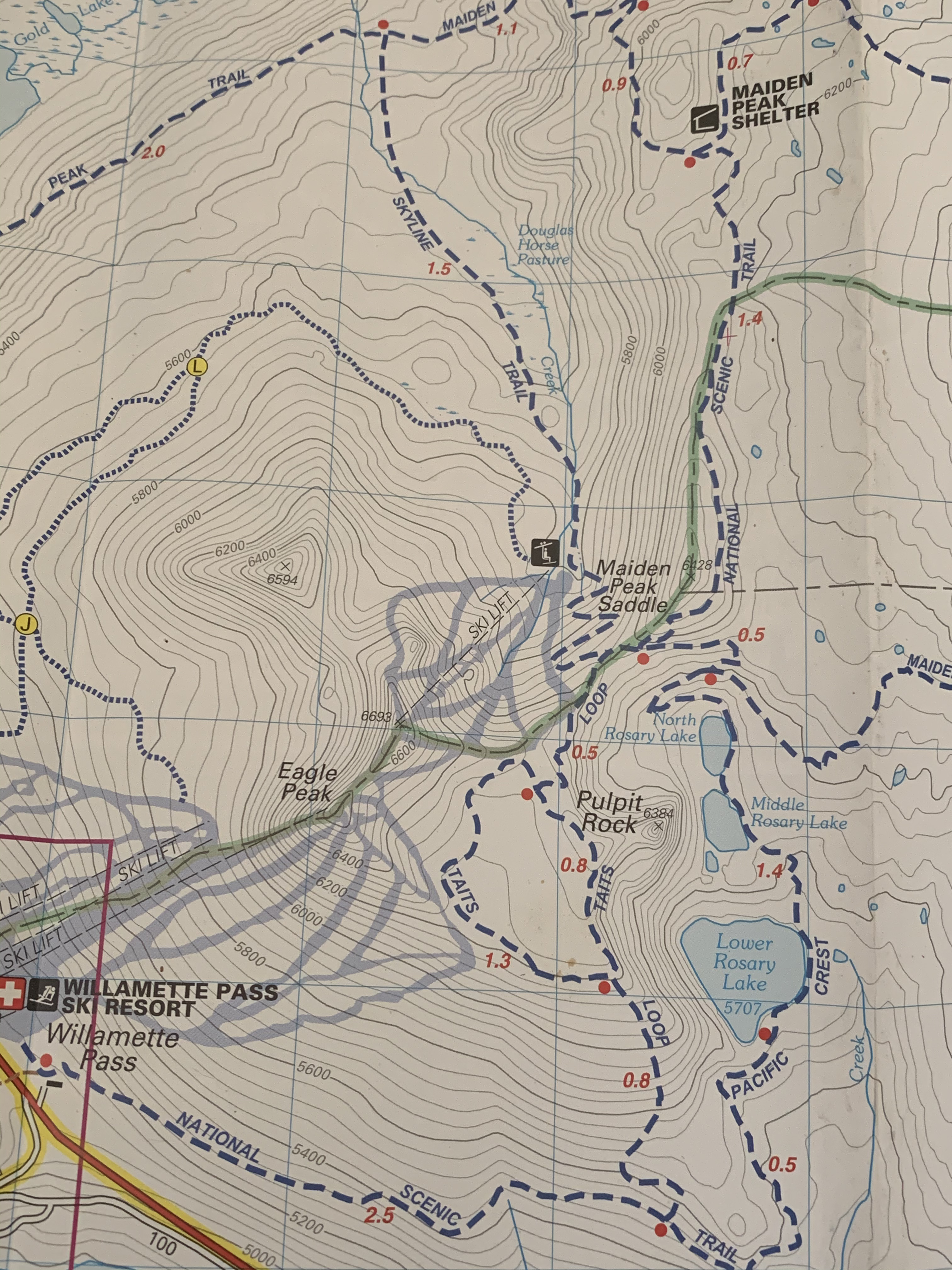
I stopped briefly to think about whether I should turn around. I was checking the winter snowshoe trail for which I am responsible and wondered if I had bitten off more trail than I could chew—or snowshoe. I hike Tait’s Trail in the Cascades in fall and snowshoe it in winter. It is like two different trails, and the past 2 years I have only taken the more heavily traveled part of the loop that goes close to the cliff overlooking the Rosary Lakes below. I was therefore less familiar with the inner loop, which is where I was, and thought the whole loop was a mile, when in fact it was 2.1, an error I should not have made.
Not surprisingly, where I was on the GPS showed considerable distance left to get to the overlook where I wanted to have lunch. The wet snow was 18 inches deep (45 cm), and I had already traveled over 4 miles (6.5 km) and climbed 1300 feet (390 m). The last mile and a half (2.5 km) I had been breaking trail. I still had to get back to the car; turning back now would be a little easier walking in my own tracks and going downhill. But the distance wasn’t going to be much less. My legs were fatigued, and I was a little winded, expected, but not quite to this extent. I was 6000 feet (1800 m) above where I had awoken.
I decided to trudge on, now aware that caution lights were flickering in my mind, saying “you aren’t in trouble…yet,” the verb trudge being appropriate to the lift, step, drop, lift, step, drop I was doing, for 50 steps, maybe 75, but definitely not 100, before I took a breather. The trail was easy enough to follow, but rest of the loop was likely untracked. I made a snap decision to go cross country, to cross a chord of the circle, mostly because I had done it in autumn when I had been on the trail wanting to mark a log blocking the trail to be cut out. Then, a quarter of a mile cross-country was no big deal and saved some time. I even saw a few elk. Today, it would be more difficult, but it would still save maybe 3/8 of a mile.
The cross-country route was slow, but flat, there weren’t many trees, and I found the trail on the other side easily with a welcome set of old ski tracks, not packed snow, but requiring less work. Fifteen minutes later, I was seated on a snowy log eating lunch, immediately putting my rain top back on because I knew I would rapidly cool. I felt old, like I didn’t have it the way I used to. This was one difficult snowshoe.
When the ski area is closed, it is possible to go up the lowest trail (looking here) and get directly to Tait’s. In an emergency, coming back down from Tait’s through the ski area saves a good deal of time, and it is possible to slide as well.
But, when I thought about it a little more, I had been lulled into a sense of being in better shape on my first two snowshoes out this winter. Both were just over 10 miles (16 km), a distance I hadn’t done for the first three years I snowshoed and thought a difficult goal in itself. This year, I did those two 10 miles+ without difficulty. The second had a lot of climbing, and I still did well. But there was a catch: in both, the trail was broken, and that makes a huge difference on snowshoes or skis. A single set of tracks in which to walk is a great help.
The third time out, I did almost eleven miles, but I had to climb in unbroken snow to Maiden Peak Shelter, a trudge as well, again at altitude, and half way back, I was ready for the end three miles before I got there. Unbroken trail requires more time and wisely fewer miles, and the reason I hadn’t done long snowshoes the first couple of years were that the trails were often unbroken. Twice in one year, I was breaking trail in 2-3 feet of snow, and it was exhausting. In addition, today I was taking time checking diamond markers, placing new ones, and moving others up on the trees. That required gloves off, using a hammer, nails, and getting the diamond properly placed. It was more work.
I had hoped to do the larger loop from Tait’s around to and back down around the Pacific Crest Trail (PCT), to Rosary Lakes and Willamette Pass, about ten miles total. I know the way, and I also knew that I did not have the strength to do it. I needed to get back down, slowly if necessary, but now. I finished lunch and started heading back towards the Tie Trail that led directly to the PCT. I had just started down the Tie Trail when I noticed I no longer had the hammer I was using to pound in the nails. Somewhere in that five hundred yard stretch after lunch, it had fallen out. I was carrying a back pack and a small tool pack which the hammer was easily accessible to me, but also easily able to fall out. I stopped, looked uphill at a possible “short cut” through the woods to where it might have been, looked at the deep snow, and decided to leave it. Downhill in my recent tracks was far easier, I had already dealt with the diamonds, and while the PCT to the trailhead was still long, it was straightforward. I reached the car in mid-afternoon, after about nine miles (14 km).
A week later, I went back to do the other part of the loop, in the opposite direction. It had not snowed and was warmer; the snow was firmer, I could stand on it without sinking, and there were more tracks. I reached the main climb that goes to Maiden Shelter, Tait’s and the ski area, started pulling diamond markers out of trees and placing them higher. The snow was “fast,” I was carrying a mallet and diamonds, pliers in my pocket to pull out nails, so that replacing diamonds was a rest break as well as work. While I got to the same lunch spot at the same time, I was not nearly as tired. I had only had to break trail over a couple hundred yards, and it was not as difficult as the prior week.
After lunch, I started to head on an angle away from the cliffs gradually towards the trail that still had my faint tracks. Then I changed my mind and headed directly to the trail. There in the middle was the hammer I had lost, frozen into the snow. It would have been a long walk back up to find it the week before. I took the same route down the Tie Trail, now covered by large clumps of snow which had fallen off the trees. I was glad I hadn’t gone up this way; coming down was far easier. I felt fine, if appropriately tired when I got to the car, after ten miles. Tait’s is done for this year, unless I decide to lead a snowshoe there. I have a few places next fall where I may add some more diamonds.
I will take better care of the hammer.
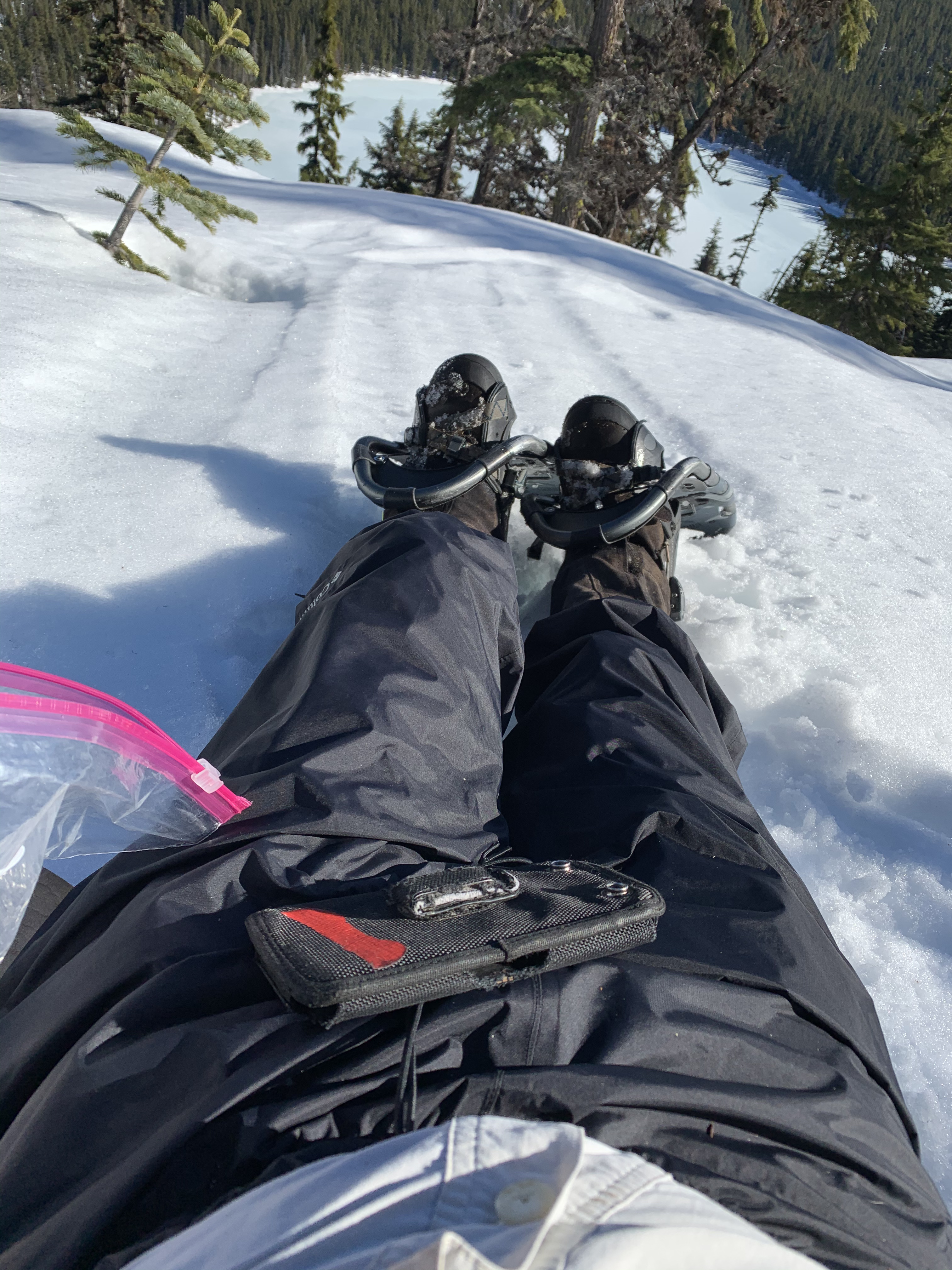
No, not training for the luge. Lower Rosary Lake below me.
Foam pads are delightful seats in snow; packs are good back rests.
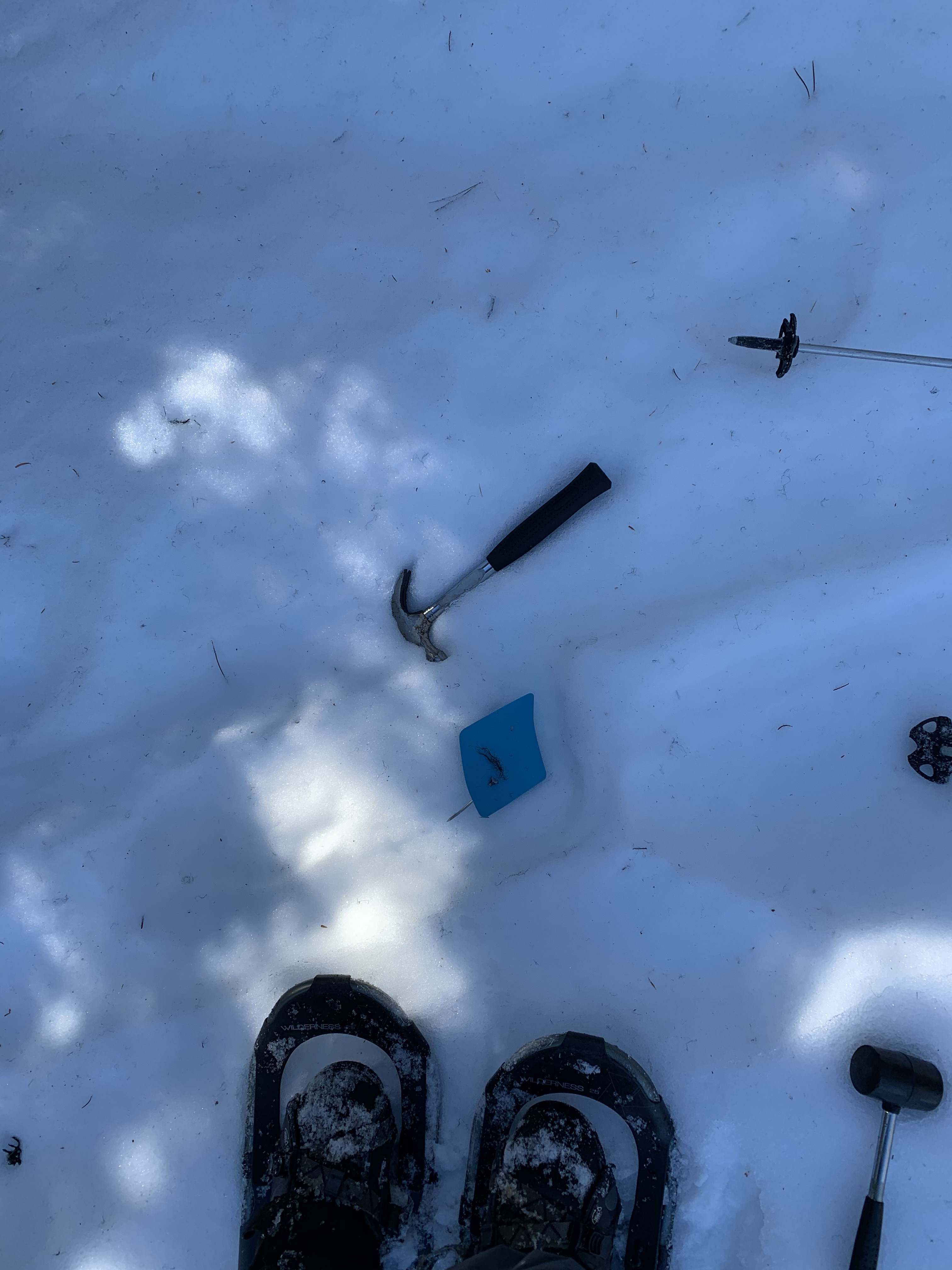
Snow shoes, poles, a diamond with nails, and the formerly lost hammer.
I almost missed seeing him. The old man. He was on the other side of Forest Service 24, at the junction of the spur road to the Salmon Lakes trailhead. Lot of miles on him. Then again, I always say to myself these days, who am I to talk? I not only look old, I am old. When I was 61, one woman told me I didn’t look a day over 55. Didn’t look a day under it, either.
Anyway, I had come down from working the day in the Swan Lake Trailhead area. We hiked in that morning, bushwhacking a “shortcut” in snow, 27 degree temperatures, wind, and climbing 300 feet through a jumble of biomass, some alive, much not, to reach the trail on Winchester Ridge. We then hiked south a mile and a half, picking up where the last crew had quit. We cleared the trail all the way to the Waldo Mountain Trail, another 2 miles. It had been a long day, cutting out logs by hand, moving them off the trail, going on to the next log. We then had to hike out nearly 4 miles with tools.
When I reached the car, I took off my gaiters, boots, and outer socks and put on some old running shoes. My feet thank me for doing it. On my way out the bumpy narrow road, a large pickup came the other way. I pulled over as far as I dared, and so did he. I had to look up to see the driver.
“There’s an old guy up ahead who had car trouble and is walking out.” He didn’t say anything else. I muttered something about the pandemic, not really wanting anybody in the car, didn’t ask for more information, and hoped by the time I got there he would have been picked up by somebody else. I knew nobody else would be driving up there, however, not this time of year, and not with a significant snowstorm heading our way in a couple of days. We were lucky we got our work done. There would be no more logouts in the high country this season.
Highway 24 up from Oakridge to Winchester Ridge is about 25 miles, gaining 4000 feet, the last 12 on dirt with a lot of washboarding, awful dust in the summer, trees that sometimes should be cut out and aren’t, and other logs cut out with dreadfully little clearance to get through. The paved stretch is no joy, either, although this year the Forest Service paved over a nasty sunken grade that would wreck alignment if one hit it wrong at just about any speed.
I was tired and kept counting off the miles passed without seeing the man, about one every three minutes, maybe four, given the conditions. I turned at the Salmon Lakes junction and there he was, almost hidden, with gray jacket, a long beard and a good sized pack. If I hadn’t been looking, I probably would have missed him. I let the car roll a few yards further, wondering what I should do, then hit the brakes and backed up. The last thing I wanted to do was have a stranger in my car, but for the last few days it sounded like he was as far away from Covid as anybody in the country, and I knew I wouldn’t be able to live with myself if I left him there. It would bitter cold up here again.
Even if there were no snowstorm coming. He got up and shuffled over to the car.
“I can take you down to Oakridge,” I said.
“That would be great,” he replied. “My phone doesn’t work up here.” Nobody’s does, I thought. He put his rather large pack in the trunk, with all my gear, and I put him in the back seat, opening all the windows. It was 50 degrees, I had on my face shield and a mask, and he was masked.
The man had gone up further on the road than we had, all the way to the Winchester Ridge trailhead. His vehicle wasn’t starting, and he had walked all the way back down from the trailhead. He had slept out a couple of nights but at least had decent gear. On the other hand, he had only covered six miles downhill in a day. Other than the pickup, mine was the first car he had seen. How he had missed me and the rest of the crew going up that morning at 8 was not clear. But if he weren’t out standing on the road, most drivers, who are checking right in front of them, would have missed him. We see what we expect to see, and we don’t expect to see a person standing by FS 24 up there at that hour.
II was a cold ride down, even with the heater running full blast, but I knew the road, where the potholes were, the sharp turns, the sunken grades, and where I could gun it. Because of the noise, we didn’t say much, although periodically, I closed my window to get warmer. He asked about what we were doing and seemed surprised old guys were doing that sort of work. I have been surprised, too. I didn’t learn too much about him. Most people who go off on their own usually are fairly taciturn. We were in Oakridge 25 minutes later, where it was a lot warmer, and I dropped him off at a store’s parking lot. He retrieved his gear, thanked me, and that was that. Hopefully, his wife hadn’t called Eugene Mountain Rescue.
There are people who disappear into the woods, some to escape the hassles of society, others to hide from whatever or whomever they feel they need to. I wonder how many I have driven by or hiked by and never have seen.
Were I out there with car trouble, and trust me, I have been alone, way out in the back of beyond in a mess of tertiary Forest Service roads, I would want to be treated the same way I had treated this man. I have been glad my car has both started and been serviceable, so I could easily return to town.. One of the Crew last year was scouting a trail in the Diamond Peak Wilderness, on one of the many dirt roads leading to trailheads when he wrecked a tire. He walked several miles to a hill where he knew he would have reception and had a long wait before he got help. I always note places like that; the backcountry horsemen do, too, map them each year, and call them convenience stores, because they can call out from there.
I also carry an In-reach, which isn’t fast at sending messages, but at least allows me to send emails home. I also leave behind a very detailed agenda of where I plan to be, and when I reach the car at the end, send that message as well. The car has food and water, and I usually have a blanket in my pack, plus a day’s supply of my medicines. I hope I never need it.
I think the man slept a lot better that night, wherever he ended up. I bet his wife did, too.
It started to rain as the last car before mine left the clearing, deep in the Willamette National Forest. My car was idling, because It’s a good rule in the woods to make sure that all cars can start before the second to last one leaves.
We had hiked in 2 miles that morning, with packs, heavy tools, including chain saws, up some nasty uphill sections, worked another 2 miles cutting out logs, cleaning up debris, and then returned the same way, up where we had gone down, down where we had gone up, the last part a barely marked trail steep uphill and eventually to the cars. As usual, the trail had more ups than downs.
I took one last look at the forest across the North Fork River and headed back to the car. The rain began to be a little more insistent. I had cooled off while waiting for others to arrive up from the trail, and I was cold, but as I drove out the bumpy, barely passable road, the heat came on, and my shivering began to abate. I had a 6 mile drive back to the main road, which was a Forest Service road, and then several more miles to a state road. We hadn’t seen anybody out on the trail the whole day. The rain was serious now, and I smiled. We had gotten our logging out done in favorable weather to do it, and now we were getting rain.
Part way out, an annoying branch stuck out into the muddy track. I had hoped to remove it by hand on the way in, but it was wedged in with other branches. I stopped the car, took out my hand saw, made sure my gloves were on, since I was alone, should I cut myself, and cut it back.
By the time I had finished driving back down the long downhill grade, getting out of the car twice to throw some large rocks off the road, and a third time to cut off another a branch that was impeding traffic, I was warm and drove across the bridge over the roaring North Fork on the gentle downhill into Westfir.
Another time, I wouldn’t mind having my tent pitched somewhere out there, my teepee style cook tent nearby, be making dinner so I could finish the dishes before dark, and then retire to my tent to read or just listen to the patter of the rain. But not tonight.
I’m one of those who likes short days, darkness, clouds, and rain. I called today’s weather “favorable” for logging, because rain does make cutting more difficult and dangerous, but it is not “bad weather.” Today, an article appeared in the Times about the dark days coming and of winter in general, and most of the comments were about the days lengthening, soon to be brighter times, spring, and then summer.
I remember years ago seeing an ad for Venezuela as “The Place with Eternal Spring.” I cringed. Who would want eternal spring? Many do. Not me. This year, I walked every morning during the early days of the pandemic. I would circle Alton Baker Park, about 5 miles, and I counted the wildflower species I saw, 65 one day. Spring is nice, but it always has summer hanging over its head, sometimes butting in early (April in Tucson, and in 1989, March, when it hit 99 the second week).
Summer is frankly overrated. Three years out of the last four here we have had west Cascade fires, last summer having them so bad that we were housebound for 10 days with air quality about 700. We were the lucky ones; ten miles to our east, there were evacuation orders; over 400 houses were destroyed. The daylight was orange when it wasn’t dark. It was supposed to be 95, but it was 25-30 degrees cooler—one silver or orange lining—because of the blocked sunlight. We limited going anywhere to a quick trip, wearing a face shield for the pandemic and an N95 for protecting our lungs from the small particles, and then closing up. We actually opened the house into the sealed tight garage, which hadn’t been opened in days. It provided cleaner air. In 2017, I slept out in smoke in the North Cascades for three nights, on a camping trip. I wonder what it did to my lungs.
One summer, only a month passed between not being able to hike because of snow in the high country and not being able to hike because of fires. One month. Record heat comes in summer more than winter, and it is worse. To me, it isn’t fair that we can have our rainiest month be dry because of a blocking high pressure ridge. This is not uncommon. But to have July or August wet because of persistent storms? Only one year I can remember; the post-Pinatubo year of 1992, when the Boundary Waters had three days over 80 and a lot of rain. I learned that summer how to work comfortably in the rain for days at a time. I’ve been cold doing trail work in the winter, but I warm up. In the summer, I have to be sure I carry a lot of water and drink it. I don’t cool down as easy as I warm up.
In Tucson, I looked forward to June 10, when the earliest sunrise occurred, and from then on it would rise later; to the solstice, when the day length started to shorten, and to July 6, when the sunsets started to become earlier as well. More people die from heat than cold, the body can deal with ambient temperatures 140 degrees below its inside temperature but only about 20 above it. I can hike, snowshoe, or just walk in pouring rain, heavy snow, and freezing temperatures and be comfortable. At 95 and humid, I have a great deal of trouble carrying gear uphill and cutting out logs. I’ve already drunk a liter of water, and I need to be careful.
No, when in December the sunlight drops in the afternoon, clouds move in, it gets dark, and I know it will rain, I like it. I know people have Seasonal Affective Disorder and they use light therapy. It’s a good idea.
For me, enjoyment seeing the dark skies to the west that are coming, or the sudden darkness in the afternoon that presages a brief, heavy shower. Being in a tent at night in the rain, dry and comfortable, nothing to do, nowhere I have to go, is how I help myself fall asleep at night.
I will be a contrarian and say I like the rain and the dark days. They belong, too.
I think summer is overrated; last summer came with wildfires, smoke that kept me in the house for 10 days, and a concern of evacuation. Three of the last four years there have been significant west Cascade fires. I led a volunteer crew yesterday into the damp woods to repair a trail, creeks and rivers roaring with the water that finally came. It was lovely.
Mind you, I counted 65 different species of wildflowers on my spring walks, I am an avid canoeist, and autumn is my favorite season. But leaving the trail yesterday with dark clouds overhead, an early sunset, and rain starting to fall, I was happy.
Reply745 RecommendShare
21 REPLIES
Julia
Dec. 18
@Mike S.
…And this post is making me smile, too. Thank you, Mike. This column is eliciting many lovely responses.
Reply49 RecommendShare
Claire Elliott
Eugene
Dec. 18
@Mike S.
I’ll be a contrarian along with you. My backyard is a cathedral of old Douglas firs. Standing amongst them in the rain and mist is wonderful, a sparkling infusion of sight, sound, that intoxicating aroma of fir. The air is so crisp and cold and sweet. I remember, looking up at the dripping branches, the 10 days of hazardous air that kept so much of the Willamette Valley housebound in September. Cold rain and freshly washed air works for me.
Reply121 RecommendedShare
Aubrey
Alabama
Dec. 18
@Mike S.
I love your post. I also love the dark cool days with
rain and drizzle all day. It is a great time to spend sitting by the fire, reading and listening to some good music, and doing lots of thinking.
The best time in Alabama is October until about January 1. Spring is nice but the worst time is the middle of Summer when it is hot and humid. The only thing good about Summer is flowers and butterflies.
With best wishes.
Reply59 RecommendedShare
Patrick Henry
USA
Dec. 18
I’m from Maine and feel the same way.
Reply19 RecommendShare
Theobroma
Normandy, France
Dec. 18
@Mike S.
Greetings from Normandy,
We too have those aplenty, and indeed they are quietly beautiful days of introspection, slow & awesome in their own priceless way.
Wouldn’t swap them for extra sunny days.
Be well.
Reply29 RecommendedShare
Alex
Dec. 18
@Mike S. Me too! I love cold, cozy days of rain…summer is fine, but winter is a time when all of the glories of theater, crafting and cozy reading come to the fore. A walk in the rain is one of God’s glories. Hail, Winter!
Reply19 RecommendShare
PB
Canada
Dec. 18
@Mike S. I agree 100% My teenager today told me that he loves the mist and the rain and prefers it to sunny days.
Looking out at my misty december afternoon, i am grateful for my warm house, and plenty of food and drink. and the privilege of loving the rain.
Reply21 RecommendShare
Patty
Sammamish wa
Dec. 18
@Mike S. I love the fresh clean air that comes with the rain, It gives us our beautiful cathedral of evergreens. Tea, a good book and intermittent walk in the misty rain isn’t half-bad.
Reply22 RecommendShare
Jon
Washington
Dec. 18
@Mike S.
I like rain too when I have a warm house to return to. But try surviving in a camp during cold weather, foraging your own food, if it’s raining all the time. You have to start a fire just to dry out your firewood!
Reply8 RecommendedShare
Deez Eyes
Dec. 18
@Jon And that Egan’s point. Rain, cold, wind, and clouds are easier to enjoy when you know you have a warm house and food in the cupboards to return to! The explorers were rugged and strong characters. Can we imagine getting through what they endured?
Reply15 RecommendedShare
Susan
Eastern WA
Dec. 18
@Mike S.–Here in NE WA we don’t have very many rainy days, but many cold cloudy and/or snowy ones in winter. Perfect for walking the dogs up the mountain and then reading by the fire.
When my son, raised here, lived on the Big Island of Hawaii he emailed me the first fall that it didn’t seem normal to live in a place without seasons. Maybe it’s genetic.
Reply9 RecommendedShare
Flaneuse
Dec. 18
@Mike S. Unite, lovers of winter! You’re right; it belongs, too. I’m sorry it makes some people depressed (are they sorry that I suffer from allergies and inflammation and too-muchness all summer?) but there it is – the weather has never arranged itself for our convenience.
Reply9 RecommendShare
Marie
Oregon
Dec. 18
@Mike S. As fellow Willamette Valley resident, I agree. We can’t have our gorgeous springtime without the dark days of winter. Politically we could never have imagined how valuable democracy is without the last 4 years. Only a few more days before our days begin to get a bit longer. I will treasure every day instead of wasting the moments I have.
Reply18 RecommendShare
Siebert
Tenseven
Dec. 18
@Mike S. Three days to winter solstice on Dec 21st. Likewise, I revel in the sparkle of it.
Reply11 RecommendShare
AzSunflower
Dec. 18
I agree that summer is overrated. With continuous temps over 110 degrees and the hottest July and August ever reported; the driest year in decades; and forest fires in June and July, all here in Southern Az, yes it is indeed overrated.
Reply8 RecommendedShare
Mike S.
Eugene, OR
Dec. 18
@Jon Yes, but to have it start to rain after dinner is eaten and the dishes cleaned is a real treat. I had that in the Boundary Waters a couple of years ago, and I lay in the tent reading, dry, nobody within miles of me, and totally at peace with the world.
That said, I’ve been where you mention, too!
Reply4 RecommendShare
Mike S.
Eugene, OR
Dec. 18
@Susan I lived in Tucson 37 years before coming to the PNW. I missed the seasons, which were warm, almost hot, and awful hot. What amazed me were the occasional rainy days that people complained about….
Reply6 RecommendShare
Mike S.
Eugene, OR
Dec. 18
@AzSunflower I lived in Tucson for 37 years. I saw it get hotter and hotter. This year sounded like it was awful. I figured 1989 and 1994 would be beaten, but their records were smashed.
Reply5 RecommendShare
Peter
canada
11h ago
@Mike S. I am a rain person I like the fresh air and it is nice to be out when the fair-weather humans are not
Reply2 RecommendShare
Mike S.
Eugene, OR
@Aubrey You understand 🙂
PacificNWesterner
Vancouver WA
Amen brother.
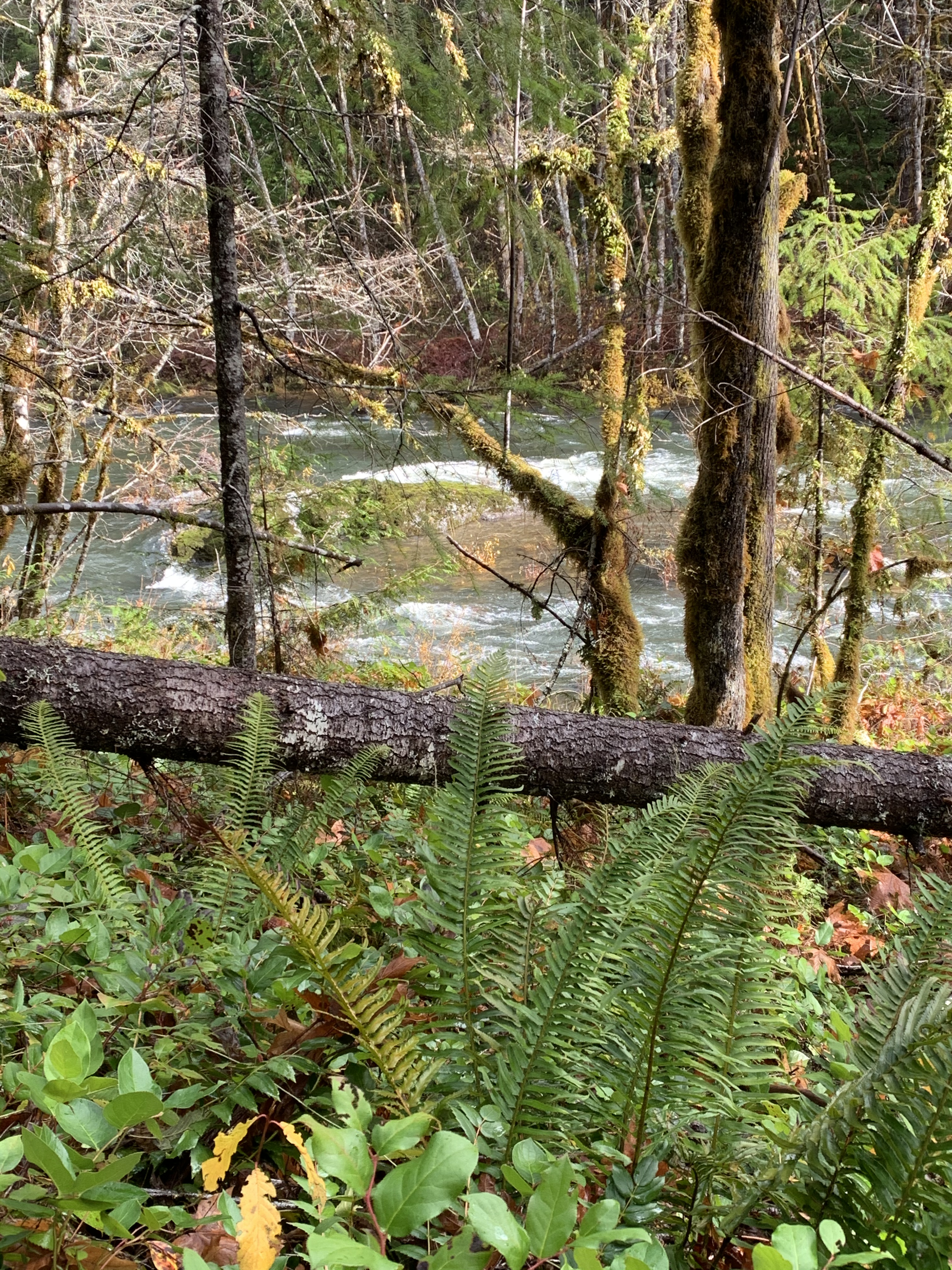
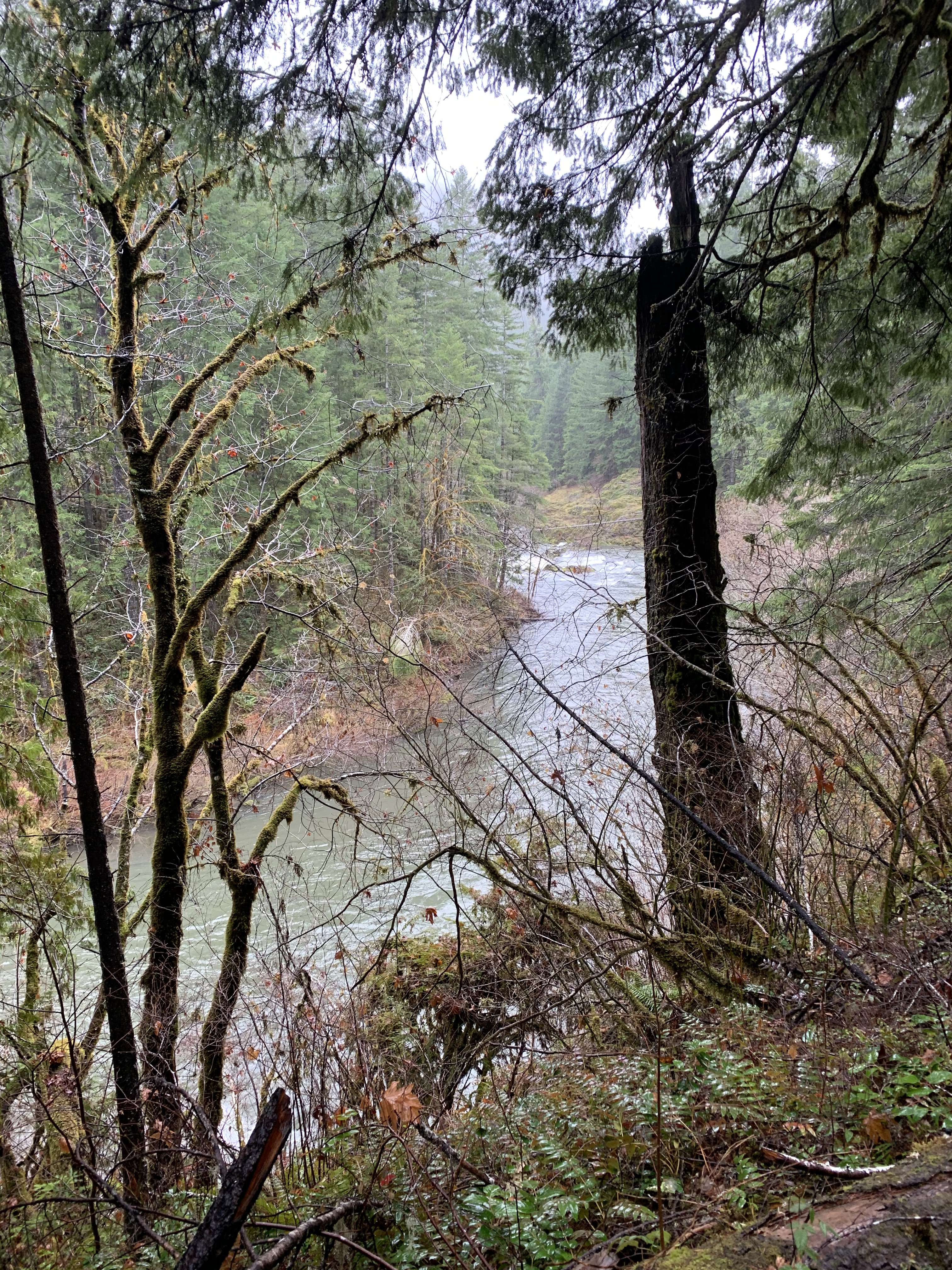
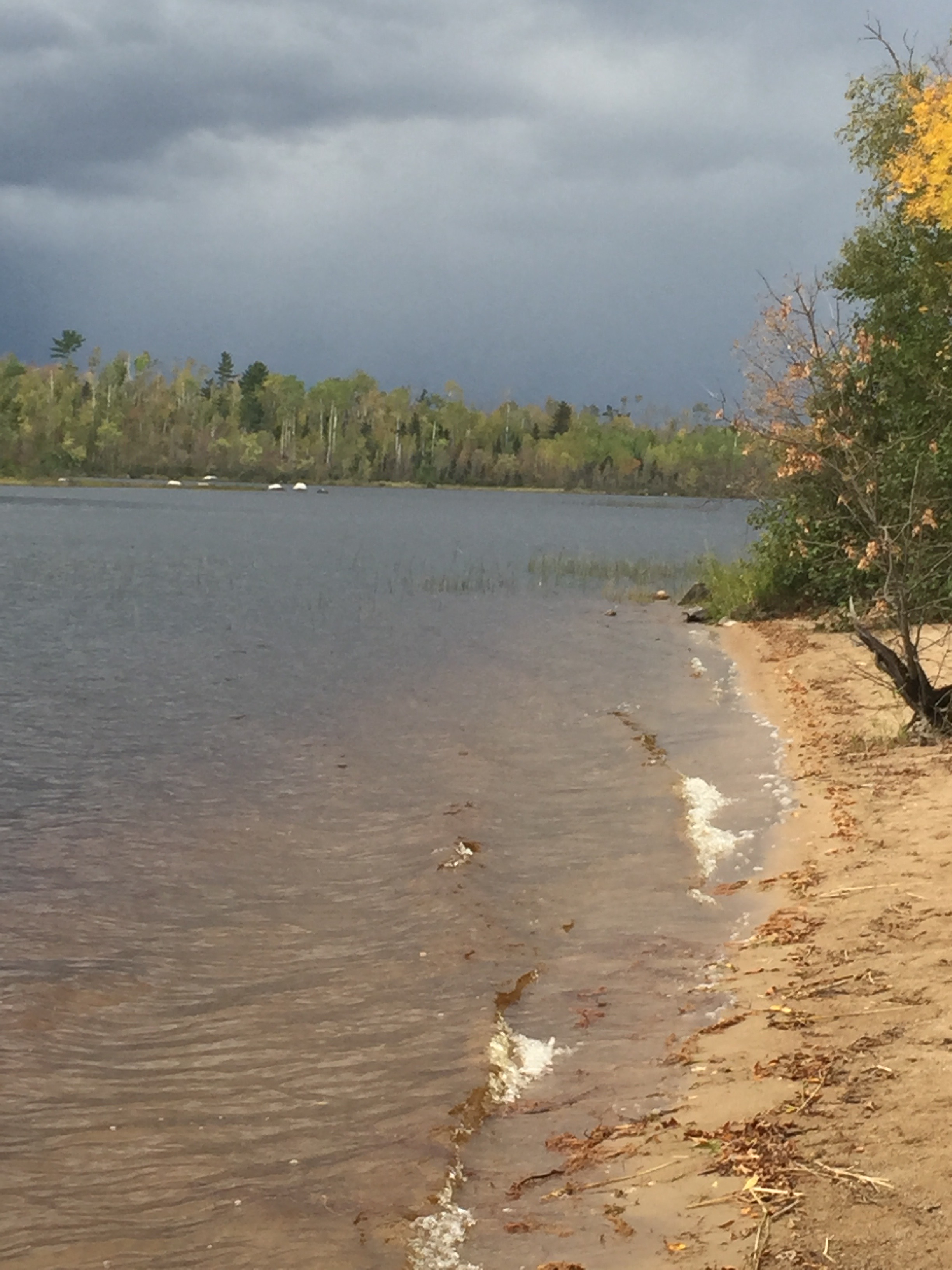
The North Fork of the Middle Fork of the Willamette RiverFrom the forest clearing from Highway 58, then 19, then 1919, then 660.Technical C class log out on the North Fork Trail. The log did not slide, much to our surprise and good fortune.Incoming rain in late afternoon. It would rain again later that night. Fall Lake, BWCA, 2018.
I should be colder than this, I thought, standing on the frozen dirt road with a thin coating of snow. I’ve got jeans on, 2 shirts, and a thin windbreaker. It was 27 (or -3 C), and I had my back to a brisk wind that so far had not worked its way through my balaclava or under my hard hat.
One way to Winchester Ridge Trail was downhill to to Swan Lake then climbing out, steeply in places, to the ridge. Others had told me the bushwhack from the parking lot directly to the trail was flat and we’d get to the ridge in about a half mile. I looked upward at the route and had my doubts, as we gathered our tools and headed east on to a trail that quickly disappeared.
My GPS showed several contours in our direction, so I assumed the worst—that the contours were real and what I had heard wasn’t—and noted my altimeter. I estimated at least 400 vertical feet—120 meters— of climbing. Some think that sort of knowledge is not part of the wilderness experience, but I have long used an altimeter when I hike, along with maps, which most definitely are part of the wilderness experience. I want to know where I am, where I am going, about how far it is, and how much I have to climb or descend. Altitude on a trail can often be a surrogate for one’s location, if there are good contour maps. The trail was gone, the trees angled up, the bushes scraped my jeans and left a coating of snow. At least hiking uphill, I was staying warm, so long as I didn’t fall. Fortunately, Winchester Ridge Trail came earlier than what my Gaia app told me, and I didn’t have to cross two more brown contour lines. We were on the trail, heading south towards Waldo Mountain junction, about 2.5 miles away. We didn’t know what was out there, log-wise, but we’d find out in about a half hour, when we reached the previous stopping point.
I have my watch altimeter and my Gaia contours set to metric. My GPS reads English. My car speedometer and odometer is set to metric. I didn’t think I would keep it that way, but I do. Making a meter of elevation is a lot better than a foot (nearly 3.03 times as better), and I play around with the numbers on the trail, the way I look at the rocks, trees, sky, and wildlife. To me, being in the outdoors is a full mental experience.
I had all my essentials except for a lot less water than I carried in summer, which was a blessing. I usually carry a Pulaski without a sheath. Sometimes, there is one, but it tends to come off if I am going through brush, and putting the sheath on and off again several times, I finally decide it’s easier to carry it without one. If I start to slip, I am supposed to throw the tool, assuming my flailing arm in an attempt to balance me is capable to doing that on short notice. The first time I was hiking out with the Crew, I threw it on one bounce into the calf of the guy in front of me. Fortunately, nothing happened, but I felt stupid and apologized. That’s why one should follow well behind on the trail.
We reached the first log, and as I in the rear approached, the two working on it waved us on to the next one, 20 yards further down the trail. As I came up to the log, I scouted the area using the acronym OHLEC—Objective-Hazards-Lean/Bind (we weren’t tree fellers, so only bind mattered)-Escape route-Cutting Plan. The first log was across the trail, 12 inches in diameter, too long to try to pull it parallel to the trail, but it had promise that with one cut, we could pull the remaining end to the side. There were no significant hazards, the log would probably have top bind, but not severe, the escape routes weren’t an issue for a log near the ground, and we opened the cut slightly to accommodate our later pushing of the log to the desired direction. My partner and I, both of us newly certified to do what we had already been doing all summer— the previous year as well— for that matter, bent to the task, or the saw.
The top bind or compression wasn’t enough to catch the saw, and we cut through the log quickly. I kneel a lot on the ground, because I prefer the ground to bending over, and I think I cut better with the saw closer to eye level. Besides, my back is happier that way.
We stopped briefly to let the first cutter crew go through on to the next log, and then finished the cut, put a strap around the log, stepped back, and pulled the remainder parallel to the trail. It was done. I now was quite warm and took off my windbreaker.
We headed on, leapfrogging, to the next log, 20 inches in diameter, in a pile of branches. I call these things a mess. In order to figure out what to do, we had to first remove the branches, some of which had 3 inch trunks of their own and were both difficult to cut and to throw aside. Once we got the area cleared, we looked at the log and decided we probably would get away with one cut, but might need two.
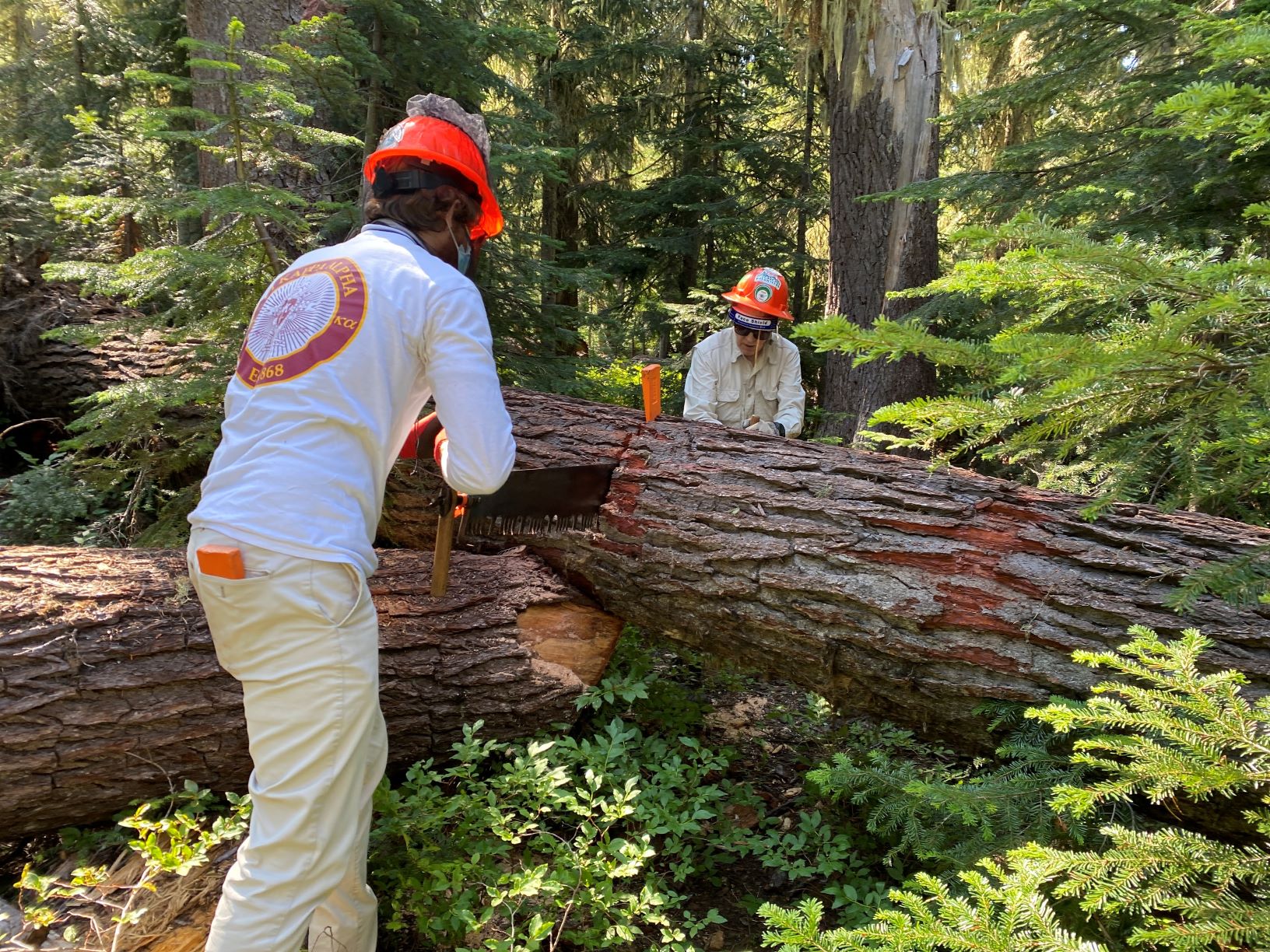
As we started cutting, the saw moved well. Sawdust was being generated, I allowed my partner to take as much of the saw as he wanted, and I pulled back as far as I could. Each stroke counted more that way. Half way through, there was a little bind. I pulled a hard plastic wedge out of my pocket, stuck it in the kerf, or the cut, and pounded it in with the back of the axe. The stuck saw was resting against my leg, and as I pounded it, I could feel it start to move, as the bind was relieved.
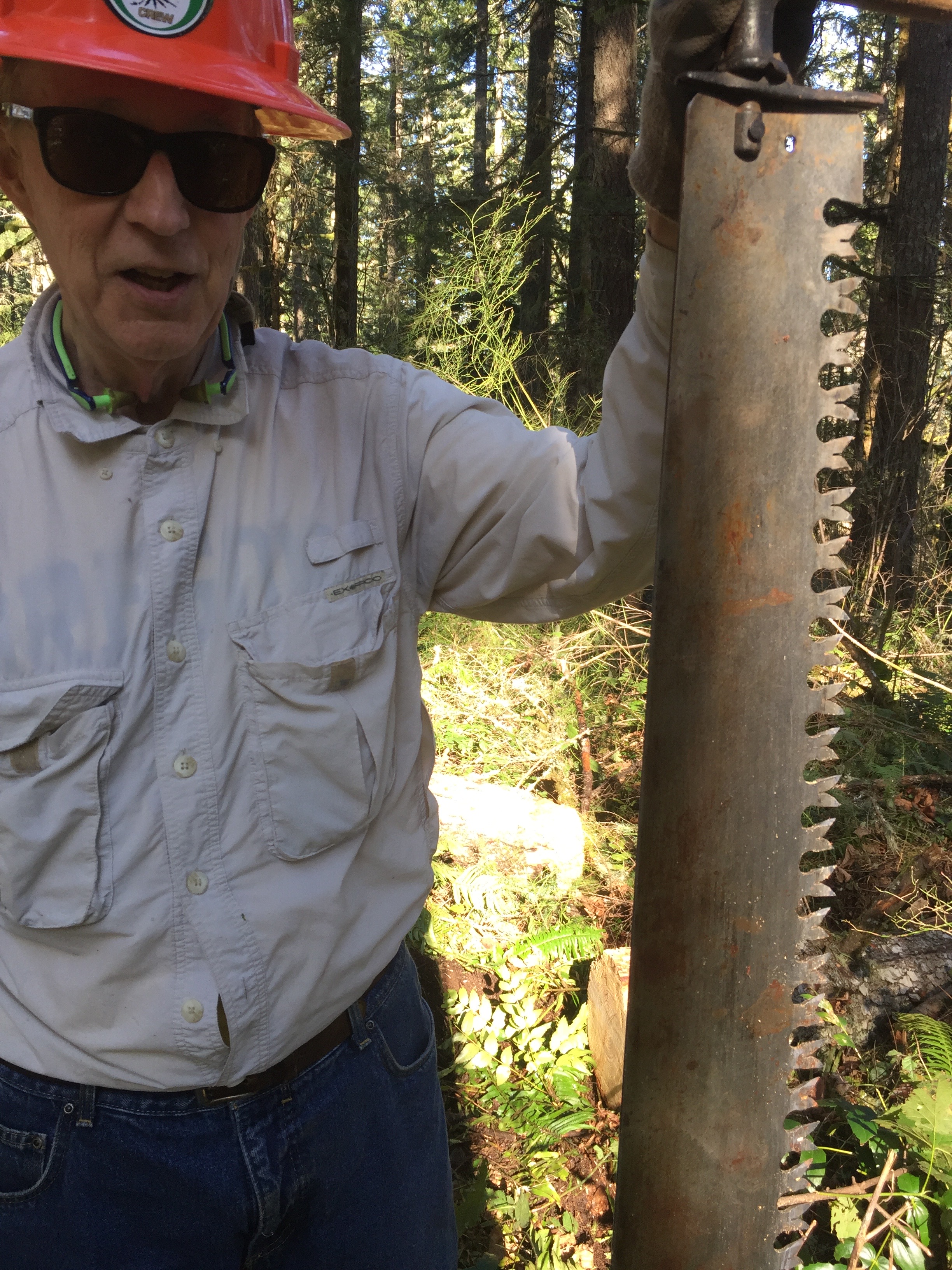
We cut further, and as we got near the end, we slowed the cutting speed and shortened the arc. The sawdust became reddish, as we entered the bark, and we stopped sawing. While we could cut through, the log might take the saw into the ground, and dirt is one of the worst enemies of a vintage cross cut saw. I removed the handle, and my partner pulled the saw through the cut, then replacing the handle.
I finished the cut with my KatanaBoy 500, a one man saw, and while that shouldn’t touch the ground either, it is less easily damaged than a large crosscut and also replaceable, unlike the vintage crosscuts, which were handmade with different steel that no longer exists. The log dropped slightly. Because of the ease of the cut, we decided to make a second cut, figuring that we could do it almost as fast as trying to rig up a way to move the log. I like moving logs and saving a cut, but I have my limits.
We would later have lunch on a splendid rock overlook with Waldo Lake in the distance to our east and the Eddeeleo Lakes below us. We would finish the trail in sunshine—although still cool—and split up the crew on the way back, some re-taking the “shortcut” back down to the cars, others, like me, taking two trails, one that descended, the second ascending to the cars.
Our way was 4 minutes faster.
Frosty morning on the crosscut, Winchester Trail, Waldo Lake WildernessThree pushing. Often, we use our legs.
Waldo Lake, visible in the distance from the lunch spot, with twin peaks in the center and Maiden Peak partially hidden to the right. The nice thing about trail work is having lunch spots in places where most hikers wouldn’t think to stop. There are many hidden gems of views out there.
Waldo Mountain. The old lookout is barely visible at the top. We logged that out two months earlier.
Two days after the election, the Crew had a job up on Shale Ridge on the North Fork of the Middle Fork (yes, it is called that) of the Willamette River. This was just outside of the Waldo Lake Wilderness, not far from the Three Sisters Wilderness, so chain saws were allowed. We had four crews to deal with about five miles of trail.
I knew a guy from the Club who had recently led a hike in that area and asked him what sort of condition the trail was in. He mentioned rotting bridges over streams and big tangles of logs and brush over the trail. I’m amazed these days that I have “connections” to learn about who has hiked where, who hadn’t put out a campfire, who is doing what in the Forest. I passed the scouting information on to the crew leader, before we all drove up separately and had our “tailgate session” at Constitution Grove. That is where we discuss the day and safety. I was with two crew leaders, one with the saw, the other, like me, a swamper helping. We started towards the river and soon found plenty of work. Constitution Grove has many Douglas firs, about the same age as the nation, so they are massive, and have signs on them with the name and state of someone at the Constitutional Convention in 1787. The area was named in 1987, the 200th anniversary. I saw a John Dickinson from Delaware and wondered whether the high school in Wilmington was named for him. It was. I scouted a basketball game there one night, 55 years ago, my senior year in high school, when an injured player from our team spent the season as a scout and asked me to help him. We’ve been good friends ever since.
It was nice out in the woods. Nobody spoke about the election, not a word. The vine maples were shedding yellow leaves, when they weren’t slapping us in the face when we tried to cut them out. Vine maples are small, but more than one guy has said his worst injuries out here were caused by them. We had to use our arms and legs, logs as pry bars to move some of the cut logs, and I spent part of the afternoon on my knees crawling 30 feet, cleaning up enough branch debris so the sawyer could get in to cut. As we were walking back to the vehicles at about 3, it started to rain. Perfect timing. The drive down was almost magical in the rain, trees ablaze in color on both sides of the road, getting dark, the needed autumn rains here.
I needed that day, because I feel like I neither know nor understand America any more. I shouldn’t be surprised. I was alive during the McCarthy era, although I don’t remember, “Have you no shame?” words that are every bit as relevant today as they were then. We have endured the last few years with people who have no shame. Nothing is sacred, and while political correctness has its flaws, there ought to be some verbal lines people in power simply do not cross.
I remember the Civil Rights workers (“outside agitators”) who were murdered and buried at another Philadelphia, in Mississippi. Here in Oregon, outside agitators came in with guns and took over a wildlife refuge. Got away with it legally, too, with only one dead, when he tried to run a police blockade and pulled a gun. Whole thing was streamed. I remember “activist judges” being decried by The Other Side, before the Supreme Court stopped a vote count, called corporations people, and other courts started practicing medicine.
We had Spiro Agnew, the first in a line of vice presidents so bad one wanted the president to survive: Dan Quayle, Dick Cheney, and Mike Pence, although Quayle now thinks the president should concede. Agnew was the one who coined the “Silent Majority,” which was believed to truly be in favor of the policies promulgated by the Nixon Administration..
No, I shouldn’t have been surprised at all by our assault on the environment by James Watt and a host of others, reaching a climax now, when there are oil leases in ANWR, and they now want to log the Tongass. This is insane, but perhaps a majority of the country doesn’t agree with me.
The flag has long been co-opted in that if one wearing it or flying it, especially in the bed of a pickup, he (yes, he) is patriotic, even if he didn’t serve in uniform, let alone overseas in unfriendly territory, doesn’t know the words of the national anthem, the Pledge of Allegiance, can’t name the thirteen colonies, the first state, or hadn’t been to even half the states.
I didn’t like Nixon, and I was glad to see him go, that August day in 1974, before I returned to the night shift at the Denver General ER. But Nixon signed the Clean Air Act, and back then there was bipartisan legislation. A few Supreme Court justices nominees got turned down, and stupid things said, like Sen. Roman Huruska’s famous words supporting mediocrity, but by and large the Senate was an important deliberative body.
Now, we have a rare few senators who think the president should concede, while the majority leader feels he should take all this purported concern about the vote to court and it isn’t clear if the Secretary of State really thinks there will be a second term. The President won’t tell the GSA head that Mr. Biden should now have his own office and get morning presidential briefings, as Mr. Obama did for Mr. Trump and Mr. Bush did for Mr. Obama.
The guys in camo have already demonstrated in Salem, probably with a few more outside agitators, but I hope they don’t really think that Biden’s nearly 400,000 vote win here should be contested or any of the now six million plus margin of victory Biden had on the west coast and the five plus million nationally, So far.
I am trying to find humor where I can. Knowing that there is now an unofficial unofficial (not a typo) Fraud Street run (to go with Philadelphia’s Broad Street Run) from Four Seasons Landscaping to the Four Seasons Hotel, is good for a laugh.
As is McConnell’s saying it was a good election for Republicans, even though he thinks the presidential part of it should be decided in court.
As were the protestors shouting “Stop the Count” in Detroit and Philadelphia, even as they were shouting “Count the Votes” in Phoenix. Can’t you guys make up your mind?
Part of me is worried that the craziness will intensify, but nobody seems to be counting on Covid’s increase to up the ante. Maybe the current leaders aren’t concerned, but the people lined up in their cars at Autzen Stadium getting tested for it are. One in 70 in North Dakota is currently infected, 1 in 16 has tested positive, and Covid positive nurses are allowed to care for patients now. A major hospital in Idaho was recently on diversion, and we don’t yet know how many long haul Covid patients there will be in the country, let alone what exactly they have, or whether it is treatable. Right now, the country is giving up. I’ve got to be more careful, even in the woods.
During this time, the president said that doctors were making a lot of money off Covid. Considering that many physicians have had to stop elective surgery, change their whole practice about seeing patients, and hospitals furloughed nurses, there may be those making money off the disease, but they aren’t wearing PPE and risking their lives.
Thursday, we go back up the North Fork to do trail work. It may rain. We will get wet and muddy, logging out the trail and repairing tread. Bridges are out, crossings may be dicey, and there are over 200 logs to take out. It will take months to fix. I’m looking forward to it. It’s November up here, and maybe things are starting to be what they are supposed to be.
One can hope.
Cut through, then push this 400+kg log to the side of the trail
This one is not on the trail. It just looked nice. Est. 400 years old
I love autumn, just not the leaf blowers.
This is a several hour job to fix. Nature reclaims her land. Most of these trails need to be cleared every other year; if not cleared in a decade, they may well be lost. In some places, that may not be a bad thing.
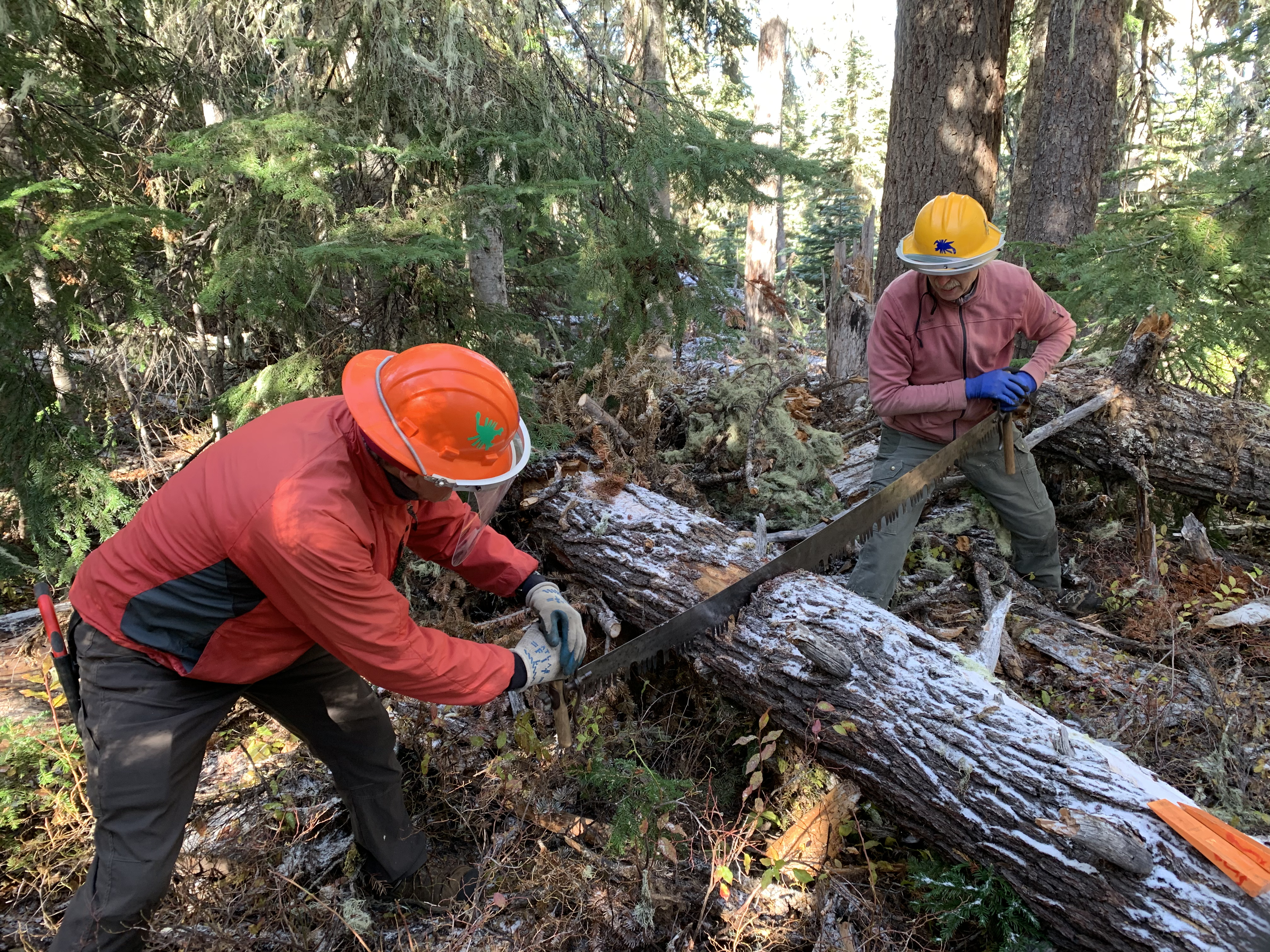
Steve and I looked at an 18 incher blocking the trail in the Waldo Lake Wilderness. It had been down for a while, the bark gone, which was nice, but needed to be removed. We both looked at the log, with enough space underneath to probably have a slight sag or top bind, meaning the cut from the top might start grabbing the saw as it cut through compressed fibers. Well, that’s what wedges are for, to keep cuts or kerfs open. He took the sheath off the 6 foot crosscut, and each of us took a handle.
We confirmed that we wanted to cut mostly straight through, and it didn’t matter which side we started from. We both got into position, which for me was kneeling on the ground, worked the teeth a little bit into the log so they grabbed, and started sawing, pull smooth and hard, relax for partner, smooth and hard, relax, over and over again, 20, 50, 100, 200, 150, 100,….
It went well. First, I could feel how smooth the cut was. I could hear the saw sing a little, and could see the kerf, or the line of the cut, staying open, not closing, and I noted a good pile of sawdust accumulating with a few “noodles,” thin strips of wood that occur with a good saw. Still, about half way through the log, I was thinking we could use a wedge to keep it open a little more, and Steve suggested it aloud. I pulled an orange hard plastic wedge from my back pocket, because I like having wedges immediately available, and with a nearby axe, pounded it into the top of the kerf.
When a wedge opens up the kerf, anyone holding the handle of a saw that is in the cut can feel a decrease of compression: the saw is loose again. We cut further, and finally got to the end, the log’s dropping part way to the ground. The saw was wedged in the kerf, so I took off the handle, so I could pass the rest of the blade to Steve to pull it through the narrow space. There was a time when I took a couple of minutes taking off or putting on a saw handle. Now, it is almost automatic. Sawing with a well-known instructor, I once removed a wedge prematurely, which was met with one of those comments, “Oh, I wish you hadn’t done that,” because getting the saw out would be more difficult. Stuck saws are bad. Sawing into the dirt is a sin.
We started on the other side of the log, had the same experience, and that end dropped, too. Sometimes, when both cuts are made, the log drops and if there is a downhill, immediately rolls off the trail without assistance. That is nice. The trail was flat, and the cut log was still held in place. I stuck a wedge between the cut part and the rest of of the log, hit it once with the axe, and the whole cut log dropped to the ground. That was real nice.
We still weren’t able to push it, however, and weren’t sure how stuck it was. We both sat down on the ground, put our legs against the log and pushed. This is easier on the back and allows one to use the strength of the legs. The log shot forward about 6 feet. That was super nice. We finished pushing it off the trail, and Steve sheathed the saw, ready for the next one.
There are probably thirty folks on the Crew, but each work party has somewhere between 3 and 8. The first group I ever went out with had about a dozen, but this summer it has been mostly 3 or 4. With three, one can get relief at the saw, which can’t happen with two. With four, one can have pairs leapfrogging each other. With more, it is possible to do serious trail clearing. The amount of sawing can still be considerable, as it was last week, when we worked solidly for about 6 hours, excepting a short lunch break.
I’ve been on the other side of a saw with many different people. When I started, three years ago, any time someone asked me if I wanted a break, I said yes. This year, I stopped saying yes and began offering my services. I’ve noticed a significant drop in the number of times my technique wasn’t optimal; indeed, one of the crew members told me the other day I was “so ready” for the saw certification class coming up, for which he had recommended me.
A month ago, in the Diamond Peak Wilderness, the two of us were cutting out a log, when he was trying to give instruction to another guy in the crew. He started pulling the saw to his left. I can now feel when my partner’s technique isn’t quite right, and I said to him, “Hey boss, you’re pulling left.”
“Really?”
“Yep.” He was. It was the first time I had ever told anybody, although I had seen it happen often.
Along the way, I have found people with whom I would share a saw any time and a few where I would just as soon limit my exposure. Earlier this summer, one guy, who is a lot larger and stronger than I, told me that I needed to give him more saw, meaning that I was pulling more and not letting him pull it back. That seemed odd, since once we are done pulling, we relax, keep our hands on the handle, allowing our partner to pull the saw. With the new position, my hands were slammed into the log every time he pulled back. I said maybe it was easier for him, but not for me, thinking that this wasn’t supposed to be a competition to see who could slam the other’s hands more.
A couple of others tend to pull the saw to one side. The saw has some flexibility, and if it is pulled to one side, it doesn’t cut cleanly through the log, making work harder. One can’t simply close one’s eyes and pull-relax-pull. The saw must constantly be sight aligned with the kerf, which is the best real-time information we have as to what the bind of the log is. If there is top bind, meaning the fibers are being compressed, as the saw cuts from the top, the fibers in the log will tend to compress or grab the saw, stopping progress. If the kerf is opening up, we are cutting through tension, the opposite, and the cut will be easier, which one probably has already noticed.
Not only do I have more endurance, I hear, feel, see, and now beginning to sense what is going on. I can feel different types of wood as we are cutting, the difficulty caused by binding, I can see the noodles of cut log when the saw is sharp and the wood the right consistency, I can monitor sawdust, and I can see the change in color that heralds the end of the wood and cutting into bark. I can hear the cracking suggesting that the log is almost cut through. Later that day, Steve wondered what he was feeling, looking over at my kerf. I showed him the knot that we were too close to, apologizing for guiding us there. I should have started the cut about an inch away.
It’s clear now what I need to take in the woods and where everything is. Indeed, my day pack has changed in part from the one I have used with the Club to one I use doing trail work, which is comfortable, and in which I have a better first aid kit, marking ribbon, extra wedges, clothing, lubricant, hand sanitizer, isopropyl alcohol, emergency supplies, a lopper, and a hand saw, food and water, and my Katana Boy 500 mm strapped to the back.
The author (back), Diamond Peak Wilderness. The wedge is keeping the kerf open, which is tending to close due to top bind or compression.The author with one type of 2-man crosscut saw, S. Willamette Trail, March 2020.Occasionally, it is possible for two pairs to cut simultaneously. Waldo Lake Wilderness.
We pulled up to the empty campsite on Knife Lake, just east of the Eddy Lake portage, and I hopped out of the canoe to check it. Mark and I were doing a sweep of the District during a week’s time, checking permits, people, campsites, picking up litter, digging new latrines and covering old ones, but mostly taking a long canoe trip and being paid for it. Earlier that day, we came upon a group of seven young women and an older man leading the trip. Mark said to the guy, “I want your job.” When the guy heard what we were doing, he said, “I want yours.”
I saw something on the site that I still vividly remember, nearly three decades later: a fire was burning well outside the fire grate, the flames high, fed by the wind, and about to reach the grassy area nearby. Fire inside the fire grate is almost friendly. Fire outside the grate, burning uncontrollably, is not.
We both used our hats to get water, shovels, and Pulaski to gradually get the fire under control and then out. Had the summer been much more drier, this fire would have been off to the races. There was no Knife Lake Fire that year, and we continued our trip uneventfully towards Fraser Lake.
Later that summer, I did a trip on the Kawishiwi River and fully a third of the sites we visited had a fire area with outright active fire or warm ashes.
I was taught that a campfire burns itself out overnight. We left sites that way. Finally, one time I decided to check that proposition and burned myself on hot ashes. I learned what has been said for a lot longer than I have practiced—put the fire dead out, drown it, and don’t leave until the ashes are cold to touch.
Five years after the Knife Lake incident, I was on a volunteer trip with the late Mike Manlove. We came into Good Lake, and at the first site there was a tent up but nobody there and a fire burning. I still remember the leader of the trip’s coming back to the site while we were there and apologizing. As Mike wrote him a $100 fine for an unattended fire, the man was upset and embarrassed, saying he had spent over four hundred nights in the Boundary Waters and nothing like this had ever happened. I wonder how many unintended fires he had during that time.
Back then, I was pushing 200 nights and knew clearly that on day trips, one was better off not building a morning fire. Drowning it would make it harder to start that evening. Eat a stove heated breakfast and save the fire for evening. I’m now over 300 days, will never hit 400, and I still canoe that way.
Three years ago, I took a backpacking trip to the coast with one of the premier leaders in the Club. The area was nice, but the trip didn’t work for me. I learned that the leader’s sleep schedule and mine must be in synch. Ours weren’t. The leader sat around the campfire drinking whisky at night and slept until 9. By 9, I have been up for 3 hours, eaten breakfast, taken a walk on the beach and was ready to go somewhere else.
That’s not a criticism of the leader. But when we were leaving the site, he kicked some dirt over where the campfire had been and scattered the logs. I went over and put my hand on the ground.
It was hot. Ouch hot. That is a criticism. Shameful. That is a criticism of the leader.
It wasn’t easy getting water, since we were on a bluff over the ocean. I did work my way down to a stream for two trips and got enough water to make the area cooler. I had to move quickly, however, because others on the trip were leaving the camp for their cars, and I didn’t want to miss my ride home. I left the site better, but worried for a full day that maybe the fire had burned under ground and would come up somewhere.
I was stunned: how could a leader leave a fire area hot? The prior day, we left the campsite about 10, and I realized that I had not checked the campfire, perhaps because I hadn’t sat around it and assumed the leader would have put it dead out. Wrong assumption.
I haven’t been on trips with this leader since. I invited a Club member on a canoe trip with me in 2017; he drank Canadian Club at night and slept in the next morning. It spoiled the trip. We got on the water late, and the best time of day had passed. Paddling lakes in the early morning is special. The wind isn’t usually up, birds and other animals are more likely to be out, and there is a stillness that won’t last but a couple of hours.
Two weeks ago, I was with the Crew doing trail work in the Diamond Peak Wilderness when a two young women backpackers came by us, having hiked up from Corrigan Lake, one of several nice lakes on the west side of that wilderness. They commented that they had put out an abandoned campfire that morning on their way out. They knew it was there because they saw it the prior night.
“Why anyone would have a campfire in these temperatures is a mystery to me,” one said. I thought there was a campfire ban, but it was beginning the following day. Still, talks of imminent campfire bans are a good reason not to have campfires.
We thanked them for their help and continued working our way towards the lake. I then remembered that the Club had had a backpack into Corrigan that very week. The same leader was leading that backpack, mentoring another, and I wondered whether it had been their campfire.
When we returned to town, it wasn’t clear to me whether they had had a campfire. I wrote a board member with my concern, not proof, because others could have been at Corrigan, although not many, since it is a small lake. I mentioned my concern and the issue on the coast three years prior. I also mentioned that I had heard that one fire almost had gotten away from that same leader up in the Cascades. That was hearsay, and I admitted that. I got a reply that the board member had seen pictures on Facebook of the group with two different campfires. He took that information to others and the Club now bans all campfires. If one wants to build a campfire, we can’t stop them, but it is not allowed on a Club trip. That may not stop people, but it protects the Club. I can think of three other violations I’ve heard about on Facebook. Be careful what you post.
And put the fire dead out when you leave the site. Fires start fast, and it only takes seconds for a fire to be high enough in a tree that you will never reach it.










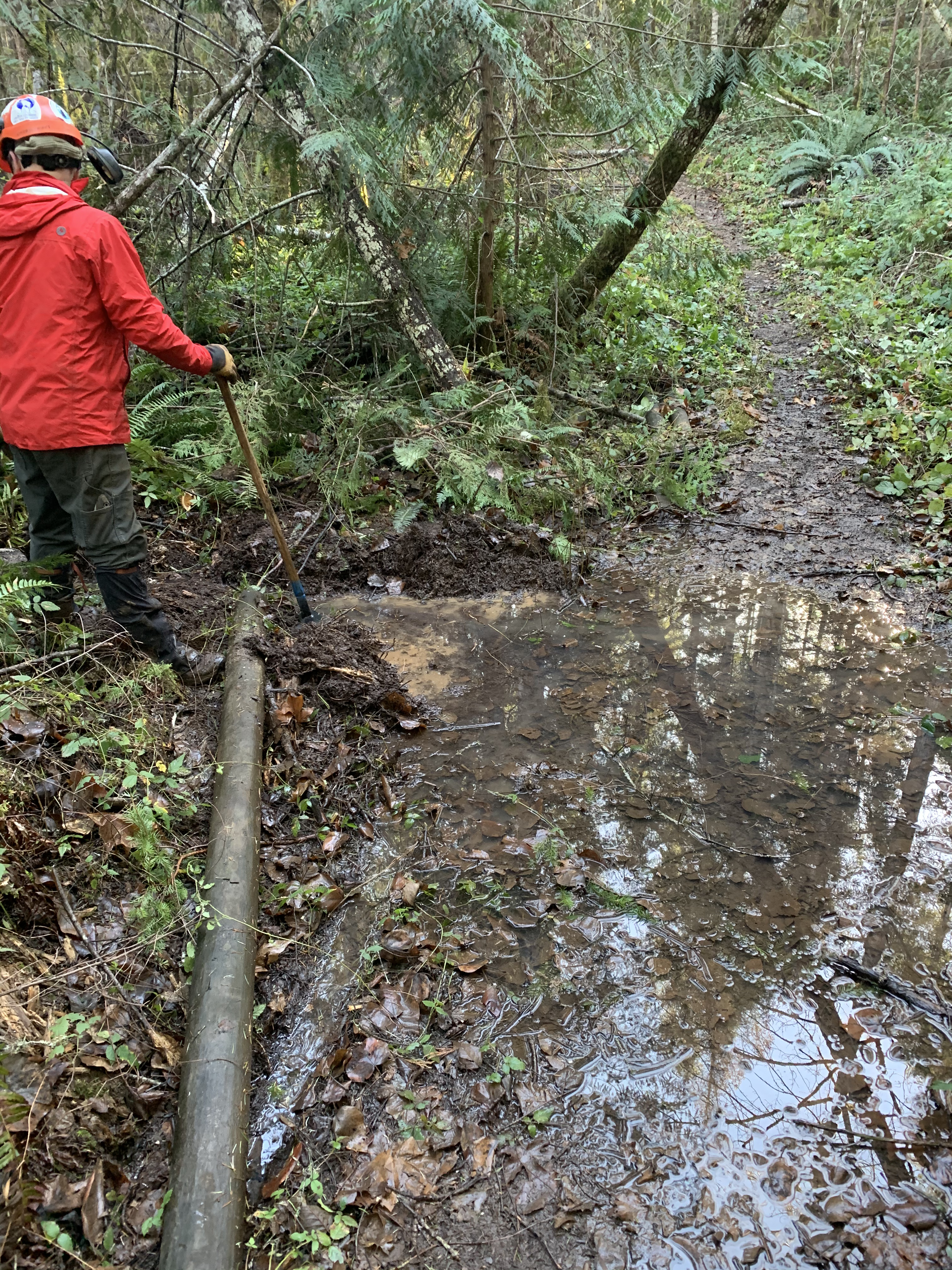









 Boreal B[l]og