Archive for the ‘Uncategorized’ Category

MOSTLY BY CHANCE

March 22, 2015

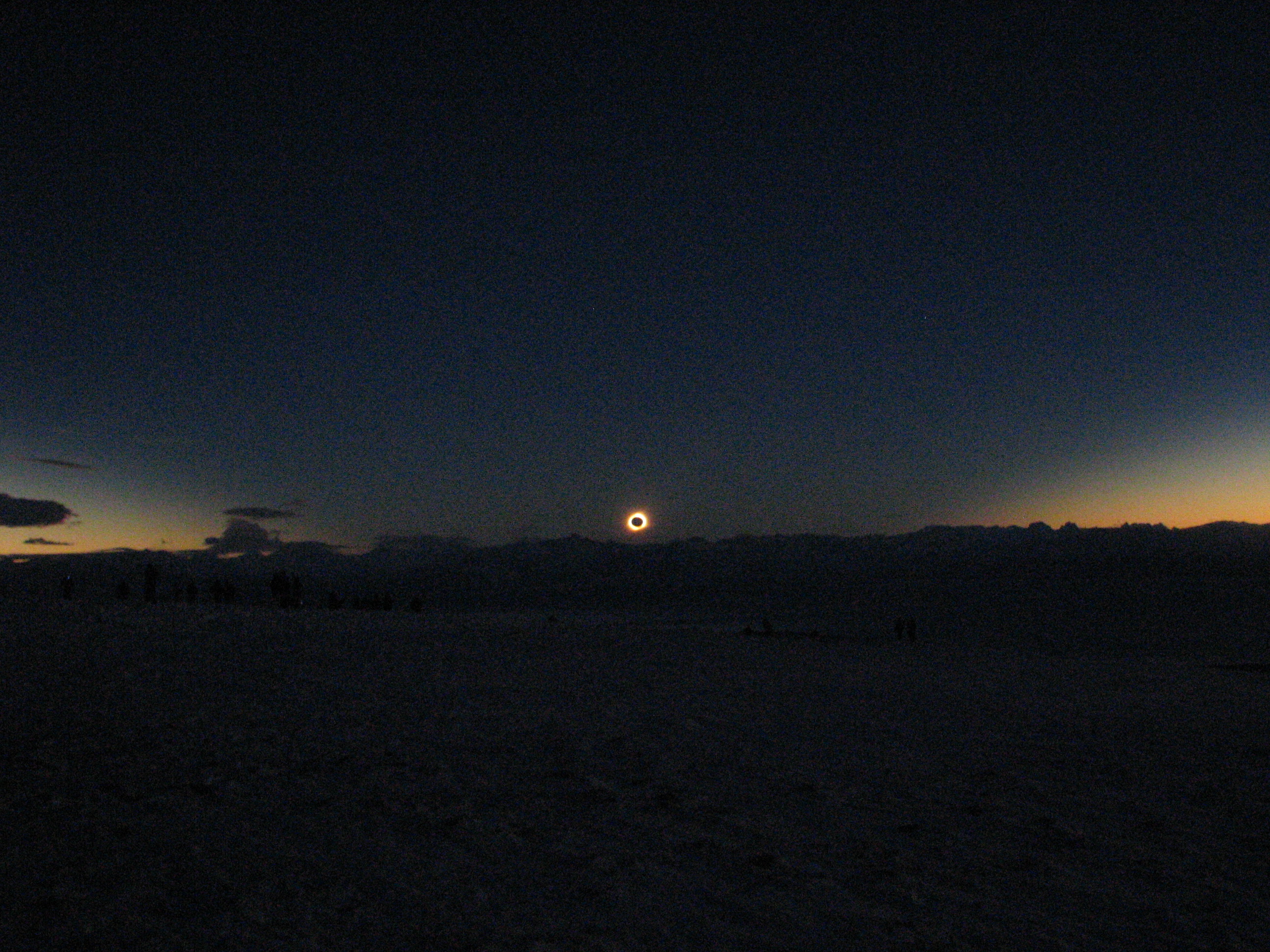
I hadn’t seen Christiaan since the 2010 eclipse, when a few of us got really, really lucky in Patagonia, Argentina.  We had a tour that had chartered a flight to see the eclipse, since July is winter in the Southern Hemisphere, and it is almost always cloudy at 50 degrees south latitude.  The flight was cancelled, ostensibly for “maintenance issues,” which none of us believed, and we thought we would never successfully see the eclipse from the ground.  Instead, we saw the most spectacular total eclipse I have seen, and I’ve seen fifteen.

IMG_2627

Christiaan, along with some others on the trip, befriended me on Facebook.  Like most of my Facebook friends, I didn’t expect to ever meet him, except that he does chase eclipses.  He lives in Amsterdam, and while we were in Germany, before the 2015 eclipse flight, he happened to message me on Facebook, asking whether we were staying at the Sheraton by the Düsseldorf airport.  I was, and he gave me his room number.

Things are things, people are busy, and he was on the other of the two eclipse flights.  I decided I really should call him after the eclipse, our last night there.  I’m not the greatest people person, but I called, and we talked for a while.  It wasn’t clear to me whether he wanted to continue the conversation. In the US, I have long been known when people didn’t want to talk to me.  In Europe, the culture is different.  In any case, I ended the conversation, since his eclipse group was having dinner together, and my wife and I planned to take the train into Düsseldorf and eat at a restaurant we liked when we had arrived ten days earlier.

Later, we decided instead to eat at the airport, a short walk, where we knew a good restaurant.  Mostly by chance, I thought since we would go by the bar in the hotel, on the spur of the moment gave Christiaan a call, asking him if he had a chance to stop by and say hi.  I wasn’t sure it was the right thing to do, but it seemed like a good opportunity to at least try. The worst that could happen was we wouldn’t meet.  Ten minutes after we arrived, I saw a tall young man and a young woman appear, guessing correctly, as it turned out it might be Christiaan and his girlfriend.  We had a delightful visit, despite being from different parts of the world, different cultures, and different generations.  We are fellow eclipse chasers.  It would have been easy not to have gone to the effort to call, but I’m glad I did.  I may or may not see Christiaan on another eclipse trip; it is highly unlikely I will see him in Europe again.  But I saw him.  That mattered.

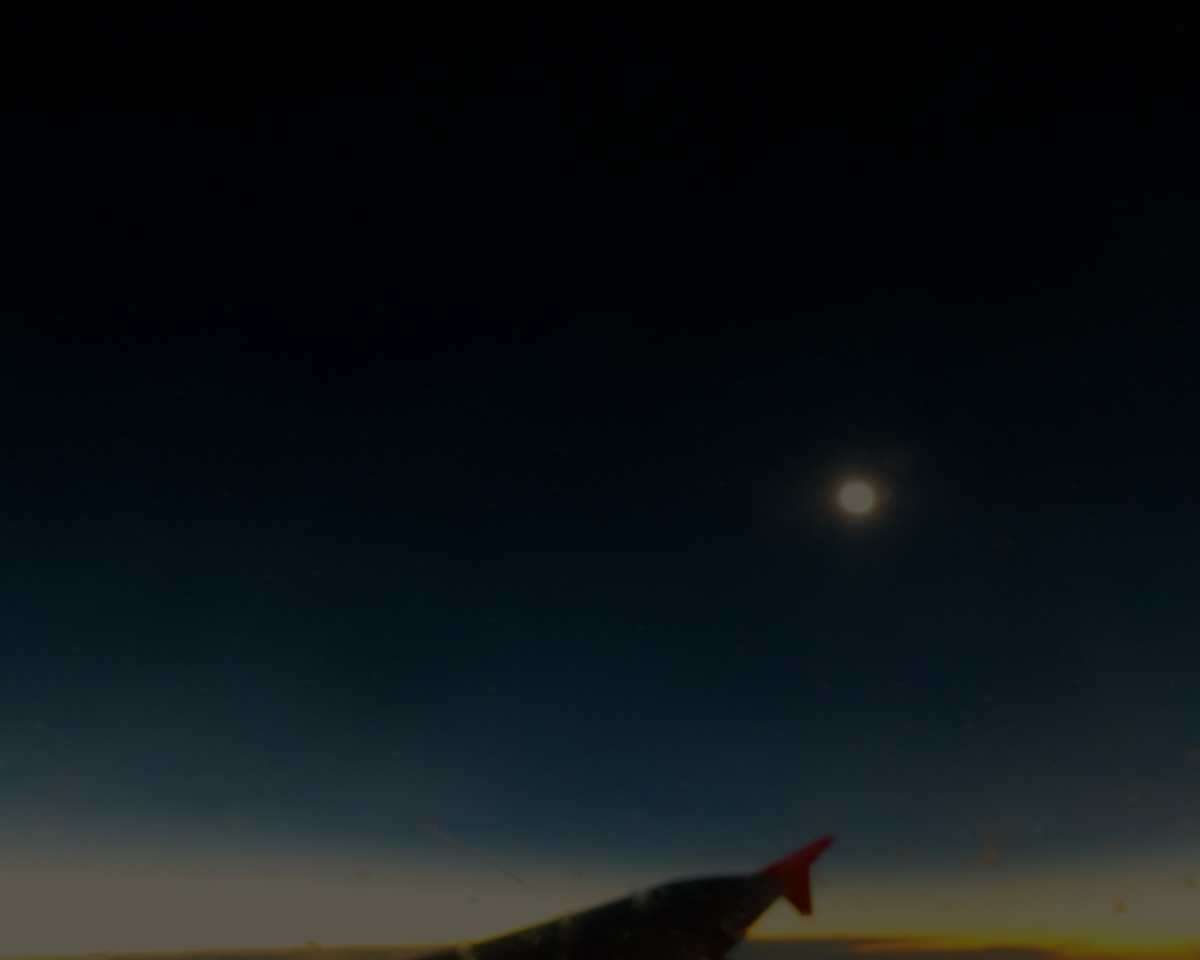
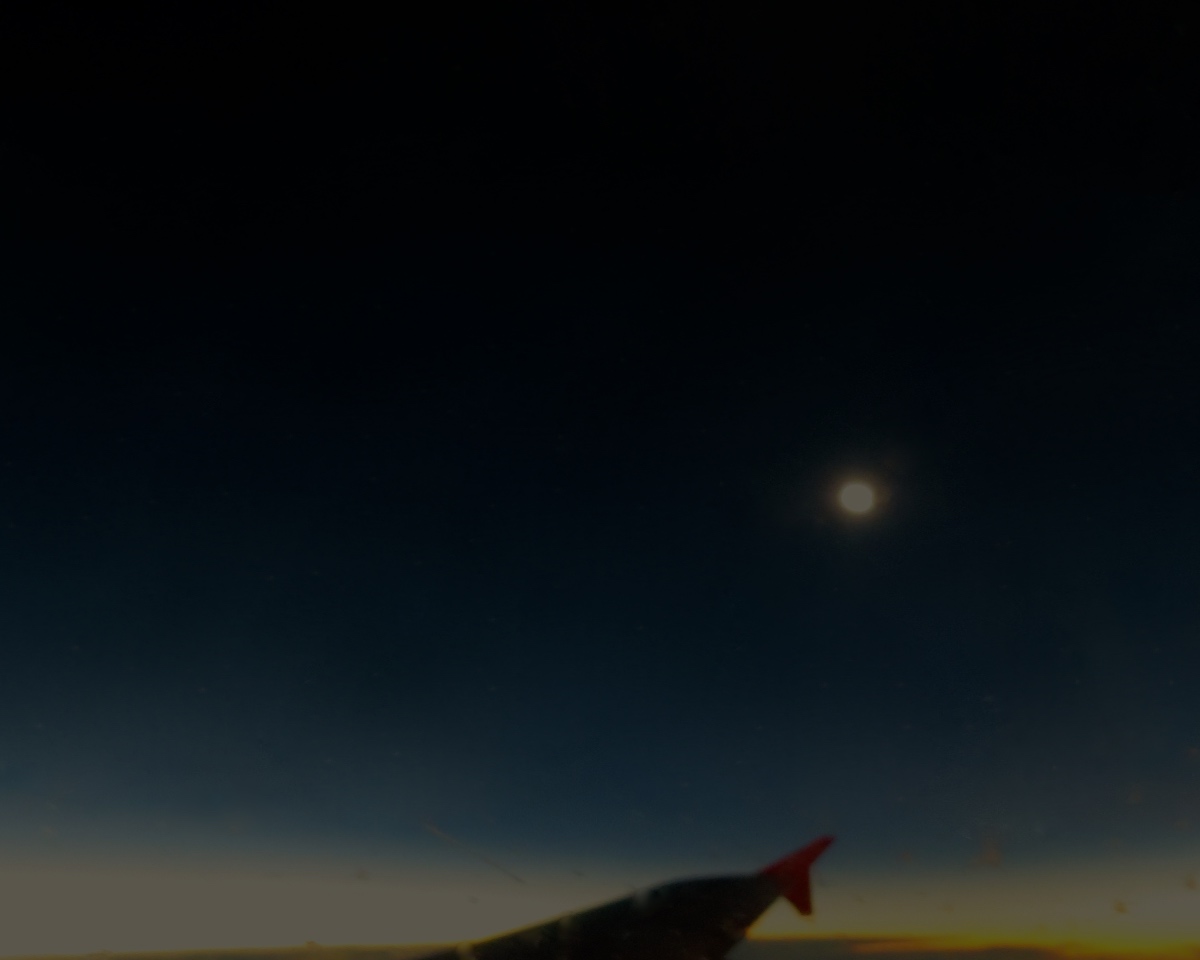
TOTAL SOLAR ECLIPSE, 20 MARCH 2015, OVER THE NORTH ATLANTIC.  SAROS 120.

TOTAL SOLAR ECLIPSE, 20 MARCH 2015, OVER THE NORTH ATLANTIC. SAROS 120.

Quite by accident, later that evening, after dinner, I decided to go and use the free wifi the hotel had only in the lobby.  I had posted something on Facebook in German, only to discover a grammar mistake.  I decided I would take the post down altogether.  I should do that more on Facebook.

While at the computer, I heard a conversation about two people, one of whom I know.  His first name is uncommon; I don’t often refer to people by their full names in this blog, so I will call him Stanley.  The man talking was an editor of an astronomy magazine, with whom I have been on at least two eclipse trips and may see in Indonesia for the 2016 eclipse.  He said that Stanley, now in a wheelchair, could be photoshopped into a group picture the other eclipse flight had taken.

Stanley is not a close friend but a man whom I greatly respect.  He lives in Tucson and has chased eclipses at least ten years before I started in 1991.  In 1984, he spoke at the Tucson Amateur Astronomy Association (TAAA) about the 99+% annular eclipse on the East Coast.  He said it had really been worth seeing.  I hadn’t.  He talked about the earlier Java total eclipse, then showed a map of total eclipses that would take place between then and 2002.  “That’s my vacation schedule,” he said, and everybody laughed.  He wasn’t kidding.

Stanley went to eclipses to possibly miss them, standing near the predicted edge to see if he saw it or didn’t.  That is a scientist.  I want to see every second of totality.  In 1987, I was with him at Tucson Mall, when the TAAA had a booth during a fair.  He showed a video of the annular eclipse in China, back when travel to China or videos were both uncommon.  He once climbed one of the Aleutians in pouring rain to try to see totality.  He failed but was philosophical about it.

Stanley is quiet.  For years, I went to a Christmas party given by a fellow amateur who is the opposite.  As I did less astronomical observation, I knew fewer and fewer people.  Stanley always came, and I knew I could talk to him about eclipses as common ground. He had been to St. Helena twice, a remote island group well off southern Africa. I once asked him how many eclipse trips he had been on.  He told me 38, and that was a while back.  Stanley never bragged.  The last time I saw him, he was 79 and looked great.

I don’t know why he is in a wheelchair.  Had I been a different person, I might have walked over and asked the editor about Stanley.  It didn’t seem appropriate.   Stanley might not have known me well; I am not a fixture in the eclipse community.  he is.

The individual hosting the Christmas parties once told me, that my eclipse chasing wasn’t “real astronomy.”  I didn’t argue, for he was one with whom one just never argued.  I think looking up at the night sky is astronomy, and seeing the Sun disappear in daylight qualifies as well.  I’ve published three articles about how astronomy has affected my life, one in Astronomy; two were in Sky and Telescope.

Perhaps I’m not a real astronomer.  But I’ve traveled all over the world chasing the Moon’s shadow.  Stanley is one of my heroes, a good man.  I’m sorry he is in a wheelchair and hope that in his early 80s now, it is temporary.  The odds don’t favor that. Nevertheless, he saw the 2015 eclipse.  I hoped he loved it.  I hope others got to hear some of his wisdom that he imparted to me.  I’m a better person for knowing him.

I’m glad that night I went to the hotel lobby twice.

Mostly by chance.

THE DOGS OF WAR

March 21, 2015

I needed to see Dresden.  The Stammtisch group I attend Tuesday nights in Eugene recommended I see it, for it is a beautiful rebuilt city.  The beauty wasn’t the primary reason I went there, however, although I was not disappointed.  The fact the city was rebuilt after the February 1945 firebombing did interest me.  I expected to see a lot of memorials in the city.

The only memorial I saw was outside of Frauen Kirche, on a piece of rubble.  There was a plaque with a comment by a man who had walked through the “dead city” on 15 February 1944, witnessing the final collapse of the dome.  Those monuments is where I remove my hat, as I did when I went into the rebuilt Frauen Kirche.  I am not religious, but I lit a candle and wrote in the guest book “Gedenke für die Opfern Februar 1945.”  Dresden didn’t need to be bombed.  I say that, not in hindsight, but because even before and during the raids, many Allies questioned the need to bomb it.  Much industry was outside the city, a cultural center, and many fleeing the Soviet Army passed through Dresden.

IMG_5094

I walked throughout the new and old cities, and when my wife and I went to dinner the last night, I again looked up in the sky, as I had many times, and wondered what it must have been like the night of 13 February 1945, when there were so many bombers that when they were first spotted, it was described as a giant dog was about to swallow the city.

It was worse than being swallowed.  The city was burned to the ground.

We walked through a square and stopped by a raised area, which had an opening for underground parking. I almost missed it.  I saw writing on the concrete that was part of the barrier.  This didn’t appear to be a monument.  But I was certain I saw some writing.  I was correct. I then read what was on it.  Translated, the last sentence was poignant:  “War went out from Germany to the rest of the world and came back to our city.”

Here, 6685 bodies were cremated.  Most of them had already been burned in the firestorm, so this was really a second, final cremation.  The dogs of war had been let loose in the world, and war had returned with a vengeance.  The people did not blame the Allies for bombing Dresden.  The statement simply stated that war had begun here, had spread from here, and had come back here in spades.  I needed to read that.  It mattered that there was an acknowledgment of war.  It mattered that the people actually wrote it on a monument, not without controversy, for there was some, but they did write it.  Indeed, it matters as much as the fact that there was a resistance museum, for it is clear that people did protest what was happening.  They were shouted down, attacked, deported and murdered.  The lucky ones fled.

I thought it ironic that a right-wing group had held a rally here the night before, including an American flag with “US go home” painted on it.  Dresden had been shut down by demonstrations earlier in that month, and more were planned.  The right wing wants its way; most of us do.  The difference is I’m willing to look for solutions, willing to give, but not willing to always give in.  The right wing I know has to have everything their way.  The right wing in Germany forced their way in the 1930s, and almost brought down civilization.  The right wing in the US had incredibly gone around the President’s back and told Iran that any deal negotiated by the US would be null and void after the next election.  Had Congress done that to the prior president, they would have been labelled traitors.

Additionally, inviting the Israeli prime minister to speak in front of Congress, and is coming, was a massive breach of protocol, torpedoes hopes of negotiation of Iran, frankly boorish, and incredibly stupid, since the senator who wrote this letter was later quoted as saying the Iranians were “in control of Tehran,” as if the capital of the country were somewhere else.  I may not be a US Senator, but I know what and where Tehran is.  I correspond with several people who live there or who have escaped from there to other countries.

I find it astounding that a country where balancing the budget is given so much press and so little effort to do what could easily—yes, easily be done—is actually considering unleashing the dogs of war on a country three times the population and area of Iraq.  We were told that war with Iraq would cost $1.7 billion and be paid for by oil revenues.  To date, the cost has been one thousand times that.  Yes, one thousand.  Several thousand Americans have died, uncountable Iraqis, and tens of thousands of American soldiers maimed for life.  The numbers of Iraqis are again uncountable.

I don’t think we can prevent Iran from obtaining a nuclear weapon, and even if we could, the fact that nuclear material has been smuggled out of former Soviet republics, that Pakistan, India, China, Israel and North Korea are among those countries with nuclear weapons, to loose the dogs of war on Iran is beyond my comprehension.

Elections matter.  Too many Americans sat out the last one because Mr. Obama hadn’t fixed everything that the recession and two wars he inherited had caused.  Further, Mr. Obama is faced with a rapidly changing world that America no longer can control with troops, CTF (that would be carrier task forces), or bombing.  Further, he is being asked to cut spending, taxes, and destroy the environment in the name of jobs, which need to be different from ones we have had before, because the world is changing rapidly.

It’s difficult to walk out of the Jewish Museum in Berlin without realizing that the world has been at war a good deal of its history with a few relatively short periods of peace.  Peace in our time will sooner or later devolve into war.  At least two thousand years of history support this contention.

Unleashing the dogs of war immolated Dresden.  It did the same to Tokyo, where fire killed more people than Hiroshima.  The dogs of war, once unleashed, are not controllable.  One might be extremely cautious before letting them loose.

One might even visit Dresden.

IT HAPPENED; THEREFORE, IT CAN HAPPEN AGAIN

March 19, 2015

In Berlin’s German Resistance Museum, there is a picture of Dr. Magnus Hirschfeld, one of many intellectuals persecuted by the Nazis in the early 1930s.  Dr. Hirschfeld had done much research about homosexuality, concluding such was a variant of human sexuality.  Note the word “variant.”  It means different, like red hair is a variant of human hair color.  Or skin color.  Or ability to do different things. Said another way, some people’s brains are wired differently when it comes to sexuality.  They just are.  I am straight, but I didn’t choose it.  I just was.  It is sort of like how I deal with math.  I am good at it.  I just am.

The rise of Nazism was due to many factors,  the upshot’s being that a group of thugs took over one of the premier civilizations of the world, blaming certain groups, instilling fear, the need for law and order, and of course creating jobs.  My late father-in-law, a physician, had to learn German in medical school, because the important scientific literature was written in German. His son-in-law, also a physician, sees disturbing parallels between 1930s Germany and the current US Congress, especially when it comes to instilling fear, racism, sexism and being boorish.

Dr. Hirschfeld was heir to the scientific tradition of Germany.  What he had discovered was astounding, given it was 80 years ago.  Unfortunately, on 10 May 1933, twenty-five thousand books were burned in Berlin, right across from the university.  These were not just novels, they were classics, books about many different subjects, and …  Dr. Hirschfeld’s work.  Before a book was thrown into the fire, the author and the title were screamed aloud.  I say screamed, because I believe with a fire and a mob, one would have to scream.  But I could be wrong.

MONUMENT TO WHERE THE BOOKS WERE BURNEDEMPTY SHELVES SEEN BELOW DEMARCATING WHERE BOOKS WERE BURNED

Dr. Hirschfeld could have been wrong, too.  I suspect, however, he would have been the first to admit it, had someone discovered compelling evidence to dispute his findings.  Good scientists use terms like “margin of error,” “confidence intervals,” and “uncertainty,” which many lay people take to mean that scientists don’t know what they are talking about.  In fact, the absence of those terms from scientific discussion is a statement of ignorance.  If we taught basic statistics well, we might be able to have a citizenry who understood how we can make inferences about quantities that may never be exactly known, such as the state of the Earth’s atmosphere, and draw conclusions about our climate, to name one.

The SA did not know much about science, either, and felt intellectuals, the Jews, gypsies, and infirm did not belong in their society.  That is why they burned books.  They burned truth, they burned what might not have been truth, but an attempt to find it.  They burned the creations of human beings.  I might not agree with such creations, like those that Glenn, Rush, Ted Cruz, James Inhofe, and Pat Robertson; indeed, I think most of what they write are outright lies.  But I wouldn’t burn their books.  I don’t buy them, I hope others don’t, and that the paper is eventually recycled into something better.  Indeed, in a capitalist society, we would call that the “market forces.”

Robertson himself recently likened being gay, or homosexual, as Dr. Hirshfeld would have stated, to being a drug abuser.  Robertson is wrong.  He needs to retire, disappear from public view, and the media ought to stop covering what he says. His time is over, not because he is old, but because he is rigid, wrong, won’t consider other ideas, and spews venom.  He has no proof that homosexuality is a choice.  Jimmy Carter is 6 years older and still writes thoughtful books.

Dr. Hirschfeld died two years later in Nice, in exile.  At least he got out of Germany before the War, when he otherwise would have ended up in one of the concentration camps and have been murdered.

Notice the word “murdered.”  The German Resistance, Holocaust, and Jewish Museums use the word “ermordert,” rather than “gassed,” “shot,” “starved to death,” “jumped off a cliff without a parachute,” or “died from tuberculosis/typhus.”  They don’t mince words.  Those who died were murdered.  They were forcibly deported, after losing their livelihood, their possessions, their families, their health, and finally their lives.  Walk the streets of Berlin or Dresden, and occasionally you see a “Stolperstein,” a small sidewalk marker, where somebody or several somebodies once lived.  These people were deported to a concentration camp and then murdered a year, two years later.  Don’t believe me?  Here are four.  Two were my age.

STOLPERSTEIN

So was lost the truth, the potential, and in Dr. Hirschfeld’s case, work that was a minimum of 80 years ahead of his time.  The clock is still running, however, for even today, a majority of those in Congress feel homosexuality is sinful, that love between two people of the same sex is wrong, can be changed, and is a choice.  As recently as 1970, the American Psychiatric Association considered homosexuality a disease.

Dr. Hirschfeld was a great man who never lived to see the fruits of his labors.  Had the Nazis not intervened, who knows how the idea of homosexuality would have interpreted in the civilized world.  Perhaps nothing would have changed; somehow, I think it might have been a lot better for both gays and straights.

Maybe. Maybe not. Jews have been persecuted on and off for their entire history.  What I do know is that I learned something the day I stood over the spot where the books were burned, and two days later, when I toured the Resistance Museum and read about Dr. Hirschfeld.  From this great man, I learned a better term than “homosexuality” or “gay”.  I learned “variability of human sexuality.” I also learned that we often don’t live to discover whether we were right.  It’s OK.  We tried, and we honestly tried to advance human knowledge.  That is enough.

What isn’t enough is we can’t rid ourselves of the enemies of truth.  They wrap themselves in the Flag, a Holy Book, their interpretation of religion, and their ideology.  They bully others by loudness, by threats, by carrying out threats, and by joining with likeminded others.  They have always been out there, and they always will be.

By the way, if you think human sexuality doesn’t vary, read Dan Savage’s column sometime.  In the Eugene Weekly it is called “Savage Love.”  As ex-Navy guy, I thought I had heard of everything to do with human sexuality.

Oh, how wrong I was.

“It happened, therefore it can happen again. That is the core of what we are trying to say.” (Primo Levi)

CHEWING AN APPLE

February 23, 2015

Yesterday, while looking for a pair of walking shoes, I was helped by a saleswoman who chewed an apple the whole time I was there.  I know people often need to eat while working.  I did it for years.  But eating in front of a customer one is helping seems rude.  I wondered about her education.  It was a good day to wonder, for the Sunday paper had reported that Lane Community College received a “scathing report” during their accreditation.  They are accredited, but there is a lot of work that must be done in the near future; a repeat visit is planned.

There are issues that clearly relate to Lane, regarding course structure, how students are evaluated, and a need to establish clearer goals.  There are other issues, however, not mentioned in the article, which I think need to be discussed.  I wrote a letter to the paper, but after finishing realized I had already used my allotted one letter per calendar month.

I am not an educator, only the son of two.  I have, however, taught at a community college and at a for-profit university, leaving the latter, because I thought it intellectually dishonest to pass students in statistics when they had neither the necessary math skills nor adequate time to learn it.  Not understanding the slope of a line makes linear regression impossible to learn. 6 E-5 on a calculator is not 6 but 0.00006.

I volunteer at Lane twice weekly tutoring math.  Yes, I eat lunch while there, but I put food away if a student needs help. In Arizona, I volunteered in 3 high schools for 9 years, eventually becoming a substitute teacher, because I wasn’t utilized enough as a volunteer.  I ate on the job there, too, and I barely had time to use the bathroom.  We need volunteers in the schools, but they must be kept busy.  Establishing such a system should be a national priority.

At Pima CC in Tucson, 80% of the incoming students flunked the math placement exam.  In a high school in an affluent district, I spent two years helping students do “accelerated math.”  The euphemism was an attempt to help 10th graders, with elementary school math knowledge, reach standards allowing them to graduate from high school, standards that have since been removed, after first being watered down.  We want math fluency; we just don’t want to hold students back from graduating if they don’t have it.  One may argue the test wasn’t good, but at least there was a way to evaluate students.  Now there is none.

The students I taught needed multiplication tables beside them, which I think should be known by everybody reaching junior high school, let alone 10th grade. I think students should know 8 x 6 or how to divide 3 into 12 without using a calculator.  I’m not exaggerating.  Each had been passed up the line despite their not knowing basic arithmetic.  They got “participation points,” “trying hard” was important, and some of their parents demanded they be allowed to finish high school with their peers who did know these basics.  Watch Suze Orman sometime, and it becomes clear what happens when people don’t understand finance.

Community colleges have become de facto high school finishing institutions.  I don’t know whether community colleges pass students to the next level—the workplace or a 4 year college—with the skills they need, like making basic change at a cash register.

Or not chewing on an apple when one is helping a customer.

I have three fundamental questions:  1.  What are we trying to do?  2.  How will we know we did it?  3.  What changes can we make that will solve the problem?

Funding tied to number of degrees awarded increases pressure to award degrees.  How do we know if the degree is worthwhile?  One can pass students up the line, but eventually I want a doctor, a mechanic, a pilot, or a computer specialist who is competent.  The piper must be paid.  Competence must be definable and proven.

It includes not chewing apples in front of customers.

I don’t believe a four or even a two year stint in higher education is necessary for all.  Many important jobs in our service economy don’t require college.  Education’s primary role might begin by teaching early and often that complex 21st century problems are not addressed by catchy phrases.  We need to grant meaningful degrees, not just count them, teach the myriad skills required today, pay for them, and keep education affordable.  Climate change, ocean acidification, immigration, religious fundamentalism, North Korea, Cuba, Iran, competition, environmental degradation, defense, can’t be addressed by “America first,” “boots on the ground,” “I’m not a scientist,” “deport all of them,” “de-regulate,”  “let the market do it,” or “allow parents to decide.”  None of these and other issues have clear answers.

We need to determine what courses are needed for today’s workforce and for those jobs we believe we will have in the future.  In 2045, people will be doing work that today not only doesn’t exist, we can’t even imagine what it will be.  Streaming video online, wi-fi and smart phones weren’t things I thought about in 1985.  Indeed, the words “streaming” “wi-fi,” and “online” didn’t exist, smart belonged with people, and video was defined in millimeters and called “film”.

How we certify students needs to be changed.  We need a required, sensibly structured way to state that an individual is prepared for the next step. These changes will be painful to higher education.  We have to pay for this as students and as taxpayers.  The debt load is burdensome; people need to learn what is necessary for a skill, which may not require 4 years, or even 2.  Stampers don’t need to know Chaucer, not if it is part of their $50,000 student debt at graduation, but they need to know enough math to do finance, enough English to communicate, and enough science, history and geography to be able to vote intelligently.  Professional golf management as a major once sounded like a joke, but given the popularity of golf, I’ve reconsidered my position.  By the way, learning to reconsider one’s position on a matter should be taught, too.

What are we trying to do?  Have an educated populace in the 21st century.  What is an educated populace?  I don’t know.  I offer my thoughts, and if our country were a place where we could discuss complexity with civility, not with talking points and shouting, we might be able to answer this question better.

How will we know we have done it?  We need better measurements than we have, ones that will tell us the bitter truth, which we all know exists.  We have millions of poorly educated citizens.  Let’s neither allow gaming of the system nor get hung up upon punishing schools.  The solution will be expensive, requiring money, volunteers, good ideas, but most importantly evaluating students honestly. It will be painful.  The truth usually is. We need multiple career pathways to accommodate variability in learning and intelligence.

How do we move forward?  Ask the right questions. Then answer them.  Honestly.

THE “GIANTS”

February 17, 2015

A woman my age recently died at a hospital because she was given an intravenous paralyzing agent rather than the ordered anti-convulsant.  Ironically, she came to the hospital to discuss her anti-convulsants and anti-anxiety medications.  She had a brain tumor removed a month earlier.

We thought we are going to give one medicine, and we gave another medicine.”

You see, a drug got mislabelled in the hospital pharmacy and a paralyzing agent was put in the IV bag instead.  She was being monitored, but unfortunately, a fire alarm went off, so the nurses were distracted closing sliding doors.  Concatenation of problems.  The patient stopped breathing, nobody noticed until she had a cardiac arrest, and she was then taken off life support three days later.

Concatenation of problems, 1985.  Delta 191 coming in to land at DFW.  Thunderstorm in vicinity.  New Doppler Radar not ready.  No weatherman on duty.  Lightning strike ahead and rapid intensification of the storm.  Plane hits updraft and accelerates.  On the other side plane encounters a downdraft, driving it downward, altitude too low to recover, 137 died.

The hospital had now implemented several steps “to ensure that an error of this kind will not happen again in our facilities.”

If I hear “to ensure that an error of this kind will not happen again,” one more time, I will scream.

Or maybe die, if it happens to me.   What about other facilities?  Any other facility going to learn from this?  We learned from Delta’s disaster.

They include the creation of a “safety zone” where pharmacists and techs are working that is intended to eliminate distractions and the implementation of a new checking system for paralytic drugs.  Airline pilots have long had “sterile cockpits,” where nothing but the aircraft is discussed below 10,000 feet.  A decade ago, I proposed the same for radiologists, who are interrupted frequently.  I think clinicians should do the same.  Very few phone calls are so important that they are worth disrupting a clinician’s concentration when seeing a patient.

Three enemies of good medical care: hurry, fatigue, interruptions or distractions.  In my training, I heard the “giants” could work 36 hours, when I couldn’t.  I dreaded days on call, knowing I might be awake for 36 hours.  The “giants” could work without eating, too.  I couldn’t. The “giants” could take phone calls while seeing patients.  I would be called out of the office, pick up the phone, and hear, “hold for the doctor” (who had initiated the call).  Some of those doctors were my partners.  The call disrupted my consultation.  I said this lifestyle was unhealthy and bad and told to suck it up.  I wouldn’t and left.  I was proven right.  Being awake for 24 hours is equivalent to being drunk.

Medication errors are common; twenty years ago my hospital, where I was medical director, were dealing with them.  How does a paralytic drug, rarely used, get into an IV bag? That’s a system that needs to be fixed quickly.  Move these drugs far away from all others in the pharmacy.

People are fallible.  We all screw up.  We are hurried, fatigued and interrupted.  We multitask; far too much is expected from too few personnel in many hospitals.  I interrupted radiologists.  Nurses are frequently interrupted, often by false alarms and incessant beeping, which is distracting. We live in a noisy, fast-paced world, dealing with huge volumes of information simultaneously.  But our brains have not equipped to deal with such.  I am a slow processor; I shut down when encountering questions from two or three people simultaneously.  When everything is urgent, nothing is.

But the “giants” dealt with that.  I couldn’t.

Very old people may hit the accelerator mistakenly, not the brake.  But you can’t shift a car into reverse without having your foot on the brake. Is that perfect?  No, but it is a good safety mechanism.  Compare that with the history of Vincristine, used to treat leukemia.

“We must be certain that there never is a 14th patient who receives vincristine intrathecally (into the spinal fluid) by mistake.”  I am not quite exact with the quotation, and I can’t find the article in the literature, but such injection, completely preventable, is almost always fatal, often in children whose leukemia was curable.  “It is unspeakable that this should happen in this day and age…”  That was said in 2001, long after the first quotation.  Google the issue now, and there is a recent case report of three children, two of whom were thought to have Guillain-Barre syndrome. The problem hasn’t been fixed, and it should never occur. Why?  In one article, twenty different system fixes were suggested.  What is wrong with medicine?

Stuff happens, yes, but this stuff needed to stop happening decades ago.  We’ve known about fixing bad systems for a long time.  Are we making progress?

Answer:  I don’t know.  We might review all hospital deaths using an ordinal scale to determine the role of medical errors.  Sample hospitals, and we have an estimate with a decent margin of error.  Do it over time, and we know trends, as well as numbers and types.

Those of us who study these issues believe in “root cause analysis.”  We also believe patient safety requires senior management’s seeing the data and acting upon it.  This does not happen in too many instances.  Reports need to be compelling and readable:  significant errors should be written up, the results of the investigation disseminated.  Delta’s crash made dealing with wind shear a major priority.  The American Airlines crash in Little Rock highlighted “get there-itis,” despite a thunderstorm’s intensification in the area, with failure to deploy spoilers, a combination of hurry, weather and fatigue.  Back then, two-thirds of pilots polled said they would land during a thunderstorm.  They no longer do so.

Medicine will never be perfect.  As technology changes, as medicines change; as illness management changes, there will be new challenges.  We need to face those challenges head on, anticipate them, have a safe way to report close calls as well as errors, and make these known to everybody in the field.  There should be no embarrassment, no hiding, but there must be an analysis as to what went wrong, as is done in aviation, what must change, and how to prove efficacy.  Top management must be involved and buy into these systems.  While we shouldn’t tolerate violation of safety principles, inherent system design must make it easier to do what is right, more difficult to make errors.

My ideas have been in the public domain for well over a decade.  Perhaps they aren’t good enough.  That’s fine.  I’m not perfect.  Offer better ideas.  Then prove it.

Just don’t tell me about the  “giants.”  They created the problem.

“MARKET FORCES”

February 5, 2015

I felt some queasiness as the plane descended to land in Tahiti, after a 4 hour flight from Auckland, New Zealand.  I’ve never been airsick, but I rationalized it that way.  After landing, we remained on the plane.  I felt worse, and then…..

When I awoke, having vomited all over my clothes, the seat, and myself, my wife asked me, “Are you all right?”

Obviously, I wasn’t.  My wife told me that I suddenly pulled “an exorcist,” threw up, had a seizure and became decerebrate.  That’s bad, and I won’t discuss the neurology, other than I briefly lost total function above my brain stem.  I didn’t feel too badly, although I threw away my shirt, the crew changed out the seat cushion, and I barfed two more times before we were airborne for LAX.  Those white bags are useful.

I got staphylococcal food poisoning from a cream pie I ate at the Auckland Airport.  A passenger in the row in front of me studied infectious disease and was thrilled to have a clinical example behind her.

That’s why food safety matters.  I probably should have been kicked off the flight.  But I lived. Food poisoning caused me to vomit, my heart rate and blood pressure fell, provoking a faint.  Children die here from bad food.  It makes the news.  Fifty-three people died in Germany in 2011; that epidemic cost $2.8 billion, so food safety regulations can save money, as well as lives, and are not government meddling.  Ayn Rand notwithstanding,  businesses don’t self-regulate.

Business has a friend in new Senator Mr. Tillis, (R-NC): ”I don’t have any problem with Starbucks if they choose to opt out of this policy (requiring hand washing after using the bathroom) as long as they post a sign that says ‘we don’t require our employees to wash their hands after they use the restroom.’  The market will take care of that.”

Mr. Tillis won a close election when a lot of people didn’t vote. Elections matter.  Now we have to deal with him for 6 years.  We have a standard requiring people in the food service industry to clean their hands after using the toilet.  They may not wash their hands, just like business can cut corners, but we require it and inspectors, too, to ensure cleanliness.  The Republicans would like to get rid of inspectors, too, because “the market will take care of that.”

Jesse Kelly, who almost unseated Gabrielle Giffords in 2010, shortly before she was shot, stated, “I would not require food safety inspections.” Voters liked his looks, his wanting to dismantle the ACA, which has insured 11 million people, apparently caring neither about food safety nor about insuring the poor.

It is difficult to know how many people are sickened by restaurant food, but we estimate 76 million cases annually with 300,000 hospitalizations and 5000 deaths.  That’s worse than 9/11.  We finally have a standard that doesn’t allow any E.coli in beef, but no such standard exists for chicken.  High rates of Campylobacter are in store chicken; E. coli are still in both products.  Left to “market forces,” does anybody think companies would worry about bacteria in beef if the government didn’t make them?  The NRA prevents the CDC from doing research on firearm violence; is Mr. Tillis going to introduce a bill banning research into food-borne illness?  Perhaps “the market” will sort it out.  Or the graveyards.

I volunteer in a school where peanut butter sandwiches, which I love, are not allowed, because of peanut allergies, a relatively new phenomenon. I can adjust my behavior, but I wonder why there aren’t signs that say “Unvaccinated Children in this Room.”

Ever had measles?  I have.  It’s the sickest I’ve ever been; 90% of my generation had it.  Measles is one of the most infectious viruses in existence, more than Ebola, with a 1 in 1000 chance of causing encephalitis, brain inflammation.  That is scary.

Pertussis?  My mother had that. Kids die from pertussis, or whooping cough.  Adults can get it, too, here and now.

How about Rubella, my generation’s favorite disease?  We got to stay home, and we felt fine.  Oh, one problem: if an unvaccinated kid gets rubella and the teacher, also unvaccinated, happens to be pregnant, the baby may be born with congenital rubella syndrome: mental retardation, deafness and cataracts. Rare?  My wife’s relative takes care of her middle-aged son, who has it.

Mumps?  There is a 40% chance of orchitis, testicular inflammation.  That is painful and might lead to sterility.  My brother had mumps meningitis.

Polio?  That killed 4000 Americans a year; some, paralyzed and in iron lungs, actually wished they were among the dead.  We stayed at home in summer, away from crowded beaches.  Jonas Salk’s injectable vaccine was so dramatically effective that the trial was stopped early.  Another brother had polio.

Herd immunity?  It exists, but what right do parents have to opt out?   Is it not child abuse to put children at risk for these and other diseases?  Ever see tetanus?  I have.  Should we let parents opt out of child care seats?  Should we let children play with guns? If that isn’t convincing, what happens when their child goes to a Third World country where these diseases are endemic? Have they thought of that?  Yes, polio is usually asymptomatic, and measles may not produce encephalitis, but why risk them when there is a vaccine?

To my generation, vaccines, including the one that decreased H. flu meningitis by 99.9%, were huge medical advances.  They occurred when science education was an American priority, when we believed in science and public education, not faith healing or for profit charters, made children get vaccinated and did it in the schools.

Ironically, my generation is getting vaccinated for pneumococcal pneumonia and shingles.  No, these aren’t perfect, but I’ve seen the misery of post-herpetic neuralgia, which has caused some to commit suicide.

Physician Ron Paul once spoke to an anti-pasteurization group.  I assume he knew something about brucellosis, otherwise called undulant fever.  Pasteurization made brucellosis rare. We now want to go backward and risk Typhoid, Listeria and Tuberculosis, too?

Perhaps we should consider that the chemicals we have dumped into our environment and our fetish with total cleanliness could be factors causing many childhood afflictions, instead of focusing on vaccines.  Perhaps instead of worrying about Ebola, which was limited, even in Africa, we ought to worry about measles, polio, E. coli, salmonella, and other scourges, all potentially treatable, which are microbial terrorists, with potential to do far more harm than two legged ones.

We haven’t become healthier by prayer.  We got healthier because of science, research, double-blind studies, good statistics, and legislating cleanliness, safety, vaccinations, and anything else that improved the public good, because we knew companies wouldn’t do it on their own.  The companies screamed it would put them out of business.

And the Dow keeps hitting new highs.  Market forces.


HIDDEN GEM

October 1, 2014

“Damn, the site is taken. I had really looked forward to camping here.”

On a beautiful September morning, my wife and I had paddled and carried 13 miles from Fall Lake into Basswood Lake, in the Boundary Waters Canoe Area Wilderness,

Fall color, calm water of Newton Lake.

Fall color, calm water of Newton Lake.

the fourth wilderness area to be created in the national system.  Fall and Newton Lakes were dead calm, and with only a slight wind present on Pipestone Bay on Basswood Lake, we made good progress, covering the distance in 4 1/2 hours.  As we entered the final bay, we saw through binoculars something that looked like a tent.  Hoping it wasn’t, we came closer, until I saw the clear movement of a tarp.

We had scouted the site two years ago and had thought it a perfect place to camp.  I did in fact camp there four nights last year, when I had to go alone, and it was better than I had thought.  On a ten to twenty yard wide isthmus was everything we needed to explore two big bays of Basswood Lake, which straddles the US-Canada border for 14 miles, 27,000 acres.  It is an International Treasure shared by the two countries.

Basswood Lake campsite author stayed at in 2013.

Basswood Lake campsite author stayed at in 2013.

The Boundary Waters has designated campsites in order to restrict impact to certain areas.  I have been on over 600 sites when I volunteered for the Forest Service from 1992-1999, cleaning them of trash and litter, sawing limbs of dead trees that were either a threat to a tent or blocked access to parts of the site.  I have camped on more than 70 different lakes; on Basswood alone, I have camped on 20 different sites.  I like campsites on a point, with a great view of sunrise and sunset; a good place to land a canoe, a nice kitchen area; sheltered, if possible; and good, flat tent sites.  The campsite we wanted had a view back up the bay.  We had both seen it in 2012 and thought it adequate.  We didn’t realize how lucky we were that the site was occupied.

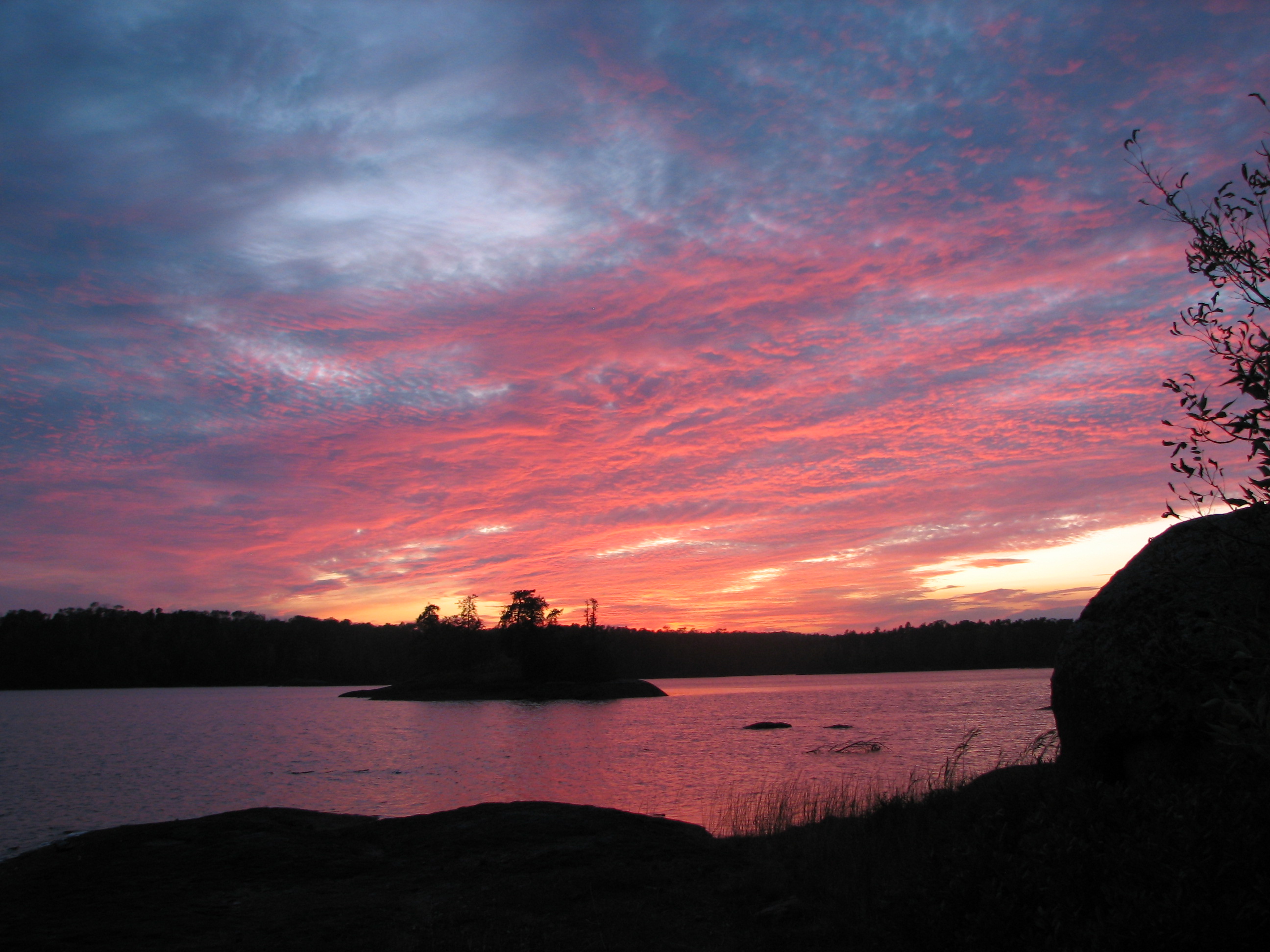
Sunset from the campsite, looking east.

Sunset from the campsite, looking northeast.

In the next five days, on our secondary site, near a swamp, we would encounter:

  • The aurora borealis, twice, because we had clear views to the north each night.  The first night showed faint lime-green streamers along the horizon.
  • A beaver show nightly, when 2 adults and their young swam from their beaver house near the campsite into the nearby swamp.  We saw them chewing trees, bringing logs and brush out, eating them not 50 feet away, then swimming back to their house.
    IMG_4658

    Baby beaver, swimming

    IMG_4654

    One of the best views I’ve had of the beaver’s tail.

    IMG_4583

    Adult beaver, who straddled the branch, and took it back to the beaver house.

  • Once, one of the trees that had been chewed, cracked and fell, in plain view of the campsite.
  • During one night, we heard a pack of wolves howl, a quarter mile away.
  • A large, bull moose came by the swamp, 50 yards away, walked along it in plain view, then walked through the back part of our campsite, without any evidence he cared we were there.
  • There were spectacular views of the autumn colors down the channel of Basswood Lake towards Canada.
  • No more than five parties passed by the site daily.  Sometimes, we saw only one.
  • There were at least two days when nobody was on a campsite north of us all the way to Canada.
IMG_4564

Sunset view down the lake.

IMG_4667

Bull moose arriving and walking through nearby swamp.

IMG_4676 IMG_4677

In short, the site was a hidden gem.  There are sites with better tent sites, good landings, nice kitchen areas, and good views of the sunset.

There are also sites with poorer tent sites, difficult places to land the canoe, exposed kitchen areas, and difficult latrine trails to navigate.

All we did was set up camp, stayed quiet, and looked.  When one base camps, staying every night in the same place, one may travel a little each day to learn about the lake and have time to see what happens in a square mile of wilderness.  I could have mentioned the eagle that flew overhead daily, the frequent visits of ravens, the loon often out front, the grouse nearby, the squirrels that ignored us, because they had never been fed on this site by people.  There was also the gradual falling of leaves from trees that became quite noticeable, and climbing the cliff across the bay rewarded me with a nice view to the south.

Twenty years ago, the idea of base camping didn’t appeal to my desire to cover miles and see new territory.  With age, I have found that slowing down, camping in one spot and making it home for a few days appeals much more.  It is easier, and I see things that I had missed on the 20 mile days.

During this trip, we enjoyed the “outdoor triad” of wilderness, totally dark skies, and complete silence.  Not only did we see the Aurorae, I saw Andromeda Galaxy and the Double Cluster in Perseus clearly, Capella’s and Venus’s reflection in the lake.  Too many do not have the fortune to ever experience one of these 3; to experience all together is beyond measure.  I have awakened in the Boundary Waters and seen Orion’s complete reflection in a calm lake, absolutely soundless, except the ringing in my ears, with knowledge nobody was within miles of me.  These places still exist in America today.  They need to be guarded, not allowed to be used to extract resources in the name of “jobs.”  People who are alive today need these places, either to go to, like me, or to know only that they exist.  Many who come here might return to the “outside world” differently, were they to do what we did.

Is there a guarantee one will find a hidden gem?  Yes.  Being in the wilderness allows one to open his or her eyes and see the gems that are available for one who happens to be in the right place at the right time.  It may be two leaves on the ground (picture), a bee or small gnats feeding on a flowering plant, or an ant carrying a pine needle twice as long as it is.  Will one see specific creatures or sights?  No, there is no guarantee. Yet, I had no thought I would see or hear the things mentioned above, except for the eagle and loon, which are common on all wilderness lakes in the North Country.

The isthmus site is good and a beautiful place.  When we visited it on this trip, however, we saw a jackpine cracked in two, threatening to drop itself and at least one other tree into the kitchen area.  That is a significant risk. The views there are great for sunrise and sunset.  Last year, the sunsets were spectacular.  But there are no views to the north, and there is no swamp nearby. I wouldn’t mind staying there again, for if I did, and were quiet, I would see something special.  I just don’t know what.

But I also know that there is a hidden gem nearby.

Fall colors

Fall colors

IMG_4606

IMG_4509

Kitchen area above this color on another campsite.

Kitchen area above this color on another campsite.

The plant that I spent time watching a honeybee pollinate and small gnats doing the same.

The plant that I spent time watching a honeybee pollinate and small gnats doing the same.

THE LAST STEP ON THE FINAL PATH

September 5, 2014

I remember one time where I “owned” the ICU at the hospital where I worked.  I was the consultant on eight patients – eight – who were severely, irreversibly brain damaged, or brain dead.  I don’t remember all the diagnoses; there were a couple of aneurysms, an intracerebral hemorrhage, hypoxic encephalopathy, a bad surgical outcome and some devastating strokes.

During my harried week, the staff were superb in using my time efficiently, shepherding me from one family group to another.  It is easy to get jaded when one often sees lethal brain damage, and such patients need to be seen a few times a day.  I tried not to become too cynical, but I don’t know how successful I was.  Taking time to talk to families is necessary, deeply appreciated but stressful, since many grieve using anger.  Nobody who is acutely grieving comprehends much of what a doctor says, so there needed to be constant repetition, and I had to bite my tongue more than once when a nurse said, “The family said you didn’t tell them anything.”  As much as I tried to talk to one designated family member, who would relay the information, that didn’t happen often.

All it took to undo a day’s work was a lung or heart consultant who told the family, “He’s doing well,” when the consultant meant the organ system.  The family didn’t hear that.

It was often the family’s first time dealing with death; it might have been my thousandth time saying, “there is nothing that can be done,” “he will not wake up,” “I am sorry.”  Doctors need to do it and to do it well.  Many do not.  Many made rounds when the family wasn’t there.  Sometimes, the nursing staff had to pressure the attending to contact a neurologist, and they often called me.

Not that it mattered, since I was busier than I wanted to be, but the time spent dealing with families was uncompensated, whereas a carotid endarterctomy, in my hospital a proven worse way of managing carotid disease than leaving it alone (I had the data), was compensated well into four figures.  We pay doctors to do procedures far more than we pay them to listen to a grieving family, say a grasping of a hand is reflex, not voluntary, see the expression of disbelief on their faces, when we give them the bad news, and hear the same stories about “some miracle” that wasn’t.  Small wonder we have expensive medical costs compared to the rest of the world, vegetative patients receiving futile care, because nobody acted when they were irreversibly brain injured and were clinically unstable.  The longer a patient lingers, the more hope a family has.  I was frequently castigated for “taking away hope,” when what I avoided was doing the worst thing of all, “giving false hope.” We pay a lot for the final months of life, but to me that statistic is misleading, because most people don’t know when they are going to die.  We do, however, pay for a lot of unnecessary care.

If we dealt with death well, we would have fewer patients lingering in a way the vast majority would say they never wanted, since the diagnosis of irreversible brain injury may often be made when the patient is clinically unstable, and support discontinued then.

If I returned to medical practice, which I won’t, I would be a far more compassionate physician than I was during the twenty years I did practice.  I thought then I was fairly good.  Now, I am not so sure. I thought I was skilled at allowing patients to die at the right time with more dignity and less stress on the families.  When it came time for my parents to die, I did everything I promised them; neither lived more than eight weeks from the time they started to die.  Ensuring quiet, quick, painless dignified deaths of my parents was the second best thing I’ve ever done in my life.

I wrote about the change in my relationship with my recently widowed father, probably the best article I will ever write.

Having lived through my parents’ deaths, I now look at life differently.  I would be far more compassionate to those who were facing death of a family member.  I would be able to tell families that it is normal to feel guilty when the time comes to stopping life support.  I could tell them how one will miss having that loved one to talk to, all the conversations one would want to have in the coming years, dreaming of the person, a decade later, the way they were in life.  I could tell families how the relationship between children and the surviving parent would change.  I would be good and far more effective.

As I enter a new phase in my life, I am considering once again dealing with death, not as a physician, who cares for a patient, but as a volunteer helping people to navigate the complexity of care and options when they have illnesses that are not going to be cured, problems that are not going away, time that may no longer be present, helping them find their own path, perhaps their last steps on that path.

In doing so, I will help myself.

BE AFRAID; BE VERY AFRAID

August 26, 2014

“Tanks at the Ukrainian Border.  World War III?” was posted, and I just shook my head.  Today, it was “Hamas style tunnels going under the Mexican-US border.”  There is so much fear out there, I wonder why only 7% of Americans have served in the military.  It sounds like we all ought to be conscripted, for terrorists appear to be everywhere.

We have become a nation of fear, afraid of the boogeyman, who will bring nuclear weapons across the southern border, infect the country with Ebola, blow up our nuclear plants, abduct thousands of children a year, drive millions of Americans out of work, raise a black flag over the White House, take over our land, allow Russia to run unchecked, ISIS to control the whole Middle East, Iran to have nuclear weapons, which they will use on Israel, and Texas targeted by North Korea (which it actually was, although the missile blew up shortly after launch and didn’t have the range).  Every time Mr. Obama speaks, people buy guns to add to the 310 million in the country, yet if any gun has been taken away illegally by the Feds, I have yet to see credible evidence.  How many guns do we need in this country?  A half billion?  A billion?  Ten billion?  A trillion?  Is there a top number?

The President has created fewer national monuments than his predecessors, yet the Organ Mountain Monument was a “federal land grab.”  I AM the federal government.  ALL OF US are.  I LIKED the monument.  I DON’T LIKE people’s grazing cattle on federal land for free, then calling for people to fighting against “them.”  I AM THEM.  I don’t eat meat, and I pay land use fees.

Make no doubt: inciting fear wins elections.  George W. Bush won in 2004 by campaigning on fear, when most Americans still believed 9/11 was caused by Saddam Hussein. Perhaps most of Americans still do believe it.  Iraq kept Bush in power, until the war became costly, “dead enders” were very much alive, and more Americans came home permanently maimed or in body bags.  Congress changed; the response to Hurricane Katrina, which was scary, was a contributing cause.  Who but the federal government would have rebuilt New Orleans, or Joplin?  We saw what happened without a decent FEMA in 2005 and with a decent FEMA in 2012.

I have fears, but nothing on the above list.  Almost anything is possible, but I can think of a many things that would easily wreak havoc in this country that nobody has mentioned; I won’t mention them here, except for rolling back safety nets.  Get rid of Medicare, Social Security, food and water inspections, and we will be the newest member of the Third World.  I find that scary.  We know enough about Ebola and other infectious diseases that we bring our living soldiers in the infection war home alive to be treated.  I can understand one’s wanting to have the body of a loved one returned home; to decry bringing a living infected body home for treatment is a contradiction.  The probability of a child’s dying from a motor vehicle accident is over 10 times that of their being abducted by a stranger, yet I see no ads for strong enforcement of child safety restraints in cars.  Scary news sells.  In 1979, during the Iran crisis, the media showed screaming protesters outside the embassy.  A block away, all was quiet.  

Muslims in America are not about to take over the country, except maybe in mathematics, where Dr. Mirzakhani, a 37 year-old Iranian citizen, full professor at Stanford (at 31), won the prestigious Fields Medal in mathematics.  Our high schools are full of students who can’t do basic division, don’t know their multiplication tables or how to write an English sentence, let alone cursively,  have no idea where Canada is, let alone Iran.  I fear ignorance.  We don’t teach critical thinking, so people are easily swayed by rumors deliberately fomented by good-looking people, nice sounding “news” outlets.  Ten children families scare me. We are straining our resources and our space.  I hear no, and I mean no, comments about that.

Russia will do what it wishes, and there is not much we can do about it.  The world has changed; American troops are not the answer to problems that can be created by a few thousand people using complex armaments supplied them by developed nations (like us).  As I write this, I am flying in an aircraft over a foreign country, but I’m not worried about being blown out of the sky.  The very notion of war continues to change. 

ISIS is controlling land, but radical Islam, Christianity, and Judaism, scare me more, especially Christianity’s influence here.  If people want to pray, fine. It is scary—and insulting— when a Congressman sends a Bible, a book with hundreds of contradictions and false interpretations, to other Congressmen. The constant use of “God” and “prayer” in speeches scares me, rather than offering ideas open to modification.  God sells here; ideas that take time to articulate are ignored. “Just give me the bottom line” is one of the scariest phrases I hear.  Major problems, like immigration, public education and the national debt, can’t be summarized in 30 seconds.

I do not know whether Iran will develop nuclear weapons.  Pakistan has them, and yes, that is scary.  So is the environmental catastrophe about to engulf China, in the name of our “requiring” a completely unsustainable 10% annual growth.  That statement is on a par with “the stock market always goes up,” based on 60 years of data. What scares me is that we in the US will do nothing about climate change, despite 650,000 years of data, until nature gives us—and forgive the term:  a “come to Jesus” moment.  

I am not scared of illegal immigration.  I am scared of drug runners, who will bypass any fence we can build, but I worry less about being shot by them than being in the wrong place at the wrong time in my city.  I am more scared that we are trying to take in much of the world.  I am not scared that Spanish will become a second language; I am more scared that Americans are not working to become fluent in another language—any language.  I am not worried that the dollar will no longer be the reserve currency in the world, but German’s becoming the lingua franca in central Europe ought to give us pause, along with the oft-cloudy nation’s out-producing us in solar power.  The world likes a lot about America, when they stop laughing at us long enough to look.

It’s time to cool it on “disaster is right around the corner,” or “We’re Number One.”  We aren’t.  If one believes all is Obama’s fault, then run for office.  If the opponents win, I give them 90 days to fix everything, since they believe the world is simple. More helpful would be quietly working to improve justice in the world, addressing population control, and dealing with climate change.  There are a few others I would throw in, but the current attention span is limited until the next tweet or upcoming disaster posted on Facebook.  Messenger is probably beeping right now, so I  better go.

24 x 7

June 21, 2014

Recently, I read a post about how the children of the ‘70s survived, despite all the problems they encountered: recalled toys, like lawn darts; not wearing seat belts; no helmets; and leaving kids unattended. Lawn darts caused a few injuries and one death; 12 high school and college students die annually from football, but a lot more play football than threw lawn darts.  It might not have been unreasonable to ban them.  Given football’s propensity to cause brain damage, I think the game must change, a tall order in this country.

We don’t need helicopter parents, not letting their children discover the world for themselves.  Kids need to experiment.  But some experiments we know aren’t a good idea, and we don’t want kids repeating them.  Diving into unknown water is one of those.  Not wearing a seatbelt is another.  I remember when cars didn’t have seat belts; people who first encountered seat belts in cars thought they were weird, like we were going to go flying.  On holiday weekends, we saw in the paper numbers of dead (hundreds) from motor vehicle accidents.  Since 1960, the absolute death rate has fallen, despite a near doubling of population.  The actual death rate per 100,000 is half of what it once was.  Seat belts are the major reason.

Helmets save lives, too.  Recently in my city, an 18 year-old girl hit her head after falling off a skateboard.  She got back on, a little while later was short of breath, collapsed and died.  This was almost certainly due to an epidural hematoma, with the classic lucid interval, and could have been prevented by a helmet.  Anecdote?  Sure.  But data support helmet safety.

Second hand smoke may not have caused cancer yet in the generation born in the ‘70s, but they are still young.  Wait until they become 50 or 60, and some who never smoked die from lung cancer.

The issue is not that you got away with it, and therefore it was safe.  That is Challenger-type of thinking. Challenger was unsafe to fly at the ground temperature it was at.  We had plenty of evidence to suggest that, but no catastrophe had occurred, so launch was allowed.  The issue is probability.  The probability I will die in a motor vehicle accident is very low.  But I can make it lower by wearing a seat belt, which then makes the airbag useful.  The probability I will get cancer from second hand smoke is low, but I can make it less by not being around it.   Smokers can live long lives and non-smokers can die young, but the probability is against such an occurrence.

I continued to write that in my youth, we had 3 TV channels, not hundreds.  We did not have Nancy Grace, Fox News, or Keith Olbermann.  Last year, after the Asiana crash at San Francisco, we had extensive coverage, where experts were continuously asked to offer opinions about something about which they had limited facts.  “Dead air” is an ironic killer in 24 x 7 news, and it has to be filled, but if the filler is conjecture, and if it is repeated often enough, the conjecture becomes treated as fact.  Politicians have known that for decades.

If child abduction and murder by strangers were 26 times higher than it is now, we would have a national campaign to protect children.  Come to think of it, we do.  And it works.  The problem is that a child is 26 times more likely to die in an auto crash and 20 times more likely to die at the hands of a family member than a stranger.  But 24 x 7 coverage of an Amber Alert overplays the idea that children are always in imminent danger, when they aren’t.

The idea that we are just seconds away from death at any moment, “It could happen tomorrow” on The Weather Channel, the idea that but for a super hero or a first responder, our lives could be snuffed out in a second, is wrong.  We need counts of deaths, we need proof of dangers, if we can determine such, and they must be peer-reviewed.  Mike to The Weather Channel:  the most dangerous weather system on Earth is a stalled high pressure system.  Heat-related fatalities comprise a plurality of weather related deaths in the US, drought is the cause of more than half of all worldwide weather-related deaths.  Showing storm chasers near electrical storms does not help teach people that lightning annually kills more people here than hurricanes, even with Katrina’s toll factored in.

Such 24 x 7 coverage often pits two “experts” against each other in the name of equal time, whether or not the science is equal.  Climate change is an example. Or, it asks multiple experts to speculate, when speculation may be outright wrong, either because the facts aren’t clear or the reasoning isn’t.  In a country with over 300 million people, there are daily tragedies.  Indeed, each of us in our own lives has tragedy strike numerous times. On an average day, most of us have things happen that we don’t like.  It is probability, and low probability outcomes with large numbers of events lead to a significant expected value of these uncommon outcomes.

There is significant news every day.  It would be nice if it were reported and then left alone until further information becomes available.  Breaking news is not helpful if it glues people to the TV screen, with experts trying to comment upon things they can’t effectively comment upon.  It is akin to diagnosing a patient based upon what they write in a letter or say over the phone.  A good doctor will use extreme caution here.  A good journalist should, too.