Archive for the ‘Uncategorized’ Category

NOT NOW vs. NOT EVER

January 15, 2019

There was a recent article in the New York Times written by a woman to explain why she wasn’t returning an email.  I would have replied to your email after a few hundred more words, I am certain, except that my 11-year-old daughter came in, clutching some pieces of paper… was the style of the article.  She wrote well, and most of the comments were favorable, that these issues with which she was spending time were indeed important.

A few commented that she was fortunate to be able to work at home, have good, healthy children, but that ignoring work-related emails for many is a good way to get fired. I decided to comment, although I am at a disadvantage in that I need more time to process information than most, in order to optimize what I say.  When I used Facebook, most of my comments were “Edited,” meaning I had posted and later changed something.  Many would do well to edit what they write, since first impressions and first words usually are not what most of us truly want to convey.  But if I wait 24 hours, the comments section is closed, and if I want people to read my thoughts I need to write quickly, not after hundreds of others.  I wrote that many of my good faith emails were never replied to even though it took all of 24 seconds to write, “We regret that we have no use for your services.”

My comment got a reply that interruptions slow down a person’s ability to re-focus on what they had been doing for up to a half hour.  I agreed, but added that there is a difference between “Not Now” and “Not Ever.”

That’s really what I wanted to say to the author in the first place.  It’s acceptable not to reply to an email now.  Very few things in life are urgent, and emails can usually wait.  But Not Ever?  You mean to say you are so busy that you can’t find any time in your day or week to reply to a good faith email from someone?

I continued that interruptions in my medical practice, which were seldom truly urgent (life threatening that if I didn’t act someone would significantly deteriorate), did affect my ability to concentrate afterwards on the my care of the patient before being interrupted.  More than once, after two or three interruptions seeing the same patient, I had to explicitly ask my secretary to stop all interruptions so I could get some work done.  I didn’t know back then how badly interruptions interfered with my work, because much research hadn’t been done, except in aviation, where there is the “Sterile Cockpit Rule” below 10,000 feet, where all cockpit conversation relates to only flying the aircraft.  Nevertheless, my colleagues were quick to tell me medicine and flying airplanes were different in regards to errors.  I retorted that they were both quite similar.

[Ten years later, CVR, “Cockpit Voice Recorder,” was a big hit at medical meetings, where two people sat on a stage and read what transpired in an aviation disaster, so perhaps my thoughts earlier were on track.]

I continued, writing that hurry and fatigue were two other reasons I left medicine, both of which again were confirmed by research in part using aviation experience (The Canary Islands disaster in 1977, and the 1999 crash in Little Rock in part respectively.)

I come from a bygone era. When I practiced, we had to return phone calls from patients.  THAT was time consuming.  We had to call, wait for the individual to answer or to be summoned, often repeat ourselves, answer things we had answered in the office, try to explain something to someone without seeing their expression, and not have any sort of written summary of what we said.  I returned calls as soon as I could during the day; many others waited until the evening or didn’t return them at all. I returned my calls if I had a few minutes to do so.  They weren’t interruptions.  Most of us have a lot of time available during the day; back then, we couldn’t use social media as a time dump, but we all have a few minutes here and there that we squander on things that may not be earth shattering.  Want to have time to reply to emails?  Stay away from social media. 

Before there was email, I couldn’t make a phone call between seeing patients, unless I knew it would be very brief.  Today, many questions could be answered in that same time period. I would have loved emails back when I was practicing.  My calls could take several minutes; an email take a matter of seconds.  This is a matter of prioritizing time.  

I used to have a pile of pink slips from calls, answered by an actual human being, that I needed to make, low tech but useful, because human beings could write notes, using a pen, and convey that the patient sounded angry, sad, depressed, busy, strange.  From here, we went to voicemail, which was listened to by a human being, until people used it as a way to avoid work by ignoring them.  That’s going from Not Now to Not Ever.  I consider myself fortunate if my voicemail gets a reply.

From voicemail, we went to email, faster and easier, but I contend that my computer is strange in that it appears to send emails but doesn’t seem to receive them.  Two decades later, I still read complaints that emails are interruptions.  Like most technology, when email is used properly, it is a wonderful tool.  How can it be an interruption unless one lets it be one?  A ringing phone is an annoyance, and those in my generation learned to pick it up, because it was polite and it usually was from someone whom one knew, not Marriott or some other big chain trying to sell me something I didn’t want and my punching 2 to not get any more of these calls made no difference, nor did a national registry of Do Not Call remove these calls.

An email is quiet, unless one chooses to activate the sound letting one know there is an email, which again admittedly used to be important, not someone trying to sell military surplus or Viagra because I was foolish enough to click on a link to read some article seen on the Internet, and didn’t delete the cookie fast enough.  

We have spam filters, and while I’m not in at least the paid work force these days, it seems obvious one can have a work email address for work and a personal one.  Twenty years ago, when I was in graduate school, I had two email addresses, and that was a good screen.

Returning calls, returning emails, communicating with people who ask good faith questions either as friends, clients, or family, is a matter of prioritizing one’s time.  It’s as simple as that.  It’s as complicated as that.  

What is clear is that email, Messenger, Whatsapp, Telegram, and Twitter have not brought us together, but rather pushed us apart, allowing formerly taboo religion and politics into the public sphere, allowing thoughts from those living in caves to see the light of day, and forgetting the best communication is what it always has been, watching body language, listening to tone of voice, repeating back instructions, and seeking first to understand before being understood.
NEW AND OLD MEMORIES

December 18, 2018

I was at the Club’s lodge recently for the annual holiday party, first featuring a 3 mile hike into a nearby large park, followed by lunch, the price being bringing a pair of socks for one of the local charities.

Later, back at the lodge, I spoke to a past president of the Club. He was originally from the UP, the upper peninsula of Michigan, and told me about his canoeing the Apostle Islands of Lake Superior. I’ve never been out there, although I’ve read a lot about the area. I told him about my time on Isle Royale National Park out on the Big Lake in 2006, when I had a wolf in my campsite, and how I always wanted to go back to the park that had the highest percentage of return visitors. Unfortunately, I never have. Still, I have fond memories of for several days one May being one of maybe a dozen people on an island 45 miles long and 9 miles wide.

Isle Royale 2006

“I had some medical issues this past year,” the past president said, “and while I was dealing with them, I realized if I never got a chance to go back out on the trail, I still had many good memories and saw many places.”

I had seen him hiking near the top of Spencer Butte a couple weeks ago on our Wednesday conditioning hike, so he was getting back out. I hope he leads a winter snowshoe this year.

I can relate to his comments. In 2009, I wasn’t sure how I was ever going to be able to travel again to places I wanted to see, but I got better. I remember fondly my three day hikes in Yosemite, while my wife was at a radiology conference nearby, the one and perhaps the only time I will be there. I hiked close to 40 miles in those days, all solo, and was thrilled to be out there in snow, but with nearby wildflowers, alive in the beautiful Yosemite backcountry.

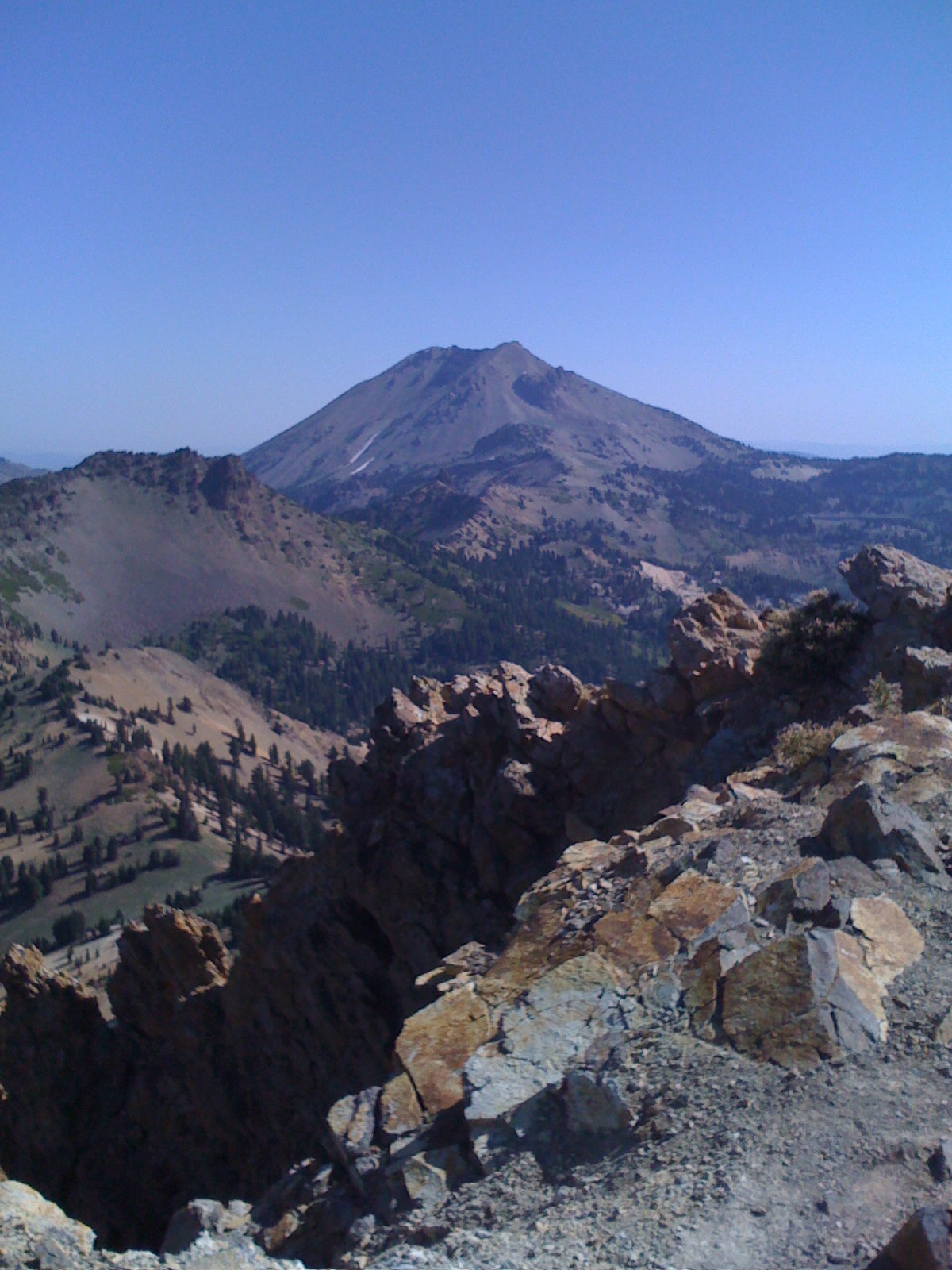
Later that summer, I decided to get another national park under my belt, and I traveled to California’s Mt. Lassen Volcanic National Park, hiking up Brokeoff Mountain, 7.5 miles round trip with 2600 feet of elevation gain. I was thrilled to do it. That was the hike where I encountered an 80 year-old at the summit wearing running shoes, no pack, gave him a soda, which he drank and then threw the can on the ground.

Mt. Lassen from Brokeoff Mt.  2009

I picked it up. There are men who hike in the outdoors, and then there are outdoorsmen who hike. They two don’t always share the same values.

We ended our conversation by discussing the Boundary Waters, where I have taken 69 trips into four districts over nearly 40 years now. Where did the time go?

Newton Lake 2018

Having arrived at three score and ten, I don’t have many hikes or canoe trips left, although in my wildest dreams, I can hope for another decade. One of my patients, on his 80th birthday, hiked up Mt. Wrightston, my favorite hike in Arizona, 4000 feet of elevation gain and about 11 miles round trip. I have climbed Wrightston many times and camped up there twice as well. Another elderly man I knew hiked up Wasson Peak in the Tucson Mountains over a thousand times. For years, I ran up it on my birthday, trying to match my age to the number of minutes it took me to go up 3 miles and 1800 vertical feet. I just missed on my 41st. I made it thereafter.

But there are no guarantees, ever. I go when I can.

While we have struggled with a drought and mountain fires the past year, this autumn, there was enough mountain snow that I checked out the Sno-Tel automatic weather stations up near Willamette Pass. It’s great to be able to access data showing snow depth and snow-water equivalent. After learning there were 9 inches of snow at Salt Creek Falls, the lowest of the stations I was interested in, I thought it might be adequate to snowshoe. The weather forecast showed no precipitation, the roads were open with no chain requirement, and I decided I was going up there, not the following week, not “some time,” not whenever but TOMORROW. A few days of warm rain could melt everything, and a two month thaw, like too many of the past winters, could end all possible trips. The ski area at Willamette Pass was open, taking advantage of low snow conditions to try to eke out a season, after last year’s three day bust.

Each of the past two years, I have taken a chance on the remaining snow and snowshoed in late April and early May. Nobody was on the trails either time, the snow conditions were excellent, and I have pleasant memories of traveling in the quiet Willamette National Forest under my own power.

I expected heavy ski traffic on the road up and had none. I arrived at the Sno-Park, my vehicle the only one there, cold and windy, temperature in the low 20s. I was dressed warmly and carried my snowshoes back up the entry road to the Sno-Park, across Highway 58, to the snow covered road leading up to Fuji Shelter, 3.7 miles further and 1400 feet higher. The snow at the base was deep enough, with one prior set of snowshoe tracks.

I felt like the luckiest guy in the world. I was sheltered from the wind, on the trail, nobody in sight, and no matter what happened tomorrow or many tomorrows, I was going to get a snowshoe in. The road stretched out before me, a snow-covered track ascending through the woods. It felt good having to break trail, but not working excessively hard to do so. I knew the trail but had my GPS running. It remained quiet, the snow’s muffling traffic back on the highway. Eventually, I got far enough away that I heard almost no sound except occasional snow coming off the trees and an occasional crow calling in the distance. The filtered sunlight reflected off the snow like diamonds. It was magical.

I took a break about half way up to get a drink and eat something. My snowshoes felt fine. I had checked them the previous day at home to make sure nothing had deteriorated over the summer. I have had snowshoes where the rubber fell apart, noting it at the beginning of a hike, which is a big problem. I got through that hike, soberly learning a lesson in preventive maintenance.

Finally, I reached the junction of the trail to the shelter and broke fresh snow for about a third of a mile. The shelter was full of wood, had a stove, and its three sided design was open to a splendid view of Diamond Peak right in front of me. I kept my shoes on for lunch, sat down on a log, and spent time looking around the shelter.

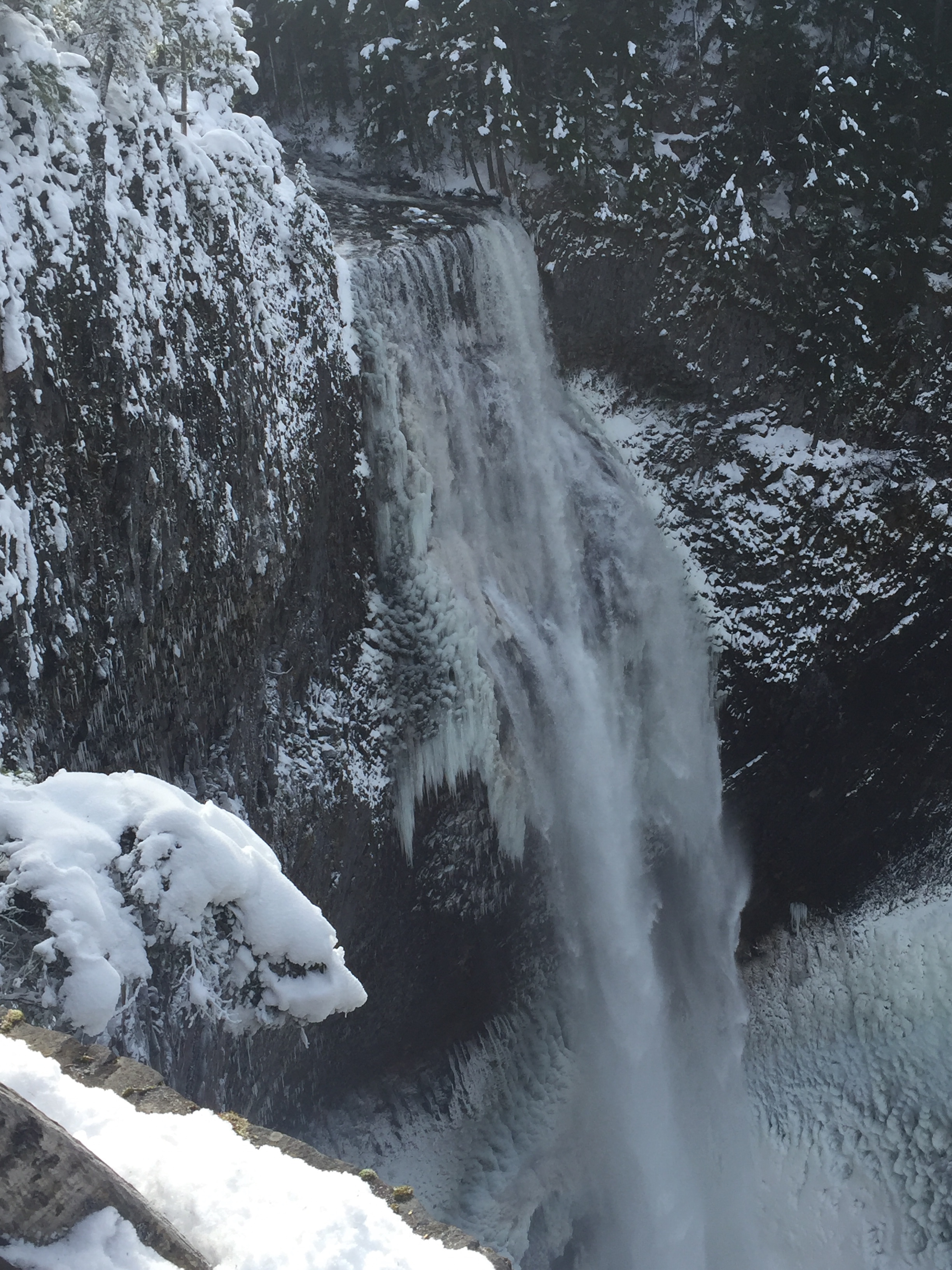
When I left to, I first stopped by one of the frozen lakes near the trail. I then retraced my tracks and descended, much faster, occasionally walking in unbroken snow just to do it. I recrossed the highway and went over to see Salt Creek Falls, the second highest in Oregon. Sure, it’s a tourist spot, but it’s really pretty, and besides, I was the only visitor.

I’m not sure when I will get to snowshoe again, but the important matter was I got out and did it.

Snow diamonds

Fuji Shelter

Fuji Shelter

Salt Creek Falls

Diamond Peak

RETURNING TO JERK JUNCTION

November 20, 2018

“In War: Resolution, In Defeat: Defiance, In Victory: Magnanimity In Peace: Good Will.” Winston S. Churchill

Last month, while in Safeway, I encountered a lady in the bread aisle, carefully examining a loaf, right where I wanted to go. I mean carefully.  I could not get to the loaf I wanted, and she seemed oblivious to everything else but that loaf of bread.

Rather than disturb her, I took Suck it Up Lane to the next aisle to get some yogurt and then returned, figuring she might be gone.  Nope, she was still checking out that same loaf of bread.  

I had enough of Suck it Up Lane, so I turned on Excuse Me Way, reached around her leg, got the loaf I wanted, and left.  She never moved, and I think, although I couldn’t swear to it at a Senate hearing, that she gave me a dirty look.  So be it.  If she wanted to be on Jerk Road, I wasn’t going to follow her, although jerk is usually a masculine noun.  In any case, shoppers usually excuse themselves a lot at the store; if not, well, one probably owns property on Jerk Road. 

Suck it Up Lane is for wanting to yell at people but not doing it.  There is also Winston Churchill Boulevard: “In victory, “Magnanimity.”  That means when the winner doesn’t lord it over the loser.  You don’t brag, you don’t rub their nose in it, you don’t laugh at them, and you don’t become a jerk.  Instead, you try to be generous, hoping one day that when you lose, which you will, that you may be treated the same way.  In other words, jerks put up Trump/Pence signs before the midterm elections, since neither of the two was running.  A jerk will drive his pickup slowly through the neighborhood with a big American flag flying from the bed, proclaiming patriotism, as if the rest of us were somehow deficient.  Blatantly showing the flag doesn’t make one patriotic any more than singing the Star Spangled Banner makes one a diva or knowing the difference between its and it’s—or your and you’re— makes one a published author.  Only jerks keep obsessing about Hillary Clinton, yelling, “Lock her up”  at rallies designed to stoke the base, where they also scream obscenities. Only jerks keep harping on her emails when the president’s own daughter did the same thing.  Only jerks keep harping on chain migration when the president’s in-laws got citizenship that way.

That’s a tall order.  I thought of the jerks who put up the sign east of Walterville for the Republican congressional candidate and another set of jerks who did the same out by Dexter, on the way up to Willamette Pass.  I found I could drive by without looking at those signs, since they are for only a month every two years, the perennial congressional candidate is a hypocrite, and I have discussed him before.  I wish he would go away, but he won’t. 

It was the signs for the president and vice president placed near the congressman sign that made those doing it jerks. Yes, they were on Jerk Road, near Highway 126 or 58.  They were lording over the fact they won.  Yes, they did win the electoral college, at least in the votes counted if perhaps not all the ones actually cast.  They are glad, not only that they got the kind of country they seem to think it should be, but really glad that My Side is upset.  They take delight in knowing we lost.  That’s right down the centerline of Jerk Road.

But in My Side’s defeat, there is Defiance Avenue, defiance of bullies, who live in the past, with a vision of an America that never existed the way they think it did. They want to take America back to a time of (old) white men’s ruling most everything, segregation, women’s place in society, few or no regulations, no abortion under any circumstances, no birth control, pregnancy and raising the child a woman’s problem.  

Lack of adequate, known, safety and other regulations has led to several million’s dying from lung cancer, transportation-related accidents, firearms, bad food, water, and air, suboptimal medical and mental health care.

The Other Side too often disparages and ignores science, even as they enjoy the electronic and much healthier world it helped develop.  Without proof, they say, “It’ll (the climate) will change back.” When? Why? How?

Here in Lane County, The Other Side’s incumbent  wanted to define a county commissioner’s race by who was better for the timber industry.  He discussed timber and so-called Oregon values in his ads.  He was funded by the timber industry, and after listening to his commercial, I realized he was out of touch with both the electorate and the time. I’m not an expert on body language, but he sure looked and sounded angry.  He was only three years younger than I, which is no compliment.  His opponent, a woman 25 years younger, runs a property management service that my wife and I used for two years with total satisfaction.  Timber is still important here, but it doesn’t define Oregon. Many of us resent being called environmental extremists for being upset at aerial spraying, clear cuts that leave slash and later burn (accelerating at least two major fires in 2017), polluted waterways, a forest management timeline of only 10 years, rather than 100, or even 200, the idea that we can cut again in 40 years, rather than 100, the unsightly scars that are replaced by monoculture forests, and the assumption that the soil will be just as good for second and third growth as it was for the original old growth.  He lost by 12%.  We flipped the commissioners from 4-1 Other Side to 3-2 My Side.  This is the kind of change we need locally that is going to directly help my life.  I’m not jeering at the ex-incumbent.  I’m hoping we can have a county more suited to the 2020s than the 1920s, when timber workers truly thought our forests were infinite.

Jerks cheer when the president thinks body slamming a reporter is a good thing, rather than Jerk Expressway behavior and should end, especially given the number of close associates to the president who have actually been charged, are in jail, or face prison time.  The new Supreme Court justice once said about being a good judge: “In short, don’t be a jerk.”  And a few days later, he was a jerk, still being confirmed, not surprisingly.    

I have traveled Jerk Road more than I care to admit, but I try to take the first exit I find. That requires a JerkMeter, called self-awareness, and a JPS, Jerk Positioning System, otherwise known as compassion or a conscience, so that one can quickly find his way off.  

Yes, his way off.

CONFESSIONS FROM A MODEL RIDER

November 11, 2018

This past summer, the first in Eugene’s records to have no rain in June, July, and August, the driest 11 month period on record, was almost not the driest.  In late July the weather models showed a significant storm system about 10 days out, then 9 then 8 then 7 then 6 days that was going to deliver a big soaker in early August, almost unheard of.  Given how dry we had been, this was eagerly awaited, and after all, 6 day forecasts aren’t too bad.  At 6 days out, the TV meteorologists were all over this storm.  The next morning, first thing I did was check the models: to my chagrin, both the GFS and the Euro forecasted that storm wasn’t going to happen.  It was gone.  Kaputt.  Sayonara.  Weg. Hasta la bye-bye. Evaporated from fantasy.  Never happening.  It was a real bummer to me, and as I learned recently, to many others as well.

For those few of you who are model riders, like me, it’s OK.  I understand. I feel your pain.  

I follow the Portland Weather Blog (TV weather caster Mark Nelsen), and the California Weather Blog (Daniel Swain), Cliff Mass in Seattle, reading their comments, but it wasn’t until I read an article in Bay Nature that I realized there was a kindred group down in the Bay Area.  They coined the term “model rider,” not me.

A model rider logs on a few times daily to check the long range weather models: the GFS, or Global Forecast System (American); the ECMWF (the European Centre for Medium-Range Weather Forecasts, or the Euro), and the GEM model (Global Environment Multiscale, Canadian.)  I don’t check the latter too often, but I look at the other two.  I even get the detailed European ones, which I have to pay for, but it’s worth it. I have access to world wide weather on the world wide web, and I can look at high pressure domes baking Scandinavia, or get 2 meter temps in Casablanca, should I want to.  I don’t, but I do have the anomalies (differences from normal) for the upper level winds, the 3,9, and 14 km models for precipitation, the jet stream, and the low level winds.  I can get local temperature forecasts using seven different models, four of which I had never heard of.  I can scan what I need in a few minutes, and if I’m traveling, I can check out a lot of other stuff.  I can get 500 mb heights for the upper level, anomalies, or departures from normal, all color coded, run them fast or slow out 3, 10, or 16 days, and even 46 days if I want to take a look at the precipitation anomaly.

Following the models gives me an idea of what I might expect in the long range.  I have watched the models come into agreement about a storm, or a prolonged high pressure system (more on that shortly), or a big wind event, days before it makes the forecasts or even the National Weather Service forecast discussions, which are also about four times a day.  I follow them in several places—Portland is my home area, but I also look at Medford, Seattle, Reno, and Sacramento.  Some of these—Medford especially—give a great synoptic summary, how something we have here, like a persistent high pressure system, which many of us refer to as a “Death Ridge,” is related to and stays as a result of deep troughing, or low pressure, downstream on the East Coast.   Medford is realistic; Portland is a little behind.  This morning, Medford said the next storm was more than a week away and might split.  Portland was still talking about the sprinkles Wednesday that won’t hit where I live. Medford NWS used the term “sacrificial front,” the first front that slams into a high pressure system, weakening both the front and the system, but allowing a second and additional fronts to break through. 

That assumes the high pressure system doesn’t build back in behind the front, which it often does.  That has happened a lot this year.  

The Bay Area group refers to forecasts out 200-300 hours as “fantasyland.”  They are right, and they confirm what I discovered my first winter here:  numerous models kept showing big storms that were going to hit us in the long range time frame.  About 7 days out, those storms disappeared from the models.  For those of us who think rain is good, like real weather, these models sometimes pull a “pull the football up,” referring to Lucy and Charlie Brown, in the classic Peanuts cartoon, where Charlie Brown hoped it wouldn’t happen and always got fooled by Lucy at the end.  Fantasyland is really wet.  Reality is really dry.

It’s not often I read something where the comments and feeling expressed match mine so perfectly:  if the models say persisting high pressure is going to set up for two weeks, persisting high pressure will set up for at least two weeks.  If the models say it’s going to rain in 7 days, there will be a high pressure system instead.  We model riders know that.  Storms get delayed a day, then 2 days later delayed another 2 days, then disappear. Want wet weather? Fantasyland awaits.

One of the commentators  on the Portland weather blog was bemoaning that “Seattle got all the good stuff,” meaning weather.  I wrote back and said that those of us (like me) in the South Valley thought that Portland got all the good stuff. Nobody is happy, unless we get some good action.   

The models over predict the rain we do get:  I cancelled a hike in the Cascades last week because of what was going to be a good soaking with a lot of wind in the mountains.  I was leery about cancelling it, because in my own mind I knew we were going to get minimal rain down here, because that has been the pattern for almost the last eleven months.  That’s what a drought is, and we are in a severe one.  We got minimal rain.  I wouldn’t have needed rain gear.

I waited 20 years in Arizona for the drought to break, and it finally did—after I left.  I stopped looking at the Climate Prediction Center for Arizona, because it invariably predicted higher than normal temperatures and less than normal rain.  And for at least seven years that I looked, it was always right.

The latest GFS model said 10 days ago showed a good rain this weekend, then the models backed the rain off until the following Wednesday.  What I am now hearing from the forecast discussions is “rain later this month, near Thanksgiving.”  The problem is that Thanksgiving this year is early.  Besides, for the last few runs, the models have shown dry weather out 10 days.  Today, they show nothing for 16.  Thanksgiving is the 22nd.  

Maybe they meant “rain later this year, near Christmas.”  Or, as I learned to say during the monsoonal busts in Arizona, “maybe it will rain next year.”

Bummer.

ASTRONOMICAL MOOD SWING

October 24, 2018

“And this is the Silver Coin Galaxy, NGC 253, in the constellation Sculptor.” The speaker at the Eugene Astronomical Society, the new president, continued his fascinating talk about lesser known deep sky objects in the autumn night sky.

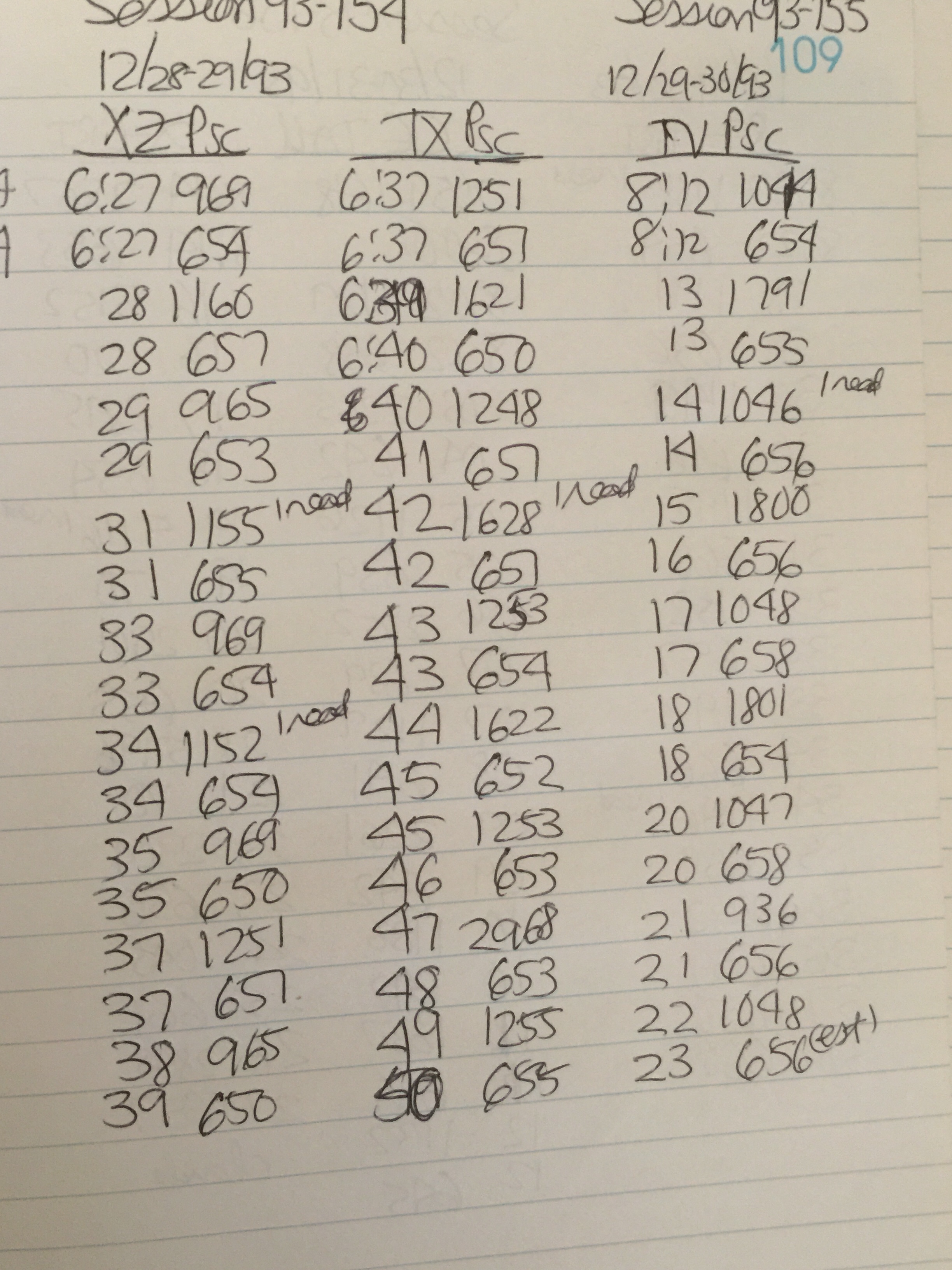
I was initially amazed at what he was showing, then became a bit depressed, because I used to be a lot more familiar with virtually everything he was discussing. I’ve seen NGC (New General Catalogue) 253, although I never knew it as the Silver Dollar Galaxy. I used to look at the variable star TX Piscium, which the speaker discussed, and I knew about NGC 404, the galaxy near the star Mirach in the constellation Andromeda. If I were at a star party in the autumn, and somebody wanted to see a galaxy, I could show them Andromeda, but this galaxy was even easier to find, because it was right next to a bright star.

I hadn’t forgotten everything I had learned, but it had been years—20 to be exact—since I last did serious observing of the night sky. I went to grad school in Las Cruces in 1998 and had little time to observe. During the 15 or so years prior that I was a diligent, active observer, I saw over 2000 double stars and at least 800 galaxies. I tracked 80 variable stars, often getting up in the middle of the night to observe a nova for the American Association of Variable Star Observers. Most of the variable stars I tracked I could find without using star charts. That’s good.

It’s not, however, as good as the Reverend Robert Evans, an Australian, who holds the record for the most supernovae discovered, 42. He could find his way without charts through the Virgo Cluster of galaxies, hundreds of them in a small area, that looks empty to the naked eye observer, in the constellation Virgo. He knew the appearance of the galaxies well enough to know whether or not they had changed since the last time he looked. That’s beyond good. His record is likely to stand, for in the age of computer driven telescopes and built in star maps, robotic telescopes are discovering many supernovae.

While no longer actively observing, I can still find my way around the night sky quite well. In 2016, at sea in Indonesia, I gave a Vancouver astrophysicist a tour of the night sky, without charts, and did a credible job. We both learned something.

My time in astronomy is like a lot of other things in my life. I study it until I am as good as I think I want to be, and then I move on to something else. I started learning German and did little else for about 3 years, then moved on, although I still watch about an hour of German videos daily on the Internet. I’m not likely to go back to Europe, although I won’t rule out the possibility, and I am not going to become fluent in German or Spanish, which I also spent time studying.

In the hiking club, I have led nearly 150 hikes and taken another 300, but I am not hiking with the group as much as I did, nor am I leading as much. I won’t give it up, but it isn’t the main focus of my life right now.

In all areas of life where I am reasonably competent—mathematics, statistics, neurology, astronomy, canoeing, writing, teaching, learning a language, traveling, leading hikes, predicting the weather, sawing logs in the wilderness—I have started at the bottom as a totally green know nothing and have worked my way up to some degree of competence. It’s not enjoyable being at the bottom, and learning provides the way upward.

Periodically, some of my past areas of competence are called upon unexpectedly. My mathematics skills, put aside for so much of my life, became my career for a while, then a source of worth for me by volunteering in high schools during the time I was neither employed nor retired. I didn’t do much, but I learned more, which I parlayed into a substitute teaching job and into my fifth year as a useful volunteer today at the community college. Writing became a way for me to relax and discuss life as I lived it and as I saw it. I am a decent writer, but not great, and never will be, but that’s fine with me. Writing is a way I express my creativity, just as the husband of a friend of mine composes and plays music that will never make him stand in front of thousands or appear on CC40, but gives him and the people with whom he is around pleasure.

Giving back to the community matters to me. Online, it is the nearly 10,000 problems I have solved on algebra.com. It’s a hope that some of the 28,000 hits my blog has had in 9 years will have helped somebody in some way. By giving, one gets back a lot more.

Several weeks ago, I went to the new SUN-day showing of the Sun by the astronomy club in a nearby park. There were three solar scopes set up and several Club members discussing the views with a few members of the public. I brought my binoculars with solar filters, but they weren’t needed. I didn’t know what my role there would be. For some reason, however, I mentioned sundials, many types of which I have built. Jerry, the Club secretary, is a remarkable person. He writes sci-fi books, columns for Sky and Telescope, has a telescope making class at his house, can make almost anything, and knows the night sky well. We starting chatting about sundials, and I explained the four corrections that needed to be made: Daylight Savings Time, correcting for one’s watch time, correcting for the longitude east or west of the time zone, which in the US is 75/90/105/120 degrees west for the contiguous states, and finally the Equation of Time, the delay or advancement of Sun time, depending upon the date. The Equation of Time deals with the Earth’s day length, which is fixed by our clocks, with the speed the Earth travels around the Sun, which changes depending upon our distance from the latter. It explains why the earliest/latest sunrise and the latest/earliest sunset do not occur on the solstice but a few days on one side or the other.

Jerry was interested and I enjoyed feeling somewhat useful. I gave him a book on sundials I had, and he returned the following week with two beautiful equatorial sundials that he made. A week after, he had business cards with a corner one could cut off and glue on the card itself to make the gnomon, or shadow caster, of a sundial. What an remarkable person.

Last week, the two of us found a place nearby to make an analemma, where if one measures a specific shadow at the same time of day over a year’s time, the shadow will trace out a Figure of 8. I once made a partial one in a math class at a high school in Arizona. There is a nearby sign with the park map where we will put a long pole to cast the shadow. Jerry now wants to make a vertical sundial on the back side of the sign. I know he can do it. I’m in awe of people like him—so creative, so full of ideas.

That’s not at all depressing to me, for while I’ve forgotten so much, I decided one day to show up in the park without any preconceived notions what would happen.

Sometimes, that’s the best way to live.

.

My log book from an observation of the variable star TX Piscium and two neighbors. I observed it from 1989-99.

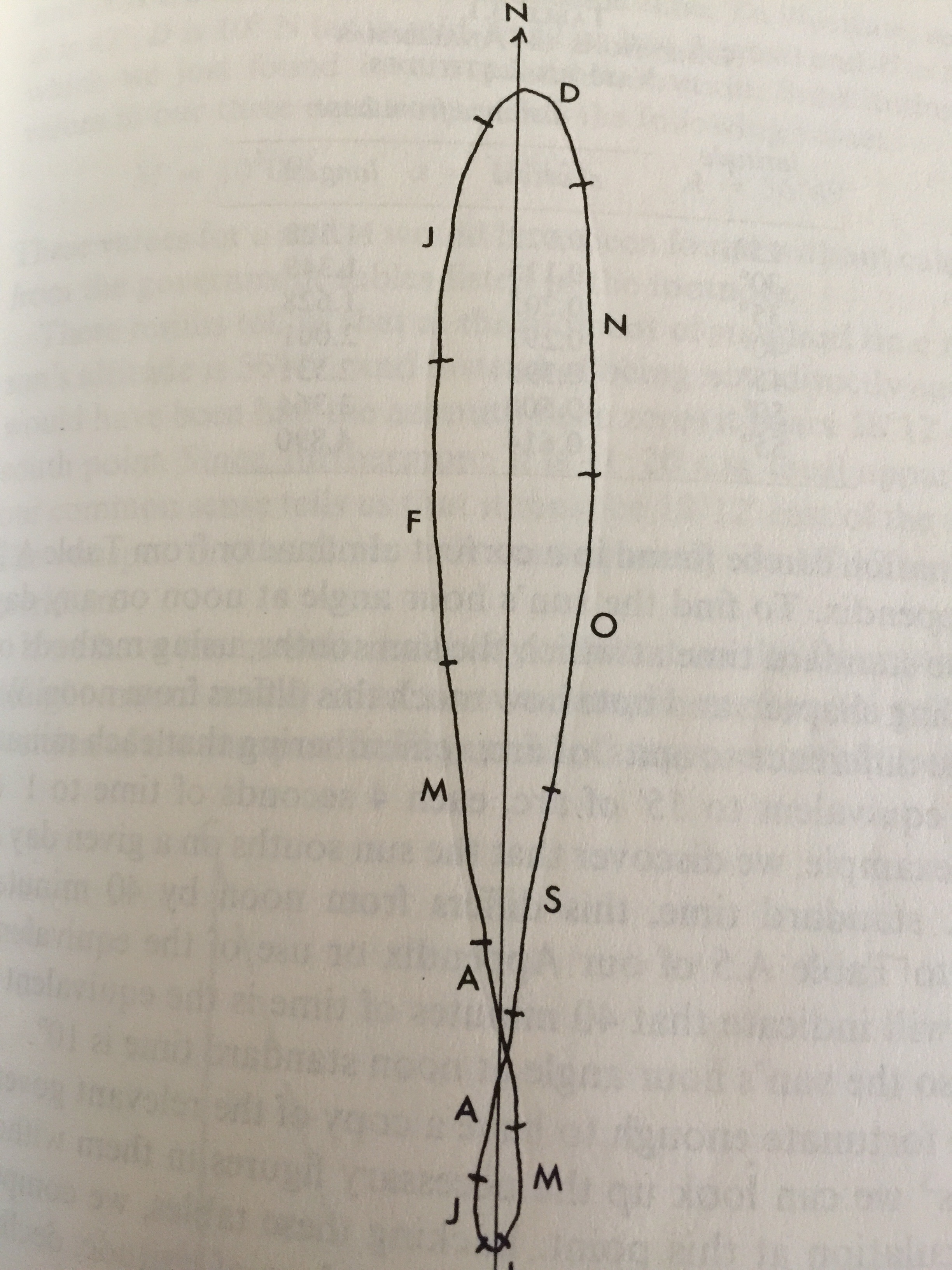
Analemma:  The shadow caster is at the bottom, where the shortest shadow will be (summer in the Northern Hemisphere.)  The areas to the right are where the Sun “runs fast” relative to clock time, especially in autumn, which gives rise to the very early sunsets we notice.  In January and February, the Sun “runs slow,” and we see that as late sunrises but relatively late sunsets, too.  We notice by Christmas that the Sun is setting later.  The vertical line is neutral.  Four times a year, Sun and clock time are the same.
SEVENTY BEFORE SEVENTY

September 28, 2018

“He is thirty-three years old. He’d like to think the next thirty-three years will be like the last ones.… Besides, he can count on the fingers of one hand the number of sixty-six year-olds he’s seen in the woods.” from Sam Cook

I stood on a large area of granite and quartz that I last visited 26 years ago, the summer I was a volunteer Wilderness Canoe Ranger in the Boundary Waters. I even remember calling this the “purple panty site,” finding a broken bottle of wine and a pair of purple panties at the base of the cliff. The old fire grate had been set on the granite, when rangers used to fly in and use air drills to fix the metal grate in place. There were now four small pieces of metal protruding from the rock marking its former location, the new grate set in soil a few yards away. We had picked up a literal boat load of trash from the 51 campsites we visited on West Basswood, using a boat with an 8 hp Yamaha motor to patrol the large area. The Fourth of July that cool, rainy summer, nobody was out here, and we camped half mile to the southeast of where I camped this year. We even were able to float the creek from Jackfish to Pipestone Bays, saving 8 miles of motoring and felt really good about doing it. That creek hasn’t been navigable for years and must be portaged around.

Twenty-six years ago, I could paddle all day long, pitch camp in an hour and break camp in the morning, including breakfast, in 40 minutes. I could hit shore, have my back pack on, the canoe on my head in a half minute and load the canoe at the other end in half that time. I wanted to see all that country, and I did pretty well at doing so, more than three hundred lakes and an equal number of nights spent out there.

This year, I was solo, like many times back then, but now needing two trips across the portage, not one, using more care to unload and load, but doing it wearing rubber boots, which allow me to stand in water to load and unload. I wore more clothing, too, not only because it was cold, but I get colder more easily. I stopped single carrying portages in my fifties, stopped wearing shorts in my sixties, My seventies may be when I lose the battle, for even as I age, and the gear gets lighter, I am going to eventually lose. Just not this year. I took my father in the woods when he was 78. Maybe someone will take me. Or maybe I’ll be extraordinarily lucky and go solo.

I like to think I’m more sensible. I wanted to go to places further up the lake, where I had camped the prior 5 years. They mean a lot to me. One is a place I take myself to mentally when the world seems too much. But I looked at the weather maps before I left, as well as watched the sky often when I left the jumping off point at Fall Lake. The forecast was for rain, cold, and wind, a difficult triad to deal with. My reality was a canoe with 8 inches of freeboard and real tippy, and after a few thousand miles in a canoe, I don’t use “tippy” lightly. If I paddled as far in as I wanted to go, I might face a headwind and rain on the return, and that was a significant possibility. The day I was to come out, I would be 70 before 70, days before years, and I felt damn lucky and blessed to just still be able to come out here. Retired Duluth Herald-Tribune columnist Sam Cook wrote the words above, and I’ve been coming out here since 1981, the year I turned 33. I am not as fast, not as strong, but far more experienced, use my gear more efficiently, and know very well that things can go south in a big hurry. I’ve never tipped over on a canoe trip, but I’ve literally been thrown out of a canoe on small rapids, and that was extremely sobering as to the power of moving water.

The solo canoe I rented had a sticker about safety, the sixth bullet point’s being “Never canoe alone,” which seemed odd on a solo canoe. I know what was meant, but I hike alone, and I have canoed alone many times. My wife isn’t coming out here with me any more, although she would love to if all the preparations and travel weren’t so difficult. I understand that. I’m going to reach a point where I can’t do this, but my goal is to be like the guy we saw lying back in his canoe floating down the Nina Moose River towards Lake Agnes, back in 2004. My wife said, “that’s you twenty years from now,” and while I laughed at the old guy back then, I kind of got a bee in my bonnet and turned the laughter into a 2024 goal. That guy was doing it right.

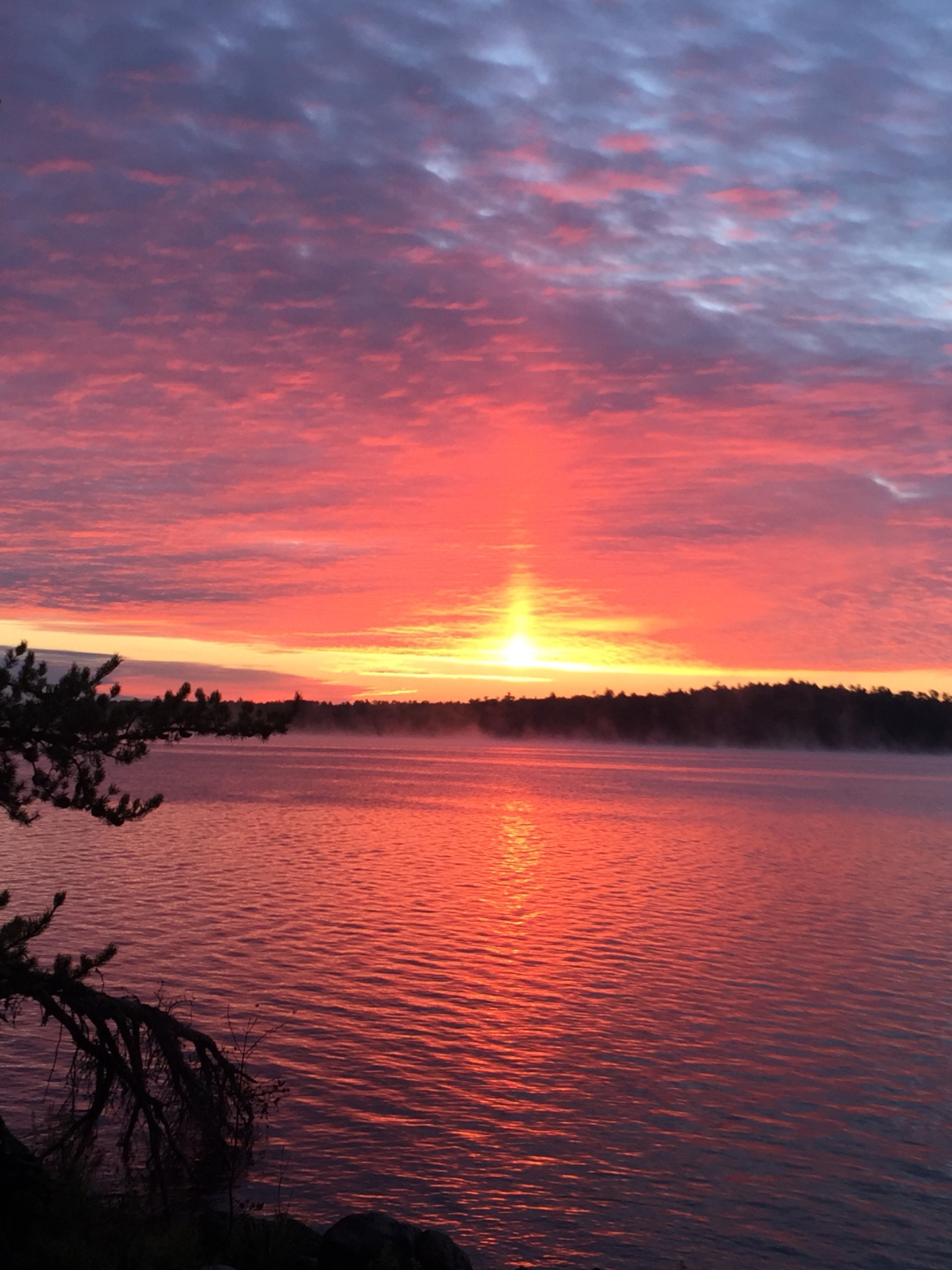
This trip, I made it a point to canoe along shorelines I had often eschewed for the straight shot down the middle of the lake to get up on the border. Exploring a small bay this year, I encountered a pair of tundra swans and a raft of mergansers. I hadn’t noted tundra swans here before, and I saw five more the next day. They were magnificent white painted against the gray sky when they took off. Coming around a point on Newton Lake, I saw an otter come out of the water, head profiled against the background light, one of those moments where I was looking in the right place with the right frame of mind. That happens a lot when one stops eschewing stuff. The first morning’s sunrise was spectacular, even if the red sky in morning was warning this canoe man to stay in camp the next day. A leaf with a few drops of rainwater was worth a picture, as well as the nearby asters, the lovely end of summer flower.

Sunrise from the first campsite.

Leaf with water droplets

Asters

My camp had a path to the next campsite, unusual in this country, but the two sites were not visible from one another, which is the norm. On the windbound day, I walked laps between the two sites, noting the 3 inch depth of white pine needles and also noting, for the first time, how the adult bark starts to appear, from ground level up a meter or two, rather than immediately on the tree as it grows. I had a lot of time to think about the past thirty-seven years I have been coming up here, and how fortunate I have been to have seen the country far beyond where I can now physically go—or wish to go—for that matter. I know what’s out there; I have good trail and lake memory. My last Quetico trip, in Canada, was in 2005. I said goodby to Kawnipi Lake back then, occasionally hoping maybe I’d get another chance—but knowing that I will not.

The trip had all the challenges—wind, rain, cold, thunderstorms. I packed wet and I set up camp in a pouring rain. I didn’t talk to a soul for four days, and I had a day when I didn’t see a boat anywhere. I wasn’t sure if solo tripping would still appeal to me. It does. I looked at things without judgment, only interest.

Maybe 2024.

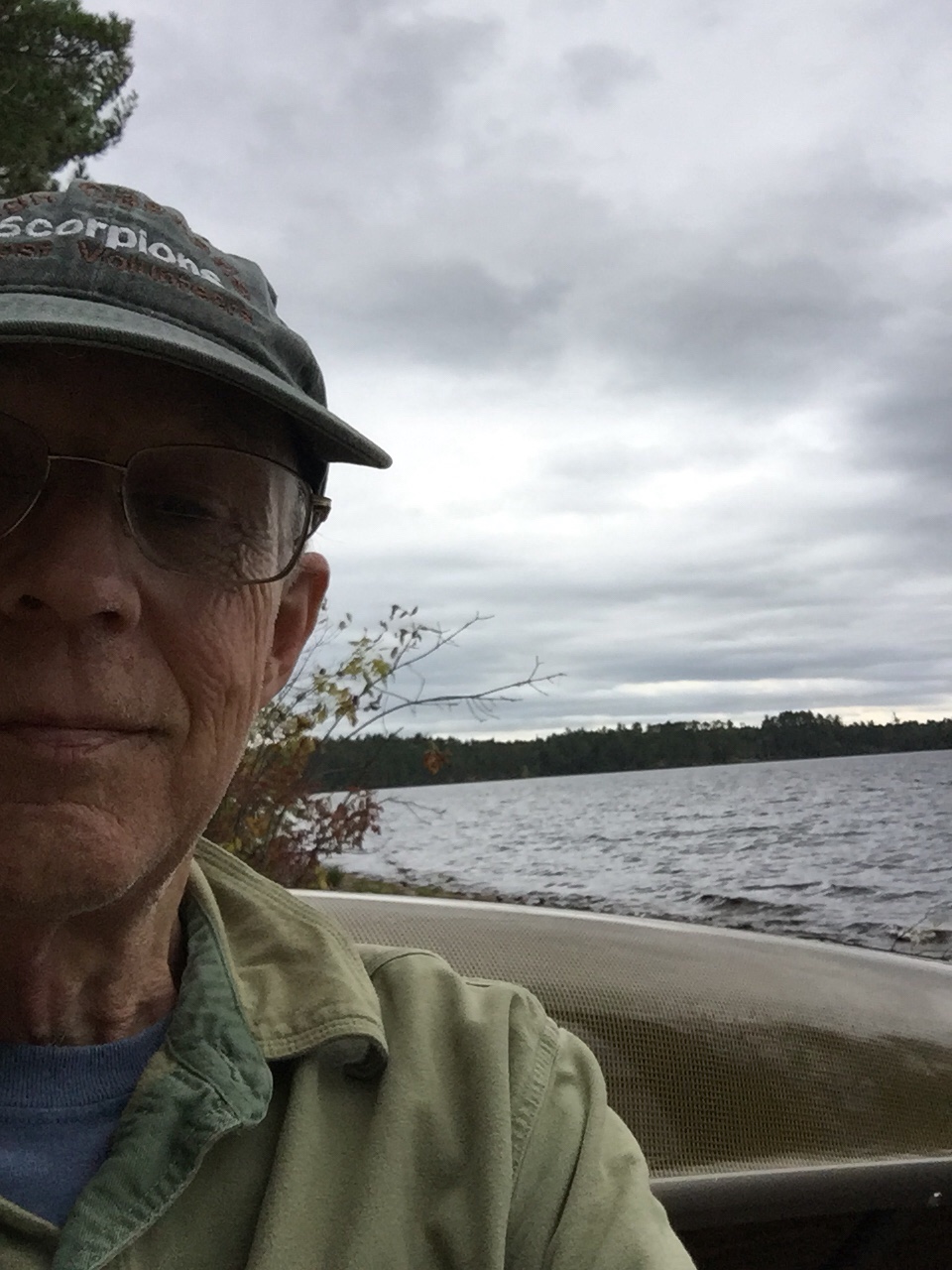
Wearing High Cascade Volunteer “Scorpions” hat. Pipestone Bay, 2018

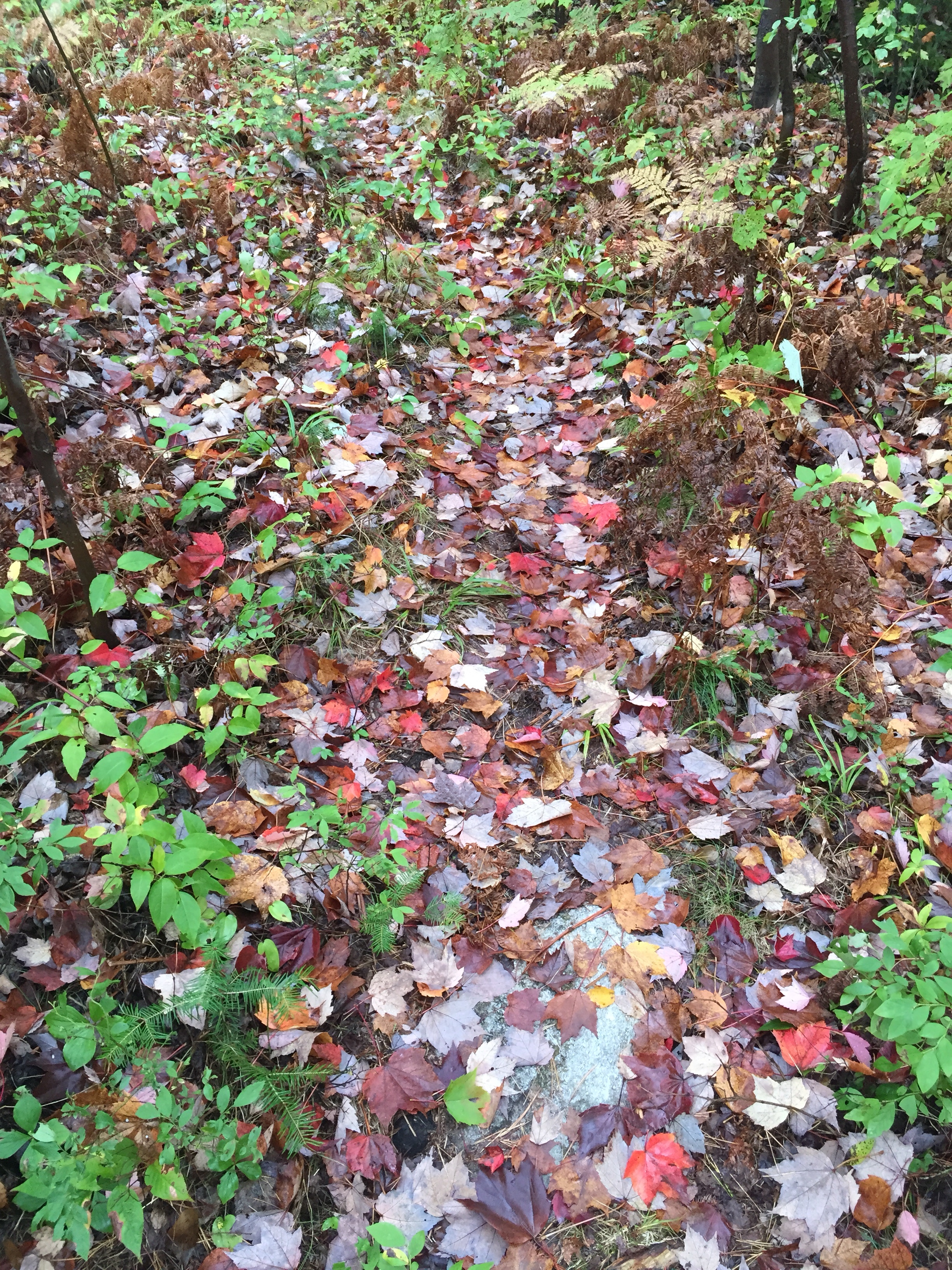
Below, leaves on a trail

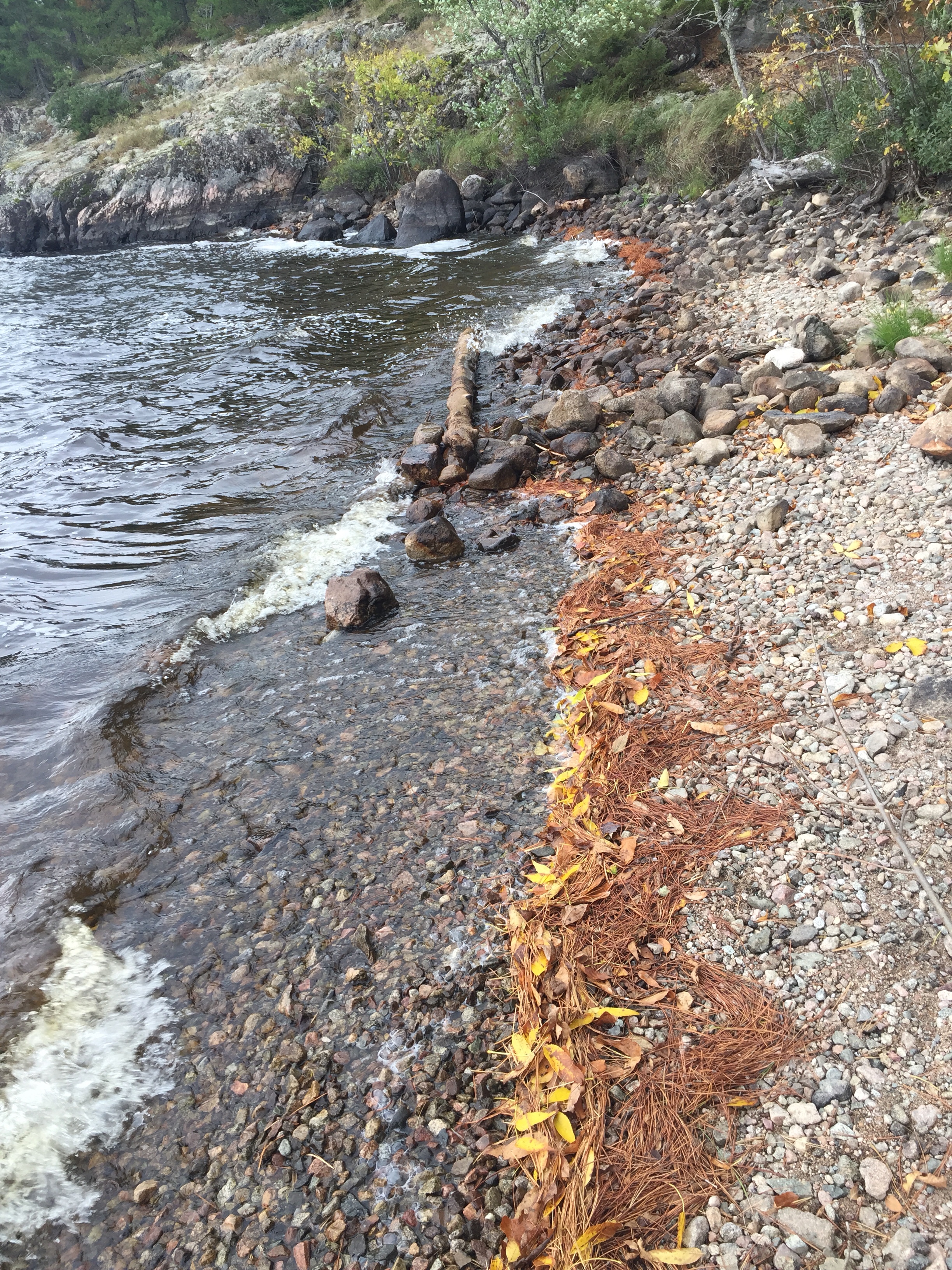
Leaves along the shoreline

MY LOST METER

September 12, 2018

Many years ago, I paddled out one September afternoon from Wolf Creek on Burntside Lake, headed into the Boundary Waters at Crab Lake, back when a mile portage seemed like a good idea.  I didn’t have a map for my entry, but I did have the next map north, where I expected to soon be within 2 miles.  Error in judgment.  After an hour and easily those two miles, none of the landmarks I saw was quite right for the map I thought I was now on.  I then “moved landmarks,” or made distant islands fit my map, but a half hour later it was obvious nothing fit, and I admitted defeat.  That was better judgment.  Far in the distance behind me, I could see where I had started, and that became my goal.  I returned to shore, put the canoe back on the car, drove into Ely, stopping at an outfitting store to take a look at a map where I had been.  I was miles from where I thought I was.  Better prepared, I headed out on the same lake the next day and had a good 4-day solo into the Burntside Unit.  

I’ve been significantly off course a few times since, which embarrassed me, because I consider myself as having good directional sense.  I do, but one or more minor mistakes can throw me a curve. On the Appalachian Trail, I was so fatigued one day that after I got up from a rest stop, I retraced a mile of my prior route.  When I saw a road that shouldn’t have been there—a road I had crossed a few hours earlier— I realized that the proper question was not “What is that road doing here?” but rather “What am I doing here?”

On Isle Royale, first boat out to the island in 2006, I realized I had a Lost Meter: it wasn’t in my pack, it was in my brain.  Hiking in the dark with a flashlight I hoped kept on working, I encountered a huge blowdown.  I went around it, and around it…, and continued, soon having a disquieting sense I was going back the way I had come.  I took out my compass, something I almost never have to do, confirmed that my basic direction was indeed southwest rather than the desired northeast, and turned around.  That disquieting sense was my Lost Meter’s kicking in.  The flashlight got me through the night until I reached Windigo, ten miles later.

I have seldom ignored my Lost Meter, the last time being on my first hike in Oregon, when I “moved the trail,” because if I had been where I thought I was, I shouldn’t have seen the Sun where it was.  I convinced myself the trail would soon turn in the direction I thought it should.  It didn’t.  The Sun didn’t move, either.  I arrived at another trailhead, clearly not where I had started, and started walking to town on an unfamiliar road.  The road refused to go north, only south, and the Lost Meter got so loud that I turned around, backtracked to the trailhead, and followed a river downstream back to the car.  I was embarrassed and tired, the error costing me at least 2 hours and six miles.  On my current hikes, I plan ahead, usually have a paper map, always carry a GPS with spare batteries, and the Gaia app on my phone to use if necessary.  If one has to move hills, mountains, islands, or the Sun to match a map, one needs to admit being lost and deal with matters accordingly.  

I became a convert to GPS technology on Obsidian Loop, solo in early July with the trail buried under feet of snow. My sense told me to go downhill, the arrow on the GPS pointed elsewhere to a ridge above me.  I went up, and life became a lot easier.  GPS arrows can’t be moved without physical motion on the holder’s part.

*                                 *                                 *

My healing knee survived the first of three days’ hiking in the Mt. Hood Wilderness, 2100 feet elevation gain on a 12 mile out-and-back to McNeil Point.  I was in front and told to stop at some ponds, the leader saying, “We wandered through there last time I was here and weren’t sure where we were.”  When I reached the ponds, there were two trails, one going towards a pond, which I assumed was a user trail, not the main trail we wanted to be on.  I went a little further on the other and stopped, since on Club hikes we stop at trail junctions, to keep people together. A few minutes later, I saw the leader below me on the user trail.  It was not a big deal, really.  We could see each other.  But the Lost Meter sounded just a little, as I realized I might need to be in charge of navigation this trip.  This was an area I felt that one should not have had trouble negotiating.  

We got off to a inauspicious start the next day when the leader said the trailhead had changed from the last time she was there. This bothered me, because trailheads usually don’t change, so I started going through my mind what I knew about her navigational skills. She’s experienced, but three weeks prior, on a hike where I shuttled the car, since I couldn’t hike, she failed to find a lake in the Mt. Jefferson Wilderness, looking below her when the contours clearly showed it was above her. Last winter, she took a group into Fawn Lake on a snowshoe.  Nobody had a GPS, and they never found the lake.  That’s a problem.  I am a good navigator, and I wouldn’t go without a GPS.  She’s seen a lot, but I ask questions when my Lost Meter goes off.  A claim that a trailhead was moved moves the needle on my Lost Meter.  Or a trail’s being moved: a leader on a snowshoe hike complained that the trail had been moved, when he was frankly lost and took the whole group on a mile bushwhack in snow. I was glad to have missed that one.  I didn’t miss the snowshoe in heavy, deep snow to the top of Willamette Pass Ski Area.  After one too many “around the next bend,” I said “one more.”  When we went around it, and nothing changed, we turned around.  Later, we discovered we had 3/4 mile still to go.  In heavy snow.

Trails can change, and part of the Castle Rock Trail actually was moved a year ago by mountain bikers. I knew it had, because my trail memory and the GPS showed me where it used to be. Somewhat a Doubting Thomas, I walked on the unfamiliar trail, watching the GPS carefully, until I was convinced we were going  to where we had planned. I wrote Oregon trail guide author Bill Sullivan about the change, got a thanks and a free book of one of the nearly two dozen he has written. 

Anyway, we started on the Umbrella Falls trail, a familiar landmark to the leader, but not somewhere where we were supposed to go.  I was new here and didn’t know better, so I made myself the sweep, last on the hike. I quickly didn’t like what I was seeing on the GPS.  We should have been going east northeast, not north.  I called out to her whether we were going in the right direction.  She assured me we were, and we arrived at Umbrella Falls a short time later.  

This was neither our destination nor part of the hike.  It was pretty, but we didn’t want to be there.  A comment was made that perhaps this falls was unnamed, “moving landmarks.”  No way.  Smaller waterfalls in the state are named, and the trail sign said, “Umbrella Falls.”  We were at a falls.  We were not where we wanted to be, and another look at the map showed we hadn’t driven far enough on Highway 35 to the trailhead. 

My Time on Trail meter is also listed below, along with my Danger Meter.  Know where you are going, keep an eye on the sky, the trail, the clock, the altitude, and if at any time things don’t make sense, stop until they do, or turn around to the last place where they did.  It’s only a hike, and it is not worth risking one’s life to do it. 

LOST METER  (“Something changed since the last time I was here,” Frequent use of the verb “to hope.”)

One should be able to answer the following questions unequivocally yes:

  1. Do I have a clear idea of the mileage I am attempting to within 10%?  
  2. Do I know exactly where I am now?  Does the altitude match?
  3. Can I truly say that no landmarks are out of place?
  4. Assuming one has walked the trail before, are landmarks on the trail familiar?
  5. Are trail junctions where they should be?
  6. Do I have a GPS?
  7. Do the maps and the GPS agree?

DANGER  METER (“Come on, you can do it,” Frequent use of “hope”)

  1. Am I lost?  BE HONEST.
  2. Is part of me saying “I don’t like this” or “This isn’t safe.”?  Is somebody saying, “Come on, you can do it?” 
  3. Are there problems with the trail, like blowdowns, unexpected snow, stream crossings?  If an out and back, and in glacier country, will a stream be crossable in the afternoon on the return?  Glacier meltwater increases in the afternoon.
  4. If with a group, is anybody uncomfortable with the situation?  Have you asked?  Really asked by saying, “If you are at all uncomfortable, please speak up.” ?  Has somebody mentioned a significant medical condition?
  5. Is anybody lagging behind or doesn’t look good?
  6. Is the environment safe for somebody to say NO? Yes, this is repeated, because nobody wants to be a wet blanket or a Killjoy.  Except me.
  7. Does the sky bother you?  Have you looked? Storms don’t suddenly occur.  There are warnings, even if only an hour or two.
  8. What are the consequences to a river, snowfield, or scree crossing in front of you if someone falls?
  9. What is the current windchill?
  10. What time is sunset, and if applicable, the next high tide?
  11. Any sign of recent bear or mountain lion scat?
  12. Are you hearing or saying, “Let’s go a little bit longer,” without “little bit” being defined? “Around the next curve=little bit.” Use “we go 5 more minutes by the clock before turning back.” And stick to it.

TIME ON TRAIL METER  “Oh, I didn’t realize how late it was.”

  1. Did you start late?  How late?
  2. What time do you expect to return (1 p.m., 3, p.m., 5 p.m., 7 p.m., 9 p.m.)? 
  3. Was there unexpected traffic or other problems driving to the trailhead?
  4. Is everybody getting ready quickly, or does somebody seem to be constantly fixing or adjusting something?
  5. Does anybody appear to lag, especially early, or is taking long breaks?
  6. Are you where you want to be at this time?  If not, what are your plans?
  7. When, where, and how long do you plan to have lunch? 
  8. Are there unusual requests, like napping, long meditation, frequent breaks?


IMG_7732.JPG

A turnaround point on an out and back exploration.  It is worth learning to say STOP, I’m not going further.  The trail will be there another day.  And so will you.  Ruby Mountains, Nevada; August 2016.

NINE LESSONS

September 7, 2018

I didn’t think I would ever financially support a Republican candidate in my lifetime, but life is full of surprises.  The husband of my wife’s best friend is a sheriff’s deputy in a rural county and ran for Justice of the Peace.  He was a great candidate, knowing the vast land, larger than many states, the people, and the law, but the first and most important requirement, my wife told him, was he had to run as a Republican in that county. 

He did in 2014, but made the decision too late to get on the ballot, so ran as a write-in candidate and still got 30% of the vote.  But he lost.  That is Lesson #1 for the Democrats this fall: please stop rejoicing about the “almosts.” A year ago, doing better than expected was encouraging.  But the winner still voted to repeal the ACA.  The situation is dire enough that nothing less than winning matters.  

Our friend stayed in his day job, did well, and bided his time.  Four years passed, 2018 arrived, and he filed to run against the incumbent, who had a lot of problems, including a rumored federal investigation into corruption.  Lesson #2: don’t underestimate the power of incumbency; Lesson #3R: only results from the investigation may matter, not the fact there is an investigation. (Lesson #3D: any investigation matters, and if the result isn’t guilty, there needs to be another investigation.)

My wife’s best friend became a skilled, creative campaign manager, making a great video of her husband’s telling why he was qualified for JP, and what the position entailed, which was educational.  She got the message out every possible way, even by a horse-drawn float at the county fair.  Her husband looked right for the job, which shouldn’t matter but does, he was available for questions and was a straight shooter, figuratively and literally.

It was a three way race, and one of the other candidates was member of a certain religious group.  Lesson #4: that’s a problem in the rural West. I’ll leave it there.

We had a chance to win:  Lesson #5: You don’t really know what will happen.  Do not, under any circumstances, become overconfident:  2016s happen, and we had no idea what the voters would do.  Or how many would not vote at all.  

The days before the primary, the candidate’s wife called many, trying to get out the vote.  One of the county election commissioners thanked her for calling people and informing them.  The commissioner herself hadn’t been doing that. Lesson #6: don’t assume the electorate will show up. Primary elections are arguably the most important elections of all.  In this particular one, the Republican winner was going to be the JP.  The general election was a formality. The primary is a hurdle that has to be crossed.  Fail to get by the primary, if you are Eric Cantor, majority leader in the House, or Joe Crowley, headed for a possible speakership in November, your career is over.  Lee Bight, one Republican who believed in global warming and attendant climate change, was ousted by Trey Gowdy in a primary, the Gowdy who kept investigating Hillary Clinton. See Lesson #3D above.

The primary turnout in Arizona this year was 30%.  And that was a record.  Seventy per cent of the electorate, for whatever reason, didn’t vote. In the county where our race occurred, turnout was 25%.  A quarter.  In 2016, 81% of Republicans voted, 74% of Democrats. There’s your 77,000 votes in three states. In 2014, 21% of millennials voted.  In California, 8.2% of 18-24 year-olds voted, and the youth, who were 14.5% of the voting population, cast 4% of the ballots.  If the millennials continue to be relative no-shows in elections, they are going to be dictated to by the conservatives in my generation.  Just sayin.’  The problem we have in the Senate, where the Affordable Care Act narrowly survived, if one can call what has happened to it survival, where we have two conservative supreme court justices so far in this term (and a possibility of as many as three more), where Republican-leaning judges for federal courts have been approved in record numbers, can be directly laid to poor turnout in elections.  I am beyond angry at those who didn’t vote in 2014.  Lesson #7: Not voting because nothing ever changes is wrong.  Things can change for the worse, and the country has seen that in spades since the last election.  Or am I the only one who hasn’t slept well since then? 

A single vote does matter:  Florida in 2000, Virginia in 2017 (a tie occurred), and some House race virtually every year. If perfection is desired in a candidate, move to Mars.

What happened to our candidate was predictable, although we didn’t predict it: the results of the investigation into the incumbent would come after the election, enough of the certain religious group voters turned out, and there were too many no-shows.  He lost, finishing again with 30%.  

I was upset, not at the campaign, which I thought was wonderfully run, in the spirit of America, or at least the America I once knew and served, but at the selfishness of those who can’t be bothered to vote, the religious turnout for someone whose qualification is the right religion but nothing else, and how people in power can delay investigations until a convenient time, read “after the election.”  

Lesson #8:  gerrymandering and a profound war on voting rights were aided by state legislatures, the Supreme Court AND by those too busy to vote, still stuck in the mindset that both parties are the same AND by those who threw their vote to a fringe candidate who ran only for their ego and had NO chance of winning. The single best weapon is convincing every possible person on one’s side to vote. What swung Alabama a year ago was the black vote, black women in particular, who increased their turnout from 25 to 30%.  That still is paltry, but it mattered.  There were six thousand people who didn’t vote in the primary for JP3. True, it’s better sometimes that some of them vote.  We will never know what would happen if they all showed up and voted, but in this race, like every other race in the country, would at least be truly decided by the people, not a few.  It’s a different world when everybody votes, and I think a lot fairer one, too, usually. 

Ayanna Pressley (and yes, spell check, better allow the second “s”) had no chance to win, but the voters turned out and she won by 18%.  There might have been a different JP in that county come November, despite Lessons #3R and #4. Arguably, the JP is going to affect one’s life in that district far more than a single representative.  

In the low moments after I failed big time in my career change nearly two decades ago, I always knew the answer to, “If only I had resigned and gone back to school.” I knew the answer, and besides, one career of mine suffered but another one did well.  My wife’s best friend will never have to say, “If only I had…”  That might be Lesson #9.

MR. KILLJOY

August 29, 2018

We had just finished sawing a 24 inch log in two places, dropping it on the trail.  Then, we sat on the ground and pushed it off with our legs.  Another section of the trail up from Patjens Lakes in the Mount Washington Wilderness was clear, just as one of our group returned from scouting what lay ahead.

“There are at least 30 logs between us and the wilderness boundary.”  My heart sank.  About an hour earlier, 10-15 cuts ago, a mile further back, a lady hiked by, telling us that we had “at most” twenty more to do to the wilderness boundary.  She obviously was wrong.

I have gone out ten times with the Scorpions, part of the High Cascade Volunteers, an amalgam of thirty volunteer groups taking care of the Central Oregon wilderness and the national forests, because the Forest Service doesn’t have the resources to hire enough personnel to clear the trails.  Elections matter.  A few folks started doing this 14 years ago, and now there are crews of volunteers going out at 7 am every Thursday and in summer on Tuesday as well. It is a two hour drive to the trailhead in many instances, the last part often on washboard roads, another hour—or more— spent hiking into where the work needs to be done, carrying saws, Pulaskis, pruning saws for the small stuff, a pry bar, doing the work, and hiking out.  

Then driving back to the meet up place.  Then driving home, hopefully before 7.  

The first time I did this, carrying a Pulaski, wearing a hardhat and other protective gear, we hiked 8 miles with an elevation gain of 2700 feet.  That’s a significant hike without gear and without having to work.  Chainsaws are not allowed in wilderness areas, so a log that might take a minute or two to cut with a chain saw takes a half hour or even longer to cut out with a two man crosscut.  Saws bind (we use wedges to keep the cut open), we sometimes have to under buck (do cuts underneath), and then we try to see if we can move the log after only cutting it once.  It’s difficult work.

Back to Patjens: The crew chief said, “Well, we’re obviously going to have to come back since we can’t finish.  Does anybody want to keep going?”

There were three others besides me, and all three nodded assent.  

“No,” I blurted out.  “I’m beat.”  I was.  It was hot, my knee bothered me, the last cut was a bitch, and I knew we had a 3 mile hike out of there before we could even start the drive home.  No, I did not want to continue, when I knew a crew would have to come back here to finish.

I prevailed.  

An hour and a quarter later, back on the road, one of the others told me that she was glad I spoke up.  “I didn’t realize how tired I was.”  

I did. 

A person willing to say no is valuable in these situations.  I was discussing my experience with a person yesterday on a drive to a hike.  He said that people need to speak up.  I replied that the leader shouldn’t put others in that situation, because many don’t want to be the one to speak up, to be the killjoy who says “no,” when asked to cut more, hike more, bushwhack more, climb to the next ridge, go on just a little longer, say they aren’t too tired, too cold, too hot, or something else I liken to a “contributing factor” to a accident report, which it may well become.

My wife once got suckered into climbing a short, but rather steep climb on an urban hike that didn’t mention the climb.  I was along and should have spoken up in her place.  She doesn’t like being the one who says no.  A few months later, on a long beach hike, we were part of the group that would turn around early.  When we arrived at that spot for lunch, the hike leader suggested we go “a little further” to another landmark.  I said no, that this was the hike we were going to do.  The leader was upset, but I realized—as did my wife, who didn’t want to say anything but who also wanted to return—that we still had to get back.  We turned around.  She stopped hiking with the Club.

I said no on a snowshoe loop hike up by Maxwell Butte when after a couple of miles of deep, unbroken snow, only three of us in the group, including me, breaking trail, we reached a junction: a steep hill was ahead, continuing to a shelter and a long loop back to the car, and a gentle downhill area was to our right, leading a much shorter 2 miles to the car.  The leader wanted to go up the hill.  Mr. Killjoy said NO.  “I’ve been pulling a lot (I should have said “breaking trail,” but the ex-cyclist in me used pulling), and I am not going up that hill with unbroken snow.”  What I didn’t add was that the hike was put on the schedule at 5 miles, and I knew already it would be over 6.  A mile extra snowshoeing breaking trail is like 3 more miles hiking.  At least.  We went right. 

A year prior, on another snowshoe uphill in waist deep snow, a person who had done this particular snowshoe kept saying, “around this bend.”  Finally, I put my foot down figuratively as well as literally.  “One more bend,” I said, and when the top didn’t appear, we turned around.  Later, in better conditions, I discovered it was another 3/4 mile.

One can’t depend upon having a Mr. Killjoy along.  As a result, many end up doing things that they assented to, but didn’t really want to do because they didn’t speak up.  I have discussed this issue in this blog before, (The Abilene Paradox) courtesy of the late Dr. Jerry Harvey, which convinced me of the need to speak up when I don’t like a situation.  

Having been burned on unscheduled food/drink stops (“it will only be ten minutes” but took an hour),  I know now that I either have to lead the hike or be one of the drivers.  I don’t want unscheduled stops or hike surprises: 

  • “hmmm, there used to be a trail here” (there was never a trail there, the leader took a wrong turn);
  • “we couldn’t find the lake” (nobody along had a GPS);
  • “We spent an hour looking for the lake, but I couldn’t find it” (the contours showed the lake above, not below);
  • “I know there is water here (a hiker who had the PCT trail update said there wasn’t, but the leader insisted and wasted well over an hour’s time);
  • “I left an arrow in the snow where I was going” (which I didn’t see), from one on my hike who continued without the group after a trail junction, something one does not do. and only by luck (which I don’t want to depend upon in the outdoors) was he at the lunch spot.  

I complain too much, and as one posted about me on Facebook (back when I used to read it), “Mike never smiles.”  That may not be far off, because when I get in the woods, I stay focused, know that early miles are like gold, knowing where I am in time and in location matter, if I don’t know where I am, I stop until I figure it out, and I keep counting people. Trail memory, recognizing when something is and isn’t familiar, and a keen sense of time are my virtues, although many consider them nerdy and too analytical.  I worry a lot, because it doesn’t take much for things to go south in a hurry.  Bad stuff happens, and I want to minimize it, not smile for somebody’s desire to get likes or shares.

As a New Zealand friend told me three years ago on Black Crater, “You don’t want to have to explain things to the coroner.”

Sign me,

Mr. Killjoy

DIALING UP TIME

August 26, 2018

Last Sunday, I didn’t hike because of a knee injury.  I remembered that at noon the Eugene Astronomical Society sponsored a weekly solar viewing in Alton Baker Park, appropriately near the 1:1 billion scale model of the Sun, part of the solar system which runs for 2 1/2 miles west along the Willamette River.  I lead a New Years’ Eve Day walk through the solar system for the hiking club and know it well.  I decided to go over and see what it was all about.

I do my solar viewing during eclipses, so viewing the “normal” Sun is strange for me.  When I arrived, three members had telescopes set up, two with Hydrogen Alpha filters and a Dobsonian with a nice solar filter.  A Hydrogen Alpha filter removes all light except the wave length emitted caused by an electron’s jumping from one specific orbit to another.  They allow prominences on the edge of the Sun to be seen well, and I saw one such prominence far larger than the Earth.  

After my look, I settled on the cool grass to look for Venus in daytime, more difficult to do here in Oregon, at lower elevation, more humidity, and in summer more smoke.  I never did find it.  Jerry, who is the EAS’s spokesman, runs the show. He has written 15 science fiction books and remarkably well-versed in all areas of astronomy.  He recognized me by name when I showed up, speaking volumes to his skills at facial recognition as well, since after the eclipse a year ago, we have seen each other twice.  After chiding myself for my laziness, I finally went to the last monthly meeting.

Somewhere in all of this, we started talking about sundials.

Jerry brought the shell of one that had been thrown out, where the shadow caster, or gnomon, was put on wrong and had the wrong latitude as well.  He was interested in bringing the dial back to life, so we started chatting about various dials.  I have built several horizontal and vertical ones, plus a 20-footer on a concrete slab, an analemmatic, in Sonoita, Arizona, where one could stand on the date with the shadow’s reading the time.  I’m not much of a builder, but math is integral to making a sundial, and I like math.   

I was able to help Jerry when I reminded him of a correction we need to make is where we are in the time zone, in addition to the correction of our watches to exact time.  We are a bit more than 123 degrees west longitude, and our clocks, plus daylight savings time, are set for local noon at 1 p.m. at 120 degrees west, 8 time zones (a time zone is 15 degrees latitude) from Greenwich.  The extra 3 degrees and change delays local noon by 12 minutes and 46 seconds, so Sun’s culmination, or furthest south, is after 1 o’clock.  There is yet a third correction that must be made for the “Equation of time,” which takes into account the difference of “Sun time” to clock time.  

These two ways of measuring time are slightly different: clock time is 86,400 seconds per day, where each second is “the duration of 9 192 631 770 periods of the radiation corresponding to the transition between the two hyperfine levels of the ground state of the cesium 133 atom.”

Got that?

The Earth’s orbit marking the day’s length—measured from noon to noon—is not quite 86,400 seconds or a bit more.  If the Sun is running “fast,” which it does especially in September and October, we note an earlier sunset, which is why October evenings (at least in the Northern Hemisphere) become so dark so soon.  The mornings don’t change much, because while the Sun is moving south, delaying sunrise, the Sun runs “fast,” speeding up sunrise, and the two effects tend to cancel each other.

When the Sun is running “slow,” especially in January and February, it is slow to rise, giving rise to the dark mornings of January.  The slowness works the same way in setting, however, which is why by New Years’ Day most people know that the Sun is setting later than it did at the beginning of the month.

It is not a good reflection on me that I tried to convey all of the above information in words during a time when nobody was viewing through the telescopes.  I left out the making of an analemma, the path the Sun takes through the sky at the same clock time, during the year.  It is the odd-shaped Figure of 8 on the globe.  If one can understand what the analemma means, one is well on the way to understanding the rhythms of the Sun and the changes in sunrise and sunset times.  I’ve made analemmas, and it is a great project for elementary school students, for it teaches how the Sun takes the same path across the sky in fall and spring but doesn’t rise and set at the same time.

Probably a better lesson is that an analemma takes a year to make, and one can’t speed up the process.  All is needed is an object that casts a decent shadow on the ground and the ability to mark the shadow periodically over a year, which helps develop delayed gratification skills.

I’ve made sundials to keep track of time of meetings I’ve attended, throwing people a little off balance, setting a different tone for the meeting.  I’ve made many noon marks, too, where the Sun is highest in the sky for a given day, demarcating the change from morning to afternoon.  These were part of the pioneer homes in our history, and some still have them today.  Noon marks are along a straight line, but they occur at different clock times.

With fast and slow Suns, hydrogen Alpha filters, and Dobsonian telescopes, I again re-learned one of life’s lessons:  when one does something new, out of the ordinary, one may predict what will happen, but one will likely have a very different experience than what was predicted.  I went over to look at the Sun and to support the local society.  I didn’t expect anything special.  

Instead, I found my knowledge of an area of the Sun useful, connected with a couple of people and made a difference by my presence.  That’s not a bad way to spend time, whether Sun time or clock time.