Posts Tagged ‘Philosophy’

WHO NAMED THE STARS?

March 28, 2015

I had just finished the last of six shows in the planetarium my first day as a volunteer at the Science Factory, a hands on museum for children, right down MLK from my house.  I had given six shows, three each of a different topic.  While the shows and my explanations had been good, I realized how much I had to learn as a volunteer, and I was tired.  As the last family left the dome, their 4 year-old daughter looked at me and made my day:

“Who named the stars?”

My fatigue vanished.  A 4 year-old had just asked me a question.    She didn’t just ask me a question, she asked a dynamite one.

That in itself is not surprising, because children are naturally curious, until they keep hearing, “Be polite, don’t bother the man,” or “don’t know, go away.”  She asked, because she wanted to know, and it’s a cinch her parents didn’t know.  I think I understood why the Science Factory wanted planetarium volunteers who knew amateur astronomy.  So, who named the stars?

I bent down to her level, and said, “What a great question that is!!”  Then I answered it:  “The ancient Arabs, Greeks and Persians named the stars.”  I didn’t get into the reasons they did: these people were desert dwellers, had no electricity, and light pollution occurred only with the Moon or a campfire.  The nights were dark.  Small wonder that they knew the sky well.  The ancient Jews knew the Moon’s irregular phase cycle to within 2 minutes.  The Saros cycle for eclipses, a repeat of a similar eclipse every 18 years and 10 or 11 1/3 days, was known 3000 years ago.

“Mommy, I want to come back here in summer and learn more names of the stars.”  I hope I am doing planetarium shows that day.

I looked in the main room and saw an 18-month old girl trying to reach a door handle. She didn’t know what it was, but she saw it, and she wanted to figure it out.  Kids run wild in that room.  That is why the museum works.  Kids need to look at how things recycle, how gravity works, how colors mix, where the lizard is in the terrarium, how we can make optical illusions, and what orbital velocity requires.

When I ask at the outset of a talk whether anybody has questions, they are invariably from children.  The questions are good.  When I was a docent at Kitt Peak in 1986, a junior high school student asked me what a parsec was.  Impressive.  It is the distance of a star from us with parallax of a star one arc second.  In other words, a star viewed six months apart in the Earth’s orbit appears to have moved, just like your thumb appears to jump when you close first one eye and then the other. The closest other star to the Sun is  1.3 parsecs.  Great question.
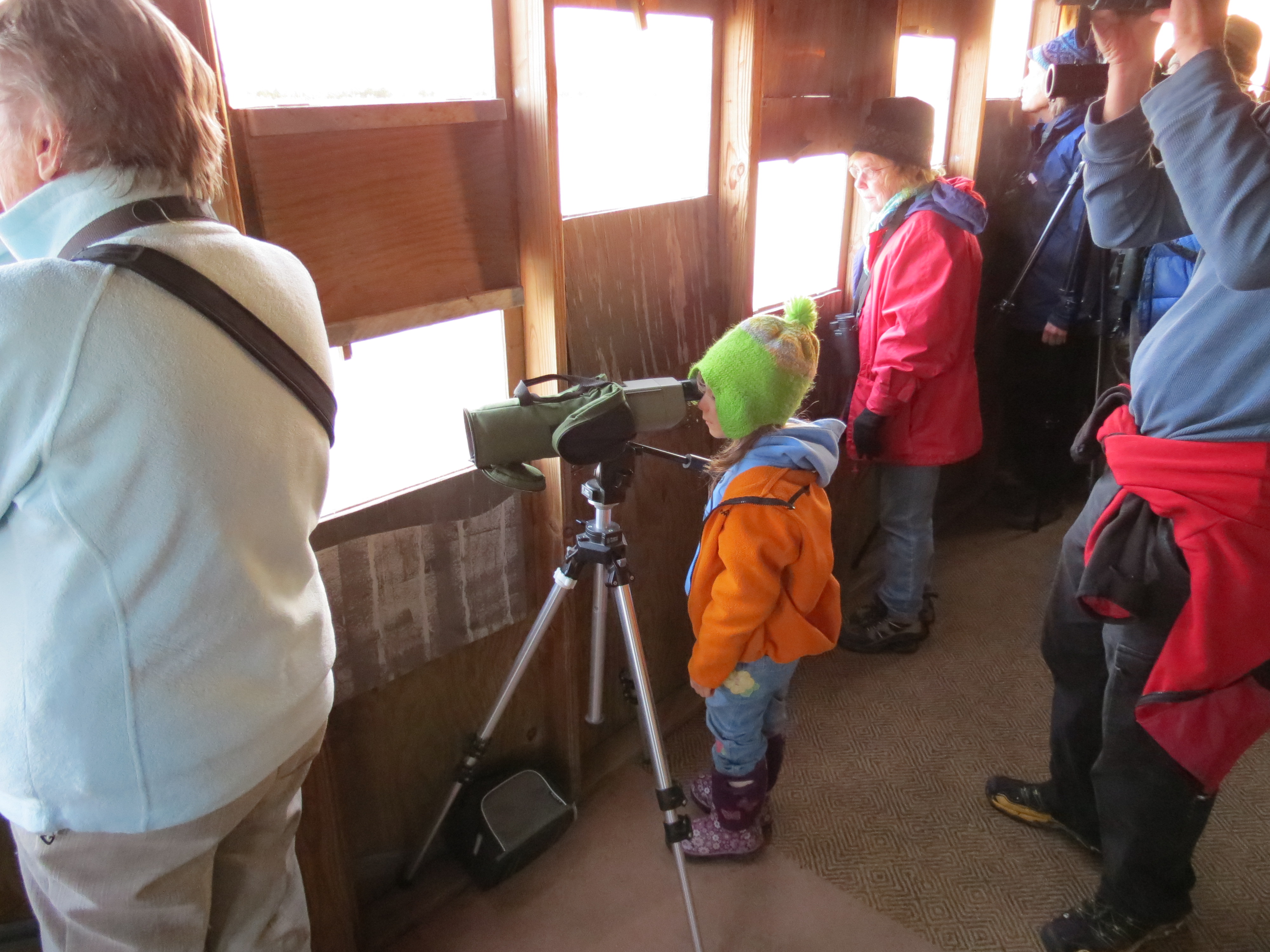
Young viewer of the Sandhill Crane migration, Kearney, Nebraska, 2012. Two great sights: the migration, and seeing a young person enthralled with nature.

Young viewer of the Sandhill Crane migration, Kearney, Nebraska, 2012.
Two great sights: the migration, and seeing a young person enthralled with nature.

I was lucky.  My curiosity was fostered by my parents.  I listened to my brother ask so many questions at the dinner table that finally my father told him to ask only three.  Great idea.  Small wonder my brother became a superb grant writer.  He learned to ask good questions; because grants are difficult to obtain, the better the question, the more likelihood of success.

I wasn’t as good as my brother, but I grew up curious. In kindergarten, I asked the teacher, “What does ‘Proceed with Caution’ mean?”  When children weren’t able to read, she was impressed I could.  I still remember her name, I still have her report cards from 1954, and I was once chided by her: “Mr. Smith, we do not say goddamn in my kindergarten.”

Precocity with some words is not always valued.

Often, I don’t answer the questions but let the children find out by watching the show or doing an experiment.  I’ve shown more than one child the Sun through a solar filter, and hear them say, “It looks like the Moon.”  Yep, it does.  That’s why we can have solar eclipses.  I showed one girl Jupiter one night, and she asked about the dots near it.  She had just discovered the Galilean Moons, as surely as Galileo had.

The following day, I spoke about solar eclipses to OLLI, the Osher Lifelong Learning Institute.  This was a tough audience of retirees. I figured I would get a couple of questions I didn’t know the answer, and I did.  I also got mildly chastised by a man who did not understand the concept of protecting the eyes from sunlight during the partial phases of eclipses.  To me, the concept is easy.  He didn’t understand it until after I explained in great detail how the Sun’s rays damage the retina.  He finally said, “OK, why didn’t you say that?”  That’s a tough group.

I also learned I didn’t explain the concept of eclipse families well, because several asked me at the break.  I had the ephemeris and showed them the eclipses of 1997, 2015, and 2033.  Then I showed them 1991, 2009, and 2027.  They understood.  Sure, there were one or two asleep while I talked, and a few looked bored, but that happens.  When I took some out to view the Sun through filters, they were thrilled.  Without my speaking, they saw a large sunspot and noted the Sun was the same apparent size as the Moon.

I was concerned that I had gone through the material too quickly, but this group of adults has been lifelong learners for a reason, and that reason is curiosity.  They were curious as kids, and they never stopped being kids.  I opened the floor to questions, and I no longer had to worry about finishing too early.  Great questions, too.

The interesting thing about adults in these situations is that some drop the fears they have about asking questions, the embarrassment, the feeling they are being impolite, and revert to being a kid, asking questions when they don’t know.  I love teaching in that situation.  Some of the questions make me think, so I learn, too.  I watch their eyes shine in a way that perhaps they haven’t shined for years, because for too long they felt it was impolite to question or were afraid it was dumb.   Some took it to the next level by asking followup questions.  Kids, of course, are naturals at doing this.

The little girl got me thinking—I used to know the names of over 100 stars.  I just went through the sky with my eyes closed and can still do 60.  I’ve got work to do.  That girl may be back, and I sure don’t want to disappoint her.  If I can get everything in the Big Dipper and Pegasus-Andromeda right, the southern stars in Canis Major, and a few others, I’ll be ready.

There is only one dumb question, asking one that was just answered when you weren’t listening.
MACK AND JACK

March 4, 2015

Former Arizona Sheriff Richard Mack is asking strangers online to pay medical bills he and his wife have incurred.  The Constitutional Sheriffs and Peace Officers Association, which Mack founded, is paying some of them.  Mack is LDS;  I was surprised that the Church wasn’t passing the hat.

I actually wish Mr. Mack good health, hoping he gets coverage under the Affordable Care Act, which he was ardently against.  I guess that makes me a liberal, whom Mr. Mack detests, because I think part of my job as a citizen is to help other citizens.  If my taxes support people on Medicare, for which Mr. Mack will be eligible in two years, assuming the program isn’t gutted by his fellow Libertarians and Republicans, then so be it.  Medicare is a good program.  It helps the elderly.  Some in Congress think that is a free ride.  Well, all Americans get a free ride, be they Ted Cruz, Mitch McConnell, or Mike Smith.  My college education was subsidized, I get more from SSI than I paid in, and I can access for free things the government requires be open source.  Oh, I had to give a couple of years of my life to the military, but that is national service and something people used to do.  Ted and Mitch did not serve. Besides, I got paid for it.  The idea that successful folks are self-made, without help, guys like Jack Welch for example, is pure baloney.  We all benefit from being Americans and from what our government does.  Research that improves medical care is tax supported, roads, infrastructure, the National Weather Service and Hurricane Center, the Coast Guard, plows during snowstorms, FEMA, all benefit us.

Passing the hat was once helpful when medicine couldn’t do much, or if somebody’s barn burned down.  It doesn’t cut it today, when a house is lost, a child has leukemia, or if you are 62, like Mr. Mack, and have had a heart attack.  After passing the hat a few times, there isn’t much money; people can’t chip in that every time there is another needy soul.  That is sort of why we have the Affordable Care Act, which covers people for whom the hat isn’t large enough to hold say $10,000, which isn’t much for a hospital stay.  Most of us don’t have that kind of money lying around.  Jack Welch does.  He got about $400 million when he retired from GE, after cutting 100K jobs and research.  He’s on his third wife, by the way, but at 79, his time has passed.  He won’t be around to see what his denial of climate change has done.

Back to Mack.  He supported Cliven Bundy, the rancher who refused to pay for grazing his cattle on public (that’s my and your) land at $1.35 per animal per month eating an average of 780 pounds of foliage, and got away with it, because to have thrown him off would have been akin to the attack at Waco in 1993.  Mack got the Supreme Court to weaken the Brady Gun Bill, and he ran for a Congressional seat, getting 11,000 votes in the primary.  That’s about 10,950 more votes than I would have gotten had I run in a primary in Arizona.  I got 50 votes in the last election I ran for, Secretary of the Arizona Medical Association, which I lost.  I wasn’t too popular in the medical community.  I told the truth.

I wish Mr. Mack good health, because ill health sucks.  I haven’t had a heart attack, but I have been very ill, and it isn’t fun.  Mack doesn’t deserve it.  Nobody does.  He deserves to have insurance, and when I supported the ACA, I hoped that all uninsured would be covered.  Many of those I may not have liked, but they deserved coverage.  Frankly, single payer, like Medicare, would have been simpler, but it was never put on the table, which to this liberal is unfathomable.

Some would say that wishing good health on somebody who supports views you detest is Christian.  Or LDS.  Well, I’m neither, and I can’t stand the latter, which has probably made a bigger mess of Arizona than other single group I can name, since their influence has packed the legislature and certainly helped Jeff Flake, a nondescript House member, win a Senate seat over Richard Carmona, a Vietnam Veteran and former Surgeon General.

My feeling about Mack is not dissimilar to that towards a woman who posted on Facebook “we ought to use the guns we have to shoot liberals.”  I pointed out that I was a liberal, a veteran, probably paid more taxes than she and her husband made, and volunteered in my community.  She apologized, one of the few I have ever received in my life, saying she and her husband had fallen on hard times when he lost his job and got sick.  The only thing they really wanted, aside from being out of debt, was to be able to hunt deer for meat they needed, without people’s deliberately scaring off the deer. I felt a little badly being right with my financial assessment. It was a cheap shot.

I’ve been a Life Member of the Sierra Club since 1983, but I wished her well, both with hunting and with her husband’s problems. I don’t believe in hunting, but hunting for food, when one needs to eat, and has no other choice, is not a sin.  They’ve been dealt bad cards, and while we can’t help everybody live great lives, we ought to help people get off the floor.  That’s what this liberal believes.

Many things I support help people, and my liking them is not a precondition.  It is not my place to judge whether only nice people get help; every citizen deserves to have affordable medical care and education.  They don’t deserve a free ride through life, but education is essential to our success as a country, and medical care costs are one of the biggest reasons people become bankrupt.

Don’t get me wrong.  I worked hard to get what I got.  In high school, I studied when other kids partied.  Did the same in college.  Worked damn hard in medical school and post-graduate, often being on call every other night. Served two years in the Navy on a ship, so I started my medical practice when I was 31, after many had been making good money for a decade.  I didn’t go abroad in high school or college.  Would have been drafted.  I’ve done a lot in my life, I worked hard to get it, but I got a huge amount of help along the way, without which I wouldn’t have gone anywhere.  I’m grateful.

It’s time to give back.  Way past time, so others may get the same shot at success I’ve had.  But I won’t donate to Mr. Mack.  He deserves medical insurance, and I’ll vote for that.

Maybe Jack Welch will help out.  Or his second wife.

She had a good pre-nup.  Does my heart good.

“IF I AM STILL AROUND”

March 2, 2015

I just know the man was younger than I.

And early last summer, he was healthy, or at least so he thought.

Today, I read his obituary in the paper.  He had been diagnosed with “brain cancer” (a glioblastoma, likely) six months earlier.

It gave me a moderate jolt.  These sorts of things do.

There is death, and there is death.  For those who are demented, death is a release for them and their families.  It is sad, but it is a release.  Society often doesn’t allow us to say that, but many of us think it.  When my mother-in-law died at 94, one niece cried for hours.  My wife and I just said, “It’s finally over.”  My mother-in-law had been widowed twenty years earlier, was never the same, moved out of her house to assisted living 8 years later, had become slowly demented and had been ready for death for years.

I have seen too many who did everything they could to forestall death, when it was not only going to be the outcome, it needed to be the outcome.  I wasn’t popular, but I had the respect of nurses who dealt with these issues first hand.  When I practiced, I once had eight dying patients simultaneously in an ICU.  I had to deal with eight families, each of whom had members who were dealing with a family death for the first time.  I don’t remember what I got paid for it; suffice it to say that my total bills for the entire 8 were less than an average inpatient surgery at the time.  Surgery takes skill; dealing with death?  Well, that is another story.  That’s just talking to patients or families, not taking a knife and curing them.  Talk is cheap, and talking about death isn’t paid for at all.  Remember Death Panels?  That was just paying for the discussion with people about how they wanted to die.  You’d think from the uproar that elderly people had never thought about the concept before.  I submit talking about death is far more important ultimately than a good deal of procedures Medicare does pay for.  Perhaps if it were reimbursed better, the discussions would be better, but I am out of date.

Here in Oregon, people who are competent and terminal can choose the time of their death, not passing, for passing is a euphemism that makes us think that the non-existence of a former sentient being is something other than non-existence.  About seventy-five people choose that option here every year, not many.  These individuals know full well what they are doing.  They know they are dying soon, and they don’t wish to go through the indignity, often painful, to reach the end result—death.  Some use “assisted suicide” to describe this law, but suicide has a different connotation in our language, and “planned death” is a better term.  The individual is dying soon from a disease, not a medication, and they don’t wish to go through the whole disease process to the bitter end.  There are strict controls, and people die when they are ready, having had for some time the knowledge that they could choose or not to choose to use the drugs that would allow them to die.  A third never use the drugs.

A death from a bad disease in a younger person is a particularly bad tragedy, even if it is were not preventable.  It is a message to those of us who hear about it to be sure we are doing what we want with our lives.  It is a message to end estrangements, if possible, to fight only those battles that are meaningful, to leave behind something good, to live and to be able to say to yourself or even aloud, “I am alive!!!!”

I don’t live in a perpetual state of angst about death, but I find myself discussing events in the next 1-2 decades with the caveat, “If I am still around.”  Mind you, accidents, which can occur at any age, can cause sudden, unexpected deaths.  In one’s 60s, however, there are a lot more things that can kill.  Pneumonia is suddenly not just a minor inconvenience; it is life-threatening.  One nurse told me a two years ago that a cardio-thoracic surgeon we both knew developed leukemia at age 60 and was dead 6 weeks later.  I probably had my mouth open for a couple of minutes.  Suddenly, the problems of the world don’t seem so pressing.  Indeed, Oliver Sacks, who recently admitted he has cancer metastatic to the liver, has stated just that.  He no longer watches the news.  I can’t say I blame him.  I don’t watch it much, either.  I try to deal with the things I can control, not worrying about the many over which I can’t control.  I wish I could stop worrying about the weather and climate change.  I can’t change it, but it still hurts to see it happening.

That means I support the Humane Society, but I turn off commercials and don’t look at posts that show animal abuse.  I simply do not have the time, resources or energy to deal with every needy individual in the world.  Further, the sheer volume of these requests overwhelms me and shuts me down.  I feel like a failure that I can’t fix the world. I am not going to try, and if that makes me a bad person, so be it.  I try to choose my battles, decide where my money, time, effort should go, and am glad I am in a position to do all of these.  I have my own list of things to do; another list, much shorter, are those few things I have done in life that I believe have defined me as a person who existed and which have mattered the most.  The first list is written down, not ordered.  I discuss it should people ask and make it a point to do the things on it when I can.  The second is far more private, and it is very much ordered.  I am deeply clear what those items are.  Others may have seen me as a different person, but this list describes how I see myself.

I don’t know how much time I have.  I just know that every year needs to count for something, and something on one of those two lists needs to be part of every year.

CHEWING AN APPLE

February 23, 2015

Yesterday, while looking for a pair of walking shoes, I was helped by a saleswoman who chewed an apple the whole time I was there.  I know people often need to eat while working.  I did it for years.  But eating in front of a customer one is helping seems rude.  I wondered about her education.  It was a good day to wonder, for the Sunday paper had reported that Lane Community College received a “scathing report” during their accreditation.  They are accredited, but there is a lot of work that must be done in the near future; a repeat visit is planned.

There are issues that clearly relate to Lane, regarding course structure, how students are evaluated, and a need to establish clearer goals.  There are other issues, however, not mentioned in the article, which I think need to be discussed.  I wrote a letter to the paper, but after finishing realized I had already used my allotted one letter per calendar month.

I am not an educator, only the son of two.  I have, however, taught at a community college and at a for-profit university, leaving the latter, because I thought it intellectually dishonest to pass students in statistics when they had neither the necessary math skills nor adequate time to learn it.  Not understanding the slope of a line makes linear regression impossible to learn. 6 E-5 on a calculator is not 6 but 0.00006.

I volunteer at Lane twice weekly tutoring math.  Yes, I eat lunch while there, but I put food away if a student needs help. In Arizona, I volunteered in 3 high schools for 9 years, eventually becoming a substitute teacher, because I wasn’t utilized enough as a volunteer.  I ate on the job there, too, and I barely had time to use the bathroom.  We need volunteers in the schools, but they must be kept busy.  Establishing such a system should be a national priority.

At Pima CC in Tucson, 80% of the incoming students flunked the math placement exam.  In a high school in an affluent district, I spent two years helping students do “accelerated math.”  The euphemism was an attempt to help 10th graders, with elementary school math knowledge, reach standards allowing them to graduate from high school, standards that have since been removed, after first being watered down.  We want math fluency; we just don’t want to hold students back from graduating if they don’t have it.  One may argue the test wasn’t good, but at least there was a way to evaluate students.  Now there is none.

The students I taught needed multiplication tables beside them, which I think should be known by everybody reaching junior high school, let alone 10th grade. I think students should know 8 x 6 or how to divide 3 into 12 without using a calculator.  I’m not exaggerating.  Each had been passed up the line despite their not knowing basic arithmetic.  They got “participation points,” “trying hard” was important, and some of their parents demanded they be allowed to finish high school with their peers who did know these basics.  Watch Suze Orman sometime, and it becomes clear what happens when people don’t understand finance.

Community colleges have become de facto high school finishing institutions.  I don’t know whether community colleges pass students to the next level—the workplace or a 4 year college—with the skills they need, like making basic change at a cash register.

Or not chewing on an apple when one is helping a customer.

I have three fundamental questions:  1.  What are we trying to do?  2.  How will we know we did it?  3.  What changes can we make that will solve the problem?

Funding tied to number of degrees awarded increases pressure to award degrees.  How do we know if the degree is worthwhile?  One can pass students up the line, but eventually I want a doctor, a mechanic, a pilot, or a computer specialist who is competent.  The piper must be paid.  Competence must be definable and proven.

It includes not chewing apples in front of customers.

I don’t believe a four or even a two year stint in higher education is necessary for all.  Many important jobs in our service economy don’t require college.  Education’s primary role might begin by teaching early and often that complex 21st century problems are not addressed by catchy phrases.  We need to grant meaningful degrees, not just count them, teach the myriad skills required today, pay for them, and keep education affordable.  Climate change, ocean acidification, immigration, religious fundamentalism, North Korea, Cuba, Iran, competition, environmental degradation, defense, can’t be addressed by “America first,” “boots on the ground,” “I’m not a scientist,” “deport all of them,” “de-regulate,”  “let the market do it,” or “allow parents to decide.”  None of these and other issues have clear answers.

We need to determine what courses are needed for today’s workforce and for those jobs we believe we will have in the future.  In 2045, people will be doing work that today not only doesn’t exist, we can’t even imagine what it will be.  Streaming video online, wi-fi and smart phones weren’t things I thought about in 1985.  Indeed, the words “streaming” “wi-fi,” and “online” didn’t exist, smart belonged with people, and video was defined in millimeters and called “film”.

How we certify students needs to be changed.  We need a required, sensibly structured way to state that an individual is prepared for the next step. These changes will be painful to higher education.  We have to pay for this as students and as taxpayers.  The debt load is burdensome; people need to learn what is necessary for a skill, which may not require 4 years, or even 2.  Stampers don’t need to know Chaucer, not if it is part of their $50,000 student debt at graduation, but they need to know enough math to do finance, enough English to communicate, and enough science, history and geography to be able to vote intelligently.  Professional golf management as a major once sounded like a joke, but given the popularity of golf, I’ve reconsidered my position.  By the way, learning to reconsider one’s position on a matter should be taught, too.

What are we trying to do?  Have an educated populace in the 21st century.  What is an educated populace?  I don’t know.  I offer my thoughts, and if our country were a place where we could discuss complexity with civility, not with talking points and shouting, we might be able to answer this question better.

How will we know we have done it?  We need better measurements than we have, ones that will tell us the bitter truth, which we all know exists.  We have millions of poorly educated citizens.  Let’s neither allow gaming of the system nor get hung up upon punishing schools.  The solution will be expensive, requiring money, volunteers, good ideas, but most importantly evaluating students honestly. It will be painful.  The truth usually is. We need multiple career pathways to accommodate variability in learning and intelligence.

How do we move forward?  Ask the right questions. Then answer them.  Honestly.

SCHÖNER TOD AND DEATH WITH DIGNITY

February 11, 2015

A friend of mine in another state told us his mother died about a month ago.  I met his mother once, and found her a lovely, friendly person.  But we all get old, and her old age was complicated by strokes and gradual deterioration.  For those who say age is just a number, it can be a crappy number.  She was a widow, too.  A great majority women over 85 are unmarried; half of men.  Just a number?  No, real numbers.  Sad facts.

When she went to hospice, after another stroke, she developed disordered breathing, hyperventilation, which could have been due to the stroke or early pneumonia.  To me, it really didn’t matter, because once a person is in hospice, they are to be kept comfortable until they die.  That may require morphine.  Yes, morphine, addicting morphine that slows down breathing, suppresses coughing, and might actually hasten death.

Can’t have that, say some.

Admittedly, the feds have a schizophrenic approach to pain management, because the medical profession failed to manage pain adequately at both ends of the spectrum.  We gave too much pain medicine to the wrong people for whom it was not helpful and addicting, and we under-treated others, who needed more analgesia than they received.  It is entirely possible one day to be in a hospital, where smileys for amount of pain are measured, and 1 smiley is good.  A day later, one may be out of the hospital and pain medication strictly controlled so he doesn’t become a medication abuser. I may exaggerate, but not much.

Pain or agitation control, when a person is dying, should be easy.  You give whatever it takes to control it.  This lady, mother, grandmother, wife, was dying.  Her life was ending.  She, like my late mother-in-law, lived far too long.  Yes, that happens to many people.  Hey, it’s just a number, right?  Life is sooooo precious, until when one is ready to die and won’t.  Sort of like Dustin Hoffman in “Little Big Man.”  But this is real.

Or won’t be allowed to, naturally.  We say that not treating a pneumonia is “playing God,” but we resuscitate people who don’t want to be resuscitated.  I’m not a believer, but if I were, I would say that is much closer to “playing God.”  The Bible and the Qu’ran don’t say 300 joules to shock the heart, when a person with dementia suddenly has a heart arrhythmia.  My friend’s mother would have liked to have lived a long, healthy life, but the second adjective was not to be.  She was ready to die.  She had nothing left to live for.

I hope I am that brave, should I reach that situation.

I hope I don’t end up in a hospice where morphine is “metered out,” in small amounts, because someone fears they might be accused of killing somebody, by making them comfortable in their final hours, even if the final hours were shortened.  If that is wrong, then the world is wrong. Fear of the patient’s dying as a result is NOT a contraindication to give morphine.  Addicted?  The person is going to die, not seek drugs.  They are going to cease to exist.  It is the way of the world.  The verb is “to die”; the noun is “death.”  Use them, not euphemisms.

A sick person in hospice should never, and I repeat never, be denied medication to keep them comfortable.  If hospice workers do not agree, they should work elsewhere. Sadly, this is too often the case in America today.  Ask Barbara Mancini, who was prosecuted for having handed her father morphine, when it wasn’t even clear he was suicidal.  Because that particular hospice was a place where “death is an option in America” occurred, her father suffered hospitalization for four more days before he died.  He didn’t even need to go to the hospital.  Naloxone reverses morphine.  Indeed, I used it in the Navy in the Gulf of Thailand once, and it was the only clear life I ever saved. Ms. Mancini was arrested in the hospice and put through hell for a year and $100,000 by a prosecutor who may be in Congress, now.  The judge who threw the case out of court wrote a scathing 42 page report, if I remember correctly.

Fortunately, the medical profession is beginning to come around more and more to the idea that sometimes we need to allow patients to die.  We need to do whatever necessary to keep people comfortable, even if it means shortening their life.  And in five states, the patient who fulfills certain conditions can choose to shorten his or her final hours, because the end result is the same.

Let’s be clear about semantics, here.  This is not assisted suicide, Dr. Gawande.  Your book was well-written, except for the short shrift and the wrong term you gave to Death With Dignity.  This is an individual who is dying, soon, and does not wish to prolong the process.  This is a individual who is aware what is happening and chooses not to continue.  It is not assisted suicide. The disease is killing the person; they want to live.  But they want to shorten the agony of their final hours.

We can argue as to whether palliative care or hospice can deal with these conditions rather than a Death With Dignity Act.  Maybe they can, but in far too many places in this country, they are not.  That is a fact.  It may be religion, misguided, or financial.  I personally don’t think palliative care can deal with the conscious person with pancreatic cancer, sees the end in sight, and doesn’t want to live it out. I hope I don’t have to find out personally.  In my home state of Oregon and four other states, I don’t have to.

Any hospice that fails to give an elderly woman morphine, because her family members are upset by her breathing, should be closed down.  The lady is beyond knowing, but her family is left with a bitterness that will never heal.  I am both angry and astonished that addiction or “mustn’t give too much morphine to a patient” still exists in the 21st century, when somebody is dying.

It’s nice that Dr. Gawande and others are finally aware at the state of dying in America today.  Welcome aboard the train.  I boarded it 40 years ago in on the third floor of Presbyterian Hospital in Denver. I’ve been riding it ever since.  I’ve known when to quit, and I know how to do it.  I count things, and I think it’s high time we counted the number of people who die at home, the per cent who have living wills, the number whose living wills are violated, the per cent who used hospice, and how long before death they used it, and the number of “Schöner Tod” (beautiful death, a German term).  Everybody dies; on the death certificate there should to be a place for “Living will used,” “hospice,” “hospice at the appropriate time,” and since we are so in love with smiley faces for pain scales, whether the pain scale the last week of life was 1.  Dichotomous question.  Easy.

I wrote about it a decade before you, Dr. Gawande.  Did it in fewer words.  Here’s the link.  It’s in a reputable medical journal.  Welcome aboard.

I’ve been waiting.

BELIEVING IS SEEING

February 9, 2015

My wife read a CT Scan of the heart, done to look for coronary artery calcification, and told the referring physician the patient had breast cancer.

Whoa!  What does that have to do with heart disease?  The answer is nothing, and that is my point: we need radiologists to read films formally, not clinicians, and I say that as a former neurologist who read CT head scans well.  A medical group may own an X-Ray facility and clinicians may read the images.  But every image must have a formal reading by a radiologist, an unbiased individual trained to look at everything on the image, every corner, every part.  There is no law in nature that says a person will have only one disease process.  It is entirely possible for a neurologist to look at an MRI of the spine and miss a large abdominal aortic aneurysm.  We see what we expect to see.  Seeing isn’t believing.  Believing is seeing.  We believe something, and we tend to look for it.  We also are pattern recognizers, often useful, but leads us astray when some see Jesus on a pizza or the “The Face on Mars.”

A CT scan of the Chest has a side view.  This isn’t a mammogram, but it certainly is capable of showing a breast cancer.  In addition to the breast cancer, there was a “ground glass” area in the lung suggesting there might be an early lung cancer, too.  Wow.  A CT scan of the heart is done for coronary disease, and two primary cancers are discovered.  Maybe the cardiologist would have found those, but I doubt it.  I doubt when I read CT scans of the head that I would have found a throat cancer, even though the throat was scanned and on the film.

In my defense, I was once asked by a cardiologist to see a man who had presented with a brief spell of unconsciousness, or syncope. Neurologists are frequently consulted for syncope, and it is usually due to a non-neurological problem.  The man had recently driven 1500 miles (2500 km) from Minnesota to Arizona. I examined him, noting his breathing was faster than normal. His neurological examination was unremarkable. I obtained an arterial blood gas, since we didn’t have pulse oximetry back then, and found pronounced hypoxia.  Thinking a cardiac arrhythmia might cause unconsciousness (strokes seldom do), thinking a pulmonary embolus could cause both an arrhythmia and hypoxia, I obtained a lung scan, since that was once the “gold standard” test. The man indeed had pulmonary emboli, likely because of venous clots in the legs occurring during prolonged sitting on his long drive.

It seems trite to talk about the “good old days,” when they were not always so good.  We didn’t have the technology we have today.  On the other hand, I think our physical diagnosis—history and physical exam—was a lot better than today.  We didn’t have scribes writing down findings and ordering a plethora of tests, many of which require a lot of radiation.  More than once, my wife has told me of head CT scans or MRIs with a specific lesion.  When I asked her what the history was, she usually answered:  “It was part of a complete body work up.”

That approach makes modern medicine foreign to me.  I ordered tests I thought I needed, and if I weren’t clear in what order I should order them, I called the radiologist.  I always wrote much information about the patient on the requesting slip, back when we used paper and still knew how to write, because a radiologist could give me a better reading when they knew the area of the brain or spine in which I was interested.  When I could, and I usually made sure I could, I would look at the films with the radiologist, when we still had films, so I could see for myself and learn more about reading images.  It made the radiologist better and feel more useful; I believe it made me a better neurologist.

So, when the MRI of my neck, done because of a concern about a pinched nerve, was unchanged from 9 years earlier, that was good news. I was chagrined, however, when the radiologist told me that I had a two thyroid nodules that were missed by even the radiologist back then.  It never occurred to me look for thyroid disease on my neck MRI.  It is sort of like people’s being surprised when I tell them the Moon is visible in broad daylight.  “It is?” they say.

“It’s there, isn’t it?”  I reply.  The thyroid nodules were definitely there.  Once I looked, there they were, quite obvious, like the first quarter Moon in the southeastern sky in the afternoon.  Try finding the Moon in daylight, if you haven’t ever noticed it.  The Moon is above the horizon half the time, and other than 2 days on either side of new, it is visible, day or night. You will discover a whole new world—literally, and wonder why you never noticed it before.  That’s the problem.  We notice only what we are willing to notice.  If we learn to notice many things, it opens a door to a new world.

Sometimes, we notice a thyroid nodule.  Sometimes, we don’t.  I was lucky; the nodule was benign.  Had it not been, my thyroid cancer’s discovery would have been much later than it should have been.

Sometimes, life itself lasts longer when people notice things.

“MARKET FORCES”

February 5, 2015

I felt some queasiness as the plane descended to land in Tahiti, after a 4 hour flight from Auckland, New Zealand.  I’ve never been airsick, but I rationalized it that way.  After landing, we remained on the plane.  I felt worse, and then…..

When I awoke, having vomited all over my clothes, the seat, and myself, my wife asked me, “Are you all right?”

Obviously, I wasn’t.  My wife told me that I suddenly pulled “an exorcist,” threw up, had a seizure and became decerebrate.  That’s bad, and I won’t discuss the neurology, other than I briefly lost total function above my brain stem.  I didn’t feel too badly, although I threw away my shirt, the crew changed out the seat cushion, and I barfed two more times before we were airborne for LAX.  Those white bags are useful.

I got staphylococcal food poisoning from a cream pie I ate at the Auckland Airport.  A passenger in the row in front of me studied infectious disease and was thrilled to have a clinical example behind her.

That’s why food safety matters.  I probably should have been kicked off the flight.  But I lived. Food poisoning caused me to vomit, my heart rate and blood pressure fell, provoking a faint.  Children die here from bad food.  It makes the news.  Fifty-three people died in Germany in 2011; that epidemic cost $2.8 billion, so food safety regulations can save money, as well as lives, and are not government meddling.  Ayn Rand notwithstanding,  businesses don’t self-regulate.

Business has a friend in new Senator Mr. Tillis, (R-NC): ”I don’t have any problem with Starbucks if they choose to opt out of this policy (requiring hand washing after using the bathroom) as long as they post a sign that says ‘we don’t require our employees to wash their hands after they use the restroom.’  The market will take care of that.”

Mr. Tillis won a close election when a lot of people didn’t vote. Elections matter.  Now we have to deal with him for 6 years.  We have a standard requiring people in the food service industry to clean their hands after using the toilet.  They may not wash their hands, just like business can cut corners, but we require it and inspectors, too, to ensure cleanliness.  The Republicans would like to get rid of inspectors, too, because “the market will take care of that.”

Jesse Kelly, who almost unseated Gabrielle Giffords in 2010, shortly before she was shot, stated, “I would not require food safety inspections.” Voters liked his looks, his wanting to dismantle the ACA, which has insured 11 million people, apparently caring neither about food safety nor about insuring the poor.

It is difficult to know how many people are sickened by restaurant food, but we estimate 76 million cases annually with 300,000 hospitalizations and 5000 deaths.  That’s worse than 9/11.  We finally have a standard that doesn’t allow any E.coli in beef, but no such standard exists for chicken.  High rates of Campylobacter are in store chicken; E. coli are still in both products.  Left to “market forces,” does anybody think companies would worry about bacteria in beef if the government didn’t make them?  The NRA prevents the CDC from doing research on firearm violence; is Mr. Tillis going to introduce a bill banning research into food-borne illness?  Perhaps “the market” will sort it out.  Or the graveyards.

I volunteer in a school where peanut butter sandwiches, which I love, are not allowed, because of peanut allergies, a relatively new phenomenon. I can adjust my behavior, but I wonder why there aren’t signs that say “Unvaccinated Children in this Room.”

Ever had measles?  I have.  It’s the sickest I’ve ever been; 90% of my generation had it.  Measles is one of the most infectious viruses in existence, more than Ebola, with a 1 in 1000 chance of causing encephalitis, brain inflammation.  That is scary.

Pertussis?  My mother had that. Kids die from pertussis, or whooping cough.  Adults can get it, too, here and now.

How about Rubella, my generation’s favorite disease?  We got to stay home, and we felt fine.  Oh, one problem: if an unvaccinated kid gets rubella and the teacher, also unvaccinated, happens to be pregnant, the baby may be born with congenital rubella syndrome: mental retardation, deafness and cataracts. Rare?  My wife’s relative takes care of her middle-aged son, who has it.

Mumps?  There is a 40% chance of orchitis, testicular inflammation.  That is painful and might lead to sterility.  My brother had mumps meningitis.

Polio?  That killed 4000 Americans a year; some, paralyzed and in iron lungs, actually wished they were among the dead.  We stayed at home in summer, away from crowded beaches.  Jonas Salk’s injectable vaccine was so dramatically effective that the trial was stopped early.  Another brother had polio.

Herd immunity?  It exists, but what right do parents have to opt out?   Is it not child abuse to put children at risk for these and other diseases?  Ever see tetanus?  I have.  Should we let parents opt out of child care seats?  Should we let children play with guns? If that isn’t convincing, what happens when their child goes to a Third World country where these diseases are endemic? Have they thought of that?  Yes, polio is usually asymptomatic, and measles may not produce encephalitis, but why risk them when there is a vaccine?

To my generation, vaccines, including the one that decreased H. flu meningitis by 99.9%, were huge medical advances.  They occurred when science education was an American priority, when we believed in science and public education, not faith healing or for profit charters, made children get vaccinated and did it in the schools.

Ironically, my generation is getting vaccinated for pneumococcal pneumonia and shingles.  No, these aren’t perfect, but I’ve seen the misery of post-herpetic neuralgia, which has caused some to commit suicide.

Physician Ron Paul once spoke to an anti-pasteurization group.  I assume he knew something about brucellosis, otherwise called undulant fever.  Pasteurization made brucellosis rare. We now want to go backward and risk Typhoid, Listeria and Tuberculosis, too?

Perhaps we should consider that the chemicals we have dumped into our environment and our fetish with total cleanliness could be factors causing many childhood afflictions, instead of focusing on vaccines.  Perhaps instead of worrying about Ebola, which was limited, even in Africa, we ought to worry about measles, polio, E. coli, salmonella, and other scourges, all potentially treatable, which are microbial terrorists, with potential to do far more harm than two legged ones.

We haven’t become healthier by prayer.  We got healthier because of science, research, double-blind studies, good statistics, and legislating cleanliness, safety, vaccinations, and anything else that improved the public good, because we knew companies wouldn’t do it on their own.  The companies screamed it would put them out of business.

And the Dow keeps hitting new highs.  Market forces.


THERMODYNAMICS

February 2, 2015

The first month I was an intern in medicine, we had a person with congestive heart failure who was on fluid restriction.  Despite this and diuretic therapy, the patient did not lose weight.  Maybe, he was getting fluid from heaven.  Or was he?

I decided to ask the man some questions.  What did he do in the hospital?  He took walks with his wife.  OK, good.  “Did you stop by a drinking fountain at any point?”

“Oh yes, I often did.”

“What did you do.”

His wife answered, “He took a big drink.”

When we restricted him to his room, his weight dropped and his condition improved.

At the weekly Stammtisch the other night, I got more than a German education.  One lady was talking about fire walkers, and a guy was talking about a man in India who allegedly had lived for 70 years without eating or drinking. I was polite, simply saying extraordinary claims (the second) require extraordinary evidence.  Fire walking exists, and there are reasons why people can do it.  We understand the science behind fire walking.  Don’t run, make sure the wood is dry before burning, and don’t try it on metal.

Getting one’s nutrients from the air, or from heaven, is another matter, unless one is moss growing from a Sitka Spruce on the Oregon Coast.  I hadn’t heard of people’s doing that, but these days there are so many new stories that it is difficult to keep up with them.  I decided to check online.

Indeed, such a man has claimed this.  He was checked with CCTV for 15 days and indeed did not eat or drink.  Interestingly, he was dressed while being observed.  Supposedly, he had no urine in his bladder and had no bowel movements.  I say supposedly, because maybe somebody filming him had an agenda and lied.  People do.  In addition, I did not see results of daily weights, electrolytes, BUN and Creatinine, UUN (urine urea nitrogen), urine specific gravity, if there were any, all of which would have been necessary.  If he were indeed getting nutrients from heaven, which plants do, his weight should have stayed the same. This story is an extraordinary claim; it requires extraordinary evidence, which was not forthcoming.  CCTV for 15 days is not enough.  I want to see the above.  Why?

There was no explanation of the few times the individual was NOT on CCTV, having gone to meet with his supporters.   I wonder if there were water fountains. He was dressed and could have hid a lot of food under his clothes.  I didn’t argue with the individual who told me the story.  He was equating some of this to “My Spiritual Beliefs” with a few references to Jesus.  Those arguments are un-winnable.  I was a bit disturbed that somebody would take such a claim at face value, but people do that these days.  I’ve seen pictures showing a huge eclipsed Moon from the North Pole.  It doesn’t work that way, and I can prove it, but many still believe this sort of stuff.  The local paper didn’t know that the Harvest Moon occurred annually, simple to research, a weatherman in Tucson thought local noon was at 12 p.m., which it is not,* and a different weatherman once commented that the Sun was “already” setting later on Christmas, “only four days after the equinox.”⁺ These are easily observable with the eye.  Technology is a wonderful thing, but photoshopping is too often believed; film was harder to fake.  I suspected nothing I said would convince the man otherwise.  I did mention “thermodynamics” twice, and he looked at me with a quizzical expression.

Obtaining food from heaven is reserved for plants, whose pyrrole rings have magnesium and not iron.  We can’t do this; indeed, people who have tried have lost an extreme amount of weight, had incipient renal failure, and some even died.  In short, there is compelling evidence suggesting that not eating or drinking leads to severe physiologic compromise and even death.  At the end of life, VSED  (Voluntary Stoppage of Eating and Drinking) causes death.  Why are there not survivors in this transition stage, especially given that impending death is an extremely spiritual time?

I try to be a reasonable skeptic, but here, reasonable has requirements.  “Spiritual,” and “God” don’t cut it with me as proof.  People used to call a child’s death from acute lymphoblastic leukemia (ALL) “God’s will.”  Today, 90% survive 10 years and are considered cured; half a century ago, ALL was a death sentence.  Sounds more like science to me.

I want the individual naked on a bare bed in a bare room with no evidence of food or water present.  I want the trial to be at least a month, subject’s health willing, so that possible over hydration issues or medications that were given (antidiuretic hormone, for example) can “wash out” and not be a factor.  People fake things all the time; I did a grand rounds on this for many years as a neurologist, to show how people could fake dilated pupils, paralysis and a host of other neurological conditions.

How did I know?  People who have paralysis from a stroke or a tumor do not lose sensation sharply to the midline, they do not lose smell on one side of the nose, and they don’t lose vision in the eye on that side.  Our brain does not work that way.  Those who present with a dilated pupil and coma, where fakery is a real consideration, require two things:  Pilocarpine should constrict a pupil caused by oculomotor nerve paralysis.  Drugs placed into the eye to dilate the pupil will resist pilocarpine.  As for “coma,” ice water squirted into the ear is not only exceedingly uncomfortable, but the eyes move in a way that cannot be faked. Some people want to be ill, as strange as that sounds.  I carried pilocarpine in my medical bag.

I feel the same way about UFOs.  There are many things for which we do not have an explanation.  I try to look for natural causes, rather than to postulate UFOs, Poltergeists, alien abductions, and government conspiracies (amazing secrets kept by a group of people who are often labelled incompetent bureaucrats).  During World War II, Venus was fired upon by the US from Maine when its bright light appeared over the ocean.  Our memories are fallible, they change with recall, and perceived sincerity, looks, or voice of an individual do not constitute proof. People have strange ideas how the body works.  They hear tales from their friends, see newspapers at the check out line, and assume these must be truthful.  I’m guilty of magical thinking, too. The difference is I know I am hoping for things to happen that I have no control over.

I found it interesting that the man who was so willing to believe a person could survive for 70 years without oral intake of food and water was so unwilling to believe that fire walking could exist.

Thermodynamics.


*Local noon is when the Sun is highest in the sky.  Not counting Daylight Savings Time, this occurs at noon only at longitudes evenly divided by 15 degrees.  For example, Tucson’s longitude of about 111 degrees is 6 degrees west of 105.  Local noon varies around the mean of 12:24.  Every 4 minutes is one degree of longitude:  1440 minutes/day/ 360 degrees of longitude/day.

⁺The equation of time is the difference in Sun time from clock time. The Sun runs faster than clock time in December, but every day it is slowing down much more than its southerly movement is occurring.  The first delays the sunset, the second speeds it up.  This makes the earliest Sunset about 6 December and the latest sunrise in early January.  By Christmas, the Sun has been setting later for nearly 3 weeks and is quite noticeable…if one looks.

SNOW JOB

January 31, 2015

I was surprised meteorologists apologized for a “blown forecast” for New York City’s snowstorm.  Here was one forecast:

January 25: The New York City area is forecast to see a foot or more of heavy snow. Blizzard conditions are possible.  Parts of eastern and southern New England, including Boston, Providence, Rhode Island, and Portland, Maine have the potential to see up to 2 feet of snow. Locally more than 2 feet of snow may fall, particularly in eastern Massachusetts. The snow will be accompanied by blizzard or near-blizzard conditions.  Forecast to see a foot or more of heavy snow.  Blizzard conditions are possible.  They did not say “probable”.

Another headline said “NYC bracing for up to 3 feet of snow.”  Later in the story, there was a comment that the amount predicted was more in the 20-30 inch range.  That is a lot less. Most of the city got less than a foot, but NYC received snowfall.  New England received what was predicted.  This is not a blown forecast.  It is taking the upper estimate, overhyping it, then complaining when it isn’t exactly right.  As a physician, the famous 44,000 to 98,000 deaths caused by medical errors every year (very out of date data, now) was rounded to 100,000, and that figure was used almost exclusively.  If one allows 100,000, one must equally allow 44,000.  Neither is good, but the example is important.

I watched The Weather Channel the night of the storm, where one of the weather models predicted that NYC would get 3-5 inches.  While that model was discounted, a model did predict the storm correctly.  

A significant weather event was forecasted and it occurred.  I think the problem is how uncertainty is handled in both the scientific and lay communities.  Uncertainty to a scientist allows for a range of possibilities, since weather cannot be predicted completely accurately, and one of those possibilities affected a lot of people.  Uncertainty to the general public too often means, “They don’t have any idea what they are talking about.”

Worse, the so-called “blown forecast” had comments from those who feel climate is not changing.  After all, the headline postulated, if you can’t predict a snowstorm 2 days in advance, why should we believe you about 100 year forecasts?  More on this later.

Years ago, a leading weatherman on the Tucson news suddenly changed his forecasts from 5 days to 7.  He had used 5 day forecasts, because he felt there was too much uncertainty out 7 days.  I wrote him to ask why he had changed.  He replied that he had been to a conference of TV Weathermen and learned that the general public wanted 7 day forecasts.

So?  Why should we accede to their wishes by giving them a lot of potentially wrong information?

There are many weather models; some are better than others for certain conditions or in certain years.  “The GFS has been trending wetter than reality this year,” is not an uncommon statement.  The other issue is with a weather system, a shift in the track of 50 miles makes a huge difference, as we have learned with hurricanes…..and low pressure systems.  Had Katrina come ashore 50 miles further east, it is likely that the surge of water from Lake Pontchartrain would not have flooded the city.  Had the current low pressure system been 50 miles closer to NYC, nobody would be complaining about the forecast, only the outcome.

There is a big problem in America about understanding probability, and it doesn’t help to have “I’m not a scientist” mentality in Congress and “math is nerdy” mentality in the country.  Weather forecast apps give exact temperature and probability of rain per hour, which to me is ludicrous.  They give exact temperatures for 10 days in the future, which is nonsense.  People believe these forecasts, because the idea of a range of temperatures is foreign to them (“can’t you be exact?”) and the fact that weather models may miss initial conditions that lead to major changes, especially when they are trying to model the ocean.

I have studied weather models 16 days in the future model rainfall in Oregon.  During that time, I have seen waffling of the models, putting high pressure anywhere from the Great Basin to the Eastern Pacific.  The storm expected next weekend, as I write, was on and off the models for several days, before the last 5 days, when it has consistently been present, but the expected severity of rainfall is not consistent.  Still, I see forecast rainfalls to the nearest hundredth of an inch over a wide swath of Oregon and Washington.  This is senseless.  Five days before the forecast discussions, I have been predicting a major weather pattern change for Oregon next weekend.  Only when the models were in agreement about 8 days out, did the local weather discussions start to mention the pattern change as a possibility.  Today, the discussion said the models were in surprising agreement about the rain event, but not exactly where it will be maximal.

Climate is very different, for all the weather changes over decades are smoothed out, and one can become quite confident what the overall picture looks like. It’s like tossing a coin.  You know that 50% of the time it will come up heads, but you could be 50% wrong on the first toss.  Do it 10 times, and the probability of exactly 5 heads actually decreases, but the probability of 4,5,and 6, are about 65%.  Already, the probability is trending towards 50%.  The probability of 0 heads is less than 0.1%.

Indeed, as you increase the number of tosses, the percentages trend closer and closer to 50%,  as to be insignificantly different.  Climate models work this way, too.  No, we can’t predict the number of snowstorms NYC will have in 2100.  We can predict, however, the range of temperature rise on the Earth and the range of rise in the oceans.  We can also predict the amount of carbon dioxide in the atmosphere.  These ranges have very high confidence, a statistical term meaning the likelihood of an unknown value, such as increase in global temperature in the year 2100, could be in a range of values, none of which is zero or negative, if we are 95% confident.   I have never seen a confidence interval (CI) quoted by someone who denies global warming is occurring.  The IPCC’s confidence has been known for years.  CIs are a scientist’s way of saying, “I might be wrong.”

Next hurricane season, look at the cone of uncertainty for hurricane motion. So many models are used that they are called “spaghetti plots.”  One could go back to the days of prayer and magical thinking, or one could look at the GFS, ECMWF, or NOGAPS, to name three. With a great deal of ease, one can have an idea of what the weather may be like several days in advance.  It’s worth learning about uncertainty; after all, it is the basis of our existence.


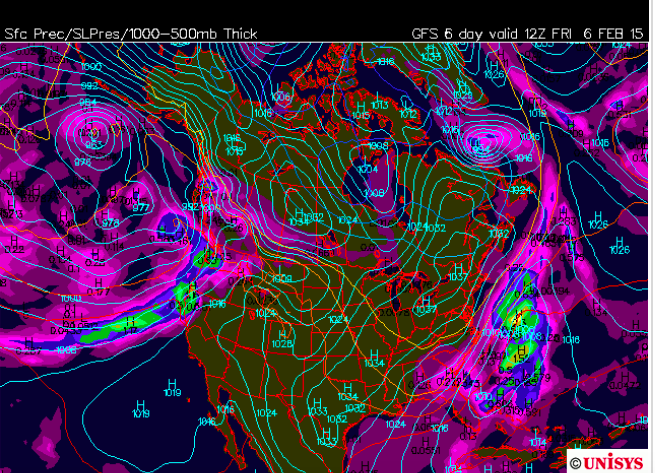
Below:  GFS Model showing precipitation (purple), heavier (blue and green) along with the 1000-500 mb thickness (one measurement of high and low pressure).  This is 6 days out, at 12 Z 6 February, or 4 a.m. Friday.  It shows that the Pacific Northwest is going to be wet, and northern California may get a strong shot of rain.  Notice the rain in the southeast and off the east coast.  The GFS has a panel of 10 days, with 1/2 day intervals.  The GFS has been showing this for several days, but the focus of the heavy rain has not been consistent.

Screen Shot 2015-01-31 at 8.04.52 PM

NOTICING THE WORLD

January 30, 2015

My wife read a CT Scan of the heart, done to look for coronary artery calcification, and told the referring physician the patient had breast cancer.

Whoa!  What does that have to do with heart disease?  The answer is nothing, and that is my point: we need radiologists to read films formally and not clinicians, and I say that as a former neurologist who read CT head scans well.  It’s fine for a medical group to own an X-Ray facility and for clinicians to read the images.  But every image must have a formal reading by a radiologist, an unbiased individual trained to look at everything on the image, every corner, every part.  There is no law in nature that says a person will have only one disease process.  It is entirely possible for a neurologist to look at an MRI of the spine and miss a large abdominal aortic aneurysm.  We see what we expect to see.  Seeing isn’t believing.  Believing is seeing.  We believe something, and we tend to look for it.  We also are pattern recognizers, often useful, but leads us astray so that some see Jesus on a pizza or the “The Face on Mars.”

A CT scan of the Chest has a side view.  This isn’t a mammogram, but it certainly is capable of showing a breast cancer.  In addition to the breast cancer, there was a “ground glass” area in the lung suggesting there might be an early lung cancer, too.  Wow.  A CT scan of the heart is done for coronary disease, and two primary cancers are discovered.  Maybe the cardiologist would have found those, but I doubt it.  I doubt when I read CT scans of the head that I would have found a throat cancer, even though the throat was scanned and on the film.

In my defense, an internist once sent me a patient with leg pain, concerned it was due to a pinched nerve in the back.  The lady had pain near the knee, but it was point tender, meaning that the problem was where I was touching.  I obtained a bone scan, looking for a fracture and found a hairline fracture of the proximal tibia.  I got a lot of pleasure diagnosing something correctly out of my field.  Most specialists do.

Years ago, I was asked by a cardiologist to see a man who had presented with a brief spell of unconsciousness, or syncope. Neurologists are frequently consulted for syncope which is usually due to a non-neurological problem.  The man had driven 1500 miles (2500 km) from Minnesota to Arizona. I saw him, noting he seemed to be breathing a little faster than normal. His neurological examination was normal. I obtained an arterial blood gas, since we didn’t have pulse oximetry back then, finding pronounced hypoxia.  Thinking a cardiac arrhythmia could cause unconsciousness (strokes seldom do), thinking a pulmonary embolus could cause both an arrhythmia and hypoxia, I obtained a lung scan, since that was once the “gold standard” test. The man indeed had pulmonary emboli, likely because of leg clots occurring during prolonged sitting on his long drive.

Several years later, one of that cardiologist’s partners referred a patient to me on whom he had diagnosed an occipital lobe infarct, producing only blindness to one side, not out of one eye.  For a neurologist, that is not difficult to diagnose, but many non-neurologists miss it.  I was impressed the cardiologist had found it.  I’m sure he got pleasure from diagnosing something outside of his field.

It seems trite to talk about the “good old days,” when they were not always so good.  We didn’t have the technology we have today.  On the other hand, I think our physical diagnosis—history and physical exam—was a lot better than today.  We didn’t have scribes writing down findings and ordering a plethora of tests, many of which require a lot of radiation.  More than once, my wife has told me of head CT scans or MRIs with a specific lesion.  When I asked her what the history was, she usually answered:  “It was part of a complete body work up.”

That approach makes modern medicine foreign to me.  I ordered tests I thought I needed, and if I weren’t clear in what order I should order them, I called the radiologist.  I always wrote much information about the patient on the requesting slip, back when we used paper and still knew how to write, because a radiologist could give me a better reading when they knew the area of the brain or spine in which I was interested.  When I could, and I usually made sure I could, I would look at the films with the radiologist, when we still had films, so I could see for myself and learn more about reading images.  It made the radiologist better and feel more useful; I believe it made me better.

So, when the MRI of my neck, done because of a concern about a pinched nerve in my neck, was unchanged from 9 years earlier, that was good news. I was chagrined, however, when the radiologist told me that I had a two thyroid nodules.  It never occurred to me look for thyroid disease on my neck MRI.  It is sort of like people’s being surprised when I tell them the Moon is visible in broad daylight.  “It is?” they say.

“It’s there, isn’t it?”  I reply.  The thyroid nodules were definitely there.  Once I looked, there they were, quite obvious, like the first quarter Moon in the southeastern sky in the afternoon.  Try finding the Moon in daylight, if you haven’t ever noticed it.  The Moon is above the horizon half the time, and other than 2 days on either side of new, it is visible, day or night. You will discover a whole new world—literally, and wonder why you never noticed it before.  That’s the problem.  We notice only what we are willing to notice.  If we learn to notice many things, it opens a door to a new world.

Sometimes, we notice a thyroid nodule.  Sometimes, we don’t.  I was lucky; the nodule was benign.  Had it not been, my thyroid cancer’s discovery would have been much later than it should have been.

Sometimes, life itself lasts longer when people notice things.