Archive for March, 2013

SAVING THE UGLIEST FISH IN AMERICA: THE PALLID STURGEON

March 31, 2013

The Pallid Sturgeon is a fish that lives in the Missouri and Mississippi Rivers, and which is on the endangered list.  Each year, many endangered species are further endangered by cuts in funding, because a country that went to war on borrowed money, with few who questioned going to war, now has to cut expenses to balance its budget.

A fish seems like a good place to start cutting money.  Or a bird.  Or a mammal, although our willingness to destroy other mammals of our own species hasn’t yet hit the chopping block.  Indeed, if we really want to balance our budget, so-called Defense should be first on the list.  But I digress.

The Pallid Sturgeon has been called the ugliest fish in America by some, so it might seem to be a good way to save money by cutting funding to preserve it.  After all, what use is a fish?  Oh sure, there are some anglers who enjoy catching something that can be 3-6 feet in length, weigh 85 pounds, and even provide caviar.  But a few anglers?  Not worth it.  Most of them who fish for the Pallid Sturgeon live in Red States, anyway, so politically this is a non-issue.

And the fish is ugly, at least compared to a Walleye.  But when I look into a mirror, I’m not looking so great some days, too, so I’m not about to pass judgment based on looks.

The Pallid Sturgeon is one of the leftovers from the Acipenseridae family and the Cretaceous period.  In 70 Million years, it has basically not changed, I have been told, making it a true living dinosaur.  It is endangered, because its habitat has been slowly destroyed by dams and pollution, and it spawns very seldom.

The question I ask is this:  “What is the Pallid Sturgeon worth?”

Each year, In Sioux Falls, a man who tries to recover this endangered fish; in other words, a man who thinks this fish has worth, has a visitor arrive from Washington, DC.  The visitor is an individual who comes from the center of government to the hinterlands of the US, where there are a lot of Republicans to be sure, but a lot of practical, commonsense people, too, people who have a multigenerational connection to the land and the life that land supports.  I don’t discuss politics with these folks, but when I discuss the land and wildlife with them there is a look on their face that I suspect is on my face, too.  I suspect the look is not on the face of the guy in the suit, when he arrives in South Dakota.

Each year, the man in charge of the Pallid Sturgeon project explains what he is doing in great detail, being sure to explain the dollars and cents involved in the recovery, so the dollars and cents guy can understand.  Mind you, this is not answering the question I raised above, for the word I chose was “worth,” not “cost”.  There is a difference, although to many, including the guy wearing the suit, the difference escapes him.  That is unfortunate, but he fortunately will learn the difference during his stay in the Dakotas.

At the end of the briefing, the biologist takes the Washington guy back to a large pool, and invites him to put hip waders on over his suit and step into the pool with him.  That to me would be worth seeing.  I would even pay to see that. Notice again how I use the two words.  The suit guy is a little surprised but does what he is asked to–he is used to that, after all–and soon, two of them are in the pool.  The biologist takes a net and scoops out one of the young sturgeon, and asks the man in the suit whether he would like to hold it.  Surprised, the man in the suit agrees, and he is soon holding a young fish in his hands, a fish without a lot of color, for that is what “Pallid” means.  While the fish is young, in terms of evolution, it is old, the same fish taking two opposite predicative adjectives.  It is somewhat ironic to me that while those who sent this man don’t believe in evolution, they would have to say that God created this fish in order to be consistent with their beliefs.  I believe something created this fish–I just call it The Creator–to be consistent with my beliefs.

The look on the face of the man holding the fish is priceless, from what I have been told.  His eyes open wide, as he realizes he is holding something special, something rare, something whose close relatives swam the waters of the Earth when dinosaurs roamed the land.  I’m about ready now to pay for the flight to Sioux Falls to just look at the fish, for the cost would be worth it, to juxtapose these two words.

“Funny thing,” the biologist has said.  “Every year, I get funding.  And the next year, they send a different guy.  And the same thing happens.”  The funding continues, and the fish recovery effort survives–for another year.  We don’t even know if the effort will be successful.  If not, our species has managed to destroy something whose close relatives were here more than three million generations ago, except there haven’t been three million generations of humans.  This fish is a relic.

So, what is the Pallid Sturgeon worth?  To me, the discussion isn’t really about dollars and cents but about dollars and sense.  Common sense.  The sense of beauty.  The sense of being stewards of God’s–The Creator, Mother Earth, or whatever you wish to call it–creation.  The sense that we are part of a vast web of life that we do not understand completely, but upon which we are dependent.  This fish has incredible worth, and a country that allows it to go extinct to save a few bucks really has its priorities wrong.

I think we have a moral duty to try to save the Pallid Sturgeon, unless nature–not man–in its own way decides that it is time for it to disappear.  Just as I believe that some day we will disappear, too.

I wonder how much that would cost.  I know this: it would have worth as far as Nature is concerned.

THE BELL IS TOLLING

March 2, 2013

Each man’s death diminishes me, for I am involved in mankind. Therefore, send not to know for whom the bell tolls, it tolls for thee.” John Donne

The sign read, “It hurts to be hungry”, and it was carried by a man walking the “804,” part of the Oregon Coastal Trail system, north of Yachats.  With him were several others, including two women in long skirts, with backpacks, not looking at all like hikers.

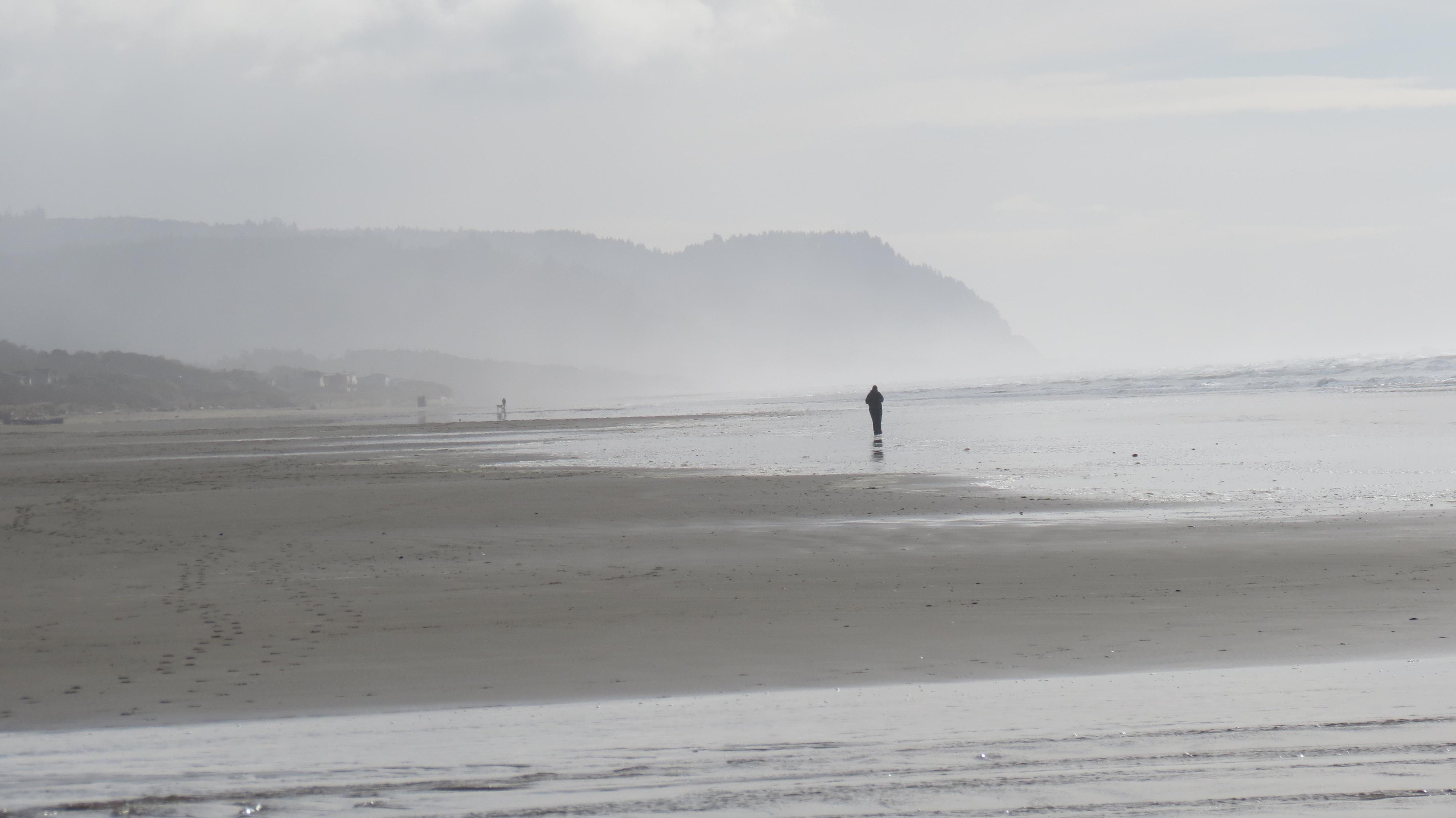
It was cold and windy on the Oregon Coast, as it usually is in February, and what was a pleasant walk along what I think is the most beautiful coast in the US was a difficult hike for these people, who were hungry.  They walked by the memorial to two young high school students from Eugene, who 2 years ago, almost to the day, were on the rocks in the ocean when a “sneaker wave” caught them, and threw them into the ocean.  With incredibly rough seas, slippery steep, sharp rocks, they could not be helped by their 4 companions.  In three minutes, they were dead.  I stared at the rocks for awhile, wondering how probably 4 minutes earlier, the boys had no clue that in 240 seconds, they would no longer exist.

We saw the hikers about 6 miles up the coast the next day, one of them hitchhiking from a bridge, the other two on the other side.  We figured they were hitchhiking one at a time, since their size and their equipment would have made it impossible to fit into most vehicles.  We were only going to Waldport, two miles further, where we walked the beach south a couple of miles.

When we left Waldport, the group was sitting on a bench near a fast food restaurant on the south side of town.  I don’t know where they were going.  I do suspect they were sleeping outdoors, maybe with a tent, probably not with one.  And they were eating, although probably not a great deal.  They did not look like hikers or even people trying to lose weight, which they needed to do, by hiking.  They looked like the homeless in America.  They looked like those who sleep in the parks in downtown Tucson, or those who sleep under bridges in Eugene, Oregon.  Many are homeless veterans, who served the country during the past decade in Iraq and Afghanistan while the 99.5% of us who didn’t were either protesting the war in vain or else assuaged our guilt with yellow ribbons.  Some of the yellow ribbons had a cross inside, which really galled me, as it invoked the idea of a Crusade.

Mind you, I have no love lost for how many Muslims treat women and Christians who live in their land.  Read Sabatina James, or go on her Website, and you hear horror stories of forced marriages, Todesstrafe, which is a death sentence on young women who become westernized, some converting to Christianity, rapes, beatings, acid thrown into the face, stabbings.  Most of this occurring in Europe is from Islamists, not Christians.  Europe has a problem with integration of these people into society, and I think eventually the problem will cross the ocean, and we will have it, too.

But right now we have homeless, hungry people in America, and they aren’t all drunks or lazy slobs.  Many lost their jobs when the rich folks on Wall Street wrecked the economy and got paid large bonuses for doing it.  Many lost their homes which they never should have had, but we don’t educate people very well in dealing with numbers, math, economic circumstances, debt or critical thinking.

Many are bankrupt because they didn’t have health insurance to cover major medical bills, the largest cause of bankruptcy, but we sure held the Democrats responsible for the Affordable Care Act, which turned the House over to the Republicans, who now are grappling with the Tea Party, which is a minority, but seems to think it is their right to obstruct any sort of laws they don’t like.  Were it the Democrats doing this, the Republicans would be howling.  Right now, the Republicans are trying to figure out how to deal with the likes of Rand Paul, who was about as rude as one can be to the Secretary of State, and then showed his ignorance by proffering a theory that there were arms shipments from Libya to Syria.  Ms. Clinton’s body language as well as her verbal language during that exchange defines the word “incredulous,” for those who want to brush up on their English.

The greatest country in the history of the world can’t deal with homelessness and hunger.  We have the means, we have people who can think, develop complex systems, and we have volunteers to do this.  We lack the will, and a few are hung up on the deficit, which Mr. Obama inherited from Mr. Bush, back when Mr. Cheney said “Deficits don’t matter,” which seems to have been conveniently forgotten,  A third of the deficit came from the wars that were off budget and unnecessary.  Probably another sixth, if not more, came from the loss of tax revenues from the crashed economy.  If the stock market plummets, capital gains taxes disappear; indeed, capital losses decrease taxes.  If interest rates fall to zero, one gets a lot fewer 1099 forms in the mail, because there are none for interest payments of fewer than $10 in a year.  Last I checked, the economy crashed mostly before 20 January 2009.  If the sequester continues, we may see it crash again.

Instead of dealing with hunger in the US, we spend time still investigating Benghazi, even though we never did anything to Condoleeza Rice, who ignored the famous 6 August 2001 memo about imminent attacks in the US.  We ignore what is going on in Egypt, Mali, Nigeria, Saudi Arabia, all time bombs ready to explode.  Many Americans couldn’t find any of these countries on a map.  We don’t take a stand on what is happening to women in Muslim countries, which is absolutely appalling.

I’m guilty, too.  I rationalize my way out of it and write stuff that few read and changes nothing.   I rationalize by saying “I can’t fix this problem,”  “I can’t save the world,” or I turn my head, when somebody wants money by saying “I’ll wash your car’s windshield,” which happened the other day in Eugene.  But the next time I’m in Market of Choice, I will buy a $10 coupon that goes to stop hunger in Lane County.  And maybe I will do that every time I am in there.  Darned if I know how I will deal with the homeless; mostly, I am more concerned about homeless animals, since not one of them had any say whatsoever in their plight.  And I have done something about that problem.

But I am human, and I remember what John Donne wrote.  Much as I despise much of what my species does, there is a certain poignancy about seeing a sign that says “It really hurts to be hungry,” not far from a 5 star hotel on the Oregon Coast.  I can rationalize all I want, but the sign and the people existed.  Time for me to stop writing and stop rationalizing.  I’m not sure what I will do, but it is time to do something.

I’m hungry for change.  These people need change to deal with their hunger, not money change, but a country change.

Near where the boys drowned, 2011.

Near where the boys drowned, 2011.

Waldport, Oregon

Waldport, Oregon