Archive for July, 2014

TIME TO TEACH ABOUT MONEY

July 28, 2014

I saw a Dave Ramsey quotation: “Identify your motivation and your passion.  Find what you’re good at and become world-class in that area.”

The term “world class” is overused, and I think harmful, making average people like me feel they are failures.  Indeed, most of us are average.  World class should apply to Olympians, bicycle riders in Le Tour de France, Nobel laureates, best seller writers, and those young people who competed at the IAAF Track Meet I saw today, a few young people who truly are at the top of what they do.

Mr. Ramsey would have done well to have removed the words and replaced them with something like “the best you can possibly be”.  That is achievable.  World class is not.  In standardized math tests when I was young, I was at the 99th percentile.  That is fine, except that if there were 10 million students, 100,000 of them were as good or better than I, making me hardly world class.

Where Mr. Ramsey does help is with people who hate their jobs and are poor.  Suze Orman does the same thing.  Both are good; both are rich; both are famous and charismatic.  It would be nice to be charismatic, but one has to have the wiring.  It isn’t in me.  What I am wired for, however, is math, and I am very opinionated about what we ought to be doing about it.

Key issues today are student loans, houses underwater, insufficient retirement savings, and too many having to live on Social Security, which it was never intended to do.  A frightening number of people go bankrupt each year, because we have a subpar health insurance and medical care system in this country.  Very few hospitals are “world class,” and saying “Centers of Excellence” does not bring it.  Having been on the medical quality front lines, I think I have a notion of what world class might mean, and we are a long, long way from there at the moment.  But we can address the financial issues that people face.

We ought to be starting early, in the schools.  That won’t cure the problem, but in a generation or two, it would help a lot.  Dealing with finances means dealing with ….uh oh…..numbers and math.  Yes.  If one cannot understand numbers and math, basic math, there is no way one can understand finance.  This means that students must be held back from moving to the next grade until they understand the math necessary for the current grade level.  If that means that we slow down education to a crawl, and people howl, then let it be so.  Let’s do it right, learning one basic lesson of math right away:  if you grade children and adults on certain measures, there will be attempts to game the system and make the person or school look good.  This happened in Atlanta.  If 80% of the students coming to a local community college, which happened in Tucson, have to take remedial math, what exactly were we—and they and their parents— doing for the prior 12 years?

It is time to be honest with math (and other subjects, too).  If students can’t pass basic arithmetic, let’s figure out how to get them to learn enough to pass, not game the system, from the teacher’s side and not play “how clever can I be?” from the tester’s side.  Certainly, we ought to have enough smart people in academics who know what should be mastered at each grade level.  Students are going to need algebra and geometry, too, but basic arithmetic is absolutely fundamental to understanding algebra, and math builds on itself.  Fail at the bottom, and there is no way anybody is going to suddenly jump to the top.  Other subjects build, too, but few as strongly as does math.

What good does it talk about an emergency fund of $1000, if the concept of a thousand is not understood?  Indeed, one of the big problems we face in this country is that few in Congress can comprehend what a billion or trillion is.  Comprehension of these numbers is not easy, but it is both essential to know and may be learned.

Students need to learn about interest, where the formulas come from, then simple rules for remembering them.  Trust me, one will use it.  They need to learn the difference between “the rate of increase” is slowing and “it is decreasing”.  These two are not understood by the majority of students I have taught.  They need to know the difference between an average and a median. They MUST be able to work with multiplication tables automatically.  This cannot be given over to a calculator or be googled.  One has to memorize it.  Learn something well, and it is no longer memorized.  It becomes innate.

I don’t have the answers to learning math.  I do know, however, one place where math would become interesting to students and worthwhile: dealing with finance.  Everybody wants money.  Everybody wants things.  Dealing with money requires dealing with numbers.  Frankly, if we could teach children enough math so that they could deal with basic finance, we’d be way ahead of the concepts we think we should be teaching them.  I could live without teaching many kids algebra if they knew enough division that they knew that 24% interest rates on credit cards led to doubling of debt in 3 years.   If they could multiply by 52, they could figure out how much money they spend annually by eating out once a week.  If they could multiply by $2000, they would know what dollars per hour wages equalled in a year.

This isn’t and should not be America’s goal for teaching math in the 21st century.  We have to go far beyond what I have stated.  But if the millions of kids who can’t make change, can’t comparison shop, don’t know what a mortgage is, or understand the basics of investment can learn to deal with these matters, even on a rudimentary level, we would be a lot better off than we are today.  I would rather see an improvement for millions than wait for perfection that will never come.  No, Mr. Ramsey, these millions aren’t anywhere near world class.  They just need to pass the class of basic material THAT EVERY CITIZEN SHOULD KNOW.

Want kids to understand math?  They need to work with, and understand, numbers.  To me, the best place to start is with finance.

SADLY, FACEBOOK IS NOT FACE-TO-FACE

July 21, 2014

I read a post in Facebook saying that doctors hid cures in order to make money.  I posted back:  “How dare you!!  I practiced for 20 years and wanted nothing more than to see a cure for the stream of patients with headaches, backaches, limb pain, dizziness, Workmen’s Compensation cases and depression (back when depression, a treatable disease, was not a mainstream diagnosis, and people equated the disorder with being crazy).  I actively de-marketed my practice.  Yes, I wanted to see fewer patients.”

Then, I deleted the post.

The two best things I’ve done on Facebook are:

1.  Been silent.

2.  Deleted a post shortly after I wrote it.

Over time, I have seen people disappear from Facebook for a month or so, a so-called “digital vacation”.  The idea is tempting, and with a trip to Alaska coming in the near future, I may just add a couple of weeks to my disappearance.

Facebook has been helpful in that it has allowed me to know about the few family members I have left.  I know about my nieces, whom I would otherwise not, and I connected with a camp where I guided canoe trips in 1967.  The late Steve Pawlowski, whom I unfortunately never met in person, was part of the Arizona Water Sentinels; his posts about the drought in the West and climate in general were excellent.

Unfortunately, there is a great deal of other stuff I have seen on Facebook which doesn’t sit well with me.  I’m sure some of my posts don’t sit well with others.  Research has shown that looking for certain posts can be beneficial, but “Facebook surfing” is correlated with depression. That is my impression.

Each of us approaches Facebook differently.  The attitudes of others aren’t necessarily wrong; however, they are not likely to be consonant with mine. I don’t, for example, agree with all the “fluff” sayings I see, like if one just tries hard enough, one can succeed at anything.  Indeed, I find that cruel, for it implies that if one fails, he just didn’t try hard enough.  It ignores the possibility that maybe one was not suited for the task, did not have the physical or mental ability, or could not devote his entire life to the task.  For me, wisdom is knowing when to quit, to give up, to stop.  Some disagree.  Having failed to change medicine after five years didn’t make me want to continue a sixth.  I found that a wise decision.

The lack of face-to-face interaction, ironic for the name “Facebook,” allows people to easily insult others, the young to insult the old, which I find rude, and to post comments I find reprehensible, racist, in bad taste, ignorant, and poorly written.  People don’t ask themselves, “Do I really want to say that in public?”   Face-to-face, many of these posts would not be said.  De facto anonymity is on Facebook; a third of my “friends” I have never and will never see; most of the others I will not see in the next year.

The worst posts, the most depressing, have been clips from right-wing news sources.  It took me too long to figure out that I could selectively block these sites and still see other posts from the rational side of the poster.  Facebook for many is an outlet for spiteful comments directed towards people who view the world the way I do:  I see posts on politics that may or may not be true, comments written by Americans who are either ignorant of the English language or don’t proofread what they write.  If something bad happens, it is my fault, or “the government’s fault” (the Democratic Party part, that is), showing lack of awareness that we are the government; any of us can run for office to fix things.  People I have never heard of and never will meet say astoundingly horrible things.  An American Mormon posted, “we ought to nuke all of Mexico.”  Wow, that is really godly behavior.  On a language web site, an Algerian saw my profile and told me it was a shame that as a non-Muslim, I would be going to hell.  Both would have done well to be silent.  I was.

Two young women, each a third my age, who insulted me got no rejoinder, only permanent silence.  Defriending is too strong and noticeable.  Silence is…..silence.

Many of these posts and comments deserve to be called out on their nastiness, spite, vitriol, and outright falsehood or looseness with the truth. But what’s the point?  Those who post these “news” items will not be influenced by anything I write.  They see their posts as truth, espousing simple solutions to complex problems, getting many “likes” from similar-minded people.

I am at a disadvantage in answering, because I process slowly, writing better when I have time to think about what I say, before I allow others to read it.  Many would do well to follow my example.  There is no sense becoming embroiled in a climate change debate with one who believes that everything is fine, that it is a plot by environmentalists, uses poor or no statistical evidence, and makes no predictions as to what will happen in the near future.  I won’t influence them.  I am capable of being influenced, but not by unscientific, hateful comments.

The best comments are short; long missives aren’t going to be read, any more than a bumper sticker on a car that tries to say too much will be.

Shortness works on Facebook.  Humor works.  Well written comments work.  Silence works really well.  I’ll make my posts here, because I have as much time as I need to try to say what I want.  Even then, I won’t always get it right.


NOT WHAT WE WANT TO HEAR

July 14, 2014

Years ago, soon after I began practicing, a colleague brought his wife to see me.  After a workup, I diagnosed her with probable MS.  About a month later, the colleague somewhat gleefully called, telling me he had his wife seen at University Hospital by an expert, who felt she did not have MS.  I don’t remember my reply.  I probably was quiet, concerned I had erred.

At a medical meeting dinner, years later, this same colleague was seated at the same table as I, and he told someone aloud about his wife’s treatment at UCLA for “MS.”  I stayed quiet; he didn’t show any sign of having made a faux pas. I was wise enough not to remind him. Being right doesn’t require one to say it.  My mistake that first day?  I told both of them what I thought was wrong, not what they wanted to hear.

Ted Cruz said the President was acting outside the law on immigration, when in fact Mr. Obama’s actions are in accordance with a 2008 law, signed by Mr. Bush, requiring deportations from countries other than Canada and Mexico to be processed here.  The Central American refugees came through not only a hole in the border but a hole in a law Mr. Cruz and his colleagues are in charge of making.  Mr. Boehner won’t move any law on immigration through this year.  He has the power to do something great, but he won’t.

DML News tells listeners what they want to hear: “we’re screwed,” bad immigration stories, things wrong in Washington, nuclear material missing, how Obama is destroying the country and wasn’t born here (which has become really tiresome), Benghazi an impeachable offense, and we should take action in Iraq.  The big problem in Iraq didn’t happen this year; it happened when we invaded it.  Remember Colin Powell’s “Pottery Barn” comment?  Remember the horrible year, 2006?  No, that is ancient history, and people don’t like to hear about inconvenient history.

Mr. Obama inherited two wars, an economy in shambles, a banking system almost shut down, an incipient depression, a horrible deficit (the war funding was kept off budget) and a divided Congress.  If one doesn’t want to hear that, I’m telling it anyway, because I tell people what I think, if it is truthful.  Surprise:  Obama hasn’t fixed everything yet.   Surprise:  He has had nearly zero Republican support.  If Ted Cruz or Rick Perry becomes President, by golly, we will have everything fixed and right with America in 100 days, max.

To those who believe that, please comment in detail exactly what needs to be done, and send to me, because I‘m curious.  Please address the following: how we will balance the budget, give every American health insurance, deal with immigration, the EU, Iraq, Iran, Palestine, North Korea, Russia, China, fix infrastructure, schools, and climate. I want details.  Please, tell me how we should deal with California’s water crisis using knowledge of what an acre foot is.  In this blog, I have addressed the budget, Iraq, schools, climate, and California’s water crisis.  It isn’t what a lot of people want to hear.  I may be wrong, but I used facts and offered detailed suggestions.  An acre foot is about 325 K gallons of water, by the way.

People don’t want to hear about climate change, because it bothers them.  People want politicians to tell the truth, until they do, and then vote for the opponent, because the truth is so unappealing.  The world is not simply a matter of US troops fixing what is wrong.  Superheroes don’t exist.  We cut FEMA to save money but then complained when government wasn’t immediately present after Katrina.  Remember Katrina?   Remember Sandy?  Who was president during each, how was the response and in what year did each occur?  If you are an American and can’t answer at least 7 of those 8 questions, shame.

Tell me how we fix unfairness that gives the Deep South more government money than they send, yet has taken a trillion dollars from New York State in the last 20 years.  Yes.  Look it up.  Incredibly, the South gets money from big government, hates same, and many of its states rank 45th or below in major health care indicators compared to the rest of the country.  What gives?

We live in a complex world, unable to be simplified in 30 seconds.  Immigration is no exception. I think overpopulation is the most significant issue we face, along with consequential environmental degradation and climate change.  In my lifetime, not likely to be more than a decade or two, I will survive. People, like Ted Cruz, in their 40s, are going to reap the wind they have helped sow.

I am a strong believer in public education, not only because people with education get good jobs, they have fewer children.  Complex problems are not addressed with simple answers: it is easy for Mssrs. Flake and Cruz, who don’t have to run the country, tell people what they want to hear.  Like my doctor colleague, they blast guys like me who conclude something else.  You are wrong, they say, and yes, I might be, words not one of them has used.  I have been right on evolution, climate change, the stock market bubble and Iraq, not because I am particularly brilliant, but because my education taught me to think about issues, open my mind, look at all sides, and draw conclusions, which subsequently I may change.  

We need good ideas about immigration; we need skilled workers who are legally here.  The 2008 law needs to be changed, and Mr. Cruz should be leading, not using his charisma and debating ability to tell people what they want to hear.  We must deal with illegal immigration, not win a debate, and there is no perfect solution.  Nobody wants to hear that.  Nobody is even saying it.

Nobody can balance the budget or pay for everything we want without raising taxes.  This is a mathematical truism.  Instead, politicians tell us what we want to hear:  “I will protect America’s elderly and borders, we will have a strong military, and I will do it without raising taxes.”  If we believe that, we are either downright stupid or believe in magical thinking.

I was sorry the woman had MS.  I was sorry for all the families to whom I told a loved one was either brain dead or irreversibly brain injured.  I am sorry for the people whom I told had metastatic cancer to the brain or carcinomatous meningitis.  I told the truth.  Many of my colleagues disliked me, for I said things that people didn’t want to hear.  Many referred patients elsewhere, not to me.

What interested me was that a dozen of these physicians—I counted— brought themselves or their family members to me, even though they sent neurological consults to the other guy.


OBSIDIAN LOOP 3 JULY 2014

July 8, 2014

I’m now out alone in a huge expanse of snow, cliffs to my south and east, South Sister towering 1500 meters, about a mile, above me, and only my tracks behind me to tell where I had been.  I had turned around about 50 yards ahead, stood there, wondering.  “Do I go back?  Or do I go on, and see what happens.”

“Obsidian Trail Loop, July 4” was posted on the Obsidians Web Site.  That was what I had been looking for, but there was a waiting list, since I was the 16th to sign up, and only 12 could go.  Since the hike was scheduled for the fourth, I figured I could go the third.  A club member was going with me, but when she called the Ranger’s Office, were told there was “serious snow” 3 miles in and there were so many mosquitoes, they would chase a person back to the car.  I was on my own, updates were 1-2 weeks old, which in the high country, are ancient history.  Snow accumulates and disappears quickly at 6000 feet in the Cascades.

I decided to do the hike, realizing that if I couldn’t do the 4 mile loop (with an additional 4 miles in and out) gaining 1800 feet, there were other places I could go to hike.  As I left Eugene, bound for the high country, a dark wall of clouds and fog were ahead of me, about where I would be.  This did not bode well.  I kept going, turned on Highway 242, soon was past 2000 feet.  There was fog above me, and I figured by 3000 feet I would be in it.

Fog below in the McKenzie Valley.

Fog below in the McKenzie Valley.


The road narrowed and climbed, and suddenly I was in sunlight.  So much for the fog, which now lay below me in the valley.  I got to the road in to the trailhead, which two weeks earlier had a 3 foot high snowdrift blocking it.  The snow was not only gone but the road dry.  I parked the car, shouldered my pack, and turned on my GPS.

I am new to GPS.  I have had one 20 years for marking points, but I never used one with a trail marker before, and I had loaded mine with high definition topographical maps of Oregon and Washington.  Those came on a mini-SD disk, a few mm on a side.  I can’t believe how much memory we can put on small objects.

I had on gaiters to keep water and snow out of my boots, so long as I was in fewer than 18 inches.  I had a light shirt on, because I was climbing and knew I was going to be warm.  I had my day pack on with my nine essentials, a whistle still missing, and a few other things added.  On a warm day, most people don’t think a jacket is needed; should one get lost and have to spend a night out, having an extra waterproof layer is essential.  That has never happened to me, but it can.  It is insurance, and the premium is carrying it with me.  The first 2 miles were a gentle climb on a dry trail.  The third mile had a large series of snowdrifts, upon which I was able to walk on top.  No problem, and I reached the lava flow area.


Life grows in some of the most inhospitable places.

Life grows in some of the most inhospitable places.


First view of South Sister from lava field.

First view of South Sister from lava field.


After I got the above view, serious snow was on the trail, and I realized there was no more trail for me to see.  The Forest Service had placed orange ribbons on the trees, so from one tree, it was possible to see the next.  And this navigation got me uphill to about 6200 feet, 600 feet below where I would top out.


Orange ribbons to navigate by.

Orange ribbons to navigate by.


Open snow field

Open snow field


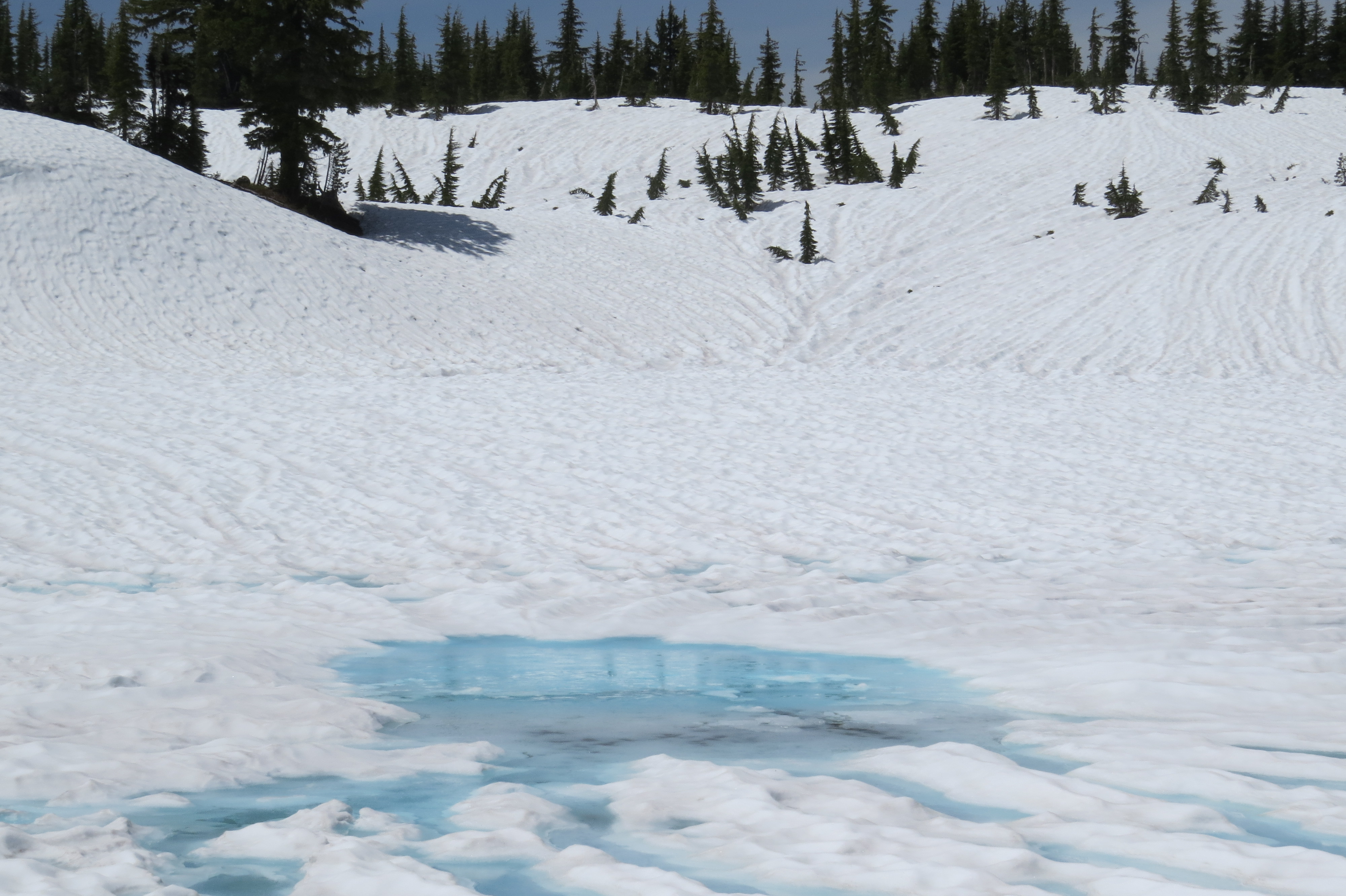
One man had come down the trail recently, and I followed his prints back up a steep hill,  switchbacking in snow, so that I could work less hard. This was not going to be easy.  It already hadn’t been, and if my Achilles Tendon still bothered me, I would have stopped.  But I felt fine.  I crossed a ridge and saw a gorgeous blue lake that was starting to melt.

Lake beginning to appear.

Lake beginning to appear.

I bypassed the lake and realized that my sense of direction was different from the GPS.  I was supposed to be on the “open” Pacific Crest Trail, but what looked like a trail was a creek with a lot of snow on it.  I started navigating on GPS, because now there were no footprints to follow, except those I had made leading back.  I was in a beautiful blinding white bowl of snow, somewhere in the middle of the Obsidian Loop.  I stopped by a tree which had no snow under it, heard a waterfall, and looked down at obsidian at my feet, beautiful black volcanic rock, that touched no water as it ascended to the Earth’s surface.  I picked up a piece and then dropped it,   leaving it where I found it, which is required in the wilderness.  The Trail here has a permit system, because there is so much use.  If each person takes one stone, in a few years, there will be fewer left.  Below me was Obsidian Falls, and I then realized my sense of direction had me on the wrong side.

Obsidian Falls

Obsidian Falls


Obsidian

Obsidian, lava that reaches the surface without touching water.

For the remainder of the loop, I seldom saw a trail, but the route tracker had me going by the trail, or at least near it.  Occasionally, I went into the woods, but the direction arrow had me clearly going the wrong way, and I had at one point to climb a rocky area to get back near the trail.  When I got near the end of the loop,I saw the trail about 50 feet below me, so I could slide down the now softer snow to reach it.  I knew from the stored track that I was close to where I had started the loop, and if necessary, I could walk over to my track.  But I continued, reaching the trail junction, not quite where the GPS said it would be, but close enough.  GPS accuracy is somewhere between 4 and 10 meters, depending upon satellite reception.  I then retraced my now familiar route back to the car.

Back in the lava field.

Back in the lava field.


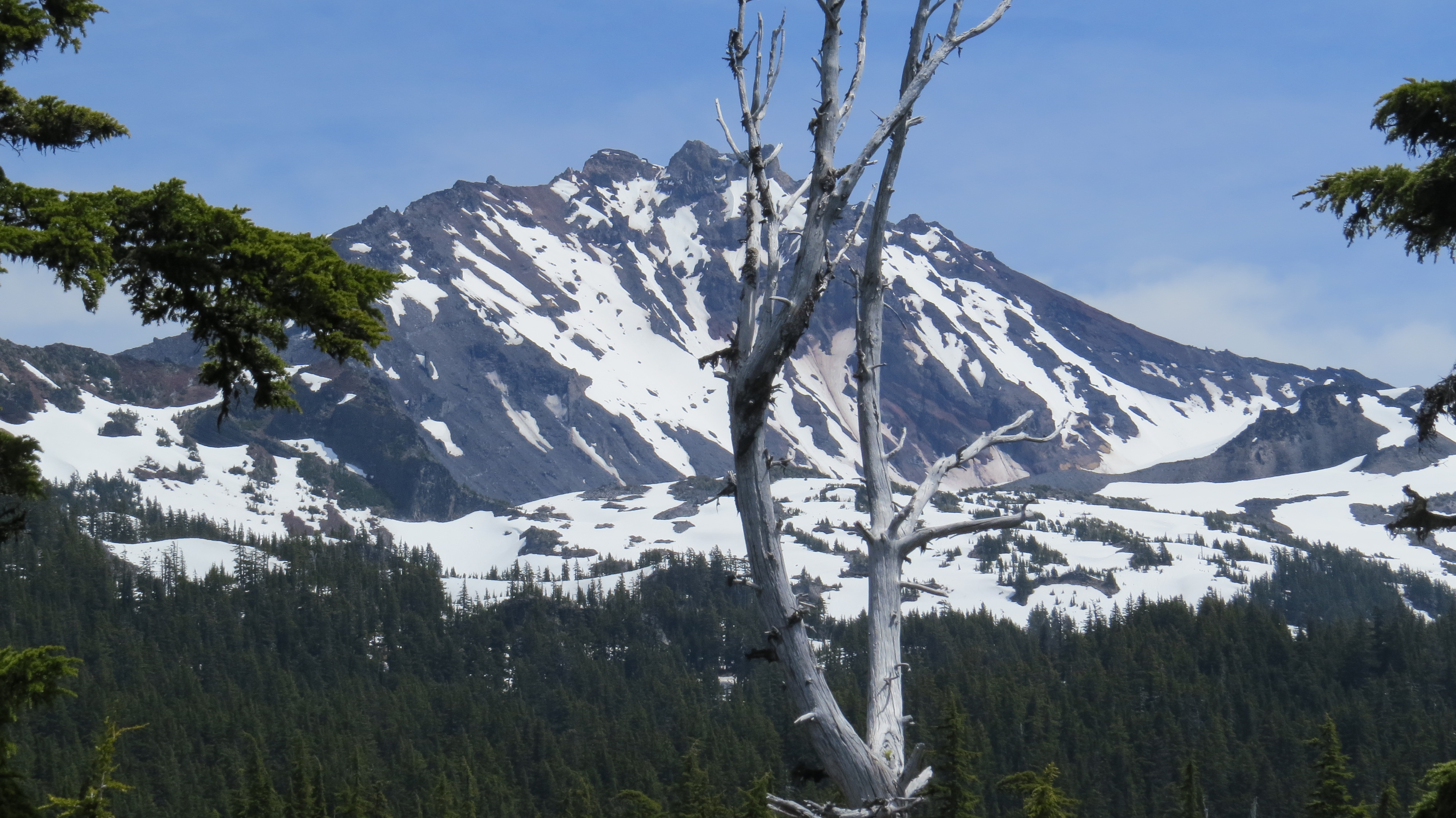
A Sister.

A Sister.

I had wanted to see the loop, but I saw it without the summer wildflowers.  On the other hand, I saw the loop in a way few do—in snow, alone, and having to work much harder than expected.  I also learned how to trust my GPS, and I learned again other ways to navigate, should they be available.  What was perhaps the most important thing I learned was again not to “trust” my sense of direction.  It isn’t bad, but it can be very flawed, be it on the Appalachian Trail, the Canoe Country, or in the Oregon Cascades.  Using the Sun, when available, is helpful.  A compass is better.  A map is even better.  Knowing when to quit is important, and periodically asking oneself:  “Do I know exactly where I am?”  is essential.


PULLING UP THE FOOTBALL

July 4, 2014

In the famous Peanuts cartoon, Charlie Brown is running to kick the football, when Lucy pulls it up, and Charlie kicks at air, falling down.  Every time, he thinks the result will be different, and every time, he is wrong.  That is the famous definition of insanity.

So maybe I am insane.  I’m getting better, but it has taken me a long, long time to do so, because I still kick at air.

Last summer, I got a call from a younger alumnus from a canoe tripping camp that I attended in the ‘60s, both of us going to the camp’s reunion in August.  There was a special request to create a special endowment for this centennial year, and I planned to give.  I thought that was obvious, since I give financial support to young people who cannot afford the camp’s fees.

Yes, fifty years ago, I was in a select group of canoe trippers that canoed Temagami Provincial Park in northern Ontario.  It was a difficult trip; I still remember my knees hurting from kneeling in the bow in 2-3 foot waves.  We were never allowed to sit in the bow seat.  We knelt. In the stern, the staff man sat. To this day, if I am in the bow of a canoe, I kneel.  Every day on that trip it rained, but it was a good trip. We saw remote country, and while I never will see Temagami again, the memories of places called Lady Evelyn, Ostergut, Makobe, and Fat Man’s Misery Portage are part of me.  I have trod that country.

The caller was interested in my subsequent canoeing experience, and I gave him a brief rundown of my outdoor water resume:  the Nahanni, the upper Yukon Basin from Lake Bennett to Carmacks, the Alatna and Noatak Rivers in Alaska, and 32 years canoeing the Boundary Waters-Quetico.  I have been blessed.  The caller had canoed Labrador, which I thought cool, but he especially wanted to see my Nahanni pictures, a trip he had always wanted to do.

Yep, sooner or later, it came to money, and I told him I would contribute, as I had planned to.  The conversation ended soon afterwards, and I felt a little used, but hey, maybe he was busy, and we would learn at the reunion about each other’s trips.  Maybe. These things almost never pan out:  the call was about money, interspersed with feigned interest of what I had done.  People seldom call me curious about what I’ve done.  The calls are usually about money or medical advice.

I arrived a day early for the reunion in late August, back on a lake where I spent 6 summers, and I got to see the island, 46 years later, with relatively few people present.  The next day, the rest arrived; I was present at the dock where they came in.  I heard the name called of the individual who had phoned me, and I went over to introduce myself. He greeted me semi-warmly then saw somebody else he knew and disappeared.  For good.

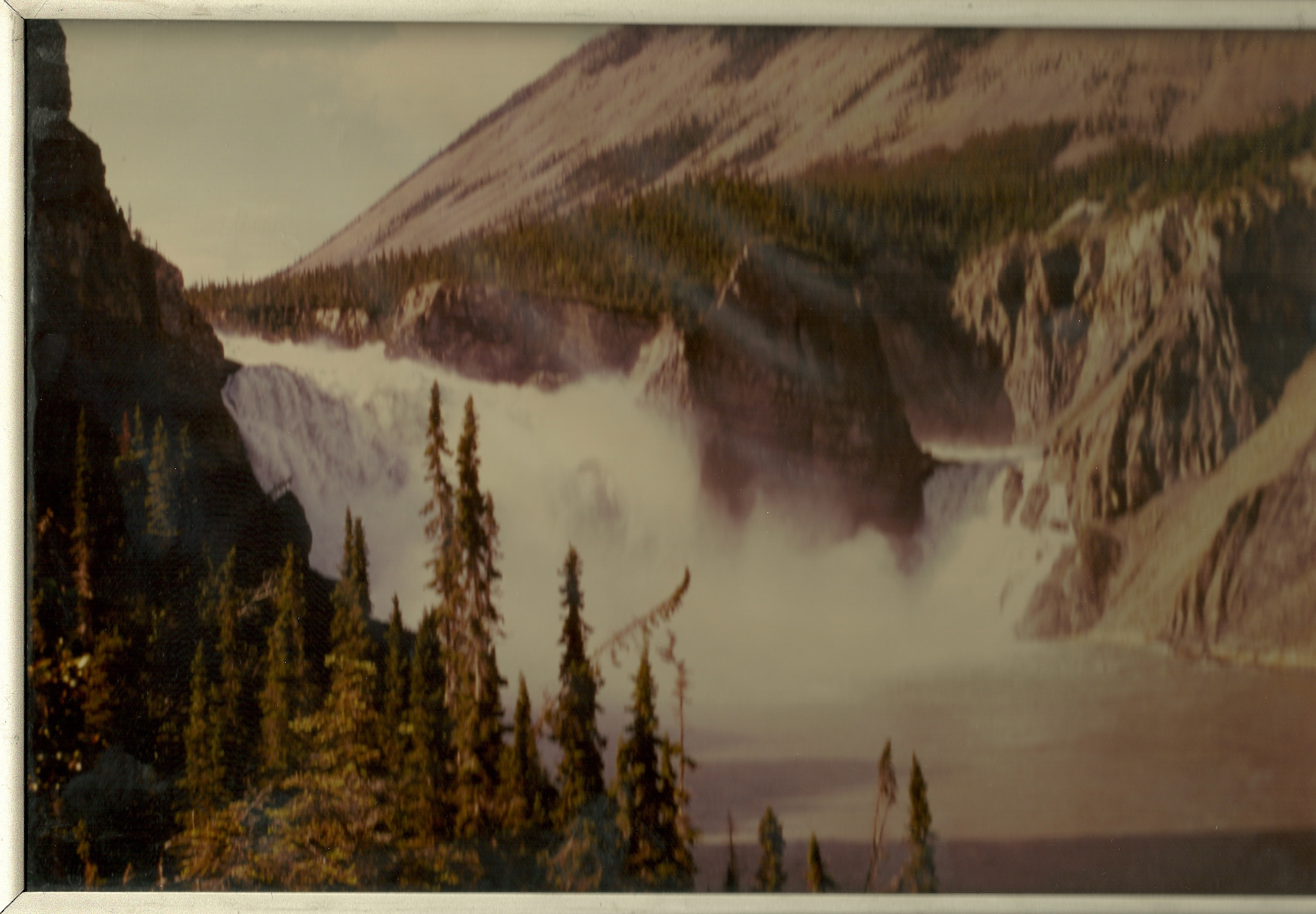
The football had been pulled up.  I had the Nahanni slides with me, for we took slides in 1985.  I had lost the roll of film, wrote Parks Canada, saying it might be in the campground at Fort Simpson, where we had stayed on our last night.  Incredibly, six weeks later, the roll was sent to me.  Canadians do those sorts of things.  I had pictures of a remarkable area very few people will ever see.  After arriving at Fort Simpson, we flew to the Nahanni in a Twin Otter with 6 people and 3 canoes, landing on a sandbar.  The Nahanni was a difficult trip through Class III rapids, the worst mosquitoes I have ever seen—and I have seen more than most— but I saw the highest waterfall, Virginia Falls, in North America.  I paddled through four canyons almost as deep as the Grand Canyon itself, sat in some natural hot springs, came out on the Liard River and saw the great Mackenzie.  The Nahanni was pure wilderness.  It is the crown jewel of my outdoor water resume.


Virginia Falls, South Nahanni River, NWT, July, 1985.

Virginia Falls, South Nahanni River, NWT, July, 1985.


I should have known better than to bring the slides.  Getting money from me was the issue, not what I did or who I was.  I’ve felt that way a lot, these past 16 years, after I left medicine.  I give on my own terms to those I wish.  I do what I can, hope to make a difference, and wish some day one of my ideas will be accepted, improved, and have a significant impact.  I had many such ideas in medicine.  My wish to be a busier volunteer in the public schools has yet to be granted.  We ought to have paid universal mandatory national service, which would give young people a sense of purpose and direction, lessening the likelihood of student debt catastrophes.  We ought to be saving water every way possible.  We should ban companion animal breeding.  I have written about all of these in this blog.

We should have had incremental single payer medical care, starting with the very young.  This would have been easier, cheaper, and less likely to have been voted against.  We should have tracked a whole host of quality issues in medicine.  We need free, unbiased, end-of-life counseling to elderly people to help them understand what “all those tubes” mean, and what their options are.  By ignoring the elderly, we ignore elders, wasting resources I can’t begin to fathom.  In short, we need incremental changes, keeping both the enemies of change and the perfectionists at bay.

I wish I hadn’t brought the pictures of the Nahanni back up to the country where they were taken.  I knew he would not be interested, but I persevered, hoping, like Charlie Brown, it would matter. People are busy, too busy for guys like me.  I tried to travel light, and those pictures and his call were excess baggage.

But I was lucky.  I have seen the Nahanni, drunk the water, know what’s out there. There is no blank spot on my map.  While it’s on my resume, far more importantly, it is in my brain.  I can call it up any time I want:  the magnificent falls, Fourth through First Canyons, Pulpit Rock, and the Gate. Wow. I was there!  I got back up to the camp one last time, and I don’t ever need to go again.  I have taken my last look.  Yeah, the football was pulled up, but I had a soft landing.

It was his loss, not mine.  That line is in Peanuts, too.