Archive for March, 2016

GREAT EXPECTATIONS

March 23, 2016

It all started with a packaging error on some soy burgers I bought.  At home, I discovered a slit in the bottom of two that I didn’t see when I bought them.  Who knows how long the contents had been exposed to air?  How often do you check the packaging when you buy something?  For me, not often enough.

I returned to the store and told the manager, who was shocked.  I said I was going to look at the other packages they had to see if they, too, were defective.  When I checked the box that had the identical soy, sure enough, the two remaining packages in it had rips.  I took them back to the manager’s counter.

I had to wait, however, as I watched a woman with bleached blonde hair, maybe mid 40s, and a young man, who might well have been her son, discuss lottery tickets.

“We can’t afford too many,” she said.  “We need $20 for xxxx.”  I couldn’t hear what “xxxx” was.

I was stunned, as I watched them purchase six lottery tickets, some sort of scratch type, for $60, which the woman counted out using twenties, fives and ones.  It might have been a Raffle. You can’t win if you don’t play, right?  That was the catch phrase in Arizona.  You can’t lose if you don’t play would have been more accurate, and I can prove it.

Let us look at the expected value, which anybody playing the lottery should understand.  We ought to teach this in schools. If the expected value of something done is positive, over the long run it will be successful; if negative, over the long run, it will not be.

Here’s an example.  At a roulette table, you plunk down $1 on a roll of two dice.  If they come up double 3s, you get a 30-fold return—$30.  Well, it isn’t 30 fold, because you paid $1 to begin with.  It is 29-fold.  Don’t laugh, casinos get rich on these “minor points.”  You have a 1 in 36 probability that the dice will both be 3: 1 in 6 for each, and we multiply the probabilities when one doesn’t affect the other, a term called  independence. The probability of winning $30 is (1/36), and the probability of losing $1 is (35/36).  If you multiply these and then add, you get +$(30/36)-$(35/36)=$(-5/36).  That fraction comes out to about MINUS 14 cents per dollar bet.  Are there winners?  Yes.  The consistent winner is the casino.  Not only is it consistent, they can predict very accurately how much they will make, because in the long run (not a player’s time horizon), the casino will make 14 cents on each dollar wagered for that bet.

What I saw for a $10 Raffle ticket:

1 in 250 chance of winning $100

1 in 25,000 chance of winning $20,000

1 in 250,000 chance of winning $1,000,000

The exact calculations are more complicated, but the simple way works just fine.

You spend $10, and you have a 1/250 chance to win $100, an expected value of $100/250 or $0.40, 40 cents.  You also have a 1/25,000 probability of winning $20,000, and that is $0.80, so the expected return of both is $1.20. Add to that the 1 in 250,000 chance of winning $1 million, $1,000,000/250,000=$4.  The total expected return on $10 spent is $5.20, give or take.  That’s the plus.  The minus is $10(249/250)=$9.96.  The expected value is $5.20-$9.96=  MINUS $4.76.  The pair spent $60. If we looked at a lot of people buying, all of them, they would on average lose about $28.50.  One of those $20s that one comes in to the store with, and nearly a ten spot as well, won’t be seen again.  Do that weekly for a year, one will lose nearly $1500 on average.

The lottery is very coy about posting long lists of numbers that won $100.  Sounds like a great deal, except that first, they really won $90, because they paid $10 for the ticket.  Secondly, the list of those who lost is about 120 times longer.  We don’t see that one.

Here in Oregon, 93% of the money spent on the lottery goes to payouts.  Sounds good, except that the big payouts go to very few people.  BUT A LOT OF PEOPLE WIN A LITTLE, LIKE $100, AND THAT’S A HUGE PROBLEM.  This is called variable ratio reinforcement.  Winning occasionally keeps one playing.  Never winning at all causes one to quit sooner.

There is a very strong correlation between low income and high use of the lottery. Why do people play?  Answer: they see this as the only way out of poverty.  The probability is exceedingly high, however, that they will only go deeper into poverty. The lottery is a regressive tax levied on those who can least afford it.  The lottery steals from those who don’t understand math, probability, or how our brain can lie to us.  When the money goes to education, a noble cause, it is being paid for by those who have the least money: the very poor spend 9% of their income on the lottery.  If one makes $13,000 a year, that is nearly $1100 they spend on the lottery.  If one has difficulty making ends meet, this is going to push them over the edge—with high probability—and I can define that probability exactly.

I never forgot what my statistics advisor said about expected values:  “If it is positive, I will beg, borrow, steal every dollar I have to play.”

It becomes absolutely certain at some point that somebody will win Powerball.  We can predict that as well.  If there is a Powerball with a probability of winning equal to 1 in 110 million (roughly equivalent to your guessing correctly a minute I choose between the signing of the Declaration of Independence in 1776 and now), and 330 million play the Powerball, the expected value of winners is 3.  Three people are expected to win; the probability of exactly 3 is about 22%; the probability that between 1 and 5 will win is nearly 7 in 8, and the probability nobody will win is about 5%, quite small.  In other words, one can make remarkably accurate probabilistic statements what is going to happen.  Did you guess my minute? (It was 3:32-3:33 a.m. 15 August 1846).

I’m lucky; I live comfortably.  Still, I bend down to pick up a dime or a penny if I see one.  If PetsMart gives me a $3 coupon for doing a survey, I will do it.  If REI gives me a dividend, and I am planning to buy something, I will buy it with the dividend and furthermore try to get it when the item is on sale.  I use coupons when I shop, I comparison shop, I don’t drive 30 miles for cheaper gas, because it’s more expensive to do so, I pay my credit cards off every month, I try not to get a tax refund, because it means I loaned the government money, and I DON’T PLAY THE LOTTERY.

But occasionally, I do silly things with money.  The store agreed that the ripped packages I returned, and the two others in that I found that were also ripped, needed to be removed.  I found two good packages, but they were not on sale, so I actually had to pay to replace them.  I paid $4.40 for doing the store and any customer who bought those a favor.  Small price for what I learned about the lottery.

The expected value for doing a good deed was negative.  In the long run…

THE ASTROPHYSICS GUY

March 13, 2016

It’s easy to get disoriented finding one’s way around the night sky from the Southern Hemisphere.  I’ve been south of the equator 11 times, each time having to relearn the southern night sky.  From our ship in the Java Sea, 4 degrees south of the Equator, almost all the northern hemisphere constellations were visible, but they appeared upside down, although my Down Under friends would disagree.

My wife and I had done a lot of laps walking around the deck during this cruise, never using the elevators.  We were piling up steps, number of feet climbed, in a losing effort to burn off the calories it was so easy to consume on board.  At least we eschewed alcohol, saving both money and calories.

On one evening walk on the third deck, we stopped to look at some of the stars, despite the bright lights aft.  My wife spotted Orion, high overhead, and from there I was able to work my way around familiar stars in both the northern and southern celestial hemispheres.  From the Equator, theoretically the entire sky is visible, although near the horizon faint stars disappear, because we look through many thicknesses of the Earth’s atmosphere to the horizon.  Go outside on a dark night sometime and notice how much brighter a star appears overhead compared to when it was on the horizon.

We did see a bright star to the south, but I couldn’t identify it, needing a darker sky.  The next night, we went looking for a better spot.  The first place we tried was the bow, but some ship workers told us that was off limits.  We weren’t convinced, however, because we had been there in daylight without problems, so we waited until they were gone and snuck back, but found the area dark and full of obstructions.  Chastened, we beat it back to safety and planned another assault to view the dark sky.  My wife suggested seven decks higher, where we finally found an open deck with a small platform that allowed us a view over a plexiglass rail.  The sky was beautiful, the ambient light minimal but enough to keep us from tripping over a bollard or a deck chair.

Now I could see some neat stuff.  Leaving Orion behind, I pointed out the False Cross and then the true Southern Cross, low in the east.  I was speaking softly, when a man approached, asking if he could join us.  We helped him up, since the platform held four or five.  He was either an astrophysicist from Vancouver or was interested in astrophysics, I wasn’t really sure, but he definitely wanted to learn the night sky.

Now I was in my element.  Night sky, interested person, chance to teach, to talk about what the stuff meant, along with what I didn’t know, which is a lot.

I started with Orion:  On the Equator, Orion is a bit hard on the neck, but wow, even the sword was bright, and the Milky Way’s running through Orion and Monoceros was fabulous, although I omitted mentioning the name of the latter.  Keep things simple.  I took us around the stars of the Winter/Summer Hexagon/Heptagon, depending whether one counts Castor and Pollux as one or two.  Following Orion’s belt to the south, I began with Sirius, brightest star in the night sky and closest night star visible to the unaided eye; then Rigel; Aldebaran; and Procyon; P for the next star, Pollux; then Castor; C for the next star, Capella; then back to Sirius.  Red Betelgeuse was in the middle and at the opposite end of Orion from Rigel.  The astrophysics guy was able to appreciate the colors of Betelgeuse, orange Aldebaran and slightly orange Pollux.  He was having fun, I was having a blast. My wife found the Pleiades, one of her favorites, and she was contributing, too.  This was great.  I mentioned the Hyades Cluster around Aldebaran, about a third the distance of the Pleiades.

From Sirius, we looked down to Canopus, the second brightest star, just visible from southern Arizona in the winter, but really bright here on the Equator.  The astrophysics guy loved it.  He had once been to a star party in Nevada’s Great Basin National Park, and was starting to remember a few things. I then took him further south in the sky, to alpha-Centauri and the Southern Cross.  This was new to him, and he was thrilled, saying he wished his wife were up with us.

By now, I was fully dark adapted, and I remembered in March, the Magellanic Clouds are visible, and pointed them out a little south of where we had been looking.  This was amazing, reminding me of the writer Peter Leschak’s words:  “You don’t see this stuff every day.  But you do see it every night, under a clear, dark sky.”  Or something like that.

Not detecting boredom, and not being told by my wife I had said enough, I kept going. I pointed out the three stars of Orion’s belt, Alnitak, Alnilam, and Mintaka, from left to right in the northern hemisphere, and I was totally confused what to call them overhead, laughing.  OK, Mintaka was about overhead, lying on the celestial equator, the projection of our equator on the night sky.  Orion is great.  Want to learn the night sky?  Find Orion, and you can learn to name about 18 stars in a hurry:  Betelgeuse and Bellatrix are at the top, in the Northern Hemisphere, Saiph and Rigel on the bottom.  But top and bottom are different on the equator—different degrees of neck straining.  Betelgeuse is definitely red and the belt goes directly overhead.  At least where we were.  Your results may vary.

So, seven stars in Orion; near Sirius was Murzim to the west; near Procyon, Gomeisa shone to the left or west; near Castor and Pollux was Alhena near Betelgeuse.  I think that’s 16.  Canopus and Alpha-Centauri make 18.  The astrophysicist mentioned that everything we were looking at was part of the Milky Way.  He was doing great.  I pointed to the region where the open star clusters M41,near Sirius, M35 near Alhena were.  We were rolling now.  I talked about the “kids,” three dim stars near Capella, one of which fades in an eclipse every 27 years, although I was damned if I could remember which Greek letter it was (it’s epsilon). The last eclipse was 2010.  I doubt I will see it eclipsed again, but I’ve seen two, and they were fascinating.  I mentioned I was formerly a variable star observer, measuring the light of pulsating intrinsic variables and eclipsing binaries.  Astronomy is such a huge field.

The astrophysicist mentioned that Andromeda was the furthest we could see with the unaided eye and continued that Hubble was one who realized that Andromeda might be beyond our galaxy.  Great.  He was teaching.  That got me talking about the Cepheid variables, whose brightness is a function of their cycle, something that allowed us to determine Andromeda’s distance.  Thank you, Henrietta Leavitt, one of the forgotten—not by me—women of astronomy, who discovered that.*  The astrophysics guy said he was going to try to bring his wife top side.

At that point, my wife was going to try to bring me back to Earth, or at least the lowest deck, where our room was.  Fair enough.

I’ll remember a lot from the cruise, but that night with the astrophysics guy was better than a lot of tours we took.

I bet he’d say the same thing.

*Henrietta Leavitt (1868-1921) proposed the periodicity-luminosity ratio for Cepheid variables in the Magellanic Clouds, discovering that the brighter ones had a longer periodicity.  Assuming correctly that they were all similar distances from the Earth, it was then possible to determine the distances of remote objects.  Hubble used it to determine the distance Andromeda Galaxy was far further from the Earth than we could have imagined, that the universe was expanding,  huge leaps in astronomical knowledge.

SHADOW: THE 2016 ECLIPSE IN INDONESIA

March 13, 2016


My wife and I are dedicated eclipse chasers.  Yes, we are crazy folks (we prefer the adjective “interesting”) who go to the ends of the Earth and take a chance on the weather in order to see the Moon completely cover the Sun, one of my top four sights in nature.  By the ends of the Earth, I mean both poles, Pitcairn Island, all 7 continents, Siberia in March, and five times in Africa.

I have been fortunate enough to have been in many beautiful wilderness areas, and the other top three were a face-to-face encounter with a wolf on Isle Royale, nobody within ten trail miles of me; the annual migration of the Sandhill Cranes; and the closeness I’ve been to grizzlies in Alaska.

IMG_3539.JPG

Bears at Brooks Falls, Katmai

On our last chase, hoping to see my sixteenth total eclipse, we flew to Singapore, boarded the MS Volendam and sailed across the equator (my finally earning at long last “shellback” status) to Indonesia, first south, later east and finally northbound for the eclipse 8 days later.

I wasn’t particularly eager to take the trip. Long flights are difficult, I don’t sleep well, and I’m not a great people person, so cruises and Asia aren’t places I like to be.  Still, I will do what it takes to see an eclipse.  We took a tour in Jakarta, so I trod on the soil of my fiftieth country.  I’ve seen a lot of the Third World, only a few times actually immersing myself in it helping people, time measured in days, not months or years, and it is difficult to see how most of the people in the world live.

We often find special moments in unexpected places.  On Jakarta’s tour, I saw the usual monuments and museums that I guess I should see, although frankly I am not a monument or a museum person.  Maybe I should be, but I don’t judge harshly those who don’t share my love for the wilderness.  In Probblingo, we went into town for the sole reason to find a mall to buy a couple of cotton Indonesian shirts like the ones we had seen in Jakarta.  We found the mall, got the shirts, explored the place, and enjoyed ourselves.  The tour was on our own, lasted two hours, and we have fond memories of the place.

IMG_6222.JPG


National Monument in Jakarta


IMG_6263.JPG

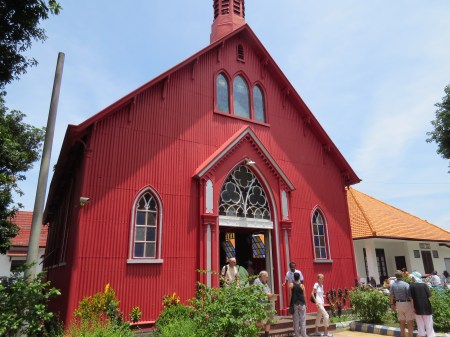
Red Church in Probblingo

Several days later, heading north towards the eclipse track, we stopped in Makassar, a city on the southwest corner of the island of Sulawesi, across the strait from Borneo.  This was a place I never expected to see, a comment I make on every eclipse trip.  We saw Fort Rotterdam, avoided getting run over in traffic, and later returned aboard the ship, a little nervous about next day’s eclipse.

IMG_6278.JPG

Fort Rotterdam in Makassar

Eclipse chasing requires one to be at exactly the right place at the exactly right time, have decent skies, clear where the Sun happens to be.  This is a tall order in the tropics, especially during rainy season.  Sometimes, we have had to explain to a tour guide that “exact time” means to the second, not whenever one happens to arrive.  Exact time for eclipses does not mean mañana.  There is no mañana.  It is be there or miss it.  You can’t see it “some other time.”

With that attitude, I can perhaps be forgiven for not being overly polite to those who dawdle going to the eclipse path, thinking that my visiting one more museum or monument is important.  No, seeing the eclipse will make my trip.  If that means I miss a monument, an elephant ride, a temple, or a church, so be it.  My priority is seeing the eclipse.  I’ve heard stories of ships being 2 hours late to the eclipse track, of vehicles breaking down.

Fortunately, we had a good captain, who along with his bridge crew understood our needs.  He steamed a little further west in the Makassar Strait than originally planned, because cloudiness was less there.  It’s not only a matter of rain that may affect eclipses, but those puffy, pretty cumulus clouds become eclipse killers on eclipse day, and we needed to dodge them.

A good eclipse is directly proportional to the amount of sunscreen one uses.

My wife and I were up at 5 to get a place on the 9th deck on the starboard side at 5:10, where twenty people had already arrived.  Stars were visible, Jupiter dotting in and out of view between clouds to the west.  Well, I thought, there is hope, but I couldn’t yet see the sky well.  We didn’t have much equipment, but we still brought up two chairs from the deck below.  The Sun rose just after 6, and the clouds were not great, not bad.  We knew the Sun would be higher during eclipse, and we waited. Others arrived, bringing more deck chairs from below.

IMG_6314.JPG

People on deck before totality

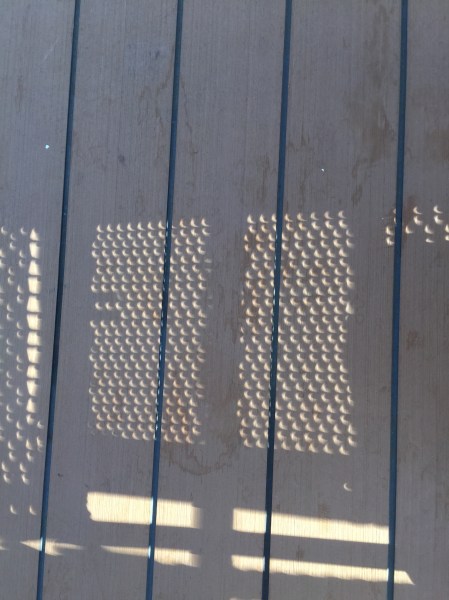
At first contact, where the Moon takes a small bite out of the Sun, it was partly cloudy.  Eclipses last about two and a half hours, totality in the middle, a little less than 3 minutes for this eclipse, 7 minutes and 32 seconds maximum possible.  After first contact, the Sun often disappeared behind a cloud for a few minutes, which is no problem, unless those minutes are during totality.  As the eclipse progressed, weather prospects improved.  The clouds became fewer and thinner.  The Sun’s projection through the weave of our deck chairs showed a multitude of crescents on the deck below, scores of pinhole cameras.  This is one of our favorite times during every eclipse.

IMG_2880.jpg

Crescents made by eclipsed Sun’s shining through tiny holes in a deck chair

As the crescent shrank to nearly nothing, I looked behind me to the west.  I was first to call out the arrival of the Moon’s shadow, a huge, dark mass, approaching at 30 miles a minute, the Moon’s orbital speed.  I turned around in time to see the Diamond Ring, the last bit of sunlight, and then beautiful totality, lasting 2 minutes and 45 seconds, over the calm Makassar Strait.  After the second Diamond Ring, the end of totality, I quickly looked down and east, calling out the rapidly disappearing Moon’s shadow, leaving us at a half mile a second.  For some time now, I have regularly watched the disappearance of the Moon’s shadow.  It’s visible for about 5, maybe 10 seconds.  I don’t know anybody who has ever mentioned it in eclipse talks.

IMG_2881.jpg

Totality

IMG_6320.JPG

Maybe they never looked.  After all, when totality is over, most people leave to celebrate, unfortunately in our instance leaving their chairs on the deck, instead of putting them back where they got them.  That’s kind of rude, even on a cruise ship.

Then a man about my age nudged me.  “Thank you,” he said, with his wife’s standing by him, “for pointing out the shadow’s disappearance.  I saw it, and I had never seen that before.  It was really interesting.”  His wife nodded.

IMG_2887.jpg

Moon’s shadow’s disappearing.  It is subtle, but the darkness on the horizon is the shadow

All total solar eclipses are special.  Sometimes, what I remember best is not the black disk in the sky covering the Sun, but something else, quite unexpected, like a disappearing shadow.  The man’s comments made my day.  I taught him something, and he was glad.

Later, my wife and I picked up about four dozen chairs left behind and helped the crew return them.  Yes, the crew is there to serve the passengers, but put the chairs back.

It appeases the eclipse gods.

EERO, EPOR AND THE 577R ALLELE

March 2, 2016

It did me good to read that Finnish skier Eero Mäntyranta’s success in winning seven Olympic medals in cross country skiing was likely due to a genetic mutation that increased his oxygen carrying capacity 25-50%.  He wasn’t the only Finn who was this fortunate.  I wondered at the time why Americans never were on the podium in those events.

It also did me good when I read in Outside about a man who could hold his breath six minutes—yes, six minutes— and used that skill to dive to tag threatened hammerhead sharks.  A comment was even made by Laird Hamilton that this man was unique.

Hamilton, one of the great big wave surfers, is unique, too.

It did me good to read that virtually every Track and Field star has the 577R allele in some form, enabling them to do things that the rest of us can’t.  It isn’t a matter of training harder, as some have told us, or “mental toughness”; nope, it’s genetics.  Now, that doesn’t mean one can’t train and improve.  There was evidence that Lance Armstrong improved his muscle performance 8 per cent through training.  Unfortunately for the sport, he improved it another smidgin by taking drugs, although he was far from alone.  All Tour de France riders are genetically exceptional, and at the top of the top, a fraction of a per cent advantage matters.  Some argue that genetic mutations don’t make for a level playing field. Well, we aren’t all created equal.

For years, reading about all these guys and gals who could do everything from surf to big wall climbing made me feel inadequate, despite my wondering that these skills were genetic.  Now it’s clear.  You either are born that way or you aren’t.  Nurture is essential, mind you, but nature creates a few special people every generation.  I am not one of them and never will be.  On the other case, I’ve never taken performance-enhancing drugs.  I was drug-free.  Maybe there is a genetic mutation for that, too.  Or maybe good nurturing teaches one not to cheat.

For most of my life, I tried to play sports well.  I am competitive.  But I have a modest ceiling.  My medal in 1966 for the third place 400 yard freestyle relay at the Delaware state swimming championships was my being a moderate size fish in a puddle, since Delaware, besides being the first state, is the second smallest.  I played baseball but never thought to try out for the team.  Basketball? I played third string in the city league, although one fabulous day I hit 20 free throws in a row at a schoolyard.

In cycling I was in the top 14% of the El Tour de Tucson 109 mile finishers.  That meant I placed about #736.  I trained long hours and had done all the right things; my result wasn’t bad, but hardly noteworthy.  In only one sport—skiing—was I good, and that was because I started young, took lessons, and had a lot of days on snow.  I was an excellent technical skier, but I couldn’t race well.  As a kid, I dreamt of being a pro baseball player; I never once dreamed of being a top skier. I was neither.

I feel better knowing that when I watch a track meet, or a good basketball game, I am watching people with chromosomal genetic code that I and nearly all others do not have.  More importantly, I understand the pain of those who train and train and train, but they didn’t have the right 577R allele to be part of the U.S. Olympic Team.

I feel better knowing that I was right when I argued with my cycling friends that it was genetics that made top riders.  All the training I did made me better and faster, but I reached a low asymptote.  I do believe I have a slight genetic advantage for endurance. I did a 200 mile bike ride once in just over 12 hours. In the 2002 Cochise County Classic, I was part of a small group that had our own support, and from mile 100 to mile 160, the end, I was pulling at the front two-thirds of the time, stamping out a solid pace, seven riders in my slip stream,  as we finished in about 8 hours, averaging 20 mph.

I was sixth out of 20 finishers.  Not even podium.

I was right when I argued that if I could be a top cyclist by training, anybody could multiply three digit numbers in their head, the way I do, simply by training.  That stopped most arguments, because people knew then that my skills were genetic.  Sure, I practiced math a lot, but I had this stuff in my genetic code from day 1, just like Yo-Yo Ma and cello;  Laird Hamilton in big wave surfing, Chris Froome in cycling, or Stephan Curry in basketball.

We should celebrate these people, and we do, paying them good money and cheering for the the ones we like to succeed.  No doubt they eat right, they train right, they do everything they can to reach their potential.  Some do it better than others, and they are household names.

I no longer feel inadequate when I read about these people who grace the articles in Outside, Sports Illustrated or Golf Digest.  I am reading about genetics, what how random mutations can positively affect performance, and—I think—to a lesser extent what training does.  Training is what we can control, and allows us to do reasonably well, be it learning a language or hiking up a mountain.  None of us will be noteworthy except maybe in our small group.  Nope, it is the mutations who make the stars, the names we know.  They work hard, to be sure, to separate themselves from other stars, but they are in a league of their own.

Now all we need is a mutation that leads to idea generation that would fix the rest of the human race, so we wouldn’t trash the planet and drive ourselves to the brink of extinction, which we will.

Maybe it’s time for better nurture.