Archive for June, 2026

BUNCH OF BUNCHGRASS

June 28, 2026

“There’s the trail right over there,” I pointed, looking at a bare area of ground. It did look like a trail 100 feet away, but there was plenty of nearby bare ground right near me right below Little Bunchgrass overlook. Turned out what I was seeing was more bare ground and no trail. I made a common error of seeing what I wanted to see and believed that the direction I was looking, southeast, would be typical of the southeastern route of Bunchgrass. A trail, however, like a road, can take all directions during its course to the end. I tried to shove what I saw into category “trail,” which is asking for trouble. We eventually found the real trail, further away than I thought, and hiked a mile further before turning back, midway to Big Bunchgrass, because we needed to return to our starting point. We would later plan to finish scouting the trail beginning from the far side.
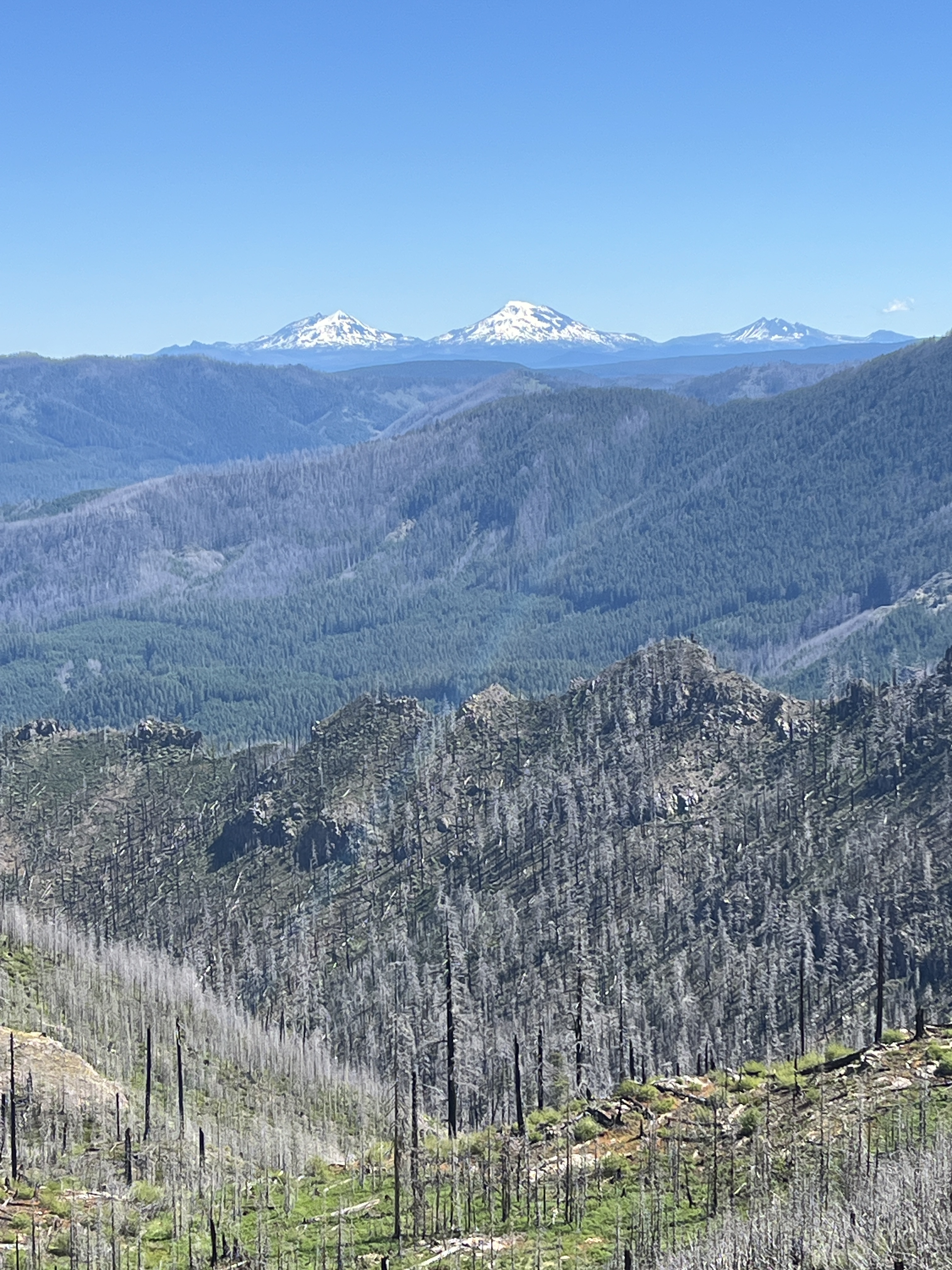
Little Bunchgrass view to Three Sisters and Broken Top

The return trip seemed shorter than the first half of the trip, a common phenomenon of travelers having something to do with the expectation of the time for the first half. We made a second observation that after having spent a good deal of time looking for the trail, over time we seemed to get better at divining where the trail was with less trouble finding it. Perhaps we developed trail finding sense. Such a sense is akin to, but not quite the same as trail landmarks being used to remember that one is on the return route and these landmarks will again be seen. We learned about the trail, its route and its markers, at least from the west.

Two weeks later, we scouted the east side of Bunchgrass, driving well up Highway 58, then taking Eagle Creek Road about 6 miles uphill to FS 378 near 4500 feet, which ended abruptly at a yard wide log maybe 40 yards long, parallel to the middle of the one lane track that had a steep cliff to the north and an equally steep drop-off to the south. Turning a vehicle around was not to be done lightly, and when any larger vehicles came up here, they needed to contain a power saw to remove the logs so to have a chance to widen the area to turn the vehicles around rather than back up a half mile. 
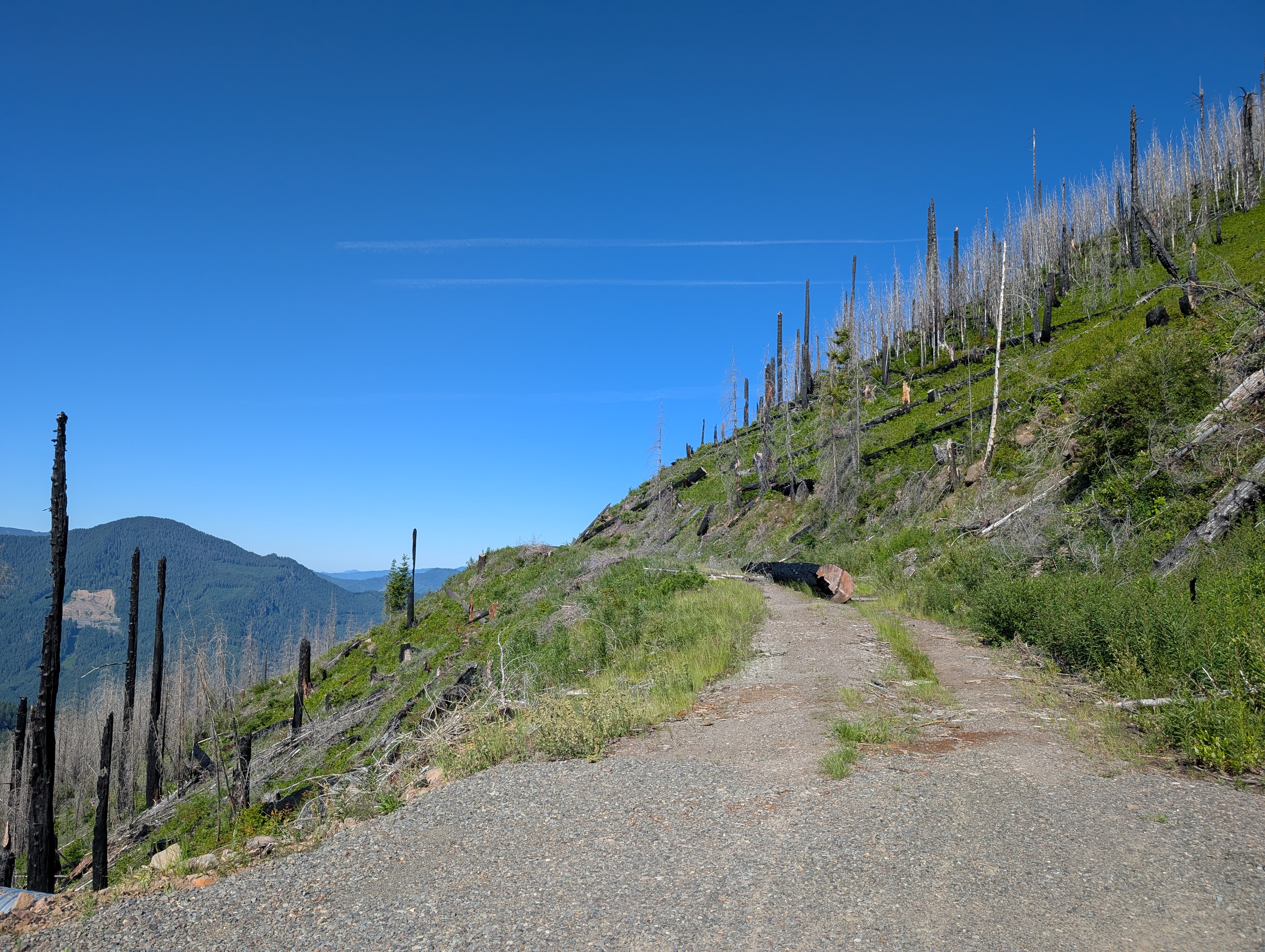
End of the road, at least until the log is removed.

The spur trail itself was an unpleasant track, climbing about 320 vertical feet in a bit more than a third of a mile. Adding to the steepness were large logs and drop offs, along with thick brush, rocky spots, and unpleasant places to slip going up or coming back down. I had not been expecting this, having been told only it was steep with logs. That was true, but in this instance both the adjective and the noun needed emphasis. By the time we had reached the junction of the spur and Bunchgrass Trail, the Gaia app showed the junction some distance away, and we needed more bushwhacking to get on the trail, then get on the trail in the right direction, which was both uphill steadily and poorly defined for the next mile and a half, which would take us an hour, a disappointing pace.

Eventually arriving at the top of what I call “The bowl,” where the trail drops 650 vertical feet into a relatively flat area for a couple of miles before exiting on the other side about 3 miles away. The distance was not huge, but the steep drop went through ceanothus plants hiding the tread beneath, where loss of tread was not uncommon, and not having any visible smooth tread for more than 50 yards continued. We did not improve our speed going downhill, and I once had hiked uphill on this stretch a few years back, when I had testosterone, and suffered. I was facing that for the return. We continued because from the GPS, it looked like we had a mile to reach where we went before, but when we reached a relatively flat spot 0.7 miles later, now it looked like a mile. 
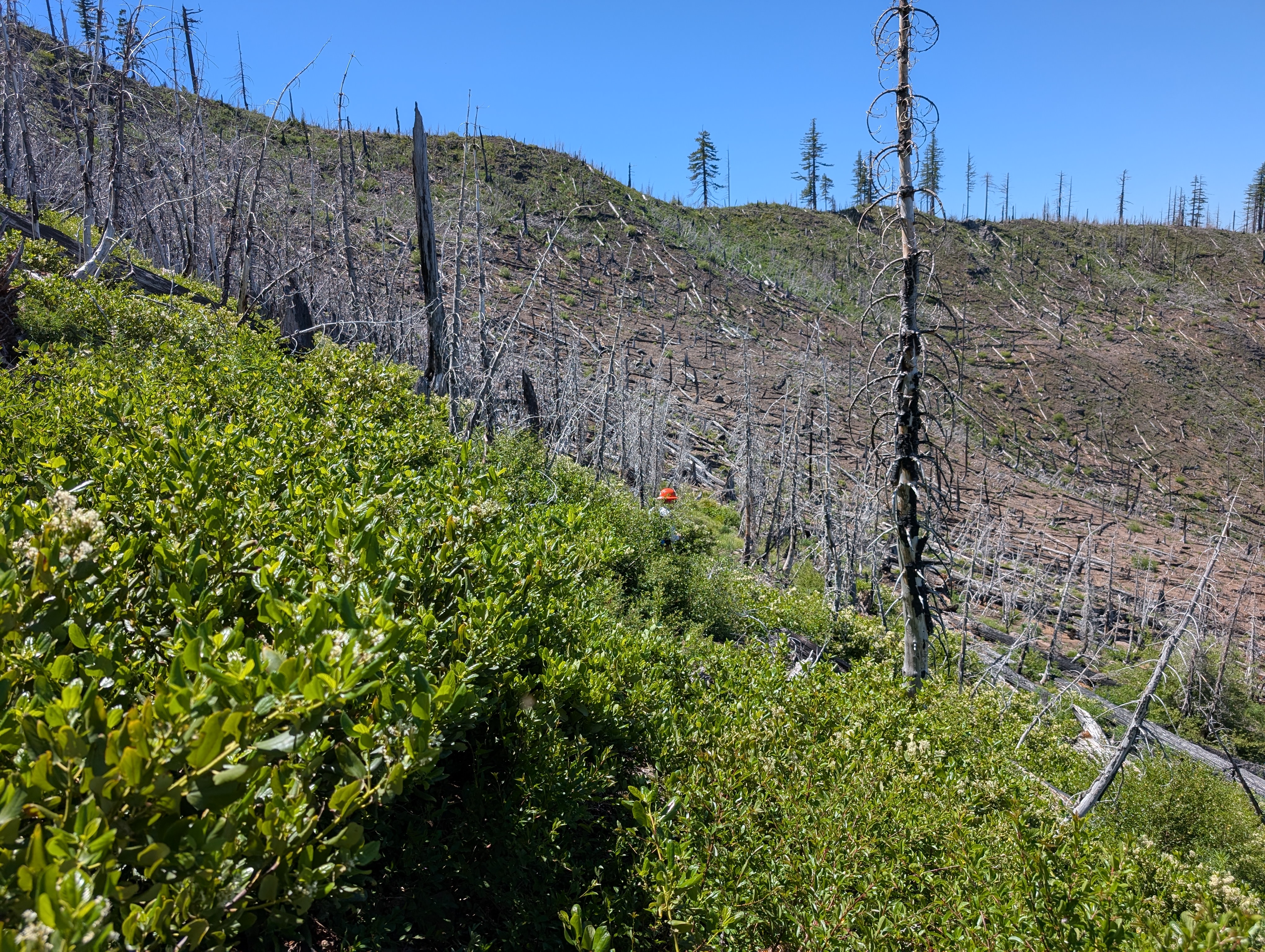
Descending into the bowl

At that point, I called it, vernacular for saying no more. A mile further was probably an hour; two hours needed to return here. That is 2:30 pm after factoring in lunch. It might take an hour to get back out of the bowl and another hour and a half to get to the vehicle, assuming we could hike at the same pace we had been. On the plus side, after getting out of the bowl, it was mostly downhill. On the minus side, there was still trail finding to do, and we would not be hiking fast after the slow climb out. Indeed, I would later start cramping.

And the last 0.3 mile downhill through the place we had come up would be its own reward of sorts. 

We scouted the trail, mostly, and we learned that we did not need a chain saw (good), almost the entire tread would need to be worked (bad), and the ceanothus had to be removed near the top (difficult to bring a power brusher in). The trail is hikeable, but riding a bike through it is another matter altogether.
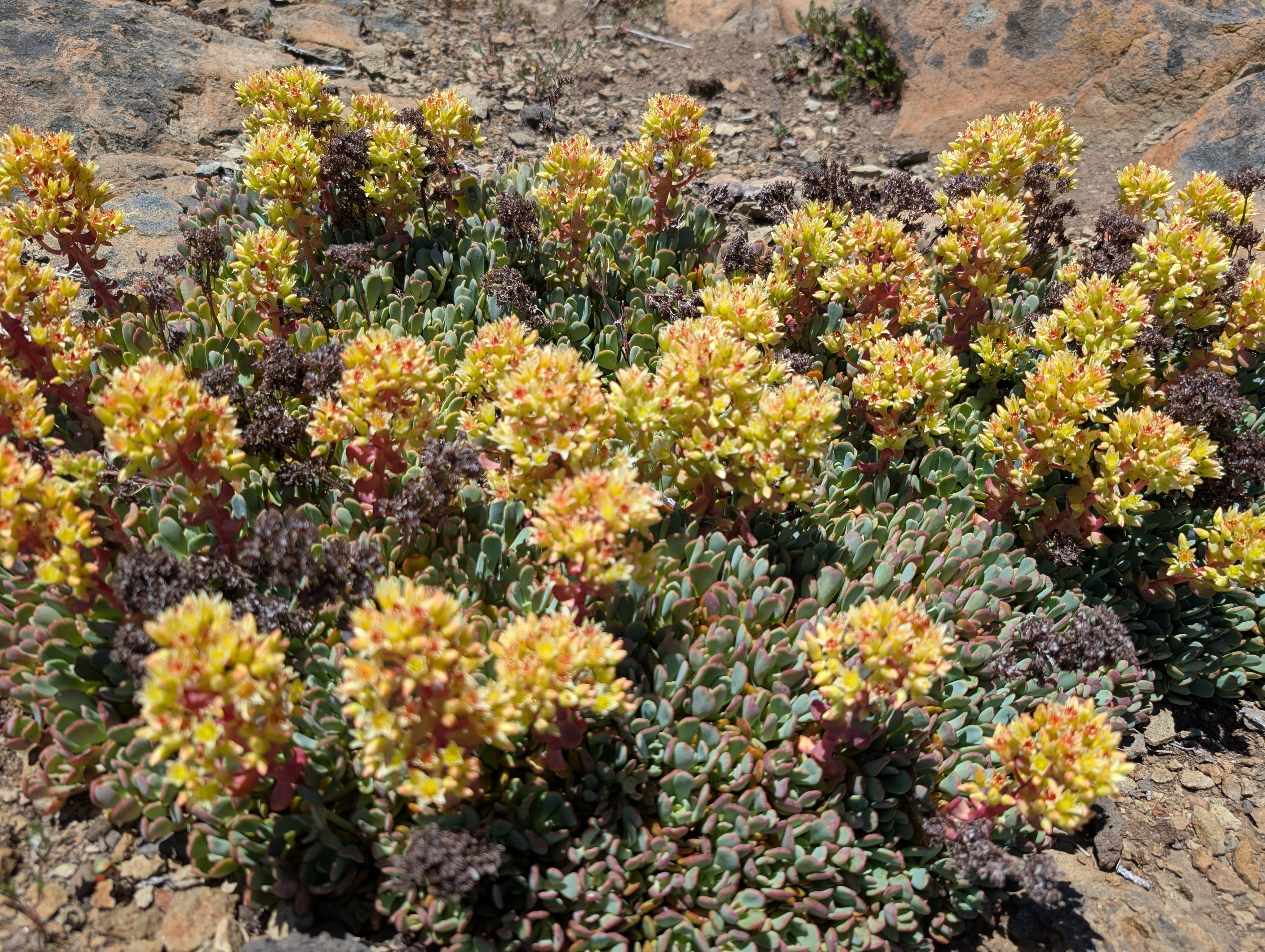
Oregon stonecrop, a succulent

BRIEF RETURN TO CLINICAL MEDICINE

June 14, 2026

“I am having a very weird experience. I feel confused.”

That text was a reply to my text wishing my friend Camilla a good trip to the Oregon Shakespeare Festival, the following day.

I was obviously bothered by these words but hoped that maybe this was a sign of stress over another friend’s imminent arrival at her house and the upcoming trip. But several texts went unanswered for several minutes. 

Then I read, “Where are we right now?” And I thought two things: first, I needed to drive across town to see her and figure out what was happening and two, I had the glimmers of a diagnosis, which wasn’t bad for a guy more than 30 years out of practice, assuming I was right.

I drove across town, not an easy task with some rain and another call from Camilla which I took hands free on the wheel. This was the second time in two months I had a medical advice phone call in the car that I had to answer hands free. Camilla couldn’t tell me the date, the president, when she last saw me, anything recent. She had no pain, but she kept saying she was confused. 

When I got to her house, she was downstairs and outside. She gave me a long hug, longer than usual, and I knew I needed to examine her, so we went upstairs to her room. She could walk fine, even upstairs. Her motor, coordination, and sensory examinations appeared just fine. We sat on the couch where I could ask her specific mental status questions, and observe her, which didn’t appear to show any improvement or worsening from my time on coming over. I gave her several nouns to say (parts of the body work well), and she did fine. That is my screen for aphasia. She wasn’t aphasic. I examined her cranial nerves, motor, sensory, coordination, and plantar responses. They were all normal. 

At this point, Lisa, Camilla’s friend and driver for her upcoming trip, appeared, and I apprised her of what was happening. I now mentioned the term “transient global amnesia,” which I had seen, looked like this, and when I saw it decades ago had no specific cause, no treatment, resolving in the matter of several hours. Camilla still needed to have a CT Scan or an MRI, blood work and be seen by someone more up to date than I, who might have some other thoughts. We needed an ED, not urgent care. So Lisa and I tried to find Camilla’s medical cards and driver’s license, which we did, and Lisa would drive Camilla and follow me. They had known each other for years. 

After we arrived at the ED, and checked in, Camilla’s vital signs were taken at the front desk and she then sent to triage where I went as well, explaining that I was a friend, a retired neurologist, thought I might be able to help explain what she was going through and mentioned the diagnosis, “transient global amnesia.” As a retired physician, I need to tread a narrow line in hospitals. I want to be helpful without getting in the way. I am out of date with both workups and treatments, but I have decent if long unused clinical skills, and in some instances, such as this one, I have historical information that the patient cannot provide. I found nothing that went against my diagnosis of transient global amnesia. 

Camilla was given a room in the ED and when she had changed into a gown, Lisa and I went in to sit beside her. She had an ECG and blood drawn, and a few minutes later, the physician came in, with a booming, “who is the retired neurologist?” I sheepishly raised my hand and gave him a fairly rapid summary of her story. He quickly examined her and turned to me, questioning, “Transient global amnesia?” To which I, sitting, nodded vigorously like a bobble headed dog. Camilla then had an MRI and a CT scan. I read the ECG, the first one I have read in a few decades, enough to know that it was normal. I left the room to make way for two other visitors, since at this point my job was mostly over, and the other two wanted to see her. I had treaded the fine line well. I spoke when I needed to, was quiet the rest of the time. I went for dinner then waited for some time in the waiting room, hoping my message that I wanted to come back into the room would be delivered. I did hear that Camilla would be discharged, but knowing discharges can take time, waited until one of the doors was open and then quietly followed one of the workers through. When he turned right, away from my direction, I hoofed it quickly down to her room, knocking on the wall, since the curtain had been pulled. My diagnosis was right; Camilla was perhaps slightly better. Lisa would need to stay with her this night.

We left and walked to the Lisa’s car, where I made sure Camilla would safely be inside. She and Lisa would travel to the Shakespeare Festival the next day and stay two nights there, seeing four plays.

I felt like a physician again, for the first time in a long, long time. I was proud of what I did, how I carried myself in a medical facility, doing exactly what needed to be done in this situation. I diagnosed the patient on the basis of a phone call and confirmed it with an appropriate workup a few hours later. Not a bad job at all.