Archive for the ‘BOUNDARY WATERS/QUETICO’ Category

BWCA, 2012. TRIP 60. SOLO TRIP 20.

April 29, 2012

I needed to get my head on straight.  Really.  I am one of those who needs to get into the woods, the wilderness, or take a long hike periodically.  How long I can go in between varies.  But I know all the signs.  I get angry easily, I am short-tempered, I get upset at minor issues, and there is a part of me that says “get away from all of this.”

In 2006, we established a scholarship in our name at Vermilion Community College, a 2 year school in Ely, MN, on the Iron Range, at the end of the road to the Boundary Waters.  VCC students live on the edge of the wilderness….and poverty.  I was at the age where leaving a legacy–the woodpile a little fuller than I found it–mattered, and the scholarship was awarded at the annual VCC scholarship banquet, held in Ely.  I have attended 5 of the last 7 banquets.

In 2009, I partnered with the Friends of the Boundary Waters , one of those small organizations that has a few dedicated staff and leverages a lot of volunteers, to create a second scholarship.  I offered to pay for the scholarship myself; the Friends matched it, and this year, with a new employee in the Northland, he would present it, and I no longer would, which suited me fine.  The Friends kept a tall cellphone tower away from Ely, so it would not be visible from the wilderness.  Unless you have spent time in wilderness, it is difficult to explain how sounds and sights from civilization can degrade the experience.  A cell tower would degrade the wilderness, where cell phones read “No Service,” and one is on his own.

Worse, PolyMet is trying to build a Molybdenum mine in the area, which is of great concern to the water supply, due to the toxicity of the element.  It is jobs vs. wilderness, except the wilderness gives jobs.  The outfitter got money from me, and so did restaurants and motels I used, before I went into the woods.  We are going to risk the cleanest water in the US for mining something that is safe until it suddenly isn’t?  (Prince William Sound, 1989, Chernobyl, 1986, Fukishima, 2011, Challenger, 1986).

The third scholarship was the Brekke/Langhorst scholarship, named for two brave young men, cousins from Moose Lake, Minnesota, who died in Iraq…or as a result of Iraq.  One died 7 April 2004, which was almost certainly in Fallujah.  The other died from complications of PTSD, which should have been anticipated before we went to war, which was unnecessary and probably illegal.  But that is another story.  Young men are often the pawns of old white men, most of whom have never spent a day in uniform or served in harm’s way.  As a veteran, I wanted to contribute to a scholarship for veterans, and the family honored me by allowing me to do so.  No family member has presented the scholarship; I and a few others have.  This is a very deep honor for me.

So, I had plenty of reason to go to Minnesota in late April.  In 2010, I took a short trip, stayed about 3 hours from Ely, and in the space of one day drove to Ely, rented a canoe, did an eleven mile day trip in to Pipestone Bay, came out, presented the scholarships (there are about 50, now), and drove 3 hours back to my hotel.  That was a bit much.

In 2011, I wanted to go into Basswood Lake, and the ice went out the day before I arrived.  However, the weather was not at all cooperative, with high winds, big waves, and frigid water.  Not being in paddling shape, I thought in unwise to go into the woods, and camped at Fall Lake Campground, where I was alone, did some day hikes in snow, saw a Pileated Woodpecker, among other birds, and enjoyed myself.

This year, I decided to go in overnight and look at the results of part of the Pagami Creek Fire.  My wife persuaded me to spend two nights, in case of inclement weather, which turned out to be a wise idea.

I flew to Minneapolis, did the usual 4 1/2 hour drive up north, and got settled in Ely for the night.  The next day, I got the rest of the equipment I needed, put it on the car, and drove out to the Lake One landing.

I got on the water on a bright 60 ish day (16 C), and in an hour found a decent campsite about 3 miles  (5 km) in  .  I was going to rest that day, but the forecast was good for that day and not so good for the next day, so I had lunch, hopped in the canoe, and portaged twice into Lake Two.  I expected a wasteland, but it was a mile before I saw any sign of fire.  But there were signs.  The campsites at the west end had some burned areas, and the beautiful white pines on the west end of the channel into Lake Three were no more, as that area had been subject to a back burn.
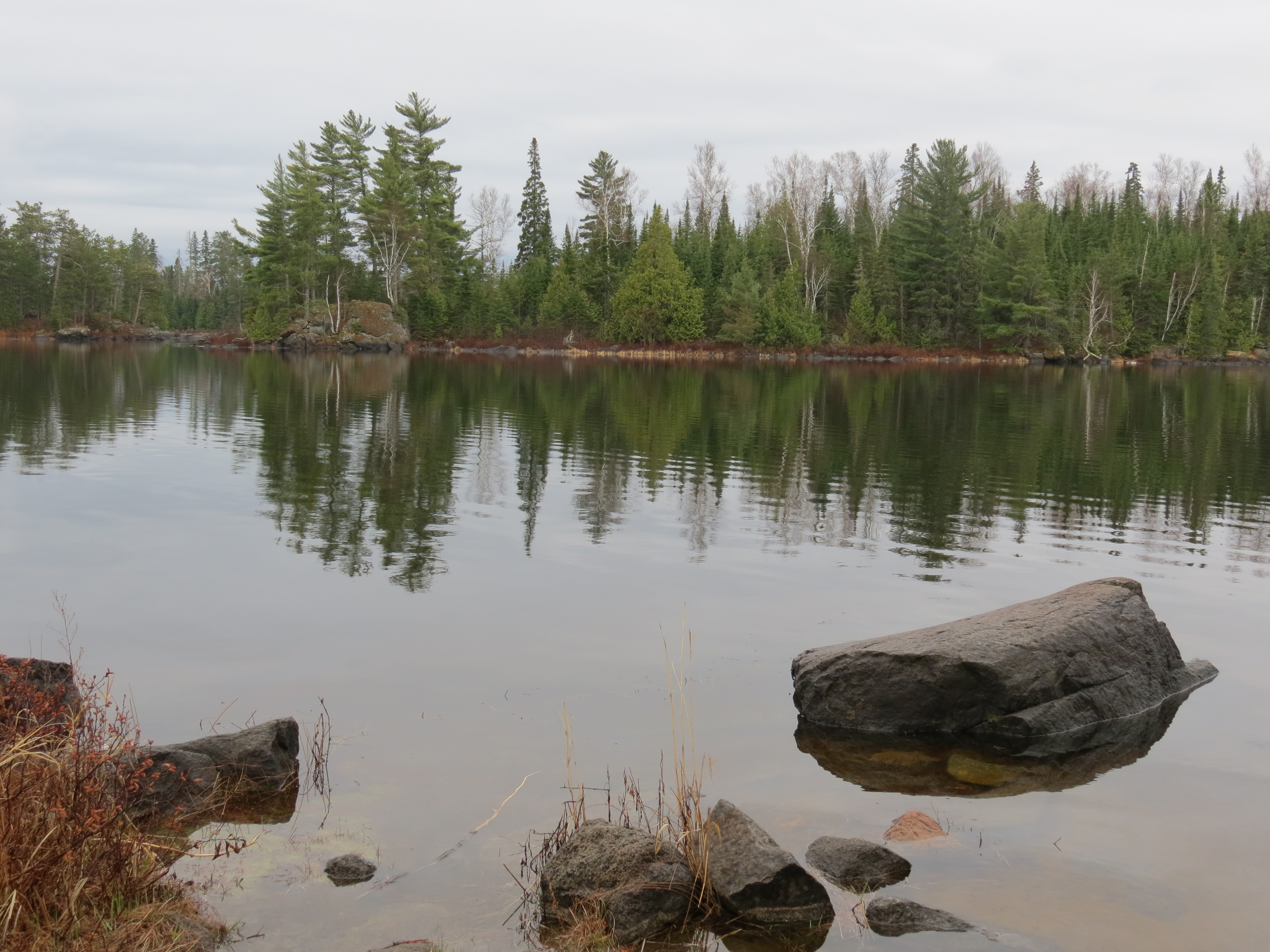
Channel between Lakes Two and Three, with tall burned white pine.

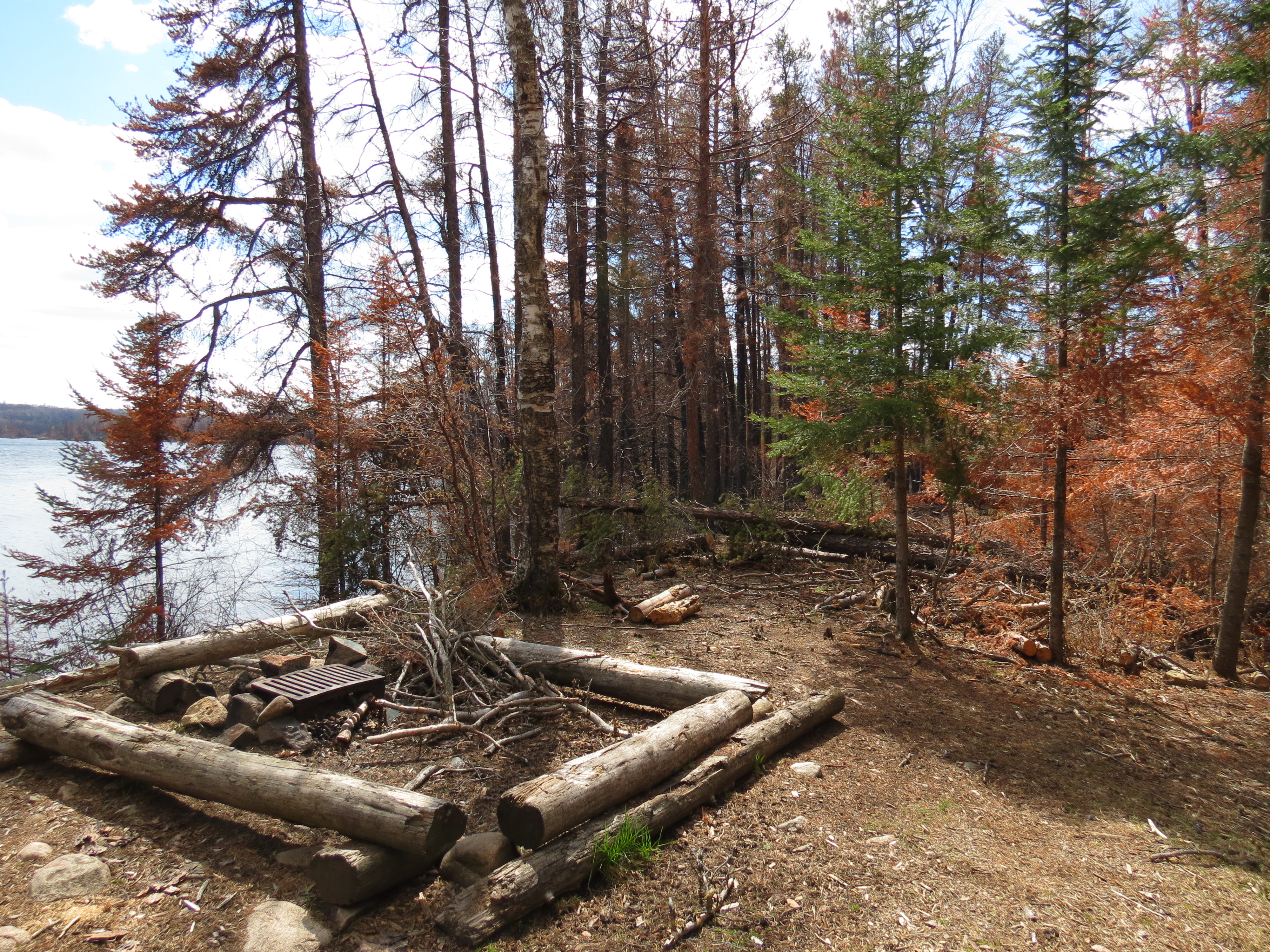
I paddled into Lake Three and was pleasantly surprised again not to see a wasteland but a significant part of the forest was burned.  There were mosaics of green amid blackened trunks.  The water was more turbid than usual, especially by the campsites, but also along the shore in general.  It will take some time for this to clear.  Some of the islands were scorched, others were completely untouched.  The south end was heavily burned, although campsites survived fairly well, in large part because most of the fuel in this area has been picked over by campers for their evening fires.

The wind was a little worse than I liked, and although a 2 foot chop is not difficult to handle, I needed to realize I had about 5 hours to explore, including time to get back to my campsite.  Wind, muck , and rapids are three things that can stop a solo canoeist, so I turned back to the north end and started to head back, stopping at one campsite that bordered the fire area.  The wind abated, so I took an open channel at the north end of the lake, which I had never before seen open, and went into the northeast bay.  The one campsite the late Mike Manlove and I had stayed at in 1993 was in the middle of a heavily burned area, and the north shore was fairly heavily involved.

Northeast Bay of Lake Three, heavily burned.

I had told everybody I would not go into Lake Four, and I believe firmly in never deviating from one’s itinerary, when one is solo. A lot of bad things can happen in the woods, and solo, what may be minor can become life threatening.  I looked around, took some pictures, and then headed back to the campsite on Lake One, the whole 13 miles (22 km)  or so taking me a little over 4 hours.

I had nothing to do when I returned so lay in the tent, not sleeping, but actually encountering a few mosquitoes, at least five weeks earlier than I am used to.  After dinner, the lowering clouds suggested that the next day might not be so nice, and I was really glad I got into the burn area when I did.

Indeed, I was awakened to the sound of rain, and I awoke under darker skies although no rain.  It was noticeably cooler, too.  I hung around the campsite for a while and then paddled about 1 1/2 miles down to Pagami Creek, far back in the depths was where the fire started.  I took a look at the western sky, and while the barometer had not changed, I did not think going further was a wise idea.  I turned around and paddled back to camp, arriving about 10 minutes before the first onset of rain.  It rained off and on through dinner.

I was really, really glad I hadn’t gone into Lake Three that day–wind, rain and cold weather would have made the trip a bad idea.  I have long learned never to squander good weather in the woods, be it 5 minutes or 5 hours.

I spent the evening looking along the shoreline for anything I could find.  Such scanning has found moose, beaver, otter and other animals.  This time, it was a raven and two crows who provided the entertainment.  The raven flew across the lake and landed in a jack pine across the small channel.  Two crows were beside themselves and called at him, each other, and probably to the general universe.  Periodically, the raven called, too.  I videoed the event, catching the raven flying off, still harassed.  Random scanning is often interesting.

The next morning, the tent was hard, as like a rock, and I went outside to see ice on the tent and snow on the ground!

Spider Web with frost

The stove was out of fuel, and while I had another cannister, it was cold, I was coming out of the woods anyway, and I had enough to eat.  I broke camp, got in the canoe, and paddled back to the landing.  The hardest thing I had to do was horse the canoe up on the car and tie it down.

I got my head back on straight.  I was out 2 days, and it felt like a week.  I saw the burned area, and next year, I have to go back one more time to Lake Insula, as sad as seeing the south shore will be for me.  I haven’t given the lake a proper good by, and who knows?  Maybe we can do our September trips there again, if I find the area isn’t too depressing.  One thing is clear–I need to tie the scholarship banquet in with a camping trip.

The banquet went well.  I met Ian Kimmer, the Friends’ person in the North Country, who presented the Friends scholarship.  I presented my two, stayed for the whole banquet, then headed south.  We’ll be back in September, headed out Fall Lake into Jackfish Bay on Basswood.  It will be a good trip.  All BW trips are.

Burned area.

Canoe with snow on it.
BWCA, 2010

September 29, 2010

This was my 58th trip and Jan’s 16th.  We went into Lake Insula for the 7th year of base camping, again on Site #26 up in Museum Bay.  Again, we had a great traveling day in, with an early start and a tailwind.  We got to Insula in 6 1/2 hours.  Unfortunately, the barometer began falling, it started to get cloudy, and by the next afternoon we had sprinkles.  The next two days were spent in the tent with rain, high winds, and generally good hypothermia weather.

However, when the rain stopped, radiational cooling gave us a beautiful morning mist on the lake.  We had a chance for a couple of day trips on the lake and again, for the second year in a row, saw no people during our 5 nights on Insula.

We had a nice travel day out and decided to go all the way to Lake One, to avoid the traffic on the campsites on Lakes Two and Three.  All was fine until about 3 a.m. on the last morning, when my stomach felt queasy, and I said, “I think I’m going to barf.”  No, I didn’t use the word “think.”  I KNEW I would.  Got the tent unzipped and retched right outside.  Nice.  Really, really nice.  First time in 4 decades that has happened on a canoe trip.  But whatever I got in disappeared, and we departed Lake One seeing the beautiful fall colors in the North Country.  These were the best we’ve ever seen in a lot of September trips.

People ask about bugs and cold this time of year.  Answer:  no bugs.  We had one day of frost.  There were very few people.  But we wouldn’t go a week later, as October canoe trips can be really dicey with the weather.

Pictures from the trip: http://s986.photobucket.com/albums/ae344/michaelspinnersmith/BOUNDARY%20WATERS%20PICTURES/2010%20BWCA/

THE LIST

October 11, 2009

(Published in the Boundary Waters Journal, 2006).                                            

It was on my “list”:  Kawnipi Lake, one more time, while I could.  I’ve got a lot on that list, each year trying to check off a couple items.  A while back, I took my wife and father to see the Sandhill Crane migration on the Platte.  Other items still undone include the Death March portages, seeing a wolf in the wild, visiting the Brooks Range and paddling the Churchill River.  The list reminds me not to squander good years.  I once practiced medicine and know too well the bad things that can happen to people and how quickly they may happen.  Last winter, a voice in my head told me, “Get into Kawnipi again, while you still can.”  As soon as I could, I obtained a Quetico permit for mid-May. 

I’ve been fortunate.  Despite living in the Sonoran Desert, 2000 miles from canoe country, I’ve logged more than 50 Quetico-Superior trips.  It’d probably be easier and cheaper to live in Minnesota, but 21 New England winters were enough.  In 1992, I worked as a volunteer wilderness ranger for the Forest Service in Ely, spending an even hundred days in the woods, the most content I’ve ever been.  I’ve had a lot of formal education, but that year I attended the University of the Forest Service, Boundary Waters Campus. 

My body has suffered wear like a heavily used Wenonah.  I have three pins in a hip and a deformed clavicle from a past bicycle accident.  Occasionally, a pinched nerve in my neck dating from a Forest Service trip bothers me, but never while canoeing.  It may require surgery some day, but not yet. 

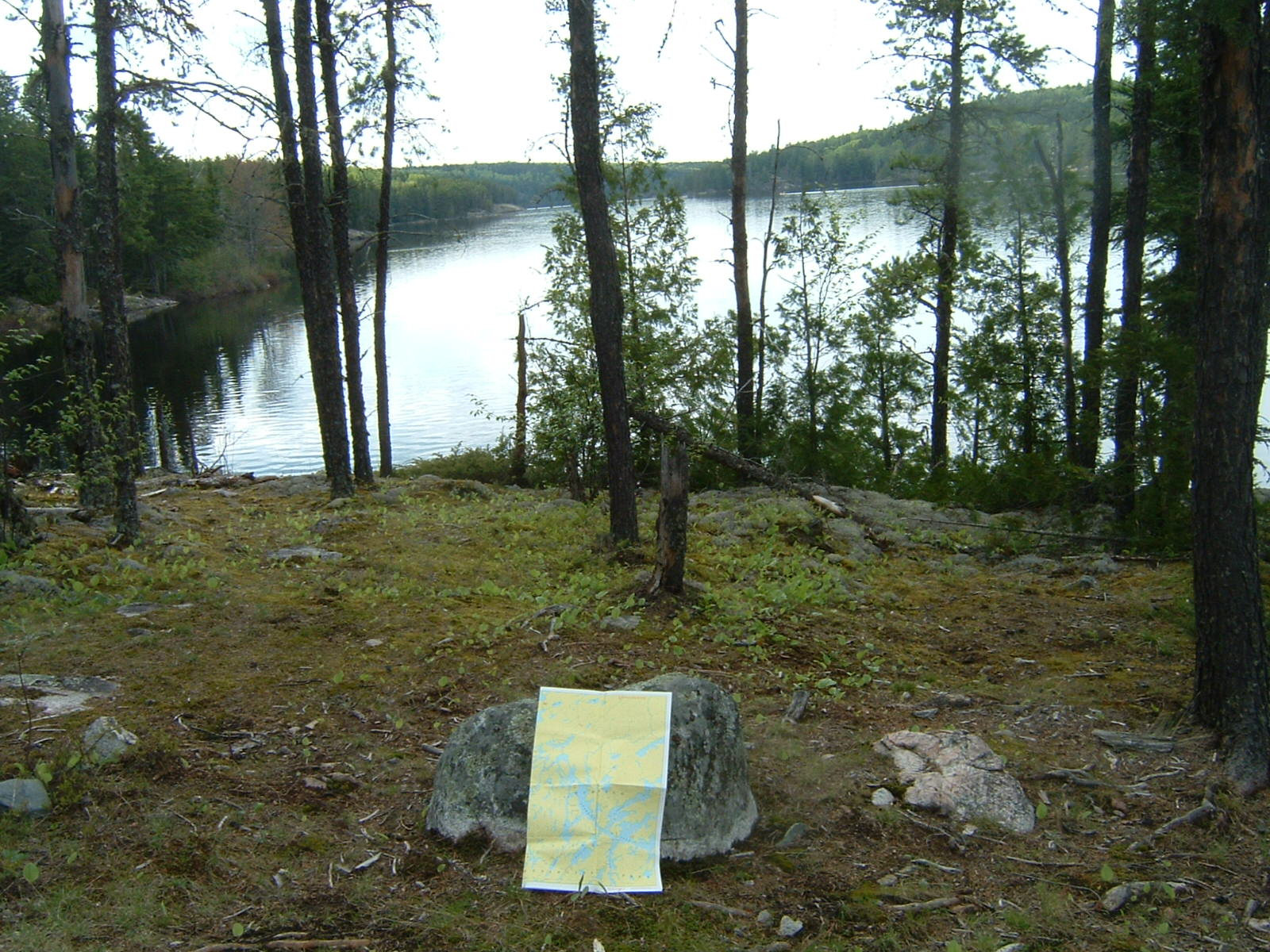
I’ve been to Kawnipi five other times, for which I feel blessed.  IMAP SHOWING KAWNIPI LAKE just wanted another chance to see the lake and spend a night there, refreshing my memories.  I’ve had great fishing in McKenzie Bay, seen moose in Kawa and McVicar Bays, soloed into Lemay and paddled from Atkins Bay to Shelley.  I didn’t have any logic for why I wanted to go back.  I just did.  Those who have been there understand. 

My wife prefers late season BWCA trips, so I contacted Pieter, a good friend from Ottawa, who introduced me to the Yukon and Nahanni Rivers.  We’ve also traveled the Quetico several times, the last being a “Triple K” trip in ‘97 — Kawnipi, Keefer and Kahshahpiwi — using his heavy Old Town Tripper.  He agreed to come (I convinced him to use a lighter canoe!), planning to meet in Ely and leave from Moose Lake.  Neither of us had time for more than up and back, but that was enough. 

Unfortunately, about a week before the trip, Pieter had a sudden emergency and had to cancel.  I’ve soloed nineteen canoe trips and the southern quarter of the Appalachian Trail (finishing that is also on my list), but those were many years and a couple of health problems ago.  Still, I wasn’t going to give up, but my time at Kawnipi would be further limited.  I organized my gear and flew north, always feeling a little odd as a mid-50ish guy carrying a canoe pack through an airport.  Some have told me at my age I should be playing golf, but I’d rather swing a paddle than a club, and the white I want to see is on an eagle’s head, not a ball. 

It was good to again see the Ely water tower, having fond memories of living at the Service Center on S. Central.  I rented a canoe, got a tow to Prairie, waited in line to clear customs, and was on Inlet Bay at a reasonable time and with fair skies.  An hour later, I reached the sand beach at the Burke portage, having camped near there on my last Quetico trip.  I’ve tried bent shaft paddles, but fairly set in my ways, I prefer the straight shaft better for tracking, especially solo.  I also tied in a spare paddle, which I once had to use in ‘91 when I dumped in Basswood River.  Fortunately, I was solo then as well, so nobody witnessed my error. 

I could probably still single carry some portages, but I don’t have anything to prove, and a lot I could really hurt.  My hip is fine, but carrying a canoe and pack together seems to be asking for trouble.  Besides, a walk in the woods back to the beginning of the carry is just fine by me.  Solo, I’m a pure traveler, not having fished in several years.  I like to cover water, lots of it, every day.  I’m the guy in one of Sam Cook’s articles, staring at the map, looking at where he’s been and wondering how he is going to see all that country before he dies. 

In 2015, I also want to be one of those few 66 year-olds he’s seen in the woods.  But there are no guarantees.  Go when you can. 

My first day plan was to reach the great campsite on the point of Agnes, at the end of the narrows, where the lake widens and one can see the broad sweep to the north.  But paddling Burke and Sunday and the two long carries from Sunday to Agnes took their toll, so when I spotted a small site on the west shore not too far north of Louisa Falls my arms told me I had covered enough water for the day.  Solo trips require few campsite amenities.  After I pitched my tent and laid out a kitchen area, I leaned up against a convenient rock, sipping cider, writing in my diary and enjoying the view of the nearby cliffs, seeing two soaring bald eagles and a broad-winged hawk.  I wish more Americans could see their national symbol in the wild.  When the wind died down, I heard the distant roaring of the falls, a remarkable spectacle in spring.  Living in the desert, I enjoy North Country greenery, trees without spines and rain.  I have simple tastes and eat well, having learned from my Forest Service “University” friends what works well for wilderness cuisine. 

I was pleased by the lack of bugs.  I prepare by treating my clothes with Permethrin®, but even so, it appeared that I beat the hatch.  Solo trips are unique; you get to do what you want, when you want, so long as you do the work.  If you need something, you have to do it.  Period.  There is no splitting up chores.  You also must be careful, really careful, never once deviating from your planned route, including any possible side trips.  It is of course essential somebody know your itinerary. 

The biggest concern I had was wind, for that, current and muck are three things that can stop a solo canoeist cold when two can continue.  I was therefore fortunate the next day to find clear skies and Agnes like glass.  I proceeded north, paddling close to shore,AGNES LIKE GLASS safer when solo and better for seeing wildlife.  I stopped at the pictographs well up the lake, especially liking the one showing two people in a boat.  I sure would have been faster with a second person!  Continuing, I encountered two young men at the portage leading to the East Channel of the Agnes River.  They asked if I knew anything about the portages.  It had been years, and my memory hazy, but I remembered the second carry as wet, full of blow downs and generally messy.  When I landed at the portage, I walked it first with a pack, rather than a canoe, so if I found trouble spots, I wouldn’t get hung up trying to change direction.  I learned that technique the hard way. 

My memory was unfortunately accurate.  There was a hundred yard stretch of flooding and serious muck, along with several blow downs.  I was real happy I hadn’t taken the canoe over first!  If the worst price I would pay was wet feet, it was pretty cheap.  After that slog, I carried three more times before reaching Murdoch, noting how quickly the sky had become overcast.  Where I live, it seldom rains, and the weather changes slowly.  Up North, I check the sky often.  Concerned, I ate a fast lunch and continued across the lake, larger than I remembered, finally reaching the outlet.  Back in ’89, I lost a large bass in those rapids. 

Once I cleared them, I was in Kawnipi.  Another half mile with a right turn, and I was in the main channel, where I stopped paddling and drifted, happy to have made it back to such splendid country, every bit as beautiful as I remembered.  I slowly continued east, passing the opening to McKenzie Bay, recalling the campsites and a side trip where I accidentally stumbled upon an old grave of a man, similar to ones I had seen in the Yukon.  I quietly departed.  Continuing in the channel, I eventually camped on a small, sheltered spot on the south shore, well above the water, with good views in both directions down the lake.

That afternoon, sitting on ledge rock, I saw only one other group, far off.  Early spring trips show the land full of promise and waterfalls on many of the cliffs.  The male mergansers are striking black and white, pollen is on the water, lining the shore and the loons seem to be constantly calling.  At times, when the wind stopped, I was surrounded by what I call “pitch quiet,” something, as unpolluted lake water or dark, dark night skies, many have never experienced. 

The clouds lowered further by dinner, and that night it rained, the morning greeting me with leaden, threatening skies.  With another person, I could have explored more, but I wasn’t sure what the wind would be like back on Agnes.  Always happy traveling, I turned south into McVicar Bay, photographing the inlets, one with a reflection reminding me of a huge hall of mirrors.  I entered theHALL OF MIRRORS burn area at the first portage; at the second, into Anubis, I passed through a large forest of young jack pines, which needed the ’95 fire in order to germinate. 

I left the burn at Bird and took the nasty, rocky, slippery carry into Agnes, the first drops of rain hitting me as I loaded for the long paddle ahead.  I could hear and see the waterfall on the uphill Dack portage, recalling my May ’92 solo into a small island on that lake, where the morning temperature was in the low 20s. 

There was no wind, and Agnes like pockmarked glass, the rain pelting me for several miles.  Fortunately, the point campsite I hadn’t reached on the way up was open, and after dozen years, I was back on it, although views up the lake were mostly of fog and rain, which this desert dweller had a full day to appreciate.  The next afternoon, I traded rain for a southwest wind, so I was unable to paddle the opposite side of the peninsula to East Lake, where I’ve seen moose.  I split up the two long portages out of Agnes, camping on Meadows, a lake that I had previously always wanted to get in and out of quickly.  I found it empty, other than two pair of loons, a sheltered campsite, plenty of firewood nearby and a good view for sunrise.  How could I have not appreciated this lovely lake all these years? 

Again, I was surrounded by pitch quiet interspersed with occasional loon calls, wishing I could package both for my return to “civilization.”  Absolute quiet, where one’s ears ring, is not uncommon in canoe country — if one is patient.  Portaging back to Sunday, I encountered a group coming the other way.  First asking permission (I’ve never been turned down) I carried some of their gear across when I doubled back.  I’ve had a lot of help in my canoeing career and it is good to close the circle. 

When I reached Singing Brook portage I remembered the time my wife and I camped there, on our first Quetico trip, trading quiet for running water, and seeing what looked like a large house cat, which of course turned out to be a pine marten.  Years later, solo, an east wind was so strong I actually couldn’t move out of the small bay by the portage into the rest of Burke.  I had to backtrack to the longer North Portage, struggling further to get out of Sunday Bay.  This time, the weather cooperated, and I set up camp early on Sunday Island, close enough to easily make my pickup the next morning.  I had never camped there, enjoying the large tent sites and the “big water” views of Bayley Bay.  There was a loon nest on the southeast end of the island, which I avoided on my afternoon paddle.  Hearing loons is a big reason why I keep coming back.  It is important that we canoeists stay well clear of their nests. 

I paddled to Prairie the next morning in dense fog, navigating by the sound of the falls.  It’s good to check something off my list, but now I want to do this trip again, although not solo, and spend more time up there.  So “a few days on Kawnipi” was added to the list, which will never get completely checked off. 

I think that’s called life. 

                             Solo Trip Tips        

  • Always, always, always leave your route with somebody, including expected camps and when you plan to be out of the woods.
  • A satellite phone might be worth having for emergencies, although the very thought is a travesty to some.
  • If you have never soloed, your first trip should be short, easy and around people.  Ensign, the numbered lakes, Basswood, Sawbill or Seagull come to mind.
  • Of course, wear a PFD.  Of course.  Sure you can swim.  What if you are unconscious?
  • Tie a spare paddle inside the canoe.
  • Everything that is worrisome for canoeists is much more so if you are solo.  Keep an eye on the sky; avoid paddling far from shore and factor wind into your trip.  Experiencing a thunderstorm, deep in the wilderness, solo, is both memorable and humbling.
  • You want it, you do it, pitching and striking the tent, cooking and cleaning up, hanging food, loading and unloading.  Plan to work hard.
  • Even gently moving water may be impossible to paddle against.  Thick weeds and muck can cause havoc.
  • A solo trip is an excellent time to think deeply about life; it can also be very lonely.  Many should not solo.  And that’s fine.
  • Use caution walking, both on portages and in campsites.  Use care when obtaining wood and using a camp saw.  Lacerations, a sprained ankle/fractured wrist from a fall or back sprains from lifting are all potentially life-threatening.  Carry a good first aid kit, remembering you have to diagnose and treat yourself while injured.  Read this again.
  • Swimming alone is not a good idea.
  • Expect everything to take longer.  Unloading the canoe and pulling it up on shore to portage is hard work, which may be lessened somewhat if you don’t mind getting wet.
  • Place the pack in the bow, especially on long paddles over open water.  It will help with tracking, even if it is more difficult to unload.
  • You may find you are unusually chatty when you encounter another person.
  • A solo trip is a unique experience in our crowded society.  Your chances of seeing wildlife are better.  Enjoy it, and of course, leave no trace of your passing.
  • Finally, remember:  There are no guarantees in life.  Go when you can.

BWCAW 2009, LAKE INSULA

October 2, 2009

This may have been my favorite trip to Insula.  We had the best travel day in, with an early start, changing sides frequently so that we wouldn’t stress our elbows, and with my boots and Jan’s gaiters, she didn’t have to climb over packs to get in and could get out sooner.  Loading and unloading went well, portaging went well, the water was calm, and we got to the point site in Museum Bay by 2 p.m.  We saw not one other group for 5 days, which is remarkable even in September.  Four of those days were with near perfect weather.  I actually swam, we day tripped there and to the north end of the lake, saw an eagle, mergansers and a moose.  The latter sloshed and clopped his way along the shore one evening, which was one of the more memorable sightings, even if the picture wasn’t good.  Two days later, we went by to look at the tracks and found fresh wolf scat plus urine!

Day 5 was cloudy but cleared, so we stayed another night, and then got the frontal passage the day we left.  The rain mostly held off until we hit the Insula portage.  We got another hit on Lake Four and had lunch under the tarp.  We took the same point site on Lake Three that two women (from Arizona, no less) were vacating, and then had high winds and rain all night.  We came out with 30 knot head winds gusting to 40.  Lake Two was pretty epic, and Lake One was no piece of cake either.  But hey, this is Minnesota in September and this sort of stuff happens.  My watch barometer was right on target with a 30 millibar drop, so while the weather stayed decent, the drop concerned me, and I knew something was due.  It finally came.  I have now spent 32 nights on Lake Insula, which is a real blessing.

On the slide show, notice the two consecutive sunsets and how far south the second one has moved.  At the equinox, the Sun is moving either north or south the most rapidly.  The Sun set nearly three minutes earlier each night.  Up in Alaska, they lose about 8 minutes of daylight each day this time of year!

BWCAW 2007, LAKE INSULA

October 2, 2009

This was the year we reviewed all the campsites on INsula.  We immediately got hammered with rain and wind after we left the Lake One landing, so instead of getting an early start on the campsites, we made it maybe a mile into Lake One!  Still was a good decision.  Next day was better, and we got to Insula.  We did some of the west end sites and then set up on an island site.  We went out in the afternoon and got a few more sites done before increasing winds made us get back to camp.  The next day, we did sites in between storms–sort of.  I recall leaving one site in sunshine and within 5 minutes, we had sleet and high winds on the high seas of the lake!  We had one last day to do the whole northern half of the lake–20 sites.  We got an early start and went hard all day, using a tape recorder and talking to each other about the kitchen, the landing, the tent pads, the bear hang, the latrine trail and other amenities.  We finished late, and I would later have tennis elbow from all the paddling that lasted about 6 months.  It was still worth it.  We picked up Site 2 on the way out, wrote it up, and it appeared as a 20 page article in the Boundary Waters Journal winter 2007-8.

Funny follow up, along the extreme makeover campsite.  Site 37 was on one map and not another.  We looked all along the shore for it and found nothing except one sawn log.  I landed in brush, bushwhacked up the hill and found a firegrate, one tentsite, and about the emptiest latrine one will ever find in the BW.  We called it the worst site on the lake, don’t stay on it unless it is the last one, and even then don’t stay there.  We day tripped to the site in 2009 and could see it from the lake!  The firegrate was surrounded by a rockpile, there was a decent landing, and while I still wouldn’t stay there, somebody from the USFS had obviously done a great deal of work.  Nice to know we probably made a difference!


BWCAW 2006, LAKE INSULA

October 2, 2009

This year, we took two days to get in, camping a night on the Kawishiwi River.  We had a point site on the southeast end of the lake with a fair amount of traffice.  But the site was huge, with a large grassy area, loads of room for tent sites, and a beautiful point where we could sit and read under a tree.  It was cold in the mornings as the mist and the outfits show, but the days were pleasant, and the one thunderstorm that came through did not dump a lot of rain on us.  This is one of the “5 star” campsites on the lake, with probably great swimming during the height of the summer.  It is also the site featured in the article here in the blog called “The Legend,” where the late Mike Manlove and I wrote up a family for an illegal fire.

This was our third year base camping on Insula.  We would explore campsites and volunteer to evaluate all 47 (more than even the Forest Service or the cartographers knew about) the following year.

BWCAW 2005–LAKE INSULA

October 2, 2009

This was our second base camp trip to Insula.  We stayed on a site just north of what we call the cut-through, a narrow isthmus between two major sections of the lake.  It saves a lot of time paddling through the lake.  We wanted to go further, but the map was misleading about the site we wanted to stay at.  We could have gone further, but the site we stayed on was open, it looked pretty reasonable and we moved in, staying five nights.

We took a daytrip up to Alice Lake and then to Fishdance to see the pictographs there.

On the way out, on Lake Two, I awoke at 0130 and went outside.  It seemed awfully bright for a night when the Moon had set.  Sure enough, we had an aurora!  I awoke Jan and asked her if she had ever seen one before.  She hadn’t.  Imagine.  We had been married nearly 35 years and I didn’t know that.  I’ve seen more striking aurorae, but this one was pretty nice, and besides, I made sure my wife saw it!


BWCAW 2005

October 1, 2009

So far, this has been my last solo trip.  I was going to go with Pieter Helmke, but a pet got very ill and he had to cancel.  Pieter and I took many trips together to the Nahanni and Yukon rdivers as well as into the Quetico.  We went into the Quetico in 1997 and had a great, but very difficult trip.  Our last time together was in 2002, when we went into Crane Lake and did the western part of La Croix.

Anyway, this trip was my last one into Kawnipi, although I always hold out for one more.  I’ve been into Kawnipi 6 times, and that makes me very blessed as anybody who has seen that lake would admit.  I had flat water all the way up Agnes, stayed a night on Kawnipi, then came back in the rain, with again calm water, and stayed on Meadows Lake, which is usually a 20 minute pass through on the way in and out.  Meadows is a great lake to camp on.  I came out in fog.

BWCAW 2004

October 1, 2009

We went down the Nina Moose River and got to LaCroix the same day.  We then paddled to Iron and Crooked, where we saw a bear.  Should have paddled further down the lake, but we thought one night would be safe.  It was.  Problem was, we got hit with 3 inches of rain and 50 knot winds, so we stayed put.  Mr. Bruin showe dup that night and knocked the pack down.  I heard Jan the next morning say, “Mike, there’s a bear in camp.  Should I bang some pots?”  Yes, and no, it didn’t help.  So, we got what food we had, found the pack and left.  Had rice for breakfast and mash potatoes for lunch.  We were a bit hungry when we finished, 3 days later.  Only time I’ve ever been hit by a bear.  I stupidly tried to reclaim my food and got bluff charged, followed by a deep hiss.  I almost backed into the lake.  Sorry, no pictures of him.

BOUNDARY WATERS CANOE AREA WILDERNESS

October 1, 2009

I discovered the BWCAW in 1981, quite by accident.  I had spent six summers canoeing Algonquin Park from 1962-67 as part of Camp Pathfinder on Source Lake.  My last year was spent as a head tripper or guide on trips up to 6 days.  Back then, we had can pits, cut tent stringers with live trees, cut pine boughs and had wooden Old Town canvas canoes that soaked up water and weighed up to 100 pounds by the end of the summer.  I remember vividly one camper who was sick, and I carried his pack and the canoe simultaneously down Misty River.  I’m not a big guy, and I’m not particularly strong, but I could go when I had to.

On a plane trip, I happened on a discussion of the BW in the inflight magazine.  I went up in June 1981, did a 5 day solo trip into the Quetico via Carp, Emerald and Plough Lakes, turning around on Knife. I met Dorothy Molter, and loved my time there.  Work had pressures, and it was five more years until I went up again, this time to Thomas, Fraser, Kekakabic, Knife, Amoeber and back down again.  I was hooked!

I took my wife on her first trip in June 1987, not the best time to introduce somebody who breaks out when bitten by mosquitoes!  We went up to Kahshahapiwi, a difficult trip in any circumstances, let alone what we were doing.  After that, I went with some friends or by myself.

In 1992, thoroughly burned out in private practice of neurology, I took a six month leave of absence and worked as a volunteer wilderness ranger for the Forest Service.  I took 22 trips into the woods that summer, many with the FS, some by myself, and some with others.  I spent 100 days in the woods and was in all districts of the BW except the Gunflint.  My last trip, in October, put me into Little Sag on a special night, which will be posted later.  I was six days without seeing another person, paddled in blizzards, got within 20 feet of a moose twice, and had a remarkable trip.

I returned from 1993-1999 and volunteered with the late Mike Manlove, who put up with my travels and about whom I wrote in the post The Legend, under medical society articles.  I also brought my wife back and did some solo trips. 

In 2001, we went in on 9/11 and didn’t hear about the attacks until the following day and then nothing else for 5 more days.  It was probably the best place to be during that time.  In 2003, my wife had had neck surgery and a weight limitation for carrying, so we base camped on Lake Insula, taking day trips.  Other than 2004, when we went down the Nina Moose to La Croix, we’ve spent a week on Insula every year since.  We wrote an article on the campsites in the lake, published in the Boundary Waters Journal, discovering sites that neither the Fisher nor the McKenzie maps had commented upon.

All in all, I’ve taken 57 trips into the BW/Quetico, spent 267 nights out there, been on over 400 campsites, cleaned at least 300, dug 16 latrines, and have traveled on over 300 lakes in the region.  On the last trip to Insula, I did it without a map with no difficulty, having finally figured that lake out.

So, lots of pictures and here goes!