Archive for the ‘MY WRITING’ Category

METRIC FLUENT?

July 9, 2012

I happened to have the TV on, during the Tour de France, when I saw and ad for a $50 gold coin, which was going to be sold for $9.95.  The coin, which looked like the 1 ounce gold coin that the US Mint made, was clad in 14 mg gold.  “Clad” means to wear or to cover.  Fourteen milligrams of gold were used to cover the coin, so it looked like the real thing.

Looks mean a lot in today’s society.  We have to get rid of gray, have white teeth, be the right weight, have the right figure–in short, be debonair.  What is inside a person, which really gives them lasting beauty, does not appear to be to be nearly as important.

So, how much is 14 mg of gold worth?  If you are metric fluent, you know immediately this is a bad purchase.  I might call it a scam.  With a little work, you can determine how much of a scam it is.  Otherwise, you pay $9.95 for what you think is a real 1 ounce gold coin.  Don’t laugh; the company wouldn’t advertise if they didn’t think this was a good idea.  They will likely make a lot more money than I will this year.  After all, looks matter.

Let’s say gold is worth $2000 an ounce, an overestimate of course, but I want to give a clear overestimate of the coin’s value.  One of the problems with today’s math teaching is that many are so calculator dependent that they can’t estimate things.

How many grams in an ounce?  Oh, about 30.  The actual number is 28.35, give or take.  I’m writing this without looking up any numbers.  I know that a pint has 453.6 ml, and there are 16 ounces in a pint (which most students I teach don’ t know either, but hey, they look great in their miniskirts and low cut blouses and tight pants, right?)  Divide 16 into 480 and you get 30, so my estimate is not far off.  And divide 16 into 453.6 and you get 28.35.  Use a calculator if you wish.

Now, you have to get to milligrams, which means you multiply grams by 1000.  This is what makes the metric system so nice to use.  We don’t have 7/16 th of a meter in most calculations, but do any carpentry, and you find sixteenths of an inch all the time.  OK, 30 gm of gold is 30,000 mg, and that ounce is worth $2000, or 200,000 cents.  It helps to convert dollars to cents, but one does not have to.  One may disagree with my opinion,  but so far, this is not difficult math.  That works out to about 7 cents per milligram gold.  You don’t need a calculator and 8 decimal places.  You need the ability to make quick estimates.  If you want to be more exact, 200 divided by 28.35 is not far from 210 divided by 30, and the latter is 7.

Don’t laugh.  Last spring, I saw a math teacher write down the tangent of 67 degrees to 8 decimal places, when he only needed one.  Since the tangent of 60 degrees is sqrt 3, the tangent of 67 degrees ought to be at least 2 and likely a little more, but not 3.   I took a stab at it and was pretty close to the actual number.  Again, it is a matter of estimating, not looking up 8 decimal places.  I don’t expect many to know what the tangent of 60 degrees is, but I do expect high school math teachers to know, without a calculator.

Anyway, back to gold.  This coin has 14 mg or roughly $1 worth of gold in it.  The company is selling nickels with $1 of gold for $9.95.  I don’t know if shipping and handling is included).  How many people are going to buy this?  The guy selling the coin looked good, sounded earnest, and was absolutely sure you should do this.  Today, that counts for a lot.  All of us are subject to make bad purchases based on irrational approaches.  I sure am.

It’s just a question here whether paying more than 9 times as much for something than it is truly worth counts for you.

WALKING AWAY FROM A BATTLE, SADLY AND QUIETLY

July 1, 2012

“When god created the horse, he said to the magnificent creature: I have made thee as no other. All the treasures of the earth lie between thy eyes. Thy shalt carry my friends upon thy back. Thy saddle shall be the seat of prayers to me. And thou shalt fly without wings, and conquer without sword; oh horse.” 

— the Qu’ran

And Ruth said, Intreat me not to leave thee, or to return from following after thee:  for whither thou goest, I will go, and where thou lodgest, I will lodge: thy people shall be my people, and they God my God.

–Ruth 1:16.

What is wealth? Being happy with what you have.

The Torah

September 1963.  I begin 10th grade in a new school in Wilmington, Delaware, a southern leaning state.  Before class starts, we have the Pledge of Allegiance to the Flag.  We sit down.  Then, the homeroom teacher opens a Bible and begins to read.

I was stunned.  Bible Reading?  This isn’t upstate New York, any more, Mike.  You are in the South.  She read a few verses, then we all stood and recited the Lord’s Prayer.  Well (n-1) did, because having been raised Unitarian, I never learned it.  Within a week, I knew it cold.  Good thing, too, for the Supreme Court banned Bible reading after that.

Prayers in the school, before events were common.  Frequently, I would hear “let each of us in our own way, pray.”  I like that.  What I didn’t like was the leader ending it “in Jesus’ name”. when a good share of the school was Jewish, or me, a Unitarian, where it was said the only time the word “God” was spoken was when the janitor fell down the back stairs.

On Memorial Day, 2012, one of the Arizona legislators gave a speech, honoring “Christian veterans.”  I was appalled.  I was also angered.  I am a veteran who happens not to be Christian.  Did that make my service somehow less valuable?  What did being Christian have to do with military service?

Two months earlier, two Jehovah’s Witnesses came to my front door.  I listened politely, then told them that I did not foster my religious beliefs on others, and I did not appreciate their trying to convert me.  I asked them, using “Please”, to leave.  They did.  My late mother had a different approach, when the Witnesses said, “Don’t you want to live forever?”  My late mother, a Unitarian, said, “Certainly not.  I can’t imagine anything worse.”  The Witnesses were tongue tied.  That might have been a first.  My late father was fond of saying, “My prayers were answered, and the answer was ‘NO’.”

On a language Web site, a Muslim from Algeria looked at my profile, saw that I didn’t put a religion, only that “We are stewards of the Earth.”  He wrote me, saying while I had a good profile, it was a shame that I would be going to hell.  I seethed but stayed silent.  I knew I would never change his opinion, so why waste his time?  Not responding is one of the best ways to stop a conversation.

On this same Website, religion seems to keep appearing as a topic.  I was teaching English to a Russian woman from southwest  Russia, near the Caspian Sea.  One Saturday, I asked her what she was doing that day.  The answer was “Not much. I’m Muslim.”   She quickly followed with, “does that bother you?”

It didn’t….until later.  I am reading the Qu’ran, and I have found many Muslims on this language site who have taught me a great deal about their religion.  Unfortunately, this woman then said, “I hope you will convert.”  That bothered me, because I don’t ask people if they will convert to my way of thinking about religion.  I said, that I couldn’t believe in Allah, although I liked many other aspects of Islam.  She replied, “You’re wrong,”  two of the most charged words in the English language, almost guaranteed to make somebody angry.  I just said, “Whoa…..stop this right now.  This is your opinion and not mine.”  She did.  I wrote her later, and told her that a lot of Americans would have immediately ended the conversation permanently.  Little did I know I would be one of them.  I mentioned in my letter that 9/11 was devastating to how many Americans felt about Islam, to which she countered: “The US government caused 9/11 for oil.”

That was the final straw.  I had not brought up religion.  She had.  And in the space of 18 hours had managed to want me converted, said I was wrong, and espoused a conspiracy theory.  I told her that if she did not admit the possibility of being wrong, she would not hear from me again.  I got back, “You just don’t want to hear the truth.”

And so ended my teaching experience with her.

All religions offer solace to their believers.  The most beautiful writing from three of the world’s great religions is at the top of the page.  Those who live their faith are fine people.  Those of us who believe how we live our life defines us as human beings can also be fine people.

I have noted throughout history that was once God’s will is now understandable. People used to die from infected hangnails, or mild gunshot wounds, like President Garfield.  Now, we can treat these problems.  Rheumatic Fever and death from diphtheria or acute lymhoblastic leukemia were “God’s will,”  until the advent of penicillin and chemotherapy. Hemoptysis from bronchiectasis was God’s will until we discovered it was M. aviae complex, and treatable with triple therapy.  Untreatable cleft palates were God’s will, until plastic surgery.  We don’t see these problems much any more.

I believe in good science, which self corrects and moves forward, each generation standing on the shoulders of the previous generation and looking further.  I also believe there is a great deal that is unknown and to date inexplicable, There are many ways people deal with the unknown.  I am curious about it and want to know why.  Others use faith.  If I liked their way better, I would take it.  I don’t.  And I don’t ask them to take my way.  It is impolite, it is not going to happen, and it will make them angry.

To the legislator who honored Christian Veterans, I have these comments:  Jews, Muslims, Mormons, Buddhists, Wikkans, Atheists, Agnostics and others like me make up this country and have served honorably.  Honor those who serve.  Keep religion out of the discussion.

Faith, or lack of, is deeply personal.  Honor others’ views, unless or until they cross a line that you find you cannot tolerate.  Then walk away, sadly and quietly.

“PEOPLE SHOULD TAKE CARE OF THEMSELVES” (Colorado Springs Resident)

June 14, 2012

For more than 10 years, I cleaned a two mile (3 km) stretch of Highway 83 north of Sonoita, Arizona, alone, in the high grasslands.  I hauled out a huge bag of garbage for every 0.4 mile (0.6 km), on one side, counting over 100 cigarette butts in that distance, too.  Considering the fire danger there, small wonder “government” made it illegal to throw cigarette butts.  We could have just made it voluntary, but even with regulation, every week thousands of people threw cigarette butts out the window along that 25 mile (40 km) road.

People don’t regulate themselves when it comes to littering.  That is a fact, and I saw it in the Boundary Waters in the 400 campsites I cleaned, too.  I don’t think we have laws against throwing soda bottles at those who pick up litter, so I guess it was acceptable to be hit while trying to “keep America beautiful.”  It was hot, dirty work, with rattlesnakes, fast cars nearby, and sharp sticking plants that had plastic bags impaled on them.

By cleaning those two miles, I saved having the government doing it and therefore made government smaller.  All government had to do was haul away the trash every week.

A while back, This American Life had a show called “What Kind of a Country Do We Want?”  The discussion was about size of government, using Colorado Springs as an example.

TAL is a good show.  They interviewed people on both sides of the issue, and even had an interview with Grover Norquist, who runs Americans for Tax Reform, and has been quoted as wanting government so small it can be drowned in a bathtub.  In his New Yorker article and later, he said, “We’re winning.”  I think he’s right.

And that scares me.  The other thing at the end of the show that scared me was a guy who said he was anti-taxes, even when it cost him more money to turn on the street lights, because “people should take care of themselves.”  Wow.  That’s a great idea.  Until your life caves in.  You lose your job, and you’re are my age.  Good luck in finding another.  You get deathly ill, and each CT scan rings up a few thousand dollars you don’t have.  Or you are a woman who gets breast cancer, and have to have chemotherapy and miss work.  Oh yes, you are a single mother, too.  I haven’t mentioned things that don’t always kill, like meningitis, M. aviae complex (MAC disease), but cost a great deal of money.  Nor did I mention a woman I know, who does vigorous outdoor work for a living, who needed surgery for spondylolisthesis, which gave her disabling back pain.  Without the surgery, covered by insurance, she’d be bedridden and her family destitute.

Sierra Vista, AZ, would have burned down last year, had it not been for the National Interagency Fire Center, a wonderful melding of 8 governmental agencies, to save duplication, that prioritizes fires and sends trained people to put them out.  No, I didn’t hear anybody in Cochise County complain about big government as government workers put their lives on the line to save the town.

Nor did I hear Iron Range residents in Minnesota, who threw out one of the best Congressman in the House, easily the most bicycle friendly one, because they wanted an anti-government person representing them.  When the Pagami Creek Fire jumped the lines and ran 12 miles in one day in the Boundary Waters Canoe Area, I heard not one voice speak out against the firefighters, who held the fire to 92,000 acres and kept it from running 60 miles further to Lake Superior.

An acquaintance of mine, who hates big government, is on government assisted medical care, and is not old enough for Medicare, a government program, although 40% of its and SSI recipients aren’t aware of that. I never called him out on how he can hate big government and yet take health saving benefits from the government.  I thought such a question rude.  I am usually called out on my contradictions immediately.  I haven’t asked this man if he gets Social Security.   “Keep the government out of my Medicare” was a remarkable line during the insurance reform debate.

Government is big, it is expensive, it has some inane rules, and at best it is often the butt of jokes.  How big should government be?  And that is an important national discussion we need to have.

For me, the answer is big enough to do those things for people that they just cannot do for themselves, like defend the country, take care of those who have catastrophic needs, ensure safety in public places–highways, the sky, put out huge wildfires–and in short, be the arbiter when two individuals or groups claim right of way, and something has to give.

In other words, we need government, because we cannot regulate ourselves properly, because it is impossible, or we choose not to do it.  Some examples:

  1. Airline security.  That was run by the airlines until… 9/11.  Now it is run by the government, and it was a Republican government who created the cabinet position.
  2. If you watch “Coast Guard Alaska,” there are a lot of independent folks up in “The Great Land” who have been saved by the Coast Guard.  For them, that part of big government works, although as a group, Alaskans probably don’t think much of big government….until water pours into the engine room of a fishing boat on a windy night 100 miles off the coast in 40 degree (4 C.) weather.  That’s OK.  It’s a contradiction, but that is the basic problem.  We all want things, but we don’t want to pay for them.  Congress is just people, who want everything, and want to cut the national debt.  It can’t happen, any more than you can lose weight by eating more and not exercising.
  3. JCAHO, which has accredited hospitals.  As a neurologist, medical director of a hospital, and former member of the executive committees of both my county and state medical associations, I can assure you that doctors don’t regulate until they are forced to do so.  Then the regulations are a real pain, like lab safety (CLIA), JCAHO itself, and patient privacy protection (HIPAA).
  4. The Interstate Highway system, begun under a Republican administration.  This was a federally funded system that revolutionized transportation in the US.
  5. The Federal Aviation Administration, which has rules as to who takes off and flies what route and when.  I can’t imagine a free for all in the skies.  I sure wouldn’t fly.  Read on to see what happened when there was a free for all.
  6. The National Park Service, which keeps areas like the Grand Canyon available to the public.  Sure, we could allow building and development all along the Rim, and down in, but at what cost?  It was the 26th president, a Republican named Roosevelt, who said “you cannot improve upon it.”  The NPS didn’t regulate flights over the Grand Canyon, which created a lot of unsavory noise, until a helicopter and a fixed wing collided on 18 June 1986, killing about 20 Dutch tourists and a few others near Tuna Creek, probably burned to death before they hit the ground.  Yes.  That happened.  Now, flights go elsewhere, and the Canyon is safer….and a lot more quiet.
  7. Lack of regulation of Medivac helicopter flights, which led to two helicopters colliding near a Flagstaff, AZ hospital, killing 7, all of whom, including those being transported, would have survived without flying.  I think we need regulation of Medivac helicopter flights, because in many instances they are not urgent and life-saving.  Two people from the hospital I worked at died in the Pinaleño Mountains near Safford, AZ in 1992, when a helicopter collided with a mountain at night.  The person they came for could have been transported by ground and indeed was.
  8. The Department of Defense, because somehow a bunch of 40 year-old men in Idaho aren’t going to be able to build and operate aircraft carriers and B-1 bombers.
  9. The funding that allows every doctor to go to medical school, and allows others to graduate from college.  The funding that allows research to be done and put in the public domain, where others can view it, a critical distinction from private research.

Do I really need to go on?

I don’t know where government should stop.  As soon as people self-regulate and do things that might not be in their economic interest, then we might not need government to do it.  Had the medical community adopted my voluntary reporting of medical errors to a neutral body, we wouldn’t need to look at federal regulation.  I contacted more than 5 dozen heads of medical groups and got zero support.  We don’t know how many such errors occur every year, because we don’t count them, something else I offered to do for free in Arizona, but got no support.  This is a fact.  Indeed, more House members backed my measures in Arizona than doctors.  The Hospital Association killed the legislation.

Nor do we have regulation as to how much radiation people should get for medical procedures.  Approximately one-third of ED patients get a high radiation imaging procedure, and 1/3 of all children get one.  We are performing an uncontrolled experiment on the people in this country when it comes to radiation.  There is no excuse for whole body scans, when a good physical examination can guide the imaging procedure.  It is costly, dangerous, and unnecessary.  Having been sued, which is usually the excuse given for doing these procedures, I will still say many are unnecessary, and I will predict an increase in certain cancers and in birth defects beginning around 2020.  I really hope I am wrong.  But my strong statements need some way to prove or disprove them.

But I come back to “we just have to take care of ourselves.”  I remember Katrina, when we saw the homeless outside the Superdome, because we had decimated FEMA.  Every city has tens or hundreds of thousands of those who cannot pay for a major illness, cannot insure themselves against a host of things, cannot afford to retire, but can no longer work.  It’s a great idea to let people take care of themselves, until they just can’t.  Then what?

Do we privatize things?  I don’t know.  In theory, it is a good idea.  Private companies have to compete, and they will provide better quality for less money.  Maybe.  Private companies also have to make a profit, and the experience with privatization in Iraq wasn’t great, with shoddy workmanship, which led to electrocutions in showers, and substandard body and vehicle armor.  Can privatization work?  Yes.  I’d like to see my wireless bill drop and my successful calls increase, instead of the reverse.  How big?  How much?  I don’t know.

What kind of country do we want?  Ideally, one that works and doesn’t cost a lot.   We have to have a government run court system to adjudicate matters.  That is clear.  We have to have a group to pass laws, because we need laws to govern a society.  That is also clear.  And we need an executive body to set the tone of the country and to negotiate with other world leaders.

Like many things in the world, there are no easy answers.  Both Republicans and Democrats have increased the national debt.  Both have raised taxes.  Both have started unfunded wars.  It is not really a partisan issue.  Before we offer solutions, let’s ask good questions:

  1. What is America about?
  2. What should the government do and not do?
  3. What should people do and not do?
  4. At what point does a person’s freedom to do something (like not wear a helmet or get obese) conflict with another person’s freedom not to have to be taxed to pay for it?

There are other questions we probably need to ask, too.  Let’s ask all the right questions and then start working on figuring out what the best answers are.  Those answers won’t be right, but they will be a start.  I know one thing for sure:  sound bites are no solution.  This is a huge gray area, and we are doing too much arguing from the black and white sides.

It’s time to take a hard look at where the country should go.

This was written before the big fires that hit Colorado, including Colorado Springs.  One of the requests for President Obama was to be for “cash”.  It is ironic, although not surprising, that Colorado Springs, where a man said, “People should take care of themselves,”  must depend upon the resources of the federal government in order to survive.   Most of the time, we should want to be able to take care of ourselves.  Sometimes, however, we just can’t.  And that’s where we need the government.  Life just isn’t as simple as we’d like it to be.  My taxes should go to help the National Interagency Fire Center help Colorado Springs, even if I never plan to visit that city again.  I should be taxed for this.  Voting against one’s economic self-interest is something I should do.  

TRANSIT OF VENUS, 2012

June 6, 2012

I took my telescope, camcorder, and camera to the Pima County Medical Society, where I hosted about 100 people, maybe 30 or 40 at one time.  The first part was hectic, because ingress is what I really wanted to see, and that required getting the video camera set up and running on its own.  I filtered the lens with a solar filter from a pair of eclipse glasses.  That worked reasonably well. Then I had to use a solar filter over my camera and increase the optical to 35x.  I did a little push with the digital, and the camera focused on the Sun, not the Mylar, which happens if the Mylar is not taught.

In the meantime, I wanted to see ingress under high power in the telescope.

While all of this was going on, I was trying to answer questions, deal with people, make sure nobody looked at the Sun unfiltered, and showed them how to look at the Sun with binoculars filtered, since it is a new experience to see nothing through binoculars unless they are pointed at the Sun.

Just inside the Sun!

What was special was that many office workers stopped by, which is exactly what I hoped would happen.  A baby, probably about 9 months old, had his head put to the eyepiece.  I loved that.  His children will never see a transit, and his grandchildren will, only if they live to a very old age!!  This isn’t as spectacular as a total solar eclipse, but the rarity, and the chance to be alive when one of these occurred made it a very special experience.

I have about eight minutes of the ingress video, with comments of all sorts in the background.  I end the video with Venus in mid-transit.  This is also on CNN iReports (the picture, anyway).

THE POWER OF “THANK YOU”

May 27, 2012

Richard DeBernadis founded El Tour de Tucson, a nationally known bicycle race, nearly 200 km around Tucson.  There are 3 shorter races, too, and a kids race.  Every November, the Saturday before Thanksgiving, El Tour takes place, rain or shine, often with wind.  One year it snowed.  And 5000 people showed up.  I was there one year with a starting temperature about 0 C., And 10,000 others were with me.

The Perimeter Bicycling Association of America (PBAA), which encourages riding around things, like cities or mountains, sponsors several events a year.  When I rode, I did all of them, including the Cochise County Classic, where I did the second longest ride (270 km) one year, in 8 hours and 20 minutes.  I was sixth.  Twenty of us rode.  It was an incredible experience.

The Tour of the Tucson Mountains is a late April event. One year, when I rode as Bike Patrol, Richard saw me before the race and asked if I could direct traffic at a “T” intersection, showing people where to park, to free him up.  Richard is a lot more important than I, so I directed traffic that year and the following year.  After my last bike accident, I gave up riding.  I left the cycling community.

But each year, for 2 hours one day in late April, I get up at 3:30 a.m., drive to Marana, and direct traffic.  As the cars come by, sooner or later Richard shows up, and for a brief second, his arm comes out the window, he shakes my hand, and says four words:  “Thank you so much.”

That action and those words are why I still volunteer, although now the race has been cancelled.  I directed traffic for eight years.  Richard thanked me every year, for two measly hours doing something anybody can do (although I was pretty good at it!)

For nearly a decade, I volunteered in the public schools.  I did so, because I strongly  believe in public education.  My parents were  both educators in public schools, and I believe strongly in Horace Mann’s six principles.

I stopped volunteering, primarily because I wasn’t busy enough, and I found, quite by accident, that I could have more influence if I became a substitute teacher.  Perhaps that is because when you charge for your services, it appears (I can’t prove it, but it sure does appear) that your services are more valuable.  I got thanked more as a well-off practicing physician than I did as a doctor on a Navy ship, one of those “government doctors,” who took care of 600 people, who got their care for free, often alone in a three quarters of a million square nautical miles of ocean.  And yes, those numbers are correct.

It was interesting.  The one teacher who really didn’t need me, for he was so good with students, always made it a point to thank me for coming and how helpful I was.  Others were different:  in one class, I volunteered during lunch, so the teacher could eat in the teacher’s lounge, have some privacy, and still offer tutoring.  She never once thanked me.  In another school, I got thanked once in a year by a teacher, for whom my presence on the day I came allowed him to do other things while I answered questions the students had.  Another teacher thanked me three times that year.  People are busy, but the busiest teacher was the one who thanked me each time I came.  I don’t think that is a coincidence.

I volunteered because I love teaching, and I am really good at math.  Indeed, I could offer areas where math is used outside the classroom, where many teachers could not. Being older, I had a little other wisdom to impart as well, about how to take tests, what to study, and what to ask.  Being thanked is one of those things in life that can’t be asked for, like love.  It has to be spontaneous, or it is meaningless.  Some people don’t particularly care whether or not they are thanked; I do.  I dress informally, and I am informal about what people call me.  But I am exceedingly formal when it comes to manners and grammar.

Thanking people, especially when they are thanked for specific actions, are very powerful.  Richard knew that.  I learned it when I was a child.  So did my only cousin, who married a Swiss ambassador and lived all over the world .  “Please and thank you go a long way in any language,” she once told me.

Indeed, specific comments at the right time are incredibly powerful.  I was one of three people to send a sympathy card to a prominent nurse, whose husband died in a flash flood in the Rincon Mountains in 1978.  I must have shown surprise on my face, because her next comment was that she thought that people were afraid of death.

When I send sympathy cards, I always try to add something specific about the person.  When David Goldblatt, the editor of A Wise Owl, on this blog and the best thing I ever wrote, thanks to him, died, I wrote his widow and told her how much David meant to me and the specifics of our relationship, things she did not know.  She later wrote me and said of all the people who wrote her, and David was one of the most well-known neurologists in the country, those words from me meant the most to her.

I have kept every thank you note a patient every wrote me, and some of them are now 40 years old.  I seldom look at them, but I am not about to throw them out.  They mean something, during those days when I am hammered by my detractors or wonder why I even bother.  In my case, one harsh criticism can ruin a day….or a week. But one really good thank you note can make my day.  It has to be from the heart, and it can’t be forced.  I’ve known people who overuse them.  But I’ve learned the power of the right words at the right time, and if I can learn this, so can others.

Richard DeBernardis knows that I came back because he thanked me.  I was sure to tell the PBAA how much his words meant to me.  I’m sure he knew they did, but my making sure he knew probably made his day.  He made mine.

ARE WE FIGHTING A WAR ON SCIENCE?

May 24, 2012

I have become very discouraged lately.  We appear to be fighting a war on science even as we enjoy the tools and the improved health science has given us.  Without doubt, I would be dead if it were not for science.  I had strep throats when I was younger, and without penicillin, I likely would have had rheumatic fever and rheumatic heart disease, the surgical treatment of which back then was far less effective than it is today.  In 20 years of practice, I never once saw rheumatic fever.

We have a vaccine rate that in Arizona is scary.  About 85% of public school students are vaccinated; 50% in charter schools.  There are many who are convinced vaccines cause autism, because of the Thimerosal in the vaccine.  This has been disproven.  Indeed, some of the research stating such was shown to be fabricated.  A recent guest on Science Friday said she did not vaccinate her children, in part because they get a third more vaccines than people like me did.  Is this wrong?  If so, do we have good data and a good analysis of those data?

Let me talk about the past…60 years ago.  Back then, we had iron lungs for polio victims (my brother had polio), and kids didn’t spend summers in crowds, because we were convinced we would get polio, we were so scared.  Today, at a clinical pathological conference in the United States, asymmetric paralysis of a limb might well be misdiagnosed, for polio is so rare.  The Salk Vaccine trial was stopped early, because it was so effective.

We don’t need vaccines, some say, because these diseases are no longer present.  They are not present because we vaccinated against them.

“UCD”–usual childhood diseases–used to be on a patient’s chart.  What are the usual childhood diseases?  I had rubella.  When was the last time somebody saw a deaf child, because the mother had rubella during pregnancy?  My wife has a cousin, who lives with his mother as an adult, because his mother had rubella during pregnancy.  Today, if we vaccinate against rubella, we will never see this happen.  Rubella is a very mild disease, and it is possible not to know one is ill.  I had rubeola (measles), and I can still remember the dark room and the sickest I have ever been.  Measles kills 1 in a 1000 people and is extremely contagious.  It is now news when there is a small epidemic.  When I grew up, everybody had measles.

Varicella, or chickenpox, was a rite of passage, a time one had to stay home from school but felt perfectly fine.  Mumps caused orchitis, or testicular swelling.  When was the last time one saw a person who had mumps?  My other brother had mumps meningitis.

Hemophilus influenzae meningitis was a common disease in young children.  What happened to it?

Diphtheria killed thousands in my parents’ generation.  In 1972, Native Americans on the Crow Reservation were still getting it.  I know.  I was there.  When was the last time anybody heard of a case in the US?

Pertussis affected my mother.  This disease has lately come back, often in adults, and has caused deaths. That scares me, because this disease may be eliminated, as we have done with smallpox.  I have a smallpox vaccination scar; most Americans do not have one.  I saw one case of tetanus in my life….in Malaysia, when I was in the Navy.

Do we really want to take the chance these diseases will come back?  Maybe I am wrong, so I will make a prediction.  In Arizona, there will be a major epidemic of a preventable childhood disease in the next 10 years.

Science gave us safer automobiles.  We have a death rate from motor vehicle accidents half of what it was in 1980.  This is due to several factors, but seat belts and airbags have been the major ones, along with a push to decrease drunken driving, better highways, and better automotive design.

Science has given us better food safety, too.  We don’t see brucellosis from unpasteurized milk, although there are many who drink it and want the right to do so, as espoused by Ron Paul, during his campaign.  Prediction #2:  we will see at outbreak of brucellosis or milk-caused tuberculosis in the next 10 years.  I can be wrong, so I think it is only fair I make predictions….and hope I am wrong.

Science gave us better aviation safety.  When I grew up, airliner crashes were frequent.  We have often gone years without a major commercial aviation accident.  There are many factors:  Doppler radar, knowledge of windshear (change in wind direction with altitude), and the ability of pilots to safely report mistakes without retribution are among them.  Doctors would do well to learn from pilots; my medical safety reporting system was drawn up 11 years ago and went nowhere.  We don’t know how many people die from medical errors, but four members of my small family have suffered from their consequences.  The crash on Mt. Weather in the 1970s occurred, because pilots did not realize where the summit was on the approach to Washington, D.C.  Six weeks earlier, pilots on another airline noted that the summit was a potential danger point.  Because there was no safe way to report that fact, nearly 100 people died.  That issue is no longer present–in aviation.

Science has given us the ability to look up things we want to know about.  I remember encyclopedia salesmen and still have Bartlett’s book of quotations.  Why do I need it?  If I want to know something, I go to the Internet.  The problem with the Internet is that one can find any counterargument to any topic, because there is no peer review.  All technology has a downside.

Science has given us evolutionary theory, which has been politicized (court cases as to whether it should be taught in school would to me qualify as politicized), which over time has better–not worse–explained how we arrived on the Earth.  Our DNA is nearly 99% in common with some primates, and yet we still have a large number of people who disagree that we evolved.  For the record, we did not descend from monkeys; we descended, the evidence shows, which to me appears sound, from a common ancestor to both of us, that no longer exists.

The vast majority of climate scientists have concluded, with high confidence, that man has caused climate change and warming of the Earth, both terms must be used.  Instead of a fair discussion of the data, this issue has become one of the most polarizing topics I can think of, and it is sad.  I wrote a column on the subject for the Medical Society, when I was an invited writer, and I got absolutely hammered in the letters column.  I did my best to argue from facts, and try not to get caught up in the personalization of the arguments, which is so easy to do.

Here are some of the facts that I have looked at that helped me make my decision.

The Earth is clearly warming, we know that from long term trend analysis and we know that from the fact that nearly all (there are exceptions) glaciers are retreating, and the ocean is rising 3.2 mm a year (from satellite measurements, which is astounding that we can do that).  A recent downturn was explained by flooding in Australia and Amazonia.  The Earth goes through cycles of warming and cooling, so there have been questions raised as to whether this is cyclical.

Carbon dioxide levels have risen since the Industrial Revolution.  We know this from ice core analysis, and we are dealing with CO2 levels that have never been this high in the history of mankind.  In addition, the oceans are acidifying at a rate not seen in the past several million years.  The oceans are buffering CO2, but nobody knows for how long they will do so, or what the current 30% increase in hydrogen ion concentration will do to shellfish, coral, and a million other species in the ocean.  CO2 is a potent greenhouse gas, although water vapor is more common, and it would seem reasonable to think that this is the cause.

Correlation is not always causation, but it can be.  Tobacco correlated highly with lung cancer, and this was enough to remove advertising from TV (yes, that once occurred).  When carcinogens were discovered in tobacco smoke, then the correlation became causal.  The high correlation of [CO2] with global temperature rise to me is strong evidence, given that CO2 is a greenhouse gas.

Around the world, people are seeing climate changes they have never before have  seen, especially in the high latitudes and high altitudes, where the changes are much greater.  If the permafrost melts, methane, an extremely potent greenhouse gas, will  become a factor.

Is this a certainty?  No.  But there is high confidence such is occurring.  Do we assume it is wrong?  We have to balance the risks of changing our lifestyles with the risk that climate change is truly occurring.  If we are wrong on the front end, we have spent money we didn’t need to spend to change how we get our energy.  On the other hand, an oil or coal driven economy cannot continue indefinitely.

If we are wrong on the other end, we have changed the planet, perhaps irrevocably.  I think Americans who argue climate change should use Fahrenheit and not Celsius, so as to honestly keep the numbers fair.  Celsius is 55% of Fahrenheit, and 3 C. does not sound as bad as 5.4 F.  Warming of 1.4 F. of the Earth, which has occurred in the past 130 years, is not insignificant.  A month 1.4 F. warmer than normal is quite noticeable to people.  A month 6 F. warmer is a record.

What I do not understand is why Americans, almost alone in the world, have such low percentages of belief that climate change/global warming is occurring.  Only 12% are “alarmists,” to quote a poll, and roughly the same number are at the opposite end.  Most of the middle is concerned, but think we have a lot of time.  Interestingly, about 90% of  Europeans believe in global climate change.  Are we smarter?  Educational results wouldn’t seem to agree.  Is it because we live in a temperate climate, where we don’t see the changes, and many Europeans live at a Canadian latitude?  Why has this issue become politicized?  I simply don’t know, but on Facebook and among people I am around,  the issue is incredibly polarizing.

In part, I wonder whether it is because science education has become poorer in this country.  More people believe in astrology, which has been soundly shown not to be the true, then know why we have seasons.  My late father edited two high school science books 60 years ago, and his explanation of seasons is still the best I have ever seen.  Many of us cannot find Polaris, although uneducated slaves on the Underground Railroad knew it well, as they fled north 150 years ago.  Only a minority know what a year represents.  Many do not know how to compute the doubling time of money (72/interest rate), feet per second a car goes at 60 mph (88), number of feet in a mile (5280), or the weight of water (8.3 pounds per gallon), the latter of which perhaps explaining why so many people get in trouble, when they try to cross running water in an automobile.  All of the above have everyday applications.  Science works, and its predictions in many instances may be verified.  Perhaps that is why there is so much resentment of science; it predicts things–bad things–accurately.  Carl Sagan called science a “candle in the darkness,” a statement I particularly like.

I was asked to debate this issue in the medical society and declined to debate. Doctors would do well to debate how we are going to improve health care access and quality, not climate science.  Yet many of my colleagues do not believe in evolution, which I have to admit I find astounding, given the evidence.  Then again, many believed surgery on asymptomatic carotid artery stenosis was beneficial, even when the data overwhelmingly showed it was harmful where I practiced.  I was unable to change something where we had clear, easy to understandable data; I don’t expect I am going to change something where the data are less understandable.

Lately, the hot button issue has been calling the issue climate change and not global warming.  That puzzles me.  Climate change occurs when our cities absorb so much heat that the nighttime temperatures rise and rainfall patterns change.  Climate change occurs when dust from Chinese coal plants lands in the Rockies, and the absorption of sunlight causes an early melting of snow and a change in runoff.  Climate change has occurred when 3/5 ths of the bird species in the Christmas Bird Count have the center of their range at least 160 km (100 miles) further north.   Climate change occurs when there are major changes in rainfall patterns.  Climate change occurs when a long standing lake in Gates of the Arctic National Park can no longer be used as a landing strip, because it is too shallow, from melting of the permafrost.  Many, many Alaskans are well aware of climate change.

The fact that nearly every climate scientist believes we are changing the climate does not, of course, mean they are right.  Science moves in fits and starts and is not based on what the majority believe.  It would appear, however, that the science behind the discussion is, if anything, under-predicting the severity of the issue.  A recent article I reviewed on Facebook used regression to show the Earth had cooled since 2002.  The regression line was not significantly different from zero, and the assumptions underlying the regression were not met.  That alone did not disprove climate change, of course, but all data used have to be subject to scrutiny by both sides, and poor data needs to be removed from the discussion.

Could my mind be changed?  Yes.  If my own city had 2 years in a row with normal temperatures–even 1 degree above normal would be acceptable–I might rethink my position.  If the Arctic Ice Cap increases in size every year for the next decade, the global temperature falls every year for the next decade, and the ocean rise stops, I would rethink my position.  I would have to.

The questions I do have are these:

Can you argue your position without personalizing it?  This is extremely difficult, but the subject is climate, not Al Gore, cap and trade, big government, conspiracy theorists or environmentalists.  It is about science.  I don’t think it is fair to state the numbers of scientists who believe there is no climate change when the vast majority do believe.  But again, science is not about majority rule; it is about facts and interpretation of facts.

Can you offer statistical evidence that shows confidence intervals that include zero (no change) or fail to include zero (a change), a p-value >0.05 (or any other value you think is worthwhile).

Can you state what it would take for you to change your mind, so that you are offering predictions as to what is going to happen to the climate?  This way, we can test your predictions versus other predictions.  If nothing will change your mind, then it is senseless to discuss the subject.

Can you state fairly what will happen to the Earth should you be wrong?  If you reply you cannot be wrong, then you are saying you can predict completely accurately the future of a complex system that we do not completely understand.  Nobody I know can do that.

It is high time we approached this issue sensibly, using the science that brought us vaccines that saved my life, transportation and food safety that keep us alive, moving and comfortable, and technology that makes our lives so much easier.  Science was at its best with Hurricane Irene last year.  With time, the models were revised and revised, so that the predictions were better and better.  If instead, we choose a path that Governor Rick Perry chose with Hurricane Rita, to pray that it stop and turn around, we are going to kill a lot of people.  We can choose to have an honest look at the science behind global climate, and look at the models, or we can choose a path that Congress did, passing a resolution, which denied climate change.  Resolutions don’t affect the climate; many factors do affect it, and we know many of them.  Right now, most scientists believe the factors are significant.  If they are wrong, we should know fairly soon.  The problem is that if they are right, then by the time there is convincing evidence for every person, it is going to be too late.  I guess that puts me in the “alarmist” camp, and I really want to be  in the “I was wrong” camp, hearing, rather than saying, “I told you so.”

WE NEED JOBS–STEVE JOBS

May 7, 2012

“The difficult we do immediately. The impossible takes a little longer.” (Seabees)

Years ago, as a young neurologist, I made a midnight call to Detroit to tell a mother her beautiful 21 year-old daughter would not survive a rollover accident.  I can still hear the screaming “NOOOOOOO”. I treated uninsured young men who were severely brain-damaged from motorcycle accidents, some existing years in nursing homes.  I saw families torn apart by conflicts over what an elderly member with irreversible brain injury would have wanted.  Preventable deaths, high cost care without insurance and too few people with living wills are among the many flaws of our medical system.

It’s shameful.

The most important function I had as a physician was not curing patients but knowing when it was time to stop treatment and to allow people–including my parents– to die with dignity. If the Supreme Court or Congress overturn what is best called “Romney-Obamacare,” these issues–insufficient preventive care, uninsured young people, not enough advance directives– will return in full force.

Health insurance has been far from optimal: pre-existing conditions, lack of portability, lack of choice, changing rules, and a pharmaceutical morass come to mind.  Yet, without it, care is unaffordable for almost any significant condition.  Why should a 25 year-old become bankrupt if he develops appendicitis?  How does a single mother pay for her child with meningitis?  What about the unlucky young father with metastatic cancer?  Do we let them suffer or die in pain? Do we allow uninsured motorcycle accident victims to die at roadside?   Without doubt, we waste money in medical care: executive salaries, not learning from errors, and not applying current knowledge are just three examples.  Expansion of Medicare to cover pregnancy and children under 10 would be a good investment, and the bill would be a lot fewer than 2700 pages.

This years’ election is about all 3 branches of government.  We can choose to keep defense well funded and cut decades-old safety nets.  We can make changes to health care unconstitutional for the next half century, for the next presidential term will likely see 2 or 3 Supreme Court vacancies. I’m hoping we will find a Steve Jobs for medical care: someone who will push us to do great things we never thought possible.  Will fixing the system be expensive?  Yes. So was Iraq.  Will some think it not fair?  Yes.  But remember this:  each of us is one aneurysm, one drunk driver, one blocked vessel, one virus, and one malignant cell away from medical catastrophe.  Insurance is about all of us, for we are all, at varying levels of non-zero probability, at risk.  I am fortunate to so far have been healthy.  Most of the less fortunate are not lazy.  Many are women and children, unlucky, poor, and ill.  Each of us is a catastrophe away from joining them.

If we elect those who take us backward, suicide by poverty or suicide by ill health will join suicide by cop as part of the lexicon.  Perhaps, as Scrooge said, that will decrease the surplus population.

 (submitted to the Arizona Daily Star as an opinion piece)

WHAT IF?

May 6, 2012

A person in their twenties lies in extremis with what appears to be a post-appendectomy intussusception.  The appendectomy was routine, although costs for appendectomies these days are probably well into five figures.

The individual, a marathon runner, died two days later.  Yes, in America, previously healthy people in their twenties can die from appendectomies.  I could go on that we need to learn what happened, so we can drive the mortality from appendicitis closer to zero, but I have long since given up on our learning from medical mistakes.  It is nearly 11 years since I offered a solution, strongly supported by the person in charge of the FAA’s Aviation Safety Reporting Program, that was blown off by 60 different medical organizations or leaders.  I count things.  No, today I’ll discuss the “what ifs” in life, which lead to buying insurance to protect ourselves from “what ifs”.

Did this person have insurance?  No idea.  It is clear that the likelihood of insuring all Americans will have as much success as my error reporting program.  One side:  “I’ve got mine, and the hell with you.”  The other side:  “I’ve got mine, and you need to be helped.”  It is a law that every driver must carry insurance.  Is it perfect?  Nope–only some of are drivers.  All of us are patients, sooner or later.

What if somebody T-bones me at Campbell and River some day?  Not likely, but it sure can happen, and I can be critically injured even by doing everything right except the location and the timing.  What if I have an ACA (anterior communicating artery aneurysm) that blows out, not killing me, but putting me in a nursing home for the rest of my life (blissfully short, since I have addressed this sort of thing in my living will.  Have you?)  ?

What if I slip and fall on a solo canoe trip, strike my head, and drown in 3 cm of water?  That happened to a classmate of mine in medical school.  This stuff happens.  What if I don’t need hospitalization, but I need long term at home medical care, like hyperalimentation, or chemotherapy, or palliative care?

You see, it isn’t just a matter of growing old.  All age does is increase the probability of bad things happening to a person.  But that probability is not zero at any age.

I wear seat belts because they improve the probability I will survive a car crash.  I don’t smoke, and  I am vegetarian.  None of these will protect me from things they don’t help.  All I can do is try to do the right things and hope those things that are really bad don’t strike me.  I don’t expect to live to 90 and then die in my sleep.  I suspect I will get more and more disorders, and if I live long enough, a lot of things will come crashing down, hopefully quickly, the way they happened to my father, whose grandfather’s greatgrandson knew enough to let nature take its course.

What or how each person insures, of course, is up to them.  How they pay for it, and how much the government should be involved should be a matter of discussion, and I happen to be one of those pointy headed liberals who has his and thinks others deserve a chance, too.  And yes, as a percentage of income, I am wayyyyy beyond Mitt Romney, 50% more taxes, for more than 99% less income.

What if I eliminate all my policies?  Wow, the dollars I would save would be great.  But what if?  It goes back to Dirty Harry, whom I wrote about many years ago in these pages.  “I know you’re thinking, did he fire five shots or six? How lucky do you feel?”

The problem is that most of us during our lifetime only have to be moderately unlucky to have a five figure medical bill before we are 50.  When a third of the people in an emergency department get some sort of multiple imaging procedures, the cash register rings up really, really quickly.

And where does the money come from for paying for the care?  Or do we do what Dr. Ron Paul, revered by many, said at a debate?  If a 25 year-old doesn’t have the money, he dies.  Many of the young love Ron Paul, because in part they think they are immortal.  They are a car crash or an aneurysmal blow out away from real problems, and the former has a higher probability for them than it does me.  A nurse I had dinner with one night once said those without insurance ought not to crowd our emergency rooms.  Yes, a nurse.  If you read Harry Potter, you know she and Dr. Paul are Dementors.  They suck the happiness out of others.

I am really analytical.  I can do things with numbers in my head that you cannot believe, like squaring 3 digit numbers ending in 5 or squaring any number that is all “9”s.  But I had one saying I used a lot as a medical director:  “Count what is important and countable.  Honor what is important and not countable.  And know the difference.”

How much does my insurance cost me?  In dollars, I know.  But how much is it worth to me to sleep each night, knowing my wife won’t be bankrupted by my medical care?  How much is it worth to be knowing that if I have long term care needs, there will be coverage?  How much is it worth to the country, and to the people affected, to have coverage?  You see, not everything has a dollar value, and the Dementors out there are missing that point.  Doing the right thing is worth something; I just don’t know how much it is worth.  What if it is worth a lot?  What if we actually did something?


*Squaring numbers end in 5.

The last two digits are 25.

The first two digits are the number before the 5 multiplied by 1 plus that number.


(x+5)  [a number ending in 5]  (x+5)= X^2 +10x +25.  (x^2 +10x)=x(x+10), and x+10 is simply the number before the 5 (which is a tens) plus one.


**Squaring numbers that are all 9.  Look at the pattern.

9*9=81

99*99=9801  9 in front, eight, zero, one (one less nine than what is squared)

999*999=998001  (two nines, eight, two zeros, one)

999999*999999=999998000001   (five nines, eight, 5 zeros, one).


RESIGNED TO MY FATE

May 1, 2012

I just resigned from my column “Reality Check” in the medical society magazine, Sombrero, after nearly a decade of writing.

I wrote about 80 columns during my tenure, and it is sad that I will write no more.  The writing made me better, for one needs to practice to write well.  And that is the primary reason I left.  There is now a counterbalance column, so to speak, to my  column.  The primary issue is not that the writer has a far right wing perspective, but that he writes poorly.  The magazine deserves the best writing possible.

This individual had his first column published a few months ago, and I was not told, as an invited columnist, that he would be a regular.  That was unfortunate.  The first column  was about climate change being not true, using evidence from 3 cold days last winter and a cold winter in Iceland as examples.  This to me showed an inability to distinguish climate from weather.  At the same time he wrote, northern Scandinavia experienced temperatures nearly 13 degrees F. (7 C) above normal throughout the autumn, and while I won’t say the presence of Sandhill Cranes over winter in Nebraska is due to climate change, any more than 3/5s of the bird species in the Christmas Bird Count have the center of their range at least 160 km (100 miles) further north, it is suggestive. Nearly every climate scientist thinks manmade climate change is occurring, and most of those who don’t believe the Earth is warming.  Those who believe neither are truly on the fringe.  Of course, the fringe might be right, but everything we are seeing suggests under predicting of the effect.  It isn’t just warming, it is the rapidity at which it is occurring, that is an issue.

Conrad Anker, the world famous climber, who is going to take a group of physiologists up Mt. Everest, says the change in the high altitudes is incredible.  Routes that were snow covered 35 years ago no longer are.  I can speak to changes in the high latitudes.  As Mr. Anker put it, if one plays golf in Kansas, one doesn’t see climate change.  But if one is at high latitudes or elevations, or happens to live in the Seychelles or Bangladesh, where the oceanic rising is occurring, it is another story.

The writer was in favor of drilling in the Arctic National Wildlife Refuge (ANWR), calling it a “god-forsaken place” where only “Birkenstock clad hikers go.”  I have been to ANWR twice, I think it is one of the most beautiful places on Earth, and I fail to see what hikers wear (I don’t have any Birkenstock outfits) has to do with climate change.  How much oil is in ANWR is a controversial subject; what is clear is that we should use every conservation method possible before even beginning to consider drilling in what many call the “American Serengeti.”

The editor of the magazine is libertarian-right wing, and has consistently argued many times about what I have said, yet he did not check these climate statements out.  The heat island effect is the simplest proof of manmade climate change; the rapid acidification of the oceans (pH has fallen 0.1 unit, which is nearly a 30% increase in hydrogen ion concentration) is a quiet problem that is going to devastate world food supplies, should there be an interaction between acidity and oceanic warming, which many scientists feel there is.  An interaction means that the sum of two variables is greater than simple addition.

Today, the new writer’s fourth column appeared; 8 column inches longer than mine, rambling, and with false statements, such as he paid $500,000 into SSI, when the current rate is about 5% on $106,000.  He said it would take him until age 137 to get that money out, when in fact if he started at age 70, it would take him 17 years to obtain $500,000.  This shows a lack of attention to detail, unwillingness to check important numbers for validity.

Edmund Burke once said, “All that is necessary for the triumph of evil is that good men do nothing.”  I have done plenty, without much to show for it.  In any case, it is up to the medical society to decide whether they want a writer who writes 1200 words of vitriol and doesn’t check facts.  It is not up to me to respond.  I will continue to post on my blog, where I will fire salvos when I think necessary, but pay attention to detail as well.

Would I return?  It is difficult to say.  I would have several requirements, and I don’t see any of them being met.  I am leaving quietly, with no fanfare, no final column, no goodbys.  It is the same way I will be leaving Tucson, when the time comes, now getting sooner.  I will leave quietly with no fanfare and goodbys to perhaps five people.

There are few things worse than staying too long, be it as a guest, a writer, a worker, or a sports star.  The best stop sooner, rather than later.  I won’t say I am the best, but I think I made a few people think.

BWCA, 2012. TRIP 60. SOLO TRIP 20.

April 29, 2012

I needed to get my head on straight.  Really.  I am one of those who needs to get into the woods, the wilderness, or take a long hike periodically.  How long I can go in between varies.  But I know all the signs.  I get angry easily, I am short-tempered, I get upset at minor issues, and there is a part of me that says “get away from all of this.”

In 2006, we established a scholarship in our name at Vermilion Community College, a 2 year school in Ely, MN, on the Iron Range, at the end of the road to the Boundary Waters.  VCC students live on the edge of the wilderness….and poverty.  I was at the age where leaving a legacy–the woodpile a little fuller than I found it–mattered, and the scholarship was awarded at the annual VCC scholarship banquet, held in Ely.  I have attended 5 of the last 7 banquets.

In 2009, I partnered with the Friends of the Boundary Waters , one of those small organizations that has a few dedicated staff and leverages a lot of volunteers, to create a second scholarship.  I offered to pay for the scholarship myself; the Friends matched it, and this year, with a new employee in the Northland, he would present it, and I no longer would, which suited me fine.  The Friends kept a tall cellphone tower away from Ely, so it would not be visible from the wilderness.  Unless you have spent time in wilderness, it is difficult to explain how sounds and sights from civilization can degrade the experience.  A cell tower would degrade the wilderness, where cell phones read “No Service,” and one is on his own.

Worse, PolyMet is trying to build a Molybdenum mine in the area, which is of great concern to the water supply, due to the toxicity of the element.  It is jobs vs. wilderness, except the wilderness gives jobs.  The outfitter got money from me, and so did restaurants and motels I used, before I went into the woods.  We are going to risk the cleanest water in the US for mining something that is safe until it suddenly isn’t?  (Prince William Sound, 1989, Chernobyl, 1986, Fukishima, 2011, Challenger, 1986).

The third scholarship was the Brekke/Langhorst scholarship, named for two brave young men, cousins from Moose Lake, Minnesota, who died in Iraq…or as a result of Iraq.  One died 7 April 2004, which was almost certainly in Fallujah.  The other died from complications of PTSD, which should have been anticipated before we went to war, which was unnecessary and probably illegal.  But that is another story.  Young men are often the pawns of old white men, most of whom have never spent a day in uniform or served in harm’s way.  As a veteran, I wanted to contribute to a scholarship for veterans, and the family honored me by allowing me to do so.  No family member has presented the scholarship; I and a few others have.  This is a very deep honor for me.

So, I had plenty of reason to go to Minnesota in late April.  In 2010, I took a short trip, stayed about 3 hours from Ely, and in the space of one day drove to Ely, rented a canoe, did an eleven mile day trip in to Pipestone Bay, came out, presented the scholarships (there are about 50, now), and drove 3 hours back to my hotel.  That was a bit much.

In 2011, I wanted to go into Basswood Lake, and the ice went out the day before I arrived.  However, the weather was not at all cooperative, with high winds, big waves, and frigid water.  Not being in paddling shape, I thought in unwise to go into the woods, and camped at Fall Lake Campground, where I was alone, did some day hikes in snow, saw a Pileated Woodpecker, among other birds, and enjoyed myself.

This year, I decided to go in overnight and look at the results of part of the Pagami Creek Fire.  My wife persuaded me to spend two nights, in case of inclement weather, which turned out to be a wise idea.

I flew to Minneapolis, did the usual 4 1/2 hour drive up north, and got settled in Ely for the night.  The next day, I got the rest of the equipment I needed, put it on the car, and drove out to the Lake One landing.

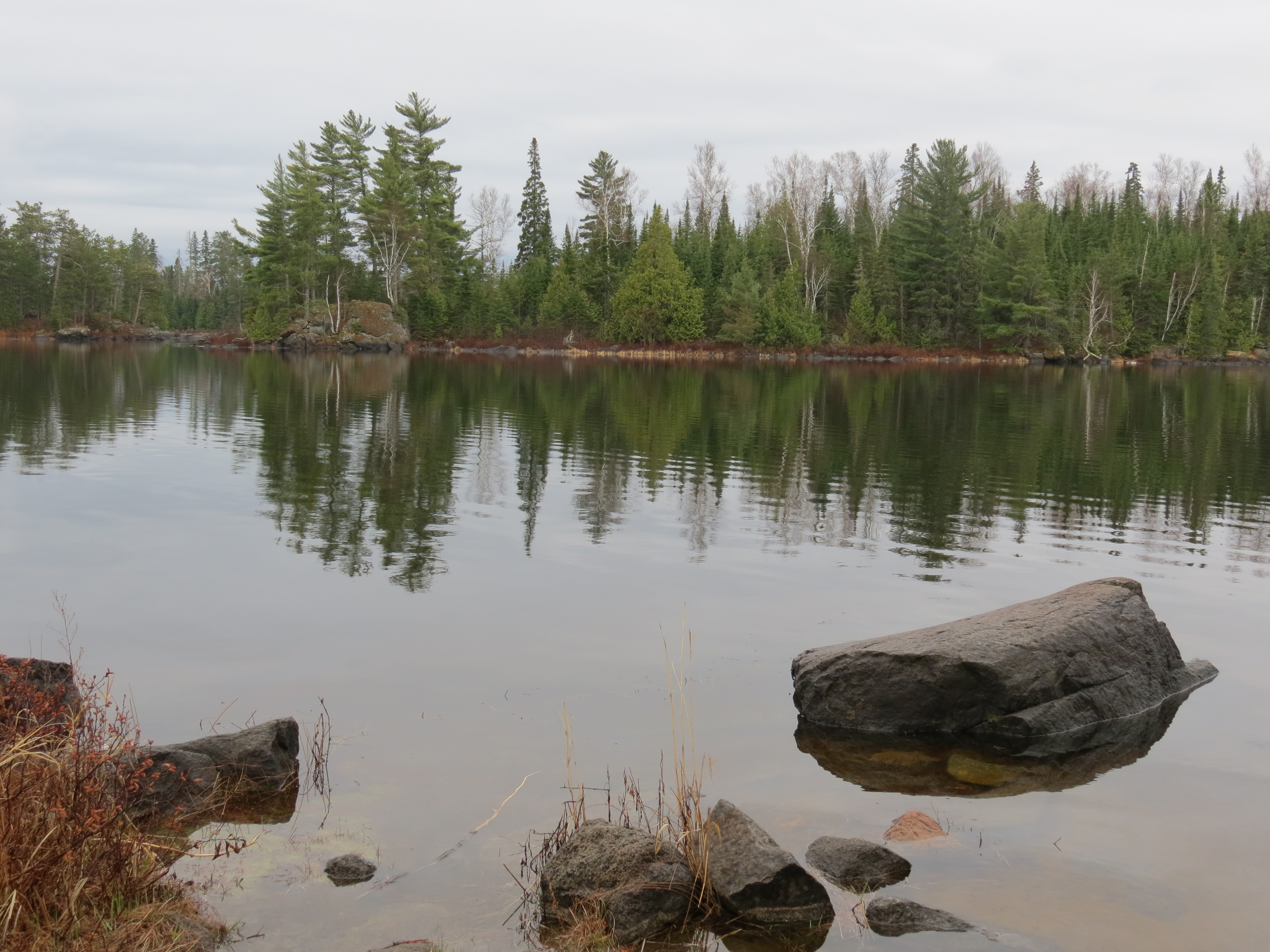
I got on the water on a bright 60 ish day (16 C), and in an hour found a decent campsite about 3 miles  (5 km) in  .  I was going to rest that day, but the forecast was good for that day and not so good for the next day, so I had lunch, hopped in the canoe, and portaged twice into Lake Two.  I expected a wasteland, but it was a mile before I saw any sign of fire.  But there were signs.  The campsites at the west end had some burned areas, and the beautiful white pines on the west end of the channel into Lake Three were no more, as that area had been subject to a back burn.

Channel between Lakes Two and Three, with tall burned white pine.

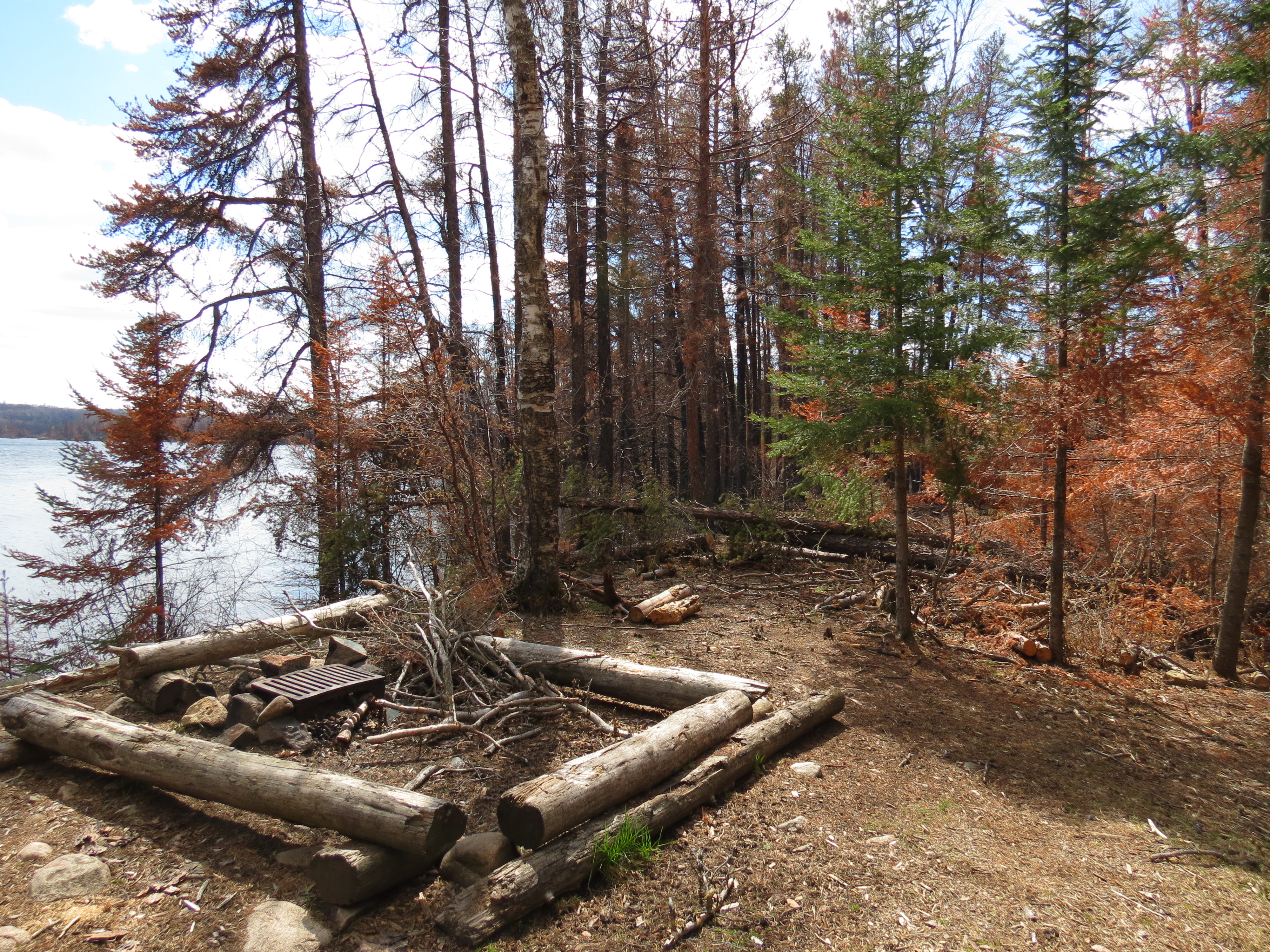
I paddled into Lake Three and was pleasantly surprised again not to see a wasteland but a significant part of the forest was burned.  There were mosaics of green amid blackened trunks.  The water was more turbid than usual, especially by the campsites, but also along the shore in general.  It will take some time for this to clear.  Some of the islands were scorched, others were completely untouched.  The south end was heavily burned, although campsites survived fairly well, in large part because most of the fuel in this area has been picked over by campers for their evening fires.

The wind was a little worse than I liked, and although a 2 foot chop is not difficult to handle, I needed to realize I had about 5 hours to explore, including time to get back to my campsite.  Wind, muck , and rapids are three things that can stop a solo canoeist, so I turned back to the north end and started to head back, stopping at one campsite that bordered the fire area.  The wind abated, so I took an open channel at the north end of the lake, which I had never before seen open, and went into the northeast bay.  The one campsite the late Mike Manlove and I had stayed at in 1993 was in the middle of a heavily burned area, and the north shore was fairly heavily involved.

Northeast Bay of Lake Three, heavily burned.

I had told everybody I would not go into Lake Four, and I believe firmly in never deviating from one’s itinerary, when one is solo. A lot of bad things can happen in the woods, and solo, what may be minor can become life threatening.  I looked around, took some pictures, and then headed back to the campsite on Lake One, the whole 13 miles (22 km)  or so taking me a little over 4 hours.

I had nothing to do when I returned so lay in the tent, not sleeping, but actually encountering a few mosquitoes, at least five weeks earlier than I am used to.  After dinner, the lowering clouds suggested that the next day might not be so nice, and I was really glad I got into the burn area when I did.

Indeed, I was awakened to the sound of rain, and I awoke under darker skies although no rain.  It was noticeably cooler, too.  I hung around the campsite for a while and then paddled about 1 1/2 miles down to Pagami Creek, far back in the depths was where the fire started.  I took a look at the western sky, and while the barometer had not changed, I did not think going further was a wise idea.  I turned around and paddled back to camp, arriving about 10 minutes before the first onset of rain.  It rained off and on through dinner.

I was really, really glad I hadn’t gone into Lake Three that day–wind, rain and cold weather would have made the trip a bad idea.  I have long learned never to squander good weather in the woods, be it 5 minutes or 5 hours.

I spent the evening looking along the shoreline for anything I could find.  Such scanning has found moose, beaver, otter and other animals.  This time, it was a raven and two crows who provided the entertainment.  The raven flew across the lake and landed in a jack pine across the small channel.  Two crows were beside themselves and called at him, each other, and probably to the general universe.  Periodically, the raven called, too.  I videoed the event, catching the raven flying off, still harassed.  Random scanning is often interesting.

The next morning, the tent was hard, as like a rock, and I went outside to see ice on the tent and snow on the ground!

Spider Web with frost

The stove was out of fuel, and while I had another cannister, it was cold, I was coming out of the woods anyway, and I had enough to eat.  I broke camp, got in the canoe, and paddled back to the landing.  The hardest thing I had to do was horse the canoe up on the car and tie it down.

I got my head back on straight.  I was out 2 days, and it felt like a week.  I saw the burned area, and next year, I have to go back one more time to Lake Insula, as sad as seeing the south shore will be for me.  I haven’t given the lake a proper good by, and who knows?  Maybe we can do our September trips there again, if I find the area isn’t too depressing.  One thing is clear–I need to tie the scholarship banquet in with a camping trip.

The banquet went well.  I met Ian Kimmer, the Friends’ person in the North Country, who presented the Friends scholarship.  I presented my two, stayed for the whole banquet, then headed south.  We’ll be back in September, headed out Fall Lake into Jackfish Bay on Basswood.  It will be a good trip.  All BW trips are.

Burned area.

Canoe with snow on it.