Archive for the ‘MY WRITING’ Category

DEATH IN THE YOUNG….AND SUICIDE, NOT BY COP, BUT BY POVERTY.

April 22, 2012

A while back, my wife got a call from an ultrasound tech, who was shaking, she was so upset.  A young individual, in their 20s, who recently had an uncomplicated appendectomy, had presented with abdominal pain.  There was gas in the liver and no portal vein was visible on the ultrasound.

CT was not performed with contrast, due to the elevated creatinine.  But another “old fashioned study,” a contrast BE, had shown, on separate days, nearly no movement of contrast except through a tiny lumen, suggestive of an intussusception.  I was interested in the fact that high tech studies, with high costs and high radiation doses, didn’t make the diagnosis in this woman, but controlling imaging studies and radiation in medicine appears to be another issue where I speak out alone.

The young person died.  Yes, people die here in Arizona from appendicitis and uncomplicated appendectomies.  I appear to speak out alone when I ask why we aren’t learning from these cases.  We should drive the mortality rate from appendicitis to zero.

This person did not live in Saddlebrooke, Cobblestone, one of the country clubs, and have a seven figure income or an eight figure net worth.  I am not sure who is going to pay for the costs of care, which were limited by the early death.  But how do the young and uninsured, who have appendectomies, or even mesenteric adenitis, pay for the costs of an ED visit with a CT scan?  Many are young, gorgeous, and broke, to quote Suze Orman.

I will ask my colleagues again where the money is coming from to pay for care for all Americans, since the young, who think they will live forever, won’t, and they can have catastrophic medical issues, including bad motor vehicle accidents.  We have pretty much tried to say vaccines are bad, radiation good, evolution didn’t happen, the Earth is a few thousand years old.  I am waiting for the concept that young people don’t get sick and the rest of us don’t really die.  I once reviewed a paper for a right-wing medical journal (volunteer, of course), that purported the FDA killed 10,000 people a year by not allowing drugs on the market.  The statistics in the paper were awful.  And I still remember thalidomide.

As a matter of fact, I wonder what will happen if we do away with social security and Medicare.  My wife and I will survive, so long as we don’t have a catastrophic illness, but when insurance companies will have premiums high enough to cover their overhead (read: eight figure salaries), we may become old, not so gorgeous, miserably ill, and broke.

Most people who live to ninety have some degree of dementia.  It is a fallacy to think we will live to a ripe old age, and then, just before bad things happen, quietly die in our sleep.  Visit a few nursing homes if you wish.  Heck, there is a life at any cost group that will keep me alive even if my wife doesn’t want me to suffer.  Or keep her alive, when I don’t want her to suffer.

The facts are these:  most women over 85 are widowed, and a lot fewer men.  Let’s look at the women.  Most are not living at La Paloma having nice dinners with their friends at 85.  Most are trying to get by, not clear what the bills mean, are subject to scams, can’t get around well, and fear for their safety.  Maybe they have children, maybe they don’t.  The children have lives of their own.  Come on, we all know the picture here.

Suicide by poverty will join suicide by cop as the new America.  We aren’t as fortunate as the African Dik-dik, who dies, when his/her mate dies.  Some of us just keep on going.  That’s fine, until we need to stop keeping on going.  I know what that is for me, and I have it in my living will, so clear that even somebody who lives in Arizona can understand it.

But I have left my point:  how do we figure out a way to care for people who have catastrophic needs at any age?  Is spending $400 billion a year on war (defense is such a nicer word, but it was once–and still should be–the Department of War) really appropriate?  After 9/11, I said that we needed covert operations, which would be far more effective, to deal with terrorism.  Two wars and a decade later, a small, brave group of men killed Osama bin Laden.  He could have been dispatched without the money and lives lost in either war.

In these pages, I have offered a host of solutions, not one of which has been adopted.  That is unfortunate, not because I didn’t get the credit, but because those who were in power have not solved the problem.  We can and will, as soon as we say, “We can care for everybody in America appropriately, and we can pay for it.”

Then it will fall upon us to figure out a way to do it.  Once we make up our mind it will happen, we will find a solution.  Heck, I might even come out of retirement to offer a few thoughts of my own.  Ten, twenty, and thirty years ago, they were ignored.  Maybe now they won’t be.

SEEKING FIRST TO UNDERSTAND, THEN, AND ONLY THEN TO BE UNDERSTOOD

April 22, 2012

Many years ago, as a hospital medical director, I attended a meeting we had with one of our payers.   I remained quiet throughout most of the meeting, and when the time was right, I spoke.  I process slowly, but I process well.

When I spoke, the mood in the room was tense.  I summarized the payer’s points, asking whether I was correct.  I wasn’t, so I continued summarizing until they agreed that I had understood them.  The tension went out of the room like air out of a balloon.  I don’t remember who “won,” but I learned something that day.

During my tenure as medical director, I received many complaints about the hospital and doctors, and I handled them the same way.  Rather than defending, I summarized the complainant’s points, discovering that I could hear tension go out of a telephone conversation, too.  People were amazed that somebody was listening to them.  Sometimes, that’s all people want.  Try it with your spouse some time.


I was asked to debate climate change.  I try to do things that will make a difference, and my debating climate change is not going to change policy.  Debating requires good public speaking skills, which I have, but only when I teach.  I doubt I will teach anybody anything in a debate.  Debating also requires fast processing skills, which I do not have.  That is why I am a writer.

Debates also have other problems, too.  They have winners and losers, and winning and losing have become toxic.  The desire to win has overshadowed the desire to look for new solutions.  Steve Jobs was deeply flawed, but he had the ability to move people to find solutions to problems that they thought impossible to solve.  We need that sort of approach in medicine.  Debates don’t offer it.

In medicine, we would have done well to have first studied the efficacy of  CABG, CEA, angioplasty, stents and EC-IC bypass.  Had we, millions of people would have been helped or not harmed.  Of the five, only EC-IC bypass was properly studied, and we found it didn’t help.  The scientific method is more helpful than the often screaming debates I heard, sometimes directed at me in the case of CEA.

In the past 15 years, national discourse on many topics, at one time bipartisan, disappeared. There are several reasons, but it is a fact that many issues that are scientifically based, and should be treated that way, have become politicized. Such polarization is toxic, and it can be transmitted.  I caught it.

The idea of seek first to understand, then to be understood, Covey’s Fifth Step, is one of the most powerful.  It goes with “if you want to influence people, you must first allow yourself to be influenced.”

I’ve also been guilty of misuse of the language, using such words as “most”, rather than “many”; adjectives and adverbs I chose might have been better.  Words matter.  I am deeply concerned about Internet anonymity and the loss of critical thinking skills; lessening of emphasis on science and math education might be the cause.  Apple outsourced to China in part because we didn’t have the engineers here.  We have far too much name calling, prejudice–not just in the racial or religious sense–but politically.  For those like me, who process very slowly, this fast-paced prejudice puts me at an disadvantage, for if I process, often the conversation is over without my participation, and if I don’t process, I risk saying something I later regret.

I’m often glad I’m pushing 65.  It isn’t always fun, and with each passing year, like the great tight end Jerry Rice, I have to work harder and harder to do the things I have done all my life, knowing at some point, I will have to hang those things up.

But I am glad I won’t be alive in a world that will be people rich and resource poor.  Wilderness will disappear.  Quiet is disappearing, too, along with our great heritage of dark skies.  I do not want to live in a crowded world, where I can no longer find solitude in the wilderness and feel more comfortable there than with a lot of people.  The first thing I notice in Europe and Asia is the pushing and shoving.   The second thing I notice is the smoking.  The third thing is the relative lack of obesity, the fourth the number of solar panels in a latitude 20 degrees further north than the one I live in.  Europe has wonderful public transportation, polyglots, downtowns that work, and good use of the available space, which is not a lot.

There are many softer words in our language; we would do well to use them more often, in hope that maybe others will catch on.  We need to discuss medical care in this society, not debate it.  I don’t know what the right system will be, but many of us think it needs to be changed.  The irony is that not all of us are doctors or payers, but all of us are patients at one time or another.  That gives us something in common.  How should patients be treated?  How do we pay for it?  How do we do what is necessary and avoid what is not?  How do we die, when it is time?  When and how do we deny care, because we simply can’t afford it?

It is easy to criticize.  It is far more difficult, but far more rewarding, to first ask “Let me see if I can summarize what you said, for it is very important I do so correctly.  Please correct me if I make any mistakes.”

I hope I am not mistaken when I say that hopefully we still have time.  But not much.

ROWE SANCTUARY, 2012

April 12, 2012

This was my fourth year volunteering at Rowe, and the crane viewing was the best I’ve seen.  I flew into Kearney and was picked up by Margery Nicolson herself, the widow of the man for whom the center is named for, Iain Nicolson.

I hit the ground running.  Three hours after arrival, I was guiding a group to Stevie’s Blind, the first of the 19 consecutive tours I would guide.  We were busy; for the first time, I experienced all 5 blinds being open simultaneously.  I was in Jamalee 7 times, Stevie 5, East 3, Tower 2, and North 2.  All the trips were good for crane viewing.  I got to see cranes in the fog one morning, which was very special, as the birds appeared like ghosts in fog as the light slowly increased.  A few took off, but it was special, and there were remarkably few birds we saw, although we heard thousands more!!

Crane taking off in fog.

As a guide, I speak with my co-guide before we go to the blinds.  In the evening, we have a lot of time, because we usually arrive at the viewing blinds 30-45 minutes before the cranes land.  I try to show my enthusiasm at the beginning, then mention why the cranes come to the Platte every year.  Then, I go through crane viewing etiquette.  We have to be silent, nothing can protrude through the plane of the outside wall, and if anybody needs to use the Portapotty, they have to ask permission, so we can open the blind door quietly.

We return in the evening as a group.  Once people are in the blind, they must stay there unless there is a medical emergency.  Those take priority.  Personal inconvenience does not take priority over crane inconvenience.  Those who are hungry, cold, bored, or otherwise not interested, thankfully a very small number, have to live with being on a tour for two hours.

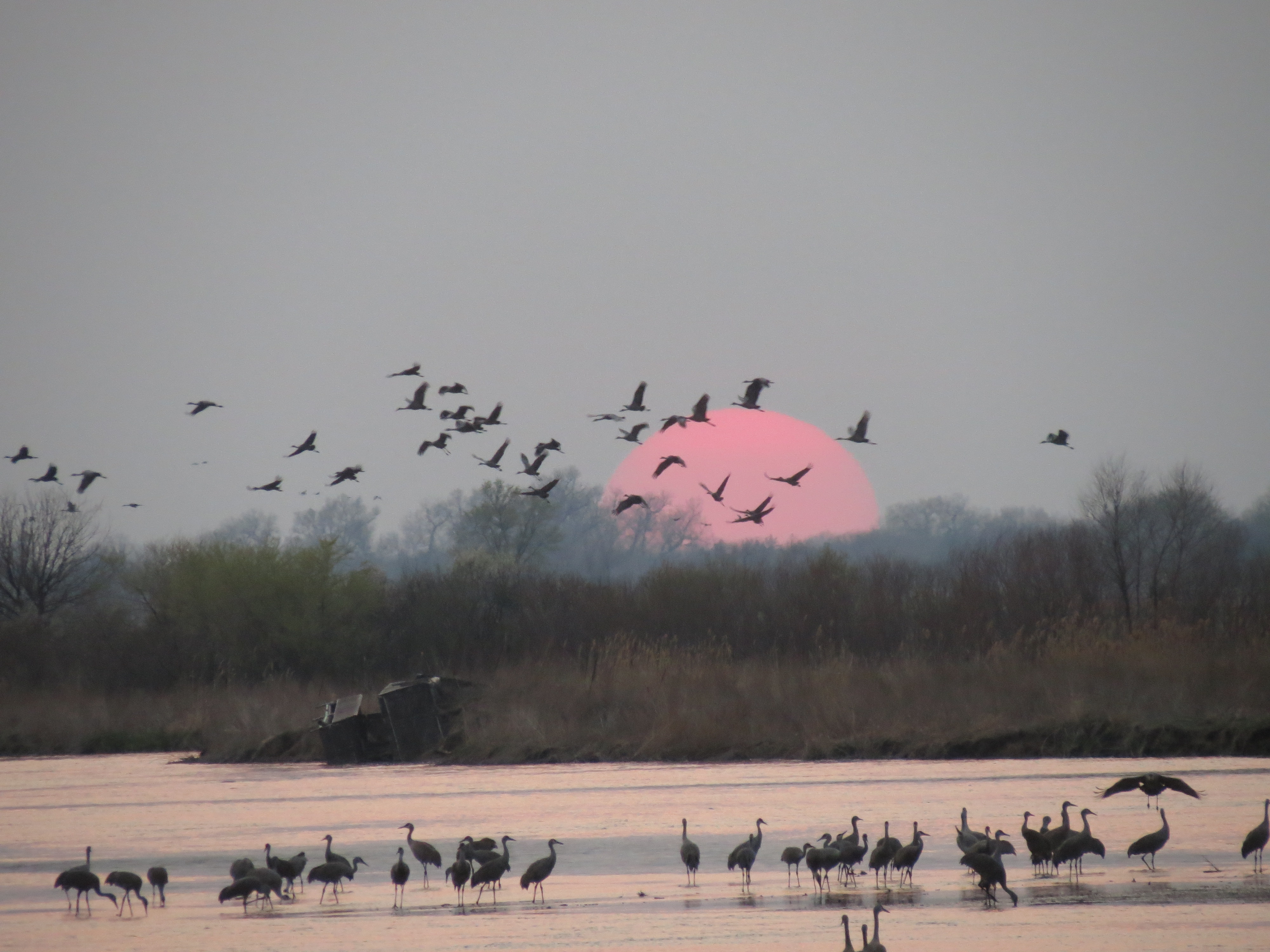
Photography is a big issue and at times a problem.  All flashes must be turned off and even taped, if there is any question.  The automatic focuser must be taped, so no light can show.  This does not affect the photography.  I ask for automatic rapid fire photography to be shut off, and only manual shutters to be used.  I have had photographers brag about 8 GB of photos taken, and one person told me that he had taken 3000 pictures during one blind session, averaging 40 a minute.  I have to wonder how many of these pictures are ever looked at over and over again, and how many pictures one needs of a Sandhill Crane, if that individual is an amateur.  I find the sunsets striking, and the great flocks of birds flying at sunset are wonderful to see.

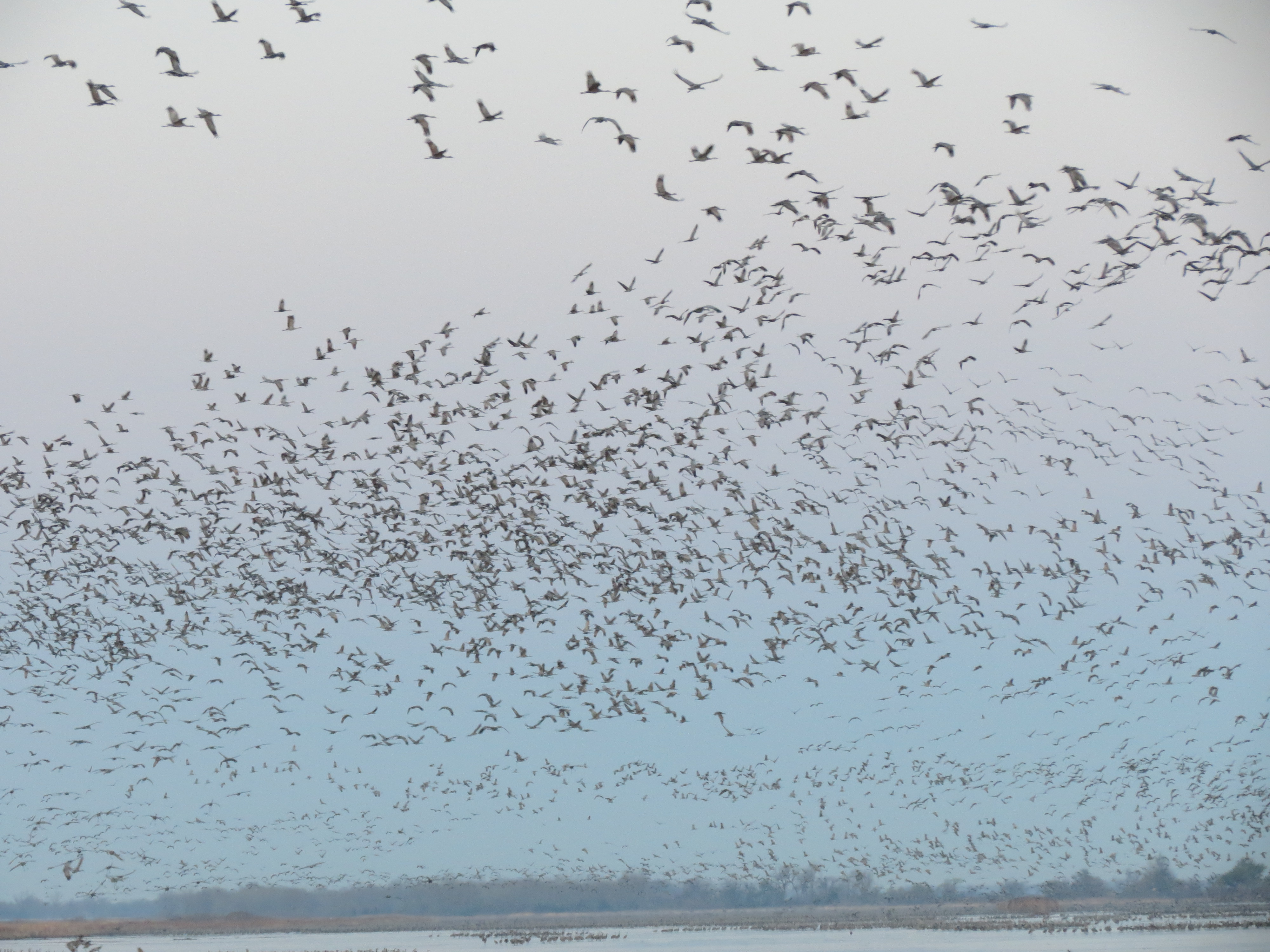
On the river and a large group overhead.

The problem with photographers can be severe at times.  In 2011, one man had his camera lens protrude about 15 cm (6 inches) outside the blind window.  I told him 3 times to bring it inside, and he got upset each time.  The third time, he was visibly shaking with anger, and his wife had to calm him down.  I have the right to make him sit down and take no more pictures.  That is a personal inconvenience, not a medical emergency.  If we spook the cranes at night, they may hit nearby power lines and die.  That must never happen on my watch.

I have had people get angry with me for taping their camera, when they think all is fine.  I ask them to point the camera at me and shoot a picture of my ugly face.  If I see any light, I make them tape the camera shut.  I have that duty.  We put post-it notes over the LED screens, to decrease reflection off the face.  The problem we are dealing with more and more is the sound from cameras, which clearly detracts from the experience of hearing the sound, at least until it gets too dark.  There are three, two-person individual photography blinds at Rowe, but they are booked in advance, and the waiting list for cancellations is equally heavily booked.  We don’t have a solution to this problem yet.  Cell phones must be turned off as well.

If we have time in the evening, once we arrive in the blinds, I can talk about crane facts.  In general, however, more and more I allow people just to look and experience the phenomenon for themselves.  The good guides I trained with did that, and I try to emulate them.

Mornings are more difficult, because we need to get to the blinds early, before it gets light.  Therefore, about the only things we can say are welcome, this is a wonderful experience, few know about it, and these are the rules.

Large flock of cranes. The true words for plural are sedge, siege, or herd. But we use flock.

In the blinds, if people have questions, they ask me, and I will spend as much time as I can with them, so long as they are interested.

In the evening, we must leave as a group, because the cranes are on the river.  In the mornings, we leave at 0830, but often, I or my co-guide will stay until 0900, for those who wish to view longer.  After that time, there may only be two or three people, and so long as they are quiet, most of the birds are off the river, and it is not a problem for them to leave alone.

I have other pictures, the best I shot, at the following link.

Cranes over setting Sun.

I love the guiding, for I get to teach and watch cranes, and there isn’t much better in my life in Nebraska than those two things!!

MUST WE DEBATE EVERYTHING?

April 4, 2012

1983:  I am in court testifying that a woman post cardiac arrest is irreversibly brain damaged.  Her husband wants to discontinue support; her sisters sued to keep her on the ventilator.  Nothing I said in the hospital had changed the sisters’ mind.  I knew the science and the outcomes of persistent vegetative states after cardiac arrest, and I agreed with the husband.  Eventually, he prevailed.

February 1988:  I show a nurse the conjunction of Saturn and Uranus in the morning sky.  She said they were in Capricorn (the proper name is Capricornus), but the two planets were visibly in Sagittarius.  I argued with her for 5 minutes before realizing nothing I said would change her mind.  Their next conjunction is in 2032.

Later, a man got a great deal of publicity for supposedly having discovered a new planet near Neptune.  I got a call at home from the man, who told me the planet was moving rapidly.  I stated that at Neptune’s distance from the Sun, the planet would move about a finger breadth at arm’s length every year among the stars.  No matter.  The man was convinced.  Nothing I could say would change his mind.

A physical therapist took me to lunch and told me that manipulation of the bones in the skull got rid of headaches.  I told him that skull bones were fused in adults.  No matter.  “It works!” he said; nothing I could say would convince him otherwise.

1984-1994: I said that the science underlying asymptomatic carotid artery stenosis meant that operations should be done only if the surgeon had a complication rate of less than 0.5%.  No matter.  Many were done at the hospitals I practiced; the major complication rate was 14%.  I got screamed at and threatened a few times, for intimidation, repetition, and reputation often trump facts.  I did not prevail.

2005:  Terri Schiavo.  Senator Frist, a physician, said she had cognition, despite clear evidence she was vegetative (smiling is part of the vegetative state).  Congress intervened briefly, an example of government’s dictating medical care if ever there was one.  Fortunately, science (amicus curiae brief by the American Academy of Neurology) and the court prevailed; indeed, the 600 gm brain with large ex vacuo hydrocephalus at autopsy confirmed what we neurologists knew.

March 2012:  I am in Tower Blind at Nebraska’s Rowe Sanctuary, guiding people to a suitable place to see the Lesser Sandhill Crane migration, one of Jane Goodall’s top 10 sights in nature and one of my top three.  As we waited for the cranes to land, my co-guide, an elderly woman, told me how she saw an egg stand upright on the recent equinox.  I said that can happen any day of the year.  The equinox is an instantaneous point in time, like the tangent to a function, with no influence on egg behavior.  No matter.  She was convinced.  Nothing I could say would change her mind.

More people believe in astrology than know why we have seasons.  Many believe we didn’t land on the Moon, that strange lights in the sky are aliens, who may abduct us.  A woman doing the luge at the Olympics held her neck in a certain way to “increase vertebral artery blood flow to the brain”; holding her breath would have been better.  Each of us has heard some remarkably odd ideas from people, totally convinced, totally wrong, about how the body functions.  Laetrile and colonic cleansing come to mind.

Our Sun is at least a second generation star, for elements heavier than iron must form in supernovae.  I believe in evolution and that vaccines are several orders of magnitude more helpful than harmful. I wish in the above instances I asked a simple question:  “Is there anything that you could learn that would convince you that you are incorrect?”  If the answer is “nothing”, then I am wasting my time.

We should change our beliefs when sound science shows that our beliefs are wrong.  When I learned that anticoagulation did not help vertebrobasilar insufficiency, I stopped using it.  When physicians at the University of Western Ontario discovered EC-IC bypass didn’t improve outcomes, they discontinued the operation.  They discharged four patients that very day.  There are many issues in medicine that we should study, in order to do the best for our patients; after all, each of us will be a patient.   We should discuss, not debate, the way we need to change American medicine, because I believe few are happy with the current situation.  We need to listen to and understand other points of view.  We must be willing to try new approaches, in order to learn from and modify them.  We need leaders able to convince people they can do great things that they never thought possible.  We need to use the best science available, even if it shows that our beliefs are wrong.

Children are born curious; alas, too many have it drummed out of them.  Perhaps if more were curious, we would look for answers, discover what we thought was true wasn’t.  That to me is moving forward.  Could I be wrong on climate change?  Yes. I don’t think I am, but yes, sound science could change my mind.  But I would rather discuss how we are going to fix medicine, locally and nationally.  My error reporting system has languished, unused, for 11 years.

I hope I am wrong about human-caused climate change; if I am, I will admit it.  Promise.

LOONS, WOLVES AND OTHER NATIONS

March 13, 2012

Years ago, loons were killed in Minnesota, because they had the gall to eat fish that fishermen wanted to catch.

Anybody who has traveled the boreal wilderness knows that without the sound of the loon, the scenery would still be there, but the experience would be lost.  I have awakened on hundreds of nights to hear the sound of loons calling.  They have four different calls, and I love each of them.  Those who have not heard a loon in the wild, and that would be most, have missed one of nature’s great sounds.  Gavia immer is a heavy bird, because its bones are solid, not porous, so it can dive and stay underwater for a significant time.  The bird needs a few hundred meters to get airborne, but flies at 60 knots.

The wonderful ability of the loon to do so much is not unique.  To me, animals are other nations, not something we should destroy.  Loons are superbly adapted to the boreal lakes.  What will happen to them as we continue to overpopulate the Earth and damage their habitat, may spell their doom.  It’s just a bird, some say.  Well, there are many Americans who dehumanize humans by calling them Kaffirs, ragheads, and words I will never dare say to myself, they are so ugly.  Femi-Nazis has been used by Rush Limbaugh, along with his other vile comments.  Dehumanizing your enemy is perhaps a great way to win arguments and wars; however, the cost is horrific, not just in war, but how it has polarized American society.  Another way, common in my experience, is to take their words out of context, and deliberately replace them with charged words.  A lawyer did that to me one time in court, and I called him out on it each time. He finally threw a book at me.  In court.  Literally.  But I have others who do the same, former colleagues, some of whom owe me a lot, for what I have done for them, and I call them out on their language, too.  Words are important.

Fortunately, in the case of the loon, a few wildlife biologists did some good science to show that fish eaten by loons really did not adversely affect overall fish population.  Nature regulates populations well, and nature will regulate us, too, should we fail to do so ourselves.  What did affect the fish population were those who caught and didn’t release large fish, the breeders, who kept the population alive.  I know some guides, if they have a client do this, quietly go to another area on a lake to ensure their client catches nothing more the rest of the day.

During the Great Leap Forward, the Chinese killed the sparrows, only to realize later that sparrows kept insects in check.  Before one disparages the Chinese, we kill coyotes, which keep rodents in check.  Most everything belongs, including wolves, since they are, after all part of the ecosystem.  What is remarkable is the number of people, who profess being religious and patriotic Americans, who believe removal of predators a good idea.  In Alaska, people killed the national bird, the Bald Eagle, which is remarkable for a group that prides itself on being “real Americans.”  How many of you have seen a Bald Eagle or a wolf in the wild?  Perhaps it doesn’t matter, any more than reading a great book or listening to great music.  But I am better for having seen eagles, reading books, and hearing music.  Seeing a wolf in the wild, both of us alone, 4 meters away, was one of the best experiences in my life.

We face tough choices.  We have too many invasive species, and we must decide how to handle them.  None of the answers is easy.  We can bring in species to kill species, but new species can become a problem.  We can poison lakes, kill the fish, and then restock, hoping to remove invasive species.  Tucson Arundo removal is trying to remove one invasive plant.  Alone, over 10 months I removed 20,000 buffelgrass plants, another invasive species, in 8 acres, battling snakes, and heaving heavy bags up a berm.  Buffelgrass was imported from the African savannah into Mexico for forage about 80 years ago.  It was a bad idea.

Three months after I finished my work, it was like I had never been there.  Nobody cared.

There are no easy answers.  Sadly, there are plenty of talk show radio hosts and others who act as if there were.  Most of their answers are less government, which frightens me, less taxes, and more freedom.  Having seen how people trash the wilderness, even when they know the rules, I am frightened when I think what would happen without regulation.  Without regulation, we would have lodges all over the Boundary Waters and have dammed Curtain Falls, ruining Crooked Lake.  How many of you have seen Curtain Falls?

We would have logged every bit of forest, and we would have cell towers everywhere in the wilderness.  As I write, PolyMet wants to put a molybdenum mine in the headwaters of much of the country I love.  The company lawyers and managers say it will be safe.  Everything is safe, until suddenly it isn’t.  There won’t be an accident with the pipeline from the Canada tar sands to Texas, either, until there is one, and the Ogallala Aquifer is destroyed.  The Alaska pipeline was safe, until 1989.  Three Mile Island was safe, until 1979.  Unregulated, we would trash the forests, pollute the wilderness lakes, cut down all the trees, mine, and get rid of every government regulation, because people will do the right thing.

Yeah.  Right.  Have somebody tell you what it is like on opening fishing day for salmon in Alaska.

Eventually, of course, like the forests world-wide, the salmon, and the cod, the biomass will disappear.  A few will become very rich, support those who lie their way into public office and keep the cycle going.

Glad I won’t be around when the bill comes due.  Also glad we don’t have children who would ask why I didn’t stop it.  “Because I couldn’t” seems pretty weak.

GIVING BACK TO THE COUNTRY

January 7, 2012

In the visitor’s center in Waldport, Oregon, mid-way down the Oregon Coast, is a sign that reads:  Federal Emergency Administration of Public Works, 1936, Project #982.

This project was a bridge over Alsea; the river flows into the Pacific about 0.5 nm after the bridge crossing.  The original bridge no longer stands, having been replaced by a new span in 1993.  Outside the visitor’s center is a wall covered with plaques of names of people, who wrote their names, all volunteers in helping with traffic, explanations of the need for a new bridge, and other jobs.  At the top, on the right side, are the names of my parents.  My father showed that to me in 2003, his last summer up there, and the only one of the 30 summers he spent there alone.  I will not visit Waldport without looking at their plaque.  This is sacred ground for me. This time, I viewed it with sadness, happiness, but no tears.

I don’t believe in turning back the clock to the “golden days,” which weren’t so golden (cars broke down a lot, more people died in transportation accidents, Jim Crow, the Poll Tax, and the KKK were all alive and well), but I do believe in learning from history.  I had hoped we would have learned from Vietnam, before our “misadventures” in the Middle East.  We didn’t, other than to support the troops, so long as most of us didn’t have to change our lives one iota.

I also believe that maybe we can learn from the ideas engendered by the Great Depression, where we put people to work–honest, hard work–rebuilding this country’s infrastructure.  It used to take several weeks and ferry crossings to traverse Oregon from north to south.  Now it can be done in a few hours, although the coast itself should require a few days.

A few kilometers south of Waldport is Cape Perpetua, about 300 meters above the Pacific with a trail, a tunnel through rock, and a park that was built by the CCC, whose abbreviation everybody should know.  We need a new version of the CCC, a need for volunteerism, a need for giving back to this country.  I had hoped in 2009 we would see this, but I was wrong.  We need it, and I know I am right.  I am often right, and I wish I weren’t.  I wrote a column on that a while back.  I make mistakes, but I admit mine, and in the need for mandatory national service and volunteerism, I am about as right as I can be.

We need those who have to give freely to those who do not. Interestingly, this is one of the five tenets of Islam.  That statement, I’m sure doesn’t go over well, but fundamentalists of all sorts are dangerous.  American fundamentalists blamed Katrina on homosexuality, rather than on a rather normal way for the Earth to remain in heat balance.  That is, of course, why we have tropical and extra-tropical cyclones.

We need those who have to give freely to their country, by giving of time to a variety of secular organizations in this country.  I have no problems with people who give to religious organizations, but to me giving to the country as a whole, in some other way than to a specific religion, is required.  I can name several possible places, besides rebuilding our infrastructure, so that Interstate bridges in Oklahoma and Minnesota don’t fall into rivers, trains don’t derail near Kingman, because water washed out part of the rail bed.

I think we need volunteers in the public schools.  We need people to tutor, before, during, after school and on weekends.  We need people to help kids of all sorts get outside and exercise more, as well as to teach good eating habits.  That might help with obesity.  We need people to actually measure some of these outcomes appropriately, the way I did for free, so we know what works and what doesn’t.  Things that don’t work are still good, if we learn from the mistakes.

I think we need volunteers in animal shelters and to teach the next generation about care of animals, which correlates highly with care of people.  Animal cruelty in the young is a red flag for real trouble as an adult.  Did I mention that leg hold traps and cock fighting used to be legal?  How about two other words:  Michael Vick.

We need people who are fluent in other languages to help out in public places, be it airports, hospitals, or national parks.  One of my dreams, that probably won’t become reality, is that I will be able to do that adequately in German some day.  We need volunteers to teach people how to read, since a frighteningly high percentage of Americans cannot.

I see volunteers who wear large V pins, red, white and blue if they are a veteran, blue (for justice, since that is what the blue in our flag stands for).  They can have stars for 1000 hours, and they would pay for the pin, a nominal cost, whose funds would be used for something special in this country.

I think citizen science should count as volunteerism:  the annual Christmas Bird Count is one example, where we have learned a great deal about birds, including the fact that nearly two-thirds have moved significantly further north in the past 112 years.

We need volunteerism.  Oh, there would be mistakes, but it would help. I went to Senator Jon Kyl’s office to push the idea.  I received a letter from him saying it was a bad idea.  Senator Kyl has never worn the uniform of his country.  The fact he doesn’t support it doesn’t mean I can’t.  There is nothing stopping me from getting a red, white and blue V pin with four stars on it, wearing it in the schools, where I teach children math, physics, chemistry, or English.  I’d love to wear one in the canoe country of Minnesota, where I’ve logged over 1000 hours.  I’d wear it at Rowe Sanctuary in Nebraska, where I have logged about 500 hours.  Maybe a few people might be curious and ask me what it is all about.

$15 MILLION…. FOR WHAT?

January 3, 2012

Two years ago, volunteers from the U of A and Pima County Medical Society (PCMS) assisted several schools in Tucson to weigh and measure 6th grade students.  I inputted much of the data and did the entire analysis.   We had a census, not a sample, of 1100 students in 5 schools.  We learned that the median body mass index (BMI) was the 89th percentile, 14% were above the 95th percentile (5’3”, 150 pounds), and 7% were above the 99th percentile. The typical student was obese. One in 14 was massively obese (5’, 220 pounds).

These are the most complete data on obesity prevalence I have seen.  What has been quoted nationally has been a sample of 40,000 teenagers.  With volunteers, we obtained complete data on 1100 6th graders in one city.  School administrators told us these data would be taken to other superintendents.  We heard nothing; our calls and e-mails were not returned.

Tucson still has the chance to be the only place in the country where we could know the BMI on every 6th grade public school student.  We could do it at virtually no cost with volunteers.  What we would discover is not known, but these data suggest we have a major local problem with obesity.

I am discouraged that as far as I have determined Activate Tucson has not considered determining the scope of the problem.  Unless we know the obesity prevalence annually, we will never know if what we do is worthwhile.

We need only the following:  permission to come to each school for two days, the second day to measure those who were absent on the first, a scale, a tape measure, somebody inputting the data, and somebody to analyze it.  As both a physician and a statistician, I am willing to do the last two for free.  U of A nurses and retired physicians are willing to volunteer.

In 2009, I hoped for national volunteerism and mandatory national service.  I hoped that we would actually count something important, count it right, and then determine what we should do with the data.  I hoped we would do away with the “fluff” that so many community activities have had, and I hoped we’d finally do something right in Arizona.  I was wrong.

The schools have ignored the data, the community isn’t interested in dealing with facts, we have significant numbers of obese 12 and 13 year-olds, and those who have $15 million to spend have not shown a way to prove whether their actions will work.

I am disappointed but not surprised.  I live in Arizona.


TOUCHING OTHERS

November 13, 2011

I never knew Jamalee Fenimore or Stephne Staples.  Nobody who reads this knew them, either.  Both of them loved the Sandhill Cranes, as do I.  Both have a viewing blind named for them at Rowe Sanctuary in Gibbon, Nebraska, at the southern bend of the Platte River.

Every spring, the Sandhill and the Whooping Cranes, the most and least common of the 15 worldwide crane species, begin their 5000-7000 mile migration to the subarctic in North America and Siberia.  Their final staging area is on the Platte River.  They go to the Platte because there is food nearby–formerly small animals, but now mostly corn–and because of the safety that one of the largest braided rivers in North America affords.  They feed in the adjacent fields by day and roost in the river at night, where the shallow water allows them to hear predators approach.  Before the Platte was dammed and water used for irrigation, recreation and drinking, it was a mile wide and an inch deep, “too thick to drink, too thin to plow.”

Now, the Platte in many areas contains less water, has invasive species and many trees nearby, limiting the suitable habitat to 50 miles from the former 200.  Rowe Sanctuary manages 4 miles of river and owns 1900 adjacent acres, preserved as habitat.  Every night, for 6 weeks in March and April, up to 600,000 Sandhill cranes, 90% of the world’s population, roost in the river.  Every morning, they leave.  It is a spectacle that Jane Goodall has called one of the world’s best.  I’ve been fortunate to have seen many great sights in nature.  This one is in my top three; seeing a solar eclipse and a wolf in the wild are the other two.  I love the cranes so much that I volunteer at the Sanctuary, along with dozens of others, helping the full time staff of four–that’s right, four–show visitors the cranes from viewing blinds, for cranes are shy birds and will not let people near them.

Many talk about the cranes that migrate to Arizona.  I simply reply, “You don’t understand.”  And you can’t, until you witness the a flock of fifty thousand cranes, darkening the sky.

Stevie Staples mentored one of the Rowe Staff and lived 74 years, dying in 2006 from cancer.  She was a former canoe racer and a real character.  I once raced canoes, and I would have loved to have discussed racing with her.  She touched the staff at Rowe.  She knew it, for she did live to see a beautiful picture of a Sandhill Crane in flight with her volunteer tag with “9 years of service” on it.  The picture hangs on the wall in the hallway of Rowe.  A picture of Stevie’s receiving the picture from the Rowe staff hangs in Keanna Leonard’s office.  Keanna is the dynamic educational director at Rowe.

Jamalee Fenimore grew up in Nebraska and practiced veterinary surgery in Washington State.  She died of cancer far too young at 49, donating her estate to Rowe.  Nobody at Rowe knew or remembered her being there.  But obviously, she was touched by the river, the cranes and the sanctuary.  We volunteers learn that we may touch visitors in ways we never know at the time.

When I volunteer at Rowe, I work 17 hour days, sleeping on the floor in the sanctuary so I can hear the cranes on the river in the middle of the night.  I guide people to the viewing blinds, and I teach them everything I know about cranes.  Mostly, however, I let people look at the sight, staying silent, so they can hear the birds.  I clean toilets, paint, greet people, make a noonmark, build a sundial, do whatever needs to be done.

On one tour, I took a disabled person to Stevie’s blind in an electric golf cart.  Had he been able to walk, all of the group would have gone to Strawbale blind, which had better views at that time.  But we still saw many cranes, American white pelicans, and unusual crane behavior.  My rider loved the view and tried to tip me, which I of course refused, asking him to put the money in the container at the sanctuary.  I planned to talk to other clients, because as the lead guide, I hadn’t spent time with them.  But I spent time with this man.  He was originally from Singapore; when I told him I had been there twice, his first comment was “Thank you for saving my country.”  I’ve never heard that before, and it did me good.  I hope I and Rowe did him good.

We touch each other in ways we may never know.  Good people spread kindness throughout their world.  The lucky ones receive that kindness or are those who live long enough to discover that their kindness was deeply appreciated and honored.  But all who spread kindness are fortunate that they have the ability to do so.  Stevie knew in her final days that her kindness was appreciated.  I hope Jamalee Fenimore did, too.  But if not, I know she knew she was doing the right thing.  I deeply appreciate what she did.  And every time I guide people to either of the two blinds, I tell them the story. Both women deserve to be remembered.  To have a viewing blind named for you on a river where a half million cranes visit every March is a wonderful honor.  I really can’t imagine a better one, frankly.

JUST CUBANS

October 27, 2011

In 1900, Cuban meteorologists knew a big hurricane was going to strike the US.  We had our own US Weather Bureau (as it was called at the time), and since we were Americans, and Cubans were–well, Cubans–we did not believe them, even though Cubans had a great deal of real world experience with hurricanes.

The 1900 hurricane that destroyed Galveston is to date the single biggest weather disaster to strike the US.  The destruction of the city was not preventable; the massive loss of life was.  Unfortunately, arrogance trumped science and listening to people who might know what they were talking about.  It is a recurrent theme.  Congress passed a resolution stating that man-made climate change is not occurring.  I wonder when they can tell me when Tucson’s average temperature for a year will again be normal.  It has been above normal every year since 1984, and the normals have been raised 3 times.

While they are at it, perhaps these same people can tell me when Tucson will again have normal rainfall.  It isn’t just warming, it is ocean acidification, changes in rainfall patterns with floods and droughts longer lasting, and earlier springs, affecting animal life.  Two-thirds of the birds in the Christmas bird count have moved significantly northward.  Dust from Chinese pollution is falling on snow in the Rockies, leading to earlier snow melts and changes in water level.

A while back, a person challenged me to “prove” global climate change without using models.  As a scientist, and especially as a statistician, I use models as a way to depict the world.  A model is a map, and I would no sooner work without models than I would go into the wilderness without a map.

Perhaps this particular individual, who sold real estate in Phoenix, had no use for models.  After all, the mathematicians who created models for the housing market assumed that housing prices would never fall, which is a remarkably dumb assumption.  Worse, purportedly smart people believed these mathematicians.

I work with models in statistics; I use and am familiar with at least nine different weather models for predictions.  Would we do away with models for predicting a hurricane’s path?  Maybe we will, in the new America.  After all, models are an attempt to use science, and many presidential candidates are already anti-science, even as they use aircraft, electronic devices, and the media, all of which were developed by science.  Many are alive today, like me, because of science.  To deny science is to turn back the clock, and  that deeply disturbs me.

I hope everybody noted the science used with Hurricane Irene.  The models originally had Irene hitting Florida, then progressively changed as new data came in.  This is science at its best, changing predictions in the face of new data, not being afraid to admit that the Hurricane might miss the East Coast altogether, but that it would be unlikely to do so.  Should we just hope?  Is that the new America?

Why should I have my hands tied when I am asked to prove something?  We do guess what natural phenomena will occur.  But why should we do uneducated guessing?  Are the models right?  No, they aren’t.  If anything, they are under predicting the severity of climate change.  And they might be wrong, although they have confidence intervals, which is a measure of uncertainty.  If you don’t understand confidence intervals, that is fine.  You just shouldn’t be arguing against climate change.  True scientists admit where there is uncertainty, try to define it, and draw conclusions, just as clearly as physicians tell their patients what they can expect, knowing that there is a certain degree of uncertainty.  Unfortunately, many physicians, being human, are often shocked when they learn how their brain can play tricks upon them in dealing with uncertainty.  (How many people do you need in a room before it is more likely than not that 2 have the same birthday?  Answer:  23)

If I lived on the east coast, I certainly would not be using my spiritual beliefs to predict whether a given hurricane would strike near my house.  I would be tuned into the National Weather Service and looking at what the models show–the cone of uncertainty and the probability of a hurricane’s striking me.  To do anything else would be stupid.

Since I live in this world, I am using what scientific models I can find to determine what the world will be like in the next 30 years, hopefully my lifetime.  I know these models aren’t accurate, but I believe in facts such as ice core analysis, oceanic warming, oceanic acidification, and what appear to me to be major changes in rainfall patterns, with three 500 year floods in North Dakota in the last 15 years, a prolonged drought here, and in Africa.  Perhaps I am just over worried and not scientific, but again, maybe this is all normal.  If it is, perhaps somebody could tell me when we will return to the temperatures and the rainfall that we used to have.

I just want an answer with a number, the word “years,” and a confidence interval. I don’t need any reading material.  How long?


HARRY TRUMAN WOULD HAVE KNOWN WHAT TO DO

October 26, 2011

I had a a screening colonoscopy recently, which went very well.  The process for check in, the procedure, and the departure went smoothly.  It ought to.  This center does thousands a year.

The bill for everything was about $4000.  We know that screening colonoscopies catch early cancers and can be treated at the same time.  It is a great test.  It helped me 10 years ago.  Early colon cancer, as far as we know, is completely treatable, and this is one of the common cancers.  We cannot say that for sure about breast cancer, because it is entirely possible that many of the early cancers might stay that way.  But certainly screening mammography has some value.

Here we are, with an expensive test that clearly can save lives.  You can think of many others.  I had insurance.  If I didn’t, well…. I guess I take my chances and hope.  Many Americans do.

How do we as a country provide better medical care to our citizens?  It is clear that our care is suboptimal.  Nobody counts errors in care, which I tried to know more than a decade ago.  Nobody knows what percentage of people who need screening colonoscopies–those over 50 and those with a family history–get them.  And I am not even mentioning the other cancers and the other biochemical screening that we should do.

Of course, I don’t have time here to mention how we provide after illness care without bankrupting the country.  I just think we should do better than we do.  My detractors will probably say we have the best care in the world.  Perhaps, at some places, we do.  I would like to see good data.  But nobody can convince me we have the optimal care for people given costs and illness burden.  We do not.

And we will continue not to.  I saw what happened during the insurance reform debate.  It was called health care reform by the media, and it had nothing to do with care.  I bet my career on improving care and lost.  This was about insurance reform and little else.  We polarized the country, and those who have not treated as many dying patients as I have (including family members) had the gall and the audacity to call end of life planning, something only 30% of us have, “death panels”.  We polarized the country, in large part because those who had theirs cared not a whit for those who did not have care.  Many decried government’s role in health care, even as they were receiving Medicare or were in the military.  This is a fact.

What is the best answer?  I have my thoughts.  I want my detractors to come up with an answer, and I want it now.  I want it to be put to the House of Representatives and the Senate, and I want it enacted now.  If America can afford a trillion dollars for one war that was not necessary and another that is no longer necessary and cannot be won, then America can afford a trillion dollars for improving what we have now.  We can call it an “emergency authorization,” as Mr. Bush did, and keep it off the budget, so our finances don’t look so bad.  It worked for Mr. Bush, so it should work now.

I’ve offered my solutions to deal with waste and to improve the care we give.  I have been slammed for it.  So to my detractors, I ask, time to stop slamming me.  I have offered my solutions.  You offer yours.  No rhetorical questions, please.  Just tell me, how do we screen people for colon cancer in this country?  How do we screen for other issues?  How do we care for those who do not have 7 or 8 figure net worths and do not have the good fortune to have medical insurance?  How do we prevent things better, and how do we have efficient treatment for the most common medical conditions?  How do we allow people to die when it is time, and how do we deliver good care to those who bodies are failing but whose brains are fine?  How do we deliver good care to those whose brains have failed but whose bodies are fine?  How do we quit when we should, and how do we know we have done this appropriately?

I have offered my solutions to these problems for the past quarter century, without success.  I am now dealing with my own medical issues.  I want solutions, I want them clearly defined, I do not want personal attacks, which are cowardly, I just simply want the country to run better.  That to me is patriotism.  If the Republicans do it and take credit, good.  They should deserve it.  If the Democrats do, then also good.

We would do well to heed the comment by one who cut waste in government, and was called by one of the leading House Republicans as a patriot–Harry S Truman. Mr. Truman once said, “There is no limit to what a man can accomplish if he doesn’t care who gets the credit.”