

Archive for the ‘MY WRITING’ Category
PRHI-ty IMPRESSIVE
November 18, 2009DEAL WITH DATA OR GET A BAD DEAL
November 18, 2009

COLTON’S CONTINUING ADVENTURES
November 4, 2009Remember Colton? He was the young man who lost his girlfriend and job the same week and was likely to face foreclosure. He now has another problem—a really painful tooth. It hurt so badly he almost went to the ED, but he owed the hospital $2000, so instead he took aspirin and eventually got better. But we know he’s headed for big problems and costs, with no insurance or medical friends who will cut him a break.
Yes, Colton’s life would have been easier had he been better educated. I saw first hand how he and his sister lost ground when they were home schooled, which requires both special students and special parents. As the son of a public school superintendent and a sociology teacher, I admit my bias favoring public education, because with 300 million people, it is the only viable approach – unless, of course, one believes that the poor and people of color shouldn’t be educated. We need volunteers in the schools and the schools need to put them to work. I’m now an on-call volunteer math teacher, math being the biggest need, but I’m only one guy trying to put his money where his mouth is. Congress bickers about the cost of health care, but I’ve heard few discuss the cost of Iraq, for years deliberately hidden from the budget. I don’t buy regime change, otherwise we’d clean out Zimbabwe, Burma, North Korea and Sudan just for starters. Iraq has oil. America has poor and sick people. For 8 years, I heard deficits didn’t matter, when I thought they did. Funny thing how the other side has now decided deficits do matter.
But back to teeth. Dentistry is the forgotten part of medical care and few have dental insurance. I had braces for 8 years. I was so sick of them, I didn’t go to a dentist for decades after, until my wife pointed out my bad breath; I’ve since had a root canal and a couple of cracked teeth needing capping. I’m lucky; I can afford preventive dental care which makes my problems minor.
Yes, Colton should have taken better care of his teeth when he was a teenager. I ask: when you were a teenager, did you brush twice a day, floss at least once and use a Water Pik? I sure didn’t. So, I’m not about to throw the first stone.
There was an excellent article in Slate about the difference between British and American approaches to dental care. In the UK, it is expected one gets dentures early. Here, bad teeth labels one a hillbilly. Don’t believe me? Recall patients or others you’ve seen who had poor dentition. Didn’t you think of them a little differently? I label people differently if they misuse grammar. They label me differently by how I look, dress or the odd things I like to do. We all pre-judge.
But it’s more than prejudice; it’s health, and we know it. SBE and bad teeth. Heart disease and bad teeth. Facial abscesses and bad teeth. Bad breath and bad teeth. Caries give rise to what some call world stopping pain, and if you’ve ever had such pain you can’t function. Poor people tend to eat the wrong food, don’t know much about dental care, can’t afford the time or money to fix their teeth, often lose work and can be miserable. Having suffered from miserable conditions, I counted my blessings I didn’t have to work at the time. How do these people put up with it? Same way Colton did—aspirin, somebody’s codeine and a lot of hope.
Let’s not forget dental care in our discussion of basic medical care, for prevention saves money. A simple root canal is $1100. Aren’t we supposed to help people relieve misery? So why aren’t we doing it? We’re talking teeth here, not Roux-en-y surgery.
Colton needs to get on AHCCCS, but that won’t get his teeth fixed. He’s 22 and headed for dentures before he’s half my age. This was once the richest country in the world, and we could have dealt with these problems if we hadn’t decided upon socialized world policing and socialized nation building with our socialized military. It’s time to admit we can’t afford our overseas commitments. But even the Blue Dogs are silent on that one.
Once again, here are 4 things we could afford that would help:
- Cover all children’s medical and dental care until they are 18.
- Limit the maximal debt people can have for medical/dental conditions. I propose $50K but I’m flexible.
- Put in an error reporting system, which I predict will decrease bad outcomes and malpractice case filing through learning. Make it anonymous and non-discoverable. And get it running in 6 months. I know how to do it.
- Tie any cuts in physician reimbursement to liability reform and a reporting system.
I’ve been saying this for years. Let’s try it. If you disagree, then I recommend Oscar Rogers’ two step approach from Update Thursday. It’s on my blog, under 2009 Reality Check, so you can click the link below:
http://www.hulu.com/watch/38477/saturday-night-live-update-thursday-fix-it
Step 1: Identify the problem. We’ve done that, so we’re half way there.
Step 2: FIX IT!!
GET HER TO THE OR, SHE’S HERNIATING!
October 18, 2009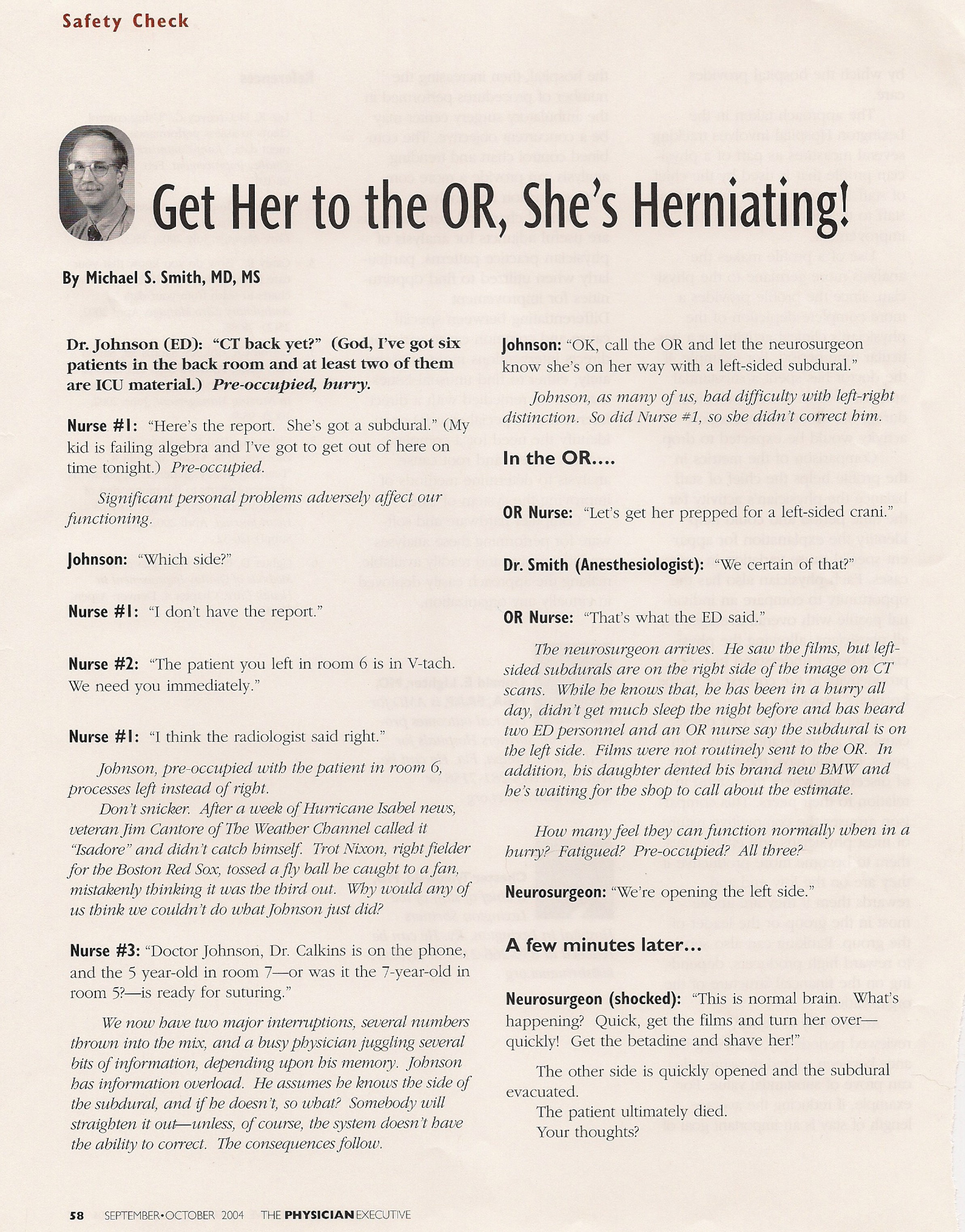


A WEEK AT ROWE SANCTUARY
October 11, 2009(Appeared in Tucson Audubon Society’s Vermilion Flycatcher)
6 a.m. on the Platte. It’s dark and it’s cold.
Upstream, I hear a sound like a jet engine warming up. The high pitched whine gets louder and closer until it reaches me, and I begin to distinguish crane and geese calls among tens of thousands of birds simultaneously lifting off the river. Because it was still early, and because I’m more auditory than visual, the intensity of the sound caught me by surprise.
This was my third trip to see the crane migration and my first year as a volunteer at Rowe Sanctuary. The Iain Nicolson Audubon Center has five permanent staff aided by many volunteers. I’m selfish. I wanted to see Cranes every chance I got, so I forged the following schedule: early morning, while still dark, I snuck into a blind. Trying not to freeze, I watched the birds gradually increase their activity, until the engine noise and the sudden explosion into the air.
During the day I’d paint, dig holes for posts, set up rooms, take down rooms, hang things, fix what I could, try not to break what I couldn’t fix, run errands and wash dishes. My dish washing ability seemed to be appreciated more than anything else. If I got a chance to work outside, I could see flocks of cranes and geese overhead, with an occasional eagle and red-tailed hawk. One day the redwing blackbirds suddenly appeared. In the evening, I’d rush back to the house they put me up in, quickly eat dinner, and then return to one of the blinds where I would see the reverse, with the backdrop of a three or four layered colored sunset. Once, I counted 10,000 cranes in a half hour, from only one direction.
On the drive from the house to Rowe, I got used to seeing thousands of cranes in nearby fields, where they were eating waste corn. Near the end of my stay, I spotted a large flock coming from the east. High overhead they flew, spanning a quarter of the sky, sunlight reflecting off their feathers giving them a grayish-white cast. Acting like a first time viewer, I stopped and got out to watch the flock pass, their primitive-sounding calls easily heard. Cranes do that to me.
Rowe takes good care of their volunteers. Next year, after I tag along four times with certified field trip guides I will become one myself. Am I lucky or what? I will show people cranes and see the birds at the same time. I was even interviewed for the Grand Island Independent: “I love the cranes,” I was quoted. “They’re large and they’re loud. The first time I saw it I was in awe of the experience. And I still am.”
The pictures not only show cranes but some of the most beautiful sunsets I’ve ever encountered. South central Nebraska in March. It’s a must see!
BACK OF BEYOND
October 11, 2009(Appeared in Sky Island Alliance publication)
Wilderness … is real and this they do know; when the pressure becomes more than they can stand, somewhere back of beyond, where roads and steel and towns are still forgotten, they will find release. Sigurd Olson (1938)
You might have seen me at a gathering, standing alone in a corner, periodically looking outside, toward the mountains, wild country where I feel more comfortable than in a crowd of people.
But if you approached me and began a conversation about wilderness, you’d see a dramatic transformation. My eyes would light up and my voice rise, for I love the American backcountry. I’m two-thirds through my odyssey to visit all 57 national parks. These are our crown jewels, our most spectacular places, ranking just behind our experiment in liberty as our great contribution to the world. As a veteran, I served America, but I serve her better by speaking up for these places, remnants of the frontier, often under appreciated and under attack.
I might excitedly tell you about the wolf – a wolf! – in my campsite on Isle Royale, 12 feet away, ten trail miles from the nearest other person. Or Alaska’s Brooks Range, containing the granite spires of the Arrigetch and large rivers with names like Kongakut, Killik, Koyukuk, Sheenjek and Alatna. Traveling this country, by pack and paddle through vast valleys, home to caribou, Dall sheep and grizzly, is life-altering. I’ve been next to a herd of elk at Wind Cave, and the next day seen bighorn in South Dakota’s Badlands. Now a different individual from that guy in the corner, I tell of hearing loons in the Boundary Waters, drinking water directly from a lake and paddling solo by a moose, five days from town, during an October blizzard. I’ve seen moisture laden wind hit cliffs on Big Bend’s South Rim, rise and condense, at eye level, the same orographic lift that produces clouds and rain in our Sky Islands. I might recall the backcountry triad of wilderness, completely dark skies and total quiet, deep down on the Grand Canyon’s Tonto platform. Or how early one morning on Mt. Kimball, I saw the shadow profile of the Catalinas etched out over Oro Valley. I would be released from shyness as I spoke of the release I found back of beyond, still out there, still unspoiled.
If you stuck around, I might wave my arms describing central Nebraska in March, mornings where tens of thousands of Sandhill Cranes simultaneously took off from the Platte in a visual and auditory mélange that nearly defies description. We still see this show because Americans with foresight preserved sixty miles of braided river the way it was before Manifest Destiny. Our wild country: America, still the beautiful.
If you wondered how a loner could talk so much, I would reply it is because I have been fortunate enough to hear what the wild country out there, the back of beyond, had to say.
STARLIGHT, MOONLIGHT AND FIREFLY LIGHT
October 11, 2009“We don’t claim to be sane,” said Spur as he and Silvermoon left the Hogback Ridge Shelter at 9 p.m., heading north on the Appalachian Trail towards Erwin, Tennessee. They arrived at the 3-sided wooden shelter as I finished my macaroni and rice dinner. For the last two hundred miles, we had leapfrogged each other. They were about to jump ahead.
A month earlier, the pair decided to hike the entire 2160-mile AT, as hikers referred to the footpath, in one season — a thru-hike. We didn’t know each other’s names in the outside world, but that didn’t matter on the AT. I had learned they were from Atlanta. Spur, his trail name coming from his spur-of-the-moment thru-hike decision, ran a business. Silvermoon was a florist. I was “Voyageur.” Trail names were accepted social convention on the AT. Every long distance hiker had one; some additionally had creative logos.
Shelters occurred every 8-15 miles along the Trail. While comfortably sleeping a dozen, an adage was “there’s always room for one more,” especially in a cold, driving rain, a frequent occurrence in the mountains. Unfortunately, most shelters harbored large populations of well-fed, pack-smart mice that ran over sleeping hikers. I usually pitched my tent nearby or stayed somewhere else. Indeed, one night near Hot Springs, I camped on the Trail itself — in poison oak as I later discovered — when rain and darkness beat me to the next campsite.
Shelters were a source of Trail news. There was usually a logbook present, left by a hiker, containing instructions to mail it, postage guaranteed, when the book was full. Reading the past three months of entries was a pleasant way to spend an evening and to learn about diversity of hiker goals, opinions, adventures, and equipment. In addition, because of travel in both directions, one heard about upcoming terrain and obtained reviews of the nearest town, emphasizing food, cost, and lodging, in that order.
That evening, I was in the middle of a 300-mile hike from the Great Smoky Mountains to Virginia. The previous year, I had walked from northern Georgia to the Smokies. I was humbled by thru-hikers, who planned to walk seven times my distance. But only one in ten who wrote “GA→ME” in the logbook actually succeeded, able to overcome the frequent physical and mental breakdowns associated with the effort. Still, after several hundred miles of hiking, one’s efficiency increased dramatically. Nothing in a thru-hiker’s pack was superfluous. Extra food was eaten; running out of food was incentive to get to the next town quickly.
I stuck my head outside the small tent to see how well their headlamps worked. Seemed interesting. While the two were hiking under a waxing gibbous Moon, it was often cloudy in the Appalachians, so that bright moons usually weren’t helpful.
Probably more relevant, however, the AT was a green tunnel. A few days earlier, in a large rhododendron patch, I started to remove my sunglasses because of the darkness. I then realized they had been off for some time. I arrived on the Trail with a full body tan. After hiking in just shorts for two weeks, my tan faded.
Hogback was in dense, hardwood forest, dark even by AT standards. Still, the idea of a night hike was intriguing, but not after my long day of climbing. My pack was lighter than the previous year, and I was far more efficient, but high humidity in the South made hiking — especially the climbing — difficult. I soon learned that clothing dried only when worn. One could either wear wet, clean clothing or dry, smelly clothing. Usually, it ended up both wet and smelly.
Nevertheless, I missed out on a real treat. I should have gone with them, even after 21 miles that day and even without a headlamp.
Three days later, I caught up with the two at a restaurant in Erwin. They were staying at Johnny’s hostel near where the Trail emerged from the mountains by the Nolichucky River. At Johnny’s, hikers could shower, sleep in a real bed, obtain food, supplies, and transportation into town. Everybody on the AT in Tennessee knew about Erwin and Johnny’s by reading the logbooks. Word traveled fast on the ridgeline telegraph. Hikers were good listeners in restaurants, since their mouths were used to eat rather than to talk. I was no exception. Sitting down at a table across from Silvermoon, I rapidly spooned a quart of chocolate ice cream into my fat-starved frame, seldom looking up during the process. It was really good. Every long distance hiker did this sooner or later, mostly sooner.
Silvermoon was still excited about their night hike. While speaking, she kept rubbing her long, brown hair, enjoying that it was clean for the first time in about 100 miles. “After we left you,” she said, looking at my rapidly diminishing pile of ice cream with some envy, “we descended into Low Gap and climbed in pitch darkness up to Big Bald.” The AT in the South has numerous descents into gaps and climbs to balds, grassy mountaintops. On a clear day, the views were spectacular from a bald. On a rainy one, the experience and view were comparable to being inside a car wash.
“Once we were on Big Bald, it was just us and fireflies everywhere, with lots of stars and a bright Moon. We didn’t need our headlamps, so we turned them off. It was even better then.” I actually stopped eating, visualizing the scene, having been there hours after they were.
“The miles just slipped by, with little flashes of light everywhere we looked. We finally slept up there in the open, with twinkling lights above, below, and around us. It was magical.” Silvermoon smiled, then delivered the coup de grace: “And so much nicer than that dark hole where you were.”
UNDER THE STARS
October 11, 2009On a pleasantly cool and quiet night, we parked under a mesquite tree in the high grasslands of southeast Arizona. We were well off the highway, the only sound being the occasional chirp of a nighthawk high overhead. Only a glow on the horizon showed us the lights of Tucson, Sierra Vista and Nogales. It was astronomical twilight, the Sun having set well north of Mt. Wrightson in the Santa Rita Mountains an hour earlier.
We were going to sleep under the stars.
I’m an amateur astronomer and own two telescopes, but there are times it is better to view through my 1X eyes. With no difficulty, I saw all the dim constellations of spring — Corona Borealis, Hercules, Libra, Serpens Caput, Corvus, Hydra, Crater, and even Lupus, far to the south. The constellations looked the way they were supposed to, not washed out by artificial lighting. The sky was full of stars, and when I lay down, I felt as if I were in a large bowl. I really was, and I felt part of the universe. Not many Americans have ever been under a truly dark sky.
Around 10, a large cloud appeared in the east. At least, it looked like a cloud. But it had been clear with no chance of rain. I’ve camped in plenty of places where I went to bed under a clear sky and awoke with rain on my face. But out here, if it is clear in the evening, it will be clear in the morning. We looked at the cloud a little more carefully. Yes, it was a cloud, but it wasn’t a few miles up in the atmosphere. It was a few hundred trillion miles away.
We were seeing the Milky Way rise.
How many of us today ever see the Milky Way, our island home in the universe? How many have ever seen the stars the way they are supposed to be seen — in darkness? The stars are as much our heritage as is the Grand Canyon, the black bear, the old growth forests, the Sky Islands surrounding us and water that can be drunk, unfiltered, from a lake. As long as we have that heritage, we connect to our forebears. And if we lose that heritage, what do we have left as a people?
I pondered all that as I watched the galaxy rise, saw Vega and Altair appear, and remembered Tanabata, that delightful Japanese holiday in July where people learn about the star crossed lovers that were separated by the river that astronomers call The Great Rift. Stars have meant something to people for thousands of years. The stories are different, the meaning changes, but mankind has always found significance among the stars.
We dozed for a while, awakening later in the night when the waning gibbous Moon rose over the Whetstones, a day from last quarter. We don’t often see this phenomenon because we don’t spend whole nights out among the stars. It’s worth doing. The Moon appeared flat on top and was orange, a consequence of the horizon haze allowing more red to be seen than usual.
But I didn’t think about atmospheric refraction and dust particles scattering light. I just looked. We saw the summer constellations – Scorpius, Ophiuchus, Serpens Cauda, Sagittarius, Corona Australis – dimmed by moonlight as the grasslands around us lit up with the glow. Neither of us said much, and when we spoke, we whispered. Physically, it seems impossible for sound to affect vision, yet loud talk or loud music does damage views, because we don’t just see, we experience, and the two are interlinked. We could have viewed the same stars from the highway, but it wouldn’t have been the same. The quiet seemed to make the stars and the Moon appear closer.
We awoke several times that night, each time noting the change in the Moon and watching new stars rise and old ones set as our Earth slowly turned. Morning twilight awoke us for good, and we watched the eastern sky gradually brighten and the Earth’s shadow slowly disappear into the western horizon. I can see the Earth’s shadow every evening and every morning from Tucson, but out there the shadow was far more impressive.
In my “must things to do” during my lifetime, sleeping under the stars was one of the earliest ones to get checked off. Occasionally, I still do it. Many times in Sky Island country, I’ve experienced the “outdoor triad,” wilderness, dark skies and total silence. On first glance it doesn’t appear to make much sense, but I think that by getting away from people in the outdoors and being alone with the stars I feel more connected to humanity.
LIGHT BULB
October 11, 2009(Appeared in Sky Island Alliance publication)
Sitting on the edge of the porch one summer evening, I looked far to the southeast. A few cumulonimbus clouds had formed over the Huachuca Mountains, and I hoped maybe they would head in my direction. I was most interested in three thunderheads in a north-south line. The first two were significant rain producers; the third, much smaller, had no rain shaft under it but lit up periodically with cloud-to-cloud lightning, as if it were a giant light bulb.
Fascinated, I watched “light bulb” turn on and off, pondering the amount of current flowing and what was happening inside it. Slowly, the whole system started to move off the mountains towards Rain Valley, and occasional distant thunder added some sound to the light show.
As the storm system moved northwest, I noted Jupiter above the middle cloud. Sure enough, the point of light was bright enough to be seen in twilight, and it was exactly where Jupiter ought to be. The show was more interesting now, a giant gas planet with its own major storms seen from a rocky planet with its own storms right nearby. I thought about the cosmos, storms and what it all meant.
In the meantime, “Light bulb” kept discharging, as if to call attention to it.
During the next half hour, the thunderheads and Jupiter moved, placing Jupiter above “light bulb.” I was intrigued with the coincidence. The thunderhead motion was a consequence of steering winds in the mid levels of our atmosphere; Jupiter’s motion was a consequence of the Earth’s rotation, although Jupiter has a proper motion of its own. I pondered planetary orbits and steering currents for a while, watching the rain, “light bulb” and remembering that rotation of the Earth does affect our weather.
I said a quiet thanks to nature for providing a nice show. I was grateful, as I always am, for what I see in the sky. It’s free to those who look, but it’s unfortunate that many don’t. This was an unusual event.
Suddenly, a bright green meteor flashed across the gap between Jupiter and “light bulb.” In that instant, I had views of an object in outer space, one in the upper atmosphere, and a third just above the Earth. In that instant, I saw and understood the three-dimensionality of the sky.
Nature occasionally presents us with gifts. As with gifts, the less the expectation, the greater the surprise and wonder. There are no guarantees except one: if you don’t look you will never see.
After all, light bulbs aren’t any good unless they are turned on.
THE LIST (NORTH DAKOTA STYLE)
October 11, 2009I puffed my way up the last of the steep climb to the Petrified Forest Plateau, the forest itself several miles and several millennia behind me. It must have been quite a sight, given the size of the stony logs and stumps, still so realistic, they needed to be touched to prove their composition was inorganic.
The plateau was a sea of short-grass prairie, a small remnant of the original. I walked south on the Maah Daah Hay trail, 13 miles from Medora, North Dakota and 86 miles from its northern terminus along the Little Missouri River. This was Roughrider Country, and I was in wilderness that bore the name of the 26th president.
The hiking itself was easy for one who is used to mountains. The pool-table flat prairie afforded views into the eroded hills with juniper trees on their north facing slopes and sparse grass on the warmer, drier southern facing ones. Trail markers were visible a mile away, allowing me to easily detour when I encountered bison.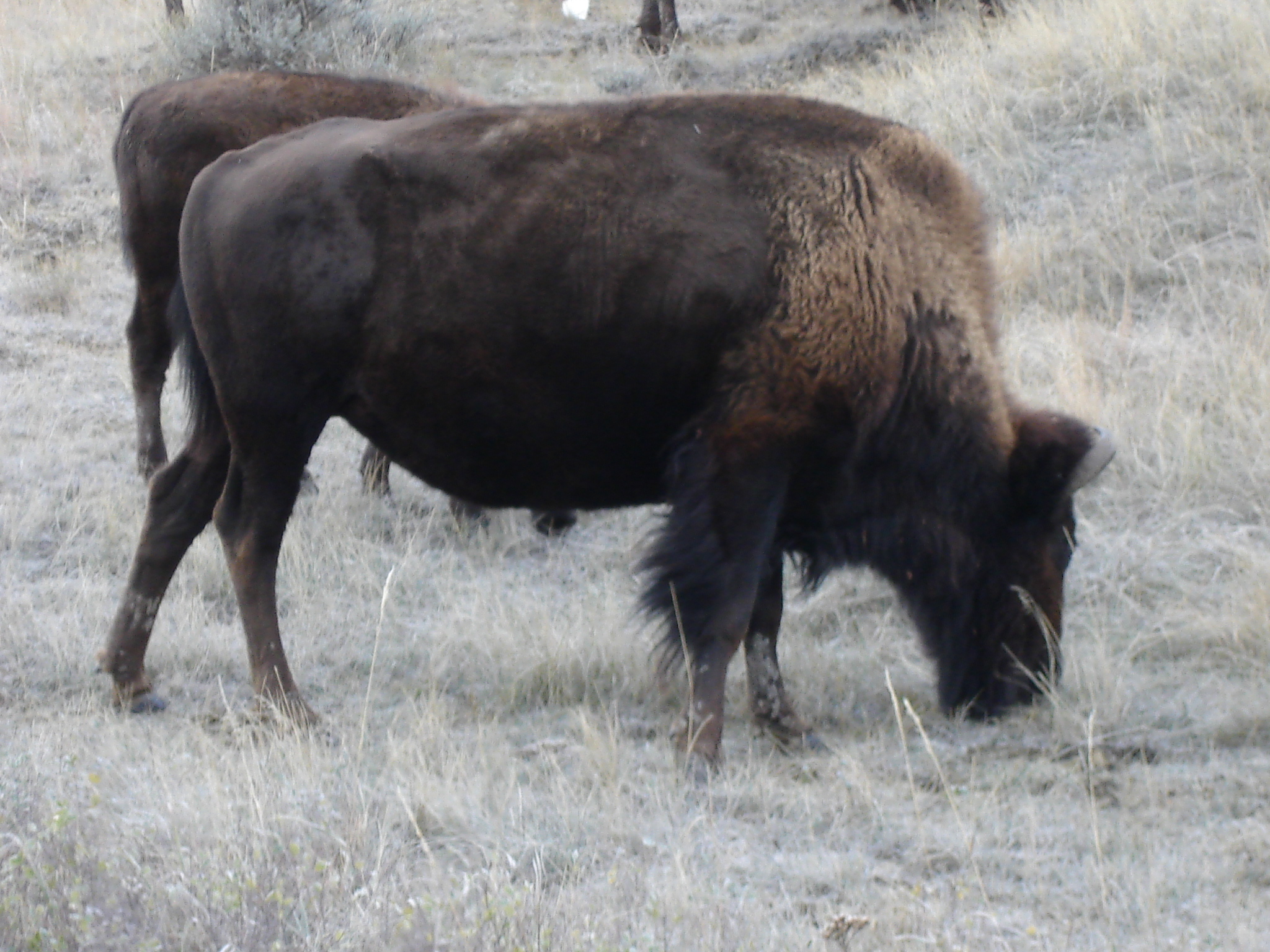
I had long wanted to see this area, which was on “The List,” affording it special status in my life. “The List” currently contains 29 items, places to see or things to do in my life. It is dynamic. Each year, an item or two gets put on it. Each year, if all goes well, a few items are checked off. This year was particularly good — I saw Isle Royale and Theodore Roosevelt National Parks, and a wolf in the wild, the last having been at the top of “The List” for many years. “The List” is the most deeply personal thought I publicize. Because it is so personal, I don’t believe in the “1000 places to see before you die” concept. That is somebody else’s list. Mine is mine. If you have one, which I hope you do, yours is yours.
“The List” began as a figure of speech many years ago. In my forties, I wrote it down, becoming more aware of life’s lack of guarantees. A neurologist, I saw too many people disabled or dead before they did or saw what they wanted to. When I reached my fifties, the realization hit me that much of “The List” contained wilderness areas that required good health and good physical condition. I almost put off the trip to Dakota for another year, but I knew if I went now I wouldn’t be kicking myself next year if something came up. Indeed, a bicycle accident in July left me with a broken scapula and three broken ribs, all of which healed but were a stark reminder of what can happen.
Occasionally, I delete an item, but only if I am really no longer interested. Namibia’s Skeleton Coast and Etosha Park remain, but it’s a long trip, and I’ve been fortunate enough to have traveled twice to South Africa. I don’t know if I’ll ever finish the 1500 miles of the Appalachian Trail I haven’t hiked. Nevertheless, finishing the AT is on the list. Some items are easier — I want to show my wife Hawaii, and I want to spend a night camped out in the Rincons. Right now, the Arrigetch Peaks in Gates of the Arctic are at the top. I’m going next summer, while I still can.
“The List” is not completely rational. North Cascades is on it; the Everglades are not, although I do want to see them. “The List” is a written reminder not to squander good years. We have to make a living, but we ought not forget things outside of work that are important to us. I’m not a city person, but seeing London is one of the items.
I day hiked in North Dakota. I had never done a trip like that before and found it rewarding. I covered serious mileage each day because I carried less. Water is an issue there, and bison are dangerous, both good reasons not to camp in the backcountry. It was also nice to sleep in a bed when the temperature was in the low 20s. In addition to bison, I saw pronghorn, wild horses, deer as well as hearing and seeing bugling elk, a real treat. But time in wilderness usually gives me more than visual memories. I generally come out of the area looking at the world differently. I left Billings County with a surprising sense of optimism, given the current state of the world. Theodore Roosevelt came to the area in 1882 as a young man. An avid hunter, he realized the uniqueness of that particular era and envisioned a time when the bison were gone and the prairie no more. He said, “What makes our country great is not what we have but how we use it.” Three days after another September 11, ’01 – 1901 – he became president, the first interested in conservation. It’s difficult to travel in Roughrider Country without encountering: “I never would have become president had it not been for my experiences in North Dakota.” I think he would be pleased to know the bison are still around, and the area he loved became first a memorial to him and then a national park. He worked to save what he could, and it changed America. Those of us who do our part can change America as well.
And while you change America, don’t forget your list.

