Archive for the ‘Uncategorized’ Category

THE ONES YOU DON’T HEAR ABOUT 

November 2, 2017

“Westerners don’t fear these restrictions (on fishing), even when their right to bear fishing poles isn’t secured for eternity in the Constitution.  But when it comes to the right to bear arms, the reasonable limitations of fishing are swept downstream with sanity.”  

Marty Jones, Writers on the Range, hcn.org/wotr

Every time there is a mass shooting or some other a significant deadly event, I look at the number “critically wounded,” for many of them will not survive.  It won’t make the news when some family member has to give permission to pull the plug to some doctor who doesn’t like pulling it, but needs to do it, in order to allow someone with irreversible brain injury to die, maybe after some organs are taken for transplant, maybe not.

“Saves” out in the field that get much news coverage may not be saves. If the rescue were too late, the individual would be irreversibly brain damaged, and some guy like me eventually would tell the family the person would end up in a persistent vegetative state. At best, the family would agree on removing life support, because “(the victim) wouldn’t want to be like this.”  At worst, the family would be divided, shattered, occasionally because well-meaning people in or out of the medical field would offer up platitudes like “you never know,”(we do), “hearing is the last thing to go,”(proof?) or “someone once woke up after 5 years,” (and was quadriplegic with limited cognition).  I did get news coverage once, in 1983, after recommending discontinuing life support on a woman who failed to wake up after cardiac surgery. The husband agreed, but the sister did not.  It went to court, and my name was in the public eye for a couple of days.  I guess I said some good words, because people didn’t lambaste me (that was before anonymity of online comments), the judge agreed with me, and the woman was allowed to quietly, with dignity, die.

Two years after Roseburg, there was a brief article about a young woman who received a major brain injury and could not speak.  She survived, but the hell she and the family went through, as well as the costs, born by them, those who cared for them, and society in general, were not publicized.  They can’t be.  There are too many—73,000 gunshot wounds a year— and I’m not even discussing auto accidents, falls, and other often preventable tragedies.

I’m not convinced the death toll from Las Vegas will remain at 58; we may not hear about the others. In the New York Times, there was an article about a woman 15 years younger than I who is now quadriplegic.  When I heard “500 wounded,” I wondered how many were going to be like her.  I still don’t know.

The woman probably has a C5-6 injury, got her elbow flexors partially back, but won’t get her hands or her legs back.  Not at this stage.  She ran a company once.  Now she runs a wheelchair courtesy of Go Fund Me.  I’d rather national health insurance pay for national medical costs.  Then, we could see  where our tax dollars are going, and ask why we aren’t trying to control firearms.  I don’t know the size of her medical bills in Nevada or now in California, where she is getting rehab not far from where the San Bernardino mass shooting took place.  These days, it’s not difficult to be close to a past mass shooting.  I am within 10 miles of the Springfield, Oregon high school, where four died 20 years ago, an hour from Roseburg, and two hours from Portland.  I lived 4 miles from where Gabby Giffords was shot, and six people died.  I came within a whisker of being at that Safeway that morning.

It’s ugly.  If the pain, suffering, and destroyed lives doesn’t bother The Other Side, they as taxpayers ought to be outraged as I am at paying for preventable medical and disability costs. Eight died in New York City on Halloween, and that day the president wanted to end the diversity lottery program. Fifty-eight died in Las Vegas a month ago, and he offered no suggestions.  The next night, three died in Thornton, Colorado by a shooter who walked into Wal-Mart, fired, and walked out.  One tragedy gets a snap judgment, and the other is ignored: Americans have a right to as many guns as they want with absolutely no restriction. It is time right now to discuss control of terrorists in our cities. NYPD had already contacted 147 businesses who rented trucks to be on the look out for potential misuse.  It’s also time to discuss some form of gun control, like repealing the second amendment, which would not prevent sane people from owning a firearm. It won’t happen, of course.

The statement that we don’t remember what happened to those who were injured is not new.  Many in World War II had shell shock and were never the same.  After Korea and Vietnam, we changed the name to TBI or PTSD.  After Iraq and Afghanistan we started seeing people with no limbs and more PTSD that couldn’t be treated well, because we don’t have a good treatment for it.  That alone should be enough to think long and hard about going to war, because in war not only do people die but at least ten times as many get PTSD.  We should have more diplomats and fewer tweets, instead of the opposite.

War is so bad that people repress it. My brother never spoke about Vietnam other than a vague memory about being on a helicopter going somewhere.   I hike with a Vietnam combat vet who once made the comment, “after I was blown up….”  which is the most he ever said about his service other than the single word, “Hué,” which told me enough.  When we go to war, we ought to realize that the cost in lives will be far more than we anticipate. That doesn’t mean we shouldn’t go to war.  Not at all.  But we ought to ask why we are fighting, what we want to achieve, and at what point it’s time to leave—totally leave.   Like PTSD or vegetative states, there are political states that just can’t be fixed, and trying to fix them is like trying to fix a vegetative state by physical therapy.  It accomplishes nothing and costs a lot of heartache and money.

I end with another form of PTSD and abuse, eloquently put in a letter in The New Yorker. The writer was raped, weekly, for four years, beginning at age 10, by one of the elders in her church.  She actually complained and was told she was crazy.  Who, after all, believes a ten year-old? She repressed her feelings for years, because nobody would take the word of a girl over a good Christian man who was a pedophile (something else not treatable, other than mandatory avoidance of children).  The fact that the woman’s own daughter is now ten brought back unpleasant memories.  What stuck with me were her comments, “Others had to have known, but they didn’t think he’d do it to one so young.”

Those who have managed to make a decent life for themselves in spite of horrors they have suffered speaks volumes about the human spirit and to those individuals themselves. It also speaks to the need for each us who is able to try to prevent such harm from occurring in the first place.  While it is reassuring to know that many obstacles may be overcome, it would be a lot better not to have such obstacles at all.

FILLING HOLES IN THE PERSONAL MAP

October 27, 2017

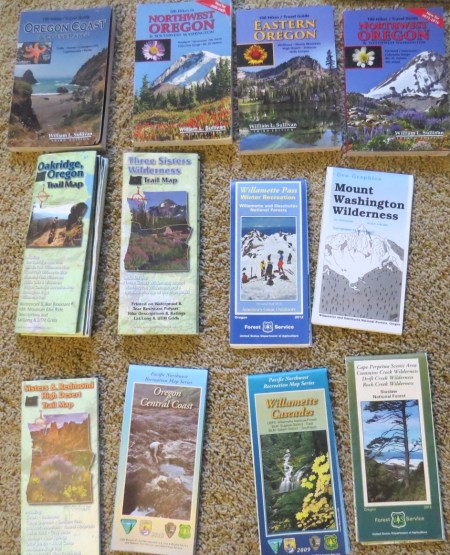
I spend far too much time looking at wilderness maps, hours looking at places I haven’t been, wondering what’s out there, and whether I have the health and the years left to get into those places.  Mind you, I’m not complaining.  I’ve been blessed far beyond most in what I’ve seen.  But I long to see more.  I always will.  I have large maps of the Oakridge, Oregon area, which include both the Diamond Peak and the Waldo Lake Wildernesses.  I have one of The Three Sisters Wilderness, others of the Mt. Washington, Drift Creek, Rock Creek, and Cummins Creek Wildernesses.  These are in addition to the Sullivan books I have which describe every major hike in Oregon, most of which I haven’t done or will do.  I bought a map of Olympic National Park the other day at REI.  I backpacked Olympic in the late ‘80s but haven’t been back since ’92. I’ve been staring at the map a lot this past week, deciding that I’ve got to go back there next summer for a few days.

IMG_9062.JPG

Oakridge area map: the town is upper left, Waldo Lake upper right

IMG_9064.JPG

A selection of books and maps.  Other than the Coast book, I’ve done maybe three hikes in the other three books.  Terrible.

A couple of years ago, I found places like Moon Point/Young’s Rock, which I got in my craw until I finally drove out there and hiked nearly 3000 vertical feet, past Young’s Rock but not to Moon Point, being stopped by snow.  I found that the bottom part of the hike was too long to lead, additionally with a really nasty climb out in the open,  so six weeks later, I went out there, drove 3 miles up a Forest Service Road and found a way to the trail, taking it to the top and seeing Moon Point.  I led the hike about a month after that, so others could see it, without having to hike more than about 2000 vertical feet.  Such a deal.

A friend told me about Foley Ridge, not far from Eugene, so I went in there twice this past year, the first time to Substitute Point, which is the closest spot to Eugene over 6000 feet.  Beautiful place.  Then, a few weeks later, I did a solo 21.5 miler in to the Three Sisters Wilderness to see some of the most beautiful Cascade scenery imaginable.  The whole area burned a month later.  I’m so glad I went when I did.

IMG_9066.JPG

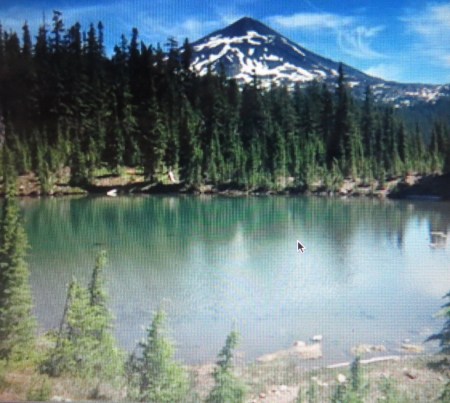
Husband Lake and South Sister before the fire

I looked for a long time at walking around Waldo Lake, Oregon’s second largest, starting not long after I arrived here in 2014.  I never got around to doing it, but I never forgot it, either.  Finally, I said the what the hell, I was going to do it.  I went mid-week and had a great hike—20.3 miles, nobody out there, nice lake, and 4 miles of trail with ripe huckleberries alongside that I could grab without stopping.  Did the hike in just over 6 hours and tried to lead it last week, but it rained too hard, and there was snow, too, up there.  I have limits.

Because of wanting to do something the day I couldn’t do Waldo, I had looked at the map and found a couple of trails that were used mostly used by mountain bikers.  One looked interesting, Heckletooth Mountain, a low elevation foothill.  I figured since the Club hadn’t had hikes here, it might not be very interesting.  On the other hand, I kept looking at the mileage and the fact it was close to Eugene, and thought why not?  I put it on the schedule to see if others wanted to come along, and I got three takers.  I later learned a fourth person was packed and ready to show up, then woke up to heavy rain and went back to sleep.  Couldn’t say I blamed him.

That morning, we were getting pounded by an atmospheric river event, a nice term, where there is a stream of moisture extending—in this case from Japan— to the Pacific Northwest.  We didn’t bear the brunt of it, but we got plenty of rain.  It hit the night before and was coming down hard when we four met at the local community college parking lot—Randy, the most experienced, Steve, the strongest, and Lynn, the fastest. I provided the idea.  And the car.

What the heck, we all had rain gear, and I wanted to see how good—or bad—my waterproofing was.  It wasn’t a cold rain for autumn and predicted to end by noon.  So off we went, 42 miles later almost missing the trailhead outside of Oakridge.  We started off with the trail’s having flowing water, a good sign in autumn, and when we took our second break about 3 miles in, I mentioned that the hike to Heckletooth might be a mile more each way than I anticipated.  I set a turn around time for 10:45.

Lynn piped up, “Well, if we are within a half mile, I want to do it.”  Liked her attitude.

We hiked through absolutely stunning yellows of Big Leaf maples and oranges of Vine maples.  It was great.  At times, I thought the sun was coming out, because it was so bright with yellow. Everybody was doing fine, and we climbed steadily the last two miles to Heckletooth, where the map showed the trail would go by the summit, not up.  Turned out the map was wrong.  We climbed to the top of the 3670 foot mountain, about a half mile vertical above Highway 58 below us, and looked out on dense fog.  You can’t have everything, but I liked the rain and loved the colors, even if I couldn’t see too much.

Each of us had been up Highway 58 probably three dozen or more times and never once knew this mountain was so close.  Nobody knew what a Heckletooth was, which turned out to be an implement for cutting grass last century—or maybe THAT last century, since I tend to think of the 19th century as last.

It was chilly on top, as our sweat plus the wind quickly cooling us.  We moved back down the trail a little for shelter and maybe a 5 minute lunch.  Randy wasn’t feeling well and didn’t eat, which explained why he was lagging 50 yards back when he can usually out climb me.  Steve had a big breakfast, not that it seemed to slow him down any.  Lynn ate faster than I, so I grabbed a protein bar and started eating it on the way down.  Everything I had on was wet with rain or sweat, but I was warm, and we were moving.

The colors were fabulous.  We stopped to take pictures, or I should say I did.  Lynn had one of those fingerprint locks, which is a great idea unless one is hiking in pouring rain and has a wet thumb.  I took what pictures I could easily take without drenching the electronics.  We came back down the way we came, 5.5 miles instead of 4, and went by a trail junction to Aubrey Mountain, which is a bit lower but reportedly has good views.  Not wishing to hike an extra 5 miles, we kept going back to the car.  Normally, I might have done Aubrey, but this day was enough.

Near the bottom, Lynn said that that Heckletooth ought to be a regular fall hike on the schedule.  I agreed, so much so that I put Aubrey Mountain on this weekend and figured I would go alone if nobody else were interested.  Got one taker so far, and Lynn is really upset that she had something else scheduled.  It’s going to be sunny and dry.


IMG_9065


THIN VENEER

October 11, 2017

In 1992, I spent six months as a volunteer wilderness ranger for the US Forest Service in the Boundary Waters Canoe Area (BWCA). For the next eight summers, I spent a week n the BWCA with the late Mike Manlove, a remarkably wise woodsman, father, husband, and friend.  One raw, late summer day, Mike and I were on large, oval-shaped Alice Lake, with only a few small islands at the northeast corner.  As we were checking out all 11 campsites on the lake, we pulled up on one sandy site, lovely, I suppose, if it were a hot summer day,  but then wet, cold, and with a lot of recently abandoned gear.  Mike shook his head as we cleaned the site, knowing we would have to haul a lot of trash out. “These people got out of their comfort zone,” Mike said, folding a wet shirt and picking up some wet food containers. “Once that happens, all the good thoughts about Leave No Trace get left behind. All people want is to get out of here.” The idea of treating the wilderness properly is a thin veneer of behavior, which under adverse circumstances may melt away like ice off a boreal lake in spring, leaving one hell-bent for whatever leather they have on their boots to leave the woods.

I’ve been out of my comfort zone, and I know what Mike was referring to.  One doesn’t want to consider Leave No Trace if facing head winds, rain, cold, 3 days’ travel from town and 15 miles to travel that day.  The best defense against such conditions is to be adequately equipped to travel in inclement weather. There was a time when we had only our eyes, ears, and nose to make weather forecasts, and every night in the North Woods one put things under cover, because it might rain, even if the evening were clear.

Today, technology allows us in the wilderness to get accurate weather forecasts and radar.  We can move further than planned on sunny days if we know the next day is likely to be wet.  Before a recent trip with a friend, he was almost obsessed with the weather forecasts, at one point texting me “Rain+Cold= Misery”.  I’ve canoed in a lot of rain and cold; it’s challenging, but it need not be miserable. I’ve paddled 15 miles in heavy rain more than once, put up a tent, changed my clothes, found dry wood, and started a fire. Yes, I was wet, but once I changed my clothes and sat by the fire, I was warm. I gave my friend a chance to not go; while he didn’t take me up on it, I think he might have been happier had he stayed.

On the first part of the trip, my friend was far more neat than I, his tent meticulously placed and his cook gear, food, and gear neatly stacked near the fireplace. I was impressed and in fact a little jealous.

The penultimate night, we had a strong thunderstorm move through.  Fortunately, it was at night, and yes, I had the camp saw in the tent with me, in order to saw any tree that fell on my tent, assuming I survived the impact.  I stayed safe and dry, but my friend’s tent was pitched in a small depression so that his sleeping bag and some gear got wet.

We needed to move a few miles the next day so that we would be close enough to the take out point to exit the woods on time.  The next morning, after the rain stopped, I started packing and taking my gear down to the canoe.  My friend was not only concerned about his sleeping bag’s being wet but his tent.  To me, packing a wet tent is not enjoyable, but something I’ve done many times. It usually dries shortly after I pitch it the next day, and if not, I have a plastic sheet that lines the floor.  My friend was clearly uncomfortable with his wet gear, folding the tent so quickly it barely fit into the sack.  The tent fly, which is normally folded with the tent, wasn’t, and we ended up carrying it and the tent separately over the portages.  I realized that he was out of his comfort zone. When we reached the lake where we were staying, I found a west-facing campsite where the late afternoon sun could dry everything. It did.

Being outside of one’s comfort zone is of course part of war.  Part VII of Ken Burns’s recent Vietnam documentary was “The Veneer of Civilization,” how some young American men, decent people in civilian life, became the ugliest side of mankind during war.  Burns’s documentary took the wraps off, hearing from brave men, taken out of their comfort zone, who were forever changed.  War strips the veneer “civil” from civilization. We saw how Germany, so strong in the sciences that my father-in-law, a physician, had to learn German in the 1930s, because the best medical research was written in German.  These same people murdered people in places called Auschwitz or Thereseinstadt; I saw the signs in Mauthausen referring to parachutists without parachutes, where one had a choice to jump down on to granite 50 feet below or be shot.  Many committed suicide by trying to escape over electrified fences, to avoid places called “Gaskammer” or slowly starving to death.

The veneer has been badly scraped here in America since 20 January, and it was completely removed in Charlottesville and Las Vegas.  Congress used to be civil; the civility has been stretched and broken.  The veneer has disappeared in the halls of power, when one party has pushed legislation that was written in secret, not taken through the committee process, and brought for a vote within a few days of its having been written.  There isn’t even the pretense that there is respect.  Instead, it is push it through, even if the rules have to be changed.

There was a time when letters to the editor were the only way most of us could express an opinion. Editors filtered the letters, and there was a decent layer of veneer in public media. The Internet has spawned anonymity in which people spew vitriol without consequences. Much of what appears is poorly written, not factual, illogical, difficult to understand, hateful, adding nothing to public discourse.  There is seldom a simple “I disagree” without an ad hominem attack.  Covey’s Fifth Law: “Seek first to Understand then to be Understood,” one of the most powerful rules I used in management, is absent. I can’t write a letter to the editor or a blog post without letting it sit at least 24 hours, often longer, so that I have time to see if my original thoughts still seem right.  Often, they have significantly moderated.  On social media, much of what I write I delete before posting.

Just as astronauts can see the thin veneer of an atmosphere that allows us to breathe; just as a thin veneer of topsoil allows us to grow things; just as a thin veneer of pollinators allows flowering plants to produce food, so is there a thin veneer of civilized behavior that keeps us from descending into a hell that will destroy us.  In the woods, my veneer is experience and proper gear. In society, it is politeness, respect, listening, measured speech, and filtering one’s thoughts before expression.

We need every last bit of veneer today.

A PLACE EVEN BETTER

September 26, 2017

I really wanted that isthmus site on Basswood Lake, an international treasure where the Canada-US border runs for 14 miles through the middle of it.  Basswood was part of the main fur trade route two hundred fifty years ago.  Spanning the border from Prairie Portage to Basswood River, its 45 square miles and 14 named bays makes it “big water” in the Boundary Waters Canoe Area.  The lake is so special that when the BWCA became one of the first wilderness designates after the Wilderness Act of 1964, there was a compromise made on the American side, allowing 25 hp motors on a large portion of it as part of the deal.

Basswood has over 150 designated campsites on both sides of the border.  When my wife and I were looking for base camps for our annual trip, we spent two autumn trips in the motorized zone, finally taking a long day trip outside the zone to find a beautiful isthmus site, a narrow strip of land between two quiet bays.  We planned to stay there in 2013, but severe illness prevented my wife from canoeing that year, so I went solo with her blessing and stayed on the site, enjoying 5 days of sunrises, sunsets and profound quiet.  When I returned with my wife in 2014, we paddled out of the motor zone, turned the corner around a wooded, rocky point, and the isthmus looked open, at least with binoculars, from a half mile.

As we got closer, however, we saw a tarp flapping in the wind, and our dreams of camping there were dashed.  Somebody else was on the site.  We turned around, went back to a site that we had just passed, and pulled in.  We had also scouted this particular site two years earlier. Neither of us thought too much of it, but we decided to take another look.

We were glad we did.

I now have the site labelled on my GPS as “Hidden Gem.”  During our five night stay in 2014, we were treated to incredibly dark skies, northern lights, wonderful sunrises, a moose, beaver swimming off the campsite every night, and wolves howling.  We would have missed almost all of that from the isthmus site.  We returned to the same site the following two years, no longer caring whether the isthmus site was open.  The beaver were no longer there, and no moose came, but the views were those that I still think of when I need to go deep into myself to get away from the world.

IMG_4563.JPG

View to the north and Canada from the site.

IMG_4667.JPG

Moose, from the “Hidden Gem” site, 2014

This past year, when I took a friend of mine into the area, I hoped again for the isthmus site.  It had a small beach, and he liked to swim.  We left the motor zone, turned the corner, paddled by “Hidden Gem,” where I would not stay at without my wife’s being along, and the isthmus site looked open.  I was pleased, as we paddled right up to the landing and got out, walking up from the beach a few feet to the site.  I turned and looked to my right, at the kitchen area.

IMG_4528.JPG

The isthmus site from “Hidden Gem”

Hidden in the trees was a tent.

Oh well, I thought, we wouldn’t stay there, but there was another site down in a bay about a half mile away.  I didn’t remember the site as being too nice, with a lot of blowdown trees and not much room, but that had been three years ago.  Besides, I reasoned, I once thought “Hidden Gem” wasn’t all that great the first time I saw it, either.  We paddled along the shore of a quiet, moderate sized bay with a high cliff on the west side and two nearly bare, small islands out in the middle, rocky but interesting.  The whole place was quiet, except for a couple of nearby ravens.

We landed and walked uphill on the rocky path.  The site wasn’t large but it did have enough space for two tents.  The views were great to the north where we could see Canada. Nobody was on the lake, and I doubted we would see anyone, for we were well off the travel routes.  Most importantly, my companion said he liked it.  I did, too.  We had room, quiet, and we later explored the two islands, climbed the cliff, and in the evening had a visit from migrating geese, which landed by the islands, staying the night.  In all my years in the Boundary Waters, I had seen a lot of geese flying overhead; I never had camped with them nearby.

IMG_8992.JPG

“Hidden Bay” campsite as viewed from the cliff

We didn’t have wildlife, other than a couple of chipmunks, which were more interested in the plants than in us, but we had clear skies one night, with some of the best dark skies in the Lower 49.  We paddled the next morning to the outlet of Basswood, where the rapids began, the international border’s being in the middle of the rushing water.  We walked on the portage a short distance to places where one could be near the roaring rapids that continued for several miles to the west, ending at Crooked Lake. Other than a pair of eagles, we had the place to ourselves.

IMG_9017.JPG

Beginning of Upper Basswood Falls; Canada across the water

IMG_9012.JPG

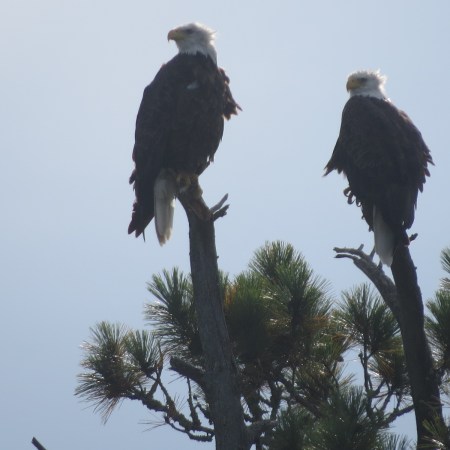
Eagle pair

I no longer go to the Boundary Waters to cover miles and quench my desire to see new country.  I have done it, enjoyed it, happy that I was so fortunate to do so. These days, a base camp in a nice place is enough.  I can get in there in a few hours, if the weather is cooperative, I have a quiet place to stay, hardly see anybody,  and I can get back out easily.  Hidden Gem is still there, should my wife be able to travel with me again.  So is the isthmus.  It’s a nice place.

I’m lucky.  I can pick among several beautiful campsites on a lake whereI have spent more than fifty-five nights on twenty-three different campsites.  I didn’t look all of these numbers up on a map; I have them all in my memory, the year I was on them, and in some instances the actual date.

I sometimes think how interesting it might be to have spent a night on every one of the 107 campsites on the US side, and the half again as many on the Canadian side.  Realistically, however, I would never do that.  Getting to know a place well means more to me these days, second only to having the ability to get there.

Isthmus, Hidden Gem, and now Hidden Bay.  Nice places.

Basswood Lake: an international treasure.

IMG_6070.JPG

Closeup of isthmus site at sunset

IMG_6106.JPG

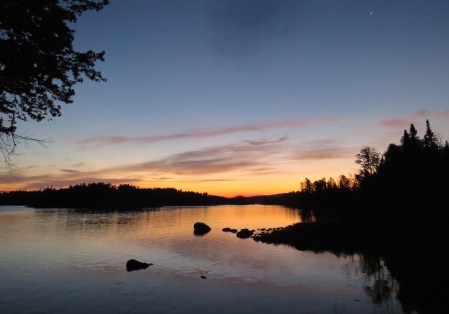
Sunrise from “Hidden Gem”

IMG_4621.JPG

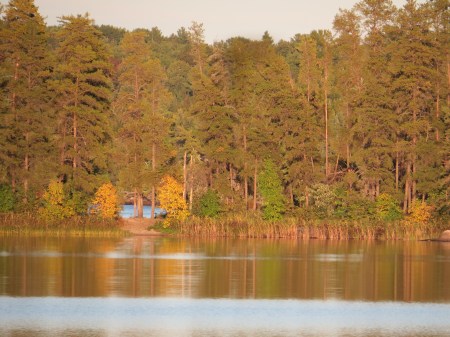
Fall colors, September 2014.

IMG_4636.JPG

Beaver, 2014

IMG_4509.JPG

CLIMATE CREEP

September 10, 2017

The other morning, after the Eagle Creek Fire had burned through much of the Columbia Gorge on the Oregon side, putting eastern Portland in jeopardy, the morning paper had several interesting comments in one article:

  • “… the smoke output in the western part of the state is massive.”
  • “The number of active fires in so many parts of this state is pretty unusual.”
  • “It’s kind of unusual to have this high-pressure system this late in the summer.”
  • “Such high pressure systems occur a few times each summer in Oregon, but they typically don’t last this long.”
  • “It just so happens that we have this pattern and we also have all these forest fires going.”
  • “The marine air (has)…been having trouble kicking in.”
  • “I’ve been here 30 years and never once has there been a fire anywhere near here.”

From some of the people I know:

  • “I’ve NEVER seen the smoke so bad.”
  • “We’ve never had fires around us like this.”
  • “We always got some rain during the summer but not this year.”

The natural events that produced these are what I call “climate creep,” and the statements I call  “climate speak.” Here are some others: “It never used to be like this,” “we’ve never seen anything like this before,” “it’s coming a lot sooner now (spring) or a lot later now (winter),” “I don’t know what to expect any more.”  It’s not that every day is hotter than last year. They aren’t.  It’s not even the years are progressively hotter, although they are always above the defined average. It’s a sense that the climate in which we grew up has changed is no longer as predictable as it once was.

I think climate creep is why we are seeing so many significant events, yet almost all of them can be considered “normal,” inasmuch as they have occurred before.  Fact: for ten years in a row, extreme weather has cost the country more than $10 billion annually. This cost has been a significant increase since 2005.  Both hurricanes Harvey and Irma are in of themselves not unheard of.  We’ve seen stronger hurricanes.  Two in two weeks seems odd, although that can be explained, too.  Three five hundred year floods in Houston in three years seems a lot more than “odd.”  A lot of the impact is because of how cities are built, and Houston was not built to handle large amounts of rain.  “Anomalously” strong high or low pressure systems are not uncommon. We now have more people affected by extreme events, no longer a few thousand, which I call a 3rd magnitude event, or even ten thousand, a 4th magnitude event.

Climate creep is our becoming so used to warm weather that normal temperatures—or what used to be normal temperatures—now seem cold.  It is becoming so used to dry weather—at least where I have lived the past twenty-five years— that normal rainfall or snowfall has become “really wet,” when in fact our “wet rainy season” last year was still a little drier than normal, whatever normal is.  Those last three words are climate speak.

Climate creep is made easier to accept in that we are brought up to believe that sunny days are fair and rainy days foul.  Deteriorating weather is used by meteorologists to mean rain; improving weather sunshine.  A few degrees of warming are more likely to be tolerated and enjoyed than the same amount of cooling.  During Oregon’s extremely warm winter of 2014-2015, I was asked by a friend how I liked the “spectacular weather.”  I didn’t.  During the following summer of dust and fire, which I knew was coming, I liked it a lot less.  In the current season of multiple fires, a TV meteorologist referred to a prediction of little rain on the weekend as “hopefully, it won’t affect the football game”.

Climate change isn’t exactly linear. It creeps, slowly.  We aren’t going to wake up one day to discover it is hot.  I think while possible that a large non-linear change may occur, I’m betting the changes will continue to be subtle, and we are good at adapting to subtle changes in our life, be it smog, traffic, weighing a few more pounds, or temperatures that aren’t what they used to be.

Climate creep is periodically punctuated by 5th or 6th magnitude climate events, affecting 100,000 and a million respectively. The unprecedented smoke here was a 5th magnitude event,  Hurricane Harvey 6th magnitude, Hurricane Irma and California’s mega-drought, in some places worse than in the past 800 years, 7th magnitude, affecting more than ten million people. None of these proves climate change, but I think we will look back in 10-20 years upon these events and realize the concatenation of all were the vanguard of what was coming. The 9.8 magnitude event, affecting everybody, may not be a storm. It may simply be called 2050. Or 2080.

Climate creep is increased variability in the climate system.  An average may or may not change, but the values are more extreme on either side.  A place can flood, later dry out and have extreme wildfires.  The average is normal, but the variability is more extreme than it once was.  It should be noted that when physical systems fail to operate well, one of the first signs is often increased variability without a change in the mean.  We are seeing more 6th and 7th magnitude climate events.  It’s also the fact that annual global temperatures are not falling, and in my life I hear more and more climate speak:  “we used to get more rain,” “we always used to say summer started after the Fourth of July,” “I’ve never seen so much smoke,” “We’ve never seen so many fires at once.”

I think it only fair I make verifiable predictions: (1) Global temperatures will continue to trend upwards, and locally I will never again experience a year with below normal temperatures. (2) The cost of severe weather in the US will continue to exceed $10 billion every year. (3) The number of discrete annual billion dollar events will be at least 6 (the long term average is 5.5, in the past five years 10.2, and 9 so far in 2017).  (4) Ocean rise will continue unabated or increase.

I hope I’m wrong.  In the meantime, I hope we begin addressing issues where people are allowed to live and be allowed to rebuild with taxpayer money, especially on the coast, floodplains, and urban-wildland interfaces. I ask how we will tolerate, safely, “climate creep”: the high magnitude climate events of heat, cold, water, wind, and fire.

TONS OF RAIN AND A TINY CHANGE OF pH

September 5, 2017

“Tons of rain” was the grossest underestimate I heard of the amount of water accumulating during Hurricane Harvey.  A ton of rain is not very much, roughly about 0.02 inches on a moderate sized roof of one house.

What about 11 trillion gallons of water?  The media used the number to say how much water fell on southeast Texas.  The problem is first, too many don’t know how big a trillion is and second, a trillion is not a term often used with water.

A trillion, 1,000,000,000,000, 1 x 10 ^12, is a term used to describe both the national debt and the Gross National Product.  It is roughly the number of days the Earth has existed.  It is about the number of seconds in 31,700 years.

The term we use to describe a lot of water here is an acre-foot (1 acre covered with one foot of water), and while perhaps archaic, it is useful.  An acre-foot of water is roughly 326,000 gallons, what an average family of 4 uses in a year.  Lake Shasta, the largest reservoir in California, has a capacity of 4.5 million acre feet.  Eight Shastas would have flooded Houston, or 11 trillion gallons of water would cover all of New York State a foot deep.  If the catchment area described were 10,000 sq miles, it would have covered it to a depth of 5 feet, basically what people needed to know and could see from the pictures.

*************************

Per cent is a useful term, but often misleading.  I inadvertently misled people before the recent eclipse.  What I should have said in the talks I gave prior to the event was that there were two kinds of eclipses (there are more, but I will keep things simpler), partial and total.  They are very different experiences.  Had I said that, mentioning that where I lived was in the partial zone, I might have persuaded more people to go to see totality.

Instead, I and many others said the eclipse would be 99.4% (or 99%) and most people figured, reasonably enough, that they would see almost the full event from their house.  I have since had several people tell me that they wish they had gone to totality.  One poignant comment was that 0.6% made all the difference in the world, since it was still sunlight and not totality.  If the eclipse isn’t total, it is partial.  It may be a little darker, a little more of the Sun will be covered if it is a deeper partial, but it is not total.  Next time, if there is a next time for me, I won’t make that mistake.

Per cent shouldn’t be used when counts are a better measure.  I have said in 2001 that the per cent of domestic flights not hijacked was 99.999996%.  Counts matter, especially when the counts should be zero.  When I was medical director of a hospital, we had a surgeon operate on the wrong side of the head.  Actually, we had three wrong side cases that I knew about—one was the wrong knee, and the other was the wrong side of the colon.  With the craniotomy, the OR head said that 99.9% of the time they did it right.  No, I retorted, we did 99.99% of them right, and that wasn’t the issue. There should be zero wrong side cases;  99.9% of landings done right means a plane crash every other day at O’Hare.

*************************

Not every measurement is interval or ratio, meaning that the difference between 10 and 20 is not the same as the distance between 20 and 30.  Most of us realize that with temperature, that 110 is not twice as hot as 55.  That is because the Fahrenheit scale has an artificial zero that is 459 Fahrenheit degrees above absolute zero.  Therefore 55 degrees is 514 above absolute zero and 110 is 569 above absolute zero, a difference of 10.7%.  With Celsius, these numbers would be 273 above absolute zero, 13 and 43, respectively, making the temperatures 287 and 316, or 10.1%, really the same, given the rounding in the conversion from one to the other.  It’s important to recognize what is ratio data, meaning that multiples make sense, and what isn’t.  Money is ratio data, as are height and weight.  Others are ratio data, but they are used in ways where one has to be careful.  Height is ratio data, but the Body Mass index is a function (depends upon) the square of the height, or the height multiplied by itself.

This concept of squaring something is important in many areas, such as the energy of a moving body, which is proportional to or depends upon the square of the velocity.  With hurricanes, velocity of winds increasing from 100 mph to 120 mph, 20%, is a 44% increase in energy, (120/100)(120/100).   A car moving at 60 mph has four times the kinetic energy it had at 30 mph.

Cubing something is to the third power or multiplying it by itself 3 times.  While 1 yard is 3 feet, 1 cubic yard is 3*3*3 or 27 cubic feet.  A meter is almost 10% longer than a yard (9.4%), and a cubic meter is 31% more than a cubic yard.  Gravitational attraction is inversely proportional to the square of the distance between objects; tides are inversely proportional to the cube of the distance between objects, which is why the Moon, so much less massive than the Sun, is responsible for 45% of the tidal pull on the Earth.

Fourth power?  Yes.  The radiation from a star can be considered to be equal to the fourth power of the temperature, useful for determining the temperature of distant stars.  And closer to home, the damage large vehicles cause to roads is roughly equivalent to the fourth power of the load equivalent factor, having to do with axle number and weight.

Other relationships?  Yes, too.  the acidity of a liquid is the negative log of its hydrogen ion concentration (pH), which is a nice way to call 0.0000001 moles/liter of hydrogen ion a pH of 7.  Therefore, what seems like a minor fall in the ocean pH from 8.2 to 8.1 represents a 26% increase in acidity.

It’s not always the magnitude of a number that matters—99.99% is not always good, and a pH’s falling from 8.2 to 8.1 will see the end of most coral reefs on Earth.

JOIE DE VIVRE

August 10, 2017

The trail was dusty, the hot sun blazed, the temperature was rapidly rising and our 5 mile trail hike to Louis Lake with 2100’ elevation gain was becoming daunting.  I was the informal leader of the group and thought—correctly, as it turned out—the others would not be feeling well at the trail junction two miles in and 600 feet up.  I was doing fine, for although I do not like hot weather, I have lived in the desert many years, and the temperature was not a problem for me.

It was for the rest of the group, however, and we had a brief, mildly heated discussion whether it was wise to continue a difficult hike on a hot day.  I favored stopping by the creek that we had hiked along, for it was shady and cool there, and I felt the group would not likely to enjoy going to the end of the trail to the lake.  We went on, however, but not before I added a proviso that we would turn around at noon, regardless of where we were.  Definable turn around points are a way to remind people that one has to get home, too.

Often, at the beginning of a hike, my warm up process is slow and I feel like quitting.  Three days earlier, on a hike up Easy Pass, which wasn’t, I reached an open meadow with two thousand vertical feet of climbing ahead of me far to my right.  My spirits sank, but as I moved upward, a nice breeze removed the bugs and cooled me, and an hour later I was on top of one of the nicer places in the North Cascades.

As I ascended the trail, now thankfully in the shade of large Ponderosa pines, my pace fell into my comfortable cruising pattern.  I wasn’t hiking excessively fast, but I was ascending a 10% grade at 3 mph and then some.  I didn’t carry a lot of weight—my day pack had the 10 essentials (map, compass/GPS, sunglasses/sunscreen, extra clothing, headlamp/flashlight, first-aid supplies, fire starter, matches, knife, extra food) and a couple of liters of water—but I didn’t notice the pack, and I barely noticed the climb, over rocks, roots, branches.  It wasn’t effortless, but I had little sense of exertion.  I was one person, climbing upward, at peace with myself and the trail.  I’d wait for the others at the end.  I was comfortably cruising, a feeling I have more as I hike more.  It’s a sense of being one with the trail.

I got to the lake just fine, went back a few minutes later to encourage two others that they were almost there, one of whom told me that the fourth was feeling badly.  I realized I should have taken my pack when I went back, but I expected everybody sooner.  I took off my hat, found a small scrap of paper, and wrote a message asking the last person to stop right where I left my hat in the trail.  I returned to the lake, got my pack, and then started back, finding the individual in good shape and waiting for me.  We all ate lunch in the woods and finished two hours later.

Nearly 20 years prior, on the Appalachian Trail, I had this feeling as well, that my pack—then about 35 pounds—and I were one, inseparable.  I had forgotten that time until I heard a Pacific Crest Trail thru hiker mention it.  The concept isn’t that one is so strong that he or she doesn’t feel the weight, but that one is so accustomed to carrying a pack that he or she doesn’t see the pack as weight.  I was a person with an appendage most would call a backpack, but I’d no sooner walk without it than I would walk without my boots, hat, or left foot.

Five years before that, when I volunteered for the Forest Service in Minnesota, I had to help haul the gear out from the Boundary Waters after a person had abandoned it.  I portaged his heavy food pack over a half mile and returned for the canoe, a heavy Grumman aluminum model.  I had been portaging canoes the whole summer, and I picked this 75 pounder up, put it over my head, and was 100 feet down the trail before I realized I had done all of that without thinking, it was so automatic.

And twenty-five years prior to the BW experience, as a young man a half century removed from now, a canoe guide for Camp Pathfinder, I had to deal with an ill camper on a 6-day trip I was leading.  I had to carry his pack and my canoe, 140 pounds total, down the Tim River, rushing water and slippery rocks part of the equation.  I felt the weight, but I knew I was up to the task.  There never was a question in my mind.

I don’t have many more years of hiking the way I want to, but I have found a joie de vivre, and I enjoy every hike I do with this feeling.  If I am fortunate, as my body ages my brain will develop a new style of hiking, where I may not do as much, but will enjoy it just as much.  My canoe tripping has evolved in that manner, and with good fortune maybe my hiking will, too.

GETTING THE MOST OUT OF THE TOTAL SOLAR ECLIPSE: FIRST TIME VIEWERS

July 28, 2017


EQUIPMENT:

  • Solar filters of some sort, which may include eclipse glasses, a #14 welding filter, mirror covered in paper with a dime-sized hole to reflect sunlight on to the wall.  Please don’t use sunglasses, X-Ray film, black and white film, or smoked glass.  None of it is safe.
  • Sunscreen:  remember, 99% of the event will be spent in sunlight.
  • Binoculars, only to be used during totality, and absolutely MUST not be used for any other part of the eclipse unless they have adequate solar filters. This includes ALL binoculars, even 8 x 20.  Binoculars are more dangerous if one so much as glances at the Sun, for they concentrate sunlight.
  • White sheet to put on the ground to look for shadow bands near totality.  Don’t get too hung up on having one.
  • A colander or something with many small holes.  A hat with a mesh is fine.
  • Thermometer to watch temperature changes is useful.
  • A video camera that about 5 minutes prior to totality you can set pointing to the west, where the shadow will come from, and start it and not worry about until about 3 or 4 minutes after totality.  That way, you can film the darkness without taking precious time away from totality.

CONTACTS

  • First:  Moon just touches Sun and you won’t see any of the Sun eclipsed for a few minutes.
  • Second: beginning of totality
  • Third: end of totality
  • Fourth: Moon just touches Sun and eclipse is over.

Between First and Second Contacts:

  • Watch the Moon slowly cover the Sun.
  • Notice that the temperature starts to fall before you notice any change in light.
  • When the Sun is about half covered, notice the slight “yellowish” cast of the light.  It’s different.
  • After the Sun is more than half covered, use a colander or hat to cast crescents on a surface, as each hole becomes a pinhole camera.  Check to make sure you are positioned where you want to be for totality.
  • IMG_2880.jpg

    Crescents made by the mesh of a deck chair, 9 March 2016 eclipse in Makassar Strait.

  • Periodically look to the western sky, because from there is where the Moon’s shadow is coming.  You are looking for some darkening.  You won’t see anything until a few minutes before totality.
  • Notice Venus to the right or west of the Sun.  It will become very easy to see.
  • Look to see if any animal nocturnal behavior is occurring, such as birds coming to roost or cattle acting like it is evening.

Last 5-10 minutes before totality—things start happening fast:

  • Sun shrinks to a crescent, and the crescent starts breaking apart into fragments to eventually become a single point of light, the Diamond Ring.  This is where you may remove all filters, because the light quickly fades.
  • A minute or two before totality, look at your shadow to see every individual hair.
  • As totality approaches, steal quick looks at the west, as the shadow approaches as a giant black curtain. Watching the shadow is good, but the Diamond Ring is something you want to see for sure.  I can look quickly at both, but I’ve had a lot more practice.  See the Diamond Ring.
  • Don’t forget to look at the ground or a wall for shadow bands.  If you don’t see anything don’t keep trying.  There is too much else to look at.

TOTALITY  (Take the eclipse glasses off, if you didn’t do it at the Diamond Ring)

IMG_2881.jpg

9 March 2016 Total solar eclipse over the Makassar Strait, Indonesia.

  • I begin by staring at the eclipse for 15-20 seconds, to fix it in my mind, for no second spent looking at the eclipse is wasted. I start talking aloud about the corona, how many solar diameters out from the Sun it is and where. I look at how dark it is and comment compared to twilight.  If you do nothing more than look at the eclipsed Sun, you will have done well.
  • What the Moon covers last is the lavender chromosphere, the inner atmosphere of the Sun.  I look for it, because it’s there and the color is beautiful.
  • Look for prominences on the surface of the Sun.  They will be small red dots on the edge of the Sun that get covered by the Moon on one side and exposed more on the other.
  • I do a 360 degree turn looking at the horizon all around me, to see reds everywhere.
  • I look for planets.  Venus has been seen; Mercury will be to the left and below the Sun; Mars on the opposite side. The star Regulus will be to the left of or east of the Sun. I want to see Regulus, but if time is passing quickly. I won’t look for other bright stars other than maybe steal a quick peek at the zenith.
  • I look at the eclipsed Sun and see if the prominences have changed.  The Moon is moving, so there will be a change.

Near the end of totality, get ready for the Diamond Ring.  There will be a slight increase in light and then suddenly there will be brightness, as the Sun is no longer completely covered.  See it, and before you put eclipse glasses on, while others are celebrating the end of the eclipse, watch the Moon’s shadow as a huge black cloud move off to the east.  Virtually nobody discusses this great phenomenon, and there are only about two or three seconds to see it.

IMGA0014.JPG

Libyan eclipse of 29 March 2006, after Third Contact.


Between Third and Fourth Contacts

Look for shadow bands again, notice the crescents on the ground and on you.  Watch everything happen in reverse as the Moon slowly uncovers the Sun.  The lighting changes, the temperature rises, animals revert to normal behavior, and soon it is difficult to know that anything happened.

I consider it honoring the event by staying until Fourth Contact, when the eclipse is over.

IMG_6350.JPG

And for us it is never completely over until we see the Moon as a crescent in the evening sky.  Notice that this is south of the equator and not the view that will be seen the evening of August 22 or more like August 23, since summertime evening crescents are difficult to see until 2 or more days after new.

NATURAL WEB OF LIFE

July 18, 2017

I went to the Oregon Coast recently on a backpacking trip with six other club members.  The coast is pleasant in summer with cool nights and days, an evening campfire welcome, and one sleeps comfortably, without the bugs at the higher elevations, where there might not be any wind and may be a good deal hotter.

The youngest on the trip was 50, the oldest 72.  We share a love of the woods and backpacking, but we had very different personalities.  One disappeared for most of the trip, hiking early and alone.  We saw him the second day out, hiking back from a place where we were going to.  That afternoon he disappeared into the woods reading, and he was gone the next morning when I got up.  I am a morning person, but other than that one individual, the rest were not, so I did some early morning solo walking on the beach, but I stayed in camp when the others were there, and during a lot of the campfire time, listened.

IMG_8741.JPG

My tracks on the beach north of Blacklock Point.

It’s good to listen long and hard to others.  I ought to do more of it.  I forget people’s names, or how to pronounce some of them, so if I listen long enough, I often avoid the embarrassment of asking someone’s name, which I should have learned but didn’t, or how they say it.  If I am especially lucky, I learn how to pronounce some of the natural landmarks from long time residents, so I don’t mangle the pronunciation myself.  While others are talking, I learn about ages, past jobs, families, marriages, divorces, kids, philosophy, and a whole host of things I would never ask, because I generally don’t like to ask people about personal matters.  Listening is great: people like someone with whom they can talk, and I get a lot of free information.  I just have to keep my own mouth shut, and that often isn’t easy.

I also learn how organized people are by how they deal with campfires.  Some like to have every piece of wood in the right place, and are constantly in motion making sure such happens.  Others just let the fire burn where it burns and don’t involve themselves in it at all.  I’m in the middle, tossing an occasional pine cone in, trying to get it to one exact spot.  I need a lot of pine cones.

The woods itself teaches me much every time I go into it.  Too many in the club think all I do is hike as fast as I can without seeing anything.  I don’t try to convince them otherwise; I won’t. I’m too old to make the effort, and I’ve long known that the only person I can likely change is myself, and that hasn’t been easy. Lately, I have been interested in wildflowers, and I get to see some that I can take a picture of and look them up back home.  I watch the Moon in daytime, when it is visible.  I look at its angle with the horizon, the phase, and notice how dim it gets near the horizon, eastern horizon if it is rising before full, western if it is setting after full.

What surprised me the most this particular trip were the spider webs.  Yes, spider webs.  It was quite by accident I even noticed them.  I was making a simple breakfast and happened to look up to the east, where the morning sun sent its beams through a the forest of red pines and Sitka spruce.  That was worthy of a picture, but instead of pulling out the camera, I kept looking. What really struck me were the number of webs, complete ones,  ones with just one strand, a strand 25 feet up in the air, several at near ground level.  I realized how many I destroy when I walk through the woods.  I understand how dangerous these webs are for small flying insects.  Mind you, there have always been spider webs in the woods, and I have long noted the beautiful ones with dew on them, but I never had fully appreciated the sheer number of spiders in the woods.  At 68, that is shameful.  On the other hand, at least it wasn’t when I was 69, 79, or never.  Kind of makes me wonder briefly what else I am missing.  I’m sure someone in the club will tell me.

On the other hand, I bet they don’t know what the phase of the Moon is and why it is angled the way it is to the horizon, either.  Maybe some night I will explain it to them, by a campfire.

IMG_8757.JPG

IMG_8758.JPG

IMG_6920.JPG

IMG_8720.JPG

“Ross Light”, the special light, at sunset. It is the name Sig Olson, the great 20th century wilderness writer, gave to that time when photography was the best.

IMG_8777.JPG

Looking south from Blacklock Point, Oregon Coast. At the far right center is the Cape Blanco Lighthouse.

IMG_8766.JPG

Wildflowers, Blacklock Point, Oregon Coast.

TOO MUCH SUN, NOT ENOUGH BRIGHT PEOPLE

July 4, 2017

About a month ago, I felt some scaling on my cheek, saw abnormal skin, and realized it was time to see the dermatologist long before my annual appointment.  Here in Oregon, I get annual appointments; in Arizona, I was seen every six months, which I needed, because I had lived there for decades, the sun angle is higher and there is more sun exposure in general.  Arizona is a hotbed of skin disease.  Worse, I grew up spending a lot of time outdoors, where my parents told me to go outside and play in the sun (along Route 20, I think the pediatrician told them).  Vitamin D was good: we all heard that. I developed many actinic keratoses as a result of all that “good” sun. The four basal cell carcinomas I had were more dangerous, but at least somebody found them in time and cured them with chemotherapy ointment.

Skin cancer is not a big deal if one has periodic checks and gets treated early.  That costs money, requiring insurance and access to dermatologists.  Unfortunately, in the scheme of needed body care, dermatology and dental are not high priorities. If one doesn’t have insurance or access—either one—there is a risk that a melanoma will be missed until it presents with a seizure perhaps, meaning it has metastasized to the brain, or a basal cell cancer presents by eroding deep into skin and bone, treatable only by extensive disfiguring surgery.  The father of a friend of mine died after surgery to try to clear a basal cell cancer that had eroded through his face. My actinic keratosis was treated in twenty seconds of liquid nitrogen therapy.  The blister on my face will be healed in a week.  I won’t discuss dental care other than it is necessary for good health as well as creating a good impression.  Americans are very teeth conscious.

Strep throats are nasty but are easily cured.  Left untreated, because someone cannot afford a doctor’s visit, they will still get better.  Unfortunately, untreated strep throats may have complications as peritonsillar abscess, mastoiditis, retropharyngeal abscess, rheumatic fever with subsequent scarring of the heart valves, and acute glomerulonephritis with kidney failure.  A big reason why I never saw mastoiditis when I practiced medicine was that American children get early treatment for strep.  Take away access to treatment and these diseases will return.  Syphilis has returned to Eugene.  Go to the Third World and you will see people with diseases we Americans never get (polio, tetanus, congenital rubella) and trauma that our “restrictive” safety regulations prevent.  No, we aren’t perfect; every fourth of July, 11 Americans die from mishandled fireworks.  A kid out here blew off his hand last week: “I thought I would have at least two to three seconds.”  He might have had that; people aren’t good judges of time. He now is young with one hand.

We need to ensure people at both ends of the age spectrum have access to affordable, good quality medical care, and then work on those in between.  I had thought we were making progress towards the first until these past few months, when there is now a real possibility we will go backward at least with children on Medicaid.  I would be very naive were I to think Medicare is immune from the chopping block in some form, either.  There are far too many who don’t think they should be taxed to pay for someone else’s medical care, even as these same people are medical care consumers.

I would hope that out of the shooting of Mr. Scalise, there might be an awakening in some circles that each one of us is one bullet away from an unexpected, unforeseen medical catastrophe.  A psychologist I know would have called this being hit with a two by four on the side of the head moment.  I would expand the list from a bullet to one malignant cell, one blood clot, one ruptured vessel in the brainstem, one bacterium, one virus, and one drunk driver.  While some of those have risk factors, virtually none is predictable.  We can screen for cancers, and we can eat right, and that will help, but I, like all doctors and nurses, have seen my share of horror stories: the 29 year-old with aggressive colon cancer, the 24 year-old runner who died after uncomplicated surgery for appendicitis, the 41 year-old man who died from a preventable heart attack, because he couldn’t afford to be screened, a 17 year-old high school student in my class, beautiful, smart, who died after routine thyroid surgery.  Bad stuff can happen to anybody, and not being able to get or to afford care makes a bad situation far worse.

Catastrophes aside, day to day preventive health care gives peace of mind if something isn’t found, and while peace of mind doesn’t have a dollar sign, it has worth: perhaps the pursuit of happiness that is discussed every July fourth.  If something is found early, like a melanoma, an unsuspected heart problem, a small malignancy in the colon, cervix, or prostate, it can be dealt with far more easily, successfully, and yes, cheaply, than waiting until the individual has Stage IV disease and is “found down” or struggles into an emergency department with extensive disease, a bad prognosis, and yes, very expensive, too.

I’m concerned about the 40% of our children covered by Medicaid.  The proportion is not surprisingly higher in the poor, especially in people of color.  A disturbingly large number of children have episodic Medicaid coverage, which is not good for those with chronic diseases, like asthma, who need regular monitoring.  I’m concerned about vaccination status, lead poisoning, and proper nutrition.  If we miss the timeline on these, these children will never catch up and be doomed to a second or lower tier existences.  If we have too many children in this country, which I think we do, then we need more available birth control, not defund Planned Parenthood or take away medical coverage.  What gives?  Let me say it right out:  Paul Ryan is a devout Catholic, and he is going to push the Church’s rules (hopefully not pedophilia, although that is a cheap shot, I admit) down our throats.  Let me keep going.  The Affordable Care Act was signed by a black (half black) president, and that is just too much to tolerate.  In one of my lesser moments in life, my father once accused me of being incredibly irrational.  Yes, I was.  And I learned from it.  (So was my father irrational when it came to the Catastrophic Care Act, which taxed the elderly.)  It’s one thing when I’m irrational.  I hurt the people around me, a very small number.  The Republicans in power are hurting a third of a billion (not counting the rest of the world), because they couldn’t stand a black president and any of his legacy.

What are they thinking?  Do they want more poor people who need more medical care?  Because that is where we are going.  Or do they honestly want to see people die because they aren’t pure in some form?  What is it that they want?  Is it government out of our lives altogether?  Why, when a majority of Americans want Medicare to be left alone, should it be changed?  Why, when a majority of Americans want background checks for firearms, should they not be allowed?  Keeping Medicare is not irrational; wanting background criminal checks before one purchases a weapon is not irrational.

Not making needed preventable and other medical care affordable to every man, woman, and child in this country is irrational.  Not only is it morally right, it will save money in the long run.  Want to save more?  Fund Planned Parenthood and increase family planning.  Wanted children are healthier and will be more productive citizens. It’s necessary, it’s fair.

It’s rational.